Description of the carbon mineralization of swine
manure and oat straw in the soil through nonlinear
models
Edilson Marcelino Silva1 Thais Destefani Ribeiro Furtado2 Jaqueline Gonçalves Fernandes3 Joel Augusto Muniz4
Abstract
Agricultural management is a viable way for recycling animal residues in feedlots. The substances that make up organic residues change the dynamics of the organic matter decomposition in the soil. Information on carbon mineralization curves allows seeking improvements in soil quality and, consequently, in crop productivity. The Stanford & Smith Nonlinear Model is the most used to describe C mineralization of organic residues in the soil. This model considers organic residues are composed of substances that are mineralized exponentially. The Cabrera Model considers two fractions, one composed of substances that are mineralized exponentially and other composed of more resistant substances with constant mineralization. The objective of this work was to compare nonlinear models that describe carbon mineralization, considering residues on surface or incorporated into the soil. The data evaluated were from an experiment with oat straw, liquid swine manure, and swine litter bedding. The Stanford & Smith and Cabrera Models were used considering structure of first order autoregressive errors - AR(1), when necessary. The fittings were compared using the Akaike Information Criterion (AIC). The Cabrera Model was more adequate to describe C mineralization in four treatments (soil + incorporated liquid swine manure; soil + oat straw on surface + liquid swine manure on surface; soil + incorporated straw; and soil + straw on surface). The Stanford & Smith Model was better in three treatments (soil + incorporated straw + incorporated liquid swine manure; swine litter bedding on surface; and incorporated swine litter bedding). None of the models described the treatment soil + liquid swine manure on surface.
Keywords: Decomposition. Half-life. Stanford & Smith Model. Cabrera Model.
Introduction
Swine farming is an economic activity with high polluting potential due to the large amount of waste generated, and reducing the impact of its disposal in the environment is a challenge. Considering swine diet is rich in protein and other products, residues from these animals have a high fertilizing potential and can be used as source of nutrients for plants (FERNANDES et al., 2011; SILVA et al., 2015). Studies show the application of appropriate rates of swine manure on the soil
1 Universidade Federal de Lavras (UFLA), doutorando em Estatística e Experimentação Agropecuária. Lavras, Minas Gerais, Brasil. edilsonmg3@ hotmail.com. Departamento de Estatística, Caixa Postal 37, Campus Universitário da UFLA, Lavras, Minas Gerais, CEP 37200-000.
2 UFLA, doutora em Estatística e Experimentação Agropecuária. [email protected]. 3 UFLA, doutoranda em Estatística e Experimentação Agropecuária. [email protected]. 4 UFLA, professor titular. [email protected].
increases soil organic dry matter and crop yield (SILVA et al., 2015; PINTO et al., 2014). Agricultural management is a viable alternative for recycling swine manure, however it requires information on its effects on the decomposition rate of crop residues over time. Studies on sustainability of agricultural production systems emphasize the importance of soil management practices and their impacts on soil biological and biochemical properties (MERCANTE, 2001). Environmental issues related to wastes from production systems and strategic recycling practices for rational conduction and sustainability of the activity have worried researchers and rural producers (COSTA et al., 2009; SILVA; PINTO, 2010).
The decomposition of plant and animal residues in the soil is important to improve organic matter (OM) and soil biological, physical, and chemical properties. The presence of OM increases the activity of microorganisms responsible for decomposition and, consequently, the release of minerals that compose the OM. In this process, part of the carbon is released as carbon dioxide (CO2) and other part remains unchanged and can be incorporated by the microbial biomass (MOREIRA; SIQUEIRA, 2006).
CO2 is the result of the energetic metabolism of microorganisms, thus, the amount of CO2 released from the soil is used to indicate the decomposition rate and microbial activity in residues and OM in the soil. The use of the regression analysis to evaluate CO2 emissions found in experiments over time with repeated measures is more adequate than comparisons by mean tests (PIMENTEL GOMES, 2000). The amount of CO2 released is greater at the beginning of the OM decomposition, since the carbon of easily degradable substances is mineralized in this stage. However, the release of CO2 decreases over time because of C mineralization of more resistant substances (PULROLNIK, 2009). This dynamic can be described by mathematical equations, with nonlinear models.
Stanford & Smith (1972) is one important nonlinear model used to describe the accumulation of mineralized carbon in soils over time. Several authors have used this model to study carbon dynamics with satisfactory results, when evaluating sewage sludge (ANDRADE et al., 2013; ANDRADE et al., 2016), poultry and biochar litter (ANDRADE et al., 2015), eucalyptus plantation (BARRETO et al., 2010), and leguminous species (NUNES et al., 2016). Other studies have used the Stanford & Smith Model in studies on animal manure (PAULA et al., 2013), swine waste (FERNANDES et al., 2011), tannery sludge (MARTINES et al., 2006), and wheat and straw (ZHOU et al., 2012). Alves et al. (1999) fitted Stanford & Smith Model and Molina and Cabrera Models to mineralization of nitrogen and carbon in 20 soils and found the same mineralization patterns for these two elements. Sleutel et al. (2005) evaluated the fit of five nonlinear models to predict mineralized C, including the Cabrera and Stanford & Smith Models, to C mineralization data of organic residues and found that the models satisfactorily described soil C dynamics. Silva et al. (2019) evaluated these two models in a study on C mineralization of sewage sludge and oat straw in the soil and obtained satisfactory results.
For accumulated data in studies of soil respiration, since measures take place repeatedly at nonlinear models, observations may be correlated (HESS; SCHMIDT, 1995), presenting structures of dependence in the experimental errors. According to Fernandes et al. (2014), the modeling of this correlation must be considered in order to obtain an adequate fitting.
The substances that compose organic residues change the dynamics of soil organic matter decomposition. The Stanford & Smith Model considers organic residues are composed of substances that are mineralized exponentially. The Cabrera Model considers two fractions, one composed of substances that are mineralized exponentially and other composed of more resistant substances that undergo constant mineralization. The dynamics of soil decomposition must be evaluated for better management of agricultural soils. Thus, the objective of the present work was to describe CO2 mineralization curves, based on the percentage of mineralized carbon from oat straw and swine manure applied to the soil surface or incorporated into the soil. The fits of the Stanford & Smith Model
and Cabrera Model were compared, estimating the half-life of the mineralized C, considering the effect of incorporating the organic residues into the soil.
Material and methods
The data used to fit the models were extracted from Giacomini et al. (2008); they consisted of average results of an experiment that evaluated carbon mineralization (C) of four organic residues applied to the soil surface or incorporated into the soil. The authors compared the treatments at each time by the Tukey test, representing the means graphically without fitting regression models, which is the most appropriate technique, mainly for data obtained over time. The fitting of non-linear models allows for comparisons of the models that best describe the data and estimation for the half-life of the mineralized C, providing useful information to explain the results.
The experiment was carried out in a laboratory, evaluating samples of an arenic dystrophic Red Argissolo ( Ultisol) collected from the 0-10 cm layer in an area that was being managed under no-tillage system. The soil presented 18 g kg-1 of organic matter, 150 g kg-1 of clay, and pH in water
of 5.2. Soil samples were sieved in a 4 mm mesh sieve and stored wet in plastic bags at room temperature for 13 days before incubation.
Oat plants were collected when they were at the physiological maturation stage, subjected to air drying, and stored in a dry place until incubation. Before incubation, the oat grains were discarded, and the stems and leaves were cut into 1 to 2 cm pieces. A subsample from the plant material was dried in an oven at 65 °C to obtain the dry matter and calculate the amount of air-dried straw to be added to the soil.
The liquid swine manure (LSM) was obtained from an anaerobic compost bin at a swine farm with animals at maternity and rearing stages. The swine litter bedding (SLB) was composed of residues from five lots of finishing swine (15 months) reared on sawdust bed. These residues were dried in an oven at 65 °C until constant weight to obtain their dry matter.
The experiment was conducted in a completely randomized design, with four replications and 9 treatments. The treatments consisted of a control (soil); soil + incorporated oat straw (OS-I); soil + oat straw on surface (OS-S); soil + incorporated swine litter bedding (SLB-I); soil + swine litter bedding on surface (SLB-S); soil + incorporated liquid swine manure (LSM-I); soil + liquid swine manure on surface (LSM-S); soil + incorporated oat straw + incorporated liquid swine manure (OS+LSM-I); and soil + oat straw on surface + liquid swine manure on surface (OS+LSM-S). The percentages of mineralized carbon in the treatments with oat straw and with swine manure were calculated based on the difference between the respective treatments and the control treatment, thus, the control treatment data were not used in this study.
Samples of the 9 treatments were incubated in acrylic containers. The amount of oat straw added to the dried soil in each container was 7.0 g kg-1, equivalent to 2.8 Mg ha-1 of oat straw. LSM
and SLB were added to dried soils at the proportions of 48.2 mL kg-1 (20 m3 ha-1) and 31.5 g kg-1
(12,6 Mg ha-1), respectively. The C mineralization in the different treatments was evaluated by the
CO2 emission during incubation, measuring the percentage of mineralized C always in the same experimental units at 3, 5, 9, 14, 20, 25, 30, 35, 45, 55, 65 and 80 days after the beginning of the incubation. The CO2 released in the treatments at different times was collected in 10 mL of a 1 mol L-1 sodium hydroxide solution.
The models evaluated were Stanford & Smith (1972) (Equation 1) and Cabrera (1993) (Equation 2), reparametrized by Zeviani et al. (2012).
Ct=C0(1-exp(-kt))+εt (1)
Ct=C1(1-exp(-ln2.t/v))+k0t+εt (2)
at which
Ct is the percentage of mineralized carbon added up to time t (days);
C0 is the potentially mineralizable carbon;
k and k0are the mineralization rates;
εt is the experimental error with mean zero and variance σ2. C1 is the easily mineralizable carbon;
v is the half-life (t1/2) of the easily mineralizable carbon; εt is the experimental error with mean zero and variance σ2.
The half-life of the potentially mineralizable carbon for the Stanford & Smith model was estimated by
t1/2=ln(2)/k (3)
which is the time spent to mineralize half of the potentially mineralizable carbon (ZEVIANI et al., 2012), i.e., when half of the organic carbon is released as inorganic carbon.
The analysis of the estimated errors was made through the Durbin Watson test to verify the independence, and the Breusch-Pagan test to verify the hypothesis that the experimental errors are homoscedastic. When the Durbin-Watson test rejected the null hypothesis that the experimental errors are independent, the errors of the model were considered as
εt = ϕεt-1 + λt (4)
at which:
ϕ is the first order autocorrelation parameter AR(1) and λtis the white noise (MORETTIN; TOLOI, 2006).
In cases at which the assumption of normality was met, not rejecting the hypothesis that errors are normally distributed (p>0.05), the confidence interval was estimated with 95% probability for the parameters of the models based on the equation 5
IC(θ�i) ⇒ θ�i + t(q ; 0,025) S(θ�i) (5)
at which
θ�iis the estimate of the model of the parameter
t(q ; 0,025) is the value in the t-Student distribution with q = n - p degrees of freedom and area of 0.025 at the right
S(θ�i ) is the standard error of the estimate of the parameter θ�i obtained by the square root of the
In studies with nonlinear models, the estimation of the parameters is approximated by iterative numerical methods, since there is no closed form to solve the system of normal equations (DRAPER; SMITH, 2014). Among the iterative methods, Gauss-Newton is the most used (PEREIRA et al., 2005; CARNEIRO et al., 2014; SILVEIRA et al., 2018; RIBEIRO et al., 2018; RIBEIRO et al., 2018). The parameters were estimated using the generalized least squares method, in the gnls function of the nlme package (PINHEIRO et al., 2015) of the R program (R DEVELOPMENT CORE TEAM, 2015).
The quality of fit was assessed by the adjusted coefficient of determination, at which the higher its value the better the fit (Equation 6)
R
2 aJ=1-(n–i)(1–R
2)
n – p
(6)
at whichn is the number of observations used to fit the model
i is the intercept of the model, which is equal to 1 when there is an intercept and 0 otherwise p is the number of parameters
is the coefficient of determination, at which SSE is the sum of squares of the errors, TSS is the total sum of the squares.
By the residual standard deviation, which is proportional to the mean square of the error, lower values indicate better fit, given by DPR = √QME
at which:
is the mean square of the error.
The best model was selected based on the Akaike information criterion, which is proportional to the mean square of the residue, thus, the most adequate model is the one that presents the lowest value (FERNANDES et al., 2014), given by Equation 7:
AIC=-2lnL(θ�)+2p (7)
at which
lnL(θ�) is the value of the natural logarithm of the likelihood function, considering the estimates of the parameters.
Results and discussion
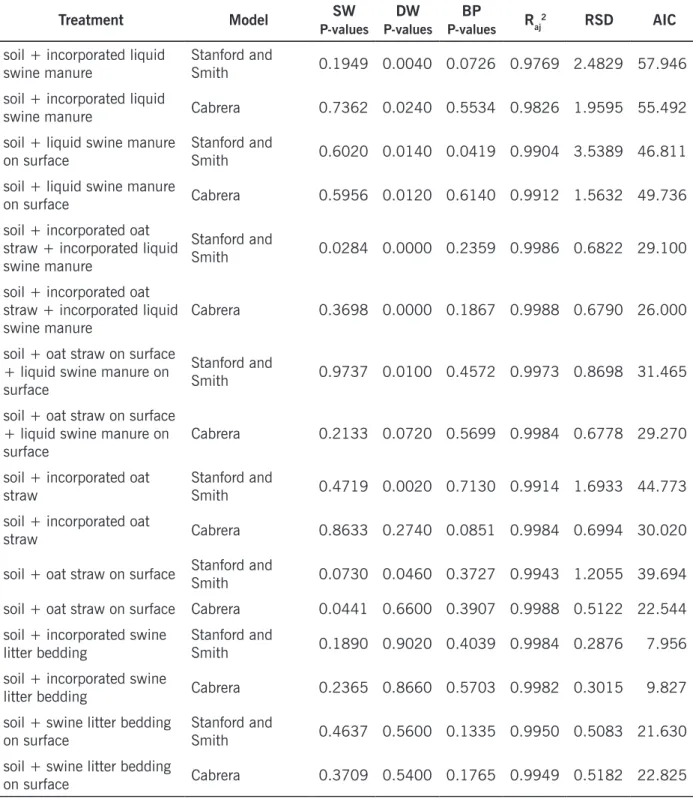
Table 1 shows the results of the analysis of estimated errors with the Stanford & Smith and Cabrera Models fitted to soil carbon mineralization data, based on the Durbin-Watson (DW), Shapiro-Wilk (SW), and Breusch-Pagan (BP) tests. SW test was significant for the OS+LSM-I and OS-S treatments when fitted by the Stanford & Smith Model and Cabrera Model, respectively. Thus, the confidence intervals for the estimates of the parameters of these models were not considered, since it is not possible to state the errors are normally distributed. For the other treatments and models, the assumption of normality was corroborated by the SW test. The BP test showed the hypothesis
QME=SQEn–p R2 = 1 – SSE
of homogeneity of variance were rejected for the LSM-S treatment (p<0.05) when considering the Stanford & Smith Model, therefore this model was not considered to describe this treatment.
Table 1: P-values of Shapiro-Wilk (SW), Durbin-Watson (DW), and Breusch-Pagan (BP) tests applied to
the errors of the Stanford & Smith Model and Cabrera Model, and evaluators of the fitting quality, adjusted coefficient of determination (Raj2), residual standard deviation (RSD), and Akaike Information Criterion (AIC) for
the percentage of mineralized carbon of the eight treatments.
Treatment Model SW P-values DW P-values BP P-values Raj2 RSD AIC
soil + incorporated liquid
swine manure Stanford and Smith 0.1949 0.0040 0.0726 0.9769 2.4829 57.946 soil + incorporated liquid
swine manure Cabrera 0.7362 0.0240 0.5534 0.9826 1.9595 55.492
soil + liquid swine manure
on surface Stanford and Smith 0.6020 0.0140 0.0419 0.9904 3.5389 46.811 soil + liquid swine manure
on surface Cabrera 0.5956 0.0120 0.6140 0.9912 1.5632 49.736
soil + incorporated oat straw + incorporated liquid swine manure
Stanford and
Smith 0.0284 0.0000 0.2359 0.9986 0.6822 29.100
soil + incorporated oat straw + incorporated liquid
swine manure Cabrera 0.3698 0.0000 0.1867 0.9988 0.6790 26.000
soil + oat straw on surface + liquid swine manure on surface
Stanford and
Smith 0.9737 0.0100 0.4572 0.9973 0.8698 31.465
soil + oat straw on surface + liquid swine manure on
surface Cabrera 0.2133 0.0720 0.5699 0.9984 0.6778 29.270
soil + incorporated oat
straw Stanford and Smith 0.4719 0.0020 0.7130 0.9914 1.6933 44.773
soil + incorporated oat
straw Cabrera 0.8633 0.2740 0.0851 0.9984 0.6994 30.020
soil + oat straw on surface Stanford and Smith 0.0730 0.0460 0.3727 0.9943 1.2055 39.694 soil + oat straw on surface Cabrera 0.0441 0.6600 0.3907 0.9988 0.5122 22.544 soil + incorporated swine
litter bedding Stanford and Smith 0.1890 0.9020 0.4039 0.9984 0.2876 7.956 soil + incorporated swine
litter bedding Cabrera 0.2365 0.8660 0.5703 0.9982 0.3015 9.827
soil + swine litter bedding
on surface Stanford and Smith 0.4637 0.5600 0.1335 0.9950 0.5083 21.630 soil + swine litter bedding
on surface Cabrera 0.3709 0.5400 0.1765 0.9949 0.5182 22.825
The DW test showed dependence in the errors for LSM-I, LSM-S, and OS+LSM-I treatments in the two fitted models (TABLE 1), and for OS+LSM-S, OS-I and OS-S treatments in the Stanford & Smith Model, i.e., the hypothesis that the errors are independent was rejected, and this correlation was considered in the study. Thus, fittings with first order autoregressive errors AR(1) were presented to explain the dependence of the residues of these treatments. Hess and Schmidt (1995) found correlation among errors in soil respiration data. Pereira et al. (2005) compared eight nonlinear models to predict the amount of mineralized nitrogen in the soil and found residual dependence for two models and considered the autoregressive errors of order AR(p) in the fitted models.
Raj2 values higher than 0.97 were obtained for the two models fitted to the C mineralization of
the treatments, indicating a good fit to the data. In the fit of five nonlinear models to C mineralization of organic residues, Sleutel et al. (2005) found R2
aj higher than 0.97 and that the models satisfactorily
described the data. The Cabrera model presented lower residual standard deviation, indicating better fit for this model, except for the SLB-I and SLB-S treatments. According to Sousa et al. (2014), the lower the residual standard deviation the better the fitting, since the evaluator is proportional to the sum of the squares of the errors.
The predicted value of mineralized C over time was similar for the two models (FIGURES 1 and 2), and their dynamics were similar when comparing the residues incorporated into the soil (FIGURE 1) with those applied to the soil surface (FIGURE 2). Paula et al. (2013) evaluated organic residues incorporated into the soil and applied on soil surface in a field experiment and they found the incorporated residues presented no abrupt increase in mineralized C, which was found when the residues were applied to the soil surface. This is a similar result to that found in the present study and it can be explained by the fact that the experiment was performed in a laboratory, where the experiment conditions are more controlled and measurements are more precise.
Negative values were estimated for the mineralization rate parameter (k0) in the LSM-S, OS+LSM-I, SLB-I, and SLB-S treatments, and the confidence intervals contained the value zero (TABLE 2). According to Zeviani et al. (2012), this result indicates the underestimation of a zero parametric value, indicating the C mineralization pattern of these residues does not present two mineralizable C fractions. The Stanford & Smith Model was the most appropriate to describe the treatments, except for the LSM-S, which also did not meet the assumption of variance homogeneity for this model. These treatments had substances that undergo exponential mineralization. Therefore, none of the two evaluated models were adequate to describe the LSM-S treatment.
According to Oliveira et al. (2013), the potentially mineralizable carbon (C0) is an important attribute because it can be used to predict the availability of C over time. The SLB-I and SLB-S treatments presented lower percentage of mineralized C than the other treatments, since there was no overlap in the confidence interval of the C0 parameter (TABLE 2) between the SLB and the other treatments. This result corroborates those found by Giacomini et al. (2008) at the end of 80 days of incubation in these treatments; they attributed this result to the difference in the chemical composition of the materials used. The incorporation of the treatments into the soil did not increase the percentage of mineralized C in these materials, since there was overlap between the C0 (TABLE 2) of the treatments with incorporation and that of treatments applied to the soil surface. According to Giacomini et al. (2008), this result indicates the organic residues present a resistant C fraction to decomposition, regardless of the contact of the C of the residues with soil microorganisms.
The potential of mineralized C (C0) (26.8% to 72.87%) and the C mineralization rates (k) (0.0172 to 0.0733 day-1) of the treatments varied, denoting dependence on the type of incubated
for SLB-S and SLB-I. Paula et al. (2013) evaluated five organic residues incorporated and applied to the soil surface in a 360-day field experiment and found different mineralization rates (k) by fitting the Stanford & Smith Model, showing the dependence on the residue and its incorporation into the soil. In addition, Martines et al. (2006) found different k when applying sludge to soils of different textural classes. The comparison of the confidence intervals of C0 for the SLB-I and SLB-S treatments showed no difference between their potentially mineralizable carbon, although the carbon mineralization rate of the SLB-I treatment was higher and, consequently, the half-life. This is also shown in Figure 3 by the confidence interval of the half-life, which presented no intersection.
Table 2. Estimates for the parameters of the Stanford & Smith and Cabrera Models, and half-life (t1/2), and their respective asymptotic confidence intervals of 95% (LL= lower limit and UL = upper limit), in the fitting of percentage of mineralized carbon of the treatments.
Stanford & Smith Cabrera
LL estimates UL LL estimates UL
soil + incorporated liquid swine manure
C0 51.8833 55.8138 59.7443 C1 37.1333 44.4690 51.8587
k 0.0558 0.0733 0.0908 v 4.6077 6.6868 8.7659
ϕ -0.0014 0.5787 1.1588 k0 0.0537 0.1759 0.2981
t1/2 7.6 9.5 12.4 ϕ -0.3658 0.3615 1.0888
soil + liquid swine manure on surface
C0 58.2791 58.8790 59.4780 C1 39.4991 49.7821 60.0651
k 0.0504 0.0543 0.0583 v 6.8866 9.8597 12.8328
ϕ -0.0872 0.5011 1.0895 k0 -0.0343 0.1129 0.2602
t1/2 11.9 12.8 13.8 ϕ -0.3541 0.3930 1.1401
soil + incorporated oat straw
C0 63.3118 72.8781 82.4445 C1 19.4944 23.1886 28.9643
k 0.0158 0.0212 0.0266 v 7.6312 9.8811 13.1490
ϕ 0.1316 0.7641 1.3967 k0 0.3854 0.4651 0.5230
t1/2 26.1 32.7 43.8
soil + oat straw on surface
C0 52.0159 57.0409 62.0658 C1 22.6698 26.5450 32.2808
k 0.0217 0.0265 0.0314 v 9.6029 11.8086 14.8078
ϕ -0.3205 0.6438 1.6081 k0 0.2333 0.3073 0.3629
t1/2 22.1 26.1 32.0
soil + incorporated oat straw + incorporated liquid swine manure
C0 52.9276 55.5267 58.1258 C1 43.6873 70.8529 98.0185
k 0.0333 0.0380 0.0428 v 14.9284 22.7089 30.4894
ϕ 0.0473 0.6658 1.2843 k0 -0.4047 -0.1526 0.0995
t1/2 16.2 18.2 20.8 ϕ -0.0521 0.5801 1.2124
soil + oat straw on surface + liquid swine manure on surface
C0 56.6644 59.3018 61.9392 C1 61.6897 92.4257 174.0935
k 0.0304 0.0340 0.0376 v 21.2645 29.4254 45.8067
ϕ -0.1505 0.5096 1.1697 k0 -0.8545 -0.2961 -0.0181
Stanford & Smith Cabrera
LL estimates UL LL estimates UL
soil + incorporated swine litter bedding
C0 25.7004 26.8000 28.0455 C1 17.5380 29.4998 88.0363
k 0.0226 0.0246 0.0266 v 19.2540 30.2711 62.7230
t1/2 26.1 28.2 30.7 k0 -0.3628 -0.0222 0.0934
soil + swine litter bedding on surface
C0 27.8735 31.0525 35.4300 C1 -943.2921 134.5774 1212.4469
k 0.0141 0.0172 0.0206 v -347.7380 98.1410 482.2150
t1/2 33.7 40.2 49.2 k0 -3.3426 -0.4386 2.4654
Source: Elaborated by the authors (2018).
Figure 1. Models fitted for the percentage of mineralized carbon to the organic residues incorporated into the
soil as a function of the incubation time.
Figure 2. Models fitted for the percentage of mineralized carbon to the organic residues on the soil surface as
a function of the incubation time.
Source: Elaborated by the authors (2018).
Figure 3. Half-life of the potentially mineralizable carbon of organic residues incubated for 80 days, considering
the Stanford & Smith Model. Vertical bars indicate the confidence interval for the half-life.
The half-life of the potentially mineralizable carbon of the organic residues varied, considering the Stanford & Smith Model. This model was more suitable for the OS+LSM-I, SLB-S, and SLB-I treatments, which presented half-life of the potentially mineralizable carbon of 18.2, 28.2 and 40.2 days, respectively (TABLE 2). The higher mineralization of C at the beginning of the incubation is due to the consumption of the easily degradable carbon, leaving less susceptible organic fractions to decomposition in the soil (PULROLNIK, 2009); this dynamic was observed by several authors (ANDRADE et al., 2015; FERNANDES et al., 2011; MANTOVANI et al., 2006).
According to the Akaike Information Criterion (AIC), the LSM-I, OS+LSM-S, OS-I, and OS-S treatments presented the lowest values for the Cabrera Model, which was the most indicated to describe the studied phenomenon. Thus, the LSM-I, OS+LSM-S, OS-I, and OS-S treatments had mineralizable carbon substances with exponential behavior and more resistant substances with constant mineralization. The comparison of the confidence intervals for the easily mineralizable carbon (C1) (TABLE 2) showed intersection for the OS-I and OS-S treatments, indicating no difference between the easily mineralizable carbon of the oat straw incorporated into the soil and that of the oat straw on the soil surface. However, the comparison of the confidence intervals of the parameter k0 showed no intersection in the confidence interval, indicating the more resistant C in the straw is more rapid mineralized when the straw is incorporated into the soil. This result confirms those found by Campos et al. (2011) in a field experiment; they found higher C mineralization rate of oat residues with conventional tillage system than with no tillage system.
Considering the Cabrera Model, the half-life of the easily mineralizable C of the LSM-I, OS+LSM-S, OS-I, and OS-S treatments were 6.6, 29.4, 9.8, and 11.8 days, respectively (TABLE 2).
Conclusions
In general, the mineralization of the carbon of swine manure and oat straw over time was described by the Cabrera and Stanford & Smith nonlinear models.
The Cabrera Model was more suitable to detail the C mineralization in four treatments (soil + incorporated liquid swine manure; soil + oat straw on soil surface + liquid swine manure on soil surface; soil + incorporated oat straw; and soil + oat straw on surface), indicating that these treatments presented substances of mineralizable C with exponential dynamic and more resistant substances with constant mineralization. The half-life of the easily mineralizable C of these treatments were 6.6, 29.4, 9.8, and 11.8 days, respectively.
The Stanford & Smith Model was better to describe the C mineralization of three treatments (soil + incorporated oat straw + incorporated liquid swine manure; swine litter bedding on soil surface; and incorporated swine litter bedding), suggesting these treatments presented substances that are mineralized exponentially. These treatments presented half-life of the easily mineralizable C of 18.2; 28.2, and 40.2 days, respectively.
None of the two evaluated models adequately described the C mineralization of the treatment soil + liquid swine manure applied to the soil surface.
Acknowledgements
The authors thank the Brazilian Coordination for the Improvement of Higher Education Personnel (CAPES) for granting doctoral scholarship to the first author.
Descrição da mineralização do carbono de dejetos de suíno
e palha de aveia no solo por modelos não lineares
Resumo
Uma forma viável para reciclagem dos resíduos de animais em confinamento é no manejo agrícola. As substâncias que compõem o resíduo orgânico altera a dinâmica de decomposição da matéria orgânica no solo. O conhecimento das curvas de mineralização do carbono permite buscar melhorias na qualidade do solo e consequentemente na produtividade das culturas. O Modelo Stanford & Smith é o mais usado para descrever a mineralização de C de resíduos orgânicos no solo. O Modelo Stanford & Smith considera que o resíduo orgânico é composto por substâncias que são mineralizadas exponencialmente. O Modelo Cabrera considera duas frações, uma composta por substâncias que são mineralizadas exponencialmente e outra composta por substâncias mais resistentes que são mineralizadas constantemente. Objetivou-se, neste trabalho, comparar modelos não lineares que descrevem a mineralização do carbono, considerando resíduos na superfície ou incorporados ao solo Os dados analisados correspondem aos resultados de um experimento com palha de aveia, dejetos líquidos de suínos e cama sobreposta de suínos. Foram utilizados os Modelos Stanford & Smith e Cabrera, considerando estrutura de erros autorregressivos AR(1) quando necessário. Os ajustes foram comparados utilizando o critério de informação de Akaike (AIC). O Modelo Cabrera foi mais adequado para descrever a mineralização de carbono em quatro tratamentos (solo + dejetos líquidos incorporado, solo + palha em superfície + dejetos líquidos em superfície, solo + palha incorporada e solo + palha em superfície) e o Modelo Stanford & Smith foi melhor em três tratamentos (solo + palha incorporada + dejetos líquidos incorporado, cama sobreposta em superfície e cama sobreposta incorporada). Nenhum dos modelos descreveu o tratamento solo + dejetos líquidos na superfície.
Palavras-chave: Decomposição. Tempo de meia-vida. Modelo Stanford & Smith. Modelo Cabrera.
Re ferências
ALVES, G. D.; SAMPAIO, E. V. S. B.; SALCEDO, I. H.; SILVA V. M. Mineralization potential of C and N in twenty soils from Pernambuco, Brazil. Revista Brasileira de Ciência do Solo, v. 23, n. 2, p. 245-256, 1999. Disponível em: <http://www.scielo.br/pdf/rbcs/v23n2/08.pdf >. Acesso em: 06 set. 2015. ANDRADE, C. A.; SILVA, L. F. M.; PIRES, A. M. M.; COSCIONE, A. R. Mineralization of carbon and nitrogen in soil after successive applications of sewage sludge. Pesquisa Agropecuária Brasileira, v. 48, n. 5, p. 536-544, 2013. DOI:10.1590/S0100-204X2013000500010. Disponível em: <http:// www.scielo.br/scielo.php?script=sci_arttext&pid=S0100-204X2013000500010&lng=pt&nrm=i so>. Acesso em: 11 fev. 2017.
ANDRADE, C. A.; BIBAR, M. P. S.; COSCIONE, A. R.; PIRES, A. M. M.; SOARES, A. G. Mineralization and effects of poultry litter biochar on soil cation exchange capacity. Pesquisa Agropecuária
Brasileira, v. 50, n. 5, p. 407-416, 2015. DOI:10.1590/S0100-204X2015000500008 Disponível
em: <http://www.scielo.br/scielo.php?pid=S0100-204X2015000500407&script=sci_abstract>. Acesso em: 06 set. 2017.
ANDRADE, L. C.; ANDREAZZA, R.; CAMARGO, F. A. O. Soil microbial activity under wastewater treatment plant sludge doses from an industrial landfill. Ciência Rural, Santa Maria, v. 46, n. 2, p. 267-272, 2016. Disponível em: <http://www.scielo.br/scielo.php?pid=S0103-84782015005040871&script=sci_abstract>. Acesso em: 06 set. 2017.
BARRETO, P. A. B.; RODRIGUES, E. F. G.; RODRIGUES, A. C. G.; BARROS, N. F.; ALVES, B. J. R.; FONSECA, S. Carbon and nitrogen mineralization in soils under an eucalyptus plantation chronosequence. Revista Brasileira de Ciência do Solo, v. 34, n. 3, p. 735-745, 2010. Disponível em: <https://www.researchgate.net/publication/262651835_Carbon_and_nitrogen_mineralization_ in_soils_under_an_eucalyptus_plantation_chronosequence>. Acesso em: 06 set. 2017.
CABRERA, M. L. Modeling the flush of nitrogen mineralization caused by drying and rewetting soils.
Soil Science Society of America Journal, v. 57, n. 1, p. 63-66, 1993.
CAMPOS, B. C.; AMADO, T. J. C.; TORNQUIST, C. G.; NICOLOSO, R. S.; FIORIN, J. E. Long-term C-CO2 emissions and carbon crop residue mineralization in an oxisol under different tillage and crop rotations systems. Revista Brasileira de Ciência do Solo, v. 35, n. 3, p. 819-832, 2011. Disponível em: <http://www.scielo.br/scielo.php?script=sci_arttext&pid=S0100-06832011000300017>. Acesso em: 06 set. 2017.
CARNEIRO, A. P. S.; MUNIZ, J. A.; CARNEIRO, P. L. S.; MALHADO, C. H. M. M.; MARTINS FILHO, R.: SILVA, F. F. Identity of nonlinear models to compare growth curves of the cattle breed Tabapuã. Pesquisa Agropecuária Brasileira, v. 49, n. 1, p. 57-62, 2014. DOI: 10.1590/S0100-204X2014000100008. Disponível em: <https://seer.sct.embrapa.br/index.php/pab/article/ view/18183>. Acesso em: 04 ago. 2017.
COSTA, M. S. S. M.; COSTA, L. A. M.; DECARLI, L. D.; PELÁ, A.; SILVA, C. J.; MATTER, U. F.; OLIBONE, D. Composting of slaughterhouse solid waste. Revista Brasileira de Engenharia Agrícola
e Ambiental, v. 13, n. 1, p. 100-107, 2009. Disponível em: <http://www.scielo.br/scielo.
php?script=sci_abstract&pid=S1415-43662009000100015&lng=en&nrm=1&tlng=en>. Acesso em: 06 set. 2017.
DRAPER, N. R.; SMITH, H. Aplied regression analisys. 3. ed., reprint. New York: J. Wiley, p. 505-565, 2014.
FERNANDES, A. H. B. M. F.; CARDOSO, M. A.; SOUZA, R. A. C.; FERNANDES, F. A.; SOARES, M. T. S.; CRISPIM, S. M. A.; GALVANI, F.; LISITA, F. O. Nitrificação e mineralização de carbono em solos
tratados com dejetos de suínos biodigeridos. Corumbá, MS: Embrapa Pantanal, p. 1-15, 2011.
FERNANDES, T. J.; PEREIRA, A. A.; MUNIZ, J. A.; SAVIAN, T. V. Selection of nonlinear models for the description of the growth curves of coffee fruit. Coffee Science, v. 9, n. 2, p. 207-215, 2014. Disponível em: <http://dx.doi.org/10.25186/cs.v9i2.618>. Acesso em: 5 mar. 2017.
GIACOMINI, S. J.; AITA, C.; MIOLA, E. C. C.; RECOUS, S. Carbon mineralization of straw and pig manure with and without incorporation in soil. Revista Brasileira de Ciência do Solo, v. 32, n. special, p. 2661-2668, 2008. Disponível em: <http://www.scielo.br/scielo.php?script=sci_ arttext&pid=S0100-06832015000501428&lng=en&nrm=iso>. Acesso em: 29 jan. 2017.
HESS, T. F.; SCHMIDT, S. K. Improved procedure for obtaining statistically valid parameter estimates from soil respiration data. Soil Biology and Biochemistry, Elmsford, v. 27, n. 1, p. 1-7, 1995. Disponível em: <https://www.sciencedirect.com/science/article/pii/003807179400166X>. Acesso em: 28 nov. 2016.
MANTOVANI, J. R.; FERREIRA, M. E.; CRUZ, M. C. P.; BARBOSA, J. C.; FREIRIA, A. C. Carbon and nitrogen mineralization in an ultisol fertilized with urban waste compost. Revista Brasileira
de Ciência do Solo, v. 30, n. 4, p. 677-684, 2006. Disponível em: <http://www.scielo.br/scielo.
php?script=sci_arttext&pid=S0100-06832006000400008>. Acesso em: 06 set. 2017.
MARTINES, A. M.; ANDRADE, C. A.; CARDOSO, E. J. B. N. Mineralization of the organic carbon in soils treated with tannery sludges. Pesquisa Agropecuária Brasileira, v. 41, n. 7, p. 1149-1155, 2006. Disponível em: <http://www.scielo.br/scielo.php?script=sci_arttext&pid=S0100-204X2006 000700011&lng=en&nrm=iso>. Acesso em: 28 nov. 2016.
MERCANTE, F. M. Os microorganismos do solo e a dinâmica da matéria orgânica em sistemas de
produção de grãos e pastagem. Dourados, MS: Embrapa Agropecuária Oeste, p. 1-14, 2001.
MOREIRA, F. M. S, SIQUEIRA, J. O. Microbiologia e Bioquímica do Solo. 2. ed. Lavras: Editora da UFLA, p. 1-729, 2006.
MORETTIN, P. A.; TOLOI, C. M. C. Análise de séries temporais. 2. ed. São Paulo: Edgard Blucher, p. 110-119, 2006.
NUNES, D. A. D.; RODRIGUES, E. F. G.; BARRETO, P. A. B.; RODRIGUES, A. C. G.; MONROE, P. H. M. Carbon and nitrogen mineralization in soil of leguminous trees in a degraded pasture in northern Rio de Janeiro, Brazil. Journal of Forest Research, v. 27, n. 1, p. 91-99, 2016. DOI: 10.1007/ s11676-015-0164-3. Disponível em: <https://link.springer.com/article/10.1007/s11676-015-0164-3#citeas>. Acesso em: 06 set. 2017.
OLIVEIRA, W. J.; SILVA, C. A.; MUNIZ, J. A.; SAVIAN, T. V. Nitrogen mineralization in latosols fertilized with organic residues. Revista Brasileira de Ciência do Solo, v. 37, n. 3, p. 715-725, 2013. Disponível em: <http://www.scielo.br/scielo.php?pid=S0100-06832013000300018&script=sci_ abstract>. Acesso em: 06 set. 2017.
PAULA, J. R.; MATOS, A. T.; MATOS, M. P.; PEREIRA, M. S.; ANDRADE, C. A. Carbon and nitrogen mineralization of wastes applied to soil under field conditions. Revista Brasileira de Ciência do Solo, v. 37, n. 6, p. 1729-1741, 2013. Disponível em: <http://www.scielo.br/scielo.php?script=sci_ arttext&pid=S0100-06832013000600029&lng=en&nrm=iso>. Acesso em: 12 nov. 2017. PEREIRA, J. M.; MUNIZ, J. A.; SILVA, C. A. Nonlinear models to predict nitrogen mineralization in an oxisol. Scientia Agricola, v. 62, n. 4, p. 395-400, 2005. Disponível em: <http://www.scielo. br/scielo.php?script=sci_arttext&pid=S0103-90162005000400014&lng=en&nrm=iso>. Acesso em: 06 set. 2017.
PIMENTEL-GOMES, F. Curso de Estatística Experimental. 14. ed. Editora F. Pimentel-Gomes, p. 1-451, 2000.
PINHEIRO, J.; BATES, D.; DEBROY, S.; SARKAR, D. nlme: linear and nonlinear mixed effects models. R package version 3. p. 1-122. 2015. Disponível em: <URL:http://CRAN.R-project.org/ package=nlme>. Acesso em: 10 fev. 2016.
PINTO, M. A.; FABBRIS, C.; BASSO, C. J.; SANTI, A. L.; GIROTTO, E. Swine slurry application and soil management on double-cropped oat/maize. Pesquisa Agropecuária Tropical, v. 44, n. 2, p. 205-212, 2014. Disponível em: <http://www.scielo.br/scielo.php?script=sci_ arttext&pid=S1983-40632014000200002>. Acesso em: 06 set. 2017.
PULROLNIK, K. Transformações do carbono no solo. Planaltina, DF: Embrapa Cerrados, p. 1-36, 2009.
R CORE TEAM. R: a language and environment for statistical computing. R Foundation for Statistical Computing Viena: 2015. Disponível em: http://www.r-project.org.
RIBEIRO, T. D.; MATTOS, R. W. P.; MORAIS, A. R.; MUNIZ, J. A. Description of the growth of Pequi fruits by nonlinear models. Revista Brasileira de Fruticultura, v. 40, n. 4, p. 1-11, 2018. Disponível em: <http://www.scielo.br/scielo.php?script=sci_arttext&pid=S0100-29452018000400705>. Acesso em: 20 dez. 2018.
RIBEIRO, T. D.; SAVIAN, T. V.; FERNANDES, T. J.; MUNIZ, J. A. The use of the nonlinear models in the growth of pears of “Shinseiki” cultivar. Ciência Rural, v. 48, n. 1, p. 1-7, 2018. Disponível em: <http://www.scielo.br/scielo.php?script=sci_arttext&pid=S0103-84782018000100202>. Acesso em: 20 dez. 2018.
SILVA, A. A.; LANA, A. M. Q.; LANA, R. M. Q.; COSTA, A. M. Fertilization with swine waste manure: the influence of chemical characteristics in Brachiaria Decumbens and changes in the soil. Engenharia
Agrícola, v. 35, n. 2, p. 254-265, 2015. DOI:10.1590/1809-4430. Disponível em: <http://www.
scielo.br/scielo.php?script=sci_arttext&pid=S0100-69162015000200254>. Acesso em: 06 set. 2017.
SILVA, B. V. N.; ANDRADE PINTO, L. V.; Potential use of the sewage sludge as organic manuring in covering forestation native arboreal species planted in area degraded by intensive pasturing. Revista
Agrogeoambiental, Pouso Alegre, v. 2, n. 1, p. 50-56, abril, 2010. Disponível em: <http://dx.doi.
org/10.18406/2316-1817v2n12010251>. Acesso em: 18 mar. 2017.
SILVA, E. M.; SILVEIRA, S. C.; RIBEIRO, T. D.; MUNIZ, J. A. Adjustment of the decomposition of sewage sludge and oat straw by nonlinear models. Revista Agrogeoambiental, v. 11, n. 2, 2019. SILVEIRA, S. C; MUNIZ, J. A.; SOUSA, F. A.; CAMPOS, A. T. Non-linear models adjusted to the accumulated production of biogas originating from swine deep bedding. Revista Agrogeoambiental, v. 10, n. 3, p. 91-103, 2018. Disponível em: <https://agrogeoambiental.ifsuldeminas.edu.br/index.php/ Agrogeoambiental/article/view/1168/pdf >. Acesso em: 26 nov. 2018.
SLEUTEL, S.; NEVE, S.; ROIBÁS, M. R. P.; HOFMAN, G. The influence of model type and incubation time on the estimation of stable organic carbon in organic materials. European Journal of Soil
Science, v. 56, n. 4, p. 505-514, 2005. Disponível em: <https://onlinelibrary.wiley.com/doi/
epdf/10.1111/j.1365-2389.2004.00685.x>. Acesso em: 23 nov. 2016.
SOUSA, I. F.; KUNZLE, J. E.; MUNIZ, J. A.; GUIMARÃES, R. M.; SAVIAN, T. V.; MUNIZ, F. R. Fitting nonlinear autoregressive models to describe coffee seed germination. Ciência Rural, v. 44, n. 11, p. 2016-2021, 2014. DOI: 10.1590/0103-8478cr20131341. Disponível em: <http://www.scielo. br/scielo.php?script=sci_arttext&pid=S0103-84782014001102016>. Acesso em: 06 set. 2017. STANFORD, G.; SMITH, S. J. Nitrogen mineralization potentials of soil. Soil Science Society of
America Journal, v. 36, n. 3, p. 465-471, 1972.
ZEVIANI, W. M.; SILVA, C. A.; OLIVEIRA, W. J.; MUNIZ, J. A. Non linear models to potassium release from animals manure in Latosols. Ciência Rural, v. 42, n.10, p. 1789-1796, 2012. Disponível em: <http://www.scielo.br/scielo.php?script=sci_arttext&pid=S0103-84782012001000012&lng=en &nrm=iso>. Acesso em: 23 nov. 2016.
ZHOU, X.; CHEN, C.; LU, S.; RUI, Y.; WU, H.; XU, Z. The short-term cover crops increase soil labile organic carbon in southeastern Australia. Biology and Fertility of Soils, v. 48, n. 2, p. 239-244, 2012. Disponível em: <https://link.springer.com/article/10.1007/s00374-011-0594-9>. Acesso em: 06 set. 2017.
Received: January 22, 2018 Accepted: April 12, 2018