Original article
RBAFSSOCIEDADE BRASILEIRA DE ATIVIDADE FÍSICA E SAÚDE
Brazilian Journal of Physical Activity and Health
RBAFS
Revista Brasileira de Atividade Física & Saúde
SOCIEDADE BRASILEIRA DE ATIVIDADE FÍSICA E SAÚDE
Brazilian Journal of Physical Activity and Health
Rev Bras Ativ Fis Saúde p. 31-42 DOI: http://dx.doi.org/10.12820/2317-1634.2012v18n1p31
1 Doutorando em Educação Física, Programa de Pós-Graduação em Educação Física, UNICAMP, Universidade Estadual de Campinas, SP, Brasil
2 Laboratório de Qualidade de Vida (LaQVida), UTFPR - Universidade Tecnológica Federal do Paraná, Programa de Pós-Graduação em Engenharia de Produção, Campus de Ponta Grossa, PR, Brasil. 3 Programa de Doutorado em Educação Física, UNICAMP - Universidade Estadual de Campinas, Faculdade de Educação Física, Campinas, SP. Brasil.
Physical inactivity and associated factors:
a study with metal-mechanical sector’s
workers of the city of Ponta Grossa – PR
Inatividade física e fatores associados:
um estudo com trabalhadores do setor
metalomecânico do município de Ponta
Grossa – PR
Leandro Martinez Vargas1
Luiz Alberto Pilatti2
Gustavo Luis Gutierrez3 Abstract
The objective was to verify the prevalence and associated factors with low levels of physical ac-tivity of the metal mechanical sector’s workers of the city of Ponta Grossa - Paraná. The sample was calculated considering the metal mechanic sector’s population of the city, being composed by 298 workers (89,9% male). For the evaluation of physical activity we used the international physical activity questionnaire (IPAQ), short version. It was considered physical inactivity who had not met the recommendation of 150 minutes per week. Analyzed demographic and socio-economic variables were gender, age, socio-economic level, marital status, education level, occupation-al class and IMC. Logistic regression was used to examine the association between outcome and independent variables, considering p ≤ 0.05. The prevalence of physical inactivity was 30,2% (CI95%: 20,5-39,9). Results on the adjusted analysis have indicated that workers who perform administrative functions (OR: 2.81, 95%CI: 1.47-5.35) and with age above 30 years (OR: 2.31, 95%CI: 1.27-4.20) were more likely to be physical inactivity. These findings may be useful in planning, implementation guidelines and specific interventions for this population.
Keywords
Physical Activity; Workers; Associated factors. Resumo
O presente estudo teve como objetivo verificar a prevalência e fatores associados a baixos níveis de ativ-idade física em trabalhadores do setor metalomecânico do município de Ponta Grossa/PR. A amostra foi calculada considerando a população total de trabalhadores do setor, sendo composta por 298 tra-balhadores (89,8% do sexo masculino). Para a avaliação da atividade física foi utilizado o questionário internacional de atividade física (IPAQ), versão curta. Foi considerado pouco ativo fisicamente quem não atingia a recomendação de 150 minutos por semana. As variáveis demográficas e socioeconômicas analisadas foram: gênero, idade, renda familiar, situação conjugal, grau de escolaridade, classe ocupa-cional e IMC. A regressão logística binária foi utilizada para examinar as associações entre o desfecho e as variáveis independentes, considerando p≤0,05. Dos trabalhadores, 30,2% (IC95%: 20,5-39,9) foram considerados pouco ativos fisicamente. Os resultados na análise ajustada indicaram que os tra-balhadores o que exercem funções administrativas (RC: 2,81; IC95%: 1,47-5,35) e com idade acima de 30 anos (RC: 2,31; IC95%: 1,27-4,20) apresentaram maiores chances de estarem com baixos níveis de atividade física. Tais achados podem ser úteis no planejamento, implantação e orientações de iniciativas específicas para esta população.
Palavras-chave
INTRODUCTION
Last century was characterized by deep changes in the lifestyle of human beings and by scientific advances in the area of health. Fostered by the industrialization, robotization and computerization of the means of production, man has become a being who depends on new daily practices that have become distant from the primitive way of living of his ancestors. The main result of these new practices is the adoption of a sedentary lifestyle that derives from changes that have occurred in the population dynamics through the process of demographic transition, mod-ernization of transportation facilities, easy obtention of food and the inclusion of machines and computers in daily and labor tasks.
In this context, the prevalence of risk behaviors at the workplace, like seden-tariness, has been gradually increasing every year, mainly in the developed and developing countries. Together with the consumption of alcoholic drinks, tobacco and inadequate diets, these behaviors form the main factors associated with the risk of cardiovascular diseases (the main cause of death in the industrialized coun-tries)1. Within this scenario, the concern about the practice of physical activity
has become a constant target of epidemiological studies in the last decade, as the positive effects of physical activity on the prevention of cardiovascular diseases and on health promotion are well reported in the literature2,3,4,5,6,7.
The workplace is an adequate environment for the development of interven-tions aiming at health promotion and quality of life, in view of the possibility of reaching a large part of the population that devotes countless hours of their lives to labor2. Depending on the management’s competence, the working space will
provide experiences that will be favorable to the improvement in the worker’s health and self-esteem, having a direct influence on his/her good physical, mental, spiritual and social conditions and, consequently, on his/her productive life8,9.
In relation to the productive environment, adults who practice physical activity on a regular basis get sick less frequently and cause fewer losses to their families and to the companies10. Robroek et al.8 investigated the practice of physical
activ-ity related to the health of 10,624 Dutch workers over a period of 12 months and observed that the workers who were physically active were absent less frequently from work due to illness or, when they got sick, they were absent for shorter peri-ods and produced more compared to the sedentary workers.
In the literature, it is possible to observe that special attention has been de-voted to the identification of demographic and socioeconomic determinants associated with the practice of physical activity. Proper and Hildebrandt7 and
Zimmermann et al.10 studied the association between physical activity practice
and socioeconomic position in Dutch industrial workers, and found that those with low level of schooling were more likely to gradually reduce the practice of leisure-time physical activity, while those with high level of schooling (≥ higher education) were more likely to remain active in their leisure time. The authors also showed that groups of lower occupational class, like factory-floor workers of the metal-mechanical sector, agricultural and construction workers, as they perform labor activities that are intense and exhausting, were more likely to be physically active at the workplace, and workers with administrative and executive functions tended to be more active in their leisure time.
The Brazilian literature has many studies about the prevalence of physical ac-tivity and the association with socioeconomic and demographic factors among
industry workers2,9,11,12. However, no population-based study was found in Brazil
focusing on workers of the metal-mechanical industry.
Therefore, this cross-sectional epidemiological study aimed to verify the prev-alence of physical inactivity and associated factors in a representative sample of workers of the metal-mechanical sector.
METHODOLOGY
The study has a cross-sectional character, as it is an instantaneous cut in a tar-get-population of workers of the metal-mechanical sector. We examined, in the members of the sample, the presence or absence of effects on the practice of phys-ical activity. In addition, in view of its nature, objectives and technphys-ical procedure, the study can be characterized as a basic and descriptive survey.
Fourteen metal-mechanical companies in the region of Ponta Grossa, State of Paraná (Southern Brazil), were invited, through an official document, to par-ticipate in the research. In each participating company, the contact between the interviewer and the workers was supervised by a person who scheduled, with the workers, the day and time of their participation in the research. The meetings occurred in an adequate place inside the company, where the interviewer could explain about the research, the inclusion and exclusion criteria, and the way to fill in the questionnaires. Independently of the company’s size, the interviewer asked the person in charge for an amount of 30 subjects, aiming to obtain a satisfactory final sample. At the end of the study, 330 workers had answered the questionnaire.
As for the procedure to approach the workers, the following sequence of in-structions was adopted:
• Presentation of the study’s objectives;
• Provision of explanations about the questionnaire; • Signature of the Informed Consent Document; • Filling in of the questionnaires.
The following exclusion criteria were employed: having been dismissed from the company during data collection, having been absent from work for at least four weeks without interruption or having been away from the daily routines for health reasons. The questionnaires were handed to the volunteers after they had signed the informed consent document.
The information about the level of physical activity was obtained through the international physical activity questionnaire (IPAQ)13, short version. The IPAQ is
an instrument that was validated in Brazilian adults by Pardini et al14. It enables to
measure the amount of physical activity that was practiced in the seven previous days. To obtain each worker’s weekly score of physical activities, the time spent in each activity in which the individual was involved was added, and the time spent in each vigorous physical activity was multiplied by two2,6. The interviewees were
classified according to the score obtained in minutes: a) < 150 minutes – physically inactive; b) ≥ 150 minutes – physically active.
General, anthropometric and socioeconomic-demographic data were gathered by means of the collection of the following information: sex; age in complete years; self-reported weight (kg) and height (meters); marital status (single, married, divorced, widowed), family income (minimum salary); level of schooling (complete years).
In order to observe possible factors of interference in the outcome related to the types of labor tasks, the occupational classes were organized according to similar labor characteristics, as it was observed that the categories of met-al-mechanical workers are submitted to different motor requirements. Thus, the occupational classes were divided into groups, which were classified as: Admin-istrative, Senior Executive, Factory Floor, Commercial and General Services. For the statistical treatment, two categories of workers were considered: Administra-tive/Senior Executive (including the Commercial category) and Factory Floor/ General Services.
Self-rated health was analyzed, as it is considered a valid and relevant in-dicator about the health status of individuals and populations4,15. The response
options to the question “How do you feel about your health?” were: satisfied or dissatisfied4.
The statistical treatment was performed by means of the program SPSS, ver-sion 20. Descriptive and inferential statistics was used. To verify the relationships between the socioeconomic-demographic variables and self-rated health with the dependent variable physical activity, an analysis of independence among variables was performed. The chi-square test with level of significance of 5% was employed, which aims to measure the association among variables, normally distributed on a table two by two, thus enabling to analyze the influence or dependence among the study’s variables16.
At the last stage, in the multivariate analysis, the binary logistic regression was used. This technique enables to estimate the probability of occurrence of a certain event in view of a set of explanatory variables. It is recommended for situations in which the dependent variable is of a dichotomous or binary nature, that is, it accepts only two response possibilities. All the associations that presented p ≤ 0.20 in the analysis of independence among variables were maintained in the re-gression model (Table 2). Through the binary logistic rere-gression, the associations among the variables were measured by Odds Ratio, with a confidence interval of 95% and p ≤ 0.05.
Based on the ethical and methodological concerns discussed in the Regulatory Guidelines and Norms of research involving Human Beings (Resolution 196/96), the research project was submitted to the Ethics Research Committee of
Univer-sidade Estadual de Ponta Grossa (COEP-UEPG), and it was approved under no.
80/2011. All the volunteers were aware that they could give up participating in the research at any time, without the need of presenting justifications to the head researcher and without any personal harm.
RESULTS
Of the fourteen companies that were invited to participate in the research, elev-en accepted and three refused. The reasons for the refusals were: there was no available time within the company’s working hours for the workers to answer the questionnaires or lack of interest in the research’s results. The eleven companies that participated in the study totaled 1,642 employees. Based on this target-pop-ulation, sample size was calculated, defined as 312 workers, so that the “n” had a 5% margin of error, a 95% confidence interval and a prevalence of 50%. Thus, 330 questionnaires were handed to the workers of the eleven companies and of these, 32 were returned with errors (the instructions had not been followed or
the questionnaires were blank). Thus, 298 questionnaires were considered valid, of which 268 were answered by men (33.9 ± 11.6) and 30 by women (31.1 ± 8.5). The response rate was 89.8%.
Most of the investigated workers were males, aged 30 or older, married or living with a partner, with high level of schooling, received two minimum salaries per month or less, presented a normal body mass index (BMI), worked in the occupation of Factory Floor or General Services and were satisfied in relation to their health (Table 1).
Table 1 – Sample distribution in relation to the socioeconomic and demographic characteristics and self-rated health. Ponta Grossa, Paraná, Brazil, 2011.
n % IC (95%)
Sex
Male 268 89.9 (86.4 – 93.4)
Occupational class
Administrative/Senior executive 109 36.6 (27.9 – 45.3) Factory floor/General Services 189 63.4 (56.8 – 70.0) Age group (years)
< 30 137 46.0 (38.0 – 54.0)
≥ 30 161 54.0 (46.6 – 61.4)
Family income (minimum salary)
≤ 2 207 69.5 (63.5 – 75.5)
> 2 91 30.5 (21.4 – 39.6)
Marital status
Married/Lives with partner 187 62.8 (56.1 – 69.5) Single/Lives alone 111 37.2 (28.6 – 45.8) Level of schooling
< 11 years 127 42.6 (34.3 – 50.9)
≥ 11 years 171 57.4 (50.3 – 64.5)
Body Mass Index (kg/m2)
< 25 159 53.4 (46.0 – 60.8)
≥ 25 139 46.6 (38.6 – 54.6)
How he/she feels in relation to his/her health
Satisfied 257 86.2 (82.2 – 90.2)
Dissatisfied 41 13.8 (3.7 – 23.9)
Source: Developed by the authors (2011).
The low proportion of women in the sample (10.1%) can be a result of the nature of the activities of the metal-mechanical sector – predominantly manual -, which ends up attracting male individuals7, who work mainly in factory-floor
functions and in general services (63.4%).
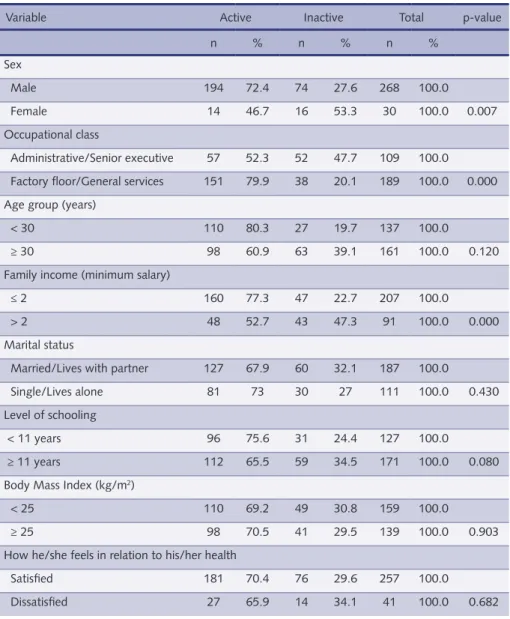
In the independence analysis, it was verified that the variables that are asso-ciated with low levels of physical activity were: sex, occupational class, age group, family income and years of schooling. Marital status, BMI and health perception were not associated with the outcome (p-value < 0.20) (Table 2).
Table 2 – Results of the dependence analysis between level of physical activity and independent variables. Ponta Grossa, Paraná, Brazil, 2011.
Variable Active Inactive Total p-value
n % n % n % Sex Male 194 72.4 74 27.6 268 100.0 Female 14 46.7 16 53.3 30 100.0 0.007 Occupational class Administrative/Senior executive 57 52.3 52 47.7 109 100.0 Factory floor/General services 151 79.9 38 20.1 189 100.0 0.000 Age group (years)
< 30 110 80.3 27 19.7 137 100.0 ≥ 30 98 60.9 63 39.1 161 100.0 0.120 Family income (minimum salary)
≤ 2 160 77.3 47 22.7 207 100.0
> 2 48 52.7 43 47.3 91 100.0 0.000 Marital status
Married/Lives with partner 127 67.9 60 32.1 187 100.0 Single/Lives alone 81 73 30 27 111 100.0 0.430 Level of schooling
< 11 years 96 75.6 31 24.4 127 100.0 ≥ 11 years 112 65.5 59 34.5 171 100.0 0.080 Body Mass Index (kg/m2)
< 25 110 69.2 49 30.8 159 100.0 ≥ 25 98 70.5 41 29.5 139 100.0 0.903 How he/she feels in relation to his/her health
Satisfied 181 70.4 76 29.6 257 100.0 Dissatisfied 27 65.9 14 34.1 41 100.0 0.682 Source: Developed by the authors (2011).
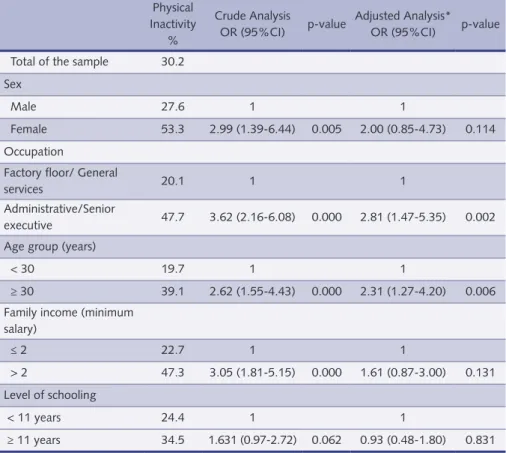
In the crude analysis, the indicators that were associated with the condi-tion of physical inactivity were: sex, occupacondi-tional class, age group and family income. In the adjusted analysis, the results indicated that workers from the oc-cupational class administrative/senior executive (OR: 2.81; 95%CI: 1.47-5.35) and aged 30 years or older (OR: 2.31; 95%IC: 1.27-4.20) had higher odds of presenting low levels of physical activity compared to their peers who work in the functions of factory floor/general services and who are younger than 30 years, respectively. According to the Omnibus test, the model proved to be valid (p<0.001) (Table 3).
Table 3 – Results of the crude and adjusted regression analysis between low level of physical activity and independent variables. Ponta Grossa, Paraná, Brazil, 2011.
Physical Inactivity % Crude Analysis OR (95%CI) p-value Adjusted Analysis* OR (95%CI) p-value
Total of the sample 30.2 Sex
Male 27.6 1 1
Female 53.3 2.99 (1.39-6.44) 0.005 2.00 (0.85-4.73) 0.114 Occupation
Factory floor/ General
services 20.1 1 1
Administrative/Senior
executive 47.7 3.62 (2.16-6.08) 0.000 2.81 (1.47-5.35) 0.002 Age group (years)
< 30 19.7 1 1
≥ 30 39.1 2.62 (1.55-4.43) 0.000 2.31 (1.27-4.20) 0.006 Family income (minimum
salary) ≤ 2 22.7 1 1 > 2 47.3 3.05 (1.81-5.15) 0.000 1.61 (0.87-3.00) 0.131 Level of schooling < 11 years 24.4 1 1 ≥ 11 years 34.5 1.631 (0.97-2.72) 0.062 0.93 (0.48-1.80) 0.831
Source: Developed by the authors (2011).
OR – odds ratio; CI – confidence interval; * - Analysis adjusted for all the variables, independently of the p-value in the crude analysis.
DISCUSSION
The main discovery of this study was the identification of the groups of workers of the metal-mechanical sector of the city of Ponta Grossa who had the highest odds of presenting low levels of physical activity, that is, those who have administrative and commercial jobs, senior executives and individuals older than 30 years. This finding can be useful to the planning of initiatives that aim at specific interventions in re-lation to the practice of physical activities for this popure-lation. In addition, the high response rate of the questionnaires (89.8%) and the standardization of the data col-lection methods are aspects that should be emphasized, as this is the first study with this approach developed with industry workers of the municipality of Ponta Grossa.
The amount of men who work in the metal-mechanical sector, compared to women (89.9% versus 10.1%), had also been identified by Proper and Hildeb-randt7. The authors analyzed the total level of physical activity of a representative
sample of Holland workers and verified that 89% were men. This percentage was justified by the characteristics of the labor activities that were performed inside of companies and industries of the sector, in which intense physical work predomi-nates, with the handling of heavy machinery and manual load transportation.
The prevalence of subjects with low levels of physical activity that was found in the present study (30.2% 95%CI 20.5-39.9) was higher than that of the majority of the studies developed with workers7,12,17. Proper and Hildebrandt7 described
sample of Dutch workers, and found that only 45.3% of the workers had high levels of physical activity and that, on average, the occupational physical activ-ities contributed with a percentage of 30%. On the other hand, in the city of Rio Grande, State of Rio Grande do Sul (Southern Brazil), it was verified that only 19.5% of the temporary dock workers were insufficiently active. In the Vale do Jequitinhonha, State of Minas Gerais (Southeastern Brazil), the prevalence of workers who do not practice 150 minutes of physical activity per week was 17.1%.
Some studies with workers have found higher prevalences of low levels of physical activities compared to the one reported in the present study2,18,19. Silva et
al.2 investigated leisure-time physical activity among industry workers in the State
of Rio Grande do Sul and identified the barriers perceived by the workers that prevent or hinder the practice of physical activity. The prevalence of sedentari-ness was of 45.4%. The most prevalent answers to justify the lack of leisure-time physical activities were tiredness (15.1%), followed by work overload (12.7%) and family obligations (9.2%). Among the sedentary workers, only 21.3% did not have difficulties in practicing leisure-time physical activities. Another study, conducted in the Federal District, found that 56% of the industry workers were physically inactive19. In Australia, this prevalence was of 53%18.
The present study found that the workers who have administrative and mercial functions and senior executives had higher odds of being inactive com-pared to those who work in the factory floor and in general services, which cor-roborates other studies carried out with workers7,18,20. The conditions that favor
the prevalence of physical inactivity among workers have been well discussed by researchers. Tigbe et al.20 have found that the researched individuals who worked
at offices spent 1.5 hours more in sedentary postures than the group of deliverers who performed tasks of transportation of light and heavy loads. The group of de-liverers spent 0.5 hours more standing up and 1.2 hours more walking (a total of 1.5 hours/day). There were also significant differences between the mean number of steps taken per day between the groups (7,700 steps/day more to the deliverers). Duncan et al.18 have found that administrative workers and senior executives were
less likely to practice physical activities and were more likely to perform sedentary tasks during the working hours (OR = 0.36, 95%CI 0.14–0.95) when compared to the factory-floor workers and to those who performed general services. Although the study did not find an association between level of physical activity and occu-pation category, it concluded that administrative workers and senior executives are more likely to practice high levels of sedentary tasks.
The majority of the studies conducted with workers considered only demo-graphic and economic factors and excluded the occupational class as one of the factors that may be associated with lack of physical activity. Even so, it is possible to make associations with the findings of these studies. Sávio et al.19, for example,
after evaluating the level of physical activity in a global way, found that individuals who had completed only the elementary school and whose income was equal to or lower than four minimum salaries were twice as likely to be physically active than individuals whose income was higher than four minimum salaries and who had undergraduate or postgraduate education. In the present study, the variables family income and years of schooling did not present a significant association with the outcome that enabled to establish the odds ratio. However, the majority of the workers of the occupational classes factory floor and general services belong to the categories that have lower incomes and levels of schooling.
On the other hand, studies that evaluated the outcome leisure-time physical activity have shown that level of schooling has been strongly associated with the level of physical activity among workers17,19 and in the population as a whole21,22.
The authors of these studies argue that adults with higher level of schooling have better access to knowledge, besides material conditions, which facilitates the prac-tice and maintenance of healthy habits. Individuals in disadvantaged schooling and socioeconomic conditions tend to live farther from the workplace, in areas that are less safe and which do not have adequate places for the practice of phys-ical activities. Furthermore, the time they spend using the public transportation system, walking or cycling as a way of moving between their homes and the work-place, limits the time they have for leisure activities22.
The lack of association observed in the present study between level of physical activity and years of schooling is attributed to the fact that the first was measured in a global way. For this reason, people with lower level of schooling may practice a higher amount of physical activity during the working hours or while they are moving (on foot or by bicycle) between the workplace and their home20. This
find-ing is confirmed by the results of the other studies that were carried out in Brazil, which show that global physical inactivity is more prevalent in individuals with higher level of schooling17,23.
Being physically active at the workplace, while going to the workplace or in domestic activities does not provide the same amount of health benefits as lei-sure-time activities do. This happens because the biomechanical patterns that characterize these activities are: lifting and manual transportation of light or heavy loads, standing up during a long period of time, repetitive work, working with the hands raised at shoulder height, and working with the spine rotated or flexed, all of these for an indeterminate period of time24. Leisure-time activities, in turn, if
performed with supervision, aim at health promotion and are exercised by means of dynamic or static contractions of major muscle groups, generate an increase in the body’s metabolism and allow time to rest when muscle fatigue occurs25.
The non-association that was found between family income and level of phys-ical activity (p-value = 0.131) is controversial in relation to some studies found in the literature19,26. The economic level of a population is a factor that directly
influences the individual’s practice of leisure-time physical activities. However, in analyses such as the present one, in which physical activity was considered in a global way, this relationship can be inverted27.
Some studies4,28 conducted with the general population have shown that the
prevalence of physical inactivity grows as age increases. In the study by Tigbe et al.20, conducted with workers, such association was found. In the study by Savio et
al.19, on the other hand, the individual’s age was not a factor associated with level
of physical activity. These controversial reports corroborate the literature concern-ing the effect of age on the levels of sedentariness in the population. Hallal et al.6
identified that physical inactivity was positively associated with age. Matsudo et al.29, in turn, observed that there were no significant differences in the proportion
of inactive individuals in distinct age groups at some capital cities. In the present study, the association between workers’ age and level of physical activity can be explained by the occupational and economic class to which the age group young-er than 30 years belongs. This group represents 66.4% of the occupational class factory floor/general services and 85.4% of the low income workers. As it was shown above, occupational class and low economic level can be associated with
high levels of total physical activity, because they include the activities performed at the workplace.
FINAL REMARKS
The results and proposals presented in this study motivate the development of ac-tions for promotion of health and quality of life in companies, and it is necessary to monitor characteristics and behaviors that translate the reality in each context23. In
relation to the workers of the metal-mechanical sector, further studies are recom-mended in order to analyze the level of physical activity in each domain, BMI and other variables connected with health status, like Waist to Hip Ratio and fat per-centage, health status perception and behaviors related to use of tobacco, alcohol and drugs, so that it is possible to learn more about this population and make more efficient and effective investments in actions to promote these workers’ health.
It is possible to conclude that the workers of the metal-mechanical sector of the city of Ponta Grossa, State of Paraná, who are older than 30 years and perform administrative functions, as well as senior executives, were the groups with the highest odds of presenting low levels of physical activities. Therefore, the findings of the present study support recommendations that encourage the companies of the investigated sector to create initiatives to stimulate physical activity practice, both inside the company and during leisure time. There are, in the literature, sev-eral examples of initiatives aiming at the promotion of physical activities out-side and inout-side the working environment, as well as evidences that actions of this type provide a preventive action in relation to morbidity and mortality caused by chronic-degenerative diseases. Moreover, these actions promote weight loss, reduce absenteeism and increase productivity8,11,18,20,24,27.
A practical and simple example of an initiative that has produced results during the last five years is the program Agita Indústria, which develops actions with the aim of raising the workers’ awareness to a change in behavior concerning the adoption of a healthy lifestyle, having the practice of physical activities as flag-ship. The program includes the promotion of sports, recreational, educational and social events, like the distribution of posters in the company with messages that stimulate workers to change to an active lifestyle11.
It is necessary to mention some limitations of the present study, like the cross-sectional design that was used, which does not allow to infer cause-effect relationships between the associated variables and low levels of physical activity. The utilization of the present results in other populations should be consulted with caution, as the investigated sample was selected in a non-probabilistic way and comes from companies that accepted to participate in the research. Another limitation that must be mentioned and which may have masked the associations among other socioeconomic-demographic variables is the utilization of the ques-tionnaire as an instrument to measure physical activity. According to Holtermann et al.24, the evaluation of an outcome through self-reported information may
over-estimate it, mainly when we are dealing with a behavior that is considered desir-able by the individual, like physical activity. The ideal way would be to employ physiological indicators and motion sensors to detect the level of physical activity2.
As for the advantages of the research, the main ones are: first, it is a study based on a representative sample of the working population of a sector that is economically important to the municipality of Ponta Grossa; secondly, it uses a
standardized questionnaire that measures all the domains of physical activity that is the most administered in Brazil30, which enables to compare the results with
those of other studies.
Authors’ contributions
LM Vargas presented the idea for the research, analyzed and interpreted the data, and wrote the final version of the paper. LA Pilatti coordinates the project that enabled the research, coordinated the fieldwork and reviewed the study. G L Gutierrez collaborated with the writing of the manuscript.
REFERENCES
1. Barros MVG, Nahas MV. Comportamentos de risco, auto-avaliação do nível de saúde e per-cepção de estresse entre trabalhadores da indústria. Rev Saúde Pública 2001; 35 (6):554-63.
2. Silva SG, Silva MC, Nahas MV, Viana SL. Variables associates with leisure-time physical in-activity and main barriers to exercise among industrial workers in Southern Brazil. Cad Saúde Pública, Rio de Janeiro; 2011; 27 (2): 249-259.
3. Guedes DP, Gonçalves LAVV. Impacto da prática habitual de atividade física no perfil lipídico de adultos. Arq Bras Endocrinol Metab 2007; 51 (1): 72-78.
4. Baretta E, Baretta M, Peres KG. Nível de atividade física e fatores associados em adultos no Município de Joaçaba, Santa Catarina, Brasil. Cad Saúde Pública 2007; 23 (7): 1595-1602.
5. Louzada JCN, et al. Atividade física e indivíduos desfavorecidos. Saúde Coletiva 2009; 34 (6): 249-254.
6. Hallal PC, et al. Physical activity in adults from two Brazilian areas: similarities and differences. Cad de Saúde Pública 2005; 21 (2): 573-580.
7. Proper KI, Hildebrandt V H. Physical activity among dutch workers: Differences between occupations. Prev Med 2006; 43: 42-45.
8. Robroek, SJW, Van Den Berg TIJ, Plat JF. The role obesity and lifestyle behaviors in a produc-tive workforce. Occu Env Med 2011; 68: 134-139.
9. Felipe-de-Melo, ERT, Silva RCR, Assis AMO, Pinto EJ. Fatores associados à síndrome me-tabólica em trabalhadores administrativos de uma indústria de petróleo. Ciência & Saúde Co-letiva 2011; 16 (8): 3443-3452.
10. Zimmermann E, et al. Predictors of changes in physical activity in a prospective cohort study of the Danish adult population. Scandinavian Journal of Public Health 2008; 36 (3): 235-241.
11. Matsudo VKR, Matsudo SMM, Andrade DR, Oliveira LC, Araújo TL. Promovendo ativi-dade física no ambiente do trabalho. Diagn Tratamento 2007;12 (2): 97-102.
12. Blanco RA. Atividade física e promoção da saúde: um estudo com os Trabalhadores Portuários Avulsos (TPAs) do porto do Rio Grande/RS. 2008. 112 f. Dissertação (Mestrado em Enfer-magem) – Programa de Pós-graduação em Enfermagem, Fundação Universidade Federal do Rio Grande, Rio Grande.
13. International Physical Activity Questionnaire. IPAQ. Background. Disponível em: <https:// sites.google.com/site/theipaq/>. Acesso em: 10 jun. 2012.
14. Pardini R, et al. Validação do questionário internacional de nível de atividade física (IPAQ - versão 6): estudo piloto em adultos jovens brasileiros. Rev Bras Ciên e Mov 2001; 9 (3): 45-51.
15. Barros MB, Zanchetta LM, De Moura EC, Malta DC. Self-rated health and associated fac-tors, Brazil, 2006; Rev Saúde Pública 2009; 43: 27-37.
16. Barros MVG, et al. Análise de dados em saúde. 3ª ed. Londrina: Midiograf; 2012.
17. Bicalho PG, Hallal PC, Gazzineli A. Atividade física e fatores associados em adultos de área rural em Minas Gerais, Brasil. Rev Saúde Pública, 2010; 5 (44): 884-893.
18. Duncan MJ, Badland HM, Mummery WK. Physical activity levels by occupational category in non-metropolitan Australian adults. J Physical Activity and Health 2010; 7: 718-723.
19. Savio KEO, et al. Sexo, renda e escolaridade associados ao nível de atividade física de tra-balhadores. Rev Saúde Pública 2008; 42 (3): 457-63.
20. Tigbe WW, Lean MEJ, Granat MH. A physically active occupation does not result in com-pensatory inactivity during out-of-work hours. Prev Med 2011.
21. Dias-da-Costa JS, Hallal PC, Wells JCK. Epidemiology of leisure-time physical activity: a population-based study in southern Brazil. Cad Saúde Pública 2005; 21: 275-82.
22. Zanchetta LM, Barros MBA, Cesar CLG. Inatividade física e fatores associados em adultos, São Paulo, Brasil. Rev Bras Epidemiol 2010; 13 (13): 387-99.
23. Siqueira FV, Facchini LA, Piccini RX. Atividade física em adultos e idosos residentes em áreas de abrangência de unidades básicas de saúde de municípios das regiões Sul e Nordeste do Bra-sil. Cad Saúde Pública 2008; 24 (1): 39-54.
24. Holtermann A, Hansen JV, Burr H. The health paradox of occupational and leisure-time phys-ical activity. British J Sports Med 2011.
25. Pollock ML, Gaesser GA, Butcher JD. The recommended quantity and quality of exercise for developing and maintaining cardiorespiratory and muscular fitness, and flexibility in healthy adults. Med Sci Sports Exer 1998; 30: 975-91.
26. Hallal PC, Victoria CG, Wells JCK. Physical inactivity: prevalence and associated variables in Brazilian adults. Med Sci Sports Exerc 2003; 38: 1894-900.
27. Seiluri T, et al. Changes in occupational class differences in leisure-time physical activity: a follow up study. IJBNPA 2011; 8: 1-8.
28. Suzuki CS, Moraes AS, Freitas ICM. Atividade física e fatores associados em adultos resi-dentes em Ribeirão preto, SP. Rev Saúde Pública 2011; 45 (2): 311-321.
29. Matsudo SM, Araújo T, Matsudo VR. Questionário Internacional de Atividade Física (IPAQ): estudo de validade e reprodutibilidade no Brasil. Rev Bras Ativ Fis Saúde 2001; 6: 5-18.
30. Hallal PC, Dumith SC, Bastos JP. Evolução da pesquisa epidemiológica em atividade física no Brasil: uma revisão sistemática. Rev Saúde Pública 2007; 41: 453-60
Corresponding author Leandro Martinez Vargas Universidade Estadual de Campinas Rua Afonso Celso, 1799, casa 3,
Uvaranas Ponta Grossa, Parana. Brazil Fone: (55 42) 3301-7143 (55 42) 8825-0246 E-mail: [email protected] Received 01/04/2012 Revised 02/15/2013 Approved 03/04/2013