© Springer International Publishing Switzerland 2015
V. Mařík et al. (Eds.): HoloMAS 2015, LNAI 9266, pp. 108–119, 2015. DOI: 10.1007/978-3-319-22867-9_10
An Approach for Characterizing the Operating Modes
in Dynamic Hybrid Control Architectures
Jose Fernando Jimenez1,2(), Abdelghani Bekrar1, Damien Trentesaux1, and Paulo Leitão3,4
1
LAMIH UMR CNRS 8201, University of Valenciennes and Hainaut Cambrésis UVHC, 59313, Le Mont Houy, France
{abdelghani.bekrar,damien.trentesaux}@univ-valenciennes.fr
2
Pontificia Universidad Javeriana, Bogotá, Colombia
3
Polytechnic Institute of Bragança, Bragança, Portugal [email protected]
4
LIACC - Artificial Intelligence and Computer Science Laboratory, Porto, Portugal
Abstract. Nowadays, manufacturing control system faces the challenge of featuring optimal and reactive mechanisms to respond to volatile environments. In automation domain, hybrid control architectures solve these requirements as it allows coupling predictive/proactive and reactive techniques in manufacturing operations. However, to include dynamic coupling features, it is necessary to characterize the possible new operating modes and visualize its potential when a switching is needed. This paper presents an approach to characterize the operating modes of dynamic hybrid control architectures to support the dynamic switching process. The results, obtained through a simulation in a multi agent platform of flexible manufacturing systems, showed the interest of our approach in terms of including the characterization of operating modes as decisional criteria towards a system switching.
Keywords: Operating modes · Switching · Dynamic · Hybrid control architec-tures · Semi-heterarchical · Reconfiguration
1
Introduction
Recently, researchers have included dynamic features in hybrid architectures [4, 5, 6]. These architectures, named in this paper as dynamic hybrid control architectures (D-HCA), are intended to feature a continuous change of configuration of the control system's architecture. In this switching process, the D-HCA switches from one operat-ing mode to another one by changoperat-ing the structure and/behavior of the system. An
operating mode is defined as a specific parameterization (definition of all parameters) that characterizes the functioning settings of the whole control system. The advantage of switching between operating modes (eg., from a predictive mode to a reactive one) aims to search for a better behavior or to respond to a degraded behavior (distur-bance). In this context, D-HCA contributes to improve the control process in terms of flexibility and adaptability for achieving the optimality and reactivity required.
Despite this, one of the major limitations of D-HCA is the absence of a clear cha-racterization of the operating modes. This lack of chacha-racterization makes it difficult to evaluate the benefits of a new possible operating mode and, consequently, makes it difficult to state if it is worth to switch or not. For these reasons, it is crucial to create a framework that characterize each of the operating modes as it identifies the specific properties that distinguish its unique capability, gives insights about the estimated result when is applied, and provides a comparison reference within different operating modes.
In this particular case, the paper proposes a general approach to characterize the operating modes in dynamic hybrid control architectures. It also aims to assess its characteristics and to validate the use of this assessment as decisional criteria towards a switching event. Our motivation for conceiving a general approach responds to the possibility of applying this approach not only to manufacturing, but also to supply chains or service systems (i.e., hospital) among others. The paper is organized as fol-lows: Section 2 reviews the characteristics of the operating modes of some existing D-HCA. Then, section 3 describes a generic model characterizing the operating modes. Section 4 instantiates the general model into a case study of a flexible manufacturing system. Section 5, describes the experimental case study and illustrate the benefits of using a characterization in the operating modes. And finally, section 6 resumes the conclusions of this study and provides recommendations for further research.
2
Operating Modes in Dynamic Hybrid Control Architectures
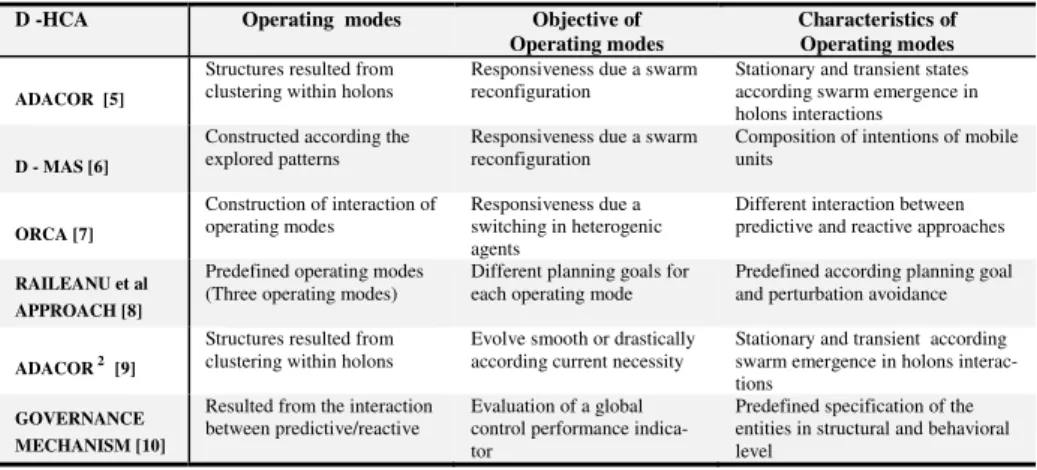
Table 1. Dynamic hybrid control architectures in manufacturing control systems. D -HCA Operating modes Objective of
Operating modes
Characteristics of Operating modes
ADACOR [5]
Structures resulted from clustering within holons
Responsiveness due a swarm reconfiguration
Stationary and transient states according swarm emergence in holons interactions
D - MAS [6]
Constructed according the explored patterns
Responsiveness due a swarm reconfiguration
Composition of intentions of mobile units
ORCA [7]
Construction of interaction of operating modes
Responsiveness due a switching in heterogenic agents
Different interaction between predictive and reactive approaches
RAILEANU et al APPROACH [8]
Predefined operating modes (Three operating modes)
Different planning goals for each operating mode
Predefined according planning goal and perturbation avoidance
ADACOR 2 [9]
Structures resulted from clustering within holons
Evolve smooth or drastically according current necessity
Stationary and transient according swarm emergence in holons interac-tions
GOVERNANCE MECHANISM [10]
Resulted from the interaction between predictive/reactive
Evaluation of a global control performance indica-tor
Predefined specification of the entities in structural and behavioral level
From the literature reviewed, two different cases in the identification of the operat-ing modes appear
On one side, articles [5][6][7][9] use self-organized processes. Despite the fact that these approaches lack to demonstrate a clear identification of the operating mode, they explicitly show a unique distinctiveness that characterizes the corresponding system configuration. In this case, the objective of these operating modes is not an expected result. Instead, the system evolves to a better configuration in order to re-spond the correre-sponding necessities. For the D-HCA, the main advantage of this ap-proach is that it will feature a continuous evolution in terms of allowing a straightfor-ward synchronization. However, as disadvantage, the emergent behavior resulted from the switching process might have difficulties of reaching an optimal configura-tion or operating mode.
On the other side, some researchers use explicit improving search processes [8, 10] that feature well-defined operating modes that describe the structure and behavior characteristics of a D-HCA. These approaches define an unique composition of each operating mode and contribute to remark the distinctiveness between each of them. In this case, it is defined an expected objective in the manufacturing execution asso-ciated to each operating mode. For the D-HCA, the main advantage is that it is known exactly the control configuration before and after the switching. In fact, it can be reached an optimal mode when an effective switching process is considered. Howev-er, it might have difficulties synchronizing online the new operating mode due to the complexity of making changes in the agents' intentions.
3
An Approach to Characterize the Operating Modes Towards
a Switching Process
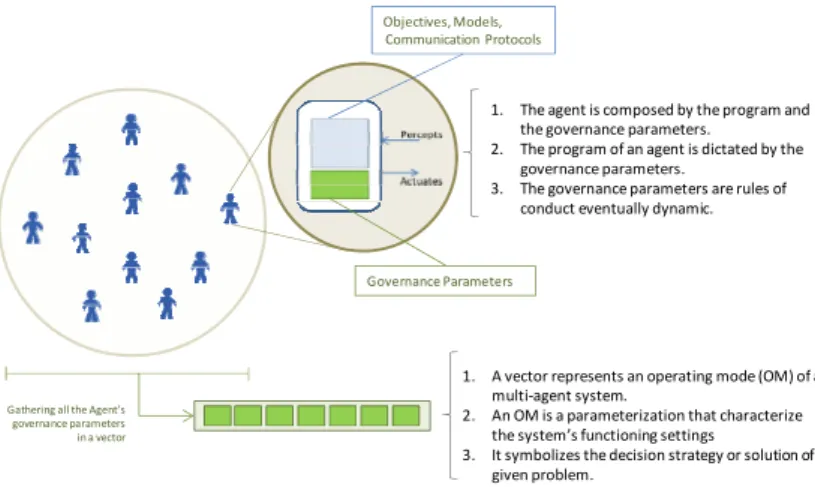
This section describes a general characterization of the operating mode assuming a D-HCA composed of agents or holons. The proposed characterization is based on the vector used in the governance mechanisms framework presented in [10]. According to this approach, an operating mode is illustrated by a vector that describes the specific settings of the architecture in the multi-agent system (See fig. 1). This vector gathers a subset of the parameters (governance parameters).to describe the system functioning. The governance parameters are the rules of conduct that dictate the entity behavioral guidelines. The main advantages of this framework are that the vector is providing a well-defined identification of the different operating modes; it allows to evaluate the entire system functioning towards a switching process; and facilitates the change of configuration when is necessary.
Fig. 1. Characterization of an operating mode: general framework
The characterization of an operating mode is depicted in fig. 1. An agent contains one or a set of governance parameters as an essential component that dictates the agent behavior. These parameters provide the characteristics and state the set of rules that agents apply. Moreover, in a switching process, they might change within different predefined states (finite or infinite) in order to adjust the agent behavior. An operating-mode vector is a representation of functioning settings of the system. This vector gathers all the governance parameters of the agents and symbolizes a decision strategy or solu-tion to a given problem. At the end, the switching process becomes an optimizasolu-tion problem that search over a set of possible operating modes best configuration. However, due the dynamic characteristic of the multi-agent environment, it is considered a dynam-ic optimization problem for its characteristdynam-ics.
For the characterization, it is identified for each operating mode the attributes and a general fitness. The attributes are the characteristics of the operating mode resulted from the arrangement of the vector. For instance, the values of certain parameter or
Objectives, Models, Communication Protocols
Governance Parameters
Gathering all the Agent’s governance parameters in a vector
1. The agent is composed by the program and the governance parameters.
2. The program of an agent is dictated by the governance parameters.
3. The governance parameters are rules of conduct eventually dynamic.
1. A vector represents an operating mode (OM) of a multi-agent system.
2. An OM is a parameterization that characterize the system’s functioning settings
the co-relation of two or more parameters are examples of this attributes. The general fitness is a unique characterization function that evaluates the quality of the operating mode. This general fitness is calculated from the attributes of the operating mode and the system state. At the end, the general fitness is the decisional criteria in a switching process.
An instantiation of this general framework on a specific flexible manufacturing system is proposed in the next section.
4
Operating Modes in D-HCA of a Flexible Manufacturing
System
In this section, a D-HCA of a specific flexible manufacturing system is modeled based on the multi-agent paradigm. At first, it is introduced the flexible manufactur-ing system for locate the reader in this specific manufacturmanufactur-ing problem. Then, it is presented the corresponding control system architecture (D-HCA) based on the go-vernance mechanism framework [10]. Finally, it is defined the characterization of the operating modes towards a switching process.
4.1 The Case of a Flexible Manufacturing System
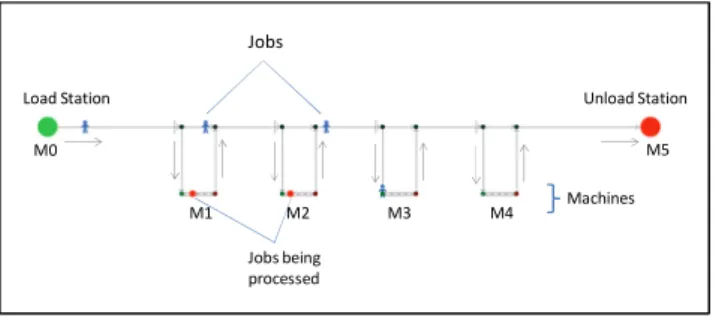
Manufacturing System: A flexible manufacturing system (FMS) corresponds to an automated production facility where production resources are linked using a transpor-tation network and can process redundant operations. The considered case study here is a simplified model of some existing FMS system, typically, automated gear box manufacturing systems. It consists in an uni-directional manufacturing cell without recirculation (fig. 2). Jobs are released into the cell in a load station M0 into the cell
main conveyor. The main conveyor is interconnected with four workstations with one machine each. Then, depending on the intentions of each job, each job enters to the correspondent machine to be processed. The operations to be performed by the jobs are loading (OL), process operations from 1 to 4 (O1, O2, O3, O4) and unloading (OU).
At the end, the jobs are removed at a unload station (M5) when they had been
processed. The shop floor has full flexibility as it features redundant machines (M1,
M2, M3, and M4) capable to perform all possible operations (O1, O2, O3 and O4).
Op-eration OL and OU are performed by the load and unload stations, respectively.
Jobs
Jobs being processed
M1 M2 M3 M4
M0 M5
Load Station Unload Station
Machines
Fig. 2. Flexible manufacturing system
Case Study Scenario: The case study is composed of a data set of 8 jobs (501 to 508). Each job has the same number of operations as OL, O1, O2, O3, O4 and OU. The
transportation times and processing times are also fixed (see table 1 and 2). The re-lease of the products is done with a difference of 3 time units. The production order is measured by the total makespan from the time the first job is loaded until the last job starts to be unloaded.
Table 2. Transportation times between machines in time units.
Table 3. Operation's processing times in time units.
M0 M1 M2 M3 M4 M5
M0 5 7.5 10 12.5
M1 5 7.5 10 12.5
M2 5 7.5 10
M3 5 7.5
M4 5
All machines Machine 1 after perturbation
OL 0.1 0.1
O1 5.0 7.5
O2 4.0 6.0
O3 7.0 10.5
O4 6.0 9.0
OU 0.1 0.1
4.2 Controlling System Architecture and Governance Mechanism Entity
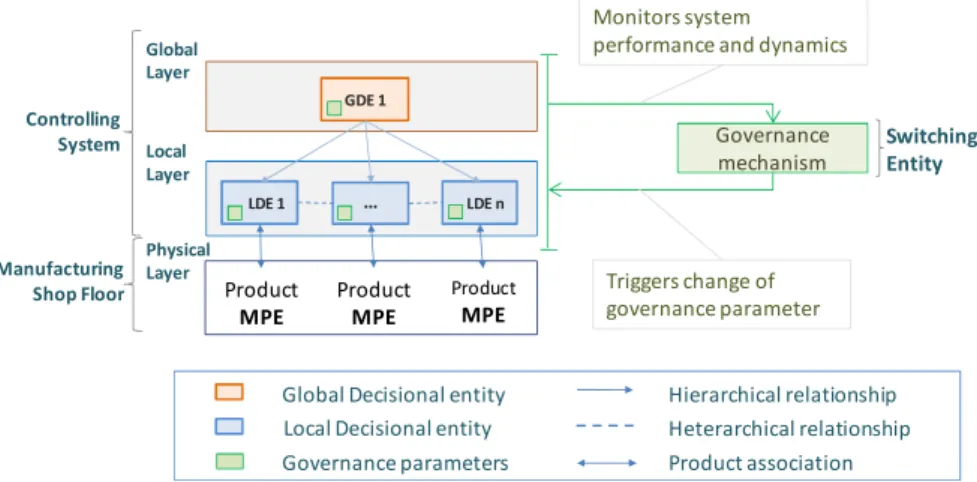
The proposed D-HCA is divided into a controlling system and a governance mechan-ism entity. While the controlling system composes the manufacturing system, the governance mechanism entity monitors and changes the mode (here, functioning set-tings) of the controlling system.
Global Decisional entity Local Decisional entity
Hierarchical relationship
Heterarchical relationship
Product association Governance parameters
LDE 1
GDE 1
Global Layer
Local Layer
Physical Layer
Product
MPE
LDE n
Product
MPE
…
Product
MPE
Controlling System
Manufacturing Shop Floor
Governance mechanism Monitors system performance and dynamics
Triggers change of governance parameter
Switching Entity
dividing the architecture in two control layers respond to the allocation of predictive and reactive techniques featured in the D-HCA. Consequently, in this approach, it is allocated the predictive technique to the global layer, while the reactive technique is allocated to the local layer.
Fig. 3. D-HCA with governance mechanism entity
Governance Mechanism Entity: The governance mechanism entity is a switching mechanism responsible of the changing of the governance parameters of GDE and LDE agents. In fact, it is a control close-loop that starts with the monitoring of per-formance of the controlling system, continues with switching process for enhancing the system performance and it triggers finally a change in the system functioning settings.
Agent Governance Parameters: The governance parameters in the decisional enti-ties (GDE and LDE) are defining the functioning of the predictive and reactive deci-sion making technique. Considering that the GDE host the predictive technique, the governance parameters of the GDE could be the role of the global entity, the global searched objective, the influence within the environment or even the decision-making technique (mathematical programming or genetic algorithm), among others. On the LDE side, the governance parameters might be the roles of the local entity, the action rules and the level of communication, among many others. In this paper, the gover-nance parameters in GDE and LDE are the roles within the manufacturing environ-ment for each decisional point (Release, machine and operation sequence). On one side, the GDE features a coercive or permissive role as the coercive role imposes the global intention to the local intentions, while the permissive ignores global intentions and leaves the intention to local autonomy. On the other side, each LDE has only a
C
GDE 1
Governance Parameters
P P S S S S
…
S S S SLDE 1
Governance Parameters
LDE …
Governance Parameters
LDE 8
Governance Parameters
C = Coercive P = Permissive S = Submissive Release
Sequence Machine Sequence
Operation Sequence
C P P
Operation mode simplified representation :
Vector of 27 elements
Agent Objective: The objective of the decisional entities is defining the searched goal of each agent. The GDE is responsible for the global completion time perfor-mance (makespan), while the LDE are responsible for the making of its operations by the machines. The machines in this case are static and not controllable resources that are giving a service to LDE.
4.3 Operating Modes and Its Characterization
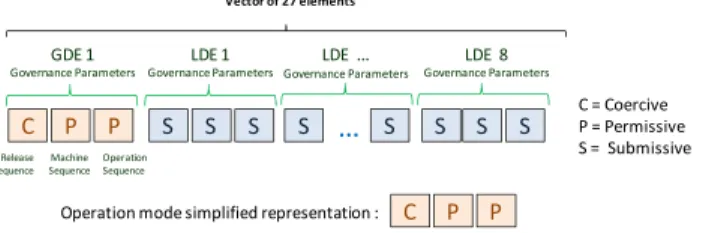
Operating Mode Definition: The vector that represents the operating mode is mod-eled as the combination of the global and local roles (see fig. 4). The operating mode in this study case is a vector of 27 elements: Three elements representing the gover-nance parameters of the GDE, and other 24 elements representing the govergover-nance parameters of the 8 LDE’s created. For the first three elements, these are the GDE role concerning the release, machine and operation sequence’s decisions, respectively. Its values are coercive or permissive as it impose or neglect the product LDE intentions. For the next 24 elements, these are the LDE role for each LDE entity con-cerning also the release, machine and operation sequence’s decisions. Its value is submissive as they respond depending the interrelation with the GDE entity. But, considering that the last 24 elements do not have any variability, the operating mode is shortened to just to the 3 first elements. For each element will be used the letter C for a coercive role, the letter P for permissive role and the letter S for submissive. Consequently, with the simplified representation of the operating mode and the letter codification, the operating modes resulted from the scenario are the following: CCC, CCP, CPC, CPP, PCC, PCP, PPC and PPP.
Fig. 4. Composition of the operating-mode's vector
Operating Mode Fitness: The fitness of the operating mode is used to summarize the behavior of the operating mode at a specific time of the manufacturing execution. Thereby, it is calculated from the operating-modes' attributes and current time of cal-culation. In this case, a shop-floor simulation based in a D-HCA is as a fitness func-tion for each operating mode. The simulafunc-tion calculates the makespan (output) of the manufacturing scenario according the attributes of the operating mode (input 1) and the current time (input 2). In the simulation, an emulation of the shop-floor is made controlled by a GDE and 8 LDEs. The GDE is modeled in Java with a MILP predic-tive technique that minimizes the makespan as the benchmark proposed in reference [11]. It aims to minimize the makespan of the data set. Also, eight LDEs are confi-gured in an agent-based programming language called Netlogo [12] with a potential fields approach as a reactive technique [13]. They aim to minimize the shortest path and the estimated own completion time in the next resource intention. At the end, each time that a switching is needed, the operating-mode’s fitness is calculated per each operating mode for giving its unique characteristic.
4.4 Dynamic Situation in the Case Study Scenario
In this case study, it is analyzed the use of different modes in the manufacturing sys-tem towards a disruption event. For this, the operating-mode vector is established in a fully coercive role strategy (CCC as Coercive, coercive, coercive) for starting execu-tion. During a execution, a disruption occurs increasing the processing times in 50% of the machine 1. The system experiences degradation, as the job that passes over machine 1 increases its own completion time. After this disruption, the switching process changes the operating mode according a selection made according to the op-erating mode fitness.
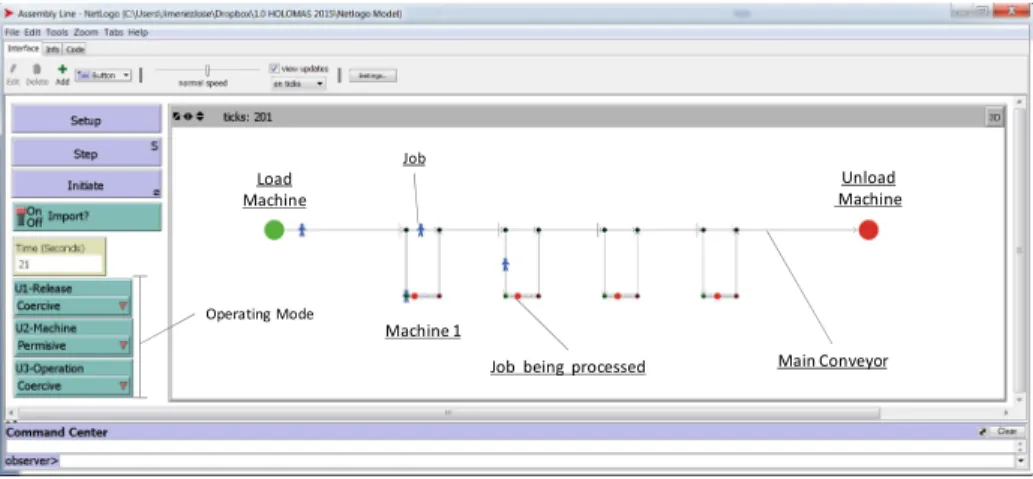
Fig. 5. NetLogo emulation of a FMS settled to a CPC Operating mode
Job
Job being processed Operating Mode
Load Machine
Main Conveyor Unload Machine
65 75 85 95 105 115 125
0 10 20 30 40 50 60 70 80 CCC CCD CPC CPP PCC PCP PPC PPP
Permissive Strategy No Perturbation (Part A)
Coercive Strategy No Perturbation (Part A)
Makespan
Time of perturbation Makespan = 83
Makespan = 70
5
Experiments and Results
In this section, it is presented the experiments performed in a simulation of the manu-facturing case. The main goal of this experiment is to analyze the characteristics of the operating modes and to evaluate the possibility of using this information as crite-ria to activate the switching. For the emulation, the proposed D-HCA with operating modes is programmed in NetLogo (See fig. 5).
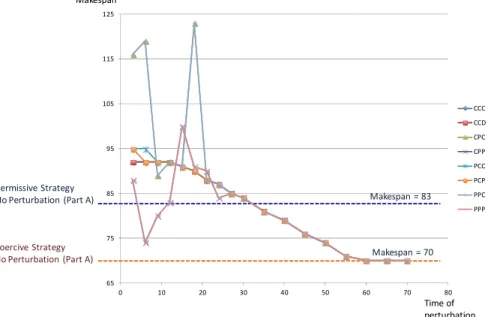
The setup of the experiments is divided in two parts. In part A, it is performed the simulation of the case study scenario without perturbations (not switching considered). This part simulates the extreme operating modes as that represent fully centralized and fully distributed architectures (CCC and PPP) throughout the whole execution. The purpose of this test is to demonstrate that the disruption is in fact de-grading the execution performance. In part B, the dynamic situation of the case study scenario is considered. At first, it is settled different times of disruptions. At each, it is calculated the fitness of each operating mode according the operating-mode's attributes and current time. The purpose of this test is three folded. The experiment aims to demonstrate that there is a variability of the results of each operating mode according the characteristics of the settings and current time. The graph for the results plots the time of the perturbation versus the makespan of the data set after the disrup-tion. To set lower bound and reference bound, one line without a slope is plotted for the coercive and permissive strategy held in part A of the experiment. The scatter dots in the graph show the makespan of the operating modes at the moment of each settled perturbation.
In general terms, Fig. 6 shows the variation of fitness with the time, as well the de-creasing of the makespan as the perturbation is closer to the execution end. It can be seen 3 different conclusion from the experiments performed.
At first, these experiments are a confirmation of the benefits of the fully centralized and fully distributed operating modes in control systems. For the fully centralized mode, when it is compared the total makespan without perturbation, the predictive technique accomplish the best result for the data set (70 in time units). However, when a perturbation occurs, the degradation of the makespan reaches a degradation of almost 30% in average from the initial predictive calculation. On the contrary, the fully distributed mode reaches a good performance when the disruption occurs (83 time units). In this case, the distributed strategy is better for the first half of the execu-tion. However, in the second half, the predictive technique lift the performance even there is disruption event.
A second results, it can be seen that the switching is sensitive as it increase the time of the disruption. In this case, when the perturbation is near the beginning, the makespan is highly degraded from the lower bound. Nonetheless, while the per-turbation happen closer to the execution ending, the makespan does not degrades much and even it reaches the same value as the lower bound. This trend is explained as at the beginning there still many decision making to perform in the release, ma-chine and operation sequence. On the contrary, it get gradually closer to the lower bound as the majority of decision had been made and the system is unable to change much even it is a different setting. At the end, while the execution takes place, the flexibility of the system decreases and it become a more rigid execution.
As a final remark, it is confirmed from the results that there is variability between the operating modes. When the system features flexibility in decision making, the operating modes perform differently according its own attributes. At the end, this variability validates that a characterization of the operating modes is important in order to evaluate the strategy towards a switching process. Also, it suggests that the switching process is an optimization problem whereas it is needed to search the optimal operating mode.
6
Conclusions
References
1. Gunasekaran, A., Ngai, E.W.: The future of operations management: an outlook and analy-sis. International Journal of Production Economics 135(2), 687–701 (2012)
2. Trentesaux, D.: Distributed control of production systems. Engineering Applications of Artificial Intelligence 22(7), 971–978 (2009)
3. Thomas, A., El Haouzi, H., Klein, T., Belmokhtar, S., Herrera, C.: Architecture de systèmes contrôlés par le produit pour un environnement de juste à temps. Journal Européen Des Systèmes Automatisés 43, 513–535 (2009)
4. Van Brussel, H., Wyns, J., Valckenaers, P., Bongaerts, L., Peeters, P.: Reference architec-ture for holonic manufacturing systems: PROSA. Computers in Industry 37(3), 255–274 (1998)
5. Leitão, P., Restivo, F.: ADACOR: A holonic architecture for agile and adaptive manufac-turing control. Computers in Industry 57(2), 121–130 (2006)
6. Holvoet, T., Weyns, D., Valckenaers, P.: Patterns of delegate MAS. In: Third IEEE Inter-national Conference on Self-Adaptive and Self-Organizing Systems, SASO 2009, pp. 1–9. IEEE, September 2009
7. Pach, C., Berger, T., Bonte, T., Trentesaux, D.: ORCA-FMS: a dynamic architecture for the optimized and reactive control of flexible manufacturing scheduling. Computers in In-dustry 65(4), 706–720 (2014)
8. Raileanu, S., Parlea, M., Borangiu, T., Stocklosa, O.: A JADE environment for product driven automation of holonic manufacturing. In: Borangiu, T., Thomas, A., Trentesaux, D. (eds.) Service Orientation in Holonic and Multi-Agent Manufacturing Control. SCI, vol. 402, pp. 265–277. Springer, Heidelberg (2012)
9. Barbosa, J.: Self-organized and evolvable holonic architecture for manufacturing control, Ph.D dissertation. Univ. of Valenciennes (UVHC), France (2015)
10. Jimenez, J.F., Bekrar, A., Trentesaux, D., Zambrano-Rey G., Leitão, P.: Governance me-chanism in control architectures for flexible manufacturing systems. In: 15th Symposium Information Control Problems in Manufacturing INCOM. (2015) (accepted)
11. Trentesaux, D., Pach, C., Bekrar, A., Sallez, Y., Berger, T., Bonte, T., Leitão, P., Barbosa, J.: Benchmarking flexible job-shop scheduling and control systems. Control Engineering Practice 21(9), 1204–1225 (2013)
12. Tisue, S., Wilensky, U.: Netlogo: A simple environment for modeling complexity. In: International Conference on Complex Systems, pp. 16–21, May 2004
13. Zbib, N., Pach, C., Sallez, Y., Trentesaux, D.: Heterarchical production control in manu-facturing systems using the potential fields concept. Journal of Intelligent Manumanu-facturing