An Extensible Framework for Smart
Environment Simulations for IoT
Renato Sampaio de Abreu
D
ISSERTATIONMestrado Integrado em Engenharia Informática e Computação Supervisor: Hugo Sereno Ferreira
Co-Supervisor: André Restivo
Simulations for IoT
Renato Sampaio de Abreu
Mestrado Integrado em Engenharia Informática e Computação
Approved in oral examination by the committee:
Chair: Filipe Alexandre Pais de Figueiredo CorreiaExternal Examiner: Ângelo Manuel Rego e Silva Martins Supervisor: Hugo José Sereno Lopes Ferreira
The Internet of Things (IoT), refers to a paradigm, based on the concept of a pervasive presence around us of a variety of things or objects. The IoT can be applied in several aspects of our everyday life, enabling the creation of an intricate system of connected devices, which make our environment smarter, more measurable, manageable, and user-friendly. Nowadays, a plethora of commercially available IoT devices are pervasively used for home automation by non-tech savvy users, however, to achieve a connected and interactive environment, the design of a smart home is (a) hard to set up, (b) error-prone and (c) expensive.
Simulation tools provide the capability to overcome challenges faced by projects that envision the creation of a smart home environment. The inherent flexibility provides users the possibility to iteratively validate and test an endless set of modeling scenarios similar to real life environments, abstracting away physical challenges. While on the other hand, simulators have the potential to provide researchers with rich datasets for the testing of novel data analysis approaches, particularly at the early stages of development.
Simulators have evolved mainly in two directions: model-based and interactive approaches. Model-based approaches resort to the modeling of the simulation context, such as agents, activities, and processes, and as a result, the correctness of the simulation depends on the accuracy of the underlying activity model. Interactive based approaches provide an interface for the users to control and capture the context in real time, which consequently increases the granularity detail of the simulation context but in general, the overall process is a cumbersome task for the users.
Researchers and homeowners alike need a platform to experiment, test, and validate smart environments, whether with the purpose to generate reliable datasets or analyze the design of their smart houses. Although in recent years several attempts have been made, none of them is considered a comprehensive solution or was widely adopted. In general, the tools fail to leverage the advantages of both approaches and, at the same time, provide a flexible and extensible platform for the configuration of smart environments, with seamless integration between the surrounding context, the devices behavior, and agents interaction.
This project aims to pave the way for the development of realistic simulators capable of providing an experimental environment for users to test and analyze their smart homes, abstracting the technical details of implementing and managing an IoT system. The simulator provides the configuration of the domain problem as the users deem fit, without imposing a high number of constraints or wide the gap between the simulated scenario context and the real one.
The simulator integrates a (1) flexible device configuration, (2) extensive scenario, and context customization, (3) interactiveness and data generation, (4) simulation of physical properties and (5) straightforward agent modeling — the set of features collectively distinguish the simulator as a tool with a broad application range with the capability to design and experiment a wide variety of virtual scenarios.
A Internet das Coisas (IoT) refere-se a um paradigma, baseado na presença pervasiva de dispositivos. A IoT é aplicada a vários aspetos do nosso quotidiano, permitindo a criação de um sistema de dispositivos interligados, que tornam o ambiente adjacente mais inteligente e administrável. Hoje em dia, uma grande quantidade de dispositivos IoT são utilizados na criação de casas inteligentes e inerente automação. Contudo, o design de uma casa inteligente é (a) difícil de configurar, (b) propenso a erros e (c) caro.
As ferramentas de simulação tem a capacidade de ultrapassar os desafios encontrados em projetos que visam o design e criação de um casa inteligente. A flexibilidade destas ferramentas fornece aos utilizadores a possibilidade de validar iterativamente e testar um conjunto interminável de cenários de modelação semelhantes a contextos da vida real.
Ao longo dos anos, os simuladores aplicados a casas inteligentes evoluíram principalmente em duas direções: abordagens baseadas em modelação e abordagens interativas. Abordagens baseadas em modelos recorrem à modelação do contexto, tal como os agentes, atividades e processos, e por conseguinte, a qualidade da simulação está diretamente relacionada com o modelo desenvolvido. Abordagens interativas incorporam uma interface para os utilizadores controlarem e capturarem o contexto em tempo real, o que aumenta a granularidade e qualidade do contexto de simulação, contudo, o processo é moroso.
A criação de um ambiente inteligente é facilitada com o uso de uma plataforma para experi-mentar, testar e validar os respetivos contextos e o design da casa. Embora nos últimos anos várias tentativas tenham sido feitas, nenhuma ferramenta é considerada uma solução abrangente. Em geral, as ferramentas não incorporam as vantagens de ambas as abordagens, fornecendo ao mesmo tempo uma plataforma flexível e extensível para a configuração de casas virtuais inteligentes, com integração consistente entre o contexto envolvemente, o comportamento dos dispositivos e a interação dos agentes.
Este projeto apresenta-se como uma ferramenta de simulação com a capacidade de representar o contexto de casas virtuais, abstraindo os detalhes técnicos de implementação e manutenção de um sistema IoT. O simulador permite a configuração do domínio e contexto conforme os requerimentos do utilizador, sem impor demasiadas restrições de modelação ou aumentar as divergências entre o contexto do cenário simulado e o real.
O simulador integra as seguintes funcionalidades: (1) configuração de dispositivos flexível, (2) criação de cenários extensível, (3) interatividade e geração de dados, (4) simulação de propriedades físicas e (5) modelação do comportamento de agentes - este conjunto de funcionalidades distingue o simulador como uma ferramenta com uma vasta aplicação que permite criar e experimentar uma grande variedade de cenários virtuais.
I would first like to thank my thesis advisors Hugo Sereno, and André Restivo of the Faculdade de Engenharia da Universidade do Porto. Whenever a question arose, or I found myself in a trouble spot regarding the research and project development, they consistently steered me in the right direction.
Finally, I must express my very profound gratitude to my family for providing me with unfailing support and continuous encouragement throughout my years of study and through the process of researching and writing this thesis. This accomplishment would not have been possible without them. Thank you.
1 Introduction 1 1.1 Context . . . 1 1.2 Motivation . . . 2 1.3 Problem Definition . . . 2 1.4 Goals . . . 3 1.5 Dissertation Structure . . . 4 2 Literature Review 5 2.1 Internet of Things . . . 5 2.1.1 Home Automation . . . 6
2.1.2 Cloud & Fog Computing . . . 6
2.2 Management of IoT Systems . . . 8
2.2.1 Visual Programming Platforms . . . 9
2.2.2 Chatbots . . . 12
2.3 Simulation of Smart Home Environments . . . 12
2.3.1 Model-Based Approach . . . 15 2.3.2 Interactive-Based Approach . . . 17 2.4 Conclusions . . . 19 3 Problem Statement 23 3.1 Existing Problems . . . 23 3.2 Proposed Solution . . . 24 3.3 Assumptions . . . 24 3.4 Desiderata . . . 25
3.4.1 Easy end-user device behavior configuration . . . 26
3.4.2 Flexible scenario customization . . . 26
3.4.3 Intuitive visualization and data generation . . . 27
3.4.4 Physical properties simulation . . . 27
3.4.5 Easy agent behavior and activities configuration . . . 27
3.5 Challenges . . . 27 3.6 Evaluation . . . 28 3.7 Summary . . . 28 4 Proposed Solution 29 4.1 Architecture . . . 29 4.2 Component Overview . . . 32 4.2.1 Things . . . 33 4.2.2 Rules Engine . . . 34
4.2.3 Agents . . . 36
4.2.4 Activities . . . 38
4.2.5 Virtual Environment . . . 41
4.2.6 Simulator . . . 45
4.3 How To Use the Simulator . . . 47
4.4 Conclusions . . . 48
5 Evaluation 49 5.1 Use Cases . . . 49
5.1.1 Use Case 1: configurable and extendable device behavior . . . 49
5.1.2 Use Case 2: complex device behavior and activity recognition . . . 50
5.1.3 Use Case 3: environment with simulation of physical properties . . . 52
5.1.4 Use Case 4: agent dynamic behavior . . . 52
5.1.5 Use Case 5: interactive simulation and data generation . . . 53
5.1.6 Use Case 6: dynamic layout . . . 55
5.1.7 Use Case 7: simulation time configuration . . . 56
5.2 Conclusions . . . 56 6 Conclusions 59 6.1 Challenges . . . 59 6.2 Contributions . . . 60 6.3 Conclusions . . . 61 6.4 Future Work . . . 61 References 63 A Simulation JSON Representations 69 A.1 Things . . . 69
A.2 Rules . . . 70
A.3 Agents . . . 72
A.4 Activities . . . 74
A.5 Physical Properties . . . 74
A.6 Entities . . . 76
B Simulation Update Process 79 C Simulation Scenarios JSON Representation 81 C.1 Scenario 1 . . . 81
C.2 Scenario 2 . . . 87
2.1 Fog architecture . . . 8
2.2 Home Assistant UI . . . 10
2.3 Flow-based GUI . . . 10
2.4 Node-RED flow-based programming . . . 11
2.5 UJAml Smart Lab . . . 14
2.6 CASS Simulator . . . 16 2.7 OpenSHS Simulator . . . 19 3.1 Project forces . . . 26 4.1 Things Management . . . 30 4.2 Simulation Settings . . . 30 4.3 Simulator Architecture . . . 32
4.4 Rule Engine process . . . 35
4.5 Activities Flow Diagram . . . 40
4.6 Simulation View . . . 41
4.7 2D Grid Neighborhoods . . . 42
5.1 Motion sensor and temperature sensor synchronization . . . 50
5.2 Device behavior within the virtual home . . . 51
5.3 Outcome of a rule with multi triggers and multi effects related to the wind speed . 53 5.4 Simulation context with multiple inhabitants . . . 54
5.5 Overlay and tooltip helper . . . 55
2.1 IoT and Cloud Computing comparison . . . 7
ADL Activiy of Daily Living AI Artificial Intelligence AmI Ambient Intelligence CA Cellular Automaton GUI Graphical User Interface IE Intelligent Environment IoT Internet of Things SH Smart Home UI User Interface
WBS Web-based Simulation WWW World Wide Web
Introduction
Section1.1introduces a general overview surrounding the management and simulation of Internet of Things environments. Section1.2(p.2) explains the reasoning of why it would be useful to have a solution to the problem defined in this dissertation. Section1.3(p.2) defines the problem that leads to the work developed in this area. Section1.4(p.3) specifies the expected outcomes and goals that the project ought to achieve. Finally, Section1.5(p.4) describes the structure and chapters that are part of this report.
1.1
Context
Feng Xia et al. [XYWV12] defined the Internet of Things, IoT, as the networked interconnection of everyday objects equipped with ubiquitous intelligence. The pervasiveness of these smart objects around us creates an interactive environment between things and humans.
The key characteristics of the Internet of Things — communication, identification, and inter-activity — alongside with the main features of an IoT system foster a plethora of opportunities in the fields of Home Automation, Transportation, Manufacturing, Healthcare, Farming, and Retail [MSPC12].
The massive proliferation of the Internet of Things is undergoing, with the number of connected devices expected to reach 20.4 billion by 2020, as predicted by Gartner [vdM17]. The assumptions presented by multiple business companies point the IoT towards the same direction: an ever-growing presence of pervasive devices in the most varied environments. This presence correlates directly to a more significant influence on people’s lives and massive amounts of data produced.
Intelligent Environments (IEs) are environments capable of monitoring their context and the conditions of their inhabitants to enhance the overall experience within that environment [NPF+11]. The environment integrates several sensor technologies capable of data collection, with configura-tions dependent on the specific monitoring domain and the needs of its inhabitants.
As the “things” play a more prominent role in our daily lives, the overwhelming number of connected devices around us increases the difficulty to manage them. For the end-users, there are two main approaches to solving the management of IoT devices: Virtual Programming Platforms and Intelligent Assistants.
On the other hand, for experienced users, researchers, and architects, the design of a smart environment is no trivial task, so the design must be thoroughly planned with the goal of diminishing future problems. Simulators appear as a perfect solution to such scenarios because of the possibility to recreate complex scenarios, system operations, and models.
Currently, the analysis of data captured from smart environments is increasingly being used to provide better services for users. The Artificial Intelligence research field appears as an enhancer for the IoT, enabling the development of machine learning techniques that use the data gathered by physical and simulated smart devices.
1.2
Motivation
Researchers and homeowners alike need a platform to experiment, test, and validate smart environ-ments, whether with the purpose to generate reliable datasets or analyze the design of their smart houses.
For the target audience specified above, the creation of a smart home is an expensive investment and challenging task. When we take into account setbacks such as device inadequacy for the domain, improper device use, or configuration, the risks of designing a smart house have to be thoroughly analyzed to diminish costs and future problems [SCNM14].
Smart home environments intend to ease the living conditions of its inhabitants; however, it is difficult for an end-user to analyze and validate how the overall system reacts to all the possible contexts. After all, a smart home is a "live" environment where the occurrence of erratic behaviors is nothing out of extraordinary due to the presence of humans.
The validation and testing of IoT systems when in a heterogeneous and complex ecosystem like a smart home has several challenges. Thus far, the solutions available for testing these systems are insufficient and fragmentary [DCPF18]. Nevertheless, the analysis of the virtual smart home under erratic or unexpected behavior can prevent the eventual impact on people’s lives.
1.3
Problem Definition
Several research areas, such as the classification and recognition of activities of daily living (ADL), anomaly detection in elderly daily behavior and optimization of electrical consumption, per example, when applied to machine learning techniques entail the need for datasets that allow testing and validation of the results. These research areas require datasets, synthetic, or real, with high reliability gathered from smart environments scenarios. The generation of datasets has two main categories: datasets generated from real smart homes testbeds or smart home simulation tools.
Real testbeds have more reliable results compared to simulation tools; nevertheless, costs of setup and maintenance appear as an essential barrier for their wide adoption.
On the other hand, users, while building a smart environment, come upon many challenges: optimal placement of sensors, lack of devices standardization, privacy issues, and integrating middleware to act as a bridge between devices. The solution to these problems is crucial to the building of an efficient and optimized system; however, currently, there is a clear gap regarding the tools that can effectively provide an environment for the users to experiment and tamper with the design of a smart home.
The development of a pervasive computing system requires a fully assembled computing environment to test and run the application accurately, which represents the system’s first test iteration — the simulation models the physical environment and system processes. The simulation is a step necessary to ensure that most of the problems that arise are minimal and the smart home design is optimal. The analysis of the results from this first iteration can reveal the need to redesign a smart home by adding or removing smart devices, change the placement, or change the scenario settings. In a real smart home, if such a situation happens, the solution is usually costly or infeasible to carry out, whereas, with a virtual smart home, the simulation provides tools to solve the problems quickly.
A smart home is a “live” environment, where the possibilities are endless. The ever-growing number of devices available in the market increases the scenarios that a user can design within their home. The heterogeneity of devices and lack of standardization in their representation increases the complexity to simulate the plethora of devices and their behaviors appropriately.
Also, the thriving and lively style of a human being together with the dynamism of the physical environment poses a challenge for the modeling and simulation of scenarios present in a smart home. As pointed out, smart environment simulators usually have to address and successfully overcome the challenges extremely complex in nature, which has severely hindered the development of tools alike.
Although in recent years several attempts have been made in terms of the development of simulation tools, none of them is considered a comprehensive solution or was widely adopted. The primary reason lies in the fact that the approaches are domain restricted to the problem at hand and often integrate a limited and inflexible representation of a real smart environment.
1.4
Goals
The goal of this project is twofold: First, ease the validation and design of smart environments by providing a simulator capable of recreating a multitude of scenarios and fundamental interactions. Second, the acquisition of reliable datasets to apply in machine learning techniques or posterior analysis of the smart environment context.
A simulation tool will be developed with the capability to recreate complex smart environment scenarios with fine-grained details. The primary purpose of this simulator, having flexibility as the
driven force, is to ease the replication of the most diverse set of scenarios with high fidelity without relinquishing usability.
As flexibility is one of the key features of this project, users should be able to create virtual environments with different degrees of complexity:
• Agents: (1) The needs of an inhabitant and the inherent complex behaviors and (2) the activities, their time-span, the effects on the environment and on the agents;
• Devices: (3) The configuration of devices, properties, and actions and (4) the interaction and behaviors established between devices;
• Layout: (5) Fully customizable layout with a graphical visualization and (6) specification of environment settings and modeling of physical properties.
In this dissertation, we analyze the development of an extensive and flexible architecture, incorporating the pivotal features of a smart home environment. This approach is a starting point for the development of realistic simulators with a flexible configuration of scenarios. Besides, the project aims to incorporate an architecture with the capability to support new requirements without becoming obsolete. Although this principle is subjective to the requirements in mind, the goal is to provide future-proofing for the primary features of this simulator.
1.5
Dissertation Structure
Besides the introduction, this dissertation contains the following chapters: Chapter2(p.5) describes the state-of-the-art, mainly divided in three parts: An in-depth background to the Internet of Things, work related to the management of IoT systems and tools developed for the simulation of smart homes. Chapter3 (p.23) details the current shortcomings of the state-of-the-art and proposes a solution to solve, or at least diminish, the problem in question. Chapter 4 (p. 29) explains the architecture and main components of the simulator developed and specific architectural and technological choices made throughout the development. Chapter5(p.49) describes the evaluation procedure used to ensure that the simulator developed meets the goals initially defined. Chapter6
Literature Review
This chapter thoroughly describes the review of the state-of-the-art for management and simulation tools for the Internet of Things environments.
Section2.1and respective subsections provide insights and background information about the Internet of Things and its central concepts, essential to understanding correctly the problem analyzed in this dissertation. Section2.2(p.8) overviews the current tools used for the management of IoT systems, detailing its shortcomings and strengths. Section2.3(p.12) focuses on tools for modeling and simulation of IoT environments, features, and principal purposes. Lastly, Section2.4(p.19) outlines and summarizes the current state-of-the-art.
2.1
Internet of Things
The Internet of Things (IoT), refers to a novel paradigm, with the concept of pervasive presence around us of a variety of things or objects, which, through unique addressing schemes, can interact with each other and cooperate with their neighbors to reach common goals [AIM10].
The IoT can be equally applied in several aspects of our everyday life or large-scale scenarios, enabling the creation of an intricate system of connected devices, which, on its own, make our environment smarter, more measurable, manageable and user-friendly. The adoption and presence of smart devices in our daily life are increasing at an incredible rate, having applications in the most diverse fields, such as Home Automation, Transportation, Manufacturing, Healthcare, Farming, Retail, among others [MSPC12].
Gartner estimates that by 2020 there will be approximately 20.4 connected "things" [vdM17]. Among these, more than half of the applications are expected to target the consumer segment. Hence, the role of IoT in our daily life is particularly disruptive.
2.1.1 Home Automation
Home automation technology refers to the interconnection of appliances and devices such as lights, temperature and humidity sensors, TVs, power plugs, security, and fire systems. Devices like smartphones, desktops, or laptops usually allow the remote control of the home automation systems [ROL+13]. The main goal of such systems is to provide comfort, convenience, and increase the quality of life and security for the end-users [AR16].
The term smart home is an application of pervasive computing. Nowadays, the use of terms such as a smart house, domotique, intelligent home, and home automation is interchangeable. While home automation refers to the devices within the home that eases its control and monitoring, a smart home is an application of pervasive computing "that can provide user context-aware automated in the form of ambient intelligence, remote home control or home automation," as defined by current trends in smart home research [ARA12].
The interpretation and analysis of the environment incorporate the smartness and context awareness in the services provided by the smart homes. If the appliances and devices can respond and adapt their settings to human behavior automatically, in a non-obtrusive way, and always according to the inhabitant requirement, it provides ambiance intelligence, which brings more automation to the user’s home [ERA09].
Nowadays, the setup of these devices in a smart home environment and access to its capabilities, even with the use of conversational systems or graphical interfaces, require some knowledge and hands-on work, which inherently, is a problem for non-tech savvy users [SDPA14].
2.1.2 Cloud & Fog Computing
As defined by National Institute of Standards and Technology (NIST), "Cloud Computing is a model for enabling ubiquitous, convenient, on-demand network access to a shared pool of configurable resources" [MG11] provided by a service provider. The cloud computing model has five essential characteristics:
• On-demand self-service - Services provided as needed, seamlessly, without the need for manual requests to the service providers;
• Broad network access - Resources provided through common and interoperable protocols over the network;
• Measured service - The service provider controls and optimizes the resources usage. This usage is controlled, measured, and provided to the consumer;
• Rapid elasticity - The resources are automatically scaled and released according to demand; meanwhile, this process is abstracted to the consumer;
• Resource pooling - The resources are pooled by several consumers, whereas they automati-cally share the resources amongst themselves.
Literature refers to Cloud Computing as the facilitator of data processing and storage for IoT, because of all the possibilities that offer to these systems, such as data mining, real-time processing, and batch processing. The analysis of Table2.1summarizes differences between both concepts and enables us to understand how IoT complements Cloud Computing and vice versa. The IoT devices create vast quantities of data and have a pervasive presence, with limited reachability and storage, which creates a challenge to integrate applications that require high computational power. The Cloud provides a centralized service with easy access and virtually unlimited storage that can store and process the data gathered by the IoT devices.
Table 2.1: IoT and Cloud Computing comparison
IoT Cloud
Displacement Pervasive Centralized
Reachability Limited Ubiquitous
Role of the Internet Point of convergence Means for delivering service Storage Limited or none Virtually unlimited
The Cloud acts as a point of monitoring and control of the smart home, as the devices and ser-vices should be accessed and manageable anytime and anywhere. The cloud-oriented serser-vices that interconnect the appliances within the home ease the automation aspect of a smart home [BDPP15].
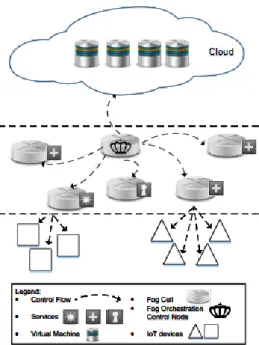
As defined by the OpenFog Consortium, "Fog Computing is a system-level horizontal architec-ture that distributes resources and services of computing, storage, control and networking anywhere along the continuum from Cloud to Things.". The concept emerges to overcome the drawbacks encountered in the cloud computing architecture, mainly the high latency, low data transfer speed, and neglecting the computational and storage resources available in the IoT devices. Thus, Fog Computing offers a decentralized architecture where it is possible to execute IoT services closer to the devices (i.e., at the edge of the network), as seen in the Figure2.1(p.8).
With a fog architecture, fog nodes at the edge ingest the data generated by appliances and other devices. This first level of the Fog, designed for machine-to-machine (M2M) interaction, collects, process the data, and issues control commands to the actuators. The data at this level can be processed, with real-time analytical processes, or sent to the higher levels, i.e., the Cloud. The second and third tiers deal with visualization and reporting (human-to-machine interactions), and systems and processes [BMZA12].
IoT brings intelligence into home devices and facilitates the measurement, control, and moni-toring of the smart home environment. Cloud computing provides scalable computing and storage capacity for tasks that require intensive processing power that is usually not present in IoT de-vices [SAH+13]. Fog Computing allocates processing power closer to the edge of the network and provides a bridge of communication between the devices and the Cloud. The architectural layout of these concepts facilitates the integration of data analytics services that can apply machine learning techniques to the real-time and historical data gathered by the devices and gain insights from it.
Figure 2.1: Fog architecture
2.2
Management of IoT Systems
With the ever-growing adoption of IoT devices, it is only natural that their management within our environment becomes complex. As the number of devices integrated increases, and their interactions become intricate, the difficulty to control the network of devices raises substantially.
The development of IoT management systems occurred due to the primary challenges that IoT systems face: (1) Technology-Centric Challenges and (2) Human-Centric Challenges [KH16]. The technology-centric challenges of IoT are:
• Data Management: the storage, processing, and analysis of the data acquired with the "things." The sheer amount of data generated by the devices, with non-uniform formats, is a major challenge for the IoT;
• Device and Application Management: The IoT devices do not have uniform standards, which makes them difficult to interoperate within the system;
• Bridging Data across Platforms and Services: The technological stack of an IoT platform encompasses several platforms for different purposes. The challenge lies in bridging the platforms and share data throughout the stack;
• Search and Discoverability: The "things" that are part of the network must be discoverable and identifiable;
• Monitoring and Reporting: The devices, independently of the context that they convey, must be monitored in real-time.
The human-centric challenges of IoT are:
• Cognitive Burden : The end-users must be educated regarding the capabilities and func-tionalities of devices. The way to obtain knowledge about the system, independently of the complexity, must be transparent;
• User Interaction : There must be an interface where the user can interact with the system and respective devices, in an interactive and user-friendly way;
• Configuration Challenges : The heterogeneity of devices ends up being a burden for the end-users in terms of the configuration since each device presents a unique way to be configured and used.
Gradually, the development of software projects intended to manage these IoT systems started to appear in the form of Visual Programming Platforms (VPP), which provide a user-friendly management overview of the system and simplify the process of managing a smart system. However, these platforms target mostly users with a background in the IoT context, having higher technical skills.
Work developed by Dias et al., show how the integration of concepts such as visual programming and liveness reduces the complexity of creating, managing, and monitoring of IoT systems, by increasing the feedback loop between the developer and the target system [DFF18].
Nevertheless, VPPs require the learning of how the software works and the respective logic, which no matter how simple or user-friendly it can appear, continues to entail specific barriers for the users, and as a result, few learn and accustom themselves to this kind of software. Chatbots and Intelligent Assistants appear as the solution for the problems mentioned above, offering a simple way to manage the IoT devices, through interactive and user-friendly voice and text interactions.
The following sections broadly explain the two types of approaches for the management of IoT systems: Visual Programming Platforms and Chatbots and Intelligent Assistants.
2.2.1 Visual Programming Platforms
Visual programming tools provide a user-friendly management overview. Whether they are created specifically for programming sensors or because they are general-purpose platforms compatible with those devices, these platforms abstract away the code and inner low-level configurations, which are the difficult aspects for non-technical users. Instead, they provide a simple graphical user interface based, normally, on drag-and-drop, toggles and widgets, that represent in more inclusive detail the underlying system, its settings, interactions, and allow the users to overview the system, manage it and configure the device’s behavior and interactions. Regarding VPPs applied to the home automation context, Home Assistant1, domoticz2, and Node-RED3are the open-source products with larger adoption.
1https://www.home-assistant.io/ 2https://github.com/domoticz/domoticz 3https://nodered.org/
Home Assistant is a home automation platform capable of tracking and controlling all devices in the IoT system. This platform allows the integration of devices and the definition of intricate automation settings with YAML configuration file that specifies the essential information and device settings.
Figure 2.2: Home Assistant UI
Home Assistant offers a plethora of integrations that facilitate its setup, configuration, usage, and configuration plugins for the most varied use-cases, provided by the community. The integrated iOS application and web-based UI, as seen by the Figure 2.2, allow the users to configure the devices’ state and analyze the data gathered. The management provided by Home Assistant focuses on simple toggles or selection inputs that define the current state of the devices, whereas a user-friendly UI supports the monitoring with the system overview.
Figure 2.3: Flow-based GUI
It offers a UI adapted to desktop and mobile devices, with an overview of the connected devices, where it is possible to configure them, analyze the data received through graphical visualizations and define custom push notifications to alert the user about specific events. Domoticz, in terms of exact automation features, allows the use of scripts or a flow-based GUI, where it is possible to define the content of the scripts, the respective trigger and their action on the system. The Figure2.3(p.10) shows Domoticz flow-based GUI.
Node-RED is a flow-based programming tool for the Internet of Things, part of the JS Founda-tion. The flow-based programming implemented by Node-RED describes the system’s behavior as a network of nodes, abstracting the low-level configurations and the code that establish the interaction between network entities. Visual representations are well suited for this model of programming, where the analysis of the system’s flow is facilitated and understandable, as Figure2.4shows.
Figure 2.4: Node-RED flow-based programming
Node-RED has as basis Node.js, taking full advantage of its event-driven, non-blocking model. The lightweight core of Node-RED makes the tool ideal to run at the edge of the network on low-cost hardware and in the Cloud, whereas, through a browser, it is possible to access the tool editor. The browser-based flow editor, which offers a wide range of nodes in the palette, allows quick prototyping of the flows established between the hardware devices, APIs, and online services. The user can subsequently deploy the flows to the runtime environment.
Nodes are the basic building blocks for creating flows, representing logic abstractions of code. A collection of nodes establishes a flow that transmits messages between them. With Node-RED and its integral elements, it is possible to create complex flows that define intricate interactions and dependencies between devices, define complex rules and configurations, and, as a result, create a complex environment of autonomous IoT devices.
The flows created in Node-RED are stored using JSON, and the built-in library stores functions, templates, or flows. This extensibility makes it perfect for the community to share and contribute to the ever-growing repository of flows provided by Node-RED. The tool also offers integrations with well known message-middleware software, such as RabbitMQ, and data visualization platforms like Kibana, which allow to get more insights about the data being gathered and transmitted by the IoT system.
2.2.2 Chatbots
According to the literature, Chatbots have several terms and definitions associated with them. Intel-ligent Personal Assistants, Virtual Agents, Software agents, and Chatbots are interchangeable terms encompassed under the umbrella term "Agents," which refers to "A self-contained, interactive and concurrently executing object, possessing internal state and communication capability" [Hew77]. Chatbots with Artificial Intelligence imbued can understand natural language, maintain a context of the conversation flow, and overall appear intelligent. Those are the denominated Intelligent Personal Assistants (IPA) widely adopted in the last years. Examples of such chatbots are Apple Siri, Google Assistant, Microsoft Cortana, and Amazon Alexa.
The development of Chatbots intends to improve Human-Machine Interaction (HMI), by providing an easy-to-use interface with a natural flow of conversation. Thus, IoT management tools started to integrate chatbots because of the vast possibilities they offer for the users and the human-centric challenges tackled by these platforms.
With a Chatbot applied to the IoT, the underlying state of the system, the orchestration of devices, and respective interaction are abstracted. From the user’s perspective, it only provides the most pertinent information and diminishes the learning curve to create and maintain an IoT environment. The user can use the chatbot to understand more quickly the overall functionalities of the system, whereas it also narrows the configuration challenges since a conversational approach explains more effectively step-by-step setups.
Although developments in IoT have been increasing in recent times, integrating Chatbots into IoT systems is a relatively new area. Work developed by Rohan Kar et al. in 2016, attempts to integrate both fields by detailing the key architectural components required, what are the main challenges and how to address them [KH16].
2.3
Simulation of Smart Home Environments
Intelligent Environments are environments capable of monitoring their context and the conditions of their inhabitants to enhance the overall experience within that environment [NPF+11]. The environment integrates several sensor technologies capable of data collection, depending on the specific monitoring domain and the needs of its inhabitants.
A wide range of scenarios integrates IEs to fulfill many purposes. For example, office environ-ments for the visualization of space utilization [CP07] and the movement of employees [IWSK07]. Airports [CC03] and banks [GMBT04] also integrate IEs, intending to detect security risks from abnormal behavior. IEs deployed within the home environment are called Smart Homes (SHs), and involve the use of sensor technology to monitor the health, wellbeing, activities, and security of inhabitants over extended periods of time [DHSR08].
Several smart home environment projects follow an Ambient Intelligence (AmI) paradigm, although their focus usually is substantially different between themselves, depending on the problem dealt with [EMMN18]. Ambient Intelligence is a paradigm emerging from Artificial Intelligence,
where computers are proactive tools assisting people with their daily activities, making everyone’s life more comfortable. The environments are created by building smart labs in academic settings or using lightweight hardware in a home setting. The following list includes some of the most prominent real smart homes built as testbeds:
• Ulster University (United Kingdom) [DNMHD09] developed a smart living environment to support the development of assistive technologies and solutions to support independent living, integrating a range of techniques for healthcare monitoring and diagnosis. This environment is in the form of a smart apartment containing a living room, dining area, kitchen, small office, a bathroom, and a bedroom, and can facilitate data collection of individual or multiple inhabitants;
• Ubiquitous Home [Yam07] is a smart home built to study context-aware services by provid-ing cameras, microphones, pressure sensors, accelerometers, and other sensor devices. To provide contextual services to each resident, the Ubiquitous Home recognizes the resident by providing radio-frequency identification (RFID) tags, and using the installed cameras; • HomeLab [dBAMI05] is a smart home equipped with 34 cameras distributed throughout
the home space. The researcher observes and monitors the conducted experiments via an observation room. HomeLab aims to provide datasets to study human behavior in smart environments and to investigate technology adoption and usability;
• Center for Advanced Studies in Adaptive Systems (CASAS) [CCTK13] developed a smart home kit, easily extendable and ready-to-install in a house. The sensors embedded gather data from the residents, their activities, and environment, which is used for the generation of useful knowledge such as patterns, trends, and predictions. Research groups use the datasets collected by CASAS toolkits for their research;
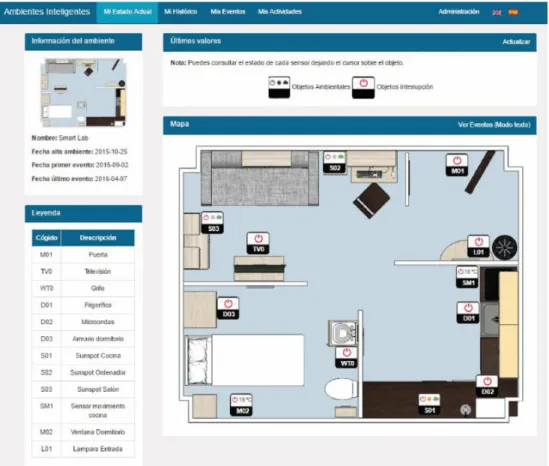
• UJAml SmartLab [EMMN18] based on Ambient Intelligence was created at the University of Jaén to provide a smart environment where solutions in assistive technologies applied to e-healthcare could be developed. The smart lab features a fully furnished apartment with a plethora of smart sensors and actuators deployed in the apartment spaces to gather data from the human-environment interactions and fulfill the users’ needs (cf. Figure2.5, p.14). It uses openHAB4, an open-source middleware technology, to ease data management and enhance home automation capabilities.
Simulation tools can overcome some drawbacks/challenges faced by projects that envision the creation of a smart home environment. The flexibility provided allows creating a broad spectrum of scenarios similar to real life environments, abstracting away physical challenges. Such tools facilitate fast dataset generation and offer robust methods to capture the sensors’ data.
The development and test of data analysis algorithms require the existence of datasets gathered from smart environments. The availability of such datasets is, however, limited because of the high
Figure 2.5: UJAml Smart Lab
costs, constraints, and limitations associated with the construction and usage of physical IEs. Using data simulation approaches has the potential to address these constraints, providing researchers with rich datasets for the testing of novel data analysis approaches, particularly at the early stages of development [SCNM14].
Synnott et al. [SCNM14] identified several challenges faced by smart home simulation research. The generation of representative datasets for a broad range of domains is a challenge that none of the simulation tools could achieve so far, whereas the focus of most simulation tools is on the visualization of smart environments with context awareness and not the generation of synthetic datasets. Another critical challenge identified is the flexibility and scalability to add new or customized types of smart devices, change their generated output, and change their positions within the smart home. On the other spectrum, the multiple inhabitants’ support is also one limitation, as it is challenging to implement.
Throughout the years, IE simulation research has evolved in two directions: Model and interactive based approaches [SCNM14]. Model-based approaches require the use of activity models and can generate vast datasets representing extended periods. Typically, model-based approaches opt for the modeling of the simulation context, such as agents, activities, and processes, and as a result, the accuracy of the data generated by these approaches depends on the accuracy of the underlying activity model. Interactive based approaches provide an interface for the users to
control and capture the context in real time, which consequently increases the granularity detail of the simulation context. Interactive approaches offer the ability to record datasets with complete ad hoc control over environment and sensor simulation and may facilitate the assessment of subtle changes to environments or sensors, such as layout and sensor placement.
2.3.1 Model-Based Approach
The model-based approach uses pre-defined models of the simulation context to create the sim-ulation flow. Usually, the models define the leading entities of the simsim-ulation, such as agents and activities. The modeling comprises typically the specification of the agent’s behavior, the probability of events occurring, their influence in the environment, and the duration of each activity.
The following list summarizes the simulation tools integrating a model-based approach with the most relevance in the literature:
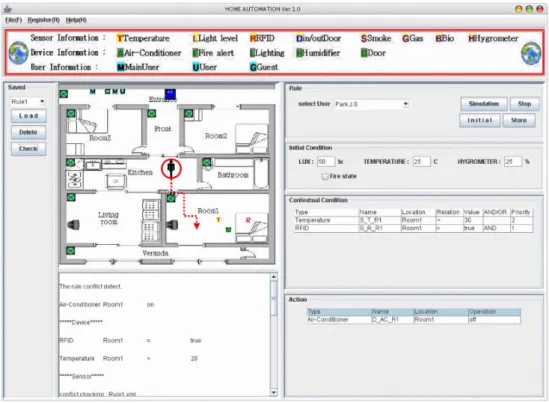
• CASS [PMHY07] is a simulation system that focuses on the context information of a smart home domain. The system responds to specific contexts through contextual rules defined by the developer and composed by a condition and an action (e.g., when the temperature is lower than 15o, turn on the AC). By using the tool, a user can detect rule conflicts and simulate rule behaviors for a smart home. As shown by Figure2.6(p.16), the simulator summarizes the smart environment, the device’s rules specification, and a toolbar to configure the simulation context;
• DiaSim [BJC09] is a simulator for pervasive computing based on actuators and sensors. The tool generates a programming framework to develop the logic for services, giving freedom for the user to develop a broad set of devices and their capabilities. It provides a GUI to define the virtual space, the custom scenarios, and to monitor the behavior of the simulated system. The tool focus lies deeply on the heterogeneity of entities that can exist in a pervasive computing system and the ability to support simulation of those entities;
• SIMACT3D [BABB10] is a smart home simulator specifically designed to help researchers with activity recognition problems. A set of scenarios captured from real-life experiments is integrated, which helps the recognition of activities of daily living. The tool provides a virtual smart home architecture, imbued with reliable scenarios, and allows researchers to test recognition approaches with minimal cost. SIMACT restricts the scenarios used in the simulation, as it uses pre-recorded contexts gathered from clinical trials;
• IoT MAS [ZKHS17] introduces an environment based agent system that simulates a smart home. The architecture includes an IoT gateway to bridge the information from the ambient environment (e.g., sensors, actuators, and house components) and the external networks. The main aim of the tool is to provide a straightforward way to manage a simulated system via remote control;
• Kormánios et al. [KP13] created a simulator with the purpose to model and analyze the daily activity of a single human within a virtual environment, to help the development and test of algorithms applied in ambient assisted living projects. The tool aims to model the human inhabitant, his social and physical environment so that the activities and interactions performed by an agent are meaningful and representative of real human behavior;
• Vasilateanu et al. [VPCG16] proposed and developed a simulator with customizable device placement and an agent-based approach to resemble human activity with a limited set of activities. The strength of this architecture lies in the agent modeling incorporated, which with the help of machine learning algorithms simulates the agents’ activities. The devices recognize the activities performed and respond according to their configuration.
Figure 2.6: CASS Simulator
Model-based approaches can generate extensive synthetic datasets describing virtual contexts over extended periods. The quality and accuracy of the resulting datasets, however, relies heavily on the quality of the model defined. The construction of accurate activity models requires access to real test data describing the performance of the modeled activities to expand the model domain as much as possible. The approach has a significant shortcoming in representing intricate interactions or erratic/abnormal behavior in a smart home. For example, activities that have external factors or activities between various inhabitants are inherently challenging to represent.
2.3.2 Interactive-Based Approach
In contrast to the model-based approach, the interactive approach allows the users to control the agents that are part of the simulation or configure, in runtime, the simulation settings. Both actions impact the environment, whether by interacting directly with the environment, which is an active interaction or through a passive interaction, such as updating the settings.
The vast majority of tools that implement this approach incorporate a 3D view which allows the users to manage avatars and their interactions intuitively. The avatar moves and interacts with the virtual environment, which has virtual sensors and actuators. The interactions are passive or active. Passive interactions occur when an avatar indirectly performs an action that activates some condition. For example, if there is a virtual pressure sensor installed on the floor, and when the avatar walks on it, the sensor should detect this and emit a signal. Active interactions involve actions performed by the avatar, such as opening a blind or turning the air conditioner on or off [AAS+17]. The following list summarizes the simulation tools integrating an interactive approach with the most relevance in the literature:
• UbiREAL [NYT+06] is a ubiquitous application simulator that can simulate a 3D smart environment, devices, and how the external context of the simulation affects the devices. The simulator offers a way to control intuitively and check the communication and rules established between devices;
• Armac et al. [AR07] developed a tool with an interactive process to configure the environ-ment 2D layout through a GUI. The simulator has a central gateway to connect the devices and configure their services, whereas the GUI manages their status. The goal of this tool is to test the services integrated with the devices;
• V-PlaceSims [LCK08] enables users to experience a smart virtual environment with context-aware information regarding activities, entities, and users. The users have an active role in the simulation, being able to explore and interact with the virtual environment, witnessing in real time the result of interactions, and how the services adapt to the current context. The tool aims to provide insights on how to better design a smart home and the ideal configuration of devices;
• ISS [NJD09] is a simulator that aims to help users understand the interaction between the environment, people, and pervasive devices in a smart home. The simulator architecture integrates contextual awareness, environmental effects and provides the users the possibility to interact and change the current settings. The end goal of this tool is the optimization of smart house design in terms of sensor settings and device placement;
• SimCon [MOG+10] extends an established building model, incorporating descriptors and parameters related to smart building technologies. The tool offers high flexibility in terms of the measured properties and simulated contexts, whereas the sensor modeling language
(sensorML) used offers interoperability. The toolset provides a runtime test environment for simulation and visualization of smart buildings, summarizing the system and its accuracy; • Buchmayr et al. [BKK11] developed an extensible simulator that can generate and visualize
data from a wide range of sensors and simulate faulty or unexpected behavior. This approach has the benefit of detecting poorly designed IoT systems, test the overall efficiency of the system, and produce test data;
• Fu et al. [QPC+11] proposed a configurable context-aware simulator for a smart home environment. Through an XML configuration, it is possible to configure the devices, their rules, and the surrounding environment. An interactive graphic interface allows the user to monitor and manage the simulation devices;
• Ariani et al. [ARCL13] developed a simulator capable of recognizing and responding to a person activity within a virtual smart home. The simulator gives researchers a set of tools to better understand how the sensors respond to a variety of activities, by analyzing character-istics like the number of sensors, user mobility, and line of sight. The floor plan designer integrated with the simulator is used as a validation of an initial placement configuration of sensors;
• Intelligent Environment Simulation (IE Sim) [SCNM14] is a tool used to generate simu-lated datasets that capture normal and abnormal ADLs of inhabitants. It allows the researcher to design smart homes by providing a 2D graphical top-view of the floor plan. Following an interactive approach, the users can interact with the simulation with an avatar, whereas the simulation captures ADLs;
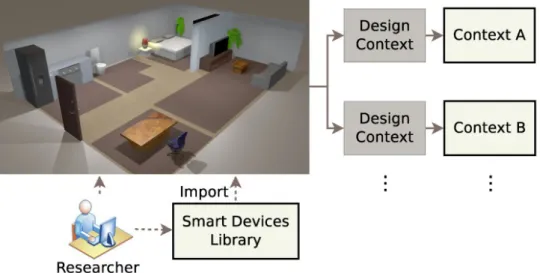
• OpenSHS [AAS+17] is an open-source, cross-platform 3D smart home simulator for dataset generation, combining advantages from both interactive and model-based approaches. The replication capabilities provide a solution for generating large representative smart home datasets, overcoming the drawbacks of an interactive based approach. The tool also offers an extensive library of smart devices that facilitates the simulation of smart home environments. As seen by Figure2.7(p.19), OpenSHS divides the dataset generation into three distinct phases:
– Design of the initial virtual environment by building a smart home with an external designer tool and the import of smart devices;
– Simulation of the context-specific events;
– Replication of the initial sample dataset to obtain the extensive final dataset.
Overall, the interactive approach comes with a significant setback, as it is cumbersome to use the simulation for extended periods because the avatar completes each interaction in real-time. This approach, as highlighted by the literature, is usually used when the end goal is the visualization and testing of a smart environment context, not the generation of datasets [AAS+17].
Figure 2.7: OpenSHS Simulator
2.4
Conclusions
In terms of management of IoT systems, VPPs like Node-RED continue to offer more complex functionalities and have higher management capabilities over the system, however, the required technical skills to use these platforms continues to be a barrier that few users will overcome. Chatbots are the perfect solution for the end-users because of the friendly and easy-to-use interaction they offer. These management tools are especially useful for smart environments already designed and pre-established, however, they are not ideal for situations where the design validation and testing is a requirement, or the user wants to fiddle with an idea for his smart home.
Simulators are a crucial tool for experimental scenarios, but their usefulness has a broad appeal. Because of their capability to model a wide range of scenarios, they can validate and test smart home designs using an iterative approach and reducing costs for the users. In terms of datasets generation, they can model several problem domains and create reliable synthetic datasets without the need to set up real smart environments.
The state-of-the-art is rich with efforts that focus on generating datasets for smart home applications. We can classify those efforts into two main categories; datasets generated either from real smart homes testbeds or using smart home simulation tools. Real test beds are the more reliable and used option; However, costs of setup and maintenance appear as an essential barrier for their wide adoption. Usually, these testbeds use research environments as groundwork with specific purposes in mind, so these conditions naturally limit the domain.
IoT simulation tools offer a more extensive set of features and possibilities compared to real smart home test beds. Besides offering an endless set of modeling scenarios, they offer full control over the simulation settings and parameters, so that minimal changes require zero to none effort. Simulators also have the option to define the simulation speed so that the observation is less cumbersome.
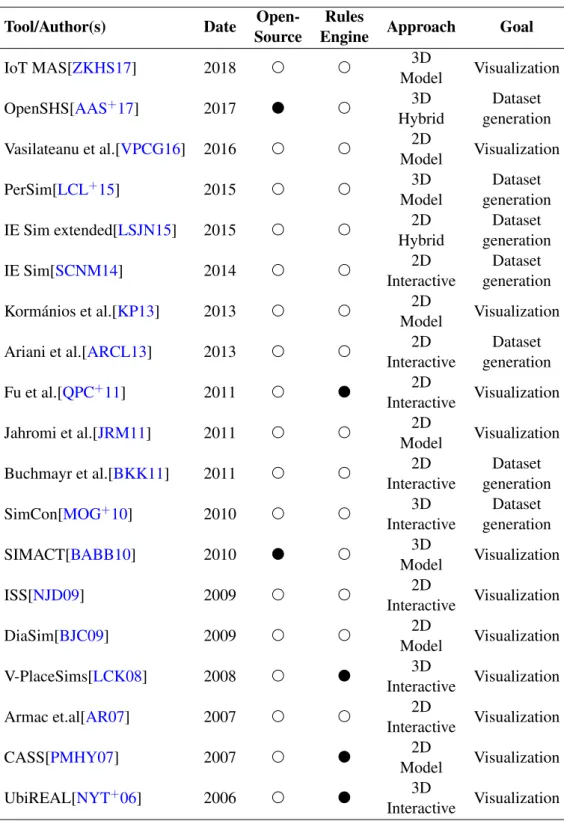
The analysis of the Table2.2(p.21) shows that most of the tools featured in the smart home simulation field are not available in the public domain as an open-source project. The lack of availability of the software implementation hinders their contribution to the field, mainly to future researchers that want to develop further the efforts in the state-of-the-art or potential researchers that want to experiment the tool and verify its validity.
Regarding the integration of a rules engine, to abstract and define the interaction between devices, the number of tools that implement this is also low. The evaluation of a rules engine in this context has to fulfill two goals: First, a device’s property state can depend on the state of other devices, directly or indirectly, and the communication link between the devices must be transparent to the user. Second, a device’s property state can depend on the environmental context, which refers to external agents, physical properties, or time. Only four out of 19 tools implement a rules engine that complies with the goals defined for a rules engine.
The simulation tools analyzed have shortcomings in terms of flexibility. For example, for most of the tools, the set of devices used in the simulation is pre-defined, being impossible to add or customize new sensors and devices. In terms of the physical environment, none of the tools addresses the simulation of physical properties, which hinders the sensors used and gathered data. Except for OpenSHS and IESim Extended, none of the tools follows a hybrid approach integrating a model-based and interactive solution. The hybrid tools combine the advantages of both approaches, having the ability to generate large datasets in a reasonable time interval while keeping the fine-grained interactions observed by the interactive tools. Also, fewer simulation tools focus on generating datasets or try to incorporate the visualization of a smart house and the generation of datasets.
Table 2.2: Smart Home Simulators comparison
Tool/Author(s) Date
Open-Source
Rules
Engine Approach Goal
IoT MAS[ZKHS17] 2018 3D Model Visualization OpenSHS[AAS+17] 2017 3D Hybrid Dataset generation Vasilateanu et al.[VPCG16] 2016 2D Model Visualization PerSim[LCL+15] 2015 3D Model Dataset generation IE Sim extended[LSJN15] 2015 2D Hybrid Dataset generation IE Sim[SCNM14] 2014 2D Interactive Dataset generation Kormánios et al.[KP13] 2013 2D Model Visualization
Ariani et al.[ARCL13] 2013 2D
Interactive Dataset generation Fu et al.[QPC+11] 2011 2D Interactive Visualization Jahromi et al.[JRM11] 2011 2D Model Visualization Buchmayr et al.[BKK11] 2011 2D Interactive Dataset generation SimCon[MOG+10] 2010 3D Interactive Dataset generation SIMACT[BABB10] 2010 3D Model Visualization ISS[NJD09] 2009 2D Interactive Visualization DiaSim[BJC09] 2009 2D Model Visualization V-PlaceSims[LCK08] 2008 3D Interactive Visualization
Armac et.al[AR07] 2007 2D
Interactive Visualization
CASS[PMHY07] 2007 2D
Model Visualization
UbiREAL[NYT+06] 2006 3D
Problem Statement
Section 3.1 summarizes the current problems revealed by the analysis of the state-of-the-art, while Section3.2 (p.24) details a minimalist breakdown of the solution proposed, specifying the most relevant features. Section3.3(p.24) defines the constraints applied to this dissertation. Section3.4(p.25) overviews the relevant goals of the simulator and the requirements it must fulfill respectively to its context. Section3.5(p.27) defines the development challenges of this simulator, while Section3.6(p.28) overviews the methods used to evaluate the project.
3.1
Existing Problems
As analyzed in Chapter2 (p. 5), the current simulators available in the literature offer several features for the simulation of smart home environments; however, from the ones available to the public domain, they have shortcomings in certain scenarios. As it stands, none of the tools simultaneously offers these features:
• Simulation of physical properties: integration of physical properties that are normally present in a real environment, characterized by non-binary data with diversified dynamism in terms of values;
• Hybrid approach: simulator with interactive configuration and control, having the fine-grained control of interactive approaches and a model-based approach for the modeling the environment context, integrating the capability to control the simulation time setting; • Complex devices behavior: the devices are aware of the simulation environmental context
and react to it, according to the user configuration; the device’s state can depend on another device, without the specification of the underlying communication link between the respective devices;
• Modeling extensibility: human behavior is inherently complex and dynamic; a simulator must provide a way to model a realistic behavior of a human independently of the domain, having the flexibility to fulfill the users’ needs.
3.2
Proposed Solution
The goal of this project is to develop an extensible framework capable of simulating realistic smart environments, abstracting the technical details of implementing and managing an IoT system.
The tool capabilities must offer the possibility to experiment and test realistic scenarios, without imposing a high number of constraints on the domain or wide the gap between the simulated scenario context and the real one.
The simulation tool should provide an intuitive UI for the user visualize the simulation process and easily manage all the information regarding the simulation context in real time, without having significant setbacks. The process to create a dataset must be as straightforward as possible, and it must integrate a fast-forwarding mechanism to streamline the performance of the simulation and allow the user to control the time as he intends. This feature makes the simulation less cumbersome and the gathering of datasets with long time intervals easier.
The device’s behavior should be flexible enough so that the user can define complex device interactions, whether with the environmental context or between devices. The simulation tool must provide a way to simulate physical properties in a simplified but realistic way, giving the user the possibility to configure the physical properties and how the system processes the properties so that he can create scenarios with unexpected behaviors. The following example showcases the use of this simulator and its utility for the users:
A user wants to model the configuration of devices and their interactions with the surrounding environment, especially when the light of the environment changes, whether via the simulation physical world or because of devices state updates. Imagine a scenario where a person works during the night and has the lights turned off or on, depending on the environmental light that the house has. The behavior of the system follows the pattern: If the light transmitted to the light sensor is below a certain threshold, the blinds are closed, and the lights within the home turned off; Otherwise, the blinds are kept open, and the user continues his work using the environment light. Although, if it is raining outside, the blinds are closed, and the lights switch on automatically.
The system must be able to simulate realistic scenarios like the one presented above, where numerous variables affect the current state of the context.
3.3
Assumptions
During the dissertation development, and due to time constraints, some general assumptions and constraints needed to be taken into consideration.
The Internet of Things creates an ecosystem of interconnected devices and appliances that acquire, store, and share data through the Internet. This scenario raises security and privacy concerns
throughout the process chain, from the moment that the data is acquired in the device to the moment that is stored and processed in the could. Several challenges have to be tackled such as data privacy, technical authentication vulnerabilities, the human factor, and data encryption [ZCW+14], to ensure security, privacy, and safe experience for the users. The security risks associated with IoT appear as an essential research and industry problem continuously being assessed. Thus, to the scope of this dissertation, these risks are overlooked so that the authors consider the IoT system used for testing and validation purposes as secure.
As the IoT continues to be used in an extensive set of domains, the number of devices, standards, and protocols continues to increase as well. As such, the simulator engine must provide interoperability between the devices and underlying data exchanged. The data model and API used to describe the physical devices should adhere to the current standardization efforts made by the IoT community.
The simulation of real physical properties introduces a problem that requires an in-depth knowledge of physical phenomenons and has a high complexity on its own. A realistic physical simulator requires plenty of computational power and introduction of physical concepts that would increase immensely the complexity of this simulator, without addressing the problems present in the state-of-the-art explicitly. For that reason, the simulation of physics properties is simplified for the development of this simulator.
3.4
Desiderata
To ensure that the solution developed presents itself as a contribution to the ensemble of simulation tools, we describe a set of goals on the next sections, focusing on common challenges generally addressed by a simulation framework. These goals define the high-level criteria that the simulation tool must address and fulfill to consider its development a success.
As mentioned in Section2.3(p.12), researchers can use machine learning algorithms with the datasets generated from simulation tools, but the reliability of such datasets is related to the underlying model. The flexibility used for simulation modeling entails the notion that the models are as reliable as the user makes them be, so the project does not intend to tackle the generation of datasets for later research use. Thus, the target audience of this project are users that intend to experiment and test virtual home scenarios to validate a real smart home design.
A project inherently has a set of forces that drive its management and development. Those forces constrain and drive the development of a project, as they define the project scope and are essential to measuring the quality of the tool. Figure3.1(p.26) shows the forces that guide the development of this project.
The project has three main forces: usability, flexibility, and heterogeneity. Heterogeneity, in this context, refers to the vast set of diversified applications for IoT devices and the efforts to standardize this domain. The number of data representation models for IoT devices is increasing at
a fast rate. The flexibility of the tool supports the heterogeneity of the simulator and the capability to handle a wide variety of devices.
The modeling of realistic human behavior also requires a high level of flexibility because of the inherent complexity of human beings. The flexibility increase directly hinders the usability of the system. As the system requires an increasingly dynamic approach to represent the models, the more difficult it is to provide a user-friendly UI for the end-user.
The tool needs to offer an intuitive UI where the user can quickly understand its functionality and achieve his objectives with effectiveness and efficiency.
The forces, as evidenced above, have a direct relationship. The project development takes into account these three forces and defines its goals, trying to minimize the trade-offs between requirements.
Figure 3.1: Project forces
3.4.1 Easy end-user device behavior configuration
A real smart home as a plethora of devices with different purposes and standards, so settings such as properties, actions, events, and message standards must be configurable. A proper simulator must be able to handle the heterogeneity and extend the device’s library with ease to apply the simulation to a broad range of domains.
A device (sensor) is aware of the environmental conditions surrounding it. Some can sense movement and activity within the defined sensing radius, while others have complex interactions between themselves, whereas their state depends only on the state of other devices. Such approaches allow for more complex systems without the need to establish communication links.
Overall, the device behavior configuration must be transparent and intuitive for the end-user throughout the creation phase.
3.4.2 Flexible scenario customization
A smart home has an extensive set of layouts, configurations, and entities. Overall, a scenario can have a multitude of possibilities that need to be adequately represented in a virtual context.
The end-user must be able to customize the scenario he is trying to represent, independently of being a realist scenario or not. The UI must provide easy-to-use functionalities to speed up the creation of a scenario.
3.4.3 Intuitive visualization and data generation
In a real smart home, the users control the things in real time, and the physical properties of the environment are in constant change. The simulation settings in terms of devices, properties, and rules should be easily configurable while the simulation is running.
The tool must offer a view of the simulation while running and the information related to what is happening. Besides this, the generation of datasets is also a focus essential for users, which must not be a cumbersome task. It is important to gather an appropriate amount of data for posterior analysis and acquisition of insights on how to improve the practical home design, without imposing the need to wait long periods. It is vital that the user has control over the internal simulation time, with the possibility of fast-forwarding as desired.
3.4.4 Physical properties simulation
Smart homes devices are usually influenced/changed because of human activity or environmental changes (light, temperature, pressure). Some sensors depend only on external properties, so a simulator without physical properties lacks a significant component of a proper virtual smart home environment, which takes value out of the tool.
The tool should integrate the simulation of physical properties using a simplified version of a physics simulator. The end-user can configure these properties and how the surrounding entities respond to the current environmental state.
3.4.5 Easy agent behavior and activities configuration
A real-life scenario comprises a set of persons with different habits, goals, and habits. Their behaviors can be simple, like the action of sleeping or complex, such as the activity of eating lunch, which is composed of a set of sub-tasks. Also, an agent has a set of strictly personal necessities, and their fulfillment depends on the accomplishment of different activities.
The agent and activities modeling must be straightforward and easily configurable by the end-user. Because of the complexity of this modeling, the tool must be flexible, offering a model representation capable of accommodating the user requirements.
3.5
Challenges
The hypothesis of this dissertation is the modeling and experimentation of realistic scenarios within a virtual environment, applied to a subset of the Internet of Things, the Smart Home domain.
According to the desiderata described in Section3.4(p.25) and the hypothesis of this disserta-tion, the following challenges are established: