Actas
do-
1P
€
m
b
o
Internacional
de
Linguística
(Porto, 2913005m98)Cognitiia
Título: Actas do 1" Encontro Internacional de Linguística Cognitiva (Porto, 29 e 30.5-98)
Organizadores Mário VilelaIFátima Silva
Editor: Faculdade de Letras do Porto
Execução gráfica: Tipografia Nunes, Lda
Tirageni: 1 ,000 Ex.
As instituições e a sua mernória não podem viver fora da reflexão so- bre o conhecimento e a sua representação nas línguas naturais. Tornou-se um lugar comum dizer-se que as ideias governam o mundo. As ideias es- tão nas línguas naturais, o que equivale a dizer que a representação das ideias substitui as próprias ideias. Na história das ideias, da sua cons- trução e representação, a teoria do protótipo pode não representar muito, mas obrigou os filósofos, os psicólogos, a inteligência artificial e os lin- guistas a repensarem muitas das coisas já tidas como garantidas. Constitui um apelo para novos paradigmas.
O pensamento é uma criatura do homem, mas também o pensa- mento, uma vez criado, recria e (re)fabrica o seu criador. O pensamento é conhecimento e o conhecimento torna o homem melhor do que ele mesmo, mais culto, mais informado, mais liberto dos "terrores" que o atoimentaram no passado. Mas conhecimento sem língua não só não é possível como ainda não é conhecimento nem mesmo pensamento. A moderilidade não espera por ninguém. A Linguística Cognitiva é entre nós uma criança.
Houve, em Portugal, uma boa tradição de reflexão sobre filosofia da linguagem. Há, entre os nossos linguistas actuais, uma boa reflexão, den- tro de dados parâmetros, num livro que não tem merecido a atenção de- vida: a Teoria da Linguagem de Herculano de Carvalho. Encontro, a cada passo, pequenas ou grandes reflexões, entre nós, sobre teoria cognitiva: mesmo onde não se espera. Há uma reflexão num dado sentido, por parte dos Colegas que trabalham sobre psicolinguística, no Porto e em Lisboa. Mas por parte dos linguistas, linguística cognitiva temos muito pouco. Temos trabalhos pioneiros, os de Pinto de Lima, de Clotilde de Almeida, de Augusto Soares da Silva, de Hanna Batoréo, de José Teixeira, de Joana Fernandes e Rosa Amaral. Está a decorrer um Mestrado na Universidade Católica (Braga) centrado sobre Linguística Cognitiva. Mas não há muito, se compararmos com o que vai pelo mundo fora: em Espanha há uma associação de linguística cognitiva, na Alemanha debatem com dureza e com paixão a linguística cognitiva, em França houve já alguns congressos para procurar as raízes da teoria, delimitar conceitos e princíg pios. Quisemos dar o pontapé de saída para uma discussão séria e actuali# zada desta problemática.
Reunimos, aqui no Porto, as pessoas que em Portugal estão nessa "onda", rodeando-a de alguns nomes que são autoridade nessa área. Quis dizer aos Colegas de Psicologia, de Filosofia, de Sociologia, de Ailtropologia (os estereótipos começaram aí), o que estamos a fazer num domínio próximo ao deles. Isto é um começo.
1. Alguns dos temas centrais da linguística cognitiva e versados no Congresso
A linguística cognitiva vem influenciando teorias e métodos de des- crição em semântica (Lakoff 1987, Langacker 1987, Taylor 1989, Kleiber 1990, Ungerer /Schmid 1996): qual a informação semântica a ter em conta. Poderíamos mesmo constituir como um dos lemas das duas últimas décadas «o protótipo: da psicologia cognitiva à linguística». A noção de protótipo estimulou poderosamente a semântica ao permitir que ela ultrapassase os limites do imanentismo que caracteriza tanto o estru- turalismo como o generativismo. A noção de protótipo provinda da psi- cologia cognitiva fornece um modelo mais reaIista das representações mentais que está na base da actividade linguística. Estas representações mentais, ao nível semântico, correspondem em grande parte a categorias cognitivas (Rosch 1973, Fillmore 1975: 123, 128-130; Taylor 1989: 21- -
-98, Kleiber 1 990: 21 - 11 7) que se baseiam no saber extralinguístico (con- ceptual e perceptivo), que nem são homogéneas nem estanques, pos- suindo, pelo contrário, uma estruturação interna que se organiza em cen- tro-periferia; que não se organizam segundo o modelo das taxonomias lógicas. Os diferentes níveis "taxonómicos" não são equivalentes, o que implica um nível de base (sempre preferencial) oposto aos níveis super- ordenado e subordinado.
Outro dos pontos nevrálgicos da discussão é a inclusão (ou não) do enciclopédico na descrição semântica. A semântica estrutural europeia separou teoricamente o conhecimento enciclopédico dos traços semânti- cos específicos da língua, fazendo destes o objecto do seu estudo. Pelo contrário, a linguística cognitiva privilegiou o conhecimento enciclo- pédico para a descrição semântica. Há autores que não se preocupam com este problema, outros há que defendem que o conhecimento lin- guístico é exclusivamente intralinguístico (Langacker e Taylor), Geeraerts dá prioridade ao conhecimento enciclopédico, mas reconhece a
importância dos factos semânticos extralinguísticos, Aridreas Blank valo- riza o conhecimento enciclopédico para a explicação das mudanças semânticas, mas defende que nas mudanças semânticas funcionam tam- bém as constelações semânticas e posição semelhante é a de Gerd Wotjak. Na verdade, parece-nos que não devemos renunciar de modo absoluto à distinção entre os aspectos extralinguísticos do significado e os traços semânticos intralinguísticos. É bem verdade que os traços intralinguísti- cos não são substancialmente diferentes da informação semântica, mas adquirem um stntus categorialmente diferente, na medida em que re- flectem oposições semânticas que em certas línguas são expressos por um só lexema e noutras há o recurso a uma palavra complexa, a uma paráfrase ou mesmo não se realiza (cfc Koch 1998. 11 8s.). A maior parte das comu- nicações ou trata directamente este tema ou faz pelo menos alusão a esta problemática e Gerd Wotjak aborda directamente o problema.
A linguística histórica é outra das áreas onde a linguística cognitiva tem incidência. Aliás, entre os pontos mais marcadamente estudados, en- contram-se a metáfora, a metonímia, a polissemia, que se situam na in- teiface diacronia-sincronia. Há comunicações que tratam directa ou indi- rectamente estes problemas (Dirk Geeraerts, Andreas Blank / Peter Koch, Pinto de Lima, entre outros).
A verbalização de entidades linguísticas está claramente relacionada com o problema da categorização, a gramaticalização e "sintacticização" das categorias (Pinto de Lima, Ana Maria Brito, Clotilde Almeida, José Teixeira, Augusto Silva, Margarita Correia, Lígia Maia). A informação re- levante da organização do significado funciona não apenas em categorias - que podem ser estruturadas prototipicamente ou não - mas também em redes conceptuais, em franzes, scenarios, donznins, dinamismo discursivo (Fátima Oliveira, Fátima Silva). A Tipologia das línguas construída a par- tir do confroilto é outra vertente activada pela lingística cognitiva: aqui, com base num quadro explicativo provindo da gramática de valências, questionam-se determinados "frames" enunciativos (García-Miguel).
O Léxico tem sido também um dos pontos fortes da linguística cognitiva, problematizando-se novamente as antigas perspectivas da in- vestigação semântica: semasiologia e onomasiologia (para um enquadra- mento global vide Koch 1996), aliás com uma presença importante nas comunicações apresentadas, embora as designações como tais nem sem- pre apareçam.
Uma outra noção associada ao (ou complementar do) protótipo, a de estereótipo, é a que interpreta o significado lexical com base no conheci- mento e na percepção espontânea dos falantes (Putnam 1975), ou a que interpreta muitos dos significados das expressões linguísticas como rotina mental partilhada pelos falantes (Mário Vilela e Ana Maria Brito). Três das comunicações (Gerd Wotjak, Bernard Pottier e Dirk Geeraerts) fazem, cada um a seu modo e com perspectivas diferentes, uma apresentação global da Linguística Cognitiva.
2. Breve apresentação individual (por ordem alfabética dos au- tores) das "comunicações"
Maria Clotilde Almeida (Space-oriertted Accustative versus Dative
Symbolic Constructions in German and its Portug~lese Counterparts: a Coglzitive Approach) toma como tema de reflexão a dupla construção em
alemão, em que o mesmo verbo e a mesma preposição podem reger acusativo e dativo e a verificação dos correspondentes em português. Aduzindo possíveis insuficiências de explicações que não tenham em conta a intervenção do enciclopédico, apoia-se na explicação dos diferen- tes esquemas imagéticos - a dupla relação entre trajector e marco (trajec-
tor e landinark) - que estão por detrás da dupla construção. A contrastivi- dade português-alemão serve também de fundo à explicação imagética.
Hanna Jakubowicz Batoréo (Language typology aizd semantic prii~zi-
tive of space: evidence from european portuguese), com base na "Natural
Semantic Language" de Wierzbicka, e, mais precisamente, com base nos quatro primitivos conceptuais que recobrem Espaço, ou seja, Tempo, Existência e Posse, Acção, Eventos e Movimento, e servindo-se ainda do conceito lógico Não-Parte e da noção de Situação de movimento de Talmy, faz o levantamento das possibilidades de realização do ESPAÇO no português europeu. Para poder aplicar os três elementos da proposta de Wierzbicka e Talmy (primitivos conceptuais, universais lexicais e o esquema de uma situação de movimento), embora visando a explicitação das possibilidades de realização do português europeu, socorre-se de outras línguas românicas, linguas germânicas e do polaco para estabelecer uni- versais empíricos no coiltributo para a construção de uma tipologia. Analisa ainda para verificar a especificidade das línguas, além da noção de Espaço, a Expressão da Existência.
Andreas Blank e Peter Koch (Orzomasiologie et é ~ m o l o g i e cognitive: I'exernple de la T Ê T ~ caracterizam a etimologia clássica por não irem além da história fonética da palavra e de informações semânticas disper- sas, a geografia linguística pela perspectiva exlusivamente onomasiológi- ca, a psicologia gestaltista e a linguística cognitiva por pretenderem atin- gir os princípios fundamentais da nossa concepção do mundo. Procuram analisar a estrutura prototípica em certas classes referenciais, ou, mais propriamente, a organização em "frames" / "scenarios", trabalhando com o maior número possível de línguas, no caso de PUPILA e sobretudo de TÊTE, verificando a evolução semântica deste último domínio cognitivo (frame), aplicando as tipologias e teorias à mudança lexical (história semântica das palavras), aproveitando onomasiologicamente os dados semasiológicos, indo em busa dos princípios de conceptualização domi- nantes e as estratégias de expressão preferidas.
Ana Maria Brito (Structures conceptuelles / structures syntaxiques: quelques réflexiorzs autour dzt verbe &r) parte do princípio de que exis- tem correspondências entre as categorias linguísticas e as categorias no- cionais ou conceptuais e interroga-se sobre os laços entre essas estru- turas: quais são as estruturas conceptuais e como se combinam? Como se articulam as estruturas conceptuais e as estruturas linguísticas? Haverá uma articulação imediata ou mediata? Há coincidência entre estruturas conceptuais e e estruturas linguísticas? Qual a relação entre universais linguísticas e estruturas conceptuais?
Margarita Correia (La corzstruction du sens des noms de qualité en
portugais) estuda o tipo de estruturas com as quais se podem designar "as
qualidades" em português: os chamados nomes de qualidade. Esta cate- goria é constituída prototipicamente por nomes simples, por nomes com- plexos não construídos e sobretudo por nome deadjectivais. Os outros tipos de nomes de qualidade situam-se na periferia desta categoria. O sentido "predicativo" é construído, apresentando, estas construções, por vezes, também o sentido "colectivo".
José Maria García-Miguel (La expresión de actantes centrales e12
espano1 (rornarzce) y bribi (chibcha): tipología, discurso y cognición) es-
determinando as entidades proeminentes (trajector e "landmark") (Langacker 1991) e as funções discursivas da ergatividade e da ergativi- dade oculta. Inspira-se na linguística cognitiva e na linguística funcional tipológica (Lazard 1994). Analisa sobretudo as correlações entre as re- lações actanciais e a organização do discurso, servindo-se, neste aspecto, da noção de Topicalidade (Givón 1983), aplicando assim as noções de proeminência cognitiva e proeminência discursiva ao espanhol e bribi (língua falada da Costa Rica).
Dirk Geeraerts (Htmclred Years of Lexical Semanticsj, autor de bi- bliografia essencial para o tema da "mudança semântica" (a nível lexical), apresenta aqui a história da semântica lexical compendiada nos seguintes tópicos: "semântica diacrónica pré-estrutural", "semântica estruturalista", "semântica lexical generativista", "semântica lógica" e "semântica cogni- tiva". Depois de tipicizar as várias semânticas, distingue as semânticas de pendor semasiológico (a pré-estruturalista) e onomasiológico (a estrutu- ralista) das de pendor simultaneamente semasiológico e onomasiológico, ao introduzir a perspectiva quantitativa na análise. Pondo ainda em para- lelo a semântica lexical com as "literary semantics" termina por ques- tionar o problema dos "limits of interpretation" (por ele designados como "Dilthey's problem").
Lígia Maia (Reflexões sobre a altenzância locativa no português) faz uma abordagem sintáctico-semântica dos verbos de alternância locativa procurando demonstrar que o significado dos predicados desempenha um papel importante na expressão sintáctica dos argumentos, impondo- -se assim o recurso a teorias que contemplem a componente lexical.
Fatima Oliveira (Domain restriction, mental rnodels and discourse context) tenta comparar duas abordagens, tidas como alternativas, de tratamento da semântica de alguns operadores nas línguas naturais: a semântica dinâmica e os modelos mentais. Partindo da distinção da res- tricão de domíiiio ("domain restriction"), da natureza pressuposicional da restrição do domínio e da acomodação constante na actualização da in- formação no discurso, defende que deve ter-se também em conta as in- ferências contidas no fundo comum dos interlocutores e o sentido (par- cial) dos enunciados. Depois de analisar, dentro desta perspectiva, alguns operadores do português europeu, chega à conclusão de que as duas pro-
postas de tratamento - a semântica dinâmica e os modelos mentais - de- vem ser tidos em conta na descrição semântica dos referidos elementos. A psicologia e a formalização são vias compatíveis.
Bemard Pottier (Le Tenzps, I'Espace et les autres dimensions cogrzi-
tives) procura pôr mais verdade na datação da chamada "revolução cog-
nitivista" e sintetiza as suas propostas expostas em vários trabalhos no campo da representação cognitiva através das cinco dimensões semânti- cas - as Entidades e o seu Comportamento, o Enunciador (e a sua ca- pacidade modalizadora), e (as relações instanciadas em ) o Tempo, o Espaço, o Nocional. Compara o seu esquema com o de Jackendoff e com o de Langacker, aduzindo alguns parâmetros aferidores da adequação das várias propostas.
José Pinto de Lima (Neither by nzetaplzor nor real- by nwtonymy.
Tlze Shortcolniizg of tlzese Concepts as E.planatory of Lnrzg~tage Churzge Processes) analisa a passagem do verbo pleno do ingl. GO, exprimindo a
"deslocação de um agente a partir de um lugar", para o seu uso para ex- primir o "futuro", a gramaticalização (de be going to). A interrogação
central da comunicação é saber se se trata de um processo metafórico (o movimento a partir do falante projecta-se no tempo e torna-se futuro: «Time is Space») ou de um processo metonímico? Por outras palavras, é a metaforização do movimento ou o contexto metonímico que explicam a passagem da ideia de movimento para a de futuridade, ou ainda os dois processos estão implicados? Isto é, três dos temas centrais da linguística cognitiva, a metáfora, a metonímia e mudança de significado (gramati- calização: geileralização) são aqui postos em análise.
Graça Pinto /João Veloso / Maria João Moura ( A brief approach to E~~ropearz Portuguese lexical ternzs connected witlz the process of knowing: Evidence frorn childrerz :s and ad~tlts ' oral prod~tctiorzs) centram-se no
domínio lexical constituído por verbos que exprimem «(the) ways of knowing or comiiig to know something??, isto é, verbos que estão rela- cionados com dados perceptivos ou com dados conceptuais e lógicos, partindo do pressuposto de que a aquisição da linguagem está intima- mente ligada ao desenvolvimento cognitivo. Esta hipótese aparece con- firmada no final do estudo. Discutem também problemas como a relação
entre a linguagem e os aspectos figurativos das funções cognitivas, as ca- pacidades cognitivas em tópicos como expressões locativas e espaciais, expressões das relações causais e das relações temporais, etc.
O estudo do uso de verbos cognitivos sob pontos de vista bem diferen- ciados representa um contibuto para a elaboração de uma teoria do conheci- mento no português europeu. Além disso, o estudo dos verbos mentais, dada a sua importância, permitiu testar, comprovando ou invalidando, algumas das experiências feitas nesse domínio para outras línguas.
Augusto Soares da Silva (Metáfora e conceitos permissivos e proibitivos) procura mostrar que a semântica dos verbos auxiliares modais
se fundamenta em esquemas imagéticos de forças e barreiras e na metá- fora. Aplica assim a base "imaginativa" e metafórica à explicação da semântica dos verbos permissivos e proibitivos do português. Neste en- quadramento apresenta três esquemas imagéticos semasiologicamente correspondentes a três sentidos do verbo deixar, sendo depois estes três
sentidos semasiológicos organizados onomasiologicamente em três gm- pos de verbos peimissivos e proibitivos. Apresenta seguidamente uma jus- tificação diacrónica demonstrativa da estrutura metafórica destes verbos. Como síntese desenha a proibição e permissão dentro do modelo social.
Fátima Silva (A dir~zensão cognitivn izn nnáfora nssociativa: um exel-rzpplo) põe em causa o mecanismo cognitivo activado pela chamada
"anáfora associativa" e a sua incidência discursiva. A anáfora associativa, baseando-se numa relação de não correferência e portanto na inexistên- cia de identidade lexical com o antecedente, consiste numa relação de hiponímia ou meronímia, manifestada por subsituições lexicais do mes- mo campo lexical associativo, a chamada referência indirecta. A A. acen- tua a natureza desta anáfora como categoria de configuração discursiva coiiceptual ou nocional. A sua interpretação é feita com base no saber partilhado pelos falantes acerca das coisas, conhecimento esse pré-ins- crito no léxico, os estereótipos e a explicação através da noção de protó- tipo que é activado discursivamente por meio de inferências.
José Teixeira (Modelos cognitivos e orieiztnção iiztrínseca dos ob- jectos) parte dos pressupostos de que a referencialidade espacial é uma evidência («referir é localizar») e de que o espaço das coisas não é o es-
paço ocupado, mas é o espaço que constitui as próprias coisas. Procura deste modo definir a "frente" e o "detrás" de um objecto. O tema é mesmo o tratamento dos objectos com orientação própria: «os objectos intrin- secamente orientados». Quais os elementos intervenientes na definição da orientação dos objectos: semelhança com o ser humano, ou o ele- mento movimento? O A. defende que o elemento definidos da orienta- ção dos objectos é a "interface funcioiial" interagindo com o ser humano. Procura sobretudo mostrar quais são essas formas de interacção.
Mário Vilela (O seguro rnorreu de velho: contributo para uma abor- dngenz cogrzitiva) parte do princípio de que cada palavra arrasta consigo a sua interpretação e a palavra activada em discurso situa-se no seu "cená- rio", no seu "script" e desde logo tem um sentido actualizado. O estudo da palavra seguro é feito por aproximações ao que se poderá considerar o seu sentido prototípico, constsuído por meio de "predicados" ou semas ex- plicativos paradigmática e sintagmaticamente perspectivados, pelas suas expansões metafóricas e metonímicas e sobretudo por meio de outros "topoi", à luz da sua inserção num provérbio que é explicitado por outros provérbios. E aqui entra-se sobretudo iio domínio do estereótipo, em que o sigiiificado se funda tanto no conhecimento partilhado como na per- cepção espontânea. Chega-se a uma (in)conclusão: estaremos perante uma categoria lexical, uma categoria conceptual ou uma categoria de objectos? O mundo real, o mundo das palavras e o mundo cultural são equivalentes? Gerd Wotjak (Acerca de la relación entre significado (verbal) y con- cept~talización /cognición), cuja obra tem percorrido os principais temas da semâiitica lexical (e não só), faz um levantamento de alguns dos grandes temas desencadeados pela linguística cognitiva em termos de descrição linguística e de métodos de descrição semântica, em que os aspectos mais salientes são a confrontação entre o significado léxico sis- temático e a configuração cognitiva micro-estmtural por um lado - em que admite possíveis coincidências - e as respectivas macro-estruturas semânticas sintagmáticas - em que aceita ainda maior possiblidade de
coincidências. Admitindo muito embora uma influência mútua entre a líiigua e a cogiiição (e respectivas configurações cognitivas) recusa a ex-
Fillmore, Charles J. 1975 - "An alternative to Checklist Theories of Meaning, in: Proceedings of t l ~ e A n n ~ ~ a l Meeting of the Berkeley Linguistic Society, 1 , 12 13.13 1
.
Georges Kleiber - La sénzantique d ~ i prototype. Paris: Presses Universitaires de France, 1990
Givón, T. (ed.) (1983) - Topic continuity in disco~irse. A quantita-
tive cr*oss-larzguuge st~rdy, Amesterdam: John Benjamins
Koch, Peter - "La sémantique du prototype: sémasiologie ou ono- masiologie?", iii: Zeitschrift fiir fraizzosiche Sprache zind Literatur, Bd CVI, H. 3, 1996: 223-240.
Peter Koch - "Le prototype entre signifié, désigné et réfèrent", in: Hiltraud Dupuy-Engerlhardt (ed.) - Questions de méthode et de délimi-
tatiorz en sé177antique lexicule. Reims: Presses Universitaires de Reims.
1996, 113-135
Lakoff, George - Women, Fire and Darzgeroirs Things. Wlzat
Categories Reveal about the Mind. Chicago etc.: University of Chicago
Press
Langacker, Ronald W. - Foundations of Cognitive G r a ~ n n ~ ~ z r , 2 volumes. Stanford: Stanford University Press. 1987191
Lazai-, G- (1994) - L'actance, Paris: PUF
Rosch, Eleanor H. 1973 - "On the Iiiternal Structure of Perceptual and Semantic Categories", in: Moore, Timothy E. (ed.) - Cognitive
Develop~zent and the Acq~iisition of Language. New York: Academic
Press, 1 1 - 144
Taylor, John, R. 1989 - Linguistic Categorization. Prototypes in
Ling~iistic Tlzeory. Oxford, Clarendon
Ungerei-, Friederich and Hans-Jorg Schmid 1\996 - An Introcl~~ction to Cognitive Ling~iistics. Loildon I New York: Longmaii, 1996
3. Agradecimentos:
Directivo pela disponibilização de espaços e de pessoas e o apoio para a publicação das Actas;
- à Fundação para a Ciência, o apoio múltiplo que nos concede, e in- directamente a Secção de Projectos da Fac. de Letras da Univer- sidade do Porto;
- à Universidade Católica (Braga) pelo apoio e sobretudo pela disponibilização de um dos seus Docentes, o Prof. Agusto Soares da Silva:
- ao CLUP, como Instituição, pelo acolhimento que lhe mereceu a minha proposta de realiza~ão deste Encontro, aos Colegas que tomaram parte com Comunicações e participação nos Debates; - aos Colegas das Universidades de Lisboa, pela participação activa
e, de modo especial, à Prof" Clotilde Almeida pela ajuda na Coordenação do Congresso;
- ao Instituto Francês do Porto, pelo apoio e pela maneira como res- ponde sempre às nossas solicitações;
- ao Dr. Pedi-o Sampaio que colocou ao nosso dispor a sua experiên- cia nestas coisas;
- à D". Rosa Deolinda pelo seu cuidado e contínuo vai-vém na procura de colmatar lacunas e prever eventualidades;
- a todos os Intervenientes, sobretudo os Colegas vindos de França, Alemanha, Bélgica e Espanha;
- a todos os Congressistas, agradecemos a resposta ao apelo do que supomos ser uma afirmação da modemidade.
Space-oriented accusative versus dative symbolic constructions in german and its portuguese counterparts: a cognitive approach
. . .
Maria Clotilde Alnzeida
Language typology and seinantic primitives of space: evidence froin european por- tuguese
Harzrza Butorgo . . . 33
Onoinasiologie et étymologie cognitive: I'exemple de la Tête
Arzrlreas Black e Peter. Koclz . . . 49
Structures coi~ceptuelles/structures syntaxiques: quelques réflexions autour du verbe
pôr
Arza Maria Brito . . . 73
La construction du sens des noms de qualité en portugais - quelques aspects
. . .
Margtrrita Cor-rein 87
La esprésion de actantes centrales en espaiiol (romance) y bribri ícliibclia): tipología, discurso y cognición
José Maria Gat-cia-Miguel . . . 101
Hundred years of lexical semantics
Dirk Geeraerts . . . ... . . 123
Reflexões sobre a alternância locativa no português
. . .
Ligia Maia
Doniain restrictions, mental models and discourse context
. . .
Fáiir~za Olii~eirn
A brief approach to European Portuguese lexical terins connected with the process of knowing: Evidence from children's and adults' oral productions
. . .
Maria Graça PBlto, Joüo Veloso e Maria .Ioão Moitra 181
Neither by inethaphor nor really by inetonymy. The short coining of tliese concepts as explanatoi-y of language change processes
. . .
José Plrzto de Lir~za 207
Le temps, I'espace et les autres dimensions cognitives
. . .
Metáfora e conceitos permissivos e proibitivos
Au,ql~sto Soarrs tln Silva . . . 23 1
A diinensão cogniliva na anáfora associaliva: um exemplo
Fcítilizu Silva . . . 253
Modelos cognitivos e orientação intrínseca dos objectos
. . .
José Teix-eira
O seguro morreu de velho: contributo para uma abordagem cognitiva
Má,-io Vileln . . . 289
Acerca de Ia I-elación entre significado léxico (verbal) y conceptualización/ congni- ción
Space-oriented Accusative versus Dative
Symbolic Constructions in German and its
Portuguese Counterparts: a Cognitive Approach
Maria Clotilcle Aitizeida (EL.L.) " T l ~ e languages of tke world differ w i d e l ~ irz their treatrnent o f space. "
Miller and Johnson-Laird (1 976:376) O. This paper deals with apparently polysemic space-oriented cons- tructions in German in which the same subject, the same verb and the same preposition are used for the representation of a static locative rela- tion, as well as for the depiction of goal relation Lyons (1977).
In fact, the only difference between the above mentioned "two-way preposition" symbolic structures, which lies on the opposition between accusative and dative complements within the prepositional phrase is as- sociated with different spatial construals in the cognitive view Smith (1 993, 1995).
However, extending the study to a parallel Portuguese corpus, we wish to go beyond the motivation - based explanation of moi-phological cases to focus on different image-schematic gestalts Johnson (1987) and their transformations (Lakoff 1987; Gibbs 1995) that underlie different space conceptualizations in both languages.
1. Before analysing the subject of the present paper, we will start with a definition of "polysemy"
'.
According to Lyons (1977551) a polyse- mous item is "a sirzgle lexer~ze with severa1 related senses". He goes on tosay it that seems to be the case of some locative prepositions (p. 695). . ." Irz n~arzy languages the sanze prepositiorz or the same case is used for botlz
the locative-relation and the goal-relation (c$ French "a" for AT arzd TO; Latirz "in" for IN and INTO, and .for ON and ONTO."
Notice, however, that he distinguishes two types of polysemic occur- rences, namely either with the same preposition or with the same (morphological) case. No mention of examples with the same preposition and a different case are to be found elsewhere.
Pertaining to the semantics of morphological cases, cognitive-ori- ented Wierzbicka (1988:3) states that grammatical constructions are mo- tivated by semantic distinctions:
. .
."every grarizrnatical construction is a velzicle of certairz senzantic structure." In fact, according to cognitive pre- misses language is an integrated system, where everything contributes to convey meaningwords, grammatical constructions and illocutionary de- vices (including intonation).It is a fact that, on reuniting both views presented above in a single perspective, which in this context are not incompatible, we arrive at a complex formula [polysemic preposition
+
different co~~struction] that leads us to believe, already at this stage, that the constructions to be studied are, in fact, only apparently polysemic, since each construction type is as- sumed to have its own unique meaning, as clearly stated by Langacker (1991:338): "A11 valid gramnzatical constructs have some kind of con- ceptual inzport".
2. An introduction to the mayor theoretical principles of cognitive linguistics is now briefly sketched, c.f. Geeraerts (1 997: 7-10). Cognitive linguistics, undertakes the study of linguistic categorization by means of the lexicon and, not so frequently, of grammatical constructs. The cate- gorization functioi? by which language imposes a structure on the world can be viewed from three different perspectives according to the same author (ibidem): "The interna1 structures of the categories taken sepa- rately, the larger corzceptual structures that combine severa1 individual categories irzto coherent rzzental rnodels arzd the relationship betweerz forrn and rneanirzg. "
In fact, in cognitive linguistic analysis, ~neaning in penpective is considered to be the primary linguistic phenomenon, due to the view that language constitutes a way of organizing knowledge that reflects the needs, interests and experiences of individuals and cultures. Thus, spatial representations are mental construals because, as stated above, the world is not something given, but something construed by human cognition. As Taylor (1 995 b:4) so accurately equates: "lt is the construals of the world that are properly regarded as the object of linguistic semantics."
2.1 We shall now establish as our goal the study of the relatively rare "two-way-preposition" constructions? with accusative and dative in the following examples:
(1) Die Jungen wanderten [mit dern Hund ] in den Bergen (2) Die Jungen wanderten [mit dern Hund] in die Berge (3) Sie fuhren [mit dern Hund] im Park
(4) Sie fuhren [mit dern Hund] in den Park (5) Die Kinder liefen [mit dern Hund] im Wald (6) Die Kinder liefen [mit dern Hund] in den Wald
First, an attempt will be made to interpret them in the light of different semantic approaches in order to find out which shall prove to be more adequate for the analysis.
There are (at least) two distinct ways of considering meaning mat- ters in semantics, namely the two-leve1 model represented by Bierwisch and followers and the one-leve1 model (or network model) defended by Langacker and others (Taylor 1995& ). The two-leve1 model sharply dis- tinguishes between semantics and cognition, between lexical and ency- clopaedic knowledge, positing a unitary meaning at the semantic level and relegating multiple senses to the non-linguistic conceptual level of interpretation. Thus , the unitary meaning of the locative expressions
2 Sinith (1993:534) uses this designation to represent prepositions which can govern ei- tner the accusative os the dative case.
could be reduced to a generic formula that, in principle, would apply to sentences (I), (3) and ( 5 ) (Herweg 1998 apud Taylor 1995a:12):
which can be read as follows: The location of x (the located object, or tra- jector) in PLACE [y] where PLACE [y] is defined as the space that y (the reference or (landmark object) occupies.
It is for us impossible to accept that such a stative formula can rep- resent the above mentioned examples due to the fact that all of the verbs represent a dislocation in space. Thus, several loci are clearly implied, even if they are inserted in an abstract spatial setting.
At this stage, however, we must emphasize that there is an abstract model that depicts with extreme precision goal-oriented examples by means of an archisemenic formula of displacement (Wotjak 1994:79):
'' [ADESSE LOCIOI [ ] n, LOCP1 ] ti &
[ADESSE LOCIO1 [ ] n, LOCP 2 ] ti
+
k& [ADESSE LOCIOI [ ] n, LOCP 3 ] ti +I."in which the representation of an entity E, placed at three different places LOCP1, LOCP2, LOCP3 at three different sequential moments ti, ti
+
k and ti+
1 is clearly pictured . As far as our corpw analysis is concerned, the only problem resides on the fact that it is too schematic, since it could represent the whole of the above mentioned examples but it could also illustrate any other sentences with different verbs and different preposi- tions.A much more precise explanation is certainly to be found in the experientialist Cognitive approach in which lexical and grammatical constructs are indissociably bound with encyclopaedic knowledge. Thus, the analysis will take into account not only the relation between form and meaning, but also the combination of several individual categories with different image-schematic bases into cognitive domains, which constitute coherent cognitive models.
2.2 Following Langacker (1 991), Smith (1993,1995) considered the constructions under analysis to be relational predications which depict interconnections between entities, namely the relation between a trajec- tor , a figure in a i-elational profile, and a landr~zark , a salient entity in the profile other than the trajector, which provides a point of reference with respect to which the trajector moves or is located, as illustrated in the following examples:
(7) "Er verschloB die Mappe sorgfaltig
.I.
seinem Schreibtisch" (our emphasis)(8) "Er verschloB die Mappe sorgfiiltig seinen Schreibtisch" (our emphasis)
Smith (1995:312) The verb verschlieJeíz, due to the fact that in the cognitive perspective world knowledge and linguistic knowledge are indissociable', is natu- rally understood as representing a path along which the entity moves as it is locked up i11 the desk. The accusative construction in (8) highlights the fact that the trajector is moving along a path which crosses into the landmark, where as the dative example (7) focuses on the final position of the trajector, as well as on the landmark as a container which hides the trajector.
Although we certainly agree with the above exploration, we shall try to go deeper into the subject investigating the image-schemas underlying the construa1 of the symbolic structures under analysis. In fact, according to Langacker (1991 :399) they '>lay an important role i11 structurirzg cog- rzitive clonzaiízs (.
.
.) tlzat sc~pport tlze chamcterizatiorz of basic grammati- cal constructs."2.3 As a starting point, it is claimed that data in question conceive a spatial dislocation of a trajector in relation to a landmark. However,
3 Langacker (l987:S):"Cognitive grainmar therefore equates meaning with conceptuali- zation.. ."
examples (2), (4) and (6) depict the displacement of the trajector into a landmark , where as (I), (3) and ( 5 ) conceptualize the displacement of the trajector inside the landmark. Futhermore, it is clear that in a11 the construals the conceptualization of the landmark Berge, Park and Wald is grounded in the pre-conceptual image-schema of a container (Johnson 1987)" Following the outlined analyses, figure 1 below represents the space-restrained trajectory of examples (1),(3) and ( 5 ) , founded upon the superimposition of the container schema with the path schema (Johnson 1987)?
Figure 1
In contrast, in the spatial constmals of examples (2), (4) and (6) the path schema interacts successively with the blokageh/ removal of blocka- ge and container schemas (Johnson 1987), picturing the trajector's pro- gression through the exertion of force into clearly container-shaped land- marks , Berge, Park and Wald-that act as represented in figure 2 below:
4 Jolinson (1987:22): (i) " The experience OS containment typically involves protection Srom, os resistance to, externa1 forces." . . .(iii)The contained object gets a relative fixity of location (IV) the relative fixing of location within the container means that the con- tained object becomes either accessible or inaccessible to the view of some observer."
5 Johnson (1987:28) "This image schema consists of three elements (a source point A, a terminal point B, and a vector tracing a path between them) and a relation (specified as a force vector inoving froin A to B)."
6 Johnson (1987:43) "Blockage: in our attempts to interact forcefully with objects and persons in our environinent, we often encounter obstacles that block os resist our force. ... Ii can try to go over tlie obstacle, around i(, os even through it, where is suifi- cient power to do so."
Figure 2
It must be emphasized that more traditional semantics, as far back as 1977, had already acknowledged, but never developped, the importance of the container notion for the study of certain prepositions Lyons (1 977:699):
"The notion of containment , or interiority is obviously a very basic notion; and there may be grounds for irztrod~~cing it into the analysis of r~zeanirzg of s ~ ~ c l z preposition as above. below, etc; "
Furthermore, the same autl-ior has also pointed out the relevance and im- portance of the "action-schema of the Jouniey" for the semantic analysis:
" ... What i.ve may or rnay not refer to as the action-schema of the
jounzey iavolving a source, a goal and, optionally, a path is of very gene- ral applicability irz the senzantics and granz17zatical analysis of lan- guages."
Now, the time has come to emphasize that the key for the semantic analysis of the above examples relies on different image-schematic arrangements. Thus, the dative construction is grounded in the superim- position of container and path schemas, whereas the accusative construc- tion is grounded in the successive interconnection of path/blockage/re- mova1 of blockage and container schemas.
3. The German examples are now to be equated with the parallel Portuguese constructions starting off from the hypothesis that space con- ceptualization is, at least to some extent, different in German and in Portuguese due to the fact that language is itself a c ~ ~ l t ~ ~ r n l entity, i.e. lin- guistic structures are conventional and acquired through social interac-
tion. In fact, cognitive linguistics recognizes "cult~lrnl knowledge as the fourzdution not j w t of lexicon, b ~ l t central facets of g r ~ i ~ ~ z m a r as well"
Langacker (1 994:3 1).
At this point, since cognitive grammar is founded directly upon the basic semiological function of language, namely to symbolize conce- ptualizations by means of phonological structures, we can distinguish three types of stiuctures, namely, semantic stiuctures (conceptualiza- tions), phonological structures and symbolic structures (established through the symbolic relation between a semantic and a phonological structure). Furthermore, Langacker (1987:88) states that: " a seinantic structure is a corzceptuul structcrre that serves as a semantic pole of a lirz- g~listic expiession." Thus, it can be concluded that grammatical/symbolic structure more generally constitutes the conventional symbolization of semantic structure.
3.1 A closer look at the Portuguese constructs parallel to the German examples will certainly provide enough evidence for establishing tlie re- lation between cultural knowledge, lexicon and grammar:
(9) Os rapazes passearam [com o cão] nas montanhas (10) Os rapazes foram passear [com o cão] até ás montanhas
(1 1 ) Eles andaram de carro [com o cão] no parque (1 2) Eles foram andar de carro [com o cão] até ao parque (1 3) As crianças correram [com o cão] na floresta
(14) As crianças foram correr [com o cão] até à floresta
However, before analysing the difference i11 space construals in
Portuguese, we shall remark that, in the first place, the Portuguese prepo- sition in is polysemic according to Batoréo (1996:384):
" Tlze Iberian lang~tuges present aizother type of polysenzy thnt is re-
lutecl eitlzer to the spatial insertion of a s~lrface or to tlze sputinl insertioiz of tlze interior o f mz area or volurne, using the sarne preposition en/em "
(our translation).
since it establishes a space insertion of the trajectos within a bounded landmark, but not necessarily an enclosed one7.
011 focusing on the lexicalization patterns, on the one hand, we are struck by the fact that the lexical item passear is not as specific as wan- dern because, as widely proven by Almeida (1995), the Portuguese lan- guage, differently from the German, must not necessarily lexicalize spe- cific action, adopting frequently a generic perspectivization. On the other I-iand, it stands out that andar de carro is conceived as a complex lexi- calization pattem, different fi-om the German that lexicalizes it exclu- sively at verbal level in fahretz.
However, the most important difference lies on the fact that European Portuguese at conceptual/semantic level does not construe se- quential interconnectioi-is of the container schema with the pathlblock- agelrenoval of blockage schemas and, consequently, does not acknowle- dge the following symbolic structures as representations of a displace- ment towards a goal (but exclusively as displacement actions within bounded landmarks):
(15) Os rapazes passearam [com o cão] nas montanhas (16) Eles andaram de carro [com o cão] no parque (17) As crianças correram [com o cão ] na floresta
Coming back to (10), (12) and (14), it stands out that the lexicaliza- tion of tl-ie path schema by means of the periphrastic consti-uction "ir
+
infirzitive+
até", in which ir itself (that is the trajectory) is emphasized is a consequeilce, in our opinion, of tl-ie lacking opposition of stative and non-stative modes in verbal lexicalizations.7 Mandler (1996:378) argues that: "Although coiltainment and support sound like uni- versal spatial priinitives, Bowermann (1989) suggests tliat this may be a somewhat provincial view. Soine languages inake no distinction at a11 (as in Spanish e i i l ) , and otlier
inake a three-way distinction." For more inforination on cross-linguistic study of space conceptualization o i containment cf. Bowerinann ( I 996a: 149-1 59; 1996b : 393-396). 8 "Johnson ( 1 987:7). .. " that image-scheilias are often experienced together, one super- imposed on the other in a11 experiential gestalt structure."
Last but not least, the landmarks in Portuguese are not configurated in a clear way, i.e. anyway not as metaphorically container-shaped enti- ties. This is also confirmed by the alternative construa1 of the scene with
para which uniquely posits a vague goal different from a not so vague one lexicalized by até:
( I 8) Os rapazes foram passear [ como cão] para as montanhas (19) Eles foram andar de carro [com o cão] para o parque (20) As crianças foram correr [com o cão] para a floresta
To sum up, in the context of passear/alzdar de carro/correl-
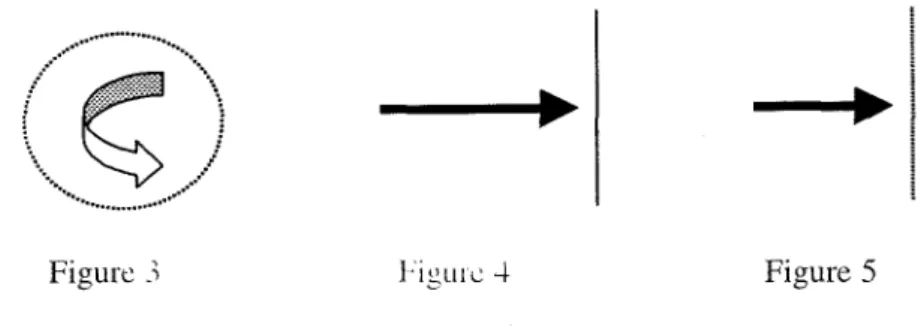
European Portuguese lexicalizes, on the one hand, the representation of an interna1 trajectory, based on a dynamic reading of the container schema by means of a construction with em. On the other hand, it lexi- calizes (exteriial) goal-oriented trajectories, iilspired on the path schema, by means of the constiuctions with até or para as depicted respectively in figures 3
.
4 and 5 below:Figure 3 l.ig~11': 4 Figure 5
Notice that the dotted circle in Figure 3 is intended to reproduce the fact that e171 in Portuguese is not be identified with a sharply delineated en- closed area with a clear boundary separating an interior section from a exterior one.
9 Cienki (1997:6) " A properly common to almost a11 iinage scheinas is that they can be realized i11 eitlier a static or a dyilamic fashion."
It must also be emphasized that in both Figures 4 and 5 the landmark con- figuration is vaguely depicted but at different degrees.
4. We shall draw some final remarks stating, once more, that the German and Portuguese languages have a large inventory of grammati- cal markers and constructions that are language-specific, conventional and cultural transmitted. Thus, "gra~nrnatical framing is not only a typo- logical feature that gives us lhe range of case rnarkirzgs possible irz a givetl language; it is also a constitutive feature of a ~oitzt of view, ofpre- sentinp events and participants, in particular wavs." Duranti (1997:336) (our emphasis).
The use of irz-constructions with dative and accusitive case assign- ments in German in conilectio~~ with wa~zderrzJahrerz/lazIfen representing, respectively, an inner trajectory and an exterior to interior trajectory, re- veals two partially, two different gestalts:
one backgrounded in the superimposition of the container schema with a path schema.
the other originated in the sequential interconnection of path/ /blockage/removal of blockagelcontainer schemas.
The Portuguese examples also depict two different gestalts through different lexicalization patterns with enz and até:
One is based upon the superimposition of a culturally configurated contaii~er-schema with the path schema.
The other establishing a vaguely configurated landmark is exclu- sively founded upon the path schema.
In both Portuguese constructions emphasis is laid on the trajector's pro- gression and not an the landmark configuration, whereas in German both the trajector's path and the landmark configuration are conceived as prominent.
If we accept (as we indeed do) that behind each conceptualization mode, i.e. each language, exists a culturally mediated entity "I, we can
figure out that the conceptualizer in the German constructions with accu- sative evidences a projection capacity that somehow perceptually follows the trajector's path into the landmarks, i.e. across physical barriers of containers, disclosing interiors", where as i11 the parallel Portuguese examples a non-mobile conceptualizer is revealed with a very limited projection capacity though a space dimension populated with vaguely shaped landmai-ks 1 2 .
This conclusion seems to be i11 accordance with the psycholinguistic line of research focusing on the fact that mental operations on image schemas are analogs of spatial operations Johnson (1987:25); Gibbs (1 995:358). Thus, some aspects of mental images reflect the operation of visual and spatial representations.
We shall center our attention on the human capacity of mentally pic- turing a "represé.~ztntiolzaI nzornerztun?", a designation for an intei-nalized representation of a physical momentum ", and namely on the "vis~~al/77(1-
nzelzt~~/.iz", i.e. the experience of seeing heavy moving things continue to
move even when encou~ltering other o b j e c t ~ . ' ~ No doubt the German con- structions witli accusative certainly evideilce this mental process since they depict the German people's ability to follow in their imagination the path of a moving entity across physical barriers of container-conceived
10 Langacker (I 99 1 : 245): "First and foreinost, a speaker apprehends the situalion fi-oin a specific place within it - froin his os her own vantage point and tiirough his or her own eyes - so that phenomenologically I-iis or her conception of it is quite different from that of a detached outside observer."
11 Deweil (1997:21) states tiiat: "Really three-dimensioiial perception of Lhe object re- quires lateral or vertical inotion by the perceiver, either walking around it to view it from anotlier angle, or reaching out to touch inore tlian one point on its surface." (our einplia- sis)
12 Dewell (ibidein): If we look at a stationary object froin a fixed single perspective w e do not get a true three-dirnensional image, at best only a 2 - -D perception of shape with deptii cues."
13 This notion was coined by Freyd and Finke (1984) apud Gibbs (1995:358) 14 Gibbs (ibidein)
landmarks and then focus on the point it will come to a rest. In our opin- ion, it certainly constitutes an example of the path-focus to end-point fo- cus transformation, as explained by Lakoff (1 987:443) in the following terms: "Follow, irz inzagirzation, the patlz of a rnoving object, arzd thelz fo-
C L I S O I Z tlze point where ir comes to I-est, or where ir will come to rest."
To sum up, in the present study emphasis was laid on the decisive role of image-schemas in the meaning coinage of spatial goal-oriented constructions in both languages. Furthermore, on studying those con- structions crossliiiguistically two different cultural models were featured: The German model grounded iiot only in the superimposition of container and path image schemas but also iii the transformation of the path schema construed on the basis of container-shaped landmarks.
The Portuguese model grouiided both in the superimposition and non-superimposition of container and path schemas by means of different lexicalizations patterns construed on the basis of vaguely shaped land- marks.
Further investigation into other symbolic constiucts will prove wliether the above studied phenomena are recurrent patterns of the German and Portuguese cultural models. We a priori believe so, since ac- cording to Duranti (1 997:337) "Larzguage is not just a represerztatiorz of
REFERENCES
Almeida, M.C. (1994), "Agenssatze im Portugiesischen und im Deutschen: eire kontrastive Analyse aus kultureller Sicht" in Thielemann, W., Welke, K. (hrsg.), Valerzz
~lzeorie - Werden, unrl Wii.K~ozg, Nokus Publikationen, Münster, pp. 101 -108
Almeida, M.C. (1995), Ti*arzsitivi&cle e tr-ajectória rzus corzcepções de abi-ir e de
cortar enz português e alerizão: arzálise pr-ototipico-urzalogista, Dissertação de
Doutorainento, Faculdade de Letras, Lisboa
Alineida, M.C. (1997a) "Agentes ou Agentes? Implicações da interacção humana em português e aleinão." in Lüdke, H.Schmidt - Radefeldt, J. (hrsg.), Lir~g~iistica con-
tinstiva Deutsclz i/eiesus Port~cgiesisch - Spanisch - Franzosisch, Gunther Narr, Tübingen,
pp. 173-1 84
Almeida, M.C. (1997b) "A semântica de prever à luz da perspectiva cognitiva",
Actas do XIII Erzcontiz> da APL, Colibri, Lisboa, pp.29-43
Almeida, M.C. (1999), "A arte de ser metáfora: estudo interlinguístico português- aleinão de índole cognitiva" in Pol.$onia 2 (Artes e línguas Vivas), pp. 59-74.
Batoréo, H.J. (1996), CorztRb~~içáo para a caracterização rla inteufnce expi.essão
lirzgí~istica - cognição espacial tzo português europeu: abordagenz psicolirzguística úu ex-
~ ~ r e s s ã o do espaço errl rzan.ativas provocaclas, Dissertação de Doutoramento, FLUL,
Lisboa
Bowennann, M. (1996a) "The Origins of Children's Spatial Seinantic Categories: Cognitive versus Linguistic Determinants" in Gumperz, J., Levinson, S., Rethinkirzg
Lirzguistic Relativitv, CUP, Cainbridge, pp. 145- 176
Bowerinann, M. (1996b), "Learning How to Structure Space for Language a Cross- Linguistic Perspective", 111 Bloom, P. et alii, Language arzd Space, MIT Press, Massachussets, pp. 385-437
Cienki, A (1 997) "Some Properties and Groupings of Image-Schemas" in Verspoor, M., Lee, D.K., Sweeter, E. (eds) (1997), Lexicnl and Syrztatical Corlstructions nrzd the
Corlsrr~~crion of Meaning, S. Benjatnins, Amesterdam, pp. 13-16
Dewell, R. (1997), "Construal Transforinations: Interna1 and Externa1 Viewpoints
i11 Interpreting Containinent" in Verspoor, M ., Dee, K.D., Sweetser, E. (eds), Lexical and
Syrztatical Constructions arzd the Coizstruction of Meartirzg, S. Benjamins, Amsterdam
Duranti, A. (1997), Anthropological Lirtguistics, CUP, Cambridge
Geererts, D. (1997) Diacl?rortic Prototype Semantics: A corztributioit to Historical
Lexicolog)~, Clarendon Press, Oxford
Gibbs, R. Colston, H. (1995), "The cognitive psychological reality of image schemas and tl-ieir transfoimations" in Cogrzifive Lirzg~~istics 6-4, pp. 347-378
Johnson, M. (1987), Tl1.e Body itz the Mirld, tlze Bodily Basis of Meaning,
Lakoff, G., (1987), Wornerz, Fire arzd Dangerous Things: Wfiat Categoi-ies Reveal
Aboclt the Mind, Chicago U. Press, Chicago
Langacker, R.W. (1987), Fourzdatioris of Cognitive Grarnrnar v. I : Tl~eoretical
Preraq~~isites, Stanford U.Press, Stanford
Langacker, R.W. (1 99 1 ), Fo~lrzdatiorzs of Cogriitive Grariinzur- 1). 2: Descr-iptii~
Al~~~licurions, Stai-iford U.Press, Stanford
Langacker, R.W. (1994), "Culture, Cognitioii and Graminar" In Putz, M. (ed),
Larlguage Corltact, Laizgciage ConJZit, J . Benjainins, Amesterdain, pp. 25-34
Langackei-, R.W. (1997), "The Contextual Bases of Cognitive Semantics" In Nuyts, J., Pederson, E. (eds), Larzgcluge arzd Concel~tualization, C.U. Press, Cambridge, pp. 229- 25 2
Levinson, S. (1996), "Relativity in Spatial Conception and Description" in Gumperz, J . Lcvinson, S. (eds), Retliirzkirig Lirzguistic Relativit)], CUP, Cambridge, pp. 177 -202
Mandler, J. (1996), "Preverbal Representation and Languagenin Blooin, P. et alii (1996), Langliage ancl Space, MIT Press, Massachusetts, pp. 365-384
Smith, M.B. (1993), "Cases as Conceptual Categories: Evidence from German" in Geiger, R., Rudzka-Ostyn, B. (eds), Conceptclalizatiorz and Mental Processing irz
Larzgciage, Mouton. de Gruyter, pp. 531-567
Smith, M.B. (1995), "Semantic Motivatioil versus Arbitrariness in Grammar: Toward a More General Account of the DATIACC Contrast with German Two-way Prepositions" in Raucli, I., Carr, G.F. (eds), blsiglzts ir1 Gerrnanic Lirzguistics:
Metliodology ir] Tr.ansiliorl, Mouton de Gruyter, pp. 276-293
Taylor, J.R. (1995a), "Models of Word Meaning in Coinparison: The Two-level Model (Manfred Bierwisch) and the Network Model (R. Langacker)" in Dirven, R., Vamparys, J. (eds), Current Apl~roacl?es to the Lexicorz, P. Lang, Frankurt, pp 3-26
Taylor, J.R. (3995b), "On Construing the World" in Taylor, J.R., Maclaury, R. (eds),
Larzguage arid Corzstrual of tlqe World, Mouton de Gruyter, Berlin, pp. 1-22
Vilela, M. ( 1 996), "A metáfora na instauração da linguagem: Teoria e aplicação",
Revista da Fac. cle Letras: L h g ~ ~ a s e Liler-arc~ms, Porto XIII, pp. 317-356
Wierzbicka, A. (1988), Tlze Semantics of Grurizirzar, J . Benjamins, Amesterdam
Wotjak, G. (1994), "Actantes y sus Correspondencias Seinanticas en Verbos",
Revista da Faccildacle de Letras Linguas e Literaturas, anexo VI - Porto 1994, pp. 71-91
Wotjak, G. (1997), "Bedeutung und Kognition: "Uberlegungen im Spannungsfeld zwisclien lexikalisclier und kognitiver Semantik" in Hoinkes, U., Dietrich, W. (hrsg),
Language Typology and
Semantic Primitive of Space:
evidence from European Portuguese
Hanrza Jak~tbowicz Batoréo
(Universidade Aberta, Lisboa)
In order to study space on a language level, we understand that first its place in the universal grammar is to be determined and then acciden- tal, language-specific characteristics of a given, particular language are to be distinguished and compared with many other different languages. To investigate and compare many diverse languages we need a powerful and universally applicable metalanguage in terms of which the compari- son can be carried out. Such a metalanguage, on the other hand, can only be constructed and verified on the basis of wide-spread crosslinguistic re- search.
After over three decades of empirical and theoretical investigations aiming at defini% universal grammar, Anna Wierzbicka has finally ar- rived at a point (Wierzbicka, 1996, 1998) in which she proposes a (hy- pothetical) set of conceptual primitives and universals based on non- technical, non-arbitrary and intuitively intelligible tertium cornparatio-
nis. The metalanguage she uses is based on empirically established lexi-
co-grammatical universals proposed as NSM (Natural Semantic Metalai~guage). The conceptual primitives Wierzbicka studies are as fol- lows: Substantives; Determiners; Quantifiers; Attributes; Mental predi- cates; Speech; Actions, events, movements; Existence and possession; Life and death; Logical concepts; Time; Space; Intensifier, augmentor; Taxonomy, partonomy; Similarity. In this proposal we can distinguish at least four conceptual primitives that cover the expression of space, i.e. the Space prime itself and partially three other ones: Time, Existence nnd
Figure 1
Concept~iul prinzitives Lexical universals
(Spatial lexical universals in bolt)
Space
WHERE(PLACE), HERE,
ABOVE, BELOW, FAR, NEAR, SIDE, INSIDE
Tirite
WHEN(TIME), NOW, AFTER, BEFORE, A LONG TIME, A SHORT TIME, FOR SOME
TIME
Existente arzrl possessiorz
THERE 1s. HAVE
Actiort, evertts, rlzovertterzts
DO, HAPPEN, MOVE
Linguistically specific space markers are defined then in function of these primes or built up by more than one of them. In the constructing task it is also possible to take some other primes into consideration, as for instance the Logical concept NOT that makes possible the constmction of marked and unmarked linguistic items or possibly some other concep- tua1 primitives, as discussed in the 'there' example below. These primes let us cover for a basic locative structuring schema defined by Leonard Talmy as a Motion situation, i.e. a situation that consists of one object moving or located with respect to another object (Talmy, 1975:182). So, for a definition of a Motion situation in European Portuguese we can con- sider the following possibilities (Figure 2).
Figure 2
(1) Space = (2) Conceptual (3) Lexical (4) E. Portuguese
Motion situation pri~nes Universais spatial markers
(nuclear examples)
Movement Action, events, movenzerlts
MOVE
Location Existerzce and possession
THERE IS, HAVE
Location Space
general location WHERE(PLACE)
vertical axe ABOVE, BELOW
distance FAR, NEAR
neighbourhood SIDE
enclosure INSIDE
deictic location [+ I ] HERE
Location Tirne
sagital axe AFTER, BEFORE
(metaphorical expression)
ir; andar
izaijel; te); se]; estar onde cima,, baixo longe, perto lado dentro aqui depois, antes/ à frerzte, atrás
Furthermore, if we want to describe, for instance, such Portuguese markers as fora ('outside') os ali ('there'), we must combine a Logical
colzcept NOT with the primitives from the Figure 2. Thus we can define
fora as NOT
+
INSIDE and ali as NOT+
HERE.But there are other possibilities. A deictic locative Portuguese form aí can be translated into English also as 'there', but it is a very specific 'there', the one that is located in reference to yo~i. For this description we need a conceptual prime included in the conceptual group of
Substantives: YOU. In such a way,
ai can be presented as (NOT
+
HERE)+
(NEAR+
YOU).ln a very similar way other spatial markers may be described, using a basic spatial schema inferred from Wierzbicka's and Talmy's proposals, on the basis of conceptual primitives, lexical universals and the schema of a motioil situation. Using Wierzbicka's minimal meaningful blocks we can account for a big part of spatial description in a given language but.. . there are some problems that still remain unsolved.
1. Typological problem
Let's focus our attention on the following problem (Example 1). In English we say He swam across the river but its literal Portuguese equivalent *Ele nadou atraves do rio is incorrect. The Portuguese equivalent of the English sentence is: Ele atravessou o rio a nado, though it is impossible to use its litteral equivalent in English: *He crossed the
river by swinz.
Example 1
(E) He swanz across the river
(Ep) *Ele nadou atraves cio rio
but
(Ep) Ele atvai~essou o 170 a nado
(E) *He crossed the river by s wi~n
In the same way we say in English that We drove over the bridge but in Portuguese we literally say: we crossed the river by car: Atravessámos a ponte de carro (Example 2):
Example 2
(Portuguese) Ati-avessán~os a ponte de carro
(went across I st pl. past the bridge by car) We drove over the bridge.
To explain this phenomenon, Talmy (1 985) postulates that event con- flation in the clause is object of linguistic variation. As we know, a Motion Situation is defined as one in which one object (Figure) is moving or located with respect to another object (Ground), whereas the respect in which one object is located or moving to another object functions as the Path (Talmy, 1975: 182). According to Talmy, some languages - as those from the Germanic family, for instante, - combine Motion with Manner in the verb (as in English swim or drive in Examples 1 and 2), while others - like Romance languages (Portuguese, Spanish, French, etc.), for exam- ple, - combine Motion with Path in the main verb (as in Portuguese atrav-
essar in Examples 1 and 2), while Manner is expressed by other means,
such as adverbial os prepositional phrases (as a nado or de carro in ex- amples above) or by relative, infinitive or gerundive clauses (see: Examples 4 and 7 below). Thus it follows that whereas English speakers
elaborate the trajectories that protagonists follow in their displacement through space, Portuguese, Spanish or French speakers provide simpler displacements with less elaborate Paths and more stative information sit- uating protagonists. This means that in English stative locations must be inferred from Paths as shown the following example from 'The Frog
Story' (Example 3) (Batoréo, 1996):
Example 3. (Englisl-i) Tlze hoy put fliefrog clobvrl irzto a jur:
In this example the present inferior frog's position is given as a re- sult of the boy's movement on the Path directed down.. In Portuguese or in Spanishl Paths must be inferi-ed from Path verbs (e.g. 'meter' = put in- side) and static locations (e.g. 'Izaver em baixo '/ 'haber nbajo' = there be (located)
+
down), as in Example 4:Example 4
(E. Poi-tuguese)
O nzerzi~ao naete~t o sapo no $-asco que havia 18
(the boy put the frog iníon tlie jar that there was there
em baixo. below).
(Spanish)
E1 ~rliizo nzeíió la runa en e1 fiasco que había ahajo
(the boy put the frog iiitoii the jar that there was below).
So, as the examples above show, the Universal Grammar we want to built on lexico-grammatical basis must not only provide us with a set of well defined conceptual primitives but also with some general lexicalisa- tion pattems. Talmy (1985) defends that these pattems are not only of spatial character but combine spatial, aspectual and causal characteristics (see: Batoréo, 1996).
1 Sometimes, though, it is dangerous to overgeneralise the basic characteristics of one language group to all the tongues classified as its mernbers, as it is discussed in Batoréo, 1996 and Batoréo & Faria, 1998.