Knowledge Transfer from Portugal Telecom to Oi: The Role of
Expatriates
João Miguel Xavier Rita
Thesis presented in partial fulfillment of requirements for the degree of
PhD in Management, with specialization in Strategy and Entrepreneurship
Supervisor:
Prof. Nelson José dos Santos António, Professor Catedrático, ISCTE-IUL Business School
Co-Supervisor:
Prof. José Duarte Moleiro Martins, Professor Adjunto, ISCAL - IPL
II
Presidente do Júri:
Doutor Fernando Alberto Ferreira, Professor Auxiliar com Agregação do ISCTE - Instituto Universitário de Lisboa
Vogais:
Doutor Hugo Emanuel dos Reis Sales da Cruz Pinto, Professor Auxiliar Convidado da Faculdade de Economia da Universidade do Algarve Doutor João Manuel do Freixo Pereira, Professor Adjunto Convidado do
Instituto Superior de Contabilidade e Administração de Lisboa
Doutor Renato Jorge Lopes da Costa, Professor Auxiliar do ISCTE-IUL Doutor José Duarte Moleiro Martins, Professor Adjunto do Instituto Superior
de Contabilidade e Administração de Lisboa
IV
ABSTRACT
The present study intends to explore the types of knowledge transferred from the headquarters to the subsidiary. As well as to clarify the role that expatriates play in the process of knowledge transfer. For this study, we used the case study of Portugal Telecom (parent) with the Brazilian Oi (subsidiary).
Quantitative and qualitative methods were applied. In order to strengthen the results obtained with the quantitative methods (questionnaires), the expatriates who were involved in the project of knowledge transfer from Portugal Telecom to Oi were also interviewed.
The study indicates that expatriates are actively involved in the areas of knowledge transfer. Finally, this study concludes with the limitations and suggestions for future research.
Keywords: Knowledge Transfer, Expatriate, Corporation JEL classification: F2, M1
V
RESUMO
O presente estudo pretende explorar os tipos de conhecimento transferido da casa mãe para a subsidiária. Bem como clarificar o papel que os expatriados desempenham no processo de transferência de conhecimento. Para este estudo é utilizado o caso de estudo da Portugal Telecom (casa mãe) com a brasileira Oi (subsidiária).
Foram aplicados métodos quantitativos e qualitativos. Com o objectivo de fortalecer os resultados obtidos via questionário (quantitativos), foram também entrevistados expatriados que estiveram envolvidos no projecto de transferência de conhecimento da Portugal Telecom para a Oi.
O estudo indica que os expatriados participam activamente nas áreas de transferência de conhecimento. Por fim, este estudo é concluído com as limitações e as sugestões para pesquisas futuras.
Palavras chave: Transferência de Conhecimento, Expatriados, Corporação Classificação JEL: F2, M1
VI
ACKNOWLEDGEMENTS
This thesis would not be completed without the guidance and the help of my supervisors, Portugal Telecom, my colleagues and my family, who have contributed and extended their valuable assistance in the preparation and completion of this study. First, my sincere thanks go to Professor Nelson Antonio and Professor José Martins, who gave me instructions and encouragement through the four years of PhD study. I extend my sincere thanks to Professor Ivo Pereira who helped in IBM SPSS software analyses.
Last but not the least, I am very thankful for my beloved family, my wife Maria Inês, my daughter Carolina, my father and mother and also my grandparents. Without their love, support, patience and inspiration my thesis would never be completed.
VII
INDEX
ABSTRACT ... IV RESUMO ... V ACKNOWLEDGEMENTS ... VI INDEX ... VII LIST OF TABLES ... XI LIST OF FIGURES ... XIICHAPTER I – CONTEXTUALIZATION ... 1
1.1 Theme / Topic and its relevance ... 1
1.2 Research Context ... 2
1.3 Research Objectives ... 3
1.4 Research Structure ... 3
CHAPTER II – LITERATURE REVIEW ... 4
2.1 Knowledge Definition ... 4
2.2 Tacit and Explicit Knowledge ... 6
2.3 Knowledge Management ... 9
2.4 Knowledge Transfer ... 12
2.4.1 Approaches to Knowledge Transfer ... 15
2.4.2 Characteristics Influencing Knowledge Transfer ... 18
2.5 Mechanisms for Knowledge Transfer ... 20
2.6 Knowledge Transfer in Multinational corporations ... 25
2.7 Expatriate ... 29
2.7.1 Expatriate and Knowledge Transfer Process ... 31
2.7.2 Role of Expatriate in Knowledge Transfer ... 33
2.8 The impact of national culture on knowledge transfers ... 35
VIII
2.10 Absorptive Capacity ... 43
2.10.1 Elements of Absorptive Capacity ... 45
2.10.2 Factors Affecting Absorptive Capacity ... 47
2.11 Motivation to Transfer ... 49 2.11.1 Job Attitudes ... 50 2.11.2 Intervention Fulfilment ... 50 2.11.3 Expected Utility ... 51 2.11.4 Climate Transfer ... 52 2.11.5 Learning Outcomes ... 54 2.12 Summary ... 55
CHAPTER III – THEORETICAL FRAMEWORK AND HYPOTHESIS DEVELOPMENT ... 56
3.1 Characteristics of knowledge ... 59
3.2 Institutional Context ... 61
3.3 National cultural context ... 65
3.4 Organizational context ... 69
3.5 Relational Context ... 71
CHAPTER IV – METHODOLOGY ... 77
4.1 Background ... 77
4.2 Research Design ... 77
4.3 Types of Data and Data Sources ... 78
4.3.1 Primary Data ... 78 4.3.2 Secondary Data ... 79 4.4 Data Collection ... 80 4.4.1 Questionnaire ... 80 4.4.2 In-Depth Interviews ... 81 4.5 Case Study ... 83
IX
4.5.1 Why It Is Suitable ... 83
4.5.2 Advantages and disadvantages of Case Study ... 85
4.6 Sampling Procedure ... 87
4.7 Measures Construction ... 89
4.7.1 Dependent Variable – Difficulty of Knowledge Transfer ... 89
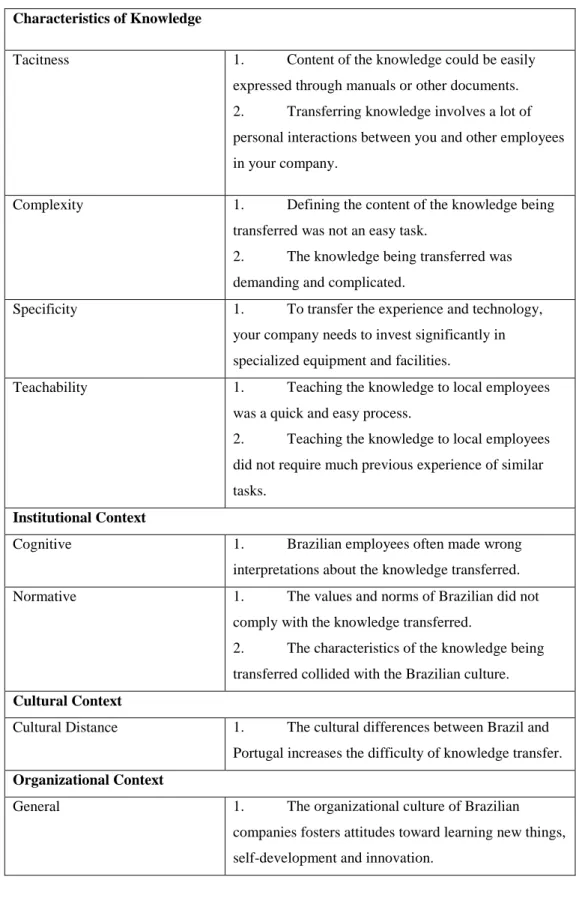
4.7.2 Independent Variables ... 90
4.8 Reliability and Validity ... 92
4.9 Ethical Considerations ... 96
CHAPTER V – RESULTS PRESENTATION AND DISCUSSION ... 97
5.1 Types of knowledge transferred ... 97
5.2 The expatriates’ role in the process of knowledge transfers ... 99
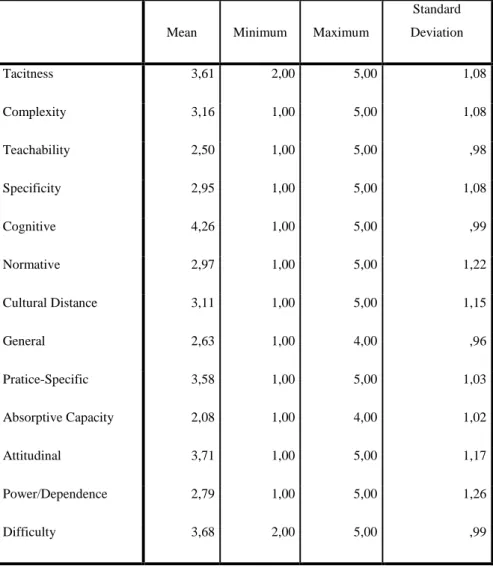
5.3 Descriptive statistics for all the variables ... 101
5.4 Analysis of Pearson Correlation Matrix of all variables ... 102
5.4.1 Correlations between the difficulty and the knowledge characteristics .... 104
5.4.2 Correlations between the difficulty and the institutional context ... 104
5.4.3 Correlations between the difficulty and the national culture context ... 104
5.4.4 Correlations between the difficulty and the organizational context ... 104
5.4.5 Correlations between the difficulty and the relational context ... 105
5.4.6 Summary of Correlations ... 105
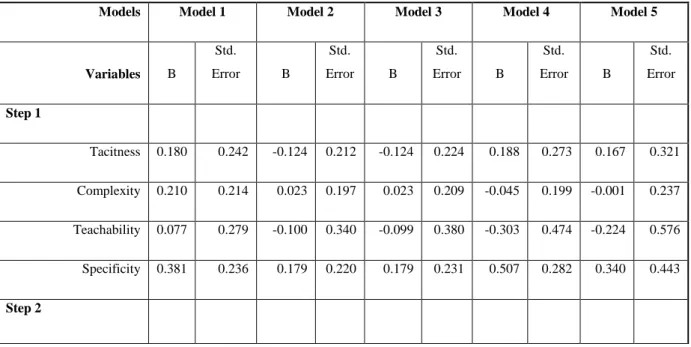
5.5 Results of regression analysis ... 107
5.5.1 Regression result of Model One. ... 108
5.5.2 Regression result of Model Two ... 108
5.5.3 Regression result of Model Three ... 109
5.5.4 Regression result of Model Four ... 109
5.5.5 Regression result of Model Five ... 109
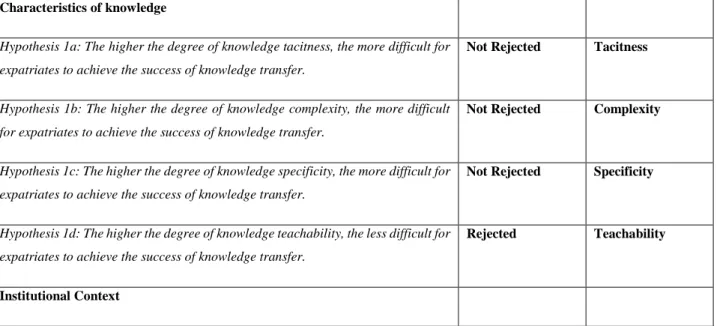
5.5.7 Summary of the regression results ... 110
X
CHAPTER VI – CONCLUSIONS ... 113
6.1 Conclusions ... 113
6.2 Limitations And Suggestions For Future Research ... 115
APPENDIX ... 116
Appendix A - Questionnaire to Expatriates ... 117
Appendix B - Interview Script ... 123
Appendix C - Interviews Resume ... 124
XI
LIST OF TABLES
Table 1 - Standard Approaches To Knowledge Transfer ... 15
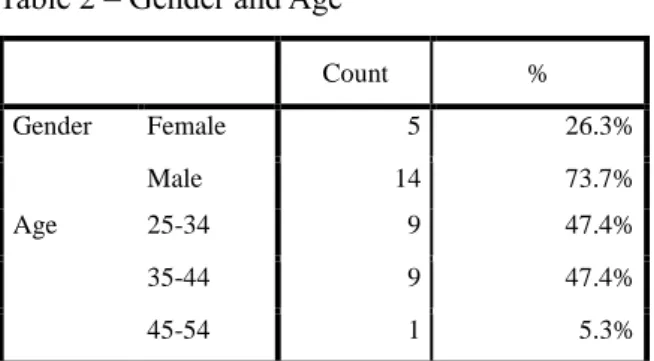
Table 2 – Gender and Age ... 88
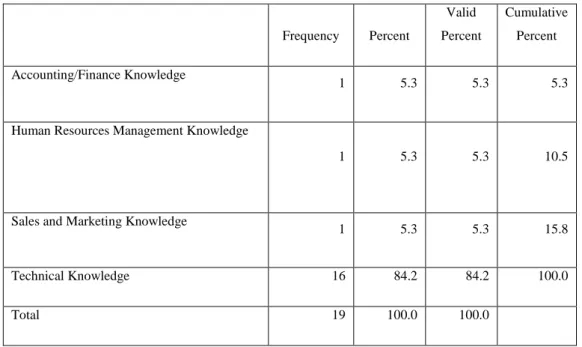
Table 3 - Area of Expertise ... 88
Table 4 - Gender and Age ... 88
Table 5 - Area of Expertise ... 89
Table 6 - Cronbach’s Alpha Measures ... 93
Table 7 - Independent variables ... 94
Table 8 - Type of knowledge transferred through expatriates ... 98
Table 9 - Areas of expatriate involvement in international knowledge transfers 99 Table 10 - Descriptive Statistics (Based on 19 samples) ... 101
Table 11 - Pearson Correlation Matrix of all variables ... 103
Table 12 - Resume of Correlation results... 105
Table 13 - Regression Analysis Model ... 107
XII
LIST OF FIGURES
Figure 1 - Variables proposed to affect the difficulty of cross-border knowledge transfers ... 58
1
CHAPTER I – CONTEXTUALIZATION
1.1 Theme / Topic and its relevance
The present study preconizes its relevance not only in cementing symbiotic bridges between the academic and business approach, by maximizing the synergistic potential of increasing the possibility of sustainability of business management models, as also to the understanding of the implied tangible and intangible variables of the equation of successful knowledge management.
The globalization of markets and production has caused a primary change of corporate strategy in many companies. The ability to create and transfer knowledge internally is one of the main competitive advantages of multinational corporations.
The multinational corporations are considered to be a differentiated network, where knowledge is created in several parts of the multinational corporations and transferred to various inter-related units (Hedlund, 1986; Bartlett and Ghoshal, 1989). Against this backdrop, knowledge, knowledge transfer, competence development in multinational corporations, and related issues have been studied both separately and in relation to each other from different perspectives within different disciplines for a long time (Boekema et al., 2000). Several recent theoretical perspectives such as the resource-based and the knowledge-resource-based views of the firm share the focus on knowledge. Both of the theories see knowledge as the most important resource and the one with the greatest potential for providing sustainable competitive advantage for the firm (Grant, 1996; Davenport and Prusak, 1998). It suggests that firm specific knowledge development is dependent upon its competitive capabilities and its ability to access and transfer such capabilities. Hence, the ability of how multinational corporations manage knowledge transfer has become one of the central issues of research in the international management literature.
Due to the critical role of international knowledge transfer within multinational corporations, there has been increasing interest in understanding the difficulties related to such transfers. This is also related to the fact that for a long time it has been recognized that such internal transfer is not very successful (e.g., Kedia and Bhagat,
2 1988; Zander and Kogut, 1995). Such difficulties have been attributed to the existence of “stickiness factors” (Szulanski, 1996; Teece 1977; Von Hippel, 1994). The term “stickiness” has been applied in various ways to capture such notions as immobility, inertness and inimitability (Szulanski, 2003, p.12). When applied more specifically to the transfer of information and knowledge, stickiness has come to represent an aggregate measure of multiple factors that block transfers, relating to the characteristics of knowledge as well as to the characteristics of the source, the recipient, and the context (Minbaeve, 2007). Accordingly, stickiness has been defined as the degree of perceived difficulty in transferring knowledge in organizations, which in turn refers to the extent of problems (e.g., communication difficulties, unmet expectations) and the extent of eventfulness (the escalation of disruptive, transfer-related problems) (Jensen and Szulanski, 2004).
1.2 Research Context
Back in 2012. Portugal Telecom was the largest telecommunications service provider in Portugal. Portugal Telecom and Brazil’s Oi agreed to merge and form a new Portuguese based-operator to leader in all Portuguese language markets and clearly compete against Telefonica. This new operator was evaluated in 17$ Billion and would be positioned to take advantage of the growth in Latin America as Europe’s phone market shrinks.
Brazil's economic and social progress between 2003 and 2014 lifted 29 million people out of poverty and inequality dropped significantly (the Gini coefficient fell by 6.6 percentage points in the same period, from 58.1 down to 51.5). The income level of the poorest 40% of the population rose, on average, 7.1% (in real terms) between 2003 and 2014, compared to a 4.4% income growth for the population as a whole. Portugal Telecom’s administrators believed that Brazil was an excellent opportunity with its huge market to invest and to become the biggest operator in the Portuguese language market.
3
1.3 Research Objectives
The goal of this study is to answer the following research question: What types of knowledge were being transferred from Portugal Telecom headquarters to Brazil’s Oi? To address this research question, we will develop a model to examine what contextual dimensions may have significant impacts. The model is based on the argument that knowledge is embedded within a set of contextual dimensions that are critical to the company’s ability to hold, utilize and extract value from the knowledge. We argue that the contextual variables at the recipient country may have different levels of impact on the difficulty of knowledge transfer to achieve the following research objectives:
Identify the types of knowledge transferred.
Clarify the participation of expatriates in these transfers.
1.4 Research Structure
This thesis is composed by six chapters. The current introduction chapter presents the study background and the objectives of the thesis. The following chapter will review research on knowledge and knowledge transfer. Based on the literature review, the third chapter develops a framework concerning the factors that influence international knowledge transfers through expatriates. In the fourth chapter, we will discuss the methodology, research design and data analysis. In the following chapter, fifth, the results and the main findings. In the final chapter, we will address the conclusions of the research study and also the limitations and the suggestions for future research.
4
CHAPTER II – LITERATURE REVIEW
2.1 Knowledge Definition
According to Awad and Ghaziri (2004), knowledge is a higher abstraction that resides in the minds of people, encompassing skills, perception, common sense, training, and experience. Gallup et al (2002) define knowledge as information whose validity is established through proof tests. Dixon (2000) points out that knowledge is the meaningful link for people who make their minds between application and information into action in a particular setting. Wiig (2004) defines knowledge as perspectives and concepts, facts, mental reference truths, models and beliefs, expectations and judgments, know-how and methodologies. Liebowitz and Wilcox (1997) describe knowledge as a whole set of experiences, insights and producers that are considered true and correct and thus guide the communication, behaviour, and people’s thoughts. Thus, knowledge is referred to as concepts, perspectives, facts and higher abstraction level that are present in people’s minds. Rennie (1999) defines knowledge as a series of knowledge know-how, what and know-who.
According to Nonaka and Takeuchi (1995), knowledge is a dynamic human justifying personal belief process towards the truth. Sveiby (1997) refers that knowledge is the capacity of an individual to act. Applehans et al (1999) point out that knowledge is the ability to turn the data and information into effective actions. Knowledge is a fluid mix of framed values, experience, expertise and contextual information insight that provide a framework for incorporating and evaluating new information and experiences. Knowledge can be created by adding value to the data through categorizing, contextualizing, calculating, condensing and correcting it (Davenport and Prusak, 2000). Thus, knowledge is the ability to act, also providing a framework for including and evaluating new information.
Desouza et al (2005) define knowledge as information in context. Knowledge is information that is combined with context, experience, reflection, interpretation, creativity and intuition. Information is referred to as knowledge when it processes in the individual’s mind. This knowledge again becomes information once it is
5 communicated or articulated to others in the form of computer output, text, writing, and spoken words or by some other means. Knowledge’s six characteristics can differentiate it from information; knowledge is the thinking residue, it is a human act, it belongs to communities, it is created in the present moment, it circulates through communities in various ways, and new knowledge will be created at the old boundaries (Groven and Davenport, 2001).
Danskin et al (2005) point out that knowledge originates at the group, individual and organizational levels. Knowledge is interpreted and used by these individual, organizational and group levels. Bennet and Bennet (2004) state that knowledge is created through various human processes involving situational, social, institutional and cultural factors. According to Bender and Fish (2000), knowledge is making use of social and intellectual contingencies that guide the communication, thought and people’s behaviours. Wah (1999) writes that knowledge is a human’s personal asset and represents the network's efforts, pooled expertise and alliances. Stewart (1997) describes knowledge as an asset like equipment or money, which exist and are worth cultivating only in the context of the strategy used to apply them. Argot and Ingram (2000) refer to knowledge as the condition or fact of knowing something with a familiarity that is gained through experience. It is the range of an individual’s understanding or information.
Knowledge consists of the cumulative experiences, attitudes and developed skills that enable personnel to systematically, consistently and effectively perform a function. It concentrates more on subtleties like understanding meaning, forming attitudes, interpreting new circumstances and making realistic application to various situations (Doz and Santos, 1997). Our understanding about knowledge is that knowledge is a awareness and understanding of something, sush as facts, information, descriptions, or skills, which are acquired through experience or education.
6
2.2 Tacit and Explicit Knowledge
According to Wang Ed et al. (2001), knowledge is categorized into two types: tacit knowledge, also referred to as personal informal knowledge, and explicit knowledge, also known as formal knowledge. Explicit knowledge is the knowledge that may be expressed in language and transferred among individuals. Tacit knowledge is the knowledge rooted in the individuals’ experience and involves people’s perspectives, beliefs and values. Nonaka (1994) states that tacit knowledge is profoundly rooted in commitment, action and involvement in a particular context. Liebowitz and Beckman (1998) point out that tacit knowledge is automatic and needs little or no time, thought and support to determine how organizations make decisions and influence collective members’ behaviour. Explicit knowledge is systematic and formal; hence it can be easily shared and communicated. Calo (2008) affirms that tacit knowledge is cognitive or technical and made up of mental values, models, beliefs, insights, perceptions, and assumptions. Technical tacit knowledge occurs when individuals master a particular body of knowledge or utilize skills that are developed gradually by the master craftsman. Cognitive tacit knowledge includes implicit mental perceptions and models that are so ingrained that are taken for granted.
Tacit knowledge is combined or grouped according to context, content and orientation. Depending on the situation and person, one or more tacit knowledge types may be used in different orientations and contexts. The knowledge of content is used to manage one’s tasks, or the tasks of others. Context is described and related to local and global situations. Local means doing the task at hand, (Noe, 2008) whereas global is how a present situation fits into the bigger picture. Liebowitz (2000) states that explicit knowledge is the tangible idea that involves words or numbers that are shared in the data form.
Ellis and Barkhuizen (2005) point out that explicit knowledge is the knowledge that is captured and written or noted down in databases or documents. Examples of explicit knowledge include written procedures, best practices, instruction manuals, lessons learned and research findings. Explicit knowledge is categorized as unstructured and structured knowledge. Examples of structured knowledge include documents, spread sheets and databases, because the information or data in them is organized in a specific way for future data retrieval. Examples of unstructured knowledge include images,
7 emails, audio and video selections and training courses, because the information is included and not referenced for future retrieval.
According to Nonaka and Takeuchi (1995), tacit knowledge is seen as being practical, subjective and analogue. It is hard and highly personal to formalize; thus, it is complex to communicate to others. It is profoundly rooted in the action and in an individual’s commitment to a particular context like a profession or a craft, a specific technology or product market or work activities of a team or group. Explicit knowledge is perceived to be theoretical, objective and digital. Explicit knowledge is systematic and formal and thus can be easily shared and communicated, such as products’ specifications, a computer programme or a scientific formula.
Hansen et al (1999) point out that explicit knowledge is technical and needs a high level of understanding or academic knowledge, which is gained through structured study or formal education. Explicit knowledge is codified, stored in a database hierarchy and can be accessed with reliable, high quality, fast information retrieval systems. Once carefully codified, the assets of explicit knowledge can be reused to solve many types or problems or connect people with reusable, valuable knowledge. Sharing processes often need major investments of money in infrastructure that is needed to fund and support information technology.
Chait (1998) refers that explicit knowledge is academic or technical data or information that is described in formal language such as mathematical expressions, manuals, copyright and patents. This systematic knowledge or know-what is readily communicated and shared through electronic methods, print and other formal means. Kogut and Zander (1992) state that knowledge transfer is divided into organization-external and internal transfer. External transfer of knowledge is of primary interest and is initiated unintentionally and intentionally by the source, occurring by chance or started by the recipient.
According to Cohendet et al (1999), tacit knowledge can be transmitted through both observation and language. Practice and imitation contribute to its transmittal. It is geographically and individually limited. People transmit tacit knowledge to others and create networks for transferring the knowledge. Ambrosini and Bowman (2001) refer that tacit knowledge is particular or specific to a context. It is rooted in craft actions or
8 professions. It utilizes specific technologies. Tacit knowledge may grow out of a team or group, and is difficult to write down. People with tacit knowledge have stickiness explaining the decision rules that support the performance. It is both technical and cognitive. The cognitive features encompass mental models of how the world works. These mental models comprise beliefs, schemata, viewpoints and paradigms. The tacit knowledge’s technical characteristic includes crafts, know-how and skills pertaining to specific contexts. Castillo (2002) writes that tacit knowledge is the kind of skills that are not codified in explicitly stated rules. Tacit knowledge is what individual people carry in their minds and find it very complex to access. Tacit knowledge transfer will happen through trust and personal contact, and this very valuable. Explicit knowledge is what is codified or documented and can be transferred easily to others. Procedures, processes, journals, drawings, manuals and similar artefacts come under explicit knowledge.
Pavlicek (2009) and Dampney et al (2002) state that the properties of tacit knowledge are highly individual and personal, residing in human minds, know-how, experts-knowledge, and experience. It is knowledge in action, learned through skills, experiences, intuitive feeling, observation, mental models, beliefs, and values. It is unstructured, difficult to see, estimate, codify, investigate, write down, formalize, capture and communicate accurately, job specific, and context-specific. It is unconscious knowledge (both unknown and known to the holder) transferred through narrative in the form of storytelling, discussions and conversation.
Explicit knowledge properties are articulated, documented and structured, learned through instruction, repetition or recitation. They can be found in journals, books, databases and other forms, and are easy to codify, recognize, store, formalize, share, communicate and use, consciously accessible, academic knowledge and know-that, know what. Kikoski et al (2004) point out that explicit knowledge is what may be embodied in a language or code. Consequently, it can be communicated and verbalized, transmitted, processed and stored relatively easily. It is public and the conventional knowledge form that can be found in journals, book and mass media like television, newspapers, and the Internet, among others. It is the sort of knowledge we are aware of using, and which may be shared in the form of scientific formulae, data, and manuals. The explicit knowledge’s ideal example is patents. On the other hand, tacit knowledge
9 is personal and very difficult to formalize as it is rooted in procedures, action, values, commitment, and emotions. Tacit knowledge is the unconventional knowledge form and is not codified.
2.3 Knowledge Management
According to Servin (2005), knowledge management is the conscious discipline. Evolved from the thinking of pioneers and academics like Peter Drucker in the 1970s, Karl-Erik Sveiby in the late 1980s, and Nonaka and Takeuchi in the 1990s. During that time, technological, social and economic changes were transforming the way firms worked. Globalization had emerged, bringing new chances or opportunities and increased competition. Companies responded by merging, downsizing, acquiring, outsourcing and re-engineering. Many streamlined their workforce and boosted their profits and productivity by using advanced network and computer technology.
Although the word knowledge management evolved in the late 1980s, it had been used for many decades earlier. Philosophers, librarians, writers and teachers had been using knowledge management for some time, with a number of notable management theorists such as Paul Strassmann, Peter Drucker and Peter Senge in the U.S. significantly contributing to the its evolution. Strassmann and Drucker stressed the growing significance of explicit knowledge and information as organizational resources and Senge focused on the learning organization that is managing the cultural dimension of knowledge. (Barton, 1995).
Classical economics theory does not fully understand the value of knowledge as an asset of an organization. However, in the mid-1980s, knowledge started to be considered an asset in terms of competitiveness, specifically with regard to the competences of professionals. Still, most organizations did not have the methods and strategies for managing knowledge. At the time, Drucker named the term knowledge worker. In the late 1980s, the ideas of knowledge were developed together with artificial intelligence, giving rise to concepts such as knowledge engineering, knowledge-based systems, knowledge acquisition, and other computer-based ontologies. In the 1990s, many consultants and academics were starting to speak about the concept of knowledge
10 management (KM), with KM becoming the new business practice. In 1995, only KM received the significant attention of organizations and corporations. KM became a rage and an alternative to the failed TQM (Total Quality Management) and re-engineering business process initiatives (Kinetika, 2008).
Ouinters et al (1997) write that knowledge management is to develop, discover, deliver, utilize and absorb knowledge outside and inside the organization through a process of appropriate management in order to meet present and future needs. According to Allee (1997), Davenport and Prusak (2000) and Alavi and Leidner (2001), knowledge management is managing the knowledge of the corporation through an organized and systematically specific process for organizing, acquiring, sustaining, sharing, applying and renewing both the explicit and tacit knowledge of employees to improve the performance of the organization and create value. Gupta et al (2000) point out that knowledge management is the process that supports organizations to select, find, organize, transfer, and disseminate the essential information and expertise necessary for their activities.
Bhatt (2001) describes knowledge management as the process of knowledge validation, creation, presentation, application and distribution. Holm (2001) refers that knowledge management is all about doing things at the right time, obtaining the right information for the right people, helping people share the knowledge and act on information. According to Horwitch and Armacost (2002), knowledge management is the extraction, creation, storage and transformation of the correct information and knowledge to design better policy, modify the action and deliver outcomes. Abell and Oxbrow (2001) state that it is the creation and management of an environment that encourages knowledge to be shared, created, learned, organized, enhanced and utilized for the organization’s benefit and that of its customers.
Skyrme and Amidon (1997) point out that knowledge management is the systematic and explicit management of vital knowledge and associated processes of creating, organizing, disseminating, gathering, using and exploiting it. It needs turning staff knowledge into corporate knowledge, which should be widely shared throughout the organization and applied appropriately. According to the Office of the e-Envoy (2002) (currently known as British e-Government Unit), knowledge management is a corporate
11 discipline and a new approach to harnessing, identifying and exploring collective organizational talents, information, know-how and expertise. Nonaka and Takeuchi (1995) refer that knowledge management is the organization’s capability to create new knowledge and disseminate it to the entire organization, embedding it in goods, services and systems.
O’Leary (1998) write that knowledge management is managing the knowledge of the organization by structuring, disseminating, creating and applying it to enhance the performance of organizations. Alavi and Leidner (1999) refer that knowledge management is the process of organizing, acquiring and communicating the employee’s knowledge so that others can be more effective in their work. Andriessen (2004) points out that knowledge management is the process of obtaining, organizing and communicating knowledge. Newman (1992) argues that knowledge management is the processes that govern the creation, dissemination and knowledge utilization. Kinetika (2008), defines knowledge management as the integral and systematic approximation that permits monitoring, managing and sharing knowledge within the organization. According to Afrazeh (2009), knowledge management is the process of confirming, creating, presenting and applying knowledge. Sturgeon et al (2008) state that knowledge management is the process through which an organization produces the knowledge and intellectual value-based property. Foss et al (2002) describe knowledge management as the activity or process of creating, possessing, obtaining, sharing and applying any knowledge. It is the learning result that provides the only sustainable-pooled expertise, particular relationships and alliances, and the value-added activities and behaviour. Levinson (2008) refers that knowledge management is the process through which organizations generate value from their intellectual and knowledge-based assets. Generating value from such knowledge-knowledge-based and intellectual assets involves codifying among departments, partners, employees, customers know and sharing the information.
Sveiby (1997) refers that knowledge management is the leveraging of the company’s intellectual assets to meet defined business objectives. Wang and Xiao (2009) state that knowledge management is the process of gaining intelligence and experience in an organization and using knowledge management for nurturing innovation through
12 continuous learning. It supports organizations to become more flexible and act as learning environments. For knowledge management, we intended that is the process of creating, sharing, using and managing the knowledge and information of an organization.
2.4 Knowledge Transfer
Szulanski (2000) writes that knowledge transfer is a process in which an organization creates and maintains complex, ambiguous routines in a new setting. Argot and Ingram (2000) point out that knowledge transfer is a process in which one unit, such as a division, group or department, is affected by another’s experience. Knowledge transfer is the process through which knowledge, expertise, capabilities and skills are transferred from the knowledge base. The purpose of knowledge transfer is to facilitate and catalyse innovation (Robert Ed et al, 2012). Watson and Hewett (2006) describe the storage and codification of existing knowledge into knowledge databases or repositories that will help access and use knowledge in future. Gooderham (2006) refers that new knowledge is the process of assimilation or accumulation of knowledge in the receiving unit. Thus, knowledge transfer is the process through which capabilities, skills and knowledge are transferred.
According to Christensen (2007), knowledge transfer is identifying previous and accessible knowledge and apply it in order to solve particular tasks faster, cheaper and better. For Riege (2007), knowledge transfer is the priority application of knowledge to new learning. Lucas (2006) refers that knowledge transfers are an attempt made by an entity to copy particular knowledge type from another entity. Wong et al (2003) point out that knowledge transfer is a systematically organized process that exchanges skills and information between entities. Inkpen and Tsang (2005) describe knowledge transfer as a process through which one relationship partner will be affected by another’s experience.
Schwartz (2006) argues that knowledge transfer is the unidirectional, focused knowledge communication between groups, individuals or organizations and that the knowledge recipient has a cognitive understanding and the capacity to apply the knowledge. According to Ko et al. (2005), knowledge transfer is a dyadic
13 organizational knowledge exchange between a source and a unit of a recipient where the recipient identity matters. OECD (2000) points out that knowledge transfer is the professional dissemination of knowledge from one person to another. Gold et al (2001) state that knowledge transfer is the act of transferring knowledge from one individual to another by means of training, mentoring, documentation and other forms of collaboration.
Gopalakrishnan and Santoro (2000) describe knowledge transfer as a more inclusive construct directed at perceiving the antecedents for action in an environment. Foss et al (2002) point out that knowledge transfer is the transfer of either external market or expert global relevant information. Doz and Santos (1997) refer that knowledge transfer is the process of transferring operationalization knowledge. This will happen in the form of information, data, parts, blueprints, machines, subassemblies or other form of information to represent knowledge. Knowledge transfer is generally based on five elements: the perceived knowledge value of the source unit, the motivational source disposition, the transmission channel’s existence and richness. The motivational receiving disposition unit and the absorptive capacity of the receiving unit have the ability to access and use the knowledge (Gupta and Govindarajan, 2000). Davenport and Prusak (2000) state that knowledge transfer is the communication that involves both information transmissions to a recipient and transformation and absorption by that group or person.
Watson and Hewett (2006) write that knowledge transfer is the learning aspect through which one can obtain knowledge from an external entity. According to Ngoc (2006), knowledge transfer is influenced by a set of three factors, namely context-related, knowledge nature-related and source and recipient-related factors. Concerning the source and recipient-related factor, the absorptive and retentive capacity and the motivation either hinder or facilitate the process of knowledge transfer. Regarding the knowledge nature, the higher level of tacit knowledge is more difficult in the process of knowledge transfer, for tacit knowledge will not be codified and transferred. For tacit knowledge transfer to be effective, it requires more involvement and interaction between the source and recipient. Thus, the context-related factor encompassing leadership, organizational culture, and the infrastructure of information technology, the richness and availability of communication system inside a firm are very critical in
14 creating a condition for knowledge transfer. Thubbas (2001) states that knowledge transfer is the objective-oriented knowledge transmission from a group, an individual or organizational entity to another group, and individual or organizational entity. Probst et al (2003) point out that knowledge transfer is the knowledge transmission from a sender to a receiver.
According to Goh (2002), knowledge transfer needs the willingness of the individual or group to work with others and transfer knowledge to their mutual benefit. Without a sharing process, knowledge cannot be transferred to another person. This indicates that the transfer of knowledge will not occur in an organization unless its work groups and employees denote a high co-operative behaviour. Bender and Fish (2000) state that knowledge cannot be transferred from individual to individual nor from individual to group or team, the same applying to group or team to individual or team or group to group or team. Carlile and Rebentisch (2003) point out that knowledge transfer is the area of KM that is concerned with knowledge movement across boundaries and that is created by domains of specialized knowledge.
Hooff and Ridder (2004) refer that knowledge transfer involves either actively consulting others to learn what they know or actively communicating to others what they know. When employees or firms within an organization identify knowledge that is critical to them, then they can use the mechanisms of knowledge transfer to acquire that knowledge. In an organization, knowledge transfer at higher levels includes product line, group, division or department. The process of knowledge transfer has two components: the sender or source that shares the knowledge and the receiver who acquires the knowledge.
According to Liebowitz and Wilcox (1997) and Nonaka and Takeuchi (1995), knowledge transfer is the knowledge management aspect. Tirana (2001) writes that knowledge management encompasses knowledge innovation, creation, access, database development, retrieval, and transfer. Knowledge transfer occurs when actionable information and knowledge are exchanged or imported within the system and adds value. For us, knowledge transfer is the process of transferring knowledge from one part to another.
15 2.4.1 Approaches to Knowledge Transfer
According to Seidman and McCauley (2005), the common formal approaches to knowledge transfer are: knowledge management systems, instructor-led training, operational and management process binders, and e-learning systems. KM (knowledge management) systems are those that transfer knowledge using search engines, database, and communities of practice, portals and other technologies. E-learning systems use Internet technology in order to transfer slide driven, self-paced, and self-tested content. The process of operational and management binders are lengthy compilations of expert content. By following the procedures, clients will be able to learn and apply it to the content. Instructor-led training is classic training, very common in most organizations.
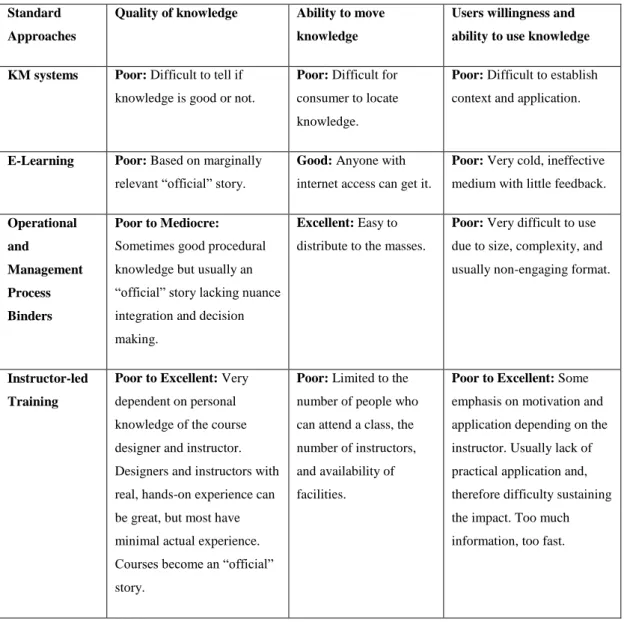
Table 1 - Standard Approaches To Knowledge Transfer
Standard Approaches
Quality of knowledge Ability to move knowledge
Users willingness and ability to use knowledge
KM systems Poor: Difficult to tell if
knowledge is good or not.
Poor: Difficult for
consumer to locate knowledge.
Poor: Difficult to establish
context and application.
E-Learning Poor: Based on marginally
relevant “official” story.
Good: Anyone with
internet access can get it.
Poor: Very cold, ineffective
medium with little feedback.
Operational and Management Process Binders Poor to Mediocre:
Sometimes good procedural knowledge but usually an “official” story lacking nuance integration and decision making.
Excellent: Easy to
distribute to the masses.
Poor: Very difficult to use
due to size, complexity, and usually non-engaging format.
Instructor-led Training
Poor to Excellent: Very
dependent on personal knowledge of the course designer and instructor. Designers and instructors with real, hands-on experience can be great, but most have minimal actual experience. Courses become an “official” story.
Poor: Limited to the
number of people who can attend a class, the number of instructors, and availability of facilities.
Poor to Excellent: Some
emphasis on motivation and application depending on the instructor. Usually lack of practical application and, therefore difficulty sustaining the impact. Too much information, too fast.
16 Table 1 illustrates the standard approaches to, and conditions for transferring knowledge. Knowledge management systems are very ineffective at transferring knowledge for many reasons. They have only minimal capability for distinguishing between poor and good knowledge, make it complex for the user to find and isolate the appropriate information needed, and give little useful information in order to facilitate application. KM systems are very expensive to implement. Even though knowledge management systems have received the essential amount of publicity in recent years, overall KM systems are the least cost-effective approach for knowledge transfer (Seidman and McCauley, 2005).
According to Seidman and McCauley (2003), e-learning systems are very effective at training functions that are highly proceduralized, and efficient in enabling many users to review the content. However, e-learning systems are sometimes problematic. They are usually developed by consultants and training groups with some direct functional experience. Most e-learning systems are boring, although they can be enhanced with programmed learning, sharp graphics and streaming video. E-learning is passive learning for the users. It does little to guide immediate knowledge application, motivate learning or sustain use of knowledge, and, like knowledge management systems, it may be expensive. Purchasing or developing the underlying system of learning management is expensive and changing the classroom training into e-materials may be expensive. Seidman (2004) points out that the process binder describes a different picture. Content quality in process binders differs tremendously depending on how the content matters. Sometimes true subject matter experts participate in content creation. This tends to transfer knowledge in a more realistic and valuable manner, which is better than the knowledge held by the population. When the subject experts join or participate in content development, binders are usually very official and procedural, containing operational checklists and specific lists that quickly become out-dated. Process binders lack in trade-offs, nuances guidelines and integration for real decision-making, and these are essential for better knowledge. Even though the binder’s process is inexpensive to distribute and develop, it often fails regarding the customer’s ability, willingness and better knowledge to use the knowledge criteria. Instructor-led training is a more difficult picture. Training is the common form of formal knowledge transfer in any organization, but like other knowledge transfer approaches, it has only mixed
17 success. The training quality is dependent on the development process, especially the subject matter expert’s role and on the skills and knowledge of the instructor. When experts who are highly experienced on the subject are profoundly involved in the development of course materials and actively participate in the learning experience, instruction can be truly extraordinary. Courses that are well designed and delivered may not always provide superior content, but can motivate learners who attend them in order to learn and use content. Still, few instructor-led courses are extraordinary. But most of the time, the content of courses is developed by professional instructional designers with minimum functional knowledge. Thus, in order to achieve effective knowledge transfer, these approaches have to be altered and developed. (Seidman and McCauley, 2003).
According to Augier and Vendelo (1999), tacit knowledge is highly individual and attainable only through personal experience and practice, and diffusion is impossible with this type of knowledge. Nonaka and Konno (1998) refer that language and perception are the main stickiness in transferring tacit knowledge. Unconsciousness is the problem for people (recipient), who are unaware of the knowledge’s full range. Whereas formalized explicit knowledge can be identified easily in oneself, the feeling of a missed connection or intuition fundamentals (perception) are very difficult to be viewed and identified. Another difficulty with the language is intangible tacit knowledge, which will be in a non-verbal form. For most people, expressing something natural will be challenging and hard. Deeper knowledge and more experience direct to higher knowledge tacitness and this leads to greater stickiness in expressing the knowledge.
Augier and Vendelo et al (1999) stress that time is another important factor of stickiness. Time also increase the challenges for transferring tacit knowledge. Internalizing this tacit knowledge needs a long time for both organizational and individual forms of knowledge. Zack (1999) points out that value is another stickiness posing a challenge in transferring tacit knowledge and explicit knowledge. Many tacit knowledge forms, like rule-of-thumb and intuition have not been considered much valuable. Value is associated with certain forms of measurement. Tacit knowledge is extraordinary and unusual. Knowledge is a valuable asset, so, when transferring tacit knowledge, the source has to be carefully valued through his/her knowledge.
18 Holtshouse (1998) and Leonard and Sensiper (1998) point out that distance also raises stickiness when transferring tacit knowledge. To transfer tacit knowledge face-to-face interaction is necessary, but organizations tend to disperse into more distant, global or virtual forms. Thus, face-to-face interaction is not possible in some cases, and this will definitely increase stickiness, particularly when transferring tacit knowledge.
Likewise, Haldin-Herrgard (2000) states that language, perception, value, distance and time are the stickiness associated with transferring tacit knowledge. The inherent tacit knowledge qualities, like hard to articulate (Spender, 1995), non-codification (Nonaka and Kanno, 1998), complication in warehousing (Hansen, Nohira and Tierney, 1999), and difficulties in communication (Ambrosini and Bowman, 2001) work as a catalyst to the barriers of knowledge transfer. Stenmark (2000) wrote that tacit knowledge is very elusive when compared to explicit knowledge. The stickiness and causes of failure in the process of externalization are due to unawareness of our own tacit knowledge. On a personal level, we are not interested in making it explicit that is in codified format and we do not want to give up our most valuable competitive advantage.
Davenport and Prusak (2000) point out that several frictions (cultural factors), like different cultures, lack of trust, giving reward and status to the knowledge owners, vocabularies, narrow idea of productive work, frames of references, treating knowledge as a prerogative of specific groups, and lack of time and meeting places, slow or prevent knowledge transfer and erode certain knowledge, and attempts to move through the organization. They also suggested that people who share general and common work culture will communicate better, thus making the transfer of knowledge more effective. Easterby-Smith, Lyles and Tsang (2008) refer that the meaning of strategically significant knowledge can be destroyed or distorted when the knowledge is transferred to a different culture.
2.4.2 Characteristics Influencing Knowledge Transfer
The characteristics that influence knowledge transfer are those of the source and recipient, knowledge and context. The source and recipient characteristics encompass the source’s reliability, the source’s abiliy to explicate knowledge, the receiver’s absorptive capacity, which is assimilation, acquisition, exploitation and transformation
19 of knowledge and also the motivation of both partners. These high value characteristics positively influence both the unintended and intended knowledge transfer (Szulanski, 1996). According to Matusik and Hill (1998) and Simonin (1999), the characteristics of knowledge include specificity, ambiguity, dependency, complexity of other tacitness and knowledge. The characteristics of the context in which knowledge transfer occurs are subdivided into categories, namely compatibility, relationship, protection, and infrastructure measures.
Van Wijk et al (2008) and Williams (2007) point out that governance means the set of policies and processes affecting the way the knowledge transfer is administrated, directed or controlled. To choose the governance mechanisms, two knowledge characteristics are proposed: context ambiguity and content ambiguity. Content ambiguity is the content of knowledge transfer that is being partial and ill structured because of non-codification, non-verbalization and complexity. Context ambiguity is the adaptability of knowledge transfer, which is contingent on the context, and the knowledge is transferred due to its specificity.
Szulansky (1996) noted that the presence of internal stickiness (barriers) impedes knowledge transfer within an organization. The origin of the stickiness depends on the characteristics of the knowledge source, on the characteristics of the knowledge transferred, on the characteristics of knowledge recipient, and on the characteristics of the context. Regarding the characteristics of the transferred knowledge, casual ambiguity refers to the stickiness to detect a cause for a fact. When a correct reason for the failure or success of a practice cannot be identified, then the knowledge involved will identify the critics of its transfer, and potential invalidity, that is, knowledge without the proven record of past success is more difficult to transfer. The characteristics of knowledge source include lack of motivation on the part of the source of knowledge, who feels he/she will not have the incentives for transferring the knowledge to others, and not being perceived as reliable, as the more trustworthy and experienced the source is, the more he/she will influence the recipient. One of the characteristics of the knowledge recipient is lack of motivation, which will affect the knowledge transfer. Accordingly, both the recipient and the source should have incentives to accept the source’s role. Another characteristic is lack of absorptive capacity, meaning that the recipient is unable to exploit the external knowledge source,
20 and lack of retentive capacity, which means that the knowledge transfer will only be effective when the recipient is able to retain and use what is transferred. The new knowledge institutionalization indicates the retentive capacity. The characteristics of the context are: barren context of organization, that is, a context that hinders the process of knowledge communication; arduous relationship, since when tacit knowledge is involved, mutual trust and a good relationship among employees is necessary. Communication has to be quick and easy, otherwise people will prefer not to communicate.
According to Araujo and Novello (2004), Jensen and Szulanski (2004), Iliev (2004), Rerup and Szulanski (2004), and Majumdar (2000), knowledge stickiness is the propensity of a specific form of knowledge to remain within the organization boundaries or other specific contexts. Szulanski et al (2004), Szulanski and Jensen (2006), von Hippel (1998), Voelpel (2006), and Mahoney and Williams (2003) point out that stickiness illustrates how difficult it is for knowledge to transfer outside a particular context. Szulanski (1996) refers that knowledge stickiness occurs due to the existence of professional and organizational antecedents. Szulanski noted that importing new organizational practices from an international context into a national organization mostly failed to fulfil the management’s expectations
2.5 Mechanisms for Knowledge Transfer
Carpenter et al (2005) point out that the key elements of knowledge transfer are audience, messenger, message, activities and evaluation or effects. It is essential to define the target audience for knowledge transfer. The potential users of knowledge may vary widely in terms of their needs and background. This may encompass media representatives, academics, volunteers and nonprofit organizations. According to Abernathy et al (2001), the message should be clear and easy to understand, concise ,that is, must be easy to read, consistent, that is, must be related to information and to the concept. It should depend on a body of knowledge. The source of the transfer of knowledge should be given credit so that the message is passed in a more effective manner.
21 Lovers et al (2003) write that some activities of knowledge transfer, for example face-to-face interaction or meetings, are more interactive than others, such as producing resources for information. For the effective transfer of knowledge, audience is more important. Examples of activities of knowledge transfer include delivering workshops and presentations, developing a new website or using an existing one, producing information resources like fact sheets, reports and tip sheets, creating video or audio tapes, producing training materials like tool kits, manuals and similar, participating in conferences, seminars and fora related to the knowledge, holding discussion and roundtable meetings, using local media for announcements, announcements, interviews, publishing articles, and arranging on-site visits or field trips. Evaluation explains the effects that are expected as an outcome of transferring the knowledge. These effects may take place in the organization or in the recipients of that knowledge. According to Truch et al (2002), the key steps in the process of knowledge transfer are: identifying critical knowledge to manage, implementing a successful transfer methodology, engaging key personnel, providing support and recognition, and the process of measuring, assessing and refining if necessary. Knowledge transfer begins with an assessment of knowledge risk. Beginning the knowledge transfer requires analysing certain questions for all levels of employees, such as: what knowledge is required in order to perform a function successfully? What is the most efficient way to articulate, capture and transfer this knowledge? It is significant that not all knowledge transfer is worth retaining. For example, some knowledge may be alternatively outsourced to experts or grow obsolete due to technology advancement. It is crucial to engage personnel in knowledge transfer throughout their careers in order to capture both micro and macro knowledge and tacit and explicit knowledge. Knowledge sharing is a circular process that starts with the new employee’s orientation through the employee’s continuing development, concluding with the sharing of the experience of the employee who is nearing retirement. At this phase, we have focused on who holds the knowledge to perform the function successfully and who needs to receive the information in order to function properly.
Tsai (2001) points out that when implementing the successful methodology for knowledge transfer, the methods of knowledge transfer range from face-to-face storytelling to difficult computer systems. Anyhow, costly and large systems and
22 programmes alone will not transfer the knowledge. The most significant method is informal exchange among people, built on trust and interpersonal relationships. Successful methods for knowledge transfer need leadership commitment, clear measures and goals, recognition and rewards for achievement, and adequate resources and support. In this phase it is critical to recognize diversity as a key component of knowledge transfer. In providing support and recognition, supervisors, managers and leaders of knowledge transfer need to recognize the successful transfer of knowledge by rewarding and encouraging employees who actively engage in the activities of knowledge transfer. Leaders have to actively communicate the knowledge transfer value programmes and also participate in those programmes. Knowledge transfer programmes include measures and assessments that are reflected in performance compensation and reviews. Short-term incentives like award programmes improve these larger efforts of organizations.
Trott (1995) writes that measuring, reassessing and refining this phase as needed is the follow-up to the process and is needed to ensure the organization continues the transfer meaningful knowledge. Knowledge holders and knowledge recipients have to be accountable for successes and failures. In this phase, they need to analyse whether the knowledge that is assessed is still relevant and they have to measure the effectiveness of the transfer methodology. Flexibility in changing the methodologies of knowledge transfer is necessary to facilitate diversity and accommodate differences in learning styles, barriers caused by gender, age or cultural differences. Gibran, cited in Cortada and Woods (1999), states that the most effective or appropriate transfer mechanism and/or knowledge communication depends on the knowledge type that is to be transferred. From an explicit point of view, knowledge is captured in words, documents and images and also communicated and distributed through technology. Tacit knowledge requires human contact to be distributed. Tacit knowledge occurs between two people or within a community or team. The transfer mechanisms have both explicit and tacit knowledge dimensions.
The mechanisms for knowledge transfer are documentation, use of experts technology, face-to-face, physical transfer and communities and networks. Dixon (2000) developed a model in order to link the transfer mechanisms types. Serial transfer refers to a team that will acquire knowledge by doing tasks that can be transferred to the next time when
23 they do them in a different setting. Near transfer using the explicit knowledge of the team, gained by doing a repeated and frequent task. The organization prefers to replicate this kind of knowledge transfer to the other teams who are doing the similar task. Far transfer uses the tacit knowledge from that team, which gains knowledge by doing a non-routine task, and the organization may prefer to make it available to other teams doing a similar task in the other part of the organization. When a transfer is far, then the knowledge of the donor or source team must be translated and changed, so that it is applicable to the receiving team.
Hackett (2000) points out that knowledge that can be described with the help of language, that is, explicit knowledge, can be documented. This is a common way of obtaining and communicating knowledge. The explicit knowledge is codified, directly understood, and can also be transferred easily through either written or verbal instructions. Documentation is an essential part in the process of knowledge transfer, especially if the organization is geographically dispersed and has many employees. Dixon (2000) claims that timing is the essential factor in documenting the explicit knowledge. It is possible to construct and collect knowledge in real time, rather than relying on team members’ memory reasoning and past events. Explicit knowledge can be codified, collected and documented, so that it can be used again. Nonaka and Takeuchi (1995) state that tacit knowledge is tough to transfer while writing it down. The tacit knowledge that can be transferred includes using analogies, metaphors and models.
According to O’Dell and Grayson (1999), most organizations recognize that technology like email, Lotus notes, and databases are effective ways to distribute explicit knowledge. Lei et al (1999) point out that the availability of computer-based technology models, components and inter-intra network connectivity may essentially improve the rapid, multi-location, and multi-level sharing of innovation, knowledge and progress status on all fronts. On the other hand, Davenport and Prusak (1998) defend that technology may not be the most effective form for knowledge transfer. Successful knowledge transfer involves neither documents nor computers, rather interactions among people. They also believe that approaches to knowledge management that overemphasize technology are less effective than creating human knowledge sharing processes, organizational change and changing behaviours. Person-to person
24 communication includes all the elements that facilitate the most effective communication, encompassing control over the format, words, voice tone, non-verbal actions, immediate feedback, physical, environmental exchange, and informal exchange. On the other hand, email contains only words.
Face-to-face mechanisms are considered to be the most effective for tacit knowledge communication (Dixon, 2000; Hackett, 2000; Davenport and Prusak, 1998; Nonaka and Takeuchi, 1995; and Wenger et al, 2002). According to Davenport and Prusak (1998), knowledge transfer can work only if people are interacting face-to-face. Transferring tacit knowledge to explicit knowledge is too complex and subtle to express in words. According to Stanley (2001), some organizations use experts to transfer knowledge in particular topic areas, as experts can transfer their experiences and ideas to recipients All employees must be experts in some field, and people will accept the user's knowledge more easily when organizations accept their own knowledge. Appointing some people as experts over others may result in a change in the knowledge sharing dynamic between the two sides that has a negative impact on the knowledge transfer process.
O’Dell and Grayson (1998) point out that the actual knowledge transfer of people from one place to another is the effective way for knowledge transfer and practices in organizations. With a physical transfer of people we can transfer implicit, tacit and explicit knowledge.
According to Gamble and Blackwell (2001), the existence of communities of practice and informal networks is an effective way for knowledge transfer within organizations. Probust et al (2000) point out that self-managing teams act as an effective vehicle for transferring knowledge, motivating individuals and getting organizational work done.
25
2.6 Knowledge Transfer in Multinational corporations
Due to the increasing global integration of business activities, firms are facing enormous pressure to adopt global strategies. As a result, an increasing number of multinational corporations have been set up. To achieve global strategies, the issue of international knowledge transfer has received wide attention. Doz, Santo, and Williamson (2001) pointed out that “globalization meant ‘teaching the world’ from headquarters, or from subsidiaries in advantaged locations or dominant clusters” (p.10). So, the ability to create and transfer knowledge internally is one of the main competitive advantages of multinational corporations.
As globalization has increased, the knowledge needed to compete in the global economy no longer resides in one location; rather, it is globally dispersed. The importance of interdependencies and knowledge transfer across multinational corporation organizational units has been recognized and extensively discussed (Doz & Prahalad, 1991; Ghoshal and Bartlett, 1988; Gupta and Govindarajan, 1995; Hedlund and Nonaka, 1993). Bartlett and Ghoshal (1989) considered that the multinational corporation is a differentiated network where knowledge is created in several parts of the multinational corporation and is transferred to various inter-related units. They defined international learning as the development and sharing of knowledge across national boundaries.
Kogut and Zander (1993) described the superior ability to transfer knowledge at the international level as a primary source for multinational corporation’s competitive advantage and growth. Barney, Wright and Ketchen (2001) argued that the multinational corporations sustained competitive advantage has become increasingly tied to its ability to share knowledge among its globally dispersed operations. The primary reason why multinational corporations exist is that their ability to transfer and exploit knowledge is more efficient and effective in the intra-corporate context than through external market mechanism (Gupta and Govindarajan, 2000).
Since Hymer introduced the view of “internalization of intangible assets” in 1960, the nature of firm-specific advantages and their transfer across borders have been the central issue in the theory of the multinational corporations. A principle belief is that the primary advantage that a firm brings to foreign markets is its possession of superior
26 knowledge. Overall, foreign direct investment is the transfer of the knowledge underlying technology, production, marketing, or other activities, which embodies a firm’s advantage. Although the external markets continue to become more open, efficient, and global on an ongoing basis, they remain relatively ineffective in terms of knowledge transfer, which could be attributed to two facts. First, much of the specialized knowledge of firms exists in tacit and thereby non-tradable form.
Likewise, Kogut and Zander (1992) claimed that much of the knowledge that can lead to a competitive advantage is tacit and not easily shared. Second, market-based transfers of knowledge are often related to negative externalities such as involuntary expropriation and the risk of creating a new competitor. Therefore, multinational corporations can only transfer the knowledge effectively through internal mechanism. The idea of multinational corporations as knowledge networks has been elaborated by Gupta and Govindarajan (1991). The main idea of their concept is that multinational corporations can be thought of as a network of multidirectional knowledge transactions among units located in different countries. Network approaches to multinational corporations emphasize the importance of internal transfers of knowledge between headquarters and subsidiaries (Bartlett and Ghoshal, 1989).
The basic premise of these approaches is that competitive advantages can be achieved from the capacity of transferring knowledge to those multinational corporation’s sub-units where it will add value. A precondition for this is that the geographically dispersed units are able to transfer knowledge to other multinational corporation’s units as well as adopt knowledge generated there. This capacity of world-wide knowledge transfer becomes essential to support transnational organizational learning and to enhance the holistic perspective of multinational corporations.
Similarly, Chung (2001) suggested firms typically invest abroad for either one of two purposes. The first purpose is to exploit their existing capabilities. From the traditional perspective, Kogut and Zander (1993) defined a multinational corporation as ‘an economic organization that evolves from its origins to spanning across borders’. Multinational corporations are attracted to invest in developing markets where they can exploit their unique capabilities (Chung, 2001). The headquarters serves as the source of innovation and knowledge for the rest of the organization (Gupta and Govindarajan, 1991).