Decorative renders simulating stone of middle 20th century in
the region of Lisbon
Maria do Rosário Veiga1, António Santos Silva2, Cláudia Martinho3, Paulina Faria4
(1) Buildings Department, National Laboratory for Civil Engineering, [email protected] (2) Materials Department, National Laboratory for Civil Engineering, [email protected] (3) Dep. Civil Engineering, FCT, NOVA University of Lisbon, [email protected] (4) CERIS and Dep. Civil Engineering, FCT, NOVA University of Lisbon, [email protected]
Abstract
Housing and public urban buildings of the middle 20th century period, in Portugal, are characterized by a sober, rather severe, architectural and constructive design, known as “Estado Novo” period. In the region of Lisbon, the façades of many of those buildings are covered with a very durable unpainted decorative type of render, called “marmorite”. Considering that cementitious binders were already often used in that period, both in structural elements and in coatings, and due to the darkening effect of fungus, soiling and pollution, there was a generalized belief that marmorite renders were cement-based mortars. As a consequence, repair interventions used materials and techniques chosen for cementitious renders. However, the characterization of the
marmorite render of the National Laboratory for Civil Engineering main building, in
Lisbon, revealed that the render was composed by air lime, limestone and marble. Later, an experimental characterization campaign of samples of marmorite renders of 20 other buildings in the region of Lisbon revealed that they were generally composed by air lime, sometimes coloured with an inorganic pigment, and mainly limestone and marble aggregates of different colours selected to obtain an aesthetic effect.
Introduction
Housing and public urban buildings of the middle 20th century period, in Portugal, are characterized by a sober, rather severe, architectural and constructive design. It is the so-called Estado Novo Portuguese style, that integrates the late modernism period. In the region of Lisbon, many of those buildings were covered with very durable unpainted decorative renders, simulating stone, known as “marmorite” renders,
expression that could be translated as something like “marbled” renders or “marmoreal” renders (Figures 1-3).
A special application technique was used to obtain the stone effect, consisting on: application of a common regularization render layer; application of a finishing render layer with a mineral binder and aggregates selected to obtain an aesthetic effect, usually of limestone or marble nature; short drying period for partial hardening; washing of the superficial skin of the binder in order to let the aggregates visible; very careful curing to avoid cracking of the render, which was rich in binder to provide a good key for the aggregates.
These marmorite renders were used both in public buildings of some importance, such as Lisbon University (1961) and National Laboratory for Civil Engineering – LNEC (1952) (Figure 1), and in housing urban buildings of the same period for medium and medium-high classes (Figures 2 and 3). They have also been used to retrofit older housing urban buildings, some for rent.
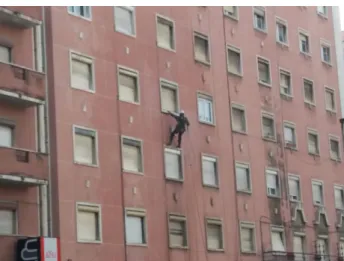
Being a very durable kind of render, after more than 5 decades, they show few anomalies, such as some cracks, stains and fungi and punctual erosion and lacunae (Figure 3).
Figure 1 – Façade of LNEC main building covered with marmorite render: a) General view; b) Detail of marmorite
In Institutional buildings, neutral colours were used (combinations of grey and cream colours) (Figure 1), while in housing buildings several colours, such as red-pink, green and yellow, were adopted by adding inorganic pigments to the binder and choosing marble and limestone aggregates of matching colorations (Figures 2-3).
This finishing technique for these façades is thought to be based in techniques of the same type used in Central Europe in the period between wars [1, 2]. However, the
mortars were artisanal, produced in situ, opposite to most of the Central European ready-mixed mortars reported in literature.
Considering the period – middle 20th century – in which cementitious binders were already often used, both in structural elements and in coatings, and due to the darkening effect of fungi, soiling and pollution, there was a generalized belief in the technical milieu that these decorative renders were cement-based mortars. This belief was enhanced by the existence of an official specification document referring the use of a cement mix [3].
Figure 2 – Façades covered with colourful marmorite renders of Av. De Roma, Lisbon
As a consequence, repair interventions on those building façades used materials and techniques chosen for cementitious renders.
In 2006 a restoration of the main building of the National Laboratory for Civil Engineering, in Lisbon, was planned. It is a building of the late modernism period in Portugal, constructed between 1950 and 1952, designed by a team coordinated by the architect Porfírio Pardal Monteiro, one of the most reputed building designers of that period [4, 5]. The façade is rendered with a cream/light grey coloured marmorite (Figure 1), which presented dark stains and some cracks. To guarantee a suitable restoration, the original render has been analysed, from the points of view of material, performance and technique. It was then verified that the marmorite render had been applied with a thickness variable between 5 and 8 mm, on a first coat of hydraulic render and was composed at 95 % by calcium carbonate [6] meaning that the binder was air lime, opposite to expectations.
Was this building an exception? It was possible to identify and interview some retired old masons that applied marmorite in the past and the majority also referred that
cement was the binder used. But they also explained that the formulation of the
marmorite mortar was generally kept secret by the expert professionals [7].
A large experimental campaign was later accomplished to clarify the composition of
marmorite renders of that period, in the Lisbon region. Samples of 20 buildings from 3
different districts (Lisbon, Santarém and Setúbal) were collected and characterized from the chemical, mineralogical, microstructural, physical and mechanical points of view [8].
Revealing the materials and compositions used and highlighting the employed technique, this study aims at gathering information in order to allow the planning of suitable, compatible interventions and in this way contributing for the preservation of this characteristic decorative render.
Figure 3 – Pink-red traditional marmorite render in Lisbon: a) General view during cleaning; b) Detail of red/pink marmorite
Materials
Samples of marmorite renders were collected in the districts of Lisbon, Santarém and Setúbal (within the region marked by the red circle in the map of Portugal mainland - Figure 4), in LNEC´s main building, located in a heavy car and plane traffic, and in housing buildings mainly of the decades 1950-1960, with different colours. It should be noticed that the collection of samples was generally only allowed by the owners in the case of renders with anomalies and in limited quantity and dimensions. Such low quantities permitted chemical, mineralogical and microstructural tests, but in many cases were not enough for physical and mechanical testing (Figure 5).
Figure 4. Map of Portugal mainland signalizing the region were the samples were collected
Figure 5. Samples of differently coloured marmorites collected
Methods
The tests used for the characterization of the samples were [6, 7]:
a) Mineralogical, chemical, petrographical and microstructural tests:
X-ray diffraction analysis (XRD) in a Philips PW3710 X-ray
diffractometer, with 35 kV and 45 mA, using Fe-filtered Co Kα
radiation of wavelength λ = 1.7903 Å.;
Thermogravimetric and differential thermal analysis TGA/DTA) performed in a Setaram TGA92 analyser, under argon atmosphere
(3 L/h) and using platinum-rhodium crucible of 50 µl capacity, with heating rate of 10 °C/min, from room temperature to 1000 °C.; Soluble silica, sulphates and alkalis content evaluation was made by
gravimetric and atomic absorption spectrometry analysis;
Granulometric analysis of the sand (separated from the binder by a controlled acid digestion according to a LNEC internal protocol for mortar samples with limestone aggregates) and stereozoom observation of the obtained granulometric fractions;
Observation of vacuum impregnated polished and thin sections by optical microscopy (OM), using Olympus PMG3 and BX50 microscopes;
Scanning electron microscope (SEM) coupled with an energy dispersive X-ray microanalysis system (EDS). The SEM used was a JEOL JSM-6400, and the EDS is an INCA X’Sight detector from Oxford Instruments. Samples were gold sputtered, and the acceleration voltage used was 15 kV using the backscattered electron image mode (BSE).
b) Physical tests:
Open porosity by the method of hydrostatic weighing based on EN 1936 [9];
Mercury intrusion porosimetry (only one case);
Water absorption by capillarity by a method based on EN 15801 [10] and adapted for irregular samples [11] (Figure 6 a);
Compressive strength using a method based on EN 1015-11 [12] and adapted for irregular samples [11] (Figure 6 b), using a Hoytom S.L., model HM-S equipment, with load cells of 200 kN and 2 kN.
Figure 6. Physical and mechanical testing: a) Water absorption by capillarity; b) Compressive strength
Results and Discussion LNEC main building
The results of the characterization of the marmorite of LNEC’s façade are presented in tables 1 and 2 and in Figure 7.
Table 1 – Chemical, mineralogical and granulometric results of LNEC’s marmorite samples [6, 4]
Sample XRD TGA/DTA IR and grain size distribution Chemical analysis (wt. %) b/a (wt.) LNEC’s main building Mainly calcite, some quartz and traces of hematite 95 % calcium carbonate IR: 2.5%; Soluble fraction: 2.5%; Grain size distribution mainly 1.25 to 2.5 mm Sodium: 0.02; Potassium: 0.03; Sulphates: 0.36; Soluble silica: 0.50 1:1
IR – Insoluble residue in acid; b/a – binder/aggregate ratio
Table 2 – Physical results of LNEC’s marmorite samples [4, 8]
Sample Bulk density
(kg/m3) Porosity (%) MIP Coefficient of capilarity (kg/(m2.min1/2)) Façade of LNEC’s main building – tests in 2006 2330 12 (MIP technique) Bimodal structure with the following peaks: 0.02 and 0.5 µm 0.48 Façade of LNEC’s main building – tests in 2017 2056 20 (hydrostatic weighing technique) - 0,56 - Curvas de distribuição 0,00E+00 1,00E-02 2,00E-02 3,00E-02 4,00E-02 5,00E-02 6,00E-02 0,001 0,01 0,1 1 10 Raio (micrometros) dV /d log r MLNEC-1.PRD MLNEC-2.PRD
The results of the characterization tests, presented in table 1, allowed to establish the composition of the LNEC´s marmorite render as mainly constituted by about 95 % calcite and small proportions of quartz and hematite, as well as some contamination with sulphates, probably from the environmental pollution. The very low alkalis and soluble silica contents indicated that there are no hydraulic compounds. The aggregates, of limestone and marble, are constituted by subangular grains from under 0.075 - 2.5 mm with predominance of the fraction 1.25 – 2.5 mm.
The main physical characteristics, presented in table 2, indicate relatively low porosity with a bimodal structure with critical pore size of 0.5 µm and capillary coefficient considered low when compared with other air lime mortars [11, 13, 14].
Housing buildings
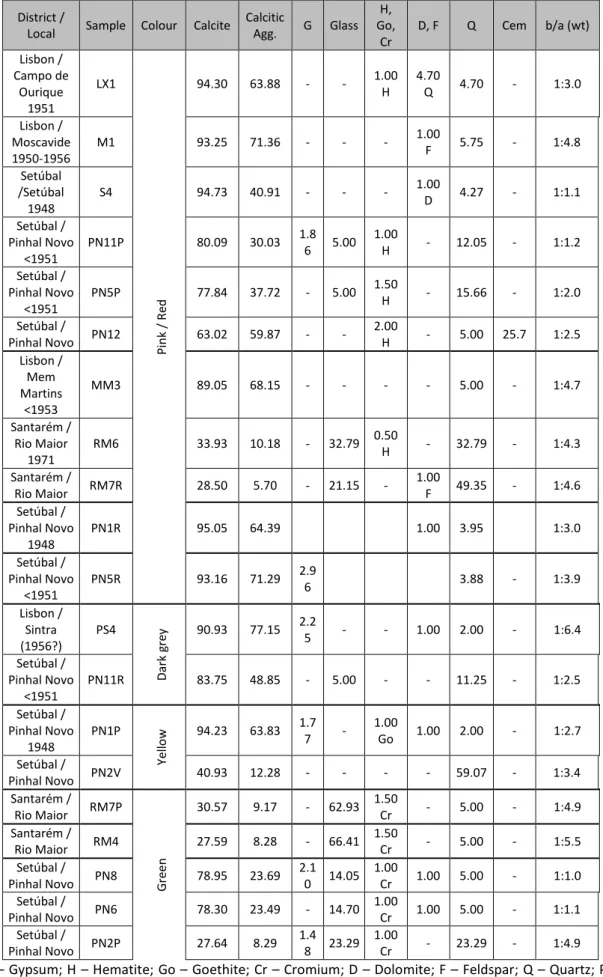
The analysis of 20 samples of marmorite renders extracted from building façades of 3 districts in the Lisbon region showed thicknesses varying between 2 and 8 mm, applied on a thicker coat of render. The results of the samples, distributed by colour, in order to highlight the pigments used, are summarized in table 3 and allow to conclude that the samples are mostly composed by air lime as a binder and mainly calcitic aggregate, in some cases with also dolomitic and siliceous grains and sometimes including glass residues.
The composition data also confirm that the colours of the binder were obtained with oxides: hematite for red, goethite for yellow and chromium oxide for green, which were the colours commonly used. The aggregate was chosen in order to match these colours.
The proportions binder:aggregate, in weight, are very variable, from about 1:1 (PN8, PN6, PN11) to about 1:6 (PS4, RM4). However, for those with low content of binder, it is possible that, for such thin samples, surface washing and erosion may have influenced some reduction of the binder content.
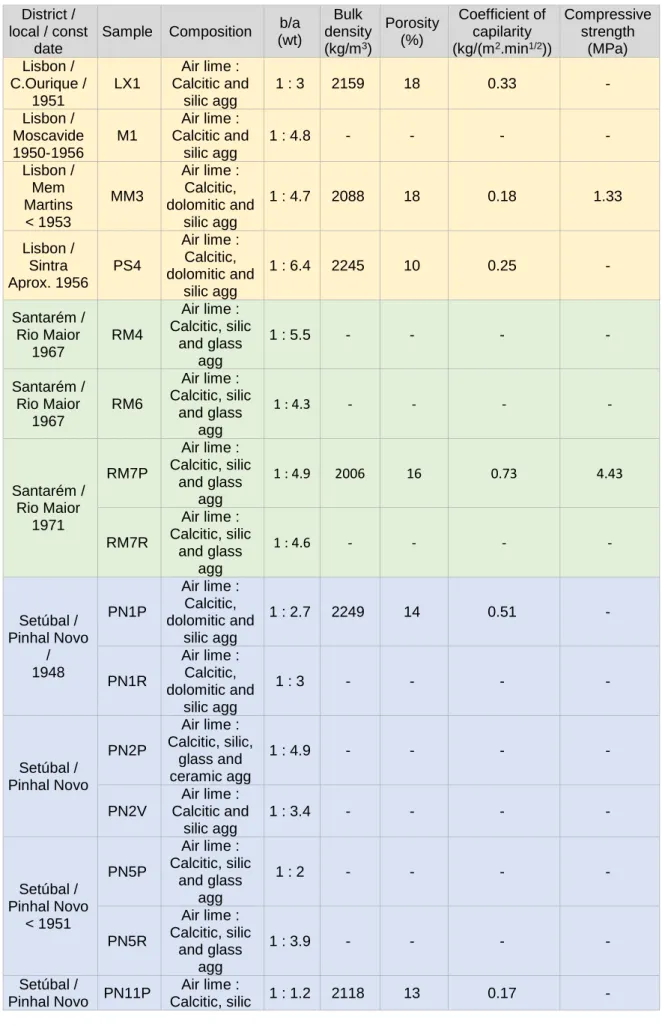
A synthesis of the composition, together with the results of physical and mechanical characterization, are presented in table 4, for the samples now organized by district and not by colour, in order to investigate local influences. As referred before, only part of the samples could be tested for bulk density, porosity and water absorption by capillarity and only 3 could be subjected to the determination of compressive strength (Figure 6), due to size limitations.
Table 3 – Compositional results of marmorite samples
District /
Local Sample Colour Calcite
Calcitic Agg. G Glass H, Go, Cr D, F Q Cem b/a (wt) Lisbon / Campo de Ourique 1951 LX1 Pin k / R ed 94.30 63.88 - - 1.00 H 4.70 Q 4.70 - 1:3.0 Lisbon / Moscavide 1950-1956 M1 93.25 71.36 - - - 1.00 F 5.75 - 1:4.8 Setúbal /Setúbal 1948 S4 94.73 40.91 - - - 1.00 D 4.27 - 1:1.1 Setúbal / Pinhal Novo <1951 PN11P 80.09 30.03 1.8 6 5.00 1.00 H - 12.05 - 1:1.2 Setúbal / Pinhal Novo <1951 PN5P 77.84 37.72 - 5.00 1.50 H - 15.66 - 1:2.0 Setúbal / Pinhal Novo PN12 63.02 59.87 - - 2.00 H - 5.00 25.7 1:2.5 Lisbon / Mem Martins <1953 MM3 89.05 68.15 - - - - 5.00 - 1:4.7 Santarém / Rio Maior 1971 RM6 33.93 10.18 - 32.79 0.50 H - 32.79 - 1:4.3 Santarém / Rio Maior RM7R 28.50 5.70 - 21.15 - 1.00 F 49.35 - 1:4.6 Setúbal / Pinhal Novo 1948 PN1R 95.05 64.39 1.00 3.95 1:3.0 Setúbal / Pinhal Novo <1951 PN5R 93.16 71.29 2.9 6 3.88 - 1:3.9 Lisbon / Sintra (1956?) PS4 Dar k g re y 90.93 77.15 2.2 5 - - 1.00 2.00 - 1:6.4 Setúbal / Pinhal Novo <1951 PN11R 83.75 48.85 - 5.00 - - 11.25 - 1:2.5 Setúbal / Pinhal Novo 1948 PN1P Ye llo w 94.23 63.83 1.77 - 1.00 Go 1.00 2.00 - 1:2.7 Setúbal / Pinhal Novo PN2V 40.93 12.28 - - - - 59.07 - 1:3.4 Santarém / Rio Maior RM7P G re e n 30.57 9.17 - 62.93 1.50 Cr - 5.00 - 1:4.9 Santarém / Rio Maior RM4 27.59 8.28 - 66.41 1.50 Cr - 5.00 - 1:5.5 Setúbal / Pinhal Novo PN8 78.95 23.69 2.1 0 14.05 1.00 Cr 1.00 5.00 - 1:1.0 Setúbal / Pinhal Novo PN6 78.30 23.49 - 14.70 1.00 Cr 1.00 5.00 - 1:1.1 Setúbal / Pinhal Novo PN2P 27.64 8.29 1.4 8 23.29 1.00 Cr - 23.29 - 1:4.9
G – Gypsum; H – Hematite; Go – Goethite; Cr – Cromium; D – Dolomite; F – Feldspar; Q – Quartz; P – Portlandite; Cem – Cement; Si – Silica; b/a – binder / aggregate ratio
Table 4 – Composition and physical and mechanical results of marmorite samples District /
local / const date
Sample Composition b/a (wt) Bulk density (kg/m3) Porosity (%) Coefficient of capilarity (kg/(m2.min1/2)) Compressive strength (MPa) Lisbon / C.Ourique / 1951 LX1 Air lime : Calcitic and silic agg 1 : 3 2159 18 0.33 - Lisbon / Moscavide 1950-1956 M1 Air lime : Calcitic and silic agg 1 : 4.8 - - - - Lisbon / Mem Martins < 1953 MM3 Air lime : Calcitic, dolomitic and silic agg 1 : 4.7 2088 18 0.18 1.33 Lisbon / Sintra Aprox. 1956 PS4 Air lime : Calcitic, dolomitic and silic agg 1 : 6.4 2245 10 0.25 - Santarém / Rio Maior 1967 RM4 Air lime : Calcitic, silic and glass agg 1 : 5.5 - - - - Santarém / Rio Maior 1967 RM6 Air lime : Calcitic, silic and glass agg 1 : 4.3 - - - - Santarém / Rio Maior 1971 RM7P Air lime : Calcitic, silic and glass agg 1 : 4.9 2006 16 0.73 4.43 RM7R Air lime : Calcitic, silic and glass agg 1 : 4.6 - - - - Setúbal / Pinhal Novo / 1948 PN1P Air lime : Calcitic, dolomitic and silic agg 1 : 2.7 2249 14 0.51 - PN1R Air lime : Calcitic, dolomitic and silic agg 1 : 3 - - - - Setúbal / Pinhal Novo PN2P Air lime : Calcitic, silic, glass and ceramic agg 1 : 4.9 - - - - PN2V Air lime : Calcitic and silic agg 1 : 3.4 - - - - Setúbal / Pinhal Novo < 1951 PN5P Air lime : Calcitic, silic and glass agg 1 : 2 - - - - PN5R Air lime : Calcitic, silic and glass agg 1 : 3.9 - - - - Setúbal / Pinhal Novo PN11P Air lime : Calcitic, silic 1 : 1.2 2118 13 0.17 -
< 1951 and glass agg PN11R Air lime : Calcitic, silic and glass agg 1 : 2.5 2254 13 0.47 - Setúbal / Pinhal Novo PN6 Air lime : Calcitic, dolomitic, silic and glass agg 1 : 1.1 - - - - Setúbal / Pinhal Novo PN8 Air lime : Calcitic, dolomitic, silic and glass agg 1 : 1 1983 21 0.88 - Setúbal / Pinhal Novo PN12 Cement : Calcitic, and silic agg 1 : 2.5 2205 21 0.04 31.03 Setúbal /Setúbal / 1948 S4 Air lime : Calcitic, dolomitic and silic agg 1 : 1.1 - - - -
All the cases present air lime as a binder, with the exception of PN12 (in Setúbal / Pinhal Novo), which is a cementitious render. As it is the only case, it is possible that it is a substitution render applied in an intervention.
The aggregates vary depending on local geology and on vogue/fashion. The aggregates of the Lisbon cases are mainly calcitic, namely of limestone and marble origin, sometimes also dolomitic, with small proportions of quartz. The case studies of Santarém, which are the most recent of the analysed group, all have calcitic and siliceous aggregates and include glass residues as a part of the aggregates. In Setúbal the case studies are the oldest and have a more heterogeneous mix of aggregates, including glass and ceramic pieces in one case, besides calcitic, dolomitic and small proportions of quartzitic aggregates.
The physical characteristics, synthetized in table 4, evidence that porosity is also very variable, between 10 % (PS4) and 18 % (LX1 e MM3), nevertheless lower than the usual values for air lime mortars [15] which are generally in the order of 20-30 %. Capillary coefficients obtained are of the same order of magnitude as those obtained for LNEC’s marmorite: between 0.18 to 0.73 kg/(m2.min½). Porosity, capillary absorption and also bulk density point out to vary compact mortars, which is consistent with the artisanal technique used of squeezing against the substrate, followed by washing to remove superficial binder and by careful curing conditions. The few results of compressive strength obtained (only three samples included pieces with the dimensions needed for this test) show moderate results for air lime marmorite mortars (1.33 and 4.43) and a very high value for the cement marmorite render (31 MPa for PN12).
With the short sampling that was possible to test, it is not possible to find a pattern of correlation between binder:aggregate ratio and porosity, capillary coefficient or compressive strength. Nevertheless, this lack of correspondence is common in air lime renders, as there are many other factors with overlapping influence, such as the technique of application (namely the squeezing against the substrate and the application and curing conditions), the water absorption of the aggregates and of the substrate, and the packing of the aggregates.
Conclusions
In the decades of 1940-1960, in the region of Lisbon, a decorative type of render with a finishing thin layer simulating stone, with visible aggregates, known as marmorite render, was commonly used.
Although most of those buildings already had a structure of concrete, or at least partially of concrete (for example concrete slabs between floors supported by structural masonry walls), it was verified that marmorite render was an air lime render with mainly carbonate aggregates of marble and limestone. That was not in accordance with what was gathered in interviews to old masons differncet that could be explained both by the secrecy that involved the marmorite mortars formulation and by the fact that those old masons consider cement as the “new” building material that presented a revolution on their old way of building, therefore, they prefer to remember and to talk about building with cement.
In Institutional buildings, the renders presented neutral colours, obtained by the selection of the raw materials (white calcitic air lime and chosen aggregates) while in housing buildings different colours were used, obtained by the addition of inorganic pigments and selection of matching marble aggregates. The pigments found were hematite, goethite and chromium oxide, according to the typical façade colours: red/pink, yellow and green. Those coloured façades originated picturesque quarters, typical of the modernist zones of Lisbon. In some areas, usually out of the centre of towns, more open colouring was chosen, through the use of glass and ceramic residues, clearly showing the joyful individual taste of their owners.
Marmorite renders that still protect and decorate many façades in the region of Lisbon
are now aged of more than fifty years. Most of them never had any maintenance operations in this period and they still present efficient conditions, with suitable cohesion and adhesion, due to well-chosen materials and a careful and efficient application technique. Therefore, apart from effective technical characteristics, one can say they have a low embodied energy because the environmental impact is divided by a long period without maintenance and repair materials. In the last decade many of them started decaying, partly due to traffic pollution that attack carbonate materials and to the corrosion of reinforcing steel bars of some of the concrete substrates. Due
to lack of knowledge about their composition and their particular application technique, the interventions were directed to the painting of the façades, hiding the
marmorite render sometimes in an irreversible way and completely changing the
brightness, the typical colour tonalities and the whole image of those quarters.
Therefore, revealing the materials and compositions used, this study intends to generate data to allow the planning of suitable, compatible interventions and the preservation of these durable and specific render.
Acknowledgements
Acknowledgements are due to Portuguese Foundation for Science and Technology for supporting project DB-Heritage - Database of building materials with historical and heritage interest (PTDC/EPH-PAT/4684/2014), to LNEC through the project PRESERVE - – Preservation of renders and plasters of the Built Heritage with Cultural Value, and to the old masons that were possible to interview.
References
1. Govaerts Y, Verdonck A, Meulebroeck W, De Bouw M (2015) Development of artificial stone imitations at the turn of the 20th century through patent analysis in a Belgian context. Proc. of 5th Int. Cong. on Construction History, Vol. 2, 229-236. 2. Dekeyser L, Verdonck A, De Clercq H (2015), Belgian Craftsmanship in the interwar
period: formulas and application techniques of decorative cement-based wall finishes. Int J Archit Herit 11:621-635.
3. Laboratório Nacional de Engenharia Civil (1952) – Execução de marmorites. LNEC, Lisboa: 1952. Especificações. E 5 – 1952.
4. Veiga R, Tavares M, Magalhães AC, Santos Silva A, et. al. (2006) Reparação das fachadas de marmorite do Edifício Principal do LNEC. Relatório /2006 NRI.
5. Veiga R, Tavares M, Magalhães A C (2007), Restauro da fachada em marmorite de cal do Laboratório Nacional de Engenharia Civil, em Lisboa. Materiais, métodos e resultados. In Proc. VII Simpósio Brasileiro de Tecnologia de Argamassas (STBA), Recife, Brasil.
6. Martinho C (2007), Marmorite: caracterização e contributo para a sua conservação. Master Thesis presented at NOVA University of Lisbon.
7. CEN (2006) Natural stone test methods. Determination of real density and apparent density, and of total and open porosity. CEN, EN 1936-2006.
8. CEN (2009) Conservation of cultural property. Test methods. Determination of water absorption by capillarity. CEN, EN 15801.
9. Magalhães A, Veiga, M R (2009) Physical and mechanical characterisation of ancient mortars. Application to the evaluation of the state of conservation. Mater Construcc 59(295): 61-77. DOI: 10.3989/mc.2009.41907.
10. CEN (1999) Methods of test for mortar for masonry. Determination of flexural and compressive strength of hardened mortar. CEN, EN 1015-11.
11. Veiga M R, Fragata A, Velosa A L, Magalhães A C, Margalha M G (2010) Lime-based mortars: viability for use as substitution renders in historical buildings. Int J Archit Herit 4 (2): 177-195.
12. Damas A L, Veiga M R, Faria P, Santos Silva A (2018) Characterisation of old azulejos setting mortars: a contribution to the conservation of this type of coatings. Constr Build Mat 171: 128-139.
13. Veiga M R (2017), Air lime mortars: what else do we need to know to apply them in conservation and rehabilitation interventions? A review. Constr Build Mat 157:132–140.
VEIGA M.R., SANTOS SILVA A., MARTINHO C., FARIA P. (2019), Decorative renders simulating stone of middle 20th century in the region of Lisbon. HMC2019 - 5th Historic Mortars Conference, 19-21 June 2019, Pamplona. RILEM Proceeedings PRO 130, José Ignacio Álvarez, José María Fernández, Íñigo Navarro, Adrián Durán, Rafael
Sirera (Eds.), ISBN: 978-2-35158-221-3, e-ISBN: 978-2-35158-222-0, 931-943. https://www.rilem.net/publication/publication/494?id_papier=11341




![Table 2 – Physical results of LNEC’s marmorite samples [4, 8]](https://thumb-eu.123doks.com/thumbv2/123dok_br/19220929.962687/7.892.142.734.585.1102/table-physical-results-of-lnec-s-marmorite-samples.webp)