Impact of hexenuronic acids on xylanase-aided bio-bleaching of chemical pulps
Anatoly A. Shatalov
*, Helena Pereira
Centro de Estudos Florestais, Universidade Técnica de Lisboa, Instituto Superior de Agronomia, Tapada da Ajuda, 1349-017 Lisbon, Portugal
a r t i c l e
i n f o
Article history:
Received 27 October 2008
Received in revised form 12 January 2009 Accepted 14 January 2009
Available online 23 February 2009 Keywords: Hexenuronic acid Xylanase Bio-bleaching Chemical pulp Brightness
a b s t r a c t
Hexenuronic acids (HexA) of hemicellulosic heteroxylan were shown to play important role in brightness development of chemical pulps during xylanase-aided bio-bleaching. Industrial wood (eucalypt) kraft pulp and a few non-wood (giant reed) organosolv pulps were pre-treated with commercial xylanase preparations (endo-1,4-b-xylanase activity; EC 3.2.1.8) and bleached by simplified bleaching sequence. The HexA performance was examined and compared with control (enzyme-free) samples. The xylan-ase-assisted direct brightening effect, noted immediately after an enzymatic stage, was proved to be caused by exclusive HexA removal with solubilized HexA-carrying xylooligosaccharide fractions. Aldo-hexa- and aldopentahexenuronic acids (Xyl5-HexA and Xyl4-HexA) were found as predominant
oligosac-charides, accounting for up to 65% of total acidic oligomers in enzymatic hydrolyzates. A strong positive correlation (R2= 0.91) was established between further brightness improvement of xylanase-treated
pulps during subsequent chemical bleaching (bleach boosting) and the content of HexA. This underlined the role of HexA as one of the key factors in definition of final brightness of bio-bleached pulps, determin-ing to a large extent the bleachdetermin-ing efficiency of xylanase application as a whole.
Ó 2009 Elsevier Ltd. All rights reserved.
1. Introduction
Acidic heteroxylan (arabino-) 4-O-methylglucuronoxylan is a principal non-cellulosic polysaccharide of many industrially important wood and non-wood (agro-fiber crop) species. In alka-line pulping, 4-O-methylglucuronic acid (MeGlcA) side-groups at-tached to the xylan backbone are degraded by about 75–90% (Buchert et al., 1995, 1997a). The residual MeGlcA are partially
converted to unsaturated 4-deoxy-b-L
-threo-hex-4-enopyranosylu-ronic acid groups (hexenu-threo-hex-4-enopyranosylu-ronic acid or HexA) by b-elimination of methanol directly or via the intermediate product
4-O-methylidu-ronic acid (Clayton, 1963; Johansson and Samuelson, 1977;
Simkovic et al., 1986). HexA was identified as a major uronic acid (UA) substituent both of the industrial kraft pulp and of some unconventional alkali-based organosolv pulps, accounting for 83–
88% of total UA (Buchert et al., 1997a; Shatalov and Pereira, 2004).
The interest to HexA has quickened in the last decade, as a re-sult of the revealed HexA capacity to affect negatively the follow-ing pulp bleachfollow-ing and the properties of bleached pulps as well (Jiang et al., 2000). In fact, the bi-functionality of HexA, i.e., the presence of enol ether and unsaturated carboxylic acid group, makes it an easy target for both electrophilic and nucleophilic at-tacks during bleaching. The HexA reactions with electrophilic bleaching chemicals, such as chlorine dioxide, ozone and peracids,
increase consumption of these chemicals (Vuorinen et al., 1999).
The capacity of HexA to bind heavy metal ions affects indirectly consumption of other bleaching chemicals, such as hydrogen
per-oxide (Devenyns and Chauveheid, 1997). Oxidative degradation
of HexA (e.g., during ozonation) causes formation of calcium
oxa-late deposits in the bleaching equipment (Elsander et al., 2000).
HexA consume permanganate during the standard procedure of kappa number determination, commonly used (particularly in
industry) for lignin quantification in pulps (Li and Gellerstedt,
1997). Finally, the HexA can modify optical properties of bleached
pulps by decreasing brightness and increasing brightness reversion (Buchert et al., 1997b).
The enzymatic pulp pre-treatment with highly specific hemicel-lulolytic enzymes (particularly with endo-1,4-b-xylanase activity, EC 3.2.1.8) before chemical bleaching (so-called bio-bleaching) has attracted considerable recent interest as a potential environ-mentally benign biotechnological approach. Xylanases allow to re-duce consumption of active bleaching chemicals (particularly the chlorine-based) and to increase the final brightness ceiling of
bleached pulps (Tolan et al., 1996; Yang et al., 1992). The beneficial
effect of xylanases on kraft pulp bleaching is attributed to the selective hydrolysis of xylan re-precipitated on the fiber surface and therefore improving fiber permeability to bleaching reagents
and degradation products (Kantelinen et al., 1993), or to the
in-creased extractability of lignin–carbohydrate complexes (LCC), what facilitates the pulp delignification during subsequent
chemi-cal bleaching steps (Paice et al., 1992).
Only limited published data are available about the effect of HexA on the bleaching performance of xylanases, whereas this 0960-8524/$ - see front matter Ó 2009 Elsevier Ltd. All rights reserved.
doi:10.1016/j.biortech.2009.01.020
* Corresponding author. Tel.: +351 21 363 4662; fax: +351 21 364 5000. E-mail address:[email protected](A.A. Shatalov).
Contents lists available atScienceDirect
Bioresource Technology
kind of information is of considerable practical importance since it allows defining the contribution of carbohydrate-derived chro-mophores in the bleaching mechanism of xylanases, thereby assuming the better control of brightness development during the entire bleaching process. In the scale of pulp and paper indus-try, as one of the most capital-intensive ‘‘heavy” industries in the world, even moderate change (increase) in pulp brightness can have tremendous economical effect.
To assess the role of HexA in bio-bleaching of chemical pulps, the fate of HexA during xylanase-aided bleaching of different pulps has been studied and correlated with brightness development after each bleaching stage. The results of this study are reported in the present paper.
2. Experimental 2.1. Materials
Industrial unbleached eucalypt ( Eucalyptus globulus L.) kraft pulp (Portucel Mill, Portugal) and three non-wood (Arundo donax L.) organosolv pulps (alkali-sulfite-anthraquinone-methanol or ASAM, alkali-anthraquinone-methanol or Organocell and Etha-nol–alkali) were used in bio-bleaching experiments. The kraft pulp
had 41.3% ISO brightness, 3.4% of residual lignin and 1348 mL g 1
intrinsic viscosity. The detailed description of organosolv pulps preparation as well as the pulp properties have been published
elsewhere (Shatalov and Pereira, 2001, 2005).
Commercial xylanase preparations EcopulpÒ TX-200A and
PulpzymeÒ HC were obtained from AB Enzymes (Germany) and
Novozymes A/S (Denmark), respectively. Ecopulp TX-200A is a thermostable EC 3.2.1.8 xylanase preparation produced by a strain of non-pathogenic fungi and specially designed to improve the bleachability of woody kraft pulps at high temperature. The xylanase activity of the product was standardized by the supplier
to 190,000 TXU g 1. One thermo-xylanase unit (TXU) is defined
as the amount of enzyme that produces reducing carbohydrates with a reducing power corresponding to one nmol xylose from birch xylan in one second under assay conditions. The DNS– xylanase assay was used to determine xylanase activity in citrate
phosphate buffer at pH 7 (Bailey et al., 1992). Pulpzyme HC is an
EC 3.2.1.8. xylanase activity produced by submerged fermenta-tion of a genetically modified Bacillus microorganism. The
prod-uct was standardized to 1000 AXU g 1 (Xylanase Unit). One
xylanase unit was defined as the amount of enzyme which under standard conditions (pH 9.0, 50 °C, 30 min incubation) releases a defined amount of dye from dyed xylan (remazol-stained wheat arabinoxylan).
All other chemicals (analytical grade purity) were purchased from Sigma-Aldrich, Fluka and Riedel-de-Haen companies. 2.2. Xylanase pre-treatment and bleaching
The enzymes were applied within the range of recommended conditions. 30 g (on oven-dry basis) of unbleached kraft pulp was
thoroughly hand-mixed with xylanase solution (76 XU g 1of
Eco-pulp or 1 XU g 1of Pulpzyme) at 10% consistency and pH 7 and
incubated for 3 h at the required temperature of 65 °C or 60 °C for Ecopulp and Pulpzyme, respectively. After enzymatic hydroly-sis, the spent filtrate was collected for subsequent analyhydroly-sis, and the pulps were carefully washed with deionised water. The control samples (enzyme-free) were treated by exactly the same way.
Hydrogen peroxide bleaching of xylanase pre-treated pulps was performed in the double-layer sealed plastic bags plunged into an agitated water bath with controlled heating using conditions
pre-viously described elsewhere (Shatalov and Pereira, 2005).
2.3. Electrospray ionization mass spectrometry (ESI-MS)
The ESI-MS analysis was carried out on a Micromass Quattro LC mass spectrometer. The aliquot of undiluted filtrate after
enzy-matic stage was adjusted to a concentration of ca. 50 ng
l
L 1ofdry matter in 3:1 CH3OH–CH2Cl2solution. Ionizing agent
(ammo-nium hydroxide) was added to final concentration of 0.2% NH4OH.
Sample was injected at a flow rate of 10
l
L min 1into theelectro-spray source coupled with triple-quadruple mass spectrometer. To optimize ion intensity, the voltage range of 40–50 V was used in the source sampling cone.
2.4. Analytical methods
Carbohydrate composition of pulps was determined by GC as
the alditol-acetate derivatives of monosaccharides (Shatalov and
Pereira, 2007) after pulp Saeman hydrolysis (Saeman et al., 1963). Hexenuronic acid groups in pulps were quantified by selective hydrolysis in formic acid–sodium formate buffer followed by UV-spectroscopy (Shimadzu, UV-160A) of the formed 2-furoic acid at
245 nm (Vuorinen et al., 1999). The same conditions were used
for preparation of HexA-free pulps.
Residual lignin content was determined as a Klason and acid-soluble lignin according to T 222 om-88 and UM 250 TAPPI stan-dards. Pulp viscosity was measured in cupri-ethylenediamine (CED) solution according to SCAN-CM 15:88 standard. Handsheets for reflectance testing of pulps were prepared according to T 272 om-92 TAPPI standard. Pulp optical properties, i.e. ISO brightness and DIN 6167 C/2 yellowness index, were measured by CM-3630 Spectrophotometer (Minolta).
At least three replicate analyses were performed in all cases.
3. Results and discussion
3.1. Effect of HexA on xylanase-assisted direct brightening
The primary purpose of xylanase pre-treatment in pulp bleach-ing is to improve pulp bleachability, basically assumed as a capac-ity to brightness (or whiteness) development in the subsequent chemical bleaching stages, i.e., bleach boosting. However, as it
was noted before (Wong et al., 1996; Yang and Eriksson, 1992),
the bleaching effect (direct pulp brightening) can be already ob-served immediately after an enzymatic stage and causes some change in the pulp optical properties. Obviously, the enzymatic re-moval of both the lignin-derived (as part of the lignin-carbohy-drate complex, LCC) and the carbohylignin-carbohy-drate-derived chromophores can cause the change in pulp brightness.
To examine the HexA effect on direct pulp brightening, the unbleached industrial eucalypt (E. globulus L.) kraft pulp as well as three non-woody (giant reed or A. donax L.) organosolv (organic solvent-based) pulps (ASAM, Organocell and Ethanol-alkali) were treated with commercial xylanase preparations (endo-1,4-b-xylan-ase activity; EC 3.2.1.8) and the change in pulp properties was de-fined in comparison with control (enzyme-free) samples.
As expected, the xylanase treatment caused a direct pulp
brightening observed with all of the tested pulps (Table 1).
How-ever, under identical reaction conditions, the brightness develop-ment of eucalypt kraft pulp was better in spite of lower intensity of enzymatic hydrolysis (xylose loss 1.6% vs. 4.8–6.3% for kraft and organosolv pulps, respectively). The fairly close degree of del-ignification shown for different pulps (as a result of the mentioned LCC degradation with removal of some lignin groups and lignin-associated chromophores) cannot explain the scatter of the exper-imental data on brightness development. At the same time, a rather good agreement can be observed between change in
bright-ness and HexA removal. The strong positive correlation (R2= 0.97)
was established between gain in brightness and HexA loss during xylanase treatment of different chemical pulps, thereby pointing to HexA as an important factor for direct pulp brightening. Since the loss of HexA during xylanase treatment is presumably caused by enzymatic solubilization of acidic xylooligosaccharide fractions, the elevated HexA removal from eucalypt kraft pulp is somewhat surprising in view of lower rate of enzymatic hydrolysis. The high-er degree of HexA substitution in eucalypt hethigh-eroxylan in
compar-ison with reed (50.5
l
mol g 1vs. 7.2–27.7l
mol g 1for eucalyptkraft and reed organosolv pulps, respectively) can explain this apparent discrepancy in experimental data.
To check the assumption on HexA losses with solubilized xylooligosaccharide fractions, the undiluted filtrates after an enzy-matic hydrolysis were analyzed by negative mode ESI-MS. Among
a group of neutral oligosaccharide fragments (Xyl2–5) observed as
the corresponding deprotonated molecules [M–H] at m/z 281,
413, 545 and 677, the long-chain acidic xylooligosaccharides (aldouronic acids) with degree of polymerization (DP) from 4 to 10 were also identified. It is remarkable that a couple of acidic olig-omers, i.e. HexA-carrying aldohexenuronic acid and
MeGlcA-carry-ing aldoglucuronic acid, were observed for each DP (Tables 2 and
3). All identified Xyl3–9HexA acidic oligomers (at m/z 571, 703,
835, 967, 1099, 1231 and 1363) were much more abundant (up to 4 times more) than their aldoglucuronic acid analogs in eucalypt kraft and reed Ethanol–alkali and Organocell pulps. In contrary, the
Xyl3–9MeGlcA oligomers (at m/z 603, 735, 867, 999, 1131, 1263 and
1395) were more abundant in ASAM pulp. The low HexA content in ASAM pulp and poor HexA removal during enzymatic hydrolysis (Table 1) correlates well with data of ESI-MS analysis.
Some additional group of acidic xylooligosaccharide fragments
Xyl5–7-MeGlcA-Gal was revealed in ESI-MS spectrum of eucalypt
kraft pulp (Table 2), confirming the previously revealed quite
origi-nal structure of E. globulus heteroxylan (Shatalov et al., 1999), and
taking into account the structural changes of this polysaccharide
during kraft pulping (Shatalov and Pereira, 2000). The ions
assign-ment was also supported by data on carbohydrate composition of the xylanase-treated pulp, which showed the removal solely of xylosyl, galactosyl and glucuronosyl monosaccharide residues dur-ing enzymatic hydrolysis. No evident proofs confirmdur-ing incorpora-tion of other glycosyl residues (e.g., glucose Glc) into the chemical structure of heteroxylan were observed.
The ESI-MS spectra of the control (enzyme-free) samples pro-cessed under essentially identical reaction conditions did not re-veal any carbohydrate oligomers in the reaction solution, underlining thereby the exclusively enzyme-assisted release of acidic xylooligosaccharide fractions.
The suggested structure of the HexA-carrying xylooligosaccha-rides was confirmed by tandem electrospray ionization mass spec-trometry (ESI-MS/MS). The MS/MS spectra of the predominant ions observed in the ESI-MS spectra at m/z 703 and 835, attributed
respectively to deprotonated molecules of Xyl4HexA and Xyl5HexA,
are shown inFig. 1. The similar fragmentation pathways can be
noted for both oligosaccharides. The stepwise fragmentation of the xylosyl backbone from the reducing end, as a result of selective
deprotonation of anomeric carbon (Garozzo et al., 1990; Spengler
et al., 1990), leads to successive loss of xylosyl residues Xyl1–4
(ob-served at m/z 131, 263, 395 and 527) and gives origin to fragment
ions at m/z 305, 437, 569 and 703, corresponding to Xyl1–4HexA
oligomers. The presence of ions Xyl3at m/z 395 (in the upper
spec-trum) and Xyl4at m/z 527 (in the bottom spectrum) suggests the
attachment of the substituting residue (HexA) at the reducing end of the oligosaccharide chain.
The abundant fragment ions observed at m/z 643 (upper spec-trum) and m/z 775 (bottom specspec-trum) due to loss of 60 Da from Table 1
Effect of enzymatic pre-treatment with xylanase preparation EcopulpÒTX-200A on properties of various chemical pulps. The data are given in comparison with control (enzyme-free) samples.
Eucalypt kraft Reed ethanol–alkali Reed organocell Reed ASAM
Control Enzyme Da
Control Enzyme D Control Enzyme D Control Enzyme D
Brightness (% ISO) 42.4 43.9 1.5 41.5 42.7 1.2 33.0 34.0 1.0 38.9 39.5 0.6 HexA (lmol/g)b 50.45 43.13 7.32 27.69 23.21 4.48 16.78 12.62 4.16 7.21 6.16 1.05 Lignin (% odp)c 3.33 2.98 0.35 3.54 3.07 0.47 2.64 2.28 0.36 3.81 3.36 0.45 Xylose (% odp)c 17.10 15.56 1.54 29.01 24.18 4.83 33.20 26.92 6.28 26.00 20.74 5.26 a Change in property. b
Thelmol of HexA per gram of pulp.
c
Percentage on oven-dry pulp.
Table 2
ESI-MS data on acidic xylooligosaccharide (XOS) fragments released from eucalypt (E. globulus L.) kraft pulp during enzymatic hydrolysis with xylanase preparations EcopulpÒTX-200A and PulpzymeÒHC.
m/z Suggested XOS structure Relative abundance (%) Ecopulp Pulpzyme 571 Xyl3-HexA 1.3 1.5 603 Xyl3-MeGlcA 0.7 1.1 703 Xyl4-HexA 20.3 13.0 735 Xyl4-MeGlcA 19.1 15.9 835 Xyl5-HexA 20.6 19.7 867 Xyl5-MeGlcA 16.2 14.5 967 Xyl6-HexA 7.6 9.4 999 Xyl6-MeGlcA 6.8 7.0 1029 Xyl5-MeGlcA-Gal 1.3 1.1 1099 Xyl7-HexA 1.9 5.6 1131 Xyl7-MeGlcA 1.8 4.0 1161 Xyl6-MeGlcA-Gal 0.9 0.8 1231 Xyl8-HexA 0.5 2.2 1263 Xyl8-MeGlcA 0.4 1.9 1293 Xyl7-MeGlcA-Gal 0.4 0.6 1363 Xyl9-HexA 0.1 0.9 1395 Xyl9-MeGlcA 0.1 0.8 Table 3
ESI-MS data on acidic xylooligosaccharide (XOS) fragments released from giant reed (A. donax L.) organosolv pulps during enzymatic hydrolysis with xylanase preparation EcopulpÒTX-200A.
m/z Suggested XOS structure Relative abundance (%)
Ethanol-alkali Organocell ASAM
571 Xyl3-HexA 2.3 3.1 1.2 603 Xyl3-MeGlcA 0.9 0.8 2.6 703 Xyl4-HexA 40.2 27.5 2.9 735 Xyl4-MeGlcA 9.9 12.9 36.3 835 Xyl5-HexA 24.8 23.0 2.3 867 Xyl5-MeGlcA 6.8 10.7 30.0 967 Xyl6-HexA 7.2 9.6 1.7 999 Xyl6-MeGlcA 1.8 4.8 13.8
1099 Xyl7-HexA 5.0 5.3 Traces
the precursor ions of Xyl4HexA and Xyl5HexA (followed by
succes-sive loss of 18 Da with formation of respective ions at m/z 625 and 757) can be attributed to a cross-ring fragmentation of the xylosyl
residue at the reducing end of oligomers (Mulroney et al., 1995).
The following successive loss of xylosyl residues (Xyl1–4) leads to
formation of fragment ions at m/z 641, 509, 377 and 245, which Xyl O Xyl O Xyl O Xyl
O HexA 132 264 396 571 439 307 159 544 703 100 150 200 250 300 350 400 450 500 550 600 650 700
m/z
0 100%
703 113 509 131 157 449 173 317 203 245 227 263 305 377 347 395 437 493 643 571 625 - 60 Da Xy l He xA Xy l2 Xy l-H e xA Xy l3 Xy l2 -H ex A Xy l3 -H ex A - Xyl - Xyl2 - Xyl3 150 200 250 300 350 400 450 500 550 600 650 700 750 800 850m/z
0 100%
131 157 173 509 449 203 263 245 227 317 305 377 347 395 437 775 641 569 527 703 757 Xy l HexA Xy l2 Xy l-H e xA Xy l3 Xy l2 -Hex A Xy l4 Xy l3 -Hex A Xy l4 -H ex A - 60 Da - Xyl - Xyl2 - Xyl3 - Xyl4 835Xyl O Xyl O Xyl O Xyl O
Xyl
O
HexA
132 264 396 703 571 439 159 676 835 528 307Fig. 1. ESI-MS/MS spectra of the predominant HexA-carrying xylooligosaccharide ions observed at m/z 703 and 835 and attributed, respectively, to deprotonated molecules [M–H] of Xyl4HexA (upper spectrum) and Xyl5HexA (bottom spectrum). The supposed fragmentation pattern of each molecular ion is shown above of the corresponding spectrum.
are the subject of further cross-ring fragmentation (60 Da loss) with formation of the ions at m/z 581 (not marked), 449, 317 and 185 (not marked).
To define contribution of HexA-caused brightening to total xylanase-assisted brightness improvement, assuming additional effect on brightness from other chromophores (such as lignin), the selective removal of HexA from eucalypt kraft pulp was
per-formed before xylanase treatment (Vuorinen et al., 1999). The
HexA-free pulp was then treated with xylanase preparations and examined on change in optical properties before and after
enzy-matic treatment. As can be seen from Table 4, the preliminary
HexA removal caused increase in pulp brightness from 42.7% ISO to 44.4% ISO. The following xylanase treatment of HexA-free pulp by two different xylanase preparations did not affect pulp bright-ness (44.6% ISO and 44.3% ISO brightbright-ness of HexA-free pulp after xylanase treatment with Ecopulp and Pulpzyme, respectively). It is remarkable that the brightness improvement due to selective HexA removal was found to be practically the same to that achieved due to direct brightening after xylanase treatment (see brightness of enzyme-treated initial and HexA-free pulps). Based on these results, it is safe to assume that the direct brightening ef-fect observed during xylanase treatment of chemical pulps is pri-marily caused by the enzymatic removal of hexenuronic acids (HexA), even though some delignification reaction takes place.
3.2. Effect of HexA on xylanase bleach boosting
A multi-stage hydrogen peroxide bleaching was chosen as a simplified model to assess the effect of HexA on xylanase bleach boosting. Hydrogen peroxide is a fairly effective chlorine-free oxi-dative chemical which is widely used as an integral part of all
mod-ern TCF bleaching sequences (Süss and Nimmerfroh, 1993). The
enzymatically pre-treated eucalypt kraft and reed organosolv pulps were bleached by either one single or three consecutive per-oxide stages under identical process conditions. The fate of HexA during bleaching was followed in comparison with control (en-zyme-free) samples and correlated with brightness development.
As can be seen fromTable 5, even single-step hydrogen
perox-ide bleaching causes additional brightness improvement of enzy-matically pre-treated pulps up to 3% ISO in comparison with control, as a result of xylanase bleach boosting effect. The gain in brightness of pre-treated pulps is accompanied by additional loss in lignin and HexA. Considering the low reactivity of HexA with
hydrogen peroxide (Jiang et al., 2000), the noted HexA losses are
obviously caused by indirect HexA removal with degraded heter-oxylan under alkaline bleaching conditions. It is easy to see that the change in brightness correlates well with the change in HexA content. The elevated HexA removal from kraft, Ethanol–alkali and, particularly, Organocell pulps agrees with their better
bright-Table 4
Effect of preliminary selective HexA removal from eucalypt (E. globulus L.) kraft pulp on brightness development during the following enzymatic pre-treatment with xylanase preparations EcopulpÒ
TX-200A and PulpzymeÒ HC.
Control Ecopulp Pulpzyme
Brightness (% ISO) Yellowness index Brightness (% ISO) Yellowness index Brightness (% ISO) Yellowness index Initial pulp 42.7 ± 0.07 34.2 ± 0.05 44.6 ± 0.08 32.3 ± 0.07 44.0 ± 0.05 33.1 ± 0.02 HexA-free pulp 44.4 ± 0.03 32.3 ± 0.08 44.6 ± 0.02 31.6 ± 0.03 44.3 ± 0.02 32.2 ± 0.02
Table 5
Effect of single-step hydrogen peroxide bleaching (QP, where Q – pulp chelating and P – peroxide bleaching stage) on properties of various chemical pulps enzymatically pre-treated with EcopulpÒ
TX-200A xylanase preparation. The data are given in comparison with control (enzyme-free) samples.
Eucalypt kraft Reed ethanol-alkali Reed organocell Reed ASAM
Control Enzyme Da Control Enzyme D Control Enzyme D Control Enzyme D
Brightness (% ISO) 75.8 77.9 2.1 68.1 70.2 2.1 61.5 64.4 2.9 61.9 63.4 1.5 HexA (lmol/g)b 44.13 34.69 9.44 23.35 13.54 9.81 13.95 3.15 10.80 5.42 3.41 2.01 Lignin (% odp)c 1.95 1.57 0.38 2.84 2.55 0.29 2.05 1.75 0.30 2.87 2.65 0.22 a Change in property. b
Thelmol of HexA per gram of pulp.
c
Percentage on oven-dry pulp.
Table 6
Change in properties of enzymatically pre-treated with EcopulpÒ
TX-200A and PulpzymeÒ
HC xylanase preparations (X – stage) eucalypt kraft pulp during QPPP bleaching (where Q – pulp chelating; P – hydrogen peroxide bleaching stage). The data are given in comparison with control (enzyme-free) samples.
X XQP XQPP XQPPP
Control Enzyme Da Control Enzyme D Control Enzyme D Control Enzyme D
Ecopulp Brightness (% ISO) 42.4 43.9 1.5 75.8 77.9 2.1 81.2 82.9 1.7 85.0 86.4 1.4 HexA (lmol/g)b 50.45 43.13 7.32 44.13 34.69 9.44 39.81 32.19 7.62 36.60 30.63 5.97 Lignin (% odp)c 3.33 2.98 0.35 1.95 1.57 0.38 1.63 1.24 0.39 1.40 1.01 0.39 Pulpzyme Brightness (% ISO) 42.0 43.2 1.2 74.8 76.9 2.1 80.1 81.5 1.4 84.5 85.7 1.2 HexA (lmol/g)b 49.16 43.69 5.47 44.04 35.92 8.12 40.19 33.77 6.42 37.14 31.88 5.26 Lignin (% odp)c 3.06 2.85 0.21 1.87 1.60 0.27 1.61 1.30 0.31 1.29 1.03 0.31 a Change in property. b
Thelmol of HexA per gram of pulp.
c
ness improvement in comparison with ASAM pulp. The scatter data on lignin content add some complexity to the data interpretation. No confident correlation was found between brightness improve-ment and lignin removal. Nonetheless, similar to HexA, the general tendency of increased brightness development under increased lig-nin removal can be observed, pointing to joint contribution of both types of chromophores to pulp brightening during bleaching.
It is of special interest to follow the HexA-to-brightness perfor-mance with bleaching progress to high brightness values, nearing the ‘‘fully bleached pulp”. To assess this objective, the enzymati-cally pre-treated (with both Ecopulp and Pulpzyme xylanase prep-arations) eucalypt kraft pulp was bleached by model QPPP sequence to get the final brightness of ca. 86% ISO. The principal
re-sults are summarized inTable 6. As evident, both xylanases exhibit
the highest bleach boosting efficiency (maximal brightness improvement in comparison with control) only at the beginning of bleaching after the first peroxide stage. The achieved gain in brightness is thereafter gradually reduced with each subsequent
P-stage, similar to previously reported observation of Yang and
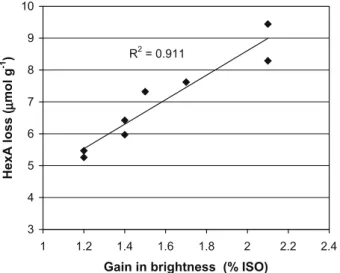
Eriksson (1992). Obviously, this decrease in brightening can not be associated with change in lignin (lignin-derived chromophores) content in bleached pulps. The rate of delignification of both xylan-ase-treated pulps increases continuously along the bleaching lead-ing to additional (over the control) lignin removal after each subsequent bleaching stage, as a result of facilitated accessibility of xylanase-treated pulps to active chemicals in bleaching solution. In contrast, the HexA performance during QPPP bleaching was found to be in excellent agreement with the bleaching profile of brightness. Similar to the latter, the maximal HexA losses were de-tected after the first bleaching stage with a tendency to continuous diminishing by the end of the bleaching sequence. A quite strong
positive correlation (R2= 0.91) can be observed between data on
HexA losses and brightness improvement (over the control) during
xylanase-aided bleaching of eucalypt kraft pulp (Fig. 2). The HexA
play therefore the role of one of the controlling factors in the def-inition of final brightness of xylanase pre-treated pulps during chemical bleaching, and determine to a large extent the bleaching efficiency of xylanase application as a whole. The extent of HexA impact on bleaching results will, obviously, depend on their abun-dance in pulp (i.e., the plant species and the pulping process) and the bleaching sequence used (i.e., the kind of active bleaching chemicals).
4. Conclusions
The carbohydrate-derived chromophores have a pronounced ef-fect on brightness development of chemical pulps during xylanase-aided bio-bleaching. The xylanase-assisted direct pulp brightening was shown to be primarily caused by HexA removal with solubi-lized xylooligosaccharide fractions. Strong positive correlation was established between xylanase bleach boosting effect and bleaching profile of HexA. That underlined the important role of HexA in the definition of final brightness of bio-bleached pulps and pointed to HexA as one of the principal factors affecting the bleaching efficiency of xylanase application as a whole.
Acknowledgements
The financial support of the Fundação para a Ciência e a Tecno-logia (FCT, Portugal) is gratefully acknowledged. The authors thank Mr. Pasi Taipalus (AB Enzymes, Finland) and Mr. Eugen Muller (Novozymes Deutschland GmbH) for providing enzymes and Dr. José Graça (CEF, ISA, UTL) for kind technical assistance in ESI-MS analysis.
References
Bailey, M.J., Biely, P., Poutanen, K., 1992. Interlaboratory testing of methods for assay of xylanases activity. J. Biotechnol. 23, 257–270.
Buchert, J., Teleman, A., Harjunpää, V., Tenkanen, M., Viikari, L., Vuorinen, T., 1995. Effect of cooking and bleaching on the structure of xylan in conventional pine kraft pulp. Tappi J. 78, 125–130.
Buchert, J., Laine, J., Tenkanen, M., Vuorinen, T., Viikari, L., 1997a. Characterization of uronic acids during kraft and superbatch pulping. In: Nineth International Symposium on Wood and Pulp Chemistry, Montreal, Canada, pp. 1–3. Buchert, J., Bergnor, E., Lindblad, G., Viikari, L., Ek, M., 1997b. Significance of xylan
and glucomannan in the brightness reversion of kraft pulps. Tappi J. 80, 165– 171.
Clayton, D.W., 1963. The alkaline degradation of some hardwood 4-O-methyl-D -glucuronoxylans. Sven. Papperstidn. 66, 115–124.
Devenyns, J., Chauveheid, E., 1997. Uronic acids and metal control. In: Nineth International Symposium on Wood and Pulp Chemistry, Montreal, Canada, pp. 1–4.
Elsander, A., Ek, M., Gellerstedt, G., 2000. Oxalic acid formation during ECF and TCF bleaching of kraft pulp. Tappi J. 83, 73–77.
Garozzo, D., Giuffrida, M., Impallomeni, G., Ballistreri, A., Montaudo, G., 1990. Determination of linkage position and identification of the reducing end in linear oligosaccharides by negative ion fast atom bombardment mass spectrometry. Anal. Chem. 62, 279–286.
Jiang, Z.-H., Van Lierop, B., Berry, R., 2000. Hexenuronic acid groups in pulping and bleaching chemistry. Tappi J. 83, 167–175.
Johansson, M.H., Samuelson, O., 1977. Epimerization and degradation of 2-O-(4-O-methyl–D-glucopyranosyluronic acid)-D-xylitol in alkaline medium. Carbohyd. Res. 54, 295–299.
Kantelinen, A., Hortling, B., Sundquist, J., Linko, M., Viikari, L., 1993. Proposed mechanism of the enzymatic bleaching of kraft pulp with xylanases. Holzforschung 47, 318–324.
Li, J., Gellerstedt, G., 1997. The contribution to kappa number from hexeneuronic acid groups in pulp xylan. Carbohyd. Res. 302, 213–218.
Mulroney, B., Traeger, J.C., Stone, B.A., 1995. Determination of both linkage position and anomeric configuration in underivatized glucopyranosyl disaccharides by electrospray mass spectrometry. J. Mass Spectrom. 30, 1277–1283.
Paice, M.G., Gurnagul, N., Page, D.H., Jurasek, L., 1992. Mechanism of hemicellulase directed prebleaching of kraft pulp. Enzyme Microbiol. Technol. 14, 272–276. Saeman, J.F., Moore, W.E., Millet, M.A., 1963. In: Whistler, R.L. (Ed.), Methods in
Carbohydrate Chemistry. Academic Press, New York, pp. 54–69.
Shatalov, A.A., Evtuguin, D.V., Neto, C.P., 1999. (2-O–D-Galactopyranosyl-4-O-methyl–D-glucurono)-D-xylan from Eucalyptus globulus Labill. Carbohyd. Res. 320, 93–99.
Shatalov, A.A., Pereira, H., 2000. Structure of heteroxylan from Eucalyptus globulus L. and its transformation during kraft delignification. In: 20th International Carbohydrate Symposium, Hamburg, Germany, pp. 370.
Shatalov, A.A., Pereira, H., 2001. Arundo donax L. reed: new perspectives for pulping and bleaching–2. Organosolv delignification. Tappi J. 84, 1–14.
Shatalov, A.A., Pereira, H., 2004. Uronic (hexenuronic) acid profile of ethanol-alkali delignification of giant reed Arundo donax L.. Cellulose 11, 109–117. Shatalov, A.A., Pereira, H., 2005. Arundo donax L. reed: new perspectives for pulping
and bleaching – 4. Peroxide bleaching of organosolv pulps. Biores. Technol. 96, 865–872.
Shatalov, A.A., Pereira, H., 2007. Polysaccharide degradation during ozone based TCF bleaching of non-wood organosolv pulps. Carbohyd. Polym. 67, 275–281. R2 = 0.911 3 4 5 6 7 8 9 10 1 1.2 1.4 1.6 1.8 2 2.2 2.4
Gain in brightness (% ISO)
HexA loss (
µ
mol
g
-1 )
Fig. 2. Gain in brightness as a function of HexA loss during three-stage hydrogen peroxide bleaching of enzymatically pre-treated (with both EcopulpÒTX-200A and PulpzymeÒHC xylanase preparations) eucalypt kraft pulp. The data are given in comparison with control (enzyme-free) samples.
Simkovic, I., Ebringerova, A., Hirsch, J., Königstein, J., 1986. Alkaline degradation of model compounds related to (4-O-methyl-D-glucurono)-D-xylan. Carbohyd. Res. 152, 131–136.
Spengler, B., Dolce, J., Cotter, R., 1990. Infrared laser desorption mass spectrometry: fragmentation mechanisms and isomer analysis. Anal. Chem. 62, 1731–1737. Süss, H.U., Nimmerfroh, N.F., 1993. Peroxide bleaching technology. Review.
Emerging Pulping and Chlorine-Free Bleaching Technologies Proceedings, Raleigh, USA.
Tolan, J.S., Olson, D., Dines, R.E., 1996. Survey of mill usage of xylanase. In: Jeffries, T.W., Viikari, L. (Eds.), Enzymes for Pulp and Paper Processing, ACS Symposium, Series, 655, pp. 25–35.
Vuorinen, T., Fagerström, P., Buchert, J., Tenkanen, M., Teleman, A., 1999. Selective hydrolysis of hexenuronic acid groups and its application in ECF and TCF bleaching of kraft pulps. J. Pulp Paper Sci. 25, 155–162.
Wong, K.K.Y., Nelson, S.L., Saddler, J.N., 1996. Xylanase treatment for the peroxide bleaching of oxygen delignified kraft pulps derived from three softwood species. J. Biotechnol. 48, 137–145.
Yang, J.L., Eriksson, K.-E.L., 1992. Use of hemicellulolytic enzymes as one stage in bleaching of kraft pulps. Holzforschung 46, 481–488.
Yang, J.L., Lou, G., Eriksson, K.-E.L., 1992. The impact of xylanase on bleaching of kraft pulps. Tappi J. 12, 95–101.
![Fig. 1. ESI-MS/MS spectra of the predominant HexA-carrying xylooligosaccharide ions observed at m/z 703 and 835 and attributed, respectively, to deprotonated molecules [M–H] of Xyl 4 HexA (upper spectrum) and Xyl 5 HexA (bottom spectrum)](https://thumb-eu.123doks.com/thumbv2/123dok_br/19236797.969895/4.892.117.754.95.988/predominant-carrying-xylooligosaccharide-observed-attributed-respectively-deprotonated-molecules.webp)