A Work Project, presented as part of the requirements for the Award of a Masters Degree in Management from the NOVA – School of Business and Economics
CORPORATE SOCIAL RESPONSIBILITY REPORTING: THE CASE OF PORTUGUESE HOSPITALS
JOANA NICOLAU OLIVEIRA – Nr. 612
A project carried out on the subject of Corporate Social Responsibility under the supervision of
Professor Joana Story
1
1 Abstract
This research investigated Portuguese Hospitals’ Corporate Social Responsibility reporting practices, by analyzing Hospitals’ Annual Reports and websites. The main hospital stakeholders were presented and activities pertaining to each group included. Overall, it appears that there is a lack of strategic CSR reporting on both private and public hospitals. Hospital managers should include stakeholders in their CSR strategy and aim it at shared value creation. Hospitals need to build a stronger relationship with the community and reformulate CSR reporting practices to ensure that the reporting is timely, complete and relevant and is easily accessible by interested parties.
Keywords: Corporate Social Responsibility, Reporting, Healthcare, Stakeholders
2 Introduction
Organizations across all sectors are becoming increasingly aware of the importance of Corporate Social Responsibility (CSR). Academic research has gone a long way to verify its benefits, most effective strategies and best practices. Accurate and transparent reporting is among them (O’Riordan and Fairbrass, 2008, ISO, 2010).
Although literature reports a positive relationship between reporting and CSR (Gelb and Strawser (2001), as cited by Abreu, et al. (2005)), there seems to be a paucity of research concerning what organizations report and how their reporting reflects (or not) their self-proclaimed CSR concerns. This scarcity of academic research is especially acute in the hospital sector, a sector in which competition is turning fierce and from which people increasingly demand higher accountability and transparency, since the whole network of stakeholders has a vested interest in their activity. The issue of a license-to-operate (Porter and Kramer, 2006) is critical for the health care sector in particular (Kakabadse and Rozuel, 2006) and their public image and reputation are
2
fundamental to their success. It is, therefore, the aim of this study to analyze what and how Portuguese hospitals report, giving special relevance to CSR initiatives, and, consequently, propose a best practices approach to hospitals managers. In order to do so, first, a brief literature review will be provided. Secondly, a stakeholder model for the hospital sector will be proposed. Thirdly, the research methodology will be presented. Fourth, the results will be explained and discussed. And finally, some conclusions will be drawn, as well as some recommendations for hospitals’ managers, research limitations and suggestions for future research.
3 Literature Review
Although Corporate Social Responsibility (CSR) is often considered a new area of knowledge, the theme dates back to the beginnings of the industrial revolution (Argandoña and Hoivik, 2009). The concept itself has evolved through the years (O’Riordan and Fairbrass, 2008) and has become an area of “considerable popular and technical discussion” (Abreu, et al., 2005:3). Indeed, nowadays the calls for attention to CSR are “more broadly expressed, more specific and more urgent” (N. Craig Smith, 2003b:54). Companies are increasingly motivated to engage in CSR activities and the reasons range from gaining consumer trust (Swaen and C., 2008, Vlachos, et al., 2009), competitive advantage, good public image and reputation (Porter and Kramer, 2006), employee identification with the company (Fox, 2007, Kim, et al., 2010), cost reduction (McGuire, et al., 1988) or profit enhancement (Cochran and Wood, 1984) and, overall, engaging relevant stakeholders (Snider, et al., 2003, Freeman, 2004, Porter and Kramer, 2006, O’Riordan and Fairbrass, 2008). Nowadays the debate is not about whether to make commitment to CSR, but how to do it (N. Craig Smith, 2003b).
3
However, the concept and dimensions of CSR are not still consensual, and there are different approaches to study this subject.
3.1 Definition and dimensions of CSR
The conceptualization of CSR has been subject to debate and it’s fairly accepted that there are no universal set of rules (Pinkston and Carroll, 1996, Abreu, et al., 2005, Argandoña and Hoivik, 2009). CSR can be seen as an ethical concept (Argandoña and Hoivik, 2009), as a four dimensional model (economic, legal, ethical and discretionary) (Carroll, 1979), a three level motivational behavior (institutional, organizational and individual) (Wood (1991) as cited by Jamali and Mirshak (2007)), the relationship between business and the larger society (Snider, et al., 2003), the obligation to benefit society independently of direct gains of the company (Kok, et al., 2001) and a strategy to gain moral capital (Godfrey (2005), cited by Vlachos, et al. (2009)), among others. However disparate these views may seem, there is a bottom line to all of them: value
creation. CSR is a value creation practice in which business and society are not
opposing forces as some imply (H. Jeff Smith, 2003a) but interdependent entities as especially stressed by other authors, namely Porter and Kramer (2006:91), who add that “the most important thing a corporation can do for society (…) is contribute to a prosperous economy”. This is more than a compromise with Friedman (1970)’s view that the social responsibility of business is to increase its profits. It’s a strategic approach to CSR, where companies align CSR practices with their business strategy, achieving important synergies that benefit both the business and the society (Porter and Kramer, 2006, Galbrea, 2010). The same idea is expressed by Burke and Logsdon (1996:496), who consider that strategic CSR benefits the firm “in particular by
4
supporting core business activities and thus contributing to the firm’s effectiveness in accomplishing its mission”.
Besides the concept itself, for practical purposes, some other related concepts are used interchangeably, for instance, “social responsibility” and “sustainability”. However, while ISO (2010) considers them to be separate concepts, The Global Reporting Initiative (2000) sees them as perfect equivalents.
3.2 The stakeholder theory and CSR reporting in the hospital sector
One interesting and useful approach is the study of CSR practices through the relations between organizations and their stakeholders. Freeman (1984)’s stakeholder theory popularized the notion that an organization’s strategy should be formulated bearing in mind the relevant stakeholders. And not only taking them into account in day-to-day management, but also investing time and resources communicating to them, especially in what pertains to CSR initiatives (Gray, et al. (1996) as cited by Snider, et al. (2003); Capriotti and Moreno (2007); Holcomb, et al. (2007)). In line with this, there has been increasing pressure for organizations to report, more so due to the fact that stakeholder engagement and dialogue is increasingly seen as an act of CSR in itself (O’Riordan and Fairbrass, 2008). In fact, the ISO 26000:2010 (2010:10) lists ‘transparency’ as a principle of social responsibility, which means to “disclose in a clear, complete manner, and to a reasonable and sufficient degree, the policies, decisions and activities for which it is responsible (…)”.
The definition of stakeholder, however, is as varied as CSR’s. Freeman (2004:229) introduced a broad definition, “any group or individual that can affect or is affected by the achievement of a corporation’s purpose”, while others like Donaldson and Preston (1995:67) define it as “persons or groups with legitimate interests in procedural and/or
5
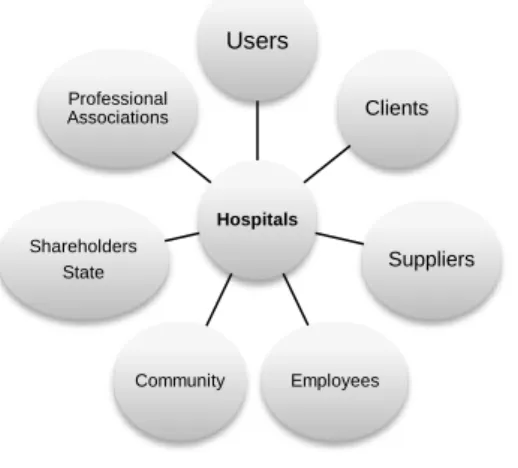
substantive aspects of corporate activity”. Using this definition as a base and Donaldson and Preston (1995)’s generic stakeholder model as a guideline, an adaptation was made to fit the specificities of the Hospital sector in Portugal, combining similar entities in more generic groups (Figure 1).
Figure 1 – The stakeholder model for the Hospital sector
This is a simplified model, since hospitals are inserted in a very complex network, in which the state is a provider, a regulator, a legislator and a client; the clients are mostly comprised of insurance providers; the professional associations vary from physicians orders to pharmaceuticals associations; and the suppliers can be either pharmaceutical companies or high technology equipment providers (Deloitte, 2011). However, for the purpose of this analysis, this more simplified model is more adequate, since it groups the main stakeholders, without singling out each institution/organization and simplifies data collection while not leaving out any relevant information.
4 Reporting and CSR in the Portuguese Hospitals
4.1 Methodology
Considering the characteristics of this research, which is an exploratory analysis, document analysis was carried out, using as sources the Annual Reports (AR) and web
Hospitals Users Clients Suppliers Employees Community Shareholders State Professional Associations
6
sites of hospitals. The framework used to code the information was the previously presented stakeholder model adapted to the hospital sector.
4.2 Data collection
Data collection was developed following three steps: Listing private and public hospitals; selecting the relevant hospitals; collecting and codifying data.
In order to list private hospitals, the chosen source was Associação Portuguesa de Hospitalização Privada (APHP)’s website, where all its associated entities (including some hospitals owned by the Misericórdias) were listed. For the public hospitals, this information was available on Administração Central do Sistema de Saúde (ACSS)’ website, given that all public hospitals are required to report to ACSS. Military hospitals were not included. From this search resulted 45 public and 44 private entities.
Secondly, in order to select a sample of hospitals satisfyingly homogeneous in terms of dimension, resources and network of stakeholders, a capacity criterion was applied. Only hospitals with a capacity above 100 beds were considered relevant, as hospitals with a smaller number of beds usually outsource or subcontract most activities, including human resources. It is important to highlight that most public hospitals are organized in groups, called “Centro Hospitalar” (CH). The CH’s gather two or more hospitals geographically close under a single legal entity, such that the hospitals themselves share resources, activities and administration. In these cases, the number of beds taken into consideration was that of the CH. From this filter resulted the removal of 40 hospitals, resulting in a total number of 40 public and 9 private relevant hospitals (Appendix A, Table 2).
Thirdly, for the final set, information was collected from two types of sources: the AR for 2009 (the most recent year with the most ARs available) for the Hospital, CH or the
7
Group and the hospitals’ websites. When the hospitals had no AR for 2009 available on the internet, an email was sent requesting it. In total, 37 ARs and 47 websites were analyzed (Appendix A, Table 3). The information reported was classified according to the stakeholder it concerned. Other relevant information was classified in general aspects of reporting.
5 Results
5.1 General reported aspects: an overview
Analyzing the reporting policy of the hospital sector is critical to understand how relevant reporting in general is to hospitals. Hospital’s reporting intensity, thoroughness and overall inclination to disclose information conditions and defines the way they choose to communicate CSR to stakeholders. An overview on the use of internet as a way to reach a wide audience, and the general information disclosed such as the implementation of an ethics code, corporate governance indicators, the favored stakeholders, as well as the way information is reported, will be useful to understand hospitals’ CSR reporting concerns.
The vast majority of the Hospitals uses the internet as a communication mechanism, be it the AR or an institutional website. Public hospitals are required to report to ACSS since 2005, therefore most of them provide access to their AR on their own websites, although some do not. Private hospitals, on the other hand, do not provide individual reports and only one private group has their consolidated AR online. Both private and public hospitals provide information for a very small timeframe, mostly for 2008 and 2009 (Appendix A, Exhibit 1).
One aspect that a significant number of hospitals seems to value is the communication of the existence of an ethical code. A total of 43% of hospitals state they have a formal
8
code of ethics and/or provide it on their websites. More importantly, even those that don’t have one, or fail to mention such code, often provide other sources of ethical guidance, such as the respective code of ethics for each profession or the Ethics Commission, in place in the majority of hospitals, public or private (Appendix A, Exhibit 2).
Regarding corporate governance indicators, most hospitals seem aware of the importance of reporting this kind of information. The majority of the hospitals identify its board of directors (75% of public and 57% of private hospitals) and its accreditation and quality programs (63% of public and 71% of private hospitals). Public hospitals also favor disclosing their organizational charts (93%), while private hospitals are more reticent to do so (29%). Disclosing the board of directors’ remunerations and the directors’ CVs and responsibilities is an exclusive public hospital practice (68% and 42% respectively), with zero private hospitals doing so (Appendix A, Exhibit 3).
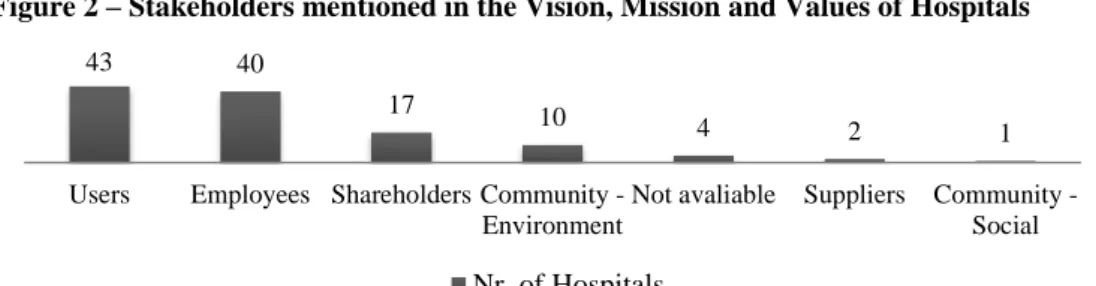
In regards to stakeholders, hospitals don’t value all the same way when they report. For instance, looking at the vision, mission and values, some stakeholders are explicitly mentioned, indicating that they are considered especially relevant. Figure 2 illustrates the most often mentioned.
Figure 2 – Stakeholders mentioned in the Vision, Mission and Values of Hospitals
Not surprisingly, hospitals value above all their users and their employees, which are, correspondingly, the recipient of their activity and the critical resource for service
43 40
17 10
4 2 1
Users Employees Shareholders Community -Environment
Not avaliable Suppliers Community -Social
9
provision. It is understandable that relevant stakeholders, like professional organizations and clients (such as public and private insurance) are not mentioned here, but then again, they are also not mentioned on Hospitals’ ARs nor their websites.
On the whole, we can consider the type of information made available as quite homogenous in terms of structure among public hospitals, as most follow a standardized reporting structure on their ARs, as required by law. Private hospitals have no specific reporting guidelines since they are ruled only by The Companies Act. However, in both cases, the level of depth and detail on the reported matters varies much, although we have to be careful in what concerns private hospitals, due to the small sample size. In fact, private hospitals are extremely reticent in divulging activity reports, while public hospitals have theirs available on their websites or in ACSS’ website. In what concerns websites, the type of information made available is also very heterogeneous, although a proneness to emphasize CSR initiatives can be detected on private hospitals’ websites.
5.2 Reporting and Corporate Social Responsibility initiatives
5.2.1 The concept of Social Responsibility
“Social responsibility” and “sustainability” are different but related concepts that hospitals sometimes use interchangeably. Information reported shows that hospitals favor the “sustainability” concept over the “social responsibility” one on ARs while on websites, it’s the other way around (Figure 3).
Figure 3 – CSR and sustainability references in Annual Reports and Websites
26% 32% 4% 15% 9% 15% 17% 4% 0% 74% 0% 4% Social Responsibility
Sustainability Both Neither Non applicable Not available
10
This may be explained by the fact that “sustainability”, in the healthcare sector, is most often understood as “financial sustainability” and not as a social and environmental concept. Indeed, all public hospitals have a “financial, social and environmental sustainability” section on their ARs where CSR practices are usually included but several only explor the financial side while fulfilling the social and environmental dimensions with legislation compliance statements. Concurrently, ARs are usually directed at the shareholders / ACSS, where financial sustainability aspects are especially relevant, while the websites are more directed at the users, to whom the term “social responsibility” might appeal more when applied to social, environmental and community events or initiatives. However, does this mean that the information reported concerns these stakeholders above the rest? In order to better answer this question, each stakeholder will be analyzed in depth in the following sections.
5.2.2 Users
Users are the direct recipient of hospitals’ services and, according to the previous section, one of the most emphasized stakeholders. The first step to assess if this has an impact on how they communicate initiatives concerning or directed at users is to understand which channels are preferred to convey information. The preferred means of communication is the hospitals’ website (91%), although a significant 36% reports information both through the website and the AR. Annual report only accounts for not more than 2% (Appendix B, Exhibit 4). This suggests an attempt to reach people as much as possible since they are more likely to search the websites to gather information that concerns them than to search it in the AR.
The information reported is fairly standardized and mostly pertains to operational aspects, such as the hospitals’ main services, specialties, appointment scheduling and
11
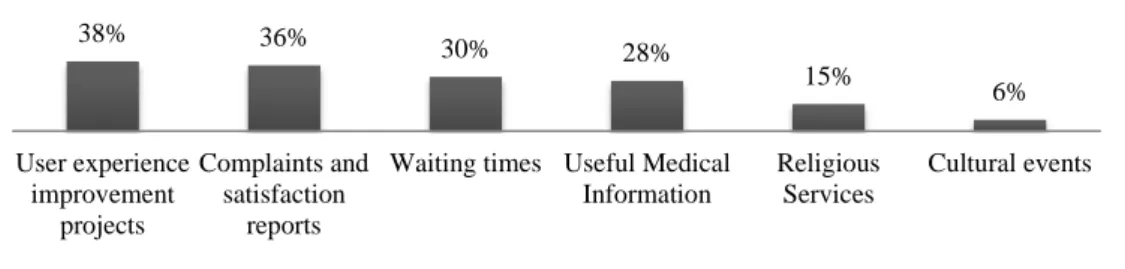
visiting regulations. However, it is not infrequent to find information on how hospitals try to go beyond their regular activity to improve the users’ experience, which can be seen as a CSR practice. Figure 4 illustrates which initiatives are most often reported. Figure 4 – Reported user-oriented initiatives
As we can see, user oriented initiatives differ substantially. ‘User experience improvement projects’ comprehend initiatives that aim at improving the user experience in the hospital, such as user offices that collect the users’ feedback, healthcare service humanization projects, availability of equipment and facilities to attenuate patients’ pain, social services to provide additional support and translation services for foreigners. ‘Complaints reports’ and ‘waiting times’ pertain to the hospitals’ efforts to incorporate user feedback and to improve users’ access to the hospitals’ services, while ‘useful medical information’ is usually aligned with the hospitals’ specialties - for instance, if the hospital is specialized in oncology, it will provide workshops, flyers and documentation with medical information about cancer – and is meant to complement the information users get during their consultation. As we can see in Figure 4, the provision of religious services is not frequent and only a very low percentage organizes cultural events, such as Christmas parties, Carnival celebrations and other entertainment events, mainly for young patients.
Trying to compare the behavior of hospitals by geographical region, one can see that most hospitals show a genuine effort to engage the user beyond simple service
38% 36% 30% 28% 15% 6% User experience improvement projects Complaints and satisfaction reports
Waiting times Useful Medical Information
Religious Services
Cultural events
12
provision, with the majority reporting at least one initiative. However, it is also observable that hospitals located outside of Lisbon tend to have relatively more initiatives, while the grand area of Lisbon registers the highest number of hospitals with no user-oriented initiatives (Appendix B, Table 4).
Additionally, it should be noted that all six types of initiatives identified are deeply aligned with the organizations’ activity and strategy.
5.2.3 Employees
Employees are the second most referenced stakeholder in hospitals’ vision, mission and values. Interestingly, employee reporting occurs primarily through the AR (38%), with only 15% of hospitals communicating through the website exclusively (Appendix B, Exhibit 5), which seems to indicate that employee-oriented communication is not usually made public for the knowledge of potential future employees.
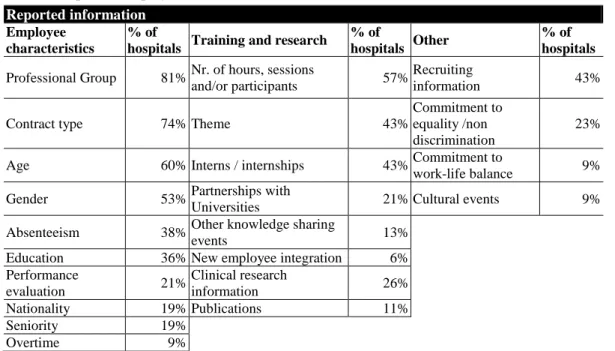
However, when we take a closer look at the content of that communication, we can see that hospitals are quite prolific in their reporting (Table 1).
Table 1 - Reported employee-oriented information Reported information
Employee characteristics
% of
hospitals Training and research
% of
hospitals Other
% of hospitals
Professional Group 81% Nr. of hours, sessions
and/or participants 57%
Recruiting
information 43%
Contract type 74% Theme 43%
Commitment to equality /non discrimination
23%
Age 60% Interns / internships 43% Commitment to
work-life balance 9%
Gender 53% Partnerships with
Universities 21% Cultural events 9%
Absenteeism 38% Other knowledge sharing
events 13%
Education 36% New employee integration 6%
Performance evaluation 21% Clinical research information 26% Nationality 19% Publications 11% Seniority 19% Overtime 9%
13
The majority of the reporting concerns employee characteristics (such as professional group, contract type, age and gender) that obviate the hospital’s non discriminating practices when hiring their work-force – even though only 23% states a commitment to non-discrimination and equal opportunities. Interestingly, merely 9% of the hospitals claim to be committed to work-life balance and indeed, again only 9% report employee overtime and the fostering of cultural events. Also, only a small percentage (21%) reports any kind of information regarding performance evaluation programs or rules. Regarding training, although hospitals are keen on reporting the number of hours and participants (57%), they are slightly less prone to divulge the themes and areas in which they occur (43%). Other types of knowledge sharing events (congresses, symposiums, workshops, etc) are only reported by 13% of the hospitals. Nevertheless, hospitals report information regarding interns (doctors) and internships (nurses) quite often (43%), which reflects not only the hospitals’ commitment to train new health professionals but also the modern version of the Hippocratic Oath, that binds’ doctors to “impart a knowledge of this art” to their younger counterparts. However, only 21% list partnerships with universities or other education institutions. Likewise, clinical trials and research are sparse and only reported by a small number of hospitals (26%).
In a sporadic way, other information is reported, such as employee feedback discussion events, employee burnout / satisfaction reports, work-related accidents and employee international exchange programs.
All of the information mentioned above is critical in attracting potential future employees, however, it’s regularly found only in ARs, while websites host only job offers and information on how to apply (43%). Finally, it is interesting to conclude that
14
the amount of employee-related aspects reported by hospitals does not vary significantly according to geographic location.
5.2.4 Suppliers
While suppliers are not given the spotlight in hospitals’ vision, mission and values, they can be considered the third most important stakeholder in a hospital. Hospitals depend so much on the timely provision of goods and services from their suppliers that some even choose to have suppliers managing the hospitals’ stocks themselves.
As with users, the preferred means of communication in what concerns suppliers is the website (63%) but from those, 23% also use the AR. However, it should be noted that the percentage of hospitals that completely disregard suppliers on their reporting is quite significant (23%) (Appendix B, Exhibit 6).
The type of information varies much. As we can observe in Figure 5, most hospitals only go so far as to report the level of debt to suppliers. This likely results from reporting demands from the Ministry of Health and they are of relevance to suppliers due to the historically high debt public hospitals harbor and which has been driving suppliers to grow more selective of whom they sell to.
Figure 5 - Reported supplier-oriented information
Nonetheless, some hospitals seek to provide other useful information, such as what kind of platform is used to acquire goods and services or what kind of inventory management
49% 17% 15% 15% 11% 9% Debts to suppliers Electronic acquisitions platform Acquisitions regulations Logistics information Current suppliers / services provided Environmental criteria % of hospitals
15
system they have – which might provide suppliers with other operational aspects to consider besides the level of debt.
Especially relevant to CSR analysis is if hospitals apply any kind of CSR criteria when selecting suppliers. For hospitals, environment is the most relevant criteria to be attended to due to the high level of dangerous waste production and it’s discouraging to observe that only 9% apply such criteria. Still, some hospitals reported that they monitor their suppliers for environmental hazardous practices and that they make an effort to pay on time in order to empower local suppliers, which may represent the beginnings of CSR concerns regarding suppliers.
5.2.5 Communication to Public Institutions / Shareholders
Although ARs may be considered the best vehicle of communication for shareholders, and hospitals do seem to somewhat agree (38%), it is interesting to note that a significant percentage of hospitals uses their websites for the same end just as much (38%). Only a small percentage (11%) uses the website exclusively for divulging shareholder-related information (Appendix B, Exhibit 7). This seems to indicate that hospitals are becoming aware of the fact that shareholder-oriented information is also of interest to other stakeholders, namely suppliers (as mentioned before), clients and even professional associations.
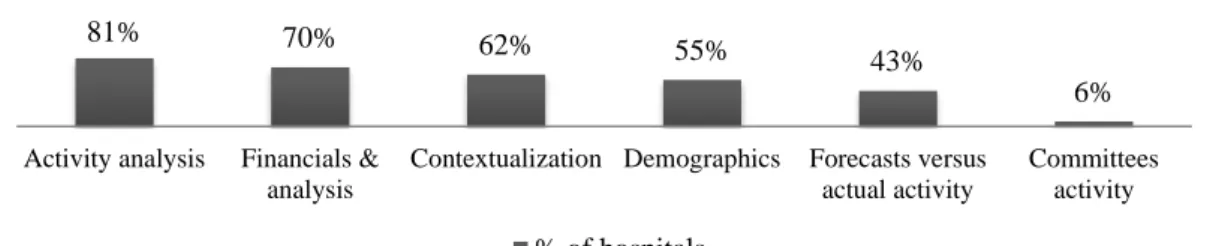
Shareholder-oriented information is, predictably, mainly about activity analysis, financial statements, financial analysis and other data for contextualization such as the demography and socio-economic indicators of the target-population, forecasted activity versus actual activity and, to a much lesser extent, committees’ activity (Figure 7).
16 Figure 6 - Reported shareholder-oriented information
When analyzing shareholder-oriented information, some hospitals seem to be adrift on what they report and how to report it. There were some less than encouraging findings on shareholder-oriented information such as considering compliance with legislation as social responsibility, having a mission that consisted only on identifying the owner, not having all the legal auditing procedures fulfilled, presenting a conceptually erroneous SWOT analysis and operational data several years outdated on the website.
This seems to indicate that not all hospitals have a clearly defined strategy on what they want to report nor fully grasp the tools they chose to use.
5.2.6 Community
5.2.6.1 Social initiatives
Community-oriented initiatives with a social concern are usually thought of as the most common type of CSR initiatives, mainly because it’s great for image and reputation. It is, therefore, intriguing to find that as much as 38% of the hospitals don’t report any kind of community oriented activities. Those who do report them, do it either through the AR (21%) or the AR and the website (21%), while 19% reports only through the website (Appendix B, Exhibit 8). This suggests that as much as 21% of the hospitals completely disregard the potential for bonding with the community through practices that are already in place.
81% 70% 62%
55% 43%
6%
Activity analysis Financials & analysis
Contextualization Demographics Forecasts versus actual activity
Committees activity
17
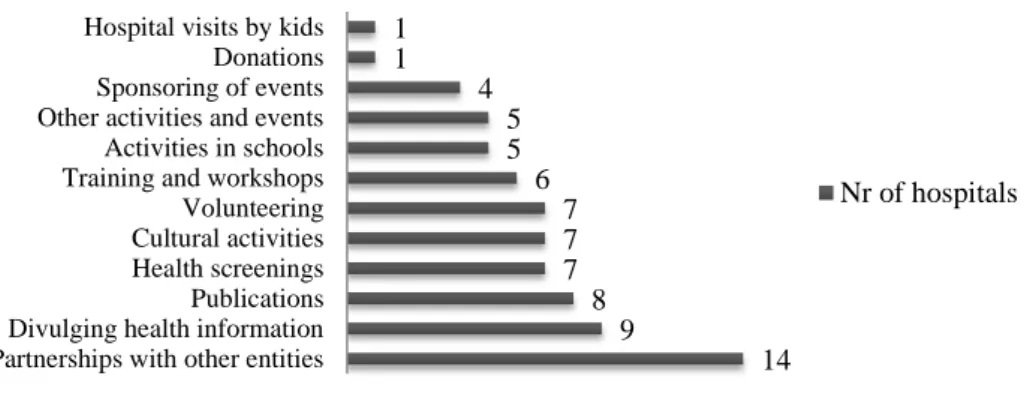
Concerning the CSR practices aimed at the community, the first evidence is a significant trend of hospitals engaging other entities, such as nonprofit entities and local government, as partners in all kinds of events, namely sports, arts, social services and other programs those entities may already have in place. From the 29 hospitals that reported social initiatives, 14 mentioned some kind of engagement in partnerships (Figure 7).
Figure 7 - Reported community-oriented initiatives
The type of initiatives varies substantially but all of those are very much aligned with the hospitals’ overall mission. The most frequent initiatives include divulging health information (either through free, open door workshops, informational videos or useful flyers), publications (where all the hospital-related news can be found), free health screenings and cultural activities.
Volunteering initiatives can take several forms, from allowing employees to recover a decaying school to organizing the community to collaborate with the hospital side by side. There also seems to be a growing interest in communicating with children, either by going to schools to talk about health issues (such as obesity, sexuality, and others) or by giving kids a tour in the hospital for them to lose their fears.
Included in ‘other activities’ are activities such as taking part in community social networks, organizing events to raise awareness of specific diseases, contributing in
14 9 8 7 7 7 6 5 5 4 1 1
Partnerships with other entities Divulging health information Publications Health screenings Cultural activities Volunteering Training and workshops Activities in schools Other activities and events Sponsoring of events Donations Hospital visits by kids
18
campaigns organized by third parties (like collecting lids and stoppers), home support for children in need and acquisition of art from institutions for handicapped people. The detail of this kind of information is quite heterogeneous. Some hospitals report scarcely, others mention community-oriented activities without specifying them and some mention with which organizations they have partnerships but don’t explain their role or the partnership’s goal. In spite of private hospitals being underrepresented in the sample, it is very clear that, although both private and public hospitals have a wide range of community-oriented initiatives, private hospitals seek to report them in much more detail, sometimes even blurring the line between reporting and advertising. On the contrary, public hospitals, with a few exceptions, are vague and sketchy on their reporting, clearly missing the opportunity to collect the benefits of their efforts. This may indicate that the private hospitals are more aware of the benefits of CSR initiatives to their reputation and image building than the public ones which, because they are public, may not feel the same motivation and, consequently, do not seem to have a cohesive CSR strategy.
5.2.6.2 Environmental initiatives
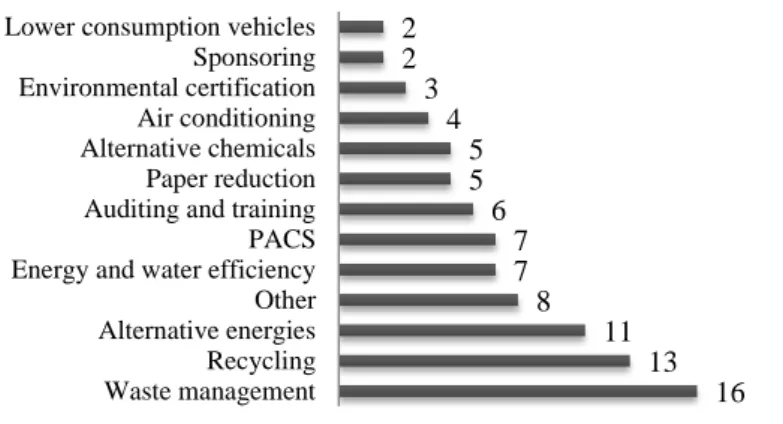
As with community-oriented initiatives with a social focus, environment-oriented initiatives register a significant percentage of hospitals that did not report any kind of information (34%). To those that report, the preferred means of communication is clearly the AR (57%) (Appendix B, Exhibit 9).
19 Figure 8 - Reported environment-oriented initiatives
Waste management recycling, alternative energies and energy and water efficiency are the most popular undertakings, which might be closely connected, on the one hand, to the fact that hospitals must obey a very tight legislation on waste disposal (since they manipulate and dispose of dangerous chemicals) and, on the other hand, to the constant demand on the shareholders / ACSS part to reduce costs. The PACS1 system is an alternative to the old X-Ray and CT scanning films and its adoption is of extreme importance because it represents a dramatic decrease in the use of film-based image retrieval, which resorts to dangerous chemicals.
Auditing and training represents hospitals’ efforts to implement a policy of continuous improvement in the environmental area, as do the air conditioning initiatives (double windows, heating mechanisms, etc.). Environmental certification, sponsoring of external projects and the adoption of low consumption vehicles are the least favorite types of initiatives.
Other mentioned activities include: acoustic evaluation (evaluation of noise pollution), committee for sustainability and environmental guidelines.
1 PACS - Picture Archiving and Communication System
16 13 11 8 7 7 6 5 5 4 3 2 2 Waste management Recycling Alternative energies Other Energy and water efficiency PACS Auditing and training Paper reduction Alternative chemicals Air conditioning Environmental certification Sponsoring Lower consumption vehicles
20
Regarding environmental practices, we can affirm that, unlike in the previous section, private hospitals are very sparse on their reporting, while public hospitals go some times as far as listing all the recycled materials, the names of the companies that collect their waste and all the infrastructural modifications in search of more efficiency (such as automatic faucets or double glass windows). However, since the main channel of communication is the AR, the community in general may not be as aware of these important efforts as it would be if these initiatives were mentioned on the hospitals’ websites.
6 Conclusions, limitations and further research
The primary aim of this study was to analyze what and how hospitals report, with a special focus on CSR initiatives. The most immediate conclusion is that private hospitals are not keen on providing their activity reports online, nor upon request. On the other hand, they make more use of their websites to communicate than public hospitals. Independently of the chosen reporting channel, both public and private hospitals seek to provide basic corporate governance information. However, in terms of CSR reporting concerning each of the stakeholders, the level of depth and detail on the reported matters varies.
Regarding users, the CSR initiatives are deeply aligned with hospital activities, but hospitals in Lisbon need to make an effort to develop more user-oriented initiatives, in line with the rest of the country. Employee reporting focuses mainly on employee characteristics, obviating non-discriminating human resources practices. But this information needs to be published on their websites, along with the other initiatives, such as clinical trials and training efforts. The market for nurses and doctors is becoming saturated so hospitals can’t compete on remuneration alone any longer to
21
attract employees which is why they need to lure them with other CSR benefits, such as education, international exchanges and work-life balance. For suppliers, a few hospitals have an environmental selection criterion, which is mediocre at best. Hospital managers need to integrate suppliers in their CSR strategy. They need to rethink supplier selection processes beyond what law requires in order to include other CSR criteria, such as fair employee compensation, environmental impact monitoring, dangerous waste treatment, energy savings and recycling, to name a few. All this should be easily accessible on their website, along with the hospitals’ own logistics CSR goals and processes. A significant percentage of hospitals don’t report community-oriented initiatives of a social nature, but private hospitals are much more detailed in their reporting than their public counterparts. Conversely, environmental-related initiatives are more thoroughly reported by public hospitals, despite also being reported by a low number of hospitals. These are both areas that need the hospital managers’ urgent attention. In a sector where the competition is becoming increasingly fierce, hospitals need bond with their immediate community to build rapport. It should be easy to find on their websites all the efforts to be environmentally sustainable and as much information as possible on community oriented information, like how do a field trip to the hospital, volunteering, free workshops, health information and publications. Reporting to shareholders seems erratic regarding what hospitals report and how they report it. This lack of coherence is transversal to the reporting as a whole, which is, directly or indirectly, of utmost interest to the shareholders. Indeed, the reporting reflects a clear lack of strategic planning that might have several causes, among which not fully understanding the concept of CSR, not having someone in charge of CSR, simply not understanding the benefits of CSR reporting or not realizing that CSR must be embedded in the business strategy.
22
The fact that most of the reported information concerns the stakeholders mentioned in the mission and vision, as well as the nature of the initiatives themselves, seems to indicate some strategic alignment, but the fact that hospitals don’t report them consistently across all channels, as well as the overlapping use (and misuse) of the ‘CSR’ and ‘sustainability’ concepts, steers us the other way. Hospital managers need to have someone in charge of defining and communicating the CSR strategy, and collecting feedback from the stakeholders to feed the information back into the hospital’s strategy. This is the first step to design a CSR strategy that aims at shared value creation. Once this is done, reporting practices need to be reformulated accordingly. Public hospitals could reformulate the contents of the “social, economic and financial sustainability” section in their ARs according to the stakeholder model herein presented thus making sure that the relevant stakeholders’ concerns are addressed. This would help eliminate the widespread impression that public service is wasteful, inefficient and uncaring as the recent news on hospital waste illegally getting turned into clothes (LUSA, 2011) and the constant cost cutting on health reinforce. Private hospitals should value transparency and make their ARs public, thereby ensuring that the users and community’s well-being is their priority and that they’re not trying to profit at all costs, as divulging a handful of CSR initiatives when financial statements are considered “confidential” can lead to believe. Moreover, private hospitals that comply with the stakeholders’ demands for reporting will certainly gain a competitive advantage and reputation. Most of all, reporting must be complete, relevant, timely and stakeholder inclusive (The Global Reporting Initiative, 2000, ISO, 2010). All these conclusions and recommendations must be considered carefully, since this study has several limitations. First, the private hospital sample is quite small because it was limited to the APHP’s associates and the dimension criteria eliminated most of
23
them. Secondly only two private hospitals provided ARs, which represented a significant asymmetry of information retrieval between private and public hospitals. Thirdly, the only sources of information were the hospitals’ AR and website. In order to overcome these limitations, future research should find other sources to expand the sample (for instance, contact União das Misericórdias to include third sector hospitals) and consider analyzing other sources of information, such as hospitals’ publications, bulletins and magazines. Further research is needed to pinpoint the causes of the lack of strategic CSR reporting in Portuguese Hospitals. Also, a comparison of CSR reporting practices between hospitals according to geographic location could be a promising research subject.
Appendix A
Table 2 – Selection of relevant hospitals
Phase Public Hospitals Private Hospitals Total hospitals
Initial set of hospitals 45 44 89
Capacity criterion
Rejected for <100 beds 2 34 36
Rejected for insufficient information 3 1 4
Total relevant hospitals 40 9 49
Table 3 – Data collection
Information source Public
Hospitals
Private
Hospitals Total Individual Annual Report from ACSS website 33 n.a. 33 Individual Annual Report from Hospital's website 1 0 1
Group's Annual Report n.a. 1* 1
Annual Report - Email requests
Requests sent 5 9 14
Accepted 0 1 1
Denied 0 1 1
No reply 5 7 12
Total Annual Reports analyzed 34 2 36
Total websites analyzed 40 7 47
*Corresponds to three hospitals owned by the same group
Two of the websites analyzed were under maintenance and therefore had limited or no information
Exhibit 1 – Years for which hospitals provide Annual Reports
1 1 6 1 8 1 9 1 12 1 1 1 1 6
20 27 27 15
10
2002 2003 2004 2005 2006 2007 2008 2009 2010 None
24 Exhibit 2 – Percentage of hospitals with a Code of Ethics
Exhibit 3 – Percentage of public and private hospitals that disclose corporate governance information
Appendix B
Exhibit 4 – Channels used to communicate user-related initiatives
Table 4 – Number of initiatives by hospital and by geographic location
Geographic location Number of initiatives Total nr. of hospitals
0 1 2 3 4 5
Alentejo 1 1 2
Algarve 1 1 2
Center 2 2 2 1 7
Lisbon and Tejo 6 7 4 3 20
North 2 8 4 1 1 16
Total 9 17 11 8 1 1 47
Exhibit 5 – Channels used to communicate employee-related information
47% 19% 34% Yes No Non specified 57% 0% 29% 71% 0% 75% 68% 93% 63% 42%
Directors Remunerations Organizational chart Accreditation and quality information Directors CVs and responsibilities Private Public 55% 36% 6% 2%
Website only Annual Report & website
non available Annual Report only
% of hospitals
38% 38%
15% 9%
Annual Report AR & Website Website only non available % of hospitals
25
Exhibit 6 – Channels used to communicate supplier-related information
Exhibit 7 – Channels used to communicate shareholder-related information
Exhibit 8 – Channels used to communicate community-related initiatives
Exhibit 9 – Channels used to communicate environment-related initiatives 40%
23%
9% 23%
Website only AR & website AR only None % of hospitals
38% 38%
13% 11%
Annual Report Annual Report & Website
non available Website
% of hospitals
21% 21% 19% 38%
Annual Report Annual Report & Website
Website non available
% of hospitals
57%
6% 2%
34%
Annual Report Annual Report & Website
Website non available
26
7 Bibliography
Abreu, Rute; Fátima David and David Crowther. 2005. "Corporate Social Responsibility in Portugal:
Empirical Evidence of Corporate Behaviour." Corporate Governance, 5(5), 3-18.
ACSS, Administração Central do Sistema de Saúde. 2011a. "Monitorização Regiões Saúde,"
http://www.acss.min-saude.pt/: ACSS,
____. 2011b. "Relatórios E Contas Hepe 2009," http://www.acss.min-saude.pt/: ACSS,
APHP, Associação Portuguesa de Hospitalização Privada. 2011. "Associados Aphp," www.aphp-pt.org: APHP,
Argandoña, Antonio and Heidi von Weltzien Hoivik. 2009. "Corporate Social Responsibility: One
Size Does Not Fit All. Collecting Evidence from Europe." Journal of Business Ethics, 89, 221–34.
Burke, Lee and Jeanne M. Logsdon. 1996. "How Corporate Social Responsibility Pays Off." Long
Range Planning, 29(4), 495-502.
Capriotti, Paul and Angeles Moreno. 2007. "Communicating Coporate Responsibility through
Corporate Web Sites in Spain." Corporate Communications: An International Journal, 12(3), 221-37.
Carroll, Archie B. 1979. "A Three-Dimensional Conceptual Model of Corporate Performance." The
Academy of Management Review, 4(4), 497-505.
Cochran, Philip L. and Robert A. Wood. 1984. "Corporate Social Responsibility and Financial
Performance." Academy of Management Journal, 27(1), 42-56.
Deloitte. 2011. "Saúde Em Análise - Uma Visão Para O Futuro," Deloitte, Deloitte,
Donaldson, Thomas and Lee E. Preston. 1995. "The Stakeholder Theory of the Corporation: Concepts,
Evidence and Implications." Academy of Management Review, 20(1), 65-91.
Fox, Adrienne. 2007. "Corporate Social Responsibility Pays Off," HR Magazine.
Freeman, R. Edward. 1984. Strategic Management: A Stakeholder Approach. Massachusetts: Pitman
Publishing Inc.
____. 2004. "The Stakeholder Approach Revisited," Argument. Rainer Hampp Verlag, 228-54.
Friedman, Milton. 1970. "A Friedman Doctrine – the Social Responsibility of Business Is to Increase Its
Profits," The New York Times Magazine. 32-3.
Galbrea, Jeremy. 2010. "Drivers of Corporate Social Responsibility: The Role of Formal Strategic
Planning and Firm Culture." British Journal of Management, 21, 511–25.
Gelb, David S. and Joyce A. Strawser. 2001. "Corporate Social Responsibility and financial
Disclosures: An Alternative Explanation for Increased Disclosure." Journal of Business Ethics, 33(1), 1-13.
Godfrey, Paul C. 2005. "The Relationship between Corporate Philanthropy and Shareholder Wealth: A
Risk Management Perspective." Academy of Management Review, 30(4), 777–98.
Gray, Rob; Dave Owen and Carol Adams. 1996. Accounting and Accountability: Changes and
Challenges in Corporate Social and Environmental Reporting. London: Prentice Hall.
Holcomb, Judy L.; Randall S. Upchurch and Fevzi Okumus. 2007. "Corporate Social Responsibility:
What Are Top Hotel Companies Reporting?" International Journal of Contemporary Hospitality
Management, 19(6), 461-75.
ISO. 2010. "Iso 26000 Guidance on Social Responsibility," ISO/FDIS,
Jamali, Dima and Ramez Mirshak. 2007. "Corporate Social Responsibility (Csr): Theory and Practice
in a Developing Country Context." Journal of Business Ethics, 72, 243-62.
Kakabadse, Nada K. and Cécile Rozuel. 2006. "Meaning of Corporate Social Responsibility in a Local
27
Kim, Hae-Ryong; Moonkyu Lee; Hyoung-Tark Lee and Na-Min Kim. 2010. "Corporate Social
Responsibility and Employee–Company Identification." Journal of Business Ethics, 95, 557–69.
Kok, Peter; Ton van der Wiele; Richard McKenna and Alan Brown. 2001. "A Corporate Social
Responsibility Audit within a Quality Management Framework." Journal of Business Ethics, 31, 285–97.
LUSA. 2011. "Lixo Hospitalar Português Utilizado No Fabrico De Roupa No Brasil," Visão,
http://aeiou.visao.pt/lixo-hospitalar-portugues-utilizado-no-fabrico-de-roupa-no-brasil=f628921: Visão,
McGuire, Jean B.; Alison Sundgren and Thomas Schneeweis. 1988. "Corporate Social Responsibility
and Firm Financial Performance." Academy of Management Journal, 31(4), 854-72.
O’Riordan, Linda and Jenny Fairbrass. 2008. "Corporate Social Responsibility (Csr): Models and
Theories in Stakeholder Dialogue." Journal of Business Ethics, 83, 745–58.
Pinkston, Tammie S. and Archie B. Carroll. 1996. "A Retrospective Examination of Csr Orientations:
Have They Changed?" Journal of Business Ethics, 15, 199-206.
Porter, Michael E. and Mark R. Kramer. 2006. "Strategy & Society." Harvard Business Review,
78-92.
Smith, H. Jeff. 2003a. "The Shareholders Vs. Stakeholders Debate." MIT Sloan Management Review,
(Summer), 85-90.
Smith, N. Craig. 2003b. "Corporate Social Responsibility: Whether or How?" California Management
Review, 45(4), 52-76.
Snider, Jamie; Ronald Paul Hill and Diane Martin. 2003. "Corporate Social Responsibility in the 21st
Century: A View from the World’s Most Successful Firms." Journal of Business Ethics, 48, 175–87.
Swaen, Valérie and Ruben Chumpitaz C. 2008. "Impact of Corporate Social Responsibility on
Consumer Trust." Recherche et Applications en Marketing, 23(4).
The Global Reporting Initiative. 2000. "Sustainability Reporting Guidelines on Economic,
Environmental, and Social Performance," Boston: GRI,
Vlachos, Pavlos A.; Argiris Tsamakos; Adam P. Vrechopoulos and Panagiotis K. Avramidis. 2009.
"Corporate Social Responsibility: Attributions, Loyalty, and the Mediating Role of Trust." Journal of the
Academy of Marketing Science, 37, 170–80.
Wood, Donna J. 1991. "Corporate Social Performance Revisited." The Academy of Management Review,
16(4), 691-717.
Hospitals’ websites consulted
Centro de Medicina de Reabilitação Rovisco Pais. (n.d.). Retrieved December 11, 2011, from Centro de Medicina de Reabilitação Rovisco Pais: http://www.roviscopais.min-saude.pt/
Centro Hospitalar Barreiro/Montijo. (n.d.). Centro Hospitalar Barreiro/Montijo. Retrieved December 12, 2011, from http://www.chbm.min-saude.pt
Centro Hospitalar Cova da Beira. (n.d.). Retrieved December 11, 2011, from Centro Hospitalar Cova da Beira EPE: http://www.chcbeira.min-saude.pt
Centro Hospitalar de Coimbra. (n.d.). Centro Hospitalar de Coimbra. Retrieved December 13, 2011, from http://www.chc.min-saude.pt/
Centro Hospitalar de Setúbal. (n.d.). Centro Hospitalar de Setúbal. Retrieved December 13, 2011, from http://www.chs.min-saude.pt/
Centro Hospitalar de Torres Vedras. (n.d.). Centro Hospitalar de Torres Vedras. Retrieved December 13, 2011, from http://www.chtvedras.pt/
Centro Hospitalar do Alto Ave. (n.d.). Retrieved November 08, 2011, from Centro Hospitalar do Alto Ave: http://www.chaa.min-saude.pt/
28
Centro Hospitalar do Barlavento Algarvio. (n.d.). Centro Hospitalar do Barlavento Algarvio. Retrieved December 13, 2011, from http://www.chbalgarvio.min-saude.pt/
Centro Hospitalar do Médio Ave. (n.d.). Retrieved November 08, 2011, from Centro Hospitalar do Médio Ave, EPE: http://www.chma.pt/
Centro Hospitalar do Médio Tejo. (n.d.). Centro Hospitalar do Médio Tejo. Retrieved December 13, 2011, from http://www.chmt.min-saude.pt/
Centro Hospitalar do Nordeste. (n.d.). Centro Hospitalar do Nordeste. Retrieved December 13, 2011, from http://www.chne.min-saude.pt/
Centro Hospitalar do Porto. (n.d.). Retrieved November 09, 2011, from Centro Hospitalar do Porto: http://www.chporto.pt/
Centro Hospitalar do Tâmega e Sousa. (n.d.). Retrieved November 12, 2011, from Centro Hospitalar do Tâmega e Sousa, EPE: http://www.chtamegasousa.pt/
Centro Hospitalar Entre o Douro e Vouga. (n.d.). Retrieved November 08, 2011, from Centro Hospitalar Entre o Douro e Vouga, EPE: http://www.hospitalfeira.min-saude.pt/
Centro Hospitalar Lisboa Central. (n.d.). Centro Hospitalar Lisboa Central. Retrieved December 12, 2011, from http://www.chlc.min-saude.pt/
Centro Hospitalar Lisboa Norte. (n.d.). Centro Hospitalar Lisboa Norte. Retrieved December 12, 2011, from http://www.hsm.min-saude.pt/
Centro Hospitalar Lisboa Ocidental. (n.d.). Centro Hospitalar Lisboa Ocidental. Retrieved December 12, 2011, from http://www.chlo.min-saude.pt/
Centro Hospitalar Oeste Norte. (n.d.). Centro Hospitalar Oeste Norte. Retrieved December 13, 2011, from http://www.chcrainha.min-saude.pt/
Centro Hospitalar Póvoa do Varzim - Vila do Conde. (n.d.). Retrieved November 12, 2011, from Centro Hospitalar Póvoa do Varzim - Vila do Conde: http://www.chpvvc.pt/
Centro Hospitalar Psiquiátrico de Lisboa. (n.d.). Centro Hospitalar Psiquiátrico de Lisboa. Retrieved December 13, 2011, from http://www.chpl.pt/default.aspx
Centro Hospitalar Trás-os-Montes e Alto Douro. (n.d.). Retrieved November 18, 2011, from Centro Hospitalar Trás-os-Montes e Alto Douro: http://www.chtmad.min-saude.pt/
Centro Hospitalar Vila Nova de Gaia - Espinho. (n.d.). Retrieved November 19, 2011, from Centro HospitalarVila Nova de Gaia - Espinho: http://www.chvng.pt/
Clipóvoa Hospital Privado. (n.d.). Clipóvoa Hospital Privado - Espírito Santo Saúde. Retrieved December 13, 2011, from http://www.clipovoa.pt/
Grupo José de Mello Saúde. (n.d.). Grupo José de Mello Saúde. Retrieved December 13, 2011, from http://www.josedemellosaude.pt/vPT/PortalJosedeMelloSaude/Paginas/Homepage.aspx
Hospitais da Universidade de Coimbra. (n.d.). Hospitais da Universidade de Coimbra. Retrieved December 13, 2011, from http://www.huc.min-saude.pt/
Hospital Curry Cabral. (n.d.). Hospital Curry Cabral. Retrieved December 13, 2011, from http://www.hccabral.min-saude.pt/
Hospital da Boavista. (n.d.). HPP Hospital da Boavista. Retrieved December 13, 2011, from http://www.hppboavista.pt/pt/Paginas/welcome.aspx
Hospital da Luz. (n.d.). Hospital da Luz - Espírito Santo Saúde. Retrieved December 13, 2011, from http://www.hospitaldaluz.pt/
Hospital de Faro. (n.d.). Hospital de Faro. Retrieved December 13, 2011, from http://www.hdfaro.min-saude.pt/
Hospital de Santarém. (n.d.). Hospital de Santarém. Retrieved December 13, 2011, from http://www.hds.min-saude.pt/
29
Hospital de Santo André. (n.d.). Hospital de Santo André. Retrieved December 13, 2011, from http://www.hsaleiria.min-saude.pt/
Hospital de São João. (n.d.). Hospital de São João. Retrieved December 13, 2011, from http://www.hsjoao.min-saude.pt
Hospital de São Teotónio. (n.d.). Hospital de São Teotónio. Retrieved December 13, 2011, from http://www.hstviseu.min-saude.pt/
Hospital Distrital da Figueira da Foz. (n.d.). Retrieved December 11, 2011, from Hospital Distrital da Figueira da Foz: http://www.hdfigueira.min-saude.pt
Hospital do Espírito Santo. (n.d.). Hospital do Espírito Santo. Retrieved December 13, 2011, from http://www.hevora.min-saude.pt
Hospital do Litoral Alentejano. (n.d.). Hospital do Litoral Alentejano. Retrieved December 13, 2011, from http://www.hlalentejano.min-saude.pt/
Hospital dos Lusíadas. (n.d.). HPP Hospital dos Lusíadas. Retrieved December 13, 2011, from http://www.hpplusiadas.pt
Hospital Garcia de Horta. (n.d.). Hospital Garcia de Horta. Retrieved December 13, 2011, from http://www.hgarciaorta.min-saude.pt/
Hospital Infante D. Pedro. (n.d.). Hospital Infante D. Pedro. Retrieved December 13, 2011, from http://www.hip.min-saude.pt/Paginas/Default.aspx
Hospital Magalhães Lemos. (n.d.). Retrieved December 11, 2011, from Hospital Magalhães Lemos: http://www.hmlemos.min-saude.pt/
Hospital Prof. Doutor Fernando Fonseca. (n.d.). Hospital Prof. Doutor Fernando Fonseca. Retrieved December 13, 2011, from http://www.hff.min-saude.pt/
Hospital Santa Maria Maior - Barcelos. (n.d.). Retrieved December 19, 2011, from Hospital Santa Maria Maior, EPE - Barcelos: http://www.hbarcelos.min-saude.pt/
Instituto Português de Oncologia de Coimbra Francisco Gentil. (n.d.). IPOCFG, EPE. Retrieved December 11, 2011, from http://www.croc.min-saude.pt/
IPO Lisboa Francisco Gentil. (n.d.). http://www.ipolisboa.min-saude.pt/. Retrieved December 13, 2011, from http://www.ipolisboa.min-saude.pt/
Maternidade Dr. Alfredo da Costa. (n.d.). Maternidade Dr. Alfredo da Costa. Retrieved December 13, 2011, from www.maternidade.pt