www.ambi-agua.net E-mail: [email protected]
Rev. Ambient. Água vol. 12 n. 4 Taubaté – Jul. / Aug. 2017
Deproteinization: an integrated-solution approach to increase
efficiency in β-galactosidase production using cheese whey powder
(CWP) solution
doi:10.4136/ambi-agua.1936
Received: 09 May 2016; Accepted: 08 Jun. 2017
Leandro Freire dos Santos1*;Cibely Maria Gonçalves2; Priscila Lumi Ishii3;Hélio Hiroshi Suguimoto2
1Universidade Estadual do Centro-Oeste (UNICENTRO), Guarapuava, PR, Brasil
Departamento de Farmácia
2Universidade Norte do Paraná (UNOPAR), Londrina, PR, Brasil
Programa de Pós-Graduação em Ciência e Tecnologia de Leite e Derivados
3Universidade Estadual do Centro-Oeste (UNICENTRO), Guarapuava, PR, Brasil
Departamento de Nutrição
*Corresponding author: e-mail: [email protected],
[email protected], [email protected], [email protected]
ABSTRACT
Whey is the liquid that results from the coagulation of milk during cheese manufacture. Cheese whey is also an important environmental pollution source. The present experiment sought to compare β-galactosidase (EC 3.2.1.23) production by Aspergillus oryzae from deproteinized and un-deproteinized CWP solutions. β-galactosidase was produced by submerged fermentation in deproteinized or un-deproteinized CWP solutions. To determine the activity of the enzyme, a reaction mixture containing cell-free extract and ortho-Nitrophenyl-β-galactoside (ONPG) was used. The results indicated that β-galactosidase induction was greater when using deproteinized CWP solution compared to the un-deproteinized CWP solution. These results may enable an alternative management of cheese whey, thereby decreasing its impact on the environment and producing value-added biomacromolecules.
Keywords: cheese whey, deproteinization, β-galactosidase.
Desproteinização: uma abordagem de solução integrada para
aumentar a eficiência na produção de β-galactosidase usando solução à
base de soro de queijo em pó
RESUMO
Rev. Ambient. Água vol. 12 n. 4 Taubaté – Jul. / Aug. 2017
Os resultados indicaram que a indução de β-galactosidase foi maior quando usada solução de SQP desproteinizada comparada à solução não-desproteinizada. Estes resultados podem permitir uma gestão alternativa do soro de queijo, diminuindo assim seu impacto no ambiente e produzindo biomacromoléculas de valor agregado.
Palavras-chave: soro de queijo, desproteinização, β-galactosidase.
1. INTRODUCTION
The dairy industry produces high amounts of wastewater, of which cheese whey is the most important. Cheese whey disposal is challenging issue from an environmental standpoint due to its high organic load (lactose content). An estimated chemical oxygen demand of 60-80 kg/m3 and biological oxygen demand of 35-45 kg/m3 are required to oxidize the organic
matter via oxidative phosphorylation. Moreover, world production of cheese whey is 108 t per
year (Bosso et al., 2016; Colognese et al., 2015; Moreira et al., 2015).
In turn, lactose can be hydrolyzed using acid treatments or enzymatic catalysis by the enzyme β-galactosidase. In this last treatment, β-galactosidase hydrolysis of terminal non-reducing β-D-galactose residues in β-D-galactosides. In addition, this enzyme can be obtained mainly by bioprocess via the induction method (Aspergillus oryzae and Escherichia coli), and it can also be found constitutively in bovine livers and testes (Fan et al., 2016; Kroeger and Thiem, 2007; Yan et al., 2014). Interestingly, after the downstream process, β-galactosidase can be applied industrially to obtain lactose-free products which can be consumed by lactose-intolerant individuals (Bosso et al., 2016). These individuals frequently have abdominal bloating and cramps, diarrhea, flatulence, nausea and vomiting due to their inability to digest lactose (Savaiano et al., 2013).
Recently, Aspergillus oryzae was evaluated for its ability to induce proteases which could consequently provide amino acids for energy functions (Murthy et al., 2015). Thus, in view of the importance of obtaining β-galactosidase mainly by the induction method (high yields), it was hypothesized that the deproteinization of cheese whey could promote high β-galactosidase induction in order to maintain the chemical energy levels which were previously provided by proteins. Interestingly, albumin energy contribution (ATP content) to the viability of cell cultures had already been evaluated (Suzuki et al., 2016).
In this article, deproteinization has been implemented in cheese whey management to evaluate its effect on production of β-galactosidase. These data might be useful in optimizing enzyme production and other value-added products.
2. MATERIALS AND METHODS
2.1. Microorganism and GrowthAspergillus oryzae was obtained from the Centre for Postgraduate Studies and Research, University of Northern Paraná, and was maintained in tubes containing potato dextrose agar. For sporulation, fungus was grown in Petri dishes for 15 days at 30°C. All reagents used were of the highest grade available. All the media were autoclaved at 121°C at 15 min. The cultures were kept at 4°C and renewed once in four weeks (Miyake et al., 2007).
2.2. Media and Culture Conditions
β-galactosidase was produced using a submerged fermentation in 250 mL Erlenmeyer flasks. The inoculum was prepared at a concentration of 106 spores mL-1, and the fermentation
Rev. Ambient. Água vol. 12 n. 4 Taubaté – Jul. / Aug. 2017 using yeast extract (12 g/L), (NH4)2SO4 (6.0 g/L), KH2PO4 (5.0 g/L) and MgSO4.7H2O
(0.6g/L). Whey powder obtained from CONFEPAR (Agro-Industrial Cooperative) at Londrina-PR, Brazil was used for the CWP solutions (1,5,10 % w/v- g/L). Deproteinization was executed under the following conditions: pH 4.8 (adjusted with lactic acid) at 95°C followed by centrifugation to remove the protein fraction (1500 g for 15 minutes). The production kinetics of microorganisms was measured in Erlenmeyer flasks using the optimum conditions for the production of β-galactosidase. Aliquots were removed every 24 h (Colognese et al., 2015; Moreira et al., 2015).
2.3. Analytical methods
Fresh biomass was obtained from the submerged cultures by a 106 nm filter mesh size. pH
was determined by potentiometry. Lactose was quantified according to the phenol-sulfuric acid method (Araujo et al., 2015).
The whey powder underwent physicochemical analysis at CONFEPAR’s quality control laboratory to determine the components of interest for the present study): water content (%), total protein (%), pH, lactose (mg/g), ash (mg/g), antibiotic, fat (%), specific weight (g/cm3),
presence of burnt particles, titratable acidity (%), and insolubility index. The analyses were performed according to procedures described by the Association of Analytical Communities (AOAC, 2005). Samples also were evaluated for the presence of Salmonella spp., Bacillus cereus, molds and yeasts, Staphylococcus coagulase positive, thermotolerant and total coliforms and mesophilic plate count (bacteriological and mycological analyses). The counts were obtained in triplicate according to the methodology described in Desconsi et al. (2014). 2.4. β-galactosidase enzyme assay
To determine the activity of the enzyme, the reaction mixture contained 10 µL of cell-free extract and 10 nmol/L ONPG (ortho-Nitrophenyl-β-galactoside) in 1000 µL K2HPO4-KH2PO4
buffer (0.1 mol/L, pH 6.5). The mixture was incubated at 40°C for 10 min, and the reaction was stopped by the addition of 100 µL of Na2CO3 (1 mol/L). The hydrolysis of the o-nitrophenol (oNP) group was then detected by 405 nm. One unit of enzyme activity is defined as the amount of 1 mol/L oNP liberated per minute under the standard reaction conditions (International units– U).
2.5. Statistical analysis
Statistical analyses were performed using the GraphPad Prism®. A normality test was
previously used to determine if the data set was well-modeled by a normal distribution. The data are presented as mean ± standard error of the mean (SEM) values. Statistical analysis was performed by one-way ANOVA, followed by the Tukey test (p<0.05) (Pacheco et al., 2015).
3. RESULTS AND DISCUSSION
Rev. Ambient. Água vol. 12 n. 4 Taubaté – Jul. / Aug. 2017
from proteins due to the insertion of the deproteinization procedure has promoted high β-galactosidase induction to maintain the energy requirements. Concerning the CWP concentration, the 10% CWP solution showed a lower capacity to induce β-galactosidase compared to the 5% CWP solution. This might be due to increased osmotic stress caused by lactose in that formulation. Otherwise, a higher concentration of these dispersed solids would promote a non-Newtonian behavior that hinders transport phenomena such as oxygen diffusion and soluble solids (Duran et al., 2016; Malakar et al., 2014). Moreover, it was noted that components from the BFM had an inhibitory effect on enzyme activity in the BFM plus CWP formulations compared with those having only the CWP solution (Figure 1). Interestingly, previous studies showed that β-galactosidase activity and the total phosphorus present in BFM had a significant negative relationship (De Santiago-Martin et al., 2013). This behavior could be attributed to the regulation mechanisms of enzyme production by means of feedback processes.
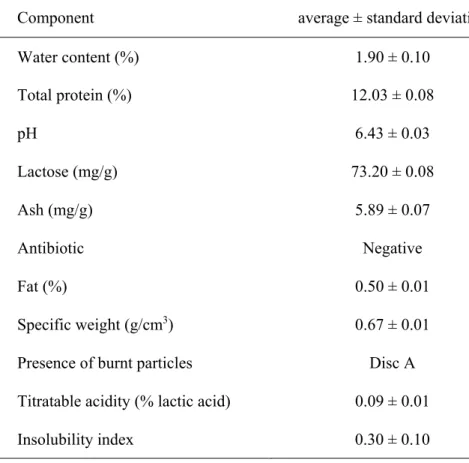
Table 1. Physicochemical composition of whey.
Component average ± standard deviation
Water content (%) 1.90 ± 0.10
Total protein (%) 12.03 ± 0.08
pH 6.43 ± 0.03
Lactose (mg/g) 73.20 ± 0.08
Ash (mg/g) 5.89 ± 0.07
Antibiotic Negative
Fat (%) 0.50 ± 0.01
Specific weight (g/cm3) 0.67 ± 0.01
Presence of burnt particles Disc A
Titratable acidity (% lactic acid) 0.09 ± 0.01
Insolubility index 0.30 ± 0.10
Rev. Ambient. Água vol. 12 n. 4 Taubaté – Jul. / Aug. 2017
Figure 1. Effect of different culture media on the enzymatic activity of β-galactosidase from Aspergillus oryzae. Columns with different letters indicate significant differences at p<0.05 (Tukey test).
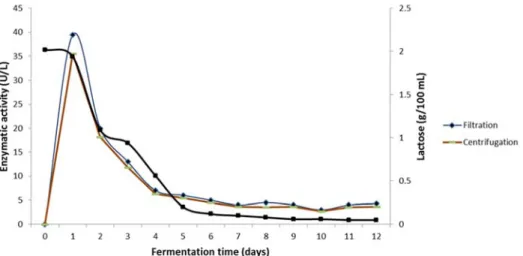
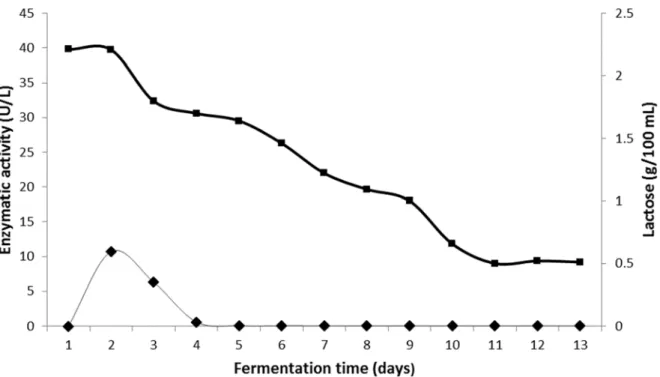
Figure 3 shows the evolution of fresh biomass and pH under optimal conditions (5%-deproteinized CWP solution). The biomass reached approximately 500 g/L and the acidification was consistent with the fermentation process. Although the use of a demineralized version of 5% CWP solution showed a similar profile as fresh biomass and pH evolution from integral CWP (Figures 3 and 5), the enzymatic activity of β-galactosidase decreased 75% (Figure 4). Delightfully, cheese whey can include the following minerals: calcium, copper, iron, magnesium, manganese, phosphorus, potassium, selenium, sodium and zinc (Tunick et al., 2015). Other previous studies showed that calcium, copper, magnesium and zinc are not needed as cofactors to beta-galactosidase (Lee et al., 2003). Thus, the initial comments concerning the negative relationship between phosphorus content and the enzymatic activity of beta-galactosidase again corroborate these results.
Rev. Ambient. Água vol. 12 n. 4 Taubaté – Jul. / Aug. 2017
Figure 3. Evolution of fresh biomass (filled square) and pH (open diamond) during batch submerged fermentation (deproteinized CWP solution - 5%) using Aspergillus oryzae.
Rev. Ambient. Água vol. 12 n. 4 Taubaté – Jul. / Aug. 2017
Figure 5. Evolution of fresh biomass (filled square) and pH (open diamond) during batch submerged fermentation (deproteinized and demineralized CWP solution - 5%) using Aspergillus oryzae.
4. CONCLUSION
The production of value-added products such as β-galactosidase is an attractive option for cheese whey management. The results of this study indicate that deproteinization has beneficial effects on enzyme yield during the fermentation process of cheese whey. Moreover, the fermentation process was able to decrease the organic load (lactose content). These results may enable an alternative management of cheese whey, thereby decreasing its impact on environment.
5. ACKNOWLEDGMENTS
The authors are grateful for the support of Coordenação de Aperfeiçoamento de Pessoal de Nível Superior (CAPES), Fundação Nacional de Desenvolvimento do Ensino Superior Particular (FUNADESP), and Kroton Educational Company (KROTON).
6. REFERENCES
AOAC INTERNATIONAL. Official methods of analysis of AOAC international. Mayland, 2005.
ARAUJO, K. et al. Ethanol production from whey using fed-batch culture with repeated cycles. Interciencia, v. 40, n. 5, p. 305–310, 2015. http://www.interciencia.org/v40_05/indexe. html
Rev. Ambient. Água vol. 12 n. 4 Taubaté – Jul. / Aug. 2017
COLOGNESE, G. O. et al. Ethanol production potential of Saccharomyces fragilis IZ 275 using cheese whey powder solution. Agrociencia, v. 49, p. 291–298, 2015.
DANDOUH, L. et al. Rheological study of orange juices for a better knowledge of their suspended solids interactions at low and high concentration. Journal of Food Engineering, v. 174, p. 15–20, 2016. https://doi.org/10.1016/j.jfoodeng.2015.11.008 DE SANTIAGO-MARTIN, A. et al. Metal contamination disturbs biochemical and microbial
properties of calcareous agricultural soils of the Mediterranean area. Archives of Environmental Contamination and Toxicology, v. 64, n. 3, p. 388–398, 2013. https://doi.org/10.1007/s00244-012-9842-8
DESCONSI, A.; IZÁRIO-FILHO, H.; SALAZAR, R. Physicochemical and microbiological evaluation of concentrated whey obtained by reverse osmosis. Revista Ambiente & Agua, v. 9, n. 2, p. 325–335, 2014. https://doi.org/10.4136/ambi-agua.1316
DURAN, C. et al. Impact of suspended solids on the activated sludge non-Newtonian behaviour and on oxygen transfer in a bubble column. Chemical Engineering Science, v. 141, p. 154–165, 2016. https://doi.org/10.1016/j.ces.2015.10.016
FAN, Q. H. et al. Illuminating the binding interactions of galactonoamidines during the inhibition of beta-galactosidase (E-coli). Bioorganic & Medicinal Chemistry, v. 24, n. 4, p. 661–671, 2016. https://doi.org/10.1016/j.bmc.2015.12.034
KROEGER, L.; THIEM, J. Synthesis and evaluation of glycosyl donors with novel leaving groups for transglycosylations employing beta-galactosidase from bovine testes. Carbohydrate Research, v. 342, n. 3-4, p. 467–481, 2007. https://doi.org/10. 1016/j.carres.2006.10.014
LEE, D. H. et al. Purification and characterization of a beta-galactosidase from peach (Prunus persica). Molecules and Cells, v. 15, n. 1, p. 68–74, 2003.
MALAKAR, P. et al. Effect on beta-galactosidase synthesis and burden on growth of osmotic stress in Escherichia coli. Springerplus, v. 3, p. 748, 2014. https://doi.org/10.1186/ 2193-1801-3-748
MIYAKE, Y. et al. Isolation of the antioxidant pyranonigrin-A from rice mold starters used in the manufacturing process of fermented foods. Bioscience Biotechnology and Biochemistry, v. 71, n. 10, p. 2515–2521, 2007. https://doi.org/10.1271/bbb.70310 MOREIRA, N. L. et al. Dynamics of ethanol production from deproteinized whey by
Kluyveromyces marxianus: An analysis about buffering capacity, thermal and nitrogen tolerance. Brazilian Archives of Biology and Technology, v. 58, n. 3, p. 454–461, 2015. https://doi.org/10.1590/S1516-8913201500372
MURTHY, P. S.; SUZUKI, S.; KUSUMOTO, K.I. Effect of light on the growth and acid protease production of Aspergillus oryzae. Food Science and Technology Research, v. 21, n. 4, p. 631–635, Jul. 2015. http://doi.org/10.3136/fstr.21.631
Rev. Ambient. Água vol. 12 n. 4 Taubaté – Jul. / Aug. 2017 SAVAIANO, D. A. et al. Improving lactose digestion and symptoms of lactose intolerance with
a novel galacto-oligosaccharide (RP-G28): a randomized, double-blind clinical trial. Nutrition Journal, v. 12, p. 160, 2013. https://doi.org/10.1186/1475-2891-12-160 SUZUKI, C. et al. Lipid-rich bovine serum albumin improves the viability and hatching ability
of porcine blastocysts produced in vitro. Journal of Reproduction and Development, v. 62, n. 1, p. 79–86, 2016. http://doi.org/10.1262/jrd.2015-076
TUNICK, M. H.; VAN HEKKEN, D. L. Dairy products and health: Recent insights. Journal of Agricultural and Food Chemistry, v. 63, n. 43, p. 9381–9388, nov. 2015. https://doi.org/10.1021/jf5042454