904 Rev Bras Epidemiol
2012; 15(4): 904-7
Notes and information
MONISA study: characteristics
and methodological aspects
Estudo MONISA: características e
aspectos metodológicos
Thiago Ferreira de Sousa
ISilvio Aparecido Fonseca
I,IIHelma Pio Mororó José
IIIMarkus Vinicius Nahas
IVIResearcher at the Research Group on Physical Activity and Health at the State
University of Santa Cruz, Ilhéus, Bahia.
IIProfessor of the State University of Santa Cruz, Ilhéus, Bahia.
IIIProfessor of the State University of Southwest Bahia, Vitória da Conquista,
Bahia.
IVProfessor of the Federal University of Santa Catarina, Florianópolis, Santa
Catarina.
Conlict of interest: None Source of funding: None
Address for correspondence: Thiago Ferreira de Sousa (E-mail: [email protected]). State University of Santa Cruz, Department of Health Sciences, Research Group on Physical Activity and Health Campus Soane Nazaré de Andrade, km 16. Highway Ilhéus-Itabuna. CEP 45662-900. Ilhéus, Bahia. Phone: +55 (73) 3680-5116.
Abstract
The objective is to present the characte-ristics and methodological procedures adopted in the MONISA Study (Surveillance of health and quality of life indicators of college students). This is a prospective, panel type study, with biannual surveys of representative samples of undergraduate students at a public university in the State of Bahia, Brazil. This study carried out five surveys, totaling 10 years of monitoring (2010-2018). The sample is stratified and proportional to the courses, study period (day and night) and year of attending uni-versity. Finally, college students are selected at each stratum, through the registration list in alphabetical order. To obtain the infor-mation is used a structured questionnaire with the following sections: socio-demo-graphic indicators, indicators of lifestyle and health, eating habits and body weight control, physical activity and other leisure options, preventive behaviors, and indica-tors environment and learning conditions. The novel aspects of this study may help in clarifying possible trends related to the health of Brazilian college students and to subsidize policies and programs or projects to promote health and quality of life in local, organizational level.
905 Rev Bras Epidemiol2012; 15(4): 904-7
MONISA study: characteristics and methodological aspects
Sousa, T.F. et al.
Resumo
O objetivo é apresentar as características e os procedimentos metodológicos adotados no Estudo Monitoramento dos Indicadores de Saúde e Qualidade de Vida de Acadêmicos
(MONISA). Trata-se de um estudo prospec-tivo, do tipo painel, com inquéritos bianuais em amostras representativas de estudantes de uma universidade pública do Estado da Bahia. Este estudo realizará cinco inquéri-tos, perfazendo 10 anos de monitoramento (2010 a 2018). A amostra é estratificada e proporcional aos cursos de graduação presenciais, período de estudo (noturno e diurno) e ano de ingresso na universidade. Por fim, os estudantes universitários são selecionados em cada estrato, por meio da lista de matrícula em ordem alfabética. Para obtenção das informações é utilizado um questionário estruturado, com as seguintes seções: indicadores sociodemográficos; in-dicadores do estilo de vida e saúde; hábitos alimentares e controle do peso corporal; atividades físicas e opções de lazer; com-portamentos preventivos; e, indicadores do ambiente e condições de aprendizagem.
Opioneirismo doEstudo MONISA poderá
auxiliar no esclarecimento de possíveis ten-dências relacionadas à saúde de estudantes universitários brasileiros e subsidiar infor-mações para propor programas ou projetos de promoção da saúde e qualidade de vida em nível organizacional local.
Palavras-chave: Estudantes. Estudos longi-tudinais. Estudos transversais. Amos tragem aleatória e sistemática. Conduta de saúde. Qualidade de vida.
Introduction
The increase in deaths related to chronic non-communicable diseases (NCDs) has been observed in several countries1 and
different risk factors such as hypertension, smoking, high blood glucose, physical inac-tivity, overweight and obesity are associated with NCD1. Given the potential harms of risk
factors to the population’s health and to the costs of health systems, many countries, including Brazil, are conducting moni-toring studies from the telephone survey surveillance system (VIGITEL)2, as well as
other surveys with specific populations, such as employees of Brazilian universities (Pro-Health and ELSA)3,4.
Such initiatives are important because of the peculiarities that determine and condition the health of people living in spe-cific environments, including the growing population of students in higher education. However, studies based on monitoring college students still do not seem to follow the initiatives observed in other population groups. In light of the shortcomings pointed out, this article presents the characteristics and methodological procedures used in the MONISA Study (Monitoring Health and Quality of Life Indicators for College Students).
Features and methodological aspects of the MONISA study
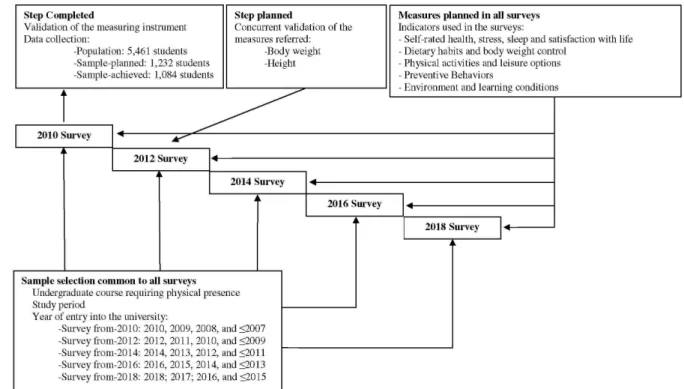
The MONISA Study is characterized as a prospective panel study, as biannual collections with representative samples of students at a public university in sou-thern Bahia will be held. This study aims to characterize and monitor the indicators of lifestyle, learning and environmental conditions of students for a period of ten years (2010-2018). The research design was approved by the local research ethics com-mittee (number 382/10).
906 Rev Bras Epidemiol
2012; 15(4): 904-7
MONISA study: characteristics and methodological aspects
Sousa, T.F. et al.
students, graduate students enrolled in hi-gher education courses and students appro-ved for the second semester. The following are taken into consideration for calculating the sample: reference population, a confi-dence level of 95%, tolerable sampling error of three percentage points and a prevalence of 50%, and an additional 20% for possible losses and 15% for association studies. The selected subjects must be sought within three attempts, if they are not found or have no interest in participating they are consi-dered as losses and refusals, respectively, with no replacements for either situation.
The sample is stratified and proportional to the courses offered by the educational institution during the study period (day or night) and year of entry to university (including four categories, and considering that most courses take at least four years to complete). In each stratum, students are selected randomly through a registration list in alphabetical order. The MONISA Study flowchart is shown in Figure 1.
In the months of July and August, the data collection staff is trained, and data are
collected on the premises of the institution, from September to November. The informa-tion is gathered through the Isaq-A questio-nnaire (Health and Quality of Life Indicators for College students)5that was based on the
questions in the original form or with minor adaptations of instruments for adults and college students. The Isaq-A was previously tested for face and content validity, clarity and pre-testing, and, for reproducibility with an interval of one week, showing satis-factory indicators for its implementation. Its final version is comprised of 71 questions, to be self-administered in the classroom and its sections are: course information; sociodemographic indicators, lifestyle and health indicators, eating habits and body weight control, and physical activity and leisure options; preventive behaviors, and indicators of environment and learning conditions.
Final Considerations
The methodological rigor of the MONISA study is one of its strengths and the easy
907 Rev Bras Epidemiol2012; 15(4): 904-7
MONISA study: characteristics and methodological aspects
Sousa, T.F. et al.
logistic requirements for its application were observed in the first survey (baseline) from 2010, which obtained a response rate of 88% (n=1,084). The information from the first survey was released in the form of lectures, institute journals and science pa-pers6-9. Further surveillance in the MONISA
Study may clarify possible trends related to
the health of Brazilian university students and provide information for the proposal of programs and projects to promote health and quality of life at the local organiza-tional level. In case of implementation of interventions, potential beneficial effects for subjects in the medium and long term are expected.
References
1. World Health Organization [WHO]. Global health risks: mortality and burden of disease attributable to selected major risks. Geneva: WHO; 2009.
2. Ministério da Saúde do Brasil. Vigilância de Fatores de Risco e Proteção para Doenças Crônicas por Inquérito Telefônico: estimativas sobre frequência e distribuição sócio-demográfica de fatores de risco e proteção para doenças crônicas nas capitais dos 26 Estados brasileiros e no Distrito Federal em 2008. Brasília: Ministério da Saúde; 2011.
3. Faerstein E, Chor D, Lopes CS, Werneck GL. Estudo Pró-Saúde: características gerais e aspectos metodológicos. Rev Bras Epidemiol 2005; 8(4): 454-66.
4. Departamento de Ciência e Tecnologia, Secretaria de Ciência, Tecnologia e Insumos Estratégicos, Ministério da Saúde. ELSA Brasil: maior estudo epidemiológico da América Latina. Rev Saúde Pública 2009; 43(1): 1-2.
5. Sousa TF, Fonseca SA, José HPM, Nahas MV. Validade e reprodutibilidade do questionário Indicadores de Saúde e Qualidade de Vida de Acadêmicos (Isaq-A). Arq Cien Esp 2012 (no prelo).
6. Sousa TF, Nahas MV. Prevalência e fatores associados a menores níveis de prática de atividades físicas no lazer em estudantes de uma universidade pública do Estado da Bahia. Rev Bras Ativ Fis Saúde 2011; 16(4): 322-29.
7. Sousa TF. Atividades físicas praticadas no lazer por universitários de uma instituição pública do Nordeste do Brasil. Rev Bras Ativ Fis Saúde 2012; 17(2): 125-31.
8. Sousa TF, José HPM, Barbosa AR. Condutas negativas à saúde em estudantes universitários brasileiros. Ciênc Saúde Colet 2013 (no prelo).
9. Sousa TF, Virtuoso Junior JS, Barbosa AR. Autovaloración de salud: localización de la pregunta en las encuestas epidemiológicas. Gac Sanit 2013 (no prelo).