HIV risk practices by female sex
workers according to workplace
Práticas de risco ao HIV de
mulheres profissionais do sexo
Laboratório de Informações em Saúde. Instituto de Comunicação e Informação Científica e Tecnológica em Saúde. Fundação Oswaldo Cruz. Rio de Janeiro, RJ, Brasil
Correspondence:
Giseli Nogueira Damacena
Laboratório de Informações em Saúde – Icict/ Fiocruz
Av. Brasil, 4365 Sala 225 Pavilhão Haity Moussatché
21040-900 Rio de Janeiro, RJ, Brasil E-mail: [email protected] Received: 6/13/2013
Approved: 10/21/2013
Article available from: www.scielo.br/rsp
ABSTRACT
OBJECTIVE: To investigate differences in HIV infection- related risk practices by Female Sex Workers according to workplace and the effects of homophily on estimating HIV prevalence.
METHODS: Data from 2,523 women, recruited using Respondent-Driven Sampling, were used for the study carried out in 10 Brazilian cities in 2008-2009. The study included female sex workers aged 18 and over. The questionnaire was completed by the subjects and included questions on characteristics of professional activity, sexual practices, use of drugs, HIV testing, and access to health services. HIV quick tests were conducted. The
participants were classiied in two groups according to place of work: on
the street or indoor venues, like nightclubs and saunas. To compare variable distributions by place of work, we used Chi-square homogeneity tests, taking into consideration unequal selection probabilities as well as the structure of dependence between observations. We tested the effect of homophily by workplace on estimated HIV prevalence.
RESULTS: The highest HIV risk practices were associated with: working
on the streets, lower socioeconomic status, low regular smear test coverage, higher levels of crack use and higher levels of syphilis serological scars as well as higher prevalence of HIV infection. The effect of homophily was higher among sex workers in indoor venues. However, it did not affect
the estimated prevalence of HIV, even after using a post-stratiication by
workplace procedure.
CONCLUSIONS: The indings suggest that strategies should focus on
extending access to, and utilization of, health services. Prevention policies
should be speciically aimed at street workers. Regarding the application of Respondent-Driven Sampling, the sample should be suficient to estimate
transition probabilities, as the network develops more quickly among sex workers in indoor venues.
DESCRIPTORS: Sex Workers. Dangerous Behavior. HIV Seroprevalence. Risk Factors. Workplace.
It is necessary to monitor the practices and attitudes of
those most at risk of HIV infection, as speciic interven
-tions aimed at these population subgroups can signii -cantly alter the pattern of the spread of HIV and AIDS in the general population.5
Research on female sex workers (FSW) conirms the
increased risk of HIV infection in this population subgroup. Lack of access to health care services, drug abuse and prior history of sexually transmitted infection have also been shown, and are also factors associated with HIV prevalence.20,23 Recent studies emphasize the
importance of characterizing FSW practice according to workplace. Practices placing them at risk of HIV infec-tion may vary according to where the FSW meet their clients (indoor venues or on the street).4,7,20,21
RESUMO
OBJETIVO: Investigar diferenças nas práticas de risco à infecção pelo HIV
segundo local de trabalho das mulheres proissionais do sexo e efeitos de homoilia na estimação da prevalência do HIV.
MÉTODOS: Foram utilizadas informações de 2.523 mulheres recrutadas por
Respondent-Driven Sampling em estudo realizado em 10 cidades brasileiras,
2008-2009. Foram incluídas proissionais com 18 anos ou mais de idade. O questionário foi autopreenchido e incluiu perguntas sobre características da proissão, práticas
sexuais, uso de drogas, testes periódicos de HIV e acesso aos serviços de saúde. Utilizaram-se testes rápidos para detecção de HIV. As participantes foram agregadas
em dois grupos por local de trabalho: pontos de rua ou locais fechados, e.g.,
boates, saunas e termas. Foram utilizados testes Qui-quadrado de homogeneidade, levando-se em consideração as probabilidades desiguais de seleção, bem como a
dependência entre as observações. Os efeitos de homoilia por local de trabalho foram pesquisados na estimação da prevalência do HIV.
RESULTADOS: As práticas de maior risco ao HIV associaram-se a: trabalhar
em pontos de rua, menor nível socioeconômico, baixa cobertura de exame
preventivo de câncer de colo de útero, elevado consumo de crack, maior
prevalência de cicatriz sorológica de síilis e maior prevalência de infecção pelo HIV. O efeito de homoilia foi maior entre as proissionais de locais fechados. Contudo, não afetou a estimativa da prevalência de HIV, mesmo utilizando o procedimento de pós-estratiicação por local de trabalho. CONCLUSÕES: Os resultados indicaram que as estratégias devem ser dirigidas
à ampliação do acesso e à utilização dos serviços de saúde. As políticas de
prevenção devem priorizar as proissionais de rua. Em relação à aplicação do
Respondent-Driven Sampling, a amostra deve ser suiciente para estimação das
probabilidades de transição, uma vez que a rede se desenvolve mais rapidamente
entre as proissionais de locais fechados.
DESCRITORES: Proissionais do Sexo. Comportamento Perigoso. Soroprevalência de HIV. Fatores de Risco. Local de Trabalho.'
INTRODUCTION
Until recently, convenience sampling was used in
studies of this type, due to the dificulties in using
traditional sampling techniques to select individuals in populations with high risk of HIV infection.25 These
studies were also local, limiting monitoring of national level prevention actions and policies.3
The development of probabilistic sampling methods
speciically for selecting individuals at greater risk of
contracting HIV, such as Respondent-Driven Sampling (RDS),14 gave new opportunities for both international22
and national research.17
individuals with a certain characteristic or participating in a certain activity are interlinked through a social network and have connections with others with similar characteristics. The data are collected in successive recruitment circles, known as “waves”.14 The method
sometimes produces the so-called “homophily effect”, a result of the tendency of the individual selected for the study to recruit others with similar charateristics.15
In 2008 and 2009, a study with FSW was conducted in 10 cities in Brazil, with RDS chosen as the sampling methodology.10,11,28 Based on the data from this study,
Szwarcwald et al28 proposed a method of analyzing
data collected using RDS, taking into consideration unequal probability of selection as well as dependency between observations, given the recruitment pattern as well as intraclass variation in the group of participants recruited by the same person. Moreover, the analysis can be conducted using logistic regression, enabling the model to be extended to a multivariate model. The
prevalence of HIV was estimated at 4.8%(95%CI
3.4;6.1), approximately 15 times greater in this group than in the female Brazilian population.27 Multivariate
analysis showed that the length of time in prostitution, charging low prices, presence of other sexually trans-mitted infections and the possibility of being pressured by the client not to use protection were the main predic-tors of HIV in Brazilian FSW.11
This article aimed to investigate differences in HIV infection-related practices in female sex workers according to the workplace, and the effects of homophily in estimating HIV prevalence.
METHODS
Data were taken from the study on sexually transmitted infections in sex workers, which took place between August 2008 and July 2009 in 10 Brazilian cities (Manaus, Recife, Salvador, Campo Grande, Brasília, Belo Horizonte, Santos, Rio de Janeiro, Curitiba and Itajaí).
The cities were chosen by the Brazilian Ministry of Health Department of Sexually Transmitted Diseases, AIDS and Viral Hepatitis due to their location and the scale of the HIV/AIDS epidemic.
In total, 2,523 FSW aged 18 and over, who had had sex in exchange for money on at least one occasion in the four months preceding the study, were included. The sample was proportional to the population of each city,
although with a minimum of 100 FSW.10
In each city, 10 initial participants, so-called “seeds”, were chosen. The choice of seeds was not random, as it was to include FSW of different ages groups, skin color/race,
economic class, level of schooling and from different workplaces, e.g., on the street, in nightclubs, saunas, and
hotels, among others. Each seed received three coupons
to pass on to acquaintances who were also sex workers. Those seeds invited to participate in the research formed
the irst “wave” of the study. After participating in an
interview they in turn received three more coupons to invite their acquaintances. This process was repeated until the required sample for each city was reached.
The data were collected using a questionnaire in an Audio Computer-Assisted Self-Interview. The FSW were provided with laptop computers and headphones with which to read and listen to all of the questions and response options in private. Studies conducted in the USA indicate that interview methods that increase privacy in the context of the interview dramatically increase reports regarding sensitive and/or illegal behavior.1,18 They also indicated that the participants
had no dificulty in using the equipment.24,25,a
HIV diagnosis was obtained using the rapid test, following the protocols of the Department of Sexually Transmitted Diseases, AIDS and Viral Hepatitis. To verify any association with the prevalence of syph-ilis with that of HIV, the disease was tested for using the Bio-Line rapid treponemal test for syphilis which gave a diagnosis of active syphilis. Negative or
posi-tive VDRL tests below 1:8 were considered to be a
syphilis serologic scar. All participants received pre- and post-test counselling. Women with positive results received additional post-test counselling, both in order to deal with the psychological impact and to encourage partners to be tested if necessary, and were referred to public health care services for follow up.
The assumptions of the RDS method and the experience of establishing this sampling process in sex workers in Brazil are described in a previous publication.10
The size of the FSW network of acquaintances was
estimated using the question: “How many sex workers
working here in the city do you know personally?”, and sampling weights proportional to the inverse of the size of the participants’ network were used.26 The total
sample was calibrated using post-stratiication proce -dures, considering the relative size of the group of 18 to 59-year-old women in each city and assuming the same proportion of FSW in all cities.28
The FSW were separated into two groups according to
their workplace: the “on the street” group composed
of those who worked on the street and in brothels; and the “indoor venues” group, made up of women who worked in nightclubs, bars, hotels, motels, saunas and massage parlors.
The following aspects were used to investigate
differ-ences according to workplace: sociodemographic
variables, characteristics of the FSW work, frequency of alcohol and illegal drug use, health service access indicators and the results of the HIV and syphilis tests. Indicators of condom use were not used as they show
no signiicant association with HIV infection.11
The comparative analysis used the Chi-square tests for homogeneity between distributions, taking into consid-eration unequal probabilities of selection as well as dependence between observations given the intra-class variation between participants recruited by the same individual. The “Complex Sample” appendix from the
Statistical Package for the Social Sciences17.0 was
used, considering the group of women invited by the same FSW as a cluster.
To verify homophily according to workplace, the recruitment network was analyzed identifying the workplace of the recruiter and the recruitee, using the NetDraw program.6 Estimates of the proportion of FSW
in each stratum and the homophily test were conducted using estimates of the probability of transition from one state (the street) to the other (indoor venue), using the
method proposed by Szwarcwald et al.28
Additionally, the possible effects of homophily according to workplace in estimating HIV prevalence were also investigated. Considering stratification according to workplace, the estimate of HIV
preva-lence is found by:
P(HIV) = p1*P(HIV|1) + p2*P(HIV|2),
In which i = 1 and 2 represent strata and P(HIV| i), the prevalence of HIV in stratum i.
The research was approved by the Research
Ethics Committee of the Fundação Oswaldo Cruz
(Protocol 395/07).
RESULTS
There were 2,523 interviews, excluding those of the
seeds, distributed among the 10 cities: Manaus (199),
Recife (237), Salvador (260), Campo Grande (147), Brasília (308), Belo Horizonte (289), Santos (191), Rio de Janeiro (601), Curitiba (201) and Itajaí (90).
When comparing the sociodemographic characteristics of the FSW according to workplace, with the exception of race, all the variables studied showed statistically
signiicant differences at the 5% level. Comparing distri -butions according to age, the majority of young women (18 to 24 years old) were found in the “indoor venue” group, whereas the majority of FSW aged 40 and over were in the “on the street” group. In regard to socioeco-nomic status, FSW in indoor venues had higher levels of schooling and income above R$ 1,200.00 (Table 1).
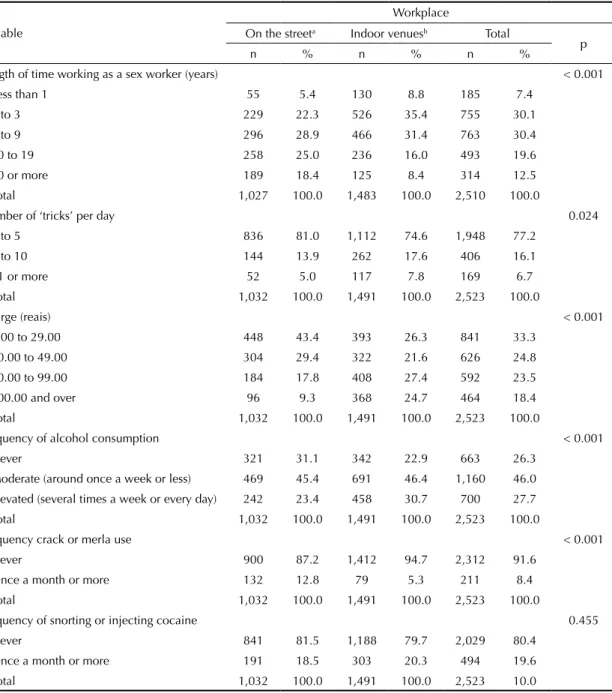
As for the characteristics of the study, those women who worked in indoor venues had spent a compara-tively shorter time in prostitution and performed a higher number of sexual activities per day, as well as charging more (Table 2). As to the frequency of alcohol consumption, the differences between
work-places were statistically signiicant, at the 5% level of signiicance, with higher consumption among those
women who worked in indoor venues (Table 2). Use
of crack or merla was more frequently observed in
women working on the streets. The declared percentage of cocaine used was high in both groups (Table 2). Whether cocaine was snorted or injected did not differ
signiicantly according to workplace.
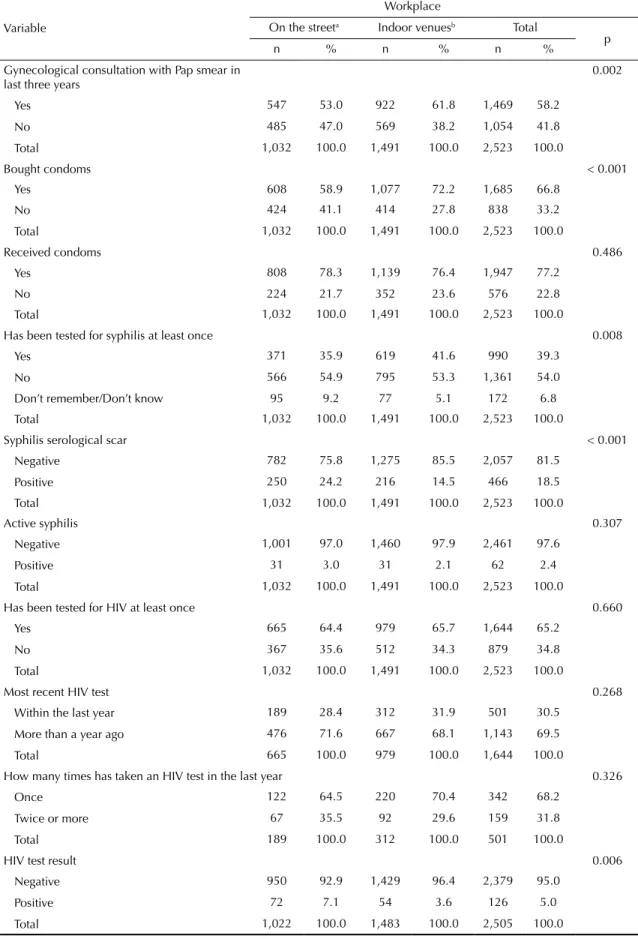
The results shown in Table 3 show the differences in accessing the health care system. In general, FSW working in indoor locations showed higher percentages of gynecological screening examinations and having been tested for syphilis at least once. However, there were no differences in receiving condoms or frequency of HIV testing.
There were some signiicant differences in the pres -ence of sexually transmitted diseases (Table 3). The percentage of FSW on the streets with a syphilis sero-logic scar was 24.2%, almost 10 percentage points above those who worked in indoor locations (15.5%).
The prevalence of HIV was also signiicantly higher
among sex workers on the street (7.2%); twice as high as in the other group (3.6%).
Homophily was observed in the recruitment pattern according to workplace. The probability of a woman working in an indoor venue being recruited by another from an indoor venue was 65.4%, but the probability of being recruited by a woman working on the streets
was only 34.6%, indicating homophily (Table 4). On
balance, the estimated proportion of FSW from indoor venues is 59.0% and street workers 41.0%. Considering
stratiication by workplace, the weighted estimate of
the prevalence of HIV was of 5.0%.
The tendency to recruit peers from the same stratum by workplace is illustrated in the Rio de Janeiro network (Figure).
DISCUSSION
The results show differences in the FSW profiles according to workplace. Women who work on the streets had a higher probability of becoming infected
with HIV. Older women with lower levels of schooling
and income who work on the streets and who have spent longer in prostitution were associated with higher risk of becoming HIV infected, as has been discussed by other authors.20 A recent study13 showed that FSW
Table 1. Sociodemographic characteristics of sex workers according to workplace. Brazil, 2009. (N = 2,523)
Variable
Workplace
On the streeta Indoor venuesb Total
p
n % n % n %
Age (years) < 0.001
18 to 24 307 29.7 551 37.0 858 34.0
25 to 39 457 44.3 743 49.9 1,200 47.6
40 to 59 248 24.0 187 12.5 435 17.2
60 and over 20 2.0 10 0.7 30 1.2
Total 1,032 100.0 1,491 100.0 2,523 100.0
Schooling < 0.001
Elementary school unfinished 704 68.2 790 53.0 1,494 59.2
High school unfinished 211 20.5 387 26.0 598 23.7
High school or above 117 11.4 314 21.0 431 17.1
Total 1,032 100.0 1,491 100.0 2,523 100.0
Skin color 0.315
White 232 22.5 372 24.9 604 23.9
Black 286 27.7 431 28.9 717 28.4
Mixed race 425 41.2 537 36.0 962 38.1
Other 89 8.6 151 10.1 240 9.5
Total 1,032 100.0 1,491 100.0 2,523 100.0
Marital status 0.002
Never married 512 49.6 820 55.0 1,332 52.8
Married or cohabiting 191 18.5 323 21.6 514 20.3
Separated or divorced 249 24.1 296 19.9 545 21.6
Widowed 80 7.8 52 3.5 132 5.2
Total 1,032 100.0 1,491 100.0 2,523 100.0
Monthly income (reais) < 0.001
1.00 to 299.00 280 32.0 191 14.6 471 21.6
300.00 to 599.00 290 33.1 375 28.8 665 30.5
600.00 to 1,199.00 205 23.4 395 30.2 600 27.5
1,200.00 to 2,999.00 83 9.5 290 22.2 373 17.1
3,000.00 and over 18 2.0 55 4.2 73 3.3
Total 876 100.0 1,306 100.0 2,182 100.0
a On the street and in brothels, predominantly.
b Clubs, bars, hotels, motels, saunas and massage parlors.
a longer time, having spent more years in the profes-sion, are also more likely to have experienced unsafe
sexual practices. The indings of this study show that
FSW working on the streets had less access to the health care system. The coverage of cervical cancer screening among FSW in indoor venues in the three years preceding the research was 61.8%, lower than that of the 18 to 69-year old Brazilian female population
(77.3%), (estimated using data from the 2008 PNAD – National Household Survey Health Care Supplementb).
In FSW who worked on the streets, coverage was lower still; only 53.0%.
The amount the women charged was shown to be a
rele-vant factor, being signiicantly lower among those who
worked on the street. According to the amount charged,
Table 2. Characteristics of work, alcohol and drug consumption in sex workers according to workplace. Brazil, 2009. (N = 2,523)
Variable
Workplace
On the streeta Indoor venuesb Total
p
n % n % n %
Length of time working as a sex worker (years) < 0.001
Less than 1 55 5.4 130 8.8 185 7.4
1 to 3 229 22.3 526 35.4 755 30.1
4 to 9 296 28.9 466 31.4 763 30.4
10 to 19 258 25.0 236 16.0 493 19.6
20 or more 189 18.4 125 8.4 314 12.5
Total 1,027 100.0 1,483 100.0 2,510 100.0
Number of ‘tricks’ per day 0.024
1 to 5 836 81.0 1,112 74.6 1,948 77.2
6 to 10 144 13.9 262 17.6 406 16.1
11 or more 52 5.0 117 7.8 169 6.7
Total 1,032 100.0 1,491 100.0 2,523 100.0
Charge (reais) < 0.001
1.00 to 29.00 448 43.4 393 26.3 841 33.3
30.00 to 49.00 304 29.4 322 21.6 626 24.8
50.00 to 99.00 184 17.8 408 27.4 592 23.5
100.00 and over 96 9.3 368 24.7 464 18.4
Total 1,032 100.0 1,491 100.0 2,523 100.0
Frequency of alcohol consumption < 0.001
Never 321 31.1 342 22.9 663 26.3
Moderate (around once a week or less) 469 45.4 691 46.4 1,160 46.0
Elevated (several times a week or every day) 242 23.4 458 30.7 700 27.7
Total 1,032 100.0 1,491 100.0 2,523 100.0
Frequency crack or merla use < 0.001
Never 900 87.2 1,412 94.7 2,312 91.6
Once a month or more 132 12.8 79 5.3 211 8.4
Total 1,032 100.0 1,491 100.0 2,523 100.0
Frequency of snorting or injecting cocaine 0.455
Never 841 81.5 1,188 79.7 2,029 80.4
Once a month or more 191 18.5 303 20.3 494 19.6
Total 1,032 100.0 1,491 100.0 2,523 10.0
a On the street and in brothels, predominantly.
b Clubs, bars, hotels, motels, saunas and massage parlors.
the clients differed regarding level of schooling
and knowledge of HIV transmission,10,29 frequently
demanding unprotected sex, offering more money for this.16 The FSW, in turn, are not able to negotiate safe
sex as they need the money.19
Charging low prices and the possibility of unprotected sex due to clients’ demands are among the main
vari-ables associated with HIV prevalence.11 Empowering
women to negotiate safe sex with partners is considered to be one of the most relevant interventions in reducing
HIV transmission in FSW.9
Using crack was another factor which proved to be more relevant in street FSW. Studies have shown that drug
abuse is associated with a signiicantly higher risk of becoming infected with HIV, as it can inluence unsafe
sexual practices.23 The need for money to buy drugs is
another factor which affects negotiations for safe sex.8,24
A study reviewing articles on FSW in Central Asia concluded that the HIV transmission risk factor was the use of illicit drugs, both injectable and non-injectable.2
Figure. Network of female sex workers who participated in the study according to workplace. Rio de Janeiro, RJ, 2009. (N = 601) Key: Larger items represent the seeds in the study. The circles represent female sex workers working on the street and the squares those in indoor venues.
of syphilis and HIV. The difference in syphilis serologic scars was almost 10 percentage points higher among
those who worked on the streets, corroborating the ind -ings of other studies.20,30
Findings in the international literature corroborate the results depicted here, indicating that FSW on the streets are those most at risk of becoming infected with HIV.21
Moreover, differing attitudes and practices emphasize the need for studies which take into account separation according to workplace, to properly guide prevention and care actions for FSW.4,7,20,21
As it uses peer recruitment techniques, in which the participant invites others with similar characteristics, the RDS method is recognized as probabilistic sampling which enables recruitment of individuals in populations
to which it is dificult to gain access.22 In Brazil, as well
as enabling gaps in information concerning the FSW
population to be illed, using RDS enables estimates of
parameters to be calculated in order to monitor the HIV epidemic in this population subgroup.10,11,28
As to the use of the RDS methodology, the indings
indicate that FSW on the street recruit FSW who work in indoor venues, and vice-versa, with the networks not being independent. However, attention should be paid to the existence of homophily, especially concerning the tendency of participants from indoor venues to recruit peers from the same group. Firstly, it
indicates the need to choose seeds diversiied by type
of workplace. Secondly, it emphasizes the need to incorporate the dependency of observations produced
by the recruiting pattern in the statistical analysis. Lastly, and perhaps most importantly, the sample
size should be suficiently large to estimate the prob -abilities of transition from one state to another. As the homophily effect did not occur in FSW working on the street, but only in those working in indoor venues, the network developed more quickly among FSW in indoor venues.
Considering the transference process of sampling
methods in populations to which it is dificult to gain
access, conducted by the Global AIDS Program, Centers of Disease Control, a pilot study in Brazil, conducted in the city of Santos, SP, Southeastern Brazil,
used the RDS method to select 173 FSW. Of these, 121
(70.0%) worked in nightclubs, of which 116 (96.0%) were concentrated in just two clubs.3 As the network
developed more quickly among FSW in indoor venues, the sample size needed to estimate the probability of transition and the proportions of FSW according to workplace was not reached, probably resulting in under-estimation of HIV prevalence.
This limitation does not apply to this study, as the
sample was suficient to achieve Markov equilibrium
and the homophily effect did not affect the estimated HIV prevalence. The estimate was very close to what had been found previously,28 even using the procedure
of post-stratiication according to workplace.
Table 3. Access to health care and results of HIV and syphilis tests in sex workers according to workplace. Brazil, 2009. (N = 2,523)
Workplace
Variable On the streeta Indoor venuesb Total
p
n % n % n %
Gynecological consultation with Pap smear in last three years
0.002
Yes 547 53.0 922 61.8 1,469 58.2
No 485 47.0 569 38.2 1,054 41.8
Total 1,032 100.0 1,491 100.0 2,523 100.0
Bought condoms < 0.001
Yes 608 58.9 1,077 72.2 1,685 66.8
No 424 41.1 414 27.8 838 33.2
Total 1,032 100.0 1,491 100.0 2,523 100.0
Received condoms 0.486
Yes 808 78.3 1,139 76.4 1,947 77.2
No 224 21.7 352 23.6 576 22.8
Total 1,032 100.0 1,491 100.0 2,523 100.0
Has been tested for syphilis at least once 0.008
Yes 371 35.9 619 41.6 990 39.3
No 566 54.9 795 53.3 1,361 54.0
Don’t remember/Don’t know 95 9.2 77 5.1 172 6.8
Total 1,032 100.0 1,491 100.0 2,523 100.0
Syphilis serological scar < 0.001
Negative 782 75.8 1,275 85.5 2,057 81.5
Positive 250 24.2 216 14.5 466 18.5
Total 1,032 100.0 1,491 100.0 2,523 100.0
Active syphilis 0.307
Negative 1,001 97.0 1,460 97.9 2,461 97.6
Positive 31 3.0 31 2.1 62 2.4
Total 1,032 100.0 1,491 100.0 2,523 100.0
Has been tested for HIV at least once 0.660
Yes 665 64.4 979 65.7 1,644 65.2
No 367 35.6 512 34.3 879 34.8
Total 1,032 100.0 1,491 100.0 2,523 100.0
Most recent HIV test 0.268
Within the last year 189 28.4 312 31.9 501 30.5
More than a year ago 476 71.6 667 68.1 1,143 69.5
Total 665 100.0 979 100.0 1,644 100.0
How many times has taken an HIV test in the last year 0.326
Once 122 64.5 220 70.4 342 68.2
Twice or more 67 35.5 92 29.6 159 31.8
Total 189 100.0 312 100.0 501 100.0
HIV test result 0.006
Negative 950 92.9 1,429 96.4 2,379 95.0
Positive 72 7.1 54 3.6 126 5.0
Total 1,022 100.0 1,483 100.0 2,505 100.0
a On the street and in brothels, predominantly.
Table 4. Recruitment patterns of sex workers according to workplace. Brazil, 2009. Participant’s workplace
Recruiter’s workplace On the streeta Indoor venuesb Total p
n % n % n %
On the street and others 477 52.0 555 34.6 1,032 40.9 < 0.001
Indoor venues 440 48.0 1,051 65.4 1,491 59.1
Total 917 100.0 1,606 100.0 2,523 100.0
a On the street and in brothels, predominantly.
b Clubs, bars, hotels, motels, saunas and massage parlors.
1. Aquilino WS. Privacy effects on self-reported drug use: interactions with survey mode and respondents characteristics. NIDA Res Monogr. 1997;167:383-415.
2. Baral S, Todd CS, Aumakhan B, Lloyd J, Delegchoimbol A, Sabin K. Literature review of HIV among female sex workers in the Central Asian Republics, Afghanistan, and Mongolia: contexts and convergence with drug use. Drug Alcohol Depend. 2013:132(Suppl 1):13-6
3. Barbosa-Jr A, Pascom ARP, Szwarcwald CL, Kendall C, McFarland W. Transfer of sampling methods for studies on most-at-risk populations (MARPs) in Brazil. Cad Saude Publica. 2011;27(Suppl 1):36-44. DOI:10.1590/S0102-311X2011001300005
4. Blankenship KM, Burroway R, Reed E. Factors associated with awareness and utilisation of a community mobilisation intervention for female sex workers in Andhra Pradesh, India. Sex Transm Infect.
2010;86(Suppl 1):69-75.
5. Boily MC, Lowdes C, Alary M. The impact of HIV epidemic phases on the effectiveness of core group interventions: insights from mathematical models. Sex Transm Infect. 2002;78(Suppl 1):78-90. DOI:10.1136/sti.78.suppl_1.i78
6. Borgatti SP. NetDraw Software for Network
Visualization. Lexington: Analytic Technologies; 2002.
7. Buzdugan R, Copas A, Moses S, Blanchard J, Isac S, Ramesh BM, et al. Devising a female sex work typology using data from Karnataka, India. Int J Epidemiol.
2010;39(2):439-48. DOI:10.1093/ije/dyp351
8. Campbell AN, Tross S, Dworkin SL, Hu MC, Manuel J, Pavlicova M, et al. Relationship power and sexual risk among women in community-based substance abuse treatment. J Urban Health. 2009;86(6):951-64. DOI:10.1007/s11524-009-9405-0
9. Chersich MF, Luchters S, Ntaganira I, Gerbase A, Lo YR, Scorgie F, et al. Priority interventions to reduce HIV transmission in sex work settings in sub-Saharan Africa and delivery of these services. J Int AIDS Soc.
2013;16(1):17980. DOI:10.7448/IAS.16.1.17980
10. Damacena GN, Szwarcwald CL, Barbosa Jr A. Implementation of respondent-driven sampling among female sex workers in Brazil, 2009.
Cad Saude Publica. 2011;27(Suppl 1):S45-55. DOI:10.1590/S0102-311X2011001300006
11. Damacena GN, Szwarcwald CL, Souza-Jr PRB, Dourado I. Risk factors associated with HIV prevalence among female sex workers in 10 Brazilian cities. J Acquir Immune Defic Syndr. 2011;57(Suppl 3):144-52. DOI:10.1097/QAI.0b013e31821e9bf6
12. Ghys PD, Diallo MO, Ettiègne-Traoré V, Kalé K, Tawil O, Caraël M, et al. Increase in condom use and decline in HIV and sexually transmitted diseases among female sex workers in Abidjan, Côte d’Ivoire, 1991-1998. AIDS. 2002;16(2):251-8. DOI:10.1097/00002030-200201250-00015
13. Hao C, Liu H, Sherman SG, Jiang B, Li X, Xu Y, et al. Typology of older female sex workers and sexual risk for HIV infection in China: a qualitative study. Cult Health Sex. 2014;16(1):47-60.
14. Heckathorn DD. Respondent-driven sampling: a new approach to the study of hidden populations. Soc Probl. 1997;4492:174-99. DOI:10.2307/3096941
15. Heckathorn DD, Semaan S, Broadhead RS, Hughes JJ. Extensions of respondent-driven sampling: a new approach to the study of injection drug users aged 18-25. AIDS Behav. 2002;6(1):55-67. DOI:10.1023/A:1014528612685
16. Kathleen EW, Eric JTT, Jay GS, Megan BM. How does sex trafficking increase the risk of HIV infection? An observational study from Southern India. Am J Epidemiol. 2013;177(3):232-41. DOI:10.1093/aje/kws338
17. Kerr LR, Mota RS, Kendall C, Pinho AA, Mello MB, Guimarães MD, et al. HIV among MSM in a large middle-income country. AIDS. 2013;27(3):427-35. DOI:10.1097/QAD.0b013e32835ad504
18. Kissinger P, Rice J, Farley T, Trim S, Jewitt K, Margavio V, et al. Application of computer-assisted interviews to sexual behavior research. Am J Epidemiol.1999;149(10):950-4. DOI:10.1093/oxfordjournals.aje.a009739
REFERENCES
of gynecological examinations and regular syph-ilis testing; increase distribution of condoms, espe-cially among the poorest FSW, so that they do not need to buy condoms; focus interventions on areas
19. Lau JT, Tsui HY, Siah PC, Zhang KL. A study on female sex workers in southem China (Shenzhen): HIV-related knowledge, condom use and STD history. AIDS Care. 2002;149(2):219-33. DOI:10.1080/09540120220104721
20. Li J, Chen XS, Merli MG, Weir SS, Henderson GR. Systematic differences in risk behaviors and syphilis prevalence across types of female sex workers: a preliminary study in Liuzhou, China. Sex Transm Dis. 2012;39(3):195-200. DOI:10.1097/OLQ.0b013e31823d2e2a
21. Li Y, Detels R, Lin P, Fu X, Deng Z, Liu Y, et al. Difference in risk behaviors and STD prevalence between street-based and establishment-based FSWs in Guangdong Province, China. AIDS Behav. 2012;16(4):943-51. DOI:10.1007/s10461-011-0102-0
22. Malekinejad M, Johnston LG, Kendall C, Kerr LR, Rifkin MR, Rutherford GW. Using respondentdriven sampling methodology for HIV biological and behavioral surveillance in international settings: a systematic review. AIDS Behav. 2008;12(4Suppl):105-30. DOI:10.1007/s10461-008-9421-1
23. Medhi GK, Mahanta J, Kermode M, Paranjape RS, Adhikary R, Phukan SK, et al. Factors associated with history of drug use among female sex workers (FSW) in a high HIV prevalence state of India. BMC Public Health. 2012;12:273. DOI:10.1186/1471-2458-12-273
24. O’Reilly JM, Hubbard ML, Lessler JT, Biemer PP, Turner CF. Audio and video computer assisted self-interviewing: preliminary tests of new technologies for data collection. J Off Stat. 1994;1092:197-214.
25. Pascom AR, Szwarcwald CL, Barbosa-Jr A. Sampling studies to estimate the HIV prevalence rate in female commercial sex workers. Braz J Infect Dis. 2010;14(4):385-97. DOI:10.1590/S1413-86702010000400014
26. Salganik MJ, Heckathorn DD. Sampling and estimation in hidden populations using Respondent-Driven Sampling. Sociol Methodol. 2004;3491:193-240. DOI:10.1111/j.0081-1750.2004.00152.x
27. Szwarcwald CL, Barbosa Jr A, Souza Jr PRB, Lemos KR, Frias PG, Luhm KR, et al. HIV testing during pregnancy: use of secondary data to estimate 2006 test coverage and prevalence in Brazil. Braz J Infect Dis. 2008;12(3):167-172. DOI:10.1590/S1413-86702008000300002
28. Szwarcwald CL, Souza-Jr PRB, Damacena GN, Barbosa-Jr A, Kendall C. Analysis of data collected by RDS among sex workers in 10 Brazilian cities, 2009: estimation of the prevalence of HIV, variance, and design effect. J Acquir Immune Defic Syndr. 2011;57(Suppl 3):129-35 DOI:10.1097/QAI.0b013e31821e9a36
29. Zhang C, Li X, Hong Y, Zhou Y, Liu W, Stanton B. Unprotected sex with their clients among low-paying female sex workers in southwest China. AIDS Care. 2013;25(4):503-6. DOI:10.1080/09540121.2012.726345
30. Zhou Y, Li X, Zhang C, Tan G, Stanton B, Zhang X, Cui Y. Rates of HIV, syphilis, and HCV infections among different demographic groups of female sex workers in Guangxi China: Evidence from 2010 national sentinel surveillance data. AIDS Care. 2013;25(11):1433-41. DOI:10.1080/09540121.2013.772282
This study was supported by the Ministry of Health/Secretariat of Health Surveillance/Department of STD, AIDS and Viral hepatitis, through the International Technical Cooperation Project AD/BRA/03/H34 between the Brazilian Government and the United Nations Office on Drugs and Crime – UNODC (TC/CFA/CSV - 239/2007).