4 3 6 4 3 64 3 6 4 3 6
4 3 6 Rev Saúde Pública 2001;35(5):436-42
www.fsp.usp.br/rsp
Hospital visitors as controls in case-control
studies
Visitantes hospitalares como controles em
estudos caso-controle
Gulnar Azevedo S Mendonçaa and José Eluf-Netob
aInstituto de Medicina Social da Universidade do Estado do Rio de Janeiro. Rio de Janeiro, RJ, Brasil.
bDepartamento de Medicina Preventiva da Faculdade de Medicina da Universidade de São Paulo. São
Paulo, SP, Brasil
Correspondence to:
Gulnar Azevedo S. Mendonça
Depto Epidemiologia, Instituto de Medicina Social Universidade do Estado do Rio de Janeiro Rua São Francisco Xavier, 524, 7o andar
20559-900, Rio de Janeiro, RJ, Brasil E-mail: [email protected]
Supported by grant sponsor from Pan American Health Organization (reference: HDP/HDR/HCP/RG/BRA/1262). This study was carried out in “Instituto Nacional de Câncer”, Rio de Janeiro, Brazil and in Departamento de Epidemiologia. Instituto de Medicina Social, Universidade do Estado do Rio de Janeiro. Presented in IV “Congresso Brasileiro de Epidemiologia”, Rio de Janeiro, 1998.
Submitted on 5/9/2000. Reviewed on 21/3/2001. Approved on 1/8/2001.
Keywords
Case control studies.# Breast
neoplasms. Selection of controls. Hospital visitors controls.
Abstract
Objective
Selecting controls is one of the most difficult tasks in the design of case-control studies. Hospital controls may be inadequate and random controls drawn from the base population may be unavailable. The aim was to assess the use of hospital visitors as controls in a case-control study on the association of organochlorinated compounds and other risk factors for breast cancer conducted in the main hospital of the “Instituto Nacional de Câncer” – INCA (National Cancer Institute) in Rio de Janeiro (Brazil).
Methods
The study included 177 incident cases and 377 controls recruited among female visitors. Three different models of control group composition were compared: Model 1, with all selected visitors; Model 2, excluding women visiting relatives with breast cancer; and Model 3, excluding all women visiting relatives with any type of cancer. Odds ratios (OR) and 95% confidence intervals were calculated to test the associations.
Results
Age-adjusted OR for breast cancer associated with risk factors other than family history of cancer, except smoking and breast size, were similar in the three models. Regarding family history of all cancers, except for breast cancer, there was a decreased risk in Models 1 and 2, while in Model 3 there was an increased risk, but not statistically significant. Family history of breast cancer was a risk factor in Models 2 and 3, but no association was found in Model 1. In multivariate analysis a significant risk of breast cancer was found when there was a family history of breast cancer in Models 2 and 3 but not in Model 1.
Conclusions
These results indicate that while investigating risk factors unrelated to family history of cancer, the use of hospital visitors as controls may be a valid and feasible alternative.
Resumo
Objetivo
A seleção de controles é uma das maiores dificuldades nos estudos caso-controle. Controles hospitalares podem ser inadequados, e controles selecionados aleatoriamente na população-base podem ser inacessíveis. Objetivou-se analisar
Descritores
Estudos de casos e controles.#
4 3 7 4 3 7 4 3 7 4 3 7 4 3 7 Rev Saúde Pública 2001;35(5):436-42
www.fsp.usp.br/rsp
Hospital visitors as controls
Mendonça GAS & Eluf-Neto J
o uso de controles visitantes hospitalares em um estudo caso-controle conduzido no principal hospital do Instituto Nacional de Câncer, no Rio de Janeiro, RJ, que investigou a associação entre compostos organoclorados e outros fatores de risco para câncer de mama feminino.
Métodos
O estudo incluiu 177 casos incidentes e 377 controles recrutados entre visitantes mulheres. Três modelos de composição do grupo-controle foram comparados (modelo 1, com todas as visitantes selecionadas; modelo 2, excluindo mulheres que visitavam parentes com câncer de mama; e modelo 3, excluindo todas as mulheres que visitavam parentes com qualquer tipo de câncer). Para testar as associações, foram calculados “odds ratios” e intervalos de confiança de 95%.
Resultados
“Odds ratios” de câncer de mama ajustados por idade, associados a fatores de risco que não fossem a história familiar de câncer, com exceção de fumo e tamanho da mama, foram semelhantes nos três modelos. A história familiar de todos os cânceres, exceto mama, mostrou risco diminuído nos modelos 1 e 2, enquanto que no modelo 3, esteve associada ao aumento de risco, porém sem significado estatístico. A história familiar de câncer de mama foi um fator de risco para a doença nos modelos 2 e 3, mas não foi observada associação no modelo 1. Na análise multivariada, risco significante de câncer de mama foi encontrado para história familiar de câncer de mama nos modelos 2 e 3, mas não no modelo 1.
Conclusões
Os resultados indicam que, para investigar os fatores de risco não relacionados à história familiar de câncer, o uso de controles visitantes pode ser uma alternativa válida e viável.
INTRODUCTION
Selecting controls is one of the most difficult tasks in the design of case-control studies. The main pur-pose of control selection is to choose individuals rep-resentative of the base population.3,11,13 Estimates of
risk in case-control studies will be unbiased if the probabilities of selection for both cases and controls do not vary between exposure groups.3 When
con-trols are sampled from a primary base, it is easier to assess whether an individual is a member of the base.8,14 In many circumstances, however, it is almost
impossible to include this type of control. Difficul-ties in obtaining a random sample of individuals from the general population, particularly in developing countries, limit the use of this type of control. There-fore, hospital controls have been widely used in case-control studies. As hospital case-controls are not healthy individuals, the exposure distribution to risk factors under study may be unrepresentative of the base-popu-lation. When cases are recruited from a cancer hospi-tal, this may be a more important concern since con-trols are cancer patients.
In a case-control study on the association of organochlorinated compounds and other risk factors for female breast cancer, controls were selected among hospital visitors to that same hospital.7 Selection bias
was assessed.
METHODS
Study population
Women admitted between May 1995 and July 1996 to the main hospital of the “Instituto Nacional de Câncer – INCA” (National Cancer Institute) in Rio de Janeiro with a clinical diagnosis of breast cancer in the previous six months were eligible for the study. Control subjects were recruited among visitors to the same hospital. Women who had ever had breast can-cer were ineligible. Cases and controls had to be resi-dents of the metropolitan region of Rio de Janeiro (Brazil) for at least six months. Women older than 75 years old or emotionally or clinically unfit to un-dergo an interview were excluded. There were ap-proximately 2:1 controls per case, and they were fre-quency-matched to cases according to age groups (30-34, 35-39, 40-44, ..., 70-75).
4 3 8 4 3 84 3 8 4 3 8
4 3 8 Rev Saúde Pública 2001;35(5):436-42
www.fsp.usp.br/rsp Hospital visitors as controls
Mendonça GAS & Eluf-Neto J
time constrains or emotional difficulties since they were visiting patients with advanced disease. Al-though it was not possible to properly characterize all refusals, it did not seem that these individuals were different from the studied individual regard-ing their age and the condition of beregard-ing visitregard-ing relatives with cancer.
Data and sample collection
Data obtained using a standardized questionnaire included environmental and occupational exposure to pesticides, menstrual and reproductive history, fam-ily history of breast cancer and other cancers, smok-ing habits, alcohol drinksmok-ing and breast size. Educa-tional level was used as a surrogate of socioeconomic status. Since family history of cancer is a risk factor for the disease and could be more common among the control group, two questions were included in the questionnaire, one regarding the family kinship with the patient visited and the other about the patient’s diagnosis. The method for determining DDE and other organochlorine levels in serum has been described elsewhere.7
The Research Committee of the Instituto Nacional de Câncer approved the study proposal and the pro-cedure of informed consent obtained from all partici-pating subjects.
Analysis
Three possible models of control group composi-tion were considered in the analysis: Model 1 (n=377) including all visitors selected; Model 2 (n=350) ex-cluding women visiting relatives with breast cancer; Model 3 (n=214) excluding all women visiting rela-tives with any cancer.
Odds ratios (OR) and 95% confidence intervals (CI) were calculated to estimate the risk of breast cancer associated with the studied factors using unconditional logistic regression.2
The association of p-p’-DDE and breast cancer was investigated by categorizing serum levels of this resi-due into quintiles based on the overall distribution of cases and controls. Other risk factors such as menarche age, menopausal status, parity, age at first and last full term pregnancy, months of lactation, tobacco smoking, alcohol drinking, body mass index, breast size and first-degree family history of breast cancer and other cancers were assessed. Alcohol consump-tion was quantified summing up doses of spirits, beer and wine. One cup of beer or wine was considered as one dose.
Statistical significance was assessed using the like-lihood ratio test.2 For ordered variables, linear trend
analyses were carried out by categorizing the expo-sure variables and treating the scores as continuous. Since cases and controls were frequency-matched according to age, all OR were adjusted to age (30-39, 40-44, 45-49,..., 70-75). Serum concentration of DDE, age, educational level, months of lactation, family history of breast cancer and variables in the 3 models with p<0.25 after age-adjustment (parity, tobacco smoking, and breast size) were included in the final model. STATA software version 6.0 was used for sta-tistical analysis.
RESULTS
A total of 177 cases and 377 controls were included
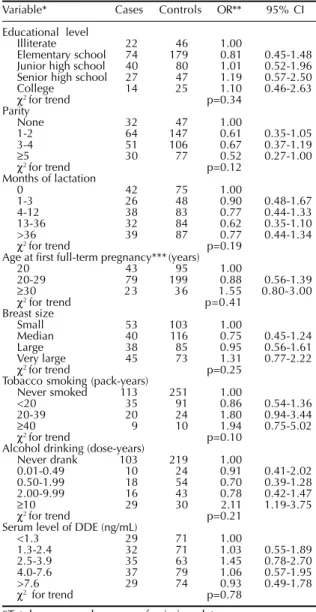
Table 1 - Odds ratios of breast cancer associated with selected variables – Model 1.
Variable* Cases Controls OR** 95% CI
Educational level
Illiterate 22 46 1.00
Elementary school 74 179 0.81 0.45-1.48
Junior high school 40 80 1.01 0.52-1.96
Senior high school 27 47 1.19 0.57-2.50
College 14 25 1.10 0.46-2.63
χ2 for trend p=0.34
Parity
None 32 47 1.00
1-2 64 147 0.61 0.35-1.05
3-4 51 106 0.67 0.37-1.19
≥5 30 77 0.52 0.27-1.00
χ2 for trend p=0.12
Months of lactation
0 42 75 1.00
1-3 26 48 0.90 0.48-1.67
4-12 38 83 0.77 0.44-1.33
13-36 32 84 0.62 0.35-1.10
>36 39 87 0.77 0.44-1.34
χ2 for trend p=0.19
Age at first full-term pregnancy***(years)
20 43 95 1.00
20-29 79 199 0.88 0.56-1.39
≥30 23 36 1.55 0.80-3.00
χ2 for trend p=0.41
Breast size
Small 53 103 1.00
Median 40 116 0.75 0.45-1.24
Large 38 85 0.95 0.56-1.61
Very large 45 73 1.31 0.77-2.22
χ2 for trend p=0.25
Tobacco smoking (pack-years)
Never smoked 113 251 1.00
<20 35 91 0.86 0.54-1.36
20-39 20 24 1.80 0.94-3.44
≥40 9 10 1.94 0.75-5.02
χ2 for trend p=0.10
Alcohol drinking (dose-years)
Never drank 103 219 1.00
0.01-0.49 10 24 0.91 0.41-2.02
0.50-1.99 18 54 0.70 0.39-1.28
2.00-9.99 16 43 0.78 0.42-1.47
≥10 29 30 2.11 1.19-3.75
χ2 for trend p=0.21
Serum level of DDE (ng/mL)
<1.3 29 71 1.00
1.3-2.4 32 71 1.03 0.55-1.89
2.5-3.9 35 63 1.45 0.78-2.70
4.0-7.6 37 79 1.06 0.57-1.95
>7.6 29 74 0.93 0.49-1.78
χ2 for trend p=0.78
*Total may vary because of missing data. **Age-adjusted.
4 3 9 4 3 9 4 3 9 4 3 9 4 3 9 Rev Saúde Pública 2001;35(5):436-42
www.fsp.usp.br/rsp
Hospital visitors as controls
Mendonça GAS & Eluf-Neto J
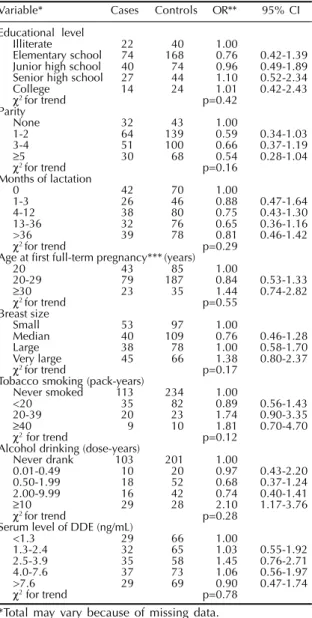
Table 2 - Odds ratio of breast cancer associated with selected factors – Model 2.
Variable* Cases Controls OR** 95% CI
Educational level
Illiterate 22 40 1.00
Elementary school 74 168 0.76 0.42-1.39
Junior high school 40 74 0.96 0.49-1.89
Senior high school 27 44 1.10 0.52-2.34
College 14 24 1.01 0.42-2.43
χ2 for trend p=0.42
Parity
None 32 43 1.00
1-2 64 139 0.59 0.34-1.03
3-4 51 100 0.66 0.37-1.19
≥5 30 68 0.54 0.28-1.04
χ2 for trend p=0.16
Months of lactation
0 42 70 1.00
1-3 26 46 0.88 0.47-1.64
4-12 38 80 0.75 0.43-1.30
13-36 32 76 0.65 0.36-1.16
>36 39 78 0.81 0.46-1.42
χ2 for trend p=0.29
Age at first full-term pregnancy***(years)
20 43 85 1.00
20-29 79 187 0.84 0.53-1.33
≥30 23 35 1.44 0.74-2.82
χ2 for trend p=0.55
Breast size
Small 53 97 1.00
Median 40 109 0.76 0.46-1.28
Large 38 78 1.00 0.58-1.70
Very large 45 66 1.38 0.80-2.37
χ2 for trend p=0.17
Tobacco smoking (pack-years)
Never smoked 113 234 1.00
<20 35 82 0.89 0.56-1.43
20-39 20 23 1.74 0.90-3.35
≥40 9 10 1.81 0.70-4.70
χ2 for trend p=0.12
Alcohol drinking (dose-years)
Never drank 103 201 1.00
0.01-0.49 10 20 0.97 0.43-2.20
0.50-1.99 18 52 0.68 0.37-1.24
2.00-9.99 16 42 0.74 0.40-1.41
≥10 29 28 2.10 1.17-3.76
χ2 for trend p=0.28
Serum level of DDE (ng/mL)
<1.3 29 66 1.00
1.3-2.4 32 65 1.03 0.55-1.92
2.5-3.9 35 58 1.45 0.76-2.71
4.0-7.6 37 73 1.06 0.56-1.97
>7.6 29 69 0.90 0.47-1.74
χ2 for trend p=0.78
*Total may vary because of missing data. **Age-adjusted.
***Among parous women.
Table 4 - Odds ratio* of breast cancer associated with family history of cancer.
Family history Model 1 Model 2 Model 3
of cancer** N cases N cont. OR (95% CI) N cont. OR (95% CI) N cont. OR (95% CI)
All types except breast
No 113 212 1.00 198 1.00 152 1.00
Yes 57 164 0.66 (0.45-0.97) 151 0.66 (0.44-0.97) 61 1.39 (0.88-2.20)
Breast cancer
No 153 339 1.00 336 1.00 204 1.00
Yes 17 37 1,02 (0.55-1.90) 13 3.15 (1.46-6.77) 9 2.84 (1.20-6.73)
*Age-adjusted.
**Missing values for 7 cases and 1 control.
Table 3 - Odds ratios of breast cancer associated with selected variables – Model 3.
Variable* Cases Controls OR** 95% CI
Educational level
Illiterate 22 26 1.00
Elementary school 74 103 0.75 0.39-1.47
Junior high school 40 44 0.96 0.43-2.28
Senior high school 27 28 0.99 0.36-2.68
College 14 13 0.99 0.36-2.68
χ2 for trend p=0.59
Parity
None 32 25 1.00
1-2 64 185 0.58 0.30-1.10
3-4 51 62 0.68 0.35-1.32
≥5 30 42 0.53 0.25-1.09
χ2 for trend p=0.20
Months of lactation
0 42 37 1.00
1-3 26 30 0.70 0.34-1.44
4-12 38 50 0.61 0.32-1.15
13-36 32 51 0.55 0.29-1.05
>36 39 46 0.74 0.39-1.41
χ2 for trend p=0.25
Age at first full-term pregnancy***(years)
20 43 49 1.00
20-29 79 117 0.72 0.42-1.21
≥30 23 23 1.22 0.58-2.59
χ2 for trend p=0.96
Breast size
Small 53 59 1.00
Median 40 68 0.82 0.46-1.45
Large 38 45 1.28 0.69-1.70
Very large 45 42 1.55 0.88-2.89
χ2 for trend p=0.07
Tobacco smoking (pack-years)
Never smoked 113 149 1.00
<20 35 50 0.94 0.56-1.59
20-39 20 9 2.72 1.16-6.37
≥40 9 5 2.73 0.85-8.72
χ2 for trend p=0.02
Alcohol drinking (dose-years)
Never drank 103 125 1.00
0.01-0.49 10 11 1.21 0.47-3.11
0.50-1.99 18 33 0.72 0.37-1.40
2.00-9.99 16 29 0.66 0.33-1.30
≥10 29 13 2.75 1.33-5.71
χ2 for trend p=0.26
Serum level of DDE (ng/mL)
<1.3 29 41 1.00
1.3-2.4 32 38 1.11 0.55-2.23
2.5-3.9 35 35 1.56 0.77-3.16
4.0-7.6 37 40 1.14 0.56-2.30
>7.6 29 46 0.93 0.45-1.92
χ2 for trend p=0.84
*Total may vary because of missing data. **Age-adjusted.
***Among parous women.
in the study. In the control group, 163 women were visiting relatives with any type of cancer and 27 were visiting relatives with breast cancer.
Age-adjusted OR of breast cancer associated with risk factors other than family history of cancer, except for smoking, were similar in all three models (Tables 1-3). In Model 3, the risks related to higher tobacco consumption (20-39 and ³ 40 pack-years) increased
and it was observed a statistically significant trend.
4 4 0 4 4 04 4 0 4 4 0
4 4 0 Rev Saúde Pública 2001;35(5):436-42
www.fsp.usp.br/rsp Hospital visitors as controls
Mendonça GAS & Eluf-Neto J
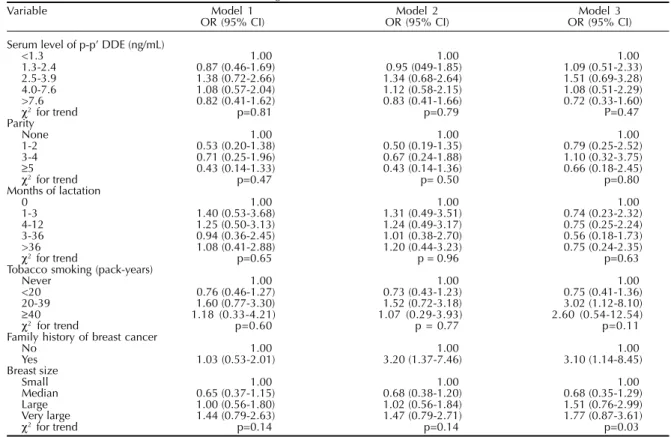
Table 5 – Odds ratios* for breast cancer according to selected variables.
Variable Model 1 Model 2 Model 3
OR (95% CI) OR (95% CI) OR (95% CI)
Serum level of p-p’ DDE (ng/mL)
<1.3 1.00 1.00 1.00
1.3-2.4 0.87 (0.46-1.69) 0.95 (049-1.85) 1.09 (0.51-2.33)
2.5-3.9 1.38 (0.72-2.66) 1.34 (0.68-2.64) 1.51 (0.69-3.28)
4.0-7.6 1.08 (0.57-2.04) 1.12 (0.58-2.15) 1.08 (0.51-2.29)
>7.6 0.82 (0.41-1.62) 0.83 (0.41-1.66) 0.72 (0.33-1.60)
χ2 for trend p=0.81 p=0.79 P=0.47
Parity
None 1.00 1.00 1.00
1-2 0.53 (0.20-1.38) 0.50 (0.19-1.35) 0.79 (0.25-2.52)
3-4 0.71 (0.25-1.96) 0.67 (0.24-1.88) 1.10 (0.32-3.75)
≥5 0.43 (0.14-1.33) 0.43 (0.14-1.36) 0.66 (0.18-2.45)
χ2 for trend p=0.47 p= 0.50 p=0.80
Months of lactation
0 1.00 1.00 1.00
1-3 1.40 (0.53-3.68) 1.31 (0.49-3.51) 0.74 (0.23-2.32)
4-12 1.25 (0.50-3.13) 1.24 (0.49-3.17) 0.75 (0.25-2.24)
3-36 0.94 (0.36-2.45) 1.01 (0.38-2.70) 0.56 (0.18-1.73)
>36 1.08 (0.41-2.88) 1.20 (0.44-3.23) 0.75 (0.24-2.35)
χ2 for trend p=0.65 p = 0.96 p=0.63
Tobacco smoking (pack-years)
Never 1.00 1.00 1.00
<20 0.76 (0.46-1.27) 0.73 (0.43-1.23) 0.75 (0.41-1.36)
20-39 1.60 (0.77-3.30) 1.52 (0.72-3.18) 3.02 (1.12-8.10)
≥40 1.18 (0.33-4.21) 1.07 (0.29-3.93) 2.60 (0.54-12.54)
χ2 for trend p=0.60 p = 0.77 p=0.11
Family history of breast cancer
No 1.00 1.00 1.00
Yes 1.03 (0.53-2.01) 3.20 (1.37-7.46) 3.10 (1.14-8.45)
Breast size
Small 1.00 1.00 1.00
Median 0.65 (0.37-1.15) 0.68 (0.38-1.20) 0.68 (0.35-1.29)
Large 1.00 (0.56-1.80) 1.02 (0.56-1.84) 1.51 (0.76-2.99)
Very large 1.44 (0.79-2.63) 1.47 (0.79-2.71) 1.77 (0.87-3.61)
χ2 for trend p=0.14 p=0.14 p=0.03
*Adjusted by age, educational level and the other variables in the table.
factor for the disease in Models 2 and 3, but there was no association in Model 1.
The multivariate analysis results did not differ sub-stantially in the three models, except for family history of breast cancer, smoking and breast size (Table 5). A significant risk of breast cancer was found regarding family history of breast cancer in Models 2 and 3 (not in Model 1). For tobacco smoking, higher odds ratios in high consumption categories were seen in Model 3 (although not statistically significant). On the other hand, a statistically significant association was found for breast size in Model 3 (p for linear trend = 0.03).
The analysis taking into account the main risk fac-tors under study was repeated comparing only two of the control groups: a) women visiting patients with any type of cancer, and b) women visiting patients who are not their relatives. In this analysis, it was found that the results including family history of can-cer (breast cancan-cer or all types except breast cancan-cer), serum level of DDE and smoking, were compatible with the previous ones (data not shown).
DISCUSSION
In this study, the values of age-adjusted and multivariate odds ratios of breast cancer associated with risk factors, other than family history of cancer, tobacco smoking, and breast size, revealed little
vari-ation in the three models of control group composi-tion. In fact, it was expected that the odds ratios would be close in Models 1 and 2, since Model 2 included more than 90% of the individuals included in Model 1. The observed odds ratios of breast cancer associ-ated with classic risk factors as parity, lactation and age at first full term pregnancy did not show statisti-cally significant differences in the three models, al-though the risk directions were as expected which could be explained by the small sample size of stud-ied population.
Differences in odds ratios were seen regarding fam-ily history of cancer. For any cancer other than breast, when the control group included all visitors recruited (women visiting relatives and women visiting non-relatives with cancer – Model 1), or when only the 27 women visiting relatives with breast cancer were excluded (Model 2), a decreased risk was observed. Excluding all visitors of relatives with cancer (Model 3), an increased risk was found, although not statistically significant. These findings indicate the existence of selection bias related to family his-tory of cancer. Considering family hishis-tory of breast cancer, selection bias due to the inclusion of 27 women visiting relatives with breast cancer masked the effect in Model 1.
increas-4 increas-4 1 4 4 1 4 4 1 4 4 1 4 4 1 Rev Saúde Pública 2001;35(5):436-42
www.fsp.usp.br/rsp
Hospital visitors as controls
Mendonça GAS & Eluf-Neto J
ing tobacco smoking was observed only in Model 3. This finding, however, proved to be not significant after controlling for other variables. Smoking habits are frequently seen in the same family, which could explain the increased risk when women visiting rela-tives with cancer were excluded from the control group.
The lack of other types of controls in this study limits the possibilities of better exploring the occur-rence of selection bias. Nevertheless, hospital visitor controls have been shown to be comparable to other types of controls in many aspects.1,9 Recent
case-con-trol studies of cancer have used hospital visitors as controls,4,5,15 but there was no discussion about their
limitations and advantages. MacMahon & Trichopoulos6 pointed out to the fact that few studies
report the convenience of using hospital visitors as controls. Armenian et al1 find this type of controls
more adequate in favor of a pragmatic and methodo-logical sense.
The selection of a appropriate control group, namely hospital or population controls, has been a controversial issue among epidemiologists.8,12,14
Case-control studies of cancer are frequently conducted in cancer hospitals, since many individuals with the disease are referred to and treated in specialized hos-pitals. It is known that hospital control patients may have a different exposure distribution compared to the base-population.10 Since visitor controls are
theo-retically not ill, this problem should be seen less of-ten. It should also be taken into account that hospital visitors tend to derive from the same hypothetical population where cases were originated, these indi-viduals having the same chance of being included as cases if they were to develop cancer under study.2
In case-control studies, the number of available
con-trols has practical implications. On this aspect, Model 2, which included more than 90% of Model 1’s indi-viduals, was better than Model 3, which included less than 60%.
Controls recruited in hospital, either as patients or visitors, show some advantages. Apart from the fact that they are sometimes more representative of the base population than community controls, they are usually more collaborative. When there is a need of collecting biological specimens, which is increas-ingly the case in epidemiological studies, this can be a very important advantage. It is well recognized that no one type of control group can be suitable for all studies, and as there are no definite criteria of what an acceptable group is,2 this specific situation might
be regarded as a practical advantage of using visitors controls.
The study findings indicate that hospital visitor controls can create selection bias regarding family history of cancer. However, the majority of risk fac-tors investigated were not confounded by family his-tory of cancer, such as serum concentration of DDE. The exclusion of women visiting relatives with breast cancer, though slightly reduced the number of eligi-ble controls, seemed to have prevented selection bias. This option offered a feasible alternative, indicating that the use of hospital visitors as controls should be explored in further case-control studies.
ACKNOWLEDGMENTS
To A. L. Eisemberg, MD and L. M. Magalhães, MD for the histopathological review of all cases and to the medical and nursing staff of the mastology divi-sion and outpatient clinics of “Hospital do Câncer/ Instituto Nacional de Câncer” for their collaboration.
REFERENCES
1. Armenian HK, Larkis NG, Sirai AM, Halabi SS. Hospital visitors as controls. Am J Epidemiol 1988;127:404-6.
2. Breslow NE, Day NE, editors. Statistical methods in
cancer research. Lyon: International Agency for
Research on Cancer; 1980. v. 1. The analysis of case-control studies.
3. Clayton D, Hills M. Statistical models in epidemiology.
Oxford: Oxford Science Publications; 1993. p. 153-65. Chap 16: Case-control studies.
4. Kalapothaki V, Tzonou A, Hsieh CC, Karakatsani A, Trichopoulou A, Toupadaki N et al. Nutrient intake and cancer of the pancreas: a case-control study in Athens, Greece. Cancer Causes Control 1993;4:383-9.
5. Katsouyanni K, Lipworth L, Trichopoulou A, Samoli E, Stuver S, Trichopoulos D. A case-control study of lactation and cancer or the breast. Br J Cancer
1996;73:814-8.
6. MacMahon B, Trichopoulos D. Epidemiology: principles and methods - Sources and methods for control
selection. Boston: Little, Brown and Company; 1996.
p.253-64.
7. Mendonça GAS, Eluf-Neto J, Andrada-Serpa MJ, Carmo PA, Barreto HH, Inomata ON et al. Organochlorines and breast cancer: a case-control study in Brazil. Int J
4 4 2 4 4 24 4 2 4 4 2
4 4 2 Rev Saúde Pública 2001;35(5):436-42
www.fsp.usp.br/rsp Hospital visitors as controls
Mendonça GAS & Eluf-Neto J
8. Miettinem OS. The case-control study: valid selection of subjects. J Chronic Dis 1985;38:543-8.
9. Ngelangel CA. Hospital visitor-companions as a source of controls for case-control studies in the Philippines. Int
J Epidemiol 1989;18(4 Suppl 2):S50-S3.
10. Oslon SH, Kelsey JL, Pearson TA, Levin B. Characteristics of a hypothetical group of hospital controls for a case-control study. Am J Epidemiol
1994;139:302-11.
11. Rothman KJ, Greenland S. Case-control studies. In: Rothman KJ, Greenland S. Modern epidemiology, New York: Lippincott-Raven; 1998. p.93-114.
12. Spitzer WO. Ideas and words: two dimensions for debates on case controlling. J Chron Dis 1985;38:541-2.
13. Wacholder S, McLaughlin JK, Silverman DT, Mandel JS. Selection of controls in case-control studies. I.
Principles. Am J Epidemiol 1992;135:1019-28.
14. Wacholder S, Silverman DT, McLaughlin JK Mandel JS.
Selection of controls in case-control studies. II. Types of controls. Am J Epidemiol 1992;135:1029-41.