ABSTRACT The objective of the present work is to contribute to a better understanding of perceptions about marijuana decriminalization and legalization. For this, a national opinion survey was conducted, between October 07 and November 26, 2014, by means of 3.007 tele-phone interviews. The results point that the debate on the subject is not well done in Brazil; the interviewees consider themselves poorly informed and a significant part of them does not want information; TV and the internet are the main sources of information; education and health services are not seen as a source of information; women over 45 with low schooling and income have more negative perceptions regarding decriminalization and legalization, if compared to young men with higher schooling and income.
KEYWORDS Democracy. Crime. Cannabis.
RESUMO O objetivo do presente trabalho é contribuir para uma melhor compreensão das per-cepções sobre descriminalização e legalização da maconha. Para isso, foi realizada pesquisa de opinião nacional, entre 07 de outubro e 26 de novembro de 2014, mediante 3.007 entrevistas telefônicas. Os resultados apontam que o debate sobre o tema não é bem feito no Brasil; os ent-revistados consideram-se mal informados e parte significativa deles não quer informação; TV e internet são as principais fontes de informação; serviços de educação e saúde não são vistos como fonte de informação; mulheres acima de 45 anos com baixa escolaridade e renda têm percepções mais negativas em relação à descriminalização e à legalização, se comparadas a homens jovens com maior escolaridade e renda.
PALAVRAS-CHAVE Democracia. Crime. Cannabis.
Democratic agendas for the 21st century:
Brazilian’s perceptions about marijuana
decriminalization and legalization
Agendas democráticas para o século XXI: percepções dos(as)
brasileiros(as) sobre descriminalização e legalização da maconha
Marcelo rasga Moreira1, antônio ivo de carvalho2, José Mendes ribeiro3, Fernando Manuel Bessa Fernandes4
1 Fundação Oswaldo
Cruz (Fiocruz), Escola Nacional de Saúde Pública Sergio Arouca (Ensp), Departamento de Ciências Sociais (DCS) – Rio de Janeiro (RJ), Brasil.
2 Fundação Oswaldo
Cruz (Fiocruz), Centro de Estudos Estratégicos (CEE) e Escola Nacional de Saúde Pública Sergio Arouca (Ensp), Departamento de Administração e Planejamento em Saúde (Daps) – Rio de Janeiro (RJ), Brasil.
3 Fundação Oswaldo
Cruz (Fiocruz), Escola Nacional de Saúde Pública Sergio Arouca (Ensp), Departamento de Ciências Sociais (DCS) – Rio de Janeiro (RJ), Brasil.
4 Fundação Oswaldo
Cruz (Fiocruz), Escola Nacional de Saúde Pública Sergio Arouca (Ensp), Departamento de Ciências Sociais (DCS) – Rio de Janeiro (RJ), Brasil.
Introduction
The political crisis that Brazil goes through since 2013 brings concrete threats to its already incipient democracy. The open con-flict between the powers of the republic in this final 2016, a corollary of the coup that dismissed President Dilma Roussef, illus-trates the radicalization of political polar-ization in society.
Since the so-called ‘manifestations of June 2013’, actions of intolerance, violence, prejudice, racism and fascism have disput-ed the public space with those that seek to promote freedom, coexistence among dif-ferent people, advancement of individual and social rights, and the intensification of democratization.
This conflict tends to follow the contem-porary political spectrum of the right-wing and left-wing alignments. It is up to those who align to the left-wing, in their differ-ent ways and conceptions, to build new democratic agendas capable, on the one hand, of preventing the dismantling of the social and protection policies built in the Country since 2003, and, on the other hand, to advance in identity struggles.
In this context, the issue of drugs is highlighted, as it involves both the need for social protection policies and respect for identities. It constitutes, therefore, a funda-mental agenda in the search for democratic radicalization, in this second decade of the twenty-first century.
The agenda hitherto hegemonic, in this field, has been the ‘war on drugs’, which, belonging to the political universe of right-wing coalitions, commonly accompanies propositions against abortion, immigration and policies of positive discrimination. It is against it that this article manifests itself.
The ‘war on drugs’ failed. From any point of view that considers peace, social justice, public health and even the effectiveness of confrontation, its executors are not able to point to any significant gain that can be
used as an argument in their favor.
On the contrary, its main results articu-late strong negative impacts, both in the scope of the individual and in the scope of the society. Being so deleterious, they suc-ceeded in transforming the damage caused by the attempts to access and purchase of drugs – by the way they are used and by social and political repression of consum-ers – in much heavier damages than those caused by the effect of drugs itself (TRANSFORM DRUG POLICY FOUNDATION, 2009).
If the aim is to produce a social scenario in which repression inhibits consumption, it is far from successful, and lives daily with pain and suffering. In Brazil, the damages manifest most sharply in the morbidity and mortality of the most vulnerable popula-tions, especially poor young people, male, black and mulatto, slum and peripheral res-idents (NEVES; GARCIA, 2015; ASSIS; DESLADES; SANTOS, 2005); in the overcrowding of prison and
socio-educational systems, which produce absolutely degrading living conditions
(FERNANDES; RIBEIRO, MOREIRA, 2015; SCISLESKI ET AL., 2014; FERNANDES ET AL., 2014); reinforcing police
repression and corruption (MUNIZ, PROENÇA JR., 2007); in the unbridled multiplication of the
demand for mental health services (RIBEIRO ET AL., 2016; SILVA; CRUZ; VARGAS, 2015); and in the
orga-nization of drug trafficking in an economic dynamic that integrates the legal, informal and illegal market, becoming an extremely profitable activity, that seeks to infiltrate on party and electoral politics (CRUZ NETO; MOREIRA; SUCENA, 2001).
Faced with these results, the debate about the legalization and decriminaliza-tion of drugs has grown in several countries and aroused the interest of different orga-nized segments of society, from militant groups of drug users to the media, through think tanks, political parties and fringes of the judiciary.
consumption of any drug – even the most moderate ones – as a business model, ad-vocate legalization, focus their action on drugs of greater social acceptance and ad-vocate the incremental improvement of the legal apparatus aimed at the socially more accepted ones.
It is in this context that the debate about the legalization and decriminalization of marijuana has become the most active in different societies, in a movement that was reinforced by the discovery of its therapeu-tic properties and possibilities of medical use. In the last years, several countries have made important changes to their marijuana laws. Particular emphasis must be given to certain states of the USA, that have opted for the free market; and Uruguay, which, following the opposite route, nationalized the production and distribution process.
In Brazil, the repercussion of these mea-sures on the organized sectors of society was intense. Non-Governmental Organizations (NGO) and civil institutions have gained new breath and more space to advance in the theme; projects were presented to the national congress; the Brazilian Commission on Drugs and Democracy (CBDD) was created, with broad social rep-resentation; and, as it has become increas-ingly common in the brazilian political process, the Judiciary has entered into the debate, which is now in abeyance, awaiting the Federal Supreme Court (STF) to judge an action whose outcome can produce a clear legal change, open precedents and make the Country’s highest court the main arena of this debate at the national level.
Despite the importance of the mobiliza-tion of the organized sectors and the value of the cause, there is an unknown: And the brazilians, what do they think? This is the objective of the article: to contribute to the understanding of what brazilian men and brazilian women think about the decrimi-nalization and legalization of marijuana, supporting ways for a social change that, if
there is any, is the result of a process that incorporates citizen participation, and not just a pact between more active and orga-nized elites.
Methodological aspects
The present article is the result of the study ‘The perception of brazilians on issues related to the decriminalization of mari-juana’, developed by the Center for Strategic Studies of the Oswaldo Cruz Foundation (CEE-Fiocruz), which, between october 7 and november 26, 2014, conducted a na-tional opinion survey, using 3.007 telephone interviews with people over 18 years old, in all states of the Country. The margin of error is plus or minus 1,4%, with a 95% confidence interval.
To gather information and perceptions of the interviewees about the subject and its relations with health, violence and public safety, this research counted on an instru-ment composed of 32 questions – 3 open, 26 closed (13 with concordance/discordance scales) and 3 mixed.
Due to its telephone character, national coverage and sample size, the researchers who conducted the telephone interviews had a script that began with the following:
Good morning/good afternoon, my name is [...] and at the moment we are doing a research for Fiocruz on the opinion of people about public health issues, especially the drugs issue. Could you participate?
their responses would be used exclusively within the scope of the research, which would involve the publication of reports, articles and books. Moreover, they were assured that even in those publications the data would never be divulged in an individu-al way, reinforcing the promised secrecy and anonymity, and preserving the principle of non-maleficence.
The data of this survey were extremely rich and extensive. For the present article, it was adopted as cut-off the focus on the perception of the interviewees about the ‘degree of information’ on the debate about marijuana decriminalization/legalization; ‘health repercussions’ and ‘violence’ stem-ming from a possible decriminalization/ legalization of marijuana; and ‘expectations’ regarding use/consumption, if marijuana were decriminalized/legalized.
The results were developed, as will be seen from the next topic, through a strategy that favored the percentage presentation of the general result and distributed it, also in percentage, in the following population strata: housing region, gender, age range, monthly income and schooling. For the reading to be fluid and comprehensible, it was chosen to present the percentage distri-butions per stratum, in situations in which they presented contrasts with the general result or with each other, allowing, thus, a better knowledge of the convergences and divergences found.
At that, as a consequence of the work devel-oped, it is understood that the dissemination of the knowledge built with the interviewees around the theme improves the explanatory possibilities of the researchers and contrib-utes to the overcoming of common sense, promoting the principle of beneficence.
Results and discussions:
what do brazilians think
about the decriminalization
and legalization of
marijuana?
For a better understanding of the results of the research, it was chosen to divide this section into the following topics: ‘degree of information’, ‘perception about marijuana use/consumption and its repercussions on health’, ‘perception about marijuana discrimination/legalization and its repercussions on violence’, and ‘expectations and experiences regarding marijuana use/consumption’. In this way, it becomes easier to do both a reading of each topic and an articulation between them.
Perceptions about the ‘degree of
in-formation of the society’ and the
‘de-gree of information of the individual’
about the debate on
decriminaliza-tion and legalizadecriminaliza-tion of marijuana
Referring to itself, the absolute majority of respondents, 57,8%, do not consider them-selves well informed to participate in the debate, with 46,6% of them mentioning that they were ‘poorly informed’ and 11,2%, ‘very poorly informed’. On the other hand, 37,9% declared themselves, somehow, informed, with 2,9% ‘very well informed’ and 33% ‘well informed’.
Among those who declare themselves uninformed, the following stand out: female (65,1%); those who are 60 years old or older (63,2%); those with incomes of up to one minimum wage (65%); those who did not complete elementary school (77%); and the residents of the Central-West Region (62,5%).
It is interesting to point out that 53% of
Table 1. Is the marijuana debate being well done in the Country? Distribution by region, gender, age range, income and schooling. Brazil, 2014
source: cee/Fiocruz, 2015.
Base Yes No Don’t know Da Total
Total 3007 11,4% 74.7% 13,8% 0,0% 100,0%
Regions of the Country
central-west 205 10,2% 77,1% 12,7% 100,0%
northeast 794 15,0% 71,9% 13,1% 100,0%
north 198 15,2% 70,7% 14,1% 100,0%
southeast 1349 8,5% 77,7% 13,7% 0,1% 100,0%
south 461 12,8% 71,6% 16,6% 100,0%
Gender
Male 1460 12,0% 77,4% 10,6% 100,0%
Female 1547 10,9% 72,2% 16,8% 0,1% 100,0%
Age range
18 to 24 years 607 12,4% 79,6% 8,1% 100,0%
25 to 34 years 727 11,4% 78,1% 10,3% 0,1% 100,0%
35 to 44 years 655 10,7% 75,4% 13,9% 100,0%
45 to 59 years 605 11,4% 71,6% 17,0% 100,0%
60 years or more 413 11,4% 65,1% 23,5% 100,0%
Income
up to 1 minimum wage 316 18,0% 63,6% 18,4% 100,0%
1 to 2 minimum wages 773 14,0% 69,6% 16,4% 100,0%
2 to 5 minimum wages 1077 8,4% 80,2% 11,4% 100,0%
5 to 10 minimum wages 379 10,0% 81,0% 9,0% 100,0%
More than 10 minimum wages 135 8,1% 81,5% 10,4% 100,0%
Schooling
Up to incomplete elementary school 363 14,6% 58,1% 27,3% 100,0%
complete elementary school/ incomplete high
school 456 18,2% 63,2% 18,6% 100,0%
complete high school/ incomplete college 1534 10,4% 78,6% 11,0% 0,1% 100,0%
the respondents said they know that “de-criminalizing marijuana means a change in the law, whereby marijuana smokers no longer commit a crime”, while 67,8% know that
legalizing marijuana means that the buying and selling of marijuana in official establish-ments become legal, and that the crack houses remain a crime.
This seems to indicate that the level of disinformation reported by the interview-ees is more related to the repercussions that decriminalization/legalization can bring to society and the individual, than to the knowledge of its meaning.
In the following topics, there are data that reinforce this hypothesis. For now, such scenario of misinformation may be more comprehensible as far as the main sources of information of the respondents are known: 22,5% declare that they do not consult any source of information, a percentage that rises in the Southeast Region (24,6%), among female (25%), those who are 60 years old or older (28,1%), those earning up to a minimum wage (32,3%) and those who did not complete elementary school (35,3%).
Among the sources of information (ques-tion of multiple answers), the most cited were TV (37,9%), internet (31,5%), newspa-pers (14,1%) and magazines (4,7%). In ad-dition to those who cited radio (1,7%) and ‘media in general’ (0,9%), it is found that among those who seek information, the media are their great source.
There is an inversion of this situation among young people between the ages of 18 and 24 years old: the internet becomes the most sought after source for 50,9% of them, followed by TV, with 25,7%. The same situation, although in smaller proportions, appears for those who are between 25 and 34 years old: 41,5%, internet and 34,4%, TV.
In the age range above 34 years, TV reas-sumes the position of most sought source, followed by the internet, with an exception
given in the range of 60 years old or more, in which magazines take second place (18,2%), becoming the internet the third source (8,2%). It is important to emphasize that this last one is also the age range in which the TV has its greater percentage, 47,7%.
Focusing on the income of the respondents, TV is the most important source for those receiving up to five minimum wages. In the ranges between ‘5 to 10’ and ‘more than 10’ minimum wages, the internet takes the first position, while, in this second range, the maga-zines surpass the TV in the second position.
Family and friendships networks appear as the traditional institutions most used as sources of information by the interviewees, but in a much lower proportion than those already mentioned: 5,4%.
The religious support also appears not to be a source of information sought, with regard to the debate on marijuana decrimi-nalization, as only 0,4% cited ‘church’.
The public policies and their institutions are seen as sources of information for very few interviewees: while the school/university was cited by 4,1% (one can add 0,3% cited by teacher/educator), health services had a poor participation, with a negligible 0,3%. Even if the 0,4% that cited the ‘doctor’ was added to it, the health sector would not even reach 1%.
A shocking data concludes this scenario: 45,8% of respondents, when asked about what information they would like to have about the topic, they answered “none/do not want information”, item that was the most cited.
Perceptions about the
use/consump-tion of marijuana and their
repercus-sions on health
62,2% revealed some level of disagreement of the phrase.
These levels of discordance remain in the stratifications worked by the research, but with distinct differences, with more intensi-ty (i) among women (67,7%, being 51,6% with total disagreement and 16,1%, with partial disagreement) than among men (56,4%, of which 41,9% totally disagree and 14,5%, with partial disagreement); (ii) people who are 60 years old or more (72,1% with total dis-agreement, 58,1% disagree more than agree and 14% with partial disagreement) and in the age range between 45 and 59 years old (65,8%, 51,4% and 14,4%, respectively) than among 18 to 24 years old (52,3%, 37,1% and 15,2%); (iii) among those with incomes of up to 1 minimum wage (78,5%, 63,9%, 14,6%) than those with income above 10 minimum wages (50,4%, 41,5%, 8,9%); and (iv) among those with incomplete elementary education (73,8%, 63,9%, 14,6%) than among those with a higher education degree or an even higher
level of education (57,2%, 43,6% and 13,6%). When questioned about the degree of agreement/disagreement about the phrase “Alcoholic beverages do more harm to health than marijuana”, 44,1% had some degree of agreement (24,7% agreed totally, while 19,4% agreed more than disagreed). Adding to these the 27,3% who ‘do not agree or dis-agree’, it is verified that 27,7% presented disagreement of the phrase, and only 16,1% disagree totally.
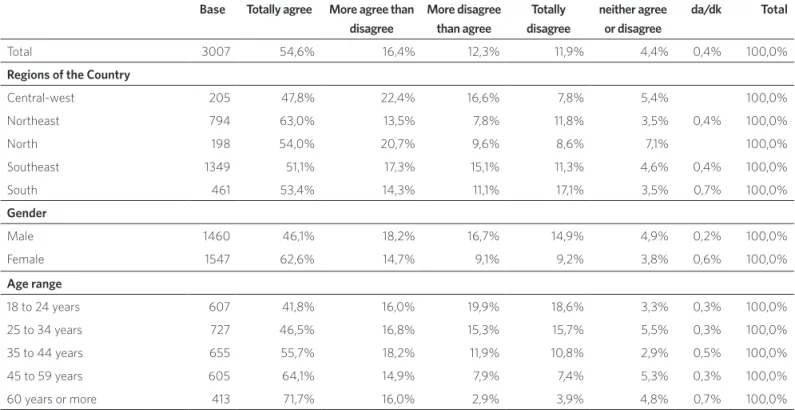
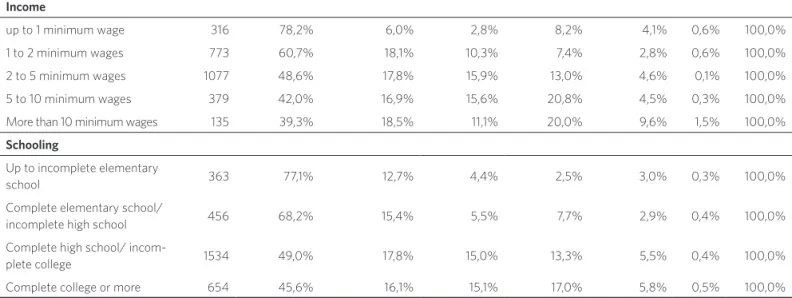
Opening a sequence of negative percep-tions about marijuana use/consumption, 71% showed some degree of agreement with the phrase “Marijuana ends up with the life of people”. Table 2 illustrates these responses, indicating important divergences in the stratifications of the interviewees, that point, mostly, to more negative perceptions among women, people who are over 60 years old, receive up to 1 minimum wage and who did not complete elementary school.
Table 2. Level of agreement/disagreement with the phrase “Marijuana ends up with the life of people”: distribution by region, gender, age range, schooling and income. Brazil, 2014
Base Totally agree More agree than disagree
More disagree than agree
Totally disagree
neither agree or disagree
da/dk Total
Total 3007 54,6% 16,4% 12,3% 11,9% 4,4% 0,4% 100,0%
Regions of the Country
central-west 205 47,8% 22,4% 16,6% 7,8% 5,4% 100,0%
northeast 794 63,0% 13,5% 7,8% 11,8% 3,5% 0,4% 100,0%
north 198 54,0% 20,7% 9,6% 8,6% 7,1% 100,0%
southeast 1349 51,1% 17,3% 15,1% 11,3% 4,6% 0,4% 100,0%
south 461 53,4% 14,3% 11,1% 17,1% 3,5% 0,7% 100,0%
Gender
Male 1460 46,1% 18,2% 16,7% 14,9% 4,9% 0,2% 100,0%
Female 1547 62,6% 14,7% 9,1% 9,2% 3,8% 0,6% 100,0%
Age range
18 to 24 years 607 41,8% 16,0% 19,9% 18,6% 3,3% 0,3% 100,0%
25 to 34 years 727 46,5% 16,8% 15,3% 15,7% 5,5% 0,3% 100,0%
35 to 44 years 655 55,7% 18,2% 11,9% 10,8% 2,9% 0,5% 100,0%
45 to 59 years 605 64,1% 14,9% 7,9% 7,4% 5,3% 0,3% 100,0%
Before the phrase “Marijuana is the en-trance door to other drugs”, 86,5% showed some level of agreement with it, with 7,.4% totally agreeing and 12,1% agreeing par-tially. The distributions among the popula-tion strata studied follow profiles like those already mentioned.
To finalize this topic, table 3, which focuses on the agreement of the respondents
(sum of the answers ‘agree totally’ and ‘agree more than disagree’) with the afore-mentioned phrases, distributes the answers by the variable in which people considered themselves ‘well informed’ or not, illustrat-ing that negative perceptions are always and considerably more intense among those who considered themselves ‘bad’ or ‘very poorly’ informed.
source: cee/Fiocruz, 2015.
Table 2. (cont.)
Income
up to 1 minimum wage 316 78,2% 6,0% 2,8% 8,2% 4,1% 0,6% 100,0%
1 to 2 minimum wages 773 60,7% 18,1% 10,3% 7,4% 2,8% 0,6% 100,0%
2 to 5 minimum wages 1077 48,6% 17,8% 15,9% 13,0% 4,6% 0,1% 100,0%
5 to 10 minimum wages 379 42,0% 16,9% 15,6% 20,8% 4,5% 0,3% 100,0%
More than 10 minimum wages 135 39,3% 18,5% 11,1% 20,0% 9,6% 1,5% 100,0%
Schooling
Up to incomplete elementary
school 363 77,1% 12,7% 4,4% 2,5% 3,0% 0,3% 100,0%
complete elementary school/
incomplete high school 456 68,2% 15,4% 5,5% 7,7% 2,9% 0,4% 100,0%
complete high school/
incom-plete college 1534 49,0% 17,8% 15,0% 13,3% 5,5% 0,4% 100,0%
complete college or more 654 45,6% 16,1% 15,1% 17,0% 5,8% 0,5% 100,0%
% of interviewees who consider themselves 'well' or 'very well informed', and who
agree with the phrase
% of interviewees who consider themselves 'more or less informed', and who agree with
the phrase
% of interviewees who consider themselves 'poorly' or 'very
poorly informed', and who agree with the phrase
if people have the right to alcoholic beverages, they should also have the right to use marijuana
39,2% 29,2% 27,5%
alcoholic beverages do more harm to health than marijuana
51,6% 36,9% 40,3%
Marijuana ends up with the life of people 62,4% 73,3% 76,0%
Marijuana is the entrance door to other drugs 79,2% 84,1% 91,3%
Table 3. Perception of interviewees about questions regarding the repercussions of marijuana decriminalization on the health of individuals. Distribution of concordant responses by degree of information about the debate. Brazil, 2014
Perceptions about marijuana
de-criminalization/legalization and its
repercussions on violence
The absolute majority of the interviewees (55,6%) considered that “does not commit a crime who only uses marijuana, and is not a trafficker”. This percentage exceeds 60% in the strata, in the age ranges between ‘18 and 24 years old’ (67,4%) and ‘25 to 34 years old’ (60,4%); among those who receive from ‘5 to 10’ minimum wages and above 10 (61,7% and 60,7%, respectively); and those with complete college education or level of education (62,5%).
Regarding the idea that “Decriminalizing marijuana would reduce drug trafficking”, 39% of those interviewed indicated some level of agreement, with 20,5% agreeing totally and 18,5% agreeing more than they disagree. And there are important differ-ences in these percentages, when the popu-lation strata investigated are focused: 42,9% of the men have some agreement, which reduces to 35,1% of the women; 51% of young people between the ages of 18 and 24 years old, against 31,5% of those over 60 years old. However, there is little agreement between the income strata (39,8% of those who
receive between ‘5 and 10’ minimum wages, while 34,5% of those who earn less than one minimum wage) and schooling, ranging from 35,5% and 41%.
Regarding the phrase “Decriminalize mar-ijuana would reduce violence”, 28,9% of the respondents showed some agreement with it, with 14,5% totally agreeing and 14,4% having only some agreement. Especially in relation to this sentence, the variation indices were of low amplitude, maintaining the correla-tions already described in this article, but with percentages close to the total.
Also recalling perceptions about the rela-tionship between marijuana decriminalization and violence, the phrase “Decriminalize mari-juana will decrease police violence” obtained the agreement of 27,8% of the interviewees.
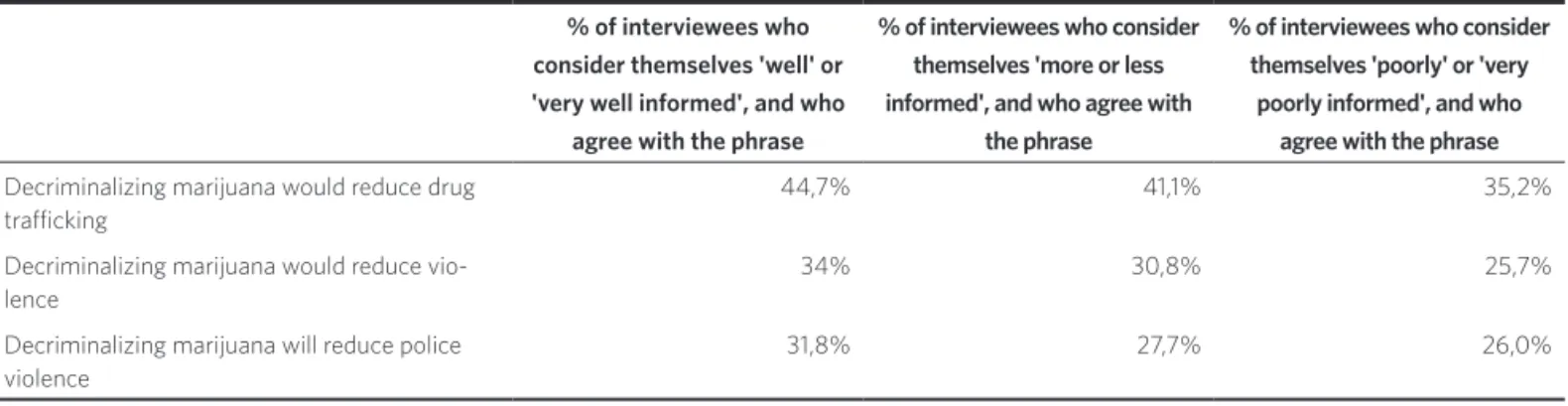
The table 4, which focuses on the agreement of the respondents (sum of responses ‘agree fully’ and ‘agree more than disagree’) with the phrases given above, distributes responses by the variable in which people considered them-selves ‘well informed’ or not, showing that the degree of agreement varies between ¼ and ⅓ of the respondents, being always smaller among those who considered themselves ‘poorly’ or ‘very poorly’ informed.
% of interviewees who consider themselves 'well' or 'very well informed', and who
agree with the phrase
% of interviewees who consider themselves 'more or less informed', and who agree with
the phrase
% of interviewees who consider themselves 'poorly' or 'very
poorly informed', and who agree with the phrase
decriminalizing marijuana would reduce drug traicking
44,7% 41,1% 35,2%
decriminalizing marijuana would reduce vio-lence
34% 30,8% 25,7%
decriminalizing marijuana will reduce police violence
31,8% 27,7% 26,0%
Table 4. Perception of the interviewees about questions related to the repercussions of decriminalization of marijuana in the scenario of violence. Distribution of concordant responses by degree of information about the debate. Brazil, 2014
Expectations and experiences about
the marijuana use
Regarding the question “If buying marijuana in Brazil were legal, would you buy it?”, 91,4% of respondents said no. Although there are differences in population strata, the pro-portion of ‘no’ is less than 90% among men (85%); young people between 18 and 24 years old (85%) and 25 to 34 years old (89,1%); with income of 5 to 10 minimum wages (87,6%) and more than 10 minimum wages (88,1%).
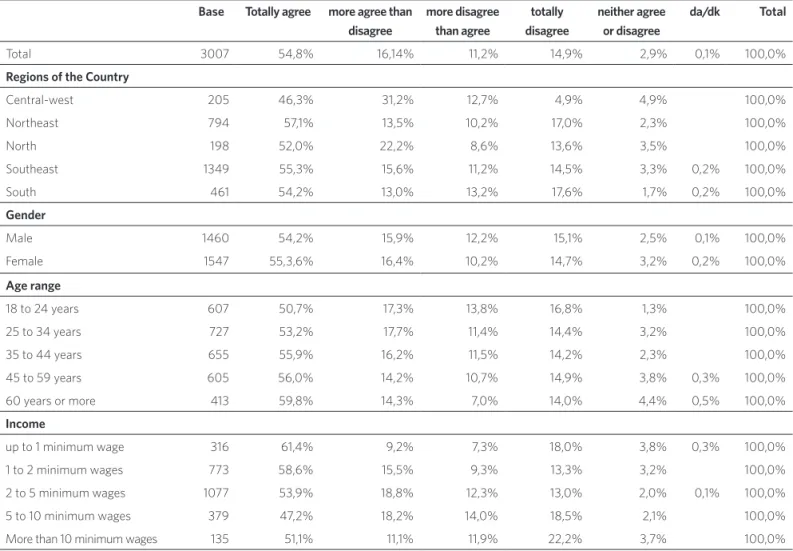
Curiously, with the phrase “If marijuana is decriminalized, will its use increase”, 70,9%
presented levels of agreement, with 54,8% totally agreeing and 16,1% agreeing more than they disagreed.
As shown in table 5, this level of agree-ment above 70% is maintained in almost all strata, and those below this level do not present less than 60%. The highest percent-ages of agreement occur in the Central-West Region (77,5%), among women (71,7%), people over 60 years old (74,1%), among those with income from 1 to 2 minimum wages (74,1%) and those with complete ele-mentary school and incomplete high school (72,3%).
Table 5. Level of agreement/disagreement with the phrase “If marijuana is decriminalized, will its use increase?”: Distribution by region, gender, age range, schooling and income. Brazil, 2014
Base Totally agree more agree than disagree
more disagree than agree
totally disagree
neither agree or disagree
da/dk Total
Total 3007 54,8% 16,14% 11,2% 14,9% 2,9% 0,1% 100,0%
Regions of the Country
central-west 205 46,3% 31,2% 12,7% 4,9% 4,9% 100,0%
northeast 794 57,1% 13,5% 10,2% 17,0% 2,3% 100,0%
north 198 52,0% 22,2% 8,6% 13,6% 3,5% 100,0%
southeast 1349 55,3% 15,6% 11,2% 14,5% 3,3% 0,2% 100,0%
south 461 54,2% 13,0% 13,2% 17,6% 1,7% 0,2% 100,0%
Gender
Male 1460 54,2% 15,9% 12,2% 15,1% 2,5% 0,1% 100,0%
Female 1547 55,3,6% 16,4% 10,2% 14,7% 3,2% 0,2% 100,0%
Age range
18 to 24 years 607 50,7% 17,3% 13,8% 16,8% 1,3% 100,0%
25 to 34 years 727 53,2% 17,7% 11,4% 14,4% 3,2% 100,0%
35 to 44 years 655 55,9% 16,2% 11,5% 14,2% 2,3% 100,0%
45 to 59 years 605 56,0% 14,2% 10,7% 14,9% 3,8% 0,3% 100,0%
60 years or more 413 59,8% 14,3% 7,0% 14,0% 4,4% 0,5% 100,0%
Income
up to 1 minimum wage 316 61,4% 9,2% 7,3% 18,0% 3,8% 0,3% 100,0%
1 to 2 minimum wages 773 58,6% 15,5% 9,3% 13,3% 3,2% 100,0%
2 to 5 minimum wages 1077 53,9% 18,8% 12,3% 13,0% 2,0% 0,1% 100,0%
5 to 10 minimum wages 379 47,2% 18,2% 14,0% 18,5% 2,1% 100,0%
Final considerations
The results of the research allow to delineate directions and actions for the construction of a democratizing agenda, regarding the decriminalization and the legalization of marijuana.
The first and most relevant one concerns the need to develop direct dialogues with the population, which admits to be poorly informed. Logically, this is directly related to the fact that public health and educa-tion services are not, by far, the source of information. If TV and social networks con-tinue to play this role, it will be difficult to overcome a series of negative perceptions, which, as seen before, prevail among those who declare themselves to be ill-informed.
Now, if the twenty-first century is that of the ‘society of information’; if information and communication technologies allow the development of social networks that have, around the world, produced powerful social mobilizations; and if, in some countries – such as Finland, for example –, the con-stituent process was conducted via web, it seems clear that, for the new democratizing agendas to succeed, they should be able to value and qualify participation and delibera-tion through a communicadelibera-tion policy.
This research provides clues, also, to the segments that need to be focused by this
communication policy: women, over 45 years old, with low schooling and income. It is noticed that, in this group, are mothers who suffer with violence that involves drug trafficking and affects their children. In this research, it was not aimed to identify the eth-nicity of the interviewees (others must do it), but some studies show that these mothers are, for the most part, black and mulattas.
Here, two other needs of the democratiz-ing agendas are clear: that of listendemocratiz-ing and giving voice to women, in general, who are already so battered by the machismo that dominates brazilian society: and to black women and mulattas, especially, raped by the racism that persists in occurring in the Country. To be a woman, a mother and a black woman is to have an accumulation of extremely beautiful and important char-acteristics for the individual and for the construction of a more just society. A de-mocratizing agenda must incorporate these people as protagonists.
Focusing on these segments does not mean neglecting others, but, above all, it is also about bringing the strength of young people to the process of building agendas. It was they who presented the most sensi-tive responses to the decriminalization and legalization of marijuana, and it is these that will easily be seen by advocates of ‘war on drugs’ as targets of repression.
Schooling
Up to incomplete elementary
school 363 55,6% 18,7% 8,8% 12,4% 4,1% 0,3% 100,0%
complete elementary school/
incomplete high school 456 60,7% 11,6% 9,0% 15,4% 2,9% 0,4% 100,0%
complete high school/
incom-plete college 1534 54,9% 17,1% 11,3% 1,0% 2,6% 0,1% 100,0%
superior completo ou mais 654 49,8% 15,4% 13,8% 18,0% 2,9% 100,0%
Table 5. (cont.)
Another essential point to be highlighted is that the debate should be set in the field of public health and overcoming the violence that involves drug trafficking, which every day makes victims in the great cities of the Country. Strengthen health policies and overcoming vio-lence demand articulated agendas, capable of bringing about vigorous improvements to the living conditions of the population.
Finally, it is emphasized that this research did not bother to ask if the interviewees are ‘for or against’ the decriminalization and le-galization of drugs. What it really intended to understand was, and is, what people think about the factors and relationships that are part of this process, and that become com-pletely obscured when a question like ‘for or against’ is made.
The paradox between the responses that reflect the fact that almost all respondents say that they would not consume marijuana
if it were legalized in Brazil, and the answers that reveal that a very large percentage also considers that marijuana consumption will increase, they demonstrate that, in order to identify and comprehend what people think about a complex and delicate subject like this, researchers must go through troubled paths of corners, intersections, bifurcations and shortcuts, before arriving at a place where possibly a direct and objective answer represents an interpretation of what the in-terviewee thinks.
This was an option of the present re-search, having as intention contribute to the construction of democratizing agendas for the 21st century: to provide a first direct contact with certain individuals and their perceptions. Such an option can, of course, logically, also be seen as a limitation of the research, which, we hope, be provisioned by more and better studies. s
References
ASSIS, S. G.; DESLANDES, S. F.; SANTOS, N. C.
Violência na adolescência: sementes e frutos de uma sociedade desigual. In: BRASIL, Ministério da Saúde, Secretaria de Vigilância em Saúde. Violência na adolescência: sementes e frutos de uma sociedade
desigual. Brasília, DF, 2005. p. 79-115.
CRUZ NETO, O.; MOREIRA, M. R.; SUCENA, L. F. M.
Nem Soldados Nem Inocentes: juventude e tráfico de
drogas no Rio de Janeiro. Rio de Janeiro: Fiocruz, 2001.
FERNANDES, F. M. B.; RIBEIRO, J. M.; MOREIRA,
M. R. A saúde do adolescente privado de liberdade: um olhar sobre políticas, legislações, normatizações e seus efeitos na atuação institucional. Saúde em Debate, Rio de Janeiro, v. 39, n. esp., p. 120-131, dez. 2015.
FERNANDES, L. H. et al. Necessidade de aprimoramento do atendimento à saúde no sistema carcerário. Rev. Saúde Públ., São Paulo, v. 48, n. 2, p.
MUNIZ, J. O.; PROENÇA JR., D. Muita politicagem,
pouca política os problemas da polícia são. Estud. Av., São Paulo, v. 21, n. 61, p. 159-172, 2007.
NEVES, A. C. M.; GARCIA, L. P. Mortalidade de jovens
brasileiros: perfil e tendências no período 2000-2012.
Epidemiol. Serv. Saúde, Brasília, DF, v. 24, n. 4, p. 595-606, out./dez. 2015.
RIBEIRO, J. M. et al. Acesso aos serviços de atenção em álcool, crack e outras drogas – o caso do município do Rio de Janeiro, Brasil. Ciênc. Saúde Coletiva. Rio de Janeiro, v. 21, n. 1, p. 71-81, 2016.
SCISLESKI, A. C. C. et al. Medida Socioeducativa de Internação: dos Corpos Dóceis às Vidas Nuas. Psicol. Ciênc. Prof., Brasília, DF, v. 34, n. 3, p. 660-675, 2014.
SILVA, C. C.; CRUZ, M. M.; VARGAS, E. P. Práticas
de cuidado e população em situação de rua: o caso do Consultório na Rua. Saúde em Debate, Rio de Janeiro, v. 39, n. esp., p. 246-256. dez. 2015.
TRANSFORM DRUG POLICY FOUNDATION. After the War on Drugs: Blueprint for Regulation. Transform Drug Policy Foundation. 2009. Disponível em: <http:// www.tdpf.org.uk>. Acesso em: 1 dez. 2016.