365 365 365 365 365 Mem Inst Oswaldo Cruz, Rio de Janeiro, Vol. 100(4): 365-370, July 2005
D ried blood spots as a practical and inexpensive source for
human immunodeficiency virus and hepatitis C virus surveillance
Antonio Carlos de Castro Toledo Jr., José Nélio Januário* /* * ,
Renata M aria Silva Rezende* * , Arminda Lúcia Siqueira* * * , Bernardo Freire de M ello* * , Érica Ligorio Fialho* * , Raquel Andrade Ribeiro* * , H élia Lemos da Silva* ,
Érika Carvalho Pires* , Taynaná César Simões* * * , D irceu Bartolomeu Greco* /* * /+
Serviço de Doenças Infecciosas, Faculdade de Medicina, Unifenas, Belo Horizonte,
MG, Brasil *Núcleo de Pesquisa em Apoio Diagnóstico **Departamento de Clínica Médica, Faculdade de Medicina ***Departamento de Estatística, Universidade Federal de Minas Gerais, Av. Alfredo Balena 190, 30130-100
Belo Horizonte, MG, Brasil
Passive surveillance of infectious diseases with a high percentage of asymptomatic cases or long incubation periods, such as acquired immunodeficiency syndrome (AIDS), does not reflect the current transmission dynamics. Thus, a multi-strategic surveillance, such as the human immunodeficiency virus (HIV) sentinel surveillance pro-posed by the World Health Organization (WHO), is necessary. The Brazilian HIV sentinel surveillance was started in May 1992 with this purpose. The objectives of this study were to evaluate the feasibility and costs of HIV and hepatitis C virus (HCV) surveillance using dried blood spots (DBS) collected for neonatal screening of metabolic diseases in the state of Minas Gerais, Brazil. This was accomplished through the comparison of HIV and HCV seroprevalence with previous Brazilian studies. From December 2001 to June 2002, 24,905 newborns were tested for HIV and 4211 for HCV. HIV seroprevalence was 0.25% and the 95% confidence interval (CI) was 0.18, 0.31%; and HCV seroprevalence was 0.71% and the 95% CI was 0.46, 0.97%. These numbers are similar to previous Brazilian studies. Cost in this study was approximately US$ 3.10 per sample, which was roughly one third of the cost of the same exam at the Brazilian HIV sentinel surveillance. We conclude that it is possible and more cost-effective to use DBS for infectious diseases surveillance, albeit it is still necessary to compare these results with the usual sentinel methodology in a concomitant trial.
Key words: human immunodeficiency virus seroprevalence - hepatitis C - sentinel surveillance - infectious disease
Passive surveillance of infectious diseases with a high percentage of asymptomatic cases or long incubation periods does not reflect the actual epidemiological status of the disease. In diseases with long incubation periods such as acquired immunodeficiency syndrome (AIDS) and chronic viral hepatitis, passive case report does not de-picts the current infection dynamics (Alary & Castel 1990). Thus, a prolonged multi-strategic surveillance system is necessary to get a reliable idea of disease trends. The World Health Organization (WHO) recommends that hu-man immunodeficiency virus (HIV) surveillance should be done trough periodical prevalence studies in a specific population. An isolated prevalence study will reveal HIV status in that population at a single moment, but the evalu-ation of serial prevalence studies can indicate the epi-demics trend (WHO 1992). This strategy is known as sen-tinel surveillance and can be applied to different popula-tion settings [such as in-hospital patients, emergency care, sexually transmitted diseases (STD) clinics, antenatal or neonatal services] and for different diseases with similar patterns, such as HIV, hepatitis B and C (Dondero et al.
+Corresponding author. E-mail: [email protected]
Received 25 January 2005 Accepted 1 June 2005
1988, Matuszak et al. 1990, McLaws et al. 1990, Pap-paioanou et al. 1990, Gwinn et al. 1991, Tappin et al. 1991, 1998, Borgdorff et al. 1993, Kigadye et al. 1993, Alary et al. 1994, Canosa et al. 1997, Siedler et al. 1998, Amar et al. 1999).
The Brazilian HIV Sentinel Surveillance Project started in May 1992, and since 1997 it is being performed in STD clinics, emergency care units, and with intravenous drug users, and childbearing women with a convenience sample. In 2000, a new random sampling strategy was adopted for childbearing women looking for more repre-sentative data. Cluster sampling method was established with two phases, starting with the selection of cities throughout the country and then selecting hospitals with at least 1000 childbirths per year in these cities. One hun-dred and fifty hospitals were randomly selected to have 120 samples each. Detailed discussion of this methodol-ogy has been published elsewhere (Szwarcwald & Carvalho 2000).
366 366 366 366
366 Dried blood spot for HCV/HIV surveillance • Antonio Carlos de Castro Toledo Jr. et al.
hypothyroidism, cystic fibrosis and phenylketonuria and the results are available 14 days after blood collection. Many other tests can be done with dried blood spots (DBS) (Aebischer et al. 1990), including serologic and molecular tests for HIV, hepatitis B virus, and hepatitis C virus (Gascon et al. 1988, Varnier et al. 1988, Cassol et al. 1991, 1992, Gupta et al. 1992, Nyambi et al. 1994, Comeau et al. 1996, Biggar et al. 1997, Tappin et al. 1998, Panteleeff et al. 1999, Parker et al. 1999, Singh et al. 2000, Proietti et al. 2001, Rollins et al. 2002). DBS tests for infectious dis-eases have been already validated and have shown good correlation with traditional serological tests (Parry et al. 1992, Pappaioanou et al. 1993, Beck et al. 2001). Newborns start to produce their own antibodies by the second month of age and the antibodies identified shortly after birth are usually maternal. Thus, it is possible to estimate the seroprevalence of infectious diseases among childbear-ing women by testchildbear-ing their newborn blood for antibodies. Sentinel evaluations are crucial for public health deci-sions, but they are also very expensive and complex to implement. The use of an established NSP for this pur-pose can be simpler, cheaper, and more feasible than tra-ditional methods.
The objectives of this study were to evaluate the fea-sibility and costs of infectious disease surveillance using dried blood spots collected for neonatal screening of metabolic diseases in the state of Minas Gerais, Brazil. This was accomplished through the comparison of HIV and HCV seroprevalence with previous Brazilian studies.
METHODS
Population - This was a transversal study in new-borns from Minas Gerais who were included in NSP be-tween December 2001 and June 2002. The NSP form in-cluded the date of collection and city of birth; mother age was not available. All tests were performed anonymously and unlinked. The project is in accordance with the Dec-laration of Helsinki (2000) and was approved by the Fed-eral University of Minas Gerais Research Ethics Commit-tee.
Sample-size - The Brazilian 2000 HIV Sentinel Surveil-lance found a national mean for HIV seroprevalence among childbearing women of 0.47%, with a 95% confidence in-terval (CI) of 0.362, 0.576 (Szwarcwald & Carvalho 2000). Focaccia et al. (1998) observed a mean HCV prevalence of 1.5% in São Paulo metropolitan area in 1997. Based on theses two studies, the sample size was calculated ac-cording to statistical criteria for the prevalence estima-tion, namely an acceptable error at the 95% CI (Lemeshow et al. 1990, Rosner 1995), and tests costs using nQuery Advisor 4.0® software. Sample size for HIV were
calcu-lated to be representative for Minas Gerais micro-regions and considered the estimated number of children born in one month (approximately 24,000). For HCV, a representa-tive sample for micro-regions was calculated and com-prised 4200 children (95% confidence level, maximum er-ror 0,014). Each one of the 66 micro-regions was consid-ered a stratum and a stratified sample was calculated ac-cording to the number of screened children in each one. Cities with no data were excluded. The means of screened
children were calculated according to NSP registers from January to August 2001.
Data collection and analysis - All tests for DBS were done at Nupad using Umelisa HIV 1+2 Recombinant Test and Umelisa HCV Test (Tecnosuma International, La Habana, Cuba), registered at Brazilian Ministry of Health. This HIV test has been already validated and used in a study of HIV prevalence among intravenous drug users by the Brazilian AIDS Programme (Proietti et al. 2001). The HCV test, as far as we know, is yet to be validated in Brazil. All samples were tested for HIV(1+2) and HCV an-tibodies detection and the positive samples were re-tested with the same kit. Confirmatory tests for DBS were not available at this time. Afterwards, the whole consolidated results and tests costs were compared with the Brazilian Ministry of Health’s 2000 Sentinel Study.
RESULTS
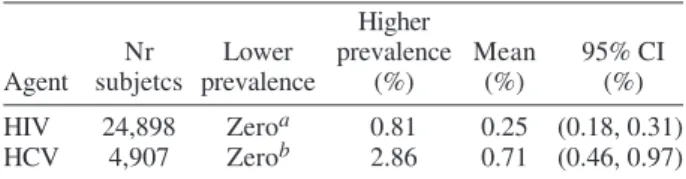
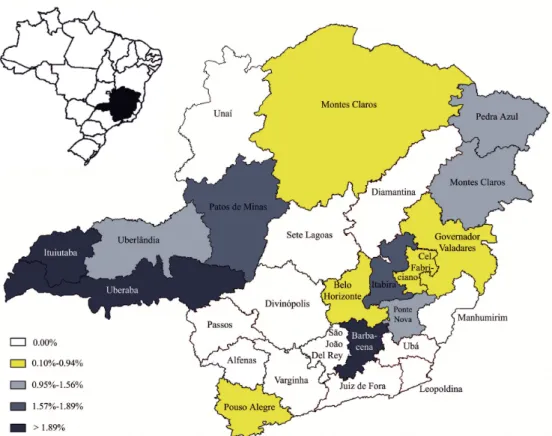
From the 24,905 ELISA tests for HIV-1+2, 61 were posi-tive and seven borderline. For HCV, 4211 tests were done, 30 were positive and four borderline. Borderline results were discarded at analysis and micro-regions were grouped in 26 macro-regions. HIV seroprevalence varied from zero (observed in six macro-regions) to 0.81% with a mean of 0.25% and a 95% CI of 0.18, 0.31%. HCV seroprevalence varied from zero (observed in 11 macro-regions) to 2.86% with a mean of 0.71% and a 95% CI of 0.46, 0.97%. From a total of 26 macro-regions, 20 had at least one HIV positive test and 15 had at least one HCV positive test (Table I). Figs 1 and 2 show the spatial distribution of HIV and HCV seroprevalence, respectively. Spatial distribution analy-sis showed higher seroprevalence of both HIV and HCV in macro-regions with known high injectable drug use, especially Uberlandia, Uberaba, and Passos or crossed by important interstate highways, as Itabira, Coronel Fabriciano, Governador Valadares, and Teofilo Otoni.
TABLE I
Human immunodeficiency virus (HIV) and hepatitis C virus (HCV) seroprevalence from blood samples of newborns in
Minas Gerais, Brazil, 2002
Higher
Nr Lower prevalence Mean 95% CI Agent subjetcs prevalence (%) (%) (%)
HIV 24,898 Zeroa 0.81 0.25 (0.18, 0.31) HCV 4,907 Zerob 2.86 0.71 (0.46, 0.97)
a: six out of 26; b: 11 out of 26; CI: confidence interval
DISCUSSION
367 367 367 367 367 Mem Inst Oswaldo Cruz, Rio de Janeiro, Vol. 100(4), July 2005
Fig 1: spatial distribution of human immunodeficiency virus seroprevalence in blood samples of newborns in the 26 macro-regions of Minas Gerais, Brazil, 2002.
368 368 368 368
368 Dried blood spot for HCV/HIV surveillance • Antonio Carlos de Castro Toledo Jr. et al.
ranging from 0 to 3.25% among persons between 15-49 years of age (Table II), with no statistical differences be-tween male and female.
Despite the apparent differences in the means, our results are practically very similar to the above-mentioned studies, when considering the confidence intervals (Table III). On the other hand, these studies are probably not comparable as their population and sampling method were different and were done in different times. Concerning HIV, we evaluated regionally the same population (child-bearing women) but two years later than the Ministry of Health study (Szwarcwald & Carvalho 2000), which repre-sents the national seroprevalence. In relation to Focaccia et al. (1998) HCV seroprevalence study, there is a five-year gap and their data represent both male and female from São Paulo metropolitan area.
Therewas a wide variation in HIV and HCV preva-lence among Minas Gerais macro-regions, as depicted in Figs 1 and 2. HIV is not only more disseminated through-out the state but it is still spreading centrifugally from large to small towns, mainly due to unprotected sexual contact and had a more pronounced variation than HCV. Nevertheless there was an overlapping of high prevalence areas in Western, Central, and Northeastern regions. Those differences in prevalence maybe due to a later introduc-tion of HCV among the populaintroduc-tion evaluated, and to dif-ferences in the transmission mode of the virus. As intra-venous drug use is currently considered the main trans-mission mode of HCV this characteristic could limit its dissemination to regions where these drugs are more eas-ily available. It is thus remarkable that the prevalence for HCV was still higher than for HIV, as showed in other studies.
Feasibility and costs - The total cost for the 2003 Bra-zilian HIV Sentinel Surveillance was estimated at US$ 280,000.00 or US$ 8.5 per sample tested for HIV, HBV, HCV, and syphilis. About 45% of this cost was for local per-sonal training and wages; 20% for laboratorial supplies (tubes, vacutainers, and needles); samples and
labora-tory supplies transportation; and 35% for the serologic kits. Our study had a total cost of R$ 30,600.00 or US$ 1.27 per sample tested for HIV and HCV. If all serological tests are included, as in Brazilian Sentinel Surveillance Program, our cost per sample would be US$ 3.10, 36.5% of the Bra-zilian Program. The NSP-based surveillance has practi-cally no extra costs with personal training and wages, laboratory supplies and sample transportation. As the infrastructure is already set, the only additional costs are testing expenses (kits plus laboratory time) and data analy-ses, making the procedure considerably cheaper and prac-tical. DBS may be also useful for epidemiological studies in other populations and/or for diagnosis purposes in re-mote areas, avoiding the technical hurdles. Of course in this situation the actual cost per sample will be higher than in places with an already established NSP, but prob-ably worth considering as it would avoid the expenses and hurdles related to drawing, stocking, and transport-ing blood samples.
It must also be emphasized that NSP is not appropri-ate for routine HIV infection diagnosis among childbear-ing women as it would be unethical to have this diagnosis only after birth. In this case, it makes more sense to in-crease efforts to have HIV tests available early in preg-nancy, as is the Brazilian Ministry of Health policy.
Sampling strategy in the usual sentinel study is quite different from NSP-based studies. Sentinel study uses cluster sampling, which has a higher risk of selection bias. As the Brazilian Sentinel Program defines hospitals as sample unit, the chances of selecting a hospital that is a reference for HIV-infected childbearing women is not small, consequently overestimating HIV seroprelavence. NSP sampling is easier to perform and has a higher chance of being representative of the target population, as it is a simple random sampling. On the other hand, NSP needs a prior existing structure and a good coverage of popula-tion to be representative. Another drawback is that if ma-ternal antibodies levels in newborn blood are very low there will be a chance of false-negative tests, which would underestimate the seroprevalence.
TABLE II
Hepatitis C virus seroprevalence in adults (15 to 49 years) in the metropolitan area of São Paulo, Brazil, 1997
Age 15-17 years 18-29 years 30-39 years 40-49 years
Prevalence 0.00 0.00 2.21 3.25
95% CI (0.000, 2.770) (0.000, 2.770) (0.050, 4.320) (0.007, 6.430)
CI: confidence interval
TABLE III
Major human immunodeficiency virus and hepatitis C virus seroprevalence studies in Brazil from 1997 to 2002
HIV HCV
Study Year Nr subjects Mean (%) 95% CI (%) Mean (%) CI 95% (%)
Present work 2002 HIV 24,898 0.25 (0.18, 0.31) – –
HCV 4,907 – – 0.71 (0.46, 0.97)
Szwarcwald (2000) 2000 15,426 0.47 (0.36, 0.58) – –
Focaccia et al. (1998) 1997 719 – – 0.00-3.25a (0.00, 6.43)
369 369 369 369 369 Mem Inst Oswaldo Cruz, Rio de Janeiro, Vol. 100(4), July 2005
The results point to the conclusion that dried blood spots are simple and inexpensive tool for the surveillance of many infectious diseases in countries with an estab-lished Neonatal Screening Network, such as Brazil. It may also become a practical surveillance strategy, albeit it is still necessary to compare its results in a concomitant study with the usual sentinel methodology to validate it for infectious disease surveillance, as HIV and HCV.
REFERENCES
Aebischer ML, Martorana MC, Costa F, Battaggia C, Madera A, Destito D, Machera F, Bailly C, Angeloni P 1990. Evalu-ation of the sensitivity of microfilter paper assays in an anthropological study: results of samples from Cameroon and Tanzania. Anthropol Anz48: 15-23.
Alary M, Castel J 1990. Risk factors for HIV seropositivity among people consulting for HIV antibody testing: a pilot surveillance study in Quebec. CMAJ143: 25-31.
Alary M, Joly JR, Parent R, Fauvel M, Dionne M 1994. Senti-nel hospital surveillance of HIV infection in Quebec. Que-bec Sentinel Hospital HIV-Seroprevalence Study Group.
CMAJ151: 975-981.
Amar HS, Ho JJ, Mohan AJ 1999. Human immunodeficiency virus prevalence in women at delivery using unlinked anony-mous testing of newborns in the Malaysian setting. J Paediatr Child Health35: 63-66.
Beck IA, Drennan KD, Melvin AJ, Mohan KM, Herz AM, Alarcon J, Piscoya J, Velazquez C, Frenkel LM 2001. Simple, sensitive, and specific detection of human immuno-deficiency virus type 1 subtype B DNA in dried blood samples for diagnosis in infants in the field. J Clin Microbiol 39: 29-33.
Biggar RJ, Miley W, Miotti P, Taha TE, Butcher A, Spadoro J, Waters D 1997. Blood collection on filter paper: a practical approach to sample collection for studies of perinatal HIV transmission. J Acquir Immune Defic Syndr Hum Retrovirol 14: 368-373.
Borgdorff M, Barongo L, van Jaarsveld E, Klokke A, Senkoro K, Newell J, Nicoll A, Mosha F, Grosskurth H, Swai R 1993. Sentinel surveillance for HIV-1 infection: how repre-sentative are blood donors, outpatients with fever, anaemia, or sexually transmitted diseases, and antenatal clinic at-tendees in Mwanza Region, Tanzania? AIDS7: 567-572.
Canosa CA, Grady GF, Cabello ML, Comeau AM, Schwerzler ME, Contreras MT, Fraga JM, Gomez de los Terreros I, Pena J 1997. Anonymous testing of newborn infants for HIV antibodies as a basis for estimating prevalence of HIV in childbearing women: the 1991-1994 study in Spain. Acta Paediatr (Suppl.) 421: 67-71.
Cassol S, Salas T, Arella M, Neumann P, Schechter MT, O’Shaughnessy M 1991. Use of dried blood spot speci-mens in the detection of human immunodeficiency virus type 1 by the polymerase chain reaction. J Clin Microbiol 29: 667-671.
Cassol S, Salas T, Gill MJ, Montpetit M, Rudnik J, Sy CT, O’Shaughnessy MV 1992. Stability of dried blood spot specimens for detection of human immunodeficiency virus DNA by polymerase chain reaction. J Clin Microbiol30: 3039-3042.
Comeau AM, Pitt J, Hillyer GV, Landesman S, Bremer J, Chang
BH, Lew J, Moye J, Grady GF, McIntosh K 1996. Early detection of human immunodeficiency virus on dried blood spot specimens: sensitivity across serial specimens. Women and Infants Transmission Study Group. J Pediatr129: 111-118.
Dondero Jr. TJ, Pappaioanou M, Curran JW 1988. Monitoring the levels and trends of HIV infection: the Public Health Service’s HIV surveillance program. Public Health Rep103: 213-220.
Focaccia R, da Conceição OJ, Sette Jr. H, Sabino E, Bassit L, Nitrini DR, Lomar AV, Lorenço R, Vieira De Souza F, Kiffer CR, Santos EB, Gonzales MP, Saez-Alquezar A, Riscal JR, Fischer D 1998. Estimated prevalence of viral hepatitis in the general population of the municipality of São Paulo, measured by a serologic survey of a stratified, randomized and residence-based population. Braz J Infect Dis2: 269-284.
Gascon J, Bruguera M, Corachan M, Mayor A, Sanchez Tapias JM, Rodes J 1988. Serological survey of hepatitis B in Northern Rwanda. Trop Geogr Med40: 293-297.
Gupta BP, Jayasuryan N, Jameel S 1992. Direct detection of hepatitis B virus from dried blood spots by polymerase chain reaction amplification. J Clin Microbiol30: 1913-1916.
Gwinn M, Pappaioanou M, George JR, Hannon WH, Wasser SC, Redus MA, Hoff R, Grady GF, Willoughby A, Novello AC 1991. Prevalence of HIV infection in childbearing women in the United States. Surveillance using newborn blood samples. JAMA265: 1704-1708.
Kigadye RM, Klokke A, Nicoll A, Nyamuryekung’e KM, Borgdorff M, Barongo L, Laukamm-Josten U, Lisekie F, Grosskurth H, Kigadye F 1993. Sentinel surveillance for HIV-1 among pregnant women in a developing country: 3 years’ experience and comparison with a population serosurvey. AIDS7: 849-855.
Lemeshow S, Hosmer D, Klar J, Lwanga S 1990. Adequacy of Sample Size in Health Studies, John Wiley, New York, 252 pp.
Matuszak DL, Panny SR, Patel J, Israel E 1990. HIV antibody seroprevalence among childbearing women surveyed in Maryland. Public Health Rep105: 562-566.
McLaws ML, Brown AR, Cunningham PH, Imrie AA, Wilcken B, Cooper DA 1990. Prevalence of maternal HIV infection based on anonymous testing of neonates, Sydney 1989.
Med J Aust153: 383-386.
Nyambi PN, Fransen K, De Beenhouwer H, Chomba EN, Temmerman M, Ndinya-Achola JO, Piot P, van der Groen G 1994. Detection of human immunodeficiency virus type 1 (HIV-1) in heel prick blood on filter paper from children born to HIV-1-seropositive mothers. J Clin Microbiol32: 2858-2860.
Panteleeff DD, John G, Nduati R, Mbori-Ngacha D, Richardson B, Kreiss J, Overbaugh J 1999. Rapid method for screening dried blood samples on filter paper for human immunodefi-ciency virus type 1 DNA. J Clin Microbiol37: 350-353.
Pappaioanou M, George JR, Hannon WH, Gwinn M, Dondero Jr. TJ, Grady GF, Hoff R, Willoughby AD, Wright A, Novello AC 1990. HIV seroprevalence surveys of child-bearing women – objectives, methods, and uses of the data.
370 370 370 370
370 Dried blood spot for HCV/HIV surveillance • Antonio Carlos de Castro Toledo Jr. et al.
Pappaioanou M, Kashamuka M, Behets F, Mbala S, Biyela K, Davachi F, George JR, Green TA, Dondero TJ, Heyward WL 1993. Accurate detection of maternal antibodies to HIV in newborn whole blood dried on filter paper. AIDS7: 483-488.
Parker SP, Khan HI, Cubitt WD 1999. Detection of antibodies to hepatitis C virus in dried blood spot samples from moth-ers and their offspring in Lahore, Pakistan. J Clin Microbiol 37: 2061-2063.
Parry JV, Mortimer PP, Nicoll AG 1992. Performance assess-ment of neonatal dried blood spot testing for HIV antibody.
Commun Dis Rep CDR Rev2: R128-130.
Proietti A, Gonçalves V, Eller R 2001. Padronização dos testes sorológicos. In Projeto AJUDE-Brasil: Avaliação Epidemiológica dos Usuários de Drogas Injetáveis dos Projetos de Redução de Danos (PRD) Apoiados pela CN-DST/Aids, Ministério da Saúde, Brasília, p. 37-51.
Rollins NC, Dedicoat M, Danaviah S, Page T, Bishop K, Kleinschmidt I, Coovadia HM, Cassol SA 2002. Preva-lence, incidence, and mother-to-child transmission of HIV-1 in rural South Africa. Lancet360: 389.
Rosner B 1995. Fundamentals of Biostatistics, 4th. ed, Duxbury, New York.
Serjeant GR 2000. Screening for sickle-cell disease in Brazil.
Lancet356: 168-169.
Siedler A, Hamouda O, Schwartlander B 1998. Anonymous
unlinked testing as a sentinel approach: experience in Ger-many. J Epidemiol Community Health52 (Suppl.) 1: 25S-27S.
Singh J, Bhatia R, Khare S, Patnaik SK, Biswas S, Lal S, Jain DC, Sokhey J 2000. Community studies on prevalence of HBsAg in two urban populations of southern India. Indian Pediatr37: 149-152.
Szwarcwald CL, Castilho EA 2000. Estimativa do número de pessoas de 15 a 49 anos infectadas pelo HIV, Brasil, 1998.
Cad Saúde Pública16: 135-141.
Tappin DM, Girdwood RW, Follett EA, Kennedy R, Brown AJ, Cockburn F 1991. Prevalence of maternal HIV infec-tion in Scotland based on unlinked anonymous testing of newborn babies. Lancet337: 1565-1567.
Tappin DM, Greer K, Cameron S, Kennedy R, Brown AJ, Girdwood RW 1998. Maternal antibody to hepatitis B core antigen detected in dried neonatal blood spot samples.
Epidemiol Infect121: 387-390.
Varnier OE, Lillo FB, Reina S, De Maria A, Terragna A, Schito G 1988. Whole blood collection on filter paper is an effec-tive means of obtaining samples for human immunodefi-ciency virus antibody assay. AIDS Res Hum Retroviruses 4: 131-136.