The Relationship between Different Kinds of
Students’ Errors and the Knowledge Required to
Solve Mathematics Word Problems
A Relação entre Diferentes Tipos de Erros Cometidos
por Estudantes e o Conhecimento Exigido para
Resolver Problemas-Palavra
Majid Haghverdi*
Ahmad Shahvarani Semnani**
Mohammad Seifi***
Abstract
The main objective of this research is to examine the relationship between different kinds of errors and the knowledge required to solve word problems in Arithmetic, Algebra and Geometry. Kinfong’s and Holtan’s framework supports the analysis of the errors, and Mayer’s theory was implemented to understand the necessary knowledge for solving math word problems. The research methodology follows a semi-experimental method. Research tools comprise both a descriptive math test and a directed interview. The research findings revealed that students’ errors when solving arithmetic word problems result from the lack of linguistic, semantic, structural and communicational knowledge; when solving the geometric word problems, the lack of semantic, intuition and structural knowledge were the cause of the students’ errors. Regarding algebra word problems, miscalculation was the reason for the higher error rate. Results show that the highest
* PhD in Mathematics Education. Departament of Mathematics, Science and Research Branch.
Islamic Azad University, Tehran, Iran. Ponak Street. Tehran, Iran. Postal Code 0098. E-mail:
** PhD in Mathematics Education. Departament of Mathematics, Science and Research Branch.
Islamic Azad University, Tehran, Iran. Ponak Street. Tehran, Iran. Postal Code 0098. E-mail:
*** PhD in Education. Departament of Education. Arak Branch. Islamic Azad University, Arak, Iran.
deficiency is mainly related to the lack of semantic, structural and communicational knowledge.
Keywords: Word Problems. Arithmetic. Algebra. Geometry. Necessary Knowledge.
Students’ Errors.
Resumo
O principal objetivo desta pesquisa é examinar a relação entre diferentes tipos de erros cometidos por estudantes e os conhecimentos necessários para resolver situações-problema em Álgebra, Aritmética e Geometria. Para a análise de erros seguimos as considerações de Kinfong e Holtan e para investigar o conhecimento necessário para ultrapassar os erros mobilizamos a teoria de Mayer. A metodologia de pesquisa é semi-experimental, envolvendo um teste de matemática com seis questões e entrevistas dirigidas. Os resultados da pesquisa revelaram que os erros na solução dos problemas-palavra aritméticos resultaram da falta de conhecimentos linguísticos, semânticos, estruturais e comunicativos; no que diz respeito aos problemas-palavra, os erros vinculam-se à lacunas no conhecimento vinculam-semântico, estrutural e intuitivo. Em relação aos problemas-palavra algébricos os erros devem-se a lacunas quanto às operações matemáticas. Em síntese, os resultados mostram que a maior deficiência dos alunos relaciona-se a lacunas relativas ao conhecimento semântico, estrutural e comunicativo.
Palavras-chave: Situações-Problema. Aritmética. Álgebra. Geometria. Conhecimento
Subjacente. Análise de Erros.
1 Introduction
such inability is that solving such problems demands mathematical computations along with other kinds of knowledge, including linguistic knowledge, which are required for understanding the problems (CUMMINS et al., 1988).
Verschafel et al. (2000) defined math word problems as verbal descriptions of problem situations wherein one or more questions are raised, the answer to which can be obtained by the application of mathematical operations to numerical data available in the problem statement. The mathematics word problems in seven grades can be classified into three categories based on their contained knowledge: arithmetic word problems, algebra word problems and geometry word problems.
The arithmetic word problems in common use are defined as problems which deal with daily use of objects. In order to solve such problems, students need to understand the numbers concept along with when and how to use four principal arithmetic operators. For example, “Joe has 8 marbles. Tom has 5 marbles. How many fewer marbles does Tom have than Joe?” (WONG et al., 2007).The algebra word problems are those problems which require using variables and setting up equations in order to solve. Consider this problem: “The value of a given number is six more than the value of a second number. The sum of two times the first number and four times the second number is 126. What is the value of the second number?” (CALDWELL; GOLDING, 1987). The geometry word problems are based on geometric concepts. For example, “There is a rectangular garden whose length is 100 cm longer than its width. The length is 300 cm. Please find the area of the garden.” (WONG et al., 2007).
The importance and necessity of learning math word problems have been emphasized by many curriculum planners (DE CORTE et al., 1989). These problems are also used frequently in Iranian textbooks. But based on our own experiences as math teachers, and the results of some related studies, solving math word problems is a hard task for students, and they face many difficulties in so doing.
from 8. The main reason for such answers, which are called student’s errors, may be their misunderstanding the problem or may be due to their clerical errors. In any case, it seems that being acquainted with the nature and the reasons for these errors can facilitate the process of solving math word problems (NEWMAN, 1977; KINFONG; HOLTAN, 1976). In this paper Kinfong’s and Holtan’s framework, which is the more comprehensive one, will be reviewed. Based on their framework, errors were classified into “clerical and computational errors”, and”other errors”.
The clerical errors may happen when the number presented in a problem is copied incorrectly in computations, but the operator is chosen correctly. The computational errors include three following types:
a) Computational errors with whole numbers: in solving math word problems, students may undertake computations which are completely or partly incorrect.
b) Computational errors with fractions: in these types of mistakes, students make errors during calculations with fractions similar to computational errors with whole numbers.
c) Computational errors with units: for solving problems, students do not undertake the needed unit transformation or do it incorrectly.
Other errors are:
a) Errors with averages and areas: these kinds of mistakes are related to unfamiliarity with necessary formulation or procedure in solving problems.
b) Use of the wrong operation: in this category, error occurred in using the incorrect operator. For example, the problem may need the addition operator but another operator has been used in computations.
c) No response error: the error happened when the student presents no solution for the problem and leaves the problem unsolved. This error takes place in two ways: 1) No response, but went on to solve other problems. 2) No response, did not attempt to solve any further problems.
d) Incorrect responses offering no clues.
The second approach for solving math word problems requiring an underlying knowledge for solutions to these problems, has been examined and classified by various authors including Schoenfeld (1985) and Mayer (1992). Mayer’s theory, which seems more reasonable than others, is used as the main reference for this approach. Mayer (1992) considers two stages in solving the word problems: problem comprehension and representation, and searching for the solution and its implementation. He allocated especial knowledge for each stage.
In the present paper, however, along with adoption of Mayer’s theory of knowledge, we present other theories mentioned in the literature in order to make it more applicable. Such types of knowledge are as follows:
1) Linguistic knowledge: this knowledge is used by problem solver to read the problem text. The lack of such knowledge at the beginning of the problem solving process stops students’ efforts to solve the problem. Greeno (1985) states that one of the students’ weaknesses in solving math word problems results from their failure in using linguistic knowledge.
The math word problem text includes expressions and numerical quantities, along with describing any special conditions. The problem solver then represents the problem text in his/her mind after reading it.
2) Comprehension knowledge consists of all of the knowledge from reading the problem text in order to comprehend the problem, which includes semantic knowledge, structural knowledge and intuition knowledge.
a) Semantic knowledge is a knowledge through which the problem text is comprehended. It means that using this kind of knowledge, data and math expression are not seen as set of pure words any more. But their meanings are formed through semantic knowledge. Having this knowledge helps students to understand the aim of the problem and to interpret it. Some students don’t interpret the problems correctly. For example if “Mary and John have 5 altogether” it means that “Mary and John each have 5”. This misinterpretation led them to construct predictably incoherent problem representations and choose incorrect solution strategies (CUMMINS, 1988).
Understanding the expressions of word problems, with special descriptions, required information from real world. This information is a part of the semantic knowledge needed by the problem solver.
and information (BURTON, 1999).
After reading the problem, students may examine the correctness or incorrectness of their given answers, along with using their intuition and common sense. Some students who do not have such knowledge only deal with calculation procedures. For instance, consider the following problem:
“An Army bus holds 30 soldiers. If 1,128 soldiers are being bussed to their training site, how many buses are needed?”
Carpenter et al (1983) showed that 70 percent of 13-year-old students were able to find their answer as 37 buses and the rest found the answer as 37.6 buses. In this case, students used the necessary computational knowledge, but they didn’t employ their intuition knowledge and common sense to present the meaningful answer.
c) The structural knowledge relates to schemata, meaning structures and all of the mathematical concepts which exist in the mind. Schemas are data structures for representing the generic concepts stored in memory (RUMELHART; NORMAN, 1985). Fischbein (1999) believes that a scheme is also a strategy for solving a certain class of problems. The schemata are knowledge structures which help students to classify problems in order to find the appropriate solution. Therefore schemata and meaning structures of math concepts are taught to students or are created by them. In facing word problems, the students select a proper method or pattern for their solutions using these schemata and structures. Nesher and Hershkovitz (1994) studied the role of schemata in solving word problems in his research and found that expert solvers have more ordered and more complete schemata and meaning structures at hand in solving word problems.
advancement, general and local reviewing, and evaluating of designs as necessary.
4) Calculation knowledge is a math knowledge which relates to calculations in problem solving. In this classification, doing math operations, procedural skills and numerical computations are distinguished from mathematical concepts.
2 Purposes of the study
As mentioned in the introductory section, two different approaches to math word problem solving were identified via reviewing the related literature. One approach explores and examines students’ errors, while the other one recognizes the required knowledge for solving such problems. But, until now, no research has been done to determine the effective relationship between these two approaches. So the main aim of the research is: “clarifying the relationship between kinds of errors and necessary knowledge for solving arithmetic, algebra and geometry word problems.”
3 Method
The research methodology is a semi-experimental method. Participants in this research were 89 seventh-grade students from 4 classes of Arak-Iran middle schools, who were selected randomly. The main reason for selecting seventh-grade students as the research subjects was that their textbook contained all three types of math word problems. In this study, two types of tools were used, a pencil and paper test (refer to appendix) and a directed interview. The first research tool contains six math word problems, which consist of two problems for each of these three types of arithmetic, algebra and geometry word problems. To do the pencil and paper test, all of the math word problems in the seventh-grade math textbook were gathered and 30 math teachers evaluated their suitability for representing the abovementioned three categories, based on Likert scales. The six problems selected for the test were those with the highest scores. The above-conducted test identified students’ errors. But to explore the kind of knowledge that students need and were related to their errors, researchers interviewed the students. In addition, the procedure was filmed for later data coding.
also he asked the students to solve these problems again. In examining the problems which had been incorrectly solved, the interviewer kept track of students’ solution processes in order to find the reasons for error and asked some questions to find their weaknesses in related knowledge. With regard to the abovementioned framework distinguishing between different kinds of knowledge,the interviewer focused on a especial aspect of needed knowledge.
The way of determining the kind of knowledge needed, as revealed by students’ errors was as follows:
1. Linguistic knowledge when students were unable to read the text.
2. Semantic knowledge when students were not able to explain the purpose of the problem in their own words.
3. Intuition knowledge when either the students’ description of the problem or the students’ answers were not reasonable in a real world context.
4. Structural knowledge when immediately after reading the problem the student did not offer any pattern or way for solving it.
5. Communicational knowledge when students did not have any reasonable argument for his/her suggested solution.
6. Calculation knowledge when students lacked calculation and algorithm problem solving skills.
Children’s responses in interviews were coded by watching the recorded films. Then for correct responses one point and for incorrect zero point was added.
4 Results
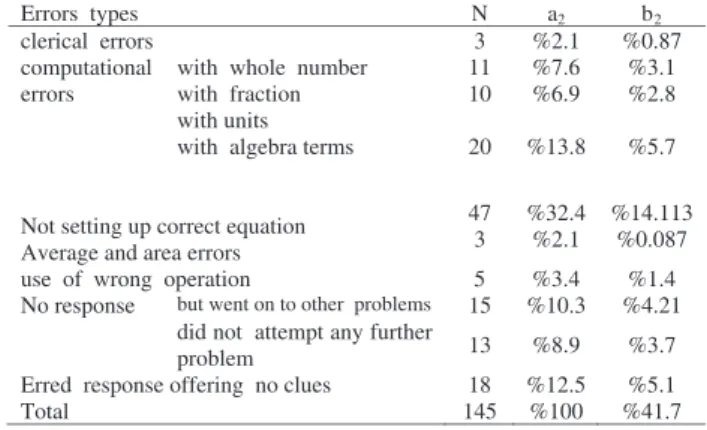
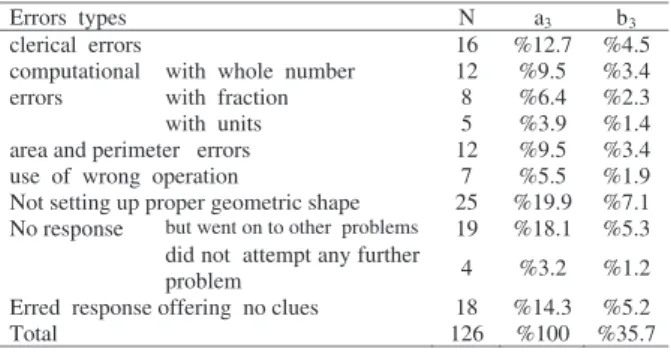
After the test, students’ answers were analyzed. In this analysis, the variety of errors were determined, and then for each kind of word problem test, the errors were collected on the basis of Kinfong’s and Holtan’s framework. They were then organized in Tables 1, 2 and 3. As a result, it was recognized that highest error rates happened respectively in algebra (41.07%), geometry (35.7%) and arithmetic (23.2%) word problems.
The students’ errors frequency analysis regarding the algebra word problems (Table 2) showed that most of the errors were related to “not setting up correct equation”. On the other hand, following the set up of the (correct or incorrect) equation, the computational errors with algebra terms placed in the second rank of students errors, as Table 2 shows.
Table 1 - Frequency and percentage of types of students’ errors in solving arithmetic
word problems
Table 2 - Frequency and percentage of types of students’ errors in solving algebra
Table 3 - Frequency and percentage of types of students’ errors in solving geometry word problems
As shown in Table 3, the evaluation of geometry problems showed that the most errors were respectively related to “not setting up proper geometric shape”, “no response error in which student went to other problems” and ultimately “erred responses offering no clues”.
This study dealt with examining the meaningful relationship between each type of necessary knowledge and the errors total. And also it determined why each of the individual errors occurred, due to which necessary knowledge was lacking respectively.
a) The relationship between each type of knowledge and all the occurring errors:
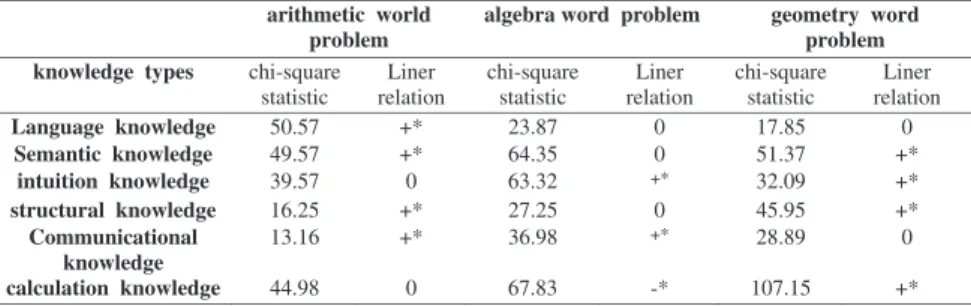
The X2 -test was used to examine the meaningful relationship between
each type of necessary knowledge and all the occurring errors (p<0.05). From the X2 -test scores in Table (4), it is obvious that lack of linguistic, semantic,
structural and communicational knowledge in the arithmetic word problems has increased student errors. In the algebra word problems, lacking calculation knowledge has caused higher rate of occurred errors. With respect to the geometry word problems, the lack of the semantic, intuition and structural knowledge increased students’ errors in solving such problems. But an unexpected result was that those students with higher calculation knowledge made more errors.
b) The relationship between each type of error and the necessary knowledge separately:
of semantic, intuition, communicational and structural knowledge.
The students with “computational errors with fractions” in solving arithmetic word problems lacked semantic, calculation and communicational knowledge, respectively. Table 6 shows the relationship between the variety of errors and necessary knowledge for algebra and geometry word problems. Based on these results, the errors related to “not setting up correct equation” are highly associated with the lack of semantic and structural knowledge. It means that lack of structural, calculation and communicational knowledge respectively has affected computational errors with algebra terms. The computational errors with whole numbers in algebra word problems were also related to the lack of communicational, calculation and intuition knowledge. Moreover, there is a meaningful relationship between “no response error but went on to other problems” and variety of necessary knowledge (Table 6).
Table 4: The relation between each of knowledge types with the total errors
Table 5: The relation between error types with needed knowledge in arithmetic word
Table 6: The relation between error types with needed knowledge in algebra and geometry word problems
The error related to “not setting up a proper geometry shape” was associated with the semantic knowledge because some of the students did not have proper understanding of the problem and so they were unable to draw the appropriate geometric shape for it. The students with “computational errors with fractions” in solving arithmetic word problems lacked semantic, calculation knowledge and communicational knowledge, respectively.
knowledge because some of the students did not have proper understanding of the problem and so they were unable to draw the appropriate geometric shape for it.
From the interview results, it is obvious that “the erred responses offering no clues” stem from the students’ providing the solution without complete understanding of the problem. As can be seen from Tables 5 and 6, it is concluded that most of the students with “average and area errors” in the arithmetic and geometry word problems, have enough linguistic and semantic knowledge needed for comprehending the considered problem; but they lack the necessary structural and communicational knowledge to solve the problem. So, they were unable to differentiate between the notions of area and the notion of circumference in geometry word problems.
5 Discussion
The aim of this article has been to examine the relationship between different kinds of errors and knowledge required to solve math word problems. Examining errors and necessary knowledge are two approaches which have been presented in studies regarding facilitation of the process of solving word problems.
were related to comprehension knowledge, in particular, semantic and structural knowledge. Therefore, teachers ought to consider knowledge acquisition in the process of student learning of problem solving.
The findings related to semantic knowledge are partly due to the fact that some students read the problem, not for comprehension but in order to extract some key numbers and operations from its text. In fact, most of them did not understand the problem’s content and goals. Some of the students lacked proper linguistic knowledge, and they were unable to read the problem text. So, the lack of linguistic knowledge results in a decrease of ability in semantic knowledge.This result coincides with the findings of Clements (1980). He concluded that the high rate of students’ errors in solving seventh-grade word problems were due to their lack of comprehension, translation, and processing skills, as well as their negligence. The error related to “not setting up correct equation” is highly associated with lack of semantic and structural knowledge. The explanation of the above relationship extracted from interview data shows that most of the students who gave incorrect equations for algebra word problems in the mentioned test are those who lacked proper understanding of the problem and who made mistakes in choosing the accurate variable and creating the related equation. In other words, they were unable to find an appropriate schema for setting the equation up in their minds.
This study explored the possible connection between two approaches for facilitating solving math word problems. This connection is very important because clarity of this relationship may increase math teachers’ insight about the nature of different kinds of errors and the different aspects of knowledge necessary for solving math word problems.
6 Recommendations
In view of the findings from the present study, mathematics teachers must first get the students engaged in the problem solving and when they are confident of the students’ comprehension of the problems, they must provide them with the relevant knowledge to reduce the rate of errors.
Mathematics teachers should also recognize the roots of students’ errors through greater awareness of the types of knowledge required.
The teachers with the awareness and recognition of this knowledge can try to foster the growth of such knowledge in their students.
different math word problems, based on required knowledge of the students in various academic grades.
References
BURTON, L. Why is intuition so important to mathematicians but missing from mathematics education? For The Learning of Mathematics, Montreal, Canada, CA, v. 19, n. 3, p. 27 - 32, 1999.
CALDWELL, J. H., GOLDING, G. A. Variable affecting word problem difficulty in secondary school. Journal for Research in Mathematics Education, Reston, Va., US, v. 18, n. 3, p. 187 - 196, 1987.
CARPENTER, T. P. et al. Result of the third NAEP mathematics assessment:
secondary school. Mathematics Teacher, Syracuse, NY, US, v. 76, n. 9, p. 52 - 659, dec. 1983.
CASEY. D. P. Failing students: A strategy of error analysis. In: COSTELLO (Ed).
Aspects of motivation, Melbourne: Mathematical Association of Victoria. 1978. p. 295
- 30.
CLEMENTS, M. A. Analyzing children’s errors on written mathematical tasks.
Educational studies in mathematics, Dordrecht, Holanda, NL, v. 11, n. 10, p. 1 - 21,
1982.
COCKCOFT, W. H. Mathematics counts: Report of the committee of inquiry into the teaching of mathematics in schools. London: HMSO, 1982.
CUMMINS, D. D. et al. The role of understanding in solving word problem. Cognitive
Psychology, New York, US, n. 4, v. 20, p. 405 - 438, 1988.
DE CORTE, E.; VERSHAFFEL, L.; DE WIN, L; Teaching word problem in the primary school. What research has to say to the teacher? In: B. Greer & G. Mulhern (Eds.),
New Development in Teaching Mathematics, London: Routledge. 1989, p. 85 - 106.
FISCHBEIN, E. Intuitions and schemata in mathematical reasoning. Educational Studies in Mathematics, Dordrecht, Holanda, v. 38. p. 11-50, 1999.
GREENO, J. Understanding and solving word arithmetic problems. Psychological
Review, Washington, US, v. 92, n. 1, p. 109 - 129, 1985.
HERSHLOVITZ, S.; NESHER, P. The role of schemes in solving word problems. The
KAUR, B. Difficulties with problem solving in mathematics. The Mathematical Educator. V. 2, n. 1, p. 93-112, 1997.
KINFONG, D.; HOLTAN, B. An analysis of children’s written soloution to word problems. Journal of Research in Mathematics Education, Reston, Va., US, v. 7, n. 2, p. 106 - 121, 1976.
LESTER, F.; GAROFALO, J. (Eds). Mathematical problem solving: Issues in Research. Philadelphia: Franklin institute Press, 1982.
MAYER, R. E.; HEGARTY, M. The process of understanding mathematical problems. In: STEMBERG, R. J.; BEN-ZEEV, T. (Eds.), the nature of mathematics thinking,
Mahwah, NJ: Lawrence Elrbaum, 1996, p. 29 - 53.
MAYER, R., Thinking, Problem solving, Cognition. 2. ed. New York: Freeman, 1992.
NCTM. NATIONAL COUNCIL OF TEACHERS OF MATHEMATICS. An agenda for
action: recommendation for school mathematics of the 1980s. Reston, VA, 1980.
NCTM. NATIONAL COUNCIL OF TEACHERS OF MATHEMATICS. Principles and
Standard for School Mathematics. Reston, VA, 2000.
NEWMAN, M. A. An analysis of sixth-grade pupils’ errors on written mathematical tasks. Victorian Institute for Educational Research Bulletin, Columbus, Ohio, US, v. 39, n. n/c, p. 31 - 43, 1977.
RUMELHART, D.; NORMAN, D. A. Representation of knowledge. In: AITKENHEAD, A. M.; SLACK, J. M. (Eds) Issues in cognitive modeling, Lawrence Erlbaum
Associates. 1985.
SCHOENFELD, A. Mathematical Problem Solving. San Diego, CA: Academic Press, 1985.
VERSCHAFFEL, L.; GREER, B.; DE CORTE, E. Making sense of word problems. The Netherlands: Swets & Zeithinger, 2000.
WONG, W. K.. et al. Learner-initiating instruction model based on cognitive knowledge for geometry word problem comprehension. Computer & Education, Manchester,v. 48, p.582 - 601, 2007.
Appendix
1. A publisher published a book in the last year of which four-fifths of the total inventory were sold and 1200 volumes remained in the warehouse, how many books were published in total?
2. Today the temperature of Arak city is 4°C. Its temperature tonight will be 7°C colder. Find the average temperature of Arak city?
3. A father is 38 years old, and his son is 8. How many years must pass for the father to be three times older than his son?
4. Job offers for pizza delivery workers have appeared in a local newspaper. Pizza restaurant A pays each delivery worker 0.6 euros for each pizza delivered and a fixed sum of 60 euros a month. Pizza restaurant B pays 0.9 euros for each pizza delivered and a fixed sum of 24 euros a month. Which do you think is the better-paid job? Make a decision and explain why your choice is the better one.
5. The roof of a building is like the following picture: we want to insulate the roof with two layers of insulation materials. The width of layers is 1.7 meters. How many meters of insulation materials are needed?
6. The festival committee in your area wishes to prepare a rectangular festival enclosure, with a surface area of 400 m2. The enclosure is to be fenced off