Bull Pan Am Health Organ 13(2), 1979.
A COMMUNITY J3EALl-H EDUCATION PROGRAM1
Miriam P. Backheuser,’ Maria M. Kampel,* and And+ Pereira da Costa*
For some time Brazil has been embarked
on
a major health education program designed to organize and stimulate cow-munity
action. This article describes both the fundamental theories behind the program and its day-to-day methodsof
operation.“If
we analyze the causesof
general mor- talityin Brazil by
region,we shall see that
in the north, northeast, and west-central
regions infectious and parasitic diseases are
the
leadingcause of death, while in the
south
andsoutheast regions degenerative
diseases (diseases of the circulatory system
and various types of cancers) are the most
important, as is the case in the more devel-
o$ed countries. However, even in the south
and southeast infectious diseases are im-
portant, since well-developed and
poorlydeveloped zones exist in all cities. In all the
regional capitals,
takentogether, the cate-
gory of infectious diseases causing the most
deaths is that of g&troenteritis and other
diarrhea1 diseases. . . .
“<It should be noted that mortality statis-
tics alone are insufficient to give an idea of
the influence of certain infectious
andparasitic diseases on the health picture of
Brazil. In
OUTcountry about 10 million
people
areinfested by
Schistosoma mansoni,several millionssuffeerfrom other
worm dis-eases and Chagas’ disease, nearly
800,000have tuberculosis, and thousands are vic-
tims of malaria, leprosy, venereal diseases,
andother ailments that reduce their ca-
pacity to work
and enjoy lafe. I’(1)
‘Also published in Portuguese in the BoletZn de la Oficina Saniturt’u Panamericana 84(3):255-261, 1978. ZProgram of Community Health Education, Bra- zilian Literacy Movement (MOBRAL), Rio de Janei- ro, Brazil.
Introduction
Brazil’s Program of Community Health Education (PES) is part of a larger educational undertaking, the Brazilian Literacy Movement (MOBRAL), that spon- sors a wide range of cultural, vocational, and leisure time projects. The purpose of these projects is to promote participation in the educational process by those who have had no opporrunity to participate during the period provided by law.
The agency operates at three organiza- tional levels: Centralized administration is provided by MOBRAL Headquarters, su- pervision and coordination is performed at the state level, and actions are executed at the
municipio
(county) level. Employing agents and officials responsible for each of its areas of activity, MOBRAL seeks to per- form its tasks in an integrated manner corresponding to overall human develop- ment needs.All of MOBRAL’s programs-from ac- tual teaching to vocational and cultural projects-touch on issues and events that involve health. Nevertheless, it is recog- nized that the process of education in health entails life-style changes and hygienic prac- tices requiring special and continuing attention. In this area, therefore, it is the task of PES, acting together with communi- ties that are underdeveloped and lack re- sources, to promote improvement of health and sanitary conditions through work of an educational nature.
Backheuser et al.
lCOMMUNITY
HEALTH EDUCATION
125
Caninde’, Clear5 State, May 1977. With work at the promotion and mobilization
phase
PES seeks active
community panicipation-the
fundamental
prerequisite for attainment of px&am
goals.
Campo Maior, Piauf State, May 1976. The PES training plrogram for advisen, helps them to learn
PES methods, to become familiar with PES supporting materials, and to pmpam themselves
126 PAHO BULLETIN . vol.
13,
no.2, 1979
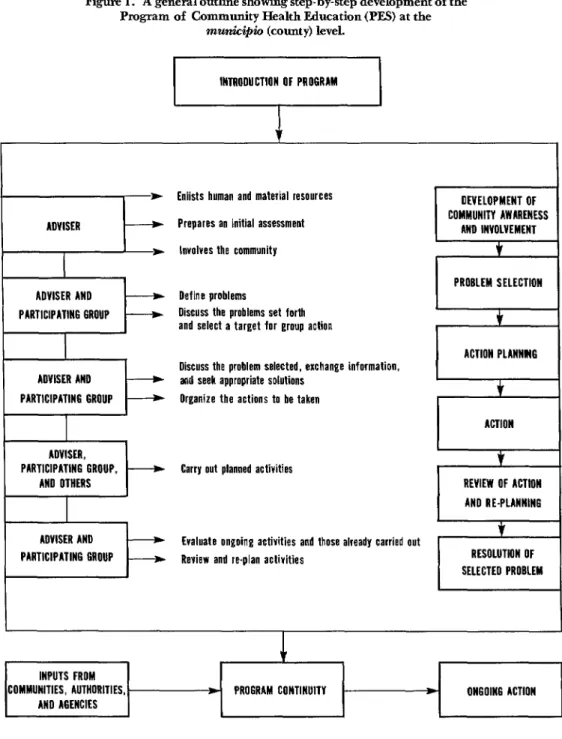
Figure 1. A general outline showing step-by-step development of the Program of Community Health Education (PES) at the
municipb (county) level.
Enlists human and material resources Prepares an initial assessment
Involves the community
Define problems
Discuss the problems set forth and select a target for group action
PARTICIPATING GROUP
Discuss the problem selected, exchange information, and seek appropriate solutions
Organize the actions to be taken
ADVISER, PARTICIPATING GROUP.
AN0 OTHERS
Carry out planned activities
ADVISER AND PARTICIPATING GROUP
Evaluate ongoing activities and those already carried out Review and re-plan activities
DEVELOPMENT OF COMMUNITT AWARENESS
AND INVOLVEMENT
I--
PROBLEM SELECTION tACTION PLANNMG
INPUTS FROM COMMUNITIES, AUTHORITIES,
AND AGENCIES
) PROGRAM CONTINUITY * ON60116 ACTION
I
ACTIONI
$‘ REVIEW OF ACTION
AND RE-PLANNING f
RESOLUTION OF SELECTED PROBLEM
Backheuser et al.
. COMMUNITY HEALTH EDUCATION 127who is also a member of the community. This adviser does not need to be highly qualified in the health field. It is expected, however, that the adviser will demonstrate leadership ability and will form his or her own working group, known as the “partici- pating group.” This group meets weekly to discuss important local health problems and to develop plans for solving them with its own resources in an organized way. Guided by the adviser, the group undertakes cam- paigns, sets up other volunteer groups, and by general agreement deals with priority problems in a manner calculated to provide maximum benefit for the community.
This participating group, formed in a spontaneous manner, is always open to new members. Initially the group operates for a four-month period, a period that may be extended in response to successful awaken- ing of community interest and the con- tinued existence of appropriate community needs.
Within this context, the PES adviser plays a key role. Generally possessing no special health-oriented technical or scien- tific knowledge, the adviser’s basic function is to mobilize a maximum number of people and to provide constant guidance and stimulation for development of group activ- ities. For this reason, before starting work each adviser receives special training in PES methods-methods designed to focus attention on group needs, to emphasize respect for existing cultural values, and to encourage maximum public involvement in discussion and solution of community problems.
Also, in order to lead discussion and plan- ning sessions, the adviser clearly needs at least a minimal degree of familiarity with health issues. This is provided by PES support materials-a set of books, pamph- lets, and posters containing information on a variety of subjects including sanitation, nutrition, communicable diseases, and ma- ternal and child health that relate directly to the health picture in Brazil.
Figure 1 presents a general plan of PES activities. As this and the foregoing discus- sion indicate, the basic goal of the PES is to provide continuity and a frame of reference for community health action. The way in which an essentially educational program such as the PES can do this, of course, is to help communities to sense the need for change. Once successfully underway, the program also serves to demonstrate what can in fact be achieved. The expectation is that once community members realize the power they have to improve health, sanitary conditions, and the quality of community life through their own efforts, they will grasp the importance of their work and will opt for its continuation.
Community Action in Carnafiba, Cear5 State A typical example of effective PES action is provided by the work of a participating group in the district of Carnaiiba in the municipio of Caninde, Gear% State. This group was formed by an adviser, Ms. Geraldina Arruda, who helped mobilize the community by inviting local residents to an initial meeting where matters of interest to all would be discussed. At that meeting, attended by some 150 people, Ms. Arruda described the PES, emphasized the need for everyone to work together to improve local health conditions, and asked the partici- pants what they felt to be the most serious local health problems. After a lengthy discussion that took up most of the meeting, the participants agreed that worm diseases (which affected nearly all residents, espe- cially children) constituted a serious problem.
128 PAHO BULLETIN l vol.
13,
no.2, 1979
of this problem grew increasingly evident, to a point where the participating group took steps to resolve it. A small landowner donated a building site in a cotton field, 10,000 bricks were made, wood was cut, and soon, through joint action, the community was constructing not merely a school but a community center available to all. Made aware in this way of its true capabilities, the CarnaGba participating group has re- mained united and has continued its efforts to solve local problems on its own by enlisting community support.
As this example demonstrates, community development (a concept sometimes confused with the more general concept of education) must start with discussion of highly sensitive structural problems directly related to daily life. Considering this, along with the strong appeal that concrete actions have for the economically deprived, it seems clear that community health action can play an ex- tremely important educational role-by providing the motivating force needed to power an educational movement with far broader implications. For once a group decides to discuss and solve its most imme- diate problems, and so comes to understand that it can achieve solutions, the concept of community participation takes root; and at this point it may be said that the process of education for human betterment is truly underway.
Results to Date
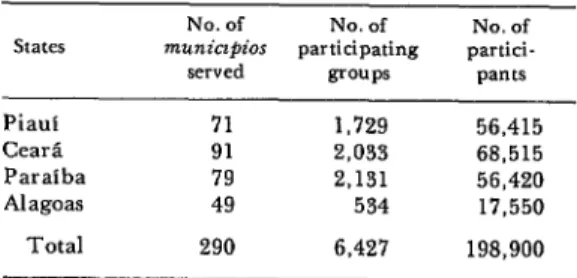
The PES was launched in four northeast states in mid-1976. As Table 1 shows, by the end of the year it had enlisted the support of roughly 200,000 local residents in 290 municipios.
Up to that time adult women had tended to predominate in the participating groups. The average number of participants per group in any given week had been about 25; but since new members had been allowed to join at any time and no provisions had been made for checking attendance, the fre-
Table 1. Participants, participating groups, mu&@&$, and states involved in the Program of Community Health Education (PF.S) in 1976.
States Piaui CearL Paraiba Alagoas Total
No. of No. of No. of 7TWtiCZpilX participating partici-
served groups PZlIltS
71 1,729 56,415
91 2,033 68,515
79 2,131 56,420
49 534 17,550
290 6,427 198,900
quency with which participants had at- tended meetings was unknown.
About 65 per cent of the advisers had teaching-related jobs and 20 per cent had some prior health training. PES meetings had been held at a wide variety of places, some of the more common sites being schools, private homes, public squares, municipal buildings, churches, hospitals, private clubs, orphanages, and peniten- tiaries. Matters discussed at these meetings in 1976 were linked to “hygiene” 35.9 per cent of the time and to “disease” 24.4 per cent of the time.
During 1976 alone the activities under- taken by PES groups included construc- tion of 12,962 cesspools: purchase of 9,596 filters;3 preparation of 4,672 vegetable gardens; repair of 2,941 houses: establish- ment of 2,091 refuse dumps; cleaning of 2,716 streets, squares, plots, or other areas; vaccination of 65,872 people; and the referral of 22,025 people to health centers, physicians, or hospitals. Efforts were made at the central level and (especially) at the action-executing level to integrate these activities with the work of a wide array of
Backheuser et al.
l COMMUNITY HEALTH EDUCATION129
health agencies and professional per- sonnel.
Regarding overall expenditures, in 1976 a total of Cr$5,054,980 was spent-for an average cost of Cr$786.52 per group and CrSJ25.41 per participant. These outlays covered advisers’ gratuities (64 per cent of the total), as well as production and print- ing of supporting literature and the cost of technical personnel, training, and tech- nical assistance.
By the end of the first half of 1977, PES had become fully operational and had activities u’nderway’ in 402 of Brazil’s 3,953 municipios-and in 8 of the nation’s 25 states and federal subdivisions. It is expected that by 1980 the program will be operating in at least half the
municipios
in Brazil.Concluding Remarks
In closing, it would seem appropriate to note how the PES activities described relate to present concepts of health educa- tion. A close examination of some of the definitions of health education current today (2-4) shows that they have at least two common characteristics: “(a) to de- velop in individuals the capacity to think, compare, select, and use health informa- tion and methods geared to their particu- lar biological and socioeconomic needs; and (b) to provide individuals with at least the minimum store of concepts and atti- tudes needed to make them effectively self- reliant in health matters.“(5)
Clearly, then, the most important task
of a community health education program is to introduce the concept of change into the community where it operates-by heightening community awareness that certain current habits and practices are generally an established part of the local culture, their immediate removal and re- placement is not possible. Educational work of this kind must therefore be slow and careful, so as to cope with a number of social variables-including the normal tendency to uphold traditional community values and residents’ lack of familiarity with new methods. Such work must of course take account of the most basic con- sideration underlying all health education activity-the fact that no change is likely to occur unless the community wants it and is willing to bring it about through its own efforts.
Because health is one of the most basic needs of every individual, it has a strong mobilizing appeal. But it is also true that once a community has mobilized itself to combat health problems, it can become an agent for change-a self-mobilizing entity capable of focusing attention on new or pre-existing needs. At this juncture one can see what theorists call the “functional role” of education-in this case the ability of education to prompt a community to seek its own development through system- atic solution of its own problems. A community thus mobilized will be moving toward health as the term is broadly defined-i.e., toward a “state of complete physical, mental, and social well-being. . .
[that] is one of the fundamental rights of every human being.“(d)
SUMML4RY
Brazil’s Community Health Education Pro- group is organized and encouraged by an gram (PES) operates on the basis of active com- “adviser,” a community member who has re- munity participation-by organizing local ceived some preliminary PES training.
130
PAHO BULLETIN .vol. 13, no. 2. 1979
included construction of 12,962. cesspools; pur- 22,025 people to health centers, physicians, or chase of 9,596 filters; preparation of 4,672 hospitals. By mid-1977 PES had become fully vegetable gardens; repair of 2,941 houses; operational and was active in 402 of Brazil’s establishment of 2,091 refuse dumps; cleaning of 3,953 municipios (counties). It is expected that 2,716 streets, squares, plots, or other areas; by 1980 the program will be operating in at least vaccination of 65,872 people, and referral of half the municipios of Brazil.
REFERENCES (I) Brazil, Secretaria National de Sadde do Ministerio da Saude, Divislo National de Edu- caczo Sanitaria. Contezido bdsico de educapio sanitdria. Rio de J aneiro, 1975.
(2) Hollanda, H. “Consideracaes sobre mu- dancas de comportamento no controle da equis- tossomose.” Paper presented at the XVII Brazilian Congress of Hygiene held at Salvador, Brazil, in 1968. Rio de Janeiro, 1968, 6 pp.
(3) Sen, A. K. Community health education: Methods and techniques. Indian Journal
of
Adult Education 37(10):12, 1976.(4) SESC (Social Service of the Trades People),
Departamento National. Normas gerais para aplica@o das direhires gerais de apio do SESC. Rio de Janeiro, 1974, 39 pp.
(5) Lobato, B. L. EducacIto sanitaria no SESC. Boletim bibliogrlifico (Secgo de Documen- tacPo da Divislo de Documentaclo e Intercambio do Departamento National do SESC [Social Service of the Trades People], Rio de Janeiro)
11:103-108, 1974.
(6) World Health Organization. Constitution of the World Health Organization (Preamble). Geneva, Switzerland, 1977.