c
Uma Publicação da Sociedade Brasileira de Matemática Aplicada e Computacional.
Proving Two Partition Identities
R. DA SILVA1
, Centro de Matemática, Computação e Cognição, UFABC, 09210-170 Santo André, SP, Brasil.
J.C. FILHO2
, Departamento de Matemática e Computação, ICE - UNIFEI, 37500-903 Itajubá, MG, Brasil.
J.P.O. SANTOS3
, Departamento de Matemática Aplicada, IMECC - UNI-CAMP, 13083-859 Campinas, SP, Brasil.
Abstract. In this paper we give combinatorial proofs for two partition identities. The first one solves a recent open question formulated by G. E. Andrews.
Keywords. Partition Identities, Combinatorics, Ferrers diagram.
1.
Introduction
In [2] Andrews considers a variety of parity questions related to partition identities. We mention two of them just to illustrate results of this nature. The first one is a well known identity given by Euler.
Euler’s Partition Identity. The number of partitions of any positive integer n into distinct parts equals the number of partitions of n into odd parts.
In terms of generating functions: for |q| < 1,
n
Y
j=1
(1 +qj) = n
Y
j=1 1
(1−q2j−1) (1.1)
The second one is due to B. Gordon ([6], [7]) and H. Göllnitz ([4], [5]) that inde-pendently introduced parity considerations as follows:
First Gollnitz-Gordon Identity. The number of partitions of n into distinct non-consecutive parts with no even parts differing by exactly 2 equals the number of partitions of n into parts≡1,4,or7(mod8).
At the end of [2], he presents a list of problems. In Section 2 we have a few definitions and the description of the Problem 5. In Section 3 we present our solution to the problem. In the last section we have a bijective proof for an identity related to the Durfee square of partitions.
1
2
3
2.
Solving an Andrews’s Problem
It is important to mention that a solution for Problem 5 of Andrews’s paper [2] was given in [8]. However, Yee’s proof is based on some results related to generating functions for partitions and q-series. Our proof, although equivalent to Yee’s one, deals with combinatorial aspects of the Ferrers diagram of a partition.
Before presenting the proof we recall a few definitions from [1] and [2].
Definition 2.1. A partition of a positive integernis a colection of positive integers
λ1, λ2, ..., λssuch thatλ1≥λ2≥ · · · ≥λs. Each λi is called a part of the partition.
We denote a partition by λ1+λ2+· · ·+λs or(λ1, λ2, ..., λs).
Example 2.1. The five partitions of 4 are: 4,3 + 1,2 + 2,2 + 1 + 1,1 + 1 + 1 + 1.
Definition 2.2. A Ferrers diagram of a partition λ1+λ2+· · ·+λsis an array of
dots left justified having λ1 dots in the first row, λ2 dots in the second row and so on.
Definition 2.3. Given a partition, the largest possible square of dots, starting in the upper left-hand corner, contained in its Ferrers diagram is called the Durfee square of this partition.
Example 2.2. Below we have the Ferrers diagram of the partition 8 + 7 + 4 + 3
with the Durfee square indicated.
Figure 1: The Durfee square of a partition
Definition 2.4. Let λ=λ1+λ2+· · ·+λj be a partition, whereλ1 ≥λ2 ≥ · · · ≥
λj. The lower odd parity index of λ, Ilo(λ), is defined as the maximum length
of nondecreasing subsequences of {λ1, λ2, ..., λj} whose terms alternate in parity
starting with an odd λi.
Example 2.3.
Ilo(11 + 11 + 7 + 6 + 6 + 3 + 2 + 1 + 1) = 5
Ilo(14 + 11 + 8 + 6 + 6 + 3 + 3 + 2) = 4
In [2] Andrews asks for a combinatorial proof for
X
r,m≥0
po(r, m, N)(−1)r=
1 ifN =n(3n+ 1)/2,
−1 ifN =n(3n+ 5)/2 + 1,
0 otherwise,
(2.2)
wherepo(r, m, N)is the number of partitions ofN intomdistinct parts with lower
odd parity index equal to r.
partitions of 11 Ilo
11 1
10 + 1 2
9 + 2 1
8 + 3 2
8 + 2 + 1 2
7 + 4 1
7 + 3 + 1 1
6 + 5 2
6 + 4 + 1 2
6 + 3 + 2 2
5 + 4 + 2 1
5 + 3 + 2 + 1 3
partitions of 12 Ilo
12 0
11 + 1 1
10 + 2 0
9 + 3 1
9 + 2 + 1 3
8 + 4 0
8 + 3 + 1 2
7 + 5 1
7 + 4 + 1 3
7 + 3 + 2 1
6 + 5 + 1 2
6 + 4 + 2 0
6 + 3 + 2 + 1 4
5 + 4 + 3 3
5 + 4 + 2 + 1 3
From these tables it is easy to see that X
r,m≥0
po(r, m,11)(−1)r = 0 and
X
r,m≥0
po(r, m,12)(−1)r=−1.
In order to present a combinatorial proof of (2.2), we identify each partition with its Ferrers diagram, the standard graphical representation of a partition.
The combinatorial proof we are going to show is based on the one-to-one corre-spondence found by F. Franklin in 1881 to prove Legendre’s combinatorial version of Euler’s pentagonal number theorem (see [1]).
3.
The Combinatorial Proof
Let De(N) (resp. Do(N)) be the number of partitions of N into distinct parts
having even (resp. odd) lower odd parity index. Then, we can rephrase (2.2) in the following theorem.
Theorem 3.1.
De(N)−Do(N) =
1 if N =n(3n+ 1)/2,
−1 if N =n(3n+ 5)/2 + 1,
0 otherwise.
Proof. We shall establish a one-to-one correspondence between the partitions enu-merated by De(N) and those enumerated by Do(N). This correspondence will
not work for some partitions of the numbers of the form N = n(3n+ 1)/2 and
N =n(3n+ 5)/2 + 1.
Each partitionλ= λ1+λ2+· · ·+λs of N into distinct parts has a smallest
part λs and the largest part λ1 is the first element of a decreasing sequence of l consecutive integers that are parts of λ. For example, below we have the Ferrers diagrams of the partitions8 + 7 + 4 + 3and8 + 7 + 6 + 3 + 2with their parameter
Figure 2: Two partitions and their parameterλsandl
In order to establish the one-to-one correspondence we consider the following two cases.
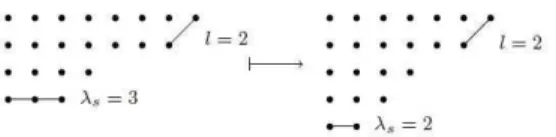
Case 1: λs> l. In this case, we remove 1 from the partsλ1, λ2, ..., λl and form a
new smallest part of sizel. For example,
8 + 7 + 4 + 37−→7 + 6 + 4 + 3 + 2,
or, in terms of the graphical representation,
Figure 3: A partition of Case 1
Case 2: λs≤l. In this case, we remove the smallest part and add 1 to the firstλs
of thel largest parts. For example,
8 + 7 + 6 + 3 + 27−→9 + 8 + 6 + 3,
that is,
Figure 4: A partition of Case 2
Note that exactly one case is applicable to a given partition into distinct parts. Then, it seems that the mapping establishes a one-to-one correspondence. This is true except for certain partitions like5 + 4 + 3.
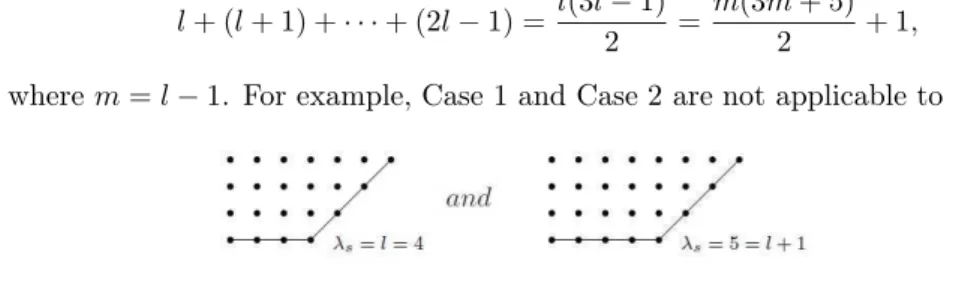
The procedure described in Case 1 is not applicable to those partitions having
l parts andλs=l+ 1, in which case the number being partitioned is
While the procedure described in Case 2 is not applicable to those partitions having
l parts andλs=l, in which case the number being partitioned is
l+ (l+ 1) +· · ·+ (2l−1) = l(3l−1)
2 =
m(3m+ 5) 2 + 1, wherem=l−1. For example, Case 1 and Case 2 are not applicable to
Figure 5: Partitions that are neither of Case 1 nor of Case 2
Note that partitions of the formλ= (2l−1) +· · ·+ (l+ 1) +lhave an odd lower odd parity index: if l is odd, thenIlo(λ) =l; ifl is even, then Ilo(λ) =l−1. We
also note that partitions of the formλ= 2l+· · ·+ (l+ 2) + (l+ 1) have an even lower odd parity index: ifl is odd, thenIlo(λ) =l−1; ifl is even, thenIlo(λ) =l.
In order to finish the proof we shall show that the correspondence described above changes the parity of the indexIlo(λ), whenλ=λ1+λ2+· · ·+λsis neither
a partition into l parts with λs = l nor a partition into l parts with λs = l+ 1.
Again, we consider the two cases above.
We will callµthe image partition obtained fromλ=λ1+λ2+· · ·+λl+λl+1+ · · ·+λs by the correspondence above, i.e.,
µ=
(λ1−1) +· · ·+ (λl−1) +λl+1+· · ·+λs+l, ifλs> l,
(λ1+ 1) +· · ·+ (λλs+ 1) +λλs+1+· · ·+λl+· · ·+λs−1, ifλs≤l.
We shall show thatIlo(λ)and Ilo(µ)have different parities.
Case 1: λs> l. We split this case into two sub-cases.
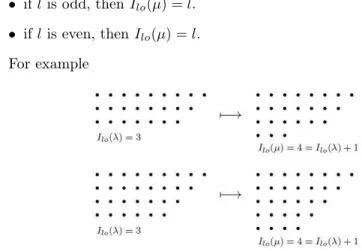
Sub-case 1.1: s=l. In this sub-case, λ=λ1+λ2+· · ·+λl and µ= (λ1−1) + (λ2−1) +· · ·+ (λl−1) +l. Hence, ifIlo(λ) =l, thenλlis odd and, consequently,
• ifl is odd, thenIlo(µ) =l+ 1.
IfIlo(λ) =l−1, thenλlis even and, consequently,
• ifl is odd, thenIlo(µ) =l.
• ifl is even, thenIlo(µ) =l.
For example
Figure 6: Examples of change of parity in Sub-case 1.1
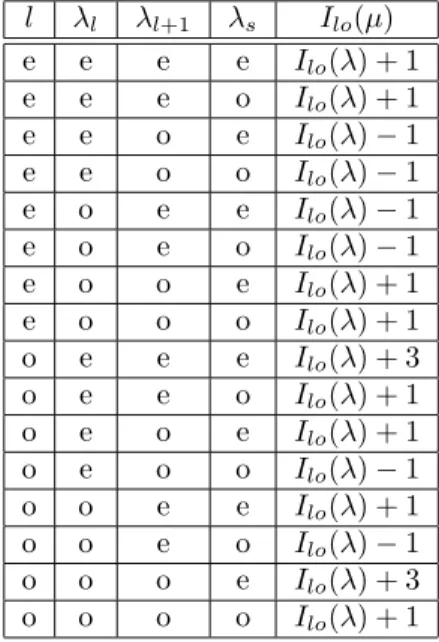
Sub-case 1.2: s > l. The parts λ1, λ2, ...,λl of λalternate in parity. The same is
true for the parts(λ1−1),(λ2−1), ...,(λl−1)ofµ. Then in order to determine the
index Ilo(µ)in terms ofIlo(λ)we have to look at the parity ofλl andλl+1 as well as the parity ofl andλs. While the parity ofλl is changed by the correspondence,
the same does not happen withλl+1. For example,
Figure 7: Examples of change of parity in Sub-case 1.2
As there are two choices for the parities ofl,λl,λl+1, and λs, then we have to
l λl λl+1 λs Ilo(µ)
e e e e Ilo(λ) + 1
e e e o Ilo(λ) + 1
e e o e Ilo(λ)−1
e e o o Ilo(λ)−1
e o e e Ilo(λ)−1
e o e o Ilo(λ)−1
e o o e Ilo(λ) + 1
e o o o Ilo(λ) + 1
o e e e Ilo(λ) + 3
o e e o Ilo(λ) + 1
o e o e Ilo(λ) + 1
o e o o Ilo(λ)−1
o o e e Ilo(λ) + 1
o o e o Ilo(λ)−1
o o o e Ilo(λ) + 3
o o o o Ilo(λ) + 1
Table 1: The 16 possibilities of Sub-case 1.2
Case 2: λs≤l. Again we consider two sub-cases.
Sub-case 2.1: λs< l. In this case the operation of removing the smallest part of
λ=λ1+· · ·+λλs+λλs+1+· · ·+λl+λl+1+· · ·+λs−1+λs and adding 1 to each of its firstλslargest parts produces
µ= (λ1+ 1) +· · ·+ (λλs+ 1) +λλs+1+· · ·+λl+λl+1+· · ·+λs−1. Since λλs and λλs+1 have opposite parities, we have to consider the parities of
λs, λs−1, andλλs. For example, by this operation we can obtain
Figure 8: Examples of change of parity in Sub-case 2.1
The table below shows the 23 possibilities and the values of I
lo(µ) in terms of
λs λs−1 λλs Ilo(µ)
e e e Ilo(λ)−1
e e o Ilo(λ)−1
e o e Ilo(λ)−1
e o o Ilo(λ)−1
o e e Ilo(λ)−3
o e o Ilo(λ)−3
o o e Ilo(λ)−1
o o o Ilo(λ)−1
Table 2: The 8 possibilities of Sub-case 2.1
Sub-case 2.2: λs=l. In this sub-case we have to look at the parity ofλs, λs−1, λl,
andλl+1. For instance, ifλsandλs−1are odd and bothλlandλl+1 are even, then
Ilo(µ) =Ilo(λ) + 1. We summarize all possibilities in the next table.
λs λs−1 λl λl+1 Ilo(µ)
e e e e Ilo(λ) + 1
e e e o Ilo(λ)−1
e e o e Ilo(λ)−1
e e o o Ilo(λ) + 1
e o e e Ilo(λ) + 1
e o e o Ilo(λ)−1
e o o e Ilo(λ)−1
e o o o Ilo(λ) + 1
o e e e Ilo(λ)−1
o e e o Ilo(λ)−3
o e o e Ilo(λ)−3
o e o o Ilo(λ)−1
o o e e Ilo(λ) + 1
o o e o Ilo(λ)−1
o o o e Ilo(λ)−1
o o o o Ilo(λ) + 1
Table 3: The 16 possibilities of Sub-case 2.2
As one can see from the tables above the parity of the indexIlois always changed
by the one-to-one correspondence described above. Therefore the theorem is proved.
4.
The Second Bijection
Ferrers diagram of a partition starting in the upper left-hand corner). This identity comes from two different interpretations for the Fibonacci Numbers (see [3]).
Theorem 4.2. The number of partitions into at most n parts without gaps4 and having each part appearing at least twice is equal to the number of partitions where the largest part is the side of its Durfee square and the largest part plus the number of parts is less than or equal ton.
Proof. Let n be a non-negative integer. Define A as the set of partitions into at mostnparts without gaps and having each part appearing at least twice. We also defineBas being the set of partitions where the largest part is the side of its Durfee square and the largest part plus the number of parts is less than or equal ton.
Note that the empty partition is in both setsAandB, consequently we associate these two partitions. Now we describe the bijection betweenAandBfor non-empty partitions. In order to do this we associate each partition with its Ferrers diagrams. Given a non-empty partition λ ∈ A, with largest part p, we obtain a partition
µ∈ B, with Durfee square of sidep, by the following procedure:
• delete pdots from the first column ofλ
• movep−2, p−4, ..., p−2× ⌊p
2⌋dots from the columns2,3, ...,⌊
p
2⌋+ 1to the columns p, p−1, p−2, ..., p− ⌊p
2⌋+ 1, respectively.
For example, consider the partitionλ= 7 + 7 + 6 + 6 + 6 + 6 + 5 + 5 + 4 + 4 + 4 + 3 + 3 + 3 + 3 + 2 + 2 + 2 + 1 + 1 + 1. The partition µobtained by the above procedure isµ= 7 + 7 + 7 + 7 + 7 + 7 + 7 + 6 + 6 + 4 + 3 + 3 + 2 + 1or, in terms of Ferrers diagrams,
Figure 9: An example of a partition of Aand its corresponding partition of B
4
It is important to note that the resulting diagram still represents a partition. This is ensured by the condition that each part appears at least twice.
Given a partitionσ∈ Bwe obtain a partitionδ∈ Ajust by inverting the above procedure. As an example, considerσ= 6 + 6 + 6 + 6 + 6 + 6 + +3 + 1; the partition associated toσ isδ= 6 + 6 + 5 + 5 + 4 + 4 + 3 + 3 + 3 + 2 + 2 + 1 + 1 + 1:
Figure 10: An example of a partition ofBand its corresponding partition of A
Resumo. Neste artigo fornecemos provas combinatórias para duas identidades de partições. A primeira resolve uma questão recentemente formulada por G. E. Andrews.
Palavras-chave. Identidades de partições, Combinatória, Diagrama de Ferrers.
References
[1] G.E. Andrews, “The Theory of Partitions”, Cambridge University Press, 1984.
[2] G.E. Andrews, Parity in partition identities, The Ramanujan Journal, 23 (2010), 45–90.
[3] J.C. Filho, “Variações do Diagrama de Ferrers, Partições Planas e Funções Geradoras”, Tese de Doutorado, IMECC, UNICAMP, Campinas, SP, 2006.
[4] H. Göllnitz, Einfache Partionen, Diplomarbeit W.S. 1960, Göttingen, 65 pp.
[5] H. Göllnitz, Partitionen mit Differenzenbedingungen, J. Reine Angew. Math, 225(1967), 154-190.
[6] B. Gordon, Some Ramanujan-like continued fractions, Abstracts of Short Com-munications, Int. Congr. of Math., 29-30, Stockholm, 1962.
[7] B. Gordon, Some continued fractions of the Rogers-Ramanujan type, Duke Math. J.,31 (1965), 741-748.