Alcohol dependence induced in rats by
semivoluntary intermittent intake
Departamento de Ciências Fisiológicas, Centro Biomédico, Universidade Federal do Espírito Santo, Vitória, ES, Brasil M.S. Macieira,
W.G. Almeida, E.A. Silva, L.C. Schenberg and E.M. Nakamura-Palacios
Abstract
The objective of the present experiment was to assess ethyl alcohol (ETOH) dependence brought about by a semivoluntary intermittent intake regimen in rats. Male Wistar rats weighing 150-250 g at the onset of the experiment were assigned to the following groups: 0% ETOH (N = 11), 5% ETOH (N = 20), 20% ETOH (N = 20) and 40% ETOH (N = 18). ETOH solutions were offered at the end of the day and overnight from Monday to Friday, and throughout weekends, for 90 days. The concentration of the ETOH solutions was increased in a stepwise fashion allowing the rats to get used to the taste of alcohol. Reposition of pure water was permitted during 1-h water drinking periods in the morning. Daily volume intake (± SEM) averaged 25.4 ± 0.4 ml (0% ETOH), 23.8 ± 0.6 ml (5% ETOH), 17.6 ± 0.7 ml (20% ETOH) and 17.5 ± 0.6 ml (40% ETOH). ETOH consumption differed significantly (P<0.05) among groups, averaging 4.4 ± 0.2 g kg-1 day-1 (5% ETOH), 10.3 ± 0.3 g kg-1 day-1 (20% ETOH) and 26 ± 1.2 g kg-1 day-1 (40% ETOH). Furthermore, ETOH detection in plasma 10-12 h after offering the solution indicated that its consumption in the 40% ETOH group was sufficient to override its metabolism. Overt signs of ETOH dependence, such as increased thirst, hyperactivity, puffing, hair ruffling and startle responsiveness as well as reduced drowsiness, were significantly increased in the 20% and 40% ETOH groups compared to the 0% and 5% groups. Accordingly, the model described here proved to be a useful tool for the evaluation of subtle or moderate behavioral and physical consequences of long-term ETOH intake.
Correspondence
E.M. Nakamura-Palacios Programa de Pós-Graduação em Ciências Fisiológicas Centro Biomédico, UFES Av. Marechal Campos, 1468 29040-090 Vitória, ES Brasil
Fax: 55 (027) 335-7330 The authors are recipients of the following CNPq fellowships: Predoctoral (M.S. Macieira), Undergraduate (W.G. Almeida and E.A. Silva) and Research (L.C. Schenberg and E.M. Nakamura-Palacios).
Received September 17, 1996 Accepted July 11, 1997
Key words •Ethanol
•Alcohol
•Drug dependence
•Rat
Experimental dependence on ethyl alco-hol (ETOH) is usually induced by 3 methods of drug administration: involuntary, semi-voluntary or semi-voluntary (1). While the invol-untary method refers to the forced drug ad-ministration by gastric intubation or by the intravenous, intraperitoneal and pulmonary routes (2), in the semivoluntary method ETOH is offered as part of a liquid or food
ag-gressive and often produces severe conse-quences. On the other hand, while the spon-taneous oral intake of ETOH greatly favors the semivoluntary method, dehydration, which is not a common feature in clinical practice, may supervene as a consequence of long-term ETOH administration in which the drug solution is the only source of liquid. Finally, although the voluntary method is quite useful for the assessment of the rein-forcing properties of ETOH, its higher cost and technical difficulties are the major draw-backs of its use. The aim of the present study was to establish a simple model of induction of ETOH dependence by means of a semi-voluntary intermittent daily intake of differ-ent concdiffer-entrations of the drug.
Two-month old male Wistar rats weigh-ing 150-250 g at the beginnweigh-ing of the experi-ment were placed in individual cages with food ad libitum. Rats were randomly as-signed to four groups: 0% ETOH (N = 11), 5% ETOH (N = 20), 20% ETOH (N = 20) and 40% ETOH (N = 18), according to treat-ment, i.e., tap water for the 0% ETOH con-trol group and 5%, 20% and 40% ETOH solutions for the remaining groups. Rats were weighed twice a week and the solutions were offered at the end of the day and kept over-night from Monday to Friday, and through-out the weekends. The concentration of the ETOH solutions was increased in a stepwise fashion allowing the rats to get used to the taste of alcohol. Weekly concentration in-crements to 5%, 10% and 20% were used in the first three weeks for the 5%, 20% and 40% ETOH groups, respectively. The con-centration of the 40% ETOH group was further increased in steps to 30% and 40% in the fourth and fifth week, respectively. Once the desired ETOH concentration was at-tained, the solution was kept unchanged up to the completion of the 90-day treatment. Daily ETOH consumption, in gram per kilo-gram body weight (g kg-1 day-1), was only evaluated after the fifth week when all groups received a stable concentration of ETOH.
Daily reposition of pure water was permitted during 1-h water drinking periods in the morning. Immediately thereafter, the ingested volume of water or ETOH solution was meas-ured and behavioral responses indicative of physical dependence were recorded as pres-ent or not.
Mean weekly frequencies of behavioral responses were calculated for the following behavioral items: thirst (strong approach be-havior to the bottle and vigorous drinking), hyperactivity (sudden quick movements dur-ing bottle replacement), startle response (sud-den jump induced by finger snapping or key shaking near the cage), puffing (rapid respi-ratory movements), drowsiness (resting pos-ture with eyes closed or semi-closed and apparent muscle relaxation as suggested by the lowering of the trunk and/or head and flexion of the limbs), and hair ruffling (pilo-erection).
Daily ETOH consumption was later con-firmed by means of a biochemical assay in a separate set of experiments. Thus, rats were submitted to the same alcohol intake regi-men, i.e., 0% ETOH (N = 5), 5% ETOH (N = 6), 20% ETOH (N = 6) and 40% ETOH (N = 6), but only for 30 days. At the end of treatment, rats were anesthetized with ethyl ether and two blood samples were drawn from the tail artery, 2-4 h (1st sample) and 10-12 h (2nd sample) after withdrawal of the ETOH solutions. Blood samples were then centrifuged and plasma ETOH levels were determined by enzymatic assay (Sigma Di-agnostics Alcohol Reagent, St. Louis, MO) using a spectrophotometer (Gilford Instru-ments, model 250, Oberlin, OH).
Alcohol intake and biochemical data were analyzed by two-way analysis of variance for repeated measures followed by the post hoc Tukey test and by the Student t-test of least square means, respectively. Weight gain was assessed by regression analysis. Behav-ioral scores were evaluated by nonparamet-ric Kruskal-Wallis ANOVA followed by a
Data are reported as the mean ± SEM and differences were considered to be signifi-cant at P<0.05.
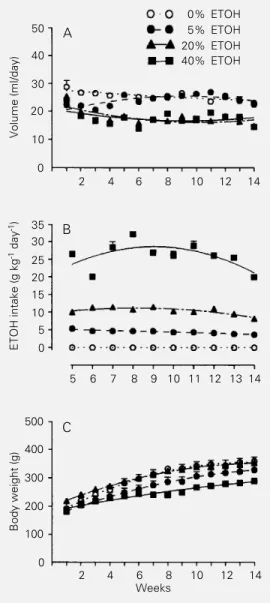
Rats weighed 192.2 ± 17.6 g (0% ETOH), 180.5 ± 14.8 g (5% ETOH), 218.2 ± 13.6 g (20% ETOH) and 181.1 ± 4.8 g (40% ETOH) at the onset of the experiment and 395.5 ± 14.1 g (0% ETOH), 328 ± 15.2 g (5% ETOH), 354.2 ± 11.4 g (20% ETOH) and 289.4 ± 6.8 g (40% ETOH) at the end of the experiment. There was a significantly smaller weight gain in the 5% and 40% ETOH rats com-pared to the other groups (P<0.003) (Figure 1C). Nonetheless, linear regression analysis showed a significant weight gain for all groups (P<0.001) throughout the experiment: 0% ETOH (Y = 208.4 + 12.3x, r = 0.95), 5% ETOH (Y = 187.8 + 11.0x, r = 0.98), 20% ETOH (Y = 229.2 + 10.0x, r = 0.96) and 40% ETOH (Y = 191.2 + 7.2x, r = 0.97).
Daily volume intake averaged 25.4 ± 0.4 ml (0% ETOH), 23.8 ± 0.6 ml (5% ETOH), 17.6 ± 0.7 ml (20% ETOH) and 17.5 ± 0.6 ml (40% ETOH) (Figure 1A). The 5%, 20% and 40% ETOH groups drank smaller amounts in the first week than the 0% ETOH group (P<0.05). Compared to control rats, the 5% ETOH group showed a lower volume intake during the first six weeks (P<0.05), but did not differ from controls thereafter. The 20% and 40% ETOH groups drank smaller vol-umes than the 0% and 5% ETOH groups from the second week onwards (P<0.05). Moreover, compared to the 0% and 5% ETOH groups, a further decrease in volume intake was observed in the 20% and 40% ETOH groups after the increase of the alco-hol concentration in the third and fifth weeks (P<0.05) (Figure 1A). ETOH consumption also differed significantly (P<0.05) among groups, averaging 4.4 ± 0.2 g kg-1 day-1 (5% ETOH), 10.3 ± 0.3 g kg-1 day-1 (20% ETOH) and 26 ± 1.2 g kg-1 day-1 (40% ETOH). Thus, ETOH consumption increased proportion-ally to alcohol concentration (P<0.05) (Fig-ure 1B).
Daily evaluation of behavioral responses
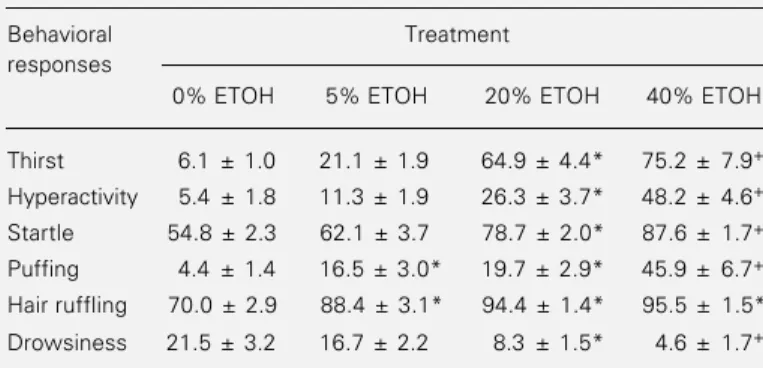
during the alcohol withdrawal period showed dose-dependent increases in thirst, hyperac-tivity and startle behavior and a dose-de-pendent decrease in drowsiness (P<0.05). Overt autonomic signs, i.e., puffing and hair ruffling, also showed a dose-dependent in-crease (P<0.05) (Table 1).
Compared to the corresponding back-ground levels of the 0% ETOH group, there was a significant increase in plasma ETOH 10-12 h after the 40% solution was offered (P<0.01). Indeed, slightly increased levels were already detected 2-4 h after the presen-tation of the 40% ETOH solution (P<0.12) and 10-12 h after the presentation of the 5%
Volume (ml/day)
ETOH intake (g kg
-1 day -1)
Body weight (g)
50
40
30
20
10
0
2 4 6 8 10 12 14
A
0% ETOH 5% ETOH 20% ETOH 40% ETOH
35
30
25
20
15
10
5
0
5 6 7 8 9 10 11 12 13 14
500
400
300
200
100
0
2 4 6 8 10 12 14
Weeks C
B
Figure 1 - Semivoluntary inter-mittent alcohol intake by rats. Data are reported as mean ± SEM for tap water (N = 11), 5% ethanol (N = 20), 20% ethanol (N = 20) and 40% ethanol (N = 18). A, Daily volume intake of alcohol solutions (ml/day); B, daily ethanol (ETOH) consump-tion per kg body weight (g kg body weight-1 day-1); C, body
ETOH solution (P<0.13). However, no changes were observed for the 20% ETOH group (Table 2).
Alcohol concentrations of 5%, 20% and 40% are close to those usually found in beer, wine and spirits, respectively. These solu-tions were offered in a regimen similar to that observed in either episodic or heavy human drinkers. Moreover, in spite of the daily offering of tap water, ETOH consump-tion was quite high, ranging from 4.4 up to 26 g kg-1 day-1, a consumption similar to that used in many studies employing the semi-voluntary method in which the ETOH solu-tion was the only available source of liquid (7). Alcohol intake of 11.1 g kg-1 day-1 after a 12-week treatment with 20% ETOH solu-tion (8), or 8 g kg-1 day-1 after an 8-week treatment with 15% ETOH solution (9), or even 11.6 g kg-1 day-1 with a mild 9% ETOH solution after a 4-week treatment only (10), has been reported. Thus, in spite of the natu-ral aversion of rats to the taste of alcohol (1), the present data suggest that rats on an inter-mittent alcohol intake regimen are able to drink large amounts of the solution. Further-more, biochemical plasma analyses showed that the ETOH intake exceeded the rate of alcohol metabolism. Indeed, although the sampling time may not reflect the actual daily pattern of ingestion, plasma ETOH levels significantly higher than those for
con-trols were found 10-12 h after offering the 40% ETOH solution. Plasma ETOH levels, however, were lower than the levels reported 15 min after acute intraperitoneal adminis-tration of 0.5 g/kg and 1 g/kg of ETOH, which produced plasma concentrations of 50 mg/dl and 107 mg/dl, respectively (1,11, 12).
Signs of physiological dependence on alcohol are often inferred from behavioral changes brought about by removal of the alcoholic solution (7,13). Accordingly, hy-perexcitability of the central nervous sys-tem, including audiogenic convulsions, trem-bling, spasticity, hyperactivity and increased responsiveness to environmental stimuli such as startle, irritability and hypervigilance, as well as autonomic responses such as tachyp-nea and tachycardia, were commonly de-scribed during abstinence of rats chronically treated with ETOH (7). Nevertheless, the virtual absence of physical dependence is often alleged as a major drawback of the oral intake of ETOH (1). Although severe re-sponses which follow involuntary adminis-tration (1,7,14) were not observed in the present study, overt signs indicating drug dependence were demonstrated for all groups, including increased puffing and hair ruffling in the 5% ETOH group. Nevertheless, the absence of heavy signs of dependence favors oral ETOH intake as a reliable model for
Table 1 - Mean week frequency of behavioral responses recorded 1 h after the removal of the alcohol solution.
Data are reported as means x 100 ± SEM. *P<0.05 compared to 0% ETOH;
+P<0.05 compared to 0% and 5% ETOH (nonparametric Tukey test).
Behavioral Treatment
responses
0% ETOH 5% ETOH 20% ETOH 40% ETOH
Thirst 6.1 ± 1.0 21.1 ± 1.9 64.9 ± 4.4* 75.2 ± 7.9+
Hyperactivity 5.4 ± 1.8 11.3 ± 1.9 26.3 ± 3.7* 48.2 ± 4.6+
Startle 54.8 ± 2.3 62.1 ± 3.7 78.7 ± 2.0* 87.6 ± 1.7+
Puffing 4.4 ± 1.4 16.5 ± 3.0* 19.7 ± 2.9* 45.9 ± 6.7+
Hair ruffling 70.0 ± 2.9 88.4 ± 3.1* 94.4 ± 1.4* 95.5 ± 1.5*
Drowsiness 21.5 ± 3.2 16.7 ± 2.2 8.3 ± 1.5* 4.6 ± 1.7+
Table 2 - Plasma alcohol levels of tail artery samples withdrawn 2-4 h and 10 -12 h after offer-ing the alcohol solution.
Data are reported as means ± SEM (mg/dl). *P<0.01 compared to 0% ETOH (Student t-test of least square means).
Group 1st Sample 2nd Sample
0% ETOH 2.2 ± 1.1 2.1 ± 1.0
5% ETOH 4.5 ± 1.8 7.4 ± 2.1
20% ETOH 5.5 ± 0.8 2.5 ± 1.7
inducing mild or moderate alcohol depend-ence, a pattern most likely to be found in human drinkers. In conclusion, the present model proved to be a useful tool for the evaluation of subtle or moderate physical and behavioral consequences of long-term ETOH intake.
References
1. Pohorecky LA (1981). Animals analog of alcohol dependence. Federation Proceed-ings, 40: 2056-2064.
2. Crandall DL, Ferraro GD, Lozito RJ, Cervoni P & Clark LT (1989). Cardiovascu-lar effects of intermittent drinking: assess-ment of a novel animal model of human alcoholism. Journal of Hypertension, 7: 683-687.
3. Chan TCK & Sutter MC (1983). Ethanol consumption and blood pressure. Life
Sci-ences, 33: 1965-1973.
4. Meish RA & Thompson T (1974). Rapid establishment of ethanol as a reinforcer for rats. Psychopharmacology, 37: 311-321.
5. Walker DW, Hunter BE & Abraham WC (1981). Neuroanatomical and functional deficits subsequent to chronic ethanol ad-ministration in animals. Alcoholism:
Clini-cal and Experimental Research, 5:
267-282.
6. Zar JH (1984). Biostatistical Analysis. Prentice-Hall International, Inc., Engle-wood Cliffs, NJ.
7. Mello NK (1973). A review of methods to induce alcohol addiction in animals.
Phar-macology, Biochemistry and Behavior, 1:
89-101.
8. Chan TCK & Sutter MC (1982). The ef-fects of chronic ethanol consumption on cardiac function of rats. Canadian Journal
of Physiology and Pharmacology, 60:
777-782.
9. Pires JGP, Cabral AM, Vasquez EC & Bissoli NS (1993). Effect of high ethanol intake on vascular reactivity to serotonin, vasopressin and acetylcholine in normo-tensive rats. Journal of International
Medi-cal Research,21: 133-137.
10. File SE, Andrews N & Al-Farhan M (1993). Anxiogenic responses of rats on with-drawal from chronic ethanol treatment: effects of tianeptine. Alcohol and Alcohol-ism, 28: 281-286.
11. Pohorecky LA & Brick J (1982). A new method for the determination of blood ethanol levels in rodents. Pharmacology,
Biochemistry and Behavior, 16: 693-696.
12. Pohorecky LA, Brick J & Carpenter JA (1986). Assessment of the development of tolerance to ethanol using multiple measures. Alcoholism: Clinical and
Exper-imental Research, 10: 616-622.
13. Woods JH & Winger GD (1974). Alcohol-ism and animals. Preventive Medicine, 3: 49-60.
14. Ellis FW & Pick JR (1973). Animal models of ethanol dependency. Annals of the
New York Academy of Sciences, 263:
215-217. Acknowledgments