PRETERM AND LATE PRETERM INFANTS:
THEIR DIFFERENCES AND BREASTFEEDING
Prematuros e prematuros tardios:
suas diferenças e o aleitamento materno
Waléria Ferreira da Silva (1), Zelita Caldeira Ferreira Guedes (2)
(1) Universidade Federal de São Paulo, UNIFESP, São Paulo, São Paulo, Brasil.
(2) Departamento de Fonoaudiologia da UNIFESP, Universi-dade Federal de São Paulo, São Paulo, São Paulo, Brasil. Conlict of interest: non-existent
gestational age is between 34 to 36.6 weeks
repre-senting ¾ of the number of infants preterm newborn
(PN)4.These have considerable importance since
they are the same representing most of the newly born hospitalized in intensive care units (ICUs)5.
It is known that the suction held during lactation in breastfeeding breast provides the proper devel
-opment of the functions and speech organs of the
newborn6, as well as nutritional, immunological,
emotional and economic beneits, providing greater protection against infections, reduces the risk of respiratory failure , apnea and bronchopulmonary dysplasia7-9.
However, some researchers10-12 have shown
in their studies, little success of exclusive breast
-feeding in preterm and low birth weight. Currently, Brazil has adopted a health policy aimed at the promotion, protection and encouragement of breastfeeding as an example the implementation of Kangaroo wards for children with low birth weight, the institution of the National Policy and Incentive
INTRODUCTION
At birth, preterm infants have their own skills of their step maturativa. They may show immaturity and lack of coordination of the functions of sucking, swallowing and breathing, cough relex and gastric immaturity, as well as smaller organization of behav
-ioral states of sleep and wakefulness¹. The exposure of these to neonatal intensive care and such an early interactional history requires not yet existing skills, burdening their development process².
For oral feeding, the newborn must have rhythm and coordination between sucking, swallowing and breathing³. However, studies have focused on premature child and some have dismissed peculiar attention to a group called late preterm infants whose
ABSTRACT
Purpose: to verify the diferences between preterm and late preterm infants in relation to the
duration of breastfeeding and exclusive breastfeeding causes and consequences of early weaning. Furthermore, the use of oxygen therapy and feeding tube, number of speech therapy sessions and length of hospital stay was observed. Methods: exploratory and longitudinal ield research. Eighty two (82) mothers of preterm babies participated in the study. The categorical data were summarized by absolute and relative frequency as compared to the total of patients in each studied group. Numerical data was summarized by average, median, standard deviation, minimum value and maximum value. Quantitative data was compared against the non-parametric Mann-Whitney test and the qualitative variables were compared against the test of equality of two proportions. Results: there was statistical signiicance between the groups of preterm babies regarding the Apgar variables, hospitalization time, duration of use of the feeding tube, number of speech therapy sessions, duration of oxygen therapy and type of mechanical ventilation. Conclusion: this research showed that late preterm infants had lower usage time probe and oxygen therapy, fewer speech therapy sessions and shorter hospital stay, making indispensable a diferent view between the two groups of preterm infants.
consists of 64 preterm infants up to 33.6 weeks
gestational age and Late Preterm Newborns (LPN)
with 18 preterm infants between 34 and 36.6 weeks. The inclusion criteria of individuals in the study were mothers of preterm babies up to one year old. And the exclusion criteria were mothers of preterm babies diagnosed with genetic syndromes, oral motor and/or congenital malformations or previously diagnosed neurological problems.
The mothers, legal guardians of the babies, were informed of the purpose of the research, read and signed the Informed Consent Term and answered a standardized questionnaire developed by the authors, being the same divided into baby’s and mother’s identiication data, hospital information, experience with breastfeeding, early weaning causes, which was divided into four groups (educa
-tional, cultural, socioeconomic and anatomo-functional factors) and consequences of early weaning (diarrhea, pneumonia, harmful oral habits and infections).
Additional data collection was carried out from the records of premature infants, for variables, such as: type and duration of oxygen therapy, it was made use of supericial O2, tube type and usage
time, number of speech therapy sessions, type of oral diet In the transition phase, place and length of hospital stay. To this end, the Risk Protection and Conidentiality Term was carried out.
The sample was collected in the period from August 2008 to November 2009. During the study, 47 mothers of preterm infants were followed up and for the remaining it was just accomplished the interview because they had already done early weaning. The primary variable of this study was gestational age.
In descriptive statistics, categorical data were summarized by means of absolute frequency (N) and on the total number of patients in each group (%). Numerical data were summarized by means of statistics such as: mean, median, standard deviation, minimum and maximum values. Quantitative data was compared with the nonparametric Mann-Whitney test and qualitative variables were compared to the test of equality of two proportions.
Statistical signiicance was set at p <0.05. The analysis and graphics were performed with the use of the software: SPSS V16, Minitab 15 and Excel Oice 200si
RESULTS
In the present study the average gestational age was 35 weeks, 78% of the sample was PN and 22% were late PN. Regarding exclusive breastfeeding time in preterm, the average value was of 121.6 days Program to Breastfeeding mother, the inauguration
of the Human Milk Banks, the Declaration of the Innocenti, the creation of the Initiative Baby Friendly Hospital strategy, the creation of the Initiative Unit Baby-Friendly and support groups in encouraging breastfeeding, in addition to national campaigns encouraging breastfeeding.
Nevertheless, there are still signiicant difer
-ences between premature infants less than 34 weeks gestational age and late preterm infants. The irst ones may not be able to breastfeed because they are neurologically immature¹, require greater technological support and longer hospital stay and are more prone to complications during the hospital stay.
Thus, the objective of this study is to verify the diferences between preterm and late preterm infants with regard to the duration of breastfeeding and exclusive breastfeeding, causes and conse
-quences of early weaning. Furthermore, the use of oxygen therapy and feeding tube, the number of speech therapy sessions and the length of hospital stay were observed.
METHODS
The project was approved by the Research Ethics Committee of the Health Sciences State University of Alagoas/ Universidade Estadual de Ciências da Saúde de Alagoas (UNCISAL) and the Federal University of São Paulo/ Universidade Federal de São Paulo (UNIFESP), under protocol no745/07 and 1226/09, respectively. It is a prospective longi
-tudinal ield study.
For this research we carried out the sample size calculation for a proportion of inite population, held in an electronic calculator, available on the website http://lia.uncisal.edu.br/ensino/pdf2/CTA_Media_ inita.xls, whose value of population (N) considered was of 2.659 children, a value obtained from the DataSUS website for the number of premature children born in Singapore in 2008. The estimated value of the reduced variable (Z) was 1.96 for an alpha value equal to 0.05 and the ratio (p) in this study was 0.5 and the tolerable error consideration (E) is equal to 0.1. The considered conidence
interval was set at 95%.
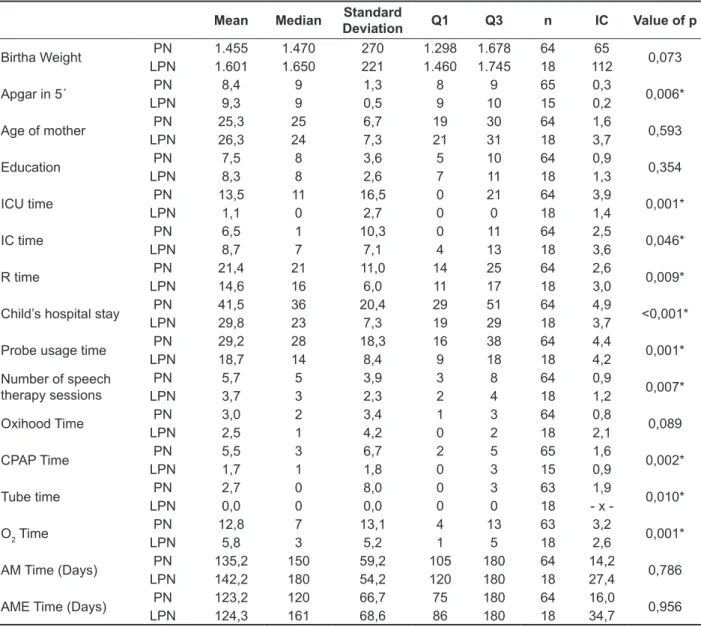
Table 1 – Comparison between Preterm infants and Preterm infants Late for quantitative variables
Mean Median Standard
Deviation Q1 Q3 n IC Value of p
Birtha Weight PN 1.455 1.470 270 1.298 1.678 64 65 0,073
LPN 1.601 1.650 221 1.460 1.745 18 112
Apgar in 5´ PN 8,4 9 1,3 8 9 65 0,3 0,006*
LPN 9,3 9 0,5 9 10 15 0,2
Age of mother PN 25,3 25 6,7 19 30 64 1,6 0,593
LPN 26,3 24 7,3 21 31 18 3,7
Education PN 7,5 8 3,6 5 10 64 0,9 0,354
LPN 8,3 8 2,6 7 11 18 1,3
ICU time PN 13,5 11 16,5 0 21 64 3,9 0,001*
LPN 1,1 0 2,7 0 0 18 1,4
IC time PN 6,5 1 10,3 0 11 64 2,5 0,046*
LPN 8,7 7 7,1 4 13 18 3,6
R time PN 21,4 21 11,0 14 25 64 2,6 0,009*
LPN 14,6 16 6,0 11 17 18 3,0
Child’s hospital stay PN 41,5 36 20,4 29 51 64 4,9 <0,001*
LPN 29,8 23 7,3 19 29 18 3,7
Probe usage time PN 29,2 28 18,3 16 38 64 4,4 0,001*
LPN 18,7 14 8,4 9 18 18 4,2
Number of speech
therapy sessions LPNPN 5,73,7 53 3,92,3 32 48 6418 1,20,9 0,007*
Oxihood Time PN 3,0 2 3,4 1 3 64 0,8 0,089
LPN 2,5 1 4,2 0 2 18 2,1
CPAP Time PN 5,5 3 6,7 2 5 65 1,6 0,002*
LPN 1,7 1 1,8 0 3 15 0,9
Tube time PN 2,7 0 8,0 0 3 63 1,9 0,010*
LPN 0,0 0 0,0 0 0 18 x
-O2 Time
PN 12,8 7 13,1 4 13 63 3,2
0,001*
LPN 5,8 3 5,2 1 5 18 2,6
AM Time (Days) PN 135,2 150 59,2 105 180 64 14,2 0,786
LPN 142,2 180 54,2 120 180 18 27,4
AME Time (Days) PN 123,2 120 66,7 75 180 64 16,0 0,956
LPN 124,3 161 68,6 86 180 18 34,7
Key: PN: preterm newborn.; LPN: late preterm newborns; ICU: Intensive Care Unit; IC: intermediate care; R: Rooming; breastfeeding: Breastfeeding; exclusive breastfeeding: Exclusive breastfeeding. * Signiicant Values (p<0,05) –Mann-Whitney Test
and 50% of mothers did not exclusively breastfeed
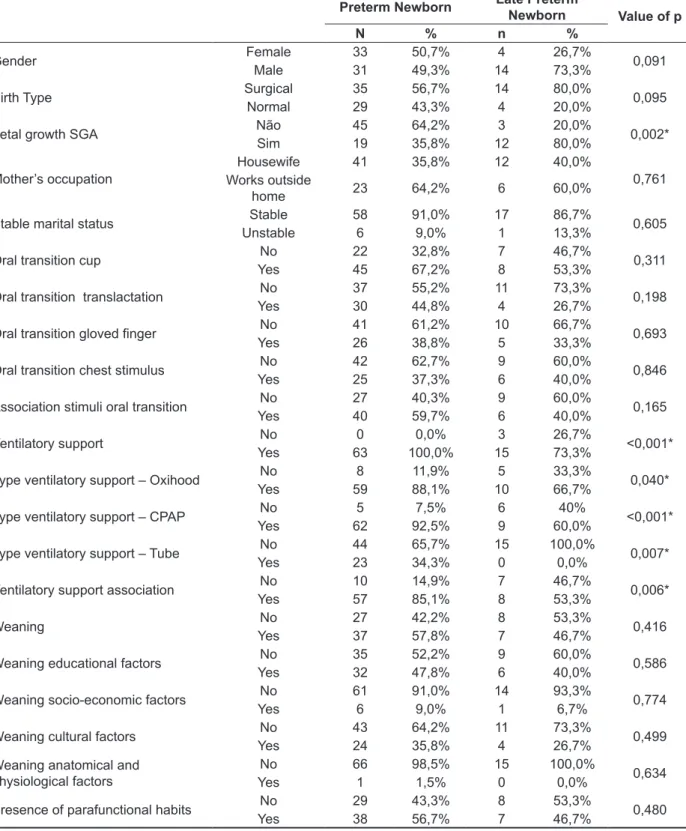
Table 2 – Comparison between Preterm infants and Preterm infants Late for qualitative variables
Preterm Newborn Late Preterm
Newborn Value of p
N % n %
Gender FemaleMale 33 50,7% 4 26,7% 0,091
31 49,3% 14 73,3%
Birth Type Surgical 35 56,7% 14 80,0% 0,095
Normal 29 43,3% 4 20,0%
Fetal growth SGA Não 45 64,2% 3 20,0% 0,002*
Sim 19 35,8% 12 80,0%
Mother’s occupation Works outside Housewife 41 35,8% 12 40,0% 0,761
home 23 64,2% 6 60,0%
Stable marital status Stable 58 91,0% 17 86,7% 0,605
Unstable 6 9,0% 1 13,3%
Oral transition cup No 22 32,8% 7 46,7% 0,311
Yes 45 67,2% 8 53,3%
Oral transition translactation No 37 55,2% 11 73,3% 0,198
Yes 30 44,8% 4 26,7%
Oral transition gloved inger No 41 61,2% 10 66,7% 0,693
Yes 26 38,8% 5 33,3%
Oral transition chest stimulus No 42 62,7% 9 60,0% 0,846
Yes 25 37,3% 6 40,0%
Association stimuli oral transition No 27 40,3% 9 60,0% 0,165
Yes 40 59,7% 6 40,0%
Ventilatory support No 0 0,0% 3 26,7% <0,001*
Yes 63 100,0% 15 73,3%
Type ventilatory support – Oxihood No 8 11,9% 5 33,3% 0,040*
Yes 59 88,1% 10 66,7%
Type ventilatory support – CPAP No 5 7,5% 6 40% <0,001*
Yes 62 92,5% 9 60,0%
Type ventilatory support – Tube No 44 65,7% 15 100,0% 0,007*
Yes 23 34,3% 0 0,0%
Ventilatory support association No 10 14,9% 7 46,7% 0,006*
Yes 57 85,1% 8 53,3%
Weaning No 27 42,2% 8 53,3% 0,416
Yes 37 57,8% 7 46,7%
Weaning educational factors No 35 52,2% 9 60,0% 0,586
Yes 32 47,8% 6 40,0%
Weaning socio-economic factors No 61 91,0% 14 93,3% 0,774
Yes 6 9,0% 1 6,7%
Weaning cultural factors No 43 64,2% 11 73,3% 0,499
Yes 24 35,8% 4 26,7%
Weaning anatomical and
physiological factors YesNo 661 98,5%1,5% 150 100,0%0,0% 0,634
Presence of parafunctional habits No 29 43,3% 8 53,3% 0,480
Yes 38 56,7% 7 46,7%
Table 3 – Duration of breastfeeding and exclusive breastfeeding of groups
Time PN LPN Total
Breastfeeding 180 days and more 47 (73,4%) 17 (94,4%) 64 (78%)
> 180 days 17 (26,6%) 1 (5,6%) 18 (22%)
Exclusive breastfeeding 180 days and more 31 (48,4%) 10 (55,6%) 41 (50%)
> 180 days 33 (51,6) 8 (44,4%) 41 (50%)
Key: Pn: preterm newborn.; LPN: late preterm newborn
Causas do desmame precoce
47,8%
40,0%
35,8%
26,7%
0% 10% 20% 30% 40% 50% 60%
Prematuros Prematuros
tardios
Causas Desmame Fatores
Educacionais
Desmame Fatores Culturais
Figure 1. Causes of early weaning among the groups Premature Late premature
Causes of early weaning
Causes of weaning Educational Factors
Weaning Cultural Factors
Consequências do desmame precoce
56,7%
46,7%
0% 10% 20% 30% 40% 50% 60%
Prematuros Prematuros tardios
Hábitos parafuncionais
Figure 2. Consequences of early weaning among groups Premature Late premature
Consequences of early weaning
Children who were on mechanical ventilation for a long period present a delay in the development of the swallowing function18. As in the aforementioned
studies, in the present study the preterm infants with gestational age less than 33.6 weeks made use of oxygen for a longer period, since the lower the gesta
-tional age, less development and maturation of the baby and more susceptible to neonatal morbidities compared to preterm infants with gestational age.
When comparing the PN groups with late PN, we observed that the variables of birth weight, age and maternal education, probe usage time, duration of breastfeeding and exclusive breastfeeding were not statistically signiicant.
Despite the diiculties encountered by preterm infants of lower gestational age, in the present study 73.4% of preterm infants up to 33.6 weeks and 94.4% of late preterm infants were breastfed up to six months or more. In another study the breastfeeding occurred until the irst 30 days of life in 98.1% of cases and in the sixth month there was
a drop to 70.1%19. Research had with inding the
median breastfeeding of 199.8 days, where in the irst month 90.4% of the children were breastfed, in the fourth month 64.7% and in the sixth month
54.4%20. This is due to a multidisciplinary team
specializing in Kangaroo Mother Method that held the appropriate assistance to the mother-baby and their family.
In terms of exclusive breastfeeding, the premature group to 33.6 weeks the mean value was 123.2 days and late preterm 124.3 days. Still, 42.2% of premature infants with gestational age were exclusively breastfed against 55.5% of late preterm. The time of exclusive breastfeeding of infants up to one month old was of 64.8% and of six months old this igure fell to 9.6%. For breastfeeding, the preva
-lence in the irst month was of 98.1% and for the sixth month of 70.1% 19. Exclusive breastfeeding rates were found in the irst month of 62.1% and in the sixth month of 17.7%21. The rates of breastfeeding
in preterm infants are still below the recommended by the WHO in all reported studies.
Comparing the groups for qualitative variables (Table 2), it was found that there was a greater number of children who are small for gestational age (SGA) in the group of late PN (80 %), with statistical signiicance between the groups. The SGA infants have a higher risk of neonatal death than those who did not show signs of intrauterine growth delay22. Late premature with fetal growth
restriction showed a greater time of stay in the ICU and neonatal complications than appropriate for gestational age (AGA)17. It is believed that this
diference should be occurring because of dichoto
-mized variables that present 67% eiciency, with a
DISCUSSION
In the present study 86.6% of the newborns presented Apgar scores between 8-10 in the 5th
minute of life, 12.2% between 7- 4 and 1.2% with Apgar of three or less. Study found an Apgar score between 9/10 in 72% of cases in the 5th minute of life 13. In another study, the Apgar score of eight
or more was found in 87% of NBs8. The data was
similar in both studies perhaps because it was the same population, preterm infants.
In the present study the average hospitalization of preterm infants was 38.2 days, ranging from 13 to 122 days. By distributing preterm in groups, those who had gestational age up to 33.6 weeks showed an average hospital stay of 41.4 days and the ones above 34 weeks, of 24.3 days. Research has found that 67% of NBs remained hospitalized for 30 days
or less14. The results of both surveys are similar, but
in the irst, time of hospitalization was slightly higher since it is referral maternity care to pregnant women
at risk.
In the current study, the length of stay of preterms and late preterm infants in the ICU was of 13.5 and 1.1, respectively. Study subdivided premature into groups according to weight and gestational age, and it was observed the time of ICU stay of 28 days for preterm infants with GA of less than 30 weeks, 13.3 for premature between 30 and 33.6 weeks and 9.8 days for preterm of 34 weeks or more. But the length of hospital stay was equal to 36.6, 25 and 24.3 days, respectively15. No studies were found
that recount the time of hospitalization for preterm infants in neonatal intensive care unit and interme
-diate care. The diference found in both studies may be due to the fact that in the irst study, it was not taken into account the birth weight.
The average number of speech therapy sessions for preterm was equal to 5.1. Premature up to 33.6 weeks showed an average of speech therapy sessions greater than the late preterm, 5.7 and 3.7, respectively, with statistical signiicance between the groups. In a case study with two preterm twins, were performed 10 sessions of speech therapy16.
The diference between the studies is due to the characteristics of the sample or even because it is a sample of 82 babies in comparison with a case study with 2 twins.
was also the main consequence of early weaning. Authors observed a signiicant correlation between weaning and the use of paciier and bottle19,24,25.
Breastfed children up to one month of age who used a paciier, had a 2.8 times greater chance of being weaned by the sixth month19. Paciier sucking habits,
bottle feeding may have contributed to premature weaning and possible changes in the evolution of oral sensorimotor system6.
Also in this study, the deleterious oral habits were presented as the main efect of early weaning. Perhaps the harmful oral habits that mix as cause and consequence of early weaning since in our country the culture of paciier and bottle usage is very deeply rooted in our families, as well as the premature weaning leads to not preparing the speech organs and as a result, the need for baby’s sucking is not satisied, thus the use of an artiicial suction nozzle becomes necessary, even if bringing future damage because they are not the most appropriate way of stimulation for them.
CONCLUSION
The present research has shown that there are signiicant diferences between preterm and late preterm, where the last show fewer complications, fewer speech therapy sessions, shorter hospital stay, moreover, the preterm of up to 33.6 weeks require a longer hospital support as use probe and ventilatory support, and although not statisti
-cally signiicant, they had shorter breastfeeding and exclusive breastfeeding, as well as increased presence of parafunctional habits, when compared to preterm late, becoming indispensable a diferent look between the two groups of preterm infants. great loss of susceptibility of the study, which may
lead to spurious indings in the statistical analysis. With regard to the variable type of ventilatory support there was statistical diference among the groups for all types surveyed. Late preterm have not made use of endotracheal tube, while 34.3% of preterm infants under the age of 33.6 weeks needed to be intubated. No studies were found that difered the types of respiratory support in preterm infants, becoming necessary additional studies to clarify the efect of each of these perinatal brackets in the development of the respiratory system of the
preterm.
The other variables: gender, birth type, occupation and maternal marital status, dietary transition, causes and consequences of weaning showed not statistically relevant in the current research.
In the present study 58.2% of preterm and 46.7% of late preterm infants were weaned early (Table 3).
In the present study the causes of early weaning (Table 1) were caused by educational and cultural factors for both groups, the socioeconomic and anatomical and physiological factors were not reported by the mothers of preterm infants as a cause of weaning in the present study. In the same study when comparing the two groups, the preterm infants showed a higher percentage of early weaning than the late preterm for both factors. Study points out the educational causes of early weaning, being poor handling the most prominent22. Study shows
that 17.8% of the mothers responded as cause of weaning the weak milk and 14.7% that the milk
dried up 23.
9. Lima GMS. Métodos especiais de alimentação: copinho – relactação – translactação. In: Rego JD. 2a ed. São Paulo: Atheneu, 2006. P. 319-28. 10. Giugliani ERJ. Amamentação exclusiva. In: Carvalho, MR; Tamez RN. Amamentação bases cientíicas para a prática proissional. Rio de Janeiro: Guanabara Koogan, 2002. P. 11-24. 11. Tasca SMT; Almeida EOC; Servilha EAM. Recém nascido em alojamento conjunto: visão multidisciplinar. São Paulo: Pró-Fono, 2002, 104p. 12. Nascimento MBR, Issler H. Aleitamento Materno em prematuros: manejo clínico hospitalar. Jornal de
Pediatria. 2004;80(5 Supl):163-72.
13. Oliver KA. Prematuridade como fator de risco no desenvolvimento motor e cognitivo avaliados com 1 e
2 anos de idade. [Tese]. Curitiba (PR): Universidade
Federal do Paraná; 2010. http://dspace.c3sl.ufpr. br/dspace/bitstream/handle/1884/24000/katia_ maio_2010.pdf?sequence=1.
14. Castro AG, Lima MC, Aquino RR, Eickmann SH. Desenvolvimento do sistema sensório motor oral e motor global em lactentes pré-termo. Pró-Fono R
Atual Cient. 2007;19(1):29-38.
15. Rodrigues MAG, Cano MAT. Estudo do ganho de peso e duração da internação do recém-nascido pré-termo de baixo peso com a utilização do método canguru. Revista Eletrônica de Enfermagem, [S.l.], 2009; 8 (2). ISSN 1518-1944. Disponível em: <http://www.revistas.ufg.br/index.php/fen/article/ view/7032/4984>. Acesso em: 01 Nov. 2014.
doi:10.5216/ree.v8i2.7032.
16. Calado DFB, Souza R. Intervenção fonoaudiológica em recém-nascido pré-termo:
REFERENCES
1. McCain CG. An evidence-based guideline for introducing oral feeding to healthy preterm infants.
Neonatal Netw. 2003;22(5):45-50.
2. Méio MDBB, Lopes CS, Morsch DS, Monteiro APG, Rocha SB, Borges RA et. al. Desenvolvimento cognitivo de crianças prematuras de muito baixo peso na idade pré-escolar. J. Pediatr.2004;80(6):495-502. 3. Gewolb IH, Vice FL, Schwietzer-Kenney EL, Taciak VL, Bosma JF. Developmental patterns of rhythmic suck and swallow in preterm infants. Dev Med Child Neurol. 2001;43(1):22-7.
4. Engle WA. Recommendation for the Deinition of “Late Preterm” (Near-Term) and the Birth Weight– Gestational Age Classiication System. Seminars in Perinatology. 2006;30(1):2-7.
5. Gilbert C. Retinopathy of prematurity: a global perspective of the epidemics, population of babies at risk and implications for control. Early Hum Dev.
2008;84(2):77-82.
6. Neiva FCB, Cattoni DM, Ramos JLA, Issler H. Desmame precoce: implicações para
o desenvolvimento motor-oral. J Pediatr. 2003;79(1):7-12.
7. Coutinho SB, Figueredo CSM. Aleitamento materno em situações especiais da criança. In:
Rego JD. Aleitamento materno, 2a ed. São Paulo:
Atheneu, 2006. P. 243-59.
8. Gianini NOM. Leite materno e prematuridade. In:
Rego JD. Aleitamento materno. 2a ed. São Paulo:
Atheneu, 2006. P. 261-83. RESUMO
Objetivo: veriicar se há diferenças entre recém nascidos prematuros e prematuros tardios no que se refere ao tempo de aleitamento materno e aleitamento materno exclusivo causas e consequências do desmame precoce. Ademais, foi observado o uso de oxigenoterapia e sonda para alimentação, número de sessões de fonoterapia e o tempo de internação. Métodos: pesquisa de campo, de cará
-ter exploratório e longitudinal. Participaram do estudo 82 mães de prematuros. Os dados categóri
-cos foram resumidos através de frequência absoluta e relativa ao total de pacientes em cada grupo estudado. Dados numéricos foram resumidos em média, mediana, desvio padrão, valor mínimo e valor máximo. Os dados quantitativos foram comparados com o teste não paramétrico de Mann-Whitney e as variáveis qualitativas foram comparadas com o teste de igualdade de duas proporções. Resultados: houve signiicância estatística entre recém-nascidos prematuros e recém-nascidos pre
-maturos tardios para as variáveis Apgar, tempo de internação, tempo de uso da sonda, número de sessões de fonoterapia, tempo de oxigenoterapia e tipo de ventilação mecânica. Conclusão: a
pre-sente pesquisa mostrou que os prematuros tardios apresentaram menor tempo de uso de sonda e oxigenoterapia, menor número de sessões de fonoterapia e menor tempo de internação hospitalar, fazendo-se imprescindível um olhar diferenciado entre os dois grupos de prematuros.
22. Santiago LB, Betiol F, Barbieri MA, Gutierrez MRP, Del Ciampo LA. Incentivo ao aleitamento materno: a importância da pediatria com treinamento especíico. J Pediatr. 2003;72(6):504-12.
23. Escobar AMU, Ogawa AR, Hiratsuka M, Kawashita MY, Teruya PY, Grisi S et. al. Aleitamento materno e condições socioeconômico-culturais: fatores que levam ao desmame precoce. Rev. Bras. Matern. Infant. 2002;2(3):253-61.
24. Wood NS, Costeloe K, Gibson AT, Hennessy EM, Marlow N, Wilkinson AR, for the EPICure Study Group. The EPICure study: associations and antecedents of neurological and developmental disability at 30 months of age following extremely preterm birth. Arch Dis Child Fetal Neonatal Ed.
2005;90:F134-F40.
25. Soares MEM, Giugliani ERJ, Braun ML, Salgado ACN, Oliveira AP, Aguiar PR. Uso de chupeta e sua relação com o desmame precoce em população de crianças nascidas em Hospital Amigo da Criança. J.
Pediatr. 2003;79(4):309-16.
estimulação oromotora e sucção não-nutritiva. Rev
CEFAC. 2012;14(1):176-81.
17. Penalva O, Schwartzman JS. Estudo descritivo do peril clínico-nutricional e do seguimento ambulatorial de recém-nascidos prematuros atendidos no Programa Método Mãe-Canguru. J
Pediatr. 2006;82(1):33-9.
18. Kunigk MRG, Chehter E. Disfagia orofaríngea em pacientes submetidos à entubação orotraqueal. Rev Soc Bras Fonoaudiol. [online]. 2007 [Acesso em 2014 nov 01]; 12(4) [4p]. Disponível em: http:// www.scielo.br/pdf/rsbf/v12n4/v12n4a06
19. Lima TM, Osório MM. Peril e fatores associados ao aleitamento materno em crianças menores de 25
meses na Região Nordeste do Brasil. Rev. Saúde
Matern. Infant. 2003;3(3):303-14.
20. Vieira GO, Almeida JAGA, Silva LR, Cabral VA, Netto PVS. Fatores associados ao aleitamento materno e desmame em Feira de Santana, Bahia. Rev. Bras. Saúde Matern. Infant. 2004;4(2):143-50. 21. Almeida MF, Mello Jorge MHP. Pequenos para a idade gestacional: fator de risco para mortalidade neonatal. Rev Saúde Pública. 1998;32(3):217-24.
Received on: October 27, 2014 Accepted on: March 01, 2015
Mailing address:
Waléria Ferreira da Silva
Rua Amazonas, no 22, Bl “A”, apto 303 – Feitosa Maceió – AL – Brasil
CEP: 57043-450