Revista Gaúcha
de Enfermagem
DOI: http://dx.doi.org/10.1590/1983-1447.2015.esp.56705
Promoting health in vulnerable communities:
social technologies for poverty reduction
and sustainable development
Promovendo saúde em comunidades vulneráveis: tecnologias sociais na redução da pobreza e desenvolvimento sustentável
Promocionando salud en comunidades vulnerables: tecnologías sociales en la reducción de la pobreza y el desarrollo sostenible
a Universidade Federal da Bahia (UFBA), Escola de Enfermagem. Salvador, Bahia, Brasil.
b Faculdade Adventista da Bahia. Salvador, Bahia, Brasil.
c Secretaria Municipal de Saúde de Salvador. Salva-dor, Bahia, Brasil.
d Faculdade São Salvador. Salvador, Bahia, Brasil.
Elenilda Farias de Oliveiraa,b,c
Viviane Silva de Jesusa,b
Samylla Maira Costa Siqueiraa,d
Thais de Andrade Alvesa
Ivana Mota dos Santosa
Climene Laura de Camargoa
ABSTRACT
Objective: To report the experience of implementing social technologies in vulnerable communities to foster individual and commu-nity potential for health promotion, poverty reduction and sustainable development.
Method: The experience reports were collected from July 2010 to June 2015 with 200 individuals residing in vulnerable communi-ties, in Bahia, Brazil. The experiences were reported in stages: 1) Awareness and diagnostics; 2) Workshops on different subjects; 3) Deployment of social technologies.
Results: The participants were notified of the importance of sustainable development and the environmental and health conditions were diagnosed. Actions for sustainable development were planned, with the implementation of acoustic artefacts (natural fibres) and experimental kitchens (homemade sweets).
Conclusions: Considering that health comprises actions that promote the quality of life, the use of social technologies favoured health promotion because they stimulated the potential of the participants. It also allowed the diversification of the community’s income source and sustainable development, which reduces poverty and fosters sustainability, quality of life and health promotion.
Keywords: Millennium Development Goals. Science, technology and society. Low cost technology. Equity in health.
RESUMO
Objetivo: Relato de experiência sobre a implantação de tecnologias sociais em comunidades vulneráveis, objetivando promover potencialidades individuais e comunitárias por meio da promoção da saúde, da redução da pobreza e do desenvolvimento sustentável.
Método: Relato de experiência sobre o trabalho desenvolvido (julho/2013 e junho/2015) com 200 pessoas de comunidades vulne-ráveis na Bahia. Ações em três etapas: 1) Sensibilização e diagnósticos; 2) Oficinas diversas; 3) Implantação de Tecnologias Sociais.
Resultados: Sensibilização dos participantes sobre a importância do desenvolvimento sustentável; diagnóstico de condições am-bientais e de saúde. Realização do planejamento de ações para o desenvolvimento sustentável, a implementação de oficinas de artefatos acústicos (fibras naturais) e de cozinhas (doces caseiros).
Conclusões: Considerando que a promoção da saúde engloba ações voltadas à qualidade de vida, a utilização de tecnologias sociais favo-receu a promoção da saúde, pois estimulou o potencial dos participantes. Ademais, permitiu a diversificação da fonte de renda e o desen-volvimento sustentável, criando meios para a redução da pobreza e promovendo sustentabilidade, qualidade de vida e promoção da saúde.
Palavras-chaves: Objetivos de Desenvolvimento do Milênio. Ciência, tecnologia e sociedade. Tecnologia de baixo custo. Equidade em saúde.
RESUMEN
Objetivo: Relatar la experiencia de la implantación de tecnologías sociales en comunidades vulnerables con el objetivo de promover potencialidades individuales y comunitarias, buscando la promoción de la salud, la reducción de la pobreza y el desarrollo sostenible.
Método: Relato de experiencia sobre un trabajo realizado en el período de Julio/2010 hasta Junio/2015 con 200 personas, habitantes de comunidades vulnerables, localizadas en Bahia. Las acciones fueron desarrolladas en tres etapas: 1) Sensibilización y diagnósticos; 2) Talleres sobre temas diversos; 3) Implantación de tecnologías sociales.
Resultados: Los participantes fueron sensibilizados sobre la importancia del desarrollo sostenible; fueron diagnosticadas las condiciones am-bientales de las comunidades, así como las de salud de sus residentes. Después del diagnóstico, se planificaron acciones para el desarrollo sos-tenible de las comunidades, siendo implementados talleres de artefactos acústicos (fibras naturales) y cocinas experimentales (dulces caseros).
Conclusiones: Teniendo en cuenta que la salud abarca todas las acciones volcadas a la calidad de vida, el uso de las tecnologías sociales ha favorecido la promoción de la salud, ya que estimula el potencial de los participantes. También permitió la diversificación de las fuentes de ingresos y el desarrollo sostenible, la creación de medios para reducir la pobreza y promover la sostenibilidad, la calidad de vida y la salud.
INTRODUCTION
Quilombola communities are groups of descendants of enslaved individuals that, in the process of resistance and struggle against slavery, led to the creation of social groups. To this day, these groups, which are also called terra do negro (land of the black) or território negro (black territo-ry), occupy a common ground and share cultural features(1).
The historical absence of investments for the devel-opment of these communities has severed them from the rest of society, especially in terms of public policies and social actions. Although governmental actions like the creation of the Secretaria de Políticas de Promoção da Igualdade Racial (Secretariat for the Promotion of Ra-cial Equality Policies) – SEPPIR – in 2003, and the Política Nacional de Saúde Integral das Populações do Campo e da Floresta (National Policy of the Integral Health of Popula-tions of the Field and Forest) in 2011, aimed to structure policies and guidelines that promote racial equality, in practice there are no strategies that ensure the effective-ness of these affirmative actions. As a result of the lack of investment in these communities, the non-use of their potential and natural available resources(2) increase their social, political and economic vulnerability.
It is estimated that in Brazil there are 214,000 quilombo-la families with about 1.17 million people, of which 78% are beneficiaries of the government Bolsa Familia (income dis-tribution) programme (PBF) and 75.6% are in a situation of extreme poverty(3). These socio-economic data reveal the social vulnerability of these communities and the need to move forward in the implementation of public policies and other tools that will contribute to the achievement of their rights, especially those relating to health and education, and reduce social inequities.
The Federal Constitution (Articles 196 to 200) estab-lishes that, “health is a right of all and a duty of the State, guaranteed by social and economic policies aimed at reducing the risk of disease and other aggravations and universal and equal access to the actions and services for its promotion, protection and recovery”(4). Further-more, the 8th National Health Conference establishes the conditions of food, education, income, environment, work, transport, employment, leisure, freedom, access and ownership of land, and access to health services(5). The professionals in this area, especially nurses, must and can contribute to the implementation of this ex-panded concept of health.
In 2000, the United Nations (UN) proposed the Mil-lennium Development Goals (MDGs) with the aim of reducing global social injustice by 2015; a commitment
signed by UN Member States and assumed by the signa-tory countries. The commitment is to eradicate extreme poverty and hunger, promote education and gender equality, reduce child mortality, improve maternal health, fight HIV/AIDS, malaria and other diseases, ensure envi-ronmental sustainability and establish a global partner-ship for development(6).
In the last 15 years, the MDGs represent an immense challenge for all countries, especially developing countries like Brazil, which in addition to its continental dimensions, is a nation of contrasts and significant social gaps. As an example of the reality of quilombola communities, we can mention the communities of the north-eastern region that have suffered significant marginalization and discrimina-tion from Brazilian society in general(3).
Actions to achieve the MDGs should be a priority for the quilombo communities and the achievement of these goals is favoured by the natural potential of these communities. This potential includes the use of nature for the development of strategies that facilitate the im-provement of the quality of life of these people and, particularly, of the first and seventh MDGs: to eradicate extreme poverty and hunger and guarantee environ-mental sustainability, respectively. The achievement of these goals is possible by using the material and hu-man potential of the communities, translated into social technology (ST ).
ST is defined as products, techniques or methodologies that can be applied several times and in different contexts and have been developed from the interaction between persons with technical and scientific knowledge on the subject and persons who have the popular knowledge (community), and represent effective solutions of social transformation(7) with the potential for generating employ-ment and income. ST can be an important instruemploy-ment for promoting the quality of life of these groups, especially when it is directly linked to the reality of local companies and responds to the concerns of the population.
In this sense, ST can be an important tool for promot-ing social and environmental development and the fight against poverty through the exploitation of local natural resources and recognition of the traditional knowledge. Whereas sustainability and social development are close-ly linked to health, it is essential that health professionals, especially nurses, are involved in achieving the millenni-um goals.
popular freedom(8) and the fact that one of the com-mitments of academia is to interconnect the scientific world with common knowledge, community education activities were considered a way of promoting quality of life and collective autonomy. As regards the produc-tive aspect, this study is based on the ideas of Dagnino(9), who defines social technology as an artefact or process resulting from the collective ownership of the productive means, so that the economic activities are self-managed, and the management and allocation of the results is par-ticipatory and democratic.
Consequently, the question we sought to answer was: How can the poverty of vulnerable communities be coun-tered by deploying social technologies? This article reports the experiences of the deployment of social technologies in vulnerable communities that aim to promote individu-al and community capabilities through heindividu-alth promotion, poverty reduction and sustainable development.
METHODOLOGY
This is an experience report(10) that describes the activ-ities carried out by nurses during the deployment of social technologies in vulnerable communities using a participa-tory methodology.
Activities that culminated in the drafting of this article relate to a multidisciplinary project entitled, “ Sustentabil-iade e Saúde:Desenvolvimento de comunidades Quilombo-las”, approved in public notice (FAPESB): 23/2013 by the school of nursing of the UFBA. This study was funded by government agencies, such as the Fundação de Amparo à Pesquisa do Estado da Bahia (FAPESB) and the Consel-ho Nacional de Desenvolvimento Científico e Tecnológico (CNPq), and has been conducted since 2013 to date.
This work observed the ethical criteria for conducting research, taking into account the requirements of resolu-tion 466/2012, and was submitted to the Ethics Committee through Plataforma Brasil. It was authorised by the partici-pating associations, Associação Beneficente Educacional e Cultural de Ilha de Maré (ABECIM) and the Associação dos Moradores de Moreré e Monte Alegre (AMAMOS), and has been reviewed semi-annually by the financiers and the participating members.
The participants were 200 individuals between the ages of 12 and 30, of both sexes, and residents of two qui-lombola communities (Praia Grande and Monte Alegre)
and an island (Moreré), located in the state of Bahia, Brazil, as described below:
Praia Grande: A quilombola community located on the island called Ilha de Maré, about eight nautical miles (14.8 km) from the capital of Bahia(11) and classified by the Palmares Cultural Foundation (FCP) as a reminiscent quilombo area since 25/5/2005(12). With a population of approximately 2500 inhabitants(13), most of which are Afro-descendants of low income, the community has a Basic Health Unit (BHU) and two first-grade schools. There is no basic sanitation, so the population coexists with an open sewer. The inhabitants of the island live off fishing, shellfishing, handicraft and subsistence ag-riculture. Artisanal fishing and shellfishing are the main sources of income of the women of the island, while the private crossing in canoes is the main source of income among the men(14).
Moreré: A community of the island of Boipeba with approximately 400 inhabitants, located 87 km from the capital of Bahia. The main economic activity is fishing and tourism. In an epidemiological diagnosise conducted in 2006, it was found that 5% of the residences have a septic tank, 43% do not have basic sanitation, and 100% do not have drinking waterf.
Monte Alegre: A quilombola community located in the centre of the island of Boipeba. The community has approximately 100 inhabitants and the main source of income is family farming. Most of the population (85%) has rammed-earth houses and no basic sanitation and or drinking waterg.
In Moreré and Monte Alegre, there is only one elementa-ry school and neither community has a basic health service.
The activities were carried out in three steps:
1) Awareness, diagnosis of health and environmen-tal conditions of the communities. This step consisted of home visits to approach the community, expeditions to identify the territory, health education workshops, and questionnaires to prepare the diagnoses. Mainly under-graduate and under-graduate students in nursing and nursing researchers participated in this stage.
2) Workshops to mobilize the community. The work-shops had a theoretical-practical approach and comprised the following themes: human relationship; sustainable de-velopment; entrepreneurship; health promotion; and spe-cific contents on production, handcrafted shutters, acous-tic devices (acousacous-tic plates and baffles), and homemade
e Performed by a child and adolescent study group, the Grupo de Estudos em Saúde da Criança e do Adolescente (Grupo Crescer/Escola de Enfermagem of the Universidade Federal da Bahia (EEUFBA). f The data presented here is part of the archive of the previously mentioned study group and has not been published in any other literature.
sweets and other products of the culinary arts. Professio-nals from the following partner institutions participated in this stage: Departamento de Engenharia Química da Uni-versidade Estadual de Maringá (UEM), Engenharia Civil do Instituto Federal da Bahia (IFBA), Faculdade de Arquitetura da Faculdade de Santo Agostinho – Montes Claros (FASA) and Universidade Metropolitana da Bahia (UNIME).
3) The last stage consisted of producing the materials referred to above, with the chemical and mechanical engi-neers of the Universidade Estadual de Maringá (UEM), who transferred their scientific technical knowledge of produc-tion of acoustic boards to the community members.
The technique of using oil palm and piassava fibres to manufacture handmade shutters and acoustic devices was developed by local artisans of Moreré and improved by the architects of the partner institutions. The technique for making homemade sweets was improved from the tech-niques of traditional bakeries of Praia Grande/Ilha de Maré and passed on to the other communities of the study. This exchange of knowledge between academia and quilombo communities helped to establish a dialogue between the professionals based on the pursuit of equitable relations.
The homemade sweets and handmade shutters are already being marketed. The acoustic boards are pending quality certification.
The analysis of the results is reflective and based on available literature, the educational concepts of Freire(8), the production line of the social technologies of Dagni-no(9), and the theory of symbolic interactionism, which is a social psychology perspective based on the congruence between individuals and society(15).
RESULTS
ST can be used to achieve the MDGs, while enabling so-cial interaction and the subsequent soso-cial transformation(7).
As a result of this study, we can point three axes of ST production:
1) Production of Sweets
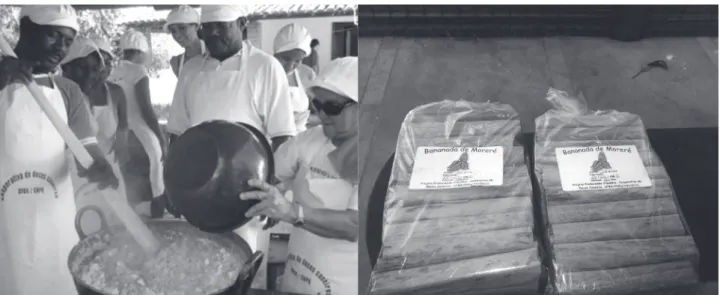
Experimental kitchens were constructed to produce banana sweet in Praia Grande/Ilha da Maré. The recipe is traditional among the women of the region, and it was improved with educational and technical activities. Simi-lar kitchens were later constructed in the communities of Moreré and Monte Alegre, where the technique of pro-ducing homemade sweets was also stimulated with the support of the local bakeries of Praia Grande (Figure 1). In this respect, one of the essential characteristics of ST is the involvement of actors in the process and the dissem-ination of traditional knowledge.
2) Handmade Shutters and Acoustic Artefacts
Abundant in the region of Moreré, piassava and oil palm fibres were already used to manufacture ecological shutters and other handicrafts (Figure 2). With the support of academia, the weaves used to produce these artefacts were enhanced and arranged in other formats, resulting in acoustic devices for sound absorption. These products have been marketed and helped increase the income of the community.
3) Production of Acoustic Boards
In Praia Grande/Ilha da Maré, there is a large amount of fibrous waste from cana-brava (Gynerium sagittatum) that the natives use to manufacture baskets. This waste was discarded incorrectly and polluted the environment. It was found that the waste generated in the community could be used to manufacture acoustic boards (technology of the Department of Engineering of the Universidade Esta-dual de Maringá). The factory for the production of these boards was built by the community (Figure 3).
For the implementation of this ST, academic knowledge was transferred to the community and vice versa, which
led to a learning experience in relation to the use of waste, environmental protection and industrial production.
DISCUSSION
ST is very important to promote health in communities that are considered socially, politically and economically vulnerable because it allows the articulation of individuals toward a common good. It also rescues, values and con-tributes to the perpetuation of traditional knowledge and the acquisition of new knowledge.
For ST to achieve one of its main goals, that is, sus-tainable development, there must be a confluence of
Figure 2 – Factory of shutters and place mats
several areas, namely education, health, public adminis-tration and, above all, the community itself, in the stag-es of planning, implementation and evaluation of the process(16).
In this study, ST was deployed to achieve the econom-ic, environmental and social sustainability(17) of the com-munities in question. Economic sustainability enables the generation of new revenues; environmental sustainability minimises the detrimental action of incorrectly discarded waste; and social sustainability engenders improvements in the living conditions of populations.
Thus, we believe that the role of nurses and other health professionals is to aggregate the knowledge of several areas in order to support vulnerable communities through the promotion of health, which is understood as a result of the conditions of food, education, income, environment, work, transport, employment, leisure, free-dom, access and ownership of land, and access to health services. Therefore, different areas of knowledge must be mainstreamed into the education and practices of profes-sionals of various fields.
Of all the social technologies that were created for this report, the acoustic boards factory is the most audacious project because it was a challenge for the professionals and for the members of the community. This production required new knowledge among the native participants, the acquisition of machinery, the adaptation of local in-frastructure where the factory was built, the adaptation of the building design, and intensive training for handling the equipment and understanding the steps involved in the production of an innovative technology.
The use of solutions with alternative materials, such as vegetable fibres, is an excellent option because these material come from renewable sources. The project is less costly because the raw material is abundant in the com-munity and does not need to be acquired. In this way, ST contributes to environmental preservation and provides a new source of income for the community, which reduces poverty(18) and, subsequently, falls within the scope of the first and seventh MDG.
The main result of this experiment is the production of competitive items with specific features that are man-ufactured from sustainable actions used by vulnerable populations. This reveals the need to adopt similar strate-gies to promote health promotion based on sustainable development(16, 19 -20).
This project allowed the members of the community to perceive themselves as citizens who are capable of gen-erating their own income, of protecting the environment, and of recognizing and using their human and natural
potential. This recognition is of paramount importance for the empowerment of these individuals, and allows them to consider other perspectives, such as the marketing of native fruit pulp, which is already occurring in Moreré. In summary, it reveals the potential and creativity of these in-dividuals and shows them that these qualities are import-ant for the development of ST.
CONCLUSION
The implementation of ST reported in the communi-ties in question led to positive technological, social and economic results. These results include the production of innovative items with the use of natural fibres, the deployment of a participatory methodology, and the promotion of sustainability, environmental conservation and income generation, all of which helped reduce ex-treme poverty and promote sustainability in the studied communities.
The deployment of these technologies led to pos-itive and visible changes in the life of the community, both for the people who are directly involved and for those who will benefit indirectly from these technolo-gies. The actions favoured creative thought, the exercise of citizenship and of democratic processes, a dialogue between different areas of knowledge (academic and popular) and, above all, collective solutions that help im-prove the living and health conditions of the quilombo-las and the islanders.
The teaching and research activities carried out in this experience, with multidisciplinary, interinstitutional and cross-cultural characteristics, were essential to train profes-sionals who are committed to diversity and to the pursuit of fairness and equality.
The limitation of this experience was the difficulty in objectively evaluating any improvements regarding the quality of life of the population since these improvements can only be measured in the long term. However, we did observe various degrees of economic and social develop-ment among the people of this community who directly participated in the experience.
It is important to note that the ST deployed in commu-nities can be replicated with other vulnerable commucommu-nities.
REFERENCES
1. Schmitt A, Turatti MCM, Carvalho MCP. A atualização do conceito de quilombo: identidade e território nas definições teóricas. Ambient Soc. 2002;(10):1-10. 2. Silva MJG, Lima FSS, Hamann EM. Uso dos serviços públicos de saúde para DST/
3. Ministério da Saúde (BR), Secretaria de Gestão Estratégica e Participativa. Se-cretaria Especial de Políticas de Promoção da Igualdade Racial. Programa Brasil Quilombola: diagnóstico de ações realizadas. Brasília (DF): Ministério da Saúde; 2012 [cited 2013 mar 12]. Available at: http://www.seppir.gov.br/portal-anti-go/destaques/diagnostico-pbq-agosto/view.
4. Constituição da República Federativa do Brasil de 1988 [Internet]. Artigos 196 a 200. Brasília; 1988 [cited 2015 nov 1]. Available at: http://www.planalto.gov. br/ccivil_03/constituicao/ConstituicaoCompilado.htm
5. Relatório da 8ª Conferência Nacional de Saúde; 1986 mar 17-21; Brasília (DF), Brasil [Internet]. Brasília: Ministério da Saúde; 1986 [cited 2015 nov 1]. Availa-ble at: http://conselho.saude.gov.br/biblioteca/relatorios/relatorio_8.pdf. 6. Whestpal MF, Zioni F, Almeida MF, Nascimento PR. Monitoring Millennium
De-velopment Goals in Brazilian municipalities: challenges to be met in facing up to iniquities. Cad Saúde Pública. 2011;27(2):s155-63.
7. Passoni I, coordenadora. Tecnologia social [Internet]. São Paulo: Instituto de Tec-nologia Social; 2007 [cited 2015 may 5]. Available at: http://www.itsbrasil.org. br/sites/itsbrasil.w20.com.br/files/Digite_o_texto/Caderno_Serie_Conheci-mento_e_Cidadania_-_Tecnologia_social_-_1.pdf.
8. Freire P. Educação como prática de liberdade. Rio Janeiro: Paz e Terra; 1967. 9. Dagnino RP, organizador. Economia solidária e tecnologia social: construindo
pontes. Campinas: Gapi/Unicamp; 2012. Documento de Trabalho do Curso Ges-tão Estratégica em Tecnologia Social.
10. Cavalcante BLL, Lima UTS. Relato de experiência de uma estudante de enferma-gem em um consultório especializado em tratamento de feridas. J Nurs Health. 2012;1(2):94-103.
11. Rodrigues M. Breves considerações sobre candomblé na Ilha de Maré – Salva-dor: entre fios de memória. C@lea: Cadernos de Aula do LEA. 2012;1(1):61-72.
12. Fundação Cultural Palmares [Internet]. Brasília (DF): FCM; c2015 [atual. 2015; cited 2015 sept 15]. Comunidades quilombolas. Available at: http://www.palmares. gov.br/?page_id=88&estado=BA#
13. Machado MSM, Almeida RO. Fontes e poços de água da Ilha de Maré, Salvador--BA: aspectos históricos, geográficos, socioculturais e físico-químicos. Candombá. 2008;4(2):111-45.
14. Almeida RO, Neves EL, organizadores. Caderno ambiental Ilha de Maré. Salva-dor: Centro Universitário Jorge Amado; 2011.
15. Carvalho LS, Silva CA, Santos ACPO, Camargo CL. O interacionismo simbólico como fundamentação para pesquisas de enfermagem pediátrica. Rev Enferm UERJ. 2007;15(1);119-24.
16. Lobo MAA, Lima DMB, Souza CMN, Nascimento WA, Araújo LCC, Santos NB. Avaliação econômica de tecnologias sociais aplicadas à promoção de saúde: abastecimento de água por sistema Sodis em comunidades ribeirinhas da Ama-zônia. Ciênc Saúde Colet. 2013;18(7):2119-27.
17. Rodrigues I, Barbieri JC. A emergência da tecnologia social: revisitando o movi-mento da tecnologia apropriada como estratégia de desenvolvimovi-mento sustentá-vel. Rev Adm Pública. 2008;42(6):1069-94.
18. Martins LA, Siqueira SMC, Oliveira EF, Freitas DA, Tavares CRG, Camargo CL. Promovendo a sustentabilidade em comunidades quilombolas e ribeirinhas. Adolesc Saúde. 2015;12(Supl 1):60-4.
19. Gallo E, Setti AFF, Magalhães DP, Machado JMH, Buss DF, Netto FAF, et al. Saúde e economia verde: desafios para o desenvolvimento sustentável e erradicação da pobreza. Ciênc Saúde Colet. 2012;17(6):1457-68.
20. Novaes H, Dias R. Contribuições ao marco analítico conceitual da TS. In: Dagnino R, organizador. Tecnologia Social: ferramenta para construir outra sociedade. Campinas: IG/UNICAMP; 2009. p.17-53.
Author’s address:
Elenilda Farias de Oliveira
Rua Carinhanha, 49/206, Jardim Brasília Pernambués 41130-135 Salvador – BA
Email: [email protected]