Translation and cultural adaptation of
the Brazilian Portuguese version of the
Behavioral Pain Scale
INTRODUCTION
Pain during hospitalization frequently occurs and is related to the severity of disease and necessary treatment procedures, which are often invasive and aggressive, especially in intensive care units (ICU).(1) Communication of the pain experience to health professionals is critical to understanding pain symptoms, implementing analgesic regimens, and evaluating therapeutic eicacy. herefore, pain assessment tools that utilize a universal language about the painful experience are urgently needed.(2)
he most widely used instruments for assessing pain in adults are based on self-reporting, which is diicult to evaluate in patients who have cognitive deicits or who require mechanical ventilation.(3-5) A common problem in ICU is the large number of critically ill patients who are unconscious and under
Márcia Carla Morete1, Sarah Camargo Mofatto2, Camila Alves Pereira3, Ana Paula Silva4, Maria Tereza Odierna5
1. Coordination of the Specialization Program in Pain, Education and Research Institute, Hospital Israelita Albert Einstein - São Paulo (SP), Brazil. 2. Hospital Santa Casa de Misericórdia de Limeira - Limeira (SP), Brazil.
3. Office of Health Economics, Hospital Israelita Albert Einstein - São Paulo (SP), Brazil. 4. Centro Integrado de Tratamento de Dor - São Paulo (SP), Brazil.
5. Intensive Care Unit, Hospital Israelita Albert Einstein - São Paulo (SP), Brazil.
Objective: he objective of this study was to translate and culturally adapt the Behavioral Pain Scale to Brazilian Portuguese and to evaluate the psychometric properties of this scale.
Method: his study was conducted in two phases: the Behavioral Pain Scale was translated and culturally adapted to Brazilian Portuguese and the psychometric properties of this scale were subsequently assessed (reliability and clinical utility). he study sample consisted of 100 patients who were older than 18 years of age, admitted to an intensive care unit, intubated, mechanically ventilated, and subjected or not to sedation and analgesia from July 2012 to December 2012. Pediatric and non-intubated patients were excluded. he study was conducted at a large private hospital that was situated in the city of São Paulo (SP).
Conflicts of interest: None.
Submitted in January 30, 2014 Accepted in October 9, 2014
Corresponding author: Márcia Carla Morete
Avenida Francisco Morato, 4.294 Zip code: 05521-200 - São Paulo (SP), Brazil E-mail: [email protected]
Responsible editor: Jorge Ibrain Figueira Salluh
Tradução e adaptação cultural da versão portuguesa (Brasil)
da escala de dor Behavioural Pain Scale
ABSTRACT
Keywords: Pain measurement;
Respiration, artiicial; Translating; Intensive care units
Results: Regarding reproducibility, the results revealed that the observed agreement between the two evaluators was 92.08% for the pain descriptor “adaptation to mechanical ventilation”, 88.1% for “upper limbs”, and 90.1% for “facial expression”. he kappa coeicient of agreement for “adaptation to mechanical ventilation” assumed a value of 0.740. Good agreement was observed between the evaluators with an intraclass correlation coeicient of 0.807 (95% conidence interval: 0.727-0.866).
Conclusion: he Behavioral
Pain Scale was easy to administer and reproduce. Additionally, this scale had adequate internal consistency. he Behavioral Pain Scale was satisfactorily adapted to Brazilian Portuguese for the assessment of pain in critically ill patients.
mechanical ventilation. hese patients are unable to verbally express their pain in an efective way because of the underlying disease or the use of sedatives with or without neuromuscular blockade.(6) Several scales have been developed to assess pain in adult patients who are under mechanical ventilation in the ICU, including the Behavioral Pain Scale (BPS)(7)and the Critical-Care Pain Observation Tool(CPOT);(8) however, further studies are needed to evaluate the psychometric properties of these scales. A previous review recommended the use of the BPS and the CPOT when these scales were compared with the Behavioral Pain Rating Scale (BPRS), the Pain Assessment and Intervention Notation Algorithm, the Nonverbal Pain Scale (NVPS), and the Pain Behavior Assessment Tool.(9) In another analysis of the BPS, the CPOT, and the NVPS scales, the BPS was recommended because this scale was tested in a larger group of patients and had good validity and reliability in three studies.(10)
Among the scales that have been developed to assess pain in ICU patients under mechanical ventilation, the BPS has garnered consensus for use in clinical practice.(11) he BPS was one of the irst to be used for the measurement of pain in patients who were unable to verbally communicate, and the BPS is currently one of the most studied pain assessment scales.(10,12)
he BPS is used to assess pain in sedated and unconscious patients under mechanical ventilation. his scale consists of the following three aspects: facial expression, body movements, and tolerance to mechanical ventilation. he intensity of pain is scored on a scale of 3 (no pain) to 12 (highest pain intensity).(12) Each indicator is categorized into four descriptions of behavior that range from no pain (a score of 1) to a maximum amount of pain (a score of 4). he total score ranges from 3 (no pain) to 12 (maximum pain).(10) he BPS can be completed in approximately 2-5 minutes.(12,13)
his study aimed to translate and culturally adapt the BPS to Brazilian Portuguese and to evaluate the psychometric properties of this scale (reliability, inter-evaluator agreement, and clinical utility).
METHODS
his study was performed in two phases: the translation and cultural adaptation of the Portuguese version of the BPS scale for Brazil (Phase I) and the study of the psychometric properties of this scale (reliability and clinical utility) (Phase II). his study was conducted on 100 patients in the ICU who were intubated, mechanically ventilated,
and sedated. he inclusion criteria were adult patients on mechanical ventilation with and without sedation and analgesia. No exclusion criteria were used in this study.
his study was conducted in an ICU at a large private hospital in São Paulo (SP). A form was structured using demographic and clinical data and the BPS scale, which was subsequently translated and culturally adapted for application in this study. his form was administered to the eligible patients for data collection from July 2012 to December 2012. he translation and cultural adaptation process followed data collection.
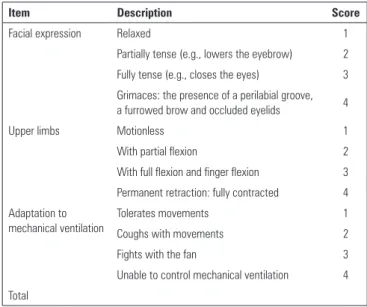
In Phase I, the scale was translated independently by two native Portuguese translators (T1 and T2) after authorization by the author of the scale. In Phase II, a board of seven experts (six nurses and one physiotherapist) who cared for the ICU patients and had experience in pain assessment validated a consensus version (T3) of the scale. his consensus validation was based on the semantic and cultural aspects of the scale after the two translations (T1 and T2). In Phase III, this version was independently translated into English by two native American and Canadian English translators. In Phase IV, a new board that was composed of the same professionals deined a consensus version, which was compared with the original version of the scale to obtain equivalence (T4). Finally, Phase V consisted of a training period with the evaluators, followed by a pilot test. Next, the test scale (pilot) was administered to the patients. he inal version (T5) was completed with minor adjustments. he Brazilian version of the BPS scale is shown in table 1.
Table 1 - Final Brazilian Portuguese version of the Behavioral Pain Scale
Item Description Score
Facial expression Relaxed 1
Partially tense (e.g., lowers the eyebrow) 2 Fully tense (e.g., closes the eyes) 3
Grimaces: the presence of a perilabial groove, a furrowed brow and occluded eyelids 4
Upper limbs Motionless 1
With partial flexion 2
With full flexion and finger flexion 3
Permanent retraction: fully contracted 4 Adaptation to
mechanical ventilation
Tolerates movements 1
Coughs with movements 2
Fights with the fan 3
Unable to control mechanical ventilation 4
he research project was approved by the Committee of Ethics and Research of Hospital Alberto Einstein under approval number 113,605, and the study was started shortly thereafter. Data collection was performed after all of the relatives of the patients signed the Informed Consent Form (ICF).
he descriptive analysis of the categorical variables was performed using the absolute, relative, and continuous frequencies and the minimum, maximum, irst quartile, and third quartile location measures. A normal distribution was not observed according to the Kolmogorov-Smirnov test.
he agreement between the two evaluators (inter-evaluators) was performed using Cohen’s kappa coeicient for the ordinal variables. hese values were assessed using the following criteria: 0.41-0.60, moderate; 0.61-0.80, substantial; and 0.81-1.0, excellent.(14) he intraclass correlation coeicient (ICC) was used to quantify the agreement of the total score of the scale. Good agreement was considered at values higher than 0.75.(15) he Kaiser-Meyer-Olkin (KMO) test was used to assess the appropriateness of the factorial analysis. Double-entry tables and Fisher’s exact tests were used to assess the relationship between pain intensity and the use of analgesia or sedation. he data were analyzed using Statistical Package for the Social Sciences (SPSS), version 17.0, for Windows®
.
RESULTS
his study enrolled a total of 100 patients who were older than 18 years of age, intubated for mechanical ventilation, and admitted to a general ICU from July 2012 to December 2012. Overall, 61% of the patients were male, and the average age of the patients was 63 years. In addition, 75% of the patients had a higher education. he length of ICU stay ranged from 1 day to 32 months with an average of 4 months. he type of sedation and analgesia and the reason for admission are detailed in table 2.
Among the pain descriptors in the scale, “facial expression” was the only item that was evaluated as classiication 4 (severe pain). his item was rated with a pain intensity score of 2 in approximately 25% of the cases. he items “upper limbs” (less pain, 88.1% for evaluator 1 and 84.2% for evaluator 2) and “adaptation to mechanical ventilation” (96% for the two evaluators) were mostly rated a score of 1. hese results indicate that “facial expression” was classiied as indicating stronger pain (Table 3).
Table 2 - Distribution of the patient characteristics, including age, length of hospital stay, gender, analgesia, and sedation
Variables Results
Age (years) 63 (18-94)
Length of hospital stay (months) 4 (1-32.4)
Reason for hospitalization
Respiratory diseases 30 (30)
Cardiovascular diseases 16 (16)
Kidney disease 11 (11)
Gastrointestinal and infectious diseases 9 (9)
Other conditions 34 (34)
Sex
Female 39 (39)
Male 61 (61)
Use of sedation
Intermittent 47 (46.5)
Continuous 54 (53.5)
Use of analgesia
Intermittent 44 (43.6)
Continuous 56 (56.4)
Sedation (Ramsay)
Score 4-5 80 (80)
Score 3 20 (20)
The results are expressed as the number (%) and the median (25%-75%).
Table 3 - The frequency of pain descriptors as obtained by two evaluators
Assessment of
the pain intensity Evaluator 1 2 3 4 Total
Facial expression 1 71 (70.3) 28 (27.7) 1 (1.0) 1 (1.0) 101 (100)
2 74 (73.3) 25 (24.8) 2 (2.0) 0 (0.0) 101 (100)
Upper limbs 1 89 (88.1) 10 (9.9) 2 (2.0) 0 (0.0) 101 (100)
2 85 (84.2) 16 (15.8) 0 (0.0) 0 (0.0) 100 (100)
Adaptation to mechanical ventilation
1 97 (96.0) 4 (4.0) 0 (0.0) 0 (0.0) 101 (100)
2 97 (96.0) 4 (4.0) 0 (0.0) 0 (0.0) 101 (100)
The results are expressed as the number (%).
he mean pain intensity score according to the scale was 3.5 (mild pain), which was obtained by evaluator 1 and evaluator 2. he total score ranged from 3-8 (mild to moderate pain) out of a total range of 3-12. Approximately 65% of the patients had mild pain intensity (3). However, 32% of the patients had pain intensity scores of 4 and 5 (moderate), and 3% of the patients had scores of 6 or 8.
factor (0.748), and “adaptation to mechanical ventilation” had the lowest correlation (0.039). he KMO test was used to assess the appropriateness of the factorial analysis, which presented a value of 0.509.
he scale had good internal consistency (a Cronbach’s alpha value of 0.501). he indicator “upper limbs” was best correlated with the scale total (0.498). In contrast, “adaptation to mechanical ventilation” was poorly correlated with the scale total (0.070).
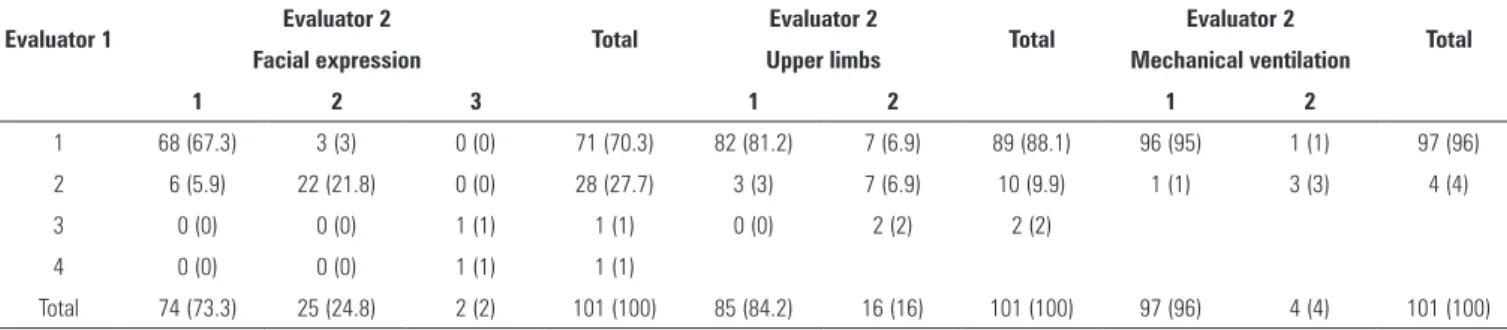
he agreement between the two evaluators was 98.0% for “adaptation to mechanical ventilation”, 88.1% for “upper limbs”, and 90.1% for “facial expression”. he kappa coeicient of agreement for “adaptation to mechanical ventilation” assumed a value of 0.740. he calculation of the kappa agreement coeicient for the other two items was not possible because a diferent number of categories were classiied by the evaluators. Good agreement was found between the evaluators for the total score of the scale with an ICC of 0.807 (95% conidence interval, CI: 0.727-0.866) (Table 4).
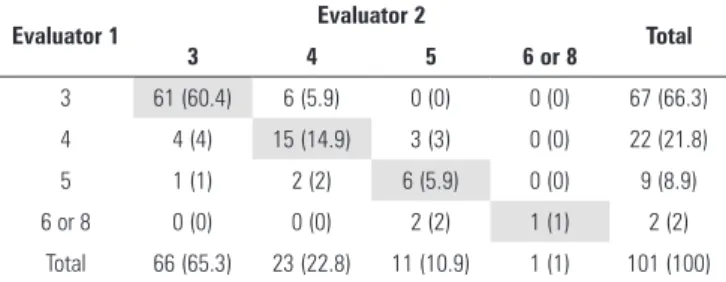
Regarding the total score of the scale, the two evaluators classiied 60.4% of the cases as having pain intensity scores of 3, 14.9% with a score of 4, 5.9% with a score of 5, and 1.0% with a score of 6 or 8 (Table 5). he inter-evaluator agreement was 82.2%, which indicated good agreement between the two evaluators. In addition to the ICC, the kappa coeicient was calculated for the total score, which resulted in a value of 0.731 (95% CI: 0.40-1.00). his inding suggested good agreement and reproducibility (Table 5).
DISCUSSION
his study demonstrated that the BPS scale is reliable with a total variance of 51.08% and good agreement and reproducibility between the evaluators, which is similar to other studies.(6,12) he range of the kappa agreement coeicient was 95%.
Less than 50% of practitioners assess pain.(16) he evaluation of pain and sedation in the ICU is particularly complex because patients are often incapable or unable to verbally communicate with health professionals(17,18) for several reasons, including tracheal intubation, altered consciousness, sedation, and the efect of
medications.(11) Patients who undergo mechanical
ventilation should be assessed for pain and sedation to optimize the dose of medication. his evaluation aims to reduce time on mechanical ventilators and the length of ICU stay.(19)
In this study, 64% of the patients under sedation (55%) had no pain, and 36% had mild pain according to the BPS scale. In a recent study, a lack of instruments for the measurement of pain and analgesia protocols was observed in a care unit for trauma patients. his study found that 48% of the patients did not receive analgesic treatment for up to 3 hours after admission.(20)
he analysis of facial expression provides valid, sensitive, and speciic information regarding the nature and intensity of pain, thereby enabling efective communication between the patient and their caretakers.(21)
he noxious response due to pain is considered unnecessary; therefore, the control and relief of pain should be a top priority in patient care. However, despite the unfavorable impact of pain, including patient sufering and the consequences of this sufering, treating pain in critically ill patients remains a major challenge.(21) It is often diicult to identify pain in these patients. Several national initiatives have aimed to institute pain as the ifth vital sign in hospitals; however, health professionals tend to be passive when in daily contact with patients, which has led to the subidentiication and underreporting of pain.(17) he indicator “upper limbs” was best correlated with the scale total (0.498), which has been previously conirmed by other studies.(6,19)
Good internal consistency (Cronbach’s alpha value =0.501) was detected in the translation and cultural
Table 4 - The analysis of the Behavioral Pain Scale according to the agreement between the evaluators regarding the pain evaluation items
Evaluator 1 Evaluator 2 Total Evaluator 2 Total Evaluator 2 Total
Facial expression Upper limbs Mechanical ventilation
1 2 3 1 2 1 2
1 68 (67.3) 3 (3) 0 (0) 71 (70.3) 82 (81.2) 7 (6.9) 89 (88.1) 96 (95) 1 (1) 97 (96)
2 6 (5.9) 22 (21.8) 0 (0) 28 (27.7) 3 (3) 7 (6.9) 10 (9.9) 1 (1) 3 (3) 4 (4)
3 0 (0) 0 (0) 1 (1) 1 (1) 0 (0) 2 (2) 2 (2)
4 0 (0) 0 (0) 1 (1) 1 (1)
Total 74 (73.3) 25 (24.8) 2 (2) 101 (100) 85 (84.2) 16 (16) 101 (100) 97 (96) 4 (4) 101 (100)
Table 5 - The analysis of the Behavioral Pain Scale according to the agreement between the evaluators
Evaluator 1 Evaluator 2 Total
3 4 5 6 or 8
3 61 (60.4) 6 (5.9) 0 (0) 0 (0) 67 (66.3)
4 4 (4) 15 (14.9) 3 (3) 0 (0) 22 (21.8)
5 1 (1) 2 (2) 6 (5.9) 0 (0) 9 (8.9)
6 or 8 0 (0) 0 (0) 2 (2) 1 (1) 2 (2)
Total 66 (65.3) 23 (22.8) 11 (10.9) 1 (1) 101 (100) The results are expressed as the number (%). The highlighted values show the observed agreement between the evaluators (82.2%), which indicates good conformity.
adaptation of the BPS, and good agreement was found in the total score of the scale (82.2%), which is consistent with previous studies.(20)
he use of a speciic tool to assess pain in critically ill patients may aid in the identiication and treatment of pain, thereby providing nursing staf a tool for implementing
pain as the ifth vital sign and for developing analgesia protocols. Because the BPS is a behavioral scale, this scale requires team building and training and dependable evaluators; however, this scale is easy and quick to administer and may be used in clinical practice. he patients in this study were under the inluence of sedatives, which may be considered a limitation because the results of the pain assessment may have been inluenced.
CONCLUSION
he Behavioural Pain Scale was easy to administer and reproduce. Adequate internal consistency was observed in this study; therefore, this scale was satisfactorily adapted to Brazil for the assessment of pain in critically ill patients.
Considering the lack of a speciic scale to assess pain in this population, the Behavioural Pain Scale should greatly aid in the early identiication of pain and, therefore, the early treatment of pain in these critical patients.
REFERENCES
1. Viana DL, Dupas G, Pedreira ML. A avaliação da dor da criança pelas enfermei-ras na unidade de terapia intensiva. Pediatria (São Paulo). 2006;28(4):251-61. 2. Correia LL, Linhares MB. Avaliação do comportamento de crianças em
situações de dor: revisão da literatura. J Pediatr (Rio J). 2008;84(6):477-86. 3. Carneiro AF, Silva LG, Bosco FP. Sedação e Analgesia em Unidade de Terapia Intensiva. Curso de Educação a Distância em Anestesiologia. Sociedade Brasileira de Anestesiologia - Comissão de Educação Continuada. 2010. Retrieved from http://www.clasa-anestesia.org/site/version/docs/SBA.
4. Gélinas C, Fortier M, Viens C, Fillion L, Puntillo K. Pain assessment and management in critically ill intubated patients: a retrospective study. Am J Crit Care. 2004;13(2):126-35.
5. Ahlers SJ, van Gulik L, van der Veen AM, van Dongen HP, Bruins P, Belitser SV, et al. Comparison of different pain scoring systems in critically ill patients in a general ICU. Crit Care. 2008;12(1):R15.
6. Payen JF, Bru O, Bosson JL, Lagrasta A, Novel E, Deschaux I, et al. Assessing pain in critically ill sedated patients by using a behavioral pain scale. Crit Care Med. 2001;29(12):2258-63.
Objetivo: Realizar tradução e adaptação cultural para portu-guês do Brasil da escala de dor Behavioural Pain Scale, e avaliar suas propriedades psicométricas.
Método: Estudo ocorreu em duas fases: versão portuguesa da escala Behavioural Pain Scale para o Brasil e estudo das suas propriedades psicométricas (coniabilidade e utilidade clínica). A amostra foi constituída por 100 pacientes maiores de 18 anos no decorrer do segundo semestre de 2012. Como critério de inclusão, deveriam estar internados em unidades de terapia intensiva, intubados, sob ventilação mecânica, fazendo uso ou não de sedação e analgesia. Foram excluídos pacientes pediátricos e que não estavam intubados. O estudo foi realizado em um hospital privado de grande porte, situado na cidade de São Paulo (SP).
Resultados: Os resultados mostraram que, em relação à reprodutibilidade, a concordância observada entre os dois avaliadores foi 92,08% para “Adaptação à ventilação mecânica”, 88,1% para “Membros superiores” e 90,1% para “Expressão facial”. O coeiciente de concordância Kappa para “Adaptação à ventilação mecânica” assumiu valor 0,740. Observamos boa concordância entre os avaliadores, com um coeiciente de correlação intraclasse de 0,807 (intervalo de coniança de 95%: 0,727-0,866).
Conclusão: A escala Behavioural Pain Scale mostrou ser de fácil aplicação e reprodutibilidade, assim como teve adequada consistência interna, sendo satisfatória a adaptação da escala Behavioural Pain Scale para o Brasil para avaliação da dor em pacientes graves.
RESUMO
7. Gélinas C, Harel F, Fillion L, Puntillo KA, Johnston CC. Sensitivity and specificity of the critical-care pain observation tool for the detection of pain in intubated adults after cardiac surgery. J Pain Symptom Manage. 2009;37(1):58-67.
8. Li D, Puntillo K, Miaskowski C. A review of objective pain measures for use with critical care adult patients unable to self-report. J Pain. 2008;9(1):2-10. 9. Cade CH. Clinical tools for the assessment of pain in sedated critically ill
adults. Nurs Crit Care. 2008;13(6):288-97. Review.
10. Puntillo K, Pasero C, Li D, Mularski RA, Grap MJ, Erstad BL, Varkey B, et al. Evaluation of pain in ICU patients. Chest. 2009;135(4):1069-74. 11. Chen YY, Lai YH, Shun SC, Chi NH, Tsai PS, Liao YM. The Chinese Behavior
Pain Scale for critically ill patients: translation and psychometric testing. Int J Nurs Stud. 2011;48(4):438-48.
12. Aissaoui Y, Zeggwagh AA, Zekraoui A, Abidi K, Abouqal R. Validation of a behavioral pain scale in critically ill, sedated, and mechanically ventilated patients. Anesth Analg. 2005;101(5):1470-6.
13. Young J, Siffleet J, Nikoletti S, Shaw T. Use of a Behavioral Pain Scale to assess pain in ventilated, unconscious and/or sedated patients. Intensive Crit Care Nurs. 2006;22(1):32-9.
14. Landis JR, Koch GG. The measurement of observer agreement for categorical data. Biometrics. 1977;33(1):159-74.
15. Kramer MS, Feinstein AR. Clinical biostatistics. LIV. The biostatistics of concordance. Clin Pharmacol Ther. 1981;29(1):111-23. Erratum in Clin Pharmacol Ther. 1989;46(3):309.
16. Kumar AB, Brennan TJ. Pain assessment, sedation, and analgesic administration in the intensive care unit. Anesthesiology. 2009;111(6):1187-8. 17. Calil AM. Avaliação da dor e analgesia no atendimento pré-hospitalar em
pacientes de trauma. Rev Gaúch Enferm. 2008;29(2):308-13.
18. Guinsburg R. Avaliação e tratamento da dor no recém-nascido. J Pediatr (Rio J). 1999;75(3):149-60.
19. Fontes KB, Jaques AE. O papel da enfermagem frente ao monitoramento da dor como 5º sinal vital. Cienc Cuid Saúde. 2007;6(Supl 2):481-7. 20. Herr K, Coyne PJ, Key T, Manworren R, McCaffery M, Merkel S,
Pelosi-Kelly J, Wild L; American Society for Pain Management Nursing. Pain assessment in the nonverbal patient: position statement with clinical practice recommendations. Pain Manag Nurs. 2006;7(2):44-52. 21. Calil AM, Pimenta CA. Intensidade da dor e adequação de analgesia. Rev