RE
VIE
W
1 Programa de Pós-Graduação em Nutrição, Universidade Federal de Pernambuco. Av. Professor Moraes Rego 1235, Cidade Universitária. 50670-901 Recife PE Brasil. [email protected] 2 Departamento de Nutrição, Universidade Federal da Paraíba. João Pessoa PB Brasil.
Impact of educational strategies in low-risk prenatal care:
systematic review of randomized clinical trials
Abstract This study aimed to analyze the impact of educational strategies developed in low-risk prenatal care on obstetric outcomes from a sys-tematic literature review. This review consulted databases PubMed, Medline, SciELO and Lilacs, analyzing randomized clinical trials with the fol-lowing birth outcomes: birth weight, prematurity and breastfeeding, using the following combina-tion of keywords: pre-natal, antenatal visits, ed-ucation, health eded-ucation, pregnancy outcomes, birth weight, prematurity, breastfeeding and ran-domized clinical trial. Nine studies were included following quality evaluation. Actions prove to be more effective when extended to the postpartum period. Most of them occurred during home vis-its and had a positive impact on breastfeeding and birth weight. The establishment of groups of pregnant women contributed to lower prevalence of prematurity. Breastfeeding was found to be the outcome most sensitive to educational strategies. Educational practices during the prenatal peri-od contributed to favorable obstetric outcomes as they minimized pregnant women concerns and anxiety during the pregnancy process, preparing them for childbirth and postpartum, and should be incorporated into health services’ work process.
Key words Prenatal, Randomized controlled
tri-al, Health education
Esther Pereira da Silva 1
Roberto Teixeira de Lima 2
Sil
Introduction
Prenatal care is a set of clinical and educational procedures that aim to monitor the development of pregnancy and promote mother and child health. It includes the reception of women from the onset of their pregnancy to postpartum. This is a period characterized by physical and emo-tional change that each woman experiences dif-ferently, so she must receive comprehensive care
from health teams1.
Adequate monitoring of pregnant women is related to benefits for both the mother and the fetus and future baby, enabling the detection and timely treatment of morbidities, reducing the in-cidence of low birth weight and prematurity and
promoting breastfeeding2.
Prenatal care quality should not only focus its quantitative aspects, such as the number of con-sultations or prenatal care onset gestational age, since it prevents the visualization of the material impact on its content. Therefore, the incorpo-ration of strategies aimed at ensuring prenatal care with a comprehensive and problem-solving
approach is required2,3. Among these, we wish
to highlight educational strategies. However, re-garding this subject, researchers have observed gaps in educational activities during prenatal care, since low-risk pregnant women receiving prenatal care regularly show a lack of knowledge about pregnancy-derived changes and lack of preparation for childbirth as they come into the
final month of their pregnancy4-6.
Women should be well instructed during prenatal care so that they may experience posi-tively childbirth, suffer lower complications risks in the postpartum period and be more
success-ful in breastfeeding4. Information on the various
experiences should be shared between women and health professionals. Support groups strat-egies and training visits to women households by experts have been successfully implemented
in prenatal health care models1,4. Experience and
knowledge exchange is the best way to under-stand the pregnancy process, it adds an educa-tional component to care and provides greater support to pregnant women during the prena-tal period, thus contributing to better
obstetri-cal outcomes7. Therefore, in this context, health
professionals should be qualified for educational work, trained to understand changes experienced during pregnancy and exercise the role of
edu-cators and health promoters1. Before the
impor-tance of educational strategies in prenatal care and their possible relationship with favorable
birth outcomes, this study aims to present a sys-tematic review of the impact of educational strat-egies used in prenatal low-risk pregnant women, in the following obstetric outcomes: birth weight, prematurity and breastfeeding practice, from randomized clinical trials.
Methods
Protocol, research strategy and selection criteria were in accordance with the guidelines of Co-chrane Handbook for Reviewers, Federal
Uni-versity of São Paulo8 and the Preferred Reporting
Items for Systematic Reviews and Meta-Analyses
(PRISMA)9.
Search strategies
The systematic search for studies was con-ducted in four electronic databases (Pubmed, Medline, SciELO and LILACS), using the
follow-ing Health Science Descriptors/Medical Subject
Headings (DeCS/MeSH): “pre-natal” AND “an-tenatal visits” AND “education” OR “health edu-cation” AND “pregnancy outcomes” AND “birth weight” OR “prematurity” OR “breastfeeding” AND “randomized clinical”. Bibliographic search was carried out in the period April-September 2014.
Only study type and obstetric outcome fil-ters were used, as per selection criteria described below. In addition, systematic reviews’ referenc-es on the subject were analyzed in order to find papers that had not been detected in databases’ search.
Study selection criteria
Study selection was independently conduct-ed by two reviewers, and a third experiencconduct-ed re-searcher was consulted when in doubt. Research was performed in two stages: evaluation of titles and abstracts of all identified studies and full text assessment.
Inclusion criteria for the study were: 1) Ran-domized clinical trial; 2) Study with at least one of the selected obstetric outcomes (birth weight and / or prematurity and / or breastfeeding); 3) Educational intervention occurred during pre-natal care; 4) Contemporary intervention and control groups that received the same cumulative duration of treatment or no treatment.
e C
ole
tiv
a,
21(9):2935-2948,
2016
the following databases, considering the follow-ing order of priority: Pubmed, Medline, SciELO and Lilacs.
Study quality evaluation
Standards of the Cochrane Handbook for
Re-viewers, Federal University of São Paulo8 for
ran-domized controlled trials which classify studies in four categories were followed to evaluate the quality of papers, namely:
- Category “A”: Means that the random al-location process has been properly reported by: centralized randomization by headquarters; se-quential administration of pre-coded or num-bered packages to participating subjects select-ed for the study; distance computerizselect-ed system available full-time; computer generated-data containing coded program distribution; opaque and numbered serial envelopes and other means that apparently offer adequate allocation, com-bined with the fact that the person who made the allocation concealment is not involved in their use;
- Category “B”: Means that the allocation concealment was not described, but the text mentions that the study is randomized, indicat-ing that the allocation seems to be appropriate although there is no other available information;
- Category “C”: Means that the allocation concealment was inadequate, in which there are, for example, interleaving data, medical records numbers, birth dates, week days, etc.; and
- Category “D”: Means that the study was not randomized.
Also, according this handbook’s guidelines, A- or B-classified items were included in the sys-tematic review, whereas. C- or D-classified were excluded since they were not considered as ran-domized clinical trials.
Outcomes
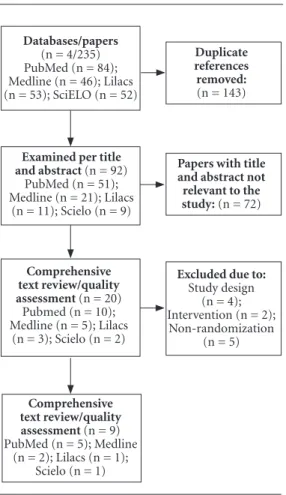
Of the surveyed studies, 235 original stud-ies and 3 systematic reviews were found. Nine-ty-two references were left after verification of duplicate references. Of these, 20 abstracts met the selection criteria and were submitted to full text review. Text reading and quality evaluation excluded 11 articles, leaving 9 studies which were included in this systematic review (Figure 1).
Table 1 describes the general characteristics of studies. Although language and period filters have not been used, studies were published in English from 1995 to 2013.
Seven studies were classified as
quali-ty-A10-13,15-17. Of the two classified as quality-B14,18,
one was held in a developing country18.
Brent et al.10, in New York, United States,
worked with 108 low-income pregnant wom-en receiving care at an outpatiwom-ent prwom-enatal care center, in order to evaluate the effectiveness of an intervention program to increase breast-feeding, randomized study population into two groups, namely, control and intervention. In the control group, prenatal care was provided at the institution through traditional clinical con-sultations (patient-doctor); in the intervention group, women received monthly throughout the pregnancy period up to the first year postpartum home visits by health professionals trained in the subject of breastfeeding, called “lactation con-sultants”. During these visits, professionals dis-cussed in participatory fashion about the impor-tance of breast milk, physiology of the breast and breastfeeding management issues, using teaching and illustrative materials on the topic, preparing
Figure 1. Flowchart of qualifications according to
PRISMA guidelines.
Databases/papers
(n = 4/235) PubMed (n = 84); Medline (n = 46); Lilacs (n = 53); SciELO (n = 52)
Examined per title
and abstract (n = 92)
PubMed (n = 51); Medline (n = 21); Lilacs
(n = 11); Scielo (n = 9)
Comprehensive text review/quality
assessment (n = 20)
Pubmed (n = 10); Medline (n = 5); Lilacs
(n = 3); Scielo (n = 2)
Comprehensive text review/quality
assessment (n = 9)
PubMed (n = 5); Medline (n = 2); Lilacs (n = 1);
Scielo (n = 1)
Duplicate references removed:
(n = 143)
Papers with title and abstract not relevant to the
study: (n = 72)
Excluded due to:
Study design (n = 4); Intervention (n = 2);
Sil
pregnant women to perform this practice prop-erly. This strategy resulted in a higher prevalence of early initiation of exclusive breastfeeding, con-sidering the first 48 hours after delivery in the in-tervention group (61%) compared to the control group (32%), with significant statistical results.
In their study, Chapman et al.11 randomized
165 low-risk and low-income pregnant women, over eighteen years of age and under 26 gestation-al weeks in the city of Connecticut, United States in order to assess the effectiveness of a breast-feeding practice counseling program. Interven-tion strategies were developed from monthly home visits by women living in pregnant wom-en’s dwelling areas during prenatal care until the
sixth month postpartum. Women who made home visits had completed high school, breast-fed a child for a period of at least six months and underwent training by health professionals from local services to work with the breastfeeding is-sue. During the visits to the intervention group, topics included: anatomy and physiology of the breast, breastfeeding management, counseling techniques, cultural and social factors related to this practice; making use of teaching resources such as illustrative materials, videos and explan-atory brochures on the subject. It was observed that, in the control group, in which prenatal care was developed only for clinical consultations, the prevalence of mothers who did not undergo
ear-Table 1. Randomized clinical trials included in the review. Recife/PE, 2014.
Author, year, location
Brent N et al. (1995), EUA
Chapman D et al. (2004), EUA
Quality Level
A
A
Sample
- 108 pregnant women (I = 51; C = 58)
- 165 pregnant women (I = 90; C = 75)
Reviewed outcomes of interest to the
study
- Breastfeeding
- Breastfeeding
Inclusion criteria
- Low income pregnant women; - Reside near study location; - Low-risk pregnant women
- Pregnancy < 26 weeks; - >18 years of age;
- Study location dwellers; - Low income; - Low-risk pregnant women
Intervention Strategy
- Strategic home visits by health professionals trained in lactation; - Discussion on the importance of breastfeeding, questions, breast physiology.
- Strategic home visits of community women trained in breastfeeding; - Topics covered include anatomy and physiology of the breast, breastfeeding management, counseling techniques and related social and cultural factors; - Educational materials
Intervention Duration
Monthly during prenatal care up to 1st year postpartum
Monthly in prenatal up to the 6th month postpartum
Review outcomes
Prevalence of early exclusive breastfeeding initiation: I = 61% C = 32% p = 0,02*
Prevalence of no early exclusive breastfeeding initiation: I = 8,9 % C = 22,7% OR = 0,39 (CI 95% 0,18-0,36)*
e C
ole
tiv
a,
21(9):2935-2948,
2016
ly breastfeeding was higher (22.7%) compared to the intervention group (8.9%), with statistical significance.
In the study by Olds et al.12, which aimed
to examine the impact of educational strate-gies during home visits in obstetric outcomes and childhood, birth weight was the analysis variable studied by these authors. In this study, 1,178 pregnant women from 21 public prenatal care clinics in the city of Denver, United States were randomized. The interventional compo-nent resulted from home visits during prenatal
care by health professionals. Subjects such as the importance of prenatal care, food intake during pregnancy, pregnancy clinical complications and family planning were addressed during visits, using teaching and illustrative materials. A sig-nificantly lower prevalence of low birth weight (2.8%) was noted in the intervention group com-pared to the control group (7.7%).
In a study developed with 304 pregnant wom-en receiving care at two public health cwom-enters in
New York, United States, Bonuck et al.13 used
educational strategies from home visits made by
Chart 1. continuation
Author, year, location
Olds D et al. (2004), EUA
Bonuck K et al (2005), EUA
Quality Level
A
A
Sample
1.178 pregnant women (I = 735; C = 443)
304 pregnant women (I = 145; C = 159)
Reviewed outcomes of interest to the
study
- Birth weight
- Breastfeeding
Inclusion criteria
- Pregnant women residing at the study location with no prior childbirth - Pregnant women without health plans
- Low-risk pregnant women
< 24 weeks pregnancy Contact with mother and child available up to 12 months postpartum - pregnant women/ mothers not taking medicines incompatible with breastfeeding - Low-risk pregnant women
Intervention Strategy
- Strategic home visits by health professionals; - Discussing issues on maternal and fetal health, encouraging self-care and family planning with the use of illustrative materials and teaching
- Strategic home visits by local workers trained in breastfeeding; - Workers discussed the physiological characteristics and benefits of breastfeeding using illustrative materials, dolls and artificial nipples and also preparation for childbirth and early initiation of breastfeeding
Intervention Duration
Monthly during prenatal care
Monthly during prenatal care up to 12 months postpartum
Review outcomes
Prevalence of low birth weight: I = 2,8% C = 7,7% p = 0,03*
Prevalence of exclusive breastfeeding in 6 months postpartum: I = 53% C = 39,3% p<0,028*
Sil
Chart 1. continuation
Author, year, location
Aidam B et al. (2005), Gana
Ickovics J et al. (2007), EUA Quality Level B A Sample 231 pregnant women (I = 136; C = 95)
993 pregnant women (I = 623; C = 370)
Reviewed outcomes of interest to the
study
- Breastfeeding
- Prematurity - Birth weight - Breastfeeding
Inclusion criteria
-Pregnant women in the last quarter; - Gave birth to term babies with adequate birth weight in the selected hospitals of the study;
-Residing in the community for at least 06 months postpartum - Low-risk pregnant women
- < 24 weeks pregnancy - < 25 years of age - Non high-risk pregnant women - Speaking English or Spanish Intervention Strategy
- Strategic and participatory home visits by breastfeeding-trained counsellors (nurses and nutritionists); - Issues discussed during visits: Mother and child breastfeeding benefits, early initiation of this practice, the importance of colostrum, breastfeeding techniques, artificial milks risks and prevention and treatment of lactation issues.
- Prenatal care was performed in groups (maxim 8 pregnant women) with professionals discussing issues raised by the very pregnant women regarding concerns related to pregnancy, childbirth,
breastfeeding, newborns care; pregnant women were handed copies of their tests and weight records (self-care incentive). Intervention Duration Monthly during prenatal care up to 1st year postpartum Monthly during prenatal care Review outcomes Prevalence of exclusive breastfeeding initiation in the first three months postpartum: I = 92,1% C = 65,9% p = 0,04*
Prevalence of exclusive breastfeeding in the first six months postpartum: I = 39,5% C = 19,6% p = 0,02*
Prevalence of prematurity: I = 9,8% C = 13,8% OR = 0,67 (CI 95% 0,44-0,99) p = 0,045*
Prevalence of low birth weight: I = 10,7% C = 11,3% OR = 0,98 (CI 95% 0,64- 1,50) p = 0,90
Early initiation of exclusive breastfeeding I = 66,5% C = 54,6% OR = 1,73 (CI 95% 1,28- 2,35) p = 0,01*
e C ole tiv a, 21(9):2935-2948, 2016
Chart 1. continuation
Author, year, location
Edwards R et al. (2013), EUA
Karp S et al. (2013), EUA
Lutenbacher M et al. (2013), EUA Quality Level A A B Sample 248 pregnant women (I = 124; C = 124)
-130 pregnant women (I = 73; C = 57)
211 pregnant women (I = 109; C = 102)
Reviewed outcomes of interest to the
study - Breastfeeding - Breastfeeding - Prematurity Inclusion criteria
- < 34 weeks pregnancy - < 21 years of age - Non high-risk pregnant women
- < 24 weeks pregnancy; - Speaking and reading English; - Living close to study location - Low income; - Low-risk pregnant women
- < 24 weeks pregnancy - 1 prior preterm childbirth - Speaking English - Living close to study location - Low-risk pregnant women Intervention Strategy
- Strategic home visits by “doulas”; - Visits topics: breastfeeding benefits, using illustrative materials and videos; personal breastfeeding experiences were shared, addressing child nutrition and dispelling breastfeeding myths.
- Strategic home visits by health professionals; - Visits topics: breastfeeding benefits, breastfeeding avoidance risks and discussing prior breastfeeding difficulties; - Educational resources, teaching materials
- Strategic home visits by health professionals according to specific protocols addressed: - Guidance to pregnant women regarding childbirth, breastfeeding, pregnancy concerns, using teaching materials and ensuring access to psychiatric and social services, when necessary. Intervention Duration Monthly during prenatal care up to 12 months postpartum
Monthly during prenatal care and 01 visit postpartum
Monthly during prenatal care and 01 immediate visit postpartum Review outcomes Early initiation of exclusive breastfeeding : I = 63,9% C = 49,6% p = 0,02*
Duration of exclusive breastfeeding > 4 months:
I = 8,3% C = 4,4% p = 0,10
Prevalence of exclusive breastfeeding early initiation I = 68,5% C = 59,6% p = 0,295
Prevalence of prematurity: I = 8% C = 13% p = 0,361
Sil
workers residing in women’s dwelling areas in or-der to determine whether these measures would impact on the duration of breastfeeding. These workers were trained by health professionals ser-vices studied in relation to lactation. Issues related to mothers’ breastfeeding intentions, breastfeed-ing benefits, physiological characteristics of the breast, preparation for childbirth and early initi-ation of breastfeeding were discussed in the visits with the help of educational brochures, dolls and artificial breasts. A statistically significant higher prevalence of exclusive breastfeeding during the six-month postpartum period (53%) was report-ed for pregnant women of the group with these actions compared to the group that received only traditional clinical consultations (39.3%) .
In a study conducted in Ghana with 231 preg-nant women receiving care at antenatal care
clin-ics of two local hospitals, Aidam et al.14 developed
educational strategies during home visits during prenatal care up to the first postpartum year, in order to determine whether these interventions contribute to the proper practice of breastfeed-ing. These meetings were conducted by two local nurses and a nutritionist. These health profes-sionals should have breastfed a child for at least six months and be recognized in the community as a credible source of health information to be included in the study. In these visits, women in the intervention group received information on the following topics: definition of breastfeeding, incentives to early initiation, importance of co-lostrum, benefits of breastfeeding for mother and baby, breastfeeding techniques and treatment of lactation problems (engorgement, sore nipples). Women were encouraged to ask questions during the educational sessions. The questions raised by pregnant women were discussed and added as additional topics for future visits. A higher prev-alence of exclusive breastfeeding was observed in the three and six months postpartum periods (92.1% and 39.5%) in the intervention group than in the control group (65.9% and 19.6%), with significant statistical results.
Working with 993 pregnant women from two university hospitals of reference in obstetrics in Atlanta and New Raven, United States, Ickovics
et al.15 proposed an educational strategy of
two-hour prenatal care provided in groups of a maxi-mum of eight pregnant women in order to verify the impact of this intervention on birth weight, prematurity and breastfeeding, as well as psy-chosocial function and user satisfaction. Initially, patients were individually evaluated for weight, blood pressure and uterine height record and
then women in the intervention group were re-ferred to groups mediated by health profession-als of analyzed services. Knowledge and concerns among pregnant women were shared in these en-vironments and the topics discussed were worked around prenatal care goals, namely, breastfeed-ing, preparation for childbirth and postpartum period, and women were encouraged to self-care (with return of laboratory tests for monitoring purposes). Educational materials were distrib-uted and, at the end of each session, pregnant women evaluated activities. Authors observed a lower prevalence of prematurity (9.8%) and higher prevalence of early initiation of breast-feeding (66.5%) in the intervention group com-pared to the control group (13.8% and 54.6%, respectively). However, it was observed that the educational strategy was not effective regarding low birth weight outcome.
A study developed by Edwards et al.16
in-cluded 248 pregnant women receiving care at a prenatal clinic of the University Hospital, Uni-versity of Missouri, United States. Women were randomized from a statistical program, with no significant differences with regard to socio-eco-nomic and demographic characteristics of the control and intervention groups. In the control group, pregnant women received prenatal care clinical consultations (patient-expert).
e C
ole
tiv
a,
21(9):2935-2948,
2016
Karp et al.17 studied the prevalence of
breast-feeding initiation in women receiving care at a university center in Southeastern United States and developed a prospective study in which they randomized 130 pregnant women into two groups: the control group (n = 57) and the inter-vention group (n = 73). Women in the control group received traditional clinical prenatal care consultation at the health service facility and the intervention group received monthly home visits during prenatal care and postpartum by health professionals specialists in obstetrics in addition to consultations.
Visits included health education actions based on standardized research protocols that used teaching resources such as illustrative bro-chures and videos. The following issues were dis-cussed with pregnant women: maternal clinical complications, oral health, stress, use of medi-cation during pregnancy, nutritional guidelines and physical activity, reproductive life planning and breastfeeding. Regarding breastfeeding, pro-fessionals addressed benefits and risks of abstain-ing from of this practice and discussed previous breastfeeding experience of pregnant women. No difference was noted between the groups follow-ing control of variables related to race, income, marital status, tobacco use and age, although women in the intervention group had a higher prevalence of early breastfeeding (Intervention = 68.5%; Control = 59.6%).
By analyzing prematurity as an outcome,
Lutenbacher et al.18, at Vanderbilt University
Medical Center, USA, randomized 211 pregnant women into two groups: the control group (n = 102), in which women performed the tradi-tional clinical prenatal care consultation (doc-tor-patient); and the intervention group (n = 109), which also included home visits by health professionals making use of teaching materials that addressed the following topics suggested by pregnant women: Guidelines regarding clinical complications, maternal and perinatal health care, childbirth and breastfeeding, as well as en-suring referral to psychiatric and social service, when needed. There was no significant difference between the groups, however, a higher preva-lence of preterm births was observed in the con-trol group (13%) compared to the intervention group (8%).
Discussion
This systematic review revealed a shortage of studies using educational strategies in random-ized clinical trials during the prenatal period. Most studies have shown that the development of educational strategies during prenatal care has a positive impact by providing better obstetric out-comes, where pregnant women who participated in educational activities showed lower prevalence
of low birth weight12 and prematurity15, as well as
earlier and lengthier practice of exclusive
breast-feeding10,11,13,14,16.
Despite two studies16,18 in which educational
interventions did not show statistically signif-icant results, it should be noted that a higher prevalence of favorable birth outcomes was ob-served in the intervention groups.
Health education as a pedagogical process requires the development of critical and reflec-tive thinking; it unravels the reality and propos-es transformative actions that lead individuals to their emancipation as historical and social subjects capable of proposing and commenting health decisions to take care of themselves, their
family and their community19.
Health education practices should involve three segments of primary stakeholders: health professionals who value prevention and health promotion as well as healing practices; manag-ers to support these professionals; and people who need to build their knowledge and ensure autonomy in their health care, both individu-ally and collectively. They should be inherent to health care services’ work process. However, many times, they are placed in the background in the planning and organization of services, im-plementation of care actions and management
itself20.
The main educational activities observed in the studies took place during home visits by pro-fessionals or trained local workers, with the use of educational resources such as videos, illustra-tive materials, explanatory brochures, dolls and
artificial nipples10-14,16-18. Of the eight studies that
worked with this initiative10-14,16-18, six showed
fa-vorable births outcomes in women who partici-pated in the intervention group, with statistical
significance10-14,16.
Sil
features and household’s available resources. This information is important for planning the educational activities of health professionals, aiming at stimulating and enhancing users’
em-powerment and self-care21. Working with the
whole family is crucial in the learning process
during pregnancy1,2,21.
As for the intervention duration, the most effective strategies stretched from prenatal care
to postpartum1,2,4,5,7, reaffirming the importance
of continued care by health teams. Regarding this topic, benefits identified as being related to continued care are: greater possibility of integrat-ing physical, psychological, social and economic realms; improved user-service provider relation-ship; promoting a more effective role in health maintenance by users and likely reduced care costs by preventing unnecessary duplication of
services and treatments22.
With regard to prematurity, of the two
stud-ies15,18 evaluating this variable as review outcome,
one of them had been successful when using the establishment of groups during prenatal care as
an educational strategy15. However, Lutenbacher
et al.18 found no significant outcomes when
mak-ing home visits by health professionals, probably due to the fact that, although they were low-risk pregnant women, these women under study previously had premature birth and home visits could not verify this clinical risk in the current
pregnancy. Researchers15,18 point out that, in the
case of women at risk, in addition to education-al strategies, referreducation-al to high complexity services must be ensured to pregnant women.
Establishing groups during prenatal care as educational activity is an opportunity to create a dialogue channel between professionals and pregnant women, a space for the exchange of experiences among women that contributes to their empowerment and to prepare pregnant woman to address the physical and emotional
changes that are part of the pregnancy process1,6.
In addition, groups encourage the participation of pregnant women as active subjects in prenatal care, valuing their concerns, since, while elemen-tary to listeners, can pose a serious problem for those who experience them. In this context, these groups can be considered as therapeutic groups in which direct and safe answers are significant to
the well-being of women and their families1,6,21.
With regard to birth weight, the two studies
that addressed this variable12,15 showed that
ed-ucational strategies during home visits and the establishment of pregnant women groups during prenatal care were effective in reducing its
prev-alence. Birth weight is an important population health indicator, it reflects women’s social, eco-nomic and environmental conditions during pregnancy. It is a women reproductive health care quality indicator, since the low quality of prenatal care is directly associated with the birth
of low birth weight children23.
Breastfeeding practice was the birth variable most used by authors to highlight the impact of educational strategies during the prenatal
peri-od. Of the nine studies included in the review10-18,
seven10,11,13-17 worked with the breastfeeding
out-come. It is worth noting that, of these studies,
six10,11,13-16 showed a higher prevalence of this
practice in the intervention group, with signif-icant results, strengthening the importance of educational activities during prenatal care while preparing women for breastfeeding .
Considering the protective role of breastfeed-ing on infant morbidity and mortality, initiatives to promote such practice should be a priority in health services. Health teams should be trained in breastfeeding clinical management and coun-seling. Professional training is essential to the success of breastfeeding promotion, protection and support, giving jurisdiction to health teams
and facilitating engagement with services’ users24.
Again on breastfeeding, intervention strate-gies most used by authors with a positive impact
were: group-based prenatal care15, home visits by
professionals10, participation of women from the
community11,14,16 and lactation-trained
investi-gative workers from the location of residence of
pregnant women13.
Although this review has only assessed the intervention of educational strategies performed during prenatal care, it is important to point out that the analyzed birth outcomes bear multiple determinants of risk. Birth weight and prematu-rity are the major risk factors to little or advanced maternal age, inadequate lifestyle habits such as tobacco use and clinical complications such as anemia, urinary tract infection and gestational
weight gain deficit25,26. These variables are more
difficult to modify. Breastfeeding, in turn, has a cultural component, including family influence as a strongly related determinant, and seems to
be more sensitive to educational strategies27,28,
with the greatest prevalence differences between intervention and control groups compared to birth weight and prematurity of the studies in-cluded in the review.
e C
ole
tiv
a,
21(9):2935-2948,
2016
be taken into account as it can have a high impact on the health of the population studied.
It is noteworthy that prenatal care should not be restricted to the clinical-traditional model (patient-expert) in a practice room, but compre-hensively include health education actions in the routine of care, including anthropological, social, economic and cultural aspects, which should be known by professionals providing care to preg-nant women, seeking to understand them in the
context in which they live, act and react1,6,29,30.
Health professionals must be qualified to guide pregnant women in relation to these issues and should extrapolate the traditional clinical in-terventions and create intense learning moments and opportunities to develop health education as
a realm of the care process20. In this regard, health
professionals should assume their educating role and share knowledge, giving back to women their confidence to live their pregnancy, childbirth and
postpartum22,31.
Conclusion
Sil
Collaborations
e C
ole
tiv
a,
21(9):2935-2948,
2016
Edwards RC, Thullen MJ, Korfmacher J, Lantos JD, Henson LG, Hans SL. Doula Home Visiting Breastfeed-ing and Complementary Food: Randomized Trial of Community. Pediatrics 2013; 132(2):S160-S166. Karp SM, Howe-Heyman A, Dietrich MS, Lutenbacher M. Breastfeeding Initiation in the Context of a Home Intervention to Promote Better Birth Outcomes. Breastfeed Med. 2013; 8(4):381-387.
Aidam BA, Pérez-Escamilla R, Lartey A. Lactation Counseling Increases Exclusive Breast-Feeding Rates in Ghana. J Nutr 2005; 135(7):1691-1695.
Lutenbacher M, Gabbe PT, Karp SM, Dietrich MS, Nar-rigan D, Carpenter L, Walsh W. Does Additional Pre-natal Care in the Home Improve Birth Outcomes for Women with a Prior Preterm Delivery? A Randomized Clinical Trial. Matern Child Health J 2014; 18(5):1142-1154.
Machado MFAS, Monteiro EMLM, Queiroz DT, Vieira NFC, Barroso MGT. Integralidade, formação de saúde, educação em saúde e as propostas do SUS - uma revi-são conceitual. Cien Saude Colet 2007; 12(2):335-342. Falkenberg MB, Mendes TPL, Moraes EP, Sousa EM. Educação em saúde e educação na saúde: conceitos e implicações para a saúde coletiva. Cien Saude Colet 2014; 19(3):847-852.
Lima SS. Enfermagem no pré-natal de baixo risco na estratégia Saúde da Família. Aquichan 2013; 13(2):261-269.
Cunha EM, Giovanella L. Longitudinalidade/continui-dade do cuidado: identificando dimensões e variáveis para a avaliação da Atenção Primária no contexto do sistema público de saúde brasileiro. Cien Saude Colet 2011; 16(1):1029-1042.
Capelli JCS, Pontes JS, Pereira SEA, Silva AAM, Car-mo CN, Boccolini CS, Almeida MFL. Peso ao nascer e fatores associados ao período pré-natal: um estudo transversal em hospital maternidade de referência. Cien Saude Colet 2014; 19(7):2063-2072.
Fonseca-Machado MO, Haas VJ, Monteiro JCS, Gomes -Sponholz F. Formação continuada na enfermagem como um fator associado ao conhecimento em aleita-mento materno. Invest. educ. enferm 2014; 32(1):139-417.
Sclowitz IKT, Santos IS, Domingues MR, Matijasevich A, Barros AJD. Prognostic factors for low birthweight repetition in successive pregnancies: a cohort study. BMC Pregnancy Childbirth 2013; 20(13):1-8.
Restrepo-Méndez MC, Lawlor DA, Horta BL, Matijase-vich A, Santos IS, Menezes AM, Barros FC, Victora CG. The association of maternal age with birthweight and gestational age: a cross-cohort comparison. Paediatr Perinat Epidemiol 2015; 29(1):31-40.
Alves ALN, Oliveira MIC, Moraes JR. Iniciativa Unida-de Básica Amiga da Amamentação e sua relação com o aleitamento materno exclusivo. Rev Saude Publica 2013; 47(6):1130-1140.
Caminha MFC, Serva VB, Arruda IKG, Filho MB. As-pectos históricos, científicos, socioeconômicos e ins-titucionais do aleitamento materno. Rev. Bras. Saude Mater. Infant. 2010; 10(1):25-37.
15.
16.
17.
18.
19.
20.
21.
22.
23.
24.
25.
26.
27.
28. References
Brasil. Ministério da Saúde (MS). Secretaria de atenção à saúde. Atenção ao pré-natal de baixo risco. Brasília: MS; 2012.
Silva EP, Teixeira-Lima R, Costa MJC, Filho MB. De-senvolvimento e aplicação de um novo índice para avaliação do pré-natal. Rev. Panam. Salud Públ. 2013; 33(5):356-362.
Gomes RMT, Cesar JA. Perfil epidemiológico de ges-tantes e qualidade do pré-natal em unidade básica de saúde em Porto Alegre, Rio Grande do Sul, Brasil. Rev.
Bras. Med. Fam. Comunidade2013; 27(8):80-89.
Rios CTF, Vieira NFC. Ações educativas no pré-natal: reflexão sobre a consulta de enfermagem como um es-paço para educação em saúde. Cien Saude Colet 2007; 12(2):477-486.
Trevisan MR, De Lorenzi DRS, Araújo NM, Ésber K. Perfil da Assistência pré-natal entre usuárias do Siste-ma Único de Saúde em Caxias do Sul. Rev Bras Ginecol Obstet 2002; 24(5):293-299.
Viellas EF, Domingues RMSM, Dias MAB, Gama SGN, Theme Filha MM, Costa JV, Bastos MH, Leal MC. As-sistência pré-natal no Brasil. Cad Saude Publica 2014; 30(1):S85-S100.
Trudnak TE, Arboleda E, Kirby RS, Perrin K. Outcomes of Latina Women in Centering Pregnancy Group Pre-natal Care Compared With Individual PrePre-natal Care. J Midwifery Womens Health 2013; 58(4):396-403. Higgins JPT, Green S, editors. Cochrane Handbook for Systematic Reviews of Interventions Version 5.1.0 [cited 2011 Mar 2]. The Cochrane Collaboration, 2011. Avail-able from: www.cochrane-handbook.org
Liberati A, Altman DG, Tetzlaff J, Mulrow C, Gotzsche PC, Loannidis JPA, Clarke M, Devereaux PJ, Kleijnen J, Moher D. The PRISMA statement for reporting sys-tematic reviewsand meta-analyses of studies that eval-uate health care interventions: explanation and elabo-ration. Ann Intern Med 2009; 151(4):65-93.
Brent NB, Redd B, Dworetz A, D’Amico F, Greenberg J. Breast-feeding in a Low-Income PopulationProgram to Increase Incidence and Duration. Arch Pediatr Adolesc Med 1995; 149(7):798-803.
Chapman DJ, Damio G, Young S, Pérez-Escamil-la R. Effectiveness of breastfeeding peer counseling in a low-income, predominantly Latina population: a randomized controlled trial. Arch Pediatr Adolesc Med2004; 158(9):897-902.
Olds DL, Robinson J, O’Brien R, Luckey DW, Pettitt LM, Henderson CR Jr, Ng RK, Sheff KL, Korfmacher J, Hiatt S, Talmi A. Home Visiting by Paraprofessionals and by Nurses: A Randomized, Controlled Trial. Pedi-atrics 2004; 110(3):486-496.
Bonuck KA, Trombley M, Freeman K, McKee D. Inter-vention on Duration and Intensity of Breastfeeding up to 12 Months Randomized, Controlled Trial of a Pre-natal and PostPre-natal Lactation Consultant. Pediatrics 2005; 116(6):1413-1426.
Ickovics JR, Kershaw TS, Westdahl C, Magriples U, Massey Z, Reynolds H, Rising SS. Group Prenatal Care and Perinatal Outcomes A Randomized Controlled Trial. Obstet Gynecol 2007; 110(2):330-339.
1.
2.
3.
4.
5.
6.
7.
8.
9.
10.
11.
12.
13.
Sil
Hossain MI, Nahar B, Hamadani JD, Ahmed T, Brown KH. Effects of community-based follow-up care in managing severely underweight children. J Pediatr Gas-troenterol Nutr 2011; 53(3):310-319.
Souza VB, Roecker S, Marcon SS. Educative actions in prenatal assistance: perceptions of pregnant women assisted at the Basic Health Unit of Maringá-PR. Rev. Eletr. Enf. 2011; 13(2):199-210.
Beeckman K, Lockx F, Putman K. Determinants of the number of antenatal visits in a metropolitan region. BMC Public Health 2010; 10(1):527-534.
Article submitted 23/04/2015 Approved 10/07/2015
Final version submitted 12/07/2015 29.
30.