Right hemisphere damage
Communication processing in adults
evaluated by the Brazilian Protocole
MEC – Bateria MAC
Rochele Paz Fonseca
1, Jandyra Maria Guimarães Fachel
2, Márcia Lorena Fagundes Chaves
3,
Francéia Veiga Liedtke
4, Maria Alice de Mattos Pimenta Parente
5Abstract – Right-brain-damaged individuals may present discursive, pragmatic, lexical-semantic and/or prosod-ic disorders. Objective: To verify the effect of right hemisphere damage on communication processing evaluated by the Brazilian version of the Protocole Montréal d’Évaluation de la Communication (Montreal Communication Evaluation Battery) – Bateria Montreal de Avaliação da Comunicação, Bateria MAC, in Portuguese. Methods: A clinical group of 29 right-brain-damaged participants and a control group of 58 non-brain-damaged adults formed the sample. A questionnaire on sociocultural and health aspects, together with the Brazilian MAC Bat-tery was administered. Results: Signifi cant differences between the clinical and control groups were observed in the following MAC Battery tasks: conversational discourse, unconstrained, semantic and orthographic verbal fl uency, linguistic prosody repetition, emotional prosody comprehension, repetition and production. Moreover, the clinical group was less homogeneous than the control group. Conclusions: A right-brain-damage effect was identifi ed directly, on three communication processes: discursive, lexical-semantic and prosodic processes, and indirectly, on pragmatic process.
Key words: neuropsychology, right hemisphere, brain damage, communication.
Lesão de hemisfério direito: processamento comunicativo em adultos avaliados pela versão brasileira do Protocole MEC – Bateria MAC
Resumo – Os indivíduos com lesão vascular de hemisfério direito podem apresentar distúrbios discursivos, pragmáticos, léxico-semânticos e/ou prosódicos. Objetivo: Verifi car o efeito da lesão de hemisfério direito no processamento comunicativo avaliado pela versão Brasileira do Protocole Montréal d’Évaluation de la Commu-nication – Bateria Montreal de Avaliação da Comunicação, Bateria MAC (em português). Métodos: Participaram do estudo um grupo clínico, com 29 adultos lesados de hemisfério direito, e um grupo controle, com 58 adultos sem lesão neurológica. Foram administrados um questionário de dados socioculturais e aspectos da saúde e a Bateria MAC. Resultados: Houve diferenças signifi cativas entre os grupos clínico e controle nas tarefas da Bateria MAC discurso conversacional, evocação lexical livre, com critério ortográfi co e semântico, prosódia lingüísti-ca repetição, prosódia emocional compreensão, repetição e produção. Além disso, o grupo clínico mostrou-se menos homogêneo do que o controle. Conclusões: Identifi cou-se o efeito da lesão de hemisfério direito em três processamentos comunicativos: discursivo, léxico-semântico e prosódico e, indiretamente, no processamento pragmático.
Palavras-chave: neuropsicologia, hemisfério direito, lesão cerebral, comunicação.
1PhD in Developmental Psychology, Institute of Psychology, Federal University of Rio Grande do Sul (UFRGS). Laboratory of Neuropsycholinguistics,
Insti-tute of Psychology, Federal University of Rio Grande do Sul (UFRGS), Brazil. 2PhD in Statistics, University of London. Department of Statistics, Institute of
Mathematics, Federal University of Rio Grande do Sul (UFRGS), Brazil. 3PhD in Medicine, Federal University of Rio Grande do Sul (UFRGS). Department
of Internal Medicine, Faculty of Medicine, Federal University of Rio Grande do Sul (UFRGS) and Neurology Service of the Hospital of Clinics of Porto
Alegre (HCPA), Brazil. 4Psychology Undergraduate, Federal University of Rio Grande do Sul (UFRGS). Laboratory of Neuropsycholinguistics, Institute of
Psychology, Federal University of Rio Grande do Sul (UFRGS), Brazil. 5PhD in Psychology, University of São Paulo (USP). Graduate Program in Psychology,
Institute of Psychology, Department of Developmental and Personality Psychology, Federal University of Rio Grande do Sul (UFRGS), Porto Alegre, Brazil.
Right hemisphere (RH) damage was first associated to linguistic disorders less than 50 years ago.1,2 Moreover,
only in the past two decades, systematic studies on such communication defi cits have been done.3 Thus, differently
from the association between the left hemisphere (LH) and linguistic abilities known since 1861, the literature has just recently considered the role of the damaged RH in linguis-tic disorders.4,5 This role has been studied in many different
manners. This study focuses on the RH damage and its ef-fects on communication. Since the late 1980s, the relation-ship between the RH and communication has been high-lighted in studies developed with neurologically preserved individuals as well as with individuals presenting a lesion to this side of the brain, both in behavioral and neuroimaging tasks.4,6-9 Thus, communicative disorders following an RH
lesion have been increasingly described in the literature, encompassing discursive abilities,10 pragmatic-inferential,11
lexical-semantic12 and prosodic disorders.13
However, few studies in the international literature have simultaneously investigated the four communicative com-ponents – discursive, pragmatic, lexical-semantic and pro-sodic – which are possibly impaired following an RH lesion. In general, each is investigated separately. This reduced amount of investigation is probably related to the fewer instruments available to systematically evaluate communi-cative processing linked to the RH. In this context, only two studies have examined the four components in samples of right hemisphere-brain-damaged (RHBD) subjects. Each study used a different evaluation tool: one study employed
the Right Hemisphere Communication Battery,14,15 and the
other used the Protocole Montréal d’Évaluation de la Com-munication – Protocole MEC.1,3 Besides these two studies,
the Right Hemisphere Language Battery has also been used to assess the pragmatic, lexical-semantic and discursive
components.16,17 In a complementary manner, the
commu-nicative defi cit profi les of RHBD patients had previously been characterized by an evaluation of the discursive and lexical-semantic components.18 Thus, there is evidence to
suggest that more studies are needed in order to character-ize the communicative defi cits in the RHBD population. It is important to consider that such investigations of clinical description depend on specifi c instruments for the assess-ment of the possible communicative defi cits presented by the target neurological population.
From a Brazilian perspective, only one empirical study analyzing a sample of RHBD individuals has been
pub-lished.19 However, in this research only the pragmatic
component had been investigated. Therefore, to the best of our knowledge, the present study is a pioneer investiga-tion in Brazil verifying the effect of RH damage in a group with lesion on this side of the brain, by simultaneously
evaluating the four communicative components affected in this population: discursive, pragmatic, lexical-seman-tic and prosodic components. To achieve this the evalua-tion of communicative processing has been based on the Montreal Communication Evaluation Battery diagnostic tool – MAC Battery (in Portuguese, Bateria Montreal de
Avaliação da Comunicação – Bateria MAC),20 which
cor-responds to the Brazilian version of the Protocole MEC,1
the fi rst instrument adapted to Brazilian Portuguese for
examining communication following RH brain damage.21
Two factors have probably led to this gap in the Brazilian literature: 1) the lack of specifi c instruments to evaluate disturbances linked to the RH adequately adapted to the Brazilian social, linguistic and cultural setting; and 2) low dissemination in Brazil of knowledge regarding the Right Hemisphere Syndrome – a set of cognitive, communicative and behavioral signs and symptoms following a neurologi-cal disorder in the RH.
In a bid to increase propagation of knowledge on the Right Hemisphere Syndrome in the international context, studies investigating simultaneously the four communica-tive processes potentially affected by an RH lesion have provided a clinical characterization of the communicative defi cits. Four subgroups of RHBD individuals were identi-fi ed according to their similarities in terms of communica-tive performance: 1) a subgroup with discursive, pragmatic, lexical-semantic and prosodic disorders, characterized by a limited recall of stories, diffi culties in adapting to the in-terlocutor, reduced comprehension of non-literal language, diminished verbal fl uency and defi cit in intonational ex-pression; 2) a subgroup with impaired pragmatic, lexical-semantic and prosodic abilities; 3) a subgroup with chang-es only in lexical-semantic procchang-essing; and, 4) a subgroup
with no communicative defi cits.3 In a study comparing a
group of RHBD individuals and a group of LH brain-dam-aged individuals to a control group, signifi cant differences between the clinical groups were not found, only between RHBD and the control group and between LH brain-dam-aged group and the control participants. These differences were found, in tasks evaluating humor, emotional prosody, indirect speech acts, metaphors, inferences, sarcasm and
ambiguous meanings and discourse.15 However, according
to observations, not all RHBD individuals present com-munication processing impairments. Although there are no epidemiologic studies on the prevalence of this type of processing in RHBD individuals, some estimates have been drawn suggesting that some 50% of RHBD
indi-viduals present communicative disturbances.3,22,23
The current investigation intended to answer the fol-lowing questions, with the aim of verifying the effect of RH damage on communicative processing in individuals with this neurological disorder compared to a control group: 1) Are there quantitative differences between the communica-tive performance of RHBD individuals and non-damaged individuals in the four communicative processes evaluated by the Brazilian MAC Battery? 2) Do the groups under investigation differ regarding the homogeneity of their communicative performance? Two hypotheses have been formulated as an attempt to answer these questions: 1) Sig-nifi cant differences will be found between RHBD adults and non-brain-damaged adults in the four communica-tive processes examined by the Brazilian MAC Battery, and the differences in the lexical-semantic component will be less signifi cant compared to the other components; and 2) The RHBD group will be less homogeneous regarding their performance than the non-brain-damaged group.
Methods
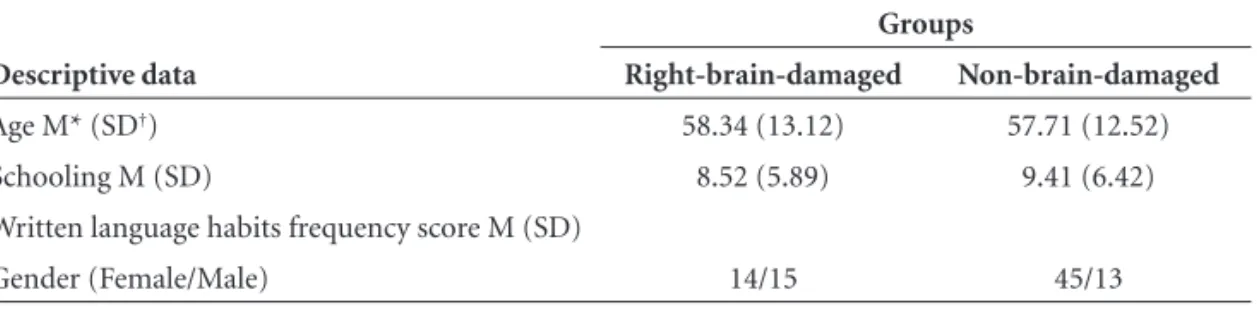
ParticipantsThe sample investigated in this study comprised two groups: 1) a clinical group: 29 RHBD adults, and 2) a con-trol group: 58 adults with no neurological lesions. The de-scriptive data of the sample of the two groups regarding age, schooling, reading and writing habits frequency, as well as the distribution by gender, are shown in Table 1. It is im-portant to state that, based on Student’s t-Test, there were no statistically signifi cant differences between the groups regarding the variables of age, schooling, reading and writ-ing habits frequency. The proportion between male and female participants has been shown to differ in the Chi-square Test (p≤001). However, no statistically signifi cant
differences were found in the scores of the Brazilian MAC Battery subtests for male and female participants in both groups according to the Student’s t-Test. Regarding man-ual dominance, in the clinical group all participants were right-handed, while in the control group, there were two left-handed individuals. The handedness was self-reported.
The clinical group sample size has been defi ned upon the application of a sample calculation (WINPEPI, module compare 2, version 1.47). A level of signifi cance of 0.05, a power of 90% and a reason 2:1 (controls:case) have been considered, in order to detect a clinically relevant difference of two standard deviations. A difference of 1.5 or of two stan-dard deviations has been observed in two studies in which the communicative performance of neurologically preserved participants and of RHBD individuals has been compared.3,15
The minimal sample size stipulated for the clinical group was 9 participants and, for the control group, 18 individuals.
The participants of the clinical group have been select-ed through the sampling technique of non-random con-venience from neurological ambulatory service records at public and private hospitals in the region of Porto Alegre, RS. The inclusion criteria were as follows: RH lesion diag-nosed by neuroimaging techniques and neurological assess-ment (18 participants underwent computerized tomogra-phy, and 11 tomography and magnetic resonance imaging); ischemic (25 participants) or hemorrhagic vascular acci-dent (4 participants); no occurrence of pre-frontal lesion to avoid executive dysfunction and behavioral disorders usually referred in patients with this lesion site (the dis-tribution of the clinical group participants regarding the RH lesion sites is presented in Table 2); minimal time of three weeks post-onset (average of 16.66 months, standard deviation 23.62); absence of any other type of neurological impairment, such as tumors, traumatic brain injury; right hand dominance; and, no participation in speech therapy and/or neuropsychological rehabilitation programs. Par-ticipants of the clinical group with a fi rst and single RH vascular lesion were preferred (only one participant had two vascular accidents, both in the RH). When it comes to hemineglect occurrence, 07 clinical participants presented signs of this syndrome in a screening cancellation lines task. They were included because visual stimuli of Brazil-ian MAC Battery were also audio presented. Besides this, the examiner guided these patients’ vision pointing from the beginning until the end of each word or sentence.
Table 1. Descriptive data of the groups regarding age, schooling, frequency of written language habits and gender distribution.
Descriptive data
Groups
Right-brain-damaged Non-brain-damaged
Age M* (SD†) 58.34 (13.12) 57.71 (12.52)
Schooling M (SD) 8.52 (5.89) 9.41 (6.42)
Written language habits frequency score M (SD)
Gender (Female/Male) 14/15 45/13
Regarding the participants of the control group, the majority were selected from the original normalization
data set of the Brazilian MAC Battery instrument.20 Two
control individuals were chosen for each case of the clini-cal group and matched for age, schooling and reading and writing habits frequency scores (2:1 design). Moreover, the following inclusion criteria were common to the two groups: no existing conditions of dementia (Mini-Men-tal27 score, adapted for the local Brazilian population,25≥24
points, for individuals with more than 4 years of school education, and 17, for participants with ≤4 years of school education); no existing conditions of depression (evalu-ated through the Brazilian version of Geriatric Depres-sion Scale);26 no existing conditions of current or previous
history of psychoactive substance use nor alcohol abuse, psychiatric, neurological and/or sensorial (non-corrected hearing and/or visual problems) disorders. These criteria were verifi ed from the participants’ self-reports in a ques-tionnaire on socio-cultural and health data.
Procedures
In accordance with the ethics related to research on human beings, the participation of the individuals in the study was voluntary. Participants and relatives signed an Informed Consent. The Committee of Ethics in Research of the Hospital de Clínicas de Porto Alegre (protocol number 06283) approved the project of this study.
The instruments described in the next subsection were administered to the control group in a session of approxi-mately one hour and thirty minutes. To the clinical group, the evaluation was done in two or three sessions, with a
duration of one hour each, subject to the availability and fatigue of the participants.
All the answers given by the participants were recorded on audio equipment for posterior transcription and analy-sis. The same examiner, a neuropsychologist expert in lan-guage, and rigorously trained by the authors of the original Protocole MEC, analyzed the answers to ensure uniformity in the attributing of scores in accordance with the Brazilian
MAC Battery Manual of Application and Interpretation.23
A sample of 15% of the protocols of the clinical group and of the control group, randomly selected, was analyzed by two independent specialized judges, and an agreement coeffi cient of over 0.80 between one of the judges and the main examiner was found in all Brazilian MAC Battery tasks.
Instruments
1) Questionnaire on socio-cultural and health aspects
The participants were instructed to answer a ques-tionnaire that investigated issues regarding demographic, cultural and communicative data and medical history (general, sensorial and neurological health). Through this instrument, all socio-demographic and health criteria were investigated.
Regarding the frequency of writing and reading habits, scores ranging from 4 to 0 were attributed. The “every day” frequency corresponded to a score of 4, some days per week corresponded to 3, once a week, 2, rarely, 1, and never, 0. The total score of written language habits frequency was obtained through the addition of seven partial scores: read-ing of magazines (1), newspapers (2), books (3), others, such as emails (4), and the activity of writing texts (5), messages (6) and others, such as emails (7).
2) The Brazilian MAC Battery
The Bateria Montreal de Avaliação da Comunicação – Bateria MAC (Montreal Communication Evaluation Bat-tery)20, the Brazilian version of the Protocole MEC,1 aims to
evaluate discursive, pragmatic-inferential, lexical-seman-tic and prosodic abilities of the communicative processing of neurological populations, mainly RHBD subjects. It is composed of 14 subtests, briefl y described in Appendix A, in the order they have been administered.
Data analysis
Data were analyzed based on inferential and descrip-tive statistics (Student’s t-Test for independent samples) using the SPSS package, version 12 to compare mean val-ues obtained for the clinical and control groups. Also, the Chi-square Test was used to compare the proportion of individuals who made the expected inference in the clinical
Table 2. Distribution of the clinical group participants regarding right hemisphere lesion sites.
Lesion sites
Number of right-brain-damaged participants
Frontal and parietal cortex 6
Subcortical zones (periventricular, perinsular, basal ganglia)
6
Temporal and parietal cortex 5
Frontal cortex and basal ganglia 3 Temboral cortex and basal ganglia 2
Frontal cortex 2
Parietal cortex 2
Frontal, temporal and parietal cortex and basal ganglia
2
Frontal and parietal cortex and thalamus
1
group and control group, and the distribution per score in titles 1 and 2 of the narrative discourse task.
Results
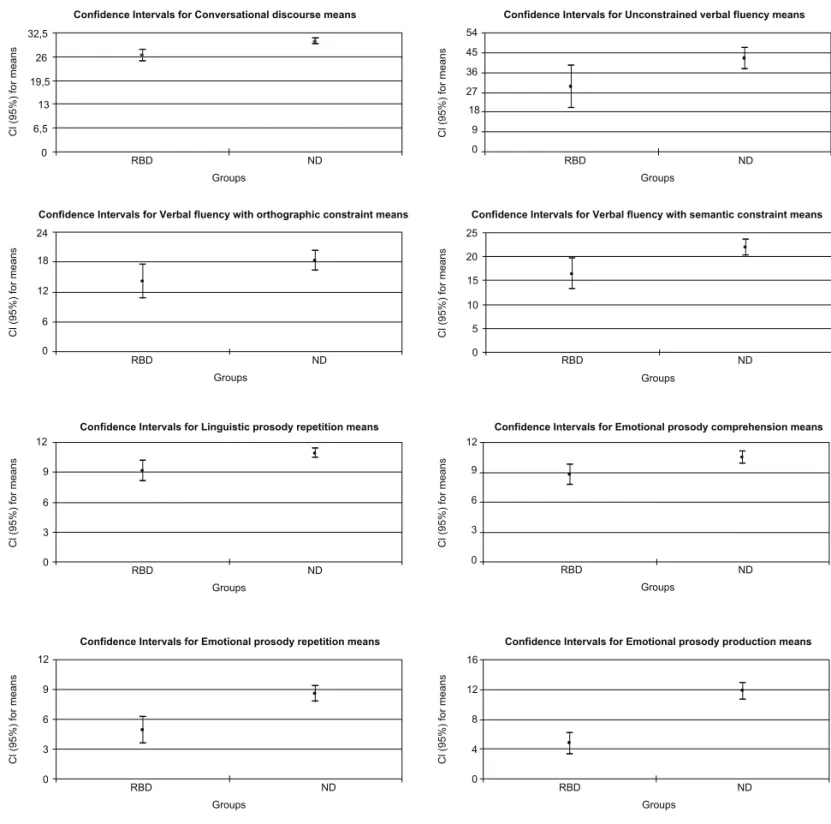
The study results are presented in Tables 3 and 4, and in Figure 1. Table 3 shows mean and standard deviation values obtained for the clinical and the control groups in the Brazilian MAC Battery, as well as the level of signifi -cance of the difference between the communicative per-formance means of the two groups through the Student’s t-Test. Regarding results obtained in the questionnaire on defi cit awareness, 7 (24.0%) of the 29 RHBD participants presented defi ciency in the awareness evaluated. Also, coef-fi cients of the variation of the groups in the Brazilian MAC Battery can be seen in Table 3.
The analysis of the results presented in Table 3 indicates the presence of a signifi cant difference between the perfor-mance of the clinical group and the control group in the following Brazilian MAC Battery tasks: conversational dis-course, unconstrained verbal fl uency, verbal fl uency with orthographic constraint, verbal fl uency with semantic con-straint, linguistic prosody repetition, emotional prosody comprehension, emotional prosody repetition and emo-tional prosody production. A general tendency for a better performance by non-brain-damaged individuals compared
to RHBD participants was observed. Moreover, based on the coeffi cient of variation, a more reduced homogeneity in the performance of the clinical group compared to the con-trol group was registered in majority of tasks. In the Levene test for equality of variances, variances between the groups were signifi cantly unequal in the following subtests: con-versational discourse (p≤0.05), verbal fl uency with seman-tic constraint (p≤0.01), linguistic prosody comprehension
(p≤0.05) and linguistic prosody repetition (p≤0,001). For better visualization of the performance variability of the two groups, Figure 1 presents graphs with the con-fi dence intervals for mean values of clinical and control groups for tasks in which a signifi cant difference between the groups was found. This Figure shows that RHBD par-ticipants’ confi dence intervals are visibly larger than those of the non-brain-damaged group. Intersection among the confi dence intervals, where present, is small.
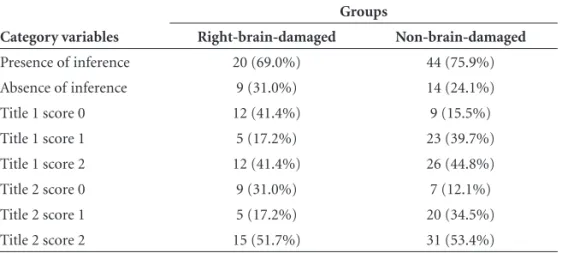
Data from narrative discourse tasks are displayed in Table 4. The table shows the proportion of RHBD and non-brain damaged individuals who have made the expected inference and who have scored 0, 1 or 2 in titles 1 and 2.
Data in Table 4 demonstrate that, regarding inferential processing, a larger proportion of non-damaged individuals elucidated the expected inference, although no signifi -cant differences among proportions in the Chi-square test
Table 3. Means, standard deviations and coeffi cients of variability of the groups on the MAC Battery.
Tasks ( /maximum score)
Groups
Right-brain-damaged Non-brain-damaged
M† SD‡ CV§ M SD CV
Conversational discourse ( /34)*** 26.24 3.91 0.15 30.07 2.73 0.09
Metaphor interpretation ( /40) 28.10 6.74 0.24 28.93 7.16 0.26
Unconstrained verbal fl uency** 29.48 25.54 0.87 42.22 17.46 0.41
Linguistic prosody comprehension ( /12) 8.34 3.10 0.37 9.45 2.37 0.25
Linguistic prosody repetition ( /12)** 9.14 2.58 0.28 10.91 1.65 0.15
Narrative discourse: partial retelling, main information ( /18) 11.07 4.14 0.37 11.47 3.88 0.34
Narrative discourse: full retelling ( /29) 6.66 3.65 0.55 7.91 3.39 0.43
Narrative discourse: comprehension questions ( /12) 9.28 2.32 0.25 9.19 2.60 0.28
Verbal fl uency with orthographic constraint * 14.10 8.84 0.63 18.29 7.54 0.41
Emotional prosody comprehension** ( /12) 8.76 2.65 0.30 10.47 2.21 0.21
Emotional prosody repetition*** ( /12) 4.86 3.51 0.72 8.57 2.96 0.35
Indirect speech acts interpretation ( /40) 29.97 3.80 0.13 30.50 3.99 0.13
Verbal fl uency with semantic constraint ** 16.41 8.53 0.52 21.86 6.36 0.29
Emotional prosody production*** ( /18) 4.75 3.77 0.79 11.74 4.22 0.36
Semantic judgement: identifi cation score ( /24) 21.72 2.77 0.13 22.41 2.25 0.10
Semantic judgement: explanation score ( /12) 7.24 3.03 0.42 8.24 3.19 0.39
were found (p=0.330). Regarding the titles given by the groups to the orally presented narrative, both titles 1 and 2 were associated to a larger percentage of the clinical group with score 0 and a lower percentage with score 1 and 2. However, only the differences in the distribution of title 1 scores were signifi cant (p≤0.05), with differences in title 2 being only marginal (p=0.055).
Discussion
Quantitative differences were found in the
communica-tive performance between the clinical and control groups in half of the tasks in the Brazilian MAC Battery, encompass-ing three types of communicative processencompass-ing: discursive, lexical-semantic and prosodic processing. The differences in tasks assessing discursive and prosodic components were generally more relevant than those observed in tasks evaluating the lexical-semantic component. The effect of RHB lesions on tasks examining conversational discourse abilities has been widely reported in the literature, with the following discursive characteristics: reduction of visual
Confidence Intervals for Conversational discourse means
0 6,5 13 19,5 26 32,5
RBD ND
Groups
Confidence Intervals for Unconstrained verbal fluency means
0 9 18 27 36 45 54
RBD ND
Groups
Confidence Intervals for Verbal fluency with orthographic constraint means
0 6 12 18 24
RBD ND
Groups
Confidence Intervals for Verbal fluency with semantic constraint means
0 5 10 15 20 25
RBD ND
Groups
Confidence Intervals for Linguistic prosody repetition means
0 3 6 9 12
RBD ND
Groups
Confidence Intervals for Emotional prosody comprehension means
0 3 6 9 12
RBD ND
Groups
Confidence Intervals for Emotional prosody repetition means
0 3 6 9 12
RBD ND
Groups
Confidence Intervals for Emotional prosody production means
0 4 8 12 16
RBD ND
Groups
Cl (95%) for means Cl (95%) for means
Cl (95%) for means Cl (95%) for means
Cl (95%) for means Cl (95%) for means
Cl (95%) for means Cl (95%) for means
Table 4. Proportion of individuals per group in terms of presence of inferencing and scores for titles 1 and 2 in narrative discourse task
Category variables
Groups
Right-brain-damaged Non-brain-damaged
Presence of inference 20 (69.0%) 44 (75.9%)
Absence of inference 9 (31.0%) 14 (24.1%)
Title 1 score 0 12 (41.4%) 9 (15.5%)
Title 1 score 1 5 (17.2%) 23 (39.7%)
Title 1 score 2 12 (41.4%) 26 (44.8%)
Title 2 score 0 9 (31.0%) 7 (12.1%)
Title 2 score 1 5 (17.2%) 20 (34.5%)
Title 2 score 2 15 (51.7%) 31 (53.4%)
contact and facial expression, diffi culty in choosing words to express feelings,27 unclear and ambiguous expression of
ideas and references,28 reduction of vocal intonation and
use of a monotonous pattern,27 diffi culty in
understand-ing the interlocutor’s intention and pragmatic aspects in general,29 among other features.
Regarding prosodic impairment, the reduction of perception and production of intonation curves of lin-guistic and emotional prosody has frequently been
de-scribed in RHB damage conditions.30,31 Besides the
sig-nificant differences observed between the groups in discursive and prosodic processing, RHBD individuals have also presented lower performance in verbal flu-ency tasks investigating lexical-semantic abilities, com-pared to non-brain-damaged participants. Less sig-nificant differences in lexical-semantic abilities had been expected, since this type of processing is
gener-ally more impaired in left-brain-damaged individuals.32
Thus, the initial hypothesis, which predicted the occur-rence of signifi cant diffeoccur-rences between the groups for the four types of communicative processing examined by the Brazilian MAC Battery, with the least signifi cant differences expected in the lexical-semantic component compared to the other types of processing, was not fully confi rmed. A right-brain-damage effect was not found in this group study on tasks that formally examined pragmatic-infer-ential processing. The groups do not differ in relation to pragmatic-inferential performance in the metaphor inter-pretation task nor in the indirect speech acts interpreta-tion task. Two factors may have contributed to the absence of a signifi cant difference between the groups. The fi rst relates to the formality of these tasks, which might have been facilitative considering the complexity generated by numerous communicative clues present in the individuals’ daily routine. This facilitation occurs specifi cally in RHBD
individuals, who are unable to take advantage of clues from the real communicative context. This explanation is postu-lated due to a dissociation observed in this study between the absence of difference in metaphoric and speech acts comprehension, normal tasks, along with the presence of difference in the conversational discourse task, a functional subtest. This test is characterized by the existence of a con-text of real communicative exchanges between interlocu-tors, in which various pragmatic aspects, such as non-literal message comprehension given by the interlocutor (exam-iner) are evaluated to give the fi nal score.1 In the literature,
impaired comprehension of non-literal information, that is, of inferential processing at the conversational discursive level, is associated with RHB damage.18,33 The second factor
consists of the probable heterogeneity present in the RHBD participants evaluated in this study, where there may be some individuals with RHB lesion in the sample who pres-ent communicative impairmpres-ent and others who do not.
The heterogeneity factor is strongly correlated to the second hypothesis of this study – the clinical group will present a less homogeneous performance than the control group. This hypothesis was confi rmed through observation of a pattern of higher variability among RHBD individuals compared to non-brain-damaged participants. Consider-ing that about 50% of individuals who present an RHB vascular lesion show communicative changes and that, in the present study, the recruitment of the clinical group was not based on the inclusion criterion of the presence of communicative defi cit, only 50% of this group presenting communicative defi cits was expected. The notion that a lesion to the right side of the brain does not automatically
impair communicative abilities was confi rmed.22
the effect of RHB lesion in communication.34 There are
disadvantages in studying individuals who are undergoing rehabilitation for altered communicative patterns because they represent a distorted sample and therefore this was an exclusion criterion in the present study. On the other hand, there also are advantages of selecting an RHB
dam-aged sample based only on the presence of the lesion per
se, which was the case in this study. This type of selection allows the investigation of clinical subgroups, despite the fact that the mean of the group may confound an existing communicative defi cit.
Several factors are pointed to in the literature as being responsible for the inter-subject variability verifi ed in the RHBD samples of group studies. Briefl y, this variability is linked to the inclusion of individuals with different neuro-logical characteristics, such as lesions in different sites, with different extents, different levels of clinical severity, besides various non-neurological attributes, such as schooling, age, manual dominance, pre-morbid knowledge and abilities. Moreover, the variability in physiological and psychological adaptation that occurs in distinct periods over time and with distinct compensations for each individual may also play a role.5,6,34,35
In this investigation, some of these attributes have been controlled for, such as schooling, age, manual dominance, among others. However, due to the great diffi culty in form-ing a clinical group with rigorous control over various in-clusion criteria, important variables have not been totally controlled for, such as time following lesion onset and ex-tent of vascular accidents. It is noteworthy that the imple-mentation of this ideal a priori control is not possible in group studies, since it implies a methodological change in the study design: from group studies to multiple-case stud-ies. Taking into consideration the diffi culties in conducting group studies with ideal control of inter- and intra-subject variables, as well as the inherent heterogeneity of the clini-cal population of RHBD individuals, the development of studies of clinical profi le grouping (cluster) and of indi-vidual and multiple-case studies for the investigation of dissociations has been recommended in the literature.3,18,22
In studies on aphasia – partial loss of language presented by the majority of left-brain-damaged individuals – het-erogeneity has been reduced by grouping different clinical subgroups, which has led to the classifi cation of aphasia typology.
Therefore, this study has identifi ed RHB lesion effects using the Brazilian MAC Battery subtests which evaluate discursive, prosodic and lexical-semantic communicative processing, providing evidence of a more prominent ef-fect in the two fi rst types of processing than in the third. RHB lesion also infl uenced pragmatic processing in the
conversational discourse task. Moreover, the RHBD group exhibited less homogeneous communicative performance compared to the control group.
In order to better understand the heterogeneity pres-ent in communicative defi cits and in their manifestations following an RHB neurological problem, more empirical studies should be encouraged employing the highest meth-odological rigor possible. The current study, representing a pioneering study into right-brain-damaged populations in the Brazilian context, contributes with initial and illustrative results. Further studies are necessary mainly involving ex-ploratory group investigations on the existence of different clinical profi les and case studies, including a general neuro-psychological description of this neurological population.
Acknowledgements – We extend our gratitude to Yves
Joanette, Bernadette Ska and Hélène Côté (Université de Montréal, Canada), authors of the Protocole MEC, for the constant scientifi c and clinical exchange regarding the ad-aptation of the Protocole MEC to Bateria MAC and the use of this battery with neurologically impaired patients. CAPES (Coordenação de Aperfeiçoamento de Pessoal de Nível Superior).
References
1. Joanette Y, Ska B, Côté H. Protocole MEC - Protocole Mon-tréal d’Évaluation de la Communication. Montreal: Ortho Édition; 2004.
2. Eisenson J. Language dysfunctions associated with right brain damage. Am Speech Hear Assoc 1959;1:107-107.
3. Côté H, Payer M, Giroux F, Joanette Y. Towards a description of clinical communication impairment profiles following right-hemisphere damage. Aphasiology 2007;21:739-749. 4. Myers PS. Right hemisphere damage: Disorders of
commu-nication and cognition. San Diego, CA: Singular Publishing Group; 1999.
5. Van Lancker DV. Rags to riches: our increasing appreciation of cognitive and communicative abilities of the human right cerebral hemisphere. Brain Lang 1997;57:1-11.
6. Kotz SA, Meyer M, Alter K, Besson M, von Cramon DY, Friederici AD. On the lateralization of emotional prosody: an event-related functional MR investigation. Brain Lang 2003;86:366-376.
7. Martins IP, Antunes NL, Castro-Caldas A, Antunes JL. Atypi-cal dominance for language in developmental dysphasia. Dev Med Child Neurol 1995;37:85-90.
8. Guerreiro M, Castro-Caldas A, Martins IP. Aphasia follow-ing right hemisphere lesion in a woman with left hemisphere injury in childhood. Brain Lang 1995;49:280-288.
10. Code C. Language aphasia and the right hemisphere. Chich-ester: J. Wiley; 1987.
11. Joanette Y, Goulet P, Hannequin D. Right hemisphere and verbal communication. New York: Springer; 1990.
12. Tompkins CA. Right hemisphere communication disorders: theory and management. San Diego, CA: Singular; 1995. 13. Marini A, Carlomagno S, Caltagirone C, Nocentini U. The
role played by the right hemisphere in the organization of complex textual structures. Brain Lang 2005;93:46-54. 14. Cutica H, Bucciarelli M, Bara BG. Neuropragmatics:
extra-linguistic pragmatic ability is better preserved in left-hemi-sphere-damaged patients than in right-hemileft-hemi-sphere-damaged patients. Brain Lang 2006;98:12-25.
15. Beausoleil N, Fortin R, Le Blanc B, Joanette Y. Unconstrained oral naming performance in right- and left-hemisphere-dam-aged individuals: when education overrides the lesion. Apha-siology 2003;17:143-158.
16. Hoyte KJ, Brownell H, Vesely L, Wingfi eld A. Decomposing prosody: use of prosodic features for detection of syntactic structure and speech affect by patients with right hemisphere lesions. Brain Lang 2006;99:35-37.
17. Gardner H, Brownell HH. Right hemisphere communication battery. Boston: Psychology Service; 1986.
18. Zaidel E, Kasher A, Soroker N, Batori G. Effects of right and left hemisphere damage on performance of the “Right Hemi-sphere Communication Battery”. Brain Lang 2002;80:510-535. 19. Bryan KL. The Right Hemisphere Language Battery. 2nd ed.
England: Whurr; 1995.
20. Bryan KL, Hale JB. Differential effects of left and right cere-bral vascular accidents on language competency. J Int Neu-ropsych Soc 2001; 7:655-664.
21. Myers PS. Profi les of communication defi cits in patients with right cerebral hemisphere damage: implications for diagnosis and treatment. Aphasiology 2005;19:1147-1160.
22. Fontanari JL. A neurolingüística e a pragmática: um lugar do hemisfério direito da linguagem. Neurobiologia 1990;53:85-112. 23. Fonseca RP, Parente MAMP, Côté H, Ska B, Joanette Y. Bateria Montreal de Avaliação da Comunicação – Bateria MAC. São Paulo:Pró-Fono; 2007a: in press.
24. Fonseca RP, Parente MAMP, Côté H, Joanette Y. Processo de adaptação da Bateria Montreal de Avaliação da Comunica-ção – Bateria MAC – ao Português Brasileiro. Psicol Refl Crít 2007b; 20: in press.
25. Joanette Y, Goulet P, Daoust H. (1991). Incidence et profi ls des
troubles de la communication verbale chez les cérébrolésés droits. Rev Neuropsychol 1991;1:3-27.
26. Benton E, Bryan K. Right cerebral hemisphere damage: inci-dence of language problems. Int J Rehabil Res 1996;19:47-54. 27. Folstein MF, Folstein SE, McHugh PR. Mini-mental state. J
Psychiatr Res 1975;12:189-198.
28. Chaves ML, Izquierdo I. Differential diagnosis between de-mentia and depression: a study of effi ciency increment. Acta Neurol Scand 1992;11:412-429.
29. Yesavage JA, Brink TL, Rose TL, Lurn O. Development and validation of a geriatric depression screening scale: a prelimi-nary report. J Psychiatr Res1983;17:37-49.
30. Hécaen H. Clinical symptomatology in right and left hemi-spheric lesions. In: Mountcastle VB, editor. Interhemihemi-spheric relations and cerebral dominance. Baltimore: Johns Hopkins; 1962:215-243.
31. Mackenzie C, Begg T, Brady M, Lees KR. The effects on verbal communication skills of right-hemisphere stroke in middle age. Aphasiology 1997;11:929-945.
32. Chantraine Y, Joanette Y, Ska B. Conversational abilities in patients with right hemisphere damage. J Neurolinguist 1998;11:21-32. 33. Kasher A, Batori G, Soroker N, Gravers D, Zaidel E. Effects of right and left hemisphere damage on understanding conver-sational implicatures. Brain Lang 1999;68:566-590.
34. Blonder LX, Heilman KM, Ketterson T, et al. Affective facial and lexical expression in aprosodic versus aphasic stroke pa-tients. J Int Neuropsych Soc 2005;11:677-685.
35. Leon SA, Rosenbek JC, Crucian GP, et al. Active treatments for aprosodia secondary to right hemisphere stroke. J Rehabil Res Dev 2005; 42:93-101.
36. Vilki J, Levänen S, Servo A. Interference in dual-fl uency tasks after anterior and posterior cerebral lesions. Neuropsycholo-gia 2002;40:340-348.
37. Mackenzie C, Brady M. Communication ability in non-right handers following right hemisphere stroke. J Neurolinguist 2004;17:301-313.
38. Tompkins CA, Fassbinder W, Lehman-Blake MT, Baumgaert-ner A. The nature and implications of right hemisphere lan-guage disorders: issues in search of answer. In: Hillis AE, edi-tor. The handbook of adult language disorders – integrating cognitive neuropsychology, neurology, and rehabilitation. New York: Psychology Press; 2002:429-448.
APPENDIX A
Description of Brazilian MAC Battery’s tasks
Questionnaire on defi cit awareness. This task was administered only to the clinical sample group, since it was specifi cally designed for assessing awareness of communication impairments in individuals who suffer lesions along with its impact on their routines, that is, of the occurrence of anosognosia. The questionnaire is composed of seven closed questions de-manding yes/no answers.
Conversational discourse. The examiner introduces two different themes during a ten-minute-long dialog. Four themes are suggested: family, work, leisure and current events such as the Presidential campaign. Various linguistic components are
observed a posteriori through the analysis of 17 aspects (such as indifference to comments like funny remarks).
Metaphor interpretation. The stimuli are 20 metaphoric sentences: the 10 fi rst ones are non-conventional metaphors in Brazilian Portuguese (e.g., “Meu pai é um pavão” – “My father is a peacock”) – and the 10 fi nal ones, idiomatic expressions (e.g., “Tenho que pôr a mão na massa” – meaning “to get stuck in” – “I have to start doing something”). The examinee is ori-ented to explain the meaning of each sentence.
Unconstrained verbal fl uency. The clinician asks the participant to say the largest number of words they can in a period of two minutes and thirty seconds.
Linguistic prosody comprehension. The individual is asked to identify if the intonation of simple sentences is affi rmative, in-terrogative or imperative (e.g., “João toma café” – “John drinks coffee”), previously audio recorded. There are 12 sentences.
Linguistic prosody repetition. The participant is asked to repeat each sentence with the same intonation that was identifi ed. The 12 stimuli are the same as the previous subtest.
Narrative discourse. This task, based on an oral fi ve-paragraph narrative, presents three subtests: 1) partial retelling, para-graph by parapara-graph; 2) full retelling; and 3) 12 comprehension questions. The individual under examination is also asked to give the story two titles: title 1 – before the comprehension questions – and title 2 – after the comprehension questions. At the end of the task, the examiner judges whether the expected inference had been made or not, based on the participant’s answers.
Verbal fl uency with orthographic constraint. The participant is oriented to say the largest number of words possible start-ing with the letter P in two minutes.
Emotional prosody comprehension. The examinee has to identify the intonation – happiness, sadness or anger – in 12 sentences of simple grammatical structure with a neutral content (e.g., “Tiago vai sair” - Tiago is going to leave”), previously audio recorded.
Emotional prosody repetition. The individual repeats each sentence in the same intonation that had been identifi ed (same 12 stimuli used in the previous task).
Indirect speech act interpretations. The stimuli are 20 brief situations – 10 ending with a direct speech act in which the in-terlocutor’s intention is explicit (e.g., “Esta nova televisão funciona muito bem” – “This new television works very well”, mean-ing “Esta nova televisão é boa” – “This new television is good”) and the other 10 ending with an indirect speech act, in which the interlocutor’s intention is implicit (e.g., “João, a porta do seu quarto está aberta” – “João, the door of your room is open”, meaning “João, feche a porta” – “João, close the door”). The participant is asked to explain what the person intended to say.
Verbal fl uency with semantic constraint. The examinee says the largest number of words as possible that denote pieces of clothing in two minutes.
Emotional prosody production. The participant is oriented to say a sentence with the intonation which expresses the emotion – happiness, sadness or anger – induced by a situation (e.g., “Acabei de vir do médico” – “I’ve just arrived from the doctor”). There are nine stimuli.
Semantic judgement. The person is initially asked to say whether there is a relationship or not between two words (yes
/ no answer); if yes, they should proceed in explaining what the relationship. A total score of the identifi ed relationships (identifi cation score) is calculated, as well as a total score of explanations for the existing relationships (explanation score).