The measurement of coal porosity with different gases
C.F. Rodrigues*, M.J. Lemos de Sousa
Departamento e Centro de Geologia, Faculdade de Cieˆncias, Universidade do Porto, Pracßa de Gomes Teixeira, 4099-002 Porto, Portugal
Abstract
Sorption processes can be used to study different characteristics of coal properties, such as gas content (coalbed methane potential of a deposit), gas diffusion, porosity, internal surface area, etc. Coal microstructure (porosity system) is relevant for gas flow behaviour in coal and, consequently, directly influences gas recovery from the coalbed. This paper addresses the determination of coal porosity (namely micro- and macroporosity) in relation to the molecular size of different gases. Experiments entailed a sorption process, which includes the direct method of determining the ‘‘void volume’’ of samples using different gases (helium, nitrogen, carbon dioxide, and methane). Because gas behaviour depends on pressure and temperature conditions, it is critical, in each case, to know the gas characteristics, especially the compressibility factor. The experimental conditions of the sorption process were as follows: temperature in the bath 35C; sample with moisture equal to or greater than the moisture-holding capacity (MHC), particle size of sample less than 212mm, and mass ca. 100 g. The present investigation was designed to confirm that when performing measurements of the coal void volume with helium and nitrogen, there are only small and insignificant changes in the volume determinations. Inducing great shrinkage and swelling effects in the coal molecular structure, carbon dioxide leads to ‘‘abnormal’’ negative values in coal void volume calculations, since the rate of sorbed and free gas is very high. In fact, when in contact with the coal structure, carbon dioxide is so strongly retained that the sorbed gas volume is much higher than the free gas volume. However, shrinkage and swelling effects in coal structure induced by carbon dioxide are fully reversible. Methane also induces shrinkage and swelling when in contact with coal molecular structure, but these effects, although smaller than those induced by carbon dioxide, are irreversible and increase the coal volume.D2002 Published by Elsevier Science B.V.
Keywords:Coal porosity; Gas compressibility factor; Void volume
1. Introduction
Gas sorption capacity of coal is a rather important issue in coalbed methane prospecting. It contributes to the understanding of both storage and recovery pro-cesses.
The gas content of coal has been studied by several authors who concluded that it varies with the charac-teristics of the coal, such as porosity of macerals, and with temperature and pressure (Mavor et al., 1990; Levine, 1993; Rodrigues and Lemos de Sousa, 1999). Methane is usually the predominant gas present in a coal seam. However, it is known that several other gases, such as ethane and heavier hydrocarbons [C2 +], as well as carbon dioxide, nitrogen, and hydrogen sulphide are also present as revealed by gas chromato-graphic analysis.
0166-5162/02/$ - see front matterD2002 Published by Elsevier Science B.V.
PII: S 0 1 6 6 - 5 1 6 2 ( 0 1 ) 0 0 0 6 1 - 1
*
Corresponding author. Tel.: 3401471; fax: +351-22-3325937.
E-mail address:[email protected] (C.F. Rodrigues).
2. Coal porosity and void volume
2.1. Definitions
Conceptually,coal porosityis the volume fraction of coal occupied by ‘‘empty spaces’’; operationally, coal porosity is the volume fraction of coal that may be occupied by a particular fluid. This varies from fluid to fluid (Levine, 1993).
In its natural state, in the seam, coal also contains inherent moisture (Bed Moisture, moisture-holding capacity—MHC), which occupies part of the pore structure, and the volume fraction free to be occupied by gases in sorption processes corresponds to the so-calledvoid volume.
2.2. Classification of coal pores
Different authors have proposed various classifica-tions of pores in coal (Van Krevelen, 1993). However, most of them agree with the classification resulting from high-resolution electron microscopy, as shown in Table 1 (Manual of Symbols and Terminology for Physicochemical Quantities and Units, 1972; McEna-ney and Mays, 1989).
In fact, however, coal is charaterized by a dual porosity, which consists of micropore and macropore systems. The micropore system is estimated to have pore diameters less than 2 nm, which occur as part of the coal matrix. The macropore system is established by the fracture network that is currently designated by the cleat system (Van Krevelen, 1993). Other disconti-nuities that contribute to the macropore system are the bedding planes or surfaces. The latter have no impor-tant role concerning the gas flow due to the overburden pressure. The different coal porosities have a large con-tribution to the swelling and shrinkage of coal during
adsorption and desorption processes (Harpalani and Chen, 1997).
Macropores (primary porosity) predominate in lower rank coals (Fig. 1 and Table 1). Geophysical factors, such as compaction and water expulsion, progressively reduce porosity. At about low-volatile bituminous coal rank (ASTM Designation D 388-98a),
Table 1
Relationship between pore size and coal rank
Pore sizes Coal rank
(ASTM Designation D388-98a)
Micropores
d< 2 nm
high volatile bituminous coal A and higher
Mesopores 2 nm <d< 50 nm
high volatile bituminous coal (C + B)
Macropores
d> 50 nm
lignites + sub-bituminous
Fig. 1. Relationship between coal porosity and coal rank (after King and Wilkins, 1944, Levine, 1993; modified with data from McCartney and Teichmu¨ller, 1972).
Table 2
Methods of coal porosimetry (after Levine (1993), modified)
Major category
Scattering methods
Microscopic methods
Fluid probe methods
Method low angle
X-ray scattering
optical microscopy
volumetric fluid displacement
vapor sorption studies electron
scattering
scanning electron microscopy
heats of wetting
NMR spectroscopy neutron
scattering
transmission electron microscopy
the development of secondary porosity begins with the formation of meso-and micropores. This implies an increase of porosity due to well-known progressive changes in the molecular structure through higher ranks.
Porosity is also related to the maceral composition. Vitrinite predominantly contains microporous con-tents, whereas inertinite predominantly contains meso-and macroporous contents (Gan et al., 1972; Unsworth et al., 1989; Lamberson and Bustin, 1993; Levine, 1993).
3. Methods for measuring coal porosity
Current methods used to determine coal porosity are summarised in Table 2 (Levine, 1993).
Regarding ‘‘volumetric fluid displacement’’, liter-ature only refers to indirect methods based on the determination of He and Hg density (Levine, 1993). Therefore, the novelty of the present investigation is the application of a direct method, based on the meas-urement of void volume as determined by a sorption process of different gases, using an apparatus for gas sorption isotherm analysis.
4. Experimentation
For the present investigation, we used gases of different molecular sizes (Table 3) to establish their relationship with coal porosity.
The apparatus used for Languir sorption isotherms (Fig. 2) was briefly described by Rodrigues and
Table 3
Gases used in the experiments
Pure gas Formula Molecular diameter (nm)
Helium He 0.186
Nitrogen N2 0.300 – 0.410
Methane CH4 0.400
Carbon dioxide CO2 0.510 – 0.350
Fig. 2. Apparatus for the determination of gas sorption isotherms by coal. (1) Reference cell, (2) sample cell, (3) helium valve, (4) methane valve, (5) supply valve, (6) purge valve of the system, (7) purge valve of the cells, (8) thermocouple (temperatureT2), (9) thermocouple
(temperatureT3), (10) connection valve between cells, (11) thermostatic head, (12) thermometer (T1), (13) voltmeter, (14) computer with
software to perform the data acquisition.
Table 4
Rank and maceral composition of samples used in the experiments
Sample Rr (%) Maceral analyses (%, vol)
Vitrinite Liptinite Inertinite Mineral matter
A 0.73 52 5 34 9
B 0.73 78 3 12 7
Lemos de Sousa (1999) and Rodrigues et al. (1999). With regard to this device and the experiments that were performed, it should be noted that the apparatus (Fig. 2) was designed based on the volumetric techni-ques that use gas expansibility, based on Boyle’s Law of ideal gases, to perform the measurements of adsorbed gas. As adsorption isotherm characteristics significantly change, depending on the temperature level, it is necessary to keep the system in a constant temperature bath (T1) at F0. 01 C.
The equipment has a set of different valves (supply, purge, connection, and security), piping to permit gas flow (this piping can hold pressures up to 20 MPa), and two cells—the ‘‘reference cell’’ (where pressure can reach 17.5 MPa), and the ‘‘sample cell’’ (max-imum pressure of 7 MPa). The method implies that all results are calculated on the basis of volume determi-nations. The reference cell has a volume of ca. 100 cm3and the sample cell, ca. 200 cm3. However, due to the accuracy of the method, all volumes must be calculated with the precision of F10 4 cm3. The
temperature of the cells is controlled by
thermocou-ples (‘‘reference cell’’—T2, ‘‘sample cell’’—T3). In fact, the smallest variation in temperature implies changes in the cell pressure.
Pressures in both reference and sample cells (P1 and P2) are independently monitored by high-preci-sion pressure transducers.
All the time-dependent temperature and pressure data are fed into a computer with an acquisition plate of 20 channels ‘‘Armature Multiplexer Module’’ asso-ciated to a voltmeter with a resolution of F10mV.
The main characteristics of the tested samples are shown in Table 4. It should be noted that these samples have the same rank, similar liptinite, and mineral matter contents, as well as the same MHC value. Therefore, relevant differences in the character-istics of the coals are primarily, and intentionally, restricted to the vitrinite versus inertinite contents.
4.1. Experimental conditions
The specific experimental conditions used for the experiments are shown in Table 5. The following should also be noted.
. The moisture content of the test samples for
sorption isotherms is irrelevant, provided that it is equal or greater than the MHC, as demonstrated by various authors including Ruppel et al. (1972) and Rodrigues and Lemos de Sousa (1999).
. Pressure was chosen in order to avoid variations
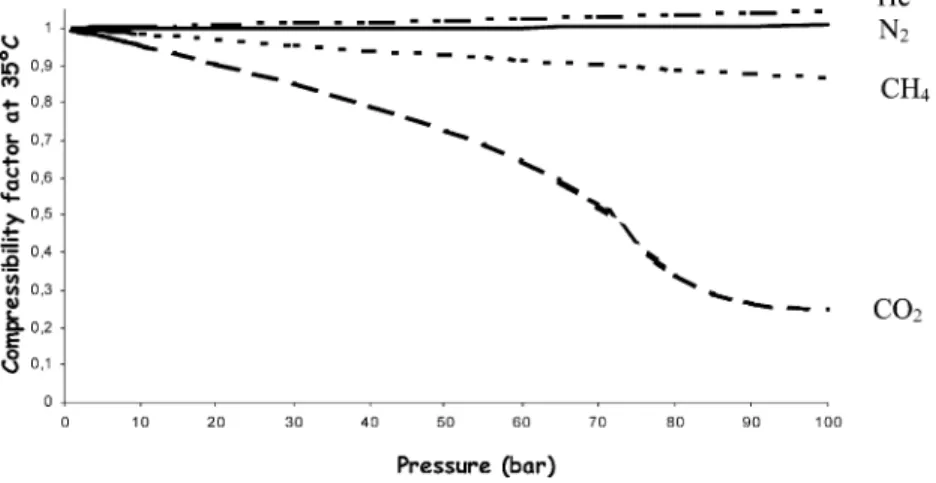
in the compressibility factor effect. In fact, it is well known that all gases at pressures up to 0.2 MPa have
Table 5
Experimental conditions
Sample Mass
(SC + M) (g)
T(C) MHC (%) M (%) Pressure
(bar)
A 115.66 35 3.7 18.1 < 2
B 115.56 35 3.2 18.6 < 2
SC—sample coal; M—moisture in the analysis sample; MHC— moisture-holding capacity.
almost the same compressibility factor value (Fig. 3). Therefore, for the current investigation, pressure was kept below 0.2 MPa.
. The system was kept in a constant temperature
bath at 35.00F0.01C.
.The weight of the samples was ca. 100 g crushed
to a particle size less than 212mm.
5. Results and discussion
Irrespective of the gas that was used, volume meas-urement of the empty ‘‘sample cell’’ of the apparatus is the same (Table 6). In fact, in such a case, gases are not in contact with the coal sample.
Due to its small molecular diameter and the absence of reaction with coal, helium is considered to be the only gas that gives a precise measurement of the void volume (Mavor et al., 1990). Therefore, the results in Tables 7 and 8 are interpreted as follows.
5.1. Measurements with He
The higher void volume of sample B compared with sample A corresponds to higher vitrinite content (Table 4). When He is used to measure the void volume, there is no coal shrinkage in the desorption process since it is a non-adsorptive gas, as confirmed by values listed in Table 8 showing that there are no significative variations in the results from the first test to the third.
5.2. Measurements with N2
Although the same general interpretation as the one above applies in this case, the main difference between the results of the two samples is due to the recognized affinity, albeit small, of N2for coal structure.
5.3. Measurements with CO2and CH4
It is well known that these gases have a greater affinity with coal structure (mainly vitrinite) than He and N2, in terms of the interaction of intermolecular forces (Van der Waals and hydrogen bonding) (Lev-ine, 1993; Van Krevelen, 1993).
This also explains the higher void volume obtained for sample A than for sample B. It is noted that the void volume determined with CO2 is ca. twice as much as the one determined with CH4.
The results shown on Table 8 confirm that swelling induced by adsorption process as well as the shrink-age resulting from desorption of carbon dioxide are reversible and do not modify the coal structure. It is also possible to observe some ‘‘abnormal’’ negative values in coal volumes, which result from the great affinity of CO2 for the coal structure. Since this method measures the volumetric relationship between the stored and the free gases in coal, the obtained results also confirm that a great quantity of CO2 is retained on coal structure.
The methane sorption process also induces swel-ling and shrinkage in coal but, in this case, both are irreversible processes, which depend on the rank and moisture of the coal. However, our results (Table 8) demonstrate that the void volume decreases from the first experimental test to the third one, which is explained by the increase of coal volume induced by methane.
The progressive increase of the N2/He, CH4/He, and CO2/He ratios conforms with the increase in
Table 6
Measurement of empty ‘‘sample cell’’ volumes
Gas Volumes (cm3)
He 195.12F0.40
N2 195.02F0.40
CH4 194.92F0.50
CO2 194.92F0.40
Table 7
Average of ‘‘void volumes’’ with different gases
Sample Gases (cm3)
He N2 N2/He CH4 CH4/He CO2 CO2/He CO2/CH4
A 110.76F0.40 117.87F0.30 1.06 146.78F1.00 1.33 288.56F1.20 2.61 1.97
affinity of N2, CH4, and CO2for the coal structure. Furthermore, in considering the CO2/CH4 ratio, we verified that the CO2affinity for the coal structure is ca. twice as much as that of CH4, even for pressures under 0.2 MPa. This clearly confirms and explains why coalbed methane (CBM) prospecting is enhanced by injecting CO2 in wells under pressure (Van der Meer, 2000), since CH4 is the major and most important component of CBM.
6. Conclusions
The measurement of coal porosity with different gases is a very complex subject in which both the size of the gas molecules and their relationship with the coal structure have to be taken into account.
The present study aimed at understanding the relationship between the gases used to investigate the coal porosity and the induced swelling and shrinkage of coal structure. In our opinion, this is an important issue to be considered in the coalbed methane pro-spection and production, since the referred parameters can dramatically induce changes in coal permeability. Since He is the gas with the smallest molecular size, it is expected to permeate, more successfully, the entire coal structure and, therefore, permit a more precise measurement of the void volume.
The fact that the same volume was obtained for the empty ‘‘sample cell’’ when using different gases (Table 6) leads to the conclusion that differences in void volume (Table 7) are a result of the relationship between coal structure and gas. If we consider He to be the gas that gives the standard measurement, then the following ranking in affinity to the coal structure is verified: N2> CH4> CO2.
Acknowledgements
The present investigation was subsidized by the Centro de Geologia da Universidade do Porto/Fundacß a˜o para a Cieˆncia e Tecnologia (Portugal). The first author also benefited from a Research Grant ref. BD/ 16047/98.
References
ASTM Designation D 388-98a—Standard Classification of Coals by Rank.
Gan, H., Nandi, S.P., Walker, P.L., 1972. Nature of the porosity in American coals. Fuel 51, 272 – 277.
Harpalani, S., Chen, G., 1997. Influence of gas production induced volumetric strain on permeability of coal. Geotech. Geol. Eng. 15, 303 – 325.
King, J.G., Wilkins, E.T., 1944. The internal structure of coal. Conf. Ultra-fine Structure of Coals and Cokes, London, 1943. The British Coal Utilization Research Association, London, pp. 46 – 56.
Lamberson, M., Bustin, R.M., 1993. Coalbed methane character-istics of Gates Formation coals, Northeastern British Colum-bia: effect of maceral composition. AAPG Bull. 77, 2062 – 2076.
Levine, J.R., 1993. Exploring coalbed methane reservoir. Short Course. Institut Francßais du Pe´trole, Rueil-Malmaison, 265 pp. Manual of Symbols and Terminology for Physicochemical
Quanti-ties and Units, 1972. Pure and Applied Chemistry, vol. 31. Mavor, M.J., Owen, L.B., Pratt, T.J., 1990. Measurement and
eval-uation of coal sorption isotherm data. 65th Annual Technical Conference and Exhibition of the Society of Petroleum Engi-neers. Society of Petroleum Engineers, New Orleans, LA, pp. 157 – 170,SPE 20728.
McCartney, J.T., Teichmu¨ller, M., 1972. Classification of coals ac-cording to degree of coalification by reflectance of the vitrinite component. Fuel, 64 – 68.
McEnaney, B., Mays, T.J., 1989. Porosity in carbons and graphites. In: Marsh, H. (Ed.), Introduction to Carbon Science. Butter-worths, London, pp. 153 – 196.
Table 8
Measurement of ‘‘coal volumes’’ (Vc) and ‘‘void volumes’’ (Vv) with different gases
Sample Experimental tests Gases (cm3)
He N2 CH4 CO2
Vc Vv Vc Vv Vc Vv Vc Vv
A 1 80.83 114.29 77.21 117.81 47.57 147.34 94.11 289.03
2 81.11 114.01 76.92 118.1 47.73 147.18 92.44 287.36
3 80.63 114.49 77.32 117.7 49.18 145.74 94.38 289.3
B 1 83.37 111.75 75.22 119.8 46.53 148.39 75.52 270.44
2 83.6 111.52 75.41 119.61 50.98 143.94 73.44 268.36
Rodrigues, C., Lemos de Sousa, M.J., 1999. Further results on the influence of moisture in coal adsorption isotherms. The 51st Meeting of the International Committee for Coal and Organic Petrology, Bucharest, 1999. Abstracts Volume. Rom. J. Miner. 79, Suppl. No. 1, 18.
Rodrigues, C., Lemos de Sousa, M.J., Machado da Silva, J.M., 1999. Isote´rmicas de adsorcßa˜o de metano: importaˆncia para a prospeccßa˜o do ‘‘metano do carva˜o em camada’’. Comun. Inst. Geol. Min. 86, 329 – 334.
Ruppel, T.C., Grein, C.T., Bienstock, D., 1972. Adsorption of
meth-ane/ethane mixtures on dry coal at elevated pressure. Fuel 51, 297 – 303.
Unsworth, J.F., Fowler, C.S., Jones, L.F., 1989. Moisture in Coal: 2. Maceral effects on pore structure. Fuel 69, 18 – 26.
Van der Meer, B., 2000. Enhanced coalbed methane production in combination with CO2storage. Information, Netherlands
Insti-tute of Applied Geoscience TNO. Natl. Geol. Surv. 5, 13 – 17. Van Krevelen, D.W., 1993. Coal: Typology – Physics – Chemistry –