Analysis of word number and content
in discourse of patients with mild to
moderate Alzheimer’s disease
Juliana Onofre de Lira1, Thaís Soares Cianciarullo Minett2,
Paulo Henrique Ferreira Bertolucci3, Karin Zazo Ortiz4
ABSTRACT. Alzheimer’s disease (AD) is characterized by impairments in memory and other cognitive functions such as language, which can be affected in all aspects including discourse. A picture description task is considered an effective way of obtaining a discourse sample whose key feature is the ability to retrieve appropriate lexical items. There is no consensus on findings showing that performance in content processing of spoken discourse deteriorates from the mildest phase of AD. Objective: To compare the quantity and quality of discourse among patients with mild to moderate AD and controls.
Methods: A cross-sectional study was designed. Subjects aged 50 years and older of both sexes, with one year or more of education, were divided into three groups: control (CG), mild AD (ADG1) and moderate AD (ADG2). Participants were asked to describe the “cookie theft” picture. The total number of complete words spoken and information units (IU) were included in the analysis. Results: There was no significant difference among groups in terms of age, schooling and sex. For number of words spoken, the CG performed significantly better than both the ADG 1 and ADG2, but no difference between the two latter groups was found. CG produced almost twice as many information units as the ADG1 and more than double that of the ADG2. Moreover, ADG2 patients had worse performance on IUs compared to the ADG1. Conclusion: Decreased performance in quantity and content of discourse was evident in patients with AD from the mildest phase, but only content (IU) continued to worsen with disease progression.
Key words: Alzheimer’s disease, dementia, language.
ANÁLISE DO NÚMERO DE PALAVRAS E DO CONTEÚDO NO DISCURSO DE PACIENTES COM DOENÇA DE ALZHEIMER LEVE E MODERADA
RESUMO. Doença de Alzheimer (DA) é caracterizada por prejuízo na memória e em outras funções cognitivas, como a linguagem, que pode ser afetada em todos os aspectos, incluindo o discurso. Tarefa de descrição de figura é considerada uma forma eficaz de obter amostra de discurso cuja característica fundamental é a capacidade de recuperar itens lexicais adequados. Não há consenso nos achados sobre deterioração no desempenho do conteúdo do discurso na fase leve da DA.
Objetivo: Comparar a quantidade e a qualidade do conteúdo do discurso em pacientes com DA leve, moderada e controles.
Métodos: Foi feito um estudo transversal cuja amostra foi composta por indivíduos a partir de 50 anos, de ambos os sexos, com um ou mais anos de escolaridade. Foram divididos em três grupos: controle (GC), DA leve (ADG1) e DA moderada (ADG2) e a eles foi solicitado descrever a “prancha do roubo dos biscoitos”. Considerados na análise o número total de palavras completas faladas e o de unidades de informação (UI). Resultados: Não houve diferença significativa entre os grupos. Para o número de palavras, o CG apresentou desempenho significativamente melhor que AD1 e AD2, não houve diferença entre os dois últimos grupos. O GC produziu quase o dobro de unidades de informação em relação ao ADG1 e mais que o dobro do que ADG2. Além disso, o ADG2 apresentou pior desempenho nas UI em comparação ao ADG1. Conclusão:
Foi observado um evidente prejuízo no desempenho quanto à quantidade e ao conteúdo do discurso em pacientes com DA a partir da fase leve. Entretanto apenas o conteúdo continuou a se agravar com a progressão da doença.
Palavras-chave: doença de Alzheimer, demência, linguagem.
1PhD. Speech Therapist, Department of Speech Therapy, Federal University of São Paulo, SP, Brazil. 2M.D, PhD. Senior Researcher. University of Cambridge,
Cam-bridge, UK. 3M.D, PhD. Professor, Sector of Behavioral Neurology, Department of Neurology and Neurosurgery, Federal University of São Paulo, SP, Brazil. 4Speech
Therapist, PhD. Professor, Department of Speech Therapy, Federal University of São Paulo, São Paulo, SP, Brazil.
Juliana Onofre de Lira. Rua Itapura de Miranda 45/82 – 11055-090 Santos SP – Brazil. E-mail: [email protected] Disclosure: The authors report no conflicts of interest.
INTRODUCTION
D
ementia due to Alzheimer’s disease (AD) is acom-plex progressive degenerative brain disorder afect-ing multiple cerebral functions. It is considered the most common cause of dementia and afects between 5 and 8% of elderly over 60 years of age.1 According to the criteria
of the National Institute of Neurological Communica-tive Disorders and Stroke/Alzheimer’s Disease and Re-lated Disorders Association (NINCDS/ADRDA) for the diagnosis of probable AD, besides memory changes, the patient must necessarily display impairment in at least
one other cognitive function, which may be language.2
Language disturbances have been cited as one of the most important cognitive deicits among patients with
AD.3 hus, language assessment is included in several
neuropsychological batteries. hese batteries, however, tend not to cover the broader aspects of language, par-ticularly the functional linguistic aspect.4 While
analy-ses of language skills based on tasks such as picture and object naming in isolation from everyday discourse provide limited information on lexical access, analysis of language in the context of connected speech is more ecologically valid and provides more complete infor-mation about the integration of cognitive–linguistic abilities, a particularly relevant aspect in dementia. Ac-cording to Giles et al.,5 discourse ability entails a
com-plex interaction of linguistic, communicative and other cognitive processes where a picture description task is considered the most efective way of obtaining a suit-able discourse sample that can be standardized across many subjects. here are at least four beneits of using this instrument: (i) it provides a clear pictorial focus, thus reducing ambiguity about the subject matter; (ii) it reduces the demand on memory because the stimulus remains available to the subject at the time of evalua-tion; (iii) it minimizes confounders in analysis due to the controlled nature of the speech content; and (iv) when used to reevaluate, it monitors progression.6,7
One of the most used tools to elicit discourse is the Cookie heft picture (CTP) from the Boston Diagnostic
Aphasia Examination.8 he picture depicts a familiar
domestic scene with basic key vocabulary learned in childhood with distinct characters, time, and place con-trasts.5 Although it was originally devised for use with
aphasic patients, the CTP has proved its usefulness in clinical research with various groups of diseases, includ-ing AD, and in several diferent languages.
According to Mackenzie,6 a major element of the
picture description task is the ability to retrieve ap-propriate lexical items. One of the most known vari-ables is information units which are “words that are
intelligible in context and accurately convey informa-tion relevant to eliciting stimulus”.9 hrough the
pic-ture description task, discourse can also be quantiied, usually by frequency of syllables or total number of complete words.
Several studies were conducted considering content and quantitative analysis in AD patients compared to normal controls, as well as for other diseases. Nicholas et al.10 compared AD patients with normal controls (NC)
and against patients with Wernicke´s and anomic apha-sia. he authors found that NC produced signiicantly more content elements than patients with AD and aphasia while detecting no diferences among groups regarding number of total words. Croisile et al.11
mea-sured the number of words and amount of information spoken by moderate AD patients compared to NC and found that controls produced more words and higher
information content than AD patients. Kavé and Levy12
compared the description of the Cookie heft Picture and found that participants with mild AD provided fewer information units than control participants. he authors concluded that although subjects with AD do not difer from controls when an information category includes a limited number of possible units, as the maxi-mum number of information units increases, the difer-ences between the groups also increase.
Other studies have considered the stages of AD in the analysis of discourse. Hier et al.13 found that
pa-tients with dementia (AD and vascular dementia) spoke fewer total words than healthy controls, but comparison among the AD patients showed no worsening of perfor-mance with increasing severity; in terms of content, AD patients produced fewer relevant observations on the CTP than controls, further decreasing with disease progression. Giles et al.5 found signiicant diferences
between controls and individuals with AD regarding in-formation content spoken on the CTP, evident from the mildest phase of the disease. he authors also measured the number of syllables and noted that only moderate AD patients spoke a lower total number of words than healthy controls. Bschor et al.14 also found that patients
with AD provided less relevant information from the mildest stage on, although the number of words
pro-duced remained unchanged. Groves-Wright et al.,15
us-ing description of the CTP, observed that moderate AD subjects achieved signiicantly lower global scores than mild AD subjects and controls.
Taken together, the results of the studies cited above show that, in terms of quantitative and qualitative as-pects, there is no consensus on the indings.
com-pare quantitative and qualitative aspects of discourse among AD patients at mild and moderate stages and in healthy adult controls.
METHODS
his was a cross-sectional study carried out at the outpa-tient clinic in the Behavioural Neurology Division of the São Paulo Federal University. he study was approved by the local Research Ethics Committee. After receiving full information about the study, written informed consent was obtained from all enrolled subjects or their carers in case of mental incapacity.
Subjects. he sample consisted of control (CG) and AD (ADG) groups. he general inclusion criteria were: age ≥50 years; schooling ≥1 year; no history of alcoholism or drug use; no use of psychotropic medications, except atypical neuroleptics; and absence of visual or uncor-rected auditory impairments that might afect the out-come of the cognitive tests.
To evaluate general cognition and avoid the inclu-sion of patients with obvious dementia, the Mini-Men-tal State Examination (MMSE) was used as a screening tool. We adopted a Portuguese-translated version, with cut-of scores adjusted for subjects’ educational level:16
illiterate - 20; elementary (1 to 4 years of education) - 25; 5 to 8 years of education - 26.5; 9 to 11 years of education - 28; and high level (more than 12 years) – 29 points.
he CG consisted of healthy elderly volunteers with-out neurological or psychiatric disturbances. Controls were all functionally independent, conirmed by scor-ing zero on the Pfefer Questionnaire17 and cognitively
preserved according to education-adjusted scores on the MMSE.
he ADG group consisted of patients diagnosed as having probable AD based on the criteria of the
NINCDS-ARDRA.18 Only those individuals with an MMSE score
higher than 12 and undergoing treatment for AD with a therapeutic dose of acetyl cholinesterase inhibitors (Do-nepezil ≥5 mg, Rivastigmine ≥9 mg or Galantamine ≥8 mg) were selected. he AD group was subdivided into two subgroups, according to MMSE score:
ADG1 (mild AD): comprising patients whose scores on the MMSE were from two to four standard devia-tions according to the local norms for age and education proposed by Brucki et al.16
ADG2 (moderate AD): comprising those individu-als whose scores on the MMSE were from four to eight standard deviations according to the local norms for age and education proposed by Brucki et al.16
Procedure. Subjects were asked to describe the “Cookie heft” picture – CTP.19 he instruction given was: “Could
you tell me everything you are seeing in this igure.” he test began the moment the subject started to describe the scene and inished when the individual indicated that there was nothing more to be said. Interruptions by the researcher were avoided and encouragement was provided as needed. he discourse was taped and later transcribed for analysis, taking into account all sample uttered by the subject, including repetitions, hesitations and help solicitation.
he total quantity of complete words was considered for the analysis, as was the total number of information units (IU). he IUs represent the amount of information provided by the subject. One point was attributed for each IU spoken by the subject, even when this was men-tioned two or more times.
he 25 IUs proposed by Kave and Levy12 were used.
hese units were divided into four categories: sub-jects (boy, girl, mother), places (kitchen, exterior seen through the window), objects (cabinet, cookies, counter, curtain, dishes on the counter, faucet, loor, jar, plate, sink, stool, water, window) and actions (boy taking the cookie, boy or stool falling, woman drying or washing dishes/plate, water overlowing or spilling, the girl ask-ing for a cookie, woman unconcerned by the overlow-ing, woman indiferent to the children). When synony-mous expressions were used, these were accepted (e.g. ‘mammy’ and ‘mother’).
Statistical analysis. One-way ANOVA or Kruskal-Wallis tests were used to compare the total number of words and information units in the three groups: CG, ADG1 and ADG2. As both tests disclosed similar results, only the parametric results are shown. Post-hoc analysis was performed using Tukey’s test.
Multiple linear regression analyses were used to in-vestigate the individual relationships between indepen-dent and depenindepen-dent variables, where study group, age, sex and years of education were independent variables, and number of spoken words and information units were the dependent variables. Among the study groups, ADG1 was chosen as a reference. he assumptions of these analyses were veriied.
he Chi-square (c2) test (without correction of Yates)
was used to compare the categorical variables: sex and each information unit.
analyses were carried out using the statistical software SPSS (Statistical Package for the Social Science) 13.5.1 for Windows.
RESULTS
For this study, 63 individuals were screened: 26 healthy elderly volunteers and 37 AD patients. Six subjects were excluded from the control group and eleven from the ADG because their MMSE scores did not fulill the inclu-sion criteria for this study. herefore, 26 patients with AD and 20 controls participated in the study.
he CG was compared with two groups of AD pa-tients for performance on the MMSE: 15 subjects in the ADG 1 and 11 subjects in the ADG2.
Sociodemographic conditions. As shown in Table 1, no sta-tistically signiicant diference was found among ADG1, ADG2 and CG, regarding age and education. As out-lined, ADG2 patients had signiicantly lower scores on the MMSE than ADG1 patients, who in turn had lower scores than controls.
Table 1. Comparison among groups according to age, education, MMSE,
total words and IU.
Groups Variables
CG Mean (SD)
ADG1 Mean (SD)
ADG2
Mean (SD) F p
Age 71.1(5.2) 68.3(9.8) 75.7(7.8) 3.0 0.060
Education 6.2(4.3) 7.3(5.3) 4.0(2.5) 1.8 0.171
MMSE* 27.6(1.6) 23.7(2.3) 15.7(2.4) 115.6 ≤0.001
Total words 99.0(50.6) 39.3(17.1) 4.0(2.5) 16.6 ≤0.001
IU 13.7(3.8) 8.0(2.8) 4.5(3.6) 25.5 ≤0.001
*MMSE: Mini-mental state examination.
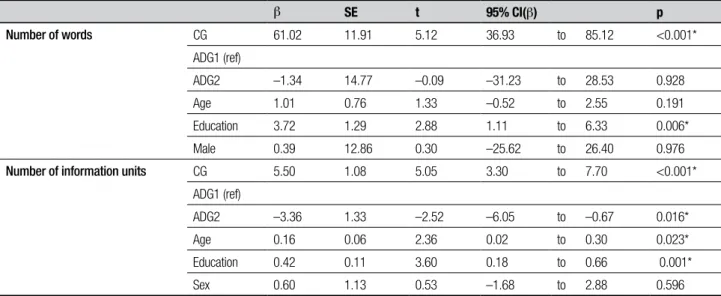
Table 2. Results of linear regression analysis for study groups and discourse performance controlling for sex, age and education.
b SE t 95% CI(b) p
Number of words CG 61.02 11.91 5.12 36.93 to 85.12 <0.001*
ADG1 (ref)
ADG2 –1.34 14.77 –0.09 –31.23 to 28.53 0.928
Age 1.01 0.76 1.33 –0.52 to 2.55 0.191
Education 3.72 1.29 2.88 1.11 to 6.33 0.006*
Male 0.39 12.86 0.30 –25.62 to 26.40 0.976
Number of information units CG 5.50 1.08 5.05 3.30 to 7.70 <0.001*
ADG1 (ref)
ADG2 –3.36 1.33 –2.52 –6.05 to –0.67 0.016*
Age 0.16 0.06 2.36 0.02 to 0.30 0.023*
Education 0.42 0.11 3.60 0.18 to 0.66 0.001*
Sex 0.60 1.13 0.53 –1.68 to 2.88 0.596
here were no signiicant diferences for sex among the study groups (CG – 51.6%, ADG1 – 25.8% and ADG2 – 22.6% of women; c2(2)=2.86; p=0.232).
Number of words and Information units. Signiicant difer-ences were found between the study groups regarding the number of words and IUs (Table 1). According to the post-hoc analysis (Tukey test), the CG performed signiicantly better than the ADG 1 (CI=29.7 to 89.6; p<0.001*) and the ADG2 (CI=32.3 to 100.3; p<0.001*) on number of words, but no signiicant diferences were observed between the two AD groups (CI=-29.1 to 42.4; p=0.895). he CG produced almost twice the number of information units than ADG1 (CI=2.7 to 8.5; p<0.001*) and more than double that of ADG2 (CI=5.9 to 12.3; p<0.001*). Moreover, patients with ADG2 performed worse than ADG1 for total number of IUs (CI=0.15 to 6.9; p=0.039*).
Linear regression analysis was carried out to verify whether the groups and discourse performance rela-tionships held after controlling the analysis for age, sex and education (Table 2).
he presence of AD was associated with a lower number of words and IUs, independently of sex, age and education. Compared to mild AD patients (AD1), healthy individuals produced approximately 61 words and 6 IUs more, whereas moderate AD patients (AD2) produced 1 fewer word and 3 fewer IUs.
DISCUSSION
he main inding of this study was a decline in both the quantity and content of speech in patients with AD in relation to NC. However, a diference between mild and moderate stages was seen only for the qualitative aspect.
AD patients spoke fewer words than healthy individ-uals, but there was no diference in this aspect between mild and moderate AD groups. his same outcome was observed by Hier et al.13 utilizing the CTP but this
ind-ing is not a consensus. When comparind-ing AD to controls, other studies, such as those carried out by Nicholas et al.,10 Bschor et al.14 and Feyereisen et al.,20 showed that
patients with AD had similar performance to healthy subjects in terms of words spoken. However, diferences in the methodologies used may explain this discrepan-cy. In the three studies cited, the AD group had more years of education than our group while Bschor et al.14
ranked the AD groups according to a functional scale (Global Deterioration Scale) and not the MMSE. Other researchers reporting worse performance in individuals with AD on number of words also considered the severi-ty of AD in their analysis. In the study by Giles, Paterson
and Hodges,5 patients with AD were divided into three
groups and only the most severe produced fewer words than healthy subjects. Carlomagno et al.21 ranked their
sample based on a diferent functional scale, the Clinical Dementia Rating, and found that subjects with moder-ate AD spoke fewer words than those with mild AD, who spoke fewer than control subjects. In the present study, the groups of patients with mild and moderate AD had similar performances. hus, another possible explana-tion for the disparity observed between our study and others could be due to diferences in stratiication pro-cedures. herefore, we conclude that there is a deicit in discourse luency in AD subjects compared with healthy individuals. Nonetheless, this alteration does not wors-en with disease progression. Hier et al.,13 despite having
found lower frequency in the AD group for total words, considered that the measure which best diferentiated the two groups was number of semantic units. In our sample, AD patients produced fewer content elements than healthy individuals. his inding corroborates re-ports in the literature.5,10-15,22 hus, we suggest a deicit
in conceptual production of information in AD21 where
the literature proposes some causes for this phenom-enon. One of the most common reasons cited is the ex-istence of impaired lexico-semantic processing caused by a deterioration in the related storage.5,22-24 Other
au-thors, on the other hand, propose that an inability to access the semantic storage may occur.25,26 here is also
a third hypothesis which proposes a failure in visual
stimulus recognition or in access to the semantic system due to visual processing.27,28 Besides the semantic
sys-tem, Glosser and Deser29 and Almor et al.30 airm that
degraded representations of verbal discourse depend
on attention and executive control. Perry and Hodges31
stated that deicit in discourse information its with the evidence that from initial stages of AD, attentional ex-ecutive function is impaired. Indeed, we believe that all these hypothesis can plausibly explain the information deicit in discourse production.
Although performance for number of words was similar in both AD groups, when we observed the spo-ken content, this was seen to worsen with progression of the disease. his discrepancy between content and luency in mild and moderate AD patients may be ex-plained by the fact that quantity of discourse may have been maintained through the use of redundant words or those unrelated to the content, which Nicholas et al.10
have called “noninformative speech”. his inding ap-pears to be frequent in studies utilizing the CTP.5,10,12-14,32
We also found that education inluenced number of words as well as information units. Mackenzie6 analyzed
picture-supported discourse with the CTP in healthy in-dividuals aged from 40 to 88 years and found that the less educated participants produced shorter and incom-plete descriptions. In our sample, education signiicant-ly inluenced the discourse in the healthy controls and AD participants.
Our study should be viewed in the light of some limi-tations. One such limitation is that the number of pa-tients and controls was relatively small. his fact might have afected the results obtained, mainly the similarity of the AD groups on performance with information units. Another limitation is that the mean education of our sample was lower than that of studies designed abroad. Despite the diference in this characteristic, it is important to consider this population of less educated aged individ-uals living in low and middle income countries (LAMIC) because, according to Ferri et al.,33 they are set to account
for the majority of patients with dementia in the world. Since patients with AD who are more educated perform better on cognitive tests than less educated patients, we were especially careful with our inclusion criteria and the process of stratiication of AD subjects, by considering not only raw MMSE scores, but also their adequacy with the local education norms.
with minimum memory requirements. Its analysis can be controlled and performance compared with patients with the same disease in other countries and various sociodemographic characteristics or even with repeat evaluations involving the same patient. hus, the CTP has proved its usefulness in clinical research in AD.5,6
Discourse production (and comprehension) remains an important ield for furthering knowledge on the dissolution of language in AD and a potential instru-ment for functional screening tools and therapeutic techniques to improve the lives of people living with dementia.
REFERENCES
1. Prince M, Bryce R, Albanese E, Wimo A, Ribeiro W, Ferri CP. The global prevalence of dementia: a systematic review and metaanalysis. Al-zheimers Dement 2013;9:63-75. e2.
2. McKhann GM, Knopman DS, Chertkow H, et al. The diagnosis of de-mentia due to Alzheimer’s disease: Recommendations from the Nation-al Institute on Aging-Alzheimer’s Association workgroups on diagnostic guidelines for Alzheimer’s disease. Alzheimers Dement 2011;7:263-269.
3. St-Pierre M-C, Ska B, Béland R. Lack of coherence in the narrative discourse of patients with dementia of the Alzheimer’s type. J Multil Commun Disord 2005;3:211-215.
4. Keller J, Rech T. Towards a modular description of the deficits in spon-taneous speech in dementia. J Pragmatics. 1998;29(3):313-32. 5. Giles E, Patterson K, Hodges JR. Performance on the Boston Cookie
Theft picture description task in patients with early dementia of the Al-zheimer’s type: missing information. Aphasiology 1996;10:395-408. 6. Mackenzie C. Adult spoken discourse: The influences of age and
edu-cation. International J Lang Commun Disord 2000;35:269-285. 7. Duong A, Ska B. Production of narratives: Picture sequence facilitates
organizational but not conceptual processing in less educated subjects. Brain Cogn 2001;46:121-124.
8. Goodglass H, Kaplan E. Boston diagnostic aphasia examination book-let: Lea & Febiger; 1983.
9. Nicholas LE, Brookshire RH. A system for quantifying the informative-ness and efficiency of the connected speech of adults with aphasia. J Speech Lang Hearing Res 1993;36:338-350.
10. Nicholas M, Obler LK, Albert ML, Helm-Estabrooks N. Empty speech in Alzheimer’s disease and fluent aphasia. Journal of Speech, Lang Hear-ing Res 1985;28:405-410.
11. Croisile B, Ska B, Brabant M-J, et al. Comparative study of oral and written picture description in patients with Alzheimer’s disease. Brain Lang 1996;53:1-19.
12. Kave G, Levy Y. Morphology in picture descriptions provided by persons with Alzheimer’s disease. J Speech Lang Hearing Res 2003;46:341-352.
13. Hier DB, Hagenlocker K, Shindler AG. Language disintegration in de-mentia: Effects of etiology and severity. Brain Lang 1985;25:117-133. 14. Bschor T, Kuhl K-P, Reischies FM. Spontaneous speech of patients with
dementia of the Alzheimer type and mild cognitive impairment. Int Psy-chogeriatr 2001;13:289-298.
15. Groves-Wright K, Neils-Strunjas J, Burnett R, O’Neill MJ. A comparison of verbal and written language in Alzheimer’s disease. J Commun Dis-ord 2004;37:109-130.
16. Brucki SM, Nitrini R, Caramelli P, Bertolucci PH, Okamoto IH. Sug-estões para o uso do mini-exame do estado mental no Brasil. Arq Neu-ropsiquiatr 2003;61:777-781.
17. Pfeffer R, Kurosaki T, Harrah C, Chance J, Filos S. Measurement of functional activities in older adults in the community. J Gerontol 1982;37:323-329.
18. McKhann G, Drachman D, Folstein M, Katzman R, Price D, Stadlan EM. Clinical diagnosis of Alzheimer’s disease Report of the NINCDS-ADRDA Work Group* under the auspices of Department of Health and Human Ser-vices Task Force on Alzheimer’s Disease. Neurology. 1984;34:939-944. 19. Goodglass H, Kaplan E. The assessment of aphasia and related
disor-ders: Lea & Febiger; 1972.
20. Feyereisen P, Berrewaerts J, Hupet M. Pragmatic skills in the early stag-es of Alzheimer’s disease: an analysis by means of a referential com-munication task. Int J Lang Commun Disord 2007;42:1-17.
21. Carlomagno S, Santoro A, Menditti A, Pandolfi M, Marini A. Referential communication in Alzheimer’s type dementia. Cortex 2005;41:520-534. 22. Ahmed S, de Jager CA, Haigh A-M, Garrard P. Semantic processing
in connected speech at a uniformly early stage of autopsy-confirmed Alzheimer’s disease. Neuropsychology 2013;27:79-85.
23. Chertkow H, Bub D. Semantic memory loss in dementia of Alzheimer’s type what do various measures measure? Brain 1990;113:397-417. 24. Hodges JR, Salmon DP, Butters N. Semantic memory impairment in
Alzheimer’s disease: Failure of access or degraded knowledge? Neuro-psychologia 1992;30:301-314.
25. Nebes RD. Semantic memory in Alzheimer’s disease. Psychol Bull. 1989;106:377-394.
26. Moreaud O, David D, Charnallet A, Pellat J. Are semantic errors actu-ally semantic?: evidence from Alzheimer’s disease. Brain Lang 2001; 77:176-186.
27. Laatu S, Revonsuo A, Jäykkä H, Portin R, Rinne J. Visual object recog-nition in early Alzheimer’s disease: deficits in semantic processing. Acta Neurol Scand 2003;108:82-89.
28. Harnish SM, Neils-Strunjas J, Eliassen J, et al. Visual discrimination predicts naming and semantic association accuracy in Alzheimer’s dis-ease. Cogn Behav Neurol 2010;23:231-239.
29. Glosser G, Deser T. Patterns of discourse production among neurologi-cal patients with fluent language disorders. Brain Lang 1991;40:67-88. 30. Almor A, Kempler D, MacDonald MC, Andersen ES, Tyler LK. Why do
Alzheimer patients have difficulty with pronouns? Working memory, se-mantics, and reference in comprehension and production in Alzheimer’s disease. Brain Lang 1999;67:202-227.
31. Perry RJ, Hodges JR. Attention and executive deficits in Alzheimer’s disease A critical review. Brain 1999;122:383-404.
32. Vuorinen E, Laine M, Rinne J. Common pattern of language impairment in vascular dementia and in Alzheimer disease. Alzheimer Dis Assoc Disord 2000;14:81-86.