Calcined Clay Lightweight Ceramics Made with Wood Sawdust and Sodium Silicate
Bruno Carlos de Santisa*, João Adriano Rossignoloa, Marcio Raymundo Morellib
Received: March 26, 2016; Revised: September 21, 2016; Accepted: October 2, 2016
This paper aims to study the inluence of including wood sawdust and sodium silicate in the production process of calcined clay lightweight ceramics. In the production process irst, a sample used by a company that produces ceramic products in Brazil was collected. The sample was analysed by techniques of liquidity (LL) and plasticity (LP) limits, particle size analysis, speciic mass, X-ray difraction (XRD) and X ray luorescence spectrometry (XRF). From the clay, specimens of pure clay and mixtures with wood sawdust (10%, 20% and 30% by mass) and sodium silicate were produced and ired at a temperature of 900 oC. These specimens were submitted to tests of water absorption, porosity, speciic mass and compressive strength. Results of this research indicate that the incorporation of wood sawdust and sodium silicate in the ceramic paste specimens can be useful to make calcined clay lightweight ceramics with special characteristics (low values of water absorption and speciic mass and high values of compressive strength), which could be used to produce calcined clay lightweight aggregates to be used in structural concrete.
Keywords: lightweight ceramics, lightweight concrete, sawdust, geo-polymers
* e-mail: [email protected]
1. Introduction
Structural lightweight concrete is an important building material due to its load-reducing properties, and has been applied in many diferent areas. In Brazil, the main applications of structural lightweight concrete use expanded clay, which requires an energy intensive process to reach its inal characteristics1,2.
Preliminary analysis indicate the viability of utilizing calcined clay lightweight aggregate as building material, despite the high level of water absorption. Furthermore, the calcined clay lightweight aggregates show promising compatible characteristics relative to structural concrete3-6.
However, to produce calcined clay lightweight aggregates with speciic characteristics, such as low water absorption or high compressive strength, the production process requires adaption. Commonly used additives to produce character-speciic lightweight ceramics are wood sawdust (to reduce the speciic mass) and alkaline activators (to reduce the water absorption and increase the compressive strength).
A mixture of wood sawdust and ceramic paste to obtain low speciic mass calcined clay lightweight ceramics has shown promising. The main downsides of the produced mixtures are a higher porosity of the material and increased water absorbency7-9.
To reduce the level of water absorption of products rich in silicon and aluminum oxide, alkali activators can be used. Alkali activators cause the products, when kept in a low-temperature alkaline environment, to obtain cementitious
properties due to an exothermic reaction10. The alkali activators have a positive efect on the hardening time of the products as well.
Geo-polymers are inorganic binders, as studied by Davidovits in the 1970s, originally referring to the investigations on the reaction of metakaolin in alkaline media forming aluminosilicate polymers7.
Geo-polymers are composed of a three-dimensional network in which silicon atoms alternate with aluminum atoms in tetrahedral coordination, sharing all the oxygen atoms. Its structure consists of a polymeric network Si-O-Al, with SiO4 and AlO4 tetrahedrons linked alternately by the oxygen atoms. The presence of cations in the structure of geo-polymers is essential for balancing the negative charge of the AlO4
10,11.
This characteristic, combined with the SiO2 and Al2O3 richness of the clay, can form geo-polymer chains by reacting with the alkali activator. The formed geo-polymer chains improve the absorbance and resistance characteristics of the ired samples, making them less absorbent and more resistant.
The pattern of geopolymer reactions comprises a set of reactions of dissolution, coagulation, crystallization and condensation. The irst step consists of breaking the covalent Si-O-Si and Al-O-Si, that occurs when the pH of the alkaline solution increases. Then happens the accumulation of products of the breaking of bonds and simultaneous interaction between them, forming a coagulated structure, leading to a third phase which corresponds to condensation and formation of a crystallized structure11,12.
a Programa de Pós-Graduação em Engenharia e Ciência dos Materiais, Universidade de São Paulo –
USP, Av. Duque de Caxias Norte, 225, CEP: 13635-900, Pirassununga, SP, Brazil
b Departamento de Engenharia de Materiais, Universidade Federal de São Carlos – UFSCar, Rodovia
Preliminary studies on the addition of alkaline activators in red ceramic pastes to reduce the water absorption of calcined clay lightweight products indicate that the use of sodium silicate as an alkaline activator can be viable. Samples made with these activators presented lower values of water absorption relative to samples made with just clay and water13.
This study aims to analyze the performance of calcined clay lightweight ceramics made with wood sawdust and sodium silicate as an alkaline activator, to produce less water absorbent and more resistant products with a low speciic mass. Furthermore, it is assessed whether this production process can be used to produce calcined clay lightweight aggregates for structural concrete.
2. Experimental Set-up and Materials
To analyze the performance of calcined clay lightweight ceramics, samples were produced using clay collected from a company that produces ceramic roof tiles located at Leme/ SP - Brazil. The collected clay is the same clay used in the production of the roof tiles. Before the sample production, the collected clay was analyzed by utilizing the following tests: liquidity (LL) and plasticity (LP) limits, particle size analysis, speciic mass, X-ray difraction (XRD) and X-ray luorescence spectrometry (XRF)14. The tests allowed for the characterization of the clay and its potential alkaline features.
Several samples were produced with diferent proportions of wood sawdust and sodium silicate (alkali activator). The irst samples were produced with only water and clay to allow for the performance comparison. The other samples included a proportion of sawdust and/or alkali activator (see Table 1). The wood sawdust was included as 10%, 20% or 30% by weight of the sample. If the alkali activator was included in the sample the sodium silicate was added with a 1:1 proportion relative to the water. Table 1 illustrates the amounts of materials used in each of the samples.
To produce the calcined clay aggregates the samples were extruded in a laboratory-sized extruder using a cylindrical mouthpiece, with 15 mm diameter. The specimens were cut in their inal dimensions (100 mm length x 15 mm diameter) after extrusion and were kept at room temperature for 48
hours. Next, the produced aggregates were exposed to temperature of 60 °C in a ventilated oven for 72 h. Finally, they are ired in a Jung brand furnace (model 10013, 7 kW) at 900 ºC for 60 min of dwell time. The iring of the furnace was performed with 4 ºC/min of heating rate and cooling at 6 ºC/min.
Several tests allowed for the performance analysis of the produced aggregates. The calcined clay aggregates were subjected to water absorption tests (after a 24 hours immersion) and apparent porosity tests. Furthermore, the speciic mass15 and the compressive strength16 of the aggregates were evaluated and compared.
3. Results
The presentation of the results is divided into two parts: the characterization of the raw material and the performance analysis of the calclined clay aggregates.
3.1. Characterization of the raw materials
The analyzed clay sample from the soil of Leme/SP – Brazil has values of liquid limit and plasticity limit of 58.0% and 25.9%, respectively. This corresponds to a plasticity index of 32.1%, characterizing the raw material as a material with plastic characteristics (plasticity index greater than 15%)17.
The plasticity limit further represents the minimum amount of water required for the clay to obtain moldable characteristics. High values of plasticity limit require more water addition to transform the sample into a moldable form. The clay sample demonstrates a plasticity index (32.1%), between the appropriate limits for molding (10% to 35%)17.
Table 2 displays the results of the particle size analysis of the clay. The sample is predominantly composed of clay (48.5%) and silt (37.5%), which conirms its highly plastic characteristics.
Figure 1 illustrates the X-ray difraction pattern of the clay. The presence of clay minerals is clearly visible in the igure. The peak in the range of 2θ = 27o indicates the presence of free quartz the clay sample, indicating possibility to improve the compressive strength of the inal product.
Table 1: Quantity of products used for molding the calcined clay samples.
Sample Clay (g) Wood sawdust (%) Water* (g) Activator (g)
100C-0WS 5210 0 1221
-90C-10WS 5210 10 1221
-80C-20WS 5210 20 921
-70C-30WS 5210 30 657
-100C-0WS-Si 5210 0 675 675
90C-10WS-Si 5210 10 675 675
80C-20WS-Si 5210 20 361.5 361.5
70C-30WS-Si 5210 30 435 435
Table 2: Particle size analysis of clay
Clay (%) Silt (%) Fine sand (%) Medium sand (%) Grit (%) Boulder (%)
48.5 37.5 10.0 3.0 1.0 0.0
Figure 1: X-ray difraction pattern.
Table 3 highlights the chemical composition of the clay sample. High levels of silicon dioxide (SiO2) and aluminum oxide (Al2O3) are clearly apparent, showing that the clay sample shows potential for alkali activation. Due to high levels of alkali oxides, the sample can be classiied as clay, a class typically used to obtain materials with special properties18.
The sawdust used in this work was collected from a sawmill located in São Carlos/SP. Table 4 displays the results of the particle size analysis of the sawdust, that’s predominantly composed of ine grains.
Table 5 highlights the characteristics of the sodium silicate, which was produced by ISOTEC Metallurgy Products, a company from São Carlos/SP.
Table 3: Chemical composition of clay
SiO2 (%) TiO2 (%) Al2O3 (%) Fe2O3 (%) MnO (%) MgO (%) CaO (%) Na2O (%) K2O (%) P2O5 (%)
68.18 0.614 14.42 4.88 0.088 1.81 0.32 0.31 4.20 0.110
Table 4: Chemical composition of clay
opening (mm) 4.8 2.4 1.2 0.6 0.3
-Retained mass (g) 1.29 9.47 21.60 106.11 517.30 296.02
% 0.14 0.99 2.27 11.15 54.35 31.10
Table 5: Characteristics of sodium silicate
Analysis Unit Speciication Result
Density (25o C) g/cm3 1.560 to 1.580 1.567
Speciic mass (25o C) oBé 52.00 to 53.00 52.500
SiO2 cp 32.50 to 33.50 33.490
Na2O % 14.50 to 15.30 15.210
Relation (SIO2/Na2O) % 2.12 to 2.31 2.200
Viscosity (25o C) % 900.00 to 1200.00 1100.00
3.2. Characterization of the calcined clay
lightweight samples
After the heat treatment, the samples may be considered calcined ceramics. Table 6 displays the values of apparent porosity and water absorption of the calcined samples.
A higher percentage of wood sawdust in the samples contributes to the increase of water absorption. The aggregate produced with just water and clay (100C-0WS) demonstrates a water absorption value of 18.21% while the 30% wood sawdust sample (70C-30WS) demonstrates a water absorption value of 47.27%.
Furthermore, the addition of sodium silicate in the ceramic pastes decreases the water absorption capabilities of the ired products, varying from 9.80% (100C-0WS-Si) to 43.87% (70C-30WS-Si).
Figure 2: Electron microscopy images of the calclined aggregates made with diferent amount of wood sawdust.
Figure 3: Water absorption and apparent porosity of calcined aggregates made with clay and wood sawdust, ired out at 900ºC
Figure 4: Water absorption and apparent porosity of calcined aggregates made with clay and wood sawdust and sodium silicate, ired out at 900ºC
Table 6: Water absorption and apparent porosity of calcined ceramics
Sample Water absorption (%) Standard deviation Apparent porosity (%) Standard deviation
100C-0WS 18.21 0.25 30.40 0.22
90C-10WS 25.27 1.46 31.68 1.64
80C-20WS 35.83 1.33 37.09 1.09
70C-30WS 47.27 0.69 44.02 0.55
100C-0WS-Si 9.80 0.67 15.26 1.07
90C-10WS-Si 18.42 0.41 22.42 0.31
80C-20WS-Si 25.84 0.35 26.47 0.43
70C-30WS-Si 43.87 0.84 43.19 1.06
Water absorption values of expanded clay aggregates are 6% (aggregates with dimension varying from 0 mm to 4.8 mm), 7% (aggregates with dimension varying from 6.3 mm to 12.5 mm) and 10% (aggregates with dimension varying from 12.5 mm to 19 mm). Relative to the samples presented in Table 6, it can be seen that specimens made just with clay, water and sodium silicate (100C-0WS-Si) presented water absorption values (9.80%) at the same level that those observed for the expanded clay aggregates2.
In Figures 3 and 4, the relative increase in water absorption and apparent porosity are compared for the calcined clay samples. A share of at least 20% wood sawdust increases both water absorption and apparent porosity signiicantly. As demonstrated before, the addition of sodium silicate reduces the water absorption and apparent porosity of the calcined samples, until a maximum of 20% wood sawdust. Higher percentages of wood sawdust lead to interference with the geo-polymerization, due to the lower amount of clay available for reaction. The interference with the geo-polymerization is caused by the iring of sawdust. When
exposed to temperatures above 600 oC, the sawdust can turn into gas. The elimination of the gases in the inal products can produce voids, making them more porous and permeable. This efect is strengthened due to the absence of a waterproof external layer. As a result the calcined samples with high levels of sawdust are more absorbent.
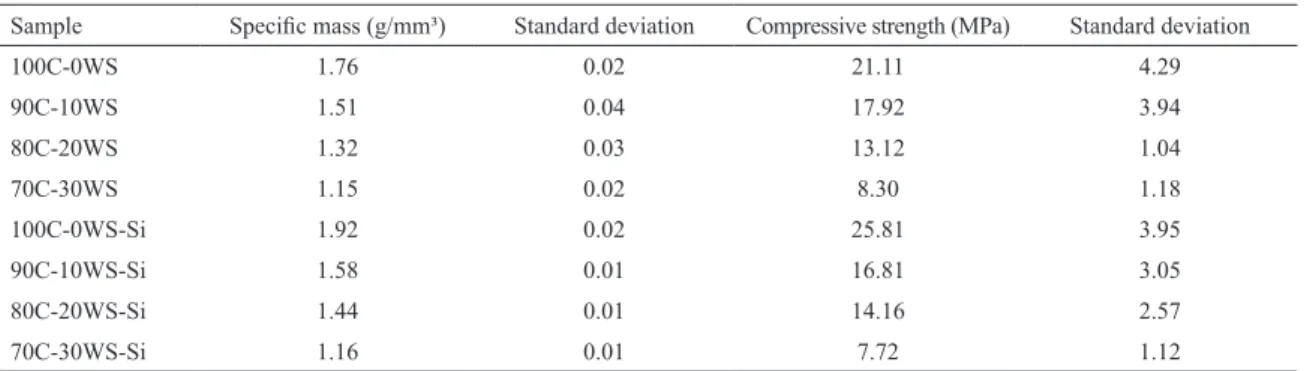
Complementary to the water absorption and apparent porosity tests, the speciic mass and compressive strength of the calcined aggregates were analyzed (Table 7).
Table 7: Speciic mass and compressive strength of calcined aggregates
Sample Speciic mass (g/mm³) Standard deviation Compressive strength (MPa) Standard deviation
100C-0WS 1.76 0.02 21.11 4.29
90C-10WS 1.51 0.04 17.92 3.94
80C-20WS 1.32 0.03 13.12 1.04
70C-30WS 1.15 0.02 8.30 1.18
100C-0WS-Si 1.92 0.02 25.81 3.95
90C-10WS-Si 1.58 0.01 16.81 3.05
80C-20WS-Si 1.44 0.01 14.16 2.57
70C-30WS-Si 1.16 0.01 7.72 1.12
A similar efect is apparent in the sodium silicate aggregates, with speciic mass varying between 1.92 g/cm³ (100C-0WS-Si) and 1.16 g/cm³ (70C-30WS-Si). However, the addition of the sodium silicate tends to increase the speciic mass of the samples, due to the geo-polymerization process during the heat treatment. The geo-polymerization process produces more dense and less porous aggregates.
The aggregate made just with clay, water and sodium silicate (100C-0WS-Si) has the highest value of speciic mass (1.92 g/cm³), the lowest value of water absorption (9.80%) and the lowest value of apparent porosity (15.26%) among all analyzed aggregates, due to the stronger geo-polymerization process (high clay availability and no sawdust).
Expanded clay lightweight aggregates have speciic mass values varying from 1.51 g/cm³ (aggregates with diameter until 4.8 mm) to 0.64 g/cm³ (aggregates with diameter from 12.5 mm to 19 mm). Comparing the values presented on Table 7 with the values presented by expanded clay aggregates and basalt aggregates (speciic mass equal to 2.95 g/cm3), the
calcined clay samples of this research present intermediary values of speciic mass3.
The compressive strength test utilized to characterize the calcined aggregates is based on the compressive strength test for cylindrical specimens of concrete15. The compressive
strength of the aggregates decreases with the increasing amount of wood sawdust (see Table 7). A higher percentage of wood sawdust makes the clay samples more porous, less resistant aggregate.
Furthermore, the aggregates with the added sodium silicate demonstrate an increase of compressive strength, due to the geo-polymerization process. This process results in more compact, less porous aggregates with a higher compressive strength resistance.
Expanded clay lightweight aggregates present compressive strength resistance of 8.4 MPa, for aggregates with diameter varying from 12.5 mm to 19 mm. Basalt aggregates present compressive strength resistance of 120 MPa for samples with similar diameter. Consequently, the calcined clay lightweight samples of this research present intermediary values of compressive strength relative to expanded clay lightweight aggregates and basalt aggregates2.
4. Conclusion
The use of wood sawdust in calcined clay aggregates provides a signiicant reduction in speciic mass relative to clay-only aggregates. However, the aggregates do become more porous and water absorbent. The addition of an alkali activator to the calcined clay aggregates can counteract these negative efects partially due to a geo-polymerization process, which results in more dense, resistant and less water absorbent aggregates.
The use of a mixture of wood sawdust and sodium silicate in the aggregate products allows for the production of materials with special characteristics (more resistant and less absorbent, with lower values of speciic mass). These mixtures demonstrate to be a viable alternative to produce lightweight aggregates in structural concrete, due to the possibility to produce lightweight aggregates with same characteristics of expanded clay aggregates but with an energetic gain.
5. Acknowledgment
To CAPES, CNPq and FINEP for the inancial support to perform this research, to Laboratório de Mecânica dos Solos do Departamento de Geotecnia da EESC/USP, to Laboratório de Construção Civil do IAU/USP, to laboratório de Construções Rurais e Ambiência da FZEA/USP and inally to Maristela Telhas Ltda. (Top Telha) company for providing raw material for this research.
6. References
1. Zhang MN, Gjϕrv OE. Mechanical Properties of High-Strength Lightweight Concrete. ACI Materials Journal. 1991;88(3):240-247. 2. Rossignolo JA. Concreto leve estrutural: Produção, propriedades,
microestrutura e aplicações. 1 ed. São Paulo: Pini; 2009.
3. de Santis BC. Agregado leve de argila calcinada para uso em
concreto estrutural: viabilidade da cerâmica vermelha do estado de São Paulo. [Dissertation]. São Carlos: Instituto de Arquitetura e Urbanismo de São Carlos, Universidade de São Paulo; 2012. 132 p.
4. Nawel S, Mounir L, Hedi H. Study of mechanical behavior of
lightweight aggregates concrete of Tunisian clay. Procedia
5. Chen HJ, Yang MD, Tang CW, Wang SY. Producing synthetic
lightweight aggregates from reservoir sediments. Construction
and Building Materials. 2012;28(1):387-394.
6. Kwang CL, Bui LAT, Lin KL, Lo CT. Manufacture and performance of lightweight aggregate from municipal solid waste incinerator ly ash and reservoir sediment for
self-consolidating lightweight concrete. Cement and Concrete
Composites. 2012;34(10):1159-1166.
7. Al-Bahar SK, Bogahawatta VTL. Development of lightweight
aggregates in Kuwait. The Arabian Journal for Science and
Engineering. 2006;31(1):231-239.
8. Mori FA, Covezzi MM, Mori CLS de O. Utilização de serragem de Eucalyptus spp. para a produção de tijolo maciço cerâmico. Floresta. 2011;41(3):641-654.
9. Chemani H, Chemani B. Valorization of wood sawdust in
making porous clay brick. Scientiic Research and Essays.
2013;8(15):609-614.
10. Bezerra IMT, Costa DL, Vitorino JPM, Menezes RR, Neves GA. Inluência da proporção do ativador alcalino nas propriedades mecânicas de materiais ativados alcalinamente. Revista Eletrônica de Materiais e Processos. 2013;8(2):101-105.
11. Sanjayan JG, Nazari A, Chen L, Nguyen GH. Physical and mechanical properties of lightweight aerated geopolymer. Construction and Building Materials. 2015;79:236-244.
12. Buchwald A, Hohmann M, Posern K, Brendler E. The suitability of thermally activated illite/smectite clay as raw material for
geopolymer binders. Applied Clay Science. 2009;46(3):300-304.
13. Santis BC, Rossignolo JA, Gavioli LM, Morelli MR. Evaluation of calcined clay lightweight aggregates made with alkali
activators. Key Engineering Materials. 2016;668:163-171.
14. Santis BC, Sichieri EP, Rossignolo JA, Ferreira G, Fiorelli J. Caracterização de massas cerâmicas do estado de S. Paulo
para produção de agregados leves para concreto. Cerâmica.
2013;59(350):198-205.
15. Associação Brasileira de Normas Técnicas. NBR NM 53: Agregado
graúdo - Determinação de massa especíica, massa especíica aparente e absorção de água. Rio de Janeiro: Associação Brasileira de Normas Técnicas; 2009.
16. Associação Brasileira de Normas Técnicas. NBR 5739: Concreto
- Ensaio de Compressão de corpos-de-prova cilíndricos. Rio de Janeiro: Associação Brasileira de Normas Técnicas; 2007. 17. Pérez CAS, Paduani C, Ardisson JD, Gobbi D, Thomé A.
Caracterização de massas cerâmicas utilizadas na indústria de
cerâmica vermelha em São Domingos do Sul - RS. Cerâmica
Industrial. 2010;15(1):38-43.