UNIVERSIDADE FEDERAL DE SÃO CARLOS CENTRO DE CIÊNCIAS BIOLÓGICAS E DA SAÚDE
PROGRAMA DE PÓS‐GRADUAÇÃO EM ECOLOGIA E RECURSOS NATURAIS
The
diatom
assemblages
as
indicators
of
field
and
laboratory
conditions
in
lotic
systems:
conservation
and
water
quality
management
in
São
Carlos
‐
SP
catchment,
Brazil
(Assembléias de diatomáceas como indicadores de condições de campo e de laboratório em sistemas lóticos: conservação e gestão da qualidade da água na captação de São
Carlos-SP, Brasil)
TAURAI
BERE
Tese apresentada ao Programa de Pós‐ Graduação em Ecologia e Recursos Naturais, do Centro de Ciências Biológicas e da Saúde da Universidade Federal de São Carlos, como parte dos requisitos para obtenção de grau de Doutor em Ciências (Ciências Biológicas), Área de concentração em Ecologia e Recursos Naturais.
SÃO CARLOS – SP
Ficha catalográfica elaborada pelo DePT da Biblioteca Comunitária da UFSCar
B487da
Bere, Taurai.
The diatom assemblages as indicators of field and laboratory conditions in lotic systems: conservation and water quality management in São Carlos-SP catchment, Brazil / Taurai Bere. -- São Carlos : UFSCar, 2011. 212 f.
Tese (Doutorado) -- Universidade Federal de São Carlos, 2011.
1. Meio ambiente de água doce - testes biológicos. 2. Monitoramento biológico. 3. Diatomáceas. 4. Experimentos mesocosms. 5. Ecotoxicologia. Título.
i
Dedicated to my wife Miriam Elizabeth Bere, my son Makomborero Joel Bere, parents and relatives and all those who love nature
ii “Few objects are more beautiful than the minute siliceous cases of the diatomaceae: were these created that they might be examined and admired under the higher powers of the microscope?”
Charles Darwin
iii
ACKNOWLEDGEMENTS
This study was funded by Third World Academy of Science (TWAS) through Conselho
Nacional de Desenvolvimento Científico e Tecnológico (CNPq). International Foundation for
Science (IFS) funded part of the activities. This study is a contribution to ACQUA – National
Institute of Science and Technology on Mineral resource, Water and Biodiversity).
I would like to thank Programa de Pós-Graduação em Ecologia e Recursos Naturais, do Centro
de Ciências Biológicas e da Saúde da Universidade Federal de São Carlos for giving me this
opportunity, an enabling infrastructure and assistance.
Positive criticism, support and encouragement were drawn from several individuals that
are worth mentioning. Firstly, I am greatly indebted to my supervisor, Professor Josè Galizia
Tundisi, for his critical remarks, support and encouragement on earlier drafts of this thesis. His
wide knowledge and his logical way of thinking have been of great value to me. I also sincerely
thank him for facilitating my establishment and comfortable stay in Brazil.
I wish to express my sincere gratitude to the directors of Instituto Internacional de
Ecologia (IIE), Dr Josè Eduardo Matsumura-Tundisi and Prof Takako Matsumura-Tundisi, for
their financial support and their generosity in allowing me to use their resources. Special thanks
to the following IIE stuff members:
1. Natália Andricioli Periotto (in absentia) for facilitating my accommodation
arrangement, registration, transport logistics and e.t.c. at the time when I could not
speak even a single Portuguese word.
2. José Jesuel, Fernando de Paula Blanco and Deyves Elias Grimberg, for helping me
during my field trips.
3. Dr. Corina V. Sidagis Galli, Dr. Maria Regina M. Triques, Edson Silverio, Aline Regina
Formentão, Cileise Priscila P. de Lima and Leandro Contri Campanelli for assisting me
with laboratory (metals, nutrients, and e.tc.) analyses.
4. Danilo Sinhei Iha for assisting me during analysis of ions in water samples.
5. Ricardo M. Degani, Karyna Pereira, Suelen Botelho, Viviane Oliveira Genovez ,
Pamela F. Rocha, Fernando Souza Soares, Valeria Teixeira da Silva and Donato Seiji
Abe for their suport in various ways.
With a deep sense of gratitude, I wish to express my sincere thanks to Dr Marcelo Luiz
Calegaro, from the University of São Paulo (São Carlos) chemistry department, for providing
cadmium chloride, lead nitrate and chromium chloride hexahydrate used in toxicology
experiments.
I am greatly indebted to Professor Eduardo Alexis Lobo Alcayaga, from Universidade de Santa
iv
I owe my loving thanks to my wife, Miriam Elizabeth Kadiwa Bere for all her endless
love, support, patience and motivation during my research. Without her encouragements and
understanding it would have been impossible for me to realize this work. She cheered me up in
times when I was low and thinking of quitting due to health challenges. Of course, what more
can I say about my son Makomborero Joel Bere, whose smiles relieved all the stress once I got
home after a hectic day. My special gratitude is due to my parents, brothers, sisters, relatives
and my family in law for their loving support. Over and above all, many thanks to the Almighty
God.
v
CONTENTS
Abstract ... 1
Resumo ... 3
General introduction ... 5
Objectives ... 8
Outline of the thesis ... 9
Materials and methods ... 10
Study area ... 10
Study design ... 13
Physical and chemical variables ... 13
Diatom sampling ... 14
Diatom sample cleaning, mounting and identification ... 16
Laboratory experiments ... 16
Data analysis ... 19
Chapter 1: Biological monitoring of lotic ecosystems: a review of the role of benthic diatoms ... 25
1.1 Introduction ... 26
1.2 Approaches to monitoring the ecological status of lotic system ... 26
1.3 Biotic indices ... 27
1.4 Distribution of diatoms in lotic systems ... 28
1.5 Diatoms and biological monitoring of lotic systems ... 31
1.6 Brief history of the use of diatoms in biological monitoring ... 33
1.7 Natural and artificial substrate sampling ... 35
1.8 Diatoms and biological monitoring in Brazil ... 36
1.9 Conclusion ... 38
1.10 References ... 39
Chapter 2: The effects of substrate type on diatom-based multivariate water quality assessment in a tropical river (Monjolinho), São Carlos-SP, Brazil ... 46
2.1 Introduction ... 48
2.2 Materials and Methods ... 50
2.3 Results ... 56
2.4 Discussion ... 65
2.6 References ... 71
Chapter 3: Influence of ionic strength and conductivity on benthic diatom communities in a tropical river (Monjolinho), São Carlos-SP, Brazil ... 78
3.1 Introduction ... 80
3.2 Materials and methods ... 81
3.3 Results ... 86
3.4 Discussion ... 95
3.5 Conclusion ... 100
3.6 References ... 100
Chapter 4: Influence of land-use patterns on benthic diatom communities and water quality in the tropical Monjolinho hydrological basin, São Carlos-SP, Brazil ... 106
4.1 Introduction ... 108
4.2 Materials and methods ... 109
4.3 Results ... 114
vi
4.6 References ... 120
Chapter 5: Applicability of borrowed diatom-based water quality assessment indices in streams around São Carlos-SP, Brazil ... 126
5.1 Introduction ... 127
5.2 Materials and methods ... 129
5.3 Results ... 133
5.4 Discussion ... 136
5.5 Conclusion ... 140
5.6 References ... 140
Chapter 6: Toxicity and sorption kinetics of dissolved cadmium and the interactive effects of dissolved cadmium, chromium III and lead on tropical freshwater periphytic communities in laboratory mesocosm experiments ... 147
6.1 Introduction ... 149
6.2 Materials and methods ... 151
6.3 Results ... 157
6.4 Discussion ... 172
6.5 Conclusion ... 179
6.6 References ... 179
Chapter 7: Effects of pulsed Cd, Cr III and Pb exposures on periphyton communities: integrating pulse frequency, duration, recovery period, timing and chemical type in aquatic life protection. ... 185
7.1 Introduction ... 187
7.2 Materials and methods ... 189
7.3 Results and Discussion ... 193
7.4 Conclusion ... 203
7.5 References ... 203
General conclusions ... 209
Outlook for future research ... 210
1
ABSTRACT
Periphyton communities (especially diatoms) constitute a system rich in information for
environmental monitoring, placing them among important indicators of ecological
conditions in lotic systems. In this thesis, field studies and laboratory experiments were
conducted to elucidate the confounding effects of substrate selection, eutrophication,
organic pollution, ionic strength, land-use patterns, and heavy metal pollution on benthic
diatom communities. Characteristics of benthic diatom communities in relation to
pollution level and type were analysed through general criteria (chlorophyll a, dry
weight, ash-free dry weight, and cell densities in the case of laboratory experiments) and
specific criteria (indicator value method, multivariate techniques and diatom-base
indices).
For field studies, epilithic, epiphytic, epipsammic and epipelic diatom
communities and those growing on bricks and glasses and water quality were assessed. A
gradient of decreasing water quality was observed from the agricultural/forested area to
the urban area. Diatom community structure closely reflected this gradient. Upstream
sites with good water quality were characterized by such species as Aulacoseira alpigena,
Cymbopleura naviculiformis, Eunotia bilunaris, E. intermedia and Stauroneis
phoenicenteron. Urban sites with medium to bad water quality were characterised by
such species as Frustulia rhomboids, Nitzschia linearis, Cyclotella pseudostelligera,
Pinnularia gibba and Achnanthidium minutissimum. Downstream urban sites with very
bad water quality were characterised by such species as Luticola geoppertiana, Nitzschia
palea, Sellaphora pupula, Planotidium lanceolatum and Fallacia monoculata. Common
diatom species were not restricted to a single substrate, though preference was generally
high for natural (especially macrophytes) compared to artificial substrates. The results of
diatom-based multivariate water quality assessment based on different substrates were
shown to be interchangeable. Variance in diatom data was partitioned between two sets
of exploratory variables, i.e. ionic strength (26.9%), other variables, particularly
eutrophication and organic pollution (23.0%), shared variance (11.3%) and unexplained
variance (38.8%). Finally, 17 indices developed in other regions proved useful in
providing an indication of the quality of the investigated waters.
For laboratory experiments, effects of cadmium, chromium III and lead on natural
periphyton community sampled from the Monjolinho River were studied. Hormesis was
2 capacity (total and intracellular) by periphyton was demonstrated depending on metal
concentration and exposure duration. Pb and Cr III were shown to decrease the toxicity
effects of Cd on periphyton communities suggesting antagonism. Finally, combined
effects of frequency, duration, recovery period, chemical type and timingof pulses with
elevated Cd, Cr III and Pb concentrations on periphyton communities were assessed. The
closer the frequency and duration of the pulse is to a continuous exposure, the greater the
effects of the contaminant on aquatic life. The higher the frequency of short duration
pulses the more likely they are to produce effects similar to that of long duration
exposures. Light was shown to have a potential role in modulating the effects of metal
toxicants on aquatic life. Shifts in species composition (development of more resistant
species like A. minutissimum and reduction of sensitive ones like Navicula viridula,
Navicula cryptocephala, and Eunotia bilunaris), decreases in species richness and
diversity and morphological alterations (deformities) of diatom cells with increasing
metal concentration and exposure duration and different exposure scenarios were
3
RESUMO
Comunidades perifíticas (especialmente diatomáceas) constituem um sistema rico
em informações para o monitoramento ambiental, colocando-as entre os indicadores mais
importantes das condições ecológicas em sistemas lóticos. Nesta tese, os estudos de
campo e experimentos de laboratório foram realizados para esclarecer os confusos efeitos
da seleção do substrato, eutrofização, poluição orgânica, força iônica, padrões de uso do
solo e poluição por metais pesados nas comunidades bentônicas de diatomáceas.
Características das comunidades bentônicas de diatomáceas em relação ao nível e tipo de
poluição foram analisadas através de critérios gerais (clorofila a, peso seco, peso seco de
cinza e densidade celular no caso dos experimentos de laboratório) e critérios específicos
(método de valor de indicador, técnicas de análise multivariada e índices baseados nas
diatomáceas).
Para estudos de campo, as comunidades de diatomáceas epilíticas, epífitas,
epipsâmicas e epipelicas, além das que crescem em tijolos e vidros, foram avaliadas,
assim como a qualidade da água. Um gradiente decrescente da qualidade da água foi
observado a partir da área agrícola/florestal até a área urbana. A estrutura da comunidade
de diatomáceas refletiu este gradiente. Pontos em áreas de nascentes, com boa qualidade
da água, foram caracterizados por espécies como Eunotia bilunaris, E. intermedia,
Aulacoseira alpigena, Cymbopleura naviculiformis e Stauroneis phoenicenteron. Pontos
em áreas urbanas, com média à baixa qualidade da água foram caracterizados por
espécies como Frustulia rhomboids, Nitzschia linearis, Cyclotella pseudostelligera,
Pinnularia gibba e Achnanthidium minutissimum e os pontos em áreas urbanas próximo à
jusante, com baixa qualidade da água, por espécies como Luticola geoppertiana,
Nitzschia palea, Sellaphora pupula, Planotidium lanceolatum e Fallacia monoculata.
Espécies comuns de diatomáceas não foram restritas em um único substrato, embora a
preferência fosse geralmente alta para natural (especialmente macrófitas) em comparação
com substratos artificiais. Os resultados da análise multivariada da qualidade da água
baseados em diatomáceas amostradas em diferentes substratos demonstraram ser
intercambiáveis. Variância nos dados das diatomáceas foi dividida entre dois conjuntos
de variáveis exploratórias, ou seja, força iônica (26,9%), outras variáveis como,
eutrofização e poluição orgânica (23,0%), variância compartilhada (11,3%) e variação
não explicada (38,8%). Finalmente, 17 índices desenvolvidos em outras regiões provaram
4 Para os experimentos de laboratório, os efeitos do cádmio, cromo III e chumbo
sobre as comunidades perifíticas naturais amostradas no rio Monjolinho, foram
estudados. Hormese foi demonstrado com um EC50 de 0,077 mgL-1 Cd registrado. Boa
capacidade de acumulação de metal (total e intracelular) pelo perifíton foi demonstrada,
dependendo da concentração do metal e duração da exposição. Pb e Cr III diminuíram os
efeitos da toxicidade de Cd em comunidades perifíticas sugerindo antagonismo.
Finalmente, os efeitos combinados de freqüência, duração, período de recuperação, tipo
de produto químico e tempo de pulsos com elevadas concentrações de Cd, Cr III e Pb em
comunidades perifíticas foram avaliados. Quanto mais a freqüência e a duração do pulso
se aproximam de uma exposição contínua, maiores serão os efeitos dos contaminantes
sobre a vida aquática. Quanto maior a freqüência de pulsos de curta duração, mais
provável é a produção de efeitos semelhantes aos das exposições de longa duração. A
luminosidade mostrou ter um papel importante na modulação dos efeitos de toxicidade de
metais sobre a vida aquática. Mudanças na composição de espécies (desenvolvimento de
espécies mais resistentes como A. minutissimum e redução das espécies mais sensíveis,
como Navicula viridula, Navicula cryptocephala e E. bilunaris), diminuição da riqueza e
diversidade, alterações morfológicas (deformidade) das células de diatomáceas, aumento
da concentração de metais, duração de exposição e diferentes cenários de exposição
foram observados.
5
GENERAL
INTRODUCTION
High population growth, industrial and agricultural development heavily exposes
most lotic systems to pollution due to associated waste discharge. This has captured
public interest because of the consequent loss of biodiversity, deterioration of water
quality, eutrophication, health problems, pest plants and animals, and other problems.
Man probably cannot have his cake and eat it too; he cannot maintain highly structured
and diverse ecosystems resistant to change and at the same time maximize their recycling
and energy-use efficiency.
The fundamental feature of lotic systems is that activities or disturbances at one
location affect processes and organisms downstream. They are characterised by
interactions among physical, chemical and biological processes, which reach a higher
degree of complexity downstream (WEHR and DESCY, 1998). Lotic systems are also
characterised by longitudinal differences in the time scales of chemical and biological
processes rendering it difficult to design polices and assess the results of management
actions (TUNDISI and MATSUMURA-TUNDISI, 2008). Characterising and managing
dynamic environmental conditions in heterogeneous systems such as these, therefore,
requires innovative approaches (TUNDISI and MATSUMURA-TUNDISI, 2008).
Two threads of basic approaches to the assessment of water quality deterioration in
lotic systems run through the literature. The first approach involves the assessment of
physico-chemical variables of lotic systems in order to gain some insight into their water
quality. The second approach involves use of biological methods (biomonitoring), the
theory behind which is to provide a direct measure of ecological integrity by using the
response of biota to environmental changes (KARR, 1991). Biotic indices has gained
momentum in their usage as alternative to chemical analyses because the latter provide, at
best, a fragmented overview of the state of lotic systems as sporadic or periodic sampling
cannot reflect fluxes of effluent discharge. In contrast, biotic indices give a
time-integrated indication of the water quality components (TAYLOR et al., 2007).
Many biotic indices have been developed worldwide among which diatom-based
indices bear special relevance to the present study. Diatoms have the following
advantages: methods are cost effective; data is comparable; techniques are rapid and
accurate; they lie at the base of aquatic food; they have a short life cycle; they are rich in
6 Numerous studies focusing on the application of standardized methods based on
diatom assemblages for water quality assessment have been carried out, especially in the
Northern Hemisphere, in particular in European countries (e.g. ROUND, 1993, KELLY
and WHITTON, 1995; PRYGIEL et al., 1999). However, there is evidence that diatom
metrics or indices developed in temperate regions are less successful when applied to
tropical regions due to floristic differences among regions (PAN et al., 1996; TAYLOR et
al., 2007) and environmental differences that modify species responses to water-quality
characteristics (PAN et al., 1996, POTAPOVA and CHARLES, 2005). For this cause,
ecological assessment methods should be river type specific (TUNDISI and
MATSUMURA-TUNDISI, 2008).
In Brazil, intensive floristic or taxonomic studies on freshwater diatoms are yet
incipient. Knowledge of the ecological status of diatom communities in aquatic system is
essential before applying or adapting biotic indices. Some diatom-based water quality
monitoring practices have been carried out in Brazil (e.g. LOBO et al., 2002, 2004;
SALOMONI et al., 2006). However, the studies are concentrated or restricted mainly to
the southern part of the country (TUNDISI and MATSUMURA-TUNDISI, 2008), and
very little was done in other lotic systems. For this course, there is lack of capacity in the
form of data, which hampers full understanding and the subsequent management of the
lotic systems in other regions. This underlines a clear vision to fill this information gap
by studying ecological responses of benthic diatom communities to different
environmental variables.
References
KARR, J.R. 1991. Biological integrity: a long-neglected aspect of water resource
management. Ecological Applications, 1: 66-84
KELLY, M.G. and WHITTON, B.A. 1995. The trophic diatom index: a new index for
monitoring eutrophication in rivers. Journal of Applied Phycology, 7: 433-444.
LOBO, E.A.; CALLEGARO, V.L. and BENDER, P. 2002. Utilização de algas
diatomáceas epilíticas como indicadoras da qualidade da água em rios e arroios da
Região Hidrográfica do Guaíba, RS, Brasil. Santa Cruz do Sul: EDUNISC, pp. 127.
LOBO, E.A.; CALLEGARO, V.L.; HERMANY, G.; BES, D.; WETZEL, C.E. and
OLIVEIRA, M.A. 2004. Use of epilithic diatoms as bioindicator from lotic systems
in southern Brazil, with special emphasis on eutrophication. Acta Limnologica
7 PAN, Y.; STEVENSON, R.J.; HILL, B.H.; HERLIHY, A.T. and COLLINS, G.B. 1996.
Using diatoms as indicators of ecological conditions in lotic systems: a regional
assessment. Journal of North American Bethological Society, 15: 481-495
POTAPOVA, M. and CHARLES, D.F. 2005. Choice of substrate in algae-based water
quality assessment. Journal of North American Bethological Society, 24: 415-427.
PRYGIEL, J.; WHITTON, B.A. and BUKOWSKA, J. 1999. Use of Algae for Monitoring
Rivers III. Agence de L’Eau Artois-Picardie, Douai. pp. 271.
ROUND, F.E. 1993. A Review and Methods for the Use of Epilithic Diatoms for Detecting
and Monitoring Changes in River Water Quality. Methods for the examination of
water and associated materials. HMSO Publications, London.
SALOMONI, S.E.; ROCHA, O.; CALLEGARO, V.L. and LOBO, E.A. 2006. Eplithic
diatoms as indicators of water quality in the Gravataí River, Rio Grande do Sul,
Brazil. Hydrobiologia, 559: 233-246.
TAYLOR, CJ.; PRYGIEL, A.V.; DE LA REY, P.A. and VAN RENSBURG, S. 2007.
Can diatom-based pollution indices be used for biological monitoring in SA? A
case study of the Crocodile West and Marico water management area.
Hydrobiologia, 592: 455-464.
WEHR, J.D. and DESCY, J. 1998. Use of phytoplankton in large river management.
8
OBJECTIVES
1. To summarise the basic concepts associated with benthic diatom-based biological
monitoring.
2. To assess the effects of substrate on benthic diatom community structure and
subsequently diatom-based multivariate water quality assessment.
3. To elucidate the confounding effects of eutrophication, organic pollution and
ionic strength and conductivity on diatom communities.
4. To assess the response of stream diatom assemblages to changes in water quality
associated to land-use, i.e., from agricultural and forest to the urban areas.
5. To assess the applicability of different benthic diatom-based indices for
assessment of lotic systems developed in different regions to the study area.
6. To assess the effects of five Cd concentrations on tropical periphyton community
growth as well as Cd toxicity to diatom assemblages in laboratory mesocosm
experiments.
7. To characterize periphyton growth under interactive effects of dissolved Cd, Cr
III and Pb as well as Cd, Cr III and Pb mixtures toxicity to diatom assemblages in
laboratory mesocosm experiments.
8. To investigate ecotoxicological effects of intermittent heavy metal exposures on
periphyton communities with the overarching aim of discussing toxicity in the
9
OUTLINE
OF
THE
THESIS
This thesis shows the results of studies conducted on periphytic diatom communities
form São Carlos-SP hydrological system. Firstly, a summary of the basic concepts
associated with biological monitoring using benthic diatoms was given with examples
from work carried out in Brazil being given where possible (Chapter 1; published in
Brazilian Journal of Biology, 70: 493-502). Secondly, in situ studies aimed at assessing
benthic diatom community structure and composition in relation to environmental
conditions along agricultural to urban pollution gradient were conducted (Chapter 2, 3
and 4; published in the following journals: Chapter 2, Water Air Soil Pollution, 216:
391-409; Chapter 3, Hydrobiologia, 261: 261-276; Chapter 4, Water SA, 37: 93-102).
Thirdly, applicability of different benthic diatom-based indices for assessment of lotic
systems developed in different regions to the study area was assessed (Chapter 5;
published in Hydrobiologia (in press, DOI 10.1007/s10750-011-0772-7)). Fourthly,
laboratory-based mesocosm experiments were conducted to examine the effects of
dissolved concentrations of Cd, Cr III and Pb on tropical periphyton community growth
and development, as well as metal toxicity to diatom assemblages (Chapter 6 and 7). The
seven chapters of the manuscript are presented as a compilation of papers already
10
MATERIALS
AND
METHODS
Study area
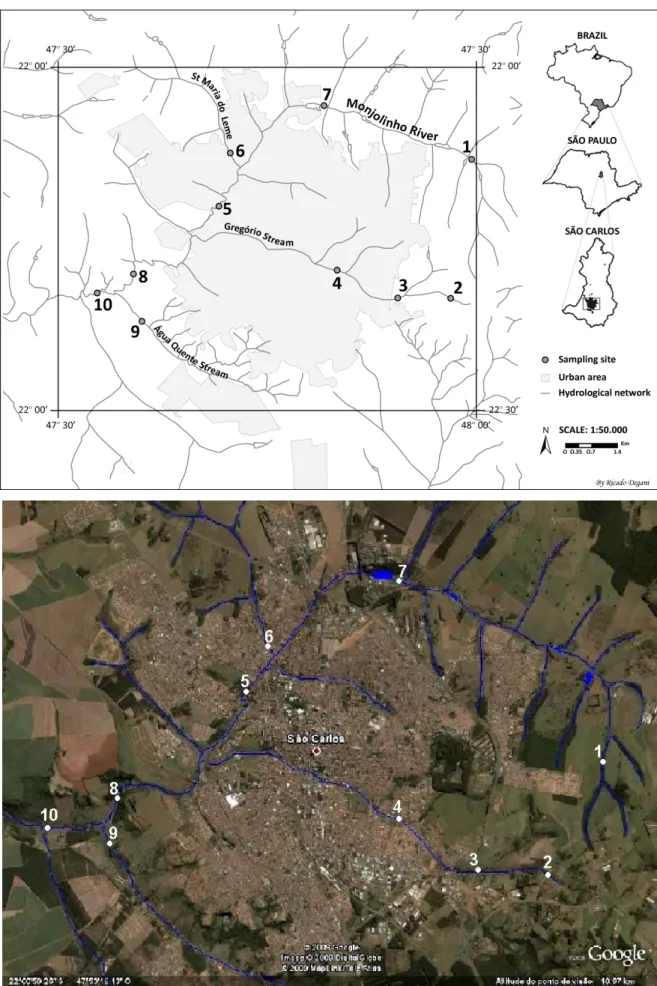
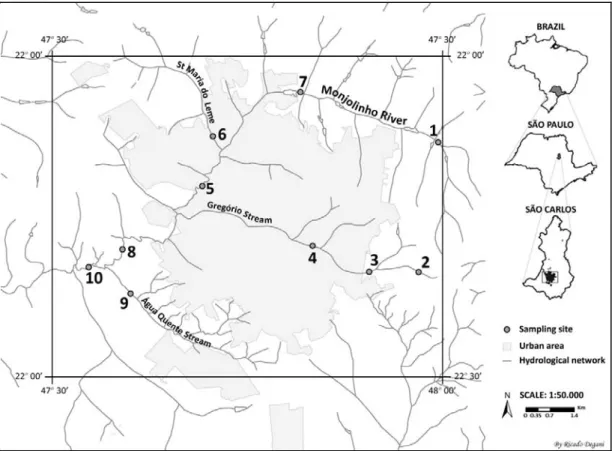
The area under study is shown in Figure 1. The Monjolinho River basin is
approximately 43.3 km long and is part of the basin of the Jacaré-Guaçú, one of the major
tributaries of the Tietê River located in central-eastern part of the state of São Paulo, with
a length of approximately 1.100km. The basin covers part of the municipalities of
Analândia, Brotas, Ibaté, Itirapina and São Carlos. Headwaters of Monjolinho River and
the tributaries studied fall mainly within agricultural area. From agricultural area, the
streams run through the urban area of the city of São Carlos, which covers a total area of
1143.9 km2 and has about 400 industries that discharge their industrial effluent directly into Monjolinho River and its tributaries affecting the ecological health and integrity of
these ecosystems (BARRETO, 1999).
In addition to this, the expansion of the city of São Carlos does not meet the
technical standards such as sewage treatment, collection of garbage, urban drainage and
so on. Streams in the study area, therefore, receive untreated or semi-treated effluent from
various domestic and industrial sources as well as other diffuse sources as they pass
through the city. This disorderly growth of the city resulted in stream health deterioration,
metal pollution, loss of the remaining primary vegetation and eutrophication among other
problems.
According to the Köppen system, the climate of the study area is classified as type
Cwa, i.e. mesothermal humid subtropical dry winter, with average temperature of the
coldest month (July) of below 18 º C and mean monthly maximum of above 22 º C
recorded in January and February. The area is characterised by a distinct dry
(May-September) and rainy season (October to April). The average annual rainfall varies
between 1200 and 1550 mm (SÈ, 1992).
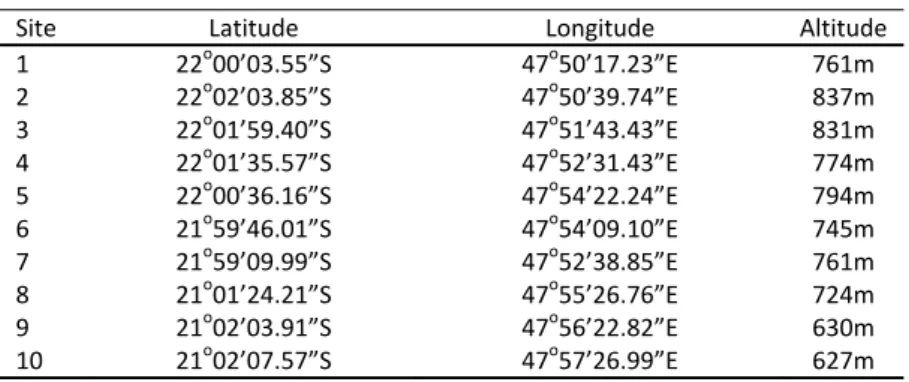
Table 1: Location of sampling sites.
Site Latitude Longitude Altitude
1 22o00’03.55”S 47o50’17.23”E 761m
2 22o02’03.85”S 47o50’39.74”E 837m
3 22o01’59.40”S 47o51’43.43”E 831m
4 22o01’35.57”S 47o52’31.43”E 774m
5 22o00’36.16”S 47o54’22.24”E 794m
6 21o59’46.01”S 47o54’09.10”E 745m
7 21o59’09.99”S 47o52’38.85”E 761m
8 21o01’24.21”S 47o55’26.76”E 724m
9 21o02’03.91”S 47o56’22.82”E 630m
12 Plate 1: Photos of the sampling sites. The sites are arranged in general order of increasing pollution.
2 1
7 3
5 4
8 6
13
Study design
Ten sites were established along Monjolinho River and its tributaries: four sites
(1, 2, 3 and 7) in the relatively less impacted agricultural and forested headwaters to act
as reference sites; 3 sites (4, 5 and 6) in the moderately polluted urban area; and 3 sites
(8, 9 and 10) in highly polluted downstream area after the urban area (Table 1, Figure 1,
Plate 1). The rational for choosing the sampling sites was to obtain a pollution gradient of
all the stream systems from relatively unpolluted agricultural headwaters to highly
polluted urban downstream sites.
Diatom and water sampling was done during dry season when flow was stable.
Four samples were collected, two in September and October 2008 and 2 in May and June
2009. Sampling was done during the dry season to avoid variable effects of the rain
season such as great variations in water level and velocity, floods and inundations. These
variations affect diatom development, especially growth rate and relative abundance of
different species (e.g. ROUND, 1991; BIGGS and KILROY, 2000). In addition,
micropollutant alterations are best estimated during the dry season i.e. under extreme
conditions, typically exhibiting the lowest discharge and highest pollutant concentrations
(MORIN et al., 2008).
Physical and chemical variables
Field measurements
At each site, dissolved oxygen (DO), electrical conductivity, temperature, pH and
concentration of total dissolved solids (TDS) were measured using a Horiba U-23 and
W-23XD Water Quality Meter (Horiba Ltd, Japan). Depth and current velocity were
measured at each site with an FP 201 global flow probe (Global Water Instrumentation
Inc. Alaska, USA). The percentage riparian vegetation cover was visually estimated at
each site. Light intensity at the air-water interface was measured using LI-193 Spherical
Quantum Sensor (LI-COR Worldwide, Brazil). Altitude was determined at each site
using a GPS (Northport Systems, Inc. Toronto, Canada).
The percentage embeddedness was also estimated along each stretch and rated on
a 0–5 scale following PLATTS et al. (1983). The following physical substrate
characteristics were visually estimated following USGS NAWQA protocol
(FITZPATRICK et al., 1998): percentage of silt-clay size particles, sand size particles,
gravel size particles, cobble size particles, boulder size particles; ratio of silt-gravel size
14 sediments for metal and nutrient analysis and of water samples for metals, total nitrogen
(TN), total phosphorus (TP), biological oxygen demand (BOD5), chemical oxygen
demand (COD) and fluoride, chloride, nitrite, nitrate, phosphate, sulphate, sodium,
ammonium, potassium, calcium and magnesium ions took place at each site following
standard methods (APHA 1988).
Laboratory analyses
The concentration of TN and TP in the water samples was determined following
the method by GOLTERMAN et al. (1978) and VALDERRAMA (1981) respectively.
TN and TP levels in sediments were determined following the micro-kjeldahl method
(APHA, 1988) and the ignition method (ANDERSEN, 1976) respectively. BOD5 and
COD were determined following standard methods (APHA, 1988). Water and sediment
samples were processed following standard methods (APHA, 1988) and analyzed using
Flame Atomic Absorption Spectrometry Analytical Methods (Varian Australia Pty Ltd,
Victoria, Australia) for aluminium (Al), cadmium (Cd), lead (Pb), zinc (Zn), chromium
(Cr III), cobalt (Co), copper (Cu), iron (Fe), manganese (Mn) and nickel (Ni). The
concentrations of fluoride, chloride, nitrite, nitrate, phosphate, sulphate, sodium,
ammonium, potassium, calcium and magnesium ions were analysed by isocratic ion
analysis using suppressed conductivity detection ion chromatography method using
Dionex DX-80 Ion Analyzer (DX-80) (DIONEX CORPORATION, 2001).
BOD5, nitrate, phosphate, DO (percent saturation), temperature, pH, turbidity and
TDS were used for calculation of a water quality index (WQI) after BROWN et al.
(1970) as follows:
∑
∑
= ×=
Wi Qi Wi WQI
n
i 1
where, Wi is the weight and Qi is the quality score of variable i.
Diatom sampling
Natural substrate sampling
At each site, epilithic, epiphytic, epipelic and epipsammic diatoms were sampled
separately. Epilithic diatoms were sampled by brushing stones with a toothbrush. Prior to
sampling of epilithic surfaces, all substrata were gently shaken in stream water to remove
any loosely attached sediments and non-epilithic diatoms. At least five pebble-to-cobble
15 diatom suspensions were pooled to form a single sample, which was then put in a labelled
plastic bottle.
Epiphytic diatoms were sampled from different species of submerged and
emergent macrophytes (e.g. Rumex crispus, Alternanthera philoxeroides, Ludwigia spp,
Rhynchathera spp, Ageratum spp, Hedychium coronarium, Eleocharis spp, Heteronthera
spp, Polygonum spectable and Brachiaria arrecta) at each site depending on the
availability of the macrophytes. The macrophyte’s whole stalk comprising of stalk and
leaves was carefully removed from the stream. Periphyton was then removed from the
macrophytes by brushing with a toothbrush adding distilled water. The resulting diatom
suspensions from all the submerged macrophytes sampled were pooled to form a single
sample, which was then put in a labelled plastic bottle.
Epipelic and epipsammic diatoms were sampled by pressing Petri dish lid into the
top layer of sand or silt/clay to a depth of 5-7 mm followed by sliding a spatula blade
under the Petri dish to isolate the contents in the dish, which were then gently brought to
the surfaces. The contents were then emptied into a labelled container. Five samples at
each site were collected and pooled into a single sample.
Artificial substrate placing and sampling
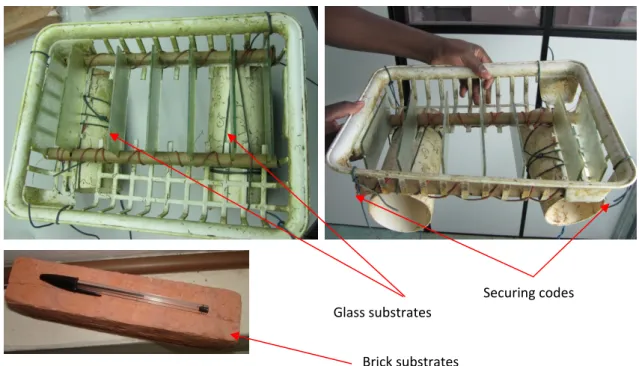
For field experiments, at each site, two bricks and a plastic rack fitted with 7
separate and vertical glass substrates (6 X 15 cm) were immersed in the water column parallel to the current at a depth of 20 to 30 cm below the surface and secured
accordingly (Figure 2). The artificial substrate was left for 4 weeks, which is the
recommended colonization time of periphyton (ROUND, 1991). Biofilms were collected
by brushing material with a toothbrush. The resulting suspensions from the replicates
were pooled.
For laboratory mesocosm experiments, four plastic racks, each fitted with 10
separate and vertical glass substrates (6 X 15 cm) were immersed at site 7 (Figure 1) parallel to the current 20 to 30 cm below the water surface. The racks were secured
accordingly and left for 4 weeks prior to sampling. On sampling, biofilms colonizing the
glass substrates were brushed with a toothbrush into culture medium. The biofilms from
all the glass substrates were pooled into one sample of approximately 2 L. This biofilm
16 Figure 2: Artificial substrates used for benthic diatom sampling.
Diatom sample cleaning, mounting and identification
Sub-samples of the diatom suspensions were cleaned of organic material using wet
combustion with concentrated sulphuric acid and mounted in Naphrax (in toluene)
fixative (Northern Biological supplies Ltd. UK. RI = 1.74) as following BIGGS and
KILROY (2000). Three replicate slides were prepared for each sample. Between 550 and
600 valves per sample (depending on the abundance of diatoms) were identified and
counted using the phase contrast light microscope (1000 X) (Leica Microsystems, Wetzlar GmbH, Type - 020-519.503 LB30T, Germany). The diatoms were identified to species
level based on studies by LOBO et al. (2002), METZELTIN et al. (2005), BICUDO and
MENEZES (2006) and METZELTIN and LANGE-BERTALOT (1998, 2007).
Laboratory experiments
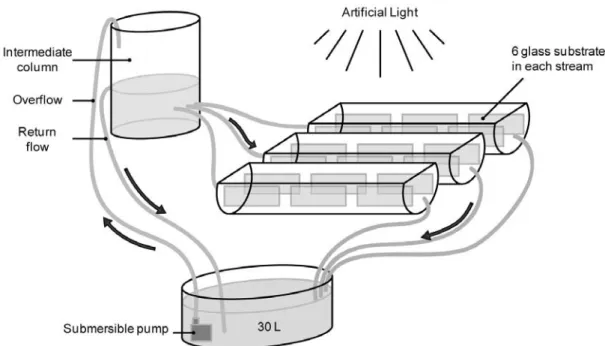
Closed experimental systems (EUs) were set up to allow the exposure of natural
periphyton communities to Cd, Cr and Pb under controlled conditions. Each EU consisted
of three half-polyvinyl chloride (PVC) tubes 50 cm long with a radius of 5 cm as artificial
streams with a capacity of 2.8 L each. The three streams were connected in parallel to a
30 L tank (Figure 3). All systems were filled with diluted (4x) modified Woods Hole culture medium (Table 2). A pump (Boyu bomba submersa SP-0100-600/h, SP-Brazil)
allowed continuous circulation of the water through each system at a rate of 10 ± 0.25 ml Glass substrates
Securing codes
17 s-1, corresponding to a velocity of 0.2 cm s-1. Each stream was fitted with 6 clean glass
substrates (6 X 15 cm) in a slightly slanting position for periphyton colonisation.
Subsamples of periphyton suspension from the field reference environment were
introduced into EUs, the EUs were equilibrated over night, and then the desired
concentrations of Cd, Cr III or Pb were obtained by addition of aliquots of appropriate
stock solutions to different systems. Depending on the objective, biofilms were collected
after a certain colonization period and analysed for algal cell densities, diatom taxonomic
composition, chlorophyll a, dry weight (DW), ash-free dry mass AFDM, and total and
non-exchangeable metals.
Figure 3: Schematic representation of a closed experimental system, consisting of three artificial streams (50 cm length, 5 cm radius), each containing 6‐glass substrata (6 X 15 cm). Arrows indicate flow direction, (by: Ricardo M. Degani).
Table 2: Composition of the Woods Hole culture medium, without EDTA, supplemented with silica and diluted 4x used in the laboratory experimental systems.
Nutrient Final concentration(mg L‐1)
CaCl2.2H2O 9
MgSO4.7H2O 9.25
NaHCO3 3.15
NaNO3 21.25
K2HPO4 2.17
FeCl3.6H2O 1.05
H3BO3 0.25
MnCl2.4H2O 45 x 10‐3
ZnSO4.7H2O 5.5 x 10‐3
CuSO4.5H2O 2.5 x 10‐3
CoCl2.6H2O 2.5 x 10‐3
Na2MoO4.2H2O 1.5 x 10‐3
Thiamine 25 x 10‐3
Biotin 125 x 10‐6
B12 vitamin 125 x 10‐6
18 For algal cell densities analysis and diatom taxonomic identification, 20 ml of the
sample was fixed with 4% (final concentration) formalin. Cells in 100 µL subsample
were counted in a Nageotte counting chamber at X400 with cell densities expressed as living algal cells per unit area (cells.cm-2). For diatom identification to species level, sub-samples of the suspensions were cleaned, mounted and valves counted as described
above. Another fraction (20 ml) was used for chlorophyll a analysis. The samples were
filtered onto Whatman GF/C filters. Chlorophyll a from the filters was measured
spectrophotometrically (at 665 nm and 750 nm) following extraction in boiling 80%
ethanol (5 min) and steeping at 4°C in the dark (24 h). A phaeopigment correction was
obtained by acidification NUSCH (1980).Another fraction (20 mL) was filtered through
pre-combusted GF/C filters and dried at 60 °C for 48 h to determine DW. After final
weighing, samples were ashed at 500 oC for 1 hr and weighed again to obtain AFDM. Growth rates inferred from AFDM measurement data were calculated for the
exponential phase and were expressed as micrograms of AFDM per unit area of glass
substrate per day following the formula:
i j
i j
j i
t t
X X
− − =
−
ln ln
μ
where μi−j is the average growth rate between time i to j; XiandX j are the
AFDM at time i and j respectively and ti and tjare the time (days) of ith and jth AFDM measurement respectively after beginning the exposure. From these growth rates, the
percent inhibition (stimulation) of each treatment was calculated following the formula:
c T c
I
μ
μ
μ
μ
−
=
where Iμ is the percent inhibition of growth rate; μcis the mean growth rate in
the control andμT is the mean growth rate in each treatment. From these results, the EC50
was then determined from linear regression equation.
Another fraction (20 mL) was used to determine the total amount of metal
accumulated in biofilm as described in below. To measure intracellular metal
(non-exchangeable) content in biofilm, another fraction (20 mL) of sample was washed with
EDTA 4 mM at pH = 8, for 10 min to remove metal adsorbed onto the surface of algal
19 The resultant sample was then analysed for metal as described in below. Adsorbed metal
level was calculated as the difference between the metal content before and after washing
with EDTA. Concentration factors (CFs) of the biofilm for metal were calculated
according to FOSTER (1976) by dividing concentrations of metal in biofilms (total and
non-exchangeable fractions) by those in water column.
Samples for total and non-exchangeable metal analysis were filtered through a
tarred metal free paper (0.45 µm membrane, Millipore) to obtain the dry weight after
drying at 60 °C for 48h. Dried biofilm samples were first digested with nitric acid
following method 3050B (Environmental Protection Agency-USA). The digestates were
diluted with ultra pure water (Millipore, Simpakkr1, Simplicity 185, SP-Brazil) to 100 ml
(final volume). Metal concentrations in biofilm (washed with EDTA or not) were
measured by inductively coupled plasma mass spectrometry (ICP-MS), (Analytical
Instrument Recycle, Inc, USA).
Data analysis
Physico-chemical variables and diatom community structure
Environmental variables that were not normally distributed (Shapiro-Wilk, p ≤
0.05) or had no equal variance (Levene’s test, p ≤ 0.05) were transformed accordingly.
Two-way Analysis of Variance (Two-way ANOVA) was used to compare means of
environmental variables among sampling periods, among sites or among treatments.
Cluster analysis and principal component analyses (PCA) were performed on
benthic diatom community data to show the main differences and similarities in
communities. Multivariate data analyses were performed on the diatom data set to
indicate the main gradients of floristic variation and to detect and visualize similarities in
diatom samples. Preliminary detrended correspondence analyses (DCA) were applied on
diatom data set to determine the length of the gradient. Canonical correspondence
analysis (CCA) was used to investigate relationships between predictor variables and
benthic diatom communities from different sites (TER BRAAK and VERDONSCHOT,
1995). Partial CCA (BORCARD et al., 1992) was used to separate and examine the
relative importance of different sets of exploratory variables on the diatom community
composition. CCA, PCA and DCA were performed using CANOCO version 4.5 (TER
BRAAK and ŠMILAUER, 2002).
For laboratory experiments, variations in physico-chemical characteristics of the
20 abundance), chlorophyll a, DW, AFDM and frequency of morphological deformities with
treatments and duration of exposure were examined by means of a repeated measures
analysis of variance (RM-ANOVA; STATISTICA software package, Release 7, Stat
Soft. Inc., USA) considering treatment as fixed factor among objects, and time a fixed
factor within objects.
Indicator species
The IndVal method (DUFRÊNE and LEGENDRE, 1997) was used to find
indicator species and species assemblages characterizing different substrates and sites.
For each species i in each substrate/site group j, we computed the product of Aij, the mean
abundance of species i in the sites of group j compared to all groups in the study, by Bij,
the relative frequency of occurrence of species i in the sites of group j, following
(DUFRÊNE and LEGENDRE, 1997) as follows:
Aij = Nindividualsij/Nindividualsi.
Bij = Nsitesij/Nsites.j
IndValij = Aij * Bij * 100
where IndVal is the Indicator Value of species i in site cluster j, Nindividualsij is the
mean number of individuals of species i across sites of group j, Nindividualsi. is the sum
of the mean numbers of individuals of species i over all groups, Nsitesij is the number of
sites in cluster j where species i is present, and Nsites.j is the total number of sites in that
cluster. Bij is maximum when species i is present in all objects of cluster j.
Diatom-based indices of water quality assessment
The diatom species counts were entered into the diatom database and index
calculation tool, OMNIDIA version 5.3 (LECOINTE et al., 1993), and the following
indices were calculated and tested: the Artois-Picardie Diatom Index or APDI (PRYGIEL
et al., 1996); the Eutrophication/Pollution Index or EPI (DELL’UOMO, 1996); the
Biological Diatom Index or BDI (LENOIR and COSTE, 1996); Schiefele and Schreiner’s
index or SHE (SCHIEFELE and SCHREINER, 1991); the Saprobic Index or SI (ROTT
et al., 1997); the Trophic Index or TI (ROTT et al., 1999); the Watanabe index or WAT
(WATANABE et al., 1986); the Specific Pollution sensitivity Index or SPI (COSTE in
CEMAGREF, 1982); the Sládeček’s index or SLA (SLÁDEČEK, 1986); Descy’s
pollution Index or DES (DESCY, 1979); Leclercq or IDSE (LECLERQ and MAQUET,
21 Commission of Economical Community Index or CEC (DESCY and COSTE, 1991); the
Trophic Diatom Index or TDI (KELLY and WHITTON, 1995); the Pampean Diatom
Index or PDI (GÓMEZ and LICUIRSI, 2001) and the Biological Index of Water Quality
trophic index or BIWQ (LOBO et al., 2004).
Pearson’s correlation analysis was used to determine the relationship between the
calculated index scores and measured physical and chemical water quality data. Forward
stepwise multiple regression analysis was performed on the data to determine the indices
that gave the best reflection of general water quality.
References
A.P.H.A. 1988. Standard Methods for the Examination of Water and Waste Water, 20th
ed. American Public Health association: Washington, D.C.
ANDERSEN, J.M. 1997. An ignition method for determination of total phosphorus in
lake sediments. Water Research, 10: 329-331.
BARRETO, A.S. 1999. Estudo da distribuição de metais em ambiente lótico, com ênfase
na assimilação pelas communidades biológicas e na sua quantificação no
sedimento e na água. São Carlos: Universidade de São Paulo. 340 p. (Tese de
Doutorado-Universidade de São Paulo).
BICUDO, C.E.M. and MENEZES, M. 2006. Gêneros de algas de águas continentais do
Brasil: chave para identificação e descrições. Rima Editora: São Carlos-SP,
Brazil.
BIGGS, B.J.F. and KILROY, C. 2000. Stream periphyton monitoring manual. NIWA:
Christchurch, New Zealand.
COSTE, M. and AYPHASSORHO, H. 1991. É tude de la qualité dês eaux du Bassin
Artois-Picardie à l’aide des communaute ´ s de diatomées benthiques (application
des índices diatomiques). Rapport Cemagref. Bordeaux - Agence de l’Eau
Artois-Picardie, Douai.
DELL’UOMO, A. 1996. Assessment of water quality of an Apennine river as a pilot
study. In Whitton, B.A. and Rott E. (eds), Use of Algae for Monitoring Rivers II.
Institut fu¨ r Botanik, Universität Innsbruck: 65-73.
DESCY, J. P. and COSTE, M. 1991. A test of methods for assessing water quality based
on diatoms. Verhandlungen der Internationalen Vereinigung für theoretische und
angewandte Limnologie,24: 2112-2116.
22 DUFRÊNE, M. and LEGENDRE, P. 1997. Species assemblages and indicator species:
the need for a flexible asymmetrical approach. Ecological Monograph, 67: 345–
366.
FITZPATRICK, F.A., WAITE, I.R., D’ARCONTE, P.J., MEADOR, M.R., MAUPIN,
M.A. and GURTZ, M.E. 1998. Revised methods for characterizing stream habitat
in the National Water-Quality Assessment Program: U.S. Geological Survey
Water-Resources Investigations Report 98-4052, 67.
FOSTER, P. 1976. Concentrations and concentration factors of heavy metals in brown
algae. Environment Polluttion, 10: 45-53.
GOLTERMAN, H.L, CLYMO, R.S. and OHNSTAD, M.A.M. 1978. Methods for
Physical and Chemical Analysis of Fresh Waters. IBP Handbook 8. Blackwell
Scientific Publication: Oxford.
GÓMEZ, N. and LICURSI, M. 2001. The Pampean Diatom Index (Idp) for assessment of
rivers and streams in Argentina. Aquatic Ecology,35: 173-181.
HAMMER, O., HARPER, D.A.T. and RYAN, P.D. 2009. PAST - PAlaeontological
STatistics, version 1.90. http://folk.uio.no/ohammer/past.
LECOINTE, C., COSTE, M. and PRYGIEL, J. 1993. ‘‘Omnidia’’: Software for
taxonomy, calculation of diatom indices and inventories management.
Hydrobiology, 269/270: 509–513.
LENOIR, A. and COSTE, M. 1996. Development of a practical diatom index of overall
water quality applicable to the French National Water Board network. In
Whitton, B.A. and Rott, E. (eds), Use of Algae for Monitoring Rivers II. Institut
fu¨ r Botanik. Universität Innsbruck: 29-43.
LOBO, E.A.; CALLEGARO, V.L. and BENDER, P. 2002. Utilização de algas
diatomáceas epilíticas como indicadoras da qualidade da água em rios e arroios da
Região Hidrográfica do Guaíba, RS, Brasil. Santa Cruz do Sul: EDUNISC, pp. 127.
LOBO, E.A.; CALLEGARO, V.L.; HERMANY, G.; BES, D.; WETZEL, C.E. and
OLIVEIRA, M.A. 2004. Use of epilithic diatoms as bioindicator from lotic systems
in southern Brazil, with special emphasis on eutrophication. Acta Limnologica
Brasiliensia, 16: 25-40.
METZELTIN, D. and LANGE-BERTALOT, H. 1998. Tropical Diatoms of South
America I.Iconographia Diatomologica, 5, p. 1 - 695.
METZELTIN, D. and LANGE-BERTALOT, H. 2007 Tropical Diatoms of South
23 METZELTIN, D., LANGE-BERTALOT, H. & GARCÍA-RODRÍGUEZ, F. (\2005).
Diatoms of Uruguay. Iconographia Diatomologica. p. 1 - 736.
MORIN, S., DUONG, T. T., DABRIN, A., COYNEL, A., HERLORY, O.,
BAUDRIMONT, M., DELMAS, F., DURRIEU, G., SCHÄFER,
J.,WINTERTON, P., BLANC, G. amd COSTE, M. 2008. Long-term survey of
heavy-metal pollution, biofilm contamination and diatom community structure in
the Riou Mort watershed, South-West France. Environmental Pollution, 151:
532-542.
NUSCH, E.A. 1980. Comparison of different methods for chlorophyll and phaeopigment
determination. Archiv für Hydrobiologie–Beiheft Ergebnisse der Limnologie, 14:
14-36.
PAN, Y.; STEVENSON, R.J.; HILL, B.H.; HERLIHY, A.T. and COLLINS, G.B. 1996.
Using diatoms as indicators of ecological conditions in lotic systems: a regional
assessment. Journal of North American Bethological Society, 15: 481-495
PLATTS, W.S., MEGAHAN, W.F. and MINSHALL, W.G. 1983. Methods for
evaluating stream, riparian, and biotic conditions. General Technical Report
INT-138, USDA Forest Service, Rocky Mountain Research Station. Ogden, UT.
POTAPOVA, M. and CHARLES, D.F. 2005. Choice of substrate in algae-based water
quality assessment. Journal of North American Bethological Society, 24: 415-427.
PRYGIEL, J., LÉVÉQUE, L. and ISERENTANT, R. 1996. Un nouvel indice diatomique
pratique pour l’e´valuation de La qualite´ des eaux en re´seau de surveillance.
Revue dês Sciences de l’Eau, 1: 97–113.
PRYGIEL, J.; WHITTON, B.A. and BUKOWSKA, J. 1999. Use of Algae for Monitoring
Rivers III. Agence de L’Eau Artois-Picardie, Douai. pp. 271.
ROTT, E., HOFMANN. G., PALL, K., PFISTER, P. and PIPP, E. 1997. Indikationslisten
für Aufwuchsalgen. Teil 1. Saprobielle Indikation. Bundesministerium für Land-
und Forstwirtschaft. Wien: 1-73.
ROTT, E., PIPP, E., PFISTER, P., VAN DAM, H., ORTLER, K., BINDER, N. and
PALL, K. 1999. Indikationslisten für Aufwuchsalgen in ö sterreichischen
Fliessgewä ssern. Teil 2: Trophieindikation (sowie geochemische Pra¨ferenzen;
taxonomische und toxikologische Anmerkungen). Wasserwirtschaftskataster
herasgegeben vom Bundesministerium f. Land- u.Forstwirtschaft, Wien. ISBN
24
ROUND, F.E. 1991. Diatoms in river water-monitoring studies. Journal of Applied
Phycology, 3: 129-145.
SCHIEFELE, S. and SCHREINER, C. 1991. Use of diatoms for monitoring nutrient
enrichment acidification and impact salts in Germany and Austria. In Whitton,
B.A., Rott, E. and Friedrich, G. (eds), Use of Algae for Monitoring Rivers. Institüt
für Botanik, Univ. Innsbruk.
SÈ, J.A.S. 1992. O Rio do Monjolinho e sua bacia hidrográphica com integradores de
sistemas ecológicos. São Carlos: Universidade de São Paulo. 378 p. (Tese de
Mestrado-Universidade de São Paulo).
SLÀDEČEK, V., 1986. Diatoms as indicators of organic pollution. Acta Hydrochimica et
Hydrobiologica, 14: 555–566.
SOLDO, D., HARI, R., SIGG, L. and BEHR, A. 2005. Tolerance of the Oocystis
nephrocytioides to copper: intracellular distribution and extracellular
complexation of copper. Aquatic Toxicology, 71: 307-17.
TER BRAAK, C.J.F. and ŠMILAUER, P. 2002. CANOCO Reference Manual and
CanDraw for Windows User’s Guide: Software for community ordination, version
4.5. Microcomputer Power, Ithaca: New York.
TER BRAAK, C.J.F. and VERDONSCHOT, P.F.M. 1995. Canonical corespondence
analysis and related multivariate methods in aquatic ecology. Aquatic Science, 37:
130-137.
TUNDISI, J.G. 2006. O Futuro dos Recursos Hídricos no Brasil. Projeto Brasil das
Águas. Disponível em http://www.brasildasaguas.com.br/.
VALDERRAMA, J.C. 1981. The simultaneous analysis of total nitrogen and total
phosphorus in natural water. Marine Chemistry, 10: 02-122.
WATANABE, T., ASAI, K. and HOUKI, A. 1986. Numerical estimation of organic
pollution of flowing waters by using the epilithic diatom assemblage – Diatom
25
CHAPTER
1
Biological
monitoring
of
lotic
ecosystems:
a
review
of
the
role
of
benthic
diatoms
1Abstract: Increasing anthropogenic influence on lotic environments because of
civilization has captured public interest because of the consequent problems associated
with deterioration of water quality. Various biological monitoring methods that provide a
direct measure of ecological integrity by using the response of biota to environmental
changes have been developed to monitor the ecological status of lotic environments.
Diatoms have been used extensively in this regard and this review attempts to summarise
the basic concepts associated with biological monitoring using benthic diatoms. Where
possible, examples from work carried out in Brazil are used.
Key words: biological monitoring, lotic environment, benthic diatoms
Biomonitoramento dos ecossistemas lóticos: revisão do papel das
diatomáceas bentónicas
Resumo: Aumento da influência antropogênica sobre ambientes lóticos como resultado
da civilização conquistou o interesse público por causa de problemas relacionados com a
conseqüente deterioração da qualidade da água. Vários métodos de biomonitoramento
que fornecem uma medida direta da integridade ecológica usando a resposta da biota a
alterações ambientais têm sido desenvolvidos para monitorar o estado ecológico de
ecossistemas lóticos. Diatomáceas têm sido amplamente utilizadas e esta revisão tenta
resumir os conceitos básicos associados ao monitoramento biológico utilizando
diatomáceas bentônicas. Sempre que possíveis, exemplos de trabalhos realizados no
Brasil serão utilizados.
Palavras-chave: biomonitoramento, ecossistemas lótico, diatomáceas bentônicas,
1
26
1.1 Introduction
Lotic environments are fundamental components of the regional and global
biogeochemical cycles, acting as both transport pathways and sites of elemental
transformations and storage and they save as sources of drinking water, fisheries
resources, irrigation supplies, and waste removal systems. They are characterised by
interactions among physical, chemical and biological processes, which reach a higher
degree of complexity downstream (WEHR and DESCY, 1998).
The fundamental feature of lotic systems is that activities or disturbances at one
location affect processes and organisms downstream, complicating the management of
these systems. The systems are also characterised by longitudinal differences in the time
scales of chemical and biological processes rendering it difficult to design polices and
assess the results of management actions (TUNDISI and MATSUMURA-TUNDISI,
2008). Characterising and managing dynamic environmental conditions in heterogeneous
systems such as these, therefore, requires innovative approaches, with the management
process striking a balance between human needs and ecological integrity (EDWARDS,
1995; TUNDISI and MATSUMURA-TUNDISI, 2008). Ecological principles are now
playing an important role in the management of these systems.
High population densities and multiplicity of industrial and agricultural activities
expose most hydrographic basins to heavy and rising environmental impacts especially to
pollution by domestic and industrial waste residues (SALOMONI et al., 2006). This
increasing anthropogenic influence on lotic environments that parallels civilization has
captured public interest because of the consequent deterioration of water quality, health
problems, pest plants and animals, and other problems (SALVIA et al., 1999; BERE,
2007). The purpose of this review is to summarise the basic concepts associated with
biological monitoring using benthic diatoms. Where possible, examples from work
carried out in Brazil are used.
1.2 Approaches to monitoring the ecological status of lotic system
Two threads of basic approaches to the assessment of water quality deterioration
in lotic systems run through the literature. The first approach involves the assessment of
physical and chemical variables of lotic systems in order to gain some insight into their
water quality. In most cases, this method allows only instantaneous measurements,
therefore restricting the knowledge of water conditions to the period when the
27 quality at the time of sampling ignoring temporal variation of water quality variables that
is usually high in lotic environments (ROCHA, 1992). Sophisticated chemical analytical
methods have been developed but still they cannot identify and quantify pertinent
compounds, especially synthetic organic compounds that are highly toxic (AIDAR and
SIGAND, 1993).
The second approach involves use of biological methods (biological monitoring),
the theory behind which is to provide a direct measure of ecological integrity by using the
response of biota to environmental changes (KARR, 1991). This allows long-term
environmental effects to be detected because of the capacity of reflecting conditions that
are not present at the time of sample and analysis. The key to use of the aquatic biota as
reliable indicators of the changes in lotic environmental conditions is deciphering the
integrated environmental information in species rich assemblages (PAN et al., 1996).
This biological monitoring has gained momentum in aquatic health management
programmes due to several shortcomings in standard physical and chemical methods
described above. Physical and chemical methods are, however, complimentary to
biological methods, contributing to the correct assessment of the quality of running
waters (LOBO et al., 2004). Since the biological response is to the integrated physical
and chemical environment to which the organism has been exposed for some time, it is
not surprising that the physical and chemical indicators often do not correlate with
biological indices (ROUND, 1991).
1.3 Biotic indices
The patterns of biota inhabiting lotic systems are responsive to the nature of the
physical and chemical characteristics of these systems (KARR, 1991). The integrity of
biota inhabiting the lotic ecosystems thus provides a direct, holistic and integrated
measure of the integrity of the systems. To this effect, therefore, the ultimate monitor of
aquatic systems is the aquatic life itself (JOHN, 2000). It is on this basis that biotic
indices enjoy widespread use in the assessment of ecological status of lotic ecosystems.
Several indices of biotic integrity have been developed worldwide to assess the
health status of the lotic systems. These indices make use of the niche requirements and
habitat preferences of the individual species (autecology), a population (synecology) or
higher taxonomic groupings to infer environmental conditions in an ecosystem
(STOERMER and SMOL, 1999). Long-term data gathered about the tolerances of a
28 conditions from the species composition by taking into account the specific tolerances of
the species in the community surveyed (PATRICK, 1986; DE LA REY et al., 2008).
These indices can be constructed to measure specific pollutants or general environmental
conditions.
Many indices have been developed using fish, macroinvertebrates, zooplankton
and phytoplankton and especially benthic diatoms. A comparison of three indices of
water quality (chemical, zoological and botanical assessment using diatoms) concluded
that the later gave the most precise data (LECLERCQ and MAQUET, 1987). However,
in some cases aquatic macroinvertebrates have been demonstrated to be superior to
diatoms as biological indicators, with a capacity to reflect on sedimentation in the
riverbed that cannot be reflected by diatoms (SCHOEMAN and HAWORTH, 1986;
KATOH, 1992; PRYGIEL and COSTE, 1993). In the cases of intermediate ranges of
pollution where the diatoms and macroinvertebrates are less sensitive, chemical analysis
have been shown to be more efficient (LECLERCQ and MAQUET, 1987; SCHOEMAN
and HAWORTH, 1986).
1.4 Distribution of diatoms in lotic systems
A fundamental part of lotic ecosystems is the periphyton community assemblages
whose diversity increases as anthropogenic influences on the system increases
(ARCHIBALD, 1972; LOBO and KOBAYASI, 1990; ROUND, 1991). This is consistent
with the intermediate disturbance hypothesis (CONNELL, 1978), which states that the
highest diversity is maintained at intermediate levels of pollution. These assemblages
have important implications for ecosystem processes in lotic environments. Firstly, they
are an integral part of the energy cycle in nearly all lotic ecosystems providing much of
the food thus maintaining higher trophic levels i.e. they are important for establishment of
ecological balance (ROCHA, 1993).
Secondly, they purify waters by absorbing many impurities such as nutrients and
heavy metals and are sites of the breakdown of bacterial and other organic matter
contamination. Thirdly, they respond rapidly to degradation of water quality, often
changing in both taxonomic composition and biomass where even slight contamination
occurs (ROCHA, 1993; PATRICK and HENDRICKSON, 1993; BIGGS and KILROY,
2000; DOUNG et al., 2007). They also play an important role in global cycling of silica
and carbon (MANN, 1999). The maintenance of proper community structure and
29 development and climate change, among other threats is, therefore, important in river
health management.
A major part of these periphyton assemblages is made up of diatoms which are
various microscopic one-celled or colonial members of the algal division or phylum
Bacillariophyta, of the class Bacillariophyceae, having cell walls of silica consisting of
two interlocking symmetrical valves. They are universally distributed in all types of
aquatic environment with others being endemic to specific regions (POTAPOVA and
CHARLES, 2003). They multiply rapidly, maintaining a dynamic population of varying
size depending on the prevailing environmental conditions. Diatoms are the most species
rich group of algae with tens of thousands of species (MANN, 1999). ROUND (1991)
states that there are currently over 260 genera of living diatoms with over 100 000
species.
Multiple factors prevailing at different temporal and spatial scales play an
important role in structuring benthic diatom communities in lotic systems (POTAPOVA
and CHARLES, 2002; MOURA et al., 2007), with local environmental conditions
playing a more important role compared to broad-scale climatic, vegetational and
geographical factors (PAN et al., 1996). Our comprehension of the role of temporary
factors in shaping global communities is, however, still in its infancy (PASSY, 2007).
Some of the factors most often found to be important in shaping the distribution
patterns of benthic diatoms in lotic systems are water chemistry (particularly pH, ionic
strength and nutrient concentrations), substrate, current velocity, light (degree of shading)
grazing, temperature (which also correlates strongly with latitude and altitude) (ROUND,
1991; PAN et al., 1996; POTAPOVA and CHARLES, 2002; NECCHI-JÚNIOR, 2003).
Most of these factors depend strongly on climate, geology, topography, land-use and
other landscape characteristics, and therefore diatom communities are similar within
ecological regions defined by these characteristics (PAN et al., 1996). Short-term
differences in community composition are also driven by immigration of cells,
differences in growth rate between populations and loss processes such as death,
emigration and sloughing.
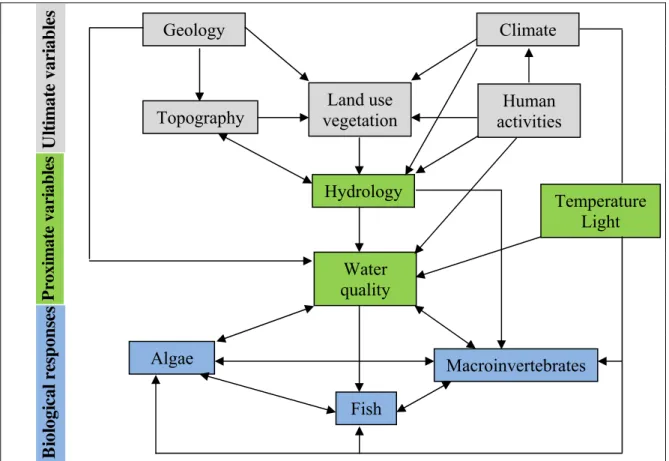
Thus, growth and development of benthic diatoms in streams is an outcome of
complex interaction between hydrological, chemical and biotic factors (Figure 1.1). Local
“proximate” variables, like discharge regime, are controlled by regional “ultimate”
factors like geology, topography or climate operating at spatial scales of catchments or