SÉRIE DIGITAL
19
2017
LONG-TERM MANAGEMENT STRATEGY FOR
SOUTHERN HORSE MACKEREL (hom27.9a)
–
MANAGEMENT STRATEGY EVALUATION
(MSE)
Manuela Azevedo, Hugo Mendes, Gersom Costas,
Ernesto Jardim, Iago Mosqueira, Finlay Scott
RELATÓRIOS CIENTÍFICOS E TÉCNICOS DO IPMA – SÉRIE DIGITAL
Destinam-se a promover uma divulgação rápida de resultados de carácter científico e técnico, resultantes da actividade de investigação e do desenvolvimento e inovação tecnológica nas áreas de investigação do mar e da atmosfera. Esta publicação é aberta à comunidade científica e aos utentes, podendo os trabalhos serem escritos em Português, Francês ou Inglês.
Edição
IPMA
Rua C – Aeroporto de Lisboa 1749-007 LISBOA
Portugal
Corpo Editorial
Francisco Ruano – Coordenador Aida Campos
Irineu Batista Lourdes Bogalho Mário Mil-Homens
Rogélia Martins Teresa Drago
Edição Digital
Anabela Farinha
As instruções aos autores estão disponíveis no sitio web do IPMA
http://ipma.pt
ou podem ser solicitadas aos membros do Corpo Editorial desta publicação
Capa
Conceição Almeida
ISSN 2183-2900
1
Long-Term Management Strategy for Southern Horse Mackerel (hom27.9a)
Management Strategy Evaluation
Manuela Azevedo1, Hugo Mendes1, Gersom Costas2, Ernesto Jardim3, Iago Mosqueira3, Finlay Scott3
1 Instituto Português do Mar e da Atmosfera (IPMA), Divisão de Modelação e Recursos da Pesca (DivRP). Rua Alfredo Magalhães
Ramalho 6, 1449-006 Lisboa, Portugal; 2Instituto Español de Oceanografía, Centro Oceanográfico de Vigo. Subida a Radio Faro,
50-52 36390 Vigo, España; 3European Commission Joint Research Center (JRC), Sustainable Resources Directorate, Water and Marine Resources Unit, Via Enrico Fermi 2749, 21027 Ispra (VA), Italy.
Recebido em: 2017-12-19 Aceite em: 2017-12-28 (revisão 2018-03-08)
ABSTRACT
The development of the long term management strategy (LTMS) for southern horse mackerel (Trachurus trachurus) started in October 2014 through a dialogue process between scientists and stakeholders. The process involved the definition of management objectives, a Harvest Control Rule and several TAC setting options, the FMSY target year,
and catch stability levels proposed by the stakeholders of Pelagic Advisory Council (PelAC) and the South West Waters Advisory Council (SWWAC). The PelAC in October 2017 sent a proposal for a LTMS for southern horse mackerel to the European Commission with a request that this be scientifically assessed. The Commission requested ICES to evaluate whether the proposed plan is seen as precautionary and to assess if the plan ensures that the stock is fished and maintained, also in the future, at levels which can produce Maximum Sustainable Yield (MSY). This report presents the Management Strategy Evaluation (MSE) on the performance of the LTMS. The conditioning of the operating model is based on the latest stock assessment, following the stock benchmark in early 2017, and with recruitment stochasticity. To implement a full-feedback MSE the management procedure component includes a stock assessment and advice cycle. The stock assessment cycle, with observation error, is performed using a statistical catch-at-age model that mimics the current assessment method. Two hundred populations are simulated from 2017 to 2080. Performance statistics for catch, spawning stock biomass and fishing mortality are computed for the short (2017-2027) and long-term (2070-2080). The proposed LTMS, with a Harvest Control Rule defined by FMSY
at 0.11, Fby-catch at 0.01, MSY Btrigger at 181 kt and Blim at 103 kt and with a ±15% catch constraint is precautionary as
the probability of SSB being below Blim is less than 5% over the entire simulated period. The long-term equilibrium
catches of the LTMS are very close to MSY. Sensitivity analyses indicate that the LTMS is also precautionary in a low productivity scenario.
Keywords: Long-term management plan, management strategy evaluation, southern horse mackerel
Resumo
Título: Plano de Gestão a longo prazo para o carapau-branco do sul (hom27.9a)-Avaliação da Estratégia de Gestão O desenvolvimento de um plano de gestão a longo prazo para o carapau-branco (Trachurus trachurus) do sul teve início em Outubro de 2014 num processo interactivo entre cientistas e os principais intervenientes na pesca deste recurso. Foram definidos pelos representantes dos Conselhos Consultivos Pelágico (PelAC) e das Águas Ocidentais Sul (SWWAC) objectivos de gestão, uma regra de controlo das capturas, várias opções de estabelecimentos de TAC, o ano alvo para o FMSY e limites para a variação anual da captura. Em Outubro de 2017, o PelAC solicitou à Comissão
uma avaliação científica da sua proposta de plano de gestão para o stock sul de carapau-branco. A Comissão Europeia solicitou ao CIEM a avaliação do plano proposto no que respeita ao critério de precaução e de captura máxima sustentável (MSY) a longo prazo. A avaliação destes critérios foi realizada com simulações usando a abordagem designada ‘Avaliação de Estratégias de Gestão’ (MSE – ‘Management Strategy Evaluation’). A componente MSE que representa a dinâmica populacional do recurso é condicionada com base nas estimativas dos parâmetros populacionais resultantes da mais recente avaliação de stock e incluindo estocasticidade no recrutamento. A componente MSE que simula a implementação do aconselhamento inclui, em cada ciclo anual, uma avaliação de stock com erro de observação, projecções a curto prazo e a aplicação da regra de controlo. A avaliação de stock é realizada com um modelo estatístico estruturado por idades, replicando o actual método de avaliação. Indicadores de captura, biomassa reprodutora e mortalidade por pesca são calculados no curto prazo (2017-2027) e no longo prazo (2070-2080) com base na dinâmica de 200 populações simuladas. O plano de gestão proposto tem uma regra de controlo definida por FMSY = 0.11, Fby-catch= 0.01 (F ‘capturas acessórias’), MSY Btrigger =
181 mil toneladas (biomassa ‘gatilho’) e Blim = 103 mil toneladas (biomassa limite) e ainda considerando um limite
de variação anual da captura de ±15%. Os resultados indicam que o plano é precaucionário dado que a probabilidade da biomassa reprodutora estar abaixo de Blim é inferior a 5% ao longo do período simulado e que a
captura de equilíbrio a longo prazo é semelhante à captura máxima sustentável. Análises de sensibilidade indicam que o plano de gestão também é precaucionário num cenário de baixa produtividade do stock.
Palavras-chave: Avaliação de estratégias de gestão, carapau-branco do sul, plano de gestão a longo prazo.
2
Table of contents
____________________________________________________________________________
1. Introduction ... 3
2. Background Information ... 5
2.1. Process ... 5
2.2. Biological Reference Points ... 5
2.3. Stock benchmark and assessment model ... 6
3. Methodology ... 8
3.1. Management Strategy Evaluation ... 8
3.2. Operating model ... 8
3.2.1. Starting population... 9
3.2.2. Stock recruitment relationship... 11
3.2.3. Selectivity and catchability ... 11
3.2.4. Biological parameters ... 12
3.3. Management Procedure ... 13
3.3.1. Assessment uncertainty ... 13
3.3.2. Short-term forecasts ... 13
3.3.3. Simulations ... 14
3.3.4. Performance Statistics... 14
4. Results and discussion ... 17
4.1. Proposed LTMS ... 17
4.2. Robustness/Sensitivity ... 20
5. Conclusions ... 22
Acknowledgments ... 22
References ... 22
Annexes ... 24
Annex 1 ... 24
Annex 2 ... 26
3
1.
Introduction
This report presents the analysis carried out to evaluate the performance of the long-term management strategy (LTMS) for southern horse mackerel (hom27.9.a) proposed by the Pelagic Advisory Council (PelAC).
The request to the long-term management strategy was as follows:
Background
A long-term management strategy (LTMS) was developed for this stock by initiative of the Pelagic Advisory Council (PELAC) in a collaborative work between scientists from IPMA and IEO and stakeholders from Portugal and Spain, with collaboration/knowledge of the South Western Waters Advisory Council (SWWAC).
Objectives
The Parties agree to propose a LTMS for the fisheries on the southern horse mackerel stock, which is consistent with the precautionary approach and the MSY objective (article 2.2) of the Common Fisheries Policy1.
Criteria and definitions
Article 1 - Subject matter
This management strategy pertains to the southern horse mackerel stock.
Article 2 - Geographical definitions of stocks
ICES Division 9.a (The Iberian coast from the Strait of Gibraltar to Cape Finisterre in Galician waters).
Article 3 - Definitions
For the purpose of this management strategy, in addition to the definitions laid down in Article 4 of Regulation (EC) No 1380/2013, the following definitions shall apply:
i) “Fby-catch“ refers to the level of fishing mortality which shall be applied when the
Spawning Stock Biomass (SSB) is equal to or below Blim to account for horse mackerel
by-catches.
Article 4 - Reference points
i) The minimum spawning biomass level and the precautionary spawning biomass level for the combined shall be as follows: Blim = 103 000 tonnes, Bpa or MSY Btrigger = 181 000
tonnes (ICES, 2017a,b).
ii) The maximum fishing mortality associated with Maximum Sustainable Yield (Fmsy) for
the southern horse mackerel stock shall be as follows: Fmsy= 0.11 (ICES, 2017a,b).
4
Article 5 - TAC setting procedures
i) In the case that the spawning stock biomass is forecast to be above or equal to MSY Btrigger (equivalent to Bpa) at mid-January* of the year for which the TAC is to be set, the
TAC shall be fixed to a catch estimated based on an gradual increase of fishing mortality towards Fmsy in 2025.
ii) In the case that the spawning stock biomass of the stock is forecast to be less than MSY Btrigger and larger than Blim at mid-January of the year for which the TAC is to be set,
the TAC shall be fixed that is consistent with a fishing mortality (F) given by the harvest control rule:
F = Fby-catch + [(FMSY - Fby-catch) / (Btrigger - Blim) / (SSB - Blim)]
iii) In accordance with the objectives of the plan detailed above, where the rules in paragraph i and ii would lead to a fishing mortality higher than FMSY, this fishing
mortality shall be set in line with article 2.2 of the CFP.
iv) Where the rules in paragraph i, ii and iii would lead to a TAC which deviates by more than 15%from the TAC of the preceding year a TAC shall be set that is no more than 15% greater or 15% less than the TAC of the preceding year.
v) In the case that the spawning biomass is forecast to be equal to or less than Blim in
mid-January of the year for which the TAC is to be set, the TAC will be fixed corresponding to a fishing mortality Fby-catch=0.01.
*For this stock, the spawning stock biomass is determined at spawning time (assumed to be mid-January)
Article 6 - Conditions of the monitoring fishery
Vessels participating in the fishery, if requested, shall take on-board scientific fisheries observers under the Data Collection Framework (DFC) to improve knowledge of the state of the stock. Those vessels upon request shall provide samples for the same scientific purpose.
Fishing effort
Spawning Biomass*
F
msy
F
by-catch
B
5
Article 7 - End of the management strategy
The Parties, on the basis of ICES advice, shall review the biological reference points and this long-term management strategy at intervals not exceeding five years.
In the LTMS simulation testing, and following Article 5, paragraph (i), it was assumed a linear increase of fishing mortality from 2016 towards FMSY in 2025.
The expression of the harvest
control rule in Article 5, paragraph (ii), used to compute F when B
lim< SSB < B
triggershould be presented as:
F = Fby-catch + (FMSY - Fby-catch) / [(Btrigger - Blim) / (SSB - Blim)]
This expression can be also presented as:
F = Fby-catch + (FMSY - Fby-catch) x (SSB - Blim)/(Btrigger - Blim)
2.
Background Information
2.1.
Process
The development of the LTMS for southern horse mackerel started in October 2014 through an interactive process between scientists and stakeholders. The process involved the definition of management objectives, a Harvest Control Rule (HCR) and several TAC setting options, FMSY
target year and catch stability levels proposed by the stakeholders of PelAC/SWWAC. A preliminary analysis of the management strategies was performed using an MSE short-cut approach based on the 2015 stock assessment and preliminary Biological Reference Points (BRP). The results from these preliminary set of stochastic simulations were discussed with stakeholders and were proven useful to decide on the preferred range of management options.
A summary of the main meetings and relevant milestones and also on the range of tested options are available in Annex 1. The description of the MSE short-cut approach is available in Annex 2.
Following the stock benchmark in 2017 (ICES, 2017a) and the adoption of BRP’s (ICES, 2016a) a full-feedback MSE approach is used to assess the performance of the proposed LTMS.
2.2.
Biological Reference Points
Biological Reference Points were estimated in the 2016 Assessment Working Group on Southern Horse Mackerel, Anchovy and Sardine (WGHANSA, ICES 2016a). The methodology to estimate Biological Reference Points (BRP) for southern horse mackerel stock followed the framework proposed in ICES guidelines for fisheries management reference points for category 1 stocks (ICES, 2017c). Stochastic equilibrium reference points were estimated based on the equilibrium distribution of stochastic long-term projections and based on the most recent period to reflect the stock current biological, productivity and fishery regimes. Simulations analyses were conducted using the Eqsim routines in the msy package (version downloaded
6 opportunities (ICES, 2016a,b). The BRPs were re-analysed during the Benchmark Workshop on Pelagic Stocks (WKPELA) and the estimates were very consistent with the adopted ones and did not require to be changed (ICES, 2017a).
Table 1 presents the adopted BRPs for southern horse mackerel. The long term yield at
FMSY=0.11 was estimated at 43516 t (median) and 45880 t (mean).
Table 1. Summary table of Biological Reference Points and predicted MSY for southern horse mackerel.
BRP Value Technical basis
Blim 103 kt
Blim = Bpa * exp(-1.645 σ)
σ = 0.34
Btrigger 181 kt
Lower bound (average) of 90%CI of
SSB1992-2015
Bpa 181 kt Bpa = Btrigger
Flim 0.19
Stochastic long-term simulations (50% probability SSB > Blim)
Fpa 0.11
Fpa = Flim * exp(-1.645 σ)
σ = 0.32
FMSY 0.11
Stochastic long-term simulations; constrained by Fpa (FMSY=Fpa)
MSY(1) 43.5 kt (45.9 kt) Stochastic long-term yield at F
MSY
(1)
median (mean)
2.3.
Stock benchmark and assessment model
The stock was benchmarked in February 2017 (ICES, 2017a), following the Data Compilation Workshop in November 2016 (Uriarte et al., 2017). During the benchmark, decisions on Stock ID, biological parameters, BRP’s and assessment method were undertaken after technical discussions and agreement among the ICES members and invited external experts.
7 projection continues until the terminal year is specified. The fishing mortality is assumed to be separable into an age component and a year component. Selectivity-at-age (constant for ages 7+) is allowed to change over time. Following the benchmark assessment, one selectivity block for the survey abundance index and three selectivity blocks for the catch-at-age (1992-1997, 1998-2011, and 2012 onwards) were adopted. Catch data by year is fitted assuming a CV of 5%, and the survey index data is fitted assuming a CV of 30%. For the fishery
proportions-at-age an “effective sample size” of 100 is assumed, and for the survey estimates of age
composition an “effective sample size” of 10 is applied. Lognormal priors are included for some
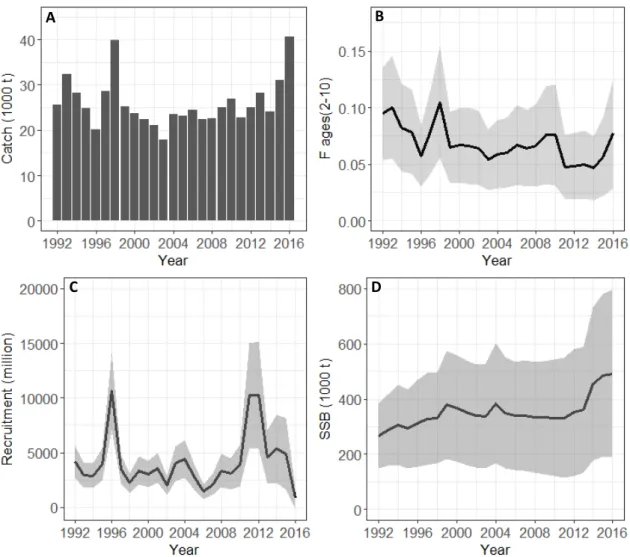
parameters. Further details are provided in the hom27.9.a Stock Annex (ICES, 2017b). Figure 1 presents a summary of the last stock assessment with data from 1992-2016, used as basis for the simulation testing of the LTMS.
Figure 1. Horse mackerel stock assessment summary from 1992-2016. Panel A – Yield. Panel B – Fishing Mortality. Panel C – Recruitment. Panel D – Spawning Stock Biomass.
A B
8
3.
Methodology
3.1.
Management Strategy Evaluation
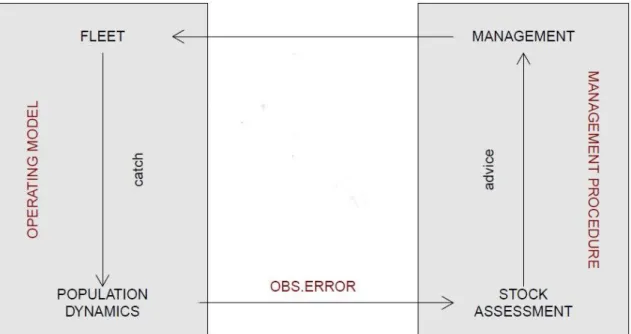
The analysis of the proposed LTMS is undertaken with the components of the MSE shown in Figure 2. The fleet behavior and the biological dynamics of the stock were simulated in an Operating Model (OM), which is the mathematical representation of the best knowledge of the natural and fishery systems (‘true’ stock). The management procedure (MP) includes the stock assessment (‘perceived’ stock) and advice for fisheries management following the application of the management strategy (HCR defined in Article 5 of the LTMS proposal, specifying future catch with a ±15% constraint), and the management process to implement the scientific advice. Two other important components are the observation error, which represents the process of collecting information for stock assessment, and the implementation error which incorporates the way the actors implement regulations and perceive the management objectives. The current MSE is run without implementation error assuming full implementation of the TAC advice.
Figure 2. Diagram of the implemented full-feedback Management Strategy Evaluation (adapted from Jardim et al., 2017).
3.2.
Operating model
The fleet and the stock are represented in an OM that characterizes the dynamics of the natural and fishery systems with the best available scientific knowledge. The operating model described in Figure 2 includes the population dynamics of stock numbers (N) at age (a) and time (t):
𝑁𝑎+1,𝑡+1=𝑁𝑎,𝑡𝑒−𝐹𝑎,𝑡−𝑀𝑎,𝑡
9
𝑆𝑆𝐵𝑡= 𝑁𝑎,𝑡𝑒−0.04𝐹𝑎,𝑡− 0.04𝑀𝑎,𝑡𝑊𝑎,𝑡𝑃𝑎,𝑡 11+
𝑎=1
with M being Natural mortality and F being Fishing mortality, calculation of catch at age in numbers follows the standard Baranov equation:
𝐶𝑎,𝑡=
𝐹𝑎,𝑡
𝐹𝑎,𝑡+𝑀𝑎,𝑡𝑁𝑎,𝑡
1− 𝑒−𝐹𝑎,𝑡−𝑀𝑎,𝑡
In southern horse mackerel discarding is known to be negligible and catches and landings are considered equal (ICES, 2017b). Total yield in weight is calculated as:
𝑌𝑡= 𝑊𝑎,𝑡𝐶𝑎,𝑡 11+
𝑎=1
Fishing mortality at age is a separable model with selectivity-at-age (Sa), and annual fishing
mortality (Ft):
𝐹𝑎,𝑡 =𝑆𝑎𝐹𝑡
The parameters used in the LTMS will be described in the following sections. Selectivity and catchability at age (Qa) are described in section 3.2.3. The proportion of mature individual at
age (Pa), the mean weight at age in the stock (Wa) and the natural mortality (Ma) are detailed
in Table 3, section 3.3.4.
3.2.1. Starting population
A statistical catch-at-age stock assessment model (hereinafter referred as sca) was used to mimic the current stock assessment model AMISH. The sca model was run in FLa4a, an R package (http://www.r-project.org/) which implements the a4a stock assessment framework (Jardim et al., 2017) using the FLR routines (Kell et al., 2007). The sca model can be applied rapidly to a wide range of situations using pre-built R estimation routines and using maximum likelihood estimation methods, which allowed running full-feedback MSE simulations on the several management scenarios proposed by the stakeholders (Annex 1), drastically reducing the computation time and complexity.
The sca model was conditioned to the same settings as the AMISH model, following the
“effective sample size” of 100 for the fishery proportions-at-age and of 10 for the survey estimates of age composition and was proven successful in emulating the selectivity blocks for both catch at age and the survey abundance index (details in section 3.2.3). The sca model structure is defined by three submodels, a model for fishing mortality (fmodel), survey catchability (qmodel) and stock-recruitment relationship (srmodel) and defined in R code as:
sca(stk, idx, fmodel, qmodel, srmodel)
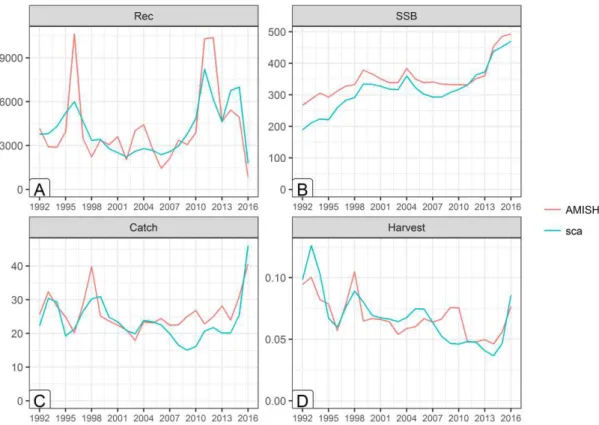
10 The different submodels required structural assumptions and further details on each will be presented in the next sections. The assessment with sca is considered appropriate for the purpose of this MSE given comparable fits to catch-at-age, to index-at-age and retrospective pattern (Annex 3). Moreover, the historical estimates of key metrics, including spawning biomass, fishing mortality and catch (Figure 3) showed correlations between assessments of 0.71-0.95. The estimates in the terminal year, which are the initial conditions for the MSE simulations, were overall very similar between the two assessments (Table 2, Figure 4).
Figure 3. Comparison of the outputs of key parameters between the AMISH model (red) currently used in the assessment and the sca model (blue) used to perform the full-feedback MSE. Panel A- Recruitment (millions). Panel B – Spawning Stock Biomass (kt). Panel C – Yield (kt). Panel D – Fishing Mortality (year-1).
The starting population number at ages 1-11+ were taken from the terminal year of the sca
assessment. As in the stock assessment procedure, population at age 0 (recruits) estimated in the final year is replaced by the geometric mean of the recruitment time series (Table 2, Figure 4).
Table 2. Numbers-at-ages 0-11+ (in millions) estimated by sca and the AMISH model in last year of assessment.
0 1 2 3 4 5 6 7 8 9 10 11+
sca 3857 2827 1448 626 589 610 296 191 124 88 66 339
11 Figure 4. Numbers at age 0-11+ estimated in the final year of the assessments by the AMISH model (red) and the sca model (blue). Population number at age 0 is replaced by the geometric mean of the recruitment time series.
3.2.2. Stock recruitment relationship
Recruits (numbers at age 0) are estimated from the spawning stock biomass following a functional relationship:
𝑁0,𝑡 =𝑓 𝑆𝑆𝐵𝑡 exp(𝜀𝑡)
The hockey-stick relationship, also adopted for the estimation of BRP´s, was used in the simulations to generate future recruitments. Recruitment variability (εt) was based on the sca
recruitment estimates, introduced by generating random draws from a lognormal distribution with µ=0 and =0.6 and modelled as a 1st order AR model with
1=0.8. The adopted value for
1 was based on the upper limit of the observed autocorrelation in R. These parameters
simulated the behaviour of AMISH recruitment time-series estimates with occasional spikes.
3.2.3. Selectivity and catchability
The sca model was conditioned to the same settings as the AMISH model with the fishing mortality model assumed to be separable into an age component and a year component. The
sca uses the smoothing spline method provided by package mgcv (Wood, 2017) to model the changes in F through time and age. The fishing mortality model (fmod) required several structural assumptions to allow for gradual changes over age (constant for ages 7+) and time. The fmod that successfuly emulated the AMISH catch at age selectivity blocks (1992-1997, 1998-2011, 2012 onwards) was defined with the following code:
12 Moreover, the estimates of the current exploitation pattern of higher selectivity for young ages (0-2) and lower selectivity to older ages, adopted for the simulations, was very similar between assessment methods (Figure 5).
Figure 5. Current selectivity-at-age from 2012-2016 for ages 0-11+ as estimated by AMISH (left) and from sca (right), used to condition the OM.
The catchability submodel (qmod) was set up the same way as the fishing submodel with the smoothing splines fitted to the IBTS autumn survey index. The selectivity block for the survey abundance index, defined in the last stock benchmark, was quicker to emulate resulting in a more parsimonious catchability model:
qmod <- list(~s(replace(age, age>7, 7), k=6))
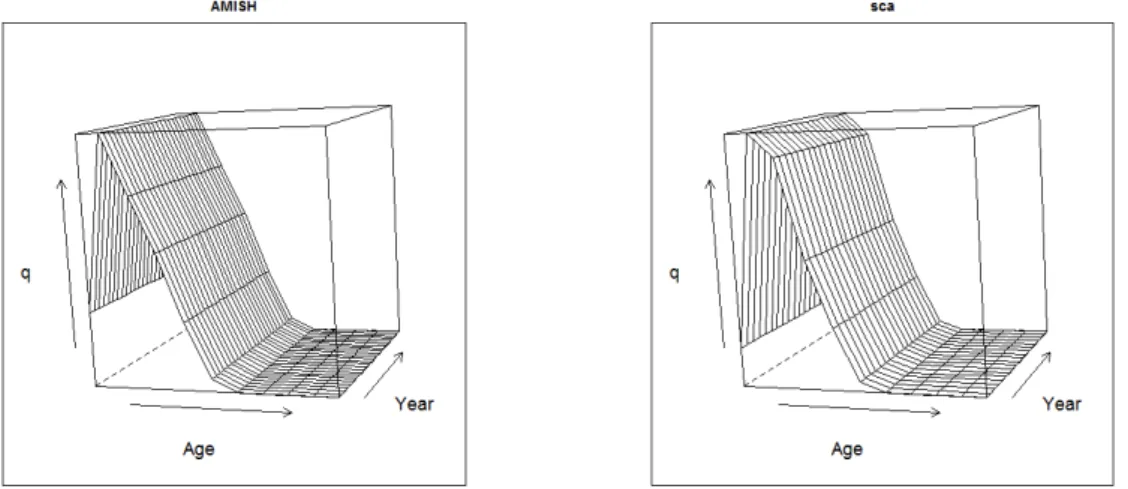
Again, the catchability submodel was successful in replicating the AMISH catchability block from 1992 to 2016 as show in Figure 6.
Figure 6. Age dependent catchability for 1992-2016 as estimated by AMISH (left) and from sca (right) and used to condition the OM.
3.2.4. Biological parameters
13 The natural mortality adopted for the southern horse mackerel stock is age dependent, being higher for younger ages and time invariant. The adopted values are based in the estimates for other similar pelagic species, a strong decrease of predation with age from observed diet composition of fish predators in the area and taking into account the observed mean life span and growth rate (Jennings et al., 2001, Cabral and Murta, 2002).
The proportion mature is age dependent, based on a logistic model fit to the histological analysis of female gonads from the combined data of three Daily Egg Production Method (DEPM) surveys, and time invariant (ICES, 2017b).
Assumptions about future weights of southern horse mackerel were based on the terminal year estimations. There are no indication of density-dependent growth for this stock and no significant trends in historical weight-at-age (ICES, 2017b). Additionally, taking in consideration that the spawning season is very long, from September to June, that the whole length range of the species has commercial interest in the Iberian Peninsula and that discards are negligible, there is no evidence to consider that the mean weight in the catch is significantly different from the mean weight in the stock.
Table 3. Natural mortality (M), mean weight at age in the stock and catch (Weight) and proportion of mature individuals (Maturity) at age 0-11+ used in the simulations.
0 1 2 3 4 5 6 7 8 9 10 11+
M (1/year) 0.9 0.6 0.4 0.3 0.2 0.15 0.15 0.15 0.15 0.15 0.15 0.15
Weight (catch & stock;kg) 0.02 0.03 0.04 0.07 0.12 0.15 0.17 0.18 0.22 0.24 0.25 0.3
Maturity 0 0 0.36 0.82 0.95 0.97 0.99 1 1 1 1 1
3.3.
Management Procedure
3.3.1. Assessment uncertainty
Because we are running a full-feedback MSE with an independent assessment for each population in each simulation loop, there is an added variability generated from the assessment cycle based on the differences between the ‘true’ and ‘perceived’ stock. Survey indices used as input to each assessment cycle were generated from the “true” population using the estimated catchability-at-age (from the sca model) with log-normally distributed errors from the qmodel to include observation error. Catch-at-age from the perceived stock is assumed known since there is evidence that catch-at-age for this stock is accurate with good sampling coverage, negligible discards and good agreement in age reading. Although the uncertainty observed in the AMISH assessment was not directly included in the MSE the range of the CVs of the SSB and F from the sca estimates were in the range 24-27%, close to those from AMISH (27-28%).
3.3.2. Short-term forecasts
14 benchmark and described in stock annex (ICES, 2017a,b). The forecast SSB at spawning time (mid-January) of year t+1 (advice year) is used to apply the TAC setting procedures according to the LTMS. It is noted that this forecast SSB is very close to the SSB estimated at the end of the interim year since the fraction of total fishing mortality before spawning is 0.04.
3.3.3. Simulations
The FLR MSE simulation carried out to analyse the performance of the proposed LTMS is based on 200 populations (npop), each projected from 2017 to 2080. Therefore, the full-feedback MSE performed simulations for nt = 64 future years resulting in 12800 assessment cycles. Simulations were carried out using the FLR packages FLCore (version 2.6.0.20170228), FLa4a (version 1.0.0; used to run sca) and FLash (version 2.5.7; used for OM projections). Code specifically developed for the specificities of this stock assessment procedures allowed for a wide range of settings, in scenario testing and supported the robustness of the results.
3.3.4. Performance Statistics
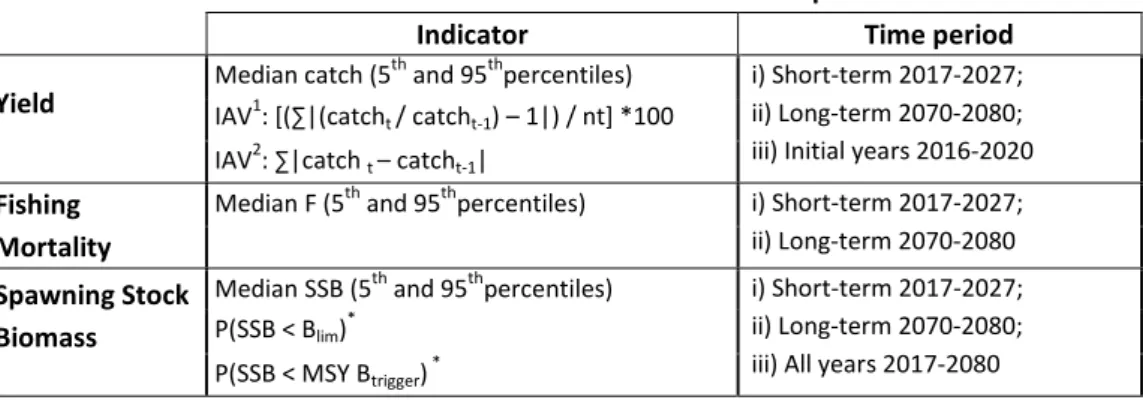
During each simulation a series of metrics were recorded for the evaluation of the LTMS. Table 4 summarizes the performance statistics used during the LTMS development and decision analysis. They include the median average and 5th - 95th percentiles in total catch (short as well as long terms), fishing mortality (‘true’ and ‘perceived’) and SSB. The probability of SSB falling below Blim and MSY Btrigger was also computed throughout the entire time series (2017-2080).
According to the precautionary approach the LTMS should ensure with high probability that the SSB is maintained above Blim. ICES (2013) defines the probability of SSB going below Blim,
P(SSB<Blim), as the maximum probability that SSB is below Blim, where the maximum (of the
annual probabilities) is taken over nt (Risk type 3). A ‘high probability’ of the LTMS maintaining the stock above Blim is achieved if P(SSB<Blim) is less than 5% (ICES precautionary criterion). The
LTMS also has to ensure that the stock is fished and maintained, in the future, at levels which can produce MSY.
From a stakeholder´s request, two statistics for the catch interannual variation (IAV1,2), were estimated for the short and long-term and also for the simulations initial 5-years period (Table 4). These indicators were proven very useful for their decision on the preferred management option.
Table 4. Performance statistics used to summarize the performance of the LTMS.
Indicator Time period
Yield
Median catch (5th and 95thpercentiles) i) Short-term 2017-2027; ii) Long-term 2070-2080; iii) Initial years 2016-2020 IAV1: [(∑|(catcht / catcht-1) – 1|) / nt] *100
IAV2: ∑|catch t – catcht-1|
Fishing Mortality
Median F (5th and 95thpercentiles) i) Short-term 2017-2027; ii) Long-term 2070-2080
Spawning Stock Biomass
Median SSB (5th and 95thpercentiles) i) Short-term 2017-2027; ii) Long-term 2070-2080; iii) All years 2017-2080 P(SSB < Blim)*
P(SSB < MSY Btrigger) *
*Maximum probability that SSB is below Blim or MSY Btrigger, where the maximum is taken over nt
15 Table 5. Summary of the methodology used in the evaluation of the Long-Term Management Strategy for southern horse mackerel stock (hom27.9a).
Background
Motive/initiative/background The LTMS was proposed for this stock by initiative of the Pelagic Advisory Council (PelAC) in a collaborative work between scientists from IPMA and IEO and Portuguese and Spanish stakeholders from the South Western Waters Advisory Council (SWWAC). The stock has no management plan and is currently above MSY Btrigger and exploited below FMSY.
Main objectives Evaluate whether the plan is in accordance with the precautionary approach and MSY approach.
Formal framework Request from PELAC to European Commission.
Who did the simulations work Scientists from IPMA, IEO, JRC.
Method
Software Stock assessment model (sca) and MSE framework implemented in R using the FLR packages (FLCore, FLa4a, FLash).
Name, brief outline Age-structured operating model and assessment with catches-at-age and one survey (IBTS) included in the loop. Survey
indices used as input to the assessments in the simulations were generated from the “true” population on the basis of
estimated catchability-at-age (from the sca model) with error coefficients log-normally distributed to simulate observation error. Catch-at-age from the perceived stock is assumed known and without implementation error.
Reference or documentation Documentation for the stock assessment model and MSE framework in Jardim, et al. (2017). Code available upon request.
Type of stock Medium life span (11+), pelagic/demersal, medium value, regionally important.
Knowledge base ICES category 1 stock.
Type of regulation TAC based on F in the TAC year.
Operating model conditioning Function, source of data Stochastic? – how (distribution, source of variability)
Recruitment Hockey-stick model (Azevedo et al., 2016) Log-normal (µ=0, =0.6), autocorrelated in time (1=0.8).
Growth & maturity As in last assessment (WGHANSA,2017) No significant trends in historical weight-at-age. No indications
of density-dependent growth.
Natural mortality As in last assessment (WGHANSA,2017) No. Natural mortality is age dependent and time invariant.
Selectivity F-at-age as in latest 2012-2016 selectivity block reviewed
in 2017 assessment/benchmark
16
Initial stock numbers Population vector from sca model mimicking AMISH
assessment
Similar to AMISH model.
Decision basis SSB at spawning time in the TAC advice year
Number of populations 200
Projection time 2017-2080; 64 years
Observation and implementation models
With assessment
Input data Catches and one survey Survey: error coefficients log-normally distributed to simulate
observation error. Comparison with ordinary assessment?
Yes
sca model is used to condition the simulation framework using the same setting as the AMISH model. Comparisons in several parameters including CV´s, retrospective patterns.
Deviations from WG practice?
No Changes from WG practice were only applied in a range of
robustness/sensitivity tests.
Harvest rule
Harvest rule design i) If SSB ≥ Btrigger , F = FMSY
ii) If Blim < SSB < Btrigger , F = Fby-catch + (FMSY - Fby-catch) x (SSB - Blim)/(Btrigger - Blim)
iii) If SSB ≤ Blim , F = Fby-catch
Stabilizers TAC shall not deviate more than 15% from the TAC the year before.
Duration of decisions Annual.
Revision clause After 5 years.
Presentation of results
Interest parameters SSB risk analysis (Blim and Btrigger), median catch, median fishing mortality.
Risk type and time interval Type 3, over entire simulated period (2017-2080).
17
4.
Results and discussion
4.1.
Proposed LTMS
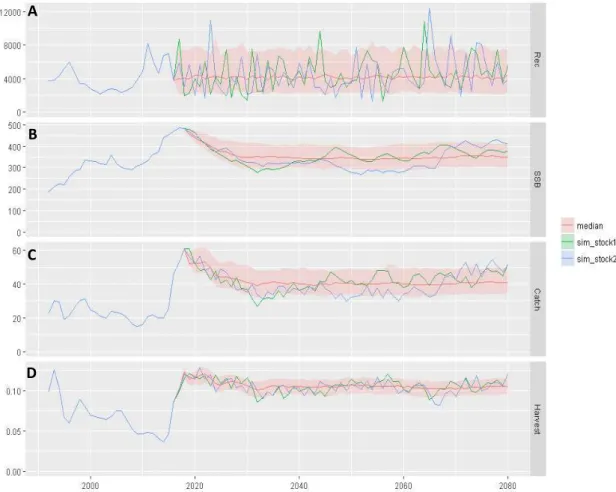
The trajectories of the key parameters recruitment, SSB, Yield and fishing mortality of the LTMS are shown in Figure 7. The stock has been exploited below FMSY and the SSB at the start
of the simulation period is at an historical high. The short-term median SSB is at 424669 t and after a small decrease in the initial period stabilizes, reaching a long-term median of 352148 t. This very healthy state of the stock at start of the simulated period, results in short-term median catches around 51468 t above the long-term average catch estimated around 40877 t.
Figure 7. Simulation summary results for 2017-2080. Panel A – Recruitment (millions). Panel B – SSB (kt). Panel C – Yield (catch, kt). Panel D – Fishing Mortality (harvest, year-1). The red line indicates the median value from the 200 populations and the shaded area the 10th and 90th percentiles. The green and blue lines show the results from two simulated populations selected randomly.
The SSB trajectory in the simulated period with 90% confidence intervals shows that in the proposed LTMS the size of the stock is maintained above Blim with high probability (Figure 8).
The maximum P(SSB < Blim) was at 0% both in the short and long-term.
The preliminary FMSY estimated for this stock (0.15) was higher than Fpa (0.11) and to ensure
consistency between the precautionary and the MSY frameworks FMSY was reduced to Fpa (ICES,
2017c). This restricted FMSY reinforced the high probability of the stock being above Blim and
A
B
C
18 also not falling below the MSY Btrigger level. Therefore, the HCR was never “triggered” in the
simulated period.
Figure 8 shows the long-term average catch distribution to evaluate whether the LTMS also ensures that the stock is fished and maintained, in the future, at levels which can produce MSY. The long-term median catch was estimated at 40877 t, with 90% confidence interval encompassing the median maximum sustainable yield of 43516 t (Table 1).
Figure 8. Panel A – SSB trajectory in the simulated period with 90% confidence intervals (shaded area) and Blim (red line) and MSY Btrigger (black line). Panel B – The long-term average catch distribution with the median of the distribution (40.88 kt, blue line) and the median MSY (43.52 kt, black line) as estimated in the BRP´s analysis.
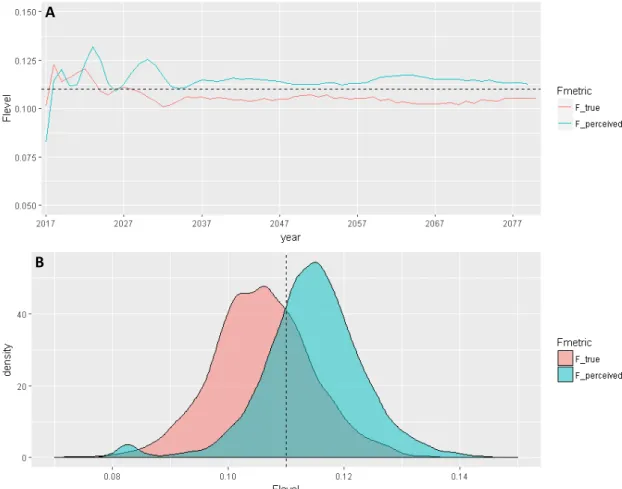
The variability in F in the initial 10 to 15 years of the simulation period with median F´s (true and perceived) above FMSY (Figure 9) is likely caused by the interim year short-term forecast in
each assessment cycle, which tends to overestimate the ‘true’ SSB during the decreasing trajectory in this period (Figure 8). When the SSB stabilizes, the perception of the stock
A
19 trajectory improves, decreasing the variability in F and increasing the agreement between
Fperceived and Ftrue. After the variability effects of the stock initial conditions, the median F at
equilibrium is estimated around F=0.104, slightly below the established FMSY (Figure 9, Table 6).
The retrospective pattern in the sca model between 2010 and 2016 (Annex 3) showed an overestimation of F, this is somehow reflected in the MSE simulations as the ‘perceived’ F is consistently higher than the ‘true’ F. This overestimation of F has the effect of underestimating the catch advice for year y+1, preventing the true F to reach FMSY (Figure 9). Nevertheless, the
median F at equilibrium, slightly below the established FMSY, produces a long-term yield close
to MSY.
Figure 9. Panel A – Median F in the operating model (F_true) and median F in the terminal year of each assessment cycle (F_perceived) for the simulation period. Panel B – Density distribution of F_true and F_perceived for the simulation period. The dashed line in both graphs is the established FMSY =0.11.
Table 6 summarizes the results of the LTMS performance metrics for yield, fishing mortality and SSB on the short term (2017-2027) and the long term (2070-2080). For precautionary considerations, P(SSB < Blim) and P(SSB < MSY Btrigger)were computed as the maximum
probability over the projection period (2017-2080).
A
20 Table 6. Performance statistics for yield, fishing mortality and SSB.
Short Term 2017-2027
Long Term 2070-2080
Yield
Median catch 51468 t 40877 t
5th perc. 38423 t 31979 t
95th perc. 60954 t 52425 t
Interannual variability
IAV1 (%) / IAV2 (t) 6% / 35.97 t <1% / 3.18 t
Fishing mortality
Median F 0.113 0.104
5th perc. 0.099 0.090
95th perc. 0.127 0.117
SSB (Precautionary considerations)
Median SSB 424669 t 352148 t
5th perc. 337165 t 286844 t
95th perc. 485520 t 436682 t
P (SSB < MSY Btrigger) 0% 0%*
P (SSB < Blim) 0% 0%*
* Maximum probability over all the simulation period (2017-2080).
4.2.
Robustness/Sensitivity
The LTMS considers a re-evaluation of the BRP´s and the management strategy at intervals not exceeding five years to account for possible changes in the stock and fishery dynamics (Article 7). However, to improve our understanding on the robustness of the proposed LTMS we performed a sensitivity analysis with changing parameters in:
i) Status quo period, changed to a 3-yrs average in the estimates of F-at-age and for the input values for the biological parameters used in the short term projections in each management cycle.
ii) Selectivity at age, allowed to gradually change over time in the OM and MP using an updated smoother in the year component, with degrees of freedom conditioned to the increasing number of simulated years (nt):
fmod<-substitute(~s(replace(age, age>7, 7), k=6) + s(year,k=KY),list(KY=floor(0.6*length(vy0))))
iii) Stock productivity, considering low productivity based on the recruitment geometric mean.
21 The key performance statistics were analyzed (results available but not shown) for scenarios i) to iv). The minor changes observed further supported the robustness of the LTMS results.
As shown in the previous section, the stock is at very healthy state and currently being exploited below FMSY. The good condition of the stock coupled with an FMSY restricted by the
Fpa, resulted in a very high probability of the stock being above Blim and also not falling below
MSY Btrigger level. To further explore the robustness of the LTMS on the performance of the
HCR with the catch constraint, we ran the simulations assuming a reduced productivity on the stock, to 40% of the observed geometric mean recruitment.
Figure 10 shows the recruitment, SSB and fishing mortality trajectories with 90% confidence intervals for the low productivity scenario. The HCR with the catch constraint also ensures that the stock is maintained above Blim with very high probability (P(SSB < Blim) = 0), fluctuating
around MSY Btrigger level, (P(SSB < MSYBtrigger) = 0.67). Fishing mortality is reduced according to
the HCR and despite the ±15% catch constraint, the HCR successfully prevents the stock falling below Blim.
Figure 10. Simulation results on the low productivity scenario. Panel A – Median Recruitment with 90% confidence intervals and the geometric mean of 1992-2016 (black line). Panel B – Median SSB with 90% confidence intervals showing the Blim (red line) and MSY Btrigger (black line). Panel C – Median fishing mortality with 90% confidence intervals and the established FMSY (black line). Two populations selected randomly are also shown in the simulation years.
A
B
22 The outputs and main results for all the MSE simulations carried out during the development of the LTMS are available upon request. The R code used to perform the full-feedback MSE is also available upon request.
5.
Conclusions
The proposed LTMS, with a HCR defined by FMSY at 0.11, Fby-catch=0.01, MSY Btrigger at 181000 t
and Blim at 103000 t and with a ±15% catch constraint for SSB above Blim, performs according
to requirements. The probability of SSB being below Blim is less than 5%, being considered
precautionary under the ICES precautionary criterion. The proposed management plan also performed successfully (in terms of being precautionary) under changing parameters of stock productivity, selectivity and status quo period, showing that the proposal is robust to some of the major assumptions made in the initial conditions. The very healthy state of the stock and an FMSY level restricted to a lower precautionary Fpa results in a very low probability of SSB also
being below MSY Btrigger. The proposed long term management strategy also ensures that the
stock is able to produce long-term equilibrium catches very close to MSY.
The results of the simulations assuming a very low productivity on the stock indicates that the HCR with the catch constraint is also able to prevent the stock to go below Blim.
The Advisory Councils (ACs), and in particular the Pelagic Advisory Council with the collaboration of the South Western Waters Advisory Council, contributed from the very beginning of the LTMS development. Their involvement led to fruitful discussions with managers and scientists on different options for management objectives, HCR, TAC settings, FMSY target year and catch stability levels. In fact, the interest and dedication showed by
stakeholders during this process gives us hope that the fishery community will be strongly committed in the implementation of the proposed management strategy.
Acknowledgments
We thank José de Oliveira and Chris Legault for reviewing a first version of the report and providing constructive comments. The work was partly supported by IPMA National Sampling Programme for Biological Parameters (PNAB\EU Data Collection Framework) and the IEO
Programme “Evaluación de recursos pesqueros en el área del ICES”.
References
Azevedo, M., Mendes, H., Costas, G. 2016. Biological Reference Points for Horse mackerel (Trachurus trachurus) in Division IXa (southern stock). WD to the Working Group on Southern Horse Mackerel, Anchovy and Sardine (WGHANSA), 24-29 June 2016, Lorient, France. ICES CM 2016/ACOM:17.
23 ICES. 2013. Report of the Working Group on Methods of Fish Stock Assessments (WGMG), 30 September - 4 October 2013, Reykjavik, Iceland. ICES CM 2013/SSGSUE:08.
ICES. 2016a. Report of the Working Group on the assessment of horse mackerel, sardine and anchovy (WGHANSA). ICES CM 2016/ACOM:17.
ICES. 2016b. Advice basis. In Report of the ICES Advisory Committee, 2016. ICES Advice 2016, Book 1, Section 1.2.
ICES. 2017a. Report of the Benchmark Workshop on Pelagic Stocks (WKPELA), 6–10 February 2017, Lisbon, Portugal. ICES CM 2017/ACOM:35.
ICES. 2017b. Working Group on Southern Horse Mackerel, Anchovy and Sardine (WGHANSA), 24–29 June 2017, Bilbao, Spain. ICES CM 2017/ACOM:17.
ICES. 2017c. ICES fisheries management reference points for category 1 and 2 stocks. ICES Advice, Book 12, Section 12.4.3.1.
Jardim, E., Scott, F., Mosqueira, I., Citores, L., Devine, J., Fischer, S., Ibaibarriaga, L., Mannini, A., Millar, C., Miller, D., Minto, C., De Oliveira, J., Chato-Osio, G., Urtizberea, A., Vasilakopoulos, P., Kell, L. 2017. Assessment for All initiative (a4a). Workshop on development of MSE algorithms with R/FLR/a4a. 30th January - 3rd February. Ispra, Italy.
Jennings, S., Kaiser, M.J., Reynolds, J.D. 2001. Marine Fisheries Ecology. Blackwell Science, Ltd. London.
Kell, L. T., Mosqueira, I., Grosjean, P., Fromentin, J.-M., Garcia, D., Hillary, R., Jardim, E., Mardle, S., Pastoors, M.A., Poos, J.J., Scott, F., Scott, R.D. 2007. FLR: an open-source framework for the evaluation and development of management strategies. ICES Journal of Marine Science, 64(4), 640–646.
Lowe, S., Ianelli, J. and Palsson, W. 2012. Stock assessment of Atka mackerel stock in Bering Sea/Aleutian Islands. In Stock Assessment and Evaluation Report for the Groundfish Re-sources of the Bering Sea/Aleutian Islands. North Pacific Fisheries Management Council: 1561-1645.
Methot, R.D. and Wetzel, C. 2013. Stock synthesis: A biological and statistical framework for fish stock assessment and fishery management. Fisheries Research 142:86-99.
Uriarte, A., Azevedo, M., Costas, G., Mendes, H. 2017. Report of the Workshop on Data Evaluation for Southern Horse Mackerel (WKSHOM) in Report of the Benchmark Workshop on Pelagic Stocks (WKPELA), 6–10 February 2017, Lisbon, Portugal. ICES CM 2017/ACOM:35. 142-225 p.
Wood, S.N. 2017. Generalized Additive Models: An Introduction with R (2nd edition). Chapman
24
Annexes
Annex 1
Summary of the main meetings and relevant milestones (Table I) and range of options
tested during the development of the LTMS, including TAC settings, target year for F
MSYand catch stability levels (Table II)
Table I – Main meetings and relevant milestones throughout the development of the LTMS.
Meeting date and Forum Subject and milestones
1. October 2014, SWWAC/PELAC meeting, Madrid
First debate on Management plan
2. November 2014, SWWAC/PELAC webex meeting
Type of harvest control rule (TAC, F or Harvest Rate)
3.February 2015, SWWAC meeting, Lisbon Refinement of HCR type and relevant Biological Reference
Points - BRPs
4.February 2016, PELAC meeting, Denn Haag BRP estimates (2015 assessment data); Rationale accepted by PELAC
5.March 2016, SWWAC stakeholders meeting, Matosinhos
6. June 2016, ICES WGHANSA, Lorient
Stakeholders feedback on options for catch stability; Level of catch for Fby-catch
BRP estimates, used by ICES for advice (Azevedo et al., 2016; ICES 2016a)
7.October 2016, PELAC meeting, Denn Haag Presentation of BRPs and results from 1st set of stochastic simulations (MSE short-cut approach); questions to stakeholders on assumptions & Management options -> questionnaire sent to stakeholders
8.November 2016, SWWAC/PELAC meeting, Lisbon
Synthesis of stakeholders response to questionnaire; set roadmap for further analysis
9.February 2017, ICES WKPELA, Lisbon Benchmark. Stock ID, biological and productivity
parameters, BRP´s and assessment method reviewed (ICES, 2017a)
10..June 2017, SWWAC/PELAC meeting, Matosinhos
Preliminary results from stochastic simulations using full MSE; stakeholders feedback on HCR, management options and diagnostic metrics
11. June 2017, ICES WGHANSA,Bilbao
12.July 2017, PELAC meeting, Denn Haag
Scientific feedback on full MSE methodology and results
Results from full MSE for several management option; process follow-up
13.July 2017, SWWAC/PELAC meeting, Matosinhos
Stakeholders discussion and decision on the draft proposal for the LTMS
25 Table II- Range of options tested during the development of the LTMS, including TAC settings, target year for FMSY and catch stability levels.
Scenarios Basis Catch constraint
F management
Target: FMSY
Management: through F Not applicable
Target year: 2025 or 2018
HCR on
TAC
management
Target: FMSY +/- 15% and
Management: TACy+1=Catchy-1 +/- 20%
Target year: 2025 or 2018
HCR on
TAC
management
Target: FMSY +/- 15% and
Management: TACy+1=mean (Catchy-3:Catch y-1) +/- 20%
Target year: 2025 or 2018
HCR on
TAC
management
Target: FMSY +/- 15% and
Management: TACy+1=TACy +/- 20%
Target year: 2025 or 2018
26
Annex 2
Description of the MSE short-cut approach
A preliminary analysis on the management strategies was performed using an MSE short-cut approach based on the 2015 stock assessment and the BRP's. The results from these preliminary set of stochastic simulations were discussed with stakeholders and were proven useful to decide on the preferred range of management options to evaluate under a full MSE. Code was developed in R and implemented with the use of the FLR packages (version 2.5.20160504), FLash and FLassess to implement the framework as described in Figure I. Simulations were run for 1000 iterations (populations) from 2017-2070, starting from the terminal year of the last assessment. Recruitment variability was generated assuming a multiplicative error using the residuals of the model fit to the historical stock-recruit pairs. Weight-at-age variability in the simulated period was generated from a log-normal error with standard deviation based on the observed time series (2005-2015). The main issue in this approach was to simulate the behaviour of the assessment model by generating from the operating model a population with similar statistical characteristics (e.g. CV) that reflect the behaviour of the AMISH model. To implement an observation error in the short-cut approach, a log normal distribution was applied directly on the stock numbers at age, with larger deviates for younger ages and scaled to give a CV on SSB similar to the CV of the assessment. Assessment error was applied directly to the F in the advice year adopting the CV of F in the last assessment year. Robustness of the HCR was also tested in a low productivity scenario without strong year classes and sensitivity of the simulations over a range of F values. Results available in: http://www.pelagic-ac.org/media/pdf/Presensation%20Azevedo%20SHom.pdf.
27
Annex 3
Diagnostics from model fit and retrospective analysis:
sca
(left) &
AMISH
(right)
MODEL FIT
Observed (dots) & fitted (line) catch-at-age Observed (dots) & fitted (line) catch-at-age
Observed (dots) & fitted (line) cpue-at-age
RETROSPECTIVE PATTERN