Porto
Development of a multi-criteria collaborative decision
model for performance management in networks of
organisations
Graduated in Economics by Faculdade de Economia da Universidade do Porto
Dissertation submitted for partial satisfaction of master degree requirements in
Information Management
Dissertation developed under the supervision of Professor Doutor António Lucas Soares,
Departamento de Engenharia Informática da Faculdade de Engenharia da Universidade do Porto
Agradecimentos
Começo por agradecer ao meu orientador Professor Doutor António Lucas Soares o convite para participar no projecto de investigação pmColNet e o empenho e paciência que mostrou ao guiar-me pelo difícil percurso da elaboração da dissertação de mestrado.
Aos meus colegas de projecto, Karla Gurgel, Jesse Wieserma e Jorge Neves, pelo apoio e incentivo nas horas de maior cansaço e pelos bons momentos passados nas reuniões. Um agradecimento especial ao Professor Doutor Jorge Pinho de Sousa pelas sugestões efectuadas.
Aos colegas de mestrado, pela facilidade com que passamos um ano de trabalho.
Aos familiares e amigos, pelo tempo que deixei de lhes dedicar e sobretudo à Ana Cristina, minha esposa, pelo apoio incondicional.
Abstract
The present work is framed by the research project pmColnet - performance management in Collaborative Networks (project PTDC/GES/71482/2006 funded by Fundação para a Ciência e Tecnologia) developed by a team at INESC Porto - Instituto de Engenharia de Sistemas e Computadores do Porto. pmConNet’s main objective is the construction of a generic performance model in collaborative networks. An important part of the project is based on using multi-criteria methodologies potential to maximize the support given to network participant’s decision about goals, criteria and performance indicators related to its collaboration.
The focus of this work is to pass in review decision support multi-criteria methodologies that may help designing pmColNet model.
Collaborative networks under consideration are interorganisational and non-vertical, where teams have some form of independence regarding their primitive organisational structure and which already have past collaborative stories, so they are embracing a new collaborative project.
In this context it should be interesting, from the participants point of view, that performance model incorporates aspects from individual organisation performance model and combine them with the general network performance model.
One main characteristic of the model is its flexibility and contextualisation regarding its participants and network typology, so, partners can freely choose and negotiate proper goals, criteria and indicators more suitable for their specific network.
Resumo
O presente trabalho é enquadrado pelo projecto de investigação pmColNet -
performance management in Collaborative Networks (projecto
PTDC/GES/71482/2006 financiado pela Fundação para a Ciência e Tecnologia) desenvolvido por uma equipa do INESC Porto. O principal objectivo do pmColNet é a construção de um modelo genérico de gestão da performance em redes colaborativas. Uma importante parte do projecto alicerça-se no aproveitamento do potencial das metodologias multicritério para maximizar o apoio aos participantes da rede na decisão de escolha dos objectivos, critérios e indicadores de desempenho da sua colaboração. O enfoque do presente trabalho passa pela revisão de metodologias multicritério de apoio à decisão que possam contribuir para o desenho do modelo pmColNet.
As redes colaborativas em apreço são redes interorganizacionais não verticais, em que as equipas possuem algum grau de independência face à estrutura organizacional primitiva e que já têm uma história de colaboração anterior, pelo que abraçam um novo projecto colaborativo.
Neste contexto será interessante, do ponto de vista dos participantes, que o modelo de desempenho incorpore aspectos provenientes do modelo de avaliação individual das organizações e os combine com o modelo geral de avaliação da rede.
Uma das características do modelo é a sua flexibilidade e contextualização face aos intervenientes e tipo de rede, pelo que os participantes podem livremente escolher e negociar os objectivos, critérios e indicadores que consideram mais adequados à sua rede.
Table of contents
Abstract... 4 Resumo ...5 Table of contents ... 6 List of figures ... 9 List of tables... 11 Abbreviations list ... 12 Glossary of terms ... 13 1. Introduction ... 141.1. Problem description and research goals ... 14
1.2. Methodology ... 16
1.3. Thesis structure ... 17
2. Performance measurement for collaborative networks ... 18
2.1. Collaborative networks ... 18
2.2. Performance measurement ... 21
2.3. A multiple criteria decision analysis problem ... 23
3. Decision analysis review ... 25
3.1. Perspectives and approaches ... 26
3.1.1. Utility modelling ... 27
3.1.2. Game theory and competitive decision making ... 28
3.1.3. Ordinal/ relational approach vs. cardinal approach ... 29
3.2. Operational research – multi-criteria methods ... 30
3.2.1. Phases ... 31
3.3. Decision support systems ... 32
3.3.1. Group Support Systems and Negotiation Support Systems ... 33
3.4.2. AHP ... 41
3.4.3. Macbeth ... 42
3.4.4. Comparative analysis... 43
4. Structuring and managing information in the performance evaluation system – Information model ... 45
4.1. Perspectives and framework ... 46
4.2. Collaborative network typology ...47
4.3. Stakeholders ...47
4.4. Evaluation framework ...47
4.4.1. Evaluation perspective: facets vs. hierarchy classification ... 48
4.4.2. Criteria ... 49
4.5. Performance indicators ... 49
4.6. Other conceptual metrics for managing collaborative networks ... 50
4.6.1. Parung and Bititci ... 51
5. Multicriteria performance management model for collaborative networks ... 52
5.1. Method proposal ... 52
5.2. pmColNet fundamentals ... 54
5.2.1. Hierarchical Framework for Performance Analysis –HFPA ... 54
5.2.2. Visual pairwise judgment ... 57
5.2.3. Aggregating preferences ... 58
5.3. Resuming pmColNet Phases ... 60
5.4. Phase A – Contextualisation ... 61
5.4.1. (I) Initial setup ... 62
5.4.2. (II) Partner’s individual performance model ... 62
5.4.3. (III) Network typology... 63
5.4.4. (IV) Defining vote power ... 64
5.5. Phase B – Partner’s proposals ... 64
5.6. Phase C – Measuring preference intensity ...67
5.7.1. (I) Network global commitment level ... 70
5.7.2. (II) Defining failure and success ... 70
5.7.3. (III) Levels of analysis ... 71
5.7.4. (IV) Performance relationships ... 73
5.7.5. (V) Index construction ... 75
5.8. Phase E – Monitoring performance ...76
5.8.1. Normalising indicators and achieving a dashboard/ tableau de bord ...76
5.8.2. Ideal performance - TOPSIS ... 77
5.8.3. Relationship between Individual and Network performance model ... 78
5.9. Scenarios ... 80 5.9.1. Scenario #1 ... 80 5.9.2. Scenario #2 ... 103 6. Conclusions ... 111 6.1. Future steps ... 112 References ... 113
List of figures
Figure 1 - Map of modeling theories applicable to CNO's, Camarinha-Matos and
Afsarmanesh (2006:8) ... 20
Figure 2 - Types of scales. Roy, Bernard, “Paradigms and Challenges” in Figueira et al. (2005:9-10)... 30
Figure 3 - Zahir and Dobing (2002:53) MCGSS ... 35
Figure 4 - Key perspectives within network performance evaluation. Neves (2009:90) ... 46
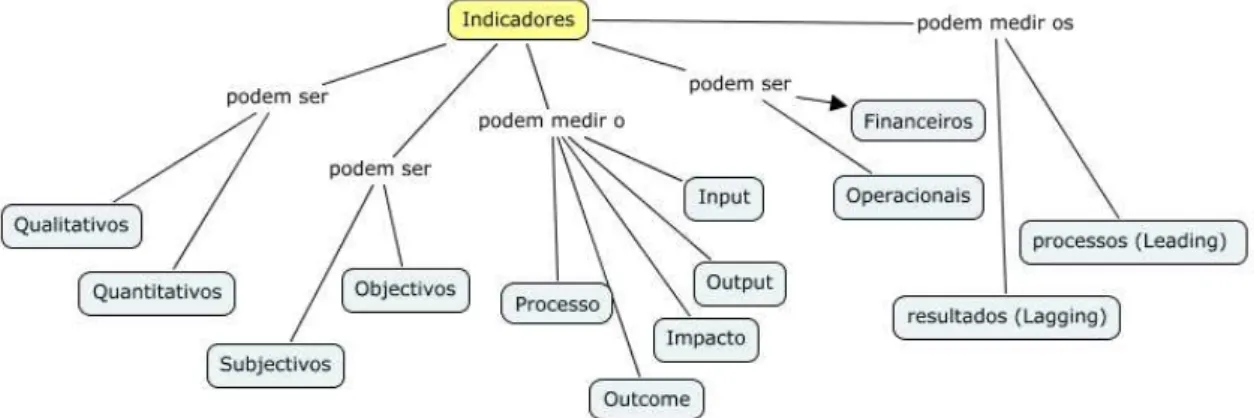
Figure 5 - Types of performance indicators. Neves (2009:44) ... 50
Figure 6 - HFPA elements ... 55
Figure 7 - HFPA ... 56
Figure 8 - Visual judgment ... 57
Figure 9 - Quantitative visual judgment ... 58
Figure 10 - HFPA partner's proposals ... 65
Figure 11 – Neves’ (2009:119) performance information conceptual map example ... 66
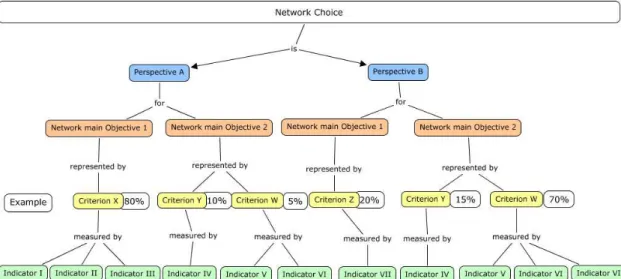
Figure 12 - Network HFPA example ... 69
Figure 13 - Defining each indicator's failure/ success limits ... 71
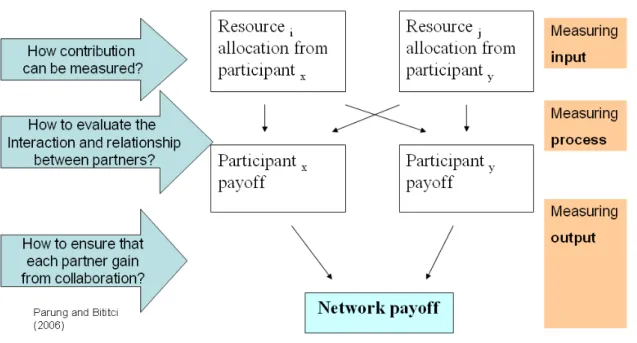
Figure 14 - Parung and Bititci (2006) adapted performance model ... 73
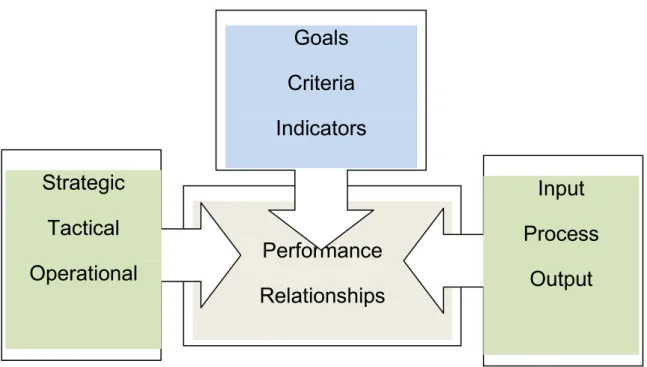
Figure 15 - Puzzling Performance relationships ...74
Figure 16 - The link between organisation and network performance model ...79
Figure 17 - Scenario #1: BS individual HFPA ... 81
Figure 18 - Scenario #1: SME individual HFPA ... 82
Figure 19 – Scenario #1: Assoc individual HFPA ... 82
Figure 20 - Scenario #1: BS network HFPA proposal ... 84
Figure 21 - Scenario #1: SME network HFPA proposal ... 85
Figure 22 - Scenario #1: Assoc network HFPA proposal ... 86
Figure 24 - Scenario #1: BS/Assoc perspectives pairwise judgement ... 87
Figure 25 - Scenario #1: Assoc/SME perspectives pairwise judgement ... 87
Figure 26 - Scenario#1 network HFPA ... 94
Figure 27 - Scenario#1: Puzzling levels of analysis and indicators ...97
Figure 28 – Example of productivity ratio between input and process indicators ... 98
Figure 29 - Example of productivity ratios and path from operational to strategic indicators ... 99
Figure 30 - Graphical view of the indices’ performance ... 101
Figure 31 - Dashboard example #1 ... 102
Figure 32 - Dashboard example #2 ... 103
Figure 33 - Scenario #2: network HFPA ... 104
Figure 34 - Scenario #2: dashboard ... 105
Figure 35 - Scenario #2: operations index ... 107
Figure 36 - Scenario #2: collaboration index ... 107
Figure 37 - Scenario #2: marketing index ... 108
Figure 38 - Scenario #2: financial and economic index ... 108
Figure 39 - Scenario#2: overall index ...109
List of tables
Table 1 - Relational approaches comparative table ... 44
Table 2 - pmColNet phases ... 61
Table 3 - Example of perspectives order and veto threshold ...67
Table 4 - Scenario #1 Commitment level ... 83
Table 5 - Scenario #1: Vote power ... 84
Table 6 - Scenario #1: BS pairwise comparisons ... 88
Table 7 - Consistency index auxiliary calculus ... 88
Table 8 - Scenario #1: SME pairwise comparisons ... 89
Table 9 - Scenario #1: Assoc pairwise comparisons ... 89
Table 10 - Scenario #1: priority vectors ... 89
Table 11 - Scenario #1: vote power matrix ... 90
Table 12 - Scenario #1: final global priorities matrix ... 90
Table 13 - Scenario #1: BS criteria pairwise comparison ... 91
Table 14 - Scenario #1: SME criteria pairwise comparison ... 91
Table 15 - Scenario #1: Assoc criteria pairwise comparison ... 92
Table 16 - Scenario #1: priority vectors for criteria ... 92
Table 17 - Scenario #1: vote power ... 93
Table 18 - Scenario #1: criteria's final global priorities ... 93
Table 19 - Scenario#1: Defining failure and success for each indicator ... 95
Table 20 - Scenario#1 levels of analysis ... 96
Table 21 - Scenario #1: substitution rate ... 99
Table 22 - Data gathering for indicators ... 100
Table 23 - Index construction ... 100
Table 24 - Scenario #2: indicators data ... 104
Abbreviations list
AHP - Analytic Hierarchy Process CMS – Content Management System CN – Collaborative Networks
CNO - Collaborative Networked Organisations DM – Decision-maker
DSS – Decision Support System
ELECTRE - ELimination Et Choix Traduisant la REalité GDSS - Group Decision Support System
HFPA - Hierarchical Framework for Performance Analysis
INESC Porto - Instituto de Engenharia de Sistemas e Computadores do Porto KPI – Key Performance Indicator
MACBETH - Measuring Attractiveness by a Categorical Based Evaluation Technique MCDA – Multiple Criteria Decision Analysis
MCDM - Multi-Criteria Decision-Making MCGSS - Multicriteria Group Support System
Glossary of terms
Collaborative network (or just network in the scope of this research) – “A collaborative network (CN) is constituted by a variety of entities (e.g. organizations and people) that are largely autonomous, geographically distributed, and heterogeneous in terms of their: operating environment, culture, social capital, and goals. Nevertheless these entities collaborate to better achieve common or compatible goals, and whose interactions are supported by computer network. Unlike other networks, in CN collaboration is an intentional property that derives from the shared belief that together the network members can achieve goals that would not be possible or would have a higher cost if attempted by them individually.” Camarinha-Matos and Afsarmanesh (2005:439)
Commitment level – is a business metric that tries to capture the degree of importance given to the collaborative network by each partner.
Decision overriding – is the privilege of network partners to decide differently from the proposed alternative ranking produced by the multicriteria method. Decision overriding emphasize the constructivist approach of pmColNet.
Facilitators –It’s a role that aims to clarify and shape the process of evaluation and/ or negotiation on the decision-making. Its position should be neutral while motivating (Moreira 2007:10). pmColNet should have a facilitator role.
Network partners – participants, players, actors or members of the network.
Primary and secondary stakeholders – We use “primary” stakeholders to refer network participants. Secondary stakeholders are all the other: Government, suppliers, clients, citizens, communities, …
Veto threshold – on the final HFPA’s ranking, pmColNet suggests exclusion of alternatives below a pre-defined accumulated preference. The veto threshold is calculated taking into account the vote power of the most and the least powerful members of the network (see 5.6 section).
Vote power - “Usually, all the experts have the same weight, but in certain applications each expert can have a coefficient of importance. (…) [This] may be interpreted as the degree in which that individual is really a decision maker relative to the decision problem, or it can be viewed as the power (degree of importance, competence or ability) of his opinion.” Marichal (1999:6)
1. Introduction
Collaborative networks among organisations are more common nowadays to respond to globalisation and competitive economies (Bititci et al. 2004; Todeva and Knoke 2005). Participant’s specialisation and core competencies focus is seen as a form to maximize efficiency and promote organisational value (Sydow and Windeler 1998). Parung and Bititci (2006:116) summarize several studies supporting the increase of collaborative networks:
“Through collaboration, companies aim to share resources, share and exchange information, reduce risks, reduce cost, reduce time-to-market, reduce delivery-time, increase market-share, increase asset-utilisation, increase skills and knowledge, increase customer-services, and so on.”
The study of collaborative networks, especially the problem of measuring performance within networks is an up-to-date subject, with observant listeners throughout management science field and organisation leaders. This is why making this thesis was so attractive and one of the main reasons for choosing it.
We are certain that collaborative networks are a valid path to surpass the actual economic and financial crisis and that performance management maximizes the network potential success.
1.1.
Problem description and research goals
According to Sydow and Milward (2003:1), network performance evaluation is an increasing need of researchers and practitioners of interorganisational networks to assess the performance of those forms of network governance. This occurs because: 1. there are high failure rates in organisational networking and organisations must
have a realistic attitude towards networking;
3. state agencies are very interested in interorganisational cooperation in order to create value;
4. we have been living in an “age of evaluation” which induces private and public organisations to strongly require performance evaluation.
Collaborative networks are really important nowadays and it is vital to assure that its performance is monitored, but designing a performance model system for collaborative networks is not a trivial task, indeed it is a complex problem because collaborative networked organisations require several dimensional analyses.
Evaluating collaborative networks is a task with common issues related to performance models, such as the choice of appropriate evaluation criteria and indicators. But those issues are more difficult to resolve, because there are multiple stakeholders involved (with possible conflicting interests).
The research question of this work is:
Will collaborative networks benefit from a multi-criteria decision support and collaborative meaning negotiation methods approach, in the construction of their performance model?
Managing collaborative networks clearly involves a set of multi-criteria problems. Therefore, in this work we propose to construct a multi-criteria framework of a performance model for collaborative networks. This multi-criteria framework was developed within pmColNet – performance management in Collaborative Networks’ (project PTDC/GES/71482/2006 funded by Fundação para a Ciência e Tecnologia) research project at INESC Porto - Instituto de Engenharia de Sistemas e Computadores do Porto.
The aim of this work won’t be the explanation of network formations or why they can promote competitive advantage. This assumption will be considered throughout the thesis.
The initial hypothesis of this work is that collaborative networks do benefit from a multi-criteria performance model that is constructed in a collaborative manner by network partners and that model contributes to maximize the network potential and value creation.
This investigation’s primary goals are:
- To develop a multi-criteria decision-making (MCDM) model to support the collaborative design of a network performance management system;
- To develop a method to support the negotiation processes in the collaborative construction of the network performance system.
1.2.
Methodology
The chosen approach for this investigation is based in two perspectives: multiple criteria decision analysis and constructivism.
In order to create a coherent and consistent framework for supporting performance management activities, a Multiple Criteria Decision Making (MCDM) framework was developed. The constructed performance system uses concepts from the Relational approach methods (see section 3.4), namely the Analytic Hierarchy Process (AHP), but also from ELECTRE (ELimination Et Choix Traduisant la REalité).
pmColNet is a Group Decision Support System (GDSS) and the Zahir and Dobing (2002) MCGDSS and PROMETHEE GDSS procedure were studied and adapted to fit this work’s objectives.
The constructivist paradigm was adopted while conceptualizing pmColNet system: - The system has a facilitator role: The role of pmColNet is to facilitate the
decision-making process, shaping the network performance model. This facilitator position (Moreira 2007:10) should be neutral but motivating;
- Every collaborative network is unique, and therefore needs an unique constructed performance model;
- It must reflect the socio-economic realities of each collaborative network. Focus should be granted to an initial contextualisation phase (see section 5.4) and partner interaction.
- Complementing the context-based approach, the design of a network performance model must not be a sum, or mere adaptation, of each organisation’s individual performance model.
1.3.
Thesis structure
Chapter 2 will be dedicated to explore relationships between performance evaluation and collaborative networks. The subject will be framed as a multi-criteria decision problem.
Chapter 3 of this investigation will resume the state of the art regarding the Decision Analysis field of study. Major importance will be conceded to Operational Research, especially multi-criteria methods, and Decision Support Systems (DSS).
In chapter 4 we will present an information model proposal according to Neves (2009) for structuring and managing information in the performance evaluation system of collaborative networks.
At chapter 5, a multi-criteria performance model for collaborative networks will be proposed, following pmColNet’s objectives. Some scenarios will be explored to understand the model’s potential.
Finally, we will present conclusions and leads for future investigation and improvements.
2. Performance
measurement
for
collaborative
networks
2.1.
Collaborative networks
For the purposes of this paper, an interorganisational collaborative network will be defined considering Camarinha-Matos and Afsarmanesh (2005:439):
“A collaborative network (CN) is constituted by a variety of entities (e.g. organizations and people) that are largely autonomous, geographically distributed, and heterogeneous in terms of their: operating environment, culture, social capital, and goals. Nevertheless these entities collaborate to better achieve common or compatible goals, and whose interactions are supported by computer network. Unlike other networks, in CN collaboration is an intentional property that derives from the shared belief that together the network members can achieve goals that would not be possible or would have a higher cost if attempted by them individually.”
We will also consider the following features of a collaborative network, regarding Hill’s (2002:6) literature review:
- “Oriented to higher purpose/common vision: Beyond the limited visions and abilities of network members;1
- Activity affects the whole system (assumption): Network activity has external effects (impact on the community) as well as internal effects (impact within the network);
- Horizontal organization: Network structure is not hierarchical; each member
is equal within the network;2
- Voluntary participation: Members choose to belong; - Decentralized: No centralized source of power;
- Member-controlled: Controlled by member organizations via stakeholders;
- Self-regulating: All members determine the network’s rules, processes and procedures;
- Collaborative: Engaged in an interactive process;
- Cognitive: Have self-knowledge; aware of environment and adept at working
with it, a learning organization;
- Involves a division of labour: Members have specialized tasks and skills;
- Autonomous members: Member organizations retain independent
decision-making powers;
- Deliberative: Deciding/addressing/exploring constructively.
Collaborative networked organisations (CNO) require several dimensional analyses, namely structural, functional, behavioural and componential dimensions. Camarinha-Matos and Afsarmanesh (2006) proposed a simplified map relating theories/ tools to the modelling dimensions:
2 Equality between network members can be relaxed and does not compromise network vision.
In fact it is not difficult to accept that in most real networks, some partners are more powerful than others, deriving from different resource allocation or socio-political advantages. The pmColNet model will attain equal or unequal membership.
Figure 1 - Map of modeling theories applicable to CNO's, Camarinha-Matos and Afsarmanesh (2006:8)
- Structural dimension addresses the structure or composition of the CNO in terms of its constituting elements, roles and characteristics such as location and time.
- Componential dimension focuses on the individual tangible/ intangible elements in the CNO’s network.
- Functional dimension focuses on operations (processes and procedures) of the CNO.
- Behavioural dimension focuses the principles, policies and governance rules of the CNO and its members.
According to Carneiro et al. (2007:11), interorganisational networks different dimension analyses are: relationships, actors (network partners in our terminology), resources, activities, motivation and context. These cooperation elements are related with network typology, which is essential to structure a well fitted performance model for each specific case.
Because several classifications are used in the research literature, we will introduce a broad classification in section 5.4.3 using Todeva and Knobe (2005) and Carneiro et al. (2007).
2.2.
Performance measurement
Performance measurement is a process of assessing the achievement of pre-determined organisational goals and objectives, using collected data and information (such as statistical evidence, qualitative information, quantitative parameters, ...).
According to Busi and Bititci (2006:13-14) and several other authors, during the 1980’s, traditional financial measures as the basis for monitoring performance, began to be insufficient. Nowadays, we assist three major transformations in performance measurement:
• “From performance measurement to performance management.
• From individual to collaborative performance measurement.
• From lagging to leading performance management.” (idem:14)
Performance management is defined as:
“the use of performance measurement information to effect positive change in organizational culture, systems and processes, by helping to set agreed-upon performance goals, allocating and prioritising resources, informing managers to either confirm or change current policy or programme directions to meet those goals, and sharing results of performance in pursuing those goals” (Amaratunga, D. and Baldry, D. (2002). "Moving from performance measurement to performance management", Facilities, Vol. 20 No.5/6, pp.217-23. in Busi and Bititci (2006:14))
“The supporting performance management system would include the following key elements:
• a structured methodology to design the performance measurement system;
• a structured management-process for using performance measurement
inform management, and report success (see also Amaratunga and Baldry, 2002);
• a set of requirements specifications of the necessary electronic tools for data gathering, processing and analysis (see also Waggoner et al. 1999);
• theoretical guidelines on how to manage through measures (as Adair et al. (2003) points out, performance management systems are used to apply the information and knowledge arising from performance measurement systems); and
• a review process to ensure that measures are constantly updated to reflect changes in strategy and/or market conditions (see also Waggoner et al. 1999).” (idem)
Our multi-criteria performance management model for collaborative networks (applied in pmColNet as described in chapter 5 will focus on a structured methodology to design the performance measurement system, a structured management-process for using performance measurement information to help make decisions, set performance goals, allocate resources, inform management, and report success and in some extent, the necessary electronic tools for data gathering, processing and analysis.
The second transformation in performance measurement, from individual to collaborative performance measurement, derives from the identified increase in collaborative networks (chapter 1) and the idea conveyed within managers that “By sharing performance data with partners, firms can identify bottlenecks and “weak links” in the network, and act in accordance to improve the overall performance.” [Busi and Bititci (2006:15)]
The third transformation: from lagging to leading performance management, focuses on timely and relevant information, used in a proactive manner, not only to identify poor performance, but to improve present and future operations and processes.
Although the assessment of the need to change and improve performance measurement/ management,
“There has been far too little focus on going beyond this previous work and developing a universal framework for the selection of performance measures for collaborative enterprises and the use of these measures to collaboratively manage the collaborative enterprise through measures. As a result, literature relating to strategic and
performance management of collaborative enterprises is still rather rare (…)”. (idem:17)
In our research and literature review, we acknowledge the lack of studies regarding performance management within collaborative networks, this was one of the main reasons to conduct this research, but it obviously created some difficulties with literature support.
2.3.
A multiple criteria decision analysis problem
The complexity of network evaluation arises from at least four problems mentioned by Sydow and Milward (2003:3-5):
• the choice of appropriate evaluation criteria and indicators;
• network evaluation should be approached on different levels of analysis;
• network structural properties may involve outcomes that are also potential inputs in network processes;
• there are multiple stakeholders involved who will have multiple interests.
Managing collaborative networks clearly involves a set of multi-criteria problems. In particular, understanding what are the objectives of the individual members of the network as well as the global network objectives, for the different types of collaborative structures, is an important research topic. In the field of Operational Research there is a large set of principles and techniques that can tackle this type of multi-criteria problems. In this project, we propose to investigate what are the adequate multi-criteria techniques to be used in this context and will study and propose a MCDM model to support decision making regarding to performance criteria and indicators. Most of this research will be based on previous work in other problems, and it will be strongly driven by practical implementation goals. This will also require work on structuring the criteria (defined in a hierarchical way) and ways to capture their relative importance. Special methods will be developed taking into account the specificity of the context. In particular, given the network aspects of the problem and the existence of various heterogeneous actors, some negotiation and interaction between partners will be considered.
According to Busi and Bititci (2006:11), “the lack of understanding of collaboration structure and dynamics is the major cause of failure of collaborative initiatives.” Therefore it is vital to construct a performance management system that can fully organise partner’s different points of view and multiple criteria, to contribute to success of the collaborative network.
It is difficult to prove the advantages of dynamic collaborative networks, but according to Camarinha-Matos and Abreu (2007:592), “The ability to measure the performance of a collaborative network as a whole, as well as the individual performance of each of its members, could represent an important boosting element for the wide acceptance of the paradigm.”
3. Decision analysis review
According to Smith and Winterfeldt (2004:561),
“As part of Management Science, the decision analysis department has focused on papers that consider the use of scientific methods to improve the understanding or practice of managerial decision making.”
Decision-making may involve certainty, uncertainty, competitive, non-competitive situations, individuals, groups, networks, markets and include managerial decisions in any kind of organisation. Thus, it is the appropriate science field to frame the problem of constructing a network performance model within a context of collaborative networking where partners may have compatible or conflicting objectives and it is necessary some form of group negotiation and decision.
Structuring key elements of the network performance model and helping partners to maximize network potential is the objective of the pmColNet support system, which will have a facilitator3 role.
In this chapter we present a review over the use of decision support systems, especially multi-criteria methods, towards an application in performance management of collaborative networks.
At the end of this chapter we must be able to propose a method to be used in pmColNet’s project, respecting its objectives to create and manage a performance system negotiated by network partners.
First focus will be on presenting decision-making main concepts, following the Operational Research field where general methods will be presented; third focus will be on Group Support Systems (GSS) and Negotiation Support Systems (NSS) as defined
3 The role of pmColNet is to facilitate the decision-making process, shaping the network
performance model. This facilitator position (Moreira 2007:10) should be neutral but motivating.
by Arnott and Pervan (2008), where computer-based information systems are studied (Wieserma 2008).
3.1.
Perspectives and approaches
Continuing to analyse Smith and Winterfeldt (2004), he refers the distinction between three different perspectives in the study of decision making:
- The normative perspective focuses on rational choice. Normative models are
built on basic assumptions that provide “logical guidance” for decisions. This perspective uses the expected utility model, probability theory and Bayesian statistics.
- The descriptive perspective focuses on how real people think, behave and decide in particular situations. Mathematical models of behaviour may be designed, but only to be confronted to actual decisions people make.
- The prescriptive perspective focuses on helping people to achieve better decisions, combining normative and descriptive models of human judgement.
pmColNet’s will try to help network partners to build a better performance management model, based on a normative assumption that decision makers should make decisions to maximize their expected utility.
The role of pmColNet is to facilitate the decision-making process, shaping the network performance model. This facilitator position (Moreira 2007:10) should be neutral but motivating.
pmColNet model will be supported on a constructivist epistemology, therefore its objective is to recommend. The preferences model construction is specific to that problem and situational. The network partners do participate in the decision process and in all decision support phases, to achieve the best result, incorporating their subjective values (Moreira 2007:19). Adopting a semi-prescriptive perspective, the
model will focus on two of the three central themes of decision making academia4: Utility Modelling and Game Theory and Competitive Decision Making.
3.1.1. Utility modelling
Marichal (1999:5-6) explains that there are two main approaches of multicriteria decision making:
- The multiattribute utility theory: each alternative is awarded with an absolute score for each criterion, and then, aggregating all scores, a global score is obtained. This is also called the cardinal approach.
- The preference modelling approach: on the contrary, here it is assigned a
preference degree to every pair of alternatives for each criterion. The global preference degree is obtained by aggregating all the partial degrees. This is also called the ordinal or relational approach.
The Multiattribute utility theory (MAUT) developed by the American School requires the construction of an abstract utility function, which in the case of collaborative networks would be probably too complex, especially if the network has several partners. On the contrary, the use of expert judgements (network partners) in pairwise comparisons to build utility functions seems to be more adequate.
The preference modelling approach, which is based on judging pairs of alternatives, will be explored at sections: 3.1.3 and 3.4.
This seems to favour pmColNet’s interaction purposes and relax (at some extent) the criteria preference independence. The basic assumptions of criteria preference independence and value compensation (between two attributes) are difficult to sustain in pmColNet’s real situations.
3.1.2. Game theory and competitive decision making
Game theory is a very interesting field of study. It analyses decisions from a rational point of view and focuses the choice of cooperation or competition between organisations regarding the best individual expected payoff. Concepts like Nash equilibrium are used to understand decisions:
“A Nash equilibrium, named after John Nash, is a set of strategies, one for each player, such that no player has incentive to unilaterally change her action. Players are in equilibrium if a change in strategies by any one of them would lead that player to earn less than if she remained with her current strategy.”
Shor, Mikhael, “Nash equilibrium," Dictionary of Game Theory Terms, Game Theory .net, http://www.gametheory.net/dictionary/NashEquilibrium.html Web accessed: 24-01-2009.
One of the major aspects revealed by investigation in this field, especially using experimental economics5, is that players are always aware of its social surroundings and tend to be “generous” towards opponents, acting in a somewhat irrational behaviour (unlike the selfish, economic principles):
“Subjects come to the lab in a social context, a world of repeat interaction in which single transactions are not isolated but part of an ongoing sequence ... what is needed ... is to reevaluate the experimenter/ theorist’s premise that subjects will view such an experiment as a single-trial game ... What may be wrong is the very idea that instances of human decision interaction can be construed as without a history or a future. (pp 80-82). Smith in Bergstrom (2002: 19)
5 In experimental economics, scientists tend to validate theory using actual human players
Because of this social context, multicriteria decision making investigators have been trying to capture interaction between players.
According to Marichal (1999:230) the problem of modelling interaction is rather complex and often “overlooked in practical applications”. Some of the complexity arises from the lack of a precise definition of interaction, although it is unquestionable that interaction phenomena do exist in real situations, researchers tend to assume that his criteria are independent and exhaustive.
Marichal concludes referring recent approaches using cooperative game theory and multicriteria decision making that propose interaction indices among pairs of criteria. These interaction indices, namely “the so-called Shapley and Banzhaf interaction indices” will not be addressed at this work due to their complexity.
pmColnet’s model will have a situational and interactional basis, but will try to simplify relationships between players using the model itself. Because the model will ultimately ask network partners its decision (even if aided), interaction will not be modelled, but actually played.
3.1.3. Ordinal/ relational approach vs. cardinal approach
According to Roy, Bernard, “Paradigms and Challenges” in Figueira et al. (2005:9-10), there are several types of scales, summarized in Figure 2 - Types of scales. Roy, Bernard, “Paradigms and Challenges” in Figueira et al. (2005:9-10)
In ordinal scales, “the gap between two degrees does not have a clear meaning in terms of difference preferences”; on the contrary, in quantitative scales, there is an absolute zero (absence of quantity) and there is a unit that allows interpreting “each degree as the addition of a given number of such units”. Therefore, in quantitative scales, “the ratio between two degrees can receive a meaning which does not depend on the two particular degrees considered”.
“A preference degree tells to what extent an alternative a is preferred to an alternative b, and thus is a relative appraisal. (…) On an ordinal scale, numbers have no other meaning that defining an order relation on the scale, and distances or differences between values cannot be interpreted. On a cardinal scale, distances between values are not quite arbitrary.” Marichal (1999:1)
Figure 2 - Types of scales. Roy, Bernard, “Paradigms and Challenges” in Figueira et al. (2005:9-10)
3.2.
Operational research – multi-criteria methods
“(…) the field is so large and comprises developments so heterogeneous that it is almost hopeless to think that an exhaustive vision of the research and practice of MCDA can be given.” Figueira, Greco and Ehrgott (2005:XXIV)
It is impossible within this work to accurately structure this vast field of study. We don’t even dare to risk saying this chapter gives a glimpse of the majority of MCDA methods. It is written with focus on supporting the decision of the methodologies used in pmColNet and we must accept all valid critics that further analysis on some particular techniques should be done.
“(…) the basic ingredients of MCDA are very simple: a finite or infinite set of actions (alternatives, solutions, courses of action, …), at least two criteria, and, obviously, at least one decision-maker (DM). Given these basic elements, MCDA is an activity which helps making decisions mainly in terms of choosing, ranking, or sorting the actions.” Figueira, Greco and Ehrgott (2005:XXII)
3.2.1. Phases
According to Marichal (1999:7):
“To summarize, multicriteria decision making procedures consist of three main steps (phases) as follows.
a. Modelling phase
In this phase we look for appropriate models for constructing the partial scores xai and also for determining the importance of each criterion (i.e., the weights). b. Aggregation phase
In this step we try to find a unified (global) score for each alternative, on the basis of the partial scores and the weights.
c. Exploitation phase
In this phase we transform the global information about the alternatives either into a complete ranking of the elements in A, or into a global choice of the best alternatives in A.”
Modelling phase will be further discussed when we analyse some of the models used to deal with multicriteria problems.
3.2.1.1. Aggregation
“Aggregation refers to the process of combining several numerical values into a single one, so that the final result of aggregation takes into account in a given manner all the individual values.” Marichal (1999:1)
Following Marichal (1999:85), he refers several important aspects addressed at this stage:
- The difference in criteria importance, usually modelled recurring to weights. - Different weights in criteria imply the use of weighted aggregation operators
specifically the most used weighted arithmetic mean (WAM), which ignores any kind of interaction between criteria.
- Because interaction dealing tools are scarce and complex, researchers tend to construct or assume independent criteria, introducing some bias effect in evaluation.
Expected/ desirable properties for preferences aggregation (Marichal 1999:7-8): - independence of irrelevant alternatives condition;
- aggregation operator is neutral with respect to alternatives;
- preferential independence (in case of violation of this property, no additive utility function can model the preferences of the decision maker - the concept of fuzzy integral allows to overcome this problem);
3.2.1.2. Exploitation
This is the phase that really matters. When partners of collaborative networks use pmColNet, they will use it to better design the performance model and actually improve/ maximize the network potential.
We will affect several time to exploring results at section 5.9, where some scenarios will be presented.
3.3.
Decision support systems
According to Arnott and Pervan (2005),“Decision support systems (DSS) is the area of the information systems (IS) discipline that is focused on supporting and improving managerial decision-making”.
Managerial decision-making problems are complex so, DSS combines analytical modelling techniques with data manipulation and visualization, helping users to solve problems which, in many cases, are not very well structured (Soeiro 2007). DSS focus is flexibility and user-friendly use, so they can be adapted to diverse situations.
Several categories of DSS can be distinguished (Wieserma 2008:6):
- “Communication-driven DSS, which supplies tools as groupware, video conferencing, bulletin boards, voice and video over IP. These tools are used to lower communicational barriers.
- Data-driven DSS, of which EIS [executive information systems] is an example. - Document-driven DSS, which is used for document storage and analysis.
- Knowledge-driven DSS, based on a knowledge-base and used for building business-knowledge.
- Model-driven DSS, used to help decision makers by presenting modelling tools (such as financial models and simulations), and problem structuring tools.”
3.3.1. Group Support Systems and Negotiation Support
Systems
According to Wieserma (2008), GSS are web-based DSS introduced in the 1990’s. They have the same objectives of DSS and facilitate discussion by groups.
The tools used by GSS focus on structure group deliberation and may include the following features:
- Member information and preferences;
- Brainstorming;
- Discussion forum;
- Commenting;
- Idea organisation and evaluation; - Categoriser;
- Consensus formation;
- Meeting management;
- Agenda;
- Aggregation tools (e.g., AHP); - Analysis and presentation tools.
In Wieserma (2008) survey, we were particularly interested in Zahir and Dobing (2002) paper.
3.3.1.1. Zahir and Dobing MCGDSS
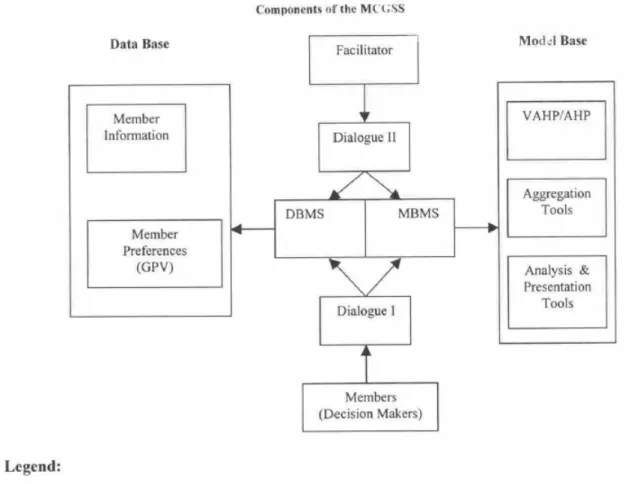
Zahir and Dobing (2002) detail the design of a web-based multicriteria group support system (MCGSS) based on the Analytical Hierarchic Process (see Figure 3 - Zahir and Dobing (2002:53) MCGSS).
The authors sustain that “Multicriteria voting greatly improves the quality of input and helps managers with the more important tasks of analysing alternatives and building consensus around the one chosen” (p.50), so they propose a Web-based multicriteria group support system “that enables users to enter their intensity of preferences using a visual interface” (idem) supported by the AHP decision model.
AHP, extended by Zahir to the Euclidean vector space (VAHP) presents several advantages to the yes/no voting procedure, especially due to the lack of face-to-face communication in a web-based framework.
Figure 3 - Zahir and Dobing (2002:53) MCGSS
“The MCGSS databases contain information on preferences and user data, as indicated by the users. The MCGSS model base consists of three different models. The VAHP/AHP model is used to let decision-makers enter their preferences for different criteria. Thereafter, the system calculates each user’s grand preference vector (GPV). The GPV is used by the MCGSS to compute the sum of preferences for criteria for a decision-making group. The calculation is made by adding all user vectors to obtain the common preference of the group.” Wieserma (2008:7)
Users enter the relative preference for each alternative via a “bar graph” using a slider control and dragging the mouse to any height assigning preferences.
Other interesting aspect of this MCGDSS is inconsistency reporting: “A simple example would be transitive consistency – if alternative A is ranked higher than B and B is ranked higher than C, then A should also rank higher than C. The system can report back to the decision-makers about the consistency of their judgements, giving them an
opportunity to review their preference inputs and also to the facilitator.” Zahir and Dobing (2002:54)
This Web-based architecture seems extremely adapted to pmColNet.
3.3.1.2. The PROMETHEE GDSS Procedure
“The PROMETHEE Group Decision Support System has been developed to provide decision aid to a group of decision-makers (DM1), (DM2), …, (DMr), …m (DMR) (see [54]. It has been designed to be used in a GDSS room including a PC, a printer and a video projector for the facilitator, and R working station for the DM’s. Each working station includes room for a DM (and possibly a collaborator), a PC and Tel/Fax so that the DM’s can possibly consult their business base. All the PC’s are connected to the facilitator through a local network.
There is no objection to use the procedure in the framework of teleconference or video conference systems. In this case the DM’s are not gathering in a GDSS room, they directly talk together through the computer network.” Brans, Jean-Pierre, “Promethee Methods” in Figueira, Greco and Ehrgott (2005:183)
PROMETHEE GDSS procedure is divided in three phases and several steps: - PHASE I: generation of alternatives and criteria;
- PHASE II: individual evaluation by each DM; - PHASE III: global evaluation by the group.
This framework is not far from Zahir and Dobing (2002), but the use of Internet and a Web-based environment maximizes model reach and flexibility.
3.4.
Relational approach methods
“The relational approach consists in comparing alternatives two by two, and expressing with a number the degree of preference of one alternative over the other, with respect to a criterion. These numbers are very often expressed by the help of fuzzy (valued) preference relations.” Marichal (1999:9)
This approach has been essentially developed by Roy (ELECTRE methods), Blin, Saaty, Fodor and Roubens.
These methods are also called outranking methods. According to Roy (1974) in Figueira, Greco and Ehrgott (2005:XXVII), “Given what is known about the decision-maker’s preferences and given the quality of the performances of the actions and the nature of the problem, an outranking relation is a binary relation S defined on the set os potential actions A such that aSb if there are enough arguments to decide that a is at least as good as b, whereas there is no essential argument to refute that statement.” Due to the characteristics of network organisations, where interaction and collaboration are essential, methods that are supported in comparing alternatives are more likely to maximize negotiation efforts and “democratic” decisions.
Therefore, fitting ordinal/ relational multicriteria approaches we will compare6:
- ELECTRE;
- AHP;
- MACBETH;
6 The choice of these three methods may be criticised. As said before, there are numerous MCDA
methods, but the criterion was that the present ones may represent different perspectives and are widely applied in real decision problems. All have their own software implementations, which is useful due to the practical implementation focus of this work.
3.4.1. ELECTRE
This section is based on Figueira, Mousseau and Roy, “Electre Methods” in Figueira, Greco and Ehrgott (2005:133-162).
ELECTRE (ELimination Et Choix Traduisant la REalité) methods are researched mainly in Europe and go back to the 1960’s, they are considered outranking methods as defined above (3.4).
3.4.1.1. Relevant context
ELECTRE methods are relevant when facing situations with the following characteristics:
1. “The decision-maker (DM) wants to include in the model at least three criteria. However, aggregation procedures are more adapted in situations when decision models include more than five criteria (up to twelve or thirteen).
And, at least one of the following situations must be verified.
2. Actions are evaluated (for at least one criterion) on an ordinal scale or on a weakly interval scale. These scales are not suitable for the comparison of differences. Hence, it is difficult and/ or artificial to define a coding that makes sense in terms of preference differences of the ratios
) ( ) ( ) ( ) ( d g c g b g a g j j j j − − , where gi (x)
is the evaluation of action x on criterion gj.
3. A strong heterogeneity related with the nature of evaluations exists among criteria (e.g., duration, noise, distance, security, cultural sites, monuments, ...). This makes it difficult to aggregate all the criteria in a unique common scale.
4. Compensation of the loss on a given criterion by a gain on another one may not be acceptable for the DM. Therefore, such situations require the use of noncompensatory aggregation procedures.
5. For at least one criterion the following holds true: small differences of evaluations are not significant in terms of preferences, while the accumulation
introduction of discrimination thresholds (indifference and preference) which leads to a preference structure with a comprehensive intransitive indifference binary relation.” (idem:136-137)
3.4.1.2. Modelling preferences using an outranking
relation
Preferences in ELECTRE methods are modelled by using binary outranking relations, S, whose meaning is “at least as good as”.
“Considering two actions a and b, four situations may occur: • aSb and not bSa, i.e., aPb (a is strictly preferred to b). • bSa and not aSb, i.e., bPa (b is strictly preferred to a). • aSb and bSa, i.e., aIb (a is indifferent to b).
• Not aSb and not bSa, i.e., aRb (a is incomparable to b).
The construction of an outranking relation is based on two major concepts:
1. Concordance. For an outranking aSb to be validated, a sufficient majority of criteria should be in favour of this assertion.
2. Non-discordance. When the concordance condition holds, none of the criteria in the minority should oppose too strongly to the assertion aSb.
These two conditions must be fulfilled for validating the assertion aSb.” (idem:137)
3.4.1.3. Structure of ELECTRE methods and relative
importance of criteria
“ELECTRE methods comprise two main procedures: construction of one or several outranking relation(s) followed by an exploitation procedure. (…) The relative role attached to criteria in ELECTRE methods is defined by two distinct sets of parameters: the importance coefficients and the veto thresholds.” (idem:138)
The importance coefficients in ELECTRE methods refer to intrinsic “weights”. For a given criterion the weight, wj, reflects its voting power towards the contribution that is in favour of an outranking. These weights do not depend of the ranges or scale encoding and cannot be interpreted as substitution rates in compensatory aggregation procedures such as AHP, MACBETH and MAUT.
“Veto thresholds express the power attributed to a given criterion to be against the assertion “a outranks b”, when the difference of the evaluation between g(b) and g(a) is greater than this threshold.” (idem:138)
3.4.1.4.Robustness concerns
In real-world decision problems, decision makers face imperfect knowledge regarding the available data. Imperfect knowledge leads to the assignment of “arbitrary” values to certain parameters: preference parameters (weights, thresholds, categories lower and upper limits, …), and the technical parameters (discordance and concordance indices of ELECTRE methods
“A conclusion, Cr, is said to be robust with respect to a domain, Ω, of possible values for the preference and technical parameters, if there is not a particular set of parameters, ώ Є Ω, which clearly invalidates the conclusion Cr.” (idem:150)
Because variations on each parameter may influence recommendations, it is frequent to proceed to sensitivity analysis. Such recommendations should be elaborated from robust conclusions. In practice, to surpass robustness concerns, it is frequent to define a “reference system built from the assignment of central values to these two types of parameters. Then, an exploitation procedure should be applied in order to obtain outputs which are used to elaborate recommendations.” (idem:149)
3.4.1.5. Elicitation of parameter values
“A preference elicitation process proceeds through an interaction between DMs and analysts in which DMs express information about their preferences within a specific aggregation procedure.” (idem:150)
- Direct elicitation techniques:
“(…) DMs should provide information directly on the values of the preference parameters. A major drawback of such techniques is that it is difficult to understand the precise meaning of the assertions of the DMs. This is why ELECTRE methods are usually implemented by using indirect elicitation procedures.” (idem:150)
- Indirect elicitation techniques:
“(…) these techniques proceed indirectly by posing questions whose answers can be interpreted through the aggregation procedure.” (idem:150)
For instance, these techniques may determine the vector of the relative importance coefficients from pairwise comparisons or assignment examples.
3.4.2. AHP
This section is based on Saaty, “The Analytic Hierarchy and Analytic Network Processes for the measurement of intangible criteria and for decision-making” in Figueira, Greco and Ehrgott (2005:345-407).
“The Analytic Hierarchy Process (AHP) and its generalization to dependence and feedback, the Amalytic Network Process (ANP), are theories of relative measurement of intangible criteria. With this approach to relative measurement, a scale of priorities is derived from pairwise comparison measurements only after the elements to be measured are known. (…) In the AHP paired comparisons are made with judgements using numerical values taken from the AHP absolute fundamental scale of 1-9. (…) The AHP/ ANP is useful for making multicriteria decisions involving benefits, opportunities, costs and risks.” (idem:345)
AHP is the original theory of prioritisation that derives relative scales of absolute fundamental scale. AHP is a descriptive approach to decision-making based on four axioms:
- reciprocal judgements;
- homogeneous elements;
- rank order expectations.
AHP is a theory of relative measurement on absolute scales for both tangible and intangible criteria, based on the judgement of knowledgeable and expert people (a panel of experts) and statistics needed to make a decision.
“Paired comparisons deal with comparative judgement. However, (…) the AHP also provides a way to rate alternatives one at a time to deal with absolute judgement. In absolute judgement the criteria are first prioritized through comparisons and then for each criterion one creates a scale of relative intensities possibly of widely ranging orders of magnitude. The priorities of these intensities are again appropriately derived through paired comparisons with respect to their criterion, and in the end the alternatives are rated one at a time by assigning each one an intensity level for each criterion, then weighting by the priorities of the criteria and adding to obtain their overall rating priority.” (idem:348-349)
According to Smith and Winterfeldt (2004:568), “The appeal of the AHP as a prescriptivemethodology remains matter of disagreement. While many in the decision analysis community (ourselves included) follow Dyer in believing the AHP to be fundamentally unsound, others (including Saaty, Harker, and Vargas) disagree and the AHP is still widely used in practice today”.
3.4.3. Macbeth
MACBETH stands for Measuring Attractiveness by a Categorical Based Evaluation Technique and is a multicriteria decision aid approach developed in the early 1990’s by Bana e Costa and Vansnick. It follows the concept of an humanistic, interactive and constructive approach (Bana e Costa et al. 2003?:1):
- Humanistic in the sense that it should be used to help decision-makers ponder, communicate, and discuss their value systems and preferences;
- Interactive because the learning process can best spread through socio-technical facilitation sustained by straightforward questioning-answering protocols. From a practical viewpoint, such interaction would greatly benefit from an extremely efficient and user-friendly decision support system (the case of the M-MACBETH software);
- “Constructive because MACBETH rests on the idea that full-bodied convictions about the kind of decision to make do not (pre-)exist in the mind of the decision maker, nor in the mind of each of the members of a decision advising group, but that we can provide them with help to form such convictions and to build robust (shared) preferences concerning the different possible options to solve the problem.” (idem:1)
MACBETH builds a “quantitative model of values based on qualitative (verbal) difference judgments, that facilitates the path from ordinal to cardinal preference modeling” (idem). This characteristic “requires the availability of very rich information, concerning the decision makers’ preferences” because the chosen additive value model implies the production of mathematically significant results.
On the one hand, MACBETH is clearly in the line pmColNet main objectives, including a path of interaction and constructivist orientation; on the other hand, “the long way between ordinal and cardinal information” (Bana e Costa et al. 2003?:4) is a disadvantage, especially if there are several network partners and different alternatives. The amount of information regarding attractiveness of the elements means many questioning procedures.
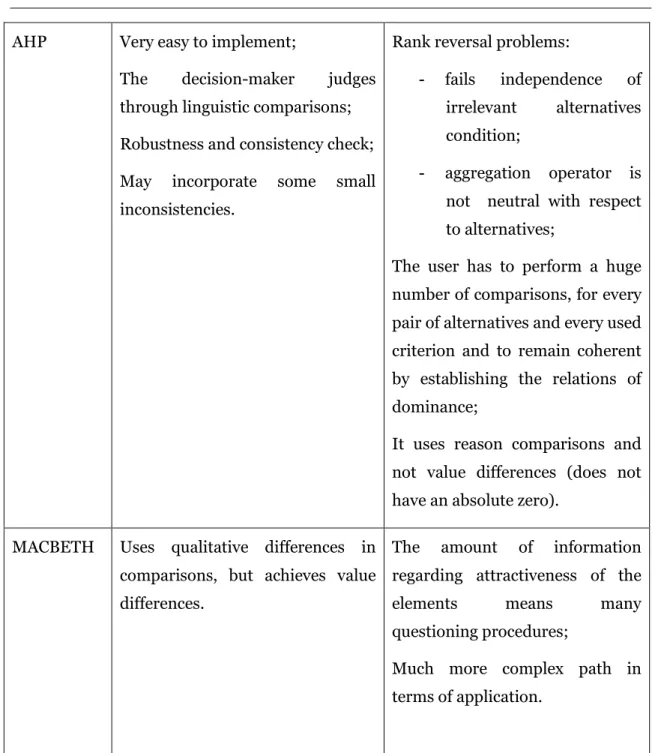
3.4.4. Comparative analysis
Method Advantages Disadvantages
ELECTRE Vote power and veto thresholds
are available.
Indifference intervals are much more adequate to real world: uses the concept of weak preference and incomparability;
Robustness evaluation; Sensibility studies.
Binary relations/ dominance
qualification are complex
concepts to implement and
AHP Very easy to implement;
The decision-maker judges
through linguistic comparisons; Robustness and consistency check;
May incorporate some small
inconsistencies.
Rank reversal problems:
- fails independence of
irrelevant alternatives
condition;
- aggregation operator is
not neutral with respect to alternatives;
The user has to perform a huge number of comparisons, for every pair of alternatives and every used criterion and to remain coherent by establishing the relations of dominance;
It uses reason comparisons and not value differences (does not have an absolute zero).
MACBETH Uses qualitative differences in
comparisons, but achieves value differences.
The amount of information
regarding attractiveness of the
elements means many
questioning procedures;
Much more complex path in terms of application.
Table 1 - Relational approaches comparative table
In the next chapter we will study the information model which will be used at pmColNet’s framework. At chapter 5, the chosen method will be used and further explanations will be addressed.
system – Information model
4. Structuring and managing information in the
performance evaluation system – Information model
Throughout this chapter we will mainly use the work of Neves, Jorge (2009), “Gestão de informação de desempenho em redes de organizações”, wich as also developed along the pmColnet research project at INESC Porto.
Performance management within networks of organisations is very complex and involves several aspects that influence metrics choice, such as:
- Performance objectives; - Evaluation level;
- Criteria choice; - Network typology;
- Data source and data access;
- Network governance;
- Power relationships between network partners; - Evaluation timeframe;
- Data gathering timing; - Data gathering frequency.
Because of several influencing elements, a generic and satisfactory model is very hard to achieve, and therefore, a situational and constructivist approach is a valid option. This situational approach should be used in the specific network and its specific timeframe and constructed in a collaborative manner.
Although in this situational model, criteria and indicators should be attained regarding individual and network objectives, that choice must be supported by a pre-defined information model that allows a quick network setup.
system – Information model
4.1.
Perspectives and framework
Neves’ (2009:90) proposes an information model that includes the following key perspectives:
Partner’s contribution refers to the level of allocated resources by each partner to the network. Internal perspective is an adapted vision of Balanced Scorecard inside the network; output refers to global network performance regarding its established objectives; and external perspective tries to capture network impact in the community.
Neves’ (2009) presents a framework for performance management that includes several different contextualisation layers that allow selecting appropriate indicators for performance evaluation:
- Collaborative network typology; - Stakeholders;
- Evaluation framework;
o Evaluation levels;
o Evaluation perspectives;
o Evaluation criteria;
- Types of performance evaluation indicators.
Figure 4 - Key perspectives within network performance evaluation. Neves (2009:90) Partner’s contribution Internal processes performance Global performance (output) External perspective
system – Information model
4.2.
Collaborative network typology
Network typology is a very important contextualisation aspect when defining the performance model. Network typology is defined regarding (not only, but also) objectives and influences criteria and indicators choice. At section 5.4.3 we will define specific network typologies regarding the type of interorganisational governance and network objectives.
4.3.
Stakeholders
There are numerous stakeholders gravitating around a collaborative network: network partners (members), clients, suppliers, banks, investors, workers, general community (local or regional). Each of them has specific information needs and may have contradictory objectives. Therefore, a multicriteria performance model is needed to attend conflicting objectives and to maximize the network success and stakeholders satisfaction.
4.4.
Evaluation framework
Neves’ (2009) identifies three dimensions within networks of organisations performance evaluation:
- Evaluation level (or evaluation object): may be individual, organisation, network and community. Criteria may refer to different evaluation levels.
- Evaluation perspective; - Criteria.