EUROPEAN ORGANIZATION FOR NUCLEAR RESEARCH (CERN)
CERN-PH-EP/2013-037 2015/09/30
CMS-FSQ-12-025
Measurement of the underlying event activity using
charged-particle jets in proton-proton collisions at
√
s
=
2.76 TeV
The CMS Collaboration
∗Abstract
A measurement of the underlying event (UE) activity in proton-proton collisions is performed using events with charged-particle jets produced in the central pseudora-pidity region (|ηjet| < 2) and with transverse momentum 1 ≤ pjetT < 100 GeV. The
analysis uses a data sample collected at a centre-of-mass energy of 2.76 TeV with the CMS experiment at the LHC. The UE activity is measured as a function of pjetT in terms of the average multiplicity and scalar sum of transverse momenta (pT) of charged par-ticles, with|η| <2 and pT >0.5 GeV, in the azimuthal region transverse to the highest pTjet direction. By further dividing the transverse region into two regions of smaller and larger activity, various components of the UE activity are separated. The mea-surements are compared to previous results at 0.9 and 7 TeV, and to predictions of several Monte Carlo event generators, providing constraints on the modelling of the UE dynamics.
Published in the Journal of High Energy Physics as doi:10.1007/JHEP09(2015)137.
c
2015 CERN for the benefit of the CMS Collaboration. CC-BY-3.0 license
∗See Appendix A for the list of collaboration members
1
1
Introduction
Hadron production in high-energy proton-proton (pp) collisions originates from multiple scat-terings of the partonic constituents of the protons at central rapidities, and from “spectator” (noncolliding) partons emitted in the very forward direction. The produced partons reduce their virtuality through gluon radiation and quark-antiquark splittings, and finally fragment into hadrons at scales approaching 0.2 GeV (ΛQCD). Usually, one separates the produced hadrons into two classes: those coming directly from the fragmentation of partons resulting from the scattering with the largest momentum transfer (hard scattering) in the event, and the rest (un-derlying event, or UE). The UE thus consists of hadrons coming from (i) initial- and final-state radiation (ISR, FSR) from the hard scattering, (ii) softer partonic scatters in the same pp collision (multiple parton interactions, or MPI) possibly with their own initial- and final-state radiation, and (iii) proton remnants concentrated along the beam direction.
An accurate understanding of the UE is required for precise measurements of standard model processes at high energies and searches for new physics. Indeed, the UE affects measure-ments of isolated high transverse momentum pT leptons or photons, and it dominates most of the hadronic activity from the overlapping pp collisions taking place in a given bunch cross-ing (pileup) at the high luminosities achieved by the CERN LHC. The semi-hard and low-momentum partonic processes, which dominate the UE, cannot be adequately calculated with perturbative Quantum Chromodynamics (pQCD) methods alone, and require a phenomeno-logical description containing parameters that must be tuned to data.
The topological structure of pp interactions with a hard scattering can be used to define ex-perimental observables sensitive to the UE. One example is the study of particle properties in regions away from the direction of the products of the hard scattering. At the Tevatron, the CDF experiment measured UE observables using inclusive jet and Drell–Yan (DY) events in p ¯p collisions at centre-of-mass energies √s = 0.63, 1.8, and 1.96 TeV [1–3]. In pp collisions at the LHC, the ALICE, ATLAS, and CMS experiments have carried out UE measurements at
√
s =0.9 and 7 TeV using events containing a leading (highest pT) charged-particle jet [4–6] or a leading charged particle [7, 8], or a DY lepton pair [9]. In this paper, we study the UE activity in pp collisions at√s = 2.76 TeV by measuring the average multiplicity and scalar transverse momentum sum (ΣpT) densities of charged particles in the azimuthal region orthogonal to the direction of the leading charged-particle jet, referred to as the transverse region.
At a given centre-of-mass energy, the UE activity is expected to increase with the momentum transfer between the interacting partons (hard scale). On average, increasingly hard parton interactions result from pp collisions with decreasing impact parameters between the two pro-tons, which in turn enhance the overall hadronic activity originating from MPI until a satu-ration is reached for central collisions with maximum overlap [10, 11]. At the same time, the activity related to the ISR and FSR components also increases with the hard scale. For events with the same hard scale, probed by the pT of jets or DY pairs, the MPI activity rises with
√
s, as more partons are expected in the protons at increasingly smaller parton fractional momenta x ∼ 2 pT/
√
s [10, 11]. Hence, studying the UE as a function of the hard scale at several centre-of-mass energies provides an insight into the UE dynamics and its evolution with the collision energy, further constraining the model parameters.
The paper is organised as follows. Section 2 presents the main features of the Monte Carlo (MC) event generators used in this study to provide a description of the UE properties. Section 3 briefly describes the experimental methods, observables, event and track selection, as well as the corrections and systematic uncertainties of the measurements. The results are presented in Section 4, and summarised in Section 5.
2 2 Monte Carlo event generators
2
Monte Carlo event generators
In this analysis, thePYTHIA6 [12],PYTHIA8 [13], andHERWIG++ [14] MC event generators are used with various tunes that are described below. InPYTHIA, the 2→2 parton scatterings, in-cluding MPI, are described by leading-order pQCD, with the 1/p4Tcross section divergence reg-ularised by introducing a low-pTinfrared cutoff (pT0), such that the diverging term is replaced by 1/(p2T+p2T0)2. There are various tunable parameters that control the behaviour of this reg-ularisation, the matter distribution of partons in the transverse plane within the hadrons, and the final-state colour reconnection effects among the produced partons. When QCD radiation is modelled via a pT-ordered evolution, the MPI and parton showers are interleaved in one common sequence of decreasing pT values [15]. For the latest version of PYTHIA6 only ISR showers and MPI are interleaved, while inPYTHIA8 FSR showers are also included. The final nonperturbative transition of partons to hadrons is described by the Lund string fragmentation model [16].
Another general-purpose generator,HERWIG++, is similar toPYTHIA, but uses angular-ordered
parton showers and the cluster model [14] for hadronisation. It has an MPI model similar to the one used byPYTHIA, with tunable parameters for regularising the partonic cross sections
at low momentum transfer, but does not include the interleaved evolution with ISR and FSR. Both MC models incorporate multiple parton collisions “perturbatively”—i.e. based on a “reg-ularisation” of the underlying pQCD subprocesses’ cross sections — but require a nonpertur-bative ansatz for the impact parameter profile of the colliding protons. The frequency of MPI is then generated by assuming a Poissonian distribution of the number of elementary partonic in-teractions over the overlapping pp volume, with the average number depending on the impact parameter of the hadronic collision [10, 11]. The MPI cross section is dominated by scatterings with semi-hard momentum transfers, O(1–2 GeV), involving low-x partons, and thus shows a stronger dependence on the evolution of the low-pT infrared cutoff, and on the incoming par-ton densities than the single hard-scattering interactions [10, 11]. In PYTHIA6, PYTHIA8 and
HERWIG++, the energy dependence of MPI is mostly controlled by the energy evolution of the low-pTinfrared cutoff parameter ,which follows a (tunable) power law dependence on the centre-of-mass energy [12–14]. The UE activity accompanying various types of hard scattering processes is well described by MC event generators, [4, 5, 7–9], illustrating the universality of MPI in different event topologies and hard-scattering production processes. Such a universality is confirmed by the similarity between the UE activity measured in DY [9] and jet-dominated events [4, 5, 7, 8], despite their different underlying parton radiation patterns.
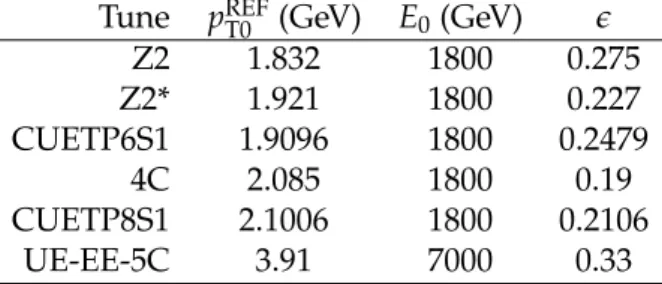
In this analysis, several event generator tunes are used. These are thePYTHIA6 (version 6.426 [12]) tunes Z2, Z2*, and CUETP6S1 [17],PYTHIA8 (version 8.175 [13]) tunes 4C [18] and CUETP8S1 [17], andHERWIG++ 2.7 with tune UE-EE-5C [14, 19]. All of these tunes use the CTEQ6L1 [20]
parton density function. The energy dependence of pT0 in these tunes is parameterised as pT0(
√
s) = pREF T0 × (
√
s/E0)e, where pREFT0 , E0, and e are tune parameters summarised in table 1. These parameters were obtained by tuning to different data sets. The 4C tune was derived from early LHC data on charged particle multiplicities [18]. Z2, Z2*, CUETP6S1 and CUETP8S1 were tuned to the previous UE results from CMS at 0.9 and 7 TeV [5]. In addition, CUETP6S1 tune also included CDF data [21] at 0.3, 0.9, and 1.96 TeV, while CUETP8S1 tune used 0.9 and 1.96 TeV data for tuning. The UE-EE-5C was tuned with the ATLAS UE data at 0.9 and 7 TeV [7] and CDF UE data at 0.3, 0.9, and 1.96 TeV [21]. None of the tunes make use of data at 2.76 TeV, making this a good test of interpolation between other centre-of-mass energies. The detector response was simulated in detail by using theGEANT4 package [22], and simulated events were
3
Table 1: Summary of the parameters of the Monte Carlo generator tunes. Tune pREFT0 (GeV) E0(GeV) e
Z2 1.832 1800 0.275 Z2* 1.921 1800 0.227 CUETP6S1 1.9096 1800 0.2479 4C 2.085 1800 0.19 CUETP8S1 2.1006 1800 0.2106 UE-EE-5C 3.91 7000 0.33
3
Experimental methods
3.1 The CMS detectorThe central feature of the CMS apparatus is a superconducting solenoid of 6 m internal diam-eter, providing a magnetic field of 3.8 T. Within the solenoid volume there are several com-plementary detectors: a silicon pixel and strip tracker, a lead tungstate crystal electromagnetic calorimeter, and a brass and scintillator hadron calorimeter, each composed of a barrel and two endcap sections. The silicon tracker measures charged particles within the pseudorapidity range|η| < 2.5. For non-isolated particles of 1 < pT < 10 GeV and|η| < 1.4, the track
reso-lutions are typically 1.5% in pT, and 25–90 (45–150) µm in the transverse (longitudinal) impact parameter [23]. Two of the CMS subdetectors acting as LHC beam monitors, the Beam Scintil-lation Counters (BSC) and the Beam Pick-up Timing for the eXperiments (BPTX) devices, are used to trigger the detector readout. The BSC are located along the beam line on each side of the Interaction Point (IP) at a distance of 10.86 m and cover the range 3.23 < |η| < 4.65. The
two BPTX devices, located inside the beam pipe at distances of 175 m from the IP, are designed to provide precise information on the bunch structure and timing of the incoming beams, with a time resolution better than 0.2 ns. A more detailed description of the CMS detector, together with a definition of the coordinate system used and the relevant kinematic variables, can be found in Ref. [24].
3.2 Event and track selection
The present analysis is performed with a data sample of proton-proton collisions collected with the CMS detector at√s =2.76 TeV during a dedicated run in March 2011, corresponding to an integrated luminosity of 0.3 nb−1. In 6.2% of the events there is an extra (pileup) pp collision, corresponding to an average of 0.12 overlapping pp collisions. Minimum bias events were recorded by requiring activity in both BSC counters in coincidence with signals from both BPTX devices (in contrast to Ref. [5], where only one of the BPTX devices is required). To reduce the statistical uncertainty for the highly prescaled minimum bias trigger at large pjetT , single-jet triggers based on information from the calorimeters, with pT thresholds at 20 and 40 GeV, were also used to collect data (differently from Ref. [5], where thresholds of 30 and 50 GeV are used). Events identified as originating from beam-halo background were removed from the sample [25]. The event selection requires exactly one primary vertex with more than four degrees of freedom (approximately 4 particles) and located no more than±10 cm from the centre of the luminous region (beamspot) in the z-direction.
For each selected event, the reconstructed track collection needs to be freed from undesired tracks, namely secondaries and background from track combinatorics and beam halo tracks. Tracks not corresponding to actual charged particles (misreconstructed tracks) are suppressed by imposing the high-purity selection criteria [23]. Secondary decays are suppressed by requir-ing that the impact parameter significance d0/σ(d0)(measure of the distance between the track
4 3 Experimental methods
and the primary vertex in the xy-plane) and the significance in the z-direction dz/σ(dz)to be each less than 3. In order to remove tracks with poor momentum measurement, we require the relative uncertainty in the momentum measurement σ(pT)/pT to be less than 5%. The aver-age reconstruction efficiency for the selected tracks is about 85% and drops to 75% for tracks with pT ≈ 0.5 GeV and|η| ≈ 2, while the track misreconstruction rate is about 2%, increasing
to about 8% for tracks with pT ≈ 0.5 GeV and |η| ≈ 2. Track efficiencies are determined by matching the generated level and reconstructed level tracks.
The event hard scale and reference direction, for the identification of the UE sensitive region, are defined using leading “track jets” [26] or charged-particle jets. The use of track jets makes the transition of leading tracks to leading jets more continuous and extends the pT coverage to larger values. These jets are reconstructed from tracks with pT > 0.5 GeV and |η| < 2.5
using the Seedless Infrared-Safe Cone (SISCone) [27] algorithm with distance parameter of 0.5. Although anti-kT [28] is now the preferred algorithm at the LHC, the SISCone algorithm is chosen in this analysis for compatibility with previous results [5]. Furthermore, a comparison of the UE activity obtained at generator level using SISCone and anti-kT algorithms has been performed, finding differences of only a few percent for pjetT ≤20 GeV. From all reconstructed track jets with|η| < 2 and pT > 1.0 GeV, the one with the largest pjetT is selected. Only events containing at least one track jet fulfilling these criteria are considered for this analysis. Jets are reconstructed with a matching efficiency of 80% at pjetT ≈1 GeV and up to 95% for pjetT >20 GeV. Trigger conditions are chosen to keep the trigger efficiency as uniform as possible and close to 100%. For the pjetT ranges in [1, 25), [25, 50), and [50, 100) GeV, we use the minimum-bias and the two single-jet samples, respectively, corresponding to about 11M, 50k, and 23k selected events.
3.3 Observables
In this analysis we follow the same methodology as in the previous studies of the UE activity in events with a leading charged-particle jet, carried out at√s = 0.9 and 7 TeV [5]. Charged-particle jets and charged Charged-particles produced at central pseudorapidity (|η| <2) with pT >1 and 0.5 GeV, respectively, are used to study the UE properties. The direction of the leading charged-particle jet in the event is used to select charged charged-particles in the transverse region defined by
60◦ < |∆φ| < 120◦, where ∆φ is the relative azimuthal distance between a charged particle
and the leading jet. The UE is measured in terms of particle andΣpT densities, as a function of the leading pjetT , which is used as an estimate for the hard scale of the interaction. The particle density (hNchi/[∆η∆(∆φ)]) andΣpTdensity (h∑ pTi/[∆η∆(∆φ)]) are computed, respectively, as the average number of primary charged particles, and the average of their scalar pT sum, each per unit of η and of∆φ.
As suggested in Ref. [29], the transverse region can be studied in detail by separating — in-dependently for the particle multiplicity and for the pT sum — the 60◦ < ∆φ < 120◦ and the
−120◦ < ∆φ < −60◦ ranges, and identifying the regions with higher and lower activities,
re-ferred to as transMAX and transMIN, respectively. The two regions should have roughly equal activities for most events since the dominant production channel, two-jet production, is topo-logically symmetrical. In a three-jet topology, the transMAX side will capture the activity from the third jet. The difference between the measured densities in the transMAX and transMIN regions is called the transDIF density. The resulting particle andΣpTdensities are expected to be sensitive to different components of the UE activity.
Since the transMAX region contains the third jet, while both transMAX and transMIN regions receive contributions from MPI and beam remnants, the transMIN activity is sensitive to MPI and beam remnants, and the transDIF activity is sensitive to harder initial- and final-state
radi-3.4 Corrections and systematic uncertainties 5
ation. The present approach extends the methodology employed in Ref. [5]
3.4 Corrections and systematic uncertainties
The UE observables (hNchi/[∆η∆(∆φ)]and h∑ pTi/[∆η∆(∆φ)]) described in Section 3.3 are reconstructed from selected tracks, with pT > 0.5 GeV and |η| < 2, in the region transverse
to the leading track-jet. These measured observables are corrected for detector effects and se-lection efficiencies to reflect the primary charged-particle activity using a 2-dimensional, it-erative unfolding technique [30] based on response matrices that correlate the generated and reconstructed level observables. These matrices are constructed from the generator level and reconstructed level UE and pjetT observables forPYTHIA6 Z2 events; this procedure accounts for detector effects and inefficiencies. The unfolding matrices are applied to a PYTHIA8 4C
sam-ple to estimate the systematic uncertainties related to the correction procedure. These vary between 0.2% and 4%, depending on the observable, region and pjetT .
Several other sources of systematic uncertainties may affect the results. These include the im-plementation of the simulation of the track and vertex selection criteria, tracker alignment and material content, background contamination, trigger conditions, and pileup contributions. The uncertainty in the simulation of the track selection is evaluated by applying various sets of se-lection criteria and comparing their effects on the data and on the simulated events. The impact parameter significance ranges are varied by one unit around the nominal window resulting in an effect on the densities of 0.6–4%. Replacing the high-purity selection by the simpler require-ment Nlayers ≥4 and Npixel layers≥ 2 for the silicon strip and pixel detector layers, respectively, has an effect of up to 0.8%. Varying the fraction of misreconstructed tracks by 50% affects the densities by 0.4–0.6%. The description of inactive tracker material in the simulation is ade-quate within 5% [4], and increasing the material densities by 5% in the simulation induces a change in the observables of 1%. The effects of tracker misalignment, precision in the IP posi-tion, and dead channels, evaluated by varying the detector conditions in the MC simulaposi-tion, are each found to change the results by 0.1–0.3%. The effect of varying the trigger and vertex efficiencies within their uncertainties, as well as the effect of pileup contributions, all lead to a negligible effect.
Systematic uncertainties are largely independent of one another, but they are correlated among data points in each experimental distribution. They are added in quadrature to the statis-tical uncertainties and are shown in all figures. Systematic uncertainties mostly dominate the statistical ones, which are often smaller than the data points. Table 2 shows a summary of the systematic uncertainties as a range from the minimum to maximum values as they vary across region, observable and pjetT . The transMAX and transMIN regions tend to have a larger total systematic uncertainty than the other regions and theh∑ pTi/[∆η∆(∆φ)] observ-able tends to have a slightly larger total systematic uncertainty by about 0.2% compared to the
hNchi/[∆η∆(∆φ)]observable. The total systematic uncertainty is large at low pjetT and decreases to a minimum at pjetT ≈3 GeV and then rises again up to a plateau for pjetT >20 GeV.
4
Results
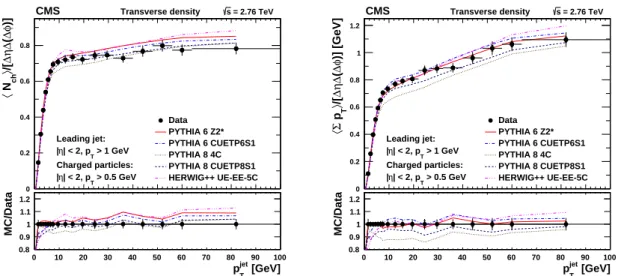
In Fig. 1, the (a) particle and (b) ΣpT densities, after unfolding, are shown in the transverse region, relative to the leading charged-particle jet, as a function of pjetT . A steep rise of the underlying event activity in the transverse region is seen up to pjetT ≈ 8 GeV, followed by a “saturation” (plateau-like) region, with nearly constant multiplicity and smallΣpT density
in-6 4 Results
Table 2: Summary of the systematic uncertainties (in percentage) due to various sources. The values range from the minimum to maximum from all regions, observables, and across differ-ent pjetT values.
Source Systematic (%) Unfolding procedure 0.2–4 Impact parameter significance 0.6–4 Fraction of misreconstructed tracks 0.4–0.6
Track selection 0.1–0.8 Material density 1
Dead channels 0.1 Tracker alignment 0.2–0.3 Interaction point position 0.2
Total 1.9–5.8
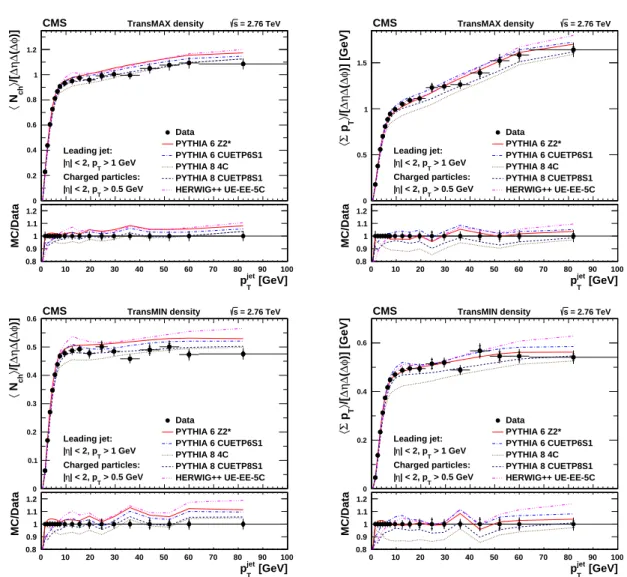
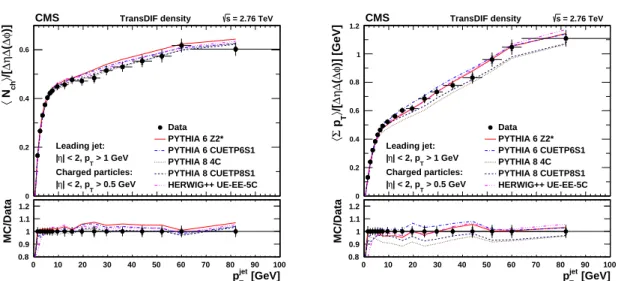
crease. In Fig. 2, the (left panes) particle and (right panes) ΣpT densities after unfolding are shown as a function of pjetT in the transverse region with maximum and minimum activities (transMAX and transMIN), respectively. In the transMIN region, the amount of UE activity is roughly half that in the transMAX region. The pjetT dependences observed in the two regions are also quite different. At high pT, the distributions show a slow rise in the transMAX region, while for transMIN the flattening of the UE activity as a function of pjetT is more pronounced. The corresponding distributions in the difference between the transMAX and transMIN regions (transDIF) are presented in Fig. 3. The particle andΣpTdensities both show a rise with pjetT , and the plateau-like region above pjetT ≈8 GeV—seen for distributions in the individual transMAX and transMIN regions—is replaced by an increase as a function of pjetT .
[GeV] jet T p 0 10 20 30 40 50 60 70 80 90 100 MC/Data 0.8 0.9 1 1.1 1.2 )] φ∆ ( ∆η ∆ /[ 〉 ch N 〈 0 0.2 0.4 0.6 0.8
CMS Transverse density s = 2.76 TeV
> 0.5 GeV T | < 2, p η | Charged particles: > 1 GeV T | < 2, p η | Leading jet: Data PYTHIA 6 Z2* PYTHIA 6 CUETP6S1 PYTHIA 8 4C PYTHIA 8 CUETP8S1 HERWIG++ UE-EE-5C [GeV] jet T p 0 10 20 30 40 50 60 70 80 90 100 MC/Data 0.8 0.9 1 1.1 1.2 )] [GeV] φ∆ ( ∆η ∆ /[ 〉 T p Σ〈 0 0.2 0.4 0.6 0.8 1 1.2
CMS Transverse density s = 2.76 TeV
> 0.5 GeV T | < 2, p η | Charged particles: > 1 GeV T | < 2, p η | Leading jet: Data PYTHIA 6 Z2* PYTHIA 6 CUETP6S1 PYTHIA 8 4C PYTHIA 8 CUETP8S1 HERWIG++ UE-EE-5C
Figure 1: Measured (left) particle density, and (right) ΣpT density, in the transverse region relative to the leading charged-particle jet in the event (|η| < 2, 60◦ < |∆ϕ| < 120◦), as a
function pjetT . The data (symbols) are compared to various MC simulations (curves). The ratios of MC simulations to the measurements are shown in the bottom panels. The inner error bars correspond to the statistical uncertainties, and the outer error bars represent the statistical and systematic uncertainties added in quadrature.
The rapid increase of the UE activity with pjetT in the region below∼8 GeV is mainly attributed to the increase of MPI activity as the hard scale of the interaction increases [11]. This fast rise
7 [GeV] jet T p 0 10 20 30 40 50 60 70 80 90 100 MC/Data 0.8 0.9 1 1.1 1.2 )] φ∆ ( ∆η ∆ /[ 〉 ch N 〈 0 0.2 0.4 0.6 0.8 1 1.2
CMS TransMAX density s = 2.76 TeV
> 0.5 GeV T | < 2, p η | Charged particles: > 1 GeV T | < 2, p η | Leading jet: Data PYTHIA 6 Z2* PYTHIA 6 CUETP6S1 PYTHIA 8 4C PYTHIA 8 CUETP8S1 HERWIG++ UE-EE-5C [GeV] jet T p 0 10 20 30 40 50 60 70 80 90 100 MC/Data 0.8 0.9 1 1.1 1.2 )] [GeV] φ∆ ( ∆η ∆ /[ 〉 T p Σ〈 0 0.5 1 1.5
CMS TransMAX density s = 2.76 TeV
> 0.5 GeV T | < 2, p η | Charged particles: > 1 GeV T | < 2, p η | Leading jet: Data PYTHIA 6 Z2* PYTHIA 6 CUETP6S1 PYTHIA 8 4C PYTHIA 8 CUETP8S1 HERWIG++ UE-EE-5C [GeV] jet T p 0 10 20 30 40 50 60 70 80 90 100 MC/Data 0.8 0.9 1 1.1 1.2 )] φ∆ ( ∆η ∆ /[ 〉 ch N 〈 0 0.1 0.2 0.3 0.4 0.5
0.6 CMS TransMIN density s = 2.76 TeV
> 0.5 GeV T | < 2, p η | Charged particles: > 1 GeV T | < 2, p η | Leading jet: Data PYTHIA 6 Z2* PYTHIA 6 CUETP6S1 PYTHIA 8 4C PYTHIA 8 CUETP8S1 HERWIG++ UE-EE-5C [GeV] jet T p 0 10 20 30 40 50 60 70 80 90 100 MC/Data 0.8 0.9 1 1.1 1.2 )] [GeV] φ∆ ( ∆η ∆ /[ 〉 T p Σ〈 0 0.2 0.4 0.6
CMS TransMIN density s = 2.76 TeV
> 0.5 GeV T | < 2, p η | Charged particles: > 1 GeV T | < 2, p η | Leading jet: Data PYTHIA 6 Z2* PYTHIA 6 CUETP6S1 PYTHIA 8 4C PYTHIA 8 CUETP8S1 HERWIG++ UE-EE-5C
Figure 2: Measured (left panes) particle density, and (right panes)ΣpT density, in the trans-MAX and transMIN regions (60◦ < |∆ϕ| <120◦, relative to the leading charged-particle jet in the event, with maximum/minimum UE activity), as a function of pjetT . The definitions of the symbols and error bars are the same as for Fig. 1.
8 4 Results [GeV] jet T p 0 10 20 30 40 50 60 70 80 90 100 MC/Data 0.8 0.9 1 1.1 1.2 )] φ∆ ( ∆η ∆ /[ 〉 ch N 〈 0 0.2 0.4 0.6
CMS TransDIF density s = 2.76 TeV
> 0.5 GeV T | < 2, p η | Charged particles: > 1 GeV T | < 2, p η | Leading jet: Data PYTHIA 6 Z2* PYTHIA 6 CUETP6S1 PYTHIA 8 4C PYTHIA 8 CUETP8S1 HERWIG++ UE-EE-5C [GeV] jet T p 0 10 20 30 40 50 60 70 80 90 100 MC/Data 0.8 0.9 1 1.1 1.2 )] [GeV] φ∆ ( ∆η ∆ /[ 〉 T p Σ〈 0 0.2 0.4 0.6 0.8 1
1.2 CMS TransDIF density s = 2.76 TeV
> 0.5 GeV T | < 2, p η | Charged particles: > 1 GeV T | < 2, p η | Leading jet: Data PYTHIA 6 Z2* PYTHIA 6 CUETP6S1 PYTHIA 8 4C PYTHIA 8 CUETP8S1 HERWIG++ UE-EE-5C
Figure 3: Measured transDIF activity (see text for its definition) for (left) particle density, and (right)ΣpTdensity, as a function of pjetT . The definitions of the symbols and error bars are the same as for Fig. 1.
is followed by a saturation region (for the transverse and especially transMIN distributions), with nearly constant multiplicity and smallΣpT density increase. This behaviour is expected as a consequence of a nearly full overlap of the colliding protons in interactions yielding the hardest parton-parton scatterings. When pp collisions occur for very small impact parameter, the amount of MPI activity saturates [10, 11]. Such a distinct pjetT -dependent pattern in the amount of UE activity (sharp rise followed by a plateau above the pjetT ≈ 8 GeV transition) is clearly seen for all the observables presented, especially in the transMIN region. In contrast, the transMAX and transDIF distributions show a continuous rise with pjetT also in the high-pT regime. This is expected to be caused by contributions from initial- and final-state radiation in the transverse region [29]. Following such an interpretation, the present results provide constraints on the modelling of the different UE components.
The results are compared to recent tunes of thePYTHIA andHERWIG++ event generators. All
PYTHIA6 andPYTHIA8 tunes predict the distinctive change in the amount of activity as a func-tion of the leading jet pT within 5–10%. The HERWIG++ UE-EE-5C tune also provides a fair description of the data. In general, the data-model agreement improves for the transDIF den-sities. The continuous increase observed at high-pjetT in the transDIF distributions is well re-produced by all MC tunes, corroborating the hypothesis of increased contributions of QCD radiation from the hardest scattered partons. The same trend is observed in pp collisions at 1.96 TeV [3]. The latestPYTHIA6 (PYTHIA8) tune CUETP6S1 (CUETP8S1) improves the descrip-tion of the data in comparison to the results obtained with the parameters of the previous Z2* (4C) tune.
The centre-of-mass energy dependence of the UE activity in the transverse region is presented in Fig. 4 as a function of pjetT for√s = 0.9, 2.76, and 7 TeV [4, 5]. A fast rise with increasing centre-of-mass energy of the activity in the transverse region is observed for the same value of the leading charged-particle pjetT . This is expected from the higher parton densities probed at low-x in the protons, and the larger phase space available for parton radiation. All tunes predict a centre-of-mass energy dependence of the UE activity which is consistent with that of the data.
9 [GeV] jet T p 0 20 40 60 80 100 )] φ∆ ( ∆η ∆ /[ 〉 ch N 〈 0 0.2 0.4 0.6 0.8 1 1.2 CMS Transverse density > 0.5 GeV T | < 2, p η | Charged particles: > 1 GeV T | < 2, p η | Leading jet: = 7 TeV s = 2.76 TeV s = 0.9 TeV s Data PYTHIA 6 Z2* PYTHIA 8 CUETP8S1 HERWIG++ UE-EE-5C [GeV] jet T p 0 20 40 60 80 100 )] [GeV] φ∆ ( ∆η ∆ /[ 〉 T p Σ〈 0 0.5 1 1.5 2CMS Transverse density > 0.5 GeV T | < 2, p η | Charged particles: > 1 GeV T | < 2, p η | Leading jet: = 7 TeV s = 2.76 TeV s = 0.9 TeV s DataPYTHIA 6 Z2* PYTHIA 8 CUETP8S1 HERWIG++ UE-EE-5C
Figure 4: Comparison of UE activity at√s= 0.9, 2.76, and 7 TeV for (left) particle density, and (right)ΣpTdensity, as a function of pjetT [4, 5]. The data (symbols) are compared to various MC simulations (curves). The definition of the error bars is the same as for Fig. 1.
The measurements presented here provide constraints for the development and tuning of the underlying event description implemented in MC models. In particular, they may allow im-proving the modelling of key ingredients—such as multiparton interactions, QCD radiation, energy evolution of the transverse proton profile, etc.—, which will play an increasing role at higher proton-proton collision energies.
5
Summary
The measurement of the underlying event (UE) activity in proton-proton collisions at √s =
2.76 TeV has been presented using events with a charged-particle jet produced at central pseu-dorapidity (|ηjet| < 2) with transverse momenta 1 ≤ pjetT < 100 GeV. This analysis
comple-ments the results of previous similar measurecomple-ments at√s =0.9 and 7 TeV.
The UE activity is measured in the transverse region and further studied in terms of the MAX, transMIN and transDIF activities. A steep rise of the underlying activity in the trans-verse region is seen with increasing leading jet pT. This fast rise is followed by a leveling above pjetT ≈8 GeV, with nearly constant particle density and smallΣpT density increase. Such a dis-tinct pattern (fast rise followed by a leveling of the UE hadronic activity) is clearly seen for all the observables in the various regions, and is compatible with the impact parameter picture of pp collisions featuring an increasing number of MPI for increasing overlap followed by a satu-ration of hadron production once the hardest most-central collisions are reached. The transDIF density distributions show an increase of the activity as a function of pjetT , corroborating the hypothesis of more intense ISR and FSR from the increasingly harder parton-parton scatter. The results are compared to recent tunes ofPYTHIAandHERWIG++ Monte Carlo event gener-ators. ThePYTHIA6,PYTHIA8, andHERWIG++ tunes describe the data within 5 to 10%. All MC tunes predict a collision energy dependence of the hadronic activity similar to that observed in the data. The ability of the latest Monte Carlo generator tunes to describe the data confirms the validity of the tunes and lends confidence to the predictions of UE activity for higher collision energies.
10 References
Acknowledgments
We congratulate our colleagues in the CERN accelerator departments for the excellent perfor-mance of the LHC and thank the technical and administrative staffs at CERN and at other CMS institutes for their contributions to the success of the CMS effort. In addition, we gratefully acknowledge the computing centres and personnel of the Worldwide LHC Computing Grid for delivering so effectively the computing infrastructure essential to our analyses. Finally, we acknowledge the enduring support for the construction and operation of the LHC and the CMS detector provided by the following funding agencies: BMWFW and FWF (Austria); FNRS and FWO (Belgium); CNPq, CAPES, FAPERJ, and FAPESP (Brazil); MES (Bulgaria); CERN; CAS, MoST, and NSFC (China); COLCIENCIAS (Colombia); MSES and CSF (Croatia); RPF (Cyprus); MoER, ERC IUT and ERDF (Estonia); Academy of Finland, MEC, and HIP (Finland); CEA and CNRS/IN2P3 (France); BMBF, DFG, and HGF (Germany); GSRT (Greece); OTKA and NIH (Hungary); DAE and DST (India); IPM (Iran); SFI (Ireland); INFN (Italy); MSIP and NRF (Re-public of Korea); LAS (Lithuania); MOE and UM (Malaysia); CINVESTAV, CONACYT, SEP, and UASLP-FAI (Mexico); MBIE (New Zealand); PAEC (Pakistan); MSHE and NSC (Poland); FCT (Portugal); JINR (Dubna); MON, RosAtom, RAS and RFBR (Russia); MESTD (Serbia); SEIDI and CPAN (Spain); Swiss Funding Agencies (Switzerland); MST (Taipei); ThEPCenter, IPST, STAR and NSTDA (Thailand); TUBITAK and TAEK (Turkey); NASU and SFFR (Ukraine); STFC (United Kingdom); DOE and NSF (USA).
Individuals have received support from the Marie-Curie programme and the European Re-search Council and EPLANET (European Union); the Leventis Foundation; the A. P. Sloan Foundation; the Alexander von Humboldt Foundation; the Belgian Federal Science Policy Of-fice; the Fonds pour la Formation `a la Recherche dans l’Industrie et dans l’Agriculture (FRIA-Belgium); the Agentschap voor Innovatie door Wetenschap en Technologie (IWT-(FRIA-Belgium); the Ministry of Education, Youth and Sports (MEYS) of the Czech Republic; the Council of Science and Industrial Research, India; the HOMING PLUS programme of the Foundation for Polish Science, cofinanced from European Union, Regional Development Fund; the Compagnia di San Paolo (Torino); the Consorzio per la Fisica (Trieste); MIUR project 20108T4XTM (Italy); the Thalis and Aristeia programmes cofinanced by EU-ESF and the Greek NSRF; the National Pri-orities Research Program by Qatar National Research Fund; the Rachadapisek Sompot Fund for Postdoctoral Fellowship, Chulalongkorn University (Thailand); and the Welch Foundation.
References
[1] CDF Collaboration, “Charged jet evolution and the underlying event in proton-antiproton collisions at 1.8 TeV”, Phys. Rev. D 65 (2002) 092002, doi:10.1103/PhysRevD.65.092002.
[2] CDF Collaboration, “Underlying event in hard interactions at the Fermilab Tevatron ¯pp collider”, Phys. Rev. D 70 (2004) 072002, doi:10.1103/PhysRevD.70.072002, arXiv:hep-ex/0404004.
[3] CDF Collaboration, “Studying the underlying event in Drell-Yan and high transverse momentum jet production at the Tevatron”, Phys. Rev. D 82 (2010) 034001,
doi:10.1103/PhysRevD.82.034001, arXiv:1003.3146.
[4] CMS Collaboration, “First measurement of the underlying event activity at the LHC with√ s =0.9 TeV”, Eur. Phys. J. C 70 (2010) 555,
References 11
[5] CMS Collaboration, “Measurement of the underlying event activity at the LHC with√ s =7 TeV and comparison with√s =0.9 TeV”, JHEP 09 (2011) 109,
doi:10.1007/JHEP09(2011)109, arXiv:1107.0330.
[6] CMS Collaboration, “Study of the underlying event at forward rapidity in pp collisions at√s=0.9,2.76, and 7 TeV”, JHEP 04 (2013) 72, doi:10.1007/JHEP04(2013)072, arXiv:1302.2394.
[7] ATLAS Collaboration, “Measurement of underlying event characteristics using charged particles in pp collisions at√s=900 GeV and 7 TeV with the ATLAS detector”, Phys. Rev. D 83 (2011) 112001, doi:10.1103/PhysRevD.83.112001, arXiv:1012.0791. [8] ALICE Collaboration, “Underlying event measurements in pp collisions at√s=0.9 and
7 TeV with the ALICE experiment at the LHC”, JHEP 07 (2012) 116, doi:10.1007/JHEP07(2012)116, arXiv:1112.2082.
[9] CMS Collaboration, “Measurement of the underlying event in the Drell-Yan process in proton−proton collisions at√s=7 TeV”, Eur. Phys. J. C 72 (2012) 2080,
doi:10.1140/epjc/s10052-012-2080-4, arXiv:1204.1411.
[10] T. Sj ¨ostrand and M. Van Zijl, “Multiple parton-parton interactions in an impact parameter picture”, Phys. Lett. B 188 (1987) 149, doi:10.1016/0370-2693(87)90722-2.
[11] L. Frankfurt, M. Strikman, and C. Weiss, “Transverse nucleon structure and diagnostics of hard parton-parton processes at LHC”, Phys. Rev. D 83 (2011) 054012,
doi:10.1103/PhysRevD.83.054012, arXiv:1009.2559.
[12] T. Sj ¨ostrand, S. Mrenna, and P. Z. Skands, “PYTHIA 6.4 physics and manual”, JHEP 05 (2006) 026, doi:10.1088/1126-6708/2006/05/026, arXiv:hep-ph/0603175. [13] T. Sj ¨ostrand, S. Mrenna, and P. Z. Skands, “A Brief Introduction to PYTHIA 8.1”, Comput.
Phys. Commun. 178 (2008) 852, doi:10.1016/j.cpc.2008.01.036, arXiv:0710.3820.
[14] M. B¨ahr et al., “Herwig++ physics and manual”, Eur. Phys. J. C 58 (2008) 639, doi:10.1140/epjc/s10052-008-0798-9, arXiv:0803.0883.
[15] T. Sj ¨ostrand and P. Z. Skands, “Transverse-momentum-ordered showers and interleaved multiple interactions”, Eur. Phys. J. C 39 (2005) 129,
doi:10.1140/epjc/s2004-02084-y, arXiv:hep-ph/0408302.
[16] B. Andersson, G. Gustafson, G. Ingelman, and T. Sj ¨ostrand, “Parton fragmentation and string dynamics”, Phys. Rept. 97 (1983) 31, doi:10.1016/0370-1573(83)90080-7. [17] CMS Collaboration, “Underlying Event Tunes and Double Parton Scattering”, CMS
Physics Analysis Summary CMS-PAS-GEN-14-001, 2014.
[18] R. Corke and T. Sj ¨ostrand, “Interleaved parton showers and tuning prospects”, JHEP 03 (2011) 032, doi:10.1007/JHEP03(2011)032, arXiv:1011.1759.
[19] M. H. Seymour and A. Siodmok, “Constraining MPI models using σe f f and recent Tevatron and LHC Underlying Event data”, JHEP 10 (2013) 113,
12 References
[20] J. Pumplin et al., “New generation of parton distributions with uncertainties from global QCD analysis”, JHEP 07 (2002) 012, doi:10.1088/1126-6708/2002/07/012, arXiv:hep-ph/0201195.
[21] R. Field, “Early LHC Underlying Event Data - Findings and Surprises”, in 22nd Hadron Collider Physics Symposium (HCP 2010), W. Trischuk, ed. Toronto, 2010.
arXiv:1010.3558.
[22] J. Allison et al., “GEANT4 developments and applications”, IEEE Trans. Nucl. Sci. 53 (2006) 270, doi:10.1109/TNS.2006.869826.
[23] CMS Collaboration, “Description and performance of track and primary-vertex reconstruction with the CMS tracker”, JINST 9 (2014) P10009,
doi:10.1088/1748-0221/9/10/P10009, arXiv:1405.6569.
[24] CMS Collaboration, “The CMS experiment at the CERN LHC”, JINST 3 (2008) S08004, doi:10.1088/1748-0221/3/08/S08004.
[25] CMS Collaboration, “CMS tracking performance results from early LHC operation”, Eur. Phys. J. C 70 (2010) 1165, doi:10.1140/epjc/s10052-010-1491-3,
arXiv:1007.1988.
[26] CMS Collaboration, “Performance of Jet Reconstruction with Charged Tracks only”, CMS Physics Analysis Summary CMS-PAS-JME-08-001, 2008.
[27] G. P. Salam and G. Soyez, “A practical seedless infrared-safe cone jet algorithm”, JHEP
05 doi:10.1088/1126-6708/2007/05/086.
[28] M. Cacciari, G. P. Salam, and G. Soyez, “The anti-ktjet clustering algorithm”, JHEP 04 (2008) 063, doi:10.1088/1126-6708/2008/04/063, arXiv:0802.1189.
[29] J. Pumplin, “Hard underlying event correction to inclusive jet cross sections”, Phys. Rev. D 57 (1998) 5787, doi:10.1103/PhysRevD.57.5787, arXiv:hep-ph/9708464. [30] G. D’Agostini, “A multidimensional unfolding method based on Bayes’ theorem”, Nucl.
13
A
The CMS Collaboration
Yerevan Physics Institute, Yerevan, Armenia
V. Khachatryan, A.M. Sirunyan, A. Tumasyan
Institut f ¨ur Hochenergiephysik der OeAW, Wien, Austria
W. Adam, E. Asilar, T. Bergauer, J. Brandstetter, E. Brondolin, M. Dragicevic, J. Er ¨o, M. Flechl, M. Friedl, R. Fr ¨uhwirth1, V.M. Ghete, C. Hartl, N. H ¨ormann, J. Hrubec, M. Jeitler1, V. Kn ¨unz, A. K ¨onig, M. Krammer1, I. Kr¨atschmer, D. Liko, T. Matsushita, I. Mikulec, D. Rabady2, B. Rahbaran, H. Rohringer, J. Schieck1, R. Sch ¨ofbeck, J. Strauss, W. Treberer-Treberspurg, W. Waltenberger, C.-E. Wulz1
National Centre for Particle and High Energy Physics, Minsk, Belarus
V. Mossolov, N. Shumeiko, J. Suarez Gonzalez
Universiteit Antwerpen, Antwerpen, Belgium
S. Alderweireldt, T. Cornelis, E.A. De Wolf, X. Janssen, A. Knutsson, J. Lauwers, S. Luyckx, S. Ochesanu, R. Rougny, M. Van De Klundert, H. Van Haevermaet, P. Van Mechelen, N. Van Remortel, A. Van Spilbeeck
Vrije Universiteit Brussel, Brussel, Belgium
S. Abu Zeid, F. Blekman, J. D’Hondt, N. Daci, I. De Bruyn, K. Deroover, N. Heracleous, J. Keaveney, S. Lowette, L. Moreels, A. Olbrechts, Q. Python, D. Strom, S. Tavernier, W. Van Doninck, P. Van Mulders, G.P. Van Onsem, I. Van Parijs
Universit´e Libre de Bruxelles, Bruxelles, Belgium
P. Barria, C. Caillol, B. Clerbaux, G. De Lentdecker, H. Delannoy, D. Dobur, G. Fasanella, L. Favart, A.P.R. Gay, A. Grebenyuk, T. Lenzi, A. L´eonard, T. Maerschalk, A. Mohammadi, L. Perni`e, A. Randle-conde, T. Reis, T. Seva, C. Vander Velde, P. Vanlaer, J. Wang, R. Yonamine, F. Zenoni, F. Zhang3
Ghent University, Ghent, Belgium
K. Beernaert, L. Benucci, A. Cimmino, S. Crucy, A. Fagot, G. Garcia, M. Gul, J. Mccartin, A.A. Ocampo Rios, D. Poyraz, D. Ryckbosch, S. Salva, M. Sigamani, N. Strobbe, M. Tytgat, W. Van Driessche, E. Yazgan, N. Zaganidis
Universit´e Catholique de Louvain, Louvain-la-Neuve, Belgium
S. Basegmez, C. Beluffi4, O. Bondu, G. Bruno, R. Castello, A. Caudron, L. Ceard, G.G. Da Silveira, C. Delaere, D. Favart, L. Forthomme, A. Giammanco5, J. Hollar, A. Jafari, P. Jez, M. Komm, V. Lemaitre, A. Mertens, C. Nuttens, L. Perrini, A. Pin, K. Piotrzkowski, A. Popov6, L. Quertenmont, M. Selvaggi, M. Vidal Marono
Universit´e de Mons, Mons, Belgium
N. Beliy, T. Caebergs, G.H. Hammad
Centro Brasileiro de Pesquisas Fisicas, Rio de Janeiro, Brazil
W.L. Ald´a J ´unior, G.A. Alves, L. Brito, M. Correa Martins Junior, T. Dos Reis Martins, C. Hensel, C. Mora Herrera, A. Moraes, M.E. Pol, P. Rebello Teles
Universidade do Estado do Rio de Janeiro, Rio de Janeiro, Brazil
E. Belchior Batista Das Chagas, W. Carvalho, J. Chinellato7, A. Cust ´odio, E.M. Da Costa, D. De Jesus Damiao, C. De Oliveira Martins, S. Fonseca De Souza, L.M. Huertas Guativa, H. Malbouisson, D. Matos Figueiredo, L. Mundim, H. Nogima, W.L. Prado Da Silva, A. Santoro, A. Sznajder, E.J. Tonelli Manganote7, A. Vilela Pereira
14 A The CMS Collaboration
Universidade Estadual Paulistaa, Universidade Federal do ABCb, S˜ao Paulo, Brazil
S. Ahujaa, C.A. Bernardesb, A. De Souza Santosb, S. Dograa, T.R. Fernandez Perez Tomeia, E.M. Gregoresb, P.G. Mercadanteb, C.S. Moona,8, S.F. Novaesa, Sandra S. Padulaa, D. Romero Abad, J.C. Ruiz Vargas
Institute for Nuclear Research and Nuclear Energy, Sofia, Bulgaria
A. Aleksandrov, V. Genchev†, R. Hadjiiska, P. Iaydjiev, A. Marinov, S. Piperov, M. Rodozov, S. Stoykova, G. Sultanov, M. Vutova
University of Sofia, Sofia, Bulgaria
A. Dimitrov, I. Glushkov, L. Litov, B. Pavlov, P. Petkov
Institute of High Energy Physics, Beijing, China
M. Ahmad, J.G. Bian, G.M. Chen, H.S. Chen, M. Chen, T. Cheng, R. Du, C.H. Jiang, R. Plestina9, F. Romeo, S.M. Shaheen, J. Tao, C. Wang, Z. Wang, H. Zhang
State Key Laboratory of Nuclear Physics and Technology, Peking University, Beijing, China
C. Asawatangtrakuldee, Y. Ban, Q. Li, S. Liu, Y. Mao, S.J. Qian, D. Wang, Z. Xu, W. Zou
Universidad de Los Andes, Bogota, Colombia
C. Avila, A. Cabrera, L.F. Chaparro Sierra, C. Florez, J.P. Gomez, B. Gomez Moreno, J.C. Sanabria
University of Split, Faculty of Electrical Engineering, Mechanical Engineering and Naval Architecture, Split, Croatia
N. Godinovic, D. Lelas, D. Polic, I. Puljak
University of Split, Faculty of Science, Split, Croatia
Z. Antunovic, M. Kovac
Institute Rudjer Boskovic, Zagreb, Croatia
V. Brigljevic, K. Kadija, J. Luetic, L. Sudic
University of Cyprus, Nicosia, Cyprus
A. Attikis, G. Mavromanolakis, J. Mousa, C. Nicolaou, F. Ptochos, P.A. Razis, H. Rykaczewski
Charles University, Prague, Czech Republic
M. Bodlak, M. Finger10, M. Finger Jr.10
Academy of Scientific Research and Technology of the Arab Republic of Egypt, Egyptian Network of High Energy Physics, Cairo, Egypt
R. Aly11, S. Aly11, Y. Assran12, S. Elgammal13, A. Ellithi Kamel14, A. Lotfy15, M.A. Mahmoud15, A. Radi13,16, A. Sayed16,13
National Institute of Chemical Physics and Biophysics, Tallinn, Estonia
B. Calpas, M. Kadastik, M. Murumaa, M. Raidal, A. Tiko, C. Veelken
Department of Physics, University of Helsinki, Helsinki, Finland
P. Eerola, J. Pekkanen, M. Voutilainen
Helsinki Institute of Physics, Helsinki, Finland
J. H¨ark ¨onen, V. Karim¨aki, R. Kinnunen, T. Lamp´en, K. Lassila-Perini, S. Lehti, T. Lind´en, P. Luukka, T. M¨aenp¨a¨a, T. Peltola, E. Tuominen, J. Tuominiemi, E. Tuovinen, L. Wendland
Lappeenranta University of Technology, Lappeenranta, Finland
15
DSM/IRFU, CEA/Saclay, Gif-sur-Yvette, France
M. Besancon, F. Couderc, M. Dejardin, D. Denegri, B. Fabbro, J.L. Faure, C. Favaro, F. Ferri, S. Ganjour, A. Givernaud, P. Gras, G. Hamel de Monchenault, P. Jarry, E. Locci, M. Machet, J. Malcles, J. Rander, A. Rosowsky, M. Titov, A. Zghiche
Laboratoire Leprince-Ringuet, Ecole Polytechnique, IN2P3-CNRS, Palaiseau, France
S. Baffioni, F. Beaudette, P. Busson, L. Cadamuro, E. Chapon, C. Charlot, T. Dahms, O. Davignon, N. Filipovic, A. Florent, R. Granier de Cassagnac, S. Lisniak, L. Mastrolorenzo, P. Min´e, I.N. Naranjo, M. Nguyen, C. Ochando, G. Ortona, P. Paganini, S. Regnard, R. Salerno, J.B. Sauvan, Y. Sirois, T. Strebler, Y. Yilmaz, A. Zabi
Institut Pluridisciplinaire Hubert Curien, Universit´e de Strasbourg, Universit´e de Haute Alsace Mulhouse, CNRS/IN2P3, Strasbourg, France
J.-L. Agram17, J. Andrea, A. Aubin, D. Bloch, J.-M. Brom, M. Buttignol, E.C. Chabert, N. Chanon, C. Collard, E. Conte17, X. Coubez, J.-C. Fontaine17, D. Gel´e, U. Goerlach, C. Goetzmann, A.-C. Le Bihan, J.A. Merlin2, K. Skovpen, P. Van Hove
Centre de Calcul de l’Institut National de Physique Nucleaire et de Physique des Particules, CNRS/IN2P3, Villeurbanne, France
S. Gadrat
Universit´e de Lyon, Universit´e Claude Bernard Lyon 1, CNRS-IN2P3, Institut de Physique Nucl´eaire de Lyon, Villeurbanne, France
S. Beauceron, C. Bernet, G. Boudoul, E. Bouvier, S. Brochet, C.A. Carrillo Montoya, J. Chasserat, R. Chierici, D. Contardo, B. Courbon, P. Depasse, H. El Mamouni, J. Fan, J. Fay, S. Gascon, M. Gouzevitch, B. Ille, I.B. Laktineh, M. Lethuillier, L. Mirabito, A.L. Pequegnot, S. Perries, J.D. Ruiz Alvarez, D. Sabes, L. Sgandurra, V. Sordini, M. Vander Donckt, P. Verdier, S. Viret, H. Xiao
Georgian Technical University, Tbilisi, Georgia
T. Toriashvili18
Tbilisi State University, Tbilisi, Georgia
I. Bagaturia19
RWTH Aachen University, I. Physikalisches Institut, Aachen, Germany
C. Autermann, S. Beranek, M. Edelhoff, L. Feld, A. Heister, M.K. Kiesel, K. Klein, M. Lipinski, A. Ostapchuk, M. Preuten, F. Raupach, J. Sammet, S. Schael, J.F. Schulte, T. Verlage, H. Weber, B. Wittmer, V. Zhukov6
RWTH Aachen University, III. Physikalisches Institut A, Aachen, Germany
M. Ata, M. Brodski, E. Dietz-Laursonn, D. Duchardt, M. Endres, M. Erdmann, S. Erdweg, T. Esch, R. Fischer, A. G ¨uth, T. Hebbeker, C. Heidemann, K. Hoepfner, D. Klingebiel, S. Knutzen, P. Kreuzer, M. Merschmeyer, A. Meyer, P. Millet, M. Olschewski, K. Padeken, P. Papacz, T. Pook, M. Radziej, H. Reithler, M. Rieger, F. Scheuch, L. Sonnenschein, D. Teyssier, S. Th ¨uer
RWTH Aachen University, III. Physikalisches Institut B, Aachen, Germany
V. Cherepanov, Y. Erdogan, G. Fl ¨ugge, H. Geenen, M. Geisler, F. Hoehle, B. Kargoll, T. Kress, Y. Kuessel, A. K ¨unsken, J. Lingemann2, A. Nehrkorn, A. Nowack, I.M. Nugent, C. Pistone, O. Pooth, A. Stahl
Deutsches Elektronen-Synchrotron, Hamburg, Germany
16 A The CMS Collaboration
A. Burgmeier, A. Cakir, L. Calligaris, A. Campbell, S. Choudhury, F. Costanza, C. Diez Pardos, G. Dolinska, S. Dooling, T. Dorland, G. Eckerlin, D. Eckstein, T. Eichhorn, G. Flucke, E. Gallo, J. Garay Garcia, A. Geiser, A. Gizhko, P. Gunnellini, J. Hauk, M. Hempel20, H. Jung, A. Kalogeropoulos, O. Karacheban20, M. Kasemann, P. Katsas, J. Kieseler, C. Kleinwort, I. Korol, W. Lange, J. Leonard, K. Lipka, A. Lobanov, W. Lohmann20, R. Mankel, I. Marfin20, I.-A. Melzer-Pellmann, A.B. Meyer, G. Mittag, J. Mnich, A. Mussgiller, S. Naumann-Emme, A. Nayak, E. Ntomari, H. Perrey, D. Pitzl, R. Placakyte, A. Raspereza, P.M. Ribeiro Cipriano, B. Roland, M. ¨O. Sahin, J. Salfeld-Nebgen, P. Saxena, T. Schoerner-Sadenius, M. Schr ¨oder, C. Seitz, S. Spannagel, K.D. Trippkewitz, C. Wissing
University of Hamburg, Hamburg, Germany
V. Blobel, M. Centis Vignali, A.R. Draeger, J. Erfle, E. Garutti, K. Goebel, D. Gonzalez, M. G ¨orner, J. Haller, M. Hoffmann, R.S. H ¨oing, A. Junkes, R. Klanner, R. Kogler, T. Lapsien, T. Lenz, I. Marchesini, D. Marconi, D. Nowatschin, J. Ott, F. Pantaleo2, T. Peiffer, A. Perieanu, N. Pietsch, J. Poehlsen, D. Rathjens, C. Sander, H. Schettler, P. Schleper, E. Schlieckau, A. Schmidt, J. Schwandt, M. Seidel, V. Sola, H. Stadie, G. Steinbr ¨uck, H. Tholen, D. Troendle, E. Usai, L. Vanelderen, A. Vanhoefer
Institut f ¨ur Experimentelle Kernphysik, Karlsruhe, Germany
M. Akbiyik, C. Barth, C. Baus, J. Berger, C. B ¨oser, E. Butz, T. Chwalek, F. Colombo, W. De Boer, A. Descroix, A. Dierlamm, M. Feindt, F. Frensch, M. Giffels, A. Gilbert, F. Hartmann2, U. Husemann, F. Kassel2, I. Katkov6, A. Kornmayer2, P. Lobelle Pardo, M.U. Mozer, T. M ¨uller, Th. M ¨uller, M. Plagge, G. Quast, K. Rabbertz, S. R ¨ocker, F. Roscher, H.J. Simonis, F.M. Stober, R. Ulrich, J. Wagner-Kuhr, S. Wayand, T. Weiler, C. W ¨ohrmann, R. Wolf
Institute of Nuclear and Particle Physics (INPP), NCSR Demokritos, Aghia Paraskevi, Greece
G. Anagnostou, G. Daskalakis, T. Geralis, V.A. Giakoumopoulou, A. Kyriakis, D. Loukas, A. Markou, A. Psallidas, I. Topsis-Giotis
University of Athens, Athens, Greece
A. Agapitos, S. Kesisoglou, A. Panagiotou, N. Saoulidou, E. Tziaferi
University of Io´annina, Io´annina, Greece
I. Evangelou, G. Flouris, C. Foudas, P. Kokkas, N. Loukas, N. Manthos, I. Papadopoulos, E. Paradas, J. Strologas
Wigner Research Centre for Physics, Budapest, Hungary
G. Bencze, C. Hajdu, A. Hazi, P. Hidas, D. Horvath21, F. Sikler, V. Veszpremi, G. Vesztergombi22, A.J. Zsigmond
Institute of Nuclear Research ATOMKI, Debrecen, Hungary
N. Beni, S. Czellar, J. Karancsi23, J. Molnar, Z. Szillasi
University of Debrecen, Debrecen, Hungary
M. Bart ´ok24, A. Makovec, P. Raics, Z.L. Trocsanyi, B. Ujvari
National Institute of Science Education and Research, Bhubaneswar, India
P. Mal, K. Mandal, N. Sahoo, S.K. Swain
Panjab University, Chandigarh, India
S. Bansal, S.B. Beri, V. Bhatnagar, R. Chawla, R. Gupta, U.Bhawandeep, A.K. Kalsi, A. Kaur, M. Kaur, R. Kumar, A. Mehta, M. Mittal, N. Nishu, J.B. Singh, G. Walia
17
University of Delhi, Delhi, India
Ashok Kumar, Arun Kumar, A. Bhardwaj, B.C. Choudhary, R.B. Garg, A. Kumar, S. Malhotra, M. Naimuddin, K. Ranjan, R. Sharma, V. Sharma
Saha Institute of Nuclear Physics, Kolkata, India
S. Banerjee, S. Bhattacharya, K. Chatterjee, S. Dey, S. Dutta, Sa. Jain, Sh. Jain, R. Khurana, N. Majumdar, A. Modak, K. Mondal, S. Mukherjee, S. Mukhopadhyay, A. Roy, D. Roy, S. Roy Chowdhury, S. Sarkar, M. Sharan
Bhabha Atomic Research Centre, Mumbai, India
A. Abdulsalam, R. Chudasama, D. Dutta, V. Jha, V. Kumar, A.K. Mohanty2, L.M. Pant, P. Shukla, A. Topkar
Tata Institute of Fundamental Research, Mumbai, India
T. Aziz, S. Banerjee, S. Bhowmik25, R.M. Chatterjee, R.K. Dewanjee, S. Dugad, S. Ganguly, S. Ghosh, M. Guchait, A. Gurtu26, G. Kole, S. Kumar, B. Mahakud, M. Maity25, G. Majumder, K. Mazumdar, S. Mitra, G.B. Mohanty, B. Parida, T. Sarkar25, K. Sudhakar, N. Sur, B. Sutar, N. Wickramage27
Indian Institute of Science Education and Research (IISER), Pune, India
S. Sharma
Institute for Research in Fundamental Sciences (IPM), Tehran, Iran
H. Bakhshiansohi, H. Behnamian, S.M. Etesami28, A. Fahim29, R. Goldouzian, M. Khakzad, M. Mohammadi Najafabadi, M. Naseri, S. Paktinat Mehdiabadi, F. Rezaei Hosseinabadi, B. Safarzadeh30, M. Zeinali
University College Dublin, Dublin, Ireland
M. Felcini, M. Grunewald
INFN Sezione di Baria, Universit`a di Barib, Politecnico di Baric, Bari, Italy
M. Abbresciaa,b, C. Calabriaa,b, C. Caputoa,b, S.S. Chhibraa,b, A. Colaleoa, D. Creanzaa,c, L. Cristellaa,b, N. De Filippisa,c, M. De Palmaa,b, L. Fiorea, G. Iasellia,c, G. Maggia,c, M. Maggia, G. Minielloa,b, S. Mya,c, S. Nuzzoa,b, A. Pompilia,b, G. Pugliesea,c, R. Radognaa,b, A. Ranieria, G. Selvaggia,b, L. Silvestrisa,2, R. Vendittia,b, P. Verwilligena
INFN Sezione di Bolognaa, Universit`a di Bolognab, Bologna, Italy
G. Abbiendia, C. Battilana2, A.C. Benvenutia, D. Bonacorsia,b, S. Braibant-Giacomellia,b, L. Brigliadoria,b, R. Campaninia,b, P. Capiluppia,b, A. Castroa,b, F.R. Cavalloa, G. Codispotia,b, M. Cuffiania,b, G.M. Dallavallea, F. Fabbria, A. Fanfania,b, D. Fasanellaa,b, P. Giacomellia, C. Grandia, L. Guiduccia,b, S. Marcellinia, G. Masettia, A. Montanaria, F.L. Navarriaa,b, A. Perrottaa, A.M. Rossia,b, T. Rovellia,b, G.P. Sirolia,b, N. Tosia,b, R. Travaglinia,b
INFN Sezione di Cataniaa, Universit`a di Cataniab, CSFNSMc, Catania, Italy
G. Cappelloa, M. Chiorbolia,b, S. Costaa,b, F. Giordanoa, R. Potenzaa,b, A. Tricomia,b, C. Tuvea,b
INFN Sezione di Firenzea, Universit`a di Firenzeb, Firenze, Italy
G. Barbaglia, V. Ciullia,b, C. Civininia, R. D’Alessandroa,b, E. Focardia,b, S. Gonzia,b, V. Goria,b, P. Lenzia,b, M. Meschinia, S. Paolettia, G. Sguazzonia, A. Tropianoa,b, L. Viliania,b
INFN Laboratori Nazionali di Frascati, Frascati, Italy
L. Benussi, S. Bianco, F. Fabbri, D. Piccolo
INFN Sezione di Genovaa, Universit`a di Genovab, Genova, Italy
18 A The CMS Collaboration
INFN Sezione di Milano-Bicoccaa, Universit`a di Milano-Bicoccab, Milano, Italy
M.E. Dinardoa,b, S. Fiorendia,b, S. Gennaia, R. Gerosaa,b, A. Ghezzia,b, P. Govonia,b, S. Malvezzia, R.A. Manzonia,b, B. Marzocchia,b,2, D. Menascea, L. Moronia, M. Paganonia,b, D. Pedrinia, S. Ragazzia,b, N. Redaellia, T. Tabarelli de Fatisa,b
INFN Sezione di Napolia, Universit`a di Napoli ’Federico II’b, Napoli, Italy, Universit`a della Basilicatac, Potenza, Italy, Universit`a G. Marconid, Roma, Italy
S. Buontempoa, N. Cavalloa,c, S. Di Guidaa,d,2, M. Espositoa,b, F. Fabozzia,c, A.O.M. Iorioa,b, G. Lanzaa, L. Listaa, S. Meolaa,d,2, M. Merolaa, P. Paoluccia,2, C. Sciaccaa,b, F. Thyssen
INFN Sezione di Padova a, Universit`a di Padova b, Padova, Italy, Universit`a di Trento c, Trento, Italy
P. Azzia,2, N. Bacchettaa, M. Bellatoa, D. Biselloa,b, R. Carlina,b, A. Carvalho Antunes De Oliveiraa,b, P. Checchiaa, M. Dall’Ossoa,b,2, T. Dorigoa, S. Fantinela, F. Fanzagoa, F. Gasparinia,b, U. Gasparinia,b, A. Gozzelinoa, S. Lacapraraa, M. Margonia,b, A.T. Meneguzzoa,b, J. Pazzinia,b, N. Pozzobona,b, P. Ronchesea,b, F. Simonettoa,b, E. Torassaa, M. Tosia,b, M. Zanetti, P. Zottoa,b, A. Zucchettaa,b,2, G. Zumerlea,b
INFN Sezione di Paviaa, Universit`a di Paviab, Pavia, Italy
A. Braghieria, M. Gabusia,b, A. Magnania, S.P. Rattia,b, V. Rea, C. Riccardia,b, P. Salvinia, I. Vaia, P. Vituloa,b
INFN Sezione di Perugiaa, Universit`a di Perugiab, Perugia, Italy
L. Alunni Solestizia,b, M. Biasinia,b, G.M. Bileia, D. Ciangottinia,b,2, L. Fan `oa,b, P. Laricciaa,b, G. Mantovania,b, M. Menichellia, A. Sahaa, A. Santocchiaa,b, A. Spieziaa,b
INFN Sezione di Pisaa, Universit`a di Pisab, Scuola Normale Superiore di Pisac, Pisa, Italy K. Androsova,31, P. Azzurria, G. Bagliesia, J. Bernardinia, T. Boccalia, G. Broccoloa,c, R. Castaldia, M.A. Cioccia,31, R. Dell’Orsoa, S. Donatoa,c,2, G. Fedi, L. Fo`aa,c†, A. Giassia, M.T. Grippoa,31, F. Ligabuea,c, T. Lomtadzea, L. Martinia,b, A. Messineoa,b, F. Pallaa, A. Rizzia,b, A. Savoy-Navarroa,32, A.T. Serbana, P. Spagnoloa, P. Squillaciotia,31, R. Tenchinia, G. Tonellia,b, A. Venturia, P.G. Verdinia
INFN Sezione di Romaa, Universit`a di Romab, Roma, Italy
L. Baronea,b, F. Cavallaria, G. D’imperioa,b,2, D. Del Rea,b, M. Diemoza, S. Gellia,b, C. Jordaa, E. Longoa,b, F. Margarolia,b, P. Meridiania, F. Michelia,b, G. Organtinia,b, R. Paramattia, F. Preiatoa,b, S. Rahatloua,b, C. Rovellia, F. Santanastasioa,b, P. Traczyka,b,2
INFN Sezione di Torino a, Universit`a di Torino b, Torino, Italy, Universit`a del Piemonte Orientalec, Novara, Italy
N. Amapanea,b, R. Arcidiaconoa,c,2, S. Argiroa,b, M. Arneodoa,c, R. Bellana,b, C. Biinoa, N. Cartigliaa, M. Costaa,b, R. Covarellia,b, A. Deganoa,b, G. Dellacasaa, N. Demariaa, L. Fincoa,b,2, C. Mariottia, S. Masellia, E. Migliorea,b, V. Monacoa,b, E. Monteila,b, M. Musicha, M.M. Obertinoa,b, L. Pachera,b, N. Pastronea, M. Pelliccionia, G.L. Pinna Angionia,b, F. Raveraa,b, A. Romeroa,b, M. Ruspaa,c, R. Sacchia,b, A. Solanoa,b, A. Staianoa, U. Tamponia
INFN Sezione di Triestea, Universit`a di Triesteb, Trieste, Italy
S. Belfortea, V. Candelisea,b,2, M. Casarsaa, F. Cossuttia, G. Della Riccaa,b, B. Gobboa, C. La Licataa,b, M. Maronea,b, A. Schizzia,b, T. Umera,b, A. Zanettia
Kangwon National University, Chunchon, Korea
19
Kyungpook National University, Daegu, Korea
D.H. Kim, G.N. Kim, M.S. Kim, D.J. Kong, S. Lee, Y.D. Oh, A. Sakharov, D.C. Son
Chonbuk National University, Jeonju, Korea
J.A. Brochero Cifuentes, H. Kim, T.J. Kim, M.S. Ryu
Chonnam National University, Institute for Universe and Elementary Particles, Kwangju, Korea
S. Song
Korea University, Seoul, Korea
S. Choi, Y. Go, D. Gyun, B. Hong, M. Jo, H. Kim, Y. Kim, B. Lee, K. Lee, K.S. Lee, S. Lee, S.K. Park, Y. Roh
Seoul National University, Seoul, Korea
H.D. Yoo
University of Seoul, Seoul, Korea
M. Choi, H. Kim, J.H. Kim, J.S.H. Lee, I.C. Park, G. Ryu
Sungkyunkwan University, Suwon, Korea
Y. Choi, Y.K. Choi, J. Goh, D. Kim, E. Kwon, J. Lee, I. Yu
Vilnius University, Vilnius, Lithuania
A. Juodagalvis, J. Vaitkus
National Centre for Particle Physics, Universiti Malaya, Kuala Lumpur, Malaysia
I. Ahmed, Z.A. Ibrahim, J.R. Komaragiri, M.A.B. Md Ali33, F. Mohamad Idris34, W.A.T. Wan Abdullah
Centro de Investigacion y de Estudios Avanzados del IPN, Mexico City, Mexico
E. Casimiro Linares, H. Castilla-Valdez, E. De La Cruz-Burelo, I. Heredia-de La Cruz35, A. Hernandez-Almada, R. Lopez-Fernandez, A. Sanchez-Hernandez
Universidad Iberoamericana, Mexico City, Mexico
S. Carrillo Moreno, F. Vazquez Valencia
Benemerita Universidad Autonoma de Puebla, Puebla, Mexico
S. Carpinteyro, I. Pedraza, H.A. Salazar Ibarguen
Universidad Aut ´onoma de San Luis Potos´ı, San Luis Potos´ı, Mexico
A. Morelos Pineda
University of Auckland, Auckland, New Zealand
D. Krofcheck
University of Canterbury, Christchurch, New Zealand
P.H. Butler, S. Reucroft
National Centre for Physics, Quaid-I-Azam University, Islamabad, Pakistan
A. Ahmad, M. Ahmad, Q. Hassan, H.R. Hoorani, W.A. Khan, T. Khurshid, M. Shoaib
National Centre for Nuclear Research, Swierk, Poland
H. Bialkowska, M. Bluj, B. Boimska, T. Frueboes, M. G ´orski, M. Kazana, K. Nawrocki, K. Romanowska-Rybinska, M. Szleper, P. Zalewski
20 A The CMS Collaboration
Institute of Experimental Physics, Faculty of Physics, University of Warsaw, Warsaw, Poland
G. Brona, K. Bunkowski, K. Doroba, A. Kalinowski, M. Konecki, J. Krolikowski, M. Misiura, M. Olszewski, M. Walczak
Laborat ´orio de Instrumenta¸c˜ao e F´ısica Experimental de Part´ıculas, Lisboa, Portugal
P. Bargassa, C. Beir˜ao Da Cruz E Silva, A. Di Francesco, P. Faccioli, P.G. Ferreira Parracho, M. Gallinaro, L. Lloret Iglesias, F. Nguyen, J. Rodrigues Antunes, J. Seixas, O. Toldaiev, D. Vadruccio, J. Varela, P. Vischia
Joint Institute for Nuclear Research, Dubna, Russia
S. Afanasiev, P. Bunin, M. Gavrilenko, I. Golutvin, I. Gorbunov, A. Kamenev, V. Karjavin, V. Konoplyanikov, A. Lanev, A. Malakhov, V. Matveev36, P. Moisenz, V. Palichik, V. Perelygin, S. Shmatov, S. Shulha, N. Skatchkov, V. Smirnov, A. Zarubin
Petersburg Nuclear Physics Institute, Gatchina (St. Petersburg), Russia
V. Golovtsov, Y. Ivanov, V. Kim37, E. Kuznetsova, P. Levchenko, V. Murzin, V. Oreshkin, I. Smirnov, V. Sulimov, L. Uvarov, S. Vavilov, A. Vorobyev
Institute for Nuclear Research, Moscow, Russia
Yu. Andreev, A. Dermenev, S. Gninenko, N. Golubev, A. Karneyeu, M. Kirsanov, N. Krasnikov, A. Pashenkov, D. Tlisov, A. Toropin
Institute for Theoretical and Experimental Physics, Moscow, Russia
V. Epshteyn, V. Gavrilov, N. Lychkovskaya, V. Popov, I. Pozdnyakov, G. Safronov, A. Spiridonov, E. Vlasov, A. Zhokin
National Research Nuclear University ’Moscow Engineering Physics Institute’ (MEPhI), Moscow, Russia
A. Bylinkin
P.N. Lebedev Physical Institute, Moscow, Russia
V. Andreev, M. Azarkin38, I. Dremin38, M. Kirakosyan, A. Leonidov38, G. Mesyats, S.V. Rusakov, A. Vinogradov
Skobeltsyn Institute of Nuclear Physics, Lomonosov Moscow State University, Moscow, Russia
A. Baskakov, A. Belyaev, E. Boos, L. Dudko, A. Ershov, A. Gribushin, L. Khein, V. Klyukhin, O. Kodolova, I. Lokhtin, I. Myagkov, S. Obraztsov, S. Petrushanko, V. Savrin, A. Snigirev
State Research Center of Russian Federation, Institute for High Energy Physics, Protvino, Russia
I. Azhgirey, I. Bayshev, S. Bitioukov, V. Kachanov, A. Kalinin, D. Konstantinov, V. Krychkine, V. Petrov, R. Ryutin, A. Sobol, L. Tourtchanovitch, S. Troshin, N. Tyurin, A. Uzunian, A. Volkov
University of Belgrade, Faculty of Physics and Vinca Institute of Nuclear Sciences, Belgrade, Serbia
P. Adzic39, M. Ekmedzic, J. Milosevic, V. Rekovic
National University of Singapore, Singapore, Singapore
W.Y. Wang
Centro de Investigaciones Energ´eticas Medioambientales y Tecnol ´ogicas (CIEMAT), Madrid, Spain
J. Alcaraz Maestre, E. Calvo, M. Cerrada, M. Chamizo Llatas, N. Colino, B. De La Cruz, A. Delgado Peris, D. Dom´ınguez V´azquez, A. Escalante Del Valle, C. Fernandez Bedoya,
21
J.P. Fern´andez Ramos, J. Flix, M.C. Fouz, P. Garcia-Abia, O. Gonzalez Lopez, S. Goy Lopez, J.M. Hernandez, M.I. Josa, E. Navarro De Martino, A. P´erez-Calero Yzquierdo, J. Puerta Pelayo, A. Quintario Olmeda, I. Redondo, L. Romero, M.S. Soares
Universidad Aut ´onoma de Madrid, Madrid, Spain
C. Albajar, J.F. de Troc ´oniz, M. Missiroli, D. Moran
Universidad de Oviedo, Oviedo, Spain
H. Brun, J. Cuevas, J. Fernandez Menendez, S. Folgueras, I. Gonzalez Caballero, E. Palencia Cortezon, J.M. Vizan Garcia
Instituto de F´ısica de Cantabria (IFCA), CSIC-Universidad de Cantabria, Santander, Spain
I.J. Cabrillo, A. Calderon, J.R. Casti ˜neiras De Saa, P. De Castro Manzano, J. Duarte Campderros, M. Fernandez, G. Gomez, A. Graziano, A. Lopez Virto, J. Marco, R. Marco, C. Martinez Rivero, F. Matorras, F.J. Munoz Sanchez, J. Piedra Gomez, T. Rodrigo, A.Y. Rodr´ıguez-Marrero, A. Ruiz-Jimeno, L. Scodellaro, I. Vila, R. Vilar Cortabitarte
CERN, European Organization for Nuclear Research, Geneva, Switzerland
D. Abbaneo, E. Auffray, G. Auzinger, M. Bachtis, P. Baillon, A.H. Ball, D. Barney, A. Benaglia, J. Bendavid, L. Benhabib, J.F. Benitez, G.M. Berruti, G. Bianchi, P. Bloch, A. Bocci, A. Bonato, C. Botta, H. Breuker, T. Camporesi, G. Cerminara, S. Colafranceschi40, M. D’Alfonso, D. d’Enterria, A. Dabrowski, V. Daponte, A. David, M. De Gruttola, F. De Guio, A. De Roeck, S. De Visscher, E. Di Marco, M. Dobson, M. Dordevic, T. du Pree, N. Dupont, A. Elliott-Peisert, J. Eugster, G. Franzoni, W. Funk, D. Gigi, K. Gill, D. Giordano, M. Girone, F. Glege, R. Guida, S. Gundacker, M. Guthoff, J. Hammer, M. Hansen, P. Harris, J. Hegeman, V. Innocente, P. Janot, H. Kirschenmann, M.J. Kortelainen, K. Kousouris, K. Krajczar, P. Lecoq, C. Lourenc¸o, M.T. Lucchini, N. Magini, L. Malgeri, M. Mannelli, J. Marrouche, A. Martelli, L. Masetti, F. Meijers, S. Mersi, E. Meschi, F. Moortgat, S. Morovic, M. Mulders, M.V. Nemallapudi, H. Neugebauer, S. Orfanelli41, L. Orsini, L. Pape, E. Perez, A. Petrilli, G. Petrucciani, A. Pfeiffer, D. Piparo, A. Racz, G. Rolandi42, M. Rovere, M. Ruan, H. Sakulin, C. Sch¨afer, C. Schwick, A. Sharma, P. Silva, M. Simon, P. Sphicas43, D. Spiga, J. Steggemann, B. Stieger, M. Stoye, Y. Takahashi, D. Treille, A. Tsirou, G.I. Veres22, N. Wardle, H.K. W ¨ohri, A. Zagozdzinska44, W.D. Zeuner
Paul Scherrer Institut, Villigen, Switzerland
W. Bertl, K. Deiters, W. Erdmann, R. Horisberger, Q. Ingram, H.C. Kaestli, D. Kotlinski, U. Langenegger, T. Rohe
Institute for Particle Physics, ETH Zurich, Zurich, Switzerland
F. Bachmair, L. B¨ani, L. Bianchini, M.A. Buchmann, B. Casal, G. Dissertori, M. Dittmar, M. Doneg`a, M. D ¨unser, P. Eller, C. Grab, C. Heidegger, D. Hits, J. Hoss, G. Kasieczka, W. Lustermann, B. Mangano, A.C. Marini, M. Marionneau, P. Martinez Ruiz del Arbol, M. Masciovecchio, D. Meister, P. Musella, F. Nessi-Tedaldi, F. Pandolfi, J. Pata, F. Pauss, L. Perrozzi, M. Peruzzi, M. Quittnat, M. Rossini, A. Starodumov45, M. Takahashi, V.R. Tavolaro, K. Theofilatos, R. Wallny, H.A. Weber
Universit¨at Z ¨urich, Zurich, Switzerland
T.K. Aarrestad, C. Amsler46, M.F. Canelli, V. Chiochia, A. De Cosa, C. Galloni, A. Hinzmann, T. Hreus, B. Kilminster, C. Lange, J. Ngadiuba, D. Pinna, P. Robmann, F.J. Ronga, D. Salerno, S. Taroni, Y. Yang