The impact of business associations on business
internationalization: The APICCAPS case
Gestão de Indústrias Criativas 2013
Joana Reid de Lacerda
Professor Orientador: Ricardo Morais Setembro 2013
III
Acknowledgements
This study had fundamental contributions from several individuals and institutions. I would like to thank to:
Professor Ricardo Morais for sharing insights, knowledge, motivation and for being available to orientate this dissertation.
Professor Gonçalo Vasconcelos e Sousa which supported my idea and motivated my work.
My friend and master colleague António Pedro Araújo for he´s untiring patience, assistance, support and above all friendship.
My master colleague Francisco Bernardo for all the interest and support.
APICCAPS, specially Carlos Silva from the Studies and Projects Department, João Maia Director of the Studies and Projects Department, and Paulo Gonçalves, Director of the Communication Department, for their time disposal and participation.
All the APICCAPS associates which kindly answered my survey.
My entire family, specially my husband, mother, father and brothers for supporting and helping me in this study with their insights and patience.
All my friends which motivated me through these last two years.
V
Abstract
Organizations today have to adapt to the complex global market of today. Internationalization stands today as a dominant strategy to fulfil business goals and gain value differentiation.
Business Associations (BAs) are platforms who ensure internationalization strategies through an organized structure created to assist their associates.
This study aims to understand the impact and influence that BAs on their member’s business internationalization.
Based on a case of a BA, APICCAPS, in the Portugal shoe sector, the author intents to comprehend how, when, why does someone reach for BA’s.
It is a fact that BAs have an important role in business internationalization; therefore the author saw the lack of study on this phenomenon as a gap, an opportunity to understand and share a Portuguese case in a valuable sector.
Keywords: Internationalization process, Networks, Business Associations, internationalization strategies
VII Table Of Contents Acknowledgements III Abstract V List of Figures 1 Glossary 5 1. Introduction 7 1.1. Research Background 8
1.2. Problem Area and Purpose 8
1.3. Contributions to the Business Association World 9
1.4. Thesis Outline 9
2. Literature Review 11
2.1. Internationalization processes 11
2.1.1. The Uppsala internationalization process model 11
2.1.2. Internationalization and the network model of 1988 17
2.1.3. Business network model in Uppsala´s model 18
2.1.4. Conclusion 20
2.2. Business Associations 21
2.2.1. Business Associations structure 21
2.2.2. Neocorporativism and business association 22
2.2.3. Relation between Business Association and the associates 23
2.2.4. Business association’s reputation 23
2.2.5. Business associations, membership and the market 24
2.2.6. Specific and collective services associations 25
2.2.7. Business Associations and Networks 26
2.2.8. Business associations, the government and the market 27
2.2.9. Organizational features and institutional strength 28
3. Methodology 31
3.1. Research Strategy 31
3.2. Unit of Analysis: Case Study 32
3.3. Case Study Selection 34
3.4. Analysis Framework 35
3.5. Data Collection 37
4. The APICCAPS case 39
4.1. Case Background 39
4.2. Case Study 50
VIII
4.3.1. APICCAPS Membership 52
4.3.2. APICCAPS Services 53
4.3.3. APICCAPS Framework 55
4.3.4. Interviews and Inquiries 56
5. Findings 61
5.1. APICCAPS internationalization process 61
5.2. APPICAPS business association structure 62
5.3. APICCAPS model vs. Uppsala internationalization model 63
63
6. Conclusions 65
6.1. Final conclusions 65
6.2. Limitations 67
6.3. Suggestions for future research 68
7. References 69
7.1. Websites 72
1 List of Figures
Figure 1 Thesis Outline ... 10
Figure 2 Establishment chain from the Uppsala model (Johanson & Vahlne, 1977) .... 13
Figure 3 State and Change Aspects from the Uppsala Model (Johanson & Vahlne, 1977) ... 14
Figure 4 Internationalization and the network model (Johanson and Matsson, 1988) ... 17
Figure 5 State and Change Aspects from Business network model (Johanson & Vahlne 2009) ... 18
Figure 6 The impact of BA in the internationalization process ... 29
Figure 7 Diagram of case-study method (Yin 2003, 50) ... 33
Figure 8 Establishment chain from the Uppsala model (Johanson & Vahlne, 1977) .... 35
Figure 9 The core concepts from the Uppsala model (Johanson & Vahlne, 1977) ... 36
Figure 10 Case study analysis framework ... 36
Figure 11 Detailed case study framework analysis ... 37
Figure 12 Business conditions indicators (2000-2010) (APICCAPS, 2011) ... 39
Figure 13 Portuguese Footwear Industry Trend (APICCAPS, 2011) ... 40
Figure 14 External trade of the Portuguese footwear industry (1991-2010) (APICCAPS, 2011) ... 41
Figure 15 Portuguese shoe exportation evolution(APICCAPS, 2007)... 42
Figure 16 Revealed comparative advantage (2009) –Footwear (APICCAPS, 2011) .... 42
Figure 17 Destination of Portuguese footwear exports (value), 2012 (APICCAPS,2012) ... 43
Figure 18 Portuguese Footwear Exports, Main Buyers (APICCAPS, 2011) ... 43
Figure 19 Portuguese Footwear Export Trends, Main Buyers (APICCAPS,2011) ... 44
Figure 20 Consumption of Footwear Consumption by Continent (quantity) 2011 (APICCAPS, 2012) ... 44
Figure 21 Top 10 Footwear Producers (quantity) 2011 (APICCAPS, 2012) ... 45
Figure 22 Distribution of Footwear Consumption by Continent (quantity) 2011 (APICCAPS, 2012) ... 46
Figure 23 Top 10 Footwear Consumers (quantity) 2011 (APICCAPS, 2012) ... 47
Figure 24 Distribution of Footwear Exports by Continent of Origin (quantity) 2011 (APICCAPS, 2012) ... 48
Figure 25 Top 10 Footwear Exporters (quantity) 2011 (APICCAPS, 2012) ... 49
Figure 26 Average Export Price among Top 15 Exporters (APICCAPS, 2011) ... 49
Figure 27 World Top 15 Exporters in 2011 (Value) (APICCAPS, 2012) ... 50
Figure 28 Detailed case study framework analysis ... 55
Figure 29 Question 1 – Survey made to APICCAPS members ... 56
Figure 30 Question 2 - Survey made to APICCAPS members ... 57
Figure 31 Question 3 - Survey made to APICCAPS members ... 57
Figure 32 Question 4 - Survey made to APICCAPS members ... 58
Figure 33 Question 5 - Survey made to APICCAPS members ... 58
2
Figure 35 Question 7 - Survey made to APICCAPS members ... 59 Figure 36 Establishment chain from the Uppsala model (Johanson & Vahlne, 1977) .. 63 Figure 37 The core concepts from the Uppsala model (Johanson & Vahlne, 1977) ... 63 Figure 38 Establishment Chain adapted by the author to APICCAPS internationalization process ... 63 Figure 39 Internationalization with and without APICCAPS ... 66
3 List of Tables
5 Glossary
APICCAPS - Associação Portuguesa dos Industriais de Calçado, Componentes, Artigos de Pele e seus Sucedâneos - Portuguese Footwear, Components, Leather and Goods Manufacturers’ Association
CTCP - Centro Tecnólogico do Calçado de Portugal – Portuguese Shoe Technological Centre
7 1. Introduction
In a global and competitive economy, organizations face complex challenges. They have the need to rethink their strategies to obtain competitive advantage in the market. Internationalization is one of the most dominant strategies to organizations in order to expand their businesses. In the last three decades, the management studies had developed a variety of models. In the present dissertation, three internationalization models are examined: the original Uppsala Model (Johanson & Vahlne, 1977), the
Internationalization and the network model of 1988 (Johanson and Mattsson, 1988) and the revisited Uppsala Model (Johanson & Vahlne 2009). They all lay on the Internationalization process theory (Johanson and Vahlne 1977; 1990) built up on the incremental process of a firm’s experiential learning in foreign markets to explain incremental accumulation of commitment to foreign markets.
Relevant to the significance of Internationalization models is the emergence of entities such as BA’s. BA’s are known for their work in international fairs and assisting their members, providing strategies for the development of their businesses.
BA’s are membership organizations engaged in promoting the business interests of their members. These associations typically perform activities that would be excessively costly or time-consuming for an individual company to perform by itself, including lobbying, information gathering, research, and setting industry standards.
Some literature sees BAs has a weak structure; they are comprehended as having a negative effect on the functioning of markets because of their group behaviour and as incompetent in wealth creation (Greenwood, 2002; Jordan, 1998; Olson, 1965).
On the other hand, Richard F. Doner and Ben Ross Schneider (2000) comprehend that there are three organizational essential and interrelated factors which affect institutional strength: high membership density, extensive benefits and effective internal interest’s mediation. BAs have a strong institutional strength due to its group interest effort.
8
1.1. Research Background
Nowadays, Portugal is focusing his attention more and more on the shoe industry. The country has always been excellent in the shoe industry, but the truth is that the general population is not completly aware of this phenomena. In the last decade, due to APICCAPS and other associations, the shoe industry has become very popular and the national production as well.
The author found a gap which became the focus for this study. Considering that Portugal exports 95% of its production and that APICCAPS is a very dynamic, contemporary and notorious association, the author considered relevant to study this association.
The author did not find any academic paper on this relation between internationalization and BAs. This topic has not been explored and the real impact that one has on the other is undefined to the author. This was the main drive to research in this field.
1.2. Problem Area and Purpose
In the first place, the main body of literature focuses essentially on the internationalization concept itself, trying to explain how an internationalization process works, which factors affect its success and its evolution throughout the years. Many of the articles (Johanson & Vahlne, 1977; Johanson & Mattsson, 1988; Johanson & Vahlne, 2009) reviewed focused on establishing the definition of internationalization,
showing the different internationalization processes. There was also literature on BA, its legal limitations and its business credibility.
The author could not find literature on any kind of relation between internationalization and BAs. There are many papers on the relation between Internationalization and Networks and BAs and Networks.
As a result, the problem area that this thesis addresses is the current gap in relevant academic and practice-oriented research on BAs and their role in the contemporary world. It also attempts to understand the lack of in-depth research on a
9 business model analysis on how to successfully internationalize the members of the BAs. Thus, the purpose of this thesis is to provide an in-depth analysis by investigating the case of a successful BA and subsequently drawing conclusions and recommendations from it.
1.3. Contributions to the Business Association World
This dissertation aims to contribute to the academic community, the associations and the management practice. The academic contribution lies on the research of the relation between internationalization and BAs, by transferring existing knowledge on the internationalization process to the BA’s business model.
The author further contributes practically by providing an in-depth analysis of a successful association.
Finally, the author provides information on how to internationalize empowering the association role and showing the importance of business models, networks, and existing internationalization processes. Summing up, this thesis contributes in several ways the fields of management, strategy as well as international business to equal extents.
1.4. Thesis Outline
The first chapter of the thesis introduces the topic, provides an overview of the Shoe industry in Portugal and the rest of the world.
Chapter two investigates the existing theory on Internationalization processes and the evolution of theories throughout the years and the existing theory on BAs, its history, delimitations, credibility and relation with markets, members and networks.
Chapter three describes the methodological approach for this study by examining the APICCAPS case study and its internationalization processes.
10
The forth chapter shows the information and data gathered by the author through primary as well as secondary research. It also presents the analyses of these findings, and answers the posed research questions.
Chapter five concludes the thesis, the role APICCAPS plays in the member´s internationalization process, by explaining the main limitations of this study and providing suggestions for future research.
11 2. Literature Review
In this chapter the author will present three internationalization models: The Uppsala Internationalization model of 1975 (Johanson & Vahlne, 1977), the Internationalization and the network model of 1988 (Johanson & Mattsson, 1988), and the recent version of the 1975 model made in 2009 (Johanson & Vahlne, 2009). This chapter will be concluded with a concise description of the evolution of these processes towards new findings and new requirements.
2.1. Internationalization processes
2.1.1. The Uppsala internationalization process model
The Uppsala Internationalization process model is based on business network research and has two sides: the first is that markets are networks of relationships in which firms are linked to each other in various ways and to a considerable extent. The second is the fact that relationships offer potential for learning, building trust and commitment; both of which are preconditions for internationalization.
The Uppsala model is a process that has two central issues: how organizations learn and how their learning affects their investment behaviour. This internationalization process
develops the relation between the knowledge growth on foreign markets and an increasing resources commitment.
In 1975, Johanson and Vahlne introduced an internationalization process model based on the empirical observations gathered in studies on internationalization issues, result of Sune Carlson´s initiative to launch an international business research program at the University of Uppsala in the early sixties.
The Uppsala model is a theory that explains how firms gradually intensify their activities and involvement in foreign markets, based on empirical data from the researchers’ studies. It showed that Swedish firms developed their international operations in incremental steps instead of making large-scale production investments. This model was developed under the influence of the behavioural theory of the firm (Cyert and March, 1963; Aharoni, 1966; Carlson, 1966), on the theory of the growth of
12
the firm (Penrose, 1959) and on the incremental decision-making process (Carlson, 1966).
According to international business literature of that time, firms should choose the ideal mode for entering a market by analysing their costs and risks based on the market characteristics, taking into consideration their own resources (Hood & Young, 1979). However, after analysing Swedish companies, Johanson and Vahlne (1977) noticed that the process started by exporting, and subsequently there would be a formal entry through deals with intermediaries, i.e. agents who represented the companies in the foreign market.
Afterwards, as soon as sales grew, they would replace their agents by their own sales organization; as sales grew more and more they began manufacturing in the foreign market to overcome the trade barriers that were still in place in the post-World War II era - this internationalization pattern dimension is called establishment chain.
Psychic distance is defined as the factors that make it difficult to understand foreign environments and it is based on the fact that firms tend to enter new markets with successively greater psychic distance. In most cases with a greater geographical distance. “The psychic distance concept relates to the expansion over countries as it predicts that firms first enter markets that are culturally and geographically proximate to the home market and gradually expand into countries characterized by successively greater cultural and geographic distance.”(Johanson & Vahlne, 1977)
The larger the psychic distance the larger the liability of foreignness. However due to
insufficient knowledge and experience, firms tend to go first to markets that they can most easily understand.
“…the sum of factors preventing the flow of information from and to the market. These include differences in language, education, business practices, culture, and industrial development.” (Johanson & Vahlne, 1977)
The less a firm understands a market the greater the psychic distance and the perceived uncertainty; therefore companies enter markets they understand, where they can see opportunities and observe little uncertainty. The best way to achieve these two factors,
13 No regular export Export through agent Sales subsidiary Production
according to the Uppsala model, is through experiential knowledge, a kind of knowledge which is acquired through personal experience in a specific market.
The second concept mentioned in the model is the establishment chain, which is divided in four different stages:
The model describes the establishment chain as a series of steps towards increased commitment of the firm in a foreign country. “The establishment chain
concept relates to the development within a market as it refers to the assumption that firms initially employ entry modes with low resource commitments and then step up to modes requiring greater commitment and risks.” (Johanson & Vahlne, 1977). As experience with foreign operations grows, uncertainty is reduced which results in more commitment:
“…First, the firm strives to increase its long term profit. Second, the firm tries to keep the risk-taking at a low level. Third, the efforts to obtain the first two assumptions are made at all levels of the firm. Fourth, the state of the internationalization affects perceived opportunities and risks, which in turn affect commitment decisions and current activities.” (Johanson & Vahlne, 1990)
The establishment chain goes from no regular export or sporadic export, to active exports through an independent representative or an agent in the country. As sales experience grows the company finds subsidiaries for sales in the foreign country and the last step is to place production in the foreign country.
The last step is “The first real investment comes with the third stage, which
involves setting up a dedicated sales subsidiary of the firm in the foreign country to handle sales directly. Often, this sales subsidiary is a previous agent. The last
14
stage in the establishment chain is the establishment of the production unit, which Johanson & Vahlne, in their study, describe as often being set up to produce for local or regional markets.” (Jonsson & Choudhury, 2009)
These four concepts are divided into two groups: state aspects and change aspects. The four concepts are linked and affect each other, as well as dependent on each other´s existence. “The underlying logic is that the firm starts with a certain level of knowledge
of the foreign market and with a certain amount of resources committed to that market. This state influences the changes that the firm will make concerning its current commitment to the market and consequently to its current activities. Then, these alterations in the change aspects will cause the state aspects to alter.” (Johanson & Vahlne, 1977)
The state aspects refer to certain degrees of market knowledge and market commitment that the firm has at different levels in the internationalization process. The change aspects refer to an on-going process of current business activities and current commitment decisions.
Therefore, “Market knowledge and market commitment are assumed to affect decisions
regarding commitment of resources to foreign markets and the way current activities are performed. Market knowledge and market commitment are, in turn, affected by current activities and commitment decision” (Johanson & Valhne, 1990)
15 The State aspects are market commitment and Market knowledge:
Market commitment is the resources committed to foreign markets and it is composed of two factors: the amount of resources and the degree of commitment. The amount of resources is seen as the size of the investment that may include marketing, organization, personnel and other areas. The degree of commitment depends on how difficult it is to find uses for the resources in question, the more difficult and the higher the specialization of the uses, the higher the degree of the commitment. (Johanson & Valhne, 1977, in Johanson & Associates, 1994)
Market knowledge is described as the knowledge of foreign markets and operations possessed by the firm at a given time. It consists of general knowledge and market-specific knowledge, and both are needed when entering, making commitments to a market. This last type of knowledge can be acquired through experience in the specific market, whereas general knowledge can be taught and transferred from one market to another.
“…its business climate, cultural patterns, structure of the market system, and, most importantly, characteristics of the individual customer firms and their personnel.”
(Johanson & Valhne, 1977)
There are two distinctive forms of how the firms obtain knowledge; it can be acquired through objective knowledge that can be taught, or throughexperiential knowledge that can only be learned through personal experience.
In this model knowledge makes it possible to perceive and formulate opportunities. The Uppsala model suggests a direct relation between market knowledge and market commitment. Knowledge here is seen as human resources, and the better knowledge a firm has the more valuable it becomes and consequently the firm will have a stronger commitment to a specific market.
Johanson and Vahlne, 2009 believed that the “… original model is based on the
assumption that developing knowledge is fundamental to a firm´s internationalization, and in particular that knowledge that grows out of experience in current activities operationsis crucial to the learning process.” (Johanson & Vahlne, 2009)
16
The Change Aspects are divided in two concepts, current activities and commitment decisions:
Current business activities are important four three reasons: first of all it is through these activities that the firm gets its main source of experience, moreover it is through experience that the firm can perceive opportunities that may lead to market commitments. The firm can gain experience through the hiring of personnel with experience, through advice from outside the firm or through taking over another firm that has experience.
Although experience is needed, it is not always easy to hire experienced personnel, or to find the right advice. This means that although this is a very important issue it´s very hard to get hold of and can therefore slow down the internationalization process.
Second, there is often a gap between activities and the consequences, and often the desired consequences only happen when the activities are realized continuously over time. The longer the gap, the more resources are needed, the higher the commitment. The third reason is if the activities are highly production-oriented or if activities have a low need for interaction between activities and the market environment, the easier it will be to start new operations which are not incremental additions to the current activities. Commitment decisions consist in the decisions to commit resources to a market. Decisions are made in response to problems and opportunities. However the awareness of these problems and opportunities are dependent on experience from activities. The decisions are also dependent on the existing market risk and the existing market uncertainty.
The existing market risk is composed of existing market commitment and existing market uncertainty. Again, the more the firm knows about the market the lower the uncertainty and market risk will be.
17
2.1.2. Internationalization and the network model of 1988
Johanson and Matsson (1988) developed a model of internationalization (figure 4). For these two authors, (1988) “the internationalization of the firm begins with the fact
that the internationalizing firm initially is engaged in a network which is primarily domestic. According to the network view, internationalization means that firms develop business relationships in networks in other countries.”
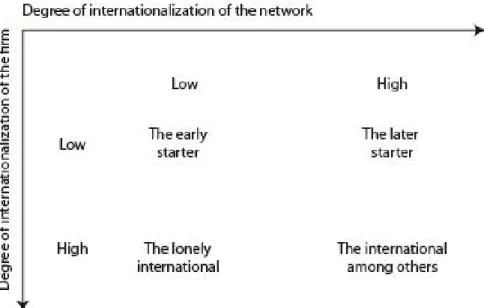
This model is seen as a process in which relationships are continuously established, developed, maintained and dissolved with the plan of achieving the company’s goals. Johanson and Matsson (1988) have identified four stages of internationalization: the early starter, the late starter, the lonely international and the international among others.
A firm´s strategy is characterized by the mission to minimize the need for knowledge development, minimize the need for adjustment and explore established network positions.
For an early starter it can be problematic to fulfil the above named demands, since the firm is the first to develop a network. The firm can follow the Uppsala model if both the degree of internationalization and network is low.
18
For the lonely international, the biggest challenge is to coordinate the international activities.
The problems that the late starter faces are related to the dependency of the firm on other players that already exist within the network. Other firms might try to delay the firms´ entrance into the international market.
The international among others, operates within an internationalized network, in which differences between countries decrease over time. Examples of this stage are mergers, joint ventures and alliances.
2.1.3. Business network model in Uppsala´s model
This model was develop in 2009 by Jan-Johanson and Jan-Erik Vahlne, and is the result of the revision of the Uppsala model, taking in count the importance of networks in the internationalization process. Considering that “…network relationships have an impact
on foreign market selection as well as on the mode of entry in the context of on-going network processes.” (Johanson & Vahlne 2009)
The 2009 business network model has, with the 1977 Uppsala model, two sets of variables: state variables and change variables that affect and are dependent on each other.
STATE ASPECTS CHANGE ASPECTS
19 The model structure is the same as the Uppsala. The difference is that the authors added “recognition of opportunities” to the “knowledge” concept, considering opportunities to be the most important element of the body of knowledge that drives the process.
“As some types of knowledge are not accessible to everyone, and are instead confined to network insiders, a strong commitment to partners allows firms to build on their respective bodies of knowledge, making it possible for them to discover and/or create opportunities.” (Johanson & Vahlne 2009)
Another variable is “network position”, that was considered in 1977 as “market commitment”. Now it is assumed that the internationalization process is pursued within a network.
In the change aspects the authors change “current activities” to “learning, creating, and trust-building”, to make the outcome of current activities more explicit.
Current activities explained that the daily operations play an important role and lead to increased knowledge, trust and commitment. By using “learning, creating, and trust-building”, the high levels of knowledge, trust, and commitment in a relationship results in a more efficient creative process.
“Relationships are characterized by specific levels of knowledge, trust, and commitment that may be unevenly distributed among the parties involved, and hence they may differ in how they promote successful internationalization.” (Johanson & Vahlne 2009)
The last change variable is “relationship commitment decisions”, which has been adapted from the original model, by adding “relationship”, to clarify that the commitment is to relationships or to networks of relationships.
“This variable implies that the local firm decides either to increase or decrease the level of commitment to one or several relationships in its network.” (Johanson &
20
2.1.4. Conclusion
As times change, the demand and the market changes as well. Many criticisms were made to the original model mainly based on the conviction that the companies behaviour had changed since 1977.
Some examples are companies that sometimes jump over stages in the establishment chain (Hedlunf & Kverneland, 1985); firms start to internationalize soon after being established (Oviatt & McDougall, 1994); and the internationalization process proceeds more rapidly now (Oviatt & McDOugall, 1994; Zahra, Ireland & Hitt, 2000). Also the order in which companies enter foreign markets no longer correlates with psychic distance (Madsen & Servais, 1997). Joint ventures and strategic alliances are models that are much more commonly used today than previously.
The model described above has been adapted to the new internationalization needs and to the new tendencies over the years.
Nowadays many companies expand through online services, which means that many entities were not able to adapt their company to the Uppsala Model (Nordström, 1991; Forsgren, 1989).
Online market entry costs are comparatively much smaller than their offline counterparts. Setting up a website and developing appropriate functionality can be costly, but the cost fades compared to setting up an international line of physical retail locations. Other repercussion is to find local suppliers and all the other necessary steps needed to complete a traditional internationalization process. Furthermore the internet has allowed multinationals to simplify the consumer targeting process: instead of using regional outlets they now have the possibility of assembling the global consumer base into one virtual location. This new arena of modern business has also entailed a new pool of competitive advantages. Traditional advantages such as manufacturing assets and employee expertise has not lost its significance, but it is complemented by new specific online resources. Consumers can view a commercial and seconds later be in a virtual location, which allows them to instantly purchase the product or service.
21 2.2. Business Associations
In this chapter the author will explain BA’s structure, historical context, the relation with members, the market and reputation. The author will also name the different types of BAs, organizational features, institutional strength and the network connection.
2.2.1. Business Associations structure
A trade association, also known as an industry trade group, BA or sector association is an organization founded and funded by businesses that operate in a specific industry. An industry trade association participates in public relations activities such as advertising, education, political donations, lobbying and publishing. But the main focus is collaboration between companies, or standardization.
“The potential benefits of associations to government are that they offer an enhanced level of compliance with regulations, lower administrative costs of regulation, and better designed regulations to take account of technical and market developments by maximizing the tacit knowledge available through associations” (Bennett, 1997).
Associations may offer other services: producing conferences, networking, charitable events, offering classes or educational materials. Many associations are non-profit organizations governed by laws and directed by officers who are also members.
In sum, “Business Associations are organizations that operate in between markets and
politics connecting these to each other through representation, rulemaking and information. “ (Fries, 2008)
Most of the literature on BAs considers that their operations and activities are either on the political or market system. However some authors show how relevant it is to be in between.
In 1986, Hutt, Mokwa and Shapiro tried to define political economy framework in order to explore what they called a parallel political market place. These three authors suggest that marketers needed to know more about the nature of powerful external stakeholders, such as regulatory agencies and trade associations, so they could do favourable agreements with these. In order to understand markets, researchers needed to understand the nature of decision making on this parallel marketplace.
22
Because of this role, between market and politics mentioned before, Liv Fries (2008) considers that BAs can be referred as boundary organizations, notion that was initially described by Guston (1999, 2000). It exists at the frontier of two relatively different worlds of politics and science, and possesses three general characteristics:
First, they have distinct lines of responsibility to both sides of the boundary, to science and politics or society. Second, they encourage participation of stakeholders on both sides of the boundary. Third, they create opportunities and incentives to create boundary, to pursue their interests both collaboratively and independently.
2.2.2. Neocorporativism and business association
In the eighties, a stream of research called neo corporativism started to appear. Within this stream, the interest in BAs was growing strongly because there were organizing societies in a new way. Streeck and Schmitter (1985) believe that it was in the 60s and 70s in the Western societies, which emerged concepts such as systems of interest arrangements accommodation and policy concentration. With this, along came the markets, community and hierarchy that lead to a new way of governance.
Private interest signified that markets were governed by associations rather than by state or pure competition - this concept is very close to self-regulation.
Researchers observed since the early studies that association’s structures tend to be very sensitive to the actual distribution of power in a policy area in a state, which conducted to the variation of BA’s organization between countries, regions and political systems. With the development of the European Union, came a wide range of EU-level BAs; but it was predicted by EU researchers that national associations would become less powerful (Wilts & Quittcat, 2003). As a matter of fact, internationalization was transforming BAs, but each one of them changes according to the structure they belong to.
For instances, in a European level, by the influence of EU, BA’s shaped each other in a loop; consequently they become dependent on each other’s and on the nation they are active in. This means that BAs have politically and structurally more important role in a more benevolent type of country.
23
2.2.3. Relation between Business Association and the associates
And how do BAs represent members? The representing process may shape firms as well. Jutterstrom (2004), in a study, concludes that interests are created during, and as a result of the representation process. This means that the actors have to adapt both to each other and to their political agenda.
The associations have to adapt to two different structures, which they depend on, at the same time: the political will and the need to represent all members. In other words, associations have to define their member’s interests and combine them with the political will. If not, they may end up losing their members interest or being seen as an extension of the government.
Because of these opposed logic, Bennett, (1997) suggested the replacement of membership logic to logic of services: interest representation and services of different kinds.
2.2.4. Business association’s reputation
BAs do not have the best of reputation. They are seen as having a negative effect on the functioning of markets, because of their group behaviour and as incompetent in wealth creation (Greenwood, 2002; Jordan, 1998; Olson, 1965).
As a matter of fact, there are problems in keeping agreement, due to problems of low density of membership and high option out. Other issues are instability over time, a lack of balance in the form of representation by associations of different types or sizes of businesses.
Olson (1965) explains the poor macro-economic performance as a group of interest problem, and sets the UK twentieth century example, which had a good post war economic performance because of the interest-group infrastructure destruction.
Williamson (1996) believes that BA emerges when transactions are characterized by uncertainty, frequency, and asset specificity.
24
Doner and Schneider (2000) based on these concepts, argue that BA’s contribute to the economic development and puts pressure on the government; it will tend to an effective and uncorrupted administration. Even so, BA’s are extremely corruptible.
Streeck and Schmitter (1985), Grant (1987), Lanzalaco (1992) and Sadowski and Jacobi (1991) demonstrate that BAs, particularly voluntary ones, are subject to a process of endemic fragmentation under-resourcing and diversity that limits their effectiveness. As an example, “Greenwood analysed 28 different factors and the strongest associated
to with a high degree of governability of an association were: a highly specialized mission, the high degree of governability (in relation to members), that the association was active in a domain with high degree of overcapacity, had a common enemy, a high degree of regulation, a low threat of exit and/or were active on a European market.”
(Fries, L. 2008)
2.2.5. Business associations, membership and the market
Regarding memberships, BAs are again dependent of their members, but usually these aren´t dependent on the associations.
As a matter of fact, the choice of membership is voluntary. The individual or business can join, remain or break anytime they want without any repercussions, allowing to act independently (self-supply), contracting a third party (outsourcing), and joining a different association or not acting at all.
One the other hand it is recognized in BAs, an organizational and institutional strength which attracts members to join.
BA’s have a considerable power over their members, by encouraging them to achieve certain goals, goals which would be difficult to achieve without the help of them, by changing their member’s preferences or behaviour.
Such associations are economic and political institutions, which shape incentives, payoffs and strategies.
25
“Our definition of strength thus emphasizes an association’s institutional capacity to induce members to commit resources and abide by association rules and decisions designed to further collective goals.” (Doner & Schneider, 2000)
The theoretical literature recognizes two categories of demand for associations (Olson 1971, Streeck and Schmittter 1985, van Waarden, 1991): the logic of services and the logic of influence.
The logic of services, as the name says, it’s an association service oriented, with individual and specific demands, where the services response is towards individual business requests and enquiries. This category allows the association to contribute to the member’s competitiveness, by filling a market niche and become a business service company.
The role of a BA’s on the logic of interest category is to act collectively on behalf of all members´ interest.
The logic of interest associations has a collective orientation and a poorly-resourced body, due to the greater proportion of income that is raised by low fees and lack of dependency.
Relatively to competitiveness, this type of association contributes by provision of collective services, such as industry standards, codes of conduct and branding of quality control, etc. One of the positive aspects is that in a collective service, when one business receives the service, others cannot be excluded from their benefits.
Streck and Schmitter (1985), Grant (1987), Sadowski and Jacobi (1991), Lanzaloco (1992), van Schendelen (1993) concluded that associations simply based on the influence logic, tend to be endemically small and fragmented.
2.2.6. Specific and collective services associations
Both collective and specific associations have an important role on the contribution of SME (Small and Medium Enterprises) competitiveness. This provides a unique relationship with their members, a unique access to businesses trust and provides also
26
high tacit knowledge skills. Specific services also allow their members to have information advantages and high quality advice of other services.
Bennett (2006) observed that “…trade associations can offer collective advantages by
reducing individual business risk and ´orientate the views´ of individual’s ´towards a collective attainment of common goals`. They can foster ´the development of trust-based inter-firm relations and be a back-up structure which ensures the validity of commonly acceptable (and accepted) norms for technical properties of products of their quality standards and arbitration.”
Lane (1997) claimed that trade associations, in general (specific and collective services), influence buyer-supplier relations in five different ways to benefit competitiveness: i) disseminating and enforcing a stock of commons rules and norms; ii) disseminating technical knowledge within the sector; iii) providing knowledge about individual firms that allows them to be assessed as potential customers or suppliers; iiii) articulating collective goals that may influence the sectors development; iiiii) and by representing the concerns of the sector to government.
These factors lead to the stimulation of ethical codes and the development of mutual trust, which benefits individual and sector competitiveness.
2.2.7. Business Associations and Networks
After understanding the existing types of associations, it is interesting to know how these interact through networks.
Blackburn (1990) and Curran and Blackburn (1994) suggest that there is a wide range of networks - from the compulsory (example: contracts within the supply chain) to voluntary (relations of individual businesses to their associations).
The use of this relation will change, depending on the condition of the business, growth or decline. These types of networks are often informal and personally based.
There is another view on these networks, pointed by Granovetter´s (1973), that has been drawn also the attention of Bryson and Daniels (1998). This observation differentiates networks relations between “weak ties” and “strong ties”. They consider that very broad networks of weak ties, originating from remote contacts may be more important to an SME than the strong ties provided by the government policy initiatives Business Links.
27 In this context, associations perform an important role for the development of weak ties within a network of collective ´trust´. This means that BA’s are judged on the costs and benefits of the services that they deliver, specially their effectiveness and the quality of their services.
“It can be concluded that networks are a crucial factor on an association success, considering that associations their selves are a network therefore, “Networks may thus facilitate associations, and associations may facilitate networks. However, it appears that most associations (local or sectorial) are an element of networks, are no themselves a free-standing network, and exist primarily to serve very specialized business needs or services niches.” (Bennett, 1997)
2.2.8. Business associations, the government and the market
Bennet (1997), defines that “BAs are collective bodies that are intermediary between
individual business action and state action. As such they are one of a number of organizations that may influence the development of individual businesses and the wider competiveness of a nation.”
For Campbell, Hillingsworth and Lindberg(1991) industries shift between different governance structures, due to economic and technological changes; this shapes and influences the members.
Fligstein (2001) defends that market structure is a result of a process, a process that has a historic past. Thereby, the market structure is a result of the evaluation of how the problem of creating a market was solved, and how the stability in particular market was ensured.
Lane and Bachman (1995) claim BAs have beneficial influence on SME competitiveness. This depends on how associations are organized and how their role is defined by both, the state and their firms.
Thereby a BA orientation, in which they interface with the state, is what influences the effectiveness of individual SME´s, their economic development of a company as a whole.
28
Streck (1991) concluded that the level of state organization or regulation affects the extent of association development and effectiveness.
It is visible why BAs are relevant for the government and the markets. They are representing actors and because they provide standards, offering market advice, information and providing a network of cooperation.
Although many associations’ activities are designed to improve the functioning of both state and markets, these should be evaluated separately.
It is known that associations contribute to economic performance. This contribution can be divided in two types: market-supporting and market-complementing activities. Associations can strengthen the market functioning through market-supporting; by supporting the provision of basic public goods (property rights and effective public administration), which are provided by the state, so that contributions of associations come indirectly through pressure on public officials.
Market-complementing is undertaken by many BAs that attempt to overcome various types of market limitations activities. This involves a direct coordination among firms to reconcile interdependent production and investment decisions.
2.2.9. Organizational features and institutional strength
BAs have a significant institutional strength and organizational features.
Although it is mentioned as a feature, it is rare to find BAs with significant institutional strength. There are a few, especially those engaged in market-complementing activities. By promoting new technologies, BA’s aren´t pressuring their members to adopt these technologies, but on the other hand, by providing information and technical assistance, they influenced the member´s decisions on investing in new technologies.
Richard F. Doner and Ben Ross Schneider (2000) concluded that there are three organizational and interrelated factors which affect institutional strength: high membership density, extensive benefits and effective internal interest’s mediation.
“Associations with one of these three attributes may be somewhat stronger than those with none, but it is the synergy between the three that builds real capacity.” Doner &
29 Usually and as mentioned before, one of the biggest problems for BAs is the fact that the members can leave the organization at any time without any cost. Therefore there are cases, especially when Associations have crucial benefits to offer to members only, the membership becomes valuable and exit becomes costly. Although the member becomes powerless at the same time, the Association guarantees standards and thereby reputation. Therefore, high density, valuable selective benefits and effective internal mediational enhance institutional strength.
Doner & Schneider (2000) stated that “associations with a great deal of institutional
capacity and abundant resources usually undertake a larger range of different activities.”
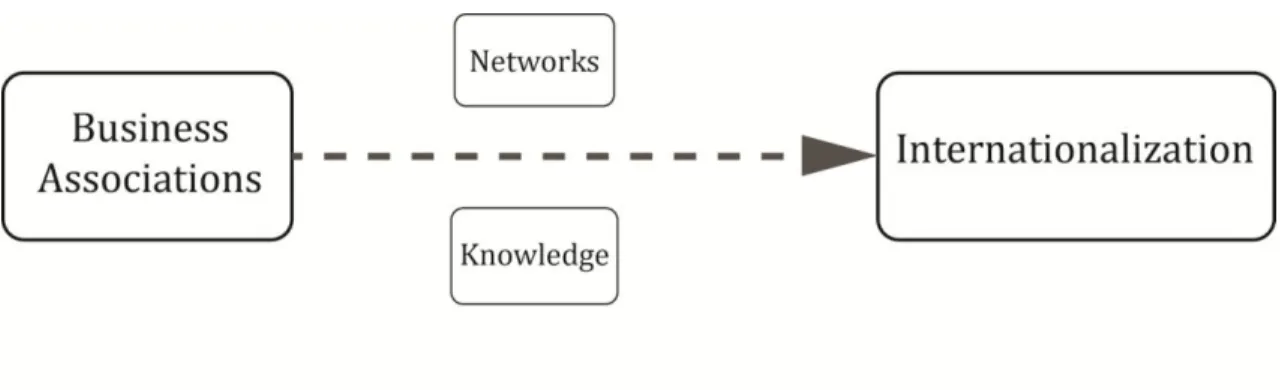
The author can conclude that the role of BAs in the internationalization process is mainly due to know how, market knowledge, networks and network positioning.
31 3. Methodology
This chapter summarizes the methodology used to respond to the main goal of this study, by describing first the Research Strategy, the Unit of analysis, the Case Study Selection and the Framework analysis. The chapter is concluded by presenting the research limitations.
3.1. Research Strategy
The problem area of this study lies in a rather unexplored field of BAs and their impact in internationalization processes; the author did not find any available literature considering this phenomena. On the other hand the author had access to literature on BA’s and in internationalization processes alone.
In order to establish this link between the two main keywords, the author focused on how and why these two concepts are linked.
For this study it was chosen a qualitative approach. The qualitative approach was used to answer main questions, such as “how” and “why” do BAs impact internationalization processes.
The qualitative research literature has two main streams: “definite” and “sensitizing” approaches (Blumer, 1954; Coffey, 1996). A sensitizing approach implies that researchers start with a broad outline of their topic, narrow down research questions throughout the empirical data collection and analysis.
Holmes and Solvang (1997) also argue that a qualitative study enables researchers to gain deep knowledge and understanding of the study subject, rather than to analyse many subjects superficially.
Therefore, "Qualitative research is a situated activity that locates the observer in the
world. It consists of a set of interpretive, material practices that make the world visible. These practices transform the world. They turn the world into a series of representations, including field notes, interviews, conversations, photographs, recordings, and memos to the self. At this level, qualitative research involves an interpretive, naturalistic approach to the world. This means that qualitative researchers
32
study things in their natural settings, attempting to make sense of, or to interpret, phenomena in terms of the meanings people bring to them." Denzin & Lincoln (2000)
Throughout the duration of the study, the author made use of this iterative sensitizing approach. Hence, the initial research questions have constantly been revisited and refined when new findings occurred.
The qualitative analysis was made through interviews to the APICCAPS spokesperson, and quantitative through surveys and data analysis given by APICCAPS demonstrating the results rates.
Mixed methods research (the combined use of quantitative and qualitative methods in the same study) is becoming an increasingly popular approach in some discipline fields. The overall purpose and central premise of mixed methods is that the use of quantitative and qualitative approaches in combination may provide a better understanding of research problems and complex phenomena than either approach alone (Creswell and Plano Clark, 2007).
Greene, Caracelli and Graham (1989) defined mixed methods research designs as those that include at least one quantitative method (designed to collect numbers) and one qualitative method (designed to collect words).
3.2. Unit of Analysis: Case Study
To be able to respond to the author’s study main goal, a case study was choose as research strategy. In order to support the study, a sample was needed to be chosen out of all the BAs the author had contact with over the years. It should be also taken into consideration that the author does not belong to any kind of associations. Therefore, it had to resort to other people, to provide information and still, this dissertation consists in a contemporary phenomenon in a real-life context.
A case study is an empirical inquiry, where the main focus is on a contemporary phenomenon within its real-life context, which contains many variables of interest; multiple sources of evidence; theoretical propositions to guide the collection and analysis of data. Yin (2003)
33 The author chose a case study strategy because "Case study research is a heterogeneous
activity covering a range of research methods and techniques, a range of coverage (from single case study through carefully matched pairs up to multiple cases), varied levels of analysis (individuals, groups, organizations, organizational fields or social policies), and differing lengths and levels of involvement in organizational functioning."
Hartley (2004)
There are different categories of case study. Yin (2003) defines three categories of case study: Exploratory, Descriptive and Explanatory. However, Stake (1995) added three more categories: Intrinsic, Instrumental and Collective:
i) Exploratory happens when there is no or very little knowledge on the research direction, ii) Descriptive is when there is a need to describe a phenomenon, iii) Explanatory answers often to questions of how and why by investigating their interrelationships in depth, iv) Intrinsic is used when the researcher has the interest in the case, v) Instrumental tries to understand more what is obvious to the observer and vi) Collective is when more than one case study needs to be analysed.
Robert Stake (1998) points out that crucial to case study research are not the methods of investigation, but that the object of study is a case: “As a form of research, case study is
defined by interest in individual cases, not by the methods of inquiry used”. Other
researchers, such as Robert Yin (1994), place more emphasis on the method and the techniques that constitute a case study.
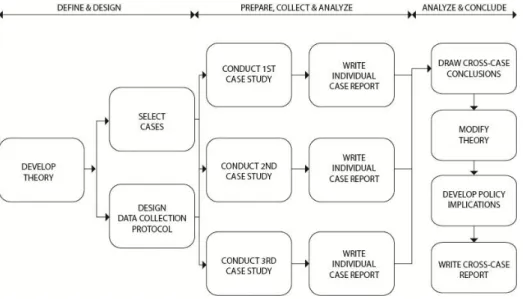
Yin (2003) describes the case study methodology in the following steps:
34
Yin (2003, figure 1) describes three main steps: i) define and design, ii) prepare/collect/analyse and iii) conclusion.
Yin (2003) also proposes three conditions for the design of the case study: i) The type of research question posed, ii) the extent of control an investigator has over actual behavioural events, and iii) the degree of focus on contemporary events.
Importance of having protocol is especially noted in the multiple case study research, which is not the case in this dissertation. The author chose to have only one case study, because it considers that this case represents a critical test to existing theory.
On the second step, Prepare, Collect and Analyse, Yin (2003) defines three different stages: Preparation for Data Collection, Distribution of the Questionnaire, and Conducting Interviews.
This step consists mostly in collecting and executing, once the design of the case study has been done. Yin (2003) identified six sources of evidence for the case study research: documentation, archival records, interviews, direct observation, participant observation, and physical artefacts.
The author in this study used and has access to documentation, direct observation and interviews.
3.3. Case Study Selection
For this study the author chose as case study APICCAPS BA - Portuguese Footwear, Components, Leather Goods Manufacturers’ Association. It is a Portuguese BA which represents the following business sectors: Footwear industry, Footwear components industry, Leather goods industry (bags, wallets, gloves, belts, etc.) and equipment for the sectors mentioned above.
This case was chosen for the purpose of this thesis and its transformation during the last decade. The case provides in-depth material for an appropriate analysis of how the entire industry has changed during the last decade.
35 No regular export Export through agent Sales subsidiary Production
There are many reasons why APICCAPS was chosen as case study: 1) APICCAPS work in the last years, 2) campaigns, 3) communication, 4) interaction with other markets, 5) documentation/access to interview resources.
First, APICCAPS is regarded as one of the most dynamic, creative and reputation to the general population.
Compared to other BAs, the shoe industry is the biggest and with the most revenue within the fashion industry and their representatives (BAs).
Second, in a time of crisis as we are going through, APICCAPS has helped to put Portugal in the international shoe market, seen as a reference in the world.
Therefore it helps the economy and provides more employment mostly within the north region of Portugal.
3.4. Analysis Framework
In the analytical part, the author followed a combination of inductive and deductive methods.
First, all empirical data was collected and guided by two frameworks: one introduced by Johansson & Vale (1977), The Uppsala Model and another introduced by Jan-Johansson and Jan-Erik Vale (2009) Business network model in Uppsala´s model by as introduced before.
36
STATE ASPECTS
CHANGE ASPECTS
As mentioned before, Uppsala business model had suffered a variety of changes trough out the years. Both frameworks presented above belong to the same model (figure 8-9). It was develop and remained the same since 1975. Figure 9 is the most recent version of the model made in 2009.
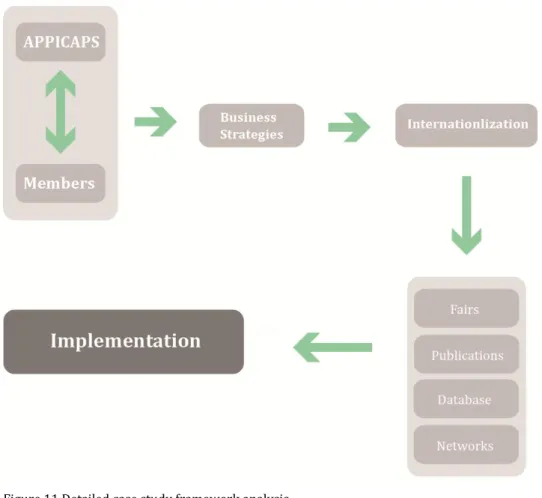
The framework (Figure 10) will be used to analyse the role of APICCAPS in the shoe companies internationalization process, by: i) analysing APICCAPS relation with their members (shoe companies), ii) studying their internationalization strategies, iii) analysing each internationalization step and iii) studying the implementation success and their results in a real life context.
Figure 9 The core concepts from the Uppsala model (Johanson & Vahlne, 1977)
37
3.5. Data Collection
Since the main focus of this study is to understand how do BAs contribute in the internationalization of their members businesses. The author decided to interview the APICCAPS head of the marketing department, the head of CITEVE and the head of international relations to understand the underlying processes of the internationalization process. In line with the nature of the research purpose, it was important to collect data of opinion leaders and, additionally, other actors within the industry. The author chose to use in-depth interviews as the main method of data collection for this thesis. This view is supported by Gillham (2005), who points out that interviews are more flexible and allow a deeper understanding of the topic than questionnaires. The author also resorted to questionnaires to APICCAPS members to understand the strategic position towards this association, in order to find out the level of importance that this association has in the internationalization process.
38
Secondary Data
For this study it was used as secondary data, the studies made by APICCAPS on the shoe sector, social networks, internet information, blogs and non-academic articles.
39 4. The APICCAPS case
In this part of the thesis the author will first give an introduction to the case of APICCAPS. Afterwards it will present the empirical findings gathered throughout the study. As outlined before, the case analysis follows the Johanson & Vahlne (1977 and 2009) framework, from the Uppsala Model. This chapter summarizes the author´s findings.
4.1. Case Background
In spite of the serious 2009 economic crisis and the modest European and Portuguese growth, the import of goods grew over 10%. The footwear exportation alone grew 5%, fully recovering the previous year´s fall, which allowed the industry to strengthen employment levels.
The APICCAPS – Portuguese Footwear, Components and Leather Goods Manufacturers´ Association study shows that 2010 was the most favourable year of this century when it comes to footwear, as can be seen in the following figures.
40
The footwear industry is the largest contributor to the Portuguese external account. The Portuguese footwear industry has a strong export vocation, and after the 2009 economic crisis, the trade recovered the export value to 95% of the national production. During the 90s exports grew faster than imports. The first half of the present decade was marked by a restructuring of the industry, with the closure of the majority of the big foreign-capital manufacturing facilities and the greater Asian competition in the main markets. Therefore Portuguese exports were severely affected, and from 2001 to 2005, Figure 13 Portuguese Footwear Industry Trend (APICCAPS, 2011)
41 they fell nearly 30%. During this period, the trade surplus fell by more than a third to about 850 million euros, roughly the figure seen early in the 90s.
The shoe industry has been strengthening its already strong orientation towards the external markets. In 2005 exports corresponded to 88% of the annual production, the highest ratio ever, when 72 million pairs of shoes were exported, with revenue of 1.250 million of euros.
Portugal exports mainly to Europe, representing 95% of the overall exports. Figure 14 External trade of the Portuguese footwear industry (1991-2010) (APICCAPS, 2011)
42
Figure 15 Portuguese shoe exportation evolution(APICCAPS, 2007)
43 Portuguese main trading partners are highly concentrated in geographic terms in 2010. 96% was directed to the European continent; the exports to outside Europe are distributed evenly among the other countries.
Figure 17 Destination of Portuguese footwear exports (value), 2012 (APICCAPS,2012)
44
World Footwear Production, Consumption and Exports World´s Production
Figure 19 Portuguese Footwear Export Trends, Main Buyers (APICCAPS,2011)
45 APICCAPS estimates that the worldwide production of footwear has reached 21 billion pairs in 2011. Asia continues to be the powerhouse of the footwear industry, with an overall share close to 90%. The other continents’ shares have only marginally changed from the previous year, with Africa showing a slight increase and others minimally decreasing.
Seven Asian countries are counted among the world’s top 10 producers, a list in which China’s is the undisputable leader. Brazil is the only non-Asian country among the top 5 producers. In the bottom half of this list, Mexico has exchanged places with Thailand although they show very similar figures. Italy, the top European producer, just makes it into the world top 10, with a number of other countries such as Turkey and Iran very close.
46
Consumption
47
Figure 23 Top 10 Footwear Consumers (quantity) 2011 (APICCAPS, 2012)
At the continental level, the consumption is more dynamic with no major changes from year-to-year. In 2011, Europe and North America yielded some market share to Asia and Africa, with South America and Oceania holding their positions.
China is the world’s largest market for footwear, in terms of quantity, closely followed by the USA and India. Compared to the previous year, the USA share showed some decrease, whereas those of the other two countries increased. In the second half of the top 10 table there have been some changes in the ranking of European countries, with Germany and France coming above the United Kingdom and Spain.
48
Exportation
Asia is officially the main player in footwear exports with 84% of the world total. Europe is in a distant second place with 11%.
The remaining players maintain their positions in the export rate.
China alone sells almost three out of every four pairs of shoes exported worldwide and is followed on the list of the main exporters by its special administrative area of Hong Kong. However, Hong Kong’s exports maintained the downward trend they have shown throughout the last decade and are now less than half of what they were ten years ago. Vietnam, Indonesia, and Thailand complete the group of 5 Asian countries in the top 10 table. The other five top exporters are European, led by Italy, which has a narrow margin over Belgium and Germany, followed by the Netherlands and Spain.
49
Figure 25 Top 10 Footwear Exporters (quantity) 2011 (APICCAPS, 2012)
China represents 38% of the value of all footwear exported worldwide, with another 5% from Hong Kong. Vietnam, Indonesia and India are the other Asian countries among the top 15 exporters. Together these five countries represent more than half of the world total. They are joined by nine European countries led by Italy, which together amount to 31% of world exports and in fifteenth place is Brazil. Italy charges the highest average export price (45 USD), followed by Portugal (32 USD) and France (30 USD). At the other end of this scale is China, exporting at an average price of just below 4 USD.
50
4.2. Case Study
APICCAPS – Portuguese Footwear, Components, Leather and Goods Manufacturers’ Association - is a nation-wide BA based in Porto. It was founded in 1975 and represents the following business sectors: Footwear industry, Footwear components industry, Leather goods industry (bags, wallets, gloves, belts, etc.) and Equipment for the above mentioned sectors.
APICCAPS also relies on the participation and the contribution of members and companies whose area of activity is related to the sectors that it represents.
The organization aims to promote the development of the sectors that represent their 700 members.