Universidade de Aveiro
2008
Secção Autónoma de Ciências Sociais, Jurídicas e Políticas (Social, Juridcal and Political Sciences)
EMNET TADESSE
WOLDEGIORGIS
COST SHARING IN ETHIOPIA: AN ANALYSIS OF
CHALLENGES AND PROSPECTS
PARTILHA DE CUSTOS NO ENSINO SUPERIOR NA
ETHIÓPIA: UMA ANÁLISE DOS DESAFIOS E
PERSPECTIVAS FUTURAS
Universidade de Aveiro
2008
Secção Autónoma de Ciências Sociais, Jurídicas e Políticas (name of the department)
EMNET TADESSE
WOLDEGIORGIS
COST SHARING IN ETHIOPIA: AN ANALYSIS OF
CHALLENGES AND PROSPECTS
Thesis presented to the University of Aveiro to fulfil the formalities essential to obtain the degree of European Master in Higher Education (Erasmus Mundus), done by the scientific supervision of Dr. Pedro Nuno Teixeira, Assistant Professor at the Department of Economics in the University of Porto
Dedicated to my mother, Hanna Bekelle Beyene, a strong woman who has given up her own happiness to put (us) her children in a better place. For her support, prayer, encouragement, and constant love that sustained me throughout my life.
The juri
president Doutor Rui Armando Gomes Santiago
Professor Associado com Agregação da Universidade de Aveiro
Doutor Alberto Manuel Sampaio Castro Amaral
Professor Catedrático da Faculadade de Ciências da Universidade do Porto
Doutor Pedro Nuno de Freitas Lopes Teixeira
Professor Auxiliar da Faculdade de Economia da Universidade do Porto
Doutor Maria Teresa Geraldo Carvalho Professora Auxiliar da Universidade de Aveiro
Thanks First, I would like to thank the Almighty God for helping me throughout my work and for giving me all the strength I needed. I would like to extend my sincere thanks to my supervisor Professor Pedro Teixeira for his constructive
comments, guidance and encouragement which enabled me to accomplish this work. I am also very grateful for the European Commission and the Erasmus Mundus Program for the financial assistance without which I would not have had the opportunity to write this thesis. My deepest gratitude goes to my loving wife Eden Fitsum, who believed in me and supported me by providing valuable information, editing my paper and in every aspect during the process. My family also deserves a big appreciation for the consistent support and encouragement they have given me all my life and especially through this study. Last but not least, to all the HEEM people, thank you all for making it feel like a second home away from home.
Palavras-chave Ensino superior; Financiamento; Partilha de custos; Empréstimos; Acesso; Etiópia
Resumo O financiamento do ensino superior é um dos aspectos mais relevantes da análise económica dos sistemas de ensino superior. A importância deste tema tem sido enfatizada pelos constrangimentos financeiros observados quer em países desenvolvidos quer em vias de desenvolvimento, os quais suscitaram a discussão entre investigadores e agentes políticos sobre modos alternativos de suportar financeiramente o ensino superior. Neste trabalho são discutidos os fundamentos teóricos para o desenvolvimento de políticas de partilha de custos e os modos de partilhar esses custos, nomeadamente através de diversos sistemas de empréstimos. Pretende-se também analisar a relevância do contexto político e do grau de desenvolvimento sócio-económico e das implicações destes no sucesso relativo dessas medidas de medidas de partilha dos custos do ensino superior.
Estas questões serão analisadas tomando por objecto central deste estudo o sistema de ensino superior da Etiópia. o qual. Este sistema de ensino superior tem sido caracterizado pelo seu padrão de acesso elitista, pelo facto de tradicionalmente excluir a maioria dos potenciais estudantes que poderiam frequentar o sistema e assim contribuir para o desenvolvimento económico e social daquele país. Este sistema de ensino superior enfrenta actualmente um conjunto de desafios importantes, entre os quais se destacam os relativos ao seu modo de financiamento. Desde as medidas de reforma iniciadas em 1994, o sistema tem apresentado um conjunto de mudanças importantes. Umas das principais medidas constitui a adopção de políticas de partilha de custos, a qual se iniciou em 2003 com um conjunto de objectivos. Este estudo pretende analisar os desafios e as perspectivas futuras que se colocam a esta política de partilha custos no ensino superior na Etiópia, nomeadamente tomando em consideração as condições específicas daquele país.
keywords Higher Education; Funding; Cost-sharing; Loans; Access; Ethiopia.
Abstract Higher education finance is one of the main issues in the economic analysis of higher education systems. The financial difficulties witnessed in both developed and developing countries have led researchers and policy makers to discuss about different alternatives of sustaining higher education systems. In this study are discussed the basic theoretical foundations of cost sharing and the different forms of implementing it, namely through student loan systems. This study also aims at discussing the relevance of the political and socio-economic context for the relative success of the adoption of cost-sharing.
These aspects will be analysed by focusing in the Ethiopian higher education system. This system has been characterized by an elite enrolment pattern, since it has traditionally excluded the majority of potential students who could join the system and therefore contribute to the development of the country. The Ethiopian system has been facing a number of challenges throughout its recent history, and financing the sector is certainly one of the major ones. Since the reform measures that have started in 1994, that system of higher education has been going through a number of important developments. Cost sharing is one of the main policy changes and has been adopted in 2003 to meet a specific set of objectives. This study investigates the challenges and prospects of cost sharing in Ethiopia, namely by taking into consideration the political and social reality of the country.
Table of Content
Chapter One: Introduction ...1
1.2 Statement of the Problem ...3
1.3 Objectives of the Study ...4
1.4 Research Questions ...5
1.5 Methodology...5
1.6 Organization of the Study...8
Chapter Two: Cost-Sharing In Higher Education ...10
2.1 Challenges in Higher Education Finance ...12
2.2 Rationales for Cost-Sharing in Higher Education ...17
2.3 Sources of Higher Education Finance ...21
2.3.1 The Government or Taxpayers ...22
2.3.2 Parents ...23
2.3.3 Students ...25
2.3.4 Individual or Institutional Donors and Institutional Entrepreneurship...27
2.4 Mechanisms of Cost-Sharing ...28
2.4.1. Forms of Cost-Sharing ...28
2.4.2 Cost-Sharing and Access in Higher Education. ...30
2.4.3 Tuition Policies and the Issue of Access ...34
2.5 Student Loans: Types of Student Loan ...36
2.5.1 Mortgage-Type or Fixed-Schedule Loan ...37
2.5.2 Income Contingent or Income Repayment Loan...38
2.5.3 Graduate Tax ...39
2.5.4 Comparing Forms of Cost-Sharing ...40
2.5.5 Hybrid Loan System...42
2.5.6 Factors for Effective Student Loan System...43
2.6 Cost-Sharing in Developing Countries: Some Examples from Sub-Saharan Africa ...45
2.6.2 Uganda...49
2.6.3 Kenya...52
2.6.4 Some Reflections on Cost-Sharing Experience in Sub-Saharan Africa ...54
2.6.5 Concluding Remarks ...56
Chapter Three: Higher Education in Ethiopia ...58
3.1 General Information ...58
3.2 The Development of Higher Education in Ethiopia ...59
3.3 The Structure of Ethiopian Higher Education ...61
3.4 Higher Education Reforms Since 1991 ...66
3.4.1 Technical, Vocational Education and Training ...69
3.5 Financing the Ethiopian Higher Education ...72
3.6 Concluding Remarks ...76
Chapter Four: Challenges and Prospects of Cost-Sharing in Ethiopia...77
4.1 Austerity in Ethiopian Higher Education System...78
4.2 Rationales for Cost-Sharing in Ethiopia...85
4.3 The Policy of Cost-Sharing in Ethiopia...88
4.3.1 The Origin of the Policy ...88
4.3.2 The Policy and Its Implementation...89
4.3.3 Why Adopting an Income Contingent System in Ethiopia?...92
4.4 Complexities of Cost-Sharing in Ethiopia...94
4.4.1General Challenges of Cost-Sharing in Ethiopia...94
4.4.2 Administrative Challenges ...98
4.5 Cost-Sharing and Access in Ethiopia ...108
Chapter Five: Conclusion ...114
5.1 Introduction of Cost-sharing in Ethiopia – Challenges and Prospects ...115
5.2 Possible Developments or Emerging Trends from Cost-Sharing in Ethiopia ...118
5.3 Recommendations ...120
TABLES
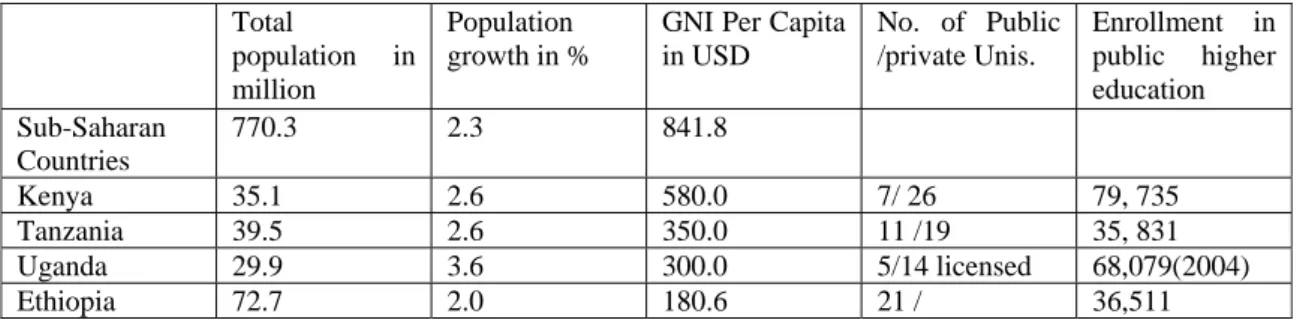
TABLE 1: Country Indicators from 2006………..46 TABLE 2: Enrollment History in Brief Ethiopian in Education System………...61 TABLE 3: Student Enrollment in Ethiopian Higher Education System………. …..67 TABLE 4: Public Expenditures on Selected Public Sectors in Ethiopia (1995/96-2005)…….73 TABLE 5: Recurrent Budget Allocation for Public Universities in Ethiopia (1995/96- 2005/06)………74 TABLE 6: Anticipated Expenditure Budget (in Birr) for the Education Sector in the Third Education Sector Development Program (2005/06-2009/10)………..75 TABLE 7: Population Growth and University Enrollment in Ethiopia (1995-2004)…………76 TABLE 8: Completion and Enrollment rate in Primary and Secondary Education in
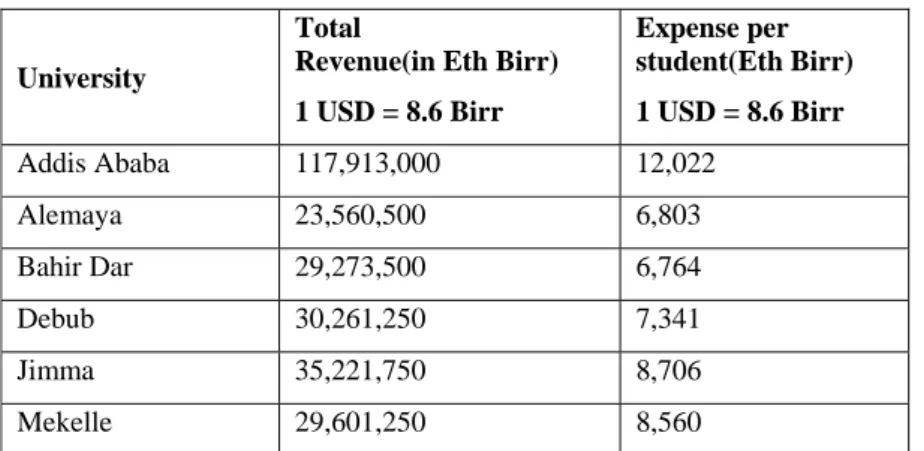
Ethiopia………79 TABLE 9: Per Student Cost in Ethiopian Universities. ………... 82 TABLE 10: Inflation Rate in Ethiopia (2003-2008) ……….84
Chapter One: Introduction
The higher education sector is generally considered to have an important contribution for economic prosperity and social development, both for the individual and for the society at large (Johnstone, 2005). Higher education has been playing a major role in generating national productivity, producing trained and flexible labor force, social cohesion, appreciation of social diversity and cultural heritage, higher social mobility, lower criminal rates, increased capacity to adapt to new technologies and so on (Jongbloed and Vossensteyn, 2002; World Bank, 2002). Thus, institutions of higher education have a major responsibility for equipping individuals with advanced knowledge and skills required for various positions within the country. They also serve as conduits for the transfer, adaptation, and dissemination of knowledge generated elsewhere in the world, and they support government and business with advice and through consultancy services. In most countries, higher education institutions also play important development roles in the knowledge economy whereby production and distribution of goods and services are highly manipulated by technologies. And currently, higher education has been known as a way of implementing Millennium Development Goals (MDG) through its research and applied technology which will loosen poverty, improve food supply, to mention a few (Saint, 2004).
In this regard, higher education throughout the world and especially in developing countries like Ethiopia has been thrown into a wide increase of demand. Therefore, many of the higher education institutions in general and public universities in particular have been in pressure with increasing enrollments. As such, most of the national governments especially in most African countries have been in constraint of adjusting the budgets of public universities. This is because for a long period, the public universities have depended entirely on governments’ financial assistance to meet most of their expenditures (Saint, 2004; World Bank, 1994). While governments are in constraint of adjusting public universities’ budgets to meet the increasing demand, public budgets have remained limited. The population growth and the expansion of primary education also entail more finance for the education system. Though the
population of children below 15 years of age has diminished over the last 20 years in developed countries, on the contrary it has increased considerably in the developing countries. Thus, the huge and steeply rising expenses began to outrun the capacities of most governmental treasuries making it impossible to keep up. Other compelling public needs like elementary and secondary education, HIV/AIDS, Malaria, unemployment, public health, public infrastructure and defense expanses do also compete with higher education for the limited government revenues. This is accompanied by increasing per-student cost, which further complicates the problems. If there is no incremental funding for the growing demand of higher education, it is difficult to expand access and improve quality and equity in higher education. As a result, many national governments have been forced to face this situation and to develop various strategies of financing to meet the growing demand (Vossensteyn, 2004).
Cost-sharing is among the most well known measures which are now being adopted by most African countries including Ethiopia, to face this complex situation. Cost-sharing or the shift of some of the higher education costs from governments to parents and/or students (Johnstone, 2005) also has been adopted by other African countries such as Kenya, Uganda, Tanzania, Ghana, Nigeria, Mozambique and South Africa, to mention few (Johnstone, 2004).
The Ethiopian higher education system has also passed through various administrative and financial difficulties since its existence. A major turning point regarding the cost of education in the history of Ethiopia however came in 1994. With a view to enhancing the role of the education sector to socio-economic development of the country, a new Education and Training Policy (ETP) has been adopted. The policies stress issues of quality and relevance in educational programs; improvement of the learning process towards a focus on students; improvement of management and leadership; introduction of financial diversification including income generation and cost-sharing by students; and improvement in the system of evaluation, monitoring, autonomy and accountability (Abebayehu and Johnstone, 2001). The policy became a binding and legal document with the ratification of Higher Education Proclamation by the Parliament in June 2003. Cost-sharing in Ethiopia has been implemented since 2003 with the objectives of generating non-governmental revenue, expanding access,
and improving equity and quality in higher education. Even though the 1994 policy reform deals with a number of issues related to higher education, the focus of this analysis/thesis will be only on cost-sharing.
1.2 Statement of the Problem
Though Ethiopia has more than fifty years of modern higher education experience, starting from 1950s, the higher education system has been extremely reserved for the few. There were less than 1,000 students and 50 teachers in 1950 in the Addis Ababa University, which was the only university in Ethiopia at the time (Ministry of Education, 2003). After a period of five decades, the higher education sector has not shown a significant improvement in terms of access and quality. The gross enrollment ratio is still very low, which places among the lowest ranking countries of the world, even in comparison with tertiary level gross enrollment ratio for Sub-Saharan Africa (Teshome, 2003). Though the number of higher educational institution has grown both in the public and private sector in recent years, the participation rate is one of the lowest in the world even below average of Sub-Saharan African countries (Bloom, 2005). The higher education system in Ethiopia has also been characterized by several other problems such as limitations in its autonomy, shortage of experienced academic staff, declining educational quality, huge brain drain, deficiency of adequate finance, weakness in its research output and poor connection with the intellectual currents of the international higher education community (Teshome, 2003). Despite the financial difficulties, higher education was totally free in Ethiopia until 2003. The government provided virtually all of the financing used to run the public tertiary system. This included instructional costs and the provision of free non-academic services to regular students; meals, lodging and healthcare (Teshome, 2007a).
To address some of these problems the government has implemented a financial diversification strategy through cost-sharing. The policy has been implemented in the form of income contingent loans (EPRDF, 2003a). The income contingent scheme has shown a significant success in one of the developed countries- Australia (Chapman, 2005). However,
several authors have acknowledged the possible challenges this policy may face in the implementation process when applying in developing courtiers. Despite the possible challenges, the Ethiopian government is investing a huge amount of money and expanding the system, hoping the repayment will generate non-governmental revenue in the future and that the policy will work well. The share of higher education in the education budget is hugely expanding (Teshome, 2007a). The number of higher educational institutions is also increasing to include more students into the system (Ministry of Education, 2007). Most of the initial funds come from the World Bank in the form of loan and the rest from donors and government treasury (Teshome, 2007a). Even though the policy has shown a relative success elsewhere, since the adoption of the policy in Ethiopia in 2003 there have been different discussions and debates both among academicians and politicians. The analysis of whether the policy will be successful or not in countries like Ethiopia is the focus of this study. Although, its main objective in most cases is generating non- governmental revenue needed for financing higher education, these cost-sharing policies have raised serious concerns about the challenges and problems they may face in implementing the policy especially in developing countries like Ethiopia (Saint, 2004).
1.3 Objectives of the Study
The policy of cost-sharing in Ethiopia has set specific goals to achieve in the course of its implementation. Among other things, generating non-governmental revenue, expanding access, and improving quality and equity are the major ones. There are also theories and explanations about cost-sharing and its implementation processes made by different scholars. The objectives of this study are:
- analyzing the policy of cost-sharing in Ethiopia, exploring the challenges it may face in the implementation processes and
- Putting out the prospect it may have if it is properly implemented according to the theories and general principles
1.4 Research Questions
In order to achieve the above research objectives, the following research questions are central to the study:
1) What are the theoretical and policy rationales or motives for adopting cost-sharing in Ethiopia?
2) How is it working towards achieving the very objectives of cost-sharing?
3) What kind of cost-sharing scheme would be more adequate in developing countries like Ethiopia?
4) What are the prospects of cost-sharing in Ethiopia in addressing the financial challenges the system is facing?
5) What are the possible challenges it may face in the implementation processes and possible solutions?
6) How does cost-sharing affect access in higher education in Ethiopia?
1.5 Methodology
Research may be defined as the application of the scientific method in the study of problems (Blaikie, 2000). A methodology defines how one will go about studying any phenomenon “Methodologies cannot be true or false, only more or less useful” (Silverman, 2005:99). A researcher who writes on methodological issues finds it helpful to distinguish between quantitative and qualitative researches. Quantitative research emphasizes on statistics and quantification in the process of collecting and analyzing data. In contrast, qualitative research is descriptive in nature and its emphasis on data collection and analysis focuses on words rather than statistics and quantifications and none of these strategies have been seen to be superior to the other (Creswell, 1994; Bryman, 2001; Silverman, 2005; Berg, 2007). Considering the topic of this research and the main objectives of the study, the researcher has found it relevant to use qualitative research method for this particular study. This is because as the title of the research implies, the objective of the study is to analyze the policy documents
according to theoretical frameworks of analysis which could be relevant to the study. Since it is a policy analysis, it is not limited to rigid definable variables, instead, it uses more of subjective information that may not be possible to quantify.
As Blaikie (2000) points out, the data used in social science researches can be at least of two main types. These are, primary data which is first hand data directly collected by the researcher through various data collection mechanisms and secondary data, which could be raw data that have already been collected by someone else, either for some general information purpose, such as government census or other official statistical records or for specific research projects or are data that have been analyzed either by the researcher who generate them or by an analyst of secondary data. In this case, the raw data may not be available but only the results of its analysis. This research is based on secondary data, government census or other official statistics, international and national documents, the Higher Education Proclamation No.351/2003 and Ministers Regulation on cost-sharing No.91/2003
Though there are different ways of qualitative research methods, like participant observation, in-depth interview or focus group analysis, this research is a qualitative document analysis. According to Mayring (2000), document analysis can be used for both quantitative and qualitative data analyses. In the case of quantitative analysis, it is used to collect information from a written document through counting or recording the repetitiveness of the significant words or related words or expressions for the study. However, document or content analysis is not only analyzing the manifested content of the document, as its name suggests, but also the themes, the context, and implications of the documents “It is the use of replicable and
valid method for making specific inferences from text to other states or properties of its source” (Ibid). Thus, in the case of qualitative analysis, the focus is on the content or the
message that the text carries; the aim is to build a model to describe the phenomenon in a conceptual form.
According to Satu and Kyngäs (2008), qualitative content analysis can be inductive or deductive. Inductive content analysis tends to be more used in cases where there are no previous studies dealing with the phenomenon or when they are fragmented. The concepts are derived from the data in inductive content analysis. Deductive content analysis is more frequently used when the structure of analysis is operationalized on the basis of previous knowledge or if the general aim is to test a previous theory in a different situation or to compare categories at different time periods.
In this respect, this research uses deductive qualitative document analysis. This is because, the objectives of the study are to analyze and evaluate the already existing policy documents of cost-sharing in Ethiopia based on theories and principles as frameworks of analysis and point out the possible challenges and prospects. Deductive document analysis constitutes of some basic steps which this research also uses. These basic steps are explained by Philipp Mayring as follows:
Model of Deductive Qualitative Document Analysis
Source: Mayring, Philipp (2000)
Research questions, Objectives
Theoretical based definitions of the aspects (framework) of analysis, categories, and sub categories
Description of the document or the data that
is going to be analysed Formative check
Analysis of the document or the data Summative check Interpretation of the result
First, a set of questions that seek answers have to be explained, then, basic theories or frameworks of analysis have to be discussed. Here the theories and analytical frameworks have to be specific and designed to analyze a set of research problems at stake. Then the documents have to be described and the description has to be in relevance to the purpose or objective of the study which is called formative check (Mayring, 2000). Based on the theoretical explanations and descriptions of the documents, the researcher analyzes the data to answer his/her research questions. The analysis has to be the summary of the research questions, theoretical frameworks, the descriptions of documents and other relevant data; this is called summative check (Ibid). Finally, the result of the study has to be interpreted. This is the model this research will be following. However, this model is not the absolute principle; instead, it is subjected to modifications depending on the subject of the study and the kind of research it is used for.
1.6 Organization of the Study
This study consists of five chapters. Following this introductory chapter, chapter two discusses some of the main theoretical issues surrounding the introduction of cost-sharing in higher education. The theories are presented and discussed in relation to the research problem. It deals with issues like challenges that higher education finance is facing, source of higher education finance, meaning of cost-sharing, the rationales for implementing cost-sharing, mechanisms of cost-sharing, cost-sharing and access, tuition policies and student loan and the experience of Sub-Saharan Africa. In order to analyze the theories that are explained in chapter two, chapter three deals with higher education in Ethiopia. It presents the higher education system of Ethiopia within which the policy has been adopted, its finances, and the reform agenda that have been going on since its existence. Chapter four further discuses the policy of cost-sharing in Ethiopia, dealing with issue like why it is implemented, how it is implemented, the challenges it is facing and its implications on access. This chapter is the analysis part where chapter two and three work together to investigate the challenges and the prospects the policy offers for the country. In order to summarize the findings of the study and
suggest solutions for future actions, chapter five provides composite summary of the major findings and recommendations and it concludes by suggesting some possible solutions for further investigations of the phenomenon.
Thus, from the financial problems that the Ethiopian higher education system has been facing, and based on the theoretical expectations of higher education finance, this study drives a set of research questions in order to analyze the policy of cost-sharing in Ethiopia. The research method which is implemented for this purpose is qualitative deductive document analysis. The next chapter deals more with the theoretical foundation on which the analysis part is going to be based.
Chapter Two: Cost-Sharing In Higher Education
Higher education in recent years has become increasingly important, not only for individual benefits but also for societal benefits. It has been a crucial component for development of democratic civil societies, an engine of economic growth and a principal vehicle for the advancement of economic mobility and social justice. Moreover, the role it has in promoting greater social cohesion, trust in social institutions, democratic participation and open debate, and appreciation of diversity in gender, ethnicity, religion, and social class, has driven the attention of all stakeholders, government, students, parents (taxpayers) and philanthropists (Teixeira et al, 2006). Knowledge accumulation and application have become major factors in economic development, and are increasingly at the core of a country’s competitive advantage in the global economy. The role of higher education in the construction of knowledge, economies and democratic societies is more influential than ever (World Bank, 2002).
But, in spite of all these benefits of higher education, and its core place in government treasury, the sector, in most countries, is suffering from financial austerity. This austerity, according to Johnstone (2004), is manifested in such problems as overcrowding, capacity limitations, declining faculty-student ratios, deteriorating physical plants and so on. Woodhall (2004) puts the challenges that higher education system facing nowadays as “the twin
pressures.” These are, according to him, financial austerity and rising demand which have
actually become urgent issues especially in developing countries. Moreover, the increasing role of higher education in the global economy, along with other important objectives, including the pursuit of knowledge for its own sake also necessitates the expansion of the sector. This is because, to support growth, the higher education sector needs to be large enough, of high quality, and responsive to a rapidly changing external environment, plus as pointed out by Barr (2003), “To support distributional objectives and social inclusion, access
to higher education needs to be broad. Access also supports the growth objective, since no country can afford to waste talent.” (No page number1)
To expand access and provide quality higher education, there is always a need for incremental funding. The number of potential students that need to join higher education has been increasing in both developing and developed countries for various reasons. Among other things, population growth in developing countries for example leads to a mass participation in primary education which creates a demand pressure on higher education enrollment. According to the population projection made by the World Bank in 1990, the population of Sub-Saharan Africa will increase by 105% by the end of 2025 (Kitaev, 1996), which is the biggest projection made so far. This definitely creates a demand pressure on higher education. Higher education degree also has a high value in the labor market for individuals, which also motivates people to aspire for higher education. In Organization for Economic Co-operation and Development (OECD) countries, for example, unemployment for university graduates is considerably lower than the average, and the salaries are remarkably greater for higher education graduates compared with people with lower educational levels (Mora and Vila 2003), the expansion of knowledge economy which needs to do things in scientific ways also claims more educated labor force.
In order to meet all these needs, however, the sector demands adequate and sustainable funding mechanism to invest on higher education. Traditionally higher education in most countries has been fully financed by the government, but for a couple of reasons, which this chapter will be explaining in detail later, the public sector could not keep up with the financial needs of higher education sector to expand access and improve or maintain quality of higher education. This condition necessitates the introduction of alternative source of funding (Teixeira et al, 2006). The first part of this chapter is going to look at the theoretical explanations for cost-sharing and attempts to answer the questions such as, why cost-sharing? Who has to share the cost? What are the possible alternatives or schemes of cost-sharing?
1 “Financing Higher Education: Comparing the Options.” Accessed in February, 2008 <http://econ.lse.ac.uk/staff/nb/barr_HE_option030610.pdf>
This chapter reviews existing theories, perspectives and approaches of cost-sharing as a conceptual framework of analysis based on different literatures. Though there are different ideas regarding higher education finance, this theoretical chapter limits its scope on those which are relevant to the study.
2.1 Challenges in Higher Education Finance
The high relevance of higher education for economic development and mobility, advancement of technology and democratic practices, is highly recognized in academic works of many higher education analysts. In our everyday life, we witness social problems being analyzed and solved with new solutions emanating from increasing knowledge and higher educational trainings (Armbruster, 2006). Higher education has never been more important than it is today in twenty-first century. It is central to an increasingly technological and knowledge-driven economy (Teixeira et al, 2006). In spite of its benefits and the high demand from the society, higher education almost every where is suffering from financial difficulties. This leads to the point where it becomes very difficult to survive only with governmental or tax generated revenue.
According to Johnstone (2005), this austerity is a function of at least three forces. First, the
demand pressure: i.e., the increasing number of students that want some kind of higher
educational experience. This can be a combination of different factors for developed and developing countries. In the case of developing countries, especially in Sub-Saharan Africa, the combination of high birthrates and increasing percentage of students completing secondary school and aspiring to have some form of higher educational experience, plus limited number of higher educational institutions as compared to the number of potential students2 creates massive demand pressures on higher education systems without adequate fund. In the case of developed countries on the other hand, like OECD countries, the demand pressure may not be
2 For example there had been only nine universities, with a total annual intake capacity of less than 36,000, for a population of about 70 million till 2003 in Ethiopia ( MoE, 2003)
because of high birthrate or limited infrastructure3. The higher educational system in fact, in these countries has grown dramatically since 1960s (Teixeira et al, 2006). According to the elite-to-mass-to-universal typology made by Martin Trow in 1970s, most European higher education systems were already clearly mass systems in the Trow’s scheme (Mora and Vila, 2003). The demand pressure in these countries is probably because of changing employment opportunities with high value of higher education degree in the labor market and a perception of increasing competition for these fewer “good” jobs which will be enhanced by higher education. This also could be because of the development of democratic values which lead an increasing regard for social and economic mobility and justice, leading to policies designed to increase higher educational participation, particularly among those traditionally less represented, such as ethnic and linguistic minorities, girls (in some cultures), or students from poor secondary schools or otherwise thought to be educationally deprived. Or, as pointed out by Mora and Vila (2003), because of the expansion of the classical Humboldtian University to more levels and to non-university sectors which focused on shorter programs, increase the academic drift towards longer courses, is also an accelerating factor, as first degree graduates perceive a need for even higher levels to be competitive (e.g. the growth of MBAs and other professional masters degrees) and as professions (especially licensed professions such as teachers, and the non-MD health professions) endeavor to raise their stature and limit the numbers allowed to practice4. All of the factors mentioned above are not exclusive of each other. The point here is there is a demand pressure on higher education but the extent defers from country to country. However, taking the high population growth, poor infrastructure, small size of the sector, and relative poverty into consideration, the demand pressure is more pronounced in developing countries than developed ones.
3 “Many or possibly even most of the universities in the OECD countries have impressive physical plants – certainly by world standards – even though much of this physical capital is being slowly consumed through deferring critical maintenance.” (Teixeira et al, 2006:4)
4 The German Fachhochschulen, the Dutch higher vocational schools (HBOs), the French Institutes Universitaires Technologies (IUTs), and the American comprehensive colleges and universities and community colleges (Ibid).
Second, there is the high and likely to be increased per-student cost on top of the increasing number of students. Per-student or unit cost in higher education tends to be high throughout the world because of different factors. Among other things, higher education is an intensive user of highly skilled personnel, whose salaries should be competitive with the salaries of those with the same educational level and skill working in other sectors. In the competitive sector of the economy, technological changes are being introduced progressively in the production system. Consequently, productivity increases and salaries rise for highly skilled workers (Mora and Vila, 2003). Nevertheless, the production system in higher education uses the same basic technology (lecture, tutorials and so on). The productivity of the system does not improve substantially, but the cost, basically wages, rise at the same pace as in the other productive sectors. At the same time higher educational institutions also need to be equipped with modern technologies like computers, scientific equipments, and library materials which make the cost of higher education even higher especially in developing countries since there are more compelling needs (like HIV/AIDS, clean water, and other social services) that compete with higher education (Johnstone, 2005).
Third, there is the decline in available public revenue possibly because of increasing difficulty in taxation, or competition from other oftentimes more politically compelling public needs. This is a much more serious problem in developing countries since it is rarely possible to find strong tax collecting capacity from the government’s side. Moreover, in many countries, individual incomes, business profits, and sales, on which so much taxation depends, are too easy to hide or similarly, too difficult to verify (Johnstone, 2005). Mora and Vila (2003) call this financial crisis as “crisis of the welfare state” which according to them has become imminent as a consequence of the strong competition for public funds from different social services in modern states. Just as the case in the above two factors however, the extent of the problem differs from developed to developing countries. In the developed countries, at least there are relatively sound tax systems and individuals’ income is relatively verifiable. Thus, governments have a broader tax base as compared to developing countries. The other point mentioned by Johnstone and Woodhall (2002) is that, globalization and the enhanced mobility of capital, technology, and production facilities lead multinational goods producers to
seek a combination of political stability, low wages, and low taxes, constraining the ability of countries to maintain high taxes and limiting the revenues able to be devoted to their public sectors, including their publicly financed universities (Woodhall, 2002).
Austerity affects both students and higher educational institutions. Its effect on higher educational institutions is manifested in various ways like weak institutional capacity to respond to change, loss of faculty motivation and morale due to declining salaries, inadequacy of equipments like computers, laboratory instruments and library materials, deterioration of physical plant, and inability to expand physical capacity to keep up with increasing enrollment and so on (Armbruster, 2006). The impact of austerity on students on the other hand shows itself by limiting student enrollment especially from low and middle income families since they cannot afford private higher education. It also limits the opportunity to get quality higher education (Chapman, 1999). Thus, revenue diversification is a must remedy for austerity in higher education through the sharing of the cost of higher education among different parties. “The true underlying cause of higher education’s austerity is the result of the naturally
diverging trajectories of expenditures and revenues: underlying costs that tend to increase naturally at a rate almost certainly greater, year in and year out, than the natural trajectory of available tax revenues” (Johnstone, 2006:4)
Generally, the extent of financial austerity is quite different among developed and developing countries. On both cost and revenue side the situation is more exacerbated in developing countries. On the cost side, such countries are the most likely to combine high birthrates with rising participation rates for potentially explosive enrollment pressures. And on the revenue side, these same countries are likely to be the ones that also combine the greatest difficulty in raising taxes with the most extensive and compelling competitors like public health, HIV/AIDS, elementary and secondary education, and public infrastructure needs for the limited public money available (Johnstone, 2006). Most researches indicate that cost-sharing and the diversification of revenue sources are near universal responses to financial austerity, along with a general trend towards mass participation in higher education “…has to be solved
revenue side – that is, through supplements to governmental, or tax-generated, revenue.”
(Teixeira et al, 2006:7)
Different countries like the United States, Korea, Canada and New Zealand Australia, UK, Tanzania, Kenya, Uganda and Ethiopia, have already implemented some forms of cost-sharing as a response to the financial austerities their higher educations have been facing. The term cost-sharing refers to the process of recovering part of the expenditure incurred in the provision of any service from the beneficiaries of that service (Johnstone, 2004). In higher education, it is about shifting of at least some of the higher educational cost burden from government or taxpayers to parents and students (Ibid). It can be said that cost-sharing is a revenue diversification and generation policy that recognizes the need for beneficiaries of higher education to pay back part of the cost of their education in order to sustain the system (Obasi and Eboh, 2004). Johnstone (2006) pointed out four main bearers of higher educational costs: taxpayers, parents, students and philanthropists. Jongbloed’s (2004) study indicates that in countries like United States, Korea, Canada and New Zealand, cost-sharing has already managed to generate substantial share of funding from alternative non-public source such as students, donations and other non-government sources5. Most of these countries had faced most of the challenges that many developing countries are facing now (Kitaev, 1996).
So far we have seen the basic challenges that higher education finance is facing. Among other things, demand pressure, increasing per-student cost and declining of available public revenue are the major causes of financial austerity in higher education which lead to cost-sharing. But what are the underlying rationales for adopting cost-sharing or for the shifting of at least some of the higher educational cost burdens from government/taxpayers to parents and students, as a solution for higher education austerity? This is what the next part of this chapter is going to address.
5 “those countries that have been able to channel more than 2 % of GDP into tertiary education – the United
States, Korea, Canada, and New Zealand – all raise a substantial share of funding from these alternative sources.” (Jongbloed, 2004: 1)
2.2 Rationales for Cost-Sharing in Higher Education
For a long time, higher education had been tuition free in most countries of the world. As described by Marcucci (2003) and Johnstone (2004), the argument for free higher education is based on several rationales. Among other things, advocates of free higher education argued that the social returns of higher education are very high; therefore, it has to be funded by the government. Moreover, education is (or should be) a fundamental right; it should be given free, because tuition fees may discourage the participation of students from low-income families, from rural areas or ethnic minorities which may have negative impacts in terms of social equality and social benefits (Barr, 2003). However, the high and rapidly rising costs of higher education and the increasingly limited public revenues, makes most governments willing and increasingly dependent on revenue supplementation. And worldwide, the most common approach to the need for increasing revenue is some form or forms of cost-sharing, or the shift of some of the higher educational per-student costs from governments and taxpayers to parents and students (Johnstone, 2004). The conventional rationales for cost-sharing and revenue diversification in higher education worldwide are three:
1-The Sheer Need for Other than Governmental Revenue for Greater Quality, Expanding Access and Participation. Barr (2003) in his study of comparing different
options for financing UK’s higher education argued that when higher education was an elite system with participation rates in single figures, maintaining a high-quality system out of taxation was not a problem. But, he said, this could not be the case if the system needs to expand access for a mass higher education. The reason is that with a mass system funding is constrained and so the substantial resources needed to promote access are crowded out by other elements in the higher education budget, and if places are scarce, middle-class students will tend to crowd out those from poorer backgrounds (Ibid). The proponents claim that public institutions of higher education must increasingly supplement their governmental revenue through cost-sharing and other revenue diversification mechanisms. This is because there is an increasing trend in decreasing public resources allocated to higher education sector, as compared to the overwhelming high demand pressure for higher education. This demand pressure especially in developing countries like Ethiopia, as we have seen above, is a function
of demographic increases as well as the expansion in the traditional college age cohort to include non-traditional students, such as mature age entrants, compounded by the increasing number of secondary school graduates who are academically qualified and want to pursue higher education (Johnstone, 2006). Moreover, the decline in available tax-based public resources to higher education is compounded by competition of public higher education sector with other politically and socially compelling needs such as healthcare or clean water supply for public fund (Ibid). Thus, there is a need for other than governmental revenue to supplement public funding. In order to achieve the objectives of quality, efficiency and equity in terms of access in higher education, “…increased private resources for higher education
would seem to be the goal to be achieved.” (Jongbloed, 2006:1).
2-Greater Equity: from the above discussion about financial austerity, we can understand
that the objective of higher education financing policy should be meeting the financial sufficiency of the system and on the way to improve efficiency with equity. According to Mora and Vila (2003), equity has two meanings. These are equal opportunities of access to higher education for people from any social class and a fair share of the cost of higher education among the beneficiaries of the service. We will discuss the first notion, the impact of cost-sharing on access, later. However, the notion of equity in a sense that those who benefit should at least share the cost, according to Johnstone (2004), is based on the fact that though higher education is actually paid for by all citizens, it has been enjoyed by a very disproportionate number of the society from middle, upper middle and upper income families who could and would pay at least a portion of the costs of instruction. As a result, there are potential students who would be excluded
“virtually all countries higher education is partaken of disproportionately by the sons and
daughters of the more privileged, while the governmental revenue base supporting this expensive governmental benefit depends heavily on taxes that are born substantially (if not regressively) by the general taxpaying citizen”(Ibid:1)
Chapman (1999) strengthens the above rationale pointing out two labels of equity, what he calls ‘vertical equity’ and ‘horizontal equity’. He explains vertical equity as follows:
“If the government does not charge for higher education, the minorities who receive it are being subsidized by those who do not attend higher education... all taxpayers have paid for the gift of higher education, and it is equitable that those so advantaged pay in part an additional amount for the individual benefits they receive.” (Chapman, 1999: no page)
“Imagine two people on identical high incomes, with one being talented at sport (or good at
business), and the other being a higher education graduate. If they both pay the same tax this is horizontally inequitable because the former has subsidized the education of the later which has in turn increased her/his income. A second point concerning horizontal equity relates directly to the issue of graduates ‘paying’ for their education. That is, some opponents of graduates contributing to part of the cost of their education argue that this is unreasonable because the extra taxes that graduate pay more than cover the public subsidy involved.” (Ibid)
Generally, equity reasons are based on the principle that higher education should be available to people with capacity, disregarding their economic resources, in order to increase the fairness in terms of access in the society. This could be attained if those who benefited from higher education share the cost. Then, the added revenue from cost-sharing can be reinvested to expand capacity, both for classroom instruction and for accommodations and thereby increasing participation. However, this fact may not always hold true unless the generated revenue from the beneficiaries are allocated to higher education.
3-Improved Efficiency: cost-sharing presumes to increase efficiency of systems and
institutions as well as improved producer responsiveness to both the student and the society; it brings some of the virtues of market (Teixeira et al, 2006). Some kinds of tuition are expected to make students and families more rational consumers and the universities more cost conscious providers (Johnstone, 2006). The other virtue of market is that it produces responsiveness. The notion of producer responsiveness is premised on the assumption that cost-sharing through tuition and other related costs would make universities more responsive to the individual, societal, and labor market demands. The notion is that students and families who pay tuition fees may demand accountability and therefore, universities will be more consumers orientated and efficient. Obasi and Eboh (2004) also state that tuition fees represent a source of independent income for the institution and this may increase its autonomy and capacity for optimal resource allocation. And on the students’ part, they are compelled to carefully select their courses, minimize their time in school and become more responsive to changing labor market needs. In neo-liberal economic theory, where there is competition and cost to be borne by the consumer, there is a possibility of greater efficiency and responsiveness (Teixeira et al, 2006). However, unlike in a real market situation, the interaction between supply and demand in higher education does not take place through the operation of a price mechanism. Excess demand or excess supply may not be eliminated
through adjustments in prices and the consequent adjustment of the quantities supplied or demanded. This is because, according to Jongbloed (2006), in most cases, students are paying relatively only small percentage of the total educational cost. And the larger share of financing higher education comes from the government, especially in developing countries since private contribution for higher education is a recent phenomenon. In such cases, the effective implementation of the market values in higher education will most likely largely depend on government’s policies and other legislative supports for the institutions and students. These legislative incentives could be provision of legal ground for institutions to recruit their own students, providing adequate information and the right of choice for the students so that they can make a rational decision. But in all cases, the introduction of some kind of tuition fee has a potential to bring market values into the higher education sector.
Apart from economic rationales, the need to diversify higher education fund is also a function of some political or ideological rationales. For example, taxes were relatively easy to collect in centrally controlled economies such as the former Soviet Union and Eastern Europe before the collapse of Communism, where purchasing power could be siphoned off at each level of the state owned production processes via turnover, or other forms of value-added taxes (Johnstone, 2006). In communism or command economy, the state could also control and thus tax all international trade. In such cases the state could have a more tax basis and could easily verify transactions. However, the shift from communism or command economy to mixed economy and liberal free market traditions have brought privatization and accelerated globalization which have essentially eliminated these largely invisible and easy–to-collect taxes, and the alternatives like, taxes on income, retail sales, property, and the sales of luxury goods which are visible, unpopular, expensive, relatively easy to avoid, and technically (in addition to politically) difficult to collect (Ibid).
Moreover, for the limited revenue collected from tax higher education may not enjoy relatively high priorities in politicians’ agenda in the face of other politically competing interests such as elementary and secondary education, public health, housing and public
infrastructure, welfare and the social and economic safety net, and internal and external security (Barr, 2003).
The rationale for cost-sharing has been the subject of a large and contested body of economic and public finance theory. To summarize the rationales, it begins with the claim of greater equity. This claim, in turn, is based on the observation that in all countries higher education is partaken of disproportionately by the sons and daughters of the more privileged, while the governmental revenue base supporting this expensive governmental benefit depends heavily on taxes that are borne substantially by the general taxpaying citizen (Johnstone, 2003, 2004, 2006). Contribution for higher education also expected to brings the basic economic principles of efficiency and responsiveness both to the consumer and producer. But beyond the conventional claims of greater equity and efficiency, the observation is that the greatly increasing revenue needs of higher education, especially in countries where governmental revenue is so limited, enrollment pressures so intense, and competing public demands so great, make it a virtual imperative to supplement scarce governmental tax revenue with non-governmental revenue through some kind of cost-sharing. The basic preceding questions here are who should share the cost? And what are the possible mechanisms (or how) for implementing cost-sharing? These are the issues that the next part of this chapter will be discussing.
2.3 Sources of Higher Education Finance
Many researchers pointed out that the concept cost-sharing, in higher education, begins with an assumption that the costs of higher education being borne by four principal parties: the government or taxpayers; parents; students; and/or individual or institutional donors (Johnstone, 2004). Plus non-governmental revenue can also be generated from institutional entrepreneurship (Ibid, 2006). Next, each of the four parties of cost-sharing is going to be discussed in detail.
2.3.1 The Government or Taxpayers
The source of government funding is taxes collected from the general public. Taxes can be paid by most citizens directly and visibly, as in taxes upon earnings, property, retail sales, general consumption, or special goods such as gasoline, cigarettes, alcoholic beverages, airline travel, or imported goods. Or, taxes can be paid indirectly and largely invisibly. Such indirect taxes, largely invisible to the average citizen, may originate with taxes on businesses or enterprises that are passed on to consumers in the form of higher prices on the products they eventually buy (Johnstone, 2005, 2006). There are different reasons for why government should subsidize higher education. Oosterbeek (1998) argued that there are at least three major arguments supporting government subsidization of higher education. These are: positive externalities, capital market imperfections and equity considerations.
Positive Externalities: Though most economics argue that higher education is more of a
private good, it is difficult to draw a clear boundary where the frontier between education as a public good and as a private one exactly is, because some of the public and private benefits are difficult to quantify and exactly measure to find out which one has the highest value. Thus, they tend to regard higher education as a quasi-public good (Kitaev, 1996). This is because it is not only individuals but also the society that drives extended benefits from higher education. These benefits are known as spillover benefits (Chapman, 1999); benefits a society indirectly drives form higher education. The societal returns from research are likely to be very high (Oosterbeek, 1998), for example. This could be getting solutions for the social problems a community has been facing or getting easy ways of doing things. In these respects, higher education has both monetary and non-monetary benefits to the society that can be good reason for the government to subsidize. The monetary benefits that society drives from higher education includes: higher national productivity, higher tax revenues, highly flexible labor force, higher consumption and less dependency on government. The non-monetary benefits include social cohesion, appreciation of social diversity and cultural heritage, higher social mobility, lower criminality rates, more donations and charity work, increased capacity to adapt to new technologies and so on (Jongbloed and Vossensteyn, 2002; World Bank 2002). In conclusion, it is not simple to accurately quantify the extent of spillover benefits from
higher education, but if they exist, there is a rationale for some form of government subsidy to ensure that society receives the appropriate level of higher education investment
Capital Market Imperfections: Capital market imperfections refer to the fact that
investments in higher education involve risks for students because they are uncertain about their abilities and future jobs so they may become risk averters, afraid to take loan. At the same time, in order to lend money banks need collateral as a guarantor. But not all students have the ability to present that. As a result, students may have difficulties in getting loans from private banks to pay the study costs (Oosterbeek, 1998). In other words, both students and banks will be reluctant to make human capital investments, which can undermine economic development in knowledge economy. Here there may be a need for governmental intervention. To prevent an underinvestment in education, governments may intervene, either by guaranteeing bank loans or by offering loans themselves (Barr, 2005).
Equity Considerations: From a lifetime equity position, public subsidies to students seem
unfair because they will probably belong to the future group of above average earners. However, at the moment of attendance, it may be argued that public subsidies are needed in order to equalize entrance opportunities for potential students from different social-economic backgrounds. Otherwise, students from disadvantaged backgrounds may not enter higher education (Chapman, 1999). Thus, the government may also intervene in this case in subsidization of higher education. Though there are many other reasons that could be pointed out for government intervention for sharing the cost of higher education, from these following three perspectives; positive externalities, capital market imperfections and equity issues, we can understand that government still has a major role in higher education finance.
2.3.2 Parents
There are two contested arguments towards parental contribution in higher education finance. The first one is parents should not be held responsible to share the higher education cost of their children. This is based on the idea that when students join higher educational institutions, they will be matured adult in most country’s age standard. They are legally independent
citizens at this stage. Thus, they have to be the only responsible body for their higher education. Moreover, students are the ones that drive direct personal benefits from the higher education and it has to be them who should pay for the services they receive. However, since most of the time students do not have the money to cover the higher education cost by themselves, while they are studying, some kind of loan system or other financial assistance mechanism has to be set at the time of study. But the repayment should be the responsibility of the students not their parents (Barr, 2001). For example in those countries with no tuition fees (the Scandinavian countries) or with deferred tuition policies (the Higher Education Contribution Scheme in Australia, the Graduate Endowment Scheme in Scotland and the Students’ Allowance Scheme in New Zealand), there is the assumption that parents are not financially responsible for their children’s higher education and that the children themselves cannot be expected to cover its cost while they are studying (Chapman, 2003).
The second assumption is that parents have to hold responsibility or should contribute for their children’s higher education costs from their current income, or in part from past savings, or even in part through borrowing (Johnstone, 2005, 2006). Grandparents or other members of an extended family, or even members of a village or a church, can also be “parents” when it comes to supporting a student. Johnstone (2006) argues that most students are still, at least through their first degree, financially dependent children assuming no significant time lapse between the completion of secondary and the beginning of higher education. In this condition, unless there is other means of financing their higher education, it is parents’ responsibility to cover their children’s transportation, food, tuition and other costs. If the government or any other agent provides loan or any other support for the students, that means the government or the agent is sharing the burden of the cost which other wise would be paid by their parent’s. In terms of receiving the loan or any financial assistance, it is not only the students but also the parents are the beneficiaries because they would be the ones who were going to cover the cost of their financially dependent child without this support. Thus, they have to contribute in repaying the loan or any share that the students are supposed to pay too. Moreover, it is assumed that the parents derive considerable satisfaction from the higher education of their children, and derive more satisfaction and even status from being able to place their children
in the “best” university they can afford and that their children are able to get into. For example “German parents are obligated by law, up to their officially-calculated means, to contribute to
their children’s costs of food and lodging (there are still no tuition fees), and they can be taken to court for the failure to do so.” (Ibid: 5). Thus, even though it is controversial to say that
parents are legally responsible for their legally independent adult child, it is fair to say that they have a moral obligation to support their financially dependent child and contribute to the expenses associated with their children’s higher educations. The necessity of parental contribution also differs from countries to countries based on different contexts6.
However, as stated by Johnstone (2006) and Chapman (1999), there are two possible difficulties which need to be considered when it comes to parental contribution. These are difficulty of determining and verifying parental ability to contribute and the duration of the presumed obligation to contribute. Financial ability to contribute is a complex and elusive concept even with a high degree of willingness to comply (Ibid). Furthermore, income and asset are relatively easy to hide. The other thing is, for how many years or for how many degrees or through what levels of higher education does extended parental financial responsibility continue? What about the case of divorce and non-custodial parenthood (Johnstone, 2006)? Despite all these challenges however, parental contribution, if it is properly designed, plays a crucial role in higher education revenue diversification.
2.3.3 Students
The other party to share the burden of higher educational costs is the student, who can bear some of the costs mostly through loans or in some cases they may also engaged in part time jobs to supplement their expanses. The loans, in turn, can be paid back when the student has
6 “Thus, a combination of wealth, relatively flat demographics (meaning high but relatively flat enrollments), a very progressive and technically successful tax system, and extensive and generally available student loans allow the Scandinavian countries to forego an officially expected parental contribution towards either the costs of instruction or the costs of student living.” (Johnstone, 2006:5)
graduated and is employed, like any regular loan, in monthly installments, or repaid through deductions that the employer removes from the graduates’ pay and forwards to the lender. Repayments can also be income contingent, or limited to a certain percentage of earnings. Or the graduate can also repay as a contribution assuming the money was borrowed from, and therefore owed to, the government through income surtax, or additional tax on income until the loan has been repaid, including the contracted percentage interest (Johnstone, 2006, Chapman, 1999 and Barr, 2005).
In one way or another, the notion that students should pay comes to existence because they drive personal benefits from higher education. They have to pay for what they have received from higher education. The human capital theory, as explained by Bloom, et al (2005), stresses that education enhances the knowledge and skills embodied in people, the benefits of education may be realized in terms increased production possibilities and reduce costs. In this respect, education increases labor productivity, improves the chance of employment and improves the chance of high labor market earnings. Thus, raising their human capital in turn implies higher salaries and a smaller chance of ending up unemployed (Mora and Vila, 2003). The personal benefits students drive from higher education are not only in the monetary forms like higher productivity and higher net earnings, better job opportunities, higher savings, personal and professional mobility but also non-monetary benefits, which include educational consumption, better labor conditions, higher personal status, higher job satisfaction, better health and life expectations, improved spending decisions, more hobbies and value of leisure, personal development and so on (Jongbloed and Vossensteyn, 2002; World Bank 2002).
As Woodhall (2006) described it, the theoretical justification for student contribution is that higher education is a profitable private investment, offering graduates high returns. It may be difficult to quantify each and every benefit that higher education provides for individuals because some of the benefits, especially the non-monetary benefits, are difficult to quantify and calculate. But there is a general consensus in most literatures of higher education finance that the private returns for individuals are greater than the social returns in the case of higher education, for the reasons mentioned above. Thus, student should share the cost of their higher
education. Moreover, the contribution from students brings more money available to reinvest on higher education and gives potential students from poor families, who would otherwise be denied access to higher education on grounds of poverty, the chance to invest in their own future by providing them with financial aid when it is needed and allowing them to repay it when they can afford to do so.
2.3.4 Individual or Institutional Donors and Institutional Entrepreneurship
1- Donations and Contributions: These are individuals ( parents, alumni, wealthier students)
and/or institutions (donor foundations, international organizations like World Bank in case of developing countries for example and so on ) whose contributions may go either toward improving the quality of the university, toward the overall institutional budget, or toward some students, in the form of grants or scholarships, presumably in substantial measure based on the students’ financial need, or the students’ and/or their parents’ low income (Johnstone, 2006). Such kinds of contributions most of the time are based on the goodwill of the individuals or institutions. There is less binding agreement between the higher education institutions and these bodies as compared to that which exists between higher educational institutions with students and parents (Ibid).
2- Institutional Entrepreneurship: This is also an alternative to generate non-governmental
source of funding through development of other activities to raise funds that can cross-subsidize teaching and research activities. As Johnstone (2006) argues, this could be from the sale or lease of university assets, or the sale of faculty expertise, whether in teaching or research or through contract research, teaching high demand courses or evening courses to non-degree students with substantial tuition fees, plus along with the above activities, higher educational institutions can also be engaged in generating income through what Burton Clark called “ third-stream income” which includes cooperating with industrial companies, local governments, campus service fees and small business activities (Clark, 1998:108).