U
NIVERSIDADE DE
L
ISBOA
Faculdade de Ciˆencias
Departamento de Inform´atica
SCADA IN A CLOUD-BASED ARCHITECTURE
Miguel Os´orio Areias
DISSERTAC
¸ ˜
AO
MESTRADO EM SEGURANC
¸ A INFORM ´
ATICA
U
NIVERSIDADE DE
L
ISBOA
Faculdade de Ciˆencias
Departamento de Inform´atica
SCADA IN A CLOUD-BASED ARCHITECTURE
Miguel Os´orio Areias
DISSERTAC
¸ ˜
AO
Trabalho orientado pelo Prof. Doutor Ant´onio Casimiro Ferreira da Costa e co-orientado pelo Prof. Doutor Alysson Neves Bessani
MESTRADO EM SEGURANC
¸ A INFORM ´
ATICA
Acknowledgments
Firstly I would like to thank Aurelio Blanquet, Carlos Mota Pinto and Pedro Gama from EDP that encouraged me and allow me to apply in this Master and also gave me all the necessary support throughout this period.
I would also like to thank Professor Ant´onio Casimiro and Professor Alysson Bessani by the engaging way that they have motivated and supported me during this thesis. To Nuno Pereira, whose guidance was essential during the development of this work, especially by give me interesting ideas and also being very supportive in this endeavor.
Resumo
Uma rede el´etrica inteligente (Smart Grid) transforma a maneira como a energia ´e dis-tribu´ıda e utilizada, adicionando inteligˆencia ao longo da rede para reduzir drasticamente interrupc¸˜oes e falhas, gerindo a procura, actual e futura, aumentando a eficiˆencia e gest˜ao de custos. Para fazer isso, a Smart Grid utiliza sensores, controladores digitais e ferra-mentas anal´ıticas para monitorar e automatizar o fluxo e entrega de energia aos consu-midores, permitindo um fluxo bidireccional de energia el´ectrica e de informac¸˜oes entre o comando central e os aparelhos do terreno, distribu´ıdos geograficamente. Atrav´es de redes inteligentes, tamb´em ´e poss´ıvel incorporar novas energias sustent´aveis, como e´olica e solar, e integrar fontes de energia distribu´ıdas, ou ve´ıculos el´ectricos. Para apoiar este novo paradigma, as redes inteligentes v˜ao impulsionar um amplo uso de sensores na rede com maior inteligˆencia, aperfeic¸oamento da eficiˆencia energ´etica e resposta `a procura. Todos esses equipamentos na rede v˜ao exigir um poder de computac¸˜ao substancialmente maior para controlo e gest˜ao. Neste ambiente exigente, a computac¸˜ao em nuvem poder´a proporcionar benef´ıcios relevantes a n´ıvel de custos. Atrav´es de uma computac¸˜ao em nuvem ´e poss´ıvel disponibilizar informac¸˜ao em tempo-real ao utilizar/consumidor dando-lhe a possibilidade de compreens˜ao de como a energia ´e consumida e o que deve fazer para opimizar esse consumo. Por outro lado, o fornecimento de informac¸˜ao sobre os benef´ıcios energ´eticos e incentivo ao consumo em determinados per´ıodos do dia pode de-sencadear ajustes de consumo e, por conseguinte, reduzir a procura durante os per´ıodos de pico de utilizac¸˜ao. Relativamente `a eficiˆencia energ´etica, o uso de computac¸˜ao em nu-vem permite reduzir o poder computacional dos centros de dados atrav´es de uma gest˜ao eficiente, aumentando a eficiˆencia dos servidores, fontes de alimentac¸˜ao e sistemas de refrigerac¸˜ao. No entanto, os riscos associados a uma migrac¸˜ao de actividades cr´ıticas para um ambiente de computac¸˜ao em nuvem podem ser inaceit´aveis. Com este traba-lho vamos avaliar o risco a que uma rede el´etrica inteligente est´a exposta e o impacto, a n´ıvel financeiro, de continuidade de neg´ocio ou de reputac¸˜ao para uma organizac¸˜ao face `a perda de qualquer um dos principais atributos de seguranc¸a (confidencialidade, integri-dade e disponibiliintegri-dade). Com base nos resultados anteriores, e considerando a crescente necessidade computacional e de armazenamento de uma rede el´etrica inteligente, vamos propor uma nova arquitectura baseada na computac¸˜ao em nuvem.
Palavras-chave: SCADA, Rede el´etrica inteligente, Computac¸ao em nuvem.
Abstract
A Smart grid transforms the way the power is distributed and used, adding intelligence throughout the grid to dramatically reduce outages and faults, handles current and future demand, increases efficiency and manage costs. To do this, a Smart Grid uses sensors, digital controls and analytic tools to automate, monitor the flow and delivery of energy to consumers. In addition, Smart Grid enables a two-way flow of electricity and informa-tion between the end-points and the appliance. Through Smart Grids it is also possible to incorporate new sustainable energies such as wind and solar generation, and interacts locally with distributed power sources, or plug-in electrical vehicles. To support this new paradigm, Smart grids will boost a widespread use of intelligence data sensors on the grid improving both energy efficiency and demand response. All those equipments will require substantial computing power for controlling and managing. In this scenario, clouds com-puting will provide substantial cost benefits. Using real-time information through cloud computing gives to the consumer the possibility of understanding how energy is consumed and what they can do to improve it. Expectatively, the real-time feedback on energy con-sumption should help to improve the consumer’s behaviour. On the other hand, on the utility side, providing information about benefits, can foster incentives for consumption adjustments and, as a result, reduce demand during peak usage periods. Concerning en-ergy efficiency, using clouds allows us to reduce the computational power of data centers through efficient application management, increasing the efficiency of servers, power sup-plies and cooling systems. However, the risks incurred by the migration of such critical activities to an unprotected cloud environment would be unacceptable. In our work we will assess the risk that a Smart Grid is exposed and the impact, in financial, business continuity and reputation levels, for an organization due to the loss of any of major se-curity attributes (confidentiality, integrity and availability). Based on the previous results and the need for scalability, underlying of a Smart Grid evolution, is then proposed an architecture based on cloud computing.
Keywords: SCADA, Smart Grid, Cloud Computing.
Contents
List of figures xv
Lista de Tabelas xvii
1 Introduction 1
1.1 Motivation . . . 1
1.2 Contribution . . . 2
1.3 Structure of the Document . . . 2
2 Industrial Networks and Critical Infrastructure 5 2.1 Critical Information Infrastructures . . . 5
2.1.1 The Importance of Securing Critical Infrastructure . . . 6
2.1.2 The Impact of Critical Infrastructure Incidents . . . 8
3 Smart Grids 13 3.1 The Electricity Network Evolution . . . 13
3.2 Smart Grid Technical Architecture . . . 14
3.2.1 Smart Meter . . . 15
3.2.2 Concentrator . . . 16
3.2.3 Grid and Communication . . . 16
3.2.4 Central Systems . . . 17
3.3 Smart Grid Security Requirements . . . 18
3.3.1 Security Objectives . . . 18
3.3.2 Vulnerabilities, Threats and Risks . . . 20
3.4 Risk Analysis . . . 21
3.4.1 Measure the Probability . . . 22
3.4.2 Measure the impact . . . 22
3.4.3 Smart Grid Risk Analysis . . . 24
3.4.4 Final Remarks . . . 29
4 Hosting the Smart Grid in a Cloud Infrastructure 31 4.1 What is Cloud Computing . . . 31
4.2 Cloud Computing Characteristics . . . 32
4.2.1 Scale and Elasticity . . . 32
4.2.2 On-Demand and Self-Service Provisioning . . . 33
4.2.3 Broad Network Access . . . 33
4.2.4 Measured Service . . . 33
4.2.5 Resource Pooling . . . 33
4.3 Service Models . . . 34
4.3.1 Infrastructure as a Service (IaaS) . . . 34
4.3.2 Platform as a Service (PaaS) . . . 34
4.3.3 Software as a Service (SaaS) . . . 35
4.3.4 Deployment Models . . . 35
4.4 The Computational needs of the Smart Grid . . . 36
4.5 Present constrains of the Smart Grid reference architecture . . . 38
4.6 A new architecture for the Smart Grid . . . 39
4.6.1 Components of the Smart Grid Cloud Architecture (SGCA) . . . 39
5 Adapting the Smart Meter to private clouds 43 5.1 Smart Meter Functionalities . . . 43
5.2 Criteria Description . . . 46
5.2.1 Physical Connection . . . 46
5.2.2 Real-time Requirements . . . 47
5.2.3 Dependency Between Functionalities . . . 47
6 Present limitations for deploying the SGCA architecture 53 6.1 Cloud Computing Weaknesses . . . 53
6.1.1 Virtualization . . . 53
6.1.2 Weak Consistency . . . 54
6.1.3 Legal Concerns and Constraints . . . 54
6.1.4 Security and privacy . . . 55
6.1.5 Dependency and vendor lock-in . . . 55
6.2 Network constrains . . . 55
6.2.1 Communication field test . . . 56
6.2.2 Results . . . 57
6.2.3 Final Remarks . . . 57
7 SGCA Security Evaluation 59 7.1 Operational impact regarding the SGCA . . . 59
7.2 Final Remarks . . . 61
8 Conclusion 63
List of Figures
2.1 Critical Infrastructure Protection. . . 6
2.2 Critical infrastructure attacks. . . 10
3.1 Smart Grid Architecture. . . 14
3.2 Assess and quantify the risk. . . 20
3.3 Quantitative risk measurement. . . 21
3.4 Operational and financial impact. . . 25
3.5 Areas of greatest risk and impact. . . 30
4.1 Cloud Computing Service Models. . . 34
4.2 Cloud Computing Deployment Models. . . 35
4.3 Reference architecture of the Smart Grid. . . 38
4.4 Smart Grid Cloud Architecture. . . 40
5.1 Smart Meter functionalities. . . 43
5.2 Smart Meter functionalities that have physical or real-time dependencies. 48 5.3 Smart Meter functionalities, in grey, that must be hosted on the meter. . . 51
6.1 Present Smart Grid architecture. . . 56
6.2 Smart Grid Cloud architecture. . . 56
List of Tables
2.1 The potential impact of successful cyber attacks. . . 9
3.1 Impact analysis - criteria for Availability. . . 23
3.2 Impact analysis - criteria for Integrity. . . 24
3.3 Impact analysis - criteria for Confidentiality. . . 24
3.4 Risk for the Smart Grid services regarding Availability. . . 25
3.5 Risk for the Smart Grid services regarding Integrity. . . 26
3.6 Risk for the Smart Grid services regarding Confidentiality. . . 26
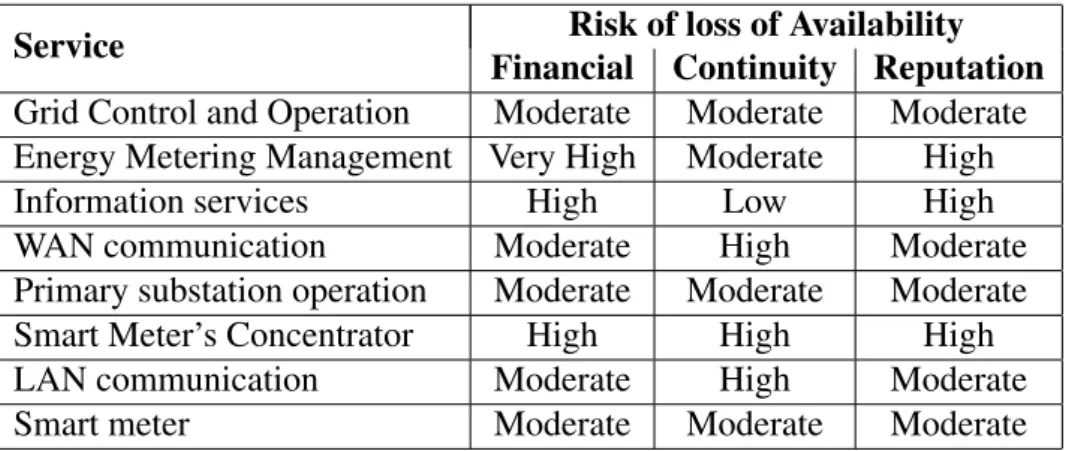
3.7 Risk of loss of Availability considering financial, business continuity and reputation impact. . . 28
3.8 Risk of loss of Integrity considering financial, business continuity and reputation impact. . . 29
3.9 Risk of loss of Confidentiality considering financial, business continuity and reputation impact. . . 29
5.1 Smart meter, scalability and physical dependency. . . 47
5.2 Smart meter, real-time dependency. . . 48
5.3 Dependency between non-fundamental and fundamental on-site function-alities. . . 49
5.4 Dependency between Storage of Information and the remaining non-fundamental functionalities. . . 50
6.1 Gathering information, test results. . . 57
7.1 Criticality of the Smart Grid Vs SGCA regarding Availability. . . 59
7.2 Criticality of the Smart Grid Vs SGCA regarding Integrity. . . 60
7.3 Criticality of the Smart Grid Vs SGCA regarding Confidentiality. . . 60
Chapter 1
Introduction
1.1
Motivation
In the last decade, the command and control systems, including SCADA (Supervision, Control and Data Acquisition), have undergone a significant evolution. This evolution is largely driven by new technological developments and by internal pressure to stream-line processes while reducing cost. This evolution led to a complete shift of paradigm in terms of systems, communications and human resources. Clear examples are the use of COTS (Commercial Off-The-Shelf) in systems previously designed and built for a spe-cific function, or even at the communication level, where proprietary protocols give rise to standards in order to enhance the interoperability of equipment and solutions. All these changes and developments have numerous advantages, not only financial but also techni-cal, since they can work as an enabler to integrate components from different manufac-turers with different communication protocols. However, some aspects of this transition were not carefully safeguarded. Two examples are security and scalability of the solution. Security, obtained for long by ”obscurity”, did not come with the technological evolu-tion of these systems, becoming a major concern for anyone responsible for security. On the other hand, the scalability, necessary to support the massive introduction of new equip-ment, was not weighted, creating limitations to the evolution of a traditional SCADA into a Smart Grid. The Smart Grid is an electrical power infrastructure that makes intelligent decisions about the state of the electrical power system to maintain a stable environment. As a matter of fact, the Smart Grid is the evolution of the traditional power grid, being more efficient, innovative and focused on the clients needs.
In this new scenario, where the computer capabilities will become much more demand-ing, the technical evolution to a cloud architecture could be a cornerstone to a new critical infrastructure focused on scalability and able to process large amounts of data in real-time.
Chapter 1. Introduction 2
1.2
Contribution
Our main objective is to introduce an alternative architecture to the Smart Grid based on cloud computing and aiming to increase dependability and robustness of this critical in-frastructure. This work has is starting point on the results of a European project, TClouds [1], where EDP have been involved. In the TClouds project we have defined a Smart Grid sub-system for public lighting management designed to be hosted on the cloud. This sub-system consists in a web application hosted in a cloud that enables authorized users to interact with the underlying Smart Grid infrastructure. Based on the TClouds results it is possible to use the cloud computing, in a controlled environment, to host the public lighting management sub-system.
In this present work we would like to complete the work developed in TClouds by as-sessing the current fragilities and limitations of the cloud computing architecture to host the electric power grid. To this end, we present a risk assessment involving current and new functionalities of Smart Grids, such as Smart Meters and their requirements in terms of privacy and data protection. This study is then used for a deeper analysis, involving all components of Smart Meters and quantifying the impact caused by the migration to the cloud of specific components and functionalities of the Smart Meter. Finally, an archi-tecture is presented, based on the concept of cloud computing, which guarantees all the functionality of the system and takes the benefits underlying cloud computing.
All work presented here has been supported on the existing Smart Grid architecture at EDP and, despite the absence of software developments, allowed us to consolidate knowl-edge about the adoption of a cloud computing in such a critical infrastructure.
1.3
Structure of the Document
This dissertation is organized as follows:
Chapter 2: This chapter explains the concept of critical infrastructure enhancing its role and importance in society and the potential impact caused by an incident in this infras-tructure.
Chapter 3: In this chapter it will be presented the evolution of the electrical network. Then it will be introduced the Smart Grid concept, its components and architecture. It will also be performed a risk analysis based on the criticality of the Smart Grid services regarding Confidentiality, Integrity and Availability. This paragraph will be ended with the analysis of organizational risk and depicts the impact into the organization in terms of financial, business continuity and reputation, caused by the loss of each of the principal
Chapter 1. Introduction 3
security attributes (Confidentiality, Integrity and Availability).
Chapter 4: This Chapter is related to the study performed by us in order to hosting the Smart Grid on cloud computing infrastructure. For that, the chapter starts with a defi-nition of a cloud computing, its characteristics and models. Then, we explain the existing limitations in the present Smart Grid architecture and enumerates the advantages of using cloud computing for the critical infrastructure. A new cloud based architecture, supported by the findings of the previous chapter, will be then presented.
Chapter 5: This chapter explores the limitation of the Smart Meter in fulfilling all the requirements of the new cloud base architecture. For this reason, it will be conducted an assessment of the impact of move each of the Smart Meter’s functionalities to the cloud. The previous analysis will give the possibility to identify fundamental and non-fundamental functionalities of the Smart Meter and select those who must remain on the equipment and those who can easily migrate to the cloud.
Chapter 6: In this chapter, and after the previous analysis presented in Chapter 5, we will evaluate present limitation for deploying this new architecture on a cloud computing environment.
Chapter 7: In order to evaluate the new architecture presented in the Chapter 4, here we performed a second risk analysis based on the same methodology used in the Chapter 3.
Chapter 8: The final conclusions of the thesis are presented in Chapter 8. This includes a SWOT analysis and also a discussion of the contribution of this work in the design of a new architecture for Smart Grids that is currently under implementation at EDP.
Chapter 2
Industrial Networks and Critical
Infrastructure
Industrial networks have been evolving over time. This development enhanced by techno-logical advances have allowed these systems to provide solutions increasingly dependent on computing power and communication. Through this section we will present what is a critical infrastructure, its importance and the possible impact of a security incident.
2.1
Critical Information Infrastructures
A critical infrastructure is a complex and large-scale system whose correct operation has a high societal value, giving rise to high louses in failure scenarios, which can range from economic costs to loss of lives. Electrical networks are one of the most mature types of Critical Infrastructure (CI). Those CIs are usually remotely controlled by computers and interconnected through networks. The computational part of the CI is usually called Critical Information Infrastructure (CII) and is composed by networks, computers and software. The CII could be split into SCADA (Supervision Control and Data Aquisition) and Corporate subsystems, both with different roles in the overall system.
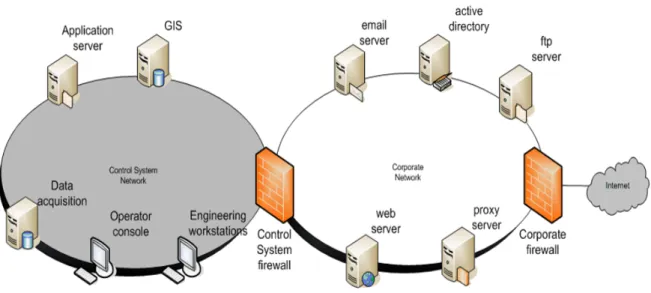
The Corporate subsystem hosts the IT components and can be composed by several sites interconnected by secure channels. In addition, the Corporate subsystem is connected, through a single logical connection, to the SCADA subsystem. This connection is de-picted in the picture 2.1 by the control system firewall.
Supervisory Control and Data Acquisition (SCADA), on the other hand, refers generi-cally to computer and network systems, which perform data collection and cyber control of physical processes, such as those of electrical utilities. These processes can span sev-eral sites spread out over large areas and as such, SCADA systems are today inherently distributed, although their aim is to allow supervision and control from one or a few cen-tralized points, from/to where all information flows.
Chapter 2. Industrial Networks and Critical Infrastructure 6
Figure 2.1: Critical Infrastructure Protection.
The SCADA system usually controls pipelines, water and transportation systems, utili-ties, refineries, chemical plans, and a wide variety of manufacturing operations. The use of those systems lies on the possibility to implement efficient control, improving plant and personnel safety, therefore reducing the cost of operation.
SCADA systems started to be used as standalone and completely isolated, i.e., with no connectivity to other systems. In addition, systems were built based on custom hardware and software. At that time, control systems were confined to a particular plant and con-sisted of a central unit that communicated with local controllers to interface with motors, pumps, valves, switches, sensors, and so on. In order to perform the connections between devices, companies and vendors developed their own communication protocols, many of them proprietary.
To improve both computer and networks effectiveness and reduce total cost of ownership, SCADA systems started to use standard hardware and software. Electrical utilities have also increased their reliance on the internet and communication networks and SCADA systems have evolved from standalone to distributed, inheriting some of the vulnerabili-ties and starting to be exposed to the same threats that plague usual computer systems.
2.1.1
The Importance of Securing Critical Infrastructure
Hardware computers, SCADA software and communication lines, as well as all the data communications transmitted trough these last ones, stored on computers or processed by software, are considered cyber assets. Cyber assets are essential to the operation of
crit-Chapter 2. Industrial Networks and Critical Infrastructure 7
ical assets infrastructures like generation plant, power lines, transformers or substations. The power of a SCADA operator to control a wide electrical infrastructure just seating in front of a computer, has brought incredible cost/efficiency advantages for electrical util-ities. However it also gave rise to an increasing importance and visibility of the cyber assets. Although, cyber assets are essential to achieve our expectations for high continu-ity of electrical service, they also have jeopardised the service itself. They are attractive targets for malicious groups or individuals that intend to cause disruption of the service. These kinds of attacks to critical information infrastructures often fall into cyber-crime and cyber-terrorism and cause severe financial impact to electrical companies as well as social implications in our lives. Nowadays, with the increasing quality requirements of the electrical business regulator and the penalties for power disruptions mainly after the 11th September, it becomes clear, to the electrical utilities, the importance of the cyber assets, their impact on the business as well as the need to protect them. Usually, Threat Agent is the term used to describe the potential source of a threat. To identify possible threat sources we must have a holistic view of the entire system. We need to consider all the aspects of the security discipline, starting from computers, go through physical security and go further up to operation procedures, social engineering and other security aspects. Threat Agents could be sorted out in two basic categories: internal threats and external threats. Internal threats could arise from employees or contractors that have free access to confidential and critical information and also physical access to facilities with critical cyber assets. These internal threats could be accidental or intentional; however they represent an important source of successful attacks to cyber assets. External Threat Agents, on the other hand, do not have an authorized physical access to facilities or sen-sitive information. These kinds of threats could be, for instance, natural or man-made disasters, that obviously are hard to avoid or predict. One of the critical external Threat Agents, belonging to the category of the former inside, that could be an ex-employee who quit and still with access to confidential information.
Security in critical infrastructures becomes even more critical once the industrial sys-tems are built for reliability and longevity, ensuring operation without pause for months or even years, where the overall life expectancy may be measured in decades. In con-trast, those systems and networks used are easily outpaced by the tools employed by an attacker, who have easy access to new exploits and can employ them at any time. Worse still, the average number of days between the time when the vulnerability is disclosed publicity and the time when the vulnerability is discovered in the control systems may be larger than one year. This gap implies that there are known vulnerabilities that can allow hackers and cyber criminals entry into the system by exploring known vulnerabilities that have not been fixed yet.
Chapter 2. Industrial Networks and Critical Infrastructure 8
2.1.2
The Impact of Critical Infrastructure Incidents
The electrical networks have been a major concern on the part of economic stakeholders, states and the operators themselves, by fears of cyber attacks that cause instability (eg, blackouts, technical data corruption, physical damage to power devices). In fact, society is increasingly dependent on critical services, and events that have gone unnoticed years ago, are now disclosed in average prime-time, as some recent blackouts. Even in so-called normal conditions, there is now a central concern with the quality of service. As this is crucial for business, it is attractive to hackers: damaging the quality of service could rep-resent cash, e.g. perspective of blackmail information, or even sabotage.
Increasingly, operators have come to discover that threats against computers and control servers, can have such devastating effects as attacks on their own physical infrastructure. Cyber sabotage could result in injury or loss of life, including the loss of critical services or even catastrophic explosions.
Consequences of a Successful Cyber Incident
A successful cyber attack on a control system could be materialized in changing the in-tended process or altering information related to a process. The first scenario could be translated in changing the amount of energy produced at an electrical generation facility while the second scenario is related with preventing a bulk energy provider from obtain-ing production metrics that are used in energy tradobtain-ing or other business operation. In both cases the result is similar, and could be translated into penalties, financial impact of loss of production or even in the unavailability of the service, resulting in a Denial of Service (DoS).
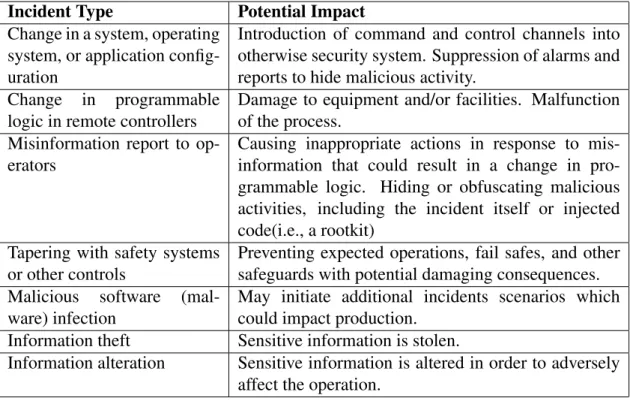
Table 2.1 shows several incident types and, for each one, its potential impact. The so-lution, currently, is to architect and manage critical information infrastructures to possess at least the level of safety and reliability of traditional IT systems (if not better).
Examples of Critical infrastructure Incidents
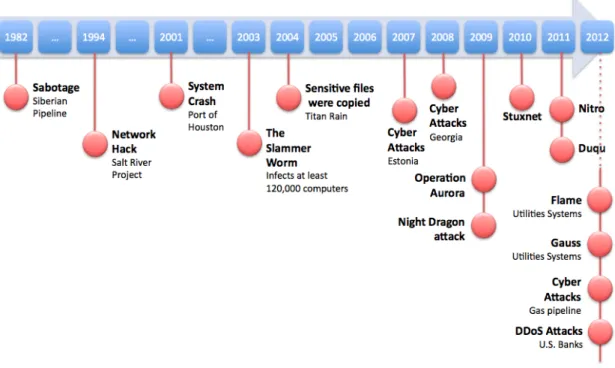
The need to protect critical infrastructures from cyber attacks started to be a concern three years ago when stuxnet [2] destroyed 1,000 centrifuges that Iran was using to enrich ura-nium after taking over the computerized systems that operated the centrifuges. From that moment on, electric grid operators started to talk about the need to protect critical in-frastructure from cyberattacks, and some utilities even hired a chief information security officer [3]. Stuxnet is a computer worm discovered in June 2010 which was targeted to the Iranian nuclear power station. There are previous reports related to critical infrastruc-tures cyber attacks [4] (see figure 2.2), not only targeting standard computing platforms,
Chapter 2. Industrial Networks and Critical Infrastructure 9
Incident Type Potential Impact
Change in a system, operating system, or application config-uration
Introduction of command and control channels into otherwise security system. Suppression of alarms and reports to hide malicious activity.
Change in programmable
logic in remote controllers
Damage to equipment and/or facilities. Malfunction of the process.
Misinformation report to op-erators
Causing inappropriate actions in response to mis-information that could result in a change in pro-grammable logic. Hiding or obfuscating malicious activities, including the incident itself or injected code(i.e., a rootkit)
Tapering with safety systems or other controls
Preventing expected operations, fail safes, and other safeguards with potential damaging consequences. Malicious software
(mal-ware) infection
May initiate additional incidents scenarios which could impact production.
Information theft Sensitive information is stolen.
Information alteration Sensitive information is altered in order to adversely affect the operation.
Table 2.1: The potential impact of successful cyber attacks.
but even to Programmable Logic Controller (PLC) equipments. The difference between Stuxnet and other attacks lies in the method used in Stuxnet and the dimension of the attack. Estonia and Georgia attacks [5] in June 2007 and August 2008 are two good ex-amples of earlier attacks, or later on, in 2010, the Night Dragon attack [6] that explored vulnerabilities on oil and electrical companies. In these cases, the attack collects sensitive information by exploring social engineering, fishing and Microsoft Windows operating system vulnerabilities.
Like the previous examples, Stuxnet’s purpose is also to sabotage industrial processes on a SCADA system, in this case by exploring security weaknesses to steal industrial secrets and potentially disrupting operations of critical infrastructures. Stuxnet, as Night Dragon, also explore Microsoft Windows operating system vulnerabilities to install and propagate the worm among SCADA equipments. However, the Stuxnet’s particularity is the use of a man-in-the-middle code to fake the PLC and also by exploring a zero-day vulnerability.
The SCADA systems, as many other critical infrastructures systems, are based on several backup mechanisms to ensure that a single failure of one component of the architecture does not stop the operation. To do that, those kinds of systems are built on a hot-standby architecture where the failure of one component is easily compensated, in a couple of sec-onds, by another component with the same role. On the other hand, to ensure reliability,
Chapter 2. Industrial Networks and Critical Infrastructure 10
Figure 2.2: Critical infrastructure attacks.
the SCADA systems have redundancy also in communications from the PLC level to the control center. Bearing in mind the redundancy implemented on the SCADA architecture and the capacity of recovering from faults, it is understandable why a direct attack aim-ing at stoppaim-ing a saim-ingle component of the architecture does not represent disruption of the overall operation. Other vectors of attack are used to increase the magnitude of the attack and many of them are based on a structured and planed attack. Stuxnet is a good example of a very well planed attack. Aware of this problem, many companies designed and implemented a common strategy of addressing security. A single security perimeter was established including in it all vulnerable critical cyber assets. All external access to the SCADA system has been protected by a strong access control scheme. In fact, all connections from the outside, established either from other corporate networks or from the Internet, were made more secure by requiring strong authentication procedures and encrypted protocols, and accesses filtered by firewalls. The security perimeter strategy, in spite of ensuring a good level of security from the outside, provides little or no secu-rity against insider attacks. The vulnerabilities and threats from the inside on the secusecu-rity perimeter need to be addressed in order to improve security for SCADA control systems. An attack from the inside represents a greater threat because someone who has deeper knowledge of the system architecture and has the cover of being already inside the secu-rity firewall perimeter might perform it.
Recent malwares such as Night dragon, Stuxnet or more recently, the malicious pro-gram Duqu [20], exploit exactly the security perimeter weakness on the SCADA systems.
Chapter 2. Industrial Networks and Critical Infrastructure 11
Those are visible both by the growth of knowledge and by the processes used in these latest attacks. Indeed, the attacks on unique equipment for the sole purpose of breaking a service are already, by far, deprecated. The next generation of attacks will be even more sophisticated and comprehensive, and utilities companies must be prepared to address the new threats appropriately. To do that they must identify current risks under a holistic at-tack model (inside as well as outside) and develop new schemes and techniques to bring its systems to the next (and higher) level of security and dependability.
In the next paragraph we address this subject by presenting a criticality evaluation un-der the three fundamental security attributes (confidentiality, integrity and availability). This evaluation has also in consideration the SCADA evolution and the impact caused by the introduction of new services and components.
Chapter 3
Smart Grids
In the previous chapter we depicted the SCADA system as a mature critical infrastructure. In this chapter we describe its evolution and its main components and we assess the impact caused by specific faults.
3.1
The Electricity Network Evolution
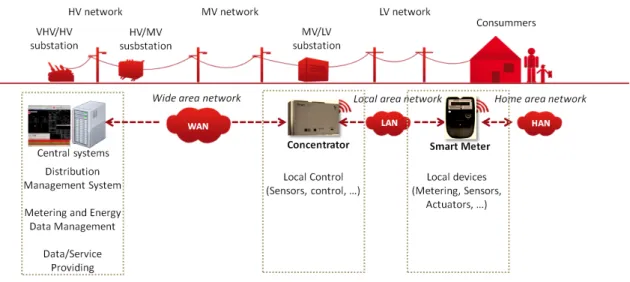
Presently, the electricity supply system is based primarily on large, centralized and pre-dictable energy sources, and networks to enable power flow to uncontrolled, but rea-sonably predictable, demand. In this scenario, the electricity networks are designed to facilitate primarily unidirectional flow from generation to demand, and to cope with the relatively low levels of short term unpredictability in demand. However, governments are now driving the transition to a secure, safe, low carbon emission, affordable energy sys-tem. This new paradigm, based on targets for reduction of greenhouse gas emissions and the decarburization of the electricity supply, requires, from the electricity network com-panies, dealing with significant new challenges in order to integrate many more forms of supply and demand, in a much more dynamic and robust manner. A core element of this system will be an electricity network which has the capacity to transfer significantly more energy between a diverse range of dynamically changing generators and consumers, whilst maintaining the balance between supply and demand at multiple levels within the network. In order to achieve this, significant developments are required in integrated and intelligent monitoring and network control, resulting in a dramatic increase in the dis-tributed nature and in the complexity of network monitoring and control systems. The resulting energy system is commonly known as the Smart Grid. Figure 3.1 presents the Smart Grid infrastructure composed and operating in three main layers. The bottom layer (right on the figure) encompasses new devices and hardware that can measure and mon-itor the grid behaviour through sensors on the grid or meters installed at homes. The middle layer is comprised of information technology systems that gather all the data be-ing captured by the previous layer and deliver them to where they are needed. The top
Chapter 3. Smart Grids 14
Figure 3.1: Smart Grid Architecture.
layer is responsible for analysing all the data gathered, translating and presenting it to stakeholders.
3.2
Smart Grid Technical Architecture
The overall solution consists of several components which, articulated among themselves, allow us to address the objectives preconized for the system, in terms of energy manage-ment, micro-production integration and implementation of Smart Grids concepts. There-fore, the main components of this solution are:
• Smart Meter: devices installed at consumers/producers (including modules for mea-suring, actuation, processing, interface, communication, etc.);
• Concentrator: local control equipment installed at switching stations (including modules for measuring, actuation, processing, interface, communication, etc.); • Grids/Communications: equipment and technologies for information transmission; • Central Systems: systems and applications for management and central data
pro-cessing.
As mentioned before, the picture 3.1 illustrates the technical architecture for the present Smart Grid, which identifies the main components and how they are joined among them-selves. The following sessions address each of these components.
Chapter 3. Smart Grids 15
3.2.1
Smart Meter
The change of paradigm underway in the electrical energy system will require restruc-turing in the architectural model of the various components of the overall solution, with particular prominence in the Smart Meter equipment’s. The Smart Meter is a device consisting of sensors, meters, actuators, etc, which will replace the current meter. Even though, it includes a set of functions that goes well beyond power metering. Along with allowing for a detailed characterization of consumptions (accessible both locally for the consumer and remotely for the marketer), the Smart Meter sets the connection between the various low-voltage grid customers and the Switching Station, via the concentrator. The Smart Meter not only establishes the link with the rest of the system, but it also re-lates a set of current and future needs of each residence/consumer, grid operator, marketer, among others. We consider that all Smart Meters generally have a concentrator that man-ages them.
The Smart Meter needs to have an innovative architecture which not only asserts its own identity, but also should ensure modularity and evolution:
• Modular to configure, in a quickly and easily fashion, the most suitable solutions for the various consumers. To ensure this requirement, the meter must operate in a similar fashion to a “lego,” by making it possible to put together various modules for creating a single object (e.g.: the possibility of setting up value-added services for more demanding customers – domotics – by simply including additional mod-ules/services on top of standard – central core), On the other hand, this equipment should operate similarly to “computer-peripherals,” by making it possible to ex-ternally connect/couple other devices so as to enrich services made available (e.g. possibility of connecting to more advanced/complex displays, various sensors and measuring points, etc).
• Evolutive to allow the evolution of services and functionalities made available with-out the need to replace the installed equipment (e.g. the possibility of adding micro-production for a consumer that also becomes a producer, and, to this end, it is enough to “add” new modules/services to the Smart Meter as already installed). The Smart Meter’s modularity and evolutionary capacity features have presently the fol-lowing characteristics:
• The ability to connect to other external components (advanced display, other meters, PDAs/laptops/PCs, etc.)
• The ability to have a basic configuration with minimum services that are indispens-able to any device to be set up at the consumption site, taking into account the basic processing and the memory of the central module, namely:
Chapter 3. Smart Grids 16
– Metrology (active and reactive power and energy);
– Standard data processing for the purposes of preparing rates, load diagrams, alarms, events, managing cut-off/restoring orders and change of power, among others;
– Communication with the concentrator;
– Standard interface for communication with external devices;
– Power cut-off/connecting mechanisms and change of maximum power; – Display with basic control and safety information.
• The ability to include and integrate other modules without the need to replace the equipment, so as to bring about an evolution of services being offered, including:
– Additional processing capability (calculations, statistics, profiles, rates); – Home Area Network (HAN) communication for interaction with other
de-vices, such as displays, equipment controllers (domotics), sensors and actua-tors, other meters;
– Micro-production support, with energy management and production control capability.
3.2.2
Concentrator
The role of the concentrator is mainly related with the capacity of gathering information from the Smart Meters, installed at the client’s home, and transfer them to the central systems. This equipment, usually installed on the switch stations, does not only work as an interconnection bridge between the Smart Meter and the central systems but it also has a command and control role. For this reason, it is often called Distribution Transformer Controller (DTC).
In this specific area, the Concentrator is the cornerstone to boost the evolution of the elec-trical distribution system for an efficient combination between several micro-production technologies, to be connected to Medium-Voltage (MV) and Low-Voltage (LV) grids. Only with this integration it is possible to optimize processes involved in managing and operating the distribution grid in real-time.
3.2.3
Grid and Communication
In the general system, there are several different communication networks. Right from the outset, we point out the communication networks set up between the central system and the Concentrator and between the Concentrator and the Smart Meter. On top of these
Chapter 3. Smart Grids 17
communication networks, there are other networks associated with each device and with the interaction between these and the exterior.
The WAN communication network ensures the communication between the central sys-tem and the Concentrator and is nowadays supported in GPRS (General Packet Radio Ser-vice) and ADSL (Asymmetric Digital Subscriber Line) technologies, Power Line Com-munication (PLC), among others. There are several european initiatives to define and specify a standard for both WAN and LAN communication to be used on Smart Grid, but still a work in progress that takes into consideration the network configurations and available technologies, among other relevant features. This debate is even more complex and broad since communication technologies, such as the PLC, may vary from country to country.
The LAN communication network, set between the Concentrator and the various Smart Meters, is also be based on PLC technology and, in a few cases, can be performed by GPRS or others. As mentioned previously, there are several initiatives regarding alter-native solutions, as a function of network configurations and other parameters associated with communication.
In addition, almost all european initiatives considered that the communication protocols, involved in the Smart Grid network, should be preferably public/standard. This means that the protocols comprising the various communication technologies shall preferably be part of the public domain, so as to ensure uniformity of communication with the various devices. The definition of communication protocols should be based on issues pertaining to the quality of service, standardization, communication security, among others.
3.2.4
Central Systems
The large volume of information that is made available with the structure of the Smart Grid system is (centrally) managed by an architecture of Central Information Systems (hereinafter designated as Information System), which shall interact with the other sys-tems of the various intervening parties in the distribution grid (either existing or which will exist). The Information System is able to support the Information management of a commercial/rate-related nature, intended for billing the use of the grids, for each con-sumer or independent producer, as well as fraud control (involving the monitoring of consumption, energy production, quality-of-services indexes for the eventual automatic issue of compensations in the event of non-compliance with reference quality levels set in the Quality-of-Service Regulation, etc.).
infor-Chapter 3. Smart Grids 18
mation that will enable to support the services provided as part of the electricity market, including those obligations associated with sending information to marketers, the systems operator, regulatory authority, as well as the management of energy data for the purposes of calculating energy balances, establishing technical and commercial losses, determining typical consumption profiles, etc. It is also a role of the Information System to control the quality of data collected, through the implementation of functionalities pertaining to validation, editing and estimating data, taking into account the infrastructure’s technical management needs and the rules set forth for the electricity market.
Finally, the Information System should ensure automatic implementation of operations associated with the contractual life cycle of the consumption/production facilities, such as: rate changes; changes in contracted power; cut-off and restoring service due to con-tractual non-compliance, contract terminations/activations, or others. On the other hand, the Information System guarantees the management of technical information intended for monitoring, controlling and operating the distribution grid, via interaction with SCADA or other types of systems (powers produced and consumed, voltage levels, monitoring quality of service, etc.) as well as updating systems responsible for managing incidents and characterizing grid topology.
3.3
Smart Grid Security Requirements
3.3.1
Security Objectives
It is imperative that any security countermeasures implemented in the Smart Grid do not impact on power availability or safety. The SCADA must be always available, since a lack or omission of information in the system, for example, during an emergency situation, could cause safety issues.
In most industries, confidentiality and integrity have higher precedence over availability. However, in the electrical power systems there is a slight difference. In these specific systems the more important security attribute is availability followed by integrity and finally by confidentiality.
Availability
Availability, as already mentioned, is the major security attribute of the electrical power system. These systems continuously monitor the state of the grid, in an estimated maxi-mum latency1of 8.3 milliseconds[24] (for a typical SCADA configuration of 1200 baud,
8 data bits, 1 start bit, and 1 stop bit, transmitting one character). In this environment a
1We discuss latency in terms of the time required to transmit a character over the long-haul SCADA
Chapter 3. Smart Grids 19
disruption in the information update can cause a loss of power. The righteousness, despite availability, of the electrical power will be dependent on the quality of the current state estimation in the power system and can be translated in integrity of input data.
Reliability and Fault Tolerance
The SCADA system relies on fault tolerance mechanisms based on hot-standby func-tionalities. Upon a computer failure, identified by the loss of communication, the system automatically transfers the functionality to the secondary (standby) computer. It is impor-tant to note that the failure determination is done independently from either computer, so a failure of either computer alone does not jeopardize the monitoring/control process. If the primary computer fails, the transfer to the hot standby is automatic. If the secondary computer fails, the primary continues all of the monitoring/control functions.
This approach has the ability to tolerate faults and it is normally used in the most critical systems that may need to operate even while under attack by intruders, viruses, or even malfunctioning servers.
Integrity
Data integrity, in the critical infrastructures is one of the most worrying considering the main CIA (Confidentiality, Integrity and Availability) security attributes. SCADA sys-tems are traditionally prepared to operate while some servers are malfunctioning. This is achieved, as mentioned before, by a hot standby system that ensures extreme reliability through data replication mechanisms. Loss of data integrity, in a SCADA system, can result in failures in the power supply or even blackouts. This is because all the system updates are centralized on a dashboard and shown to the operator. A malicious change on that information can induce or influence the operator to perform actions based on wrong information or influencing wrong decisions.
Confidentiality
The underlying challenges about data confidentiality on a Critical Infrastructure environ-ment are similar to any other system and rely on ensuring that only authorized entities can gain access to that information. When unauthorized individuals or systems can have access information then, confidentiality is breached. Usually the value of confidentiality is high when it has personal information about people and its behaviour. Considering this last paragraph and in the context of our work, problems arise when the SCADA system be-come border and, through the Smart Grid, starting to deal with personal and private infor-mation.
Chapter 3. Smart Grids 20
3.3.2
Vulnerabilities, Threats and Risks
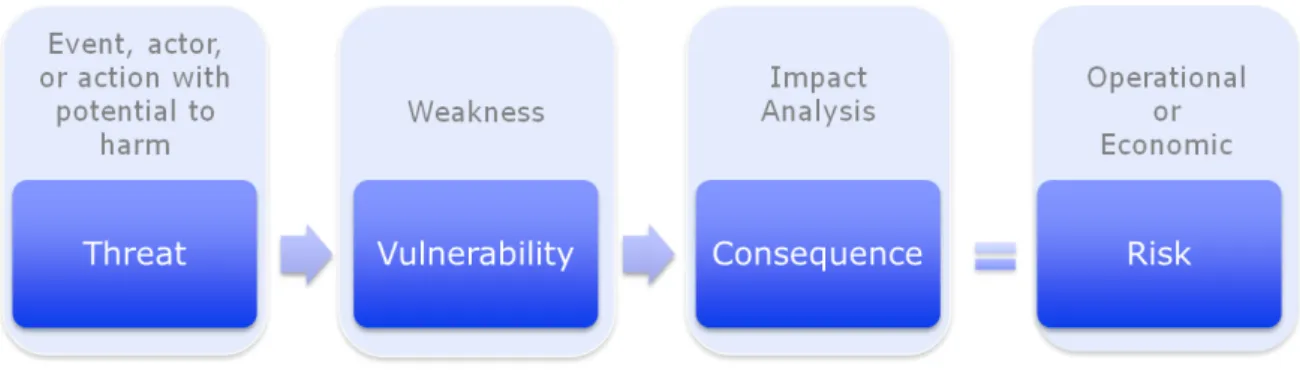
Based on the previous sessions and in what has already been mentioned about critical infrastructure, their impact on society and evolution, it became evident that ensuring the reliability of the electricity network infrastructure, whether Smart Grid or traditional grid, is a fundamental requirement for the functioning of modern society. Its importance to daily life means that it must be carefully designed, implemented and operated in order to ensure that risks are appropriately managed. Thus, the successful operation of the Smart Grid will be highly dependent on ICT (Information and Communication Technology) based computing systems, which will need to be sufficiently dependable in such a way that they do not negatively impact on the security of supply. Chain cyber security risks in general, and Smart Grids cyber security risks in particular, are not well understood or quantified. As a matter of fact, the risk measurement could also be quite confusing. The correct measure of how to secure a system depends much on the number and significance of the flows of the system and on the potential of the attack they may be subjected to. This means that the risk is the combination of the level of threat to which a computing or com-munication system is exposed, and the degree of vulnerability it possesses. In general, an attack is a malicious intentional fault, introduced in a computer or component, with the objective of exploiting a vulnerability in that system.
Figure 3.2: Assess and quantify the risk.
Figure 3.2 represents a threat that exploits a security gap in some part of the infrastructure that may generate, as a consequence, errors in the system. The risk assessment is not more than quantify the effects and impacts of a vulnerability being exploited [22]. The conse-quence of the above is that Smart Grid security risks can only be qualitatively assessed, need to be re-assessed on a regular basis as the threat landscape changes and new vulner-abilities are disclosed over time and, need to be actively managed to maintain acceptably low levels of risk. The next session is dedicated to this topic, deepening performing a risk analysis.
Chapter 3. Smart Grids 21
3.4
Risk Analysis
The Risk Analysis, by definition [33], is a component of risk management entered on the determination of cause-and-effect relationship between probable happenings, their mag-nitude and likely outcomes. The risk analysis consists also in predicting the outcomes evaluation under different perspectives and the application of qualitative and quantitative techniques to reduce ambiguity of the outcomes and associated impact, usually converted in costs, liabilities, or losses.
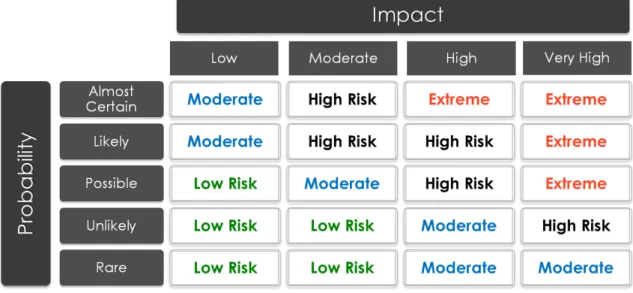
The qualitative risk analysis consists of using the cause-and-effect matrix, presented in Figure 3.3, to prioritize and rank the risk. It is important to highlight that the qualita-tive measures of risk must combine this two qualitaqualita-tive components: the probability of the risk occurring and the size of its impact. At the end, the result for each risk would be evaluated through a numbered raking system such as Low, Moderate, High and Very High. The quantitative risk analysis quantifies, in terms of quantity, the ranked risks in terms of time and cost.
Figure 3.3: Quantitative risk measurement.
In our particular case, the Smart Grid, as any other complex system, is built through the integration and contribution of many different services which, according to its own specificities, have different security requirements encompassing different impacts in case of failure. In order to perform a trustworthy risk assessment it is mandatory to identify all the services available and, for each one, assess the possible impact of its failure. For this purpose we have identified eight different services covering all existing roles in the Smart
Chapter 3. Smart Grids 22
Grid architecture:
• Grid Control and Operation - is related with the SCADA control and operation which is performed centralized at the central system;
• Energy Metering Management - it is also performed at the central systems but related with the metering management;
• Information Services - represent the IT systems that are connected to the Grid Control and Operation and to the Energy Metering Management (billing, SAP, As-set management, ..);
• WAN communication - is the communication between the Smart Meter concen-trator or the primary substation and the central system;
• Primary Substation Operation - represents the operation and data gathering per-formed at the primary substation;
• Smart Meter’s Concentrator - usually installed at the secondary substation, is responsible for collect data from the Smart Meters and to control local SCADA equipments;
• LAN communication - is the communication between the Smart Meter concentra-tor and the Smart Meters;
• Smart Meter - is installed at the client’s home and it is responsible for collect consumer data, perform some calculation and provide information to the client.
3.4.1
Measure the Probability
The probability in the risk analysis, estimates the likelihood of uncertain events occur within a specified period. However, this previous sentence should not be misread, the risk event will not occur deterministically with a specific frequency, thereby, the probability of an event occurs can range anywhere from just above never to just below certain. It is important to note that a probability in any of those extremes (never or certain) represents a certainty not a risk. With this notion in mind, our probability rank was defined between rare and almost certain.
3.4.2
Measure the impact
Impact is a measure of importance (negative) for the operation caused by the loss of the listed proprieties. For that, we consider that two resources with the same level of impact in relation to a failure can have a complete different probability of failure among them. What we refer here is, assuming a failure, how critical is the lack of this functionality. To
Chapter 3. Smart Grids 23
illustrate this previous paragraph, we can consider two resources with high impact con-cerning Integrity. In this scenario, resource A has a high probability of losing Integrity (almost certain) while resource B, on the other hand, has a low likelihood (rare). We also consider a third resource, C, with low impact. In this abstract example, the operational risk imposed by the integrity of the resource A is considerably higher comparing to the resource B. Accordingly, the protection of integrity, which must be considered in both cases, should be higher for resource A. Nevertheless, they may use the same mechanisms but implemented differently in terms of settings and parameters. Resource C, by having a low impact, can earn simpler mechanisms.
The criteria identified for the evaluation of the operational impact of the major categories of services in Smart Grids, concerning loss of Availability, Integrity and Confidentiality are:
Availability
Availability is the proportion of time a service is in a functioning condition, i.e., is the maximum delay time admissible to a service response. In our work we considered that a service that can be more than 2 hours off-line is a service with low Availability require-ments. On the opposite, a service is considered very high in Availability terms, if it cannot be off-line more than 30 minutes. Table 3.1 depicts all the Availability levels considered in our work.
Availability
Very High The service cannot be off-line more than 30 minutes High The service can be off-line between 30 minutes and 1 hour Moderate The service can be off-line between 1 hour and 2 hours Low The service can be off-line more than 2 hours
Table 3.1: Impact analysis - criteria for Availability.
Integrity
Integrity is regarded as the honesty and truthfulness or accuracy of a system or process, and can be measured as the impact caused by a malicious change on the information. In our work we considered a system with low Integrity requirements whose who the unau-thorized modifications do not have any impact on the process. On the opposite, a system is considered very high if it unauthorized modifications represents serious impact on the service. Table 3.2 depicts all the Integrity levels considered in our work.
Chapter 3. Smart Grids 24
Integrity
Very High Modification have serious impact on the service High Modification have notable impact on the service Moderate Modification only have a minor impact on the service Low Modification do not have impact on the service
Table 3.2: Impact analysis - criteria for Integrity.
Confidentiality
Confidentiality is a requirement that limits access or places restrictions on certain types of information. In our work we considered a system with low Confidentiality requirements if the information that it deals with is public domain. On the opposite, a system is considered very high if it the information that it deals with is confidential. Table 3.3 depicts all the Confidentiality levels considered in our work.
Confidentiality
Very High The information is confidential
High The information in restricted internally Moderate The information in internally
Low The information is public
Table 3.3: Impact analysis - criteria for Confidentiality.
3.4.3
Smart Grid Risk Analysis
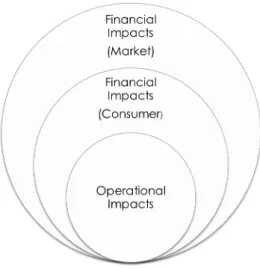
The criteria defined and presented in Tables 3.1, 3.2 and 3.3 are considered the impact for our risk analysis which, complemented with the likelihood of happening, will identify the risk for each of the Smart Grid’s services. However, the Smart Grid, as any other complex system, has a number of stakeholders with different requirements and expectations. For our analysis we have defined three different level of stakeholders involving operational and financial impacts.
The operational impact analyzes the criticality of the system from an internal point of view, i.e., evaluates the probability of a hazard and the impact that it causes in critical services.
The financial impact determines the potential impact, this time from an external point of view, resulting from the interruption of a specific service and how it is reflected in con-sumers and, in the last instance, in the market. To this second analysis we have considered that the impact could be translated in terms of cost (financial), provisioning (business con-tinuity) and the impact caused by a hazard on the society’s opinion (reputation).
Chapter 3. Smart Grids 25
Figure 3.4: Operational and financial impact.
Operational Impact
Through Table 3.4 it is possible to see that the level of risk concerning loss of Availability is the same (moderate risk) for all functionalities of the Smart Grid. Although, even with the same risk level, it is important to highlight the probability of the loss of Availabil-ity assigned to the Smart Meter and the LAN communication which, comparatively, it is higher than the other services. The reason for this lies in the fact that this equipment is in-stalled in the customers’ homes and, therefore, it is impossible to create physical barriers of security.
Service Probability Loss of Availability Risk
Grid Control and Operation Rare Very High Moderate
Energy Metering Management Rare Very High Moderate
Information services Rare Very High Moderate
WAN communication Unlike High Moderate
Primary substation operation Unlike High Moderate
Smart Meter’s Concentrator Unlike High Moderate
LAN communication Possible Moderate Moderate
Smart meter Possible Moderate Moderate
Table 3.4: Risk for the Smart Grid services regarding Availability.
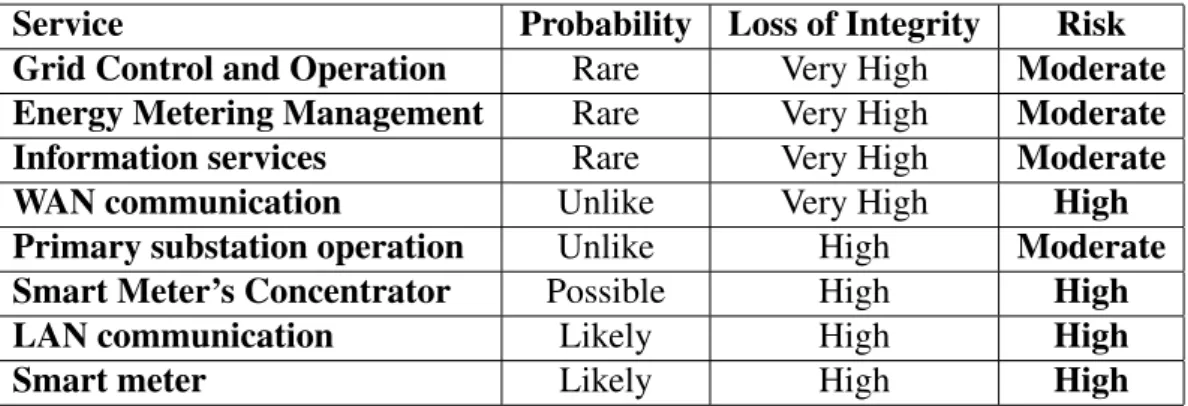
Table 3.5 represents the same study that was done in Table 3.4 but now assessing the im-pact in terms of Integrity.
The evaluation in terms of Integrity gives us the possibility to segregate the Smart Grid services in two main groups: 1) the group of SCADA functionalities that have a clear influence on the command and control of the electric network and, 2) the group caused by the lack of integrity throughout the metering process. The first group includes the Grid
Chapter 3. Smart Grids 26
Service Probability Loss of Integrity Risk
Grid Control and Operation Rare Very High Moderate
Energy Metering Management Rare Very High Moderate
Information services Rare Very High Moderate
WAN communication Unlike Very High High
Primary substation operation Unlike High Moderate
Smart Meter’s Concentrator Possible High High
LAN communication Likely High High
Smart meter Likely High High
Table 3.5: Risk for the Smart Grid services regarding Integrity.
Control and Operation and the Primary Substation Operation, here the lack of Integrity is high at the Primary Substation because they may hold wrong decisions. As a matter of fact, the electric control network is performed centrally and entirely based on informa-tion received from the field, in this case, by the command and control equipment at the substations level. This hierarchical dependency supports the impact on the Grid Control and Operation in terms of loss of Integrity once this system collects information from the substations, compute and remotely control the substations. Even with several differences in terms of impact, due to loss of Integrity, the risk is the same. The reason for that lies on the security mechanisms, implemented at the central systems layer, which reduce the hazard probability at the Grid Control and Operation.
The second group defined for the risk analysis for the loss of Integrity involves the Smart Meter, the Concentrator and the Energy Metering Management. Here it is important to mention that, similar to the previous analysis, the probability decrease from the bottom to the top,e.i., is possible at the Smart Meter, unlike at the Smart Mater’s Concentrators and rare at the Energy Metering Management.
Service Probability Loss of Confidentiality Risk
Grid Control and Operation Rare Low Low
Energy Metering Management Rare Very High Moderate
Information services Rare Very High Moderate
WAN communication Unlike High Moderate
Primary substation operation Rare Low Low
Smart Meter’s Concentrator Unlike High Moderate
LAN communication Unlike High Moderate
Smart meter Possible High High
Chapter 3. Smart Grids 27
Table 3.6, focusing on the loss of Confidentiality, shows evidences that services related to SCADA (Grid Control and Operation and Primary Substation operation) present a very low risk in face of loss of Confidentiality. The reason for this is related to the fact that those services only treats technical data related to the electric network and, because of that, the Confidentiality is not a requisite. The same situation is no longer present in the metering components (Energy Metering Management, Concentrator and Smart Meter). Here, as in the case of loss of Integrity, the likelihood is higher in Smart Meters compared with the central systems. In addition, the impact of loss of Confidentiality grows towards the central systems.
It is also important to mention that WAN and LAN communications are considered high in terms of confidentiality when placed in the Smart Grids context. The reason for that lies in the fact that this new Smart Grids paradigm involves not only control and operations processes but also customer and consumption information, required for the metering pro-cess, and much more demanding in terms of Confidentiality requirements. Traditionally, in a independent analysis assumes that control and operation as critically low concerning Confidentiality.
Financial Impact
Tables 3.4, 3.5 and 3.6 gives us a view of the impact, in term of criticality, for each of the Smart Grid’s services, evaluated them in terms of Confidentiality, Integrity and Avail-ability. Despite the goodness of this analysis, the assessment based only on criticality might not be enough. Actually, even considering the CIA[23] a widely used benchmark for security evaluation, there are organizational risks that must be considered in addition to those which have already been discussed. These risks must have impact into the organi-zation in terms of financial, business continuity and reputation for the loss of Availability, Integrity and Confidentiality.
Tables 3.7, 3.8 and 3.9 present, respectively, the risk of loss of Availability, Integrity and Confidentiality, from the perspectives of financial, business continuity or reputation impact for an organization. What is important and noteworthy is that the introduction of the commercial component of the Smart Grid, referred in the tables as energy metering management, expressively increases the risk for the organization in all three analyses. The financial risk measures the increase in costs and decrease in revenue resulting from losses of each one of the security attributes. The same methodology was used to evaluate the impact of business continuity on the organization. The business continuity analysis complements the previous one, the financial, by integrating the possible costs associated with the technical impact. Lastly, we assessed the impact on the company’s reputation
re-Chapter 3. Smart Grids 28
sulting from loss of each security attributes. This final analysis, the reputation, represents a social assessment of the organization and may hold negatively the financial results of the organization.
Service Risk of loss of Availability
Financial Continuity Reputation Grid Control and Operation Moderate Moderate Moderate
Energy Metering Management Very High Moderate High
Information services High Low High
WAN communication Moderate High Moderate
Primary substation operation Moderate Moderate Moderate
Smart Meter’s Concentrator High High High
LAN communication Moderate High Moderate
Smart meter Moderate Moderate Moderate
Table 3.7: Risk of loss of Availability considering financial, business continuity and rep-utation impact.
Table 3.7, gives us the possibility to draw some conclusions about the risk of loss of Avail-ability in a Smart Grid architecture. On one hand, the introduction of the Energy Metering Management represents an increase in the financial risk, which influences negatively the reputation security risks. The reason for the increase of the financial risk is related to the services provided to customers which, as in the case of consumption, have high re-quirements in terms of availability and impact on reputation. On the other hand, real-time operation is a prerequisite of any SCADA system and, as that, requires availability and dependency on communications.
A second analysis, presented in the Table 3.8, assesses the risk resulting from loss of Integrity. This analysis can be analyzed in two different perspectives. On one hand, the impact of the hazard in the technical components (Grid Control and Operation and Pri-mary Substation Operation) and the impact on the metering components (Energy Meter-ing Management, Smart Meter’s Concentrator and Smart Meters). ConsiderMeter-ing the tech-nical components, which only deals with techtech-nical data, the impact of loss of Integrity is bigger at the business continuity and reputation level if compared with the financial im-pact. The lack of Integrity in the SCADA system could influence negatively the operation of the electrical grid, misleading to wrong decisions at the command and control level that may cause interruptions in the power distribution. The coherence of the system is, in this scenario, compromised and influence negatively the business continuity and, in cause of power outages, also the reputation of the organization.
In terms of metering, the loss of Integrity represents a financial impact that may influence negatively the revenue. The impact on business continuity and reputation are moderate not representing a real risk to the organization.
Chapter 3. Smart Grids 29
Service Risk of loss of Integrity
Financial Continuity Reputation
Grid Control and Operation Moderate High High
Energy Metering Management Very High Moderate Moderate
Information services High Low Moderate
WAN communication Moderate High Moderate
Primary substation operation Low High Moderate
Smart Meter’s Concentrator High Moderate Moderate
LAN communication Moderate Moderate Moderate
Smart meter Moderate Moderate Moderate
Table 3.8: Risk of loss of Integrity considering financial, business continuity and reputa-tion impact.
A final analysis now considering Confidentiality, allows the measurement of the extreme impact that Smart Grids introduce on this security attribute. There are two factors that alter our intuition about Confidentiality in an environment dedicated to the power dis-tribution. On the one hand, with the introduction of Smart Grids are also introduced services that process sensitive contents, such as consumption and client’s habits. On the other hand, may now less intuitive, the SCADA information itself represents a quite high Confidentiality requirements, as confirmed by recent attacks on critical infrastruc-ture (presented in Chapter 2) which, exclusively targeted critical infrastrucinfrastruc-ture with the intention to sabotage and to get operational information. The results of this final analysis are presented in the table 3.9.
Service Risk of loss of Confidentiality
Financial Continuity Reputation
Grid Control and Operation Moderate Moderate Low
Energy Metering Management Very High High Very High
Information services High Moderate High
WAN communication High Moderate High
Primary substation operation Low Low Low
Smart Meter’s Concentrator High High High
LAN communication High Moderate High
Smart meter High Moderate High
Table 3.9: Risk of loss of Confidentiality considering financial, business continuity and reputation impact.
3.4.4
Final Remarks
The analysis carried out in this chapter was been achieved through the analysis of internal documents and analysis of the combined degree of vulnerabilities and threat levels. As
Chapter 3. Smart Grids 30
Figure 3.5: Areas of greatest risk and impact.
shown earlier, a risk analysis can identify the areas where the efforts must be placed in order to reduce the fragility of a system. The major objective is to reduce the highest val-ues, both in terms of probability of occurrence and impact caused. The following section presents an alternative architecture for Smart Grids that, in addition to present significant advantages in terms of scalability, significantly decreases the highest risks identified in this session.