A Work Project, presented as part of the requirements for the Award of a Masters Degree in Management from the NOVA – School of Business and Economics.
Mozambikes – The Challenges of Growth
Mafalda Correia Larroudé Trigo da Roza MST15000842
A Project carried out on the Social Enterprise Work Project, under the supervision of:
Professor Miguel Alves Martins
Table of Contents
Abstract ... 3
Purpose of Project ... 4
Case Narrative ... 5
The co-founders of Mozambikes ... 5
How it started ... 7
The Mozambikes’ development ... 11
The future of Mozambikes ... 16
Appendixes ... 18
Discussion Questions ... 23
Discussion Notes ... 24
Abstract
Mozambikes is a Mozambican social enterprise founded in 2009, whose mission is to
“transform the lives of rural Mozambicans by providing higher quality bicycles at low market prices throughout the country.”1 The idea of Mozambikes resulted from a road-trip, in which Lauren and Rui came across many rural Mozambicans walking and carrying heavy burdens on foot. They realized that bicycles would provide a quicker and safer way to reach the cities and improve their standard of living. The co-founders have therefore designed an innovative business model that allows them to accomplish their mission. In December 2011 the first order was dispatched and since then the social enterprise has gained recognition and has created three new business models, different from the initial one, in order to achieve a wider range of customers. At the end of 2012, 1,000 bicycles had been sold. During the next 6 years the co-founders want to expand in order to better achieve Mozambikes’ mission, producing 25,000 bicycles per year. To do this, they need to develop a strategic plan towards a scaling up process.
Key words
Social entrepreneurship, social business model, scaling-up, rural development
Purpose of Project
The purpose of this work project is to develop a case study about Mozambikes. Through this case study, the student would be able to understand the growth process of social enterprises. Social enterprises have usually a distinct development, which is different from profit making businesses, and therefore they face different challenges during the entire growth process. Thus, through the Mozambikes’ example the student can analyze the growth not only as a future strategy, but also as an ongoing process starting from the original idea. The most valuable point of this case study is the evolution of different business models. Hence, Mozambikes’ growth process was, is and will be a very interesting challenge.
This case study is oriented for management students specifically for a Social Entrepreneurship course.
Case Narrative
At the end of a busy the day, Lauren was walking back to her home and thinking about Mozambikes. During the last few years she had dedicated her entire time to make this dream come true. Unexpectedly and fortunately, it had grown quickly and with little planning they had developed three distinct business models. However, she was worried about the enterprise’s future. Upon her arrival home, Lauren shared her uncertainties with Rui. They started revising the whole story of Mozambikes, in an attempt to clearly define a strategy for its growth during the next years.
The co-founders of Mozambikes
Lauren Thomas and Rui Mesquita met for the first time in 2008 in Mozambique. Lauren was doing a summer volunteer program with TechnoServe while Rui had moved to Mozambique for professional reasons.
Lauren was born in Baltimore, Maryland and worked in investment banking in New York. In 2008, she left her work and decided to do an MBA at IESE Business School in Barcelona.
“I enjoyed the pace of the banking industry and my work in New York, but I felt that something was missing. I began to contemplate what I was really passionate about, and realized that I wanted to learn new languages, experience different cultures and see the world.”2
Rui is from Alverca in Portugal. He graduated in Marketing at the Polytechnic Institute of Santarém and after obtaining his BA, he worked for Nobre (a Portuguese food company) in the Marketing operations department. Rui’s marketing experience would be crucial later, when creating an innovative bicycles’ business model for Mozambikes.
2 Eder, Andrew. 2011. “Mozambikes Pedals to Promote Development Via Low-Cost Bicycles”, Next billion:
development through enterprises, 7 September, http://www.nextbillion.net/blogpost.aspx?blogid=2465 (accessed February 15, 2013)
During that summer, Lauren and Rui rapidly found that they were both passionate about cycling. She used to rent bicycles to help her to explore new places during her travels, including Cambodia, Vietnam, Singapore, Holland, Spain and so forth. Rui also used to cycle as a hobby, especially in mountain biking. He shared with Lauren the will to implement a bicycle business in Mozambique, which would later become Mozambikes. That summer was also important for Lauren’s personal development. Through the volunteer program, she applied her knowledge and professional experience, helping Mozambican farmers to develop their businesses. This was an important experience for her, as she realized that her financial and business knowledge could dramatically help people’s lives in developing countries. She and Rui got involved in a close relationship, and Lauren’s desire to use her knowledge to serve the poor and Rui’s idea of creating a bicycle business in Mozambique motivated them to follow their dreams.
One year later, in 2009, they founded Mozambikes Limitada. The social enterprise was based in Maputo and was created to produce high quality bicycles at affordable prices in order to offer to low income rural Mozambicans an efficient solution for their transportation needs. The co-founders also created a sister non-profit company, Mozambikes Social Development Inc. to receive donations from around the world.
Lauren is currently the CFO of Mozambikes - manager of Finance/Accounting, Capital Raising and Client Relations. Rui is the CEO – holding responsibility for Procurement and Logistics, HR and Operations. He is also Director of TotalTim’s Mozambique operations, a subdivision of Portuguese telecom consultant TIMWE. Rui’s professional position in TotalTim, which requires a constant contact with India, China, South Africa and Europe, and his comprehensive knowledge on how to develop a business in Mozambique, were crucial to create and implement Mozambikes’ project.
How it started
In the summer of 2009, even before the foundation of Mozambikes, Lauren went back to Mozambique and decided to go with Rui on a road trip throughout the country. During those days they found many people walking long distances, carrying heavy water containers or bundles of wood on their heads and backs. They quickly realized that transportation was an urgent need for these Mozambicans.
Public transport was only available in the main cities as Maputo, Beira and Nampula. There was also an alternative transport in cities and some rural zones, called “chapa”, run by private companies.3 However these vehicles were usually 9 seat vans or pick-ups and normally carried a greater number of passengers, leaving little or no room to carry goods. On top of this, the vehicles were in poor conditions and were extremely unsafe. This scarcity of public transport in rural areas and the high cost of a personal vehicle left rural Mozambicans with no other alternatives.4
During the trip, Lauren and Rui began to brainstorm on how transportation could be made affordable for low-income people, and it became clear that a bicycle could be a solution as a low cost, personal vehicle requiring, in most cases, minimal maintenance.They became increasingly excited with the idea, as they believed that the social impact of this business could significantly change the lives of those people.
Bicycles would offer some benefits to the majority of Mozambicans, since 70% of population lived in rural areas.5 Advantages would be mainly threefold. In first place,
3 Public Transports’ price: 7 MZN; Chapa’s price: 9 MZN
http://www.rtp.pt/noticias/index.php?article=603543&tm=7&layout=121&visual=49 (accessed May 22, 2013)
4 A second hand Toyota Duet imported from Japan, from 2004, with 43,000 Km – Price: $1470
http://www.autorec.co.jp/car-detail.php?refno=19639A2N5&post_maker=TOYOTA&post_model=DUET (accessed May 20, 2013) In 2011 the Mozambican minimum wage in agriculture was 2,005 MZN ($67)
http://www.portaldogoverno.gov.mz/noticias/news_folder_econom_neg/abril-2011/governo-aprova-reajuste-salarial/
(accessed 1 May, 2013) and exchange rate (2 May 2013): 1 USD = 29.9849 MZN
http://www.xe.com/currencyconverter/convert/?Amount=2005&From=MZN&To=USD (accessed may 2, 2013)
5 World Bank Data from 2011, indicator: rural population (% of total population), http://data.worldbank.org/indicator/SP.RUR.TOTL.ZS (accessed May 1, 2013)
commercial: the bicycles could help people to transport their products to the city markets. Usually the quantities were limited to what they could carry. These products were usually food (vegetables, fruit, fish), which frequently lost their freshness under the sun, since people had to walk for many hours to the cities. With a bicycle these Mozambicans could carry heavier goods and reach the cities much quicker. Secondly, there would be an educational advantage: circa 50% of adult Mozambicans were illiterate due to the lack of schools in their residential areas.6 The bicycle could provide an effective means of transport to travel to schools. Thirdly, regarding health: Mozambique has serious health problems concerning HIV and malaria. In 2011, 11% of the population between the ages of 15-49 had HIV, which is a disease that requires regular treatment.7 However, the rural population lacks nearby health care centers or hospitals, which increases the likelihood of death. The bicycles would shorten the travel time between the rural villages and hospitals, offering these people an opportunity to see a doctor regularly.
After the road trip, Lauren went back to Barcelona to continue her MBA and Rui remained working in Mozambique. Although they were not together, this was a crucial period for the development of Mozambikes. The co-founders continued to develop their business model, talking frequently about how to build a consistent business plan for it. The first business model (retailing model) was based on two sources of revenue - one from advertising on the bicycles and the other one from the sales of these branded bicycles. Through this strategy, Mozambikes offered a solution with innovative advertising on the bicycles, which would allow selling them to the general public at very low prices. The bicycle’s total price would be 3,100 MZN ($103). The companies’ advertising cost of each bicycle would be 2,500 MZN ($83). The advertising would
6 World Bank Data from 2011, Indicator: Literacy rate, adult total (% of people ages 15 and above), http://data.worldbank.org/indicator/SE.ADT.LITR.ZS (accessed May 1, 2013)
7 World Bank Data from 2011, Indicator: Prevalence of HIV, total (% of population ages 15-49) http://data.worldbank.org/indicator/SH.DYN.AIDS.ZS (accessed May 1, 2013)
partially sponsor the bicycles (roughly 70% of bicycles’ total price) and would be more effective and cheaper than other channels (see Exhibit 1). After the bicycles’ customization, Mozambikes would sell them to the rural population through a network of re-sellers throughout the country. The social enterprise would sell the branded bicycles for 600 MZN ($20) to these re-sellers and they would then re-sell the product for 1,000 MZN ($33) – the price having been previously painted on the bicycles to ensure that it would not be altered.8
In March 2009, Rui and Lauren legally founded Mozambikes, and after finishing her MBA, Lauren moved to Maputo to live there and help Rui implement it. They finished the business plan and started to think about the product’s characteristics, aiming to offer a well-built bicycle capable of carrying heavy materials and being used in rural areas. Rui had already bought a standard bicycle in Maputo, and three weeks later it had fallen apart. The quality of the bicycle was extremely poor and he realized that Mozambikes’ bicycles had to be more resistant and prepared for bumpy roads, so bicycles were carefully designed and produced in order to make them a unique and high quality product. There was a lack of local manufacture of bicycle components in Mozambique, so during 2010 they looked for suppliers in India and China. In the end they asked for a sample from three different suppliers and then chose a Chinese supplier who offered the best option in terms of price/quality. They looked for a reinforced thicker tire, rear carrier, reflectors, a front
8 Exchange rate (2 May 2013): 1 USD = 29.9849 MZN
http://www.xe.com/currencyconverter/convert/?Amount=999&From=MZN&To=USD (accessed May 2, 2013) Figure 1: Retailing business model
Supply Chinese suppliers of bicycles components Advertising Mozambikes customizes the bicycles with companies’ logos and colors Assembly Mozambikes assembles the bicycles Distribution Mozambikes sells the bicycles to re-sellers throughout the country Sales The re-sellers sell the bicycles to the general public
light and an alloy frame designed for both men and women (see Exhibit 2).
They also planned a very strict process of assembly divided into 4 different steps (see
Exhibit 3). They started by lacing the wheels, and then they assembled the frame only.
Thirdly, they painted the bicycle and applied the logo, and finally they assembled the entire bicycle (see Exhibit 4).9 This assembly process was fundamental in guaranteeing higher quality bicycles than the existent ones on the market. Not only would the bicycle components be more resistant, but the paint and branding would also be well treated. While Lauren and Rui were planning the product’s characteristics and production, they asked a friend to build their website because they wanted to create awareness of their project and engage potential clients.10
When everything was planned, Lauren and Rui began by reaching out to their existing contacts, to pitch the idea and gauge their interest.11 Before these meetings, the founders believed that these companies would pay for 50% of their orders in advance. While the companies understood the project’s value, they asked for samples in order to personally see the bicycle. Therefore, at the beginning of 2011, Lauren and Rui took a risk and ordered the first container with components for 1,200 bicycles entirely financed by themselves. It took 2 months to arrive in Mozambique, one month of production and another month to deliver.12 The initial investment of this project was $130,000 (see
Exhibit 5).
Simultaneously with the order of the first container and even before selling a single
9 Painting process: The process started with a primary coat to prevent oxidation and then applied two coats of the desired
colors. Then they applied vinyl with the branding images and then a varnish to protect the image.
10Later, when the project was up and running, they created a Facebook account, which now has almost 10,000 likes
(https://www.facebook.com/Mozambikes?ref=ts&fref=ts, accessed May 1, 2013). In 2012, they also felt the need to create a blog to post, more frequently, regular news and information about the project in order to create and foment a closer relationship with people and reach a public beyond Facebook.
11 Firstly, they wanted to reach the big brands, NGOs and Communication agencies. They already knew that NGOs had
a budget for bicycles, as a working tool, and communication agencies were most of times responsible for some companies’ marketing campaigns. Big brands wanted invest in new advertising means. Therefore they could be potential clients to sponsor the bicycles.
12 One bicycle is composed by 129 components and the delivery time is independent from the number of components
bicycle, the co-founders started hiring the assembly team. The original idea was to hire people with experience in construction. However, they found many people with experience with bicycles from working on the streets. Mozambikes would be an opportunity in which they could contribute with their knowledge. The company was thus launched with 6 employees working on customization and assembly, and has since grown to 12 workers. One of their first workers was Vicente Mafume and within two weeks he was promoted to Factory Manager due to his comprehensive knowledge about bicycles.13 The Co-Founders shared the responsibility of reaching more clients and managing the social enterprise, of working with the Factory Manager to meet delivery deadlines, and of managing inventory purchases and ensuring efficiency (see Exhibit 6).14
In 2011, with the production of the first sample for Vodacom, with whom the co-founders had already established a good relationship due to Rui’s job, other potential clients became really excited.15 Through this sample, the potential clients could observe the quality of the final product and how their brands would be designed based on the bicycle, motivating them to start ordering. The first big order of nearly 300 bicycles was from an US-based NGO present in Mozambique. This organization decided not only to pay for the advertising, but also for the bicycles.
From 2009 to 2011, approximately two years had passed from the initial idea to start producing the bicycles.
The Mozambikes’ development
Since the first order from corporations, the retailing model has altered slightly. Three more business models have since emerged and the business model that had been
13 Vicente Mafume is member of the Professional Mozambican Cycling Team
14 Additionally, Mozambikes had one administrative assistant and two guards, who also worked for the other businesses
in the space. The legal affairs and accounting services are outsourced, provided by independent professionals.
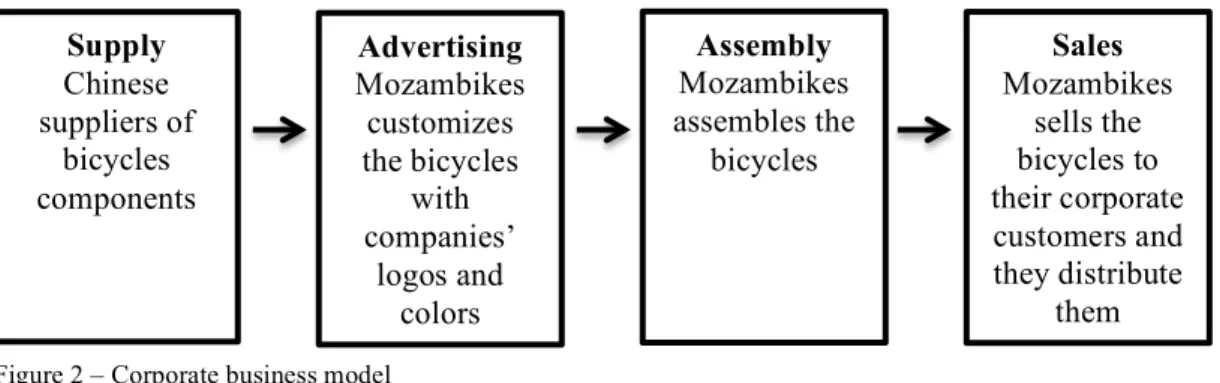
developed during the road trip was left, without being implemented. Companies opted to buy the bicycles as well, substituting the need for a re-sellers channel to sell to low income rural Mozambicans. Therefore, nowadays Mozambikes has three consistent business models, different from the retailing model initially designed (see Exhibit 7). 1. Corporate: When Lauren and Rui started selling their product to corporations, the novelty and innovation of this new concept of advertising on the bicycles motivated the companies to buy both advertising and bicycles. The low price of branded bicycles was an incentive for companies to opt to buy them and then distribute the bicycles to their employees or rural communities. The corporate clients preferred not only to be sponsors but also the bicycles’ owners, starting including these customized bicycles in their marketing and CSR campaigns.16 Hence, the co-founders did not proceed with the network of re-sellers as they had originally planned, since corporations became responsible for that part of the value chain. It was easier for Lauren and Rui to sell the advertising and bicycles to the corporate clients and to start without the distribution channels.17 Although this was beneficial for them it could also compromise their mission. They saved money and time, which definitely helped them with their first kick off. However, the companies’ final clients could not be low income rural Mozambican since it was the corporations that decided who the beneficiaries were, changing the initial target.
16 Massmart (supermarket chain) - bought bicycles to offer to the local community during the launch of a new Save-Rite
supermarket. DSTV (multimedia company) - offered the bicycles as a promotion to its customers. Golo (advertising agency) - launched a marketing campaign with the bicycles, “Think Local”, throughout the capital city of Maputo.
17 The cost of distribution varies according with the distance. It is not possible to establish an average price.
Supply Chinese suppliers of bicycles components Advertising Mozambikes customizes the bicycles with companies’ logos and colors Assembly Mozambikes assembles the bicycles Sales Mozambikes sells the bicycles to their corporate customers and they distribute them Figure 2 – Corporate business model
Regarding the prices, the co-founders increased the price of the bicycle from 3,100 MZN to 3,500 MZN ($116) to achieve higher profit margins since the corporations’ purchasing power was higher than re-sellers’. The cost of advertising on the bicycle was 2,500 MZN ($83) and the customized bicycles were sold with a reduced price of 1,000 MZN ($33). In 2012, 895 bicycles were sold through this business model.18
In the future, the number of corporate clients has the potential to grow due to the country’s increasing economic development and foreign investment. The GDP (Gross Domestic Product) increased 6,8% in 2010 and 7,1% in 2011 and is expected to continue to rise in the next few years.19 Moreover, the foreign direct investment has also increased. In 2008, it was around $600 million, while in 2011 it reached approximately $2,000 million.20 Since foreign companies want to gain exposure and brand awareness, and bicycles could be an effective means to do this. However, the co-founders believe that the Mozambikes will develop the re-sellers network in the future, as initially planned, once the logistics and distribution prove to be too complex for these companies.
“I do still think that there is a place for the other channel, as I think the excitement and novelty of having the bicycles will wear out. (…) I expect that some will tire of getting involved in the logistics of bicycle distribution and move onto the channel where they can get the CSR and advertising benefits without the logistics.”21
2. Consumer: Since 2011, Mozambikes has become well known in Maputo and the quality of the bicycles has been widely recognized. The middle and upper classes that live in Maputo have unexpectedly approached the company to buy bicycles for leisure. These products were not financed by advertising and were produced with the Mozambikes’ logo.
18 Exchange rate (2 May 2103): 1 USD = 29.9849 MZN
http://www.xe.com/currencyconverter/convert/?Amount=999&From=MZN&To=USD (accessed May 2, 2013)
19 World Bank Data from 2008 and 2011, Indicator: GDP growth (annual %), http://data.worldbank.org/indicator/NY.GDP.MKTP.KD.ZG (accessed May 1, 2013)
20 World Bank Data from 2008 and 2011, Indicator: Foreign direct investment, net inflows (BoP, current US$), http://data.worldbank.org/indicator/BX.KLT.DINV.CD.WD (accessed May 1, 2013)
Thus, the social enterprise reached another public, albeit not the main target.
The price of these bicycles is 3,500 MZN ($116) and people buy them directly from the company’s headquarters.22 In 2012, Mozambikes only sold 21 bicycles to this segment, because the demand for this model is very limited since this type of clients with a higher income is a minority in Mozambique. Thus, the contribution of this model for the enterprise’s revenues is not much relevant.
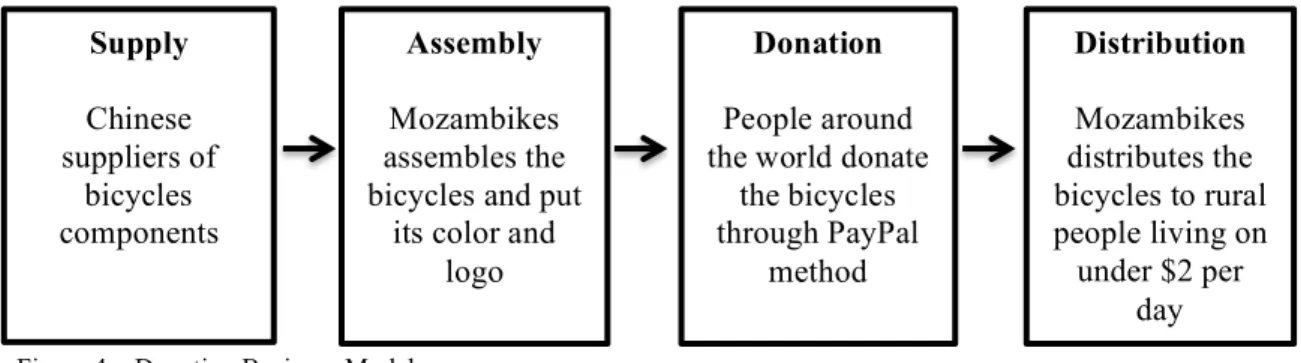
3. Donation: Early on, the co-founders’ families and friends wanted to help them with their new social business. Lauren and Rui realized that some of the rural people could not afford to buy the Mozambikes Limitada’s bicycles, even at the low rates, so, in 2009, they founded a sister company, Mozambikes Social Development, Inc. through which people could donate bicycles by donating the amount of money correspondent to one bicycle ($80) using PayPal as a payment method. Through this, Mozambikes produced and distributed the bicycles to people who lived on less than $2 a day.
Mozambicans could apply for donated bicycles by filling in a form issued by
22 Exchange rate (2 May 2013): 1 USD = 29.9849 MZN
http://www.xe.com/currencyconverter/convert/?Amount=999&From=MZN&To=USD (accessed May 2, 2013) Supply Chinese suppliers of bicycles components Assembly Mozambikes assembles the bicycles and put
its color and logo Distribution Mozambikes distributes the bicycles to rural people living on under $2 per day Donation People around the world donate
the bicycles through PayPal
method
Figure 4 – Donation Business Model Supply Chinese suppliers of bicycles components Assembly Mozambikes assembles the bicycles and put its color and logo Sales Mozambikes sells the bicycles to upper and middle classes of Maputo
Mozambikes. Lauren and Rui would then check to see if the candidate actually lived below the poverty line. To make this process easier, Mozambikes developed local partnerships with field institutions to help them to verify and choose the candidates. Theses institutions now fill in the forms with their beneficiaries’ data, and Mozambikes certifies the veracity and delivers the bicycles. In 2012, only 165 bicycles were donated. However, there is a huge demand for donated bicycles. In 2008, 56.9% of the rural population lived on less than $2 per day and although this number has decreased since then, the demand for donated bicycles is still high.23
Through these three business models Lauren and Rui has now reached a wider range of customers than those that they had initially planned. This was also beneficial for Mozambikes’ brand recognition within different industries and sectors. Hence, during the last few years the co-founders took advantage from these opportunities, expanding the business to different segments.
Regarding all the activities developed through the value chain, the enterprise is responsible for the majority of them except the production of the bicycle components and the distribution to the corporations’ final clients. All the other activities are held and supervised by Mozambikes (see Exhibit 8).
Nowadays Mozambikes is financially sustainable and the investment in the first container has already been recovered. Mozambikes started selling at the end of 2011 and by 2012, it had a net margin of 11% and an EBITDA margin of 14%. Mozambikes had multiple revenue sources that year, including branded bicycles (91.64%), donations, (4.38%) unbranded bicycles (2.20%), and others (1.78%). They expect the profit to increase and branded bicycles to continue to be the main source of revenue (see Exhibit 9).24
23 World Bank Data from 2008, Indicator: Poverty headcount ratio at rural poverty line (% of rural population), http://data.worldbank.org/indicator/SI.POV.RUHC (accessed May 1, 2013)
Concerning the unit cost analysis, they have of 33% net profit, which translates into a profit of 1,153 MZN ($38.5) per bicycle.25 The main costs are: bicycle inventory (30%), labor (25%), paints (6%) and distribution (4%).26 Furthermore, by adding the Retailing model that has not yet been implemented (with full capacity) the net margin would only decrease 1% from the actual one, due to an efficient use of labor, which compensates the increase of the distribution costs (see Exhibit 10).27
The future of Mozambikes
After three hours revising the Mozambikes’ story, Lauren and Rui decided to continue their discussion of future plans for the social enterprise the following day. Although, they found that they had several different ideas, there was a shared main goal of selling 25,000 bicycles per year, in order to reach a total of 150,000 bicycles sold in six years, which is equivalent to around 2 % of the estimated potential need (see Exhibit 11).28 In order to reach this, they expected to employ 30 permanent employees (see Exhibit 12).29
Excited with the idea of growth Lauren and Rui started dreaming about a whole new bicycle industry in Mozambique. They understood that the bicycle industry was not totally developed, consisting of only a few brands and a limited number of bicycle stores, most of them concentrated in Maputo. The internal competition was relatively weak and the barriers of entry were low, meaning that Mozambikes had high potential to grow (see
Exhibit 13).30 Apart from helping help poor people, they were dreaming, as long-term goal, about a country where the bicycle is the main means of transport. For that they people) and advertising of the bicycles without its purchase.
25 Exchange rate (2 May 2013): 1 USD = 29.9849 MZN
http://www.xe.com/currencyconverter/convert/?Amount=999&From=MZN&To=USD (accessed May 2, 2013)
26 If Mozambikes worked at full capacity (12 employees and 100 bicycles per week), the net margin would increase by
10%.
27 Source: Mozambikes
28 The co-founders set this conservative goal in order to test Mozambikes’ business models in the next few years. 29 In the future they will also need to increase the factory’s plant or change its location, since the current one is only
prepared to produce 9,000 per year.
30 The information about this industry in Mozambique is scarce. There are no objective numbers about competitors’
planned to build a cycle lane in Maputo and develop campaigns to create awareness of healthy transports.
However Lauren’s worries were focused on short-term achievements. She reminded Rui that Mozambikes was going through a major turning point because they were changing the factory’s location from Maputo to Matola, an industrial area near Maputo, in order to increase the production capacity from 1,000 to 9,000 bicycles per year. This was a first kick-off to expand during the next years. They were also planning a second container, which they intended to fund with third party capital.
Moreover, Lauren and Rui still sought to build a network of re-sellers around the country in order to sell and organize the maintenance of their bicycles. Lauren already had a shortlist of possible distributors and wanted to hire one person this year, responsible for these operations and open up the possibility for companies to buy only the advertising.31 At the end of this conversation, Rui shared with Lauren his wish to add and offer a new variety of bicycle complements such as trailers, which can be used to transport heavy materials or injured people. He was expecting to start producing these new products next year, opening doors to other types of clients.
This was an intense morning and the co-founders did not come up with a final conclusion. They realized that they needed to further analyze and understand the most suitable business model mix for Mozambikes to best achieve its mission and a successful scaling up process. The future was in their hands and the decisions taken would definitely influence the path of Mozambikes.32
31 Lauren and Rui believe that the bicycle will be a standard channel of advertising.
32 After Mozambique the co-founders also expected to scale up to neighboring countries Zambia, Zimbabwe and
Appendixes
Type of advertising Price
(MZN) # of Ads
# of Mozambikes
Newspaper: O país Full page 27,500 1 18
Half page 17,188 1 11
Newspaper: O diário de Moçambique
Full page 10,662 1 7
Half page 5,476 1 4
TV – TIM (Prices as of 11/2010, for timeslot between 19:00-22:59) 5,000 1 3 TV – STV (Prices as of 11/2010, for timeslot between 18:00-22:59) 5,620 1 4
Outdoor 1,500 1 for 1
month 10
TV Radio Print Mozambikes
Reach low income people ✖ ✖ ✖ ✔
Duration of exposure 30 sec 30 sec 1 day 3-5 years
Geographic Presence Regional
(cities) Regional (cities) Regional (cities) National (cities and rural areas)
Branding Quality Features
High quality graphs under protective clear paint coat
36 – spoke tires Diagonal top bar friendly for women and men
Thick top bar for extra space Steel mudguards 26” double wall rims Lower bar ideal for slogan Tire with white lining Adjustable seat post
Chain cover image Car valve Rear night reflector
Caliper brake 40 cm strong load carrying rack Alloy handle bar with rubber
handgrip
Steel bell for handlebar Front battery-powered light Front basket bracket
Exhibit 1 – Advertising comparison
Exhibit 2 – Bicycle’s specifications
Source: Thomas, Lauren. 2012. Mozambikes Limitada, Powerpoint slides, Mozambique Source: Thomas, Lauren. 2012. Mozambikes Limitada, Powerpoint slides, Mozambique
Exhibit 3 – Assembly process
1st step
Lace the wheels
2nd step
Assemble the frame
3rd step
Paint and apply the vinyl with
the logos
5th step
Assemble the bicycle
Exhibit 6 – Organizational Chart CFO CEO Accountant (outsourced) Factory Manager Office Manager Lawyer (outsourced)
Worker 1 Worker 2 Worker 3
Worker 4 Worker 5 Worker 6
Advisor
Exhibit 5 – Co-founder’s initial Investment Exhibit 4 – Customized bicycle example
Bicycle Branding Customized Bicycle
+ + Inventory 34% Shipping&Ports 4% Wharehouse 2% Legal 2% Website and Graphics 1% Rent payments 3 months 1% CPI Certification 1% Other 17% Materials 23% Labor 15%
Note: Nowadays Mozambikes has 12 workers
Source: Thomas, Lauren. 2012. Mozambikes Limitada, Powerpoint slides, Mozambique Note: This is a rough estimate in order to protect some confidential data
Bicycles sold (2012) % of total units Bicycle price Sponsor Re-sellers Final client Target Corporate 895 83% 3,500 MZN $115 2,500 MZN $83 - 1,000 MZN $33 Corporations Consumer 21 2% 3,500 MZN $115 - - 3,500 MZN $115 Upper and Middle classes Donation 165 15% $80 $80 - Free People live under $2 per day Retailing (Not implemented) - - 3,100 MZN $103 2,500 MZN $83 600 MZN $20 1,000 MZN $33 Low income rural Mozambican
Exhibit 9 – Revenues and Income analysis
Branded Bicycles 91,64% Unbranded Bikes 2,20% Donations 4,38% Other 1,78% Revenues streams in 2012 Branded Bicycles 44,94% Ad Channel Bikes 34,33% Unbranded Bikes 4,17% Donations 15,52% New Products 0,41% Other (training, consulting) 0,62% Revenue streams in 2018
Exhibit 7 – Business Models
Sourcing
• Bicycles components production - Chinese suppliers
Production
• Bicycles Painting - Mozambikes • Logo design - Mozambikes • Bicycles Assembly - Mozambikes
Marketing
• Events - Mozambikes + local partnerships • Facebook - Mozambikes
• Site - Mozambikes • Blog - Mozambikes
• Meetings with corporate clients to sell the product - Mozambikes
Distribution
• Coporate clients - Mozambikes* • Donated Bicycles - Mozambikes • Consumer clients - Mozamb Exhibit 8 – Mozambikes’ value chain
Note: Full capacity assumes current staff capacity (100 per week) for 50 weeks, or 5,000 bikes $0 $500 000 $1 000 000 $1 500 000 $2 000 000 $2 500 000 $3 000 000 2011 2012 2013 2014 2015 2016 2017 2018 Revenues' Evolution Other (training, consulting) New Products Unbranded Bikes Donations Ad Channel Bikes Branded Bicycles
Exhibit 10 – Unit Cost analysis
11% 12% 15% 19% 21% 21% 20% 14% 18% 23% 27% 31% 31% 29% 0% 10% 20% 30% 40% $0 $100 000 $200 000 $300 000 $400 000 $500 000 $600 000 2012 2013 2014 2015 2016 2017 2018 Net income and EBTDA Margin Growth
Net Profit Net Margin EBITDA Margin Source: Mozambikes 32% 100% 32% 2% 6% 8% 20% 0% 20% 40% 60% 80% 100%
Retailing model unit costs - with full capacity 33% 100% 30% 2% 6% 25% 4% 0% 20% 40% 60% 80% 100%
Current unit costs
Population in Mozambique 23.93 Million
52.8% between ages of 15 and 24 12.68 Million
91.1% without disabilities 11.55 Million
Average family of five 2.31 Million 80% households do
not own a bicycle 1,85 Million
Exhibit 11 – Bicycles’ demand analysis
0 5 000 10 000 15 000 20 000 25 000 30 000 2012 2013 2014 2015 2016 2017 2018 Unit Growth (bicycles)
Donations
Unbranded Child Bicycles Unbranded Adult Bicycles Child in Ad Channel Adult in Ad Channel Branded Bicycles Exhibit 12 – Bicycles’ production evolution
NOTE: This is a very conservative analysis since it does not take into account multiple bicycles per household, the 7% of Mozambican population’s annual growth, and people who wants to substitute their current bicycles.
Source: Thomas, Lauren. 2012. Mozambikes Limitada, Powerpoint slides, Mozambique
Threats of new substitutes
- Mozambicans needs a low cost transportation solution. This limits new possible substitutes, which are generally more expensive.
Threats of new entries
- The barriers of entry in this industry are very low, since bicycle industry is relatively small in
Mozambique, which opens up the possibility for new brands to come in.
- This is an attractive market since bicycles are the most affordable transportation solution for the majority of Mozambicans, which motivates new brands to come in.
Bargaining Power of Buyers
- Buyers’ power is low, since population has low purchasing power.
- This product is only available in cities and the prices are higher outside Maputo, due to the distance to the port.
Bargaining Power of Suppliers
- Since there are no suppliers in Mozambique, the suppliers’ power is relatively low.
- Companies have a lot of good options in terms of price/quality outside Mozambique, mainly in China and India.
Competitive internal Rivalry
- The industry’s competition is weak and low; - There are few bicycles’ brands and stores, mainly concentrated in Maputo;
- The quality is low and the prices are not affordable for everyone.
Exhibit 13 – 5 Porter’s analysis
Discussion Questions
The main objective of these discussion questions is to generate a debate about this case study and guide the students to develop a scaling up strategy for Mozambikes.
Mozambikes had an interesting pathway regarding the development of its business models. For internal and external factors the co-founders have altered the retailing business model planned. Therefore, it is important as a first step to look further at the social enterprise’s business models and evaluate the potential of each of them taking into account their future development. Hence the first question raised is:
1. What are the key dimensions to evaluate a social business model? Based on these dimensions evaluate the Mozambikes’ business models.
Once the business models were firstly looked at separately, it is also significant to assess the organizational readiness as a whole. Before the choice of the scale up strategy, it is important to understand if the Mozambikes is definitely prepared to scale up. The second question that is raised is:
2. What are the key factors to evaluate the organizational readiness to scale up? Based on these factors assess the Mozambikes’ readiness.
In the non-profit sector, scaling up is a complex process, which involves an ongoing assessment and learning, adjusting the business model to the new changes (Smith, 2010). The scaling up process should be in accordance with the mission of the project and help to achieve the organizational objectives (Deeds et al, 2002).
Hence, taking into account the previous assessment considered in the other questions, one has to define a clear scaling up strategy for Mozambikes. Hence, the third question is:
3.What is the strategy that Mozambikes should follow in order to scale up and achieve its objectives? What are the possible bottlenecks?
Discussion Notes
The purpose of these discussion notes is to present the guidelines for the answers about the questions raised above and the conclusions and findings taken from Mozambikes. The learning objectives are the following:
- Understand the different dimensions of a social business model
- Understand the different steps of a scaling up process in non-profit organizations - Analyze a social business model
- Evaluate the organizational readiness for scale up - Define a scaling up strategy
Guidelines, tools and conclusion for the respective questions:
1. In the non-profit sector business models are associated with the funding models (Foster
et al, 2009). There are different ways of sustaining an organization - from donations to fully self-funded corporations. “The hybrid nature of social enterprises with a balance of
both social aims and financial objectives can present particular challenges” (Lyon &
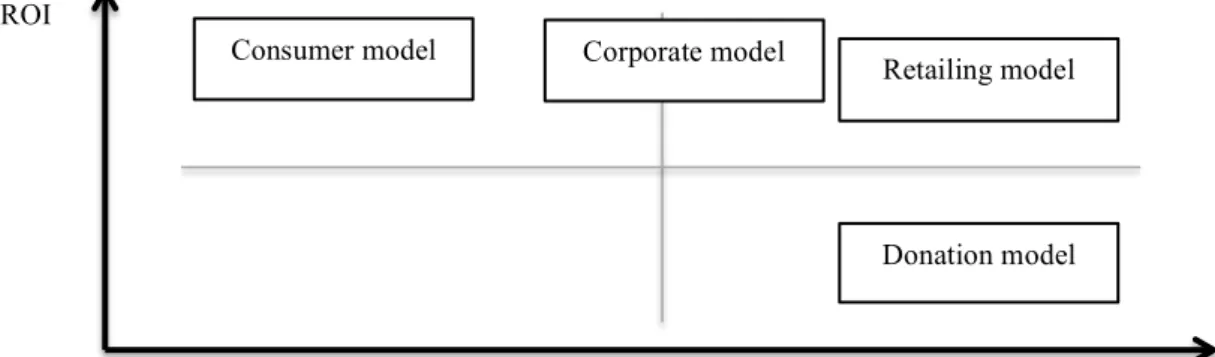
Fernandez, 2012). Therefore, the first two dimensions that are important to assess primarily are the organizational social impact and sustainability. The following graph with the Mozambikes’ business models shows a very useful tool to analyze and compare both simultaneously (Bell et al, 2010).
The retailing and donation models have the highest social impact, since they reach the Social Impact ROI
Consumer model Corporate model
Donation model Retailing model
Source: Bell et al, 2010
social enterprise’s target directly. However, the donation model is the least sustainable due to the current funding method used. The size of the donations given was not significant for the overall revenue. On the other hand, although the consumer model has a high ROI, it is not linked with the mission. Thus, the models with the most potential are the retailing and corporate models, due to their high social impact and ROI.
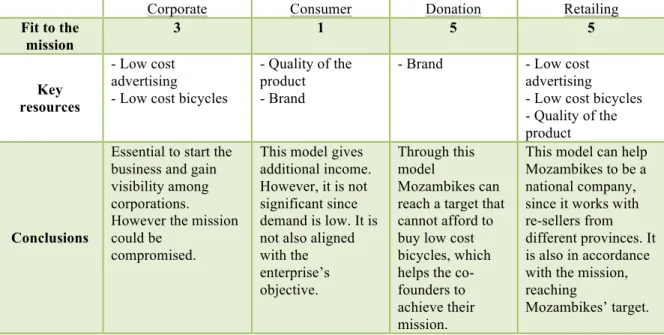
Also regarding the business models’ analysis, it is important to go a step further and make a comprehensive evaluation. The literature about the evaluation of social business models is scarce. Most of the authors only refer superficially to some key factors of success of social business models. Therefore, the following tool used is the most structured assessment instrument for non-profit business models. This is a clear business models’ evaluation for entrepreneurs, developed in Santos (2009) and originally has six areas, sustainability, feasibility, potential scalability, potential replicability, and impact multiplier.33 Two more relevant dimensions were added (fit to mission and key resources for competitive advantage) to complete the assessment, since Mozambikes integrates three business models with different inputs on these dimensions. These different dimensions were evaluated with a scale from 1 to 5 (1 worst, 5 best) in order to facilitate the comparison between the models. Using this tool, the following table presents the main conclusions regarding the Mozambikes’ business models.
Business Models
Corporate Consumer Donation Retailing
Sustainability 5 5 2 4 Feasibility 5 3 2 5 Potential Scalability 4 3 3 5 Potential Replicability Replicable to countries where bicycle is used as an efficient advertising channel. Replicable to any market. Replicable to countries where people do not have purchasing power to buy low cost bicycles.
Replicable to countries where bicycle is an efficient transport and is used as an advertising channel.
33 The impact multiplier factor was not used in this evaluation since it was not possible to estimate the value of it for
Corporate Consumer Donation Retailing Fit to the mission 3 1 5 5 Key resources - Low cost advertising
- Low cost bicycles
- Quality of the product - Brand
- Brand - Low cost advertising
- Low cost bicycles - Quality of the product
Conclusions
Essential to start the business and gain visibility among corporations. However the mission could be
compromised.
This model gives additional income. However, it is not significant since demand is low. It is not also aligned with the enterprise’s objective. Through this model Mozambikes can reach a target that cannot afford to buy low cost bicycles, which helps the co-founders to achieve their mission.
This model can help Mozambikes to be a national company, since it works with re-sellers from different provinces. It is also in accordance with the mission, reaching
Mozambikes’ target.
2. Concerning the organizational readiness to scale up, there are two main assessment
frameworks, the SCALERS (Bloom & Smith, 2010), and 5 Rs (Deeds et al, 2002). The SCALERS method is based on seven organizational capabilities that should be developed in order to have a successful growth. These are:Staffing - Human Capital, Communication
- Social Capital, Alliance-Building - Social Capital + New resources, Lobbying - Political
Capital, Earnings Generation - Financial Capital, Replicating - Potential Capital,
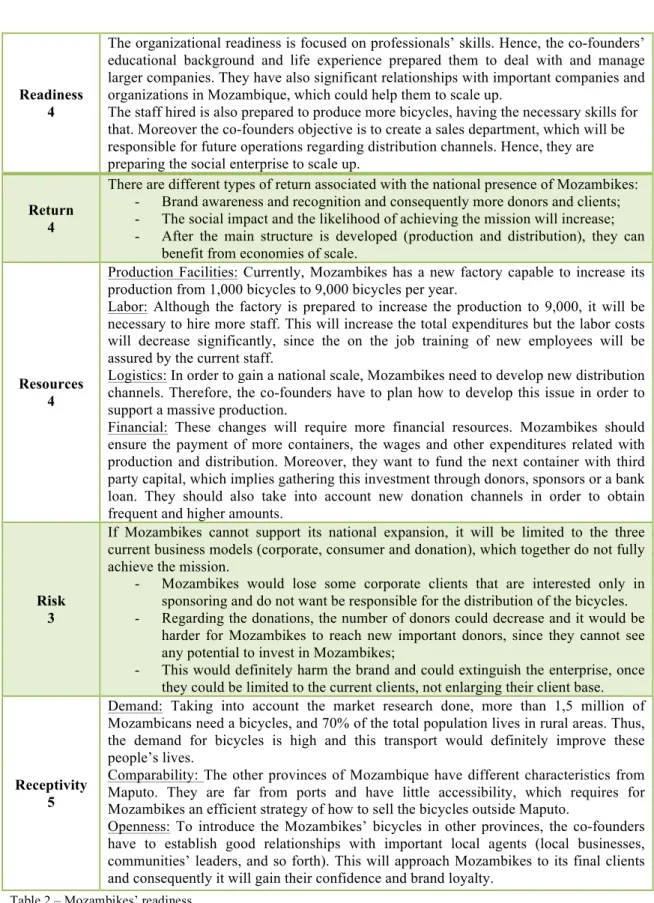
Stimulating Market Forces - Financial Capital. The 5 Rs model is based on five dimensions: readiness, return, resources, risk and receptivity. These two methods could either be focused on one business model or encompass the entire organization. The 5 Rs model was used to assess Mozambikes’ readiness, since it is a more practical and objective tool. In this case Mozambikes was assessed as a whole, because the different business models were already analyzed separately before. The 5Rs were also evaluated by a numerical scale (1 low, 5 high) in order to have an objective and quantitative assessment of each dimension. Therefore, the table below presents the 5 R’s assessment.
As a general assessment the organization shows to be ready for a first step to scale up.
3. Theoretically, there are different approaches regarding scaling up strategies. The goal of
scaling up in non-profit organizations is to increase their social impact. However, there are
Readiness 4
The organizational readiness is focused on professionals’ skills. Hence, the co-founders’ educational background and life experience prepared them to deal with and manage larger companies. They have also significant relationships with important companies and organizations in Mozambique, which could help them to scale up.
The staff hired is also prepared to produce more bicycles, having the necessary skills for that. Moreover the co-founders objective is to create a sales department, which will be responsible for future operations regarding distribution channels. Hence, they are preparing the social enterprise to scale up.
Return 4
There are different types of return associated with the national presence of Mozambikes: - Brand awareness and recognition and consequently more donors and clients; - The social impact and the likelihood of achieving the mission will increase; - After the main structure is developed (production and distribution), they can
benefit from economies of scale.
Resources 4
Production Facilities: Currently, Mozambikes has a new factory capable to increase its production from 1,000 bicycles to 9,000 bicycles per year.
Labor: Although the factory is prepared to increase the production to 9,000, it will be necessary to hire more staff. This will increase the total expenditures but the labor costs will decrease significantly, since the on the job training of new employees will be assured by the current staff.
Logistics: In order to gain a national scale, Mozambikes need to develop new distribution channels. Therefore, the co-founders have to plan how to develop this issue in order to support a massive production.
Financial: These changes will require more financial resources. Mozambikes should ensure the payment of more containers, the wages and other expenditures related with production and distribution. Moreover, they want to fund the next container with third party capital, which implies gathering this investment through donors, sponsors or a bank loan. They should also take into account new donation channels in order to obtain frequent and higher amounts.
Risk 3
If Mozambikes cannot support its national expansion, it will be limited to the three current business models (corporate, consumer and donation), which together do not fully achieve the mission.
- Mozambikes would lose some corporate clients that are interested only in sponsoring and do not want be responsible for the distribution of the bicycles. - Regarding the donations, the number of donors could decrease and it would be
harder for Mozambikes to reach new important donors, since they cannot see any potential to invest in Mozambikes;
- This would definitely harm the brand and could extinguish the enterprise, once they could be limited to the current clients, not enlarging their client base.
Receptivity 5
Demand: Taking into account the market research done, more than 1,5 million of Mozambicans need a bicycles, and 70% of the total population lives in rural areas. Thus, the demand for bicycles is high and this transport would definitely improve these people’s lives.
Comparability: The other provinces of Mozambique have different characteristics from Maputo. They are far from ports and have little accessibility, which requires for Mozambikes an efficient strategy of how to sell the bicycles outside Maputo.
Openness: To introduce the Mozambikes’ bicycles in other provinces, the co-founders have to establish good relationships with important local agents (local businesses, communities’ leaders, and so forth). This will approach Mozambikes to its final clients and consequently it will gain their confidence and brand loyalty.
diverse ways to do so. Generically there are two main ways to scale up by depth and by wide (Bloom & Chaterji, 2009). The former aims at increasing the outcomes, while the latter aims at expanding the project, serving more people. Deeds et al. (2002) present a more specific perspective, talking about “what” to scale up (programs – a set of procedures serving a social purpose, principles – guidelines for how to serve a specific social purpose, and organizations – a system for mobilizing people and resources for a social purpose), and “how” to scale up (dissemination – sharing information and knowledge, affiliation – an agreement between two or more parties to be a part of a network, and branching – the same project in other places, which are legally part of a large organization).34
Other author, Gillespie (2004) cited in Creech (2008) looks at organizational (increase organizational strengths), functional (increase in the types of activities and integration with other programs), political (increase political power and engagement) and quantitative (expanding a program size, geographical base, or budget) dimensions. For each of these dimensions the author develops several specific strategies.35
Mozambikes’ strategies will be analyzed based on the Gillespie’s perspective aforementioned, since it offers several scaling up options and presents a clear division among the different dimensions. Furthermore, the strategy developed will also be based on the co-founders’ priorities and the analyses made before.
The co-founders’ goal is to sell 25,000 bicycles per year, achieving a national presence in Mozambique. They defined some priorities for the next years: hire a sales director, develop a network of bicycle re-sellers and technicians throughout the country, and produce new bicycle complements. Therefore, through these priorities the co-founders
34 The author designed a matrix covering these two criteria, which helps the entrepreneurs to visualize the different
options.
want to invest on a functional dimension, integrating a new type of activities - the network of re-sellers and new bicycle complements. This could be developed as a vertical
integration - add other activities related with the value chain - or a horizontal integration -
integrate new unrelated activities or programs in the existent organization (Gillespie, 2004). In this case Mozambikes needs to invest in a vertical integration, integrating the network of re-sellers in its value chain. Through this vertical integration Mozambikes could developed the initial business model designed (retailing model), which allows the enterprise to distribute bicycles in all provinces, maintaining, at the same time, its production in Maputo.
Therefore, by adding the retailing model to the current business models (corporate, donation and consumer), Mozambikes could offer two options to corporations: advertising + bicycles, or only advertising. Moreover, the consumer model should be maintained only as an extra, since it is not in accordance with the mission.
These improvements would also attract new sponsors and donors, due the higher social impact and Mozambikes could also increase its market share and maintain its competitive advantage, selling high quality bicycles at low prices, which is unique in Mozambique. Concerning the bottlenecks, there are some limitations that this strategy might have. Hence, the co-founders should pay attention to the following bottlenecks and work very hard to surpass them in order to have a successful scaling up process.
1st Bottleneck
The co-founders cannot establish the network of re-sellers, since they work in Maputo and do not have a regular contact with them, which makes it impossible to develop this vertical expansion, due to geographic limitations.
2nd bottleneck
Rural Mozambicans cannot have purchasing power for their bicycles, even at low rates, and therefore this vertical expansion is not the most suitable for Mozambikes’ clients. The co-founders will be forced to work with the current business models and their limitations.
3rd bottleneck
If corporate clients continue buying the whole package and not just the advertising, the retailing model cannot be developed and Mozambikes’ mission can be compromised, since the co-founders cannot control the bicycles’ final clients.
Bibliographic References
• Bell, Jeanne, Jan Masaoka and Steve Zimmerman. 2010. Non-profit
sustainability: Making strategic decisions for financial sustainability, San
Francisco: Jossey-Bass
• Berrisford, Kate. 2012. “Mozambikes Creates a Sustainable Cycling Culture in Mozambique”, Green Africa Directory, November 19.
http://www.greenafricadirectory.org/mozambikes-creates-a-sustainable-cycling-culture-in-mozambique/ (accessed February 25, 2013)
• Bloom, Paul and Aaron K. Chaterji. 2009. “Scaling Social Entrepreneurial Impact”, California Management review vol. 51, no. 3
• Creech, Heather. 2008. “Scale up and Replication for social and environmental enterprises”, Report for SEED Initiative Research Programme
• Dees, J Gregory, Beth Battle Anderson and Jane Wei-Skillern. 2002. “Pathways to Social Impact:Strategies for Scaling Out Successful Social Innovations”, CASE Working Paper Series No. 3
• Eder, Andrew. 2011. “Mozambikes Pedals to Promote Development Via
Low-Cost Bicycles”, Next billion: development through enterprises, September 7.
http://www.nextbillion.net/blogpost.aspx?blogid=2465 (accessed February 15,
2013)
• Foster, William Landes, Peter Kim and Barbara Christiansen. 2009. “Ten Non-Profit Funding Models”, Standford Social Innovation, n.d.
http://www.ssireview.org/articles/entry/ten_nonprofit_funding_models/ (accessed
February 15, 2013)
• Ghazi, Sami. 2011. “Mozambikes”, Kabissa, November 17.
http://www.kabissa.org/mozambikes (accessed February 15, 2013)
• Social Entrepreneurship Institute.2012.
Mozambikes Case Study Interview • Mozambikes, http://www.mozambikes.com (accessed from February 2013 until
May 2013)
• Mozambikes’ blog, http://mozambikesblog.wordpress.com (accessed from February 2013 until May 2013)
• Rosenberg, Heidi and Hellen Westmoreland. 2009. “Lessons from Evaluators’ Experiences with Scale”, The evaluation Exchange, vol. 15, no. 1
• Sapo Notícias Moçambique. 2012. “Mozambikes monta fábrica de bicicletas”, video, July 5. http://videos.sapo.mz/E0YUP6zgHREC41LEUZ4Y (accessed February 15, 2013)
• Souissi, Elyssa. 2012. “Mozambikes “ride for an ethical planet!””, United Passion
for Peace, April 26. http://webzine.unitedfashionforpeace.com/ethical-planet/mozambikes-ride-for-an-ethical-planet/ (accessed February 15, 2013) • The Willion James Foundation. n.d. “Interview with Lauren Thomas,
Co-founder of Mozambikes”
http://williamjamesfoundation.org/index.cfm?fuseaction=Page.viewPage&pageId= 1386 (accessed February 15, 2013)
• Thomas, Lauren. 2012. “Mozambikes Limitada”, Powerpoint slides, Mozambique
• UNC Kenan-Flager. 2011. “Mozambikes: On the road in Mozambikes”,
December 15, http://blogs.kenan-flagler.unc.edu/impact/2011/12/15/mozambikes-on-the-road-in-mozambique/ (accessed February 15, 2013)
• USAID. 2010. “USAID Country Health Statistical Report – Mozambique”
• Vale, Sara. 2012. “Mozambikes: Pedalar para mudar o mundo”, p3, May 25, http://p3.publico.pt/vicios/em-transito/3174/mozambikes-pedalar-para-melhorar-o-mundo (accessed February 15, 2013)
• Lyon, Fergus and Heather Fernandez. 2012. “Scaling up social enterprise: Strategies taken from early years provides”, TSRC-informing civil society, working paper 79
• Santos, Filipe. 2009. “Business Model Innovation Workbook: How entrepreneurs design and assess innovative business models”, INSEAD
• Bloom, Paul N. and Brett R. Smith. 2010. “Identifying the Drivers of Social Entrepreneurial Impact: Theoretical Development and an Exploratory Empirical Test of SCALERS”, Journal of Social Entrepreneurship, Vol. 1 No. 1 126–145
• Weiss, Heather B. and Helen J. Malone. 2009. “A conversation with Mike Smith”, The evaluation Exchange, vol. 15, no. 1