LIVE2WORK PROJECT:
METHODOLOGY FOR A LIFE
PROJECTS INTERVENTION
DEVELOPED FOR PEOPLE IN
PROFESSIONAL VULNERABILITY
LIVE2WORK PROJECT:
METHODOLOGY FOR A LIFE
PROJECTS INTERVENTION
DEVELOPED FOR PEOPLE IN
PROFESSIONAL VULNERABILITY
Joana Carneiro Pinto1, Ana Azeiteiro2, Mette Holm Harrsen3& Helena
Rebelo Pinto1
Faculty of Human Sciences, Catholic University of Portugal (Portugal) Santa Casa da Misericórdia de Lisboa (Portugal)
Project Live2Work (L2W): GOAL
•
ERASMUS+ Key Action 2 - Strategic Partnership for cooperation
and the exchange of good practices
•
Partnership involving 4 countries (PT, FR, DE, and CZ) and 8
different institutions
•
To develop a work methodology for professionals dealing with
young adults facing professional vulnerability, including migrants
and refugees actively promoting the development of skills
relevant to their ability to build healthy and sustainable life
trajectories
Project Live2Work (L2W): OUTPUTS
1. Handbook of the project’s conceptual frame - concerning the (re)
construction of life projects of those in professionally vulnerable situations
2. Toolbox - consists of a total of 15 instructional activities, organized into four
distinctive modules: self-knowledge, knowledge of the world, transitional
skills and decision making
3. Course guide - a general set of instructions (includes a PowerPoint course) to
assist the training of professionals on how to use all products associated with
the project
4. Piloting courses/ in-service training courses - aimed at testing the following
materials: L2W conceptual framework, toolbox, and course guide (including
workshop content and structure)
5. Online audio-visual learning scenarios - Up to now 4 videos have been
produced within the project’s context: One is for international promotional
activities and the remaining three are tutorial videos
6. Moodle courses and learning platform on website - with a set of interactive
materials for online learning, that are easy and intuitive to use
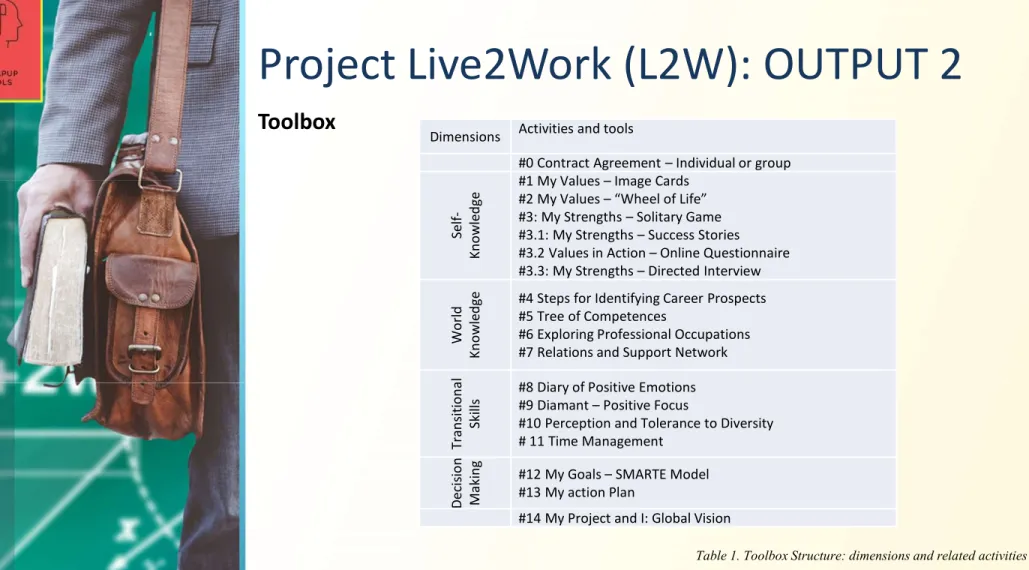
Project Live2Work (L2W): OUTPUT 2
Toolbox
Table 1. Toolbox Structure: dimensions and related activities
Dimensions/ Modules Sub-dimensions
Self-knowledge
- What characteristics do I have?
- How did I get to who I am? What was my path? - Who do I want to be?
- What do I need to change? - What skills do I need to develop?
Clarification of concept and development of self-esteem: - Personality -Character strengths - Values -Interests -Skills World knowledge
- What opportunities do I have? - What obstacles do I anticipate?
- Which resources do I have to overcome those obstacles? - Who is part of my social network?
- Who supports me?
- World exploration (academic, professional) to find realistic professional opportunities
- Identification and promotion of networks, to find role models to enhance self-efficacy and trust in oneself
Transitional skills
- Am I tolerant of difference? - What adaptability skills do I have? - How do I manage my time?
- Motivation, persistence, perseverance, resilience, and self-efficacy
- Communication and tolerance to difference - Time management
Decision-making
- What goals do I have for my future?
- What do I want to achieve in my several life domains? - What steps, tasks, activities I must do in order to achieve my goals?
- What obstacles do I anticipate, and what resources can I use to overcome them?
- Development of life/career goals
Project Live2Work (L2W): OUTPUT 2
Toolbox
Table 1. Toolbox Structure: dimensions and related activities
Dimensions Activities and tools
#0 Contract Agreement – Individual or group
Se lf-Kn ow le dg
e #1 My Values – Image Cards#2 My Values – “Wheel of Life” #3: My Strengths – Solitary Game #3.1: My Strengths – Success Stories #3.2 Values in Action – Online Questionnaire #3.3: My Strengths – Directed Interview
W or ld Kn ow le dg
e #4 Steps for Identifying Career Prospects #5 Tree of Competences
#6 Exploring Professional Occupations #7 Relations and Support Network
Tr an si tio na l Sk ill
s #8 Diary of Positive Emotions#9 Diamant – Positive Focus
#10 Perception and Tolerance to Diversity # 11 Time Management De ci si on M ak in g
#12 My Goals – SMARTE Model #13 My action Plan
My values - Image Cards
• Goals
– Motivate the participants to explore and identify their values, aiming the definition of goals. • Instructions
– 1. Introduce the concept of value to the participants to make sure they understand it and know how to use it in the exercise. – 2. Hand out #2. My values – Image cards to each participant and divide the group in pairs.
– 3. Ask the participants to choose 2 values image cards that represent a positive experience from their past. It’s vital that the experience is positive.
– 4. After this, please, give the groups a few minutes to reflect, in pairs, and share the positive experiences that lead to their choice, as well as to
registerthe key elements that support the value card chosen.
– 5. Following this, the participants should choose 2 value cards that represent their present life. Once again, highlight that it’s very important to only mention positive experiences.
– 6. After this, please, give the groups a few minutes to reflect, in pairs, and share the positive experiences that lead to their choice, as well as to
registerthe key elements that support the value card chosen.
– 7. As soon as this is done, ask the participants to reflect on possible connections between the values from the past and the present. • . How are the values connected? Have the values changed? If so, how and why?
• . Ask the participants to register the connection between the values from the Past and the Present. – 8. Lead the participants to choose only one value card representing their future life.
Self-knowledge: Values
Value Definition
Achievement It is important to accept new challenges and work hard to improve
Ambition Valuing hard work; with aspirations
Beauty Valuing the beauty of nature and the arts
Creativity It's important to have new ideas or create new things
Education Valuing the transmission of knowledge in the different areas of life
Equality Equal opportunities for all
Evolution Valuation of scientific and technological evolution
Family Valuing family priority throughout life
Freedom Freedom of action and thought
Generosity Valuation of free actions for the benefit of others
Health It is important to be healthy and physically active
Helping others Be helpful and dedicated; Worry about the well-being of others
Humility It's important to be humble and modest about what I do;
Independence It's important to make your own decisions and do things your way; Valorisation of self-sufficiency, autonomy
Inner Peace In peace with oneself
Leisure Valuing of personal rest and personal activities
Life Valuing the right to life, above all else
Love Deep emotional and spiritual intimacy
Self-knowledge: Values
Value Definition Money (economic prosperity)/
fortune It is important to be successful in making money
Nature (worry about environment) It is important to protect and preserve the environment
Openness Tolerance towards different ideas and beliefs
Peace Valorisation of a world free of war and conflict
Pleasure Wish fulfilment
Positivity Positive posture with the self, with others and the with life events
Privacy It is important to have some time or place just for you
Responsibility It is important to be considered honest and trustworthy
Self-discipline Self-control
Sense of belongingness It is important to be accepted by others and feel part of the group; Feeling of belonging and being accepted
Social justice Concern for the correction of injustices, with the help of the weak
Social order Valuation of social regulation
Social power Control over others, domain
Spirituality It is important to have spiritual beliefs and believe that we are part of something higher than ourselves
Success Achieve important goals
True To be genuine and true
Wisdom Mature understanding of life
•
Values
•
The beliefs that define what is most
important for people; the motivators of
people, providing life purpose and
meaning; personal life values influence
behaviour, choices, emotions, habits,
lifestyle and social experiences. Focusing
on one’s core values, enables the
participants to set personal goals based on
what is important for themselves.
My strenghts – Solitary Game
• Goals
– To help participants identify and explore their personal Character Strengths and resources.
– Gaining insight and knowledge about one’s strengths and resources enhances the possibility to reinforce these. A vocabulary and knowledge of personal Character Strengths is both motivating and useful when trying to create lasting improvements in life
• Instructions
– 1. Introduce the concept of Strength and present the different strengths on the cards, one by one, to the participants.
– 2. Divide the participants into groups of 2 or 3. Handout a set of cards, charts and instructions for each group. This allows them to share views, and examples of strengths from everyday life.
– 3. Ask each participant to rank the strengths cards from “More like me” to “Least like me”. You may use the questions presented in the handout, to help participants rank their strengths.
– 4. All participants must find, at least, 5 to 7 Top strengths.
– 5. Ranking the strengths makes each participant aware of their own personal character strengths, which helps create narratives about opportunities in life. (Register them at the handout).