Creative Support Musical Composition
System:
a study on Multiple Viewpoints
Representations in Variable Markov
Oracles
Nádia de Sousa Varela de Carvalho
Mestrado Integrado em Engenharia Informática e Computação Supervisor: Gilberto Bernardes de Almeida
a study on Multiple Viewpoints Representations in
Variable Markov Oracles
Nádia de Sousa Varela de Carvalho
Mestrado Integrado em Engenharia Informática e Computação
Approved in oral examination by the committee:
Chair: Prof. João Jacob
External Examiner: Prof. Maria Navarro Cáceres Supervisor: Prof. Gilberto Bernardes de Almeida July 23, 2020
The mid-20th century witnessed the emergence of an area of study that focused on the automatic generation of musical content by computational means. Early examples focus on offline process-ing of musical data and recently, the community has moved towards interactive online musical systems. Furthermore, a recent trend stresses the importance of assistive technology, which pro-motes a user-in-loop approach by offering multiple suggestions to a given creative problem.
In this context, my research aims to foster new software tools for creative support systems, where algorithms can collaboratively participate in the composition flow. In greater detail, I seek a tool that learns from variable-length musical data to provide real-time feedback during the com-position process.
In light of the multidimensional and hierarchical structure of music, I aim to study the repre-sentations which abstracts its temporal patterns, to foster the generation of multiple ranked solu-tions to a given musical context. Ultimately, the subjective nature of the choice is given to the user to which a limited number of ‘optimal’ solutions are provided.
A symbolic music representation manifested as Multiple Viewpoint Models combined with the Variable Markov Oracle (VMO) automaton, are used to test optimal interaction between the multi-dimensionality of the representation with the optimality of the VMO model in providing both style-coherent, novel, and diverse solutions. To evaluate the system, an experiment will be conducted to validate the tool in an expert-based scenario with composition students, using the creativity support index test.
Keywords: Musical Composition, Pattern Analysis, Variable Markov Oracle, Context-dependent, Variable-length, Multiple Viewpoints, Musical Representations
Em meados do século XX, assistiu-se ao surgimento de uma área de estudo focada na geração au-tomática de conteúdo musical por meios computacionais. Os primeiros exemplos concentram-se no processamento offline de dados musicais mas, recentemente, a comunidade tem vindo a explo-rar maioritariamente sistemas musicais interativos e em tempo-real. Além disso, uma tendência recente enfatiza a importância da tecnologia assistiva, que promove uma abordagem centrada em escolhas do utilizador, oferecendo várias sugestões para um determinado problema criativo.
Nesse contexto, a minha investigação tem como objetivo promover novas ferramentas de soft-ware para sistemas de suporte criativo, onde algoritmos podem participar colaborativamente no fluxo de composição. Em maior detalhe, procuro uma ferramenta que aprenda com dados musi-cais de tamanho variávelpara fornecer feedback em tempo real durante o processo de composição. À luz das características de multidimensionalidade e hierarquia presentes nas estruturas musi-cais, pretendo estudar as representações que abstraem os seus padrões temporais, para promover a geração de múltiplas soluções ordenadas por grau de optimização para um determinado contexto musical. Por fim, a natureza subjetiva da escolha é dada ao utilizador, ao qual é fornecido um número limitado de soluções ’ideais’.
Uma representação simbólica da música manifestada como Modelos sob múltiplos pontos de vistacombinada com o autómato Variable Markov Oracle (VMO), é usada para testar a interação ideal entre a multidimensionalidade da representação e a idealidade do modelo VMO, fornecendo soluções coerentes, inovadoras e estilisticamente diversas. Para avaliar o sistema, será realizado um teste para validar a ferramenta num cenário especializado com alunos de composição, usando o modelo de testes do índice de suporte à criatividade.
Keywords: Composição Musical, Análises de Padrões, Variable Markov Oracle, Representações Múltiplas, Dependentes de contexto, Tamanho variável, Representações Musicais
I would like to express my deep gratitude to Professor Gilberto for his patient advice, enthusiastic incentives and valuable critiques of this research work.
I would also like to extend my thanks to the composers who have enthusiastically answered my request and participated in the evaluating process.
Finally, I wish to thank my family and, in particular, my parents for their constant support and encouragement throughout my studies, both in the musical and informatic fields.
Nádia de Sousa Varela de Carvalho
largely of repetition, come to an end, before the whole story is happily told all over again.”
Zuckerkandl, 1956
1 Introduction 1
1.1 Context and Motivation . . . 1
1.2 Problem Definition and Objectives . . . 2
1.3 Methodology . . . 2
1.4 Document Structure . . . 3
1.5 Publication . . . 3
2 Knowledge Support Systems for Music: A literature review 5 2.1 Knowledge Support Music Systems . . . 6
2.1.1 Important Concepts in Music Informatics . . . 6
2.1.2 An Overview of CAAC Systems . . . 7
2.1.2.1 CAAC Systems that use Statistical Modeling . . . 7
2.1.2.2 CAAC Systems that use Deep Learning . . . 9
2.2 Computational Representation of Symbolic Musical Structures . . . 9
2.2.1 String Modeling . . . 10
2.2.1.1 String Modeling of Monophonic Music . . . 10
2.2.1.2 String Modeling of Polyphonic Music . . . 11
2.2.2 Multiple Viewpoint Models . . . 12
2.2.3 Geometric Modeling . . . 13
2.2.4 Multidimensional Point Sets . . . 14
2.2.5 Models based on Formal Grammars and Syntax Trees . . . 15
2.2.6 Graph-based representations . . . 18 2.3 Generative Algorithms . . . 19 2.3.1 Compression algorithms . . . 19 2.3.1.1 Lempel-Ziv 77 and 78 . . . 19 2.3.1.2 Burrows–Wheeler transform . . . 20 2.3.1.3 SIA-based algorithms . . . 20 2.3.2 Genetic Algorithms . . . 21 2.3.3 Markov Models . . . 22 2.3.3.1 N-grams . . . 22
2.3.3.2 Hidden Markov Models . . . 23
2.3.3.3 Variable Order Markov Models . . . 23
2.3.4 Factor Oracle . . . 24
2.3.5 Variable Order Markov Oracle . . . 26
2.3.6 Deep Learning Techniques . . . 26
2.4 Summary . . . 27 ix
3 Encoding Information from Symbolic Music Manifestations: A Multiple Viewpoint
Model Approach 29
3.1 Unpacking a Musical Score . . . 30
3.2 MusicXML . . . 32
3.3 Music21 . . . 33
3.4 Abstracting multiple viewpoints from parts . . . 33
3.4.1 Part Segregation: Separation of Voices . . . 33
3.4.2 The Part Events’ Viewpoints . . . 34
3.4.2.1 Metadata Viewpoints . . . 34 3.4.2.2 Basic Viewpoints . . . 34 3.4.2.3 Duration Viewpoints . . . 36 3.4.2.4 Pitch Viewpoints . . . 36 3.4.2.5 Expression Viewpoints . . . 36 3.4.2.6 Time Viewpoints . . . 37 3.4.2.7 Key Viewpoints . . . 37 3.4.2.8 Phrase Viewpoints . . . 37 3.4.2.9 Derived Viewpoints . . . 38
3.5 Abstracting multiple viewpoints from inter-part dependencies . . . 39
3.5.1 Metadata and Duration Viewpoints . . . 40
3.5.2 Key Viewpoints . . . 40
3.5.3 Chord Viewpoints . . . 40
3.6 From part events to a new Musical Score . . . 42
4 My Musical Suggester 45 4.1 Architecture . . . 45
4.2 Representation Sub-Module . . . 47
4.2.1 Multiple Viewpoint Models . . . 47
4.2.2 Segmentation of events . . . 49
4.2.3 Multiple Viewpoint Weights . . . 50
4.3 Generation Sub-Module . . . 51
4.3.1 Variable Order Markov Oracle . . . 52
4.3.2 Generation of sequences . . . 55
4.3.2.1 Single-Part Generation . . . 56
4.3.2.2 Generation of synchronized Multiple Parts . . . 58
4.3.2.3 Ordering the Generated Sequences . . . 62
4.4 Interface Module . . . 62
4.4.1 Standalone Application . . . 62
4.4.2 The Database Menu . . . 63
4.4.3 The Viewpoints Menu . . . 64
4.4.4 The Generation Menu . . . 66
5 Evaluation and Results 69 5.1 Evaluation protocols . . . 69
5.1.1 Task-Oriented Test . . . 69
5.1.2 Creative Support Index . . . 71
5.2 Results . . . 73
5.2.1 Task-Oriented Test . . . 73
6 Conclusions 77 6.1 Summary . . . 77 6.2 Contribution . . . 77 6.3 Future Work . . . 78 References 79 A Table of Viewpoints 85
B Creativity Support Index Form 95
B.1 Part I . . . 96 B.2 Part II . . . 97
2.1 The first four bars of J. S. Bach’s Courante of his Suite No. 1 in G major, BWV
1007 . . . 10
2.2 Geometric Modeling for the first four bars of J. S. Bach’s Prelude Courante of his Suite No. 1 in G major, BWV 1007 . . . 15
2.3 Multidimensional Point Sets projection of onset time and chromatic pitch for the first four bars of J. S. Bach’s Prelude Courante of his Suite No. 1 in G major, BWV 1007 . . . 16
2.4 Multidimensional Point Sets projection of onset time and diatonic pitch for the first four bars of J. S. Bach’s Prelude Courante of his Suite No. 1 in G major, BWV 1007 . . . 17
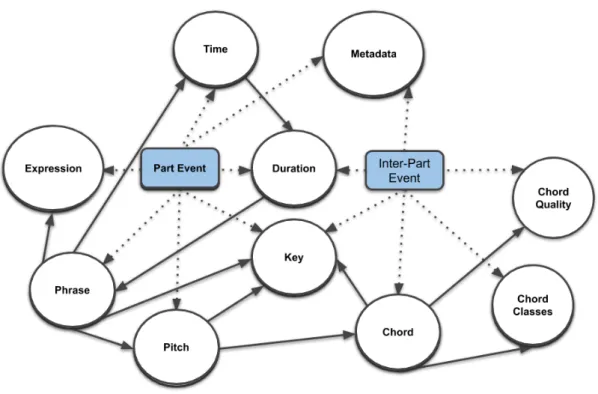
3.1 Organization of All Viewpoints. Dotted arrows represent relations of Viewpoint categories to events and full arrows represent dependencies between Viewpoint categories. . . 30
3.2 Part division of the first six measures of J. S. Bach’s Fugue I in C Major, BWV 846 from the Well Tempered Clavier (First Book). . . 31
3.3 Part division of the first two measures of J. M. Whyte’s We shall hear a voice, an immortal voice (1890). . . 31
3.4 Part division of the first four measures of the 3rd Movement (Rondo Alla Turca) of Mozart’s Piano Sonata No. 11, K.331. . . 32
3.5 Voice making in a passage with 2-note chords that should be divided in two voices 33 3.6 Organization of Part Viewpoints, by category. . . 35
3.7 Original and Chordified Versions of the first five measures of J.S. Bach’s Cantata, "Schwingt freudig euch empr", BWV 36 . . . 40
3.8 Organization of Inter-Part Viewpoints. . . 41
4.1 General Architecture of My Musical Suggester. . . 45
4.2 Structure of My Musical Suggester’s Representation Sub-Module. . . 46
4.3 Structure of My Musical Suggester’s Generation Sub-Module. . . 47
4.4 Structure of My Musical Suggester’s Interface Module. . . 47
4.5 Process of Extracting the Multiple Viewpoints for both Part and Inter-Part Events, starting from Part extraction to normalization of features. . . 48
4.6 VMO in 4.6b constructed with the duration length information of the notes in the score in 4.6a. . . 53
4.7 VMOs constructed with different threshold values from the same sequence and same feature weights. . . 55
4.8 Three Conditions in a generation from a single oracle, that started with a threshold LRS of 2 and probability of taking forward links of 26%. The algorithm used to choose sfx is the one that chooses uniformly among all the possible suffix (or reverse suffix) links given the current state. The current state is annotated by a green box and the next real state by a blue circle. In the jump by suffix links, a red
box is used to annotate the state to which the jump occurs. . . 59
4.9 A multiple part model, in which the last VMO, surrounded by a green box, matches the artificial line extracted from inter-part information. . . 60
4.10 In Figure 4.10a, we can observe a block identification for a forward transition, where the current state is the one in the green box and the transition chosen was the one made by the blue arrow in the artificial line. The block stored is the one in the blue box. In Figure 4.10b, we can see the respective musical score. . . 61
4.11 General Features of the GUI. . . 63
4.12 The Database Menu with music on the database path, and a few music selected to parse. . . 64
4.13 The Viewpoints Menu after clicking on View Automatic Weights. . . 65
4.14 The Generation Menu after clicking on Create Oracle. . . 66
5.1 Instructions of First Task. . . 70
5.2 Instructions of Second Task. . . 72
5.3 CSI average score by factor, measured from 0 (less relevance of the software in this factor) to 20 (higher relevance of the software in this factor). . . 74
5.4 Average values of factors importance, measured from 0 (less interest) to 5 (higher interest). . . 75
B.1 Part I of Creativity Support Index . . . 96
2.1 Different possible Pitch Encodings for the example in Figure 2.1, using the various possible techniques presented in Section 2.2.1.1, S.1. . . 11 2.2 Different possible Rhythm Encodings for the example in Figure 2.1, using the
various possible techniques presented in Section 2.2.1.1, S.2. . . 12 2.3 List of possible basic and derived viewpoints and their description . . . 13 2.4 List of some basic and derived viewpoints for the first two bars’ events of Figure 2.1 14
AO Audio Oracle
CAAC Computer-aided algorithmic composition CSI Creativity Support Index
FO Factor Oracle
VMO Variable Markov Oracle
Introduction
1.1
Context and Motivation
The mid-20th century witnessed the emergence of an area of study that focus on the automatic creation of musical content by computational means. Early examples focus on offline processing of musical data. Gradually, new communities have been established with their focus on musical informatics in societies such as Sound and Music Computing (SMC)1, the International Computer Music Association (ICMA)2 and the International Society for Music Information Retrieval (IS-MIR)3. Recently, those communities have expanded towards interactive online musical creation. Furthermore, a recent trend stresses the importance of computer-assisted technology, which pro-motes a human-in-loop approach by offering multiple suggestions to a given creative problem [78]. In light of the creative challenge most authors face when addressing a new work, independent of the support they use to express their creativity, is a possible lack of creative flow once they stare at a blank page. Unlocking this initial process with some initial co-creative brainstorming between human and computer can help a fluid craft of a narrative. In this context, our research aims to foster new software tools for creative support systems, where algorithms can collaboratively participate in the composition flow and assist in the process. As composers, we often turn to support tools that help us in achieving new ideas in order to overcome blockages and frustration. We feel that there is not yet a tool that does it in an efficient manner, as most that can be encountered in the actuality have not reached the artistic community in the form of applications, just small research systems, and those that have, do not allow for transparent solutions, adapted to the needs of the user at different times, without requiring a great degree of learning involvement. In that sense, we propose to develop a co-creative tool that unlocks the creative potential of a composer, offering real-time feedback, through the suggestion of musical sequences that can foster new ideas to populate and disrupt the creative process.
As the creative process is individual and subjective, as a composer writes using their own interests, language and techniques, the system has to learn from variable-length data, as a user
1http://www.smcnetwork.org/ 2http://www.computermusic.org/ 3https://ismir.net/
may want to learn from a small number of notes or measures or a database of musical pieces (either their own or from other composers) and it cannot only learn from a certain style, as each composer has its manner of creating.
1.2
Problem Definition and Objectives
Following that view, our work aims to answer the following research question: how to find a balance between the universes of computational representations of a variable musical context, ab-stract the patterns that best define it and generate both style-coherent, novel, and diverse solutions from them.
To answer this question, and in a search for supporting the unlocking of the creative composi-tion process, we defined the following three objectives for our research:
• To develop a system for creative support that learns from musical data of variable size and structure and that provides real-time feedback during the composition process;
• To study the representations that abstract temporal patterns of hierarchical and multidimen-sional musical structures, and
• To implement a system that generates multiple solutions, e.g. variations and continuations, for a given musical context, ordered by their similarity to the original, so that the user can make his choice or even, from time to time, provoke the composer to come up with new ideas.
1.3
Methodology
To this end, we intend to develop a knowledge-support system that uses the multiple viewpoint modelssuggested by Conklin and Witten [21] to encode information from symbolic musical sur-faces. We choose this representation structure as they are the ones that allow for the best coding of structures with flexible information, due to the manner in which they incorporate derivative information from the basic data with a higher level of abstraction and hierarchy (for example, the beginning and end of musical phrases and metrics).
We will then combine these representations with the Variable Markov Oracle automata to study an optimal balance between the amount and typology of information encoded in the multiple viewpoints and its implications in the model’s generative capabilities. Adapting the amount and typology of musical information is sought have important creative bias in the generative output.
The resulting application, MyMusicalSuggester is planned to be manifested as a standalone software or as a plugin for the MuseScore4 notation software, given the familiarity of the target audience with this environments. That way, the users can ask for and receive suggestions to continue their compositions directly in their notation software. Due to the subjective nature of
the composition process and the possible lack of existing content that suits a given composer, the use of a style-driven datasets from which MyMusicalSuggester learns musical structures is not mandatory. Instead, the composer can use a stylistically varied database that they can compile by parsing a collection of works of their choice. Alternatively, composers can use the datasets supplied with the application. The user has the possibility of guiding the whole process, in order to achieve results better adapted to their needs.
Finally, we will evaluate MyMusicalSuggester in the field, by developing and realizing tests with composers and analysing their comments, considering the creative potential of the application as a support system for the composition activity, as well as applying the Creative Support Index test for comparison of results.
1.4
Document Structure
This dissertation includes sixth chapters.
Chapter 1 1 presents an introduction to the context, the motivation and objectives of the re-search documented in this dissertation.
Chapter 2 2 comprises a review of related literature, divided into three topics: 1) an historical perspective of knowledge support musical systems (primarily ones that endorse computer-aided algorithmic composition) that have been implemented with similar objectives, 2) representations that abstract information from musical sequences, and, lastly, 3) algorithms that extract temporal patterns from these representations, from which generation of new musical sequences can be done. Chapter 3 3 details the encoding of multiple-viewpoints from symbolic music manifestations along with the integration with existent libraries for element-extracting.
Chapter 4r 4 presents a detailed architecture of MyMusicalSuggester, expanding on its vari-ous modules and the connections between them.
Chapter 5 5 explains the evaluation process and discusses the results, as well, as the potential of the system in the creative musical field.
Finally, Chapter 6 6 presents a summary of the research, its main conclusions and highlights its original contributions. Moreover, it also promotes future challenges and open questions related to the work.
1.5
Publication
This research led to a paper that was accepted for presentation and publication in the proceedings of the International Conference on Computational Creativity, ICCC 20205as:
• Carvalho, N., Bernardes, G. (2020). Balanced Tunes: A review of symbolic representations and the modeling techniques that capture temporal hierarchy of musical surfaces. Coimbra, 2020.
Knowledge Support Systems for Music:
A literature review
Music informatics has been historically exploring the notion that musical structure can be modeled and predicted algorithmically, taking advantage of information theory principles and the postulate of music as a low entropy phenomenon. Modeling and predicting or generating musical structures is built upon the temporal and hierarchical nature of those structures, by typically informing the algorithms using a sequence of past events [20]. Different degrees of inter-dependency can be captured by these models across the adopted representation of the constituent elements of the musical surface as discrete and finite alphabets. Algorithmic models capture different traits from the musical surface, depending on the adopted intra- and inter-opus musical material. These range from tonal music principles to stylistic idiosyncrasies of a composer or the recurrent patterns in a composition.
The balance between familiarity to known compositional traits, captured by these algorithmic methods and the introduction of varied, unfamiliar and unpredictable structures is of utter impor-tance in the design of generative systems. This balance can be represented by the Wundt curve, a hedonic function which relates the levels of novelty and expectation to the ’pleasantness’ of creative work [9].
As Roads states in [72, p.3],"a central task of composition has always been the management of the interaction amongst structures on different time scales." Roads [72] identifies the following nine time scales of music: Infinite, Supra, Macro, Meso, Sound Object, Micro, Sample, Subsample and Infinitesimal. From an operational standpoint, we will be working on the Meso and Sound Objectscales, as we are interested in the divisions of musical form that group the basic units of musical structure into hierarchies of phrase structures. In greater detail, we seek a representation at the Sound Object level in order to abstract patterns formed in the Meso time scale.
The review of the literature for this research has been divided into three main sections. In 5
Section 2.1, we review existing knowledge support systems in the domain of computer-aided al-gorithmic composition. In Section 2.2, we introduce the problem of analyzing and representing symbolic musical structures, where a piece of music is transformed into a higher-level descrip-tion derived from the basic surface representadescrip-tion [20], Finally, in Secdescrip-tion 2.3, we present ways to automatically discover recurrent musical patterns from the representations, to generate style-coherent, novel and diverse musical sequences.
A large bulk of the literature review relative to the representation of symbolic musical struc-tures is also presented in Chapter 3 due to its instrumental role in this research.
2.1
Knowledge Support Music Systems
The first experiments in the field of music informatics date from the middle of the 20th-Century, about a decade after the first electronic digital computers. Early research in the field of gained special momentum in 1956 when the first work composed by a computer system was presented on the television [4]. Over the last seventy years, this area of study has expanded greatly across the following two major lines of research:
• Statistical models combined with discrete-event systems, such as Markov chains.
• Deep Learning techniques, provided by the introduction of tools such as Magenta, a library for python and javascript that interfaces with Tensorflow models, specifically for music. Before reviewing these systems, some important concepts on music informatics should be presented to better introduce the reader to the context of this dissertation.
2.1.1 Important Concepts in Music Informatics
Generative music was a term coined by Brian Eno in 1995 to describe any music created by a system, that is ever-different and changing [31]. This concept has been interpreted in different manners: from a linguistic approach, one can create structures using analytic theoretical constructs that are explicit enough such as generative grammars; from an interactive field, it refers to the non-use of discernible musical inputs during the generation process; and, from a biological perspective, it means a non-deterministic, non-repeatable music [91].
Procedural musicrefers to musical structures generated from abstract set of rules set in motion by a human composer but without its direct involvement. Audible outcomes are typically less rel-evant as the algorithms behind them, i.e., the generative process [72]. This is especially interesting within contexts where it is necessary to create music that can change or respond to different states or events at varying degrees, usually in real-time.
Computer-aided composition(CAC) refers to the generation of musical content by computa-tional means and it allows composers to design computer processes in order to generate musical structures. It typically manifests as "offline" rendering processes [12]. However, these systems
lack the specificity of using generative algorithms, and we can include in its examples notation or sequencing software, as they aid the composers in their creative process by computational means. Computer-aided algorithmic composition (CAAC) systems are inspired by algorithmic pro-cesses, used in Western music since several centuries ago, and implement them in computer soft-ware that facilitates the generation of new music by means other than the manipulation of direct music representation [3]. These systems expand on compositional design models by computa-tional resources, allowing for the (semi-) automatic employment of various algorithmic techniques at different levels of the composition process [4].
Since 1995, a great number of CAAC systems have been proposed with the aim of facilitating the generation music by means other than the manipulation of direct music representations. They can be characterized by seven properties [3]:
1. The level of musical structures produced by the system;
2. The relationship between the computation of musical structures and their output;
3. The proximity of a system to a particular musical idiom, style, genre, or form; 4) its possi-bility for extension;
4. The proximity of a system to a particular musical idiom, style, genre, or form; 4) its possi-bility for extension;
5. The type of event production that it offers (either generation of events from indirect music representations or transformation of direct music representations);
6. The sources for producing sound and event data; and
7. The environment that exposes the system’s abstractions to the user, by presenting an artificial language to their design and configuration, only allowing the user to provide input data for processing, without more involvement or an interactive system that allows the user to issue commands and receive responses to which they can answer with a new command.
2.1.2 An Overview of CAAC Systems
In this section, we will be reviewing CAAC systems, taking into account the techniques they use for abstracting musical structures and their temporal models.
2.1.2.1 CAAC Systems that use Statistical Modeling
A representative first example of CAAC is Hiller and Isaacson’s (1958) Illiac Suite, composed using rule systems and Markov chains. Inspired by this work, a library providing standard im-plementations of the various methods used for composing was created by Baker in 1963, called MUSICOMP [2].
Starting in the early 1960s, Xenakis, renowned for his use of manually-drafted stochastic algorithms in his compositions, starts adopting computers to make these methods automatic [2].
Koening followed similar trends and implemented some techniques, such as Markov chains to automate the generation of music, which were lately compiled in a collection of tools to facilitate various aspects of algorithmic composition, in the AC Toolbox software [2].
In 1980, Cope developed Experiments in Musical Intelligence (EMI). The system was based on generative models to analyze existing music and create new pieces based on them [38].
AthenaCL, the system of Ariza [4] was developed in 2005 as a software tool for creating musical structures, using Markov transitions.
CACIE emerged in 2007 by the hand of Daichi and Iba [25] to be a system for helping com-posers in the process of composing atonal works. It uses Tree representations of musical phrase of music in midi format and an evolutionary (genetic) system for generating the new pieces. It allowed for the direct manipulation of the threes by the users as well as the editing of the chromo-somes.
MorpheuS is a music generation system proposed in 2016 by Herremans and Chew [37] that uses pattern detection techniques (COSIATEC) to find repeated patterns in a template piece, which are then used for applying constraints to the generation process, guided by an efficient optimization algorithm based on evolutionary systems for a new polyphonic composition. They conclude that the quality of the musical output could be improved by imposing more constraints such as those related to playability and to the statistical properties of a style of music.
FlowComposer [63] uses Markov chain models for automated composition of musical lead sheets including harmonization. The musical structures are encoded by formal string representa-tions captured from MIDI information.
Another typical use of the statistical modeling CAAC systems is as improvisation mechanisms that interact and follow a musician in real-time.
GenJam [10], developed in 1994 was proposed as a Jazz Improviser that builds choruses of MIDI events on the tune of the music, by means of genetic algorithms.
Other project that builds upon human-machine co-improvisation is The OMax Project. It consisted of a system to learn, in real-time, features of the style of a musician. The study for the system started in 1998, but it was implemented in OpenMusic and Max and made available to the public in 2004 by Gerard Assayag, Shlomo Dubnov, M. Chemillier and G. Bloch at IRCAM. Since its inception, OMax has evolved in two directions: ImproteK, which adds a notion of narrative to the improvisation and SoMax that extends on a context-guided improvisation. The DYCI2: Dynamics of Creative Improvised Interaction) is now trying to compile the three versions on a single program for Max/Msp [6].
The Continuator [61] was proposed in 2003 as a system that "bridges the gap between interac-tive musical systems, limited in their ability to generate stylistically consistent material, and music imitation systems, which are fundamentally not interactive" [61].
Freely Improvising, Learning and Transforming Evolutionary Recombination (FILTER) by [60], uses both FOs and HMMs to learn temporal structures and a fitness function to define the balance of novelty vs. repetition of the generated sequences.
2.1.2.2 CAAC Systems that use Deep Learning
The use of deep learning has been growing in the last few years in the musical community. One particular application is in the musical creation field, where it builds on the more recent techniques, applied to available corpora, to automatically learn musical styles for generating new musical content, proportioned by the introduction of tools such as Magenta [?].
AIVA, created also in 2016, proposes a system that can compose emotional soundtracks for ads, video games or movies by using deep learning techniques.
BachBot, implemented in 2016 by Feynman Liang proposes the use of LSTMs to create a sys-tem in python able to compose choral music such as J. S. Bach [45]. The results were good enough that just half the time a user distinguished the original Bach compositions from the generated by the system.
2.2
Computational Representation of Symbolic Musical Structures
Representing the content of musical structures in a symbolic format is not a menial task. Firstly, pieces of music are not physical objects, and so have no single ‘ground’ manifestation [50]. Sec-ondly, we have to consider that the attributes that define musical content are diverse and vary in the application domain, even when considering only symbolic musical structures. For example, the information to learn from a musical score of an unpitched percussion instrument differs from that of a pitched one. In the context of pattern finding, music is typically a low entropy phenomena, from an information standpoint, as repeating content is typically adopted, such as similar intervals and melodic contour, repeating rhythmic values or chord progressions, confined registers, timbre and instrumentation, dynamics, pitch-class sets, and so on [20].
Two generative and reductive theories have been the basis for guiding previous works on cre-ating structure-rich representations for music: The Schenkerian Analysis (1906-1935) and the Lerdahl and Jackendoff’s Theory (1983). Schenkerian analysis aims at finding structural depen-dencies among the events of a musical composition, instead labeling individual objects in a musical score by examining "interrelationships among melody, counterpoint, and harmony" in a hierarchi-cal manner, identifying and extracting the notes with more structural significance. [40, 16] In the Schenkerian theory, the Ursatz is the fundamental structure, as it appears over most of the work being analyzed and in various levels of its hierarchy.
On the other hand, Lerdahl and Jackendoff attempt to describe the structure of music from a linguistic approach by abstracting preference-rule systems (grammars) that describe a musical work. As these rules lack weight properties that serve to distinguish the importance of each rule and are mainly focused on vertical segmentation of the musical surface, this system is described by its authors as an incomplete representation. In this section, multiple computational methods for encoding attributes from symbolic musical structures are reviewed and discussed. Provided examples encode the musical excerpt shown in Figure 2.1.
Figure 2.1: The first four bars of J. S. Bach’s Courante of his Suite No. 1 in G major, BWV 1007
2.2.1 String Modeling
Encoding the component objects of a music manifestation as strings is one of the oldest com-putational techniques for representation symbolic music structures. We address monophonic and polyphonic encode techniques separately, in Section 2.2.1.1 and Section 2.2.1.2 as they present different difficulties, specially the second, because of their properties.
2.2.1.1 String Modeling of Monophonic Music
A common string-based encoding combines pitch and rhythm information as linear sequences, when encoding monophonic music. In his thesis, Rizo [70] defines a formal string representation framework for monodies in which strings are defined over a finite alphabet Σ and the empty symbol is denoted by λ /∈ Σ. Each symbol in a string X is notated for its i-th position in the string as Xi and a substring as X[i, j], with i and j the positions of the start and end of the substring. In these representations, pitch and rhythm are encoded as explicit symbols, belonging to the respective alphabets, Σp and Σr. Each note event includes a combination of two symbol, one per alphabet. Rizo [70] equally summarizes the possible alphabet encoding techniques for pitch and rhythm as follows:
S.1 Pitch Encoding
The pitch encoding alphabet, Σpcan follow different approaches such as the Common Music Notation (pcmn), where the note is encoded as a tuple in which the first element is the name of the note (C-B notation), the second is the accidental and the third is the octave. Other encoding approaches are base-n representations (the most used n values are 7, 12, 21 and 40) that encode notes as integers in the [0, n] interval, with 0 being considered the rest in most of them, Interval and Interval from tonic (pitv and pi f t) that use the relative intervals between successive notes or to a specific note (the tonic) to map the integer value referent to a certain note and relative pitch contour (normal or extended) that only represents the motion direction of the pitches in the three possible simple ways (unison, ascending, or descending) or using a discrete interval space for better definition. The differences in pitch encoding for the chosen example are presented in Table 2.1.
S.2 Rhythm Encoding
For the rhythm encoding alphabet, all temporal dimensions of notes are considered. They can be represented by taking into account the absolute value of time (from 0 to end of the piece) or duration, for which it is used a quantized resolution of time in which ’16th’ is the
Pitch Encoding Encoded Sequence
Common music notation (pcmn) (G,
^
,3) (G,^
,3) (D,^
,3) (G,^
,2) (B,^
,3) (C,^
,4) (D,^
,4) (D,^
,4) (B,^
,3) (A,^
,3) (B,^
,3) (D,^
,3) (G,^
,2) (G,^
,3) (A,^
,3) (B,^
,3) (G,^
,3) (E,^
,3) (C,^
,3) (C,^
,2) (A,^
,3) (B,^
,3) (C,^
,4) (B,^
,3) (A,^
,3) (G,^
,3) (F,\
,3) (D,^
,3) (D,^
,2) (D,^
,3) (E,^
,3) (F,\
,3) (G,^
,3) (A,^
,3) (B,^
,3) Base-12 (p12) 8 8 3 8 12 1 3 1 12 10 12 3 8 8 10 12 8 5 1 1 10 12 1 12 10 8 7 3 3 3 5 7 8 10 12 Base-21 (p21) 13 13 4 13 19 1 4 1 19 16 19 4 13 13 16 19 13 7 1 1 16 19 1 19 16 13 11 4 4 4 5 11 13 16 19 Base-40 (p40) 26 26 9 26 38 3 9 3 38 32 38 9 26 26 32 38 26 15 3 3 32 38 3 38 32 26 21 9 9 9 15 21 26 32 38 Interval (pitv) 0 0 7 0 4 5 7 5 4 2 4 7 0 0 2 4 0 9 5 5 2 4 5 4 2 0 11 7 7 7 9 11 0 2 4Interval from tonic (pi f t) In this case, it is the same as pitvbecause the first note is also the tonic.
Contour (pc) 0 0 -1 -1 1 1 1 -1 -1 -1 1 -1 -1 1 1 1 -1 -1 -1 -1 1 1 1 -1 -1 -1 -1 -1 1 1 1 1 1 1
HD-Contour (phdc) 0 0 -3 -3 4 1 1 -1 -1 -1 1 -4 -3 4 1 1 -2 -2 -2 -4 4 1 1 -1 -1 -1 -1 -2 -4 4 1 1 1 1 1
Table 2.1: Different possible Pitch Encodings for the example in Figure 2.1, using the various possible techniques presented in Section 2.2.1.1, S.1.
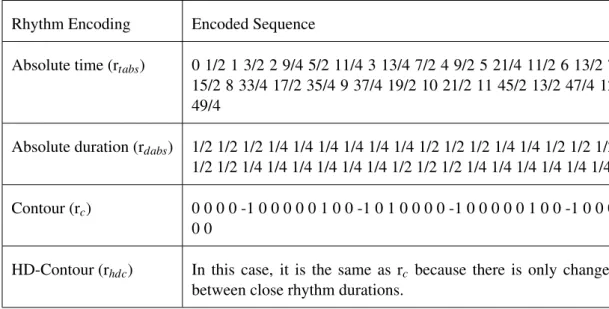
most common quantization event and ’1’ usually corresponds to the elementary ’time’ event (rtabs and rdabs, respectively). Contour can also be used with its normal or high definition form, encoding the duration of a note as longer, equal, or shorter than the previous (or next) note. The differences in rhythm encoding for the chosen example are presented in Table 2.2.
2.2.1.2 String Modeling of Polyphonic Music
Lemström and Pienimäki [22] propose three different methods for adopting string modeling in polyphonic textures (two or more concurrent) voices: a Non-Interleaved, an Interleaved and an Onset-Basedrepresentations.
The Non-Interleaved representation divides the polyphonic texture into several monophonic lines according to composed or perceived voices and then simply represents each by an associated (monophonic) string and stores them sequentially. This representation is most effective when the patterns to be searched resemble an excerpt within one of the voices (Solid Occurrence), but meaningful extraction patterns across all voices cannot be achieved from this representation.
The Interleaved representation [68] consists of sorting the notes in lexicographical order, firstly by their onset times and then by pitch values. The method is more flexible than the non-interleaved, yet the strict ordering enforced is not natural. It can lead to big gaps between con-tiguously perceived notes when using edit distances to quantify how similar two musical segments
Rhythm Encoding Encoded Sequence
Absolute time (rtabs) 0 1/2 1 3/2 2 9/4 5/2 11/4 3 13/4 7/2 4 9/2 5 21/4 11/2 6 13/2 7 15/2 8 33/4 17/2 35/4 9 37/4 19/2 10 21/2 11 45/2 13/2 47/4 12 49/4
Absolute duration (rdabs) 1/2 1/2 1/2 1/4 1/4 1/4 1/4 1/4 1/4 1/2 1/2 1/2 1/4 1/4 1/2 1/2 1/2 1/2 1/2 1/4 1/4 1/4 1/4 1/4 1/4 1/2 1/2 1/2 1/4 1/4 1/4 1/4 1/4 1/4 Contour (rc) 0 0 0 0 -1 0 0 0 0 0 1 0 0 -1 0 1 0 0 0 0 -1 0 0 0 0 0 1 0 0 -1 0 0 0
0 0
HD-Contour (rhdc) In this case, it is the same as rc because there is only changes between close rhythm durations.
Table 2.2: Different possible Rhythm Encodings for the example in Figure 2.1, using the various possible techniques presented in Section 2.2.1.1, S.2.
are. If transposition invariance is required, this representation is highly inefficient as it requires computing the brute-force solution of all possible transpositions.
The Onset-Based representation [42] may be used if notes having simultaneous onsets are modeled instead of individual notes. Careful algorithmic planning is required to avoid the combi-natorial explosion while aligning the monophonic voices based on the onsets. When they happen simultaneously, the notes are grouped. Comparison of musical sequences can be done straightfor-wardly with this approach, in cases where transposition invariance is not required. As the duration information is lost, some authors have attempted to solve this problem by fragmenting long notes into notes of fixed duration connected by ties as in [36].
2.2.2 Multiple Viewpoint Models
The multiple viewpoint models emerged from a necessity of extending the application of statistical modeling of music to domains where the internal structure of the events is an important factor. They are adaptive, in the sense that a representation of a particular piece will change as that piece progresses [21]. Pearce implemented a multiple viewpoint model in Lisp, called IDyOM (Information Dynamics of Music) [66] [65].
The viewpoints use background domain knowledge to derive new ways of expressing events in a sequence by introducing types (represented as τ) as abstract properties of the musical events and for each, associating a partial function Ψτ that maps the events to this type. A viewpoint com-prises one such function and the set of all sequences that can be represented using elements of the respective type. A multiple viewpoint model is comprised of a collection of different viewpoints.
As the viewpoints can have correlations, a new type was introduced: the product type (τx⊗ τy), whose elements are the cross product of the constituents. For inferring to which viewpoint an event
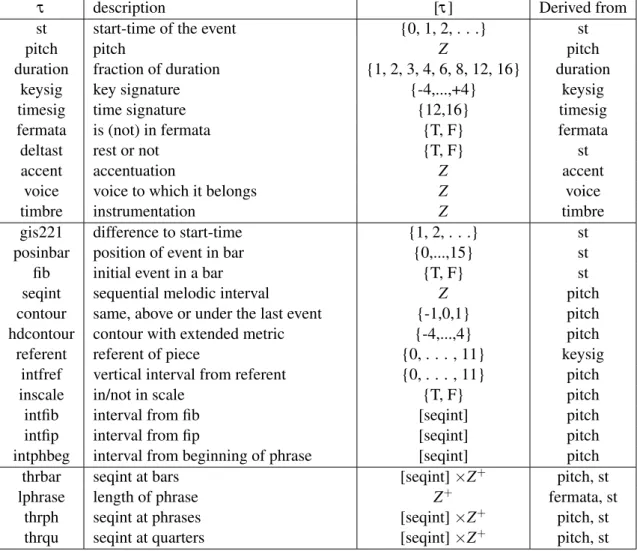
τ description [τ] Derived from
st start-time of the event {0, 1, 2, . . .} st
pitch pitch Z pitch
duration fraction of duration {1, 2, 3, 4, 6, 8, 12, 16} duration
keysig key signature {-4,...,+4} keysig
timesig time signature {12,16} timesig
fermata is (not) in fermata {T, F} fermata
deltast rest or not {T, F} st
accent accentuation Z accent
voice voice to which it belongs Z voice
timbre instrumentation Z timbre
gis221 difference to start-time {1, 2, . . .} st
posinbar position of event in bar {0,...,15} st
fib initial event in a bar {T, F} st
seqint sequential melodic interval Z pitch
contour same, above or under the last event {-1,0,1} pitch
hdcontour contour with extended metric {-4,...,4} pitch
referent referent of piece {0, . . . , 11} keysig
intfref vertical interval from referent {0, . . . , 11} pitch
inscale in/not in scale {T, F} pitch
intfib interval from fib [seqint] pitch
intfip interval from fip [seqint] pitch
intphbeg interval from beginning of phrase [seqint] pitch
thrbar seqint at bars [seqint] ×Z+ pitch, st
lphrase length of phrase Z+ fermata, st
thrph seqint at phrases [seqint] ×Z+ pitch, st
thrqu seqint at quarters [seqint] ×Z+ pitch, st
Table 2.3: List of possible basic and derived viewpoints and their description
belongs, it is necessary to compute the probability of belonging to that context, which involves converting the event’s surface string to the sequences belonging to that viewpoint. That is done by using a function Φτ that is empty for an empty event and the extension of all elements in the viewpoint until that moment plus the current event if defined.
In a musical context, we can have several types of basic and derived elements. A summary of possible viewpoints can be seen in Table 2.3.
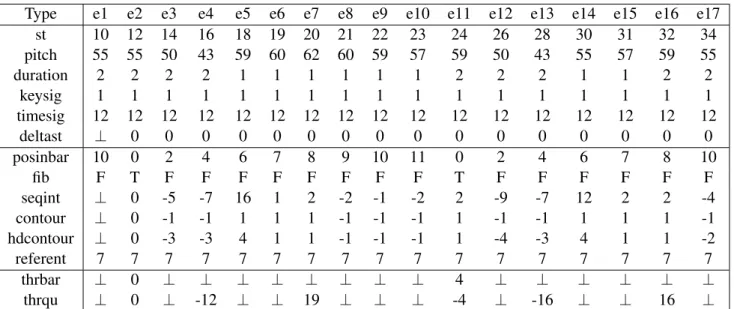
For the first 2 bars of the example of Figure 2.1, a set of multiple viewpoints that could be extracted is represented in the table 2.4.
2.2.3 Geometric Modeling
Proposed by Maidín in 1998 [48], the geometric representations for music present a technique for creating a 2-dimensional graphic representation of the pitch-duration contour of a music score by plotting the pitch of the notes versus their duration on a sequential timeline, with a similar result as a piano-roll sheet. This technique allows for the use of mathematical concepts, such
Type e1 e2 e3 e4 e5 e6 e7 e8 e9 e10 e11 e12 e13 e14 e15 e16 e17 st 10 12 14 16 18 19 20 21 22 23 24 26 28 30 31 32 34 pitch 55 55 50 43 59 60 62 60 59 57 59 50 43 55 57 59 55 duration 2 2 2 2 1 1 1 1 1 1 2 2 2 1 1 2 2 keysig 1 1 1 1 1 1 1 1 1 1 1 1 1 1 1 1 1 timesig 12 12 12 12 12 12 12 12 12 12 12 12 12 12 12 12 12 deltast ⊥ 0 0 0 0 0 0 0 0 0 0 0 0 0 0 0 0 posinbar 10 0 2 4 6 7 8 9 10 11 0 2 4 6 7 8 10 fib F T F F F F F F F F T F F F F F F seqint ⊥ 0 -5 -7 16 1 2 -2 -1 -2 2 -9 -7 12 2 2 -4 contour ⊥ 0 -1 -1 1 1 1 -1 -1 -1 1 -1 -1 1 1 1 -1 hdcontour ⊥ 0 -3 -3 4 1 1 -1 -1 -1 1 -4 -3 4 1 1 -2 referent 7 7 7 7 7 7 7 7 7 7 7 7 7 7 7 7 7 thrbar ⊥ 0 ⊥ ⊥ ⊥ ⊥ ⊥ ⊥ ⊥ ⊥ 4 ⊥ ⊥ ⊥ ⊥ ⊥ ⊥ thrqu ⊥ 0 ⊥ -12 ⊥ ⊥ 19 ⊥ ⊥ ⊥ -4 ⊥ -16 ⊥ ⊥ 16 ⊥
Table 2.4: List of some basic and derived viewpoints for the first two bars’ events of Figure 2.1
as area and spatial transformations, when processing music scores, which are particularly useful when computing similarities between two musical sequences. This method can be extended for representing other features of the notes by increasing the number of dimensions used.
For the example of Figure 2.1, a possible geometric representation would be as shown in Figure 2.2 where circled in red, we can observe similarities between small fragments of the melody and in blue, similarities between bigger fragments of the melody.
2.2.4 Multidimensional Point Sets
The idea of using a set of points in a multidimensional Euclidean space to represent music in the context of pattern recognition algorithms is a result of the work of Meredith [53], in order to overcome the limitations of string-based modeling methods which, as described by the author, are inefficient when dealing with polyphonic music (which produces a combinatorial explosion in the number of strings required) or trying to find highly embellished occurrences of a query pattern.
In this approach, the author defines a musical object as a tuple of 5 elements in which the first element indicates the onset time of the note and the second defines the respective chromatic pitch (MIDI pitch - 21) for the note. The third element gives the diatonic pitch, defined by an integer that indicates the position of the head of the note on the staff. The fourth element marks the duration of the note and the fifth, the voice to which the note belongs.
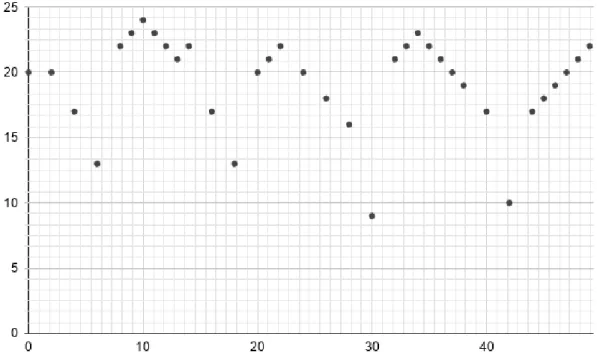
From these point sets, it is possible to do a 2- or 3-dimensional projection, which is particularly useful in searching for patterns as it is possible to visually discover repetitions by analyzing the relative position of the points in the space and the geometric figures they make. Choosing the variables for the projection depends on the kind of pattern we are aiming to find and the style of music we are analyzing. For Tonal Music, a 2-dimensional projection using onset time and diatonic pitch of each note is more relevant than one using chromatic pitch, as two occurrences of
Figure 2.2: Geometric Modeling for the first four bars of J. S. Bach’s Prelude Courante of his Suite No. 1 in G major, BWV 1007
a motive on different degrees of a scale might be perceived to be similar even if the corresponding chromatic intervals in the patterns differ. This conversion can be made using a pitch spelling algorithm such as ps13, which tries to compute the correct pitch names of the notes in a passage of tonal music when given only the onset-time, chromatic pitch and possibly the duration and voice of each note [54].
For the example of Figure 2.1, a projection of onset time and chromatic pitch and a projection of onset time and diatonic pitch would be as shown in Figures 2.3 and 2.4. The set of multidimen-sional points for this musical sequence would be:
{ <0, 34, 20, 2, 1>, <2, 34, 20, 2, 1>, <4, 29, 17, 2, 1>, <6, 22, 13, 2, 1>, <8, 38, 22, 1, 1>, <9, 39, 23, 1, 1>, <10, 41, 24, 1, 1>, <11, 39, 23, 1, 1>, <12, 38, 22, 1, 1>, <13, 36, 21, 1, 1>, <14, 38, 22, 2, 1>, <16, 29, 17, 2, 1>, <18, 22, 13, 2, 1>, <20, 34, 20, 1, 1>, <21, 36, 21, 1, 1>, <22, 38, 22, 2, 1>, <24, 34, 20, 2, 1>, <26, 31, 18, 2, 1>, <28, 37, 16, 2, 1>, <30, 15, 09, 2, 1>, <32, 36, 21, 1, 1>, <33, 38, 22, 1, 1>, <34, 39, 23, 1, 1>, <35, 38, 22, 1, 1>, <36, 36, 21, 1, 1>, <37, 34, 20, 1, 1>, <38, 33, 19, 2, 1>, <40, 29, 17, 2, 1>, <42, 17, 10, 2, 1>, <44, 29, 17, 1, 1>, <45, 31, 18, 1, 1>, <46, 33, 19, 1, 1>, <47, 34, 20, 1, 1>, <48, 36, 21, 1, 1>, <49, 38, 22, 1, 1>, }
2.2.5 Models based on Formal Grammars and Syntax Trees
In 1979, Curtis Roads [71] presents a small survey on several theories for using formal grammars for representing musical sequences until that moment, such as in [79] where Smoliar implements
Figure 2.3: Multidimensional Point Sets projection of onset time and chromatic pitch for the first four bars of J. S. Bach’s Prelude Courante of his Suite No. 1 in G major, BWV 1007
a language for musical analysis using a tree structure, [57] in which Moorer suggests that context-free grammars may be augmented with procedures to perform transformations to enhance the context-sensitivity and in the Generative Theory of Tonal Music system of Lerdahl and Jackend-off, a grammar attempts to model a "formal description of the musical intuitions of a listener who is experienced in a musical idiom", focusing on four hierarchical systems: Grouping (related to motives, phrases, periods and sections), Metric (regular alternation of strong and weak beats), Time-span reduction (TSR), derived from metrical and grouping structures to at all temporal lev-els of a work and Prolongational reductions (PR) which describe the moments of tension and relaxation along a piece [43].
He concludes that grammars and parse trees had been found useful formal models for repre-senting the syntax of musical structures as they allow for a very concise manner of modeling as the production rule of a grammar is a powerful abstraction but that they were always considered insufficient by itself, particularly in the context-free form, as the context in music is both parallel and sequential whereas, in the formal grammars, it is only sequential.
Some more experiences were undergone in trying to apply formal grammars for representing musical contexts, as in [51], where Mardsen and Pople proposed a grammar, implemented in the Bol Processor, to model improvisations in North Indian tabla drumming as it is very similar to speech. This type of music is rule-based and its rhythmic patterns are very similar to those encountered in formal grammars. The major limitation presented for this system was that "expert systems represent knowledge at a low (non-hierarchical) theoretical level, and so it was impossible
Figure 2.4: Multidimensional Point Sets projection of onset time and diatonic pitch for the first four bars of J. S. Bach’s Prelude Courante of his Suite No. 1 in G major, BWV 1007
to separate general analytical statements from specific instances of facts" [51].
As noted by Rizo in [70], the hierarchy of subdivisions of the figure duration as always been represented in theory books, such as in [46], like a tree. For that reason, as a means to understand and model perceived rhythms from notation, several grammars were proposed to, assuming that a listener unconsciously performs this kind of parsing. These can be encountered in a survey done by C. S. Lee. in [41]. However, none of those implemented the grammars in a computational algorithm.
The OpenMusic tool, implemented at IRCAM [7], uses trees for representing the hierarchical nature of subdividing the musical figures and groupings, allowing for the representation of tied figures.
In [11], a grammar learns the segmentation of melodies from the ESSEN corpus, with man-ually separated phrases, using Data-Oriented Parsing (DOP) and in [33], the parsing of simple monophonic melodies into tree structures using a probabilistic context-free grammar allows for their melodic reduction.
David Rizo, in his dissertation thesis in 2010 [70], presented a novel tree representation for both monophonic and polyphonic music, suitable for doing similarity computation of musical sequences. The construction of the three followed a metrical based hierarchical subdivision of time, similar to that proposed by Lee [41]. The notes are only represented in the leaves of the tree, so a set of rules were proposed for propagating the labels from the leaves upwards, labeling the internal nodes. For polyphonic music, all voices are simply merged in the same tree with
node labels being represented by sets of pitch classes when there are various notes played in the different voices at the same time (chords) and using multi-sets to encode cardinalities of the labels for representing their duration. He concluded that this tree structure is very versatile as it is able to fit more elaborate information than simply notes or rhythm, as the musical form or harmony but presents two main drawbacks related to its tight dependency on the meter structure of the input source, and its difficulty to represent ties, dots, and syncopations.
2.2.6 Graph-based representations
In 2001, Marsden [49] presented his work on describing a melody as the product of successive elaborations of a simple outline. He called his structure an E-Graph, which consisted of places, elaborations and links. The structure is intended as a sequence of at least two places and a pair of places can be connected by an elaboration, generating a new intermediate place, without cross-ing links, makcross-ing it interpretable as an acyclic graph, which can be easily converted in a tree representation.
A place (representation of a note) is constituted by time (expressed in terms of a particular metre), pitch (distinguishes between enharmonically equivalent pitches) and articulation (tied or untied, to describe if the pitch was already sounding or not). Some particular functions were de-veloped for dealing with pitch and time, such as chromaticUp/Down(pitch), stepUp/Down(pitch), arpeggioUp/Down(pitch), octaveUp/Down(pitch) and timeDivision(time1, time2).
Elaborations are composed of characteristics in metre (relation between metres of places con-nected by the elaboration to the new place resulting from this elaboration), time (same as metre but relating to time) and pitch, and can be simple or accented. This is most important, as the kind of elaborations allowed will, to a certain degree, define a musical language. There are various kinds of simple elaborations, where a new note is simply inserted between two existing notes, such as shorten (the new place is a rest), repetition (the pitch of the new place is the same as the pitch of the first parent place), anticipation (the pitch of the new place is the same as the pitch of the second parent place), and relating to the style of the music, (chromatic and not) passing notes, arpeggios in the key harmony and octave jumps. The accented elaboration types refer to cases in which the time of the original notes is unchanged, such as delays, suspensions of notes from one time to the other and accented passing notes.
Although this representation was presented as having several potential uses, particularly for pattern recognition in cases when the same pattern can generate different sequences of pitches or intervals because of harmonic or pitch context differences or when a pattern is not on a top-level, it was subsequently abandoned as excessively complex in computational terms, especially consid-ering that it only could represent well single-line melodies and a mechanism for their parsing was required.
Another approach to a graph representation was posteriorly presented in [80], in which the graph intends to model a global, time-independent signature of the melody, with its pitches en-coded in the 12-tone system, capturing its global structure while being invariant under transfor-mations such as inversions and retrogradations. New weights were proposed for the edges of the
representative graph, containing information on basic rhythmic features and order of events.
2.3
Generative Algorithms
In their theory of GTTM, Lerdahl and Jackendoff [43] state that
"the importance of parallelism [i.e., repetition] in musical structure cannot be overes-timated. The more parallelism one can detect, the more internally coherent an analy-sis becomes, and the less independent information must be processed and retained in hearing or remembering a piece."
The discovery of repeated patterns is a known problem in different domains, including com-puter vision, bioinformatics, and music information retrieval (MIR).
As explained in the introduction to this chapter, "discovering the important repetitions in a passage of music is an essential step towards achieving a rich understanding of it" [53]. However, most of the patterns that occur in the musical pieces were not planned by the composers or are not even perceived when listening to it. Thus, a tool for discovery of repeated patterns in a musical surface must be capable of discovering those interesting, relevant patterns.
In this section, we will present the algorithms that have been studied to find the redundancy in musical structures and in particular, those that were later applied in the generation of new musical sequences based on those patterns. Most of these algorithms also apply to text, as the treatment of musical sequences is similar to the treatment of the text.
2.3.1 Compression algorithms
General-purpose lossless compression algorithms use the redundancy of input sequences for com-pressing them in order to reduce their size, maintaining the maximum possible information from the original. For that reason, it was suggested that they might be useful for finding musically rele-vant patterns. In the next few sections, some of these algorithms will be explained as well as their use in pattern discovery for music.
2.3.1.1 Lempel-Ziv 77 and 78
The algorithms Lempel-Ziv 77 (LZ77) [93] and 78 (LZ78) [94] were developed by Abraham Lem-pel and Jacob Ziv in 1977 and 1978, respectively and are some of the most popular lossless data-compression algorithms.
Both the algorithms work as a dictionary-based approach, creating a dictionary of tokens that appear in the original input sequence. LZ77 does it by creating a search buffer where it stores the offset of positions to move backward to reach the start of a pattern, its length, and the event after the pattern by finding the longest match of a string that starts at the current position with a pattern available in the search buffer. This buffer is constructed over a sliding window so the encoder and decoder only have this data to create and get the references. The larger the sliding window is, the
longer back the encoder may search but all data can be encoded and decoded by incorporating a flexible and easy form of run-length encoding, repeating a single copy of data multiple times until necessary [93]. LZ78 creates an explicit dictionary in the format dictionary[...] = index, event and encodes the input stream by replacing repeated occurrences of data with references to the dictionary which is constructed by searching in it for a match and if exists, replacing the index (that refers to the last match found for that event) for the index of the event being processed. If a match is not found, then a new dictionary entry is created and the index of the last match is reset for the new event being processed. When the end of the input stream is reached, the algorithm outputs the index of the last match.
In the musical domain, they were mostly used in genre-classification contexts such as in [44] or music analysis by encountering patterns as in [47], where various general-purpose compression algorithms were explored in pattern discovery in music for classifying folk song melodies. One of the conclusions taken from this research was the correlation between compression factor and score for all the algorithms, as the best classifications were achieved from the shortest representations.
2.3.1.2 Burrows–Wheeler transform
The Burrows–Wheeler transform [15] is an algorithm for preparing the data without loss for data-compression invented by Michael Burrows and David Wheeler in 1994. Its implementation has linear time complexity, using a suffix array for executing a permutation of the input sequence as to bring equal elements closer together, in order of increasing the probability of finding a character c at a point in a sequence in case of c already occurring near this point. Along with Move-to-front coding, this means a better compression effect.
The Move-to-front algorithm encodes the string incoming from the Burrows–Wheeler trans-formby building the alphabet of the events in the input sequence by reading it from left to right, and then constructing a vector of the indexes of the sequence events in the alphabet. To ensure reversibility, the algorithm needs to return the alphabet, the index vector and the index of the row of the Burrows–Wheeler transform’s resulting matrix corresponding to the original input [47].
2.3.1.3 SIA-based algorithms
The Structure Induction Algorithm (SIA) and the SIATEC (TEC stands for translational equiva-lence classes) were presented in 2001 [56] for discovering maximal repeated patterns in any set of points in Cartesian spaces of any dimensionality, in particular in musical surfaces.
SIA can be described as the computation of a structure set of all the maximal subsets from a dataset of any set of points with any number of dimensions for which can be encountered a metric that gives their total ordering, removing repetition under symmetry for helping prevent waste of effort and duplication of results but admitting unlimited gaps in the patterns found [52].
SIATEC extends SIA by calculating all the occurrences of each of the maximal repeated pat-terns computed by this algorithm, generating a set of translational equivalence classes. Transla-tional equivalence between patterns happens if one can be obtained from the other only by trans-lation. Each pattern can only be contained in a TEC, as it contains all the translationally invariant patterns [52].
Using the SIATEC algorithm, it’s authors design COSIATEC, a data-compression algorithm to generate a compressed or efficient representation of a dataset [53]. It works by extracting the TECs resulting from running SIATEC on a dataset and from these selecting the "best" ones that don’t overlap. This compression algorithm was used in [53] to find themes and motives in a set of 15 Two-Part Inventions (BWV 772–786) by J. S. Bach. The musical sequences were represented by using the Multidimensional Point Sets and the results generated by COSIATEC for these pieces were concluded to be similar to what one might expect from a thematic analysis of an expert music analyst.
In more recent works, a new extension of these algorithms, RECURSIA-RRT (Recursive trans-latable point-set pattern discovery with the removal of redundant translators) was proposed, de-signed to increase the compression factor achieved using any TEC cover algorithm [55].
2.3.2 Genetic Algorithms
Genetic Algorithms model the evolutionary processes without needing domain-specific knowledge of the problem [59]. The general scheme of the algorithm implies the generation of a random starting population of a given number of chromosomes (binary coded symbol strings that represent an individual) and for each chromosome, the calculation of a fitness score using a fitness function that usually represents a rule-based system that examines the ability of a chromosome to fulfill the objective. If a chromosome achieves a score higher than a given threshold, the result is deemed as good enough and the process terminates. Otherwise, the chromosomes with the highest scores are sent to the next generation unmodified or are submitted to a mutation (elements of the chromosome are modified in position) or crossover (elements of the chromosome are crossed with elements of another chromosome, giving rise to new chromosomes that are a mix of the two). Those are the new population for the next phase, for which the process is repeated.
The first use of Genetic algorithms for music generation was documented by Horner [39], using a technique of thematic bridging for specifying the thematic material and delegating the development of the new melodic sequences to the genetic algorithm.
In [64], Papadopoulos and Wiggins achieve a system for the generation of melodies of vari-able length and rhythmic structure over chord sequences by using an automatic fitness evalua-tion that evaluated, among other aspects, the similarity between patterns. In the following year, Townsey [83] applied the algorithm to existing melodic material describing 21 melodic features used as the basis for a multidimensional fitness function and mutation procedures.
In 2007, Waschka [89] implemented a system called GenDash that employs evolutionary com-putation to help compose pieces with various instrumentation.
In 2016, a novel evolutionary technique combining Feasible/Infeasible two-population method (FI-2POP) and multi-objective optimization was used to create an extensible framework for music composition called MetaCompose [76].
A recent trend in genetic algorithms seems to be the use of artificial immune systems to op-timize the objective function that encodes the musical features, by returning multiple candidate solutions, instead of the usual optimal one, which feats better when thinking about musical cre-ation, where we require different solutions to the same problem. ChordAIS [58] uses Opt-aiNet (Artificial Immune Network for Optimization) with this finality in order to assist its user in gener-ating realistic and functional chord progressions.
2.3.3 Markov Models
In music generating systems, the use of Markov models to capture the statistical occurrence of features in a particular piece or corpus to generate music having the distributions of those features similar to the ones captured is one of the most explored techniques. The first system that attempted to use Markov models was Pinkerton’s “Banal Tune-Maker” [69] in 1956, in which the author analyzed simple nursery songs, taking the sequential probabilities of its notes (First-Order Markov model) and then produced similar using a random walk process. In the next year, n-grams with n in the range 1 to 8 were constructed to analyze a corpus of melodies [14] and then generate similar ones. In the discussion of the results, the authors noted that the use of elevated order values led to sequences most similar to the original, while lower values generate more random results. This problem has been examined by Papadopoulos [62], where the author studies the problems of plagiarism arising from higher-order Markov chains, proposing a mechanism to curb excessive repetitions of source material by implementing a maximum allowable subsequence order in a generated sequence.
2.3.3.1 N-grams
N-grams are a specific type of Markov model in which N corresponds to the total number of preceding symbols plus the current symbol being analyzed.
One of the limitations of these contiguous n-grams is that they offer no alternatives with the dependence of every event only on the respective contiguous neighbors (data sparsity problem) but if all neighbors where permitted, the number of associations between events would explode in combinatorial complexity with the increase of n and the length of the sequence. These limitations are overcome by introducing skip-grams.
The skip-grams are a generalization of n-grams in which the events processed do not have to be contiguous and the gaps that are skipped over. The maximum length of the skips allowed can be fixed to a threshold in the fixed-skip model, where the tokens are only evaluated if they are within a fixed range of skips of the event processed or can follow a variable-skip approach, useful for sequences of events that depend on temporal structure, where the events are evaluated if the inter-onset interval(s) (IOI) between them occur within a specified upper boundary [77].