International Journal of Marketing, Communication and New Media. ISSN: 2182-9306. Vol 6, Nº 11, DECEMBER 2018
31
Research Paper
The Efficiency of Listening Tools’ Usage in Customer Relationship
Management: The case of telecom companies.
Saleh Alwahaishi* Amine Nahari Talet**
ABSTRACT
The purpose of this paper is to examine the utilization of listening tools by telecommunication companies to obtain information about customer preferences, needs, and perceptions of companies’ performance to facilitate customer relationship management and to identify some leading activities for managing customer relationships and satisfaction. A survey addressed to employees at three management levels (top, middle, and operational) at the three leading mobile telecommunication companies in Saudi Arabia. The most effective listening tools are those that align with the organization’s objectives. Customer complaints and visits were the most effective and important tools, while observation and focus groups were the least effective listening tools that Saudi telecom companies use. Further, the study profiled the factors drawn from the major objectives of using listening tools in two main areas: customer satisfaction and customer relationship. A further study might expand the scope of this research by observing only social media platforms in a complaint-handling context. Additionally, the uses and benefits of listening tools and their impact on customer satisfaction and relationships might differ across different consumer business service sectors. The findings will shed some light on the telecommunication sector in Saudi Arabia for policymakers and administrators for the purpose of planning, designing, and using listening tools in customer relationship efficiently and effectively. Telecommunication companies should invest in advanced technology and prioritize social media to get in touch with customers and be close to them. The primary contribution of this research is its discussion of a variety of customer listening tools used by Saudi telecommunication companies. Additionally, this study profiled the factors drawn from the major objectives of using listening tools in two main areas: customer satisfaction and customer relationship.
Keywords: Listening tools; customer relations; customer satisfaction; customer service.
* Department of Accounting and Management Information Systems King Fahd University of Petroleum & Minerals, Dhahran, Saudi Arabia. Email: [email protected]
** Department of Accounting and Management Information Systems King Fahd University of Petroleum
& Minerals, Dhahran, Saudi Arabia. Email: [email protected]
Received on: 2018.06.06 Approved on: 2018.12.03
Evaluated by a double blind review system
1. INTRODUCTION
Over the last two decades, the mobile telecommunication industry has considerably extended its boundaries. The sector is fundamentally changing and is expected to face complex issues related to new technologies and value-added services owing to continuous innovations. The real differentiation in the market will not be technology, services, or prices, but the ability to deliver better-quality services and responding to customer requests, to keep customers informed as orders are being processed, reduce the cost and not prices, and enhance the pace of responding to service inquiries. The main critical success factors and risks facing the business today remain the same: managing falling margins, improving customer satisfaction, and enhancing productivity.
Growing challenges and uncertainties at the marketplace along with intensifying global competition are forcing business organizations to invest in building customer relationships. To meet these challenges in the telecommunication sector, the satisfaction and retention of customers is one of the key activities of customer relationship management (CRM). Moreover, CRM aims to create, develop, and enhance personal and valuable relationships with customers by providing personalized and customized products and services (Goodhue, Wixom, & Watson, 2002; McKim, 2002). While applying CRM, the goal of organizations is to identify their own customers and provide personalized services, to enhance both customer satisfaction and loyalty in the end (Gebert, Geib, Kolbe, & Brenner, 2003). However, customers tend to become more demanding by expecting the next interaction to be at least as good, if not better, than the previous one (Subramanian, Raju, & Zhang, 2014). Hence, better knowledge about customer needs and wants helps improve customer service, which eventually helps companies achieve customer satisfaction and retention (Palmer, Lindgreen, & Vanhamme, 2005).
Measuring customer satisfaction helps identify ways of improving product/service quality, which in turn, leads to increased competitive advantage. The level of service
International Journal of Marketing, Communication and New Media. ISSN: 2182-9306. Vol 6, Nº 11, DECEMBER 2018
33
quality has potential impacts on customer satisfaction. Thus, customers compare the overall perceived and expected service delivery to form a subjective judgment of satisfaction. Hence, customer satisfaction in the service context cannot be studied without giving due consideration to service quality. Moreover, there is a connection between customer satisfaction and employee satisfaction. If customers are satisfied, employees will not have to listen to complaints and may feel better about their job, leading to increased employee retention and reduction in the cost associated with hiring new employees (Bernhardt, Donthu, & Kennett, 2000). Furthermore, the process of measuring satisfaction is a non-stop process as it conveys the customers’ voice into the organizations’ decision makers, which in order leads to products and services novelty (Thomke & Von Hippel, 2002). Consequently, communication with customers is becoming more complex, and multiple communication and distribution channels are expected by them.
The increase in the choice of channels complicates the method of identifying the right channel for the right customer. World-class companies use a variety of different customer listening tools to collect customer information for fully understanding customers’ needs, preferences, and perceptions. It is not about companies utilizing a wide spectrum of those tools, but in enabling them to recognize the benefits of them in a business context. Accordingly, the main contribution of this paper is to examine the efficient utilization of listening tools by telecommunication companies to obtain information about customer preferences, needs, and perceptions of companies’ performance, which could be used as the basis for CRM support in the future.
This paper is organized as follows. After the introduction, the second section reviews the literature on this research. Section three overviews the Saudi telecom sector. The fourth section describes the research objectives and methodology. The results are discussed and analysed in the fifth section. Finally, Section six presents the research conclusion, limitations, and future work.
2. LITERATURE REVIEW
2.1 Customer relationship management
The ultimate objective of information technology (IT) is involved in its applicability in targeting the right customers and catering efficiently to their needs. Therefore, IT practices are being adopted to redefine customer service parameters and to retain
customers. One such practice that is being followed by business organizations to compete in the ever-changing environment is CRM, which is rapidly becoming an integral part of many organizations.
The term CRM emerged in the IT vendor community and practitioner community in the mid-1990s. In the academic community, the terms ‘relationship marketing’ and CRM are often used interchangeably (Parvatiyar & Sheth, 2001). However, CRM is more commonly used in the context of technology solutions and has been described as ‘information-enabled relationship marketing’ (Ryals & Payne, 2001). An increasing number of researchers and practitioners from the fields of marketing and information systems (IS) have contributed to the definition of the CRM concept.
The concept itself is relatively simple. Rather than marketing to a mass of people or firms, the concept involves marketing to each customer individually. In this one-to-one approach, customer information is used to devise offers that are more likely to be accepted. This approach is made possible by advances in IT. CRM, thus, requires organizational and business level approaches, which are customer-centric, for doing business rather than a simple marketing strategy. CRM involves all the corporate functions (marketing, manufacturing, customer services, field sales, and field services) required to contact customers directly or indirectly.
Strategically, CRM is considered as viewing customer relationships as an investment that will contribute to the enterprise’s bottom line and is aimed at strengthening an enterprise’s competitive position by increasing customer loyalty. It has become clear that CRM is more than just a technology. While technology is only a way to implement CRM (Chen, 2005), many authors consider CRM as a multivariate construct, a combination of strategy and IT (Payne & Frow, 2005), processes and IT (Plakoyiannaki and Tzokas, 2002), strategy, processes, and IT (Buttle, 2004), and processes, strategy, philosophy, capability, and IT (Zablah, Bellenger, & Johnston, 2004). From a technical point of view, CRM is defined as a methodology that heavily employs certain IT concepts such as databases and the Internet to leverage the effectiveness of the relationship marketing process (Chen, 2005).
As the concept of CRM matures, CRM definitions also change to reflect its evolutions. Some of the CRM definitions come from a technological perspective, while others come from business and social perspectives. Evidently, CRM is a multidisciplinary topic because it deals with marketing, IS, management, etc. (Kevork & Vrechopoulos, 2009).
International Journal of Marketing, Communication and New Media. ISSN: 2182-9306. Vol 6, Nº 11, DECEMBER 2018
35
It aims to unify the potential of relationship marketing strategies and IT to create profitable, long-term relationships with customers, and other key stakeholders. Furthermore, it provides enhanced opportunities to use data and information to understand customers and the value of relationships with them. Thus, CRM is similar to an integration of technologies and business processes used to satisfy the needs of the customer during any given interaction. In addition, CRM is an enterprise-wide integration of technologies, such as data warehouses, websites and intranet/extranet, phone support systems, accounting, sales, marketing, and production, working together (Bose, 2002.).
2.2 Customer satisfaction
Nowadays, customer satisfaction is regarded as one of the most indispensable elements playing a vital role in determining the success and prosperity of a specific business in a dynamic and fast-growing market. Customer satisfaction is often seen as the key to an organization’s success and long-term competitiveness and is linked to profits (Stein & Bowen, 2003). It is based on the customer’s experience regarding a particular service encounter; it is in line with the fact that service quality is a determining factor of customer satisfaction because service quality results from service outcomes by service providers. As a result, increasing customer satisfaction is an important goal in business practices today.
Measuring satisfaction is becoming increasingly common, and research on customer satisfaction and relationships is, by far, the most popular means of gathering customer feedback. CRM refers to activities that companies practice for understanding customer demands and improving customer satisfaction (Aggarwal, 1997). It involves acquisition, analysis, and the use of knowledge about customers to sell more goods or services and to do so more efficiently. Other definitions of CRM include the management approach that involves identifying, attracting, developing, and maintaining successful customer relationships over time to increase the retention of profitable customers (Bradshaw & Brash, 2001). Likewise, CRM has been defined as a process/application that permits organizations to gather and analyse customer data rapidly while seeking to improve customer loyalty via targeted products and services (Rigby, Reichheld, & Schefter, 2002). Similarly, it has been defined as a process designed to collect data related to customers, grasp their features, and apply them to particular marketing activities (Swift, 2000).
CRM is also considered to be a set of strategies and tools aimed at retaining customers over time instead of attracting new ones; it requires some basic components, from a database to basic analyses on the data, from decisions regarding target customers to tools for targeting, from relationship strategies to metrics and even privacy issues (Winer, 2001), thereby generating, aggregating, and analysing customer data and employing the results for service delivery and marketing activities (Schoder & Madeja, 2004). It is logical for customers to feel satisfied based on the quality of services received, the range of products or services offered, and the ability to personally interact with the system. It is believed that customers’ perceptions will be influenced by how well they are listened to and treated.
2.3 CRM and social media
The CRM approach enhances organizations’ ability to understand the current needs of customers, their past behaviour, and their future behaviour (Xu, Yen, Lin, & Chou, 2002). Using technology and human resources to understand behaviour, values, and attitudes of customers is the basic idea of traditional CRM, which is based on an internal operational approach to manage customer relationships effectively (Cho, Im, Hiltz, & Fjermestad, 2002; Gupta & Shukla, 2001). However, social CRM is based on the ability of companies to meet the personal agendas of their customers, while simultaneously meeting the objectives of their own business plans. It is aimed at customer engagement rather than customer management.
Concepts such as personalization, loyalty programs, and customer valuation are used regularly to interact with and prioritize customers. Unsurprisingly, the more widespread use of these concepts has changed our understanding of CRM substantially and, as a consequence, the field has seen a remarkable transformation in the past decades. Yet, the CRM strategies implemented by many firms today are frequently still fundamentally based on an understanding of CRM from the early days. When CRM utilizes social communication well, businesses gain the ability to better listen to customer conversations and engage social customers on their own terms while managing and measuring their efforts to do so. Social communications help organizations get closer to a comprehensive and realistic view of the customer so they can further optimize their marketing, sales, and customer service efforts.
Brands use social media listening tools, customer satisfaction surveys, and focus groups to capture customer thoughts, expectations, likes and dislikes, etc. Unfortunately, much
International Journal of Marketing, Communication and New Media. ISSN: 2182-9306. Vol 6, Nº 11, DECEMBER 2018
37
of this conversation gets lost in traditional company silos, making it a challenge for brands to really listen to customers and then engage with them meaningfully at the time and place that makes the most sense (Mangold & Faulds, 2009). Before the development of social communications, telecommunication companies retained control over the messages they diffused and the time at which customers would have access to them. Nowadays, with the spread of customer social value, which arises from the influence customers have over each other, a specific customer may not purchase a service himself, but instead convince others to start purchasing or to purchase more. Hence, telecommunication companies are rapidly embracing social communications not only to build virtual communities but also to create innovative social commerce programs, improve customer care, and streamline customer research. With so much to gain, companies need to invest their effort in understanding how to break through the noise and reason out with current and potential customers via social media.
2.4 Telecommunication sector in Saudi Arabia
No longer is any country able to ignore the rapid development in the fields of telecommunications and IT and the adoption of new technologies and services as a key element that gives countries the ability to compete in the globalized world. Since the 1990s, the telecommunication sector has become a key dynamic area for the economic development of industrialized nations. It is the result of enormous technical progress as well as an increased number of network operators and intense competition that has developed between them. Hence, economic development is now determined to a large extent by the ability of countries to cope with the rapid development in the fields of telecommunications and IT and the promotion of their use.
The Saudi Arabian telecommunication sector is considered as one of the biggest in the Middle East and North Africa (MENA) region, comprising over 56.0 million mobile subscribers with an estimated revenue of SAR 180.0 billion. The sector has undergone a huge transformation process through the age of deregulation and privatization and has seen a rapid rise of market players who offer innovative products and services. After staying dormant under the control of a government-owned company called STC, the sector recorded supernormal growth in the past decade due to its liberalization since 2003. The market has been liberated over the years as licenses were given to two additional operators, Mobily and Zain. There have not been any new entrants in the mobile market except recently for a Push-To-Talk operator called Bravo that focuses on
businesses.
The Saudi telecommunication market is growing rapidly, and according to recent market data published by the Saudi Communications and Information Technology Commission (CITC), the number of mobile phone subscribers in the second quarter of 2017 was around 44.0 million with a penetration rate of 139% (CITC, 2017). Revenues from operations reached about SAR 71.63 billion in 2016, wherein mobile revenues represented 75% of all telecommunication sector revenues, while fixed line and data services accounted for the remaining 25%, which is around 6% of the total GDP. If, however, the oil and mining sector components of the GDP are excluded, it is estimated that the Information and Communication Technology (ICT) contribution to the national GDP was up to 10% for 2016 (CITC, 2017).
In light of Saudi Vision 2030 and the National Transformation Program 2020, the Saudi telecommunication market is expected to continue growing alongside the demand for digital services. The CITC estimates that the total spend on ICT services was around SAR 120 billion in 2015, with a growth rate of about 7% compared to 2014. The telecommunication sector accounted for a lion’s share of the ICT spend of around 64%, while the proportion of spends on IT services was about 36%. This scale of expenditure was due to the investment in infrastructure for the next-generation network and 4G mobile network and the adoption of electronic services (government, health, e-education, e-commerce, etc.) as well as the expenditure on information security. It is expected that the telecommunication and IT market will continue to grow on a regular basis (CITC, 2017).
2.5 Mobile services
The Saudi telecommunication sector witnessed a number of challenges in 2016 such as weak oil prices, high subscriber penetration levels in voice and data, fingerprint registration of SIM cards, limited growth avenues, and a cut in government spending. According to the latest CITC data for the full year of 2016, since the disconnection of SIM cards on the back of biometric verification, subscriber base decreased by 4.9 million in 2016 as compared to 2015, reaching 47.9 million subscribers. On the contrary, post-paid subscribers increased by 0.9 million to reach 8.8 million in 2016 compared to 7.9 million in 2015, while prepaid subscribers decreased by 5.8 million from 44.9 million in 2015 to 39.1 million in 2016 as shown in Figure 1 (CITC, 2017).
International Journal of Marketing, Communication and New Media. ISSN: 2182-9306. Vol 6, Nº 11, DECEMBER 2018
39
Figure 1. Mobile service growth-total subscriptions (CITC, 2017)
2.6 Internet services
The number of Internet users in the Kingdom continued to rise rapidly, reaching about 24.1 million at the end of the second quarter of 2017, with a population penetration of 76%. Increased demand for Internet services and broadband was observed due to large use of social networking applications, video downloading and gaming, and the spread of VOIP communication applications. Customers are seeking higher speeds and larger packages resulting in heavy data traffic on both mobile and fixed networks as shown in Figure 2 (CITC, 2017).
Figure 2. Internet service market growth- internet penetration (CITC, 2017) 0.00% 50.00% 100.00% 150.00% 200.00% 0.000 10.000 20.000 30.000 40.000 50.000 60.000 2011 2012 2013 2014 2015 2016 Q2 2017
Mobile Subscription Growth
Post-paid Pre-paid Penetration Rate (%) Total Subscriptions 47.5% 54.1% 55.1% 63.7% 68.5% 74.88% 76.00% 0.00 5.00 10.00 15.00 20.00 25.00 30.00 2011 2012 2013 2014 2015 2016 Q2 2017 28.616 29.196 29.994 30.770 31.521 31.742 31.742Internet Penetration Rate
Internet Users (Millions) Penetration Rate (%)The liberalization of the telecommunication sector and the resulting competition in the market has led to remarkable benefits for the Saudi economy, at large, and consumers, in particular, such as the availability of better quality services, improved customer care, more consumer choices, and lower prices. While the cost of living index has continued to rise in the last few years due to increased prices of most of its components, the prices have progressively decreased (CITC, 2017).
2.7 Mobile broadband services
The total number of mobile broadband subscriptions reached around 25.3 million by the end of the second quarter of 2017, representing a population penetration rate of 80%. The mobile broadband market also continues to gain momentum in the Kingdom. The key reasons for this growth include strong competition, the healthy expansion in the use of smart phones, and the offering of various data packages by mobile operators suitable for different user segments. These factors have led to a dramatic rise in the number of users in recent years and an increase in the data traffic over these devices, supported by the wide coverage of 3G and 4G networks (CITC, 2017).
2.8 Fixed broadband services
Fixed broadband subscriptions including DSL, fiber optics, fixed wireless (WiMax), FTTx, and other fixed lines grew to around 3.27 million at the end of the second quarter of 2017. The fixed broadband penetration rate stood at about 44.13% of the total number of households (CITC, 2017).
3. RESEARCH METHODOLOGY 3.1 Research objectives
The literature has identified some customer listening tools including surveys, customer complaints, focus group, and observation. Figure 3 shows a fitness for purpose framework of a range of customer listening tools (Maguire, Koh, & Huang, 2007). This framework highlights the perceived benefits of the various listening tools. It was suggested that large companies constantly use multiple customer listening tools to listen to their customers’ needs, preferences, and perceptions (Garver, 2003). However, there is no standard use of a particular set of tools (Maguire, et al., 2007). Hence, this research aims to answer the following research questions:
International Journal of Marketing, Communication and New Media. ISSN: 2182-9306. Vol 6, Nº 11, DECEMBER 2018
41
customer feedback and data?
RQ2. How do they use these tools to listen to customers?
RQ3. How are these tools associated with customer satisfaction and relationship? RQ4. What benefits do these tools bring to Saudi telecommunication companies?
3.2 Research method
This study is based on a survey addressed to employees at three management levels (top, middle, and operational) at the three leading mobile telecommunication companies in Saudi Arabia. The questionnaire is accompanied by a cover letter explaining the purpose of the research, the voluntary nature of participation, and assuring participants of confidentiality.
To ensure that the variables selected for this study are relevant to the respondents, a pilot test was conducted to reduce and minimize any misunderstanding or ambiguous questions and procedures used in conducting the survey, which, in turn, may negatively affect the data analysis. In addition, it was necessary to obtain some assessment of the questions’ validity and the likely reliability of the data that would be collected (Saunders, Lewis, & Thornhill, 2012). This pilot study helped the authors understand CRM in the context of Saudi Arabia.
The final questionnaire developed comprised four parts. In the first part concerned with demographic variables, such as gender, age and education, area of specialization, position, and department of the respondents were included. The second part contained a list of customer listening tools and how they were being utilized by the company. The third part incorporated a number of questions regarding customer satisfaction/complaint recording system used by the company; the data collection method employed and the technology used to analyse customer data were also part of the questionnaire. The last part included questions concerning managers’ attitudes towards customer relationship management. The questions in these sections were compiled by the authors after conducting an extensive literature review and discussion with colleagues. The survey was distributed to the three management levels of the three telecommunication companies in Saudi Arabia. The questionnaires were distributed and collected on site based on two visits.
Figure 3. A fitness for purpose framework of the ten listening tools (Maguire, et al., 2007)
International Journal of Marketing, Communication and New Media. ISSN: 2182-9306. Vol 6, Nº 11, DECEMBER 2018
43
3.3 Reliability analysis
The construct was analysed through a series of validated tools and procedures. The reliability of items was assessed by computing the coefficient alpha (Cronbach, 1951) that measures the internal consistency of the items. The Cronbach’s alpha coefficient value was 0.941, which exceeds the 0.7 value suggested by Nunnally (Nunnally, 1978). The coefficient values suggest that all constructs are internally consistent and reliable as shown in Table 1.
N %
Cases Valid 201 100.0
Excluded* 0 .0
Total 201 100.0
* List wise deletion based on all variables in the procedure.
Cronbach's Alpha N of Items
0.941 62
Table 1. Case processing summary and reliability analysis
4. RESULTS ANALYSIS AND DISCUSSION
There were 201 respondents to the questionnaire survey after data cleaning, i.e., the removal of unengaged responses, thereby comprising 189 males (94.0%) and 12 females (6.0%). The respondents were in the age group of 18-24 (17.9%), 25-34 (55.2%), 35-44 (19.4%), and 45-60 (7.5%) years. The majority of respondents were from Mobily Company, accounting for 65.7% of the total participants, 26.9% were from STC, and 7.7% were from Zain Telecommunication Company. Regarding the participants’ education level, the majority of them had a college degree (66.6%), while 25.4% were high schoolers, and 6.0% had postgraduate degrees. Regarding the respondents’ departments and their positions, 26.9% were from sales, 25.4% were from customer care, 17.9% were from marketing, and the rest were from other departments. In terms of their administrative level, 70.1% were staff, 17.9% were supervisors, and 11.9% were managers.
Saudi telecommunication companies use a variety of different customer listening tools to try and gain a comprehensive understanding of their customers and to identify customer service attributes for improvement; however, data collection is not the challenge; the challenge is aggregating the results and analysing them. Therefore, when asked to rate the listening tools according to their importance, Saudi telecommunication staff and management rated customer complaints as the most important listening tool (97%), followed by customer visits and employee feedback (94%), surveys (92%), benchmarks (85%), observations (83%), and focus groups as the least important tool (64%) as shown in Table 2.
It is no surprise that customer complaints were rated the most important listening tool among others, considering that social media is fast becoming essential for addressing customer complaints. Customers are turning to social media to communicate with brands at a rapid rate, which makes it a priority channel for Saudi telecom companies when it comes to engaging continuously with customers and providing quick responses to complaints and demands. Increasingly, platforms such as Twitter and Facebook are being viewed as the perfect vehicles for customers to escalate complaints. One of the major driving forces behind this situation is the country’s high rate of smartphone ownership. 84% of Saudi Arabians live in cities, where the adoption of mobile technologies has been much faster than the rest of the nation (Insight, 2018). Thus, social listening is a great tool for Saudi telecommunication companies to learn more about their customers’ perspective regarding their products or services on social media channels, which, in turn, leverages sentiment analysis around the topics of interest for their customers.
Although complaint handling on social media is further enhanced by dynamically generated messages to customer comments, traditional listening tools such as customer visits, employee feedback, and surveys were still highly rated in tandem with social listening. These tools are directly linked to data collection of customer satisfaction and/or dissatisfaction at different stages of the service lifecycle. Customer visits as a listening tool are used for enhancing and maintaining good relationships with customers through direct discussions and interactions with them to gauge their satisfaction/dissatisfaction about the provided service and performance-related issues. However, one of the problems that telecommunication companies face is the need for measuring the customer’s voice and integrating it into a culture of continuous feedback.
International Journal of Marketing, Communication and New Media. ISSN: 2182-9306. Vol 6, Nº 11, DECEMBER 2018
45
Customers’ voice could be brought into the organization through a direct link with employees. Therefore, employee feedback is a kind of listening tool that bridges the understanding between the performance perceived by organizations with respect to customer satisfaction and actual customer satisfaction brought into the organization through this channel. Employees who deal with customers directly should know better whether the customers they serve are satisfied or otherwise. The management could react accordingly to such feedback and the process could be accelerated via the use of intranet. Likewise, when surveys are utilized as a listening tool, both relationship and dissatisfaction surveys provide a strategic view of the relationship with customers as well as enable companies to proactively search for customer problems and achieve customer satisfaction through problem resolution.
Listening tool Important/very
important (%)
Not/ little important (%) Customer Complaints 97.10% 2.90% Customer Visit 94.00% 6.00% Employee Feedbacks 94.00% 6.00% Surveys 92.50% 7.50% Benchmark 85.00% 15.00% Observations 83.50% 16.50% Focus group 64.30% 35.70%
Table 2. Importance of listening tools among employees of Saudi telecom companies
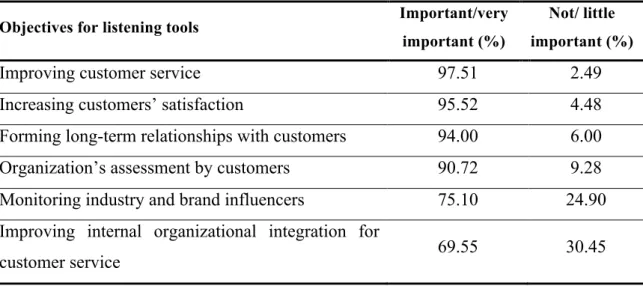
Because listening tools offer businesses a chance to collect insider information from existing and prospective customers, Saudi telecommunication companies are using listening tools primarily to enhance customer service (97%) and increase their satisfaction (95%) by monitoring customer requests and questions and concerns, according to the survey. Utilizing these tools also helps them form long-term relationships with customers (94%) and get their organizations’ assessed by customers (90%), as shown in Table 3. While these are common objectives of using listening tools, there are some others that are relatively widely known, such as monitoring industry and brand influencers (75%) and even improving the intraorganizational integration towards
better customer service (69%).
Objectives for listening tools Important/very important (%)
Not/ little important (%)
Improving customer service 97.51 2.49
Increasing customers’ satisfaction 95.52 4.48
Forming long-term relationships with customers 94.00 6.00
Organization’s assessment by customers 90.72 9.28
Monitoring industry and brand influencers 75.10 24.90
Improving internal organizational integration for
customer service 69.55 30.45
Table 3. Objectives for listening tools
It has been argued that customer satisfaction is viewed as an important indicator of customer retention and that there is a strong and positive relationship between customer relationship quality and retention (Oyeniyi & Joachim, 2008). The more satisfied the customers are, the longer is the relationship with them in terms of customer loyalty. Up to this end, factor analysis was performed on the above set of listening tools’ objectives; the KMO measure for sampling adequacy was satisfactory at 0.91.8 and Bartlett’s test of sphericity was 772.5 at the 0.000 significance level. The factor loadings are presented in Table 4, and the analysis resulted in two factors: the first one included an improvement in performance and intraorganizational integration towards customer service as well as increase in customer satisfaction. These factors were collectively named ‘customer satisfaction’ with a reliability of 0.923. The second one included the factors forming long-term relationships with customers, the organization’s assessment by customers, and retaining brand and competitive advantage. This factor was named ‘customer relationships’ and exhibited a reliability of 0.916.
International Journal of Marketing, Communication and New Media. ISSN: 2182-9306. Vol 6, Nº 11, DECEMBER 2018
47
Factor 1: Customer satisfaction
Improving performance towards customer service 0.905
Increasing customers’ satisfaction 0.875 Improving internal organizational integration for customer service 0.716 Factor 2: Customer relationship
Forming long-term relationships with customers 0.854 Organization’s assessment by customers 0.845
Monitoring industry and brand influencers 0.771
Table 4. Factor analysis for listening tools’ objectives
Table 5 shows the perception of employees of the Saudi telecommunication companies toward the benefits of using customer listening tools. While fostering relationships with existing and potential customers was viewed as a primary benefit of using listening tools, the number one benefit was receiving feedback to improve products and services (90%). It was closely followed by the benefit of exploring customer satisfaction (86%), ahead of improving service performance (80%), which consecutively leads to acquiring new customers (73%). Evaluating the external environment and competition was cited as a major benefit by nearly two-third of the surveyed employees, which implies that regardless of the resource availability or overall business goals, companies can learn a lot from both their competitors and customers.
Benefits of the listening tools Percentage
Feedback on products and services 90.1.9%
Carry out customer satisfaction research 86.6%
Improve service performance 80.6%
Attracting new customers 73.0%
Evaluation of external environment and competition 65.9%
5. CONCLUSION
Organizations are spending more on looking for innovative ways to maintain and satisfy existing customers as well as for acquiring new ones. This study found that Saudi telecommunication companies use a variety of different customer listening tools to collect customer information for fully understanding customers’ needs, preferences, and perceptions. Customer complaints and visits were the most effective and important tools that companies use, while observation and focus groups were the least effective, which is logical because customer complaints and visits can be used for active interaction and building good relationships with customers through direct discussion, while observation and focus groups are relatively passive data collection methods and can be perceived as more passive than dealing with customer complaints, which complies with the fitness framework that specific tools are fit for specific objectives under prescribed conditions. All the research questions posed within this study have been addressed. This research found that Saudi telecommunication companies use a variety of different customer listening tools to collect customer information for fully understanding customers’ needs, preferences, and perceptions. This study also pointed out several objectives that could have a significant impact on the successful use of listening tools and the enhancement of CRM. It can be seen that not only understanding customers’ perception regarding service performance and satisfaction but also their assessment of the company and its branding are important objectives for using listening tools. When paired with a company’s keen sense of brand messaging, listening tools can be a crucial part of any advertising or marketing campaign. By correctly developing a social strategy, brands can obtain insight into campaigns, improve product or service offerings, and properly address consumers’ concerns, all while monitoring and analysing greater global trends. Additionally, this study profiled the factors drawn from the major objectives of using listening tools in two main areas: customer satisfaction and customer relationship. It was found that customer satisfaction is associated with improving service performance and integrating the internal communication within the organization towards better customer service, while forming long-term relationships with customers was associated with the organization’s assessment by customers as well as monitoring industry and brand influencers.
Hopefully, these findings will shed some light on the telecommunication sector in Saudi Arabia for policymakers and administrators for the purpose of planning, designing, and
International Journal of Marketing, Communication and New Media. ISSN: 2182-9306. Vol 6, Nº 11, DECEMBER 2018
49
using listening tools in CRM efficiently and effectively. Telecommunication companies should invest in advanced technology and prioritize social media to get in touch with customers and be close to them. Moreover, it is important that they know the weaknesses as well as the strengths of their own data systems to generate real competitive advantage. Therefore, data systems and processes should be in place to empower a quick response to address and hopefully solve customer complaints.
5.1 Limitations and future research
We conclude on a note of caution about the generalizability of findings across ‘different’ listening tools and traditional and social channels. This is because social media is constantly evolving and assuming a genuine role as a listening tool. Moreover, social media acts as a vehicle of communication media, while the traditional channels are more of solution-oriented channels. Therefore, further research might expand the scope of this research by observing only social media platforms in a complaint-handling context. Additionally, the uses and benefits of listening tools and their impact on customer satisfaction and relationships might differ across different consumer business service sectors. A customer’s choice of channel and perceptions regarding complaint-handling quality might change due to the exact nature of the product, service, and customer problem. Therefore, future research would benefit from comparing the customers’ perception regarding telecommunication companies in a general and wider service context and from corroborating our findings with other sectors such as healthcare or retail/e-commerce.
REFERENCES
Aggarwal, S. (1997). Flexibility Management: the Ultimate Strategy. Industrial
Management , 39 (1), 5-14.
Bernhardt, K., Donthu, N., & Kennett, P. (2000). A longitudinal analysis of satisfaction and profitability. Journal of Business Research , 47 (2), 161-171. Bose, R. (2002.). Customer relationship management: key components forIT success. Industrial Management & Data Systems , 102 (1-2), 89-97.
Bradshaw, D., & Brash, C. (2001). Management Customer Relationships in the E-Business World: How to Personalise Computer Relationships for Increased Profitability. International Journal of Retail & Distribution Management , 29 (12), 520-530.
Buttle, F. (2004). Customer Relationship Management: Concepts and Tools. Oxford: Elsevier.
Chen, M. (2005). A methodology for building mobile computing applications: business strategy and technical architecture. International Journal of Electronic
Business , 2 (3), 229-43.
Cho, Y., Im, I., Hiltz, J., & Fjermestad, J. (2002). An analysis of online customer complaints: implications for web complaint management,. The 35th Hawaii
International Conference on System Sciences, : I. Los Alamitos, CA: EEE
Computer Society.
CITC. (July de 2017). ICT Indicators Q2 - 2017. (Communication, Communication and Information technology) Obtido em 27 de October de 2017, de The ICT Sector
in the Kingdom of Saudi Arabia:
http://www.citc.gov.sa/en/Reportsandstudies/Indicators/Pages/CITCICTIndicators. aspx
Cronbach, L. J. (1951). Coefficient Alpha and the Internal Structures of Tests.
Psychometrika , 16 (3), 297-333.
Garver, M. (2003). Best practices in identifying customer-driven improvement opportunities. Industrial Marketing Management , 32, 455-66.
Gebert, H., Geib, M., Kolbe, L. M., & Brenner, W. (2003). Knowledge-enabled Customer Relationship Management. Journal of Knowledge Management , 7 (5), 107-123.
Goodhue, D. L., Wixom, B. H., & Watson, H. J. (2002). Realizing business benefits through CRM: hitting the right target in the right way. MIS Quarterly
Executive , 1 (2), 79-94.
Gupta, M., & Shukla, S. (2001). Implementation issues in CRM: a study in the Indian banking sector,. Productivity, , 42 (1), .26–38.
Insight, G. M. (2018). Saudi Arabia Social Media Statistics 2018. (Global Media
Insight) Obtido em 22 de March de 2018, de
https://www.globalmediainsight.com/blog/saudi-arabia-social-media-statistics/ Kevork, E. K., & Vrechopoulos, A. P. (2009). CRM literature: conceptual and functional insights by keyword analysis. Marketing intelligence and planning , 27 (1), 48-85.
Maguire, S., Koh, S., & Huang, C. (2007). Identifying the range of customer listening tools: a logical pre‐cursor to CRM? Industrial Management & Data
Systems , 107 (4), 567-586.
Mangold, W. G., & Faulds, D. J. (2009). Social media: The new hybrid element of the promotion mix. Business Horizons , 52 (4), 357-365.
McKim, B. (2002). CRM: beyond the hoopla. Target Market , 25 (7), 38-39. Nunnally, J. C. (1978). Psychometric Theory. New York: McGraw- Hill.
Oyeniyi, O., & Joachim, A. A. (2008). Customer service in the retention of mobile phone users in Nigeria. African Journal of Business Management , 2 (2), 6-31. Palmer, R., Lindgreen, A., & Vanhamme, J. (2005). Relationship marketing: schools of thought and future research directions. Marketing Intelligence and
Planning , 23 (3), 313-330.
Parvatiyar, A., & Sheth, J. N. (2001). Customer Relationship Management: Emerging Practice, Process, and Discipline. Journal of Economic and Social
Research , 3 (2), 1-34.
Payne, A., & Frow, P. (2005). A strategic framework for customer relationship management. Journal of Marketing. , 69, 167-176.
Plakoyiannaki, E., & Tzokas, N. (2002). Customer relationship management: A capabilities portfolio perspective. Journal of Database Marketing , 9 (3), 228-37.
International Journal of Marketing, Communication and New Media. ISSN: 2182-9306. Vol 6, Nº 11, DECEMBER 2018
51
Rigby, D. K., Reichheld, F., & Schefter, P. (2002). Avoid the four perils of CRM.
Harvard Business. Revie , 80 (2), 101-110.
Ryals, L., & Payne, A. (2001). Customer Relationship Management in Financial Services: Towards Information- Enabled Relationship Marketing. Journal of
Strategic Marketing , 9, 1-25.
Saunders, M., lewis, P., & Thornhill, A. (2012). Research Methods for Business
Students (Vol. Sixth Edition). Harlow: Pearson.
Schoder, D., & Madeja, N. (2004). Is Customer Relationship Management a Success Factor in Electronic Commerce? Journal of Electronic Commerce
Research , 5 (1), 38-53.
Stein, M. M., & Bowen, M. (2003). Building a customer satisfaction system: effective listening when the customer speaks. Global Business and Organizational
Excellence , 22 (3), 23-34.
Subramanian, U., Raju, J. S., & Zhang, Z. J. (2014). The strategic value of high-cost customers. Management Science , 60 (2).
Swift, R. S. (2000). Accelerating Customer Relationships : Using CRM and
Relationship Technologies. Upper Saddle. River, NJ: Prentice Hall.
Winer, R. S. (2001). A Framework for Customer Relationship Management.
California Management Review , 43, 89-105.
Xu, Y., Yen, D. C., Lin, B., & Chou, D. C. (2002). Adopting customer relationship management technology. Industrial Management and Data Systems , 102 (8), 442– 452.
Zablah, A. R., Bellenger, D. N., & Johnston, W. J. (2004). Customer Relationship Management Implementation Gaps. Journal of Personal Selling & Sales
Management , 24 (4), 279-295.
How to cite this article
Alwahaishi, S. & Talet, A. N. (2018). The Efficiency of Listening Tools’ Usage in Customer Relationship Management: The case of telecom companies. International Journal of Marketing,