Maria Fernanda Gil Cosme Martins
INTERACTIONS BETWEEN PROTEIN FINING AGENTS AND
SEVERAL WINE PROANTHOCYANIDINS
Universidade de Trás-os-Montes e Alto Douro Vila Real, 2007
Este trabalho foi elaborado como dissertação original com o objectivo da obtenção do grau de Doutor em Ciência Alimentar ao abrigo do Decreto-Lei nº 216/92 de 13 de Outubro.
RESUMO
As características sensoriais dos vinhos bem como a sua estabilidade são factores de grande importância para a sua competitividade e consequentemente para a sua comercialização nos mercados internacionais e nacionais. Uma das operações tecnológicas mais utilizada na elaboração dos vinhos é a colagem proteica, pois influência as características sensoriais (amargor e adstringência) bem como a estabilidade do vinho. A eficiência e a actuação das colas proteicas dependem por um lado da composição em proantocianidinas existentes nos vinhos que tem por base a casta e o processo de vinificação utilizado, por outro das características físico-químicas das diversas colas proteicas.
Um dos objectivos do presente trabalho foi procurar conhecer os perfis tânicos de algumas variedades de castas Vitis vinifera bem como dos vinhos monovarietais delas resultantes. Pretendeu-se também caracterizar as principiais colas proteicas comercializadas no mercado português bem como avaliar a sua eficácia em relação às diferentes fracções de proantocianidinas dos vinhos tintos e brancos. Por fim, foram adicionadas as colas proteicas anteriormente caracterizadas a soluções modelo semelhantes ao vinho, em que cada uma das soluções era constituída por proantocianidinas com diferentes graus médios de polimerização com o intuito de aprofundar o conhecimento sobre a influência da estrutura das proantocianidinas, da concentração de proantocianidinas, do pH e da temperatura no processo de colagem. Com este estudo pretende-se disponibilizar informação de suporte à escolha do tipo de cola a usar em função do tipo de produto final a obter, e consequentemente optimizar a operação de colagem.
Os resultados mostraram que a quantidade e as características estruturais das proantocianidinas presentes nas grainhas e nas películas são diferentes entre as castas estudadas. Os vinhos monovarietais obtidos a partir dessas castas apresentavam proantocianidinas com um grau médio de polimerização que oscila entre 2,1 e 9,6. Nos vinhos monovarietais obtidos em dois anos consecutivos, verificou-se haver uma variação da concentração em proantocianidinas, no entanto o grau médio de polimerização das proantocianidinas manteve-se inalterado para cada casta. Os vinhos monovarietais analisados após seis meses mostraram uma redução de 39-59 % na quantidade de proantocianidinas e também se constatou uma modificação quanto à distribuição das diferentes proantocianidinas com distintos graus médios de polimerização. Parece ter ocorrido em simultâneo uma polimerização das proantocianidinas com um grau médio de polimerização
mais baixo e uma perda das proantocianidinas com um grau médio de polimerização mais elevado.
As colas proteicas comerciais caracterizadas mostraram diferentes características físico-químicas, quanto à distribuição da sua massa molecular, ponto isoeléctrico e quanto à densidade de carga de superfície. Essas variações verificam-se não só entre colas de diferentes tipos, como seria de esperar, mas também entre cada tipo de cola. Assim, o caseinato de potássio, a caseína, a albumina de ovo e a ictiocola sólida (obtida da bexiga natatória de peixes) são caracterizados por bandas individualizadas, respectivamente nos 30,0 kDa, na vizinhança dos 43,0 kDa e por várias bandas bem definidas superior a 94,0 kDa, entre 94,0 e 43,0 kDa e nos 20,1 kDa, enquanto que o perfil electroforético das gelatinas e ictiocolas líquidas, de uma gelatina sólida e da ictiocola sólida (obtida da hidrólise da pele dos peixes) são caracterizados por uma polidispersão na distribuição das suas massas moleculares. Em duas outras gelatinas sólidas não foram detectadas bandas entre as massas moleculares de 14,4 a 94,0 kDa. A densidade de carga de superfície também apresenta valores diferentes entre as colas estudadas. Assim, a albumina de ovo, a ictiocola e a gelatina (em soluções a 1%) mostraram densidade de carga de superfície superior quando estas se apresentavam sobre a forma sólida.
A adição de colas proteicas com diferentes características físico-químicas a vinhos tintos e brancos mostrou que estas actuam diferenciadamente sobre as fracções de proantocianidinas de diferentes graus médios de polimerização. Foi também mostrado que o decréscimo depende da cola proteica mas também do grau médio de polimerização da fracção de proantocianidina. As duas ictiocolas estudadas decresceram as fracções de grau médio de polimerização 1,5 e de 3,4 do vinho tinto, no entanto a ictiocola obtida da bexiga natatória do peixe reduziu o dobro essas fracções do que a ictiocola caracterizada por uma polidispersão inferior a 20,1 kDa. Os resultados sugerem que a acção das colas depende do tipo de moléculas de proantocianidina com que interage e não tanto se a operação se efectua em vinho tinto ou branco. Assim, a adição de ictiocolas, não induziu uma diminuição notória nas proantocianidinas com um grau médio de polimerização de 3,8 no vinho branco bem como na fracção de proantocianidinas com um grau médio de polimerização de 3,4 no vinho tinto. Por outro lado, foram a caseína e a gelatina caracterizada por uma baixa massa molecular as que mais reduziram a fracção de grau médio de polimerização 1,5 em ambos os vinhos.
Após aplicação de colas proteicas as características estruturais das proantocianidinas que permanecem no vinho colado são diferentes das do vinho inicial. Constatou-se um decréscimo do grau médio de polimerização das proantocianidinas induzido pela albumina de ovo na fracção mais polimerizada de 26 % no vinho branco e de 24 % no vinho tinto, e nos ensaios com as outras proteínas foi registrado um decréscimo de 6 a 14 % no vinho tinto e de 3 a 24 % no vinho branco.
A intensidade corante bem como as moléculas relacionadas com a cor foram menos influenciadas pela colagem proteica comparativamente às proantocianidinas. Pelo método do CIELab verificou-se que em todos os vinhos tintos colados, a luminosidade (L*) aumentou acentuadamente o que parece estar associado a uma redução dos vermelhos (a*), proporcionado pela redução dos pigmentos. Estes dados estão em concordâncias com os resultados obtidos para as antocianinas monoméricas bem como para os pigmentos totais e poliméricos.
No que diz respeito à limpidez, foi constatado, que quanto maior for a densidade de carga de superfície da proteína maior é a capacidade de clarificação do vinho. Foi estabelecida uma correlação linear entre a densidade de carga de superfície total e o decréscimo da turvação.
Nos estudos efectuados em soluções modelo, mostrou-se que as ictiocolas e as gelatinas apresentam uma correlação (r=0.52 e r=- 0.49, respectivamente; P< 0,05) estatística significativa entre a percentagem de decréscimo das proantocianidinas e o grau médio de polimerização das fracções de proantocianidinas presentes nas soluções. Foi ainda mostrado que o decréscimo de proantocianidinas era sempre superior à temperatura de 10 ºC do que à temperatura de 20 ºC. Para uma concentração de proantocianidinas superior, verificou-se um maior decréscimo para as fracções de proantocianidinas de grau médio de polimerização mais elevado. Não se verificou influencia do pH, quando se aplicou a ictiocola obtida da bexiga natatória de peixe na fracção de proantocianidinas com um grau médio de polimerização superior e quando se aplicou a ictiocola obtida da hidrólise da pele de peixe na fracção de proantocianidinas com um grau médio de polimerização inferior.
Palavras-chave: vinho, cola, proteína, proantocianidinas, masa molecular, densidade de carga de superfície.
ABSTRACT
Wine sensory characteristics and stability are of great importance for the wine competitivity and consequently for their commercialization on the national and international market. One of the most required technological process in winemaking is protein fining which influenced wine sensory (bitterness and astringency) and stability. The effect of protein fining depends on the wine proanthocyanidin composition, which is influenced by the grape variety and the wine production process employed as well as on the physic-chemical characteristics of the protein fining agents.
The aim of this work was to know the tannic profile of grapes from Vitis vinifera varieties and from their monovarietal wines as well as to characterise commercial protein fining agents. The characterised proteins were added to white and red wine in order to better understand their action on the proanthocyanidin fractions and on the sensory characteristics. The characterised proteins were also added to wine-like model solutions containing each one proanthocyanidin fractions with an identified mean degree of polymerisation to enhance the information of the influence of environmental factors (pH and temperature), proanthocyanidin structural characteristics and concentration on the fining process. With these work we want to improve the knowledge of the protein fining agents and consequently allow the optimisation of the fining process.
The results showed that the quantity and the structural characteristics of the proanthocyanidins of grape seeds and skins differed between the V. vinifera L. cv grape varieties studied. On the monovarietal wines obtained from these grape varieties, the mean degree of polymerisation ranged from 2.1 to 9.6. In monovarietal wines obtained from two different vintages was observed that the concentration altered but the mean degree of polymerisation remained unchanged. The monovarietal wines analysed after 6 month showed a reduction of 39-59 % on the amount of proanthocyanidins and the distribution of the diverse proanthocyanidin fractions is different.
The different proteins characterised showed distinct physic-chemical characteristics such as molecular weight distribution, isolectric point and surface charge densities. These differences are not only confirmed among the different proteins as it would be accepted, but
The addition of proteins with different physic-chemical characteristics to red and white wines showed that they decrease differently the proanthocyanidin fractions with diverse mean degree of polymerisation. The decrease depends on the fining agent but also on the mean degree of polymerisation of the proanthocyanidin fraction. Therefore, the two isinglasses assayed decreased the proanthocyanidin fractions with mean degree of polymerisation 1.5 and 3.4 from red wine, however isinglass obtained from fish swim bladder decreases these fractions more than the twice as effectively as isinglass obtained from fish skin. The results suggested that the proteins acted in function of the mean degree of polymerisation of the proanthocyanidins independently they come from red or white wine. Any of the isinglass diminished the proanthocyanidins with a mean degree of polymerisation of 3.8 in white wine as well as with 3.4 in red wine.
After employ of proteins the structural characteristics of the proanthocyanidin remained in the fined wine were different from that presented on the initial wine. Regarding the mean degree of polymerisation of fined wines, the egg albumin induced a decrease on the mean degree of polymerisation of 24 % in red wine and 26 % in white wine for the more polymerised tannin fraction; although within all assays were observed a decrease ranged from 6 to 14 % in red wine and from 3 to 24 % in white wine.
Colour intensity and molecules related to wine colour were shown to be less influenced by proteins than proanthocyanidins. A linear correlation was found between total surface charge density and decrease of turbidity.
In wine-like model solution was shown that isinglasses and gelatines presented a statistical significant correlation between the decrease of the percentage of proanthocyanidins and the mean degree of polymerisation of the proanthocyanidin fractions presented in the solution. The proanthocyanidin decrease was always higher at 10 ºC than at 20 ºC. At a higher proanthocyanidin concentration, a greater decrease was shown for the proanthocyanidin fractions with higher mean degree of polymerisation. The pH did not influenced the decrease of proanthocyanidin fractions with higher mean degree of polymerisation after fining with swim bladder isinglass, and the proanthocyanidin fractions with lower mean degree of polymerisation after fining with isinglass obtained from fish skin.
Key words: wine, fining, protein, proanthocyanidins, molecular weight, surface charge density.
GENERAL INDEX
RESUMO...III
ABSTRACT ...VI
GENERAL INDEX...VIII
INDEX OF FIGURES...XI
INDEX OF TABLES...XIII
1. GENERAL INTRODUCTION ...1
1.1. STATE OF ART SUMMARY... 2
1.2. AIMS OF THE STUDY... 5
REFERENCES... 7
2. TANNIC PROFILES OF VITIS VINIFERA L. CV. RED GRAPES GROWING IN LISBON AND THEIR MONOVARIETAL WINES PROFILE...13
ABSTRACT... 14
2.1. INTRODUCTION... 15
2.2. MATERIALS AND METHODS... 18
2.3. RESULTS AND DISCUSSION... 21
2.3.1. Grape tannic profile...21
2.3.2. Wine tannic profile...28
Acknowledgements...31
REFERENCES... 32
3. PROTEIN FINING AGENTS: CHARACTERIZATION AND RED WINE FINING ASSAYS...37
ABSTRACT... 38
RIASSUNTO... 39
3.1. INTRODUCTION... 40
3.2. MATERIALS AND METHODS... 42
3.2.1. Fining agent characterization ...42
3.2.2. Wine fining trials...45
3.2.3. Statistical analysis ...47
3.3. RESULTS AND CONCLUSIONS... 47
REFERENCES... 59
4. BEHAVIOR OF VARIOUS PROTEINS ON WINE FINING: EFFECT ON DIFFERENT MOLECULAR WEIGHT CONDENSED TANNIN FRACTIONS OF RED WINE...65
ABSTRACT... 66
4.1. INTRODUCTION... 67
4.2. MATERIALS AND METHODS... 69
4.3. RESULTS AND DISCUSSION... 72
4.3.1. Quantification of flavan-3-ol fractions affected by fining ...73
4.3.2. Structural characterisation of proanthocyanidin fractions affected by fining...75
4.3.3. Quantification of some monomeric, dimeric and trimeric flavan-3-ols molecules affected by fining...77
4.3.4. Colour and Pigments ...79
4.4. CONCLUSIONS... 80
Acknowledgments...81
REFERENCES... 81
5. INTERACTIONS BETWEEN PROTEIN FINING AGENTS AND PROANTHOCYANIDINS IN WHITE WINE...87
ABSTRACT... 88
5.1. INTRODUCTION... 89
5.2. MATERIALS AND METHODS... 90
5.3. RESULTS AND DISCUSSION... 95
5.3.1. Effect of the fining agents on the flavan-3-ol fractions ...96
5.3.2. Effect of the fining agents on the structural characteristics of proanthocyanidin fractions ...97
5.3.3. Effect of the fining agents on some monomeric, dimeric and trimeric flavan-3-ols molecules ...98
5.3.4. Effect of the fining agents on flavanoid and non-flavanoid compounds, colour, chromatic characteristic, limpidity and browning potential ...102
Acknowledgements...104
REFERENCES... 105
6. GELATINE, CASEIN AND POTASSIUM CASEINATE AS WINE FINING AGENTS: DIFFERENT EFFECTS ON COLOUR, PHENOLIC COMPOUNDS AND SENSORY CHARACTERISTICS...109
ABSTRACT... 110
6.1. INTRODUCTION... 111
6.2. MATERIALS AND METHODS... 113
6.2.1. Fining agents characterisation...113
6.2.2. White and red wine fining trials...115
6.3. RESULTS AND DISCUSSION... 119
6.3.1. Fining agents characterisation...119
6.3.2. White wine fining trials...121
6.3.3. Red wine fining trials ...123
6.4. CONCLUSIONS... 129
Acknowledgements...129
REFERENCES... 130
7. REACTION BETWEEN PROTEIN FINING AGENTS AND PROANTHOCYANIDINS WITH DIFFERENT DEGREES OF POLYMERIZATION IN WINE-LIKE MODEL SOLUTIONS: EFFECT OF PROANTHOCYANIDIN STRUCTURE, PH, TEMPERATURE AND CONCENTRATION...135
ABSTRACT... 136
7.1. INTRODUCTION... 137
7.2. MATERIALS AND METHODS... 139
7.3. RESULTS AND DISCUSSION... 143
7.3.1. Effect of proanthocyanidin structural characteristics (mDP, % gal and % prodelph) on the interaction with protein fining agents in wine-like model solution...143
7.3.2. Effect of temperature, pH and proanthocyanidin concentration on the quantity of proanthocyanidins remained after fining with isinglass...148
Acknowledgements...150
REFERENCES... 151
8. GENERAL CONCLUSIONS...157
DIVULGAÇÃO DOS RESULTADOS NO ÂMBITO DESTA TESE...167
INDEX OF FIGURES
Fig. 2.1 - Tannic profile of Vitis vinifera L. cv. Touriga Nacional, Trincadeira, Cabernet Sauvignon, Castelão and Syrah grape seeds. ... 24 Fig. 2.2 - Tannic profile of Vitis vinifera L. cv. Touriga Nacional, Trincadeira, Castelão, Syrah
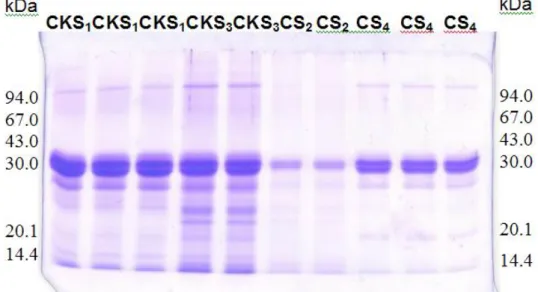
and Cabernet Sauvignon monovarietal wine (vintage 2004 and 2005)... 30 Fig. 3.1 - Electrophoretic patterns of potassium caseinates – CKS1, CKS3 and caseins – CS2, CS4... 49
Fig. 3.2 - Electrophoretic patterns of egg albumins – AS1, AS’1, AS4 and AL4. MW standard – P,
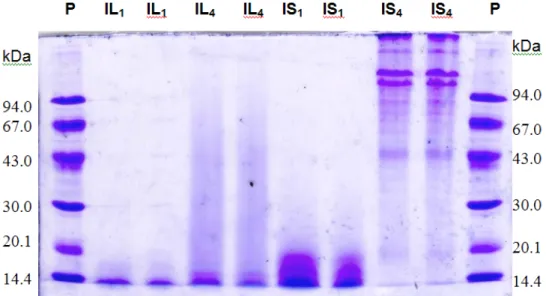
are given on the left and right side. ... 50 Fig. 3.3 - Electrophoretic patterns of isinglasses – IL1, IL4, IS1 and IS4. MW standard – P, are
given on the left and right side... 51 Fig. 3.4 - Electrophoretic patterns of gelatins – GS4, GS3 and GS2. MW standard – P, are given on
the left and right side... 51 Fig. 3.5 - Electrophoretic patterns of gelatins – GL1, GL2, GL4 and GL5. MW standard – P, are
given on the left and right side... 52 Fig. 3.6 - Total surface charge density of protein fining agents versus turbidity decrease. Isinglass
(IL1), isinglass (IS4), casein (CS4), potassium caseinate (CKS1), egg albumin (AS1), gelatin
(GL1), gelatin (GS2), gelatin(GS4). The turbidity of the unfined wine (T) was 0.421. ... 55
Fig. 4.1 – Decrease of the tannic fractions (%) FI, FII and FIII, with the mean degree of polymerisation (mDP) of 1.5, 3.4 and 4.9, respectively, after fining treatment with distinct proteins. Isinglass (IL1), isinglass (IS4), casein (CS4), potassium caseinate (CKS1), egg
albumin (AS1), gelatin (GL1), gelatin (GS2), gelatin (GS4). The error bars indicated in the fig.
represented the standard deviations... 74 Fig. 6.1 - Electrophoretic patterns of casein – CS, potassium caseinate – CK and gelatine – GSQ,
GL. MW standard – P, are given on the left and right side... 120 Fig. 6.2 - Principal components analyse of white wine. GL – gelatine, GSQ - gelatine, CS –
casein, CK – potassium caseinate, EB – unfined wine. LM – limpidity, AC – colour, AI – aroma intensity, AQ – aroma quality, GQ – taste quality, GI – taste intensity, GC – taste body, AG – global appreciation. ... 123 Fig. 6.3 - Principal components analyse of red wine. GL – gelatine, GSQ - gelatine, CS – casein,
CK – potassium caseinate, ET – unfined wine. CI – colour intensity, CT – colour hue, AI – aroma intensity, AQ – aroma quality, GQ – taste quality, GI – taste intensity, GC – taste body, GA – taste astringency, AG – global appreciation... 128 Fig. 7.1 - Quantity decrease (%) of the proanthocyanidin fractions with different mDP presented
egg albumin and (D) gelatine. Isinglass (IL1), isinglass (IS4), casein (CS4), potassium caseinate
(CKS1), egg albumin (AS1), gelatine (GL1), gelatine (GS2), gelatine (GS4). The error bars
indicated in the fig. represented the standard deviations... 144 Fig. 7.2 - Galloylation decrease (%) of the proanthocyanidin fractions with different mDP on
wine-like model solution fined with (A) isinglass, (B) casein, potassium caseinate, (C) egg albumin and (D) gelatine. Isinglass (IL1), isinglass (IS4), casein (CS4), potassium caseinate
(CKS1), egg albumin (AS1), gelatine (GL1), gelatine (GS2), gelatine (GS4). The error bars
indicated in the fig. represented the standard deviations... 145 Fig. 7.3 -Prodelphinidin decrease (%) of the proanthocyanidin fractions with different mDP on
wine-like model solution fined with (A) isinglass, (B) casein, potassium caseinate, (C) egg albumin and (D) gelatine. Isinglass (IL1), isinglass (IS4), casein (CS4), potassium caseinate
(CKS1), egg albumin (AS1), gelatine (GL1), gelatine (GS2), gelatine (GS4). The error bars
indicated in the fig. represented the standard deviations... 146 Fig. 7.4 - Decrease (%) of the proanthocyanidin fractions with different mDP on wine-like model
solution fined with isinglass (A – IL1, B – IS4) at 10 ºC and 20ºC. The error bars indicated in
the fig. represented the standard deviations. ... 148 Fig. 7.5 - Decrease (%) of the proanthocyanidin fractions with different mDP at two
concentrations on wine-like model solution fined with isinglass (A – IL1, B – IS4) at pH 3.2
and pH 3.8. The error bars indicated in the fig. represented the standard deviations ... 149 Fig. 7.6 - Decrease (%) of the proanthocyanidin fractions with different mDP at pH 3.2 and pH
3.8. on wine-like model solutions fined with isinglass (A – IL1, B – IS4). The error bars
INDEX OF TABLES
Table 1.1 – Mean degree of polymerisation (mDP), percentage of galloylation (% gal) and percentage of prodelphinidins (%prodeph) of grape seeds and skins proanthocyanidins from Vitis Vinifera grapes varieties. ... 2 Table 1.2 – Mean degree of polymerisation (mDP), percentage of galloylation (%gal) and
percentage of prodelphinidins (% prodeph) of wine proanthocyanidins obtained from different Vitis Vinifera grapes varieties. ... 3 Table 2.1 - Concentration (mg/g) and mean degree of polymerisation (mDP) of seeds and skins of
the monomeric flavanols, oligomeric proanthocyanidins and polymeric proanthocyanidins of Vitis vinifera L. cv. Touriga Nacional, Trincadeira, Cabernet Sauvignon, Castelão and Syrah grape seeds and skins (mean±SD)... 23 Table 2.2 - Structural characteristics (mDP – mean degree of polymerisation, %gal – percentage
of galloylation) and concentration (mg/g) of the proanthocyanidin fractions from Touriga Nacional, Trincadeira, Castelão, Syrah and Cabernet Sauvignon grape seeds (mean±SD)... 26 Table 2.3 - Structural characteristics (mDP – mean degree of polymerization, %gal – percentage
of galloylation, % prodelph – percentage of prodelphinidins) and concentration (mg/g) of the proanthocyanidin fractions from Touriga Nacional, Castelão and Cabernet Sauvignon grape skins (mean±SD)... 27 Table 2.4 - Concentration (mg/L) of the monomeric flavanols, oligomeric proanthocyanidins,
polymeric proanthocyanidins, total proanthocyanidins and the mean degree of polymerisation (mDP) of the total proanthocyanidins of Vitis Vinfera L. cv Touriga Nacional, Trincadeira, Cabernet Sauvignon, Castelão and Syrah monovarietal wines of the vintage 2004 and 2005 (mean±SD). ... 29 Table 2.5 - Structural characteristics (mDP – mean degree of polymerisation, %gal – percentage
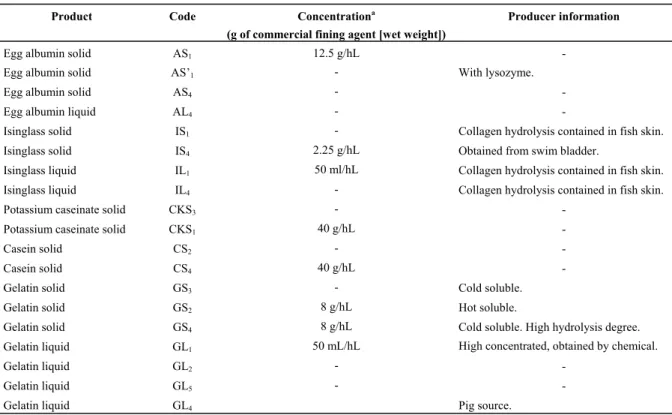
of galloylation, % prodelph – percentage of prodelphinidins) and concentration (mg/L) of the proanthocyanidin fractions from Touriga Nacional, Trincadeira, Cabernet Sauvignon, Castelão and Syrah monovarietal wines of the vintage 2004, 2004 (S) and 2005 (mean±SD). ... 31 Table 3.1 - Protein fining agents characterized and used in this study. ... 42 Table 3.2 - Total nitrogen, surface charge density, isoelectric point, protein, lead and cadmium
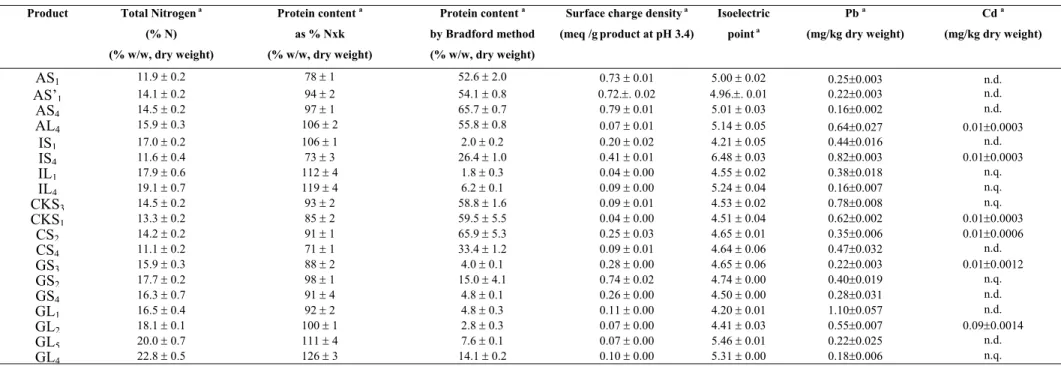
content of the fining agents. ... 48 Table 3.3 - Weight loss on drying, ash and pH of fining agents. ... 54 Table 3.4 - Flavonoids, non-flavonoids, total phenols and chromatic characteristics of both fined
Table 3.5 - Monomeric anthocyanins (mg/L malvidin-3-glucoside) for both fined and unfined red wine (means ± SD)... 58 Table 4.1 - Fining agents employed in this study... 69 Table 4.2 - Physic-chemical characteristics of the protein fining agents employed on the fining
trial (Cosme et al. 2007)... 73 Table 4.3 - Structural characterization of proanthocyanidins (oligomeric and polymeric), mean
degree of polymerization (mDP), percentage of galloylation (% gal), percentage of prodelphinidins (% prodelph), average molecular mass (mM) and the cis/trans (cis:trans) ratio for both unfined red wine and red wine after different fining treatments (mean±SD)... 76 Table 4.4 - (+) – catechin, (-) – epicatechin, sum of dimeric, trimeric and dimeric procyanidins
esterified by gallic acid (mg L-1) analysed by HPLC for both the unfined red wine and the red
wine after different fining treatments (mean±SD). ... 78 Table 4.5 - Total Pigments (TP), colour intensity (CI), hue (H), coloured anthocyanins (CA),
polymerized pigments (PP) and total anthocyanins (TA) for both unfined red wine and red wine after different fining treatments (mean±SD). ... 80 Table 5.1 - Fining agents employed in this study... 90 Table 5.2 - Physic-chemical characteristics of the protein fining agents employed on the fining
trial (Cosme et al., 2007)... 96 Table 5.3 - Monomeric flavanols (FI), oligomeric proanthocyanidins (FII) and polymeric
proanthocyanidins (FIII) for both unfined white wine and white wine after different fining treatments (mean±SD). ... 97 Table 5.4 - Structural characterisation of proanthocyanidins (oligomeric and polymeric), mean
degree of polymerisation (mDP), fractions of galloylation (% gal), fraction of prodelphinidins (% prodelph), average molecular mass (mM) and the cis/trans (cis:trans) ratio for both unfined white wine and white wine after different fining treatments (mean±SD). ... 100 Table 5.5 - Monomeric flavan-3-ols, dimeric, trimeric and dimeric procyanidins esterified by
gallic acid, analysed by HPLC for both unfined white wine and for white wine after different fining treatments (mean±SD)... 101 Table 5.6 - Non-flavonoids, flavonoids, total phenols, turbidity, browning potential, chromatic
characteristics and colour A420, of both fined and unfined white wine (mean±SD)... 103
Table 6.1 - Fining agents characterised and used for white and red wine fining. ... 113 Table 6.2 - Physic-chemical characteristics of the white and the red wines used before fining
treatment... 116 Table 6.3 - Weight loss on drying, pH, total nitrogen, total protein and surface charge density
Table 6.4 - Monomeric flavanols, oligomeric and polymeric proanthocyanidins, non-flavonoids compounds and chromatic characteristics of both fined and unfined white wine (means ± SD). 121 Table 6.5 - Oligomeric and polymeric proanthocyanidin contents of both fined and unfined red
wine (means ± SD)... 124 Table 6.6 - (+) - Catechin, (-) - epicatechin, dimeric, trimeric and dimeric procyanidins esterified
by gallic acid (mg/L) as analysed by HPLC for both fined and unfined red wines (means ± SD). ... 125 Table 6.7 - Monomeric anthocyanin contents (mg/L malvidin-3-glucoside) for both fined and
unfined red wine (means ± SD)... 126 Table 6.8 - Total anthocyanins, coloured anthocyanins, total pigments, polymeric pigments,
colour intensity, hue and chromatic characteristics of both fined and unfined red wine (means ± SD). ... 127 Table 7.1 - Physic-chemical characteristics of the protein fining agents employed on the fining
trial (Cosme et al. 2007)... 140 Table 7.2 - Quantity and structural characteristics (mean degree of polimerisation – mDP,
percentage of galloylation -%gal, percentage od prodelphinidins - % prodelph) of proanthocyanidin fractions extracted from Vitis vinifera cv. Touriga Nacional wine (mean±SD). ... 141 Table 7.3 - Concentration and mean degree of polymerisation (mDP) of the proanthocyanidin
1.1. STATE OF ART SUMMARY
Wine has great importance in the history of the Mediterranean people and in the last years it has been brought great improvements on their production, quality and commercialization. Wine stability is an important quality factor for the final product. The stabilisation process involves frequently modifications on wine composition. The physic-chemical stability depends on some factors such as the type and structure of the molecule involved, for example proanthocyanidins and proteins.
Wine proanthocyanidins are extracted during wine making from the solid parts (seed and skin) of the grape (Bourzeix et al. 1986, Escribano-Bailón et al. 1992, Ricardo-da-Silva et al. 1992, Dallas et al. 1995), as a result, wine proanthocyanidins contained procyanidins and prodelphinidins, oligomers or polymers of catechins or epicatechins and gallocatechins or epigallocatechins, esterified or no with gallic acid (Ricardo-da - Silva et al. 1991, Prieur et al. 1994; Souquet et al. 1996, Sun et al. 1998, Fulcrand et al. 1999, De Pascual-Teresa et al. 1998, 2000, Sun et al. 2001, Monagas et al. 2003, González-Manzano et al. 2004, Cheynier et al. 2006). The composition and the structural characteristics of proanthocyanidins are dependent of the grape localisation (seed or skin) and of the variety, as it was shown in same works (Table 1.1).
Table 1.1 – Mean degree of polymerisation (mDP), percentage of galloylation (% gal) and percentage of prodelphinidins (%prodeph) of grape seeds and skins proanthocyanidins from Vitis Vinifera grapes varieties.
Grape V. vinifera
variety fractions separated number of tannic mDP % gal % prodeph Reference Seed
Alicante Bouchet 5 2.3-15.1 13.2-30.2 - Prieur et al. (1994) Tinta Miúda Oligomeric and polymeric 9.8 and 31.5 23.0 and 26.2 - Sun et al. (1998) Cabernet Franc 8 4.7-15.7 20.0 - Labarbe et al. (1999) Syrah 2 2.8 and 8.9 16.2 and 22.5 - Vidal et al. (2003)
Gamay 10 1.8 to 19.3 - - Perret et al. (2003)
Temperanillo Polymeric 7.1 14.3 - Monagas et al. (2003) Graciano Polymeric 7.3 10.9 - Monagas et al. (2003) Cabernet Sauvignon Polymeric 6.4 12.9 - Monagas et al. (2003) Skin
Merlot 6 3-80 3-6 17 to 31 Souquet et al. (1996)
Cabernet Franc 11 9.3 to 73.8 2.7 - Labarbe et al. (1999)
Consequently, grape proanthocyanidins quantity, composition and structural characteristics at harvestplays a decisive role in wine quality.
Proanthocyanidins are particularly important for the sensory characteristics of red wine, since they have the propriety to bind salivary proteins. They are relevant to red wine quality due to their astringent properties (Grawel 1998) and their responsibility in colour stability (Somers 1971). In enology, the proanthocyanidins-salivary protein associations are frequently related with the sensation of astringency (Kallithraka et al. 1998; Saint-Cricq-de-Gaulejac et al. 1999).Nevertheless, Lea and Arnold (1978) had suggested that not all wine phenolic compounds contribute in a similar form for wine astringency, and showed that the sensation of astringency was essentially due to the more polymerised tannins and those esterified with gallic acid.Therefore, it is important to know the proanthocyanidin profile of wine. In the literature there are some works that focused the structural characteristics of wine proanthocyanidins (Table 1.2).
Table 1.2 – Mean degree of polymerisation (mDP), percentage of galloylation (%gal) and percentage of prodelphinidins (% prodeph) of wine proanthocyanidins obtained from different Vitis Vinifera grapes varieties.
Grape V. vinifera variety number of tannic fractions separated
mDP % gal % prodeph Reference
Tinta Miúda Oligomeric and polymeric 4.8 and 22.1 3.0 and 7.3 - Sun et al. (1998, 2001) Temperanillo Polymeric 13 2.8 11.3 Monagas et al. (2003) Graciano Polymeric 6.9 2.8 8.2 Monagas et al. (2003) Cabernet Sauvignon Polymeric 9.0 3.4 10.6 Monagas et al. (2003) Merlot/Carignan (50%/50%) proanthocyanidins 6.2 3.9 19.2 Sarni-Manchado et al. (1999) Syrah proanthocyanidins 10.3 5.0 19.2 Maury et al. (2001) Merlot proanthocyanidins 5.8 8.3 17.7 Maury et al. (2001) Syrah/Gernache (75%/25%) proanthocyanidins 10.4 5.0 19.9 Maury et al. (2003) Syrah/Gernache (25%/75%) proanthocyanidins 12.3 4.8 22.6 Maury et al. (2003)
Frequently the new wines do not have the required final sensory characteristics. In most cases it is necessary to use specific processes to modify wine proanthocyanidins profile and consequently the sensory characteristics. Protein fining is one of the most common technological processes available that is associated with wine clarification and the improving of the sensory characteristics such as reduction of the wine astringency. Sarni-Manchado et al. (1999) in studies with gelatines showed that proanthocyanidins with higher degree of polymerisation are more astringent and other authors also in works with gelatines showed that the wine proanthocyanidins structural characteristics influenced wine fining
process (Ricardo-da-Silva et al. 1991; Sarni-Manchado et al. 1999; Maury et al. 2001; Maury et al. 2003).
At the present time, the most commonly used protein fining agents for wine fining are gelatines, egg albumins, caseins, potassium caseinates or isinglasses. The diverse protein fining agents can behave differently, depending on their composition, their origin and their preparation condition. Consequently, it is essential to know the characteristics of the fining agent and to comprehend the fining mechanisms, to achieve the proposed objectives. Proteins used as wine fining agents have different physic-chemical characteristics mainly molecular weight distribution, isoelectric point and surface charge density (Lagune and Glories 1996 a, b; Lagune-Ammirati et al. 1996; Maury et al. 2003).
Several works are focused on the influence of the fining proteins on wine composition, using in their studies different types of proteins (Ough 1960; Cruess et al. 1963; Amati et al. 1979; Yokotsuka et al. 1983; Yokotsuka and Singleton 1987; Jouve et al. 1989; Castino 1992, Gorinstein et al. 1993, Yokotsuka and Singleton 1995; Sims et al. 1995; Machado-Nunes et al. 1995; 1998, Panero et al. 2001; Fischerleitner et al. 2002, 2003; Stankovic et al. 2004). However, there are few works that shown the relation between the physic-chemical characteristics (molecular weight and surface charge density) of fining protein and their effect on wine composition in especially their interaction with proanthocyanidins. The majority of these studies were performed with gelatines (Ricardo-da-Silva et al. 1991; Lagune and Glories 1996c; Versari et al. 1998; 1999; Lefebvre et al. 1999; Sarni-Manchado et al. 1999; Maury et al. 2001; 2003) or vegetable proteins (Lefebvre et al. 1999; Marchal et al. 2000a, b; 2002; Maury et al. 2003; Bonerz et al. 2004).
Gelatines likesalivary proteins are composed by a higher concentration of proline than the majority of the other proteins (Lagune and Glories 1996a). According to Sarni-Manchado et al. (1999) and Maury et al. (2001), the addition of gelatine to the wine leads to a proanthocyanidin reduction, mainly to the more polymerised and esterified with gallic acid. It was also observed that the molecular weight distribution of gelatines influenced the type of proanthocyanidins removed from red wine (Hrazdina et al. 1969; Lefebvre et al. 1999; Sarni-Manchado et al. 1999; Maury et al. 2001; 2003;Bonerz et al. 2004), and that the surface charge densities affect the precipitation of wine components (Versari et al. 1999).So, it is important for the fining process to know the physic-chemical characteristics
It is known that the two main types of interactions between proteins and proanthocyanidins are: hydrogen bonds and hydrophobic interactions (Murray et al. 1994). The formation of these complexes is directly related with some factors such as the proanthocyanidin structure, the protein structure, their concentration and the environmental conditions such as pH and temperature (Calderon et al. 1968, Lea and Arnold 1978; Yokotsuka and Singleton 1978). The study of the interactions occurred between wine proantocyanidins with different mean degree of polymerisation and fining proteins are particularly important for the wine industry.
1.2. AIMS OF THE STUDY
In the last years advances on the knowledge of protein fining agents characteristics as well as on their interactions with wine phenolic compounds were done. However, the majority of this works do not perform a detailed and comparative study of the effect of different characterised protein fining agents with the distinct proanthocyanidins fractions existent in the wine. So, the goal of this work was to study both, the protein fining agents characteristics and the structural characteristics of wine proanthocyanidins and consequently the effect of adding protein fining agents on the wine proanthocyanidins final composition, since the proanthocyanidins have an important function on the sensory characteristics of wines, such as colour, bitterness and astringency.
1) Wine proanthocyanidins are extracted during wine making from the solid parts (seed and skin) of the grapes. Therefore, a better knowledge of the structural characteristics and distribution of the grape seeds and skins proanthocyanidins as well as from the monovarietal wines seems to be useful.
The aim of this point was to study the tannic profile of the proanthocyanidins from the grape seeds and skins of varieties grown in Portugal as well as from the respective monovarietal wines. The tannic profile from the monovarietal wines obtained from two vintages and also one of these vintage after 6 month of aging were compared.
2) Given the role that proteic products take in fining processes and in wine quality, it is useful to characterize them. In addition, the knowledge of the physic-chemical
characteristics of protein fining agents is important for optimizing the fining process, which affects wine quality.
Consequently, the main objectives of this part of the work was to describe and compare the characteristics such as molecular weight distribution, surface charge density, isoelectric point, and protein, Pb and Cd contents of several protein fining agents present on the market.
3) In spite of, the maiority of the authors had shown that protein fining agents interact with phenolic compounds presented in the wine, few is known about the specificity and efficiency of each protein in the interaction with each of the different proanthocyanidin fractions of wine.
The aim of these point was to undertake a comparative study on the effect of protein fining agents (gelatine, egg albumin, casein, potassium caseinate and isinglass) with distinct physic-chemical characteristics (molecular weight distributions, isoelectric points, surface charge densities) on the structural characteristics (mean degree of polymerisation, galloylation and the percentage of prodelphinidins) of oligomeric and polymeric proanthocyanidins remaining in wine after fining as a function of the type of fining protein added to red and white wine.
4) The wine complexity leads to the use of wine-like model solutions to study the extent of protein and proanthocyanidin interaction, mainly to study the influence of physic-chemical factors such as temperature, pH and proanthocyanidin concentration.
The main propose of this point was to assay the characterised fining agents in wine-like model solutions composed by proanthocyanidins with different mean degree of polymerisation. The quantity and structural characteristics (mean degree of polymerisation, percentage of galloylation and percentage of prodelphinidins) of the proanthocyanidins remaining in wine-like model solutions after fining with different type of proteins as well as the influence of environmental factors (pH and temperature) were studied. An enhanced understanding of all the molecules implicated on fining and there behaviour at different environmental conditions could conduct to an improved control of the fining operation and thus to an optimisation of this enological practice.
REFERENCES
Amati, A., Galassi, S., and Spinabelli, U. 1979. Sull’impiego del “Caseinato potassico” nella stabilizzazione dei vini bianchi. II – Effetti dell’aggiunta al vino. Vignevini 6, 27-33. Bonerz, D.P.M., Bloomfield, D.G., Dykes, S.I., Rawel, H.M., Rohn, S., Kroll, J., Creasy, G.L. and Nikfardjam, M.S.P. 2004. A new gentle fining agent for ‘Pinot noir’. Mitt.
Klosterneuburg 54, 86-95.
Bourzeix, M., Weyland, D. and Heredia, N. 1986. Étude des catéchines et des procyanidols de la grappe de raisin, de vin et d’autres dérivés de la vigne. Bull. O.I.V. 669-670, 1171-1254.
Calderon, P., Van Buren, J. and Robinson, W. B. 1968. Factors influencing the formation of precipitates and hazes by gelatin and condensed and hydrolyzable tannins. J. Agric.
Food Chem. 16, 479-482.
Castino, M. 1992. La stabilizzazione ossidasica dei vini bianchi. Annali dell Istituto
Sperimentale per l´Enogia 23, 301-318.
Cheynier, V., Dueñas-Paton, M., Salas, E., Maury, C., Souquet, J. M., Pascal, S. M. and Fulcrand, H. 2006. Structure and properties of wine pigments and tannins. Am. J. Enol.
Vitic. 57 298-305.
Cruess, W. V. 1963. A study of several problems of clarification of wine with casein. Am.
J. Enol. Vitic. 14, 137-138.
Dallas, C., Ricardo-da-Silva, J.M. and Laureano, O. 1995. Degradation of oligomeric procyanidins and anthocyanins in a Tinta Roriz red wine during maturation. Vitis, 34, 51-56.
De Pascual-Teresa, S., Treutter, D., Rivas-Gonzalo, J.C. and Santos-Buelga, C. 1998. Analysis of flavanols in beverages by high-performance liuid chromatography with chemical reaction detection. J. Agric. Food Chem. 46, 4209-4213.
De Pascual-Teresa, S., Rivas-Gonzalo, J.C. and Santos-Buelga, C. 2000. Prodelphinidins and related flavanols in wine. Int. J. Food Sci. Tech. 35, 33-40.
Escribano-Bailón, T., Gutiérrez-Fernández, Y., Rivas-Gonzalo, J. C. and Santos-Buelga, C. 1992. Characterization of procyanidins of Vitis vinfera variey Tinta del País grape seeds.
J. Agric. Food Chem. 40, 1794-1799.
Fischerleitner, E., Wendelin, S. and Eder, R. 2003. Comparative study of vegetable and animal proteins used as fining agents. Bull. O.I.V. 76, 30-52.
Fischerleitner, E., Wendelin, S. and Eder, R. 2002. Auswirkungen konventioneller und neuartiger eiweißhaltiger Schönungsmittel auf Qualität, Zusammensetzung und Verträglichkeit von Wein. Mitt. Klosterneuburg, 52, 69-88.
Fulcrand, H., Remy, S., Souquet, J.M., Cheynier, V. and Moutounet, M. 1999. Study of wine tannin oligomers by On-line liquid chromatography electrospray ionization mass spectrometry. J. Agric. Food Chem. 47, 1023-1028.
Gawel, R. 1998. Red wine astringency: a review. Aust. J. Grape Wine Res. 4, 74-95.
González-Manzano, S., Rivas-Gonzalo, J.C. and Santos-Buelga, C. 2004. Extraction of flavan-3-ols from grapes and skin into wine using simulated maceration. Anal. Chim. Acta
513, 283-289.
Gorinstein, S., Weisz, M., Zemser, M., Tilis, K., Stiller, A., Flam, I., et al. 1993. Spectroscopic analysis of polyphenols in white wines. J. Ferm. Bioengineering 75, 115-120.
Hrazdina, G., Van Buren, J.P. and Robinson, W.B. 1969. Influence of molecular size of gelatin on reaction with tannic acid. Am. J. Enol. Vitic. 20, 66-68.
Jouve, C., Cabanis, J.C., Bourzeix, M., Heredia, N., Rosec, J.P., and Vialatte, C. 1989. Teneurs en catéchines et procyanidols de vins blancs et rose; Effets du collage par la caséine. Rev. Fran. Œnol. 117, 14-20.
Kallithraka, S., Bakker, J. and Clifford, M.N. 1998. Evidence that salivary proteins are involved in astringency. J. Sensory Studies 13, 29-43.
Labarbe, B., Chynier, V., Braussaud, F., Souquet, J. M. and Moutounet, M. 1999. Quantitative fractionation of grape proanthocyanidins according to their degree of polymerization. J. Agric. Food Chem. 47, 2719-2723.
Lagune, L., and Glories, Y. 1996b. Les gélatines oenologiques: caractéristiques, propriétés.
Rev. Fran. Œnol. 158, 19-25.
Lagune, L., and Glories, Y. 1996c. Les nouvelles données concernant le collage des vins rouges avec les gélatines oenologiques. Rev. Œnol. 80, 18-20.
Lagune-Ammirati, L., Lartigue, L. and Glories, Y. 1996. Apports récents à l’étude du collage des vins rouges. Rev. Fr. Oenol. 161, 17-28.
Lea, A. G. and Arnold, G. M. 1978. The phenolic of ciders, bitterness and adstringency. J.
Sci. Food Agric. 29, 478-483.
Lefebvre, S., Maury, C., Poinsaut, P., Gerland, C., Gazzola, M. and Sacilotto, R. 1999. Le collage des vins: Influence du poids moléculaire des gélatines et premiers essais de colles d’origine végétale. Rev. Œnol. 26, 37-40.
Machado-Nunes, M., Laureano, O. and Ricardo-da-Silva, J.M. 1995. Influência do tipo de cola e metodologia de aplicação nas características físico-químicas e sensoriais do vinho.
Actas do 3º Simpósio de Vitivinicultura do Alentejo 2, 99-115.
Machado-Nunes, M., Laureano, O. and Ricardo-Da-Silva, J.M. 1998. Influência do tipo de cola caseína e bentonite e da metodologia de aplicação nas características físico-químicas e sensoriais do vinho branco. Ciência Téc. Vitiv. 13, 7-28.
Marchal, R., Venel, G., Marchal-Delahaut, L., Valade, J.-P., Bournérias, P.-Y. and Jeandet, P. 2000a. Utilisation de protéines de blé pour la clarification des moûts et des vins de base champenois. Rev. Fran. Œnol. 184, 12-18.
Marchal, R., Jeandet, P., Bournérias, P.Y., Valade, J.-P. and Demarville, D. 2000b. Utilisation de protéines de blé pour la clarification des moûts champenois. Rev. Œnol. 97, 19-21.
Marchal, R., Marchal-Delahaut, L., Lallement, A. and Jeandet, P. 2002. Wheat gluten used as a clarifying agent of red wines. J. Agric. Food Chem. 50, 177-184.
Maury, C., Sarni-Manchado, P., Lefebvre, S., Cheynier, V. and Moutounet, M. 2001. Influence of fining with different molecular weight gelatines on proanthocyanidin composition and perception of wines. Am. J. Enol. Vitic. 52, 140-145.
Maury, C., Sarni-Manchado P., Lefebvre S., Cheynier V. and Moutounet M. 2003. Influence of fining with plant proteins on proanthocyanidin composition of red wines. Am.
J. Enol. Vitic. 54, 105-111.
Monagas, M., Gómez-Cordovés, C., Bartolomé, B., Laureano, O. and Ricardo-da-Silva, J. M. 2003. Monomeric, oligomeric, and polymeric flavan-3-ol composition of wines and grapes from Vitis vinifera L. Cv. Graciano, Tempranillo, and Cabernet Sauvignon. J.
Agric. Food Chem., 51, 6475-6481.
Murray, N. J., Williamson, M. P., Lilley, T. H. and Haslam, E. 1994. Study of the interaction between salivary proline rich proteins and a polyphenol by 1H-NMR spectoscopy. Eur. J. Biochem. 219, 923-935.
Ough, C.S. 1960. Gelatin and polyvinylpyrrolidone compared for fining red wines. Am. J.
Enol. Vitic.11, 170-173.
Panero, L., Bosso, A., Gazzola, M., Scotti, B. and Lefebvre, S. 2001. Primi risultati di esperienze di chiarifica con proteine di origine vegetale condotte su vini Uva di Troia.
Vigne e Vini 11, 117-126.
Perret, C., Pezet, R. and Tabacchi, R. 2003. Fractionation of grape tannins and analysis by matrix-assisted laser desorption/ionization time-of-flight mass spectrometry. Phytochem.
Analysis 14, 202-208.
Prieur, C., Rigaud, J., Cheynier, V. and Moutounet, M. 1994. Oligomeric and polymeric procyanidins from grape seed. Phytochemistry 36, 781-784.
Ricardo-da-Silva, J.M., Cheynier, V., Souquet, J.M., Moutounet, M., Cabanis, J.C. and Bourzeix, M. 1991. Interaction of grape seed procyanidins with various proteins in relation to wine fining. J. Sci. Food Agric. 57, 111-125.
Ricardo-da-Silva, J.M., Belchior, A.P., Spranger, M.I. and Bourzeix, M. 1992. Oligomeric procyanidins of three grapevine varieties and wines from Portugal. Sciences des Alimentes
12, 223-237.
Saint-Cricq-De-Gaulejac, N., Vivas ,N., Freitas, V. and Bourgeois, G. 1999. The influence of various phenolic compounds on scavenging activity assessed by an enzymatic method.
Sarni-Manchado, P., Deleris, A., Avallone, S., Cheynier, V. and Moutounet, M. 1999. Analysis and characterization of wine condensed tannins precipitated by proteins used as fining agent in enology. Am. J. Enol. Vitic. 50, 81-86.
Sims, C.A., Eastridge, J.S. and Bates, R.P. 1995. Changes in phenols, color, and sensory characteristics of muscadine wines by pre- and post-fermentation additions of PVPP, casein, and gelatin. Am. J. Enol. Vitic. 46, 155-158.
Somers, T. C. 1971. The polymeric nature of wine pigments. Phytochemistry 10, 2175-2186.
Souquet, J.M., Cheynier, V., Brossaud, F. and Moutounet, M. 1996. Polymeric pronthocyanidins from grape skins. Phytochemistry 43, 509-512.
Stankovic, S., Jovic, S. and Zivkovic, J. 2004. Bentonite and gelatine impact on the young red wine coloured matter. Food Technololy and Biotechnolgy 42, 183-188.
Sun, B., Leandro, C., Ricardo-da-Silva, J.M. and Spranger, I. 1998. Separation of grape and wine proanthocyanidins according to their degree of polymerization. J. Agric. Food
Chem. 46, 1390-1396.
Sun, B., Spranger, I., Roque-do-Vale, F., Leandro, C. and Belchior, P. 2001. Effect of different winemaking technologies on phenolic composition in tinta miúda red wines. J.
Agric. Food Chem. 49, 5809-5816.
Versari, A., Barbanti, D., Potentini, G., Mannazzu, I., Salvucci, A. and Galassi, S. 1998. Physico-chemical characteristics of some oenological gelatins and their action on selected red wine components. J. Sci. Food Agric. 78, 245-250.
Versari, A., Barbanti, D., Potentini, G., Parpinello, G.P. and Galassi, S. 1999. Preliminary study on the interaction of gelatin-red wine components. Ital. J. Food Sci. 11, 231-239. Vidal, S., Francis, L., Guyot, S., Marnet, N., Kwiatkowski, M., Gawel, R., Cheynier, V. and
Waters, E. 2003. The mouth-fell properties of grape and apple proanthocyanidins in wine-like medium. J. Sci. Food Agric. 83, 564-573.
Yokotsuka, K., Nozaki, K. and Kushida, T. 1983. Turbidity formation caused by interaction of must proteins with wine tannins. Journal of Fermentation Technolology 61, 413-416.
Yokotsuka, K. and Singleton, V.L. 1987. Interactive precipitation between graded peptides from gelatin and specific grape tannin fractions in wine-like model solutions. Am. J. Enol.
Vitic. 38, 199-206.
Yokotsuka, K. and Singleton, V.L. 1995. Interactive precipitation between phenolic fractions and peptides in wine-like model solutions: Turbidity, particle size, and residual content as influenced by pH, temperature and peptide concentration. Am. J. Enol. Vitic.
2. T
ANNICP
ROFILES OFV
ITIS VINIFERAL.
CV. R
EDG
RAPESG
ROWING INL
ISBON ANDT
HEIRM
ONOVARIETALW
INESP
ROFILETannic profiles of Vitis vinifera L. cv. red grapes growing in Lisbon and
from their monovarietal wines
F. COSME1; J. M. RICARDO-DA-SILVA∗; O. LAUREANO
Universidade Técnica de Lisboa, Instituto Superior de Agronomia, Laboratório Ferreira Lapa (Sector de Enologia), 1349-017 Lisboa, Portugal
ABSTRACT
The tannic profiles of five grapes (Vitis vinifera L. cv. Touriga Nacional, Trincadeira, Castelão, Syrah and Cabernet Sauvignon) as well as the profile of their red monovarietal wines [vintage 2004 and 2005] were studied. In seeds and skins depending on the variety, the polymeric fraction represented, respectively, 77-85 % and 91-99 % of the total proanthocyanidins. The distribution of the mean degree of polymerisation (mDP) of the proanthocyanidins ranged from 2.8 to 12.8 for seeds and from 3.8 to 81.0 for skins. In monovarietal wines, the distribution of the mDP of the proanthocyanidins ranged from 2.1 to 9.6. The polymeric fraction represented 77-91 % and 82-95 % of the total proanthocyanidins, respectively, in vintage 2004 and 2005. The wine proanthocyanidins of Trincadeira and Cabernet Sauvignon, in the two vintages, showed a similar tannic profile. After 6 month it was measured a noticeably decreases on total proanthocyanidins concentration accompanied by a little decrease of the prodelphinidins percentage but the percentage of galloylation and mDP remained unchangeable.
Keywords: Vitis vinifera, grape seed, grape skin, red wine, proanthocyanidins, tannin, thiolysis.
2.1. INTRODUCTION
Proanthocyanidins (condensed tannins) are found in all grape clusters (skins, seeds, stems and pulps), however, skins contain lower amount of proanthocyanidins (oligomeric and polymeric flavan-3-ols) than seeds and their structural characteristics differ (Bourzeix, Weyland & Heredia, 1986; Ricardo-da-Silva, Rigaud, Cheynier, Cheminat & Moutounet, 1991a, Ricardo-da-Silva, Belchior, Spranger & Bourzeix, 1992a, Ricardo-da-Silva, Rosec, Bourzeix, Mourgues & Moutounet, 1992b, Labarbe, Cheynier, Braussaud, Souquet & Moutounet, 1999, Souquet, Cheynier & Moutounet, 2000, Sun, Spranger, Roque-do-Vale, Leandro & Belchior, 2001, Monagas, Gómez-Cordovés, Bartolomé, Laureano & Ricardo-da-Silva, 2003, Ó-Marques, Reguinga, Laureano & Ricardo-Ricardo-da-Silva, 2005).
Grape seed tannins are composed only by procyanidins (Prieur, Rigaud, Cheynier & Moutounet, 1994, Labarbe et al. 1999, Vidal, Cartalade, Souquet, Fulcrand & Cheynier, 2002) whereas grape skin tannins are composed by prodelphinidins and procyanidins (Souquet, Cheynier, Brossaud & Moutounet, 1996, Cheynier, Prieur, Guyot, Rigaud & Moutounet, 1997, Labarbe et al. 1999, Vidal et al. 2002, Cheynier et al. 2006). Skin proanthocyanidins have a higher average molecular weight and a lower percentage of galloylated subunits than those from seeds (Moutounet, Rigaud, Souquet & Cheynier, 1996, Cheynier et al. 1997, Labarbe et al. 1999, Kennedy, Hayasaka, Vidal, Waters & Jones, 2001, Vidal et al. 2003). However, in both seeds and skins, the polymeric tannins were presented to a greater extent than the monomers and dimers (Cheynier et al. 1997).
According to Prieur et al. (1994) the grape seed proanthocyanidins (V. vinifera, var. Alicante Bouchet fractionated into 5 fractions) showed an mDP ranging from 2.3 (fraction 1) to 15.1 (fraction 5) and the proportion of galloylated units increased with the mDP from 13.2 % to 30.2 %. Sun, Leandro, Ricardo-da-Silva and Spranger (1998) determined an mDP of 9.8 and 31.5 and a percentage of galloylation of 23.0 and 26.2, respectively on oligomeric and polymeric proanthocyanidins of seed extracts (V. vinifera, var. Tinta Miúda). The mDP of the separated seed proanthocyanidins (V. vinifera, var. Cabernet Franc fractionated into eight fractions) characterised by Labarbe et al. (1999) ranged increasingly from 4.7 (fraction 1) to 15.7 (fraction 8). However, these authors showed that the galloylation rate remained constant (20%) in each fraction, which seems indicate that the extension of galloylation is independent from mDP.
Vidal et al. (2003) studied also the structural characteristics of seeds proanthocyanidins from V. vinifera, var. Syrah fractionated into two fractions and verified an mDP of 2.8 and 8.9 and a percentage of galloylation of 16.2 and 22.5, respectively. Perret, Pezet and Tabacchi (2003), fractionated grape seed proanthocyanidins from V.
vinifera, var. Gamay into ten fractions and observed that the mDP varied from 1.8 to 19.3.
Kennedy and Taylor (2003) fractionated grape seed proanthocyanidins from V. vinifera, var. Pinot noir into five fractions observed that the mDP varied from 2.0 to 24.1.
The mDP and the degree of galloylation (%gal) of the seed polymeric proanthocyanidins from Tempranillo (mDP = 7.1, % gal = 14.3), Graciano (mDP = 7.3, % gal = 10.9) and Cabernet Sauvignon (mDP = 6.4, % gal = 12.9) were determined by Monagas et al. (2003). The mDP measured in seeds from V. Vinifera cv. Cabernet Sauvignion at harvest was 5.6 (Kennedy, Matthews & Waterhouse, 2000a) and in seed from Syrah around 5 (Kennedy et al. 2000b, Downey, Harvey & Robinson, 2003).
The mDP of skin proanthocyanidins (V. vinifera var. Merlot fractionated into six fractions) determined by Souquet et al. (1996) ranged from 3 (fraction 1) to 80 (fraction 6). Nevertheless, these authors showed that the galloylation rate was low (3-6 %), and seems also to be independent from mDP, and that the percentage of prodelphinidins ranged from 17 to 31 %. Likewise, skins proanthocyanidins (V. vinifera, var. Cabernet Franc fractionated into eleven fractions) analysed by Labarbe et al. (1999), presented an mDP that ranged increasingly from 9.3 (fraction 1) to 73.8 on the last fraction (fraction 11). These authors also showed that the galloylation rate (2.7%) was low and independent from mDP and that the percentage of (-) epigallocatechin units (prodelphinidins) increased slightly with mDP.
Vidal et al. (2003) studied the structural characteristics of skin proanthocyanidins from V. vinifera, var. Syrah fractionated into three fractions and found that the mDP ranged from 3.0 to 19.8 and the percentage of (-) - epigallocatechin units (prodelphinidins) from 9.0 to 16.3, however the percentage of galloylation was around 4 %. Kennedy and Taylor (2003), fractionated grape skin proanthocyanidins from V. vinifera, var. Pinot noir into 7 fractions and observed that the mDP varied from 3.8 to 39.0. Monagas et al. (2003), also determinate the mDP, degree of galloylation (%gal) and percentage of prodelphinidins (% prodelph) of the skin polymeric proanthocyanidin fraction from Tempranillo (mDP = 72.3, % gal = 2.9, % prodelph = 13.3), Graciano (mDP = 33.8, % gal = 6.5, % prodelph = 10.7)
The mDP determined in skins from V. Vinifera cv. Syrah at commercial harvest was 27.0 by Kennedy et al. (2001) and 28.5 by Downey et al. (2003).
Wine proanthocyanidins were extracted during wine making from the solid parts of the clusters, mainly from skins and seeds, and stems if they are present (Bourzeix et al. 1986, Escribano-Bailón, Gutiérrez-Fernández, Rivas-Gonzalo & Santos-Buelga, 1992, Ricardo-da-Silva et al. 1992a, Dallas, Ricardo-da-Silva & Laureano, 1995, Fuleki & Ricardo-da-Silva, 1997, Sun, Pinto, Leandro, Ricardo-da-Silva & Spranger, 1999). Consequently, wine proanthocyanidins enclosed procyanidins and prodelphinidins (De Pascual-Teresa, Treutter, Rivas-Gonzalo & Santos-Buelga, 1998, González-Manzano, Rivas-Gonzalo & Santos-Buelga, 2004).
The mDP and percentage of galloylation of oligomeric and polymeric proanthocyanidins from red wine of Tinta Miúda [(mDP 4.8 and 22.1, respectively), (% gal 3.0 and 7.3, respectively)] were determinate by Sun et al. (1998), as well as from red wines obtained by various winemaking technologies [(mDP 3.7-5.0 and 11.1 – 15.6, respectively), (% gal 1.8 -3.3 and 5.9 – 8.3, respectively)] (Sun et al. 2001).
Monagas et al. (2003), measured the mDP, the percentage of galloylation and the percentage of prodelphinidins of the polymeric proanthocyanidins from Tempranillo (mDP = 13.0, % gal =2.8, % prodelph = 11.3), Graciano (mDP = 6.9, % gal =2.8, % prodelph = 8.2) and Cabernet Sauvignon (mDP = 9.0, % gal =3.4, % prodelph = 10.6) wines. Sarni-Manchado, Deleris, Avallone, Cheynier and Moutounet (1999) estimated an mDP of 6.2, percentage of galloylation of 3.9 and percentage of prodelphinidin of 19.2 on the proanthocyanidins of a wine from V. vinifera var. Merlot (50%) and var. Carignan (50%).
The mDP, percentage of galloylation and prodelphinidins of wine proanthocyanidins from Syrah [(mDP = 9.5, % gal = 5.0, % prodelph = 19.2), (mDP = 10.3, % gal = 5.1, % prodelph = 19.5)], and Merlot [(mDP = 5.8, % gal = 8.3, % prodelph = 17.7), (mDP = 5.8, % gal = 8.3, % prodelph = 12.8)] were determined by Maury, Sarni-Manchado, Lefebvre, Cheynier and Moutounet (2001) and by Maury, Sarni-Sarni-Manchado, Lefebvre, Cheynier and Moutounet (2003), respectively.
A wine made from 75% Syrah and 25 % Grenache presented mDP = 10.4, percentage of galloylation and percentage of prodelphinidins of 5.0 % and 19.9%, respectively. A wine made from 25% Syrah and 75 % Grenache showed mDP = 12.3, percentage of galloylation and percentage of prodelphinidins of 4.8 % and 22.6 %, respectively (Maury et al. 2001).
Cheynier et al. (1997) observed that a red wine after four months aging showed a decrease in total proanthocyanidins, particularly on the prodelphinidins and also on the galloylated compounds, but in a lesser extend. These authors also verified that the mDP diminished which could be related to easier degradation of the proanthocyanidins with higher molecular weight. Vidal et al. (2002) also attributed the decrease of mDP to cleavage reaction that occurred in acidic medium like wine, which in this case probably dominate in relation to the polymerisation reaction of proanthocyanidins that also could occur (Haslam 1974).
According to several studies, proanthocyanidins are concerned an important function on the sensory characteristics of red wines, such as colour, bitterness and astringency. It was shown, that astringency depends on the proanthocyanidin structural characteristics such as mDP and degree of galloylation (Peleg, Gacon, Schlich & Noble, 1999, Vidal et al. 2003). Therefore, the knowledge of the wine proanthocyanidin structural composition could be essential for the definition of the sensory characteristics of the final wine. It was also evidenced by some authors that the mDP and galloylation of wine proanthocyanidins are essential structural characteristics affecting wine fining agents action (Ricardo-da-Silva, Cheynier, Souquet, Moutounet, Cabanis & Bourzeix, 1991c; Sarni-Manchado et al. 1999; Maury et al. 2001, 2003; Cosme, Ricardo-da-Silva & Laureano, 2007, 2008).
The aim of this work was to study the tannic profile from the grape seed and skin from Vitis vinifera L. cv. Touriga Nacional, Tricadeira, Cabernet Sauvignon, Castelão and Syrah growing in Lisbon, Portugal, as well as from the monovarietal wines produced from these grapes since there is no information about this subject. The tannic profile from the monovarietal wines from two vintages (2004 and 2005) and the evolution of same wine aged six month were compared.
2.2. MATERIALS AND METHODS
Reagents
Grapes
Vitis vinifera L. cv. Touriga Nacional, Trincadeira, Castelão, Syrah and Cabernet
Sauvignon berries grown during the 2005 harvest season on the vineyards of the Tapada da Ajuda at the Instituto Superior de Agronomia located in Lisbon were used in this study. Approximately 250 berries at their technological maturity were randomly selected. The solid parts of the grape, skins and seeds, were manually separated for subsequent analysis.
Preparation of phenolic extracts from grape seeds and skins
Grape seeds were ground to a fine powder using a coffee-bean miller. The phenolic compounds from grape seeds (≈ 9 g) and skins (≈ 50 g) were extracted following the method described by Bourzeix et al. (1986).
Monovarietal Wines
Monovarietal red wines were made from grapes from Vitis vinifera L. cv. Touriga Nacional, Trincadeira, Cabernet Sauvignon, Castelão and Syrah grown in the same geographical area (Instituto Superior de Agronomia vineyard, Lisbon) and harvested at their technological maturity (vintage 2004 and 2005, respectively) to produced the wine for these study. The wines were elaborated at the Instituto Superior de Agronomia experimental cellar located in Lisbon, by classic vinification with maceration during approximately 12 days. The 2004 and 2005 wines were analysed around 5 month after vinification (the malolactic fermentation was already achieved). The 2004 wine was also analyses after six month storage. The chemical characteristics of wines from vintage 2004 and 2005 are: Touriga Nacional 2004 (11.8 % v/v, 7.1 g/L tartaric acid, pH 3.51), Touriga Nacional 2005 (11.6 % v/v, 5.1 g/L tartaric acid, pH 3.84), Trincadeira 2004 (11.0 % v/v, 7.5 g/L tartaric acid, pH 3.43), Trincadeira 2005 (12.4 % v/v, 6.8 g/L tartaric acid, pH 3.62), Cabernet Sauvignon 2004 (13.0 % v/v, 7.5 g/L tartaric acid, pH 3.39), Cabernet Sauvignon 2005 (13.0 % v/v, 7.1 g/L tartaric acid, pH 3.62), Castelão 2004 (11.8 % v/v, 8.0 g/L tartaric acid, pH 3.20), Castelão 2005 (11.9 % v/v, 6.9 g/L tartaric acid, pH 3.50), Syrah 2005 (14.7 % v/v, 6.8 g/L tartaric acid, pH 3.53), Syrah 2005 (14.4 % v/v, 6.6 g/L tartaric acid, pH 3.75).
Separation of proanthocyanidins by C18 Sep-Pak cartridges and determination of the
flavan-3-ol content by the vanillin assay
The separation of flavanols was performed in a C18 Sep-Pak cartridge (Waters, Milford, Ireland) according to their degree of polymerisation in three fractions monomeric, oligomeric and polymeric, in agreement with the method described by Sun et al. (1998). The total flavan-3-ol of each fraction was performed by the vanillin assay according to the method described by Sun et al. (1998). Quantification was carried out by means of standards curves prepared from monomers, oligomers, and polymers of flavan-3-ol isolated from grape seeds, as described earlier (Sun et al. 1998, 2001).
Fractionation of proanthocyanidins (wines, seeds and skins) according to their degree of polymerisation using a sequential dissolving procedure on an inert glass powder column
Proanthocyanidins (oligomeric and polymeric) extracted from seeds, skins and wines were separated from phenolic monomers, by fractionation in a C18 Sep-Pak cartridge (Waters, Milford, Ireland), and in agreement with the method described by Sun et al. (2001). The proanthocyanidin extract from seeds (Touriga Nacional, Trincadeira, Cabernet Sauvignon, Castelão and Syrah), skins (Touriga Nacional, Cabernet Sauvignon, and Castelão) or wines (Touriga Nacional, Trincadeira, Cabernet Sauvignon, Castelão and Syrah), were separated according to their degree of polymerisation following the method described by Labarbe et al. (1999). The elution gradient (methanol/chloroform) applied for wines and seeds was the following FI-25:75 (v/v); FII-30:70 (v/v); FIII-35:65 (v/v); FIV-40:60 (v/v); FV-45:55 (v/v); FVI-50:50 (v/v); FVII-55:45 (v/v); FVIII 100:0 (v/v) and for skins was used the subsequent gradient FI-25:75 (v/v); FII-30:70 (v/v); FIII-35:65 (v/v); FIV-40:60 (v/v); FV-45:55 (v/v); FVI-50:50 (v/v); FVII-55:45 (v/v); FVIII 60:40 (v/v); FIX 65:35 (v/v); FX 70:30 (v/v); FXI 100:0 (v/v).
Those tannin fractions were analysed by HPLC after thiolysis, to estimate their structural characteristics (mDP, % gal and % prodelph) and to determine their concentration.
Characterisation of wines, seeds and skins proanthocyanidins by acid-catalysed depolymerisation in the presence of toluene− α-thiol followed by reversed-phase HPLC analysis
The acid-catalysed degradation was carried out according to Monagas et al. (2003) and the thiolysed sample were then analysed by reversed-phase HPLC. The equipment and elution conditions employed for analytical HPLC were the same used by Cosme et al. (2008). The amounts of monomers (terminal units) and toluene-α-thiol adducts (extension units) released from the depolymerisation reaction in the presence of toluene-α-thiol, were calculated from the areas of the chromatographic peaks at 280 nm by comparison with calibration curves (Rigaud, Perez-Ilzarbe, Ricardo-da-Silva & Cheynier, 1991; Prieur et al. 1994, Kennedy et al. 2000a).
2.3. RESULTS AND DISCUSSION
2.3.1. Grape tannic profile
Concentration and structural composition of the proanthocyanidins from grape seeds and skins greatly differed among the V. Vinifera L. cv grape varieties studied, which agrees with previous studies performed by other authors. On an mg/g basis, the grape seed proanthocyanidin concentration was always higher than in skins (Table 2.1).
Structural characterisation and quantification of grape seed proanthocyanidin fractions
The flavan-3-ols, of seed fractions (monomeric, oligomeric and polymeric) determined by the vanillin reaction, are shown in Table 2.1. The grape seeds of Cabernet Sauvignon presented higher level of oligomeric plus polymeric flavan-3-ols when compared with the other V. Vinifera L. cv grape seed proanthocyanidin analysed (Table 2.1). The lowest values of monomeric, oligomeric and polymeric flavan-3-ols were measured for Touriga Nacional grape seed. The highest mDP for the polymeric grape seed fraction was verified for Castelão (8.8 mDP) followed by Syrah (7.8 mDP). The mDP values for Syrah grown in Portugal are in the range of already published data concerning Syrah seed proanthocyanidins (Vidal et al. 2002, 2003).
Proanthocyanidins extracted from grape seeds were also fractionated according to their degree of polymerisation on an inert glass powder column eluted with a gradient of methanol/chloroform. The data concerning the structural characteristics of all the fraction of seed proanthocyanidins after toluene-α-thiolyse are summarized in Table 2.2. The percentage of galloylation ranged from 9.4 to 32.2 %, and it was observed that the degree of galloylation of the proanthocyanidins increased with an increase of the mDP, as it was previously observed for grape seeds from Alicante Bouchet (Prieur et al. 1994), but not in grape seeds from Cabernet Franc (Labarbe et al. 1999).
The proanthocyanidins of grape seeds showed an mDP ranging from 2.8 to 12.8 (Table 2.2). Among the varieties analysed different tannic profiles were observed (Fig. 2.1). Touriga Nacional measured the lowest concentration of total proanthocyanidins, and showed a distribution of tannin fractions as follow: 36 % for 2-4 mDP, 44 % for 5-8 mDP and 17% for 12-13 mDP. Trincadeira and Syrah presented the major quantity of proanthocyanidins (85% and 76 %, respectively) on the mDP 4-7 and on the mDP 3-6, respectively, and a lower amount at a higher mDP (13% at 10-11 mDP and 23 % at 12-13 mDP, respectively). As already noticed Cabernet Sauvignon measured the highest concentration of total proanthocyanidins. This variety showed the major quantity of tannins on the mDP 3-5 (59 %) and at 6-7 mDP (30%) and a fewer quantity of proanthocyanidins on higher mDP (10 % at 11-12 mDP). Castelão presented 40 % of the proanthocyanidins with an mDP of 3-6, 24 % at mDP 8-9 and 33 % at mDP 11-12.