Promoting change and easing quality management into higher
education institutions
Duarte, R.1), Lacerda-Nobre, A.2), Ramos-Pires, A.1,4), Duarte, J.3), and Silva-Ribeiro, J.2,3)
1) DEM, Escola Superior de Tecnologia de Setúbal, Instituto Politécnico de Setúbal, Campus IPS,
Estefanilha, 2914-761 Setúbal, Portugal
2) DEG, Escola Superior de Ciências Empresariais, Instituto Politécnico de Setúbal, Campus IPS,
Estefanilha, 2914-761 Setúbal, Portugal
3) UNIQUA, Instituto Politecnico de Setúbal, Campus IPS, Estefanilha, 2914-761 Setúbal, Portugal 4) Associação Portuguesa para a Qualidade, Pólo Tecnológico de Lisboa, Rua Carlos Alves nº.3,
1600-515 Lisboa, Portugal
STRUCTURED ABSTRACT
Purpose - The purpose of this paper is to investigate the benefit of aligning quality management
with organisational change and to describe the circumstances for which such alignment is possible.
Design - The paper starts by drawing a parallel between difficulties associated with organisational
change and those found when implementing quality management systems in higher education. From this initial analysis characteristics of quality management systems conducive to organisation change are highlighted. A case study is presented that includes several (but not all) of the characteristics that support organisational change and lessons from the implementation of this quality management system are used to draw conclusions.
Findings - The study found that quality management systems that accept variability and diversity
are better fit to create the necessary conditions for organisational change to take place. It was also found that within the higher education institutions context, the promotion of academic success is a good candidate for a unifying shared belief at organisational level, and, because change is easier when supported on a shared belief, quality management systems benefit from being centred on the core objective of academic success.
Practical implications - Because knowledge is above all local and regional, reporting local
experiences contributes to a better understanding of the challenges facing those wishing to implement effective quality management systems in higher education institutions. Key features
highlighted with the presentation of the case study should also assist developers of quality management systems.
Originality - This paper is the first to discuss the successful implementation of quality management
systems in higher education institutions in connection to academic success, used as a driver for organisational change and as a unifying shared belief.
Keywords: Higher education; quality management systems; academic success; shared belief;
change culture.
1. INTRODUCTION
The number of Higher Education Institutions (HEIs) with quality management systems increased significantly since the first reported cases in the 1980s (see Kanji et al., 1999). According to a 2010 European University Association survey (Loukkola and Zhang, 2010), of over 200 HEIs from 36 countries the majority already had an internal quality assurance system. This owes much to the 1999 Bologna Declaration and to the subsequent definition, in 2005, of guidelines for the development of institutional quality management systems (the European Standards and Guidelines, ESG, by ENQA, 2005)1.
Researchers who foresaw in the 1990s the growth of quality management in higher education (among others, Williams, 1993; Owlia and Aspinwall, 1996) were correct in doing so; quality assurance in higher education “won’t go away”, and the scientific literature shows how Quality Management Systems (QMS) are being used to improve HEIs’ administrative services — e.g., front-office, back-office, library, and internationalisation (Owlia and Aspinwall, 1996; Nadiri et al., 2009; Vauterin et al., 2011; Min et al., 2012) — but also to improve course design/ delivery, and as a tool to reframe higher education service models (Yeo and Li, 2014; Noaman et al., 2013).
From the standpoint of academic staff, it is generally recognised that the accountability introduced by quality systems is appropriate and beneficial. Advantages associated with QMS are increased openness, which allows for a better detection of weaknesses, more transparency and fairness and more opportunities to work closer together (Hoecht, 2006). Frequently reported disadvantages of QMS relate to incommensurability (when comparing the effort required by QMS to end results), bureaucracy and shift towards managerialism. Relevant to the discussion of QMS in HEIs is also the fact that often quality management is implemented as a response to external accreditation pressure, suggesting that QMS in HEIs does not stand on its own value but as an external demand for accountability (Newton, 2002). As a consequence, from HEIs’ stakeholders perspective (especially, from the academic staff perspective), QMS may not reflect the institution’s inner needs, and the stakeholders expectations.
Indeed, concerning the specific case of the teaching and learning process, academic staff is often sceptical of the benefits that might arise from QMS. Already in the 1990s Jauch and Orwig (1997) claimed that important quality management principles were contrary to the essence of higher education teaching and learning, and presented the following arguments to support their claim: • Quality management asks for the reduction in processes variability, which is contrary to both students being an active part of teaching, and to innovation in the teaching process itself;
1 Though not mandatory, and not used as an integrated whole, according to Loukkola and Zhang (2010)
• Quality management emphasises customer focus, asking for identifiable customers that are able to define and recognise quality; which is a subject of much debate in higher education, due to the multifaceted characteristics of HEIs’ stakeholders;
• Quality management assumes employees willingness to be empowered by quality, which is questionable given that in HEIs academic staff already have complete discretion over course design, and over scientific and pedagogical issues.
Obviously, these arguments can be refuted, and today several successful examples of QMS implemented in HEIs could be presented, nevertheless, it should be recognised that more than 20 years after the first reported implementations, “primordial fears” against QMS in HEIs (like the ones above) are still common. Why? Most likely because too many QMS have been implemented without proper account for the specific characteristics of HEIs, and QMS became associated with problems of trust, control and professional autonomy. Newton (2002); Brennan and Shah (2000); Hoecht (2006) or Hackman and Wageman (1995) report on such problems mentioning reactions to QMS implementation that include academics detached attitude with cases of window dressing and cynical “playing the game” attitudes, which leave organisations untouched, whilst simultaneously generating the same repetitive behaviour dynamics, with or without quality management systems. The present paper starts from the premise that implementing changes in HEIs is difficult, especially in processes related to teaching and learning. It recognises that a successful implementation of QMS depends, to a great extent, on the ability to link quality to a meaningful inner need, a need that makes the efforts and the difficulties associated with change worthwhile to stakeholders. Additionally, the paper posits that organisational change associated to QMS should be preceded by an easing-in process to promote individual and organisational learning.
In the following sections, the difficulties implementing changes in HEIs are reviewed and a parallel to the difficulties found when implementing QMS in HEIs is established. Arguments supporting the use of academic success as the driver and as the unifying shared belief supporting change in HEIs are then discussed, and a report from experience on actual strategies for easing QMS into HEIs is presented. The paper finishes summing up reasons for the gap between espoused and in-use practices associated with QMS in HEIs, and reiterating ways for easing quality management into HEIs.
2. QUALITY MANAGEMENT AND BEHAVIOUR CHANGES
More than 2000 years ago Heraclitus stated that everything is in a continual state of flux and that nothing is permanent, but change. To survive in an ever changing environment individuals (organisations) develop control mechanisms in the attempt to cope with change. However, relying solely on the ability to adapt to changes isn’t the only solution—nor the best one, whenever changes fall outside the range of adaptation—, individuals (organisations) can also withdraw and search for other environments and, more importantly, they may attempt to secure adequate environmental conditions by governing (directly and indirectly) the environment.
Individuals (organisations) are in continuous search for adequate environments to settle and prosper, and, when confronted with the need to change, they react. These reactions can be extreme; for individuals, somatic and emotional symptoms such as exhaustion, irritability, crying, when forced to cope with new conditions, are examples of extreme reactions (Bozak, 2003). Reactions can also be more subtle — albeit equally harmful — as in the case of decreased morale and lack of trust (in management, a business partner, etc.).
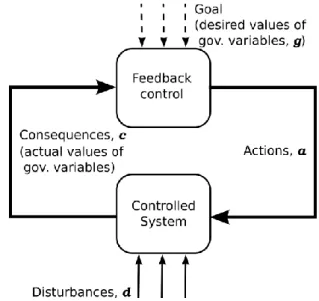
Behaviour scientists have long discussed individuals’ (organisations’) reactions to change and the ability to learn and adapt to change and, hence, to survive and flourish. In the analysis of behaviour, a parallel to principles of control theory is frequently used (Staddon, 2003; Argyris et al., 1985). According to Argyris et al., when an individual (organisation) is in equilibrium and detects an environmental change, actions follow according to the generic pattern: In a situation with governing variables g, to achieve consequence c (and restore equilibrium), do action a. Such formalism allows a cybernetic-like representation of individuals’ (organisations’) reactions to change, as depicted in Figure 1.
Figure 1 – Cybernetic interpretation of individual/ group adapting to changes (based on Argyris et al., 1985).
In Figure 1 inputs and outputs of an individual (or of an organisation) are represented with arrows entering and leaving the box labelled feedback control. Every individual (organisation) has a set of goals related to the governing variables, for example, the goals related to skills learned by a class. In order to achieve these goals, specific actions have to be taken, which will influence the controlled system and translate into consequences and new values of governing variables. The error—the gap—between actual and desired values of the governing variables determines the need for corrective actions.
But the controlled system is also subject to disturbances d, and, if on account of these disturbances values of governing variables change, individuals (organisations) react in order to restore the desired values of governing variables and cancel the effect of disturbances.
In HEIs, the implementation of QMS represents a disturbance, and one that doesn’t go away, for quality systems demand continuous improvement. Because of what has been written in the previous paragraph, a reaction to the implementation of QMS is expected. As explained, the objective of this reaction is to restore the desired values of governing variables, set prior to the disturbance by the QMS.
For the specific case of changes to the teaching and learning process, and considering the difficulty in agreeing to what is a HEI client and what is meant by “product quality”, frequently, information produced by quality systems is insufficient, ambiguous and performance indexes are inconsistent. Furthermore, to enforce change, management often resorts to top-down approaches, bringing about coercion and threatening issues. Argyris et al. (1985) describe the consequences of a change process conducted in such a way: according to these researchers, individuals (organisations) reaction will lead to dysfunctional group and intergroup dynamics, with win/ loose situations, games of deception, camouflaging of errors and the mismatch (a gap) between espoused practices and actual
in-use practices.
Argyris et al. also discuss with great detail what should be done to avoid dysfunctional dynamics. For the purpose of this paper, Figure 1 is enough to understand Argyris et al. main arguments. Before implementing changes, individuals’ (organisations’) goals should be questioned and revised. Change would then spring from within, and not as an external demand. Using Lewin’s model of organisational change (Schein, 1999), the initial stage during which existing organisational goals are questioned, and new ones are communicated, is called “unfreezing” stage. Lewin’s model considers two additional stages, the change stage, and the refreezing stage, but for the discussion of QMS in HEIs, and given the scientific and pedagogic discretion of academic staff, the unfreezing stage is critical and will be the focus of this paper.
3. COMMUNICATING ACADEMIC SUCCESS TO PROMOTE CHANGE
Quality models for HEIs are structured around processes to deal with administrative services, library, staff, research, curriculum development, learning and teaching, etc., and, in order to assess quality in different processes, different performance indexes are used. The operational need for performance indexes does not restrain quality being associated with a core and unifying shared belief that is clearly understood by stakeholders and around which the need for change is centred. In fact, considering the skills and high quality standards of HEIs’ human resources, it could be argued that for HEIs QMS should focus on strengthening shared beliefs rather than on imposing quantitative performance indexes. This line of thought will not be pursued, but is mentioned because it introduces one simple and yet very important question: Which shared belief should HEIs focus on? Which shared belief would be meaningful to the largest number of stakeholders?
In HEIs, all individual objectives coalesce into the single larger one of educating and graduating students. This objective can be restated more effectively as the promotion of academic success2. As explained in Section 2, when implementing changes it is important to communicate the need for change; academic success is a meaningful driver for all HEIs’ stakeholders and its use as a unifying shared belief will be one of the subjects dealt with in the present paper. However, before discussing how to communicate and how to embed academic success in QMS, it is important to explain what makes academic success and how it is measured.
3.1 What makes academic success
Academic success depends on a constellation of factors which change over time, from the moment a student enrols until their graduation. According to Tinto (1975), among these factors are the following: the individual’s prior experience (academic and cultural); the academic and social environment they experience in the HEI, including grade performance, interactions with peers and faculty; and, naturally, individual attributes, such as perceived competence, self-determination, project-formulation/ instrumentality of action (Carré, 1998). In a given moment in time, all these factors make up the individual’s motivational pattern that lies beneath the decision to enrol and to persist.
To promote academic success — and prevent dropout — contemporary HEIs have programmes (Swail et al., 2003; Swail, 2004) that include financial aid and diverse academic services. For
2 Focusing on academic success has advantages because it is not easy to find a performance index for
example, the services include digital library, platforms for autonomous/ distance learning, tutoring, and investment in social integration with activities that stimulate students’ interaction with peers and faculty.
Many of these services are classified by QMS as supporting processes, however, it is clear that these so called “support” processes are important determinants of academic success (the following sections will help clarify the importance of this argument). Traditionally, for academic success other processes, such as the curriculum development and the teaching and learning process are judged more important. As mentioned in the Introduction, typically, and from QMS implementation standpoint, the latter process is the one most difficult to address.
3.2 Measuring academic success
Academic success is traditionally specified by quantitative indexes such as Grade Point Average (GPA), number of enrolments until graduation, or dropout rate. These indexes or metrics are simple to understand by managers, faculty, students and employers. It is natural that when implementing QMS these indexes are used. However, an analysis relying on such indexes requires careful interpretation and should not be detached from the analysis of students’ background. In other words, socio-economic background influences academic performance, even if this influence occurs through complex and non-linear relationships.
With the democratisation of higher education, supported by policies promoting free and compulsory secondary education, life-long learning and internationalisation, variability in students’ academic and cultural background, and also in motives to enrol and to persist increased significantly. For HEIs, this means the ability to cope, simultaneously, with populations that have specific and often very different instructional needs and frailties. HEIs (especially public ones) are being asked to deal with inputs — undergraduate students — with highly variable characteristics but are expected to deliver an output — graduate students — with a much smaller variability. This is a difficult task because when little control of input variability is allowed, larger variability in the output is expected.
For an effective implementation of QMS, realising the difficulties HEIs have to reduce output variability could not be overemphasised, and if key QMS procedures are supported by indexes that measure only the output of the learning/ socialisation process and are blind to input characteristics (students background/ motivation to enrol), then QMS will stand on inconsistent/ incomplete information and dysfunctional dynamics such as those described in the introductory section will
take place. This applies to all processes but especially for the learning and teaching core process, for which academic success is, typically, measured directly3.
3.3 Embedding academic success in quality management systems
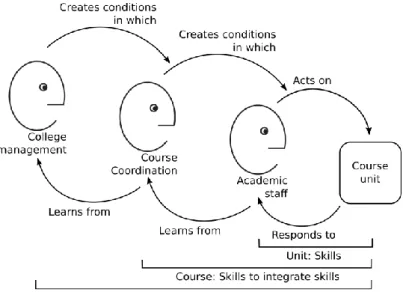
Adequate embedding of academic success depends on two main aspects: first, explicit support from top management, as active leaders and change champions, who have the ability to learn and the authority to create the conditions in which adaptations are possible and natural; and, second, the ability to accept variability, that is, a wide spectrum of diversity regarding key variables. Figure 2 represents the interlinks between different management levels in HEIs and how different skills can be used to promote nested change.
Figure 2 represents (on the right side), for the course unit level, the dynamic interaction between academic staff and course unit. Through performance indexes, such as GPA, course unit reacts to specific actions, for example, it may react to a teaching style or to contents lectured. But a unit belongs to a course and course coordination should be able to learn and to create the necessary conditions in which teachers are capable of introducing changes (to either reduce variability or to accept variability and work with it).
Figure 2 – Nested change: from action at course unit level to shared belief. Figure inspired on Dubberly and Pangaro (2010).
3 An example of how indexes influence the perception of performance was the change that occurred in
Portuguese secondary schools ranking in 2015. Prior to 2015, based on students GPA, public schools typically ranked poorly when compared with private ones, however, in 2015 a new index was used that considered not only students’ GPA but also students’ social background and with this slight change public schools immediately jumped to top positions (TSF, 2015).
Upstream from the course coordination, college management also learns from course results, and also creates conditions for courses to develop and to flourish. And it is part of college management discretion and decision power to choose between emphasising absolute performance indexes, such as GPA, number of enrolments until graduation, dropout rate, or else combining these indexes with students’ background and emphasising relative progresses in students’ skills.
Communicating academic performance requires, first of all, an understanding of what makes academic success and a careful decision process regarding how it can be effectively measured. This understanding is only possible with adequate information to support decision making, and the ability to learn from all stakeholders. Therefore, embedding academic success indexes in quality systems requires using QMS to communicate academic success as its ultimate institutional goal, and including students’ success in most performance indexes (not only for the teaching and learning process).
4. CHANGE AND QUALITY MANAGEMENT HAND-IN-HAND: A REPORT FROM
EXPERIENCE
The present section describes the implementation of a QMS within a HEI setting. The QMS is not an ideal one nor is it the archetype of what has been written in previous sections. However, its analysis contributes to the empirical and practical grounding of an open reflexion about the crucial role of quality management in higher education, both for promoting higher performance and a positive attitude towards a change culture. Moreover, recognising that knowledge is above all local and regional, reporting local experiences certainly contributes to a wider and better understanding of the challenges facing those that wish to implement effective QMS in HEIs.
4.1 Brief description of the quality management system
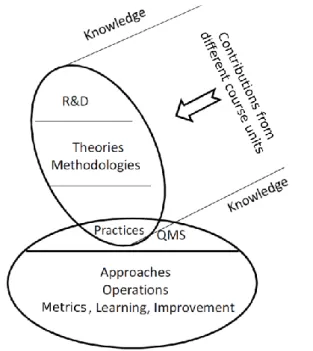
The implementation of the QMS started in 2008 as a consequence of the HEI decision to apply for an evaluation by the European University Association. A formal quality management structure was set up headed by a pro-rector. From its inception the focus of the QMS has been on the teaching and learning process and on the development of tools to improve this process, moreover, it was assumed from the start that QMS would emphasise the availability of information to assist decision making, rather than the definition of organisational procedures. This strategy was rooted in two developing axis. The first axis considered the development of the existing Information and Technology (IT) support system. The second axis considered the active promotion of applied research on topics of interest to quality management. The main objective of this latter axis was to promote cross-fertilisation between academics’ Research & Development (R&D) interests and QMS
organisational practice. Figure 3 presents a schematic description of the interconnection sought between R&D and QMS.
Figure 3 – Linking R&D to QMS operations (Ramos-Pires, 2011).
The implementation timetable considered a first stage that is related to the “unfreezing” mentioned previously. This stage focused on raising HEI stakeholders awareness towards the crucial importance of QMS and aimed at preparing the organisation for change, mainly by providing the necessary “knowledge of the variables with impact on results” (Ramos-Pires, 2011), but also by promoting organisational learning through R&D activities associated and supporting QMS.
After “unfreezing”, actual change is being promoted with the development of operational procedures and rules on which the HEI will stand to ensure effective quality management.
4.2 Report from experience
The experience related to the present case study has revealed interesting perspectives that lead to “food for thought” regarding the implementation of quality systems in HEIs.
Section 4.1 stated that the first axis to be developed by QMS was the existing IT support system. This proved a wise decision because it allowed early in the QMS implementation process to uncover important weaknesses, namely, the lack of integration between college IT subsystems and the need to implement changes for easier access to databases. The fact that these problems were identified and specific efforts were made towards correction testify for the adequacy of the adopted strategy. As stated previously improving the teaching and learning process was from the start a
priority, and with improved IT services regular reports were introduced to assess performance at course unit level and for each course.
Regarding the QMS second development axis—link between R&D and QMS—, in spite of the initial difficulties in gathering data, important progresses were made to characterise the institution and to raise awareness towards the need for quality management. Initial technical reports focused on (Ramos-Pires, 2011):
• Socio-demographic characterisation of students.
• Monitoring the teaching-learning process (development of harmonised questionnaires). • Setting generic rules and gathering information necessary to certify courses.
• Complementary studies with emphasis on students’ dropout.
Longitudinal studies that followed individual students’ academic trajectories, as well as the analysis of curriculum development throughout time were also performed (Duarte et al., 2014; Lourenço et al., 2013).
Regarding the planned connection between QMS and doctorate studies performed by academic staff, work was carried out on topics related to marketing, innovation (and quality) and information systems in HEIs. The impact of linking R&D to QMS is difficult to evaluate because it extends far beyond the production of documents. In fact, because R&D was carried by academic staff who are members of HEIs governing bodies, it is fair to assume that this was the most important contribute of the second axis—the development in a natural way (without external enforcing) of an institutional culture for quality.
When it comes to the topic of centring QMS on the topic of academic success, the need for quality management wasn’t explicitly linked to academic success, however, all individual course unit reports and course reports emphasised academic success and enforced corrective actions for course units with success rates below a specified minimum. An interesting point is that, contradicting the warning presented in Section 3.2, the implemented system has been unable to use performance indexes that consider students’ background. The justification lays in the difficulty in agreeing on the selection and use of the available socio-demographic data. However, because course units with low success are subject to detailed pedagogic and scientific analysis, students’ background considerations could be included in this analysis.
5. CONCLUSION
Within the context of higher education institutions, quality management systems implementation is difficult, given the variability in students’ backgrounds and the ambiguity in the definition of the quality of the “end product”, the graduate student. This difficulty becomes even more apparent within the core teaching-learning process, the interface between students’ and teachers’ effort to reach adequate success levels; therefore, caution is needed to prevent the gap between espoused practice and in-use practice.
This study argued that biased behaviours (towards QMS implementation) are avoided when:
• The link between quality management and external accreditation pressure is less significant and “inner needs” are used to drive QMS implementation;
• Quality management relies on reliable performance indexes, meaningful to all stakeholders; and, finally,
• Quality management is grounded on the community, on the organisational inner setting, as opposed to enforced from top management.
For a gentler use to quality management in HEIs, it is proposed that QMS implementation is preceded by an initial stage that seeks to embed the organisation with a shared belief, one worth fighting for, and to provide clear information about the whole process. During the actual design/ development of these cultural intervention procedures, aimed at creating a unified shared belief worth fighting for, a deepening and an intensification of the identifying and strategic characteristics of the organisation will take place. That is, QMS will effectively contribute to a stronger organisational culture, one that differentiates in a unique form each HEI, and, simultaneously, enables and promotes a universal, civilisation wide, culture of excellence and of work and effort gratification/ motivation.
The present paper ascertains that, within HEI contexts, the promotion of academic success, evaluated by objective indexes, is itself a good candidate for a unifying shared belief at organisational level. It is also argued that QMS that accept variability and diversity are better able to create the necessary and optimising conditions for organisational change to take place. These conditions occur throughout the whole value chain process, at the different, and interrelated, core and supporting processes. The stronger the change culture that is embedded into the organisation, the larger will be the resilience of the QMS. Therefore, the QMS is itself an effective mechanism for creating a trustworthy atmosphere, conducive to organisational excellence, through motivating, stimulating and gratifying behaviour that may lead to organisational success. As has been discussed,
this success becomes visible namely via academic success, which is a plus collectively, to the organisation as a whole, and individually, to both students and, indirectly, to each member of the academic and administrative staff.
REFERENCES
- Argyris, C., Putnam, R., and Smith, D., (1985), Action Science: Concepts, Methods, and Skills for Research and Intervention, Jossey-Bass Publishers, San Francisco.
- Bozak, M., (2003), Using Lewin’s Force Field Analysis in Implementing a Nursing Information System, Computers, Informatics, Nursing, 21, 80–85.
- Brennan, J. and Shah, T., (2000), Quality assessment and institutional change: Experiences from 14 countries, Higher Education, 40, 331–349.
- Carré, P., (1998), Motifs et dynamiques d’engagement en formation: Synthèse d’une étude qualitative de validation auprès de 61 adultes en formation profissionnelle continue, Education Permanente, 136, 119–131.
- Duarte, R., Ramos-Pires, A., and Gonçalves, H., (2014), Identifying at-risk student in Higher Education, Total Quality Management & Business Excellence, 25 (7-8), 944–952, http://dx.doi.org/10.1080/14783363. 2014.906110.
- ENQA, (2005), ENQA report on Standards and Guidelines for Quality Assurance in the European Higher Education, Tech. rep., European Association for Quality Assurance in Higher Education, http://www. enqa.eu/pubs.lasso.
- Hackman, J. and Wageman, R., (1995), Total Quality Management: empirical, Conceptual, and Practical Issues, Administrative Science Quarterly, 40, 309–342.
- Hoecht, A., (2006), Quality assurance in UK higher education: Issues of trust, control, professional autonomy and accountability, Higher Education, 51, 541–563.
- Jauch, L. R. and Orwig, R. A., (1997), A violation of Assumptions: Why TQM Won’t Work in the Ivory Tower, Journal of Quality Management, 2, 279–292.
- Kanji, G. K., Malek, A., and Tambi, B. A., (1999), Total quality management in UK higher education institutions, Total Quality Management, 10, 129–153.
- Loukkola, T. and Zhang, T., (2010), Examining Quality Culture: Part 1 — Quality Assurance Processes in Higher Education Institutions, Tech. rep., European University Association, http://www.eua.be/publications.
- Lourenço, R., Ferreira, E., Duarte, R., Gonçalves, H., and Duarte, J., (2013), IPS’ Technology and Industrial Management graduate course: A curriculum follow-up analysis, in: Proceedings of European Conference on Curriculum Studies, University of Minho, Braga, Portugal, October 18-19.
- Min, S., Khoon, C. C., and Tan, B. L., (2012), Motives, Expectations, Perceptions and Satisfaction of International Student Pursuing Private Higher Education in Singapore, International Journal of Marketing Studies, 4, 122–138.
- Nadiri, H., Kandampully, J., and Hussain, K., (2009), Student’ perceptions of service quality in higher education, Total Quality Management & Business Excellence, 20, 523–535.
- Newton, J., (2002), Barriers to effective quality management and leadership: Case study of two academic departments, Higher Education, 44, 185–212.
- Noaman, A., Ragab, A., Fayoumi, A., Khedra, A., and Madbouly, A., (2013), HEQAM: A Developed Higher Education Quality Assessment Model, in: Proceedings of the Federated Conference on Computer Science and Information Systems.
- Owlia, M. S. and Aspinwall, E. M., (1996), Quality in higher education — A survey, Total Quality Management, 7, 161–171.
- Ramos-Pires, A., (2011), How applied research can improve quality of teaching processes and management systems, in: Proceedings of the 1st world engineering education flash week.
- Schein, E. H., (1999), Kurt Lewin’s change theory in the field and in the classroom: Notes toward a model of managed learning, Reflections, 1, 59–74, https://www.solonline.org/?SoLReflectionsIndex.
- Staddon, J. E. R., (2003), Adaptive Behavior and Learning, Internet Edition 2003 (updated and corrected, 2010), http://dukespace.lib.duke.edu/dspace/bitstream/handle/10161/2878/ StaddonAdaptiveBehaviorLearning2010.pdf?sequence=1.
- Swail, W., Redd, K., and Perna, P., (2003), Retaining minority student in higher education: A framework for success, Tech. rep., Education Policy Institute.
- Swail, W. S., (2004), The art of student retention: A handbook for practitioners and administrators, www.educationalpolicy.org.
- Tinto, V., (1975), success from higher education: A theoretical synthesis of recent research, Review of Educational Research, 45, 89–125.
- TSF, (2015), School ranking: Private schools are not that much better (in Portuguese), http://www.tsf.pt/ sociedade/educacao/interior/escolas-privadas-nao-sao-tao-melhores-como-se-pensa-4925831.html, (accessed March 2016).
- Vauterin, J. J., Linnanen, L., and Marttila, E., (2011), Issues of delivering quality customer service in a higher education environment, International Journal of Quality and Service Sciences, 3, 181–198.
- Williams, G., (1993), Total Quality Management in higher education: panacea or placebo, Higher Education, 25, 229–237.
- Yeo, R. and Li, J., (2014), Beyond SERVQUAL: The competitive forces of higher education in Singapore, Total Quality Management, 25, 95–123.