Effect of Surfactants on the Rheological
Properties and Microstructure of MWCNT/Epoxy
Resin Suspensions
A Master’s Dissertation
of
Carolina Sá da Cruz
Developed within the course of dissertation
held in
INEGI – Instituto de Ciência e Inovação em Engenharia Mecânica e Engenharia
Industrial
Supervisor at FEUP: Dr. Ricardo Santos
Supervisor at INEGI: Dra. Marina Torres
Departamento de Engenharia Química
Acknowledgement
This thesis had important support elements, which without it would be not possible to do this project. First, I would like to express my great gratitude to INEGI, particularly the UMEC group and Dr. Nuno Rocha, for the opportunity to develop this work and for all the support.
Additionally, I would like to acknowledge the project PTDC/CTM-POL/4607/2014 - High performance multifunctional composite materials based on self-assembly approaches; project NORTE-01-0145-FEDER-000022 – SciTech - Science and Technology for Competitive and Sustainable Industries; and project H2020 Grant Agreement No 685844 - ModComp – Modified cost effective fiber based structures with improved multi-functionality and performance.
I would like to thank Dra. Marina Torres for providing her knowledge and time in the preparation and development of this thesis, as well as for all the autonomy that allowed the development of my abilities . Additionally, I would like to thank Dr. Ricardo Santos for his supervising, useful discussions and critical review relative to this project.
Also, acknowledgement and thanks are extended to Dra. Raquel Santos and Jéssica Rocha for providing their time and moral support throughout this work, and for assisting me in the activities entrusted to me.
To Magda for her friendship, motivation and company throughout this semester and for our memorial conversations that I will keep forever. Also, to ‘Almoçaradas’ group for the funny moments that we spend and the conversations that we share.
And, at last, a special thanks to my parents for their support in all the stages of my life and especially to my brother for his precious advices.
Resumo
O objetivo da presente tese visa o estudo do efeito de nanotubos de carbono e de métodos de funcionalização não-covalentes no comportamento reológico de suspensões de res ina epóxi/nanotubos de carbono. A técnica de funcionalização não covalente utilizada envolveu o uso de surfactantes, de forma a promover uma melhor dispersão das cargas na matriz polimérica. Os resultados reológicos foram posteriormente correlacionados com a microestrutura das amostras, através da realização de análises de microscopia ótica e testes de condutividade elétrica.
A caracterização reológica das suspensões, envolveu a realização de testes de fluxo, com variação da taxa de corte, e oscilatórios, com variação da frequência angular. Os dados reológicos de cada amostra permitiram a determinação de parâmetros reológicos específicos de cada mistura, nomeadamente a tensão de cedência, o índice tixotrópico e a frequência angular crítica. Os resultados obtidos mostram um aumento da viscosidade das suspensões com o aumento da concentração de nanotubos. A percolação reológica ocorreu entre 0.25 % (m/m) e 0.375 % (m/m) de nanotubos, sendo a rede física mais rígida e estável com o aumento do conteúdo de cargas. Assim, o aumento da rigidez da rede pressupôs o aumento da tensão de cedência e do índice tixotrópico. Misturas contendo 1.0 % (m/m) de nanotubos foram selecionadas para testes posteriores, de modo a garantir a existência de uma rede estável e completamente formada. Para promover uma melhor dispersão das cargas, foram testados três surfactantes com diferentes polaridades e pesos moleculares (Triton X-100, SDBS e PPGMBE) e adicionados a misturas com 1.0 % (m/m) de nanotubos. Os resultados não mostram uma variação significativa da viscosidade das suspensões em relação à amostra sem surfactante. No entanto, devido ao efeito plastificante, a microestrutura dos materiais foi afetada, tendo levado a uma diminuição da tensão de cedência e do índice tixotrópico.
A dispersão das amostras foi igualmente estudada para complementar os resultados obtidos e verificar o desempenho dos surfactantes. Os dados revelaram que o aumento da concentração de nanotubos não provocou o aumento do número de aglomerados, contudo provocou o aumento da área dos mesmos. A utilização dos surfactantes revelou a melhoria da dispersão, tendo o Triton X-100 desempenhado uma melhor performance, comparativamente ao SDBS. A caracterização elétrica dos nanocompósitos também foi efetuada, tendo-se constatado que a percolação elétrica ocorreu antes da percolação reológica (< 0.125 % (m/m) de nanotubos). Além disso, as amostras funcionalizadas demonstraram maior condutividade elétrica para baixas concentrações de surfactante, embora para concentrações mais elevadas a condutividade tenha diminuído. Este efeito estará associado à separação excessiva das cargas por parte dos dispersantes, que impede o contacto direto entre estas , e provocando o aumento da resistência elétrica.
Palavras Chave: Nanocompósitos; Nanotubos de Carbono; Reologia; Propriedades reológicas; Dispersão; Propriedades elétricas
Abstract
The objective of the present thesis aim the study of the effect of untreated carbon nanotubes (CNTs) and non-covalent functionalization methods on the rheological behavior of epoxy/multi-wall carbon nanotubes (MWCNTs) suspensions. The non-covalent functionalization technique employed on the work was the use of surfactants, to promote a better dispersion of the fillers into epoxy polymeric matrix. The rheological results were correlated with the microstructure of the samples, which was analyzed through optical microscopy and electrical conductivity tests.
The rheological characterization of the suspensions, carried out in a rheometer, involved the performance of flow and oscillatory frequency experiments. The rheological data of each sample was analyzed and specific rheological parameters of each mixture were determined, namely yield stress, thixotropic index and critical angular frequency. The obtained data show an increase in the viscosity suspensions with the increasing of MWCNT content. The rheological percolation threshold occurred between 0.25 % (m/m) and 0.375 % (m/m) of MWCNTs, being the physical network more rigid and stable with the further increase of fillers content. Thus, the increase of network’s strength presupposed an increase in rheological parameters (yield stress and thixotropic index). The amount of 1.0 % (m/m) of CNT was chosen for further tests, because it was considered that the fully developed network was formed at this point.
To promote a better dispersion of the CNTs, three surfactants with different polarities and molecular weights (Triton X-100, SDBS and PPGMBE) were added to mixtures with 1.0 % (m/m) of MWCNT. The results do not show a significant variation of the suspensions viscosity in relation to the sample without surfactant. However, a decrease in yield stress and thixotropic index was obtained, which suggested that the microstructure of the samples was affected by the presence of the surfactants, due to their plasticizer effect.
The dispersion degree of samples was studied to complement the results obtained and to verify the performance of the surfactants. The data revealed that with an increase in the CNT amount, the number of aggregates maintained similar, but the aggregates area increased. The addition of surfactants revealed to be beneficent for the dispersion of fillers, with best performance of Triton X-100 in comparison with SDBS, allowing the reduction of agglomerates size and number, in relation with the sample without functionalization.
At last, electrical characterization on nanocomposites was also performed, having obtained an electrical percolation threshold lower than the rheological percolation (< 0.125 % (m/m) MWCNT). The functionalized samples demonstrated higher electrical conductivity, although at higher surfactant concentration the value decline due to the excessive separation of the fillers.
Keywords: Nanocomposites; Carbon nanotubes; Rheology; Rheological properties; Dispersion; Electrical properties
Declaration
I hereby declare, on my word of honour, that this work is original and that all non-original contributions were properly referenced with source identification.
Porto, ___ July 2017
Table of Contents
1 Introduction ... 1
1.1 Presentation of the Work ...1
1.2 Company Presentation...2
1.3 Contributions of the Work...2
1.4 Organization of the Thesis ...3
2 Context and State of Art ... 5
2.1 Nanotechnology...5
2.2 Composite Materials ...5
2.2.1 Carbon Fiber Reinforced Polymers (CFRP) ...6
2.2.2 Carbon Nanofiller Composite M aterials ...7
2.2.3 Processing of Carbon Nanotube-Polymer Composite M aterials...8
2.3 Surfactants...9
2.3.1 Dispersing Carbon Nanotubes using Surfactants ... 10
2.4 Rheology ... 11
2.5 Materials Behavior ... 11
2.5.1 Ideal Elastic Behavior... 11
2.5.2 Ideal Viscous Behavior ... 12
2.5.3 Newtonian and Non-Newtonian Behavior... 12
2.5.4 Viscoelastic Behavior ... 12
2.5.5 Linear Viscoelasticity ... 13
2.6 Aspects of Rheometry... 13
2.6.1 Methods of M easuring Materials Behavior ... 13
2.7 Rheology of Carbon Nanotube Suspensions ... 14
2.7.1 Effect of Carbon Nanotube Concentration ... 15
2.7.2 Effect of Carbon Nanotube Dispersion and Physical Network ... 16
2.7.3 Effect of Carbon Nanotube Content on Specific Rheological Parameters ... 16
2.7.4 Effect of Surfactants as a Non-Covalent Functionalization of Carbon Nanotubes ... 17
3 Materials and Methods ...19
3.1 Materials ... 19
3.2 Preparation of Epoxy/MWCNT Suspensions ... 20
3.2.1 Approaches for M ixing and Dispersing Carbon Nanotubes ... 20
3.3 Preparation of Cured Nanocomposites Boards ... 22
3.4 Rheological Characterization ... 22
3.4.1 Summary of the Experiments ... 22
Effec t of Surfactants on the Rheological Properties and Mic rostructure of MWCNT/Epoxy Resin Suspensions
ii
3.4.3 Determination of Thixotropic Index ... 23
3.4.4 Determination of Yield Stress ... 24
3.4.5 Determination of Critical Angular Frequency ... 24
3.5 Characterization of Carbon Nanotubes Nanocomposites... 25
3.5.1 Optical M icroscopy ... 25
3.5.2 Electrical Properties ... 25
4 Results and Discussion ...27
4.1 Effect of MWCNTs Concentration on Rheological Properties ... 27
4.1.1 Steady-State Flow Measurements ... 27
4.1.2 Dynamic Flow Measurements ... 29
4.2 Effect of Various Surfactants on Rheological Behavior... 31
4.2.1 Steady-State Flow Measurements ... 31
4.2.2 Dynamic Flow Measurements ... 33
4.3 Determination of Specific Rheological Parameters ... 35
4.3.1 Yield Stress ... 36
4.3.2 Thixotropic Index ... 37
4.3.3 Critical Angular Frequency ... 38
4.4 Optical Microscopy... 39 4.5 Electrical Properties ... 42 4.6 Data Summary... 44 5 Conclusion ...45 5.1 Future Work ... 46 References ...47
Appendix 1 Preparation of Epoxy/MWCNT Suspensions: Experimental Conditions ...51
Appendix 2 Characteristics of the Rheometer ...52
Appendix 3 Optical Microscopy Analysis ...53
Notation and Glossary
A Cross-sectional area m2
d Diameter m
G Shear modulus Pa
G’ Storage shear modulus Pa
G’’ Loss shear modulus Pa
I Current A
l Length m
R Resistance Ω
T Temperature ºC
V Electric potential difference V
v Rotation speed of the rollers rpm
Greek Letters
t
Shear stress Pa𝜏𝑐 Yield stress Pa
𝛾̇ Shear rate s-1
η Dynamic viscosity or viscosity Pa∙s
ηf Final constant viscosity Pa∙s
ω Angular frequency rad.s-1
σ Electrical conductivity S.m-1
ρ Resistivity Ω∙m
δ1 Gap between the feeder and center rollers µm
δ2 Gap between the center and apron rollers µm
List of Acronyms
CMC Critical micelle concentration CNT Carbon nanotube
DGEBA Diglycidyl ether of bisphenol-A LVE Linear viscoelastic
MWCNT Multi-walled carbon nanotube SDBS Sodium dodecylbenzene sulphonate SWCNT Single-wall carbon nanotube OM Optical microscopy
PPGMBE Poly(propylene glycol) monobutyl ether TX100 Triton X-100
1 Introduction
The evolution of society and the increasing demand for new products has led to need to develop new materials, to satisfy its requests. In the past years, a wide number of materials were created, leading to products with enhance properties regarding to their mechanical, chemical, thermal and electrical aspects.
The searching for new enhanced materials led to the appearance of distinct materials with properties that cannot be encountered in isolated substances. They are denominated composite materials. Composite is defined as any material containing more than one substance/component, resulting a product with different properties than those of the individual components [1-3]. The constituent elements of composite materials are a matrix and a filler. These two elements together proportionate a new material with great advantages, such as, i.e. lower density combined with high resistance [2, 3]. Due to their advantageous characteristics, composites materials have been used in several fields, such as aerospace, chemical industry, electrical, automotive, medical and sports field [1].
Over the past decades, polymers have replaced many of the conventional materials in various application because of their easy processing and productivity. The incorporation of fillers into polymeric matrix became a current practice, to modify and improve the properties of the material. A strong emphasis on developing polymeric composites that incorporate nanometric fillers is growing, providing unique final properties to the material.
Due to the potential of carbon nanofillers, such as carbon nanotubes, innumerous research studies were conducted in this field, especially regarding to electrical, thermal, rheological and mechanical properties of the nanocomposite. One of the challenges relative to carbon nanofiller/polymeric composite resides in the dispersion of the nanofillers into the polymeric matrix, which may conditionate the processing and the final properties of the material.
Mechanical and chemical methods were developed in order to improve the dispersion of the carbon nanofillers into polymeric matrix, standing out the surface modification of carbon nanotubes (CNTs) using non-covalent methodologies, like surfactants. Nowadays, a combination of methods can be employed to optimized the dispersion of the CNTs, although the relation between the improvement of final mechanical, electrical, thermal and rheological properties of nanocomposites and the dispersion is not well clarified, which makes this aspect a main challenge to the researchers.
1.1 Presentation of the Work
A considerable interest in the use of nanoparticles to improve the properties of materials has begun to show in the past years and the constant search for new and specific materials, make carbon nanotubes the ultimate reinforcement agent for different types of matrices. However, as mentioned before, there are limitations related to processing difficulties and the potentially weak interaction between the fillers and the matrix, which often result in nanocomposites that fall short of expectations. Thus, great efforts are being made to overcome these limitations and provide improved materials.
Effec t of Surfactants on the Rheological Properties and Mic rostructure of MWCNT/Epoxy Resin Suspensions
2 Rheometry has been an important tool in the study and development of CNTs field, allowing to unravel and solve some aspects. In the present work, the focus was to analyze the effect of addition of CNTs on the rheological behavior in epoxy-based resin mixtures. This study involved the determination of several specific parameters that are characteristics of each material, namely yield stress, thixotropic index and critical angular frequency, but also the suspension’s behavior with shear rate and angular frequency. Considering the dispersion problem of CNTs, many methods are being developed and used to minimize the formation of CNTs aggregates and promote the individual separation of the fillers. Naturally, each technique has its advantages and disadvantages, although the goal it is to control the interfacial interaction between CNT and matrix and promote the suspension’s stability [4]. Thus, in this work, the role of surfactants in dispersion was analyzed by studying their effect on rheological properties. To complement this, optical microscopy (OM) was also used to evaluated the nanocomposites qualitativ e and quantitatively, in terms of number and area of CNT aggregates. Additionally, electrical conductivity of final nanocomposites was measured to verify the effect of CNT content and surfactants in the property.
1.2 Company Presentation
Instituto de Ciência e Inovação em Engenharia Mecânica e Engenharia Industrial (INEGI) is an institute of new technologies, dedicated to innovation and research which is in strong connection with the needs of Portuguese industry. It was created in 1986, as a partnership between Department of Mechanical Engineering and Department of Industrial Engineering in Faculty of Engineering of University of Porto. INEGI’s main goal is to contribute to industrial development and economy, through innovation based on scientific and technologic knowledge. To accomplish that, the institute has established several partnerships with wide number of companies, to promote their institutional identity [5].
The present thesis was framed in one of the several INEGI’s groups, namely UMEC. UMEC is the Composite Materials and Structures Research Group and performs Research & Development and Technology Transfer in all fields related to Composites, from materials development and modelling, process modelling and optimization to prototyping and pre-series production. UMEC has been involved in R&D projects commissioned by private and state owned companies, public services and European programs. The European Aerospace Industry is the main client of INEGI’s R&D services and the main partner i n R&D projects.
A significant part of INEGI-UMEC activities has been focused in the development of the basic materials to be used in the development of high performance composite structures, the development of associated manufacturing processes, and the testing and validation of such materials, processes and structures.
1.3 Contributions of the Work
In production of carbon fiber reinforced plastics, with the nano-sized fillers, such as carbon nanotubes, the high viscosity constitutes a processing limitation, thus the contribution of the present thesis aimed the study of rheological properties of epoxy/carbon nanotubes suspensions. The objective consisted in perceive the main contributions to the increase of suspensions viscosity and seeks to minimize the
problem through a detailed rheological study while correlating with the impact on final product characteristics.
Moreover, a study was carried out on the dispersion of the fillers in the matrix through the application of a functionalization method using surfactants. With this work, it was also intended to establish a relationship with the rheological properties and to perceive its role for the improvement of processing, while guaranteeing a performing formulation.
The electrical properties of nanocomposites were analyzed to understand the data obtained so far and to complement them.
1.4 Organization of the Thesis
The present dissertation is divided in five distinct chapters. In the first chapter is presented a brief introduction relative to the subject of the work and the company.
The second section is dedicated to state of art, where aspects about nanocomposites, CNT properties, methods for dispersion of CNTs and rheology of CNT suspensions are covered.
The third chapter corresponds to materials and methods, which describes in detail the materials and equipment used and the experimental procedure.
In the fourth chapter, it is presented and discussed the results obtained, correlating the data and comparing with the literature.
At last, the fifth and final section consists in the main conclusions about the study and the future work that could be done to complement the data already obtained.
2 Context and State of Art
2.1 Nanotechnology
Nanotechnology consists in an engineering at the molecular level, that focus on controlling and exploiting the structure of matter on a large scale below 100 nanometers. This field has referred in several purpose technologies because it presents a significant impact in almost all industries , pointing out cosmetic, electrical and environmental field, aerospace, medicine, biotechnology and food industry [6, 7].
2.2 Composite Materials
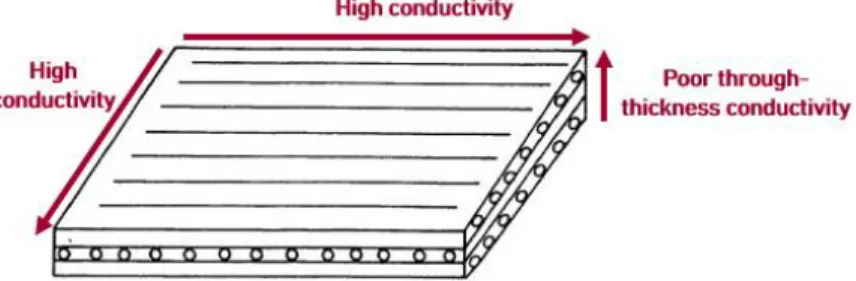
In the universe of nanotechnology, nanocomposites are an example of a real growing application. Different nanometric materials may be incorporated in order to develop and obtain materials with distinct capabilities. As an example, most carbon fiber reinforced composites materials present great electric and thermal conductivity along the plane direction, although through the thickness direction, that properties are reduced significantly (see Figure 1). That loss of properties is a result of reduced contact between the fibers of different laminas of the composite material. Therefore, the introduction of carbon nanofillers into matrices of the composite allowed the enhancement of those properties, due to the improvement of the contact between the fibers [8-10].
Generally, reinforcements exist in the form of particle, platelet or fibrous. Particulate composites are typically less stiff and much weaker than fiber composites, however they are less expensive. They also present equal dimensions in every direction. On the other hand, fibers tend to present a length (l) greater than its diameter (d), which allow to define the aspect ratio (l/d) [2].
Particulate composites are reinforced with micron-sized particles of diverse materials, such as silica, metal or organic and inorganic particles. Typically, platelet-reinforced composites are made of graphite or clay. Both are found as layered materials on their bulk state, therefore to be well dispersed in a continuous phase, their layers must be separated [11]. Fibrous-reinforced composites contain fibers as element to improve overall properties of composites. There are two types of fibers (see Figure 2), continuous and discontinuous fibers, where the first one has long aspect ratios and a preferred orientation, and second one has short aspect ratios and a random orientation [2].
Figure 1 - Schematic of aligned CNT polymer nanocomposite. Indication of the poor conductivity in-plane direction and the
Effec t of Surfactants on the Rheological Properties and Mic rostructure of MWCNT/Epoxy Resin Suspensions
6
2.2.1 Carbon Fiber Reinforced Polymers (CFRP)
The matrix plays an important role in a system reinforcement-matrix, where it is responsible for the interconnection of the fibers and also proper spacing and orientation of them [2].
Polymer-matrix composites comprise matrices of thermoplastic or thermosetting polymers. Because of their superior mechanical properties, epoxies became one of the most common thermosetting matrix, used in innumerable applications [12].
Since their discovery in 1909 by Prileschajew to nowadays, epoxy resins kept attracting the interest of industry due to their potential to be applied across varied fields [13, 14].
In the late 1930s and early 1940s occurred the first synthetization of epoxy resins, simultaneously in Europe and United States of America. Dr. Pierre Castan from Switzerland and Dr. S. O. Greenlend from United Stated of America studied the reaction between epichlorohydrim and bisphenol-A, leading to production of diglycidyl ether of bisphenol-A (DGEBA), illustrated in Figure 3 [13, 15].
Epoxy resins are the class of thermosetting polymers, which are polymerized (cured) via curing reaction, using a wide variety of curing agents [16]. Commercial epoxies are typically found in a prepolymer form of low molecular weight containing at least one epoxide group of the form illustrated in Figure 4 [13].
The active epoxied groups in the uncured epoxy can react with numerous chemical species, such as curing agents or hardeners, thus currently are available a wide type of epoxy base resins [13].
Figure 2 - Fiber-reinforcement types: (a) continuous fibers (b) discontinuous fibers [2].
When compared to other thermosetting polymers, epoxy resins are quite more expensive, although show they better mechanical properties and higher resistance to chemical and environmental corrosion and moisture absorption. Moreover, they show high electrical resistivity and good performance at elevated temperatures because of their higher heater deflection and glass transition temperatures. Epoxy resins also have a good adhesion capacity to other components/substances, due to the polar groups, which make them ideal matrices to formulate new materials. Another positive aspect resides in the fact that during curing process, there is not emission of dangerous compounds and the resins does not suffer a significant volume contraction [17].
They also have toughness, good adhesion to other materials, mechanical and corrosion resistance, which make these resins suitable for industrial tooling, aerospace industry, electronic materials, biomedical devices, paints and coatings [13, 18].
2.2.2 Carbon Nanofiller Composite Materials
The versatility of the chemical element carbon enables to form distinct structures with different characteristics. Its potentiality has attracted much attention, especially in the composite materials field, as a reinforcement component. Among carbon-type reinforcement materials, carbon nanotubes (CNTs) have been extremely used because of their incredible capacity to be incorporated with different materials, giving rise to a variety of composite materials with enhanced properties.
Since their discovery in 1991 by Iijima, carbon nanotubes have been commonly used as reinforce materials because of their mechanical, thermal and electrical characteristics [19-22]. CNTs are cylindrical molecules composed by carbon atoms, with a typically hexagonal structure that repeats itself periodically in space, leading to atoms bonded to three neighbor atoms , as illustrated in Figure 5 [23, 24].
CNTs can assume two forms: single-walled carbon nanotubes (SWCNTs) or multi-walled carbon nanotubes (MWCNTs), which are composed of concentric SWCNT (see Figure 6) [24]. SWCNTs are usually stronger than MWCNTs, with a diameter in order of few nanometers. Diameters of MWCNTs ranging from 10
Figure 4- Chemical structure of epoxide group, which the oxygen atom is attached by single bonds to two adjacent
carbon atoms, forming a cyclic ether with a three-atom ring. The R is a radical and represents any subgroup of atoms [13].
Effec t of Surfactants on the Rheological Properties and Mic rostructure of MWCNT/Epoxy Resin Suspensions
8 nanometers to 200 nanometers [20, 24, 25]. The exact properties of CNTs are extremely influenced by their degree of graphitization, diameter and whether if are in single-wall or multi-wall form [26]. Although, according to the literature [27], individually, CNTs can show Young’s moduli ranging from 270 GPa to 2 TPa and tensile strength ranges from 11 GPa to 200 GPa, which makes them ideal reinforcements. They also have failure strains of up 15% and electrical conductivity that depends on their structure, ranging from semiconducting to metallic. Their surface area is around 10–20 m2/g and their thermal stability in air is higher than 700 ºC [28]. Studies revealed that SWCNT shows an electrical conductivity around 102–106 S.cm-1 and thermal conductivity around 6000 W .m-1.K-1. In other hand, MWCNT has shown an electrical conductivity around 103–105 S.cm-1 and thermal conductivity around 2000 W.m-1.K-1 [29].
In spite of CNTs superior properties, when compared with conventional materials and their unique nanostructure, these carbon fillers present some limitations: the poor dispersion in polymeric matrices, which limits the extent of realizing potential improvements in polymeric composites area, and their high cost [30, 31]. Several studies reported an increase in viscosity, which may lead to problems in processing, with regard to adequate mixing and operation temperature, that could affect the final properties of the composite [20, 32, 33].
The literature does not show a consensus regardless to increasing of suspensions viscosity, as detailed in the next sections.
2.2.3 Processing of Carbon Nanotube-Polymer Composite Materials
One important aspect when producing a nanocomposite is to achieve a good dispersion of fillers in a matrix, regardless of their size or shape. Without a good dispersion, the nanofiller tends to agglomerate, forming aggregates that act like local flaws which limit the mechanical performance of nanocomposite and influence its final properties [34]. Therefore, one of the challenges of processing CNT suspensions is achieving good quality dispersion of the filler into the polymeric matrix. Three distinct approaches are generally used for dispersing carbon nanofillers:
• Mechanical methods; • Use of organic solvents;
• Methods designed to modify CNT surface (functionalization), which can be chemical (addition of the functionalization group) or physical (addition of surfactants).
Figure 6 - Representation of (a) SWCNT and (b) MWCNT. SWCNT is formed by a single curved layer of graphene. MWCNT
Mechanical approaches, such as ultrasonication and high shear mixing, involve the separation of CNTs from each other, however higher frequencies/shear mixing can fragment them, and decreasing their aspect ratio [26].
The physical-chemical aspects behind dispersion of CNTs using organic solvents are not totally clarified, being an area in current investigation [35]. Furthermore, organic solvents cause processing more challenging and expensive, because it involves another process step, solvent separation.
Methods designed to change the surface, as mentioned above, can be either chemical or physical. Chemical functionalization of CNTs involves the addition of the functional group covalently bonded to CNT surface (such as CO, CO2, NH3…) and are used to improve their chemical compatibility with the polymeric matrix, by covalently bonding with the epoxydic group of epoxy pre-polymer, resulting in an improve of adhesion, wetting or reduce their tendency to aggregate [26, 29]. Although, aggressive chemical treatment, such as strong acid treatments or high temperature methods, can damage the CNT’s structure, changing the hybridization from sp2 to sp3 and losing the ð-conjugation system. Thus, in this case, the agglomerates of CNTs may act as defects/flaws in the composite and consequently they lead to inferior final properties [29, 36].
To avoid these problems, physical methods, like non-covalent treatment by surfactants, are particularly important. These methods allow the CNT surface to adsorb functional groups without disturbing the π system (no covalent bond is made) [26]. Both CNTs and surfactant play an important role in dispersing. The nature, concentration and the type of interaction of surfactant and the surface charge of CNT are essential for understanding the adsorption mechanism [26].
2.3 Surfactants
Surfactants are amphiphilic molecules consisting of at least two parts structurally distinct, one which is soluble in a specific solvent and another is insoluble in that same solvent (see Figure 7). These molecules have the capacity to adsorb at a surface or at an interface between two different phases, reducing the interfacial Gibbs energy, i.e., reducing the surface tension or interfacial tension of the system [37].
To avoid the contact between regions with different polarities, surfactants tend to form aggregates with distinct forms (micellar structure, laminar structure or cubic structure). The micellar structure is illustrated in Figure 8 [38]. The critical concentration, in water, at which this structures begin to form is called critical micelle concentration (CMC) [37].
Effec t of Surfactants on the Rheological Properties and Mic rostructure of MWCNT/Epoxy Resin Suspensions
10 According to the literature [26, 39-41], because of their structure which promotes the affinity to adsorb to CNTs surface, these agents are currently being tested to analyze their effect in the dispersion of CNTs into polymeric matrices as an alternative to covalent functionalization.
2.3.1 Dispersing Carbon Nanotubes using Surfactants
The quality of the dispersion is subjective, but the ideal dispersion consists in a higher fraction of isolated fillers in suspension. Pure epoxy pre-polymer is polar and CNTs are non-polar, which makes their individual dispersion a difficult task. Due to physical-chemical properties of surfactants, recently they have been explored as CNT dispersants. For mixtures without the presence of surfactants, the suspensions may be unstable and the fillers tend to rebounding through Van der Waals forces. If the surfactant is present, it is adsorbed along the filler length in an unzipping mechanism, i.e., its non-polar head interacts with the wall of the tube through Van der Waals forces, which allows the full separation. Figure 9 shows the interaction of a surfactant with CNTs [40]. The adsorption strength is critically important and it is given by the hydrophobic interactions with the tube wall. Although, despite all studies there is no definitive understanding of the dispersion mechanisms and the structure of surfactants [42]. A common studied CNT dispersant is Triton X-100. It is a non-ionic surfactant, which its non-polar head consists in a benzene ring and an alkane chain. Because of its chemical structure, and in comparison with other dispersants, Triton X-100 seems to have a better interaction with the surface of CNT and a better compatibility with epoxy resin [40].
Figure 9 – Schematic illustration of the interactions between Triton X -100 and the wall of a MWCNT [40]. Figure 8 - Schematic representation of surfactant aggregates in water [38].
2.4 Rheology
The addition of reinforcement components, such as carbon fillers, in polymeric matrices allows to improve the properties of the final material (composite). Although, some issues are known to may cause processing problems. The problems associated to dispersion and the increase in viscosity of CNT/epoxy suspensions are aspects that many researches have been looking at. In order to optimize the filler/epoxy mixtures and minimize those processing problems, rheological features can be evaluated.
Rheology is defined as the science of flow and deformation of materials (solid, liquid or gas) under the influence of stresses [43, 44].
Every type of flow is resisted by viscosity, consequently to maintain the flow of a fluid it is necessary to add energy. Ideal elastic solids suffer an elastic deformation, where the energy required for the deformation is fully recovered when the stresses are removed. However, ideal fluids suffer an irreversible deformation, where the energy required for the deformation is dissipated within the fluid in the form of heat. The majority of liquids show a rheological behavior that classifies them in a region between solid and liquid (viscoelastic) [43]. There are two types of flows with relative movement of adjacent liquid particles: shear flow, where liquid elements flow over or past each other, and extensional flow, where liquid particles flow towards or away from each other (see Figure 10) [44].
2.5 Materials Behavior
2.5.1 Ideal Elastic Behavior
Ideal elastic materials respond to applied external forces by changing its internal structure. If the provided stress is sufficiently small, the material recovers its original structure when the force is removed. However, if the force applied is larger enough the material’s structure yields and the deformation is permanent. This deformation behavior is formally described using Hooke’s Law [45]:
𝜏 = 𝐺×𝛾̇ (1)
This behavior shows a linear relationship between stress and strain and the response of the material to stress is instantaneous. Shear modulus (G) reveals information about the rigidity of a material, if its
Effec t of Surfactants on the Rheological Properties and Mic rostructure of MWCNT/Epoxy Resin Suspensions
12 intermolecular forces show higher internal rigidity, the material has a higher value of shear modulus [45].
2.5.2 Ideal Viscous Behavior
The response of ideal viscous materials, in comparison to ideal elastic materials, is delayed when the stress is applied and, contrary that what is observer in ideal elastic behavior, the materials do not recover their original shape. The basic law of viscometry describing the flow behavior of an ideal viscous material is given by the Newton’s Law [43, 45]:
𝜏 = 𝜂×𝛾̇ (2)
Dynamic viscosity (η) is given by the ratio between shear rate (𝛾̇) and shear stress (τ) ratio. Shear stress is defined as a force applied tangentially to an area. The velocity of flow that can be maintained for a given force is controlled by the internal resistance of the material (viscosity) [43]. Shear rate describes the gradient of the velocity in the normal direction to the flow [44].
2.5.3 Newtonian and Non-Newtonian Behavior
Figure 11 illustrate all types of flows of a Newtonian and non-Newtonian liquid [43]. Due to the straight line of curve flow, shear rate and shear stress ratio values are constant, which means that viscosity is not affected by changes in shear rate. Therefore, all liquids that follow this behavior are called Newtonian liquids. All fluids that do not exhibit a Newtonian behavior are called non-Newtonian fluids [43].
Pseudoplasticity or shear thinning behavior are terms used to describe the decrease of viscosity of a fluid when shear rate increases. Shear thickening behavior or dilatancy describe the increase of viscosity when shear rate increase. Examples of a shear thinning fluid and a shear thickening fluid are ketchup and quicksand, respectively.
2.5.4 Viscoelastic Behavior
A viscoelastic material always shows an elastic and viscous behavior simultaneously. When a stress is applied, the material will always suffer a deformation, which the extent of the deformation represents the elastic portion and the extent of permanently remaining deformation corresponds to the viscous
portion. This deformation process is irreversible, the material changed its structure at the end of the process because it does not recover its original form [45].
The yield stress consists in the stress corresponding to the transition from elastic to plastic deformation. Samples with yield point only began to flow when the external forces acting on the material are larger than the internal structural forces. Thus, bellow the yield stress the material reveals an elastic behavior and no flow is observed, which under load shows a small degree of deformation that does not remain after the removal of the stress [45, 46].
2.5.5 Linear Viscoelasticity
All materials internal structure has a natural rest condition that represents a minimum-energy state. When deformed, thermodynamic forces immediately begin to operate to restore the minimum-energy state. This movement from the rest state represent a storage energy which is the origin of elasticity of many materials. Thus, the deformation energy stored in the sample during the shear process is given by storage modulus and the deformation energy used up in the sample during the shear process is given by loss modulus [45].
Linear viscoelasticity is the simplest response of viscoelastic materials, where the microstructure responds over a certain time scale without changing [44]. This region can be determined by performing an oscillation amplitude sweep test, applying a constant and reduced angular frequency and increasing the strain over time.
2.6 Aspects of Rheometry
Rheometry is understood as the field of knowledge that involves any technique used to measure mechanical or rheological behavior of a material. These properties are evaluated using a rheometer, which consists in an equipment that can exert a torque (force that can induce the rotation of an object) or force on a material and accurately measures its response.
This equipment is commonly used in industry and research to provide information related to process engineering, quality control, product development and others. However, today, rheological measurements represent a standard method to determine viscoelastic properties of materials.
2.6.1 Methods of Measuring Materials Behavior
There are many ways to measure the response of materials. Rheological measurements can be static or dynamic. Static methods involve the application of a step change in strain or stress and the observation of material’s response over time [47]. Static measuring methods are divided into two categories: creep and flow-ramp tests. Creep experiments consist in an application of a constant stress in a period, followed by the removal of that stress. The material’s response is monitored with time. Flow-ramp tests involve the application to the material of a constant increasing or decreasing stress or shear rate, from an initial to a final stress or shear rate level, continuously or in steps.
Effec t of Surfactants on the Rheological Properties and Mic rostructure of MWCNT/Epoxy Resin Suspensions
14 Dynamic methods involve the application of a harmonically varying torque [47]. Thus, material’s behavior can be divided into a time-independent part (elastic) and a time-dependent part (viscous). Three types of experiments can be employed [48]:
• In constant-oscillation tests, the applied stress and the oscillatory frequency are constant. • In amplitude sweep measurements, the stress is increased or decreased over time, while
oscillation frequency is held constant.
• In frequency sweep test, the applied stress is constant and the oscillation frequency is increased or decreased with time.
Rheological analysis can be employed as a sensitive tool in predicting the physical properties of materials and understanding the rheological properties can help to develop improved materials, since physical properties are usually linked to material’s formulation and processing.
Through the rheological experiments mentioned above, several rheological parameters can be evaluated and some specific parameters characteristic of each material can be determinate, such as yield stress, thixotropic index, storage and loss modulus etc.
The storage modulus characterizes the ‘solid-like’ component of a material at any particular frequency and the ‘liquid-like’ response is characterized by the complementary loss modulus (G’’) [44]. The yield stress, as mentioned in Section 2.5.4, corresponds to the stress required to induce plastic deformation and it is a significant factor for several industrial processes. The phenomenon where a continuous decrease of viscosity with time is observed when a stress is applied to a sample that has been previously at rest and the subsequent recovery of viscosity in time when the flow is discontinued is called thixotropy [49]. This parameter is an indicative of a material’s ability to maintain its shape and is also an important aspect in several processes. The representations of yield stress and thixotropy are illustrated in Figure 12 (A) and Figure 12 (B), respectively [50].
2.7 Rheology of Carbon Nanotube Suspensions
It is expected that rheological behavior of CNTs suspensions will depend of its network structure, CNT concentration, CNT aspect ratio, and even orientation and dispersion state and interrelations between these parameters [20, 22, 51].
Y ield stress
Concentration of CNT in a suspension is an important aspect to considerer. A higher CNT concentration (up to a certain limit) combined with good dispersion suggest more and stronger interactions among CNT due to shorter distances between them. Thus, increasing the CNT concentration leads to the appearance of suspension gel behavior, which is translated by the increasing in magnitude of suspension viscosity, G’ and G’’ at a fixed strain and within the linear viscoelastic region. Beyond a certain value a plateau is observed, usually at low frequencies. The critical concentration at which this phenomenon is observed (as a result of a formation of a space-filling network) is defined as threshold value (i.e., rheological
percolation threshold) [20, 32].
There is no apparent consensus on percolation thresholds of CNT/polymer materials, the values reported in the literature [52] for typical multiwall CNT/epoxy nanocomposites vary from 0.002 to over 4.0 % (m/m). Some studies have described the rheological percolation as a sudden modification in rheological properties of the material on account of the onset solid-like behavior, which is triggered by network formation of filler. An existence of a low-frequency G’ plateau in oscillatory tests is an indication of a rheological percolation associated to the formation of a solid-like network of filler [53, 54]. The literature [55] reviewed suggest that the percolation threshold may depend on the processing method, polymer matrix and filler type.
Despite all studies that were conducted, the literature does not clarify well the relationship between CNT dispersion and physical network and the improvement of the rheological behavior of epoxy composites.
2.7.1 Effect of Carbon Nanotube Concentration
In rheology, volume-per-fraction is often used in defining concentration rather than weight-per-fraction. In rheology, phase volume is important because it is dependent of the hydrodynamic forces that act on the surface of particles or aggregates, regardless of particle density [47]. However, usually for CNT nanocomposites it is reported the concentration in weight-per-fraction, which is useful to compare mechanical and rheological properties between composite materials and metals or even ceramics. Allaoui et al. (2002) [56] demonstrated the potential of the MWCNTs. The report showed that the addition of 1 and 4 % (m/m) of CNT in the epoxy resin has increased G’ and yield strength. They also stablished a relation between the CNT dispersion and the mechanical behavior of nanocomposite, concluding that higher CNT content (4.0 % (m/m) MWCNT) promotes a poor dispersion and the formation of CNT aggregates and consequently a reducing of G’. Song et al. (2005) [57] conducted experiments that showed an increase of G’ as CNT concentration increases for composites with well dispersed CNTs, and a decreas e of G’ for composites with poorly CNTs dispersion. Fan et al. (2007) [20] demonstrated the increase of viscosity and complex viscosity at a given shear rate and frequency, respectively, with the increasing of CNT content. Yearsley et al. (2012) [58] verified the increase of G’ as CNT content increases at a certain shear rate and the formation of CNT aggregates at lower shear rates that were posteriorly broken down at higher shear rates.
Mun et al. (2014) [59] conducted dynamic shear rheology tests to characterize polymer-based materials (polycarbonates) and observed an increase of G’ and G’’ with the increasing of CNT concentration, although the increment of G’’ was less significant, which indicated that the network formation of CNT
Effec t of Surfactants on the Rheological Properties and Mic rostructure of MWCNT/Epoxy Resin Suspensions
16 contributed more to the yielding or solid-like behavior than to viscous nature. Chang et al. (2016) [33] reported that CNT tend to form domains constitute by CNT aggregates, that when subjected to an increasing shear rate they tend to swelling, allowing a better interaction between CNT and resin and leading to the increasing of viscosity. Thus, they showed that the increase of CNT content increases the viscosity of suspension at a given shear rate, which has been associated with the domain size that CNT aggregated in the epoxy resin.
2.7.2 Effect of Carbon Nanotube Dispersion and Physical Network
Song et al. (2005) [57] investigated the influence of CNT dispersion and reported that suspensions containing CNTs poorly dispersed presented higher G’’, G’ and complex viscosity than well dispersed suspensions. On the contrary, Fan et al. (2007) [20] claimed that epoxy resins with well dispersed CNTs exhibit higher G’ and G’’ than suspensions poorly dispersed. According to the research group, due to a strong Van der Waals force between CNTs, they tend to agglomerate and form a non-uniform CNTs aggregates in the continuous phase. CNTs network structure played an important role in CNTs suspension rheology and was classified from two aspects: CNT separation and interconnection. In other words, the structure was defined as a mixture of individually separated CNTs and CNTs aggregations that are interconnected with each other, forming an entangled network. Thus, they defined a good dispersion system as a state that at the lower end has CNTs aggregates which are uniformly dispersed in the continuous phase and at the highest end has individual separated CNTs in the suspending liquid [20, 60]. Moreover, Fan et al. (2007) [20] studied the formation of CNTs network, comparing similar samples subjected to different agitation times. The agitation allowed to separate, uniformly and individually, the CNT and as result the physical network was changed. They found out that G’ and complex viscosity are very sensitive to network structure and a small change resulted in different responses of those parameters.
Rahatekar et al. (2006) [61] linked the optical microstructure observations with the rheological properties of a CNT/epoxy resin suspension. They concluded that the high viscosity at low shear rates is the result of the presence of interconnections between CNTs aggregates and the shear thinning at high shear rates is the result of the breakage of those interconnections. Chapartegui et al. (2010) [46] reported a physical network formation for CNTs concentration above 0.13 % (m/m), resulting from CNTs interactions. A viscosity reduction as shear rate increases combined with an existence of a shear thinning behavior, revealed that the physical structure was destroyed when the shear was imposed. Evidences of destruction of the network were not noticed in dynamic viscoelastic measurements, suggesting a rapid recovery of the physical network.
2.7.3 Effect of Carbon Nanotube Content on Specific Rheological Parameters
No specific studies about rheological parameters characteristic of epoxy/CNT suspensions, such as yield stress, thixotropic index and critical angular frequency (crossover frequency), were found on the literature, however some papers refer some conclusions about yield stress for these systems.
Chapartegui et al. (2010) [46] reported an increase of sample’s yield stress with the increasing of CNT concentration, but did not establish a relation with other rheological properties. On the other hand, Martin-Gallego et al. (2013) [62] related the suspension’s yield stress with the physical network
formation. The research group observed a tendency of yield stress to increase with the CNT amount, which was attributed to the increase of network strength with the increasing of fillers content.
Reports about critical frequency of epoxy/CNT systems were not found, however were found some references for polycarbonates/CNT suspensions. Mun et al. (2014) [59] obtained an increase of modulus crossover with the increase of CNT loading and justified the data as changes in chain mobility and relaxation.
2.7.4 Effect of Surfactants as a Non-Covalent Functionalization of Carbon Nanotubes
The literature does not report a study mainly focused on the effect of surfactants on rheological properties of epoxy/MWCNT materials. Simcha et al. (2012) [36] proceeded to the characterization of MWCNT nanocomposites, having tested, among all the samples, the effect of the use of the surfactant Triton X-100. All the samples had the same quantity of surfactant, varying only the CNT content. The research group obtain for a given MWCNT content, a higher suspension viscosity for the samples with untreated MWCNTs (without surfactant), being that increase more pronounced for higher MWCNTs contents. This led them to conclude that the surfactant allowed a better dispersion of MWCNTs, due to the reduced value of viscosity. Relative to G’, they also obtained a value increase, for the samples functionalized with Triton X-100, with the increasing of MWCNTs.3 Materials and Methods
3.1 Materials
The selected polymeric-matrix was DGEBA epoxy pre-polymer Araldite LY556 from Huntsman
Corporation (Europe) with a viscosity of 10-12 Pa∙s and a density of 1.15-1.20 g.cm-3. The MWCNTs
Graphistrength C100 (>90%) with an outer diameter of 10-15 nm (5-15 walls) and length of 1-10 µm, were
obtained from Arkema.
To obtain a nanocomposite, the MWCNT/epoxy suspensions were mixed with a mixture of hardeners:
Aradur 1571, Accelarator 1573 and XB 3903, all from Huntsman Corporation (Europe).
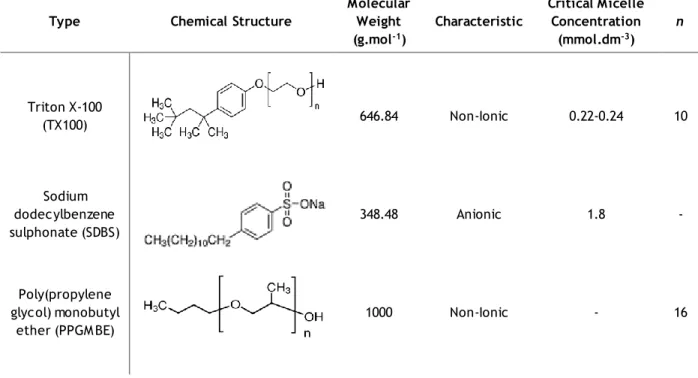
Three distinct surfactants were employed in the experimental procedure and their characteristics are presented in Table 1:
• Triton X-100 (TX100) from VWR Chemical (typically used for this type of suspensions because of the good results obtained so far);
• Sodium dodecylbenzene sulphonate (SDBS) from MP Biomedicals (selected because of its high polarity);
• Poly(propylene glycol) monobutyl ether (PPGMBE) from Sigma-Aldrich (selected because of its affinity to CNTs and its high molecular weight).
Table 1 - Characteristics of the surfactants used.
Type Chemical Structure
Molecular Weight (g.mol-1) Characteristic Critical Micelle Concentration (mmol.dm-3) n Triton X-100 (TX100) 646.84 Non-Ionic 0.22-0.24 10 Sodium dodecylbenzene sulphonate (SDBS) 348.48 Anionic 1.8 - Poly(propylene glycol) monobutyl ether (PPGM BE) 1000 Non-Ionic - 16
Effec t of Surfactants on the Rheological Properties and Mic rostructure of MWCNT/Epoxy Resin Suspensions
20
3.2 Preparation of Epoxy/MWCNT Suspensions
The experimental work involved the preparation of epoxy/MWCNT suspensions with different contents of filler, between 0 and 1.0 % (m/m). The MWCNTs were added to the neat epoxy and subjected to mechanical stirring and then processed in a calendaring-type equipment - three-roll mill. Both mixing techniques are described in detail in Section 3.2.1.
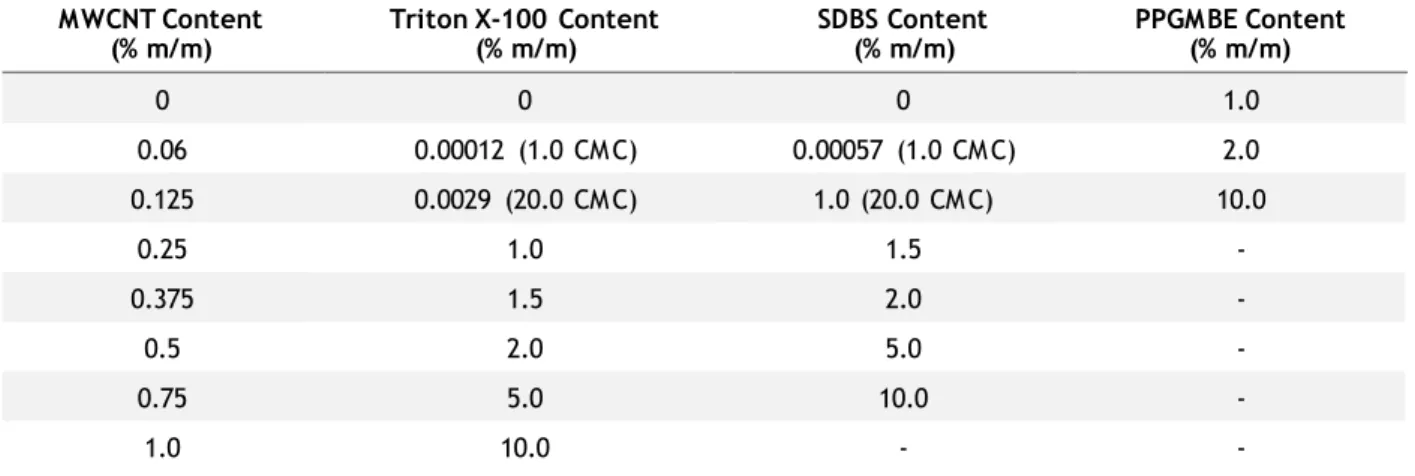
To evaluate the effect of surfactants on rheological properties, mixtures of 1.0 % (m/m) MWCNT/epoxy were prepared with different concentrations of Triton X-100, SDBS and PPGMBE, as presented in Table 2.
Table 2 - Compositions of the formulations prepared.
MWCNT Content
(% m/m) Triton X-100 Content (% m/m) SDBS Content (% m/m) PPGMBE Content (% m/m)
0 0 0 1.0 0.06 0.00012 (1.0 CM C) 0.00057 (1.0 CM C) 2.0 0.125 0.0029 (20.0 CM C) 1.0 (20.0 CM C) 10.0 0.25 1.0 1.5 - 0.375 1.5 2.0 - 0.5 2.0 5.0 - 0.75 5.0 10.0 - 1.0 10.0 - -
The MWCNTs and the surfactant were added to the resin and then the mixtures were processed as mentioned above (mechanical stirring and three-roll mill). After the processing of epoxy/MWCNT suspensions, the rheological measurements were performed and boards were cured for optical microscopy and electrical analysis.
3.2.1 Approaches for Mixing and Dispersing Carbon Nanotubes
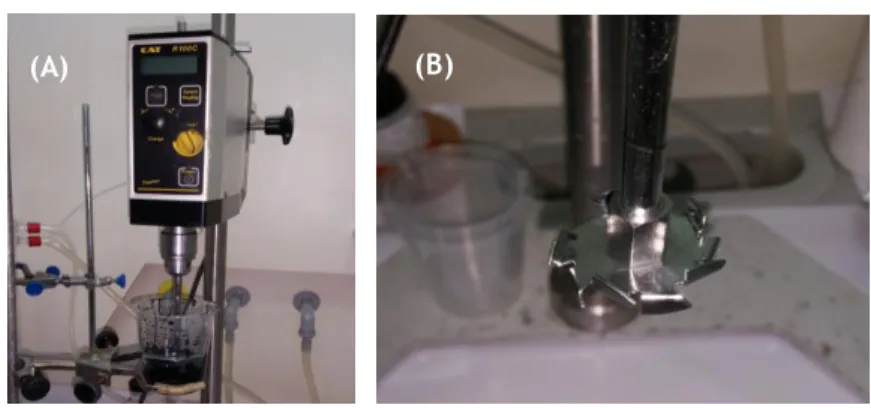
The primal approach for mixing the carbon fillers in the polymeric matrix was the mechanical agitation, using a mechanical stirrer CAT R100C. The blade employed for this task was a dispersing homogenizer blade, indicated for high shear mixing, with a diameter of 35 mm. The mechanical stirrer and the blade are illustrated in Figure 13.
However, the mixture provided by this mechanism may not be as efficient as necessary, existing several locations, mainly near the recipient walls, called dead zones, where the dispersing is not improved. Furthermore, other methods may be used and even combined with the techniques mentioned before. Thus, another method was employed to promote a better dispersion of carbon nanotubes: the calendering process.
Unlike other types of mills which rely on compressive impact as well as shear, the calendaring approach results in nearly pure shearing [63]. In this dissertation, this was the method used to assure an efficient dispersion of CNTs in the matrix.
The use of calender, or commonly known as three-roll mill, consists in a standard method for dispersing micro and nano-scaling particles [64]. This equipment employs a shear force created by rollers to mix, disperse or homogenize viscous materials. The general configuration of the machine consists of three adjacent rolls which rotate at different velocities. The feeding roller (n1 in Figure 14 (B)) and the apron roller (n3 in Figure 14 (B)) runs in the same direction, while the center roller (n2 in Figure 14 (B)) rotates at the opposite direction [29].
As illustrated in Figure 14 (B), the material is fed between the feed and the center rollers where it will be pre-dispersed. After that, the material sticks to the bottom of the center roller, which transports it into the second gap, where the material is dispersed to the desired degree of fineness. The material that remains in the center roller moves through the second nip between the center and the apron rollers , which subjects it to even higher shear force due to the higher speed of the apron roller. A sharp blade collects the mixed material from the apron roller and transfers it to the apron [29]. This cycle can be repeated to promote a better dispersion.
For the preparation of epoxy/MWCNT mixtures was used the model EXAKT 80E (EXAKT GmbH, Germany), illustrated in Figure 14 (A). The processing in three-roll mill was carried out at room temperature in five steps, all at the same rotation velocity and varying the gap between the rollers, with the procedure Figure 14 - (A ) Calender (or three roll mill) machine and (B) schematic of configuration of calender machine, where n1
represents the feeding roller, n2 is the center roller and n3 represents the apron roller [29].
Figure 13 - (A ) Mechanical stirrer and (B) Dispersing homogenizer blade.
(A) (B)
Effec t of Surfactants on the Rheological Properties and Mic rostructure of MWCNT/Epoxy Resin Suspensions
22 presented in Table 5 (in Appendix 1). In each step, the mixture was milled five times to obtained a homogeneous suspension.
3.3 Preparation of Cured Nanocomposites Boards
To obtain a cured nanocomposite boards for microscopy and electrical conductivity analysis, a mixture of hardeners was added into the epoxy/MWCNT suspensions. The mixtures of hardeners consist of
Aradur 1571 (23:100) and Accelarator 1573 (5:100), and was prepared using a mechanical stirrer at 100
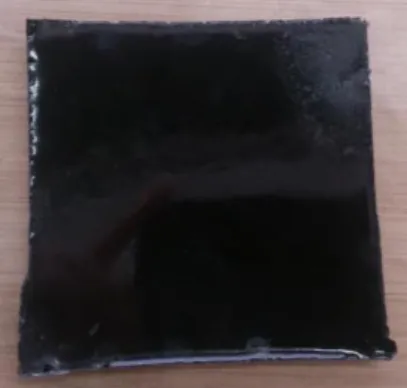
rpm. Then the hardener XB 3903 (12:100) was added, which was also mixed using a mechanical s tirrer at 1000 rpm. After that, that material was casted into the mold, and cured in the oven for 2 hours at 120 ºC. In the end, a 10 cm x 10 cm cured nanocomposite board with approximately 2 mm of thickness is obtained, as illustrated in Figure 15.
3.4 Rheological Characterization
3.4.1 Summary of the Experiments
The rheometer model used in this thesis was Discovery Hybrid Rheometer-1 from TA Instruments (see Figure 16). All characteristics of the equipment are described in Table 6 (Appendix 2).
Flow-ramps and small amplitude oscillatory flow measurements were carried out in a rheometer, using a plate-plate geometry of 25 mm diameter and 1 mm gap.
All experiments were run at 25 ºC and each rheological test was performed on freshly loaded samples. Flow ramp tests with a shear rate from 0.0085 s-1 to 1150 s-1 were carried in four steps, where the first and the third steps were run with an increasing shear rate (0.0085 s-1 to 1150 s-1) and the second and fourth steps were run with a decreasing shear rate (1150 s-1 to 0.0085 s-1). Each step has a duration of 60 seconds. This steady state measurements allowed the determination of dynamic viscosity, thixotropic index and yield stress.
Oscillatory rheology tests were performed in the linear viscoelastic (LVE) regime (experiment described in Section 3.4.2), where the microstructure of the samples responds without changing.
Frequency sweeps from 115 rad.s-1 to 0.01 rad.s-1 were applied at a strain within the linear viscoelastic region. This dynamic experiment allowed the determination of storage modulus, loss modulus, complex viscosity and modulus crossover (G’ = G’’).
3.4.2 Determination of the LVE Regime
To determine the viscoelastic regime, oscillation amplitude sweeps must be performed for each sample, resulting in a graph presented in Figure 17 (corresponding to the sample 1.0 % (m/m) MWCNT/epoxy). The limit for linear viscoelasticity was obtained from an amplitude sweep at a constant angular frequency (ω) of 10 rad.s-1 and varying the strain between 0.0125 % and 12.5 %.
The viscoelastic region corresponds to the range of strain where G’ values do not change drastically. In the example presented in Figure 17, the LVE region corresponds to the range of strain between approximately 0.7 % and 3 %.
Figure 17 - Oscillation amplitude sweep result.
3.4.3 Determination of Thixotropic Index
The systems that satisfy the definition of thixotropy can be identify through several rheological features, but also through physical properties, such as optical and electric features, due to the changing in the microstructure with the shear history that affects the mechanical response. One rheological feature used often is the hysteresis technique. It consists in increasing and decreasing shear rate between zero and a
Figure 16 - Hybrid rheometer-1 from TA Instruments used to perform all rheological experiments.
10-1 100 101 2x10² 4x10² 6x10² 8x10² 103 Storage Mod ul us G' (Pa) Lo ss Modu lu s G'' (Pa) Oscillation Strain (%)
Effec t of Surfactants on the Rheological Properties and Mic rostructure of MWCNT/Epoxy Resin Suspensions
24 maximum value, continuously or in steps [49]. When the stress is plotted against shear rate, a thixotropic sample will form a hysteresis loop, as shown in Figure 18.
For a viscoelastic solid material, under cyclic loading and unloading they exhibit hysteresis which leads to a dissipation of mechanical energy per volume, that corresponds to the area within the hysteresis loop [65]. In polymeric solutions, the level of elasticity and viscosity is given by entanglement density, thus for MWCNT/epoxy suspensions, the microstructure is associated to the entanglement of epoxy chains and the alignment and favorable distribution of CNTs. The maximum microstructure is observed when the alignment and distribution of fillers are random and entanglement density is maximum [66]. Therefore, the area within the hysteresis loop corresponds to the energy consumed in microstructure breakdown (disentanglement of polymeric chains and alignment of filler with flow direction). This energy is obtained by calculating the integral of each experimental curve.
Figure 18 - Hysteresis loop of a thixotropic material.
3.4.4 Determination of Yield Stress
Several empirical equations have been proposed to determine the yield stress of viscoelastic systems. In this case, the linearization of stress-shear rate flow curves is very well reached with the Casson Model given by Equation (3) [67]:
𝜏0.5= 𝜏
𝑐0.5+ (𝜂𝑓. 𝛾̇) 0.5
(3) This model gives a straight line when 𝜏0.5 (stress) is plotted against 𝛾̇0.5 and yield stress (𝜏
𝑐) and final constant viscosity (𝜂𝑓) values for each sample correspond to the square of the intercept and square of the slop, respectively.
3.4.5 Determination of Critical Angular Frequency
The variation of concentration of a polymer solution can be reflected in the viscoelastic properties. Therefore, the addition of carbon nanofillers into an epoxy resin in different contents may also affect the viscoelastic properties of the material. For a viscoelastic system, the frequency over which shear is applied becomes a critical determinant and defines whether viscous or elastic portion is dominant. In dynamic measurements, the crossover of G’ and G’’ on abscissas axis represents the change in the mode of relaxation of material with a characteristic time scale which is controlled by the interactions between fillers [68]. 10-2 10-1 100 101 102 103 101 102 103 104 Stres s (Pa) Shear Rate (s-1)
![Figure 2 - Fiber-reinforcement types: (a) continuous fibers (b) discontinuous fibers [2]](https://thumb-eu.123doks.com/thumbv2/123dok_br/15912099.1092802/20.893.304.607.105.387/figure-fiber-reinforcement-types-continuous-fibers-discontinuous-fibers.webp)
![Figure 9 – Schematic illustration of the interactions between Triton X -100 and the wall of a MWCNT [40]](https://thumb-eu.123doks.com/thumbv2/123dok_br/15912099.1092802/24.893.277.650.864.1027/figure-schematic-illustration-interactions-triton-x-wall-mwcnt.webp)
![Figure 10 - Schematic of shear and extensional deformation and flow [44].](https://thumb-eu.123doks.com/thumbv2/123dok_br/15912099.1092802/25.893.311.602.577.793/figure-schematic-shear-extensional-deformation-flow.webp)
![Figure 11 illustrate all types of flows of a Newtonian and non-Newtonian liquid [43]](https://thumb-eu.123doks.com/thumbv2/123dok_br/15912099.1092802/26.893.280.634.754.963/figure-illustrate-types-flows-newtonian-non-newtonian-liquid.webp)
![Figure 12 - Schematic representation of material's (A ) yield stress and (B) thixotropy [50]](https://thumb-eu.123doks.com/thumbv2/123dok_br/15912099.1092802/28.893.235.681.782.949/figure-schematic-representation-material-yield-stress-b-thixotropy.webp)