DOI: http://dx.doi.org/10.18363/rbo.v75.2018.e1186 Literature Review/Stomatology
Geographic tongue and atopy:
Is there an association?
Thaylla Núñez Amin Dick,1 Thays Teixeira-Souza,1 Sueli Carneiro,2 Daniella Moore,3 Dennis de Carvalho Ferreira,4,5 Simone Pestana,3 José Laerte Boechat,3 Adrianna Milagres,1 Bruna Picciani1
1Postgraduate Program in Pathology, School of Medicine, Fluminense Federal University, Niterói, RJ, Brazil 2Sector of Dermatology, Medical Clinic Department, Rio de Janeiro Federal University, Rio de Janeiro, RJ Brazil 3Allergy and Clinical Immunology Service, School of Medicine, Fluminense Federal University, Niterói, RJ, Brazil 4Faculty of Dentistry, Estácio de Sá University, Rio de Janeiro, RJ, Brazil
5Faculty of Dentistry, Veiga de Almeida University, Rio de Janeiro, RJ, Brazil • Conflicts of interest: none declared.
AbstrAct
Objective: this systematic literature review aimed to find data to clarify a controversy about the association between geographic tongue and atopic diseases/atopy. With emphasis on the relationship between these conditions. Material and Methods: data extracted include information on age and sex, family and personal history of atopy, geographic tongue prevalence, immunoglobulin E (IgE) serum levels, and skin tests. Results: 08 articles were selected and read in full text and information in articles used in this study. During a review, there was difficulty in standardizing the findings due to lack of details in the diagnosis of atopy and geographic tongue; and the lack of separate analysis of the conditions of asthma, rhinitis or atopic dermatitis. Limitation: low number of publications on the subject. Conclusion: based on the literature, more data are available to confirm the relationship between geographic tongue, atopic diseases / atopy, new ones with larger sample sizes, adequate diagnosis of atopy / atopic diseases and geographic tongue, IgE serum levels determined simultaneously oral examination and skin tests.
Keywords: Atopic dermatitis; Asthma; Allergic rhinitis; Atopy; Geographic tongue.
Introduction
A
llergic diseases are common in the general popu-lation and are usually associated with sensitivity to environmental allergens such as foods, pollen, mites, fungus, insects, and drugs.1 The prevalence of thesediseases has increased considerably in recent decades. Con-sequently, several theories have been proposed as a justifica-tion; however, no conclusive explanation for this phenome-non has been defined.2 In this context, atopy, the hereditary
predisposition of the immune system to immunoglobulin E (IgE)-mediated hypersensitivity reactions in response to common antigens, in intra- and extra-domiciliary environ-ments is important.3 In addition to interactions with the
en-vironment in genetically predisposed individuals, there are systemic variations and immunological abnormalities that make the pathogenesis of this condition quite complex.4
The main atopic disorders are asthma, rhinitis, and atopic dermatitis (AD). Asthma is a chronic inflammatory disea-se of the airways characterized by generalized but variable bronchial obstruction, partially reversible spontaneously or by pharmacological intervention. In allergic asthma, the in-flammation is largely dependent on IgE sensitization.5
Allergic rhinitis is characterizing by inflammation of the nasal membranes, induced by exposure to allergens. It
oc-AD is a chronic inflammatory, cutaneous disease, with outbreaks that occur more often in children in the first years of life but may persist until adulthood.7 It is an itchy disease,
but its clinical presentation depends on the age of the pa-tient. It can be classified as either extrinsic AD, integrated with atopy, or intrinsic AD, considered only as a skin disease that may eventually be associated with respiratory diseases.7
The earlier the appearance of AD in the child, the greater the child’s propensity to develop atopic diseases in the future.
In addition to cutaneous lesions and respiratory disea-ses, patients with atopy may exhibit oral lesions. Thus, some studies have reported that patients presenting with allergic diseases, a personal or family history of atopy, and high IgE serum levels are more likely to present with geographic ton-gue (GT). One possible explanation for this is an acute in-flammatory condition contribute to the emergence of both: atopy and GT.8 Although not a specific feature of atopy, GT
is a condition that may be associated with an atopic disorder and is often reported before other symptoms of atopy.9
GT, or benign migratory glossitis, is a recurrent condition characterized by the loss of the epithelium, particularly the filiform papillae, on the dorsum of the tongue (Figure 1).10
The appearance of GT may vary, with stages of exacerbation and remission of the lesion.11,12 It is an immunologically
me-The association between GT and atopy is not very well defined. Some authors have affirmed this associa-tion, while others have denied it.14,15 Furthermore, the
number of clinical studies reporting adequate evidence for the definitive diagnosis of GT or atopy is limited. The GT frequently appears in atopic patients, being able to constitute a predecessor of the atopic disorder and gravity marker. Therefore, it is essential to resolve this controversy, for that the extraoral and intraoral thorou-gh examination in atopic patients and in patients with geographic tongue should not be neglected so there is no loss of holistic assessment of the disease. Thus, the aim of this systematic literature review was to obtain su-pporting data to clarify this controversy, with particular emphasis on the relationship between atopy and GT.
Material and Methods
The systematic literature review reported here was performed according to the following steps:
1. After a thorough review of the literature and based on the authors’ clinical experience, two guiding ques-tions were formulated to be answered by the present study: What is the frequency of geographic tongue in patients with atopy? Did these findings were correlate with the IgE levels and skin tests?
2. Search strategies: the chosen descriptors were previously identified in published articles on the the-me in question and they were registered in the MeSH of PubMed. The following virtual databases have been accessed: PubMed, Scientific Electronic Library Online
(SciELO) and Latin American and Caribbean Health
Sciences (LILACS). They were searched using
combi-nations of the descriptors with the help of the Boolean operator AND: geographic tongue, benign migratory glossitis, atopic dermatitis, asthma, immediate hyper-sensitivity, allergic rhinitis, and hay fever. A temporal interval was not established in order to obtain as many publications as possible.
3. Inclusion and exclusion criteria: Articles were se-lect if they to be relate to the research theme through the reading of titles and abstracts. Duplicate publica-tions, publications for whom the full article could not be accessed, and publications written in languages other than Portuguese, English and Spanish were excluded (Figure 2).
4. Analysis: Extracted data included information about the age and gender of the participants, atopy, pre-valence of GT, IgE levels, and skin tests.
Results
The research resulted in 29 articles in PubMed, 1 article in SciELO and 32 articles in LILACS. Some articles were ex-cluded either based on the title or because of being a repe-tition, two were excluded based on language (Chinese and French), and two were excluded as the full text could not be obtained for them. Ultimately, only 08 articles were selected and read in full text, and information from these articles was used in this study.
The 07 publications comprise the literature between 1979 and 2015, of which 6 are original articles, 1 case reports, and 1 a literature review. The majority involved both male and female patients, ranging in age from 3 to 83 years. Althou-gh females were more prevalent in the studies, this did not
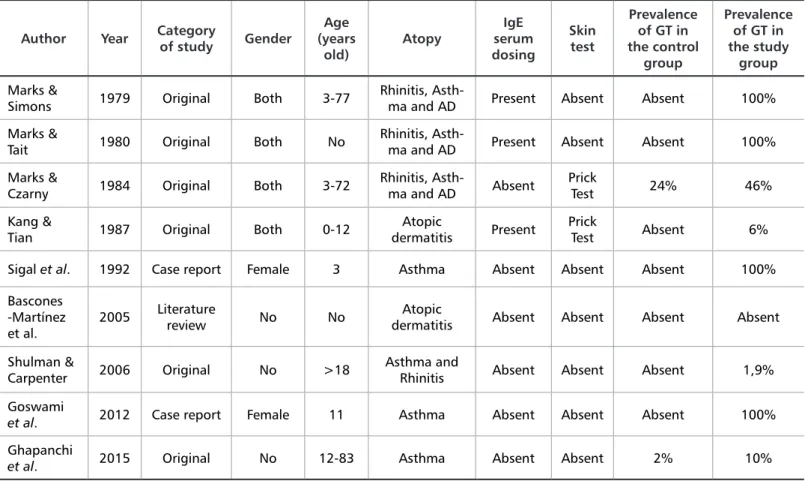
In relation to atopy, three articles were related to asthma, rhinitis, and AD; three to asthma; two to AD; and one to asthma and rhinitis. In the only original article, that con-sidered exclusively asthma, the research group concluded that the frequency of GT in 100 asthmatic patients was 10%, which was higher than that in the control group (2%).16 IgE
serum levels were reported in only three articles (Table 1) in which 200 patients had GT.8,14,16-20,31-33 In the first and
se-cond articles, all atopic diseases were considered within the same group. In the first article, of 100 participants with GT, 28% presented with IgE total serum levels ≥ 200 units/mL against 18% of those in the control group. In another article with 95 participants with GT, 24.2% presented high IgE to-tal serum levels, but the control group was not mentioned.
The use of the prick test reported in only two articles, and the result used only for the evaluation of atopy. In one of those articles, among 70 patients with AD and/ or respiratory allergy, 41 (58%) showed positive prick test results to an extract of Dermatophagoides farinae compa-red with 3 of 39 (7.7%) non-atopic persons. However, the relationship between GT and a positive prick test result was not discussed in this article (Table 2).8,18,31 At the same
time, in another study of 102 atopic participants with pri-ck test result positive to common inhalant allergens, mi-xed-grass pollens, and house dust mites, 46 (45%) presen-ted with GT. Of 164 participants in the control group, 38 (23%) showed positive prick test results. Of these 38 par-ticipants, 12 (31%) presented with GT. These findings led the authors to conclude that there is a possible association between allergic conditions and the presence of GT.
Author Year Category of study Gender
Age (years old) Atopy IgE serum dosing Skin test Prevalence of GT in the control group Prevalence of GT in the study group Marks &
Simons 1979 Original Both 3-77
Rhinitis,
Asth-ma and AD Present Absent Absent 100%
Marks &
Tait 1980 Original Both No Rhinitis, Asth-ma and AD Present Absent Absent 100%
Marks &
Czarny 1984 Original Both 3-72 Rhinitis, Asth-ma and AD Absent Prick Test 24% 46%
Kang &
Tian 1987 Original Both 0-12 dermatitisAtopic Present Prick Test Absent 6%
Sigal et al. 1992 Case report Female 3 Asthma Absent Absent Absent 100%
Bascones -Martínez
et al. 2005
Literature
review No No dermatitisAtopic Absent Absent Absent Absent
Shulman &
Carpenter 2006 Original No >18 Asthma and Rhinitis Absent Absent Absent 1,9%
Goswami
et al. 2012 Case report Female 11 Asthma Absent Absent Absent 100%
Ghapanchi
et al. 2015 Original No 12-83 Asthma Absent Absent 2% 10%
Table 1. Atopy, tests performed, age, gender and category of study evaluated in articles
Year Author Control Group (n) Participants with atopy (n) Atopy + GT (n) Atopy + *high IgE serum
do-sing (n)
GT + *high IgE serum dosing (n)
Control Group + *high IgE serum dosing
1979 Marks & Simons 255 66 66 21 28 46
1980 Marks & Tait 586 95 63 absent 23 absent
1987 Kang & Tian 213 372 22 65 absent absent Table 2. Correlation between GT, atopy and IgE serum levels
The diagnosis of GT was considered when the following conditions were present: papillary atrophy (reported in six articles), “white halo” (reported in two articles), and lesion migration (reported in two articles). In only one study, the-re was a diffethe-rential diagnosis with candidiasis, a principal diagnostic differential for GT. Further assessment was ham-pered by variations in the description of the lesion among the studies.
Discussion
Atopy is the hereditary predisposition of the immune system to IgE-mediated hypersensitivity reactions in re-sponse to common environmental antigens. In addition to environmental interaction in genetically predisposed indi-viduals, there are systemic variations and immunological abnormalities that make the pathogenesis of this condition quite complex. The presence of oral lesions in atopy remains controversial, with GT considered the most frequent lesion. Some studies have shown this relationship through the pa-tient’s clinical history, total IgE serum levels, human leuko-cyte antigens, and prick test results.18-21 Many other
associ-ations between GT and systemic diseases have already been described, with psoriasis being the disease that presents the most significant clinical, histopathological, and genetic re-lationship.13,22
Several studies have shown that GT has no gender pref-erence and usually occurs in the third decade of life.23,24 Our
results regarding the prevalence of GT revealed no differ-ences between the genders. Jainkittivong et al.25 showed that
GT is more prevalent in women than in men (1.5:1), attribut-ing this frequency to female hormones, which can intensify the condition, facilitating the diagnosis. In relation to age, corroborating our findings in the literature, we observed that in atopic individuals, GT is more frequent before the age of 40 years. In patients with psoriasis, GT is associated with early disease, whereas some studies have reported that GT may represent a predilection for future disease.26-28 Thus,
it is extremely important to identify the age at lesion onset and to monitor patients for the early diagnosis of atopy or other diseases.
The association between GT and atopy was first described in 1979, where Marks and Simons8 demonstrated the
in-creased frequency of atopy (asthma, rhinitis, and derma-titis) in patients with GT. GT was directly related to high IgE serum levels and occurred at levels > 200 μ/mL. The authors concluded that there is a relation between GT and atopy, raising the hypothesis that these conditions are simi-lar in pathogenesis.8 Both conditions (GT and atopy) are
re-current and inflammatory and can get initiated by contact
variations in the frequency of GT in each condition: asth-ma, rhinitis, or AD. Although this association was reported more than 30 years ago, few additional studies have been performed. In addition, the existing studies were clinical, without distinction between atopy and atopic diseases. The only study investigating the association of oral lesions with asthma found a high frequency of GT in asthmatic patients, but the authors did not describe how the diagnosis of both conditions was made and did not affirm that GT is a mani-festation associated with asthma.16
Shulman & Carpenter20 evaluated the presence of atopy,
with emphasis on cutaneous manifestations, in 279 cases of GT and 16.554 control individuals and found no relation between these conditions. Further, despite emphasizing cu-taneous manifestations, there was no dissociation between intrinsic and extrinsic ADs, which hinders the correlation between AD and GT.20 In addition, the assessment of the
presence of GT is often inaccurate in cross-sectional stud-ies because the patient may not present with the lesion in that examination and may be unaware of its presence. Gon-zaga & Consolaro 29 reported that the prevalence of GT in
some diseases, such as psoriasis, would be much higher than that reported due to the fact that, as a rule, patients are not routinely subjected to a thorough oral examination, which would yield results that are helpful in the resolution of this divergence. New studies with a larger sample size and diag-nostic criteria for atopic diseases and GT are necessary.
Some studies have reported a significant increase in the frequency of GT associated with an increased frequency of elevated IgE serum levels. The authors suggested that GT probably represents a reaction pattern of the tongue to sev-eral different diseases, especially in the active and severe phases of those diseases.8,19 Singh et al.28 and Picciani et al.30
demonstrated that psoriatic patients with GT presented a se-vere form of the cutaneous disease and concluded that this oral lesion represents a marker of psoriasis severity.
The role of cellular immunity, type 1 and type 4 reac-tions, in atopy has been evaluated for both the prick and patch tests. The immunological mechanisms of GT are not well described, and some studies have shown an increase in this lesion in atopic patients. These tests were used to in-vestigate the role of allergens in GT.19,27 The authors showed
an increase in the positivity of these tests in GT patients, concluding that there is a predisposition to allergy in indi-viduals with GT, thus, supporting the hypothesis that GT correlates with allergic conditions.27 However, because the
studies used skin tests for diagnosis, the clinical history of the participants was not described in detail, which makes it difficult to associate GT with some atopic diseases.
16. Ghapanchi J, Rezazadeh F, Kamali F, Rezaee M, Maryamghodrati E, Amanpour S. Oral manifestations of asthmatic patients. J Pak Med Assoc. 2015;65(11):1226-7.
17. Gonzaga HFS, Gonzaga LHS, Sgarbi JH, Picciani BLS, Jorge MA. Search of association between atopic dermatitis and oral diseases. In focus 4 – UNIMAR. 2015;(4):319-30.
18. Marks R, Tait B. HLA antigens in geographic tongue. Tissue Antigens. 1980;15(1):60-2.
19. Marks R, Czarny D. Geographic tongue: sensitivity to the environment. Oral Surg Oral Med Oral Pathol Oral Radiol Endod. 1984;58(2):156-9.
20. Shulman JD, Carpenter WM. Prevalence and risk factors associated with geo-graphic tongue among US adults. Oral Dis. 2006;12(4):381-6.
21. Miloglu O, Goregen M, Akgül HM, Acemoglu H. The prevalence and risk fac-tors associated with benign migratory glossitis lesions in 7619 Turkish dental out-patients. Oral Surg Oral Med Oral Pathol Oral Radiol Endod. 2009;107(2):e29-33. 22. Picciani BLS, Carneiro S, Sampaio AL, Santos BM, Santos VCB, Gonzaga HFS, et al. A possible relationship of human leucocyte antigens with psoriasis vulgaris and geographic tongue. J Eur Acad Dermatol Venereol. 2015;29(5):865-74.
23. Honarmand M, Farhad ML, Shirzaiy M, Sehhatpour M. Geographic tongue and associated risk factors among Iranian dental patients. Iran J Public Health. 2013;42(2):215-9.
24. Dafar A, Çevik-Aras H, Robledo-Sierra J, Mattsson U, Jontell M. Factors associated with geographic tongue and fissured tongue. Acta Odontol Scand. 2016;74(3):210-6.
25. Jainkittivong A, Langlais RP. Geographic tongue: clinical characteristics of 188 cases. J Contemp Dent Pract. 2005;6(1):1-11.
26. Assimakopoulos D, Patrikakos G, Fotika C, Elisaf M. Benign Migra-tory Glossitis or Geographic Tongue: An Enigmatic Oral Lesion. Am J Med. 2002;113(9):751-5.
27. Goregen M, Melikoglu M, Miloglu O, Erdem T. Predisposition of allergy in patients with benign migratory glossitis. Oral Surg Oral Med Oral Pathol Oral Radiol Endod. 2010;110(4):470-4.
28. Picciani BLS, Souza TT, Santos VC, Domingos TA, Carneiro S, Avelleira JC, et al. Geographic tongue and fissured tongue in 348 patients with psoriasis: correla-tion with disease severity. Scientific World Journal. 2015;(2015):564326. 29. Gonzaga HF, Chaves MD, Gonzaga LH, Picciani BL, Jorge MA, Dias EP, et al. Environmental factors in benign migratory glossitis and psoriasis: retrospective study of the association of emotional stress and alcohol and tobacco consump-tion with benign migratory glossitis and cutaneous psoriasis. J Eur Acad
Derma-References
1. Daher S, Galvão C, Abe A, Cocco R. Diagnosis in IgE-mediated Allergic Dis-eases. Braz J Allergy Immunol. 2009;32(1):3-8.
2. Fiore RW, Comparsi AB, Reck CL, Oliveira JK, Pampanelli KB, Fritscher CC. Asthma and atopy prevalence in a group of students from Porto Alegre, Rio Grande do Sul. J Bras Pneumol. 2001;27(5):237-42.
3. Leite RMS, Leite AAC, Costa IMC. Atopic dermatitis: a cutaneous or systemic disease? The search for answers in the history of Dermatology. An Bras Dermatol. 2007;82(1):71-8.
4. Orfali RL, Shimizu MM, Takaoka R, Zaniboni MC, Ishizaki AS, Costa AA, et al. Atopic dermatitis in adults: clinical and epidemiological considerations. Rev Assoc Med Bras. 2013;59(3):270-5.
5. Todo-Bom A, Pinto AM. Physiopathology of severe asthma. Braz J Allergy Im-munol. 2006;29(6):113-6.
6. Campanha SMA, Freire LMS, Fontes MJF. Impact of asthma, allergic rhinitis and mouth breathing in life quality of children and adolescents. Rev CEFAC. 2008;10(4):513-9.
7. Mendes AIS, Souza CRC, Mallozzi MC, Naspitz CK, Solé D. Thalidomide in the treatment of patients with severe atopic dermatitis: retrospective study of 14 patients. Braz J Allergy Immunol. 2005;28(5):245-8.
8. Marks R, Simons MJ. Geographic tongue - a manifestation of atopy. Br J Der-matol. 1979;101(2):159-62.
9. Gelmetti C, Wollenberg A. Atopic dermatitis – all you can do from the outside. Br J Dermatol. 2014;170(Suppl 1):19-24.
10. Sehra S, Tuana FMB, Holbreich M, Mousdicas N, Kaplan MH, Travers JB. Clinical correlations of recent developments in the pathogenesis of atopic derma-titis. An Bras Dermatol. 2008;83(1):57-73.
11. Wollenberg A, Seba A, Antal AS. Immunological and molecular targets of atopic dermatitis treatment. Br J Dermatol. 2014;170(Suppl 1):7-11.
12. Castro APM, Solé D, Filho NAR, Jacob CMA, Rizzo MCFV, Fernandes MFM, et al. Practical guide for management of atopic dermatitis – conjunct opinion of allergologists from the Associação Brasileira de Alergia e Imunopatologia and Sociedade Brasileira de Pediatria. Braz J Allergy Immunol. 2006;29(6):268-82. 13. Picciani BLS, Domingos TA, Teixeira-Souza T, Santos VCB, Gonzaga HFS, Oliveira JC, et al. Geographic tongue and psoriasis: clinical, histopathological, immunohistochemical and genetic correlation – a literature review. An Bras Der-matol. 2016;91(4):410-21.
14. Sigal MJ, Paed D, Mock D. Symptomatic benign migratory glossitis: report of two cases and literature review. J Clin Pediatr Dent. 1992;14(6):392-6. 15. Rahamimoff R, Muhsam HV. Some observations on 1.246 cases of geographic tongue. Am J Dis Child. 1957;93(5):519-25.
pathway involving IL-4 and IL-13 cytokines and IgE pro-duction, in GT the response is mediates by CD3 / CD4 / CD8 T lymphocytes. For this reason, there is an associ-ation between psoriasis and GT, whereas the associassoci-ation with atopic diseases remains uncertain.4,5,13
During the literature review, only 08 articles correlated the presence of GT with some atopy. In addition, in many cases, the characteristics of lesions such as papillary atro-phy, the presence or absence of “white halo,” and lesion migration were not reported, making it difficult to associ-ate and characterize GT in atopy. It is important that Pap screening be routinely performed to detect the presence of atypical lesions because the primary differential diagnoses include candidiasis, which can be easily detected using cy-topathology.
During the review, we found it difficult to standardize the findings because of a lack of detail in the diagnoses of atopy and GT; a lack of separate analyses of asthma, rhini-tis, or AD conditions; and primarily, few publications on
the subject. For this reason, the 08 publications related to the theme were included regardless of the type of study, i.e., a literature review, a case report, or an original arti-cle. Therefore, new research is needed for a better under-standing of GT in atopy.
Conclusion
Based on the scarce literature on this subject, we con-clude that there are still insufficient data to confirm the relationship between GT and atopy. Although not able to confirm this relation, some authors affirm that GT frequently appears in atopic patients, being able to cons-titute a predecessor of the atopic disorder and gravity marker. Therefore, it is essential to carry out a thorough oral examination and follow up patients with GT without atopic diseases. Besides that, new studies are need with larger sample sizes, adequate diagnoses of atopy and GT, IgE serum levels determined simultaneously with the oral examination, and skin tests.
Submitted: 05/29/2018 / Accepted for publication: 07/27/2018 Corresponding Author
Thaylla Núñez Amin Dick E-mail: [email protected]
Mini Curriculum and Author’s Contribution
1. Thaylla Núñez Amin Dick – DDS. Contribution: conception, drafting, review, and final approval.
2. Thays Teixeira-Souza – DDS and MSc. Contribution: participated in the data collection, review, and final approval. 3. Sueli Carneiro – MD and PhD. Contribution: data interpretation, review, and final approval.
4. Daniella Moore – MD and PhD. Contribution: data interpretation, review, and final approval.
5. Dennis de Carvalho Ferreira – DDS and PhD. Contribution: data interpretation, review, and final approval. 6. Simone Pestana – MD and MSc. Contribution: data interpretation, review, and final approval.
7. José Laerte Boechat – MD and PhD. Contribution: conception, drafting, review, and final approval. 8. Adrianna Milagres – DDS and PhD. Contribution: data interpretation, review, and final approval. 9. Bruna Picciani – DDS and PhD. Contribution: conception, drafting, review, and final approval. tol Venereol. 2015;29(3):533-6.
30. Singh S, Nivash S, Mann BK. Matched case-control study to examine asso-ciation of psoriasis and migratory glossitis in India. Indian J Dermatol Venereol Leprol. 2013;79(1):59-64.
31. Kang K, Tian R. Atopic dermatitis an evaluation of clinical and laboratory findings. Int J Dermatol. 1987;26(1):27-32.
32. Goswami M, Verma A, Verma M. Benign migratory glossitis with fissured tongue. J Indian Soc Pedod Prev Dent. 2012;30(2):173-5.
33. Bascones-Martínez MA, Valero-Marugán A, Encinas-Bascones A, Carrillo de Albornoz A, Bascones-Martínez A. Lengua geográfica y dermatitis atópica: una asociación frecuente. Av Odontoestomatol. 2006;22(2):111-8.