Original scientific paper UDC 637.352.05
INFLUENCE OF DIFFERENT PROCESSING PARAMETERS IN PHYSICAL
AND SENSORIAL PROPERTIES OF SERRA DE ESTRELA CHEESE
Paula Correia
1,2*, André Vitor
1, Marlene Tenreiro
1, Ana C. Correia
1, António Pinto
1,
Paulo Correia
1, João Madanelo
3, Marta Vacas
4, Raquel Guiné
1,21Departamento Indústrias Alimentares – Escola Superior Agrária de Viseu, Quinta da Alagoa,
Estrada de Nelas, 3500-606 Viseu, Portugal
2CI&DETS – Instituto Politécnico de Viseu, Av. Cor. José Maria Vale de Andrade,
Campus Politécnico, 3504 - 510 Viseu, Portugal
3ANCOSE - Associação Nacional de Criadores de Ovinos da Serra da Estrela,
Quinta da Tapada - Negrelos, 3400 Oliveira do Hospital, Portugal
4Controlvet, Zona Industrial de Tondela, ZIM 2, Lote 6, 3460-070 Tondela, Portugal *e-mail: [email protected]
Abstract
Cheese is a classical dairy product, which is strong-ly judged by its appearance, flavour and texture. Processing parameters that could affect cheese struc-ture play a dominant role upon the feastruc-tures exhibited by the final product. Serra da Estrela cheese is a Pro-tected Denomination of Origin (PDO) cheese manu-factured from raw ewes ‘milk and curdled with thistle flowers. The study aimed to evaluate cheeses physic-ochemical, microbiological and sensorial properties, produced with two thistle flowers ecotypes added in different quantities to milk, sheep bread, salt quantity and ripening moisture.
Two dairies were involved in this study, named as A and B, both with certification. The sheep milk chemi-cal composition (moisture, protein, fat, solids-non-fat, lactose, solids, density, freezing point), and microbial analysis (coliforms and total enumeration of microor-ganism at 30 0C) were determined, using respectively a Lactoscan equipment and norms ISO 4832:2006 and 4833-1:2013. The clotting time, the evolution of weight loss and color, the texture (texturometer TA-XT Plus) and sensorial characteristics of cheeses were evaluated. Both dairies presented similar chemical sheep milk composition and clotting time for the same thistles flower, varying from 36-47 minutes. The loss of weight showed similar decreasing and tendency. Generally, the thistle flower ecotype didn’t influence the L, a* and b* color parameters, during the ripening process and in the final product there was a significant influence on a* parameter. The textural analysis revealed signifi-cant differences between the two dairies for the same thistle flower ecotype, considering the inner firmness, stickiness and adhesiveness. Cheeses presented similar
sensorial properties, considering the different process-ing parameters studied.
Serra da Estrela cheese produced in both dairies pre-sented different physical and sensorial properties, meaning that with a strong knowledge of the proper-ties assign by processing parameters it is possible to produce a specific cheese attending to different con-sumer targets.
Key words: Serra da Estrela cheese, Thistle flower, Process parameters, Color, Texture analysis, Sensorial analysis.
1. Introduction
Cheese is a food derived from milk that is produced in a wide range of flavours, textures, and forms by coagu-lation of the milk protein casein. Cheese structure char-acteristics are significantly affected by many parame-ters, from the characteristics of the raw materials used up to the processing factors.
One of the most traditional cheeses in Portugal is Serra da Estrela cheese, a product with Protected Denomi-nation of Origin (PDO), which has a great economic importance and unique sensorial characteristics. This semi-soft type of cheese is manufactured from coag-ulation of raw ewes milk curdled with thistle flowers aqueous extract (Cynara cardunculus, L.) without addi-tion of a starter.
During the last years, the manufacturing practices were improved, mainly because of strict governmental regulations. Some research has been done in order to
optimize and control several quality factors in Serra da Estrela cheese, such as temperature of coagulation, the amount of plant rennet added to the raw ‘milk, and the amount of salt added, which influence in the cheese’s final characteristics (Macedo [1]).
The objective of this work was to evaluate some physi-cal and sensorial properties of Serra da Estrela cheeses, produced with thistle flowers of two ecotypes, added in different quantities to milk. Other factors evaluated were sheep bread, salt quantity and ripening moisture.
2. Materials and Methods
2.1 Samples preparation
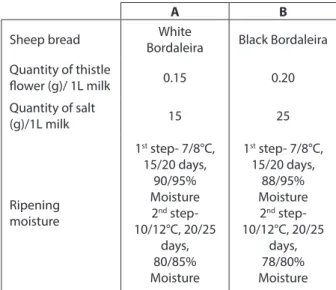
Cheeses were manufactured in two dairies: A and B, both certificated. The general cheese manufacturing methodology was the same, but there were some dif-ferences which are summarised in Table 1. Five cheeses were produced in both dairies for each thistle flower ecotype.
Table 1. Differences between the processing manufacturing in the A and B dairies
A B
Sheep bread BordaleiraWhite Black Bordaleira Quantity of thistle flower (g)/ 1L milk 0.15 0.20 Quantity of salt (g)/1L milk 15 25 Ripening moisture 1st step- 7/8°C, 15/20 days, 90/95% Moisture 2nd step- 10/12°C, 20/25 days, 80/85% Moisture 1st step- 7/8°C, 15/20 days, 88/95% Moisture 2nd step- 10/12°C, 20/25 days, 78/80% Moisture
The manufacturing processes were done according to the following methodology: 20 L approximately of raw sheep milk was filtered through a fine, clean cloth and poured into a double-walled, food grade steel coagu-lation vat with controlled temperature. After the tem-perature of the milk had reached 30 0C, crude kitchen salt and the thistle flower aqueous extract were placed inside a cloth, submerged in the milk and agitated until complete solubilisation of the salt. The milk was then allowed to coagulate at 32 0C until complete clotting, after which time the coagulum was cut by stirring with 20 x 20 mm2 knives. After 10 minutes, the curd pieces were poured into a fine cloth, which was hand closed and firmly pressed to expel the whey. Each cheese was then placed in a form and each cheese was surface- labelled using a food-grade casein marker.
Drainage of whey was complete by using a standard pneumatic press. The cheeses were then placed in the maturation room, with temperature and humidity con-trol. The cheeses were finish after 45 days.
Two thistle flower ecotypes were tested in both dairies, the C-32 and the F-19. The main characteristics of these two ecotypes considering the results of exclusion mo-lecular chromatography are showed in Table 2.
Table 2. Exclusion molecular chromatography character-istics of the thistle flower ecotypes used for cheese pro-duction Ecotype Area (mAU*mL) Height (mAU) Absorbance (280 nm) Total cardosins (µg/mL) C-32 21334 1192 0,534 474 F-19 18864 1218 0.474 419
2.2 Chemical analysis of sheep milk
An ultrasonic milk analyser LactoScan model Milkos-can S (Milkotronic, Lda, Nova Zagora, Bulgaria) was used to determined moisture, protein, fat, solids-non-fat, lactose, solids, density (kgm-1), freezing point (0C) in milk samples, which were collected (after milking), and frozen, until performing the analysis. These sam-ples were related with the cheeses respectively. All the samples were analysed in triplicate for each deter-mined parameter.
2.3 Microbiological analysis of sheep milk
The methods used to the microbiological analysis fol-lowed the regulation ISO 4832:2006, for the enumer-ation of coliforms, using the colony count technique, and the ISO 4833-1:2013, for the enumeration of mi-croorganisms, using the colony count at 30 0C by pour plate technique. The results are expressed in CFU /mL (Colony Forming Units). All the samples were analysed in triplicate for each determined parameter.
2.4 Clotting time
The clotting time is the time necessary to curdle the milk after the addition of the C-32 and F-19 thistle flower aqueous extract. It was measured in minutes. The experiment was carried out in triplicate for each thistle flower ecotype.
2.5 Weight and colour evaluation during ripening
The weight of the cheeses was performed by weigh-ing the cheeses durweigh-ing the ripenweigh-ing period. Five meas-ures were done during one and a half months, in each cheese produced in both dairies. The measures start-ed in April until middle of May. The first measure was measure immediately after the cheese produced.
The colour of all cheeses was measured using a hand-held tristimulus colorimeter (Chroma Meter - CR-400, Konica Minolta) calibrated with a white standard tile. A CIE standard illuminant D65 was used to determine CIE Cartesian colour space coordinates, L*, a*, b* val-ues. The parameters measured were the brightness L*, which varies between 0 and 100 (from black to white, respectively), and the coordinates of opposed colour: a* and b*, which vary from -60 to +60, where the a* assumes negative values for green and positive values for red, while b* assumes negative values for blue and positive for yellow. In each cheese 25 measurements were made to access the mean value and standard deviation.
2.6 Texture evaluation
The texture profile analysis (TPA) for all samples was made by a texturometer (TA.XT. Plus from Stable Mi-cro Systems). The test performed was measure force in compression and the probe used was P/2 (2mm diameter cylinder). The operational parameters were: pre-test speed = 2.00 mm/s, test speed = 1.00 mm/s and post-test speed = 1.00 mm/s, distance = 10.0 mm, trigger force = 0.029 N, load cell = 50 kg. Five measure-ments were carried for each cheese. The curve force (N) versus time (Figure 1) allows calculate the crust firm-ness inner firmfirm-ness, stickifirm-ness and adhesivefirm-ness.
Figure 1. Example of a TPA obtained for a cheese sample
intensity to all attributes except colour. For the colour the range was blank (1) to yellow (7).
3. Results and Discussion
The milk analysed from both dairies presented similar chemical composition, but different freezing points and density (Figures 2 and 3). The composition of the milk is very similar to other sheep milk values report-ed by other researchers (Boyazoglu [3]). The A dairy showed the highest values of freezing point and den-sity. These differences could be explained by the type, quality and quantity of animal feed. The limited access to concentrate feed and ingestion of water in milking intervals could diminish the decreasing of the freezing point (Prates [4]).
The results of microbiological analysis showed that no coliforms were found in the sheep milks from both dair-ies. This result reflects the absence of faecal contami-nation, ensuring a satisfactory microbiological quality of milks. The mesophilic microorganisms growth at 30 0C presented different values, with the highest values occurring in the A dairy (Fig 4). These differences could be associated with different milking and handling pro-tocols, thus leading to extensive and unpredictable variability. Furthermore, considering the Regulation CE 853/ 2004 ([5]), it could be used raw milk with a maximum content of 500000 UCF/mL. Thus, taking in consideration this statement it could be mention that these microbiological results were very good.
Figure 2. Chemical composition of sheep milk of A and B dairies. The results are expressed in percentage
(g/100 g milk sample) 2.7 Sensorial evaluation
Eleven trained panellists carried out the sensory eval-uation of the cheeses. Samples had presented intact form in first place and after in slice pieces identified by random three-digit codes. Testing was carried out in a tasting room equipped as specified in ISO Standard (ISO 8589/1988 [2]). Thirteen sensory attributes had assessed: a rind cheese aspects (thickness, uniform-ity, and colour), cheese past (uniformuniform-ity, buttery, and colour), flavour intensity, taste and aroma (intensity, salt, acidity, bitter, remaining presence), and global appreciation. The attributes were evaluated using a structured scale of seven unit points applied a
The Serra da Estrela cheeses were produced with raw milk, without any standardizing thermal treatment, depending critically on their indigenous microflora for the development of the final characteristics. The contribution of such microflora, coupled with that of milk composition, which depends on the local animals diet and physiological conditions, eventually account for the unique flavour and texture of those traditional cheeses (Pereira [6]).
Figure 4. Total mesophilic microorganisms of sheep milk of A and B dairies. CFU - Colony Formation Unit
Figure 5. Clotting time of raw ewes ‘milk considering the C-32 and F-19 thistle flower ecotypes in A and B dairies
Figure 6. Weight (kg) of cheeses during the ripening in A and B dairies, with C-32 and F-19 thistle flower ecotypes. I - Day one, when cheese was manufacturing (4th April);
II - 17th April; III - 2nd May; IV - 9th May; V - 16th May
The B dairy presented low clotting times (Figure 5), which was due to the higher amount of thistle flow-er aqueous extract that was added to the milk (Table 1). The clotting time was not significantly different for both ecotypes in the same dairy.
Figure 6 showed the loss of weight of Serra da Estrela cheeses during ripening. The profile is very similar for all the cheeses produced with the two thistle flowers in the two dairies. The differences between the samples result from different initial weight of the cheeses. A po-tential function was fit to the experimental results, and the results are shown in Table 3.
Table 3. The potential functions and the correlation coefficients of the weight loss during ripening of Serra da Estrela cheeses produced in A and B dairies
A B Thistle flower ecotype Function R 2 Function R2 C-32 y = 1.2374x-0.213 0.984 y = 1.0916x-0.164 0.934 F-19 y = 0.8918x-0.211 0.983 y = 1.1073x-0.184 0.990
The colour parameters of Serra da Estrela cheeses pro-duced in A and B dairies are showed in Figure 7. The L* colour parameter results presented values closer to 100, meaning that cheeses are very white, and this characteristic is more evident in cheeses of B dairy, be-ing this difference less important at the end of ripen-ing. It is also important to notice that the thistle flower ecotype did not influence the cheese L* parameter, since no significant differences were found. The L* pa-rameter is similar for both faces of the cheese, and this could be due to the process of handling during ripen-ing, since the cheeses were turned over every day. The a* colour parameter shows a big difference in the end of ripening time. The a* values were negative for the cheeses of A dairy, meaning that they presented a predominant green colour (although not intense), and positives for cheeses of B dairy, meaning that the cheeses have a predominant red colour (again not very intense). The different thistle flower ecotypes also did not influence the colour of cheeses. It was still ob-served that the a* parameter was similar for both faces. The b* assumed positive values meaning a predomi-nance of the yellow tonality, and this colour was more intense in cheeses of A dairy. No significant differences were found for the two thistle flower ecotypes and be-tween cheeses faces.
Figure 7. Colour characteristics of cheeses during the ripening in A and B dairies, with C-32 and F-19 thistle flower ecotypes. I - 15th days after cheese manufactured;
II - One month after cheese manufactured; III - One and an half month after cheese manufactured; A - face A;
b - Face B (the other face)
The sensorial analysis was just performed on cheeses produced with the thistle flower ecotype C-32 (Figure 9). In general, the panellists gave high scores to the rind colour and uniformity (which was corroborated by colorimeter analysis), paste uniformity and flavour intensity to cheese of B dairy. The cheese produced in the A dairy was, in general, less appreciated in almost all characteristics, but globally it obtained a higher punctuation in the global appreciation, probably due to the less intensity of bitter, and high ring thickness. The high ring thickness showed by the cheese pro-duced by the A dairy could be related to the high con-tent of moisture during ripening (Table 1). The paste buttery was the sensorial parameter less appreciated, despite of the cheeses presenting a softer inner flesh in the textural analysis. The salt attribute had almost the same punctuation even though the B dairy added more quantity of it to the produced cheeses (Table 1).
Figure 9. Sensorial evaluation for cheeses from A and B dairies produced with the thistle flower ecotype C-32
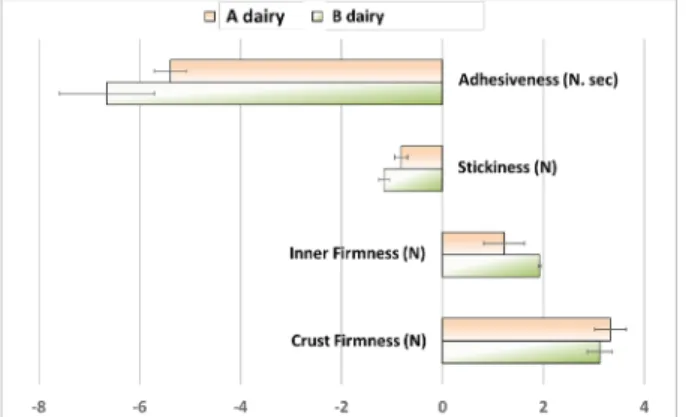
The results of the texture analysis made to the cheeses produced with the thistle flower ecotype C-32 (Figure 8) show similar values for crust firmness in both dairies. However, the cheeses of A dairy presented a softer in-ner flesh, when compared to the cheeses from B dairy. Also the stickiness and adhesiveness were lower in the cheeses from A dairy. In global the results reveal that these cheeses have a relatively soft crust (lower than 4 N), and they are very adhesive and sticky, as a result of the creamy flesh that characterizes this soft paste type of cheese.
Figure 8. Texture of cheeses from A and B dairies produced with the thistle flower ecotype C-32
4. Conclusions
- Serra da Estrela cheese produced in both dairies pre-sented different physical and sensorial properties. - The cheese weight loss during the ripening time pre-sented similar profiles for cheeses produced with the two thistle flower ecotypes and for both dairies, and it is predicted by a potential function.
- The studied thistle flower ecotype did not influence significantly the clotting time and colour parameters, with exception to the a* colour parameter which could vary from green to red.
- Cheeses presented good colour uniformity, and there were no significant differences between both sides. Generally, the cheeses of B dairy presented a white colour, with a predominant red colour and a light yel-low colour. The A dairy cheeses were darker, with a predominant green colour and more intense yellow colour.
- The texture and the sensorial analysis were just per-formed for the C-32 thistle flower ecotype and the re-sults were quite different for both dairies. This could be understood as a consequence of the different process parameters, which in this study could be related with the ripening conditions and also with the amount of microorganisms that intervened during the matura-tion stage.
- The obtained results showed that, it is important to continue the search in order to acquire a strong knowl-edge of the properties assigned by processing param-eters to produce a specific cheese attending to differ-ent consumer targets.
Acknowledgement
The authors thank the Portuguese Foundation for Science and Technology (FCT) through the project PEst-OE/CED/UI4016/2014, and the Centre for Stud-ies in Education, TechnologStud-ies and Health (CI&DETS). The thistle flowers (Cynara cardunculus L.) were gently provided by CARDOP project, from Program PRODER Conservation and Improvement of genetic resources of Cynara cardunculus L.
5. References
[1] Macedo A. J., and Malcata F. X. (1997). Technolocical op-timization of the manufacture of Serra Cheese. Journal of Food Engineering 31, pp. 433-447.
[2] ISO 8589:1988. (1988). Sensory analysis - General guid-ance for the design of test rooms. International Standard Organization, Geneva, Switzerland.
[3] Boyazoglu J., and Morand-Fehr P. (2001). Mediterranean dairy sheep and goat products and their quality. A critical review. Small Ruminants Research, 40, pp. 1-11. [4] Prates Ê. R. (2000). New Challenges for the Dairy of Rio
Grande do Sul (in Portuguese). In: 2° Encontro Anula da UFRGS sobre nutrição de ruminantes, Porto Alegre, RS: Universidade Federal do Rio Grande do Sul, 2000, pp. 73-98.
[5] Regulation (EC) No 853/2004. (2004). Specific hygiene rules for on the hygiene of foodstuffs. Official Journal of the European Union, L 139/55.
[6] Pereira C. I., Graça J. A., Ogando N. S., Gomes A. S. O., and Malcata F. X. (2010). Influence of bacterial dynamics upon the final characteristics of model Portuguese traditional cheeses. Food Microbiology, 27, pp. 339-346.