Teaching and Learning Modelling
and Specification Based on
Mobile Devices and Cloud:
A Case Study
Fernando Moreira, IJP, REMIT, UPT & IEETA, UA, Porto, Portugal Maria João Ferreira, REMIT, UPT & ALGORITMI, UM, Porto, Portugal
ABSTRACT
Teaching Requirements Engineering and, in particular modelling and specification requirements, at the higher education institutions is an “arduous” task according to the literature. In this way, it is proposed an approach that aims to contribute for filling this gap. So, in the context of a degree in Informatics, and following the guidelines of the Information Systems courses provided by ACM/AIS, we explore the Modeling and Specification (MS) of requirements using Unified Modelling Language (UML) integrated into the TLP (TLP-MS) activity of the BML Context Oriented (BML-CO) model. These activities (modelling and specification of requirements) are supported by the use of the Lucidchart tool in a collaborative environment.
KeywoRDS
Cloud, Collaborative work, m_Learning, Mobile Device, Modeling, Requirements Engineering, UML Teaching/ Learning Process,
INTRODUCTION
Mobile devices have been gradually introduced in educational contexts in recent decades due to factors such as the new social needs in educational technologies, the development of market economy, improvement of forms and methods of learning (Awadh & Higgins, 2013). Mobile technology has led most people to carry their own individual devices (laptops, tablets, smartphones, etc.) that already have a high computing power, storage, etc. This large amount of computing power and portability, combined with wireless tools and context sensitivity, makes these devices a great potential learning tool, both in the traditional classrooms, or in informal learning outdoors, taking the development of mobile learning (m_Learning).
Educationally advanced countries have developed strong policies and strategies to address the educational needs of the XXI century. These countries are the pioneers in how to take advantage of mobile devices in the teaching-learning process (TLP). Some European countries have developed some m_Learning projects, for example, in the UK, the MoLeNET1, has a sterling £ 12 million budget
and 40,000 students. In Australia, the feasibility and m_Learning sustainability is a topic of intense debate, since 65% of people have their own smartphone, 37% its own tablet, and about 1/3 of the population have both devices (Deepend, 2014).
Moreover, in terms of promoting innovation in education through various technologies (Web 2.0, cloud, etc.) have been adapted for teaching and learning (Cochrane and Oldfield, 2011), not only in supporting the traditional teaching, but also through the collection and sharing of information, also can promote innovative methods of teaching through cooperative learning, exploratory learning outside the classroom, and games-based learning (Moreira et al., 2016).
When the learning environment is stimulating, students become curious and facilitate immersion in the teaching-learning process (TLP) (Osang et al., 2013). Simultaneously, students are able to use their mobile devices (Bring Your Own Device, BYOD) anywhere, anytime, in order to continuously learn and stay active. In this context, according to Toktarova V., et al. (2015) there are new requirements for the design and development of educational mobile applications, or the use of existing applications, to making your application on effective TLP: (i) integration with multiple systems and e-learning services; (ii) Adequate supply of content for effective learning; (iii) Distribution of learning materials in various shapes and sizes; (iv) ergonomics, simplicity and the possibility of working with educational web applications; (v) stability, reliability and productivity, provide efficient utilization and high availability of the application for a large number of students at the same time. These factors lead to an increased number and complexity of tasks.
Requirement Engineering (RE) is a stage in the software life cycle and the success of the final product – software system – critically depends on the designer’s understanding the problem to be solved. This understanding is compiled into a formal document – Software Requirements Specification (SRS), which should unambiguously, completely and consistently describe requirements (ISO, 2012). RE process is an ongoing and interplaying and iterative. Nevertheless, there are several approaches that diverge on the definition of which activities need to be satisfied in the RE process. Wexler et al. (2008) claimed that in context of a RE course the process is composed by five activities – Elicitation; Analysis, Negotiation and Prioritization, Modeling and Specification; Documentation and Validation. In this paper is explored the Modeling and Specification (MS) of requirements using UML integrated into the TLP (TLP-MS) activity of the BML Context Oriented (BML-CO) model (Moreira and Ferreira, 2016). These activities (modelling and specification requirements) are supported by the use of the Lucidchart tool in a collaborative environment.
The rest of the paper is organized as follows. In the next section, a background of the addressed subjects is presented. The state of the art is described in the section III. In section IV it is described the methodology, while in section V the proposal it is defined. The goal of the section VI it is to present the practical application, and in section VII the assessment and results. Finally, in the last section, conclusions and future work are presented and discussed.
BACKGRoUND m_Learning
Mobile Learning (m_Learning) can be defined as a form of learning that makes use of mobile technology and gives students the possibility to learn anywhere and at any time. That definition is a result of the following m_Learning definitions: (i) “Any sort of learning that happens when the learner is not at a fixed, predetermined location or learning that happens when the learner takes advantage of the learning opportunities offered by mobile technologies.” (Malley et al., 2003); (ii) “The use of wireless and mobile networks to facilitate, support, enrich learning and provide greater educational coverage” (MoLeNET, 2015).; (iii) “E-learning through the use of mobile devices (smart-phones, tablets, handhelds, etc.), that provides mobility to students” (Gost, 2011); (iv) “Educational activities through the use of compact and portable devices that allow students to master learning materials more effectively consume and create information” Wexler et al. (2008).
According to Caballé et al. (2010) the essential requirements to support mobile learning is the possibility of ubiquity and omnipresence. These authors state that these requirements are essential for
members of a learning community (students and teachers) to carry out their activities from different locations and cooperate with each other (student-student, teacher-student) through a wide range of mobile equipments. Furthermore, in order to unify the dispersed learning practices, the authors propose a three-dimensional approach, where the dimensions are pedagogical, technological and assessment. To Baek and Cheong (2005) the main benefits of m_Learning are the perspectives of ubiquitous and pervasive learning. Continuous learning opportunities and lifelong without restrictions of time and space. The implementation of m_Learning offers students the opportunity to enjoy absolute flexibility, collaboration, freedom and just-in-time learning (Asabere, 2013). Another clear advantage of mobile learning is to support the communication and increase student-student and student-teacher interactions (Brown, 2005). A real-time monitoring is carried out of students’ progress. This monitoring will make it possible for students to adjust their performance with the teacher’s help (Mahamad et al., 2008).
Cost issues related to m_Learning are minimal, since the implementation of m_Learning systems is encouraged in open source platforms, technologies and operating systems such as Android, iOS and others. Students can explore this opportunity to learn and develop free applications (Mahamad et al., 2008). Technological innovations are not immune to the challenges, and the m_Learning also has its limitations with regard to technical, security, social and learning challenges (Straumsheim, 2016). Modeling and Specify Information Systems
A model could be defined as a simplified representation (abstraction) of a system from a particular point of view (Seila, 1995). Furthermore, to Embley and Thalheim (2012), a conceptual model is a holistic view of a system based on the concept of “entity” and its “relationships”. In modelling & specification context a model is typically represented graphically as a diagram, or a set of diagrams, using a modeling language like UML.
According to Nelson et al. (2012) the main factors that affect the quality of a conceptual model are the knowledge of modelling concept, modelling language and the domain that will be modelled. Transmit these knowledges and contribute that students, without previous knowledge, acquire the respective skills is a complex task. Damassa and Sitko (2010) show that this task becomes more complex when one of the objectives of the course, in which these programmatic contents are taught, is the transference of academic cases for situations in business environments.
Conceptual modelling is one of the main, if not the major, activity of the software development process. Since it is the bases of information systems development (Sedrakyan et al., 2014). However, as referred, there are some aspects that make conceptual modelling teaching very hard: (i) cognitive modelling aspects (Schenk et al., 1998; Wang e Brooks, 2007); (ii) the complexity of modelling tools (Siau & Loo, 2006; Wilmont, Hengeveld, Barendsen, & Hoppenbrouwers, 2013; Erickson & Siau, 2007); (iii) lack of knowledge of the specific domain (Schenk et al., 1998); and (iv) lack of validation procedures and support tools (Shanks et al., 2003; Barjis et al., 2012).
In this context and in order to overcome these challenges it is necessary to introduce innovative teaching practices and, integrated learning environments to facilitate the acquisition of skills and the progression of students to advanced levels of expertise.
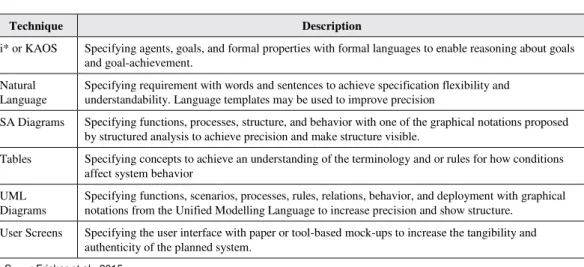
The modeling systems, as referred, aims to provide a specification that will guide developers in other stages of software development, namely design, implementation and testing of the system as referred in previous section. In this context there are several approaches for modeling and specify requirements as summarized in Table 1.
In the present proposed approach to teaching and learning modeling and specification of an information system was adopted the Unified Modeling Language – UML (OMG, 2016), since it is a methodology-independent and it is accepted (adopted) by the academy (researcher and teachers) and industry that works in this field as a tool for modeling systems based on Object Oriented (Ramollari and Dranidis, 2007), (Engels et al., 2006), (Szlenk, 2006). Furthermore, UML could be used both in high level conceptual modeling as well as in more detailed for a lower level programming code (Berardi et al., 2005; Marshall, 2000).
Table 1. Specification Techniques
Technique Description
i* or KAOS Specifying agents, goals, and formal properties with formal languages to enable reasoning about goals and goal-achievement.
Natural Language
Specifying requirement with words and sentences to achieve specification flexibility and understandability. Language templates may be used to improve precision
SA Diagrams Specifying functions, processes, structure, and behavior with one of the graphical notations proposed by structured analysis to achieve precision and make structure visible.
Tables Specifying concepts to achieve an understanding of the terminology and or rules for how conditions affect system behavior
UML Diagrams
Specifying functions, scenarios, processes, rules, relations, behavior, and deployment with graphical notations from the Unified Modelling Language to increase precision and show structure.
User Screens Specifying the user interface with paper or tool-based mock-ups to increase the tangibility and authenticity of the planned system.
Source: Fricker et al., 2015
Bloom’s Taxonomy
Regarding the tools used in the respective courses their selection should consider a theoretical framework. Thus, the use of Bloom’s Taxonomy (BT) (Krathwohl, 2002) appears as a suitable referential, since it is a metric tool that can provide the explanation for many issues that happen in the TLP. In this work, Bloom’s Taxonomy is used to help to choose the techniques that potentially will fit the goal.
The educational objectives of BT (Krathwohl & Anderson, 2001; Krathwohl, 2002) are presented by a framework that retrieves what students are supposed to learn according to their educational profile. Krathwohl (2002) describes a set of learning skills, starting with the lower order ones that form the basis of a hierarchy. This hierarchy, in turn, culminates in learning skills of higher order. The BT proposed by Cheong, et al. (2012) specifies the following classification from the low level to high level: Remember, Understand, Apply, Analyze, Evaluate and Create, where each level has a set of verbs to be used in the definition of the learning objectives. As seen in Krathwohl & Anderson (2001), the very first step in cognitive process is “Remember”. There are so many steps to learn at the first level of MS that it is not possible to continue before nailing them down. Although it is essential to go through the “Remember” level before “Understand”, motivation may be taken into account. Therefore, explaining students the methods of teaching could be implemented in order to solve the latter problem.
For a better understanding of the contribution of each of the steps of BT, regarding the TLP-MS, the following is showned:
1. Remember: This is the beginning of the learning, as it is an essential part of the study of new material particularly when there is no familiarity with the concept like modeling of requirements with the use of diagrams.
2. Understand: This category includes “Interpreting, Exemplifying, Classifying, Summarizing, Inferring, Comparing, and Explaining”. Worth to note that the interaction present in team work will facilitate implementing most of these sub categories. For example, when a student is teaching a teammate, the teaching position will force the student to apply all of the categories. So, teamwork is encouraged in MS class.
3. Apply: This category demands first to remember and understand the given material. The examples and assignments in lower levels are usually an imitation of what is covered in the class and follow
step-by-step to repeat the procedure in the same context. However, in “Apply” cognition level, the student has to think deeper and modify the procedure, and make the known procedure to work in the new context. The assignments should be designed very carefully in order to accomplish the desired performance level.
4. Analyze: This category includes sub-categories as “Differentiating, Organizing, and Attributing”. “Analyze” requires the ability to connect the constituent parts of the material. The ability to distinguish the different diagram types in UML, a critical sense will give to the students the skills to differentiate, use, and organize the different diagrams.
5. Evaluate: “Evaluate” is defined as ‘judgment by standards’ including critique and checking. In requirements modelling and specification, good examples are a result of (i) comparison of several examples according to a purpose, (ii) improvements in developed diagrams, and (iii) identification of deficiencies in the requirements.
6. Create: This category consists in the aggregation of each single element to form a whole. In MS, it includes producing the desired output by one’s own way of solving a problem.
In this context, and in addition to the referential used, it is necessary to analyze and select the learning theories that best fit to the use of cloud computing technologies.
Denton (2012) suggests constructivism and cooperative learning. In the first case, Denton shows that constructivism suggests that students integrate previous knowledge to create new knowledge. This can be which is verified in cloud applications that contain tools that support activities to access previous knowledge, such as retrieving and sharing information. Furthermore, according to the same author, constructivism suggests that knowledge is created in a collaboratively way and the results of this construction are influenced by time and place.
METHODOLOGY
The main goal of this research is explored the MS of requirements using UML integrated into the TLP (TLP-MS) activity of the BML Context Oriented (BML-CO) model (Moreira and Ferreira, 2016) with the use of Lucidchart tool (to model requirements) in a collaborative environment.
The proposed approach is based on public domain tools, easy to use and accessible anywhere and anytime, these tools are free for Higher Educations Institutions (HEIs). The tools allow that students the daily use, inside and outside the HEIs, contributing positively in the TLP of the MS. The study draws conclusions of student’s perceptions on the topic, by providing suggestions about learning the subject supported by mobile devices.
A research methodology is used to ensure the recognition and the scientific validity of a research project. The methodology should be selected properly in order to ensure the success of the research project. In the development of the present project it was selected the Design Science Research (DSR) methodology (Gregg, Kulkarni, & Vinzé, 2001; Hevner et al., 2004; Peffers, Tuunanen, Rothenberger, & Chatterjee, 2008) as the theoretical basis that supports the scientific validation of this research.
In order to reach the goals of project, several steps were performed. Firstly, it was analysed and presented a background, where is included defnitions about mobile learning and modelling and specification of Information Systems. Next, a reviewing the literature (Connelly, 2010), is discussed in the next section, in order two identify the literature gaps and the opportunity and need of a new approach to teaching and learning modelling and specify Information Systems and, in this way recognize the change benefits. The support of the DSR allows the design and implementation the proposed model, leading it in interaction with persons (students and teachers), technology (mobile devices) and organization, which needs to be managed if it is to consider a success application of the model (Hevner et al., 2004).
The DSR methodology is driven to the development of information technology artifacts intended to solve organizational problems known (Peffers et al., 2008), such as the difficulty in developing
TLP-MS. This has been most widely used in disciplines such as engineering and computer science, where the design is accepted as a valid research methodology and valuable, with several contributions from the scientific community to the extent of application of the methodology in the development of engineering artifacts (Archer, 1984; Eekels & Roozenburg, 1991; McPhee, 1997).
Additionally, the obtained results are based on a research technique that makes use of pre and post-tests that measure the knowledge acquired by students in a learning activity. Such tests consist on the application of a set of questions that must be answered by students before and after a particular activity. In particular, the pre-test allows assessing the participants’ level of knowledge on an issue that will be approached before training. The post-test consists in applying a set of questions with the same level of difficulty, in order to assess the evolution of the acquired skills (I-TECH, 2008). RELATED WORK
As referred in section 1 RE is the process by which the requirements for software products are gathered, analyzed, documented, and managed throughout the Software Engineering (SE) lifecycle. RE is concerned with interpreting and understanding stakeholders’ goals, needs and beliefs. As RE is one of the main contributors to the success of software projects.
Modeling and specification of requirements is an RE activity that represents a conceptual formalization of the system view which occurs when it originates a model (Machado et al., 1998). This activity allows breaking the problem-solving process down into separate views (according to the diagram – use case, class diagram, etc.). Their teaching is not a simple task since it requires a great capacity of abstraction by the students (Starrett, 2007), (Sien, 2011).
In the literature there some proposed approaches for teaching RE (Moreira and Ferreira, 2016) and in particular modeling and specification requirements using UML. Sien (2011) proposes that a teacher should (1) expose students to a variety of case studies describing different problem domains; (2) provide opportunities for students to work in teams to produce UML models; (3) adopt concept maps as a graphical representation of fundamental concepts and their relationships within a problem domain. Rivera-Lopez et al. (2009) propose an approach that uses a subgroup of UML diagrams – class diagram and sequence diagram, or class diagram and state chart diagram. The approach aims that the students learn to analyze problems and to design solutions to these problems using the object oriented approach. Engels, et al. (2005) propose an approach that use UML as a vehicle for teaching such core concepts of software engineering with the support of Multimedia elements and tools. In (Kruus et al. 2014) the authors propose an approach using SysML/UML. In this approach, essentially the authors emphasize the teamwork involving small modeling tasks targeted at specific type of diagram. Also, they propose discussions and teacher feedback which are the keys to improve study results of systems modelling.
Yamazaki and Jiromaru (2014) proposed instructional design to teach UML. The instructional design of teaching materials for the students’ literacy, and assess their effectiveness. Their strategy includes three levels of instruction, each with numerous step-by-step exercises. The students learn 10 basic patterns of UML notation at level 1, composition of the notation at level 2, and creating UML system diagrams at level 3. Kuzniarz and Staron (2005) propose a set of best practices for teaching UML Based Software Development. The practices are basically of two basic types – pedagogy wise and subject wise. The first practice is the consistency between all artefacts in the entire process and, the second concerns realization of the students’ projects. An active learning framework for instructors to describe modeling guidelines of the OO analysis and design method and for students to learn the method based on the instructors’ guidelines is proposed by Kim et al. (2000).
Matthiesen et al. (2014) presents an educational concept for SysML (Friedenthal et al., 2009) focusing the students’ abilities. In their development project they have to use SysML for modeling concepts, prototypes, validation and optimization. However, there isn’t reference to collaborative learning supported by mobile devices.
Lang and Červeňák (2014) in their approach have recorded requirements of certain type in the form of use cases. They state that Use Cases along with other UML diagrams allow capturing educational content. The authors ensure that this “approach makes no redundancy because it is based just on real and well defined requirements”. Aditionaly, this process processed educational content is suitable for computer aided education or distance learning.
Finally, Stikkolorum, et al. (2015) proposed an online modelling editor WebUML (Bellettini et al., 2004) and visualisation tool ‘LogViz’ for the logging and interpretation of the log files. The tool WebUML only allows drawing class diagrams equipped with the most used relationships, attributes, operations, labelling and multiplicity elements, but without any reference to collaborative learning supported by mobile devices.
From the discussed approaches we can conclude that teaching modelling and specification requirements are a difficult task to teachers and students and there not exist an ideal and standardized approach that solves this problem.
PROPOSAL: TLP-MS – SELECT TOOLS AND DEVICES
In general thesis, we can state that it is important that teachers consider the learning styles of students when designing and developing modeling systems teaching materials. Although it may not be essential for teachers to test and instruct students in all situations, testing them with the VARK instrument (Bernardes and Hanna, 2009) – simple and fast – can provide important information that is beneficial to create an effective learning environment. Being aware of different learning styles and considering its impact on learning environments are the two first steps towards an essential understanding of the students’ profiles when developing activities to teach modeling systems.
Methodology
In order to contribute to minimize the problem addressed above, it was proposed a methodology (Moreira and Ferreira, 2015) that should help HEI students acquiring modeling systems concepts. As discussed previously it is important to define the students profile in order to help designing and developing teaching materials. This assumption was the basis for the development of the methodology that is here proposed (Figure 1). It consists of five different steps with a defined sequence: (A) Analysis of student profile; (B) Construction didactic material; (C) Select tools and devices; (D) Defining evaluation methodologies and (E) Monitoring and control.
Teachers should consider the different learning styles of students while designing the teaching modeling systems and throughout the development modeling systems activities. Despite the fact that it may not be highly essential for teachers to test and instruct students in all situations, testing them with the VARK instrument – simple and fast – can provide important information to create an effective learning environment. It should be once again highlighted that being aware of learning styles and considering its impact on the learning environments are the two first steps towards an essential understanding of the profile of the students when developing modeling systems skills.
In the component (A) the VARK questionnaire is used to analyses the profile of each one of the students who attend modeling systems courses in order to understand what kind of teaching materials need to be built and made available for (B) (for instance, it is assessed if those materials should be more descriptive or visual, etc). Based on the results and constructed materials it is necessary to carry on their distribution to different types of devices, namely, if the model is applied to classroom teaching, distance learning (e-learning), blended learning (b-learning), or to be used only in mobile devices (m_Learning) (C). For instance, the use of e-learning or m_Learning demands the production of materials appropriate for such type of devices. Some of the most important components in the teaching-learning models are the used evaluation methodologies (D). The whole methodology has a monitoring and control process (E) which allows the adjustment of the materials, devices used and evaluation methodology, as long as students and teachers understand these needs.
Figure 1. Methodology steps
Select tools and devices
One of the great issues when choosing a tool to teach modeling systems is the large amount and variety of tools, which makes it a great challenge. As there are several tools the following questions must be answered before the selection: Where to start? and How to choose the best modeling systems tools that could be adopted with mobile devices that meets the needs of HEI students?
Due to the large number and variety of modeling systems tools it is necessary to establish a set of characteristics: (i) Platform (Desktop, Web, Mobile); (ii) What are the operating systems that support (Windows, Mac, Linux, Other); (iii) Mobile device type (Tablet, Smartphone); (iv) Cost (Commercial, Free). In Table 2 there is showned one set of 24 tools which demonstrates the stated quantity and diversity of modeling systems tools.
Based on the results shown on the Table 2 we can conclude that Lucidchart is the most appropriate tool for modeling systems courses that adopt m_Learning.
PRACTICAL APPLICATION
Course overview
The RE course was designed following the ACM/AIS guidelines. It runs for 15 weeks (one semester) and consists of two hours of theoretical and practice lectures to discuss theory and 2 hours of practice (lab sessions), where students put in practice the learned theory they have learnt.
The main goal of the course is to induce students for the use of RE in their future work as designer in the development of software systems. Teaching RE is not only to provide students with solid concepts of the subject, but also to expose them to real problems.
As referred in section 1 we consider five activities in ER process – (1) Elicitation; (2) Analysis, Negotiation and Prioritization, (3) Modeling and Specification; (4) Documentation, and (5) Validation. These activities are not independent of each other; information obtained in one of them can serve
Table 2. Surveyed Tools
Nome Platform Cost
Desktop Mobile
A B C D E F G H I J
AndyUML x
astah* UML x x
Cacoo x x
Chrons Web Modeler x x
ckwnc x x x Creately x x x x Cubetto x x x x x x Draw UML x draw.io x x x x x x DrawExpress Diagram x x GenMyModel x x x x x Grapholite x x x x Idatto x x x iUML x jsUML2 x x Lucidchart x x x x x x x MagicDraw Reader x PlantUML x x x x x x Syngraph.me x x
UML Diagram Tool
UML Process Aid x
UML SketchClass x x
VisiTouch x x x
yUML x x
A – Mac; B – Windows; C – Linux; D – Web; E – Android; F – iPhone; G – iPad; H – Windows Mobile; I – Commercial; J – Free
for the other activities. At any time, the designer may need to go back for example to clarify one a requirement or student can go on to the next activity. Our proposed approach is about topic (3) modeling and specification.
After having a catalog of requirements typically written in natural language, it is necessary to express these same requirements through models. Models are graphical representations of the requirements – which represent the problem to be solved – that giving different visions of the solution. It is important to emphasize that the modeling is conceptual, since it is intended to define “what” and not “how”. Modeling focus on application of “rules” in order to produce useful and verifiable, requirements, model. It is important to point out the difference between a model, which could be in UML, and a set of diagrams. A diagram is a partial graphic representation of a system model. The set of diagrams need not completely cover the model and deleting a diagram does not change the model.
The model may also contain documentation that drives the model elements and diagrams (such as written use cases) (OMG, 2016).
In the proposed approach it is used UML language and it is intended to produce three diagrams types (1) Use Case, (2) Class and (3) Sequence. Those diagrams give different visions of the system: 1. Use Case diagram(s) give a functional vision – capture business requirements and illustrate the interactions between the system and its environment; 2. Class diagram give a structural vision – illustrate the relationships between classes modeled in the system; 3. Sequence diagrams give a behavioral vision – illustrate the behavior of objects within a use case and in what order.
This proposed approach is based on the approach presented in (Moreira and Ferreira, 2016). Summarily, the theoretical and practice lectures use the expositive method. However, it is still expected to have an active participation of students through direct interpellation between teacher and students and vice versa. In laboratory lectures students must solve case studies that approximate them to the real-world situations. In parallel, students should develop a group project whose goal is to acquire knowledge “Known to do” in a collaborative environment. It is intended that each concept, technique or tool presented and discussed in lectures, is put into practice by resolution of Case Studies and a Project which are solved during lectures and afterwards. In turn, the lectures take place in the context of collaborative work, where the ability to group works will be developed.
Proposed Approach
Mainly, it is proposed the following steps in the modeling task:
1. Presentation and discussion of the rules&steps to the construction of each diagram and the rules to use the Lucidchart tool
2. Review the catalog of requirements
2.1 Model the different diagrams, based the catalog reviewed, according to the following sequence: i. Use Case
ii. Class iii. Sequence
3. Models verification and validation
Case Study
In order to operationalize the proposed approach, it was asked previously to students to collaboratively create the catalogue of requirements for the case study below, either in fixed or mobile context, design the Use Case diagram(s), Class diagram and Sequence diagrams. The selected theme of the case study is believed to be easily understood by students who should easily understand its system and the business environment.
System Golf Club – ClubeGolf
…members renting equipment. A member could be a Full Membership or one of your dependents. When a person makes its registration in the “GolfClub” as a Full Membership, is given the right to nominate up to three dependents, for which is responsible. To the “GolfClub” is critical to identify exactly who rented the equipment, if the Full Membership or one of your dependents. However, for control purposes, the “GolfClub” wants to get more information about the Full Membership than about his dependents. About a Full Membership it is intended to know his name, email address, home phone number, work address, work phone, mobile phone, tax identification number and birth date. Only persons of greater age could Full Membership. From a dependent, only the name, email, birth date and relationship are needed. Both Full Membership and dependents have a registration number, which is single per Full Membership …
Figure 2. Use Case Diagram modelling by a group of student and followed by the teacher on laptop (a) and iPhone (b)
Modeling Requirements
Step 1: Presentation of theoretical concepts.
Presentation and discussion of the rules & steps to the construction of each diagram and the rules to use the Lucidchart tool.
Step 2: Review the catalog of requirements
In this stage, it is asked to students to review the catalog of requirements in order to remember the necessities (requirements) of the system for through the use of Google tools and tool Lucidcahart interact between the group members and the teacher to, collaboratively, modelling diagrams described above.
Step 3: Modelling the different diagrams
In this step, the students are allocated to working groups with different types of devices (laptops, smartphones and tablets). Guaranteed the basis for the work, the teacher through the Lucidchart chat regardless the students’ location – classroom or any other location or additionally students who are out of the classroom and have the need of a contact “face-to-face” uses a Hangout (integration with Google’s tools) – initiates the modeling of different diagrams (Figure 2).
To each group is created an independent document, shared by the group member and the teacher. In this way the teacher could supervise and monitor the tasks of each group, but each group do not see the work of the others groups.
As referred the modelling process is collaborative, since each element of the group has contributed in the modelling process. To follow up with feedback, the teacher monitors and suggests solutions & paths to the modelling of each of the diagrams in real time. This communication could be performed in two ways. The first one making itself the corrections in real time with the monitoring of the changes by the students (group), or the second one giving suggestions through messages in chat. These two ways could be used as independent or complementary ways.
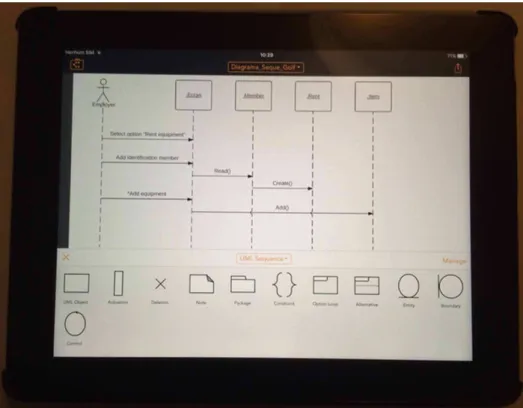
In modeling the Sequence diagram (Figure 3) the process is repeated, i.e. the teacher starts with an explanation task then makes the monitoring by providing feedback during the modeling process. Students and teachers can also participate in the diagrams modelling through smartphones and tablets, in this case there is a native application for the Apple platforms (Figure 2 (a) and Figure 3). However, students who do not have Apple’s mobile devices can perform the same tasks on their mobile devices using the browser application.
Step 4: Diagrams verification and validation
Diagrams verification and validation task should occur at the end of the “construction” of each diagram. When students end up modeling the Use Case diagram(s), it is verified/validated if they satisfy the requirements, then when students end up modeling the Class diagram it is validate and verify if it satisfy the use cases diagram(s) and requirements, finally when students end up modeling the Sequence diagrams they validate and verify with Use Case diagram(s) and Class diagram in order to eliminate and minimize inconsistencies and satisfy all the requirements. This step, as step 2, could be monitored by the teacher and he/she could provide feedback during the all process.
ASSESSMENT AND RESULTS
The evaluation of a learning activity is one of the most important factors in the relationship of trust between student and teacher. A rigorous evaluation with the criteria initially defined and accepted by the parties, complemented with appropriate feedback process it is important to measure the students’ learning progress.
As shown in subsection Methodology, the model prosed by Moreira and Ferreira (2015) consists in five steps: (A) Analysis of student profile; (B) Construction of didactic material; (C) Select tools and devices; (D) Defining evaluation methodologies and (E) Monitoring and control. In that subsection was developed the step (C) and in subsection entitled Proposed Approach a case study. In this context and in order to complete the model in this section will be presented and discussed the step (D).
The development of the step (D) will be based on the evaluation model proposed by Yamazaki and Jiromaru (2014). The model does not include the three levels proposed by the referred authors, but only a more general level, since it is part of a broader framework and applied in another course (Moreira & Ferreira, 2015a).
The objective is to evaluate students, through the post-test (I-TECH 2008), with non-binding nature in the final grade, but as a proof of concept. This evaluation is based on a problem description in natural language, e.g. System Golf Club – ClubeGolf, and the students will model the different UML diagrams. The description of the problem, i.e. the requirements elicitation, was previously performed (Moreira & Ferreira, 2015a).
In this context, it was evaluated the students’ performance for the effectiveness of this learning activity. This evaluation was based in the skills shown, by a universe of forty-five students, in the conception of three UML diagrams - Use Case, Class and Sequence diagrams.
At this point have been partially used the items proposed by Yamazaki and Jiromaru (2014): 1. The required diagrams (Use Case, Class and Sequence diagrams), derived from the requirements,
are incomplete i.e. does not satisfy entirely the functional requirements catalog. 2. The required diagrams are complete, but some notation in the diagrams is wrong.
3. The required diagrams are complete, and the notation is almost correct, but the semantics are wrong.
4. The required diagrams are complete, and the notation and semantics in the diagrams are almost correct.
The classification of the activity (post-test) varies on a scale from 0 to 20, for exemple, ratings between 12 e 20 are sufficient to be consider the student successful in learning activity.
Table 3 shows the evaluation results. Approximately 70 percent of students meet the criteria. However, there is a margin of 30 percent to improve their learning activities.
As can be seen in Table 3 there is a discrepancy in the post-test results, 80% of the students are familiar with modeling “against” 30% that demonstrate little or non expertise in the modeling UML diagrams topic. Recognizing, as referred above, the TLP-MS activity of the BML-CO model can and will be improved.
It should be emphasized that failure is also due to the fact that some of the students have not a continued presence in class and do not participate in group work. As well as some of them did not have sufficient basic technical knowledge in modeling.
After the formative examination (pos-test), were provided corrective learning materials and instruction for students without success.
Group study for all students was also nominated in order to improve their capabilities. As result, 90% of the students obtained positive classification in the final exam.
Table 3. The result of the post-test
Criteria # of students %
1. The required diagrams are incomplete. 6 13.3
2. The required diagrams are complete, but some notation in the diagrams is wrong 8 17.8 3. The required diagrams are complete, and the notation in the diagrams is almost correct,
but the semantics are wrong.
10 22.2 4. The required diagrams are complete, and the notation and semantics in the diagrams are
almost correct.
21 46.7 Total: 45 100
CONCLUSION AND FURTHER WORK
RE is an important task in software life cycle. When the RE is not conduct correctly the consequences could be catastrophic namely late delivery systems and above the budgeted; the systems do not do what users expect; low quality and costs of maintenance and evolution are very high. In this way the acquisition of competences by students in a RE course of high education is fundamental in the job market. RE is an arduous task for teachers who transmit the knowledge and to students who have to understand and save this same knowledge. In order to contribute to improve the TLP it is proposed an approach TLP-MS for the modelling and specification activity using UML.
The proposed model is based on public domain free tools (easy and accessible to use anywhere and anytime), that helps students in their daily life inside and outside of the higher education institutions to solve problems collaboratively. That collaboration is promoting through the use of tools where students and teacher communicate, discuss and increment their work.
As discussed in the above section the proposed approach is not the solution for all problems of the TLP of MS, but it is a comproved good contribute. As future work the proposed model will be tested in a larger student base with the aim of improve the success of students learning in the modelling and specification requirements topics. In this way the model will not be static but will be improved and enhanced continuously. This model will also be extended and applied to all activities of RE.
ReFeReNCeS
Asabere, N. (2013). Benefits and challenges of m-learning implementation: Story of Developing Nations.
International Journal of Computer Applications, 73(1).
Awadh, A., & Higgins, S. (2013). Effects of traditional, blended and e-learning on students achievement in higher education. Journal of Computer Assisted Learning, 29(3), 220–234. doi:10.1111/j.1365-2729.2012.00490.x Baek, Y., & Cheong, D. (2005). Present and future prospects for m-learning in Korea. Proc. of the 2005 IEEE
International Workshop on Wireless and Mobile Technologies in Education (WMTE’05) (pp. 28-30). DOI:
doi:10.1109/WMTE.2005.53
Barjis, J., Gupta, A., Sharda, R., Bouzdine-Chameeva, T., Lee, P. D., & Verbraeck, A. (2012). Innovative teaching using simulation and virtual environments. InterdisciplinaryJournal of Information, Knowledge, and
Management, 7, 237–255.
Bellettini, C., Marchetto, A., & Trentin, A. (2004). WebUml: Reverse Engineering of Web Applications. In
ACM Symposium on Applied Computing.
Berardi, D., Calvanese, D., & De Giacomo, G. (2005). Reasoning on UML class diagrams. Artificial Intelligence,
168(1), 70–118. doi:10.1016/j.artint.2005.05.003
Bernardes, E., & Hanna, M. (2009). How do management students prefer to learn? Why should we care?
International Journal for the Scholarship of Teaching and Learning, 3(1), 1–12. doi:10.20429/ijsotl.2009.030121 Brown, T. (2005). Towards a model for m-learning in Africa. International Journal on E-Learning, 4(3), 299–315. Caballé, S., Xhafa, F., & Barolli, L. (2010). Using mobile devices to support online collaborative learning. Mob.
Inf. Syst., 6(1), 27–47.
Cochrane, T., & Oldfield, J. (2011). iPadagogy 2.0: Exploring the affordances of the iPad for student-generated media production. Proceedings of the 28th ascilite Conf., Hobart, Australia.
Deepend (2014), Australian mobile device ownership and home usage report 2014. In Deepend, In-depth. Sydney, Australia: Deepend.
Engels, G., Hausmann, J., Lohmann, M., & Sauer, S. (2006). Teaching UML Is Teaching Software Engineering is Teaching Abstraction. LNCS, 3844, 306–319. doi:10.1007/11663430_32
Erickson, J., & Siau, K. (2007). Can UML Be Simplified? Practitioner Use of UML in separate domains.
Proceedings of the 12th Workshop on Exploring Modeling Methods for Systems Analysis and Design (EMMSAD’07), Trondheim, Norway (pp. 87-96).
Fricker, S. A., Grau, R., & Zwingli, A. (2015). Requirements Engineering: Best Practice. In S.A., Fricker, C. Thummler, & A. Gavras (Eds.), Requirements Engineering for Digital Health (pp. 25-46). USA: Springer. DOI: doi:10.1007/978-3-319-09798-5
Friedenthal, S., Moore, A., & Steiner, R. (2009). OMG Systems Modeling Language. from http://www.omgsysml. org/INCOSE-OMGSysML-Tutorial-Final-090901.pdf
Gost, R. (2011). Information and communication technologies in education (E-learning resources). Moscow: Standard-inform.
I-TECH. (2008). Technical Implementation Guide. Guidelines for Pre- and Post-Testing. Seattle, Washington, USA: University of Washington.
ISO. (2011). ISO/IEC/IEEE 29148:2011 - Systems and software engineering - Life cycle processes — Requirements engineering.
Kim, J., Hahn, J., & Hahn, H. (2000). How Do We Understand a System with (So) Many Diagrams? Cognitive Integration Processes in Diagrammatic Reasoning. Information Systems Research, 11(3), 285–303. doi:10.1287/ isre.11.3.284.12206
Kruus, H., Robal, T., & Jervan, G. (2014). Teaching modeling in SysML/UML and problems encountered.
Proceedings of the 25th international conference on european association for education in electrical and
information engineering EAEEIE ’14 (pp. 33-36).
Kuzniarz, L., & Staron, M. (2005). Best practices for teaching UML based software development. doi:10.1007/11663430_33
Lang, J., & Červeňák, M. (2014December 4-5). Use Case Driven Educational Content Modeling with UML.
Proceedings of the 12th IEEE International Conference on Emerging eLearning Technologies and Applications ICETA ‘14, Starý Smokovec, Slovakia (pp. 289-294). doi:10.1109/ICETA.2014.7107600
Machado, R., Ramos, I., & Fernandes, J. M. (1998). Specification of Requirements Models. Aurum, A. Wohlin, C. (Eds.), Engineering and Managing Software Requirements. Berlin, Heidelberg: Springer.
Mahamad, S., Ibrahim, M., Foad, M., & Taib, S. (2008). Open source implementation of m-learning for Primary school in Malaysia. International Journal of Social, Management. Economics and Business Engineering, 2(8), 135–139.
Malley, C., Vavoula, G., Glew, J., Taylor, J., Sharples, M., & Lefrere, P. (2003). WP4—guidelines for learning/
teaching/tutoring in a mobile environment”, MOBIlearn/UoN, UoB. OU, Tech. Rep.
Marshall, C. (2000). Enterprise modeling with UML: Designing successful software through business analysis. Addison-Wesley Professional.
Matthiesen, S., Schmidt, S., Moeser, G., & Munker, F. (2014). The Karlsruhe SysKIT Approach – A Three- Step SysML Teaching Approach for Mechatronic Students. Procedia CIRP, 21, 385–390. doi:10.1016/j. procir.2014.03.136
Moreira, F., & Ferreira, M. (2015). Profile-oriented algorithms teaching: a proposed methodology. Proceedings
of the 10th Iberian Conference on Information Systems and Technologies (CISTI) (Vol. 2, pp 43-46).
Moreira, F., & Ferreira, M. J. (2016). Teaching and Learning Requirement Engineering based on Mobile Devices and Cloud: A Case Study. In D. Fonseca, & E. Redondo (Eds.), Handbook of Research on Applied E-Learning in Engineering and Architecture Education (pp. 237-262). Hershey, PA, USA: IGI Global. doi:10.4018/978-1- 4666-8803-2.ch012
Moreira, F., Ferreira, M. J., Pereira, C. & Durão, N. (2016). Collaborative Learning supported by mobile devices: A case study in Portuguese High Education Institutions. In Á. Rocha, A.M. Correia, S. Costanzo & L.P. Reis (Eds.), New Contributions in Information Systems and Technologies. Springer International Publishing. OMG – Object Management Group. (2016). Unified Modeling Language Resource Page. Retrieved from http:// www.uml.org/
Osang, F., Ngole, J., & Tsuma, C. (2013). Prospects and challenges of m-learning implementation in Nigeria: Case study National Open University Of Nigeria (Noun), International Conference on ICT for Africa, February 20-23 Ramollari, E., & Dranidis, D. (2007). StudentUML: An Educational Tool Supporting Object-Oriented Analysis and Design. Proceedings of the 11th Panhellenic Conf. on Informatics (PCI ‘07).
Rivera-Lopez, R., Rivera-Lopez, E., & Rodriguez-Leon, A. (2009). Another approach for the teaching of the foundations of programming using UML and Java. Proceedings of the 3rd WSEAS international conference on
Computer engineering and applications (pp. 279-283).
Schenk, K. D., Vitalari, N. P., & Davis, K. S. (1998). Differences between novice and expert systems analysts: What do we know and what do we do? Journal of Management Information Systems, 15(1), 9–50. doi:10.108 0/07421222.1998.11518195
Sedrakyan, G., Snoeck, M., & Poelmans, S. (2014). Assessing the effectiveness of feedback enabled simulation in teaching conceptual modeling. Computers & Education, 78, 367–382. doi:10.1016/j.compedu.2014.06.014 Shanks, G., Tansley, E., & Weber, R. (2003). Using ontology to validate conceptual models. Communications
of the ACM, 46(10), 85–89. doi:10.1145/944217.944244
Siau, K., & Loo, P.-P. (2006). Identifying difficulties in learning uml. Information Systems Management, 23(3), 43–51. doi:10.1201/1078.10580530/46108.23.3.20060601/93706.5
Sien, V. (2011). An investigation of difficulties experienced by students developing unified modelling language (UML) class and sequence diagrams. Computer Science Education, 21(4), 317–342. doi:10.1080/08993408.2 011.630127
Starrett, C. (2007). Teaching UML modeling before programming at the high school level. Proceedings of the 7th IEEE International Conference on Advanced Learning Technologies ICALT ’07 (pp. 713-714). doi:10.1109/ ICALT.2007.234
Stikkolorum, D., Ho-Quang, T.ng, Chaudron, M. (2015). Revealing Students’ UML Class Diagram Modelling Strategies with WebUML and LogViz. Proceedings of the 41st Euromicro Conference on Software Engineering and Advanced Applications (pp. 275-279). doi:10.1109/SEAA.2015.77
Straumsheim, C. (2016). Digital Distractions. Retrieved from https://www.insidehighered.com/news/2016/01/26/ study-use-devices-class-nonclass-purposes-rise
Szlenk, M. (2006). Formal semantics and reasoning about uml class diagram. Proceedings of the International
Conference on Dependability of computer systems DepCos-RELCOMEX’06 (pp. 51-59). IEEE. doi:10.1109/
DEPCOS-RELCOMEX.2006.27
The Mobile Learning Network (MoLeNET). (2015). Mobile learning in practice. Retrieved from http://www. molenet.org.uk
Toktarova, V., Blagova, A., Filatova, A., & Kuzmin, N. (2015). Design and Implementation of Mobile Learning Tools and Resources in the Modern Educational Environment of University. Review of European Studies, 7(8), 318–324. doi:10.5539/res.v7n8p318
Wang, W., & Brooks, R. J. (2007). Empirical investigations of conceptual modeling and the modeling process.
Proceedings of the Simulation Conference (pp. 762-770). doi:10.1109/WSC.2007.4419671
Wexler, S., Brown, J., Metcalf, D., Rogers, D., & Wagner, E. (2008). ELearning guild research 360 report: Mobile learning. Santa Rosa, CA, USA: eLearning Guild.
Wilmont, I., Hengeveld, S., Barendsen, E., & Hoppenbrouwers, S. (2013). Cognitive mechanisms of conceptual modelling. In W. Ng, V. Storey, & J. Trujillo (Eds.), Conceptual modeling, LNCS (Vol. 8217, pp. 74-87). Springer Berlin Heidelberg. doi:10.1007/978-3-642-41924-9_7
Yamazaki, S., & Jiromaru, T. (2014) Instructional Design of Exercise-Centric Teaching Materials on UML Modeling. Proceedings of the IIAI 3rd International Conference on Advanced Applied Informatics (pp. 342- 346). DOI doi:10.1109/IIAI-AAI.2014.77
eNDNoTeS