WORKING PAPER SERIES
Universidade dos Açores Universidade da Madeira
CEEAplA WP No. 20/2008
Virtual SCM Impact on E-Business
Performance: The European Case
Maria Teresa Tiago João Couto
Flávio Tiago José Vieira
Virtual SCM Impact on E-Business Performance: The
European Case
Maria Teresa Tiago
Universidade dos Açores (DEG)
e CEEAplA
João Pedro Couto
Universidade dos Açores (DEG)
e CEEAplA
Flávio Tiago
Universidade dos Açores (DEG)
José Vieira
Universidade dos Açores (DEG)
e CEEAplA
Working Paper n.º 20/2008
Dezembro de 2008
CEEAplA Working Paper n.º 20/2008 Dezembro de 2008
RESUMO/ABSTRACT
Virtual SCM Impact on E-Business Performance: The European Case
In the last two decades, Supply Chain Management (SCM) continues to gain popularity among companies and has been broadly studied by academic researchers. However, with the development of the digital economy, a new paradigm has emerged in this arena: virtual supply chain management (e-SCM). Thus, this paper establishes a new model, considering the results of virtual SCM adoption on e-business performance, which has been tested in European companies. For that purpose, we used a structural equation modelling (SEM) analysis.
Maria Teresa Tiago
Departamento de Economia e Gestão Universidade dos Açores
Rua da Mãe de Deus, 58 9501-801 Ponta Delgada João Pedro Couto
Departamento de Economia e Gestão Universidade dos Açores
Rua da Mãe de Deus, 58 9501-801 Ponta Delgada Flávio Tiago
Departamento de Economia e Gestão Universidade dos Açores
Rua da Mãe de Deus, 58 9501-801 Ponta Delgada José Vieira
Departamento de Economia e Gestão Universidade dos Açores
Rua da Mãe de Deus, 58 9501-801 Ponta Delgada
VIRTUAL SCM IMPACT ON E-BUSINESS PERFORMANCE: THE EUROPEAN CASE
ABSTRACT:
In the last two decades, Supply Chain Management (SCM) continues to gain popularity among companies and has been broadly studied by academic researchers. However, with the development of the digital economy, a new paradigm has emerged in this arena: virtual supply chain management (e-SCM). Thus, this paper establishes a new model, considering the results of virtual SCM adoption on e-business performance, which has been tested in European companies. For that purpose, we used a structural equation modelling (SEM) analysis.
Maria Teresa Borges Tiago, PhD Business, Professor, University of Azores, Rua da Mãe de Deus, Ponta Delgada, [email protected] or [email protected] (contact author) João Pedro Couto, PhD Business, Professor, University of Azores, Rua da Mãe de Deus, Ponta Delgada, [email protected]
Flávio Tiago, PhD student, Assistent Professor, University of Azores, Rua da Mãe de Deus, Ponta Delgada, [email protected]
José Cabral Vieira, PhD Economics, Professor, University of Azores, Rua da Mãe de Deus, Ponta Delgada, [email protected]
Keywords: Virtual Supply Chain Management, E-business Performance, European Companies
Acknowledgement: This paper is based on data provided by the European Commission and the e-Business W@tch and funding for this work is granted by FCT – CEEApla, Research Center for Applied Economics.
SECTION 1.INTRODUCTION
In the electronic commerce age, major challenges facing corporate management, to maintain competitive advantage through several of its processes (Porter, 2001), include: improvements in production flows, establishment of strong relations with all stakeholders and acquisition and application of knowledge, among others.
In the last decades, organizations have begun to realize the importance of closely managing activities of the supply chain in order to create additional value, which can be grounds for significant competitive advantages. Although marketing researchers and information system investigators have studied supply chain management to some extent; there are still few conceptual bases available, necessary to assessing supply chain management’s (SCM) contribution to business success. When analyzed, the on-line performance of the companies and the implications of virtual SCM application, these assessment weakness assume a major role.
This paper examines an exploratory survey conducted among a sample of e-business European companies. Using a structural equation analysis, this study explores the relationship between e-business success and SCM initiatives, measured by the internal resources of a company and internal competencies in SCM, and intrinsic success measures, including: sales volume, number of customers, sales area and customer service quality.
This paper is organized as follows: Section 2 presents the definition and benefits associated with SCM, including virtual supply chain management. An evaluation framework is developed in Section 3 and Section 4 presents the methodology and the achieved results. In the last section, we conclude our study, reiterate major points and suggest avenues for further investigation.
SECTION 2. LITERATURE REVIEW
Traditional supply chain management (SCM) has been widely studied by academics (Oliver & Webber, 1992; Jones & Riley, 1985; Houlihan, 1985; Snowdon, 1988). Since the nineties, driven by academic research and organizational practices developed around the concept of e-business, SCM has gained a new dimension and importance. Much research has emerged from the logistics/ distribution and marketing fields as a result, complemented by studies carried out in the information technology field (Nagurney et al., 2002).
In light of mounting research, SCM has now acquired the status of a generic management concept that comprised the systemic implementation of processes allowing the development of competitive advantages and profitability of firms through an integrated management of distribution channels (Svensson, 2003).
According to Porter (1985, 2001) SCM is a model that describes sequentially the activities that add value to an organization, establishing the connection between the demand dimension (raw materials, entry logistics and production process) and the supply dimension (output logistics, marketing and sales), including support activities (infrastructures, human resources and R&D, among others).
Lummus et al (2001) suggested that SCM includes all the logistics processes, delivers management, production processes and information flows necessary to the management of all the activities in the value chain. To Mentzer et al. (2001), despite the popularity of the term Supply Chain Management, both in academia and practice, there remains considerable confusion regarding its meaning.
Chandra and Kumar (2000) stated that a considerable number of firms that adopt SCM have as a primary motivation the balance between demand flows and company results. The efforts developed in this arena seek the reinforcement of the firm’s flexibility and the improvement of the partnerships and communication inside and outside the firm, resulting in global enhancement of the supply chain. According to these authors, outsourcing secondary functions should also be considered.
According to the recent research of Wu and Chen (2006), successful supply chain management requires choosing a type of relationship suitable to product and market conditions as well as the adoption of management practices to it.
Rapid growth of the Internet as a means for business seems fundamental to reshaping business structure, allowing firms to embrace unprecedented opportunities. Rayport and Sviokla (1995) suggested that with the advent of the Internet, firms began to do business in two different worlds: physical (marketplace) and virtual (market space).
As a result of the adoption of new information and communication technologies and the Internet, some management tools can be augmented, with the consequence of increased controls over production operations and implementation of just-in-time and quick response systems (Gattorna & Walters, 1996). In this context, the concept of SCM can be modified into the virtual supply chain management (Apostolou et al., 1999; Gan et al., 2000). While the original value chain model treats information as a supporting element, in a digital era, information itself can be a critical source of value.
The introduction of on-line practices has created new opportunities for both suppliers and consumers: (i) firms began to have an open access to larger numbers of suppliers and consumers; and (ii) physical boundaries to consumers were removed (Nagurney et al., 2002; Gabbott & Colgate, 1999).
With Internet use, firms can adopt two different postures toward developing business, in order to grow revenues, reach new customers and enhance business opportunities: first, base on the establishment of a more open structure that allows the expansion of partners and their connection through electronic means and secondly, supported by the integration and alignment of the technological components with firm’ strategy and human resources (Hoffman & Novak, 1996).
One of the attractive features of Internet business is its market space characteristics- high efficiency levels, reduced operating costs (Butler et al., 1997; Rice & Bair, 1984), and augmented value for customers (Watson et al., 2000). The possibility of cost reduction in several points of the supply chain relates to two components of the marketing mix: price and distribution.
The process of cost reduction can be mapped via flow diagram and then re-engineered to increase value or reduce costs through technology increment. Several have authors suggested modifications in supply chain management derived by the adoption of on-line activities (Rayport & Sviokla, 1995; Donthu & Garcia, 1999; Gallaugher, 1999; Choudhury et al., 1998; Park & Suresh, 2005).
There are three main stages of value-adding informational processes: (1) visibility (improve the ability to track physical operations more effectively); (2) mirroring capability (substitute virtual activities for physical ones and parallel value chain in market spaces); and (3) create new customer relationships (use information matrix to deliver value to customers in new ways). Physical and virtual markets have different intrinsic value systems that must be understood in order to leverage the benefits of the virtual value chain. However, both chains must be managed simultaneously, in order to be effective and productive (Rayport & Sviokla, 1995).
By exploiting the five generic value-adding steps of the information world in each activity of the value chain, firms are able to better access new markets and establish new relationships with customers. In this process, a new value matrix is created. According to Rayport and Sviokla (1995), in market space several business axioms that have been used by managers over the decades no longer apply to e-business. Nevertheless, the works of Hartcher (2000) and Poon and Swatman (1999) point to the fact that changes and differences in the value chain (either virtual or otherwise) cannot be generalized. The dimension and type of industry can affect the evolution path of a firm’s value chain. Consequently, the value chain and the virtual value chain can assume different forms. From research developed in this area, several typologies can be found, based on the: level of functional integration and innovation (Timmers, 1998); integration of value and economic control (Rappa, 2001; Tapscott et al., 2000); and the type of relationship established (Amit & Zott, 2001).
Turner (2000) suggests the classification of virtual supply chain management according to the traditional concept of supply chain management. In this perspective, all the activities of e-business affect differently both the supply and demand side of the value chain. Despite the methodology used to classify different SCM models, academia and managers seem to agree that on-line systems can be used to augment the performance of SCM (Watson et al, 2000; Turner, 2000). In this context, web pages can be considered collaborative tools between stakeholders (Hamel & Sampler, 1998).
SECTION 3: EVALUATION FRAMEWORK AND HYPOTHESES
From the literature review emerges that research developed on supply chain management field focuses mostly on SCM in a physical context, its influence on general business performance and in specific industries. Although academic researchers and practitioners alike praised virtual supply chain adoption (Cooper et al., 1997; Menzer et al., 2001), there remains a lack of empirical evidence as to its effects on e-business success. Accordingly, our aim is to establish a measurement framework that helps to fill the current gap in research and provides a better understanding of the critical elements of the virtual supply chain, based on a sample of European companies.
Traditional financial and accounting methods of evaluation are not suitable in the case of e-business, since there are some intangible, indirect and even strategic benefits that need to be considered (Grembergen & Amelinckx, 2002). Suitable performance measurement is an issue that has been widely debated in current marketing literature. With the establishment of online business, new models and measures of performance are needed (Amit & Zott, 2000; Hoque, 2000; Craig & Jutla, 2001). In terms of e-business performance measurement, we distinguish between economic and market-based performance (Kholi & Jaworski, 1991; Bharadwaj, Varadarajan & Fahy, 1993; Reinartz et al., 2003). Therefore, the concept of corporate success of e-business in this research is limited to three dimensions (Amit & Zott, 2001): hard factors, soft factors and innovation. The first is an indicator of economic performance, namely number of customers. The second dimension refers to a company’s improvement in customer relationships, measured in our model by the quality of customer service. The last dimension reflects the company’s achievements in terms of its competitive position, given by the sub dimension sales area.
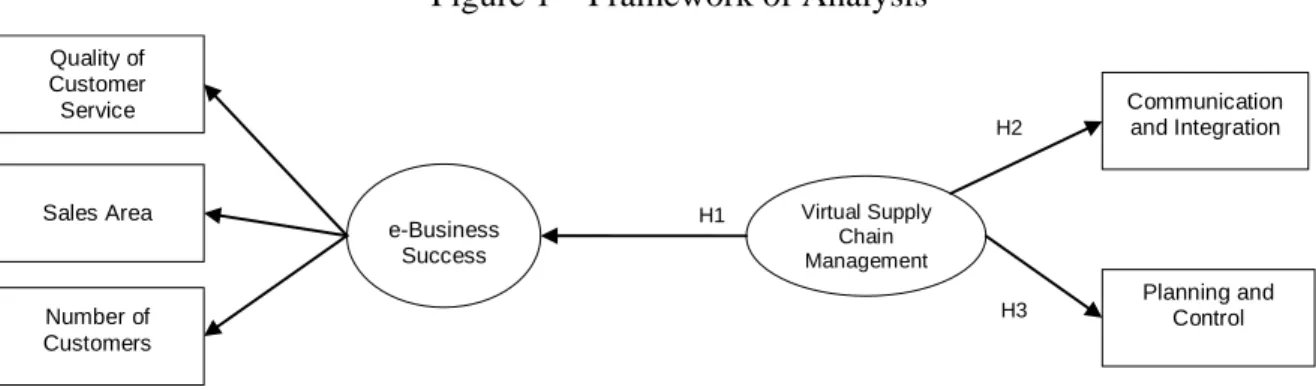
The research model, as shown in Figure 1, illustrates whether or not higher levels of virtual SCM adoption are associated with e-business performance.
Figure 1 – Framework of Analysis e-Business Success Virtual Supply Chain Management H1 H2 H3 Number of Customers Sales Area Quality of Customer Service Communication and Integration Planning and Control
The framework identifies metrics that can be used to evaluate the impact of the virtual supply chain management on business performance. The proposed research model tests three hypotheses: the first one related to the impact of the virtual supply chain management in firms’ performance and the others regarding the impact of two dimensions in virtual SCM.
The digital economy made it possible to develop and implement a range of different supply chain designs, based on several factors, such as: new competitive advantages driven by information technologies; new organizational forms; heterogeneous information systems integration into virtual information systems; closer strategic planning and control; and wider information sharing process, among others. In this context, a critical requirement is information sharing and its addition is the base of virtual supply chain management.
In analyzing the literature, we find three distinctive perspectives of SCM results: (i) firm focused tactics; (ii) competitive strategy; and (iii) operational effectiveness. As our aim is to consider virtual supply chain management effects on e-business performance, we will consider tactical elements. Thus, virtual supply chain management performance will be indirectly measured in this model through two dimensions: communication and integration of partners and planning and control systems. According to the literature, these components profoundly affect the way companies behave in terms of SCM.
Having as reference the achievements of Tan (2002), which noted that all of the significant supply chain management practices have a positive impact on a firm’s performance, hypothesis one is written as:
H1: The greater the virtual supply chain management competencies and implementation, the higher a company’s e-business performance on markets.
Terzi and Cavalieri (2004) argue that companies have been advocating further optimization of their organizational process in order to face the competition of their industries. According to these authors, this optimization encompasses new forms of collaboration and partnership with their direct counterparts. The interactive nature of the Internet allows establishment of this closer relationship, especially by improving the communication among users (Hoffman &Novak, 1996; Peterson, Balasubramanian & Bronnerberg, 1997; Watson et al., 2000) and enlarges access to new suppliers and customers (Nagurney et al., 2002). The use of technologies of information and communication further allows firms to improve and reinforce their integration processes (Sheombar, 1992; Walton & Marucheck, 1997; Jayaram et al., 2000; Narasimhan & Carter, 1998). According to several authors (Stevens, 1989; Lee et al., 1997; Metters, 1997; Narasimhan & Jayaram, 1998; Lummus et al., 1998; Anderson & Katz, 1998; Hines et al., 1999; Johnson, 1999), higher levels of integration with suppliers and customers in the supply chain can generate greater potential benefits. Reinforcing this point, Frohlich and Westbrook (2001) pointed to the positive effect of integration in firms’ improved performance.
These authors suggested that a broad and reasonable integration could improve company performance in terms of productivity and non-productivity indicators.
As Eloranta and Hameri (1991) noted, inbound and outbound logistics tend to be separated in research, so in our study we consider them together. Based on the notion presented by the literature review that both communication and integration processes can improve firm performance, the second hypothesis is postulated as:
H2: The better communication and integration processes of a firm, the improved performance level of its virtual supply chain management.
Rayport and Sviokla (1995) noted that a firm’s “manager knows that staying competitive today depends on achieving higher levels of performance for customers while incurring lower costs in R & D and production…On the VVC, companies may find dramatic low-cost approaches to delivering extraordinarily high-value results to customers.” So, the dimension of planning and control in virtual supply chain management must be considered. While the Internet is simplifying the nature of communication with and integration of consumers and suppliers, it is also challenging suppliers to find new methods of cost reduction, combined with just-in-time practices (Chopra & Meindl, 2001). In fact, growing evidence suggests that strategic planning and control of logistic operations is critical to a successful virtual SCM. As pointed out by Bowersox and Daugherty (1995), Lewis and Talalayevsky (1997) and Van Hoek et al. (1998), the use of technologies of information and communication can improve traditional planning and control systems. This leads to the following hypothesis:
H3: The better the planning and control systems, the greater the performance level of virtual supply chain management.
SECTION 4: METHODOLOGY AND RESULTS
Data from the e-Business W@tch annual survey was used to test our three hypotheses. For this research, coordinators in 25 European countries (Cyprus, Czech Republic, Estonia, Hungary, Latvia, Lithuania, Malta, Poland, Slovakia, Slovenia, Austria, Belgium, Denmark, Finland, France, Germany, Greece, Ireland, Italy, Netherlands, Portugal, Spain, Sweden, UK and Norway) administered the survey on a country-by-country basis. As this study examines primarily the adoption status of virtual supply chain management by companies, it is important to mention that only 360 of the 9,264 total responses were included in this analysis. The excluded cases referred to companies that did not apply virtual supply chain management, or to cases that had relatively incomplete reported performance data.
Distribution of firm size, measured by the number of employees, shows that most cases are small and medium size (around 60% of the firms). The distribution of responding sample is approximately similar to the original sample. The two most heavily represented sectors in the sample are food, beverages and tobacco and transport equipment, with 11.4% and 9.7% respectively, closely followed by all the others.
The casual structure proposed in the theoretical framework was examined using a structural equation model. After global model fit had been assessed, numerical results were evaluated in order to test their support of the research hypotheses. The numerical results for our model can be obtained directly from the path coefficients of the structural model presented in Figure 2. We refer to standardized coefficients, which account for scale effects and serve as indicators of the relative importance of the variables.
Figure 2 – Structural equation model estimation
Several goodness-of-fit tests were conducted to assess whether the empirical model could explain the observed data. The measures for global model fit included in Figure 2 suggest that our model fits the underlying data quite well. The three hypotheses’ paths were all statistically significant.
Our findings generally support the conceptual framework previously presented, even though some of the relationships found were weaker than expected. With regard to Hypothesis 1, results show that virtual supply chain management implementation contributed 34% to the e-business performance construct. This finding empirically supports the concept that e-e-business performance can be improved by investment in virtual supply chain management systems. Similarly, communication and integration in SCM context and planning and control of inbound and outbound activities contributes 63% and 96% to virtual supply chain management competencies construct. The results demonstrate a higher relative importance to planning and control than would be expected from literature review, because most of the research in this field emphasizes communication and integration elements. With respect to H2 and H3, the results achieved in the model support these hypotheses.
SECTION 5: DISCUSSION AND CONCLUSIONS
As literature review demonstrated, there has been little study that examines virtual supply chain management contributions to e-business performance. However, those works developed to study virtual SCM and e-business performance were largely confined to specific industries. With this study, we attempt to fill existing research gaps, presenting results from an empirical investigation based on a cross industry survey (360 respondents), which covers 25 European countries.
The goal of the current study was twofold: (1) to determine whether the implementation of tactical dimensions (communication & integration and planning & control) is positively linked to virtual supply chain management competencies and (2) to identify the nature of the relationship between virtual supply chain management and e-business performance. The results of this effort have generated some interesting findings. First, the data supports our conceptualization for the virtual SCM construct. Within it, both tactical elements have a positive impact on the maximization of virtual supply chain management implementation. Second, these findings allow us to conclude that implementation of a virtual supply chain management system has a positive impact on e-business performance. According to these results, the concept of virtual SCM as an integrated e-business tool that allows a more profitable relation with customers and suppliers is reinforced as is the need for a daily based planning and control emphasized.
This study and its findings will be useful for firms intending to emulate the application of virtual supply chain management, giving insights to managers about the influence of different components of virtual SCM in e-business performance.
Some useful preliminary insights are produce, leaving however a considerable number of issues for future research, including the possibility of extending the investigation in order to consider the impact of the virtual supply chain management in terms of competitive strategy and operational effectiveness. Similarly, this study could be expanded to compare firm performance in e-business versus non-virtual business activities.
REFERENCES
Amit, R. and Zott, C. (2000). Value Drivers of E-commerce Business Models, Knowledge@ Wharton, available at: http:// knowledge.wharton.upenn.edu/PDFs/978.pdf
Amit, R. and Zott, C. (2001). Value Creation in E-Business, Strategic Management Journal, 22(6), pp.493-520.
Anderson, M. and Katz, P. (1998). Strategic sourcing, The International Journal of Logistics
Management, 9 (1), pp. 1-13.
Apostolou, D., Sakkas, N. and Mentzas, G. (1999). Knowledge Networking in Supply Chains: A Case Study in the Wood/Furniture Sector, Information Knowledge Systems Management, 1 (3-4) (Autumn/Winter), pp. 267-281.
Bharadwaj, S., Rajan, P. and Varadarajan, J. (1993). Sustainable Competitive Advantage in Service Industries: A Conceptual Model and Research Propositions, Journal of Marketing, 57 (4) (Oct.), pp. 83-99
Bowersox, D. and Daugherty, P. (1995). Logistics paradigms: the impact of information technology, Journal of Business Logistics, 16 (1), pp. 65–80.
Butler, P., Hall, T., Hanna, A., Mendonca, L., Auguste, B., Manyika, J. and Sahay, A. (1997). A Revolution in interaction, McKinsey Quarterly, 1, pp. 4–23.
Chandra, C. and Kumar, S. (2000). Supply chain management in theory and practice: a passing fad or a fundamental change, Industrial Management & Data Systems, 100 (3), pp.100-13. Chopra, S. and Meindl, P. (2001). Supply chain management: strategy, planning, and
operation, Prentice-Hall: Upper Saddle River, NJ.
Choudhury, V., Hartzel, K. and Konsynski, B. (1998). Uses and consequences of electronic markets: an empirical investigation in the aircrafts parts industry, MIS Quarterly, 22 (4), pp.471.
Cooper, M., Ellram, L., Gardner, J. and Hanks, A. (1997). Meshing multiple alliances, Journal
of Business Logistics, 18 (1), pp. 67–89.
Craig, J. and Jutla, D. (2001). e-business Readiness: A Customer-focused Framework, Addison-Wesley, MA.
Donthu, N. and Garcia, A. (1999). The Internet shopper, Journal of Advertising Research, 39, pp.50-58.
Eloranta, E. and Hameri, J. (1991). Experiences of different approaches to logistics, Journal of
Engineering Cost and Production Economics, 21, pp. 155–169.
Frohlich and Westbrook (2001). Arcs of integration: an international study of supply chain strategies, Journal of Operations Management, 19 (2) February), pp. 185-200.
Gabbott, M. and Colgate, M. (1999). Information technology and relationship marketing: advances, incompatibilities and opportunity, Australasian Marketing Journal, 7 (1), pp. 102-108.
Gallaugher, J. (1999). Challenging the new conventional wisdom of net commerce strategies,
Communication of the ACM, 42 (7), pp. 27-9.
Gan, B., Liu, L., Jain, S., Turner, S., Cai, W. and Hsu, W. (2000). Manufacturing supply chain management: distributed supply chain simulation across enterprise boundaries, in Proceedings of the 32nd Conference on Winter Simulation (Orlando, Florida, December 10 - 13, 2000). Winter Simulation Conference. Society for Computer Simulation International, San Diego, CA, 1245-1251.
Gattorna, L. and Walters, D. (1996). Managing the supply chain, Palgrave: New York Grembergen, W. and Amelinckx, I. (2002). Measuring and Managing E-business Projects through the Balanced Scorecard, in proceedings of the 35th Hawaii International Conference on System Science, IEE Computer Society Press.
Gunasekaran, A. and Ngai, E. (2004). Virtual supply chain management, Production, Planning
& Control, 13 (6) (September), pp. 584-595.
Hamel, G. and Sampler, J. (1998). The e-corporation: more than just web-based, it's building a new industrial order, Fortune, 23 (December) pp. 80-92.
Hartcher, P. (2000). Technology and history: why this boom must end, Australian Financial
Review, 25–26 (March), pp. 23-25.
Hines, P., Wilding, R. and Holweg, M. (1999). Dynamics, dimension and directions – making sense of linear supply chain thinking, in proceedings Logistic Research Network Conference. Hoffman, D. and Novak, T. (1996). Marketing in hypermedia computer-mediated
environments: conceptual foundations, Journal of Marketing, 60, pp. 50-68.
Hoque, Z. and Mia, L. (2001). Market competition, computer-aided manufacturing and use of multiple performance measures: an empirical study, British Accounting Review, 33, pp. 23–45. Houlihan, J. (1985). International supply chain management, International Journal of Physical
Distribution & Materials Management, 15, pp. 22-38.
Jayaram, J., Vickery, S. and Cornelia, D. (2000). The effects of information system infrastructure and process improvements on supply-chain time performance, International
Johnson, J. (1999). Strategic integration in industrial distribution channels: managing the interfirm relationship as a strategic asset, Journal of the Academy of Marketing Science, 27 (1), pp. 4–18.
Jones, T. and Riley, D. (1985). Using inventory for competitive advantage through supply chain management, International Journal of Physical Distribution and Materials Management, 15 (5), pp. 16-26.
Kohli, A. and Jaworski, B. (1990). Market orientation: the construct, research propositions and marketing management implications, Journal of Marketing, 54, pp.1-18.
Lee, H., Padmananhan, V. and Whang, S. (1997). Information Distortion in a Supply Chain : The Bullwhip Effect, Management Science, 43 (4) (April), pp. 546-558.
Lewis, I. and Talalayevsky, A. (1997). Logistics and information technology: a coordination perspective, Journal of Business Logistics, 18 (1), pp. 141-57.
Lummus, R., Krumwlede, D. and Vokurka, R. (2001). The relationship of logistics to supply chain management: developing a common industry definition, Industrial Management & Data
Systems, 1011 (8), pp.426-31.
Lummus, R., Vokurka, R. and Alber, K. (1998). Strategic supply chain planning, Production
and Inventory Management Journal, 39 (3), pp. 49–58.
Mentzer, J., DeWitt, W., Keebler, J., Min, S., Nix, N., Smith, C. and Zacharia, Z. (2001). Defining supply chain management, Journal of Business Logistics, 22 (2), pp.1-25.
Metters, R (1997). Quantifying the bullwhip effect in supply chains, Journal of Operations
Management, 15 (2), pp. 89-100.
Mohammed, R., Fisher, R., Jaworski, B. and Paddison, G. (2003). Internet marketing: building
advantage network economy, 2nd edition, McGraw Hill: New York.
Nagurney, A., Loo, J., Dong, J. and Zhang, D. (2002). Supply chain networks and electronic commerce: a theoretical perspective, Netnomics, 4, pp.187-200.
Narasimhan, R. and Carter, J. (1998). Environmental supply chain management, Tempe, AZ: Center for Advanced Purchasing Studies.
Narasimhan, R. and Jayaram, J. (1998). Causal Linkages in Supply Chain Management: An Exploratory Study of North American Manufacturing Firms, Decision Sciences, Summer, 29(3), pp. 579-605.
Oliver, K. and Webber, M. (1982). Supply chain management: logistics catches up with strategy, in Logistics: the strategic issues, edited by Christopher, M. (1992), Chapman & Hall: London, pp.63-75.
Park, S. and Suresh, N. (2005). An investigation of the roles of electronic marketplace in the supply chain, in Proceedings of the 38th Hawaii International Conference on System Sciences. Peterson, R., Balasubramanian, S. and Bronnenberg, B. (1997). Exploring the implication of the Internet for consumer marketing, Academy of Marketing Science Journal, 30 (4) Fall, pp. 348.
Poon, S. and Swatman, P. (1999). An exploratory study of small business internet commerce issues, Information and Management, 35, pp.9-18.
Porter, M. (1985). Competitive advantage: creating and sustaining superior performance, The Free Press: New York.
Rappa, M. (2001). Business models on the web, acedido em http://digitalenterprise.org/models/models.html.
Rayport, J. and Sviokla, J. (1995). Exploiting the virtual value chain, Harvard Business Review, 73 (6), November-December, pp. 75-85.
Reinartz, W., Kraft, M. and Hoyer, W. (2003). Measuring the customer relationship management construct and linking it to performance outcomes, working paper series, INSEAD, France.
Rice, R. and Bair, J. (1984) 'New Organizational Media and Productivity, in R.E. Rice (ed.),
The New Media: Communication, Research, and Technology, Sage: Beverly Hills, pp.185–
215.
Sheombar, H. (1992). EDI-induced redesign of coordination in logistics, International Journal
of Physical Distribution & Logistics Management, 22, pp. 4-14.
Snowdon, M. (1988). Moving towards a single market, International Journal of Technology
Management, 3 (6), pp. 643-55.
Stevens, G. (1989). Integrating the supply chain, International Journal of Physical Distribution
and Materials Management, 19 (8), pp. 3-8.
Svensson, G. (2003). Holistic and cross-disciplinary deficiencies in the theory generation of supply chain management, Supply Chain Management: An International Journal, 8 (4), pp. 303-316.
Tan, K. (2002). Supply chain management: practices, concerns, and performance issues, The
Journal of Supply Chain Management, 38 (1), pp. 42-53.
Tapscott, D., Ticoll, D. and Lowy, A. (2000). Digital capital: harnessing the power of business
webs, Harvard Business School Press: Boston, MA.
Terzi, S. and Cavalieri, S. (2004). Simulation in the supply chain context: a survey. Comput.
Ind. 53 (1) (Jan. 2004), pp.3-16.
Timmers, P. (1998). Business models for electronic markets, EM- International Journal of
Electronic Markets, 8 (2), pp.3–8.
Van Hoek, R., Commandeur, H. and Voss, B. (1998). Reconfiguring logistics systems through postponement strategies, Journal of Business Logistics, 19 (1), pp.33–54.
Walton, S. and Marucheck, A. (1997). The relationship between EDI and supplier reliability,
International Journal of Purchasing and Materials Management, 33, pp.30–35.
Watson, R., Zinkhan, G. and Pitt, L. (2000). Integrated Internet Marketing, Communications of
the ACM, 43 (6), pp. 97-102.
Wu, I. and Chen, Y. (2006). A model for exploring the impact of purchasing strategies on user requirements determination of e-SRM, Information & Management, 43 (4) (June), pp. 411-422.