EUROPEAN ORGANISATION FOR NUCLEAR RESEARCH (CERN)
JINST 11, (2016), P11020
DOI:10.1088/1748-0221/11/11/P11020
CERN-EP-2016-137 10th January 2017
A measurement of material in the ATLAS tracker using secondary
hadronic interactions in 7 TeV pp collisions
The ATLAS Collaboration
Abstract
Knowledge of the material in the ATLAS inner tracking detector is crucial in understand-ing the reconstruction of charged-particle tracks, the performance of algorithms that identify jets containing b-hadrons and is also essential to reduce background in searches for exotic particles that can decay within the inner detector volume. Interactions of primary hadrons produced in pp collisions with the material in the inner detector are used to map the loca-tion and amount of this material. The hadronic interacloca-tions of primary particles may result in secondary vertices, which in this analysis are reconstructed by an inclusive vertex-finding al-gorithm. Data were collected using minimum-bias triggers by the ATLAS detector operating at the LHC during 2010 at centre-of-mass energy √s= 7 TeV, and correspond to an integ-rated luminosity of 19 nb−1. Kinematic properties of these secondary vertices are used to study the validity of the modelling of hadronic interactions in simulation. Secondary-vertex yields are compared between data and simulation over a volume of about 0.7 m3around the interaction point, and agreement is found within overall uncertainties.
c
2017 CERN for the benefit of the ATLAS Collaboration.
Contents
1 Introduction 2
2 ATLAS inner detector 3
3 Event samples, track and secondary-vertex reconstruction 4
3.1 Track reconstruction 5
3.2 Track selection 5
3.3 Secondary-vertex reconstruction 6
3.4 Secondary-vertex selection and resolution 7
3.5 Vertex yields 8
4 Qualitative comparison of data to simulation 10
4.1 Displacement of material layers 15
4.2 Pixel and SCT detector modules in their local coordinate frames 15
4.2.1 Pixel modules 15
4.2.2 SCT modules 17
4.3 Kinematic characteristics of secondary vertices 18
5 Systematic uncertainties 18
5.1 Tracking efficiency 18
5.2 Modelling of hadronic interactions in simulation 20
5.3 Vertex reconstruction 21
5.4 Other sources 22
5.5 Total systematic uncertainty 23
6 Results 23
7 Conclusions 25
1 Introduction
An accurate description of the amount and location of the material in the ATLAS inner detector (ID) is necessary for understanding the reconstruction efficiency of tracks, as well as other objects such as electrons, photons, and jets containing b-hadrons. Moreover, uncertainties in the modelling of hadronic interactions in simulation affect the performance of algorithms that reconstruct jets and missing transverse momentum. The amount of material in the as-built ID [1] is generally known to an accuracy of about 4– 5%, which was achieved by weighing the various components before installation.
The trajectories of these particles can be reconstructed by the tracking system, and in cases where two or more such tracks are reconstructed, the precise location of the interaction can be found.
In ATLAS, an inclusive vertex-finding and fitting algorithm is used to find vertices associated with had-ronic interactions. Typical resolutions of vertex positions,1in r (z), are around 0.2 mm (0.3 mm) for this technique, as compared to around 2 mm (1 mm) for photon conversions. In the latter, the opening angle between the outgoing electron–positron pair is close to zero, thereby degrading the radial resolution. The good position resolution of hadronic-interaction vertices is exploited to study the location and amount of material in the ID.
Knowledge of the exact location of this material is needed in searches for exotic particles that can decay within the ID volume, as secondary interaction vertices are a background to these searches. The results from a previous study were used in analyses searching for decays of exotic particles that are postulated to exist in models ranging from R-parity-violating supersymmetry, split supersymmetry, Generalized Gauge Mediation [3] to Hidden Valley scenarios [4]. In these analyses, part of the search region was masked out using material maps based on the results of Ref. [2]. Additionally, since this technique directly probes the hadronic interaction length of any material, it can also be used to study the modelling of low- to medium-energy hadronic interactions in simulation.
The analysis presented here uses a modified tracking configuration and improved vertex selection criteria, which substantially increase the number and quality of reconstructed vertices over a larger volume as compared to the previous study. The previous study was restricted to r < 320 mm and |z| < 300 mm, whereas this one expands this region to r < 400 mm and |z| < 700 mm, which represents an increase in the fiducial volume from 0.19 m3to 0.70 m3. The dataset used now is the same one as in Ref. [2], although the track reconstruction algorithms use improved ID alignment parameters. The data are compared to simulation, which has an improved description of the ID geometry and other corrections to resolve some of the discrepancies found in the previous study.
This paper is structured as follows. A brief introduction to the ATLAS ID is given in Section2. The event samples, track selection and vertex reconstruction and selection are described in Section3, along with the yield of reconstructed secondary vertices (SV). Section4contains a qualitative comparison of data with simulation, followed by an estimate of the systematic uncertainties in Section5. The results are presented in Section6, and conclusions are given in Section7.
2 ATLAS inner detector
The ATLAS detector consists of an inner tracking detector, electromagnetic and hadron calorimeters, a muon spectrometer, and three magnet systems [1]. The inner tracking detector is crucial to this analysis; its active volume extends from 45 mm to 1150 mm in r and ±2710 mm in |z|. A quarter section of the ID is shown in Figure1.
The ID is composed of three sub-systems: a silicon pixel detector, a silicon microstrip detector (SCT) and a transition radiation tracker (TRT), all of which are immersed in a 2 T axial magnetic field. The tracking system consists of a cylindrical barrel region (|η|. 1.5) arranged around the beam pipe, and two 1ATLAS uses a right-handed coordinate system with its origin at the nominal interaction point (IP) in the centre of the detector and the z-axis along the beam pipe. The x-axis points from the IP to the centre of the LHC ring, and the y-axis points upward. Cylindrical coordinates (r, φ) are used in the transverse plane, φ being the azimuthal angle around the beam pipe.
end-caps. Disks in the end-cap region are placed perpendicular to the beam axis, covering 1.5. |η| < 2.5. The pixel detector is located at r < 150 mm, and provides precision measurements from 80.4 million sensors. It consists of three barrel layers with |z| < 400 mm and six disks in the end-cap region, which extend out to |z| ∼ 660 mm. The SCT detector has four barrel layers extending from r ∼ 250 mm to 550 mm with |z| < 750 mm, and 18 disks in the end-cap region with |z| < 2710 mm; it consists of ∼ 6.3 million readout strips. The TRT consists of 298,000 straw tubes with diameter 4 mm, and provides coverage out to |η| ∼ 2.0. In the barrel, it stretches from r ∼ 560 mm to 1100 mm and |z| < 780 mm. The end-cap region extends the TRT to z = ±2710 mm. The regions between the material layers are filled with different gases, such as CO2or N2. In addition, there are various support structures, which, for the
most part, are carbon fibre reinforced plastic honeycomb shells, and services such as cooling pipes.
Envelopes Pixel SCT barrel SCT end-cap TRT barrel TRT end-cap 255<R<549mm |Z|<805mm 251<R<610mm 810<|Z|<2797mm 554<R<1082mm |Z|<780mm 617<R<1106mm 827<|Z|<2744mm 45.5<R<242mm |Z|<3092mm Cryostat PPF1 Cryostat Solenoid coil z(mm) Beam-pipe Pixel support tube SCT (end-cap) TRT(end-cap) 1 2 3 4 5 6 7 8 9 10 11 12 1 2 3 4 5 6 7 8 Pixel 400.5 495 580 650749853.89341091.5 1299.9 1399.7 1771.4 2115.2 2505 2720.2 0 0 R50.5 R88.5 R122.5 R299 R371 R443 R514 R563 R1066 R1150 R229 R560 R438.8 R408 R337.6 R275 R644 R1004 2710 848 712 PPB1 Radius(mm) TRT(barrel) SCT(barrel) Pixel PP1 3512 ID end-plate
Pixel
400.5 495 580 650 0 0 R50.5 R88.5 R122.5 R88.8 R149.6 R34.3Figure 1: View of a quadrant of the ID [5] showing each of the major detector elements with their active dimensions and envelopes. The lower part shows a zoomed-in view of the pixel detector region.
implies, on average, a very low number of extra interactions per beam crossing (pile-up). This data sample is the same as in Ref. [2], although the track reconstruction algorithms use improved ID alignment parameters. The data are compared to simulation, which includes an improved description of the ID geometry, e.g., the position of the beam pipe, the implementation of a slight shift of the pixel barrel layers, and the amount of material in the end-region of the pixel barrel.
Monte Carlo (MC) simulation events were generated using PYTHIA8 [7] with the MSTW2008LO set of parton distribution functions [8] and A2MSTW2008LO set of tuned parameters [9]. Particle propaga-tion through the detector was simulated with GEANT4 [10]. Hadronic interactions in GEANT4 were simulated with the FTFP_BERT [11] model, which is an improvement over the previous model. The simulated events were processed with the same reconstruction software as data. The ATLAS simulation infrastructure is described in Ref. [12].
The triggers that were used to collect the data sample recorded single-, double- and non-diffractive events, with a large fraction belonging to the last category. In order to reduce systematic uncertainties from single-and double-diffractive events, their contributions were reduced by requiring a large track multiplicity at the primary vertex (PV). Hence, an event was required to have exactly one reconstructed PV with at least 11 associated tracks [13]. After this requirement there were 18 (6) million events in data (simulation). The simulated events were weighted such that the mean and width of the z-coordinate distribution of the PV position matched the data.
3.1 Track reconstruction
Since tracks originating from secondary hadronic interactions generally have large impact parameters with respect to the PV, the reconstruction efficiency of such tracks needs to be as high as possible. In the standard track reconstruction algorithm, stringent upper limits are placed on the impact parameters of the tracks with respect to the beam axis. Such requirements have little effect on the efficiency of reconstruct-ing primary tracks and speed up event reconstruction time. However, these requirements severely limit the reconstruction of secondary tracks, especially those originating far from the PV.
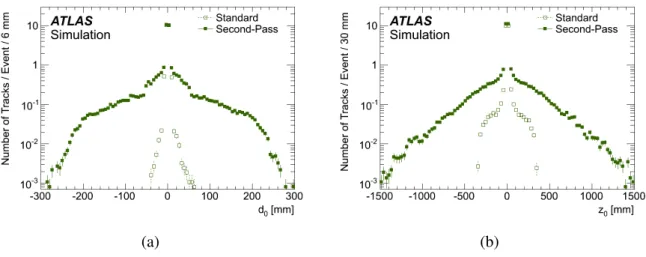
To address the low efficiency of reconstructing secondary tracks, a second pass of track reconstruction was executed that used hits in the ID left over after the standard track reconstruction step had finished. This second pass also had looser selection criteria applied to track parameters. The increase in the number of reconstructed tracks with large impact parameters can be seen in Figure2, where d0(z0) is the
trans-verse (longitudinal) impact parameter with respect to the PV. In both reconstruction steps, the transtrans-verse momentum, pT, of tracks was required to be ≥ 0.4 GeV, and their pseudorapidity was required to be
within the range |η| ≤ 2.5.
3.2 Track selection
Secondary tracks typically have large values of transverse impact parameter. Therefore, in order to select mostly secondary tracks and reduce the contamination of primary tracks, the tracks were required to have |d0|> 5 mm. This requirement removed ∼ 99% of primary tracks as well as many tracks originating from
KS0andΛ decays, and photon conversions.
No requirements were placed on the number of pixel hits on a track as this would have prevented recon-struction of vertices outside the pixel detector. However, tracks were required to have at least one SCT
(a) (b)
Figure 2: Distributions of (a) transverse (d0) and (b) longitudinal (z0) impact parameters of tracks in simulated events. Open squares show tracks reconstructed with the standard algorithm, closed squares show tracks recon-structed with either the standard or second-pass reconstruction algorithm.
hit, to ensure that there was at least one hit per track in a silicon detector. In order to improve the quality of reconstructed secondary vertices, well-measured tracks were required, i.e., track fit χ2/dof < 5 (where “dof” means degree of freedom).
Track reconstruction efficiency and track parameters are well reproduced in simulation. However, there are small differences between data and simulation [6,7] in the number of reconstructed primary tracks. The primary track multiplicity directly affects the number of secondary interactions; if there are more primary particles, then there are also more hadronic interactions. Since data has more primary tracks, yields in simulation are corrected to account for this difference. This correction factor was determined by extrapolating primary tracks, separately in data and simulation, to various material layers, counting how many of them intersected the layer within the fiducial volume, and taking their ratio. Particles that travel through a layer at angles different than normal encounter more material and have a higher interaction probability than those at normal incidence; this is taken into account. The correction factor ranged from 1.05 to 1.07.
3.3 Secondary-vertex reconstruction
A pp collision event may contain decays of short-lived particles such as bottom and charm hadrons, decays of long-lived particles such as KS0 andΛ, photon conversions, and hadronic interaction vertices with a priori unknown multiplicity. To cleanly detect these hadronic interactions, all other secondary vertices must be reconstructed and eliminated.
track parameters [14]. The reconstructed two-track vertices define the full set of vertices in the event, because any N-track vertex is simply a union of corresponding two-track sub-vertices.
Requiring these two-track vertices to have an acceptable χ2/dof (< 4.5) removes ∼ 85% of random pair-ings. Studies on simulated events indicate that more than 83% of hadronic interaction vertices are re-tained. In the barrel region of the ID, the number of fake vertices from random combinations is further reduced by requiring that tracks do not have hits in silicon layers at a radius smaller than the radius of the reconstructed vertex, and have hits in some of the layers that are at larger radii than the vertex; in the end-cap region, only the minimum number of hits in the SCT is required. Vertices that fail to meet these criteria are removed from the list of selected two-track vertices. This procedure removes, depending on radius, anywhere from one-half to two-thirds of the initial set of two-track vertices, whereas the reduction in efficiency for reconstructing hadronic interaction vertices is about 2–10%.
To finalize the vertex finding, two further steps were undertaken: first, the total number of vertices in the event was minimized by merging the two-track candidates that were nearby, a decision that was based on the separation between vertices and on their covariance matrices; second, since a track could have been used in several two-track vertices, such cases were identified and resolved so that all track–vertex associ-ations were unique. The algorithm worked iteratively to clean the vertex set, based on an incompatibility-graph approach [15]. In each iteration it either identified two close vertices and merged them, or found the worst track–vertex association for multiply assigned tracks and broke it. Iterations continued until no further improvement was possible. The CPU performance of the algorithm was acceptable for events with track multiplicity up to ∼ 200, which was significantly larger than the average multiplicity in events used in this analysis (about 50 tracks/event).
3.4 Secondary-vertex selection and resolution
The looser requirements on track reconstruction (Section3.1) significantly improve vertex reconstruction efficiency for all values of r and z. However, studies on simulated events show that this increase is accompanied by a decrease in the purity of secondary-vertex reconstruction, which is defined as the fraction of reconstructed vertices that match true secondary interactions. The matching is based on the distance between the true and reconstructed position of a secondary interaction. Since the most important purpose of the analysis is to provide precise comparison of data and simulation, purity needs to be as high as possible. To achieve this, stringent requirements were placed on tracks associated with reconstructed secondary vertices: relative error on the transverse momentum of tracks σ(pT)/pT < 0.05, transverse
and longitudinal impact parameters relative to the secondary vertex |d0SV| < 1 mm and |zSV0 | < 2 mm respectively.
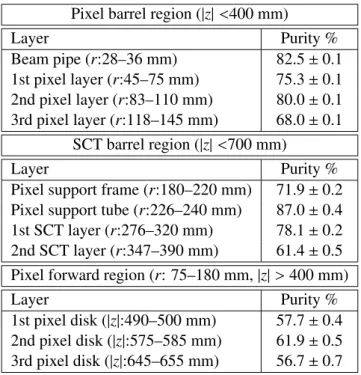
These requirements were applied after track selection and vertex reconstruction since they were on quant-ities measured relative to the reconstructed secondary vertex. If a track in a secondary vertex failed these requirements, the entire vertex was discarded. This procedure removed a small fraction of real secondary vertices with more than two tracks, but since most of the reconstructed vertices had only two tracks, the benefit from the significant increase in purity outweighed the small loss in efficiency. In both data and simulation, about 90% of reconstructed secondary vertices are two-track vertices and almost all of the other 10% of vertices have three tracks. Purities are consistently higher for all r and z, especially at larger radii, as compared to the previous study. For instance, the second SCT layer was not previously studied since the purity was only 15%. Table1lists the values at various material layers. This metric enters into the final result as an additional systematic uncertainty due to small differences in the rate of fake vertices
Table 1: Purity of reconstructed vertices in various regions of the ID. Errors are statistical only.
Pixel barrel region (|z| <400 mm)
Layer Purity % Beam pipe (r:28–36 mm) 82.5 ± 0.1 1st pixel layer (r:45–75 mm) 75.3 ± 0.1 2nd pixel layer (r:83–110 mm) 80.0 ± 0.1 3rd pixel layer (r:118–145 mm) 68.0 ± 0.1 SCT barrel region (|z| <700 mm) Layer Purity %
Pixel support frame (r:180–220 mm) 71.9 ± 0.2 Pixel support tube (r:226–240 mm) 87.0 ± 0.4 1st SCT layer (r:276–320 mm) 78.1 ± 0.2 2nd SCT layer (r:347–390 mm) 61.4 ± 0.5 Pixel forward region (r: 75–180 mm, |z| > 400 mm)
Layer Purity %
1st pixel disk (|z|:490–500 mm) 57.7 ± 0.4 2nd pixel disk (|z|:575–585 mm) 61.9 ± 0.5 3rd pixel disk (|z|:645–655 mm) 56.7 ± 0.7
in data and simulation. The total efficiency to find secondary vertices, containing at least two tracks with pT and η satisfying the selection criteria, is about 9% at the beam pipe, and decreases with radius; it
includes efficiencies for track and vertex reconstruction steps, and the selection requirements described above.
The spatial resolution of the position of the secondary vertex depends on the quality of the track recon-struction. Vertices at smaller radius contain tracks with more silicon hits and are therefore reconstructed with less uncertainty. Averaging over the full kinematic range of tracks, studies on simulated events indic-ate that radial and z resolutions at the beam pipe and through to the first SCT layer are about 0.22 mm and 0.25 mm respectively (see Ref. [2] for details). At the second SCT layer (r > 320 mm), they worsen to about 0.34 mm and 0.70 mm respectively. These resolutions make it possible to resolve structural details at the millimeter scale.
3.5 Vertex yields
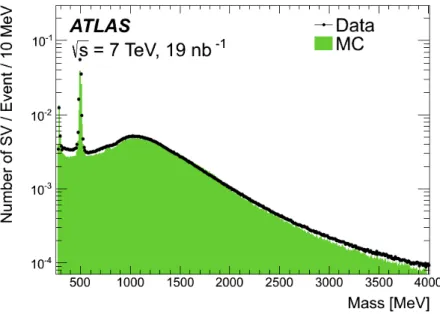
The invariant-mass spectrum of reconstructed secondary vertices is shown in Figure 3. During track reconstruction, the pion mass is assigned by default to tracks. The broad ‘shoulder’ around 1100 MeV is
mass was recalculated by assigning the proton mass to the track with the higher momentum, which gave the correct assignment in over 97% of such decays. If the invariant mass lay within ±35 MeV of the KS0 mass (497.5 MeV) or ±15 MeV of theΛ mass (1116 MeV), the vertex was vetoed. Track combinations with invariant masses below 310 MeV were removed to eliminate photon conversions.
Figure 3: Invariant-mass spectrum of the reconstructed secondary vertices, assuming the pion mass for all tracks, in data (points) and MC simulation (solid histogram).
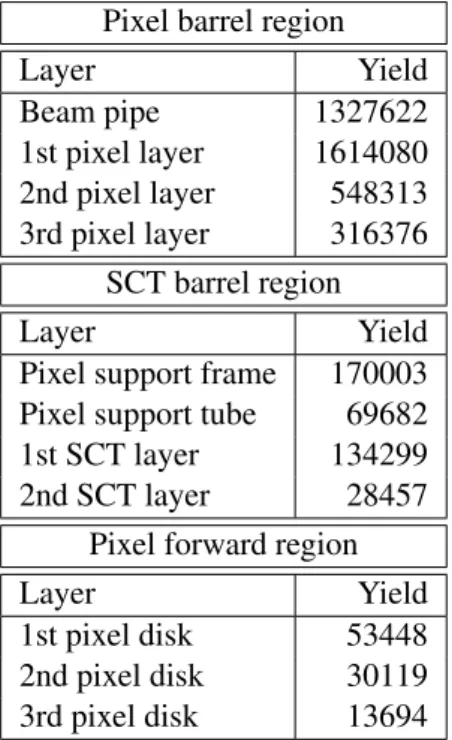
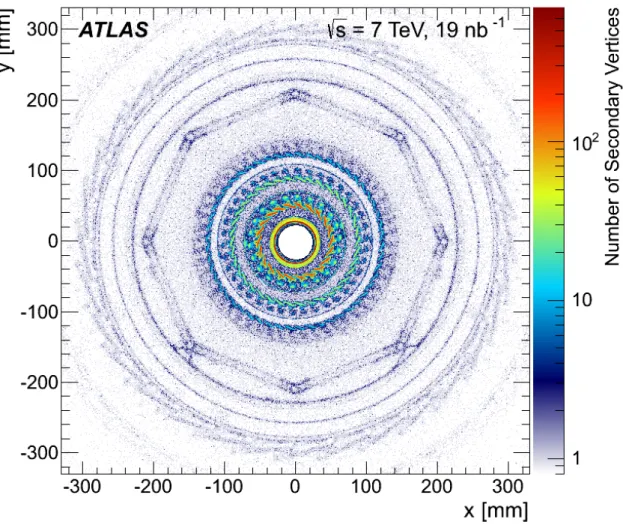
The vertex yields in data after these selection criteria are shown in Table2. High-resolution images, in data, of the secondary-vertex positions in the detector are shown in Figures4,5and6. In Figure4 the y-position is shown versus the x-position for vertices in the pixel barrel region, |z| < 400 mm. The regions with higher density than their surroundings are, going from the innermost to the outermost: the beam pipe, the first, second and third pixel layers, the pixel support frame (the octagon), the pixel support tube, the SCT thermal shield, the first SCT layer and at the very edge with few vertices is the second SCT layer. Vertices further out than the second SCT layer are expected to have worse resolution and purity due to fewer silicon hits on the associated tracks; these layers are therefore disregarded.
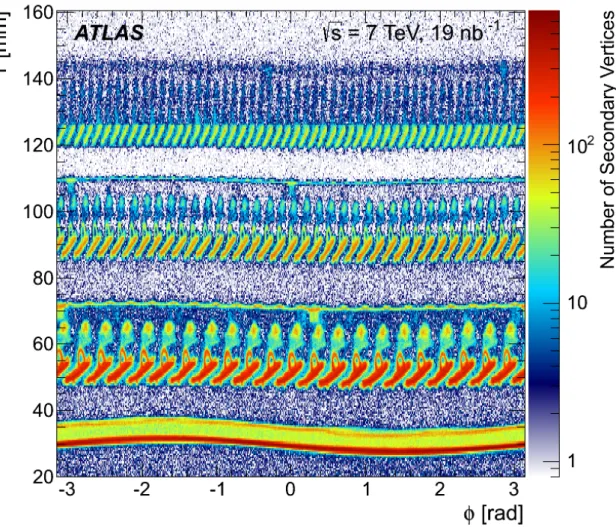
In Figure5, clear details of the composition of the beam pipe are visible, e.g. the increase in vertex density at r ∼ 29 mm indicates the layer made out of beryllium. Moreover, the fine structure of the modules in the three pixel barrel layers is visible. The wave-like behaviour in the beam pipe and the three pixel layers is due to the fact that the layers are not centred around [0,0]. The average displacements in x and y are listed in Table3. The decrease in the number of vertices between the pixel barrel and the pixel end-caps, at |z| ∼ 400 mm in Figure6, is due to differences in the silicon-hit based fake-removal criteria in these two regions. The dense cluster of vertices at |z| ∼400–470 mm and 50 < r < 155 mm represents services at the end of the pixel barrel. The pixel end-cap disks are at z > 495 mm, and r between 80 and 175 mm.
Table 2: Yields of secondary vertices in data in various regions of the ID. The radius and z of these regions are defined in Table1.
Pixel barrel region
Layer Yield Beam pipe 1327622 1st pixel layer 1614080 2nd pixel layer 548313 3rd pixel layer 316376 SCT barrel region Layer Yield
Pixel support frame 170003 Pixel support tube 69682
1st SCT layer 134299
2nd SCT layer 28457
Pixel forward region
Layer Yield
1st pixel disk 53448
2nd pixel disk 30119
3rd pixel disk 13694
4 Qualitative comparison of data to simulation
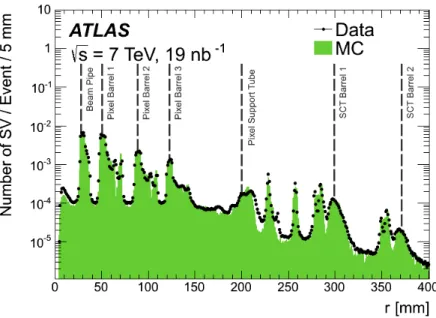
Vertex yields as a function of radius are shown in Figure 7. Each material layer is clearly visible as indicated by the increase in vertex density at specific values of r. Agreement between data and simu-lation is good, especially for the detector layers. However, there are small disagreements arising from simplifications made in the geometry model for some of the structures, e.g., the pixel support tube at r ∼200 mm, and others which appear as sharp peaks, e.g., r around 70 and 105 mm. There are also some disagreements in the air gaps between detector layers.
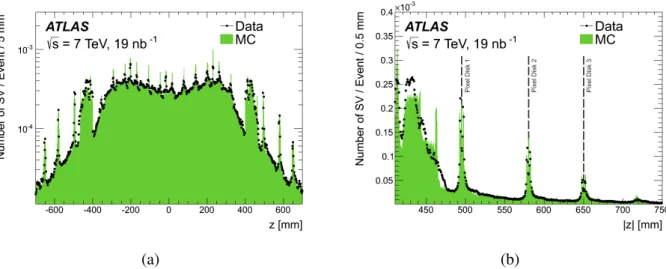
The distribution of secondary vertices for the full z-range is shown in Figure8(a), and the pixel end-cap region is shown separately in Figure8(b). The peaks seen in simulation for |z| < 300 mm are due to simplifications of the support structures. The sudden drop at |z| > 300 mm until around 400 mm is due to differences in the silicon-hit based fake-removal criteria when going from the barrel to the end-cap region. The end of the pixel barrel and the three pixel end-cap disks correspond to the four spikes at |z| > 400 mm. To make the comparisons in the pixel end-cap region, vertices with r < 50 mm and r> 155 mm are excluded to eliminate regions such as the beam pipe and various support structures. The three pixel disks are clearly visible at z ∼ 495, 580 and 650 mm. Some discrepancies are observed in
Figure 4: Number of selected secondary vertices in data in the x–y plane of the ID. Only vertices with |z| < 400 mm are considered. For presentation purposes, the background inside the beam pipe is masked out.
Figure 5: Number of selected secondary vertices in data in the r–φ plane of the ID. Only vertices with |z| < 400 mm are considered.
Figure 6: Number of selected secondary vertices in data in the r–z plane of the ID.
Figure 7: Number of selected secondary vertices per event in data (points) and MC simulation (solid histogram), as a function of r with |z| < 700 mm.
(a) (b)
Figure 8: Number of selected secondary vertices per event in data (points) and MC simulation (solid histogram), as a function of z, (a) for |z| < 700 mm, and (b) for |z| > 410 mm, where vertices with r < 50 mm and r > 155 mm are excluded to highlight the pixel end-cap region.
4.1 Displacement of material layers
As reported previously [2], the positions of the beam pipe and the three pixel layers are not centred around [x = 0, y = 0] in the detector, as concluded from the sinusoidal behaviour in Figure5. Sine functions were fit to the φ dependence in each radial interval to estimate the displacement from the origin in x and y. Their amplitudes are reported in Table3; uncertainties coming from the fitting procedure are. 0.02 mm. The shift in simulation agrees well with data for the beam pipe, and the small discrepancy for the pixel layers has no impact on the quantitative results presented later in this paper.
Figure9 shows the r–φ distribution of selected secondary vertices for the radial region corresponding to the first SCT layer (r: 276–320 mm). The SCT inner thermal shield is at r ≈ 257 mm. Several deformations and shifts are visible in the thermal shield, e.g. most clearly the "bumps" at various φ positions (−1.8, −0.2 and+1.0) with a size of 0.5 mm; shifts are of order 0.5 mm to 1 mm. In simulated events, these structures are flat along the φ-axis.
Table 3: The displacement, x and y, in mm from the origin for the first four material layers of the ID. Displacements seen in simulated events are compared with data. The radius and z of the various layers are defined in Table1.
Data MC simulation
Layer Disp. x Disp. y Disp. x Disp. y
Beam pipe –0.21 –1.90 –0.21 –1.93
1st pixel layer –0.32 –0.50 –0.23 –0.32
2nd pixel layer –0.34 –0.46 –0.25 –0.35
3rd pixel layer –0.15 –0.16 –0.31 –0.18
4.2 Pixel and SCT detector modules in their local coordinate frames
The detector modules in the barrel overlap in r–φ to give complete coverage, as can be seen in Figure4. To study details of individual modules, the positions of the reconstructed vertices were transformed from the global ATLAS reference frame to the module-specific local coordinate frame.2 These transformations were performed for vertices in the first five silicon layers of the ID barrel. Due to the decreasing number of vertices with increasing r the visible details of the pixel modules are degraded when going from the first to the third layer, and similarly for the SCT layers. Hence for qualitative comparisons, only modules in the first pixel and SCT layers are considered. These are shown in Figures10and11respectively. Due to the excellent radial vertex resolution it is possible to specifically select vertices originating in the silicon sensor element in the pixel and SCT modules; the thickness of this element in these two kinds of modules is 250 µm and 285 µm respectively. These vertices are then used in Section4.3 to explore kinematic details of the modelling of hadronic interactions in the silicon.
4.2.1 Pixel modules
Components of the pixel module such as the active silicon sensor element (local-X within ±9 mm and local-Z ∼ 0 mm), the cooling-fluid pipe (seen as the half-circle on top of the module), and cables and
Figure 9: Number of selected secondary vertices in data in the r–φ plane of the ID. The radial range corresponds to the SCT inner thermal shield and the first SCT barrel layer.
supports (the rectangular area above the cooling pipe in simulation, and above and to the right in data) are clearly visible in Figure10.
(a) (b)
Figure 10: Number of selected secondary vertices in the local coordinate frame of the pixel module, for (a) data, and (b) MC simulation, in the first barrel layer. The data sample has more events than the simulated sample.
4.2.2 SCT modules
Figure11shows a detailed view of a module in the first SCT barrel layer in data and in simulation. The horizontal section around local-Z of 0 mm spanning local-X within ±30 mm is the sensor element, and the structure right above it (with local-X in the range [10,30] mm) is the cooling-fluid pipe. The band with local-Z in the range [−30, −20] mm is a support structure, and the band at the bottom of the plot is the SCT thermal shield.
(a) (b)
Figure 11: Number of selected secondary vertices in the local coordinate frame of the SCT module, for (a) data and (b) MC simulation, in the first barrel layer. The data sample has more events than the simulated sample.
4.3 Kinematic characteristics of secondary vertices
In addition to comparing the location of secondary vertices in data and simulation, their kinematic charac-teristics are compared. This allows a study of models of hadronic interactions of low- and medium-energy hadrons used in GEANT4. Kinematic variables that are mainly dependent on details of the hadronic in-teractions are compared, e.g., the total momentum of tracks emerging from the secondary vertex, the fraction of the total momentum carried by the highest-momentum secondary track, and the opening angle between the tracks.
These variables are explored by isolating structures within the ID that are composed of single elements, the 800 µm beryllium layer in the beam pipe and the 250 µm silicon sensor within the pixel modules in the barrel. Two different models of hadronic interactions (FTFP_BERT and QGSP_BERT) [11] are compared with data. Figure12shows the total (scalar) momentum sum of the tracks emerging from a secondary vertex in data compared with the two interaction models in (a) beryllium, and (b) silicon; the FTFP_BERT model agrees better with data, and is used in the nominal MC simulation sample.
(a) (b)
Figure 12: The total (scalar) sum of the momentum,Σ| ¯p|, of secondary particles from hadronic interactions found in (a) the beryllium part of the beam pipe, and (b) the silicon element in the pixel modules. The data (points) are compared to simulation using two models of hadronic interactions (solid histograms). The number of selected secondary vertices is NSV.
5 Systematic uncertainties
Decays of K0
S-mesons are used to make a comparison of track reconstruction efficiency in data and
sim-ulation as a function of vertex position. These decays are a source of charged pions that are independent of the hadronic interaction rate, yet probe the material in a manner similar to tracks from a secondary interaction vertex. Pions produced in these decays also have large impact parameters relative to the PV. The momentum spectrum of KS0 candidates in simulation agrees with data, hence a comparison of their yields (in data and simulation) as a function of decay distance probes the efficiency of reconstructing secondary tracks. KS0yields are determined by fitting the invariant mass of two tracks of opposite charge with a signal and a background function, where the signal is a sum of two Gaussian functions (with a common mean) and the background is represented by a first-order polynomial.
The hadronic-interaction analysis provides differential measurements of the material budget, layer by layer. Comparing the reconstructed KS0yield in data to that in simulation in different radial intervals cor-responding to the material layers eliminates any direct dependency of the track reconstruction efficiency on the material in that layer, since this efficiency is dependent only on the amount of material outside the given material layer. Intervals were selected so that the tracks from the KS0 decays in the selected radial range passed through the same amount of material as tracks from hadronic interactions: 0–48 mm, 48–86 mm, 86–120 mm, 120–276 mm, 276–347 mm, and 347–500 mm.
To account for different numbers of K0
S-mesons produced in data and simulation, yields in various radial
bins in data and simulation were normalized separately to the total yields in the respective samples. A double ratio of these normalized yields in data and simulation was constructed, and is shown in Figure13. A deviation from unity would imply a difference between track reconstruction efficiencies in data and simulation. The largest deviation is about 3.4%.
The uncertainty arising from the production of KS0-mesons in secondary interactions or decays of heavier hadrons was estimated to be 0.3%. This was added linearly to the uncertainty determined above to give a total systematic uncertainty of 3.7% for a two-track vertex. This implies an uncertainty of 1.85% per track. Since the maximum deviation from unity was taken as a measure of the systematic uncertainty, it is likely to be conservative.
Since about 10% of secondary vertices from hadronic interactions have more than two associated tracks, an overall systematic uncertainty was derived by randomly removing 1.85% of the tracks during vertex reconstruction. In vertices with more than two tracks, removing one of the tracks still allows the vertex to be reconstructed. The reduction in the number of secondary vertices was 3.4%, which was taken as the systematic uncertainty on the ratio of hadronic interaction vertex yields in data and simulation.
Figure 13: A double ratio of K0
Syields at different decay distances. The bands are statistical uncertainties from the fits to obtain Ksyields. Details are given in the text.
5.2 Modelling of hadronic interactions in simulation
A quantitative comparison of vertex yields in data and simulation is sensitive to the modelling of low- and medium-energy hadronic interactions in GEANT4. If incorrect hadronic cross-sections were to be used in simulation, that would lead to an incorrect prediction for the number of secondary vertices. To study this, hadronic interaction cross-sections used in the nominal simulation sample (FTFP_BERT model) were compared with two of its variants, FTFP_BERT_chipsXS and FTFP_BERT_gheishaXS [11]. These cross-sections were generated separately for charged pion, kaon, and proton interactions with beryllium, carbon and silicon for a variety of incident energies. Using the differences between these cross-sections, and the numbers of interactions in various elements due to these hadrons, the following systematic uncer-tainties were assigned:+0.2%−0.4%for the beam pipe (which is mainly beryllium), ±0.1% for the pixel support frame and tube (mainly made of carbon), and+0.9%−3.2% for all other material layers (assumed to be silicon and carbon).
In addition, mismodelling of secondary hadronic interactions in GEANT4 can lead to differences in the distributions of kinematic variables between data and simulation. Several variables were studied: invari-ant mass andΣ(pT) of the tracks emerging from the secondary vertex, (pT(max) − pT(min))/Σ(pT), where
min (max) are the minimum (maximum) pT of secondary tracks, and the polar angle of the momentum
Table 4: Systematic uncertainties due to mismodelling of hadronic interactions in GEANT4 in various regions of the ID. These uncertainties are applied to the ratios of secondary-vertex yields in data to those in simulation. The radius and z of these regions are defined in Table1.
Pixel barrel region
Layer Syst. Uncert.
Beam pipe +0.2%−0.4%
1st pixel layer +1.6%−3.5% 2nd pixel layer +2.7%−4.1% 3rd pixel layer +2.8%−4.1%
SCT barrel region
Layer Syst. Uncert.
Pixel support frame +2.9%−2.9% Pixel support tube +3.4%−3.4% 1st SCT layer +3.0%−4.3% 2nd SCT layer +3.6%−4.7%
Pixel forward region
Layer Syst. Uncert.
1st pixel disk +1.7%−3.5% 2nd pixel disk +1.4%−3.4% 3rd pixel disk +1.2%−3.3%
5.3 Vertex reconstruction
Systematic uncertainties arising during the vertex selection step could come from non-optimal modelling of the χ2requirement on the vertex fit, and the merging of nearby vertices. Data and simulated samples were re-analysed using different selection criteria for these variables, and the relative differences in the behaviour of these samples were used to assign a systematic uncertainty of 1%.
Studies on simulated events showed that once restrictions were placed on the invariant mass of tracks emerging from secondary vertices to remove contamination from photon conversions, KS0 andΛ decays, the remaining vertices were mainly due to true hadronic interactions or were fake, i.e., composed of random tracks that do not originate from a common point, and consequently have large values of χ2/dof. Any residual contamination from conversions and KS0 andΛ decays was found to be less than 1%, and was ignored.
Table 5: Systematic uncertainties due to fake vertices in various regions of the ID. These are applied to the ratios of secondary-vertex yields in data to those in simulation. The radius and z of these regions are defined in Table1.
Pixel barrel region
Layer Syst. Uncert.
Beam pipe 1.4%
1st pixel layer 2.0%
2nd pixel layer 1.6%
3rd pixel layer 2.6%
SCT barrel region
Layer Syst. Uncert.
Pixel support frame 3.6% Pixel support tube 1.7%
1st SCT layer 2.8%
2nd SCT layer 5.0%
Pixel forward region
Layer Syst. Uncert.
1st pixel disk 3.4%
2nd pixel disk 3.0%
3rd pixel disk 3.5%
vertices. At the beam pipe, the purity is 82.5%, i.e., 16.5% of the reconstructed vertices are expected to be fake. In some of the other material layers, the fraction of fake vertices is higher (Table1). Vertices with 10 < χ2/dof < 50 were chosen to study this effect. The ratio of reconstructed vertices in data and simulation, with these poor values of χ2/dof, was studied in three intervals of vertex radius, 0 − 100 mm, 100 − 180 mm and ≥ 180 mm, and was found to differ from unity by 8%, 8% and 13% respectively. Using these numbers in conjunction with the expected fake rate at various material layers led to systematic uncertainties shown in Table5. These uncertainties are applied to the ratios of secondary-vertex yields in data to those in simulation.
5.4 Other sources
In this analysis, only the number of primary tracks in simulation was corrected to match data, and because hadronic interactions caused by secondary particles and neutral hadrons were not explicitly accounted for, a systematic uncertainty due to this source was investigated. Correction factors for primary and secondary tracks were studied separately, where the latter were selected by requiring |d0| to be > 5 mm, and an
PV and noting the reduction in the number of vertices, separately in data and simulation samples. A difference of 0.3% was seen between the two samples, and this was taken as a measure of the systematic uncertainty from this source.
Another uncertainty could arise if the primary-particle composition was incorrectly generated in PY-THIA8 [7]. This event generator was tuned using data collected by experiments at LEP and SLAC, which had dedicated particle identification sub-detectors. Also, a comparison of PYTHIA8 and EPOS [16] samples (for 13 TeV pp collisions) showed good agreement in the generated fractions of charged hadrons such as pions, kaons and protons. Hence, the systematic uncertainty from this source was assumed to be small and was neglected.
5.5 Total systematic uncertainty
The systematic uncertainties on the ratios of yields in data to those in simulation are listed in Table6. They are assumed to be uncorrelated and combined in quadrature.
Table 6: Summary table of all systematic uncertainties in the vertex yield comparisons.
Source Syst. Uncert.
Track reconstruction efficiency 3.4%
Modelling of hadronic interactions −4.7% –+3.6%
Vertex reconstruction 1.0%
Fake vertices 1.4–5.0%
Track multiplicity correction for MC simulation 1.0%
Primary track multiplicity cut 0.3%
6 Results
The ratios of yields of reconstructed vertices per event in data to those in simulation are used to make a quantitative estimate of how well the detector material is modelled in the simulation. In this approach, various acceptances and reconstruction efficiencies largely cancel, and any residual differences between data and simulation are assigned as systematic uncertainties on the ratio of yields; these uncertainties are listed in Table6.
The ratios of yields for the beam pipe, the three pixel layers, the pixel support frame and tube, the first two SCT layers and the three pixel end-cap disks are shown in Table7and Figure14. All secondary-vertex quality cuts were applied before vertex yields were calculated. The yields in the simulated sample were multiplied by the correction factors to account for different numbers of primary tracks in data and simu-lation. Simulated events were also weighted to match the z-coordinate of the primary-vertex spectrum in data. The total uncertainty is dominated by systematic effects, discussed in Section5.
The beam-pipe region shows good agreement between data and simulation; in addition, the yields in the 800 µm beryllium layer in the beam pipe agree well, where the ratio of data to simulation is 1.010 ±
Table 7: Ratios of yields of secondary vertices in data to those in MC simulation for various regions in the ID. The first uncertainty is statistical and the second systematic. The radius and z of these regions are defined in Table1.
Pixel barrel region
Layer Yield Data/MC
Beam pipe 1.002 ± 0.002 ± 0.040
1st pixel layer 0.967 ± 0.001+0.043−0.053 2nd pixel layer 0.944 ± 0.002+0.046−0.054 3rd pixel layer 0.976 ± 0.003+0.051−0.060
SCT barrel region
Layer Yield Data/MC
Pixel support frame 1.121 ± 0.006 ± 0.067 Pixel support tube 1.159 ± 0.009 ± 0.061 1st SCT layer 1.042 ± 0.006+0.058−0.066 2nd SCT layer 1.100 ± 0.013+0.079−0.086
Pixel forward region
Layer Yield Data/MC
1st pixel disk 1.023 ± 0.009+0.054−0.062 2nd pixel disk 0.975 ± 0.011+0.049−0.057 3rd pixel disk 0.937 ± 0.015+0.049−0.057
0.002 (stat.) ± 0.040 (syst.).3 In the three pixel barrel layers the simulation overestimates the material by about 1σ while in the two SCT barrel layers the material in the data is larger than in the simulation by also about 1σ. The first two pixel disks agree well within uncertainties, while the third disk is low by about 1σ. An excess of material in the radial regions 180–220 mm (pixel support frame) and 226–240 mm (pixel support tube) is observed in data as compared to the ATLAS detector model; these two structures combined constitute less than 1% of the total mass of the ID. These discrepancies are understood to be due to missing components in the description of these support structures, which will be included in newer
Figure 14: Ratios of yields of secondary vertices in data to those in MC simulation for the barrel and end-cap regions. The total uncertainties (dotted lines) include both statistical (dark shading) and systematic uncertainties (light shading) in the vertex yields.
Table 8: The ratios of vertex yields in data to those in MC simulation for the silicon sensor element in the pixel and SCT modules, measured using the local coordinate transformations. The first uncertainty is statistical and the second systematic. The radius and z of the various regions are defined in Table1.
Pixel barrel region
Module location Yield Data/MC 1st pixel layer 0.999 ± 0.003+0.045−0.054 2nd pixel layer 0.945 ± 0.004+0.045−0.054 3rd pixel layer 0.957 ± 0.006+0.050−0.058
SCT barrel region
Module location Yield Data/MC 1st SCT layer 1.029 ± 0.011+0.057−0.065 2nd SCT layer 1.035 ± 0.030+0.074−0.081
7 Conclusions
This paper presents an updated study of the material in the ATLAS ID using secondary hadronic inter-actions in 19 nb−1of √s= 7 TeV LHC pp collision events collected with a minimum-bias trigger. The technique described here exploits primary particle interactions with ID material to reconstruct secondary vertices from the outgoing tracks. Since the incident primary particles have low to medium energies, the outgoing tracks tend to have large opening angles between them, thereby improving spatial resolu-tions. A major improvement is due to second-pass track reconstruction that increases the efficiency of
reconstructing secondary tracks, especially those arising from vertices far from the primary vertex. These secondary vertices are reconstructed using an inclusive vertex-finding and fitting algorithm, and they have good spatial resolution in both the longitudinal and transverse directions. The resulting res-olutions are significantly better than the resolution of vertices produced by photon conversions, which are routinely used for material estimation. This leads to a precise ‘radiography’ of the as-built ID and facilitates comparison with the implementation of the detector geometry in simulation.
Many sources of systematic uncertainty have been investigated, viz., secondary track and vertex recon-struction efficiencies, pTand η distributions of primary particles that interact in the ID, and the accuracy
of hadronic interaction modelling in GEANT4. Experimental systematic uncertainties, i.e., those arising from track and vertex reconstruction, are estimated from data in this analysis. Differences between data and simulation in the pT and η distributions of the primary tracks are accounted for via a reweighting
procedure. Uncertainties in the modelling of hadronic interactions in GEANT4 are studied by comparing various models.
Due to the increase in vertex reconstruction efficiency from second-pass track reconstruction, this study explores a large fiducial volume (0.7 m3). The second barrel SCT layer and the pixel end-cap disks have been investigated for the first time with this technique. Moreover, this paper includes ‘radiography’ im-ages of the SCT modules, which had not been studied previously. Agreement between data and simulation is good to within the experimental uncertainties, which are about 5%.
Acknowledgements
We thank CERN for the very successful operation of the LHC, as well as the support staff from our institutions without whom ATLAS could not be operated efficiently.
We acknowledge the support of ANPCyT, Argentina; YerPhI, Armenia; ARC, Australia; BMWFW and FWF, Austria; ANAS, Azerbaijan; SSTC, Belarus; CNPq and FAPESP, Brazil; NSERC, NRC and CFI, Canada; CERN; CONICYT, Chile; CAS, MOST and NSFC, China; COLCIENCIAS, Colombia; MSMT CR, MPO CR and VSC CR, Czech Republic; DNRF and DNSRC, Denmark; IN2P3-CNRS, CEA-DSM/IRFU, France; GNSF, Georgia; BMBF, HGF, and MPG, Germany; GSRT, Greece; RGC, Hong Kong SAR, China; ISF, I-CORE and Benoziyo Center, Israel; INFN, Italy; MEXT and JSPS, Japan; CNRST, Morocco; FOM and NWO, Netherlands; RCN, Norway; MNiSW and NCN, Poland; FCT, Por-tugal; MNE/IFA, Romania; MES of Russia and NRC KI, Russian Federation; JINR; MESTD, Serbia; MSSR, Slovakia; ARRS and MIZŠ, Slovenia; DST/NRF, South Africa; MINECO, Spain; SRC and Wallenberg Foundation, Sweden; SERI, SNSF and Cantons of Bern and Geneva, Switzerland; MOST, Taiwan; TAEK, Turkey; STFC, United Kingdom; DOE and NSF, United States of America. In addition, individual groups and members have received support from BCKDF, the Canada Council, CANARIE, CRC, Compute Canada, FQRNT, and the Ontario Innovation Trust, Canada; EPLANET, ERC, FP7,
Ho-The crucial computing support from all WLCG partners is acknowledged gratefully, in particular from CERN, the ATLAS Tier-1 facilities at TRIUMF (Canada), NDGF (Denmark, Norway, Sweden), CC-IN2P3 (France), KIT/GridKA (Germany), INFN-CNAF (Italy), NL-T1 (Netherlands), PIC (Spain), ASGC (Taiwan), RAL (UK) and BNL (USA), the Tier-2 facilities worldwide and large non-WLCG resource pro-viders. Major contributors of computing resources are listed in Ref. [17].
References
[1] ATLAS Collaboration, The ATLAS Experiment at the CERN Large Hadron Collider,
JINST 3 (2008) S08003. [2] ATLAS Collaboration,
A study of the material in the ATLAS inner detector using secondary hadronic interactions,
JINST 7 (2012) P01013, arXiv:1110.6191 [hep-ex].
[3] ATLAS Collaboration, Search for massive, long-lived particles using multitrack displaced vertices or displaced lepton pairs in pp collisions at √s= 8 TeV with the ATLAS detector,
Phys. Rev. D 92 (2015) 072004, arXiv:1504.05162 [hep-ex].
[4] ATLAS Collaboration, Search for long-lived, weakly-interacting particles that decay to displaced hadronic jets in proton-proton collisions at √s= 8 TeV with the ATLAS detector,
Phys. Rev. D 92 (2015) 012010, arXiv:1504.03634 [hep-ex]. [5] ATLAS Collaboration,
Expected Performance of the ATLAS Experiment - Detector, Trigger and Physics, (2008), arXiv:0901.0512 [hep-ex].
[6] ATLAS Collaboration,
Charged-particle multiplicities in pp interactions measured with the ATLAS detector at the LHC,
New J. Phys. 13 (2011) 053033, arXiv:1012.5104 [hep-ex].
[7] T. Sjöstrand et al., An introduction to PYTHIA 8.2,Comput. Phys. Commun. 191 (2015) 159, arXiv:1410.3012 [hep-ph].
[8] A. D. Martin et al., Parton distributions for the LHC,Eur. Phys. J. C 63 (2009) 189, arXiv:0901.0002 [hep-ph].
[9] ATLAS Collaboration, Further ATLAS tunes of PYTHIA6 and Pythia 8,
ATL-PHYS-PUB-2011-014 (2011), url:https://cds.cern.ch/record/1400677. [10] S. Agostinelli et al., GEANT4: A Simulation toolkit,Nucl. Instrum. Meth. A 506 (2003) 250. [11] A. Ribon et al., Status of Geant4 hadronic physics for the simulation of LHC experiments at the
start of LHC physics program, CERN-LCGAPP-2010-02 (2010),
url:http://lcgapp.cern.ch/project/docs/noteStatusHadronic2010.pdf. [12] ATLAS Collaboration, The ATLAS Simulation Infrastructure,Eur. Phys. J. C 70 (2010) 823,
arXiv:1005.4568 [physics.ins-det]. [13] G. Piacquadio, K. Prokofiev and A. Wildauer,
Primary vertex reconstruction in the ATLAS experiment at LHC,
[14] P. Billoir and S. Qian, Fast vertex fitting with a local parametrization of tracks,
Nucl. Instrum. Meth., A 311 (1992) 139.
[15] S. R. Das, On a New Approach for Finding All the Modified Cut-Sets in an Incompatibility Graph,
IEEE Transactions on Computers C 22 (1973) 187.
[16] T. Pierog et al., EPOS LHC: Test of collective hadronization with data measured at the CERN Large Hadron Collider,Phys. Rev. C 92 (2015) 034906.
[17] ATLAS Collaboration, ATLAS Computing Acknowledgements 2016-2017,
The ATLAS Collaboration
M. Aaboud135d, G. Aad86, B. Abbott113, J. Abdallah64, O. Abdinov12, B. Abeloos117, R. Aben107, O.S. AbouZeid137, N.L. Abraham149, H. Abramowicz153, H. Abreu152, R. Abreu116, Y. Abulaiti146a,146b, B.S. Acharya163a,163b,a, L. Adamczyk40a, D.L. Adams27, J. Adelman108, S. Adomeit100, T. Adye131, A.A. Affolder75, T. Agatonovic-Jovin14, J. Agricola56, J.A. Aguilar-Saavedra126a,126f, S.P. Ahlen24,
F. Ahmadov66,b, G. Aielli133a,133b, H. Akerstedt146a,146b, T.P.A. Åkesson82, A.V. Akimov96, G.L. Alberghi22a,22b, J. Albert168, S. Albrand57, M.J. Alconada Verzini72, M. Aleksa32,
I.N. Aleksandrov66, C. Alexa28b, G. Alexander153, T. Alexopoulos10, M. Alhroob113, B. Ali128, M. Aliev74a,74b, G. Alimonti92a, J. Alison33, S.P. Alkire37, B.M.M. Allbrooke149, B.W. Allen116, P.P. Allport19, A. Aloisio104a,104b, A. Alonso38, F. Alonso72, C. Alpigiani138, M. Alstaty86,
B. Alvarez Gonzalez32, D. Álvarez Piqueras166, M.G. Alviggi104a,104b, B.T. Amadio16, K. Amako67, Y. Amaral Coutinho26a, C. Amelung25, D. Amidei90, S.P. Amor Dos Santos126a,126c, A. Amorim126a,126b, S. Amoroso32, G. Amundsen25, C. Anastopoulos139, L.S. Ancu51, N. Andari19, T. Andeen11,
C.F. Anders59b, G. Anders32, J.K. Anders75, K.J. Anderson33, A. Andreazza92a,92b, V. Andrei59a, S. Angelidakis9, I. Angelozzi107, P. Anger46, A. Angerami37, F. Anghinolfi32, A.V. Anisenkov109,c, N. Anjos13, A. Annovi124a,124b, C. Antel59a, M. Antonelli49, A. Antonov98,∗, F. Anulli132a, M. Aoki67, L. Aperio Bella19, G. Arabidze91, Y. Arai67, J.P. Araque126a, A.T.H. Arce47, F.A. Arduh72, J-F. Arguin95, S. Argyropoulos64, M. Arik20a, A.J. Armbruster143, L.J. Armitage77, O. Arnaez32, H. Arnold50,
M. Arratia30, O. Arslan23, A. Artamonov97, G. Artoni120, S. Artz84, S. Asai155, N. Asbah44,
A. Ashkenazi153, B. Åsman146a,146b, L. Asquith149, K. Assamagan27, R. Astalos144a, M. Atkinson165, N.B. Atlay141, K. Augsten128, G. Avolio32, B. Axen16, M.K. Ayoub117, G. Azuelos95,d, M.A. Baak32, A.E. Baas59a, M.J. Baca19, H. Bachacou136, K. Bachas74a,74b, M. Backes148, M. Backhaus32,
P. Bagiacchi132a,132b, P. Bagnaia132a,132b, Y. Bai35a, J.T. Baines131, O.K. Baker175, E.M. Baldin109,c, P. Balek171, T. Balestri148, F. Balli136, W.K. Balunas122, E. Banas41, Sw. Banerjee172,e,
A.A.E. Bannoura174, L. Barak32, E.L. Barberio89, D. Barberis52a,52b, M. Barbero86, T. Barillari101, M-S Barisits32, T. Barklow143, N. Barlow30, S.L. Barnes85, B.M. Barnett131, R.M. Barnett16, Z. Barnovska5, A. Baroncelli134a, G. Barone25, A.J. Barr120, L. Barranco Navarro166, F. Barreiro83, J. Barreiro Guimarães da Costa35a, R. Bartoldus143, A.E. Barton73, P. Bartos144a, A. Basalaev123, A. Bassalat117, R.L. Bates55, S.J. Batista158, J.R. Batley30, M. Battaglia137, M. Bauce132a,132b, F. Bauer136, H.S. Bawa143, f, J.B. Beacham111, M.D. Beattie73, T. Beau81, P.H. Beauchemin161,
P. Bechtle23, H.P. Beck18,g, K. Becker120, M. Becker84, M. Beckingham169, C. Becot110, A.J. Beddall20e, A. Beddall20b, V.A. Bednyakov66, M. Bedognetti107, C.P. Bee148, L.J. Beemster107, T.A. Beermann32, M. Begel27, J.K. Behr44, C. Belanger-Champagne88, A.S. Bell79, G. Bella153, L. Bellagamba22a, A. Bellerive31, M. Bellomo87, K. Belotskiy98, O. Beltramello32, N.L. Belyaev98, O. Benary153, D. Benchekroun135a, M. Bender100, K. Bendtz146a,146b, N. Benekos10, Y. Benhammou153, E. Benhar Noccioli175, J. Benitez64, D.P. Benjamin47, J.R. Bensinger25, S. Bentvelsen107, L. Beresford120, M. Beretta49, D. Berge107, E. Bergeaas Kuutmann164, N. Berger5, J. Beringer16, S. Berlendis57, N.R. Bernard87, C. Bernius110, F.U. Bernlochner23, T. Berry78, P. Berta129, C. Bertella84, G. Bertoli146a,146b, F. Bertolucci124a,124b, I.A. Bertram73, C. Bertsche44, D. Bertsche113, G.J. Besjes38, O. Bessidskaia Bylund146a,146b, M. Bessner44, N. Besson136, C. Betancourt50, A. Bethani57,
S. Bethke101, A.J. Bevan77, R.M. Bianchi125, L. Bianchini25, M. Bianco32, O. Biebel100,
D. Biedermann17, R. Bielski85, N.V. Biesuz124a,124b, M. Biglietti134a, J. Bilbao De Mendizabal51, T.R.V. Billoud95, H. Bilokon49, M. Bindi56, S. Binet117, A. Bingul20b, C. Bini132a,132b, S. Biondi22a,22b, T. Bisanz56, D.M. Bjergaard47, C.W. Black150, J.E. Black143, K.M. Black24, D. Blackburn138,
U. Blumenschein56, S. Blunier34a, G.J. Bobbink107, V.S. Bobrovnikov109,c, S.S. Bocchetta82, A. Bocci47,
C. Bock100, M. Boehler50, D. Boerner174, J.A. Bogaerts32, D. Bogavac14, A.G. Bogdanchikov109, C. Bohm146a, V. Boisvert78, P. Bokan14, T. Bold40a, A.S. Boldyrev163a,163c, M. Bomben81, M. Bona77, M. Boonekamp136, A. Borisov130, G. Borissov73, J. Bortfeldt32, D. Bortoletto120, V. Bortolotto61a,61b,61c, K. Bos107, D. Boscherini22a, M. Bosman13, J.D. Bossio Sola29, J. Boudreau125, J. Bouffard2,
E.V. Bouhova-Thacker73, D. Boumediene36, C. Bourdarios117, S.K. Boutle55, A. Boveia32, J. Boyd32, I.R. Boyko66, J. Bracinik19, A. Brandt8, G. Brandt56, O. Brandt59a, U. Bratzler156, B. Brau87,
J.E. Brau116, H.M. Braun174,∗, W.D. Breaden Madden55, K. Brendlinger122, A.J. Brennan89,
L. Brenner107, R. Brenner164, S. Bressler171, T.M. Bristow48, D. Britton55, D. Britzger44, F.M. Brochu30, I. Brock23, R. Brock91, G. Brooijmans37, T. Brooks78, W.K. Brooks34b, J. Brosamer16, E. Brost108, J.H Broughton19, P.A. Bruckman de Renstrom41, D. Bruncko144b, R. Bruneliere50, A. Bruni22a, G. Bruni22a, L.S. Bruni107, BH Brunt30, M. Bruschi22a, N. Bruscino23, P. Bryant33, L. Bryngemark82, T. Buanes15, Q. Buat142, P. Buchholz141, A.G. Buckley55, I.A. Budagov66, F. Buehrer50, M.K. Bugge119, O. Bulekov98, D. Bullock8, H. Burckhart32, S. Burdin75, C.D. Burgard50, B. Burghgrave108, K. Burka41, S. Burke131, I. Burmeister45, J.T.P. Burr120, E. Busato36, D. Büscher50, V. Büscher84, P. Bussey55, J.M. Butler24, C.M. Buttar55, J.M. Butterworth79, P. Butti107, W. Buttinger27, A. Buzatu55,
A.R. Buzykaev109,c, S. Cabrera Urbán166, D. Caforio128, V.M. Cairo39a,39b, O. Cakir4a, N. Calace51, P. Calafiura16, A. Calandri86, G. Calderini81, P. Calfayan100, G. Callea39a,39b, L.P. Caloba26a, S. Calvente Lopez83, D. Calvet36, S. Calvet36, T.P. Calvet86, R. Camacho Toro33, S. Camarda32, P. Camarri133a,133b, D. Cameron119, R. Caminal Armadans165, C. Camincher57, S. Campana32, M. Campanelli79, A. Camplani92a,92b, A. Campoverde141, V. Canale104a,104b, A. Canepa159a, M. Cano Bret35e, J. Cantero114, R. Cantrill126a, T. Cao42, M.D.M. Capeans Garrido32, I. Caprini28b, M. Caprini28b, M. Capua39a,39b, R. Caputo84, R.M. Carbone37, R. Cardarelli133a, F. Cardillo50, I. Carli129, T. Carli32, G. Carlino104a, L. Carminati92a,92b, S. Caron106, E. Carquin34b,
G.D. Carrillo-Montoya32, J.R. Carter30, J. Carvalho126a,126c, D. Casadei19, M.P. Casado13,h, M. Casolino13, D.W. Casper162, E. Castaneda-Miranda145a, R. Castelijn107, A. Castelli107,
V. Castillo Gimenez166, N.F. Castro126a,i, A. Catinaccio32, J.R. Catmore119, A. Cattai32, J. Caudron23, V. Cavaliere165, E. Cavallaro13, D. Cavalli92a, M. Cavalli-Sforza13, V. Cavasinni124a,124b,
F. Ceradini134a,134b, L. Cerda Alberich166, B.C. Cerio47, A.S. Cerqueira26b, A. Cerri149, L. Cerrito133a,133b, F. Cerutti16, M. Cerv32, A. Cervelli18, S.A. Cetin20d, A. Chafaq135a,
D. Chakraborty108, S.K. Chan58, Y.L. Chan61a, P. Chang165, J.D. Chapman30, D.G. Charlton19, A. Chatterjee51, C.C. Chau158, C.A. Chavez Barajas149, S. Che111, S. Cheatham73, A. Chegwidden91, S. Chekanov6, S.V. Chekulaev159a, G.A. Chelkov66, j, M.A. Chelstowska90, C. Chen65, H. Chen27, K. Chen148, S. Chen35c, S. Chen155, X. Chen35f, Y. Chen68, H.C. Cheng90, H.J Cheng35a, Y. Cheng33, A. Cheplakov66, E. Cheremushkina130, R. Cherkaoui El Moursli135e, V. Chernyatin27,∗, E. Cheu7,
L. Chevalier136, V. Chiarella49, G. Chiarelli124a,124b, G. Chiodini74a, A.S. Chisholm19, A. Chitan28b, M.V. Chizhov66, K. Choi62, A.R. Chomont36, S. Chouridou9, B.K.B. Chow100, V. Christodoulou79, D. Chromek-Burckhart32, J. Chudoba127, A.J. Chuinard88, J.J. Chwastowski41, L. Chytka115,
G. Ciapetti132a,132b, A.K. Ciftci4a, D. Cinca45, V. Cindro76, I.A. Cioara23, C. Ciocca22a,22b, A. Ciocio16, F. Cirotto104a,104b, Z.H. Citron171, M. Citterio92a, M. Ciubancan28b, A. Clark51, B.L. Clark58,
F. Crescioli81, W.A. Cribbs146a,146b, M. Crispin Ortuzar120, M. Cristinziani23, V. Croft106,
G. Crosetti39a,39b, A. Cueto83, T. Cuhadar Donszelmann139, J. Cummings175, M. Curatolo49, J. Cúth84, H. Czirr141, P. Czodrowski3, G. D’amen22a,22b, S. D’Auria55, M. D’Onofrio75,
M.J. Da Cunha Sargedas De Sousa126a,126b, C. Da Via85, W. Dabrowski40a, T. Dado144a, T. Dai90, O. Dale15, F. Dallaire95, C. Dallapiccola87, M. Dam38, J.R. Dandoy33, N.P. Dang50, A.C. Daniells19, N.S. Dann85, M. Danninger167, M. Dano Hoffmann136, V. Dao50, G. Darbo52a, S. Darmora8,
J. Dassoulas3, A. Dattagupta62, W. Davey23, C. David168, T. Davidek129, M. Davies153, P. Davison79, E. Dawe89, I. Dawson139, R.K. Daya-Ishmukhametova87, K. De8, R. de Asmundis104a,
A. De Benedetti113, S. De Castro22a,22b, S. De Cecco81, N. De Groot106, P. de Jong107, H. De la Torre83, F. De Lorenzi65, A. De Maria56, D. De Pedis132a, A. De Salvo132a, U. De Sanctis149, A. De Santo149, J.B. De Vivie De Regie117, W.J. Dearnaley73, R. Debbe27, C. Debenedetti137, D.V. Dedovich66, N. Dehghanian3, I. Deigaard107, M. Del Gaudio39a,39b, J. Del Peso83, T. Del Prete124a,124b,
D. Delgove117, F. Deliot136, C.M. Delitzsch51, A. Dell’Acqua32, L. Dell’Asta24, M. Dell’Orso124a,124b, M. Della Pietra104a,k, D. della Volpe51, M. Delmastro5, P.A. Delsart57, D.A. DeMarco158, S. Demers175, M. Demichev66, A. Demilly81, S.P. Denisov130, D. Denysiuk136, D. Derendarz41, J.E. Derkaoui135d, F. Derue81, P. Dervan75, K. Desch23, C. Deterre44, K. Dette45, P.O. Deviveiros32, A. Dewhurst131, S. Dhaliwal25, A. Di Ciaccio133a,133b, L. Di Ciaccio5, W.K. Di Clemente122, C. Di Donato132a,132b, A. Di Girolamo32, B. Di Girolamo32, B. Di Micco134a,134b, R. Di Nardo32, A. Di Simone50, R. Di Sipio158, D. Di Valentino31, C. Diaconu86, M. Diamond158, F.A. Dias48, M.A. Diaz34a, E.B. Diehl90, J. Dietrich17, S. Diglio86, A. Dimitrievska14, J. Dingfelder23, P. Dita28b, S. Dita28b, F. Dittus32, F. Djama86, T. Djobava53b, J.I. Djuvsland59a, M.A.B. do Vale26c, D. Dobos32, M. Dobre28b, C. Doglioni82, J. Dolejsi129, Z. Dolezal129, M. Donadelli26d, S. Donati124a,124b, P. Dondero121a,121b, J. Donini36, J. Dopke131, A. Doria104a, M.T. Dova72, A.T. Doyle55, E. Drechsler56, M. Dris10, Y. Du35d, J. Duarte-Campderros153, E. Duchovni171, G. Duckeck100, O.A. Ducu95,m, D. Duda107, A. Dudarev32, A.Chr. Dudder84, E.M. Duffield16, L. Duflot117, M. Dührssen32, M. Dumancic171, M. Dunford59a, H. Duran Yildiz4a, M. Düren54, A. Durglishvili53b, D. Duschinger46, B. Dutta44, M. Dyndal44, C. Eckardt44, K.M. Ecker101, R.C. Edgar90, N.C. Edwards48, T. Eifert32, G. Eigen15, K. Einsweiler16, T. Ekelof164, M. El Kacimi135c, V. Ellajosyula86, M. Ellert164, S. Elles5, F. Ellinghaus174, A.A. Elliot168, N. Ellis32, J. Elmsheuser27, M. Elsing32, D. Emeliyanov131, Y. Enari155, O.C. Endner84, J.S. Ennis169, J. Erdmann45, A. Ereditato18, G. Ernis174, J. Ernst2, M. Ernst27, S. Errede165, E. Ertel84, M. Escalier117, H. Esch45, C. Escobar125, B. Esposito49, A.I. Etienvre136, E. Etzion153, H. Evans62, A. Ezhilov123, F. Fabbri22a,22b, L. Fabbri22a,22b, G. Facini33, R.M. Fakhrutdinov130, S. Falciano132a, R.J. Falla79, J. Faltova32, Y. Fang35a, M. Fanti92a,92b, A. Farbin8, A. Farilla134a, C. Farina125, E.M. Farina121a,121b, T. Farooque13, S. Farrell16, S.M. Farrington169, P. Farthouat32, F. Fassi135e, P. Fassnacht32,
D. Fassouliotis9, M. Faucci Giannelli78, A. Favareto52a,52b, W.J. Fawcett120, L. Fayard117,
O.L. Fedin123,n, W. Fedorko167, S. Feigl119, L. Feligioni86, C. Feng35d, E.J. Feng32, H. Feng90, A.B. Fenyuk130, L. Feremenga8, P. Fernandez Martinez166, S. Fernandez Perez13, J. Ferrando55, A. Ferrari164, P. Ferrari107, R. Ferrari121a, D.E. Ferreira de Lima59b, A. Ferrer166, D. Ferrere51, C. Ferretti90, A. Ferretto Parodi52a,52b, F. Fiedler84, A. Filipˇciˇc76, M. Filipuzzi44, F. Filthaut106, M. Fincke-Keeler168, K.D. Finelli150, M.C.N. Fiolhais126a,126c, L. Fiorini166, A. Firan42, A. Fischer2, C. Fischer13, J. Fischer174, W.C. Fisher91, N. Flaschel44, I. Fleck141, P. Fleischmann90, G.T. Fletcher139, R.R.M. Fletcher122, T. Flick174, A. Floderus82, L.R. Flores Castillo61a, M.J. Flowerdew101,
G.T. Forcolin85, A. Formica136, A. Forti85, A.G. Foster19, D. Fournier117, H. Fox73, S. Fracchia13, P. Francavilla81, M. Franchini22a,22b, D. Francis32, L. Franconi119, M. Franklin58, M. Frate162, M. Fraternali121a,121b, D. Freeborn79, S.M. Fressard-Batraneanu32, F. Friedrich46, D. Froidevaux32, J.A. Frost120, C. Fukunaga156, E. Fullana Torregrosa84, T. Fusayasu102, J. Fuster166, C. Gabaldon57,
G. Gagliardi52a,52b, L.G. Gagnon95, P. Gagnon62, C. Galea106, B. Galhardo126a,126c, E.J. Gallas120,
B.J. Gallop131, P. Gallus128, G. Galster38, K.K. Gan111, J. Gao35b,86, Y. Gao48, Y.S. Gao143, f, F.M. Garay Walls48, C. García166, J.E. García Navarro166, M. Garcia-Sciveres16, R.W. Gardner33, N. Garelli143, V. Garonne119, A. Gascon Bravo44, K. Gasnikova44, C. Gatti49, A. Gaudiello52a,52b, G. Gaudio121a, L. Gauthier95, I.L. Gavrilenko96, C. Gay167, G. Gaycken23, E.N. Gazis10, Z. Gecse167, C.N.P. Gee131, Ch. Geich-Gimbel23, M. Geisen84, M.P. Geisler59a, C. Gemme52a, M.H. Genest57, C. Geng35b,o, S. Gentile132a,132b, C. Gentsos154, S. George78, D. Gerbaudo13, A. Gershon153,
S. Ghasemi141, H. Ghazlane135b, M. Ghneimat23, B. Giacobbe22a, S. Giagu132a,132b, P. Giannetti124a,124b, B. Gibbard27, S.M. Gibson78, M. Gignac167, M. Gilchriese16, T.P.S. Gillam30, D. Gillberg31,
G. Gilles174, D.M. Gingrich3,d, N. Giokaris9, M.P. Giordani163a,163c, F.M. Giorgi22a, F.M. Giorgi17, P.F. Giraud136, P. Giromini58, D. Giugni92a, F. Giuli120, C. Giuliani101, M. Giulini59b, B.K. Gjelsten119, S. Gkaitatzis154, I. Gkialas154, E.L. Gkougkousis117, L.K. Gladilin99, C. Glasman83, J. Glatzer50, P.C.F. Glaysher48, A. Glazov44, M. Goblirsch-Kolb25, J. Godlewski41, S. Goldfarb89, T. Golling51, D. Golubkov130, A. Gomes126a,126b,126d, R. Gonçalo126a, J. Goncalves Pinto Firmino Da Costa136, G. Gonella50, L. Gonella19, A. Gongadze66, S. González de la Hoz166, G. Gonzalez Parra13,
S. Gonzalez-Sevilla51, L. Goossens32, P.A. Gorbounov97, H.A. Gordon27, I. Gorelov105, B. Gorini32, E. Gorini74a,74b, A. Gorišek76, E. Gornicki41, A.T. Goshaw47, C. Gössling45, M.I. Gostkin66,
C.R. Goudet117, D. Goujdami135c, A.G. Goussiou138, N. Govender145b,p, E. Gozani152, L. Graber56, I. Grabowska-Bold40a, P.O.J. Gradin57, P. Grafström22a,22b, J. Gramling51, E. Gramstad119,
S. Grancagnolo17, V. Gratchev123, P.M. Gravila28e, H.M. Gray32, E. Graziani134a, Z.D. Greenwood80,q, C. Grefe23, K. Gregersen79, I.M. Gregor44, P. Grenier143, K. Grevtsov5, J. Griffiths8, A.A. Grillo137, K. Grimm73, S. Grinstein13,r, Ph. Gris36, J.-F. Grivaz117, S. Groh84, J.P. Grohs46, E. Gross171,
J. Grosse-Knetter56, G.C. Grossi80, Z.J. Grout79, L. Guan90, W. Guan172, J. Guenther63, F. Guescini51, D. Guest162, O. Gueta153, E. Guido52a,52b, T. Guillemin5, S. Guindon2, U. Gul55, C. Gumpert32, J. Guo35e, Y. Guo35b,o, R. Gupta42, S. Gupta120, G. Gustavino132a,132b, P. Gutierrez113,
N.G. Gutierrez Ortiz79, C. Gutschow46, C. Guyot136, C. Gwenlan120, C.B. Gwilliam75, A. Haas110, C. Haber16, H.K. Hadavand8, N. Haddad135e, A. Hadef86, S. Hageböck23, Z. Hajduk41,
H. Hakobyan176,∗, M. Haleem44, J. Haley114, G. Halladjian91, G.D. Hallewell86, K. Hamacher174, P. Hamal115, K. Hamano168, A. Hamilton145a, G.N. Hamity139, P.G. Hamnett44, L. Han35b,
K. Hanagaki67,s, K. Hanawa155, M. Hance137, B. Haney122, S. Hanisch32, P. Hanke59a, R. Hanna136, J.B. Hansen38, J.D. Hansen38, M.C. Hansen23, P.H. Hansen38, K. Hara160, A.S. Hard172,
T. Harenberg174, F. Hariri117, S. Harkusha93, R.D. Harrington48, P.F. Harrison169, F. Hartjes107, N.M. Hartmann100, M. Hasegawa68, Y. Hasegawa140, A. Hasib113, S. Hassani136, S. Haug18, R. Hauser91, L. Hauswald46, M. Havranek127, C.M. Hawkes19, R.J. Hawkings32, D. Hayakawa157, D. Hayden91, C.P. Hays120, J.M. Hays77, H.S. Hayward75, S.J. Haywood131, S.J. Head19, T. Heck84,
V. Hedberg82, L. Heelan8, S. Heim122, T. Heim16, B. Heinemann16, J.J. Heinrich100, L. Heinrich110, C. Heinz54, J. Hejbal127, L. Helary32, S. Hellman146a,146b, C. Helsens32, J. Henderson120,
R.C.W. Henderson73, Y. Heng172, S. Henkelmann167, A.M. Henriques Correia32, S. Henrot-Versille117, G.H. Herbert17, V. Herget173, Y. Hernández Jiménez166, G. Herten50, R. Hertenberger100, L. Hervas32, G.G. Hesketh79, N.P. Hessey107, J.W. Hetherly42, R. Hickling77, E. Higón-Rodriguez166, E. Hill168,
M. Huhtinen32, P. Huo148, N. Huseynov66,b, J. Huston91, J. Huth58, G. Iacobucci51, G. Iakovidis27,
I. Ibragimov141, L. Iconomidou-Fayard117, E. Ideal175, Z. Idrissi135e, P. Iengo32, O. Igonkina107,u, T. Iizawa170, Y. Ikegami67, M. Ikeno67, Y. Ilchenko11,v, D. Iliadis154, N. Ilic143, T. Ince101, G. Introzzi121a,121b, P. Ioannou9,∗, M. Iodice134a, K. Iordanidou37, V. Ippolito58, N. Ishijima118, M. Ishino155, M. Ishitsuka157, R. Ishmukhametov111, C. Issever120, S. Istin20a, F. Ito160,
J.M. Iturbe Ponce85, R. Iuppa133a,133b, W. Iwanski41, H. Iwasaki67, J.M. Izen43, V. Izzo104a, S. Jabbar3, B. Jackson122, P. Jackson1, V. Jain2, K.B. Jakobi84, K. Jakobs50, S. Jakobsen32, T. Jakoubek127, D.O. Jamin114, D.K. Jana80, E. Jansen79, R. Jansky63, J. Janssen23, M. Janus56, G. Jarlskog82,
N. Javadov66,b, T. Jav˚urek50, F. Jeanneau136, L. Jeanty16, J. Jejelava53a,w, G.-Y. Jeng150, D. Jennens89, P. Jenni50,x, C. Jeske169, S. Jézéquel5, H. Ji172, J. Jia148, H. Jiang65, Y. Jiang35b, S. Jiggins79,
J. Jimenez Pena166, S. Jin35a, A. Jinaru28b, O. Jinnouchi157, H. Jivan145c, P. Johansson139, K.A. Johns7, W.J. Johnson138, K. Jon-And146a,146b, G. Jones169, R.W.L. Jones73, S. Jones7, T.J. Jones75,
J. Jongmanns59a, P.M. Jorge126a,126b, J. Jovicevic159a, X. Ju172, A. Juste Rozas13,r, M.K. Köhler171, A. Kaczmarska41, M. Kado117, H. Kagan111, M. Kagan143, S.J. Kahn86, T. Kaji170, E. Kajomovitz47, C.W. Kalderon120, A. Kaluza84, S. Kama42, A. Kamenshchikov130, N. Kanaya155, S. Kaneti30, L. Kanjir76, V.A. Kantserov98, J. Kanzaki67, B. Kaplan110, L.S. Kaplan172, A. Kapliy33, D. Kar145c, K. Karakostas10, A. Karamaoun3, N. Karastathis10, M.J. Kareem56, E. Karentzos10, M. Karnevskiy84, S.N. Karpov66, Z.M. Karpova66, K. Karthik110, V. Kartvelishvili73, A.N. Karyukhin130, K. Kasahara160, L. Kashif172, R.D. Kass111, A. Kastanas15, Y. Kataoka155, C. Kato155, A. Katre51, J. Katzy44,
K. Kawagoe71, T. Kawamoto155, G. Kawamura56, V.F. Kazanin109,c, R. Keeler168, R. Kehoe42, J.S. Keller44, J.J. Kempster78, K. Kawade103, H. Keoshkerian158, O. Kepka127, B.P. Kerševan76, S. Kersten174, R.A. Keyes88, M. Khader165, F. Khalil-zada12, A. Khanov114, A.G. Kharlamov109,c, T.J. Khoo51, V. Khovanskiy97, E. Khramov66, J. Khubua53b,y, S. Kido68, C.R. Kilby78, H.Y. Kim8, S.H. Kim160, Y.K. Kim33, N. Kimura154, O.M. Kind17, B.T. King75, M. King166, S.B. King167, J. Kirk131, A.E. Kiryunin101, T. Kishimoto155, D. Kisielewska40a, F. Kiss50, K. Kiuchi160,
O. Kivernyk136, E. Kladiva144b, M.H. Klein37, M. Klein75, U. Klein75, K. Kleinknecht84, P. Klimek108, A. Klimentov27, R. Klingenberg45, J.A. Klinger139, T. Klioutchnikova32, E.-E. Kluge59a, P. Kluit107, S. Kluth101, J. Knapik41, E. Kneringer63, E.B.F.G. Knoops86, A. Knue55, A. Kobayashi155,
D. Kobayashi157, T. Kobayashi155, M. Kobel46, M. Kocian143, P. Kodys129, N.M. Koehler101, T. Koffas31, E. Koffeman107, T. Koi143, H. Kolanoski17, M. Kolb59b, I. Koletsou5, A.A. Komar96,∗, Y. Komori155,
T. Kondo67, N. Kondrashova44, K. Köneke50, A.C. König106, T. Kono67,z, R. Konoplich110,aa, N. Konstantinidis79, R. Kopeliansky62, S. Koperny40a, L. Köpke84, A.K. Kopp50, K. Korcyl41,
K. Kordas154, A. Korn79, A.A. Korol109,c, I. Korolkov13, E.V. Korolkova139, O. Kortner101, S. Kortner101, T. Kosek129, V.V. Kostyukhin23, A. Kotwal47, A. Kourkoumeli-Charalampidi121a,121b, C. Kourkoumelis9, V. Kouskoura27, A.B. Kowalewska41, R. Kowalewski168, T.Z. Kowalski40a, C. Kozakai155,
W. Kozanecki136, A.S. Kozhin130, V.A. Kramarenko99, G. Kramberger76, D. Krasnopevtsev98,
M.W. Krasny81, A. Krasznahorkay32, A. Kravchenko27, M. Kretz59c, J. Kretzschmar75, K. Kreutzfeldt54, P. Krieger158, K. Krizka33, K. Kroeninger45, H. Kroha101, J. Kroll122, J. Kroseberg23, J. Krstic14,
U. Kruchonak66, H. Krüger23, N. Krumnack65, A. Kruse172, M.C. Kruse47, M. Kruskal24, T. Kubota89, H. Kucuk79, S. Kuday4b, J.T. Kuechler174, S. Kuehn50, A. Kugel59c, F. Kuger173, A. Kuhl137, T. Kuhl44, V. Kukhtin66, R. Kukla136, Y. Kulchitsky93, S. Kuleshov34b, M. Kuna132a,132b, T. Kunigo69, A. Kupco127, H. Kurashige68, Y.A. Kurochkin93, V. Kus127, E.S. Kuwertz168, M. Kuze157, J. Kvita115, T. Kwan168, D. Kyriazopoulos139, A. La Rosa101, J.L. La Rosa Navarro26d, L. La Rotonda39a,39b, C. Lacasta166, F. Lacava132a,132b, J. Lacey31, H. Lacker17, D. Lacour81, V.R. Lacuesta166, E. Ladygin66, R. Lafaye5, B. Laforge81, T. Lagouri175, S. Lai56, S. Lammers62, W. Lampl7, E. Lançon136, U. Landgraf50, M.P.J. Landon77, M.C. Lanfermann51, V.S. Lang59a, J.C. Lange13, A.J. Lankford162, F. Lanni27,
![Figure 1: View of a quadrant of the ID [5] showing each of the major detector elements with their active dimensions and envelopes](https://thumb-eu.123doks.com/thumbv2/123dok_br/14951753.1003602/4.892.115.799.370.838/figure-quadrant-showing-detector-elements-active-dimensions-envelopes.webp)