Comparative
study between the viscoelastic
behaviors
of different lipid nanoparticle
formulations
E. B. SOUTO, S. A. WISSING, C. M. BARBOSA, and ..
R. H. MULLER, Department of Pharmacez/tics, Biopharmacez/tics and Biotechnology, Free University of Bet/in, Ke/chstrasse 31, D-12169
Bet/in, Germany (E.B.S., S.A.W., R.H.M.), and FacMty of Pharmacy, Department of Pharmacez/tica/ Technology, Oporto University, Rz/a
An/ba/ Cz/nha 164, P-4050-047 Porto, Portz/ga/ (E.B.S., C.M.B.).
Accepted for pz/blication JMy 7, 2004.
Synopsis
Application of drug substances to the skin for systemic absorption or action in a particular layer of the skin
is a rather old approach. However, over the last years it has received much more attention, as a consequence
of the development of new membrane-moderated and matrix reservoir devices. As new reservoir systems, solid lipid nanoparticles (SLN TM) and nanostructured lipid carriers (NLC TM) have been successfully tested for derreal application of different physicochemical substances. The knowledge obtained from theological investigations of these systems may be highly useful for the characterization of the newly developed topical formulation. In the present study, an oscillation frequency sweep test was used for the evaluation of storage modulus (G'), loss modulus (G"), and complex viscosity ('q*) of twelve different SLN and NLC formulations, over a frequency range from 0 to 10 Hz. The lipidic aqueous dispersions were prepared using three different solid lipids (Softisan©138, Compritol©888, and stearyl alcohol) as matrix material. Miglyol©812, tocoph- erol, sunflower oil, and long-chain triacylglycerols were the chosen liquid lipids for NLC preparation. The objective of the present work was to investigate the effect of these different liquid lipids on the rheological properties of aqueous dispersions of NLC as model systems. It was found that the liquid oil component of the formulation has a strong influence on the viscoelastic parameters, which are dependent on the particle size, zeta potential, and crystallinity of the lipid particles, as well as on the solid lipid used.
INTRODUCTION
The skin is the largest organ of the body, considered as a natural protective barrier against either the penetration of dangerous exogenous compounds or the loss of excessive amounts of water and other essential compounds from the body. At the same time, it can also be a promising portal of entry of active substances to the systemic circulation. A drug penetrates the stratum corneum and eventually it diffuses across the viable under- lying tissues, according to its physicochemical properties (1).
Address all correspondence to R. H. Miiller.
A wide spectrum of formulations is available for use in topical therapy, including simple solutions, fluid emulsions and suspensions, sprays and aerosols, gels, and creams and ointments (2). These most common topical formulations are essentially able to control the release of a drug substance but not its penetration rate or residence time in the different layers. The development of the new membrane-moderated and matrix reservoir devices improve the penetration of some drugs, by targeting either to the stratum corneum or to the follicles, and control their release profiles. The use of particulate carriers for this purpose presents an interesting challenge concerning the targeting of topically applied drugs to the different skin layers and appendages.
Solid lipid nanoparticles (SLN TM) and nanostructured lipid carriers (NLC TM) are novel particulate lipidic carriers that have been extensively studied for different administration routes, such as the gastrointestinal, ocular, and topical routes (3-5). Regarding topical administration, these systems show adhesive properties and, therefore, an occlusive effect, which is dependent on the size, crystalline status, and lipid composition of the particles (6,7). SLN and NLC can also protect chemically labile active ingredients in water-containing formulations against chemical degradation (4).
The aim of the present study was to characterize the rheological behavior of different SLN and NLC aqueous dispersions in order to elucidate the viscoelastic improving effects of these new drug vehicles for skin application.
MATERIALS
Softisan © 138 was purchased from Condea (Witten, Germany), Miglyol©812 from Caelo (Hilden, Germany), and Compritol©888 and Tego Care©450 from Gattefoss• (Weil a.R., Germany). Lutrol©F68 was a gift from BASF AG (Ludwigshafen, Germany), and sunflower oil and deoxycholic acid sodium salt were obtained from Fluka Chemie AG (Steinhelm, Switzerland). Long-chain triacylglycerols (LCT) were purchased from Braun (Melsungen, Germany) and tocopherol from Sigma Aldrich (Deisenhofen, Germany). All samples developed for this study were prepared using ultra-pure Millipore water
(Schwalbach,
Germany)
of specific
resistance
greater
than 18 Mll-cm 1
METHODS
PRODUCTION OF LIPID NANOPARTICLES
According to Miiller eta/. (4), SLN and NLC aqueous dispersions were prepared by the hot high-pressure homogenization technique using the high-pressure homogenizer APV Micron Lab 40 (APV Systems, Liibeck, Germany). Briefly, the lipid components were admixed and melted at 90øC, and this liquid lipid solution was dispersed in an aqueous surfactant solution heated to the same temperature, using an Ultra-Turrax T25 (Jankle & Kunkel GmbH and Co KG, Staufen, Germany) at 8000 rpm for one minute. The obtained pre-emulsion was then homogenized at 90øC, applying three homogenization cycles at 500 bar. The produced O/W nanoemulsion was cooled down, the recrystallized lipid providing SLN or NLC aqueous dispersions.
PARTICLE SIZE AND ZETA POTENTIAL ANALYSIS
Particle size analysis of the SLN and NLC aqueous dispersions was performed by laser diffraction using an LS230 (Coulter Electronics, Krefeld, Germany). The mean particle size and the polydispersity index (PI) were determined by photon correlation spectros- copy (PCS) (Malvern Zetasizer IV, Malvern Instruments, UK) (n = 5, standard deviation
<2%).
Zeta potential (() measurements were performed in distilled water (n = 3, standard deviation <5%) adjusted to a conductivity of 50 12S/cm by addition of 0.9% (m/V) NaC1, using a Zetasizer IV (Malvern Instruments, UK) (8). The electrophoretic mobility was converted to a ( by the Helmholtz-Smoluchowski equation.
DSC ANALYSIS
The degree of crystallinity was determined by differential scanning calorimetry (DSC) measurements on a Mettier DSC 821e (Mettier Toledo, Giessen, Germany). Samples containing 15 mg of SLN or NLC aqueous dispersions, i.e., 1-3 mg of solid lipid, were accurately weighed in 40-121 aluminium pans, heated from 25øC to 85øC, and cooled from 85øC to 25øC under liquid nitrogen. DSC scans were recorded at a heating and cooling rate of 5 K/min. The melting points and crystallization points corresponded, respectively, to the maximum and minimum of the DSC curves. The recrystallization index was calculated using the following equation (9):
AHsLN
or
NLC
aqueous
dispersion
RI(
%
) = AH3ulk
.tat
....
l X
Cøncentratiøn/jpid
p3ase
X 1
O0
RHEOLOGICAL ANALYSIS
Rheological analysis of the SLN and NLC aqueous dispersions was carried out in order to compare the different viscoelastic behaviors of these carriers. Therefore, an oscillation frequency sweep test was performed with a RheoStress RS 100 rheometer (Haake, Karlsruhe, Germany), equipped with a cone-and-plate test geometry (plate diameter 20 ram, cone angle 4ø). All measurements were carried out at a temperature of 20 ø + 0.1øC, recording the variation of the storage (G') and loss (G") moduli, as well as the complex viscosity (•q*), over a frequency range from 0 to 10 Hz at a constant stress amplitude of 5 Pa. The complex modulus (G*) was measured as a function of shear stress (Pa) at a constant frequency of 1 Hz.
RESULTS AND DISCUSSION
SLN and NLC aqueous dispersions containing 10% (m/m) or 15% (m/m) of lipid phase were developed for the present investigation. Table I shows the composition of these
formulations.
PARTICLE SIZE AND ZETA POTENTIAL ANALYSIS
Aqueous dispersions prepared with Softisan©138 and Compritol©888 showed physical stability and. a narrow size distribution (<0.25) one week after preparation when stored
Table II
PCS, PI, and ( of the Developed SLN and NLC Formulations
Measured One Week After Production, Stored at 20øC
Formulation PCS diameter (nm) PI ((mV) A 178 + 4 0.16 + 0.04 -15 A• 192 + l 0.14 + 0.05 -19 B 209 + 3 0.25 + 0.07 -23 B• 220 + 1 0.22 + 0.08 -25 B 2 233 + 1 0.23 + 0.09 -26 B 3 231 + 0 0.19 + 0.10 -24 B 4 243 +_ 4 0.18 + 0.11 -28 C 397 -+ 3 0.56 + 0.13 -6 C• 259 _+ 2 0.35 + 0.14 -10 C 2 267 + 3 0.36 + 0.15 -11 C• 268 _+ 1 0.33 _+ 0.16 -9 C4 254 _+ 1 0.34 + 0.17 -12
at room temperature (20øC) (Table II). SLN formulations (A and B) exhibited lower PCS diameters than the respective NLC formulations. Conversely, samples composed of stearyl alcohol revealed higher mean particle sizes (>250 nm) and PI values between 0.3 and 0.6, and for this lipid NLC exhibited lower PCS diameters than SLN. However, LD analysis revealed that all developed formulations had a maximum particle size lower than 700 nm, which is in the nanometer range (data not shown). These results confirm that suitable production parameters have been employed for the preparation of nanosized lipid particles composed of chemically different solid lipids and using Miglyol©812, tocopherol, sunflower oil, or LCT as liquid lipid for NLC formulations.
Concerning ( measurements, it is clearly visible that stearyl alcohol formulations showed lower absolute ( values than the Softisan©138 and Compritol©888 formulations, and for
all tested
solid
lipids
NLC exhibited
higher
electrostatic
stability
(i.e., higher
[([) than
the respective SLN.DSC ANALYSIS
For Softisan©138, no melting peak was detected, revealing a still liquid status or a supercooled melt seven days after sample production (Figure 1). SLN and NLC based on Compritol©888 showed a degree of crystallinity between 60% and 70% (seven days after production), calculated in comparison to the melting enthalpy of the raw material. SLN and NLC based on stearyl alcohol showed the highest crystallinity (75-80%) in com- parison to the other developed formulations. Concerning NLC formulations, crystallinity decreased according to: tocopherol > Miglyol©812 > sunflower oil > LCT, for both Compritol©888 - and stearyl alcohol-based NLC formulations (data not shown).
RHEOLOGICAL ANALYSIS
Semi-solid systems such as SLN and NLC aqueous dispersions are the most difficult of the materials to characterize rheologically because they combine solid behavior and liquid properties within the same material (10-12). In order to obtain information about
1,2
-0,2
Temperature (øC)
Figure 1. DSC curves of the developed SLN formulations (A, B, and C) recorded seven days after sample
production.
the viscous and elastic behavior of the investigated systems and the network structure formed by particle-particle interactions, an oscillation frequency sweep test has to be performed (13).
When performing oscillation measurements, first the linear viscoelastic region has to be determined by a stress sweep at a constant frequency. The linear viscoelastic region is the range of stress over which G* is independent of the applied stress. Over this linear region the structure of the dispersion remains intact. The stress sweep test is a dynamic test in which the complex modulus G* is measured as a function of stress at a constant frequency. Being in the viscoelastic region for all tested formulations, 5 Pa was chosen as the stress amplitude in the following studies. The shape of the material function curves reveals structural characteristics of the system. Therefore, in the present work this test was performed over a frequency range from 0 to 10 Hz.
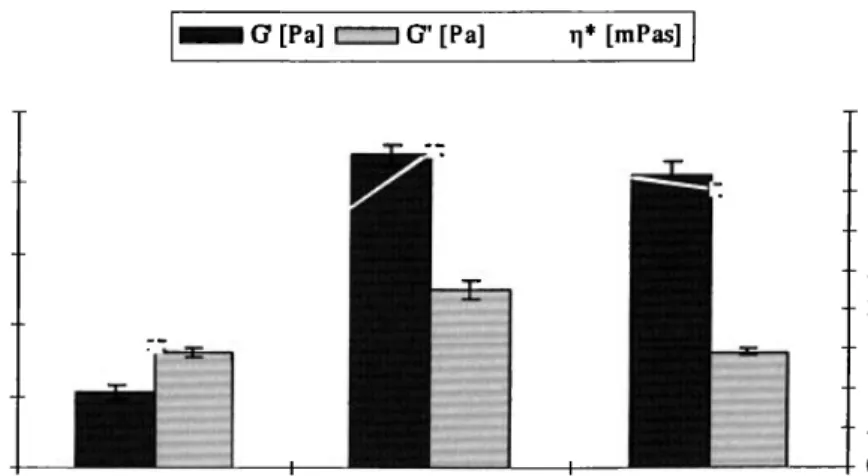
Figure 2 displays the storage modulus (G'), loss modulus (G"), and complex viscosity (Xl*) of the developed SLN formulations (A, B, and C), after application of a frequency range between 0 and 10 Hz. With regard to formulation A (SLN based on Softi- san©138), it can be seen that G' is lower that G", which means that the system is more viscous than elastic. For both B (SLN based on Compritol©888) and C (SLN based on stearyl alcohol) formulations, G' is higher by about one order of magnitude than G", and so the system is more elastic than viscous in the investigated frequency range and both parameters show weak dependence on the applied frequency. Note that formulation A is a supercooled melt; it has a lower Xl* and shows less suitability for topical adminis- tration because it might readily flow out of the container. Conversely, formulations B and C are highly crystalline and show a prominent elastic component. Another reason for the obtained differences is the percentage of lipid phase in each formulation. In more concentrated dispersions (B and C), relatively large amounts of lipid may significantly increase the effective volume fraction of the dispersion, and hence the viscosity, due to the quantity of immobilized liquid between the lipid phase and the relatively high surface area of the nanoparticles. According to these results, formulations B and C might
[Pal
U'-'-'-q
•' [Pa] q*
[mPas]
I
250 200 ß •. 150 • 100 5O A B C Formulation 4500 4000 3500 3000 2500 2000 1500 1000 50O 0Figure 2. Storage modulus (G'), loss modulus (G"), and complex viscosity 0q*) of the developed SLN formulations, after application of a frequency range between 0 and 10 Hz.
be suitable for topical administration because they exhibit a more uniform resistance against flow.
Both G' and G" moduli, as well as qq*, are also affected by the type and concentration of the surfactant in the formulation (14). Formulation B is sterically stabilized with poloxamer and, to provide a sufficient steric hindrance, a relatively large amount of this polymer is used, which might increase the effective volume fraction, resulting in higher viscosity. Therefore, the influence of the oil used for NLC preparation in its viscoelastic parameters has been evaluated in comparison to the respective SLN system. Regarding the obtained G' and G" values for NLC formulations, a completely different rheological behavior can be observed as a function of the liquid lipids of the formulations. The results are shown in Figures 3 and 4.
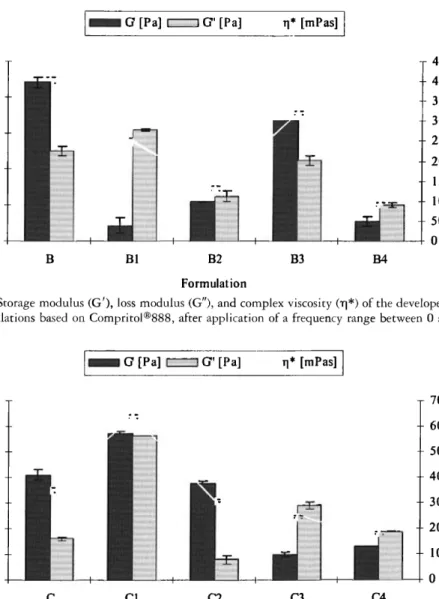
Using Compritol©888 as solid lipid, Miglyol©812 (B L) revealed a G" value four times higher than G', and therefore this oil is responsible for a more viscous system. In contrast, when using stearyl alcohol (C1), both moduli lie in the same range of mag- nitude. Tocopherol showed a greater influence on elasticity when formulated with stearyl alcohol as a solid lipid in NLC (C2). Sunflower oil also displayed significant
differences with regard to the solid lipid. In fact, when using Compritol©888 (B3) , the
G' was twice as high as G", showing that the system is more elastic than viscous, but the same was not detected when using stearyl alcohol (C3). Concerning LCT, this oil did not reveal any significant difference with regard to the solid lipid used for NLC prepa- ration (8 4 and C4).
Regarding the obtained qq* values, formulations B 2 and B 4 indicated a significant decrease in viscosity in comparison to the SLN system (Figure 3). Stearyl alcohol-based formulations (Figure 4) showed higher values, although the influence of the liquid oils was more pronounced in Compritol©888-based formulations (Figure 3). The lower zeta potential values of the stearyl alcohol-based nanoparticles might be responsible for the higher qq* values recorded for these systems. In fact, the decrease in electrostatic repul- sion between the suspended nanoparticles might be responsible for the develop-
[Pal
L-7--3
G'
[Pal •l*
[mPas]
}
250 2OO 15o 1oo 5O 0 { { • B Bi B2 B3 B4 4500 4000 3500 3000 2500 2000 1500 1000 500 0 FormulationFigure 3. Storage modulus (G'), loss modulus (G"), and complex viscosity (•*) of the developed SLN and NLC formulations based on Compritol©888, after application of a frequency range between 0 and 10 Hz.
i G
[Pal
• G"
[Pal n*
[mPas]
]
350 7000 300 250 200
150
1oo 5O C CI C2 C3 6000 5000 4000 3000 2000 1000 FormulationFigure 4. Storage modulus (G'), loss modulus (G"), and complex viscosity (qq*) of the developed SLN and NLC formulations based on stearyl alcohol, after application of a frequency range between 0 and 10 Hz.
ment of a three-dimensional structure more difficult to disperse due to the possible formation of aggregates. Another possible explanation is the higher mean particle size of the stearyl alcohol-based nanoparticles in comparison to the other developed formu-
lations.
CONCLUSIONS
Although much of the qualitative information about a material can be obtained by simply observing how a sample behaves when handled, the determination of the rheo-
logical properties of a dermatological formulation is extremely important. These studies allow (i) the evaluation of a the capability of a vehicle to suspend solids or immiscible liquids; (ii) the assessment of a topical formulation with respect to patient usage, e.g., the ease of removing the preparation from a container or spreadability and adherence to the skin; and (iii) the monitoring of the effect of the vehicle's consistency on the release of a drug from the preparation and its subsequent percutaneous absorption (bioavail- ability of the drug substance).
The determination of G', G", and qq* as a function of the applied frequency, using an
oscillation frequency sweep test, gives important information concerning topical admin- istration. According to the obtained results, for Compritol©888 as a solid lipid for NLC preparation, sunflower oil seems to be the oil that presents the best attributes for a topical formulation, i.e., more elastic behavior and a higher viscosity. With regard to stearyl alcohol, tocopherol shows the best results. The presence of a more compact and organized system can have a significant beneficial effect on the stability and on the viscoelactic properties of particulate aqueous dispersions and, therefore, on the topical administration of drug substances.
REFERENCES
(1) B. W. Barry and B. Warburton, Some theological aspects of cosmetics, J. Soc. Co, met. Chem., 19, 725-
744 (1968).
(2) J. Ceulemans, L. van Santvliet, and A. Ludwig, Evaluation of continuous shear and creep rheometry in the physical characterisation of ointments, Int. J. Pharm., 176, 187-202 (1999).
(3) R.H. Miiller, W. Mehnert, J.-S. Lucks, C. Schwarz, A. zur Miihlen, H. Weyhers, C. Freitas, and D. Rtihl. Solid lipid nanoparticles (SLN)--An alternative colloidal carrier system for controlled drug delivery, Eur. J. Pharm. Biopharm., 41, 62-69 (1995).
(4) R. H. M•iller, K. M•ider, and S. Gohla, Solid lipid nanoparticles (SLN) for controlled drug delivery-- A review of the state of art, Eur. J. Pharm. Biopharm., 50, 161-177 (2000).
(5) W. Mehnert and K. M•ider, Solid lipid nanoparticles--Production, characterization and applications, Adv. Drug Deliv. Rev., 47, 165-196 (2001).
(6) S. A. Wissing, A. Lippacher, and R. H. Miiller, Investigations on the occlusive properties of solid lipid nanoparticles (SLN),J. Cosmet. Sci., 52, 313-323 (2001).
(7) S. A. Wissing. SLN alr innovatives Formulierungskonzept J•ir pflegende und protective dermale Zubereitungen, PhD Thesis, Free University of Berlin, 2002.
(8) R. H. Miiller, "Zetapotential und Partikelladung in der Laborpraxis," in Wissenschaftliche Verlag•gesdl- schaft mbH (Stuttgart, 1996).
(9) C. Freitas and R.H. Miiller, Correlation between log-term stability of solid lipid nanoparticles (SLN TM) and crystallinity of the lipid phase, Eur. J. Pharm. Biopharm., 47, 125-132 (1999).
(10) A. Lippacher, R. H. Miiller, and K. M•ider, Preparation of semisolid drug carriers for topical appli- cation based on solid lipid nanoparticles, Int. J. Pharm., 214, 9-12 (2001).
(11) A. Lippacher, R. H. Miiller, and K. M•ider. Semisolid SLN TM dispersions for topical application: Influence of formulation and production parameters on viscoelastic properties, Ez•r. J. Pharm. Bio- pharm., 53, 155-160 (2002).
(12) E. B. Souto, S. A. Wissing, C. M. Barbosa, and R. H. Miiller, Evaluation of the physical stability of SLN and NLC before and after incorporation into hydrogel formulations, Eur. J. Pharm. Biopharm. 58,
83-9O (2OO4).
A. Lippacher, R. H. Miiller, and K. M•ider, Investigations on the viscoelastic properties of lipid based colloidal drug carriers, Int. J. Pharm., 196, 227-230 (2000).
A. A. Zaman, P. Singh, and B. M. Moudgil, Impact of self-assembled surfactant structures on the theology of concentrated nanoparticle dispersions, J. Colloid. Interface Sci., 251,381-387 (2002).
(13)