Revista Intersaberes | v9. n15. Edição Especial | jun. 2014 | p. 95-113| p. 95-113| ISSN 1809- 7286 Alvino Moser1
1 Graduated in Chemistry from the Pontifícia Universidade Católica do Paraná (1963) and in Philosophy from the Université Catholique de Louvain (1969). Master’s degreee in Epistemology from the Université Catholique de Louvain (1970) and doctorate in Ethics from the Université Catholique de Louvain (1973). Professor and researcher at Centro Universitário Internacional – UNINTER. [email protected]
Mario Sergio Cunha Alencastro2
2 Engineer, post-graduated in Philosophy (PUC/PR). Master’s degree in Technology (UTFPR) and doctorate in Environment and Development (UFPR). Professor and researcher at Centro Universitário Internacional UNINTER. [email protected]
ABSTRACT
The aim of this paper is to present some considerations about the mediation that occurs in social networks and their potential uses in the teaching-learning process. Virtual communities on the Internet that bring together people who are online connected by common values and interests can be very important in educational activities, as long as they overcome the recreational use and apply its interactivity features to provide knowledge exchange, collective learning, and consequently contribute to a dialogical practice. To be included in this process, the teacher's function is no longer to transmit or disseminate knowledge in a unidirectional way, but to encourage students to connect with their colleagues in order to share knowledge and practices, thus consigning an experience of collaborative learning.
Key words: Social networks. Learning. Communities of practice. Teaching practice. Epistemology.
INTRODUCTION
The current moment is of an intense and complex process of accelerated transformations in the communication field. It is the change from a writing-based culture to a multimedia- based culture. According to Manuel Castells (2012, p. 414), this change has historical dimensions similar to what happened in the Western world, when around
The first version of this article - with the original title “Learning by social networks: epistemological
considerations” - was presented as communication at the VII Seminário Internacional: as redes
educativas e as tecnologias, held at the Universidade Estadual do Rio de Janeiro (UERJ) within the
period of June 03-06, 2013.
Title in Portuguese: Considerações acerca da aprendizagem pelas redes sociais. English version by SILVA, Edna Marta Oliveira da. 2014
Revista Intersaberes | v9. n15. Edição Especial | jun. 2014 | p. 95-113| ISSN 1809- 7286
91 500 BC the Greeks started to use the alphabet. As a result, they migrated from an eminently oral culture to a culture based on writing in the range of only two generations.
Not always do paradigmatic changes happen without criticism. It is appropriate to remember that Socrates was against writing because according to him the written texts are inert and passive and they do not speak with the reader. When dialoguing with Fedro about the invention of writing by the Egyptians, he commented that "once it is written, a speech wanders everywhere, not only among the connoisseurs, but also among those who do not understand it, and it can never be said for who it suits or not", moreover, "when it is despised or unjustly censored, it needs help from the father, because it is not able to defend or protect itself" (PLATÃO, 2007, p. 120)1.
In the Socratic conception, although the writing is a drug for the memory, it is not appropriate to dialog. A written text has an audience and the interpretations may be different from those the writer wanted to say. It will be never known the author’s intention exactly. That is why Nietzsche (2008, p. 260) emphasized the perspectivism in reading the authors. In other words, “there are no facts, only interpretations" and that the needs of the individual (pulses) are those who interpret the world and that "each pulse is a kind of despotic ambition ", therefore, "each one has its own perspective, perspective that the pulse would like to impose as the standard for all other pulses".
It is worth remembering that with the invention of the mobile press by Gutenberg around 1439, the written language in the form of texts became universal, and it was consolidated in the Western culture as the main form of knowledge transmission. Later, due to the development of broadcasting in the 1920s and with the widespread of the television in the 1950s, the traditional written language started to suffer the influence of these new media.
Marshall McLuhan has drawn the attention to the fact that, as the possibility of broadcasting the news (weather forecast, traffic, etc.) at the right time, the radio had immense power to engage people. With respect to the written language it is as vital to the press as it is to the radio. However, its use occurs in different forms, according to the
1 In Portuguese: “uma vez escrito, um discurso sai a vagar por toda parte, não só entre os conhecedores, mas também entre os que não o entendem, e nunca se pode dizer para quem serve e para quem não serve”, além do mais, “quando é desprezado ou injustamente censurado, necessita de auxílio do pai, pois não é capaz de defender-se nem de se proteger por si”
Revista Intersaberes | v9. n15. Edição Especial | jun. 2014 | p. 95-113| ISSN 1809- 7286
92 media used. The journalistic texts can be ironic or only informational and each reader interprets it in their own way. In relation to the radio, someone reads to the listeners with suitable intonation. There are several ways to write the word night, for example. But on the radio, the newsreaders can pronounce it in different ways, and by giving it a wide variety of emotions and feelings (MCLUHAN, 1996, p. 97).
Thus, the communication resources were expanded. However, the accelerated development of ICTs (Information and Communication Technologies) that occurred from the 1980s modified this scenario even more. This complex set of technological resources interconnected among them provided the integration between different modes of communication in an interactive network that allows the fast and continuous flow of data, images, sounds and texts by means of the junction of the functions of hardware, software and telecommunications. As a result, the limitations of space and time are broken and endless possibilities for communication that are virtually revolutionizing all processes of human interaction are open up.
The Gutenbergian literary universe preserved in the conventional use of radio and television gives space for another model in which prevails the visual intertwined with several languages - radio, television, films and videos - arranged in a non-sequential writing through media that allow the synergistic use of sound, text and images broadcasted in real time. Everything works on the basis of intense interactivity among the agents, the profusion of means of communication and the simultaneity of messages (SROUR, 1998, p. 29-30).
Now, the ICTs as technologies that interfere and mediate the informational and communicative processes provided the emergence of networks. With the networks, it is possible to answer Socrates’s concerns about the inertia of the written texts, because the WEB2 enables the art of dialectics or dialog, and it is no longer a repository in which information or entertainment are sought, but meeting places or places to exchange information and knowledge.
With this, it can be said that the migration of the mass communication mode to the broadcasting style has already occurred nowadays in which certain information is
2 WEB - World Wide Web, also identified as WWW, is a system of hypermedia documents (the gathering of different media in a computational support) that are interconnected and executed on the Internet.
Revista Intersaberes | v9. n15. Edição Especial | jun. 2014 | p. 95-113| ISSN 1809- 7286
93 transmitted or distributed to many receivers simultaneously through digital media and networks, allowing interactivity and collaboration, as it occurred when there were only the radio and television. So, the passivity condition of a situation is overcome and the subject becomes operative because these features allow listening, reading, writing, going back and forward, selecting, treating and sending any kind of message to any place and at any time.
To gain mastery over the interactivity resources available on the WEB, it is possible to build personalized communication systems which gives rise to a phenomenon that Howard Rheingold (apud CASTELLS, 2010, p . 442) named "Virtual Communities", a new form of community that gathers online people around values and interests in common.
According to Hunter (2002, p . 96), "a virtual community is defined as a group of people who interact among themselves, by learning with the work of others and providing knowledge and information resources to the group in relation to issues on which there is agreement of mutual interest"3. Each participant of a virtual community is a contributor to the knowledge base in evolution of the group and not only a receiver or consumer of its services or knowledge base.
The virtual communities are expanded through social spaces built on the internet, also known as social networks. Such networks are social structures composed of people (or organizations) that share values, goals, interests and goals of those involved, and it allows horizontal and non-hierarchical relationships among the participants.
These horizontal nets are multimodal and incorporate many types of documents, such as photos, large-scale cooperative projects such as Wikipedia (the open code encyclopedia), music, movies, and even the social activism/political/religious networks that combine forums based on the internet by sending video, audio and text globally (CASTELLS, 2012, p. xiii).
Nowadays, Facebook attracts people from different age groups and social levels and expands the sociability to the inside of the social networks. The online communities
3
In Portuguese: “uma comunidade virtual é definida como um grupo de pessoas que interagem entre si, aprendendo com o trabalho das outras e proporcionando recursos de conhecimento e informação ao grupo, em relação a temas sobre os quais há acordo de interesse mútuo”.
Revista Intersaberes | v9. n15. Edição Especial | jun. 2014 | p. 95-113| ISSN 1809- 7286
94 have become a fundamental dimension of daily life that continues to grow everywhere, even in countries that were refractory to its dissemination some time ago, such as China and some Islamic countries.
The interactivity that networks provide is a challenge for all agents involved with the processes of communication, which has undoubtedly caused strong impact in learning environments.
In this context, social networks have great potential for educational activities, provided that their entertainment condition such as social networking sites or chat rooms is overcome, and their resources are used with focus on exchanging knowledge and collective learning. The same "place" where people gather to exchange share amenities can be also used by students to discuss topics of academic interest and clarify doubts, for example.
Due to its characteristics, Distance Education (DE) will be directly affected by this whole process, because it can be noticed that the facilities for interactivity provided by the social networks have not been incorporated into large-scale yet. The communicational profile of long distance classes via TV, radio and transmitted live to distance education classrooms maintained by the educational institutions has almost always remained centered in the logic of massive distribution of information (broadcasting), with little or no interaction in the process. The same can be said about the educational sites disseminated on the internet, which are usually static and devoid of interactivity mechanisms and collective creation. Such sites are little (or not) attractive to the young public, who are familiar with some much more interactive media.
Once the scenario in which social networks appear as a potential promise for educational activities is presented a question arises: is the learning in social networks credit worthy? The answer leads directly to an analysis of epistemological nature, the "study of the conditions of access and validity of knowledge" (PIAGET, 1967, p. 6). In this case, it means to examine the validity of the conditions of access to learning through social networks.
Revista Intersaberes | v9. n15. Edição Especial | jun. 2014 | p. 95-113| ISSN 1809- 7286
95
The epistemological substantiation
Etienne Wenger (2008, p. 3) draws attention to the fact that the school institutions are generally based on the assumption that learning is the teaching result which occurs during an individual process, from the beginning to the end, and it is separated from the rest of the student’s activities who is a passive agent. Thus, the necessary information in a society are encoded and translated into curriculum content programs taught in schools.
Learning is undoubtedly something personal that occurs in the brain of each individual through the interactions of neurons as shown by John Eccles (1997), Gerad Edelman (1992; 2007) ,Larry Squire and Eric Kandel (2003), for example. As such, learning occurs in first person. However, as it was stated by Descartes (1953, p . 559) in the Principia Philosophica prologue, learning happens in a more effective way in conversations and in the individual’s daily activities .
For Vygotsky (1998), Leont'ev (1978) and Luria (1979), learning is a transformation that takes place in an individual by the activity. In order words, it is an acquisition or appropriation of active knowledge, and the development of the individuals occurs from their social relationship, in the cultural environment in which they live.
Wenger (2008, p. 11) sees learning as something that happens throughout the lifetime in the most different occasions and places, and not necessarily only in school. Therefore, a new benchmark in respect of learning, "a social theory of learning" would be of value not only for the theorists in education, but also for all those who in one way or another need other ways to promote learning (individual or collective) in their relationships, communities and organizations.
However, the present form of learning today still very much emphasized in school process is the one regarding to the acquisition or appropriation of knowledge in cumulative nature, which is acquired by the individual through transmission. It is a process based on passive transmission of knowledge and with focus on the teacher from whom the student only listens to the requirements provided by external authorities. Paulo Freire used the expression "banking education" to characterize this model that
Revista Intersaberes | v9. n15. Edição Especial | jun. 2014 | p. 95-113| ISSN 1809- 7286
96 proposes to deposit information, data and facts in the mind of the student, "that receives the knowledge passively, and becomes a deposit of the educator. Educating to archive what is deposited4 “(1979, p. 38).
It is a millenary tradition “that has been based on the teacher’s speech for five thousand years" (LÉVY, 1993, p. 8) and which is physically located in school.
The social learning theory is more comprehensive than the learning that considers only cognitive aspects because the social dimensions include elements that involve the person as a whole, by considering his/her interactions and emotional aspects.
Bandura (1977, p. 22) emphasizes the importance of observing and modeling the behaviors, attitudes and emotional responses from others. Most human behavior is learned by observation of the others, which enables a person to form ideas of how new behaviors are performed. Once this information is "codified” it subsequently serves as a guide for action. It is learning by mutual determinism, which happens more in social relations than in educational institutions.
Therefore, not only does the individual learning take place with the effort of just one person, but in the context of networks that constitute a community. For Illera (2007, p. 120), "the learning appears completely linked with the rest of the personal and social life of the subjects and not only with the cognitive domain of skills and aptitudes to acquire5". It is a repositioning that "assumes that learning is not seen as the sole or last purpose of the practice, but as an element of interconnection between aspects that have the same importance to the subject as the mere improvement of performance or acquisition of certain abilities"6.
In the prologue of his work, Nicholas Carr (2011, p. 11-15) makes a remark about the fact that few people gave attention to Marshall McLuhan’s statement that "we are approaching the 'technology simulation of consciousness', in which the creative process
4 In Portuguese: “que recebe passivamente os conhecimentos, tornando-se um depósito do educador. Educa-se para arquivar o que se deposita”
5
In Portuguese: “a aprendizagem aparece completamente relacionada com o resto da vida pessoal e social dos sujeitos e não só com o domínio cognitivo de competências e destrezas a adquirir.”
6 In Portuguese: “pressupõe que a aprendizagem não seja considerada como o fim único ou ultimo da prática, mas como um elemento de interligação entre aspectos que tem a mesma importância para o sujeito que a simples melhoria do desempenho ou aquisição de determinadas habilidades”.
Revista Intersaberes | v9. n15. Edição Especial | jun. 2014 | p. 95-113| ISSN 1809- 7286
97 of knowledge would be collectively and corporately extended to the entire human society7". When McLuhan says that the medium is the message, it is necessary to understand that the medium content matters less than the medium itself in its influence on our way of thinking and acting in long term.
However, it remains unclear whether this has some epistemological validity. It is considered Vygotsky’s concept of mediation, reviewed by James Wertsch. Generally speaking, “mediation is the process of intervention of an intermediary element in a relationship; then, the relationship ceases to be direct and starts to be mediated by this element" (apud OLIVEIRA, 2002, p. 26) and that "the process of mediation by means of instruments and signs is fundamental for the development of higher psychological functions, distinguishing the human being from other animals. The mediation is an essential process to make possible the voluntary, intentional, psychological activities controlled by individual himself". 8
But the mediation cannot only be seen as language and neither is it consistent with all the other methods traditionally employed in classrooms. Learning is an action of the person. If there is mediation in all human action, in the same way the learning is done with the semiotic mediation or by social interaction, in which the words are employed as a means of communication. Vygotsky and his disciples named this mediation as social interactionism. The action takes place in a social and historical interaction or in a historical and cultural one.
It should be noted, however, that the means or tools that constitute the mediation do not produce the meaning or the learning, which is something peculiar to the action of each individual; because a tool or medium has only one action in as far as the individuals use them (WERTSCH, et. al, 1998, p. 28). Therefore, mediation has its own dynamics.
7 In Portuguese:
“estamos nos aproximando da ‘simulação tecnológica da consciência’, onde o processo criativo do conhecimento seria estendido coletiva e corporativamente ao todo a sociedade humana”. 8
In Portuguese: .“Mediação em termos genéricos é o processo de intervenção de um elemento intermediário numa relação; a relação deixa, então de ser direta e passa a ser mediada por esse elemento”(...) “processo de mediação, por meio de instrumentos e signos é fundamental para o desenvolvimento das funções psicológicas superiores, distinguindo o homem dos outros animais. A mediação é um processo essencial para tornar possíveis as atividades psicológicas voluntárias, intencionais, controladas pelo próprio indivíduo”.
Revista Intersaberes | v9. n15. Edição Especial | jun. 2014 | p. 95-113| ISSN 1809- 7286
98 Learning cannot be seen anymore as an individual who learns alone. Learning takes place in a structure and in a social environment as something that involves the whole person in all aspects of his/her life. In this regard, on social networks "the content" goes much further than it may be required in a classroom because each student brings his/her knowledge, experiences and clarifications that can be more enlightening than in a traditional classroom in which a teacher monopolizes the knowledge with the intention of communicating it to all.
Above all, it can no longer be considered the teachings or information encapsulated in the curricula and programs because content and lessons are already delayed due to the rapidity with which the internet provides new information. On the one hand, the programmatic content is presumably stable and; on the other hand, the information evolves and grows in a surprisingly way. There are hyper- specialization and hyper-expansion of information that raise a dilemma for anyone who is in charge of teaching (MORIN, 2000, p. 13-20).
With the advent of digital and virtual means which introduced the cyberspace, it is necessary to revisit the concept of mediation for the virtual that expands and extends the possibilities for learning and teaching. It is a situation in which the role of the teacher will no longer be limited to the transmission or dissemination of knowledge, but to encourage students or apprentices to connect with their colleagues to exchange their knowledge, by showing that all of them have a collective intelligence because they can be interconnected in cyberspace, while noosphere, the "sphere of human thought 9" (LÉVY, 2008, p.154).
So, the social environment is an essential mediator that does not need an extra tutor per se. It can be simply observed the way children learn to speak and do many other things just by listening to what is said in their surroundings and by imitating the people who do certain things or actions.
Another important factor is the advent of the "net generation", a term used by Don Tapscott (1999) to define those who have already been born surrounded by digital technology, "the product of a society immersed in a profusion of technologies that no
9
Revista Intersaberes | v9. n15. Edição Especial | jun. 2014 | p. 95-113| ISSN 1809- 7286
99 longer are tools and started to integrate the profile of these young people. Do these young people who are incapable of understanding a world without internet have to adapt themselves to a traditional educational model as we know it?
Tapscott (2010) comments on how the net generation learns and says that the educational institutions are outdated. In the 21st century, the internet generation grew in a digital environment, while the educational system that prevails in many places is one hundred years behind at least. It is a teacher- centered model of education designed for the industrial age with standardized and unidirectional classes. The idea of an isolated student who works alone and has to absorb the content taught by the teacher does not work anymore "for the challenges of the digital economy or for the mind of the internet generation” (p. 149-150)10.
Social networks in education
The education model that is based on planned classes with anticipation of years, months or weeks is no longer appropriate because nowadays a fact taught during a class may be different at the end of the day since the changes in facts occur in an extremely fast manner. How can students be prepared or trained for a world in which innovation and discard constitute the rule?
Of course, there are no recipes for it. Even so, Tapscott (2010, p. 149-150.) offers several examples such as the one from Dr. Mary Terrell, a calculation professor at Cornell University. Before class, she posts questions on the Internet that produce anxieties about the topic to be studied or the issues to be discussed and solved, if possible. Those questions can also come from the students in order to register with transparency all meanings which will be naturally very different.
A meeting planned in this way represents a compromise and interactivity among colleagues, and certainly positive discussions to reinvent solutions or provide new answers to the problem. Finally, if there is time, some students will present the best
10
Revista Intersaberes | v9. n15. Edição Especial | jun. 2014 | p. 95-113| ISSN 1809- 7286
100 solutions on the board or in the lesson report.
It is important to note that these classes are face to face and without the aid of the digital medium. Undoubtedly, the interaction would be much more efficient and participatory with the aid of digital media by using Facebook, My Space or another type of site for collaborative group.
There is no doubt that the mediation is a dynamic interactive form of communication for students in distance or face-to-face classes. As Wertsch (1998) stated, mediation requires changes in ways of learning and teaching.
A class in a traditional style in which the teacher was the knowledge keeper who taught students willing to follow the teacher or pay attention to him/her is a thing of the past. The reference here is to the teacher who guided his/her disciples to follow the routes imposed on the students. The new students do not accept and cannot learn this way.
How to proceed then? The answer can be found in the use of Communities of Practice (WENGER, 2008, p. 72-85). A Community of Practice (CoP) is a self-organized group of people who share an interest and join together to develop knowledge in order to create a practice around this topic. It is different from a team because it is defined by a topic of interest and not by a task to be carried out. It also differs from an informal network because it has a theme and an identity.
There are three elements that define a Community of Practice. The first is the domain, the issue on which the community discusses. The second is the community itself, people who must interact and build relationships among themselves around the domain. The third element is the practice itself. There must be necessarily a practice and not just a shared interest by people. They learn together how to do the things they are interested in.
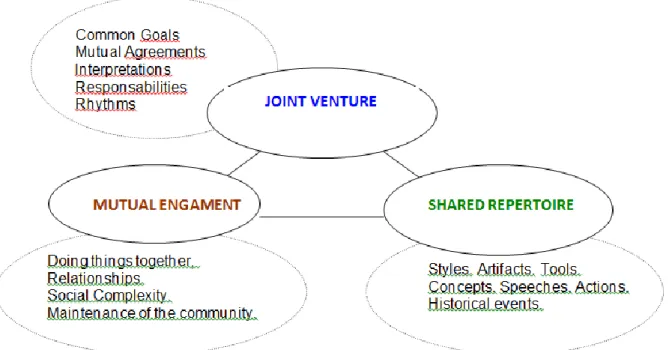
Wenger (2008, p. 73-74) lists the key concepts to associate practice to the community: mutual engagement, joint enterprise and shared repertoire (Figure 1). A community of practice is sustained from relations of mutual engagement on what is intended to do, and this involves performing the tasks together, interpersonal relationships and the maintenance of the community itself. It is worth remembering that the members of the community share common interests, carry out the same task and
Revista Intersaberes | v9. n15. Edição Especial | jun. 2014 | p. 95-113| ISSN 1809- 7286
101 have shared goals, their idiosyncrasies and aspirations make each member assume a unique place and a unique identity within the group at the same time.
Despite their individual differences, the members of a CoP must find mechanisms of coexistence and cooperation. It is a joint venture, in which are defined the common goals, the agreements among the participants, the responsibilities and work pace. An enterprise of this nature is established and horizontally maintained by the entire group, and not determined by a hierarchical superior. Along the coexistence and interaction among the participants, the meanings, the codes of practice and ways of proceeding are established, even if not always in a structured way.
In addition, the CoP makes use of a common language. It is a kind of repertoire that includes styles, artifacts, tools, concepts, words, actions, historical events, routines, symbols, gestures and ideas shared by the community (WENGER, 2008, p . 83). However, this repertoire undergoes constant transformation of meanings as new interactions happen in the community. To achieve competence in a CoP it is important to have access to and master this repertoire in a proper way.
Figure 01 -The dimensions of a CoP. Source : Adapted from Wenger (2008, p . 73).
Revista Intersaberes | v9. n15. Edição Especial | jun. 2014 | p. 95-113| ISSN 1809- 7286
102 In a Community of Practice, the people who are involved must interact by building mutual relationships, and they must also develop a practice around the topic of interest , i.e. learning together how to do the things for which they are involved and interested in. The emphasis is always on collective learning. Its members are so committed that even in their free time they discuss and seek solutions to the problems that they are dealing with in a process of permanent learning. In summary, a collective learning around the interests of the community must be shaped. For example, researchers can constitute a CoP to develop and share knowledge around some object of research. In the case of virtual communities, the meetings can happen even when the members are physically distant.
The internet offers a range of facilities that once well explored, they can provide effective support the CoP's as it is the case of a social network. In this respect, many virtual communities have conditions to represent the establishment of true communities of practice, a knowledge network on the internet.
Still in the CoP context, it should be further explained what Wenger (2008) and Flush (2001) understand by learning. These authors emphasize the interconnection between learning and concepts that were considered classically separated: learning, identity, practice, meaning, community, context, according to the scheme:
Figure 02 - Adapted from components of a social theory of learning: an initial creation (WENGER, 2008, p. 5)
For learning in social networks, what is the meaning of the components of this scheme?
PRACTICE
[learn by doing]
COMMUNITY
[learning as belonging]
MEANING
[learning through experience]
IDENTITY
[learning how to become ]
Revista Intersaberes | v9. n15. Edição Especial | jun. 2014 | p. 95-113| ISSN 1809- 7286
103 The individual and collective interactions must refer to the knowledge to be acquired in the various disciplines as something meaningful to the student. It is well known that much of what is taught in the classroom little is internalized by the people from the community they are part of. On the other hand, in the social networks students offer the knowledge that are significant to them and result from their experiences and practice in their daily lives. The learning in these networks causes changes in the individual’s way of being and creates personal stories that identify them with the communities to which they belong to (WENGER, 2008, p 5).
In the CoP's, the participants learn in so far as they are willing to communicate their knowledge (not information) to others and if they also want to benefit themselves from the knowledge made available by other participants in the community. According to Jacques Ranciere (1987), when considering the communities of practice as the locus of learning, it can be said that learning is something processed as mediation in these communities. In this way, a virtual community of practice is not a free site; it is an environment for people who want to learn. In other words, a "virtual learning environment".
Stricto sensu, virtual learning environment also known as Learning Management System (LMS) is software that adds tools for creating, tutoring and managing activities that are normally present in the form of courses when available on the internet. It is constructed from different media and languages aiming at providing not only contents, but mainly the interaction among people and groups with focus on the knowledge construction. Claroline, Moodle and Teleduc are examples of virtual learning environments currently available among others (SILVA, 2010, p. 16).
The use of tools such as the LMS’s provides the means for a true "reengineering of the classroom", because the teaching and learning activities are focused on student learning in such environments, a practice that is built under three basic pillars, the cognitive, the affective and the social, and in which the educational practice, here understood as mediation for learning, always happens by the involvement of the student in learning actions (GUIMARAES; DIAS, 2002, p. 26-27).
If social networks are already part of the students’ routine, then why not exploit them as virtual learning environments? Their popularity and ease of information sharing,
Revista Intersaberes | v9. n15. Edição Especial | jun. 2014 | p. 95-113| ISSN 1809- 7286
104 knowledge and common interests can no longer be undervalued. Another important point is that networks are democratic, in the sense that many people have access to them, regardless of social class, age, race, etc. In addition, unlike many traditional tools on LMS, networks are flexible, in which it is possible for the user to change settings, posting pictures, texts and videos, format, play, share, opine, meet, chat, write and repeat everything again, as many times as necessary. This is the autonomy and free creation process that makes social networks an open field for research and camp.
It is necessary that the school seeks an approximation with social networks; because it is there that the students’ interest is more focused. Among the innumerous ways that the internet offers to work the school contents, social networks may be the ones that deserve greater attention on the part of the researchers, if addressed by bias of communities of practice.
Final Considerations
It seems opportune now to mention the Apology of Socrates who was convicted of corrupting the youth. And what corruption was it? It was the dialogs said by Socrates in the public square that supplanted the ones who thought wise. The disciples who always accompanied Socrates began to imitate him, and consequently, they unmasked many people who thought wise, but were not in fact. Socrates was considered responsible for having taught such behavior to their young disciples and he was accused of being "the most disgusting of the individuals and is corrupting the youth" (PLATÃO, 2003, p. 9-13). This accusation has never been proven.
What does Socrates’ subversion have to do with the educational use of social networks? Everything is going by dispelling the myth the figure of the knowledge keeper, no matter if they are parents, religious leaders or educators. As well stated by Don Tapscott "the net generation seems to prefer raising controversial issues with their parents and other adults." (TAPSCOTT, 1998, p. 87). The inquiring Socratic spirit applies to parents and adults in general, but particularly in relation to the lessons that students
Revista Intersaberes | v9. n15. Edição Especial | jun. 2014 | p. 95-113| ISSN 1809- 7286
105 receive from their teachers, because they can confront what is taught to them with what is on the internet.
In view of these findings and epistemological assumptions, the teaching methods as well as the assessment ones maybe need to be redesigned and rerouted towards a dialogical praxis. One of the authors of this article has taught for more than 60 years, and uses several resources of media interaction in his philosophy classes. He also assesses his students, not only by tests, works and researches that they develop, but also by their effective participation in the chat room and in other online interactive activities.
It is not enough to camouflage the old action modes with fresh technological wrapping, despite of being captivating. It is necessary to review (subvert?) certain archaic educational methodologies completely, or as the French would say, fondencomble.
It is well known that in many occasions the students little learn in the classroom, or better, few learn with the traditional classes taught in the conventional way. Any individual presents difficulties in remembering the content that it was transmitted in high school or even what was taught at the university. Why?
Simply because the contents had little to do with reality: the contents were taught by the teachers who did not ask the students what they wanted or needed to learn. The concern was only to fulfill the curricular guidelines designed by professionals who lived in ethereal academic world with their backs turned to reality. They preached in the wilderness to drowsy or indifferent students. Whereas, a community of practice is comprised of members who are interested in learning what they need to know in order to better carry out their day-to-day functions. If available on the internet by means of a social network, we have a potential virtual community of practice, as it has been already discussed previously; it holds endless possibilities of interaction and knowledge construction.
Not only should the teaching methodology be reviewed, but also the assessment procedures. These should measure not so much the contents, but above all:
1. If there was interaction among students in both group chat rooms, as communities of practice and other networks.
2. If the participants of networks in fact cooperated effectively in knowledge construction. Collaboration requires more than simple interaction.
Revista Intersaberes | v9. n15. Edição Especial | jun. 2014 | p. 95-113| ISSN 1809- 7286
106 3. Finally, if the students in networks were creative and not just repeaters of what is on the WEB, reflecting the same opinions, but if they have taken steps towards new discoveries. But if they were not creative, it has to be verified if they are divergent and inspire new aspects and new ideas for group discussion. Now, this is very different from what is done in multiple-choice exams and, usually, in exams with open questions. And all of this requires a profound reflection in the teachers’ everyday life practice.
REFERENCES
BANDURA, A. Social Learning Theory. New York: General Learning Press, 1977. CARR, Nicholas. A geração superficial: o que a Internet está fazendo com nossos cérebros. Rio de Janeiro: Agir, 2011.
CASTELLS, Manuel. A sociedade em rede. V.1. A era da informação: economia, sociedade e cultura. 6.ed. São Paulo: Paz e Terra, 2012.
DESCARTES, René. Oeuvre set Lettres. Paris: Gallimard, 1953.
ECCLES, John: Comment la conscience controle le cerveau. Paris: Fayard, 1997.
EDELMAN, Gerard. La science du cerveau et la connaissance. Paris: Odile Jacob, 2007. EDELMAN, Gerard. Biologie de La conscience. Paris: Odile Jacob, 1992.
FREIRE, Paulo. Educação e mudança. Rio de Janeiro: Paz e Terra, 1979.
GUIMARÃES, Ângelo de Moura; DIAS, Reinildes. Ambientes de aprendizagem: reengenharia da sala de aula. In: COSCARELLI, Carla Viana. (Org.). Belo Horizonte: Autêntica, 2002. p. 23-42.
HUNTER, B. Learning in the Virtual Community Depends upon Changes in Local
Communities. In: RENNINGER, K. A.; SHUMAR, W. Building virtual communities. Learning and change in cyberspace.New York: Cambridge University Press, 2002.
ILLERA, José L. Rodriguez. Como as comunidades de prática e de aprendizagem podem transformar nossa concepção de educação. SÍSIFO- Revista Ciências da educação, n. 3. mai/ago, 2007.
KANDEL, E.; SQUIRE, L. Memória da mente às moléculas. Porto Alegre: ArtesMédicas, 2003.
LAVE, J. ; WENGER, E. Situated Learning: Legitimate peripheral participation. Cambridge: Cambridge University Press, 1991.
Revista Intersaberes | v9. n15. Edição Especial | jun. 2014 | p. 95-113| ISSN 1809- 7286
107 LEONTIEV, A.N. O desenvolvimento do psiquismo. 4.ed. Lisboa: Livros Horizonte, 1978. LÉVY, Pierre. As tecnologias da inteligência: o futuro do pensamento na era da
informática. Rio de Janeiro: Ed. 34, 1993.
LEVY, Pierre. Cibercultura. São Paulo: Editora 34, 2008.
LURIA, A. R. Curso de psicologia geral. Rio de Janeiro: Civilização Brasileira, 1979, vol. I. MCLUHAN, Marshall - Os meios de comunicação como extensões do homem. São Paulo: Editora Cultrix, 1996.
MORIN, Edgar. A cabeça bem feita: repensar a reforma, repensar o pensamento. Rio de Janeiro: Bertrand do Brasil, 2000.
NIETZSCE, W,F. A vontade de poder. Rio de Janeiro: Contraponto, 2008.
OLIVEIRA, Marta Kohl. Vygotsky: aprendizado e desenvolvimento, um processo sóciohistórico4. ed. São Paulo: Scipione, 2002.
PIAGET, Jean. Logique et connaissance scientifique. Paris: Gallimard, 1967. PLATÃO. Apologia de Sócrates. Disponível em: <
http://www.dominiopublico.gov.br/pesquisa/DetalheObraForm.do?select_action&co_obr a=2296> Acesso em 10 jun. 2014.
PLATÃO. Fedro. São Paulo: Martin Claret, 2007.
RANCIÈRE, Jacques. O mestre ignorante: cinco lições sobre a emancipação intelectual. Belo Horizonte: Autêntica, 2002.
SILVA, Robson Santos da. Moodle para autores e tutores. São Paulo: Novatec Editora, 2010.
SROUR, Robert Henry. Poder, cultura e ética nas organizações. Rio de Janeiro: Campus, 1998.
TAPSCOTT, Dan. Geração digital: A crescente e irreversível ascensão da geração Net. São Paulo: Makron Books, 1999.
TAPSCOTT, Don. A hora da geração digital. Rio de Janeiro: Agir Negócios, 2010. VYGOTSKY, L. S. A. Formação social da mente..6. Ed. São Paulo: Martins Fontes, 1998. WENGER, Etienne. Communities of practice: learning, meaning and identity. 18 ed. Cambridge: University Press, 2008.
Revista Intersaberes | v9. n15. Edição Especial | jun. 2014 | p. 95-113| ISSN 1809- 7286
108 WERTSCH, James V., DEL RIO, Pablo, ALVAREZ, Amélia. Estudos socioculturais da mente. Porto Alegre: ArtMed, 1998.