Issue 1 Pushing the Boundaries: Performing Research
October 2016
Re-Constructing the Choreographic Studio of João
Fiadeiro Through Animated Infographic Films
Stephan Jürgens
New University of Lisbon
Francisco Henriques Carla Fernandes
New University of Lisbon
Follow this and additional works at:http://scholar.colorado.edu/partake
Part of theDigital Humanities Commons,Interdisciplinary Arts and Media Commons, and the Performance Studies Commons
This Article is brought to you for free and open access by CU Scholar. It has been accepted for inclusion in PARtake: The Journal of Performance as Research by an authorized administrator of CU Scholar. For more information, please [email protected].
Recommended Citation
Jürgens, Stephan; Henriques, Francisco; and Fernandes, Carla (2016) "Re-Constructing the Choreographic Studio of João Fiadeiro Through Animated Infographic Films," PARtake: The Journal of Performance as Research: Vol. 1: Iss. 1, Article 3.
This paper presents a novel visualization method for conceptual structures and dramaturgical strategies in contemporary dance based on a case study of three selected solo works by choreographer João Fiadeiro. The authors argue that video annotation techniques can be used efficiently to analyze the collected data about the solo pieces across the different media (video recordings of rehearsals, performance, workshops, public discussions; audio recordings of interviews and working sessions with Fiadeiro; program notes, reviews, academic articles, and so forth). Following the data processing and analysis, we have produced three animated infographic films, which provide an adequate medium to present findings in a multimodal format that combines the advantages of audio-visual storytelling and graphic representation of complex interconnections. Both techniquesvideo annotation and animated infographic films—constitute the novel visualization method we have recently developed.
The work presented here has been developed in the framework of the ERC1 -funded BlackBox Arts&Cognition2 project (2014-2019) hosted at the New University of Lisbon, Portugal. During five years the BlackBox researchers (linguists, performance theorists and computer scientists) collaboratively investigate and document performance composition processes in contemporary dance. Three choreographers from different areas of contemporary dance open the doors of their studio spaces during the creation and production period of a new stage work.
Our first case study is choreographer João Fiadeiro, whom we have accompanied for eighteen months. Due to Fiadeiro’s varied lines of work as a solo performer, choreographer and teacher, we have engaged in several complementary research activities. As a team, we attended improvisation and composition workshops in his particular Composition in Real Time method; we attended classes taught by Fiadeiro in different universities and interviewed the professors he collaborates with; we have attended, documented and collaborated in the SOLOS | ENACTMENTS performance series; and we have accompanied and documented the entire creation process of his latest stage work entitled What to do with what remains (2015). As a result of this multifaceted engagement with Fiadeiro we have produced four studies in the different scientific areas of the BlackBox project, which are presented on the project’s web-based platform3.
While the research on performance composition processes represents our first and main line of investigation, the visualization of conceptual structures and
compositional or dramaturgical techniques employed by the choreographers constitutes a second important line of inquiry. Consequently, this paper focuses specifically on the study of the SOLOS | ENACTMENTS performance series by Fiadeiro and discusses in detail, how we re-created this choreographer’s conceptual and imaginative space in the digital environment of animated infographic films. The process of re-creating Fiadeiro’s compositional process in a specific digital environment, we argue, is media-practice-as-research. As we will show below, certain digital technologies and techniques allow the visualizion of compositional strategies and dramaturgical structures in ways that witnessing a live performance does not permit. In other words, we have produced the animated infographic films from a visual art-based research perspective, questioning the creation process of three contemporary dance performances through another artistic medium. The result is an invitation to the viewer to enter the virtual re-constructed studio space of the choreographer and to experience João Fiadeiro’s unique artistic universe.
Introducing João Fiadeiro’s Composition in Real Time (CTR) Method
More than two decades ago, in 1995, João Fiadeiro started to develop what became known as his Composition in Real Time method (CTR).4 Based on the necessity to share his personal artistic modus operandi with others who collaborate with him in production processes and in live performance, Fiadeiro designed a compositional system that he has continuously developed for twenty years.
After an initial foundational phase, the CTR method was established as a system to both improvise conjointly, and to explore the dramaturgical dimension in dance with collaborating artists, philosophers and scientists. In the following decade of development and consolidation, the CTR method increasingly attracted attention from scientists in such diverse fields as economics and management, neuroscience, complexity science and anthropology. Some of these scientists explored the CTR method and collaboratively developed transdisciplinary research tools with Fiadeiro.5 In turn, the central CTR concepts and techniques were elaborated and refined through these collaborations.
Today the CTR method is a fully developed system that can be put to use by its practitioners in various ways. For some, the method represents a tool to reflect upon
collaboratively towards shared objectives in a way that respects the contributions of collaborators.6 For others, the CTR method is mainly employed as a technique for artistic improvisation in rehearsal and performance on stage.7 For yet another group of practitioners, the CTR is utilized as a powerful set of compositional and dramaturgical principles, which can guide the production process of new work.8
The BlackBox Study on Fiadeiro’s SOLOS | ENACTMENTS Performance Series
During the years 2009-2014 Fiadeiro dedicated himself exclusively to systematizing, teaching and developing his Composition in Real Time method in various contexts. Following these years of absence from the stage, he initiated a new choreographic cycle. In November 2014, he began presenting a performance cycle entitled SOLOS | ENACTMENTS, comprised of three signature solo works from different periods of his career: I am sitting in a room different from the one you are in
now, (1997); Este corpo que me ocupa, (This body that occupies me, 2008), and I was here (2008).
The BlackBox project team of researchers commenced their collaboration with Fiadeiro in October 2014. The opportunity to accompany the SOLOS | ENACTMENTS performance series was especially convenient for our research, as Fiadeiro decided to start a new choreographic cycle with a profound reflection on his artistic modus operandi. In the following months, one of the authors of this paper (Stephan Jürgens) decided to design and carry out a study on the particular conceptual structures and dramaturgical strategies underlying the three solo works of this series. During a first preparatory meeting, Fiadeiro suggested that Jürgens could best research his creative process through practice, and invited Jürgens to develop the video design for one of the solo works (I was here), which Fiadeiro was planning to present several times during the year 2015.9
As Jürgens rehearsed with Fiadeiro, he became familiar with the compositional concepts and techniques, the dramaturgical structure and the particular way in which Fiadeiro documented and re-enacted I was here. Based on this first-hand practice-as-research experience, Jürgens invited Fiadeiro to video annotate the remaining two works of the SOLOS | ENACTMENTS performance cycle in two dedicated sessions. Fiadeiro meticulously annotated the dramaturgical structure of both solo works, and
provided detailed information about the creative process and the evolution of the pieces over the years.10 Both sessions were video recorded and complement Fiadeiro’s video annotations.
Subsequently, Jürgens devised an annotation scheme11 for the analysis of all collected data, and used the annotation software ELAN for data processing. Once annotated, all available documents together formed a database, which could be searched to analyze a particular question: for example, whether Fiadeiro used a specific compositional strategy in more than one solo piece.
Animated Infographic Films as a Novel Research Visualization and Dissemination Format
At the time the study on the SOLOS | ENACTMENT performance cycle had come to a close, we contemplated different and complementary formats of research dissemination that could be published on the evolving BlackBox project platform, alongside the scientific publications we produced. A common strategy would have been to produce a documentary film on our subject, eventually accompanied by a printed
publication. 12 Alternatively, we considered navigable DVD-ROM or online
environment formats, where the user could freely explore our materials and findings.13 However, we needed a different format given the specific nature of our data that had been extracted from the video annotation documents, such as the dramaturgical organization of choreographic sections and their duration in seconds; or the categorization of different types of artistic themes. This information, we felt, would be best presented in a graphic language, and consequently we investigated adequate forms of data visualization and information graphics. Tim Finke and Sebastian Manger clarify the differences between both forms of visualization.
Information Graphics
Here one distinguishes between static, interactive and animated information graphics, the last of which are the subject of the present book. In contrast to the data visualization discussed in the next section, in which every numerical value has exactly one visual representative, the information graphic presents overall contexts and is often result of a journalistic examination of a specific thematic area. By comparing different data sets and visualizations of the data and embedding them in a context, the viewer sees the result in the form of a narration with the help of illustrations.14
Finke and Manger present the rather recent genre of animated infographic films in their insightful book Information - Animated Infographics as a new medium for the concise communication of complex information. The authors list seven important advantages, of which the first three are particularly relevant for our study:
(1) Time Sequences: Temporal sequences of events can be rendered graphically. In addition, time can be slowed down or accelerated at will to emphasize or speed up process.
(2) Causality: Relationships and interdependencies of data and processes can be illustrated more directly.
(3) Viewers are directed to selected facts in a predetermined sequence, resulting in fewer misunderstandings in interpreting the graphic.15
Convinced that we had discovered the adequate format and medium to visualize and critically reflect our research findings, we embarked on a six-month journey of producing four animated infographic films, three of which were dedicated to the respective solo pieces of the SOLOS | ENACTMENTS performance cycle, and a fourth film presenting the graphic models that Fiadeiro has been developing to explain central concepts of his Composition in Real Time method.
All films are accessible via Vimeo:
1. I am sitting in a room different from the one you are in now -
https://vimeo.com/149282000
2. I was here - https://vimeo.com/149282563
3. Este corpo que me ocupa (This body that occupies me) -
https://vimeo.com/164809579
4. Graphic models developed by João Fiadeiro - https://vimeo.com/149281774
From the perspective of PAR theory, creating an animated infographic film represents an act of media-practice-as-research. Graeme Sullivan, for exemple, has suggested that through “forming acts” of research (such as the production of our films) “understanding emerges within the process of media experimentation, and this performative knowledge can be likened to more traditional grounded strategies such as observation and empirical confirmation.”16 As we experimented with the visualization of our findings, we acquired a deeper understanding of our subject through medium-specific processes. For example, time can be re-configured in the digital realm, and
through the technique of time-lapse photography we were able to visualize dramaturgical ideas and processes that can neither be perceived in live performance nor in conventional video recordings. Throughout the six months of producing the animated infographic films, we discovered new interconnections between the different solo works, and the CTR concepts and principles. We decided to re-create essential elements of Fiadeiro’s artistic and educational universe in the form of an ‘expanded studio’17, or virtual space, which the visitor can explore from several entry points.
Re-Creating Fiadeiro’s Conceptual and Imaginative Space
The starting point for the visualization of our research findings was the conception of an audio-visual space that would translate Fiadeiro’s conceptual and imaginative space(s) as accurately as possible. Consequently, we decided to visually recreate the studio space of Atelier Real in Lisbon, Portugal, where Fiadeiro has developed his multifaceted artistic, educational and scientific work during the past decade. To this end we took a series of photographs of the empty studio from various angles in succession, which could later be combined and composed in a way that the film viewers might perceive themselves as being physically present in the space. This illusion is created by employing a series of image processing techniques that allowed us to digitally produce two and three-dimensional spaces, in which each object within the image existed in the correct distance and field depth in relationship to other objects.
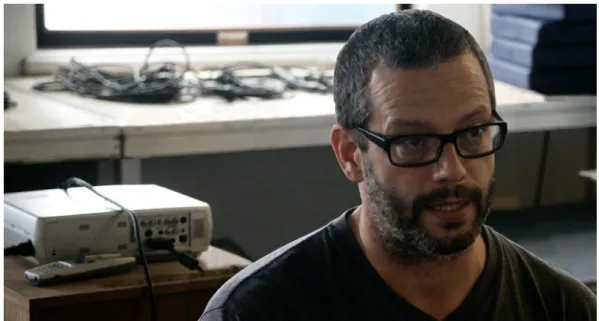
In the opening sequence of the Graphic models film, for example, we have employed a technique commonly known as parallax to recreate the sensation of sitting at a table with Fiadeiro and listening intensely to his explanation of important concepts of the CTR method. The viewer’s gaze first rests on objects such as electric cables near the window, then seemingly zooms in on a video projector positioned on a small table behind Fiadeiro, who becomes the next object to enter the frame. Interestingly, the entire sequence was generated using a single photograph, and from the observer’s point of view a peculiar sense of spatial perception is created through the tension between the static objects (including the moment of Fiadeiro’s captured gesture), and the simulation of movement created through the animation of the camera positioning and distance.
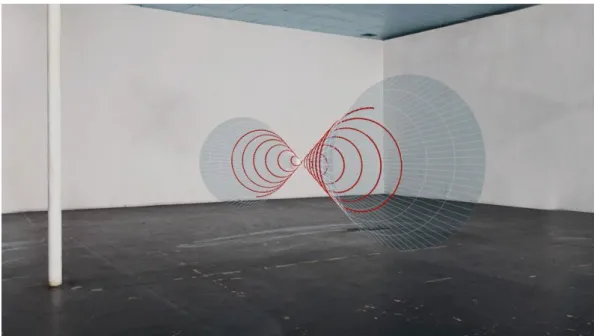
Fig. 2 - Video still of a 3D model inserted in the recreated studio space taken (from the Graphic models film).
In addition to focus, perspective, field depth, relative and absolute object positions, camera angles and camera movement animation, the lighting factor becomes a preponderant characteristic in digital composition when new objects are integrated. Figure 2 shows a three-dimensional conical object which explains how time in the CTR method can be perceived as simultaneously affecting the past and future. Two subtle shadows on the white walls of the studio and a soft reflection of the object on the floor yield a credible physical presence in the digitally recreated studio space. Complex concepts hence gain a physical presence resembling the existence of performers in a rehearsal, or of participants in a workshop in situ, at the Atelier Real.
In essence, we have combined the two strategies outlined above transversely across the four animated infographic films: (1) the ubiquitous spectator, present in the camera perspective and animations as the dynamic viewpoint; and (2) the physical materialization of highly abstract and complex concepts as two- and three-dimensional graphic models and elements. By inviting the viewer of the film to enter the digitally re-constructed studio space, we provide the sensation of being kinesthetically transported to the conceptual and imaginative space of João Fiadeiro’s artistic universe.
Media-Practice-as-Research: Performing Acts of Appreciation in the Re-Constructed Studio
In this section we explore three excerpts of the animated infographic films dedicated to the SOLOS | ENACTMENTS performance series. Each example will demonstrate how this medium provided techniques and tools that allowed a Sullivanian ‘create to critique’18 mode of composition, which would have been impossible to employ in the medium of the live performance event, and to a certain extent, even in the medium of printed academic writing.
First impossibility: time in a live performance event can not be reconfigured.
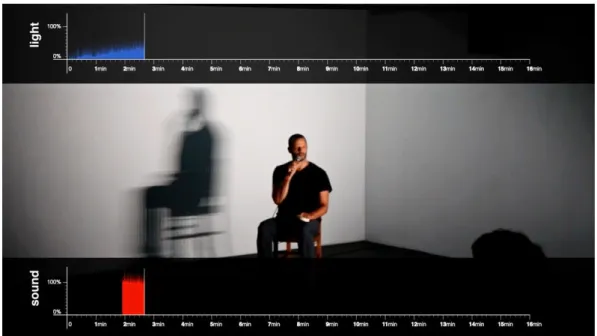
Digitally reconfiguring time through the use of animation and editing techniques allows the viewer the experience of: time accelerating, slowing down, repeating, rewinding, and/or altered sequencing. In our concrete example we have used time lapse photography as a means to perceive processes in the live performance of I
am sitting…19 that otherwise could not be discerned by the audience, because they occur very gradually over a longer period of time. Part one of the solo originally has a duration of fifteen minutes and fifty seconds, and was compressed into fifty-seven seconds in the time-lapse version. The objective here was to let the spectator of the film experience two processes of degradation that occurred simultaneously but inversely to each other during part one of the work. The lighting was designed in a way that the audience could hardly see anything in the beginning, and gradually stabilized until the entire scene was fully lit. The sound, however, consisted of a short text by Alvin Lucier,20 which Fiadeiro vocalized, recorded, and played back repeatedly, until the sound became
imperceptible. We visualized both processes graphically along a timeline to provide reference points for the time lapse experience.
Fig. 3 - Video still of the time-lapse version and animated infographics of the first part of I am sitting…
Certainly our readers have experienced the sonic distortion effects that occur when a film is played back fast forward. To recreate the experience of the degradation of the copy of the copy in the live performance of I am sitting…, we had to carefully edit the audio recording. A section of the text was taken from the first recording, a following piece from the next recording, and so forth, until the text was imperceptible. Both, the time-lapse photography and the audio editing technique are good examples of the reconfiguration of time in the re-constructed digital studio space of our animated infographic films. In this altered digital space-time, dramaturgical concepts can materialize and become the protagonists in a complementary performance, which elucidates Fiadeiro’s artistic strategies.
Second impossibility: simultaneous realities cannot be experienced in daily life
Este corpo que me ocupa has been called a “metapiece” by João Fiadeiro,
meaning that his choreographic modus operandi is the topic and the material for this solo piece. During the first part of the piece, short texts are video projected onto the back wall of the stage space, providing the audience with fragments of stories and
histories about the performance venue and its surroundings, which Fiadeiro carefully researches in each location in which he performs the piece. The effect of this approximately ten-minute section on the audience is a gradual familiarization with the performance venue, and a sensitizing for the kind of augmented perception of space-time that characterizes Fiadeiro’s Composition in Real Time method. In Fiadeiro’s words, the text fragments “zoom in and out of years and centuries of people’s lives in these particular spaces and places”21.
Fig. 4 - Video still taken from the three-minute zooming section in the film Este corpo que me ocupa.
Our choice to employ consecutive zoom in and zoom out camera movements for the entire first half of this animated infographic film embodies Fiadeiro’s analogy mentioned above. However, we also intended to physically provoke a sensation of traveling through his conceptual and imaginative universe.
The first camera movement travels from the floor of the Atelier Real to the ceiling, and takes us to a view from above where we can see the entire structure of the piece in the form of nine video thumbnails organized in a circle. Both the camera movement and the visualization of the scenic structure correspond to Fiadeiro’s perception of time as circular, not linear, as presented in detail in the film about his graphic models.
zooming in and out movements stresses how specific each encounter between Fiadeiro and the people he meets is, taking place in a distinct location and a particular moment, as expressed in the texts projected in the beginning of the piece.
These texts are carefully composed of mixtures of factual and fictional elements, which Fiadeiro identified in great detail in a video annotation session. We have thenceforth created a scale depicting the varying degrees of facts and fiction, and mapped the graphic symbols to the geographic locations of the respective stories and histories. Finally, a third sequence of zooming camera movements takes the viewer to these mapped locations and provides a graphic representation of actual events, and simultaneously of possibilities of situations that might have happened. In the live performance of Este corpo que me ocupa an audience can clearly perceive the zooming in and out of places and epochs; in our digital studio space-time, however, the viewer can look at factual events and possible hypothetical situations simultaneously by means of the graphical illustrations.
Third impossibility: the gap between audience perception and the conceptual
structures of a piece
During one of our interview sessions, Fiadeiro meticulously examined the dramaturgical structure of I am sitting…, using video annotation software to identify nineteen distinct sections or scenes in the recording of the performance from the 4th of October, 2014 at Atelier Real. He named each section according to its dramaturgical function and content. Following this analysis, Fiadeiro affirmed, conceptually, that two distinct pieces existed within the same work; that for him a piece “always starts somewhere else” (later in the performance than the audience perceives); and that the analyzed work had several beginnings and endings.
Evidently, the audience witnessing the live performance of I am sitting… perceives this solo work quite differently; namely as a continuous flow of events from the moment the performance begins (by convention the first performative event) until the performance ends (the last performative event). How could we visualize the dramaturgical structure in a way that would respected the audience perception, and simultaneously reveal the conceptual structures underlying the work?
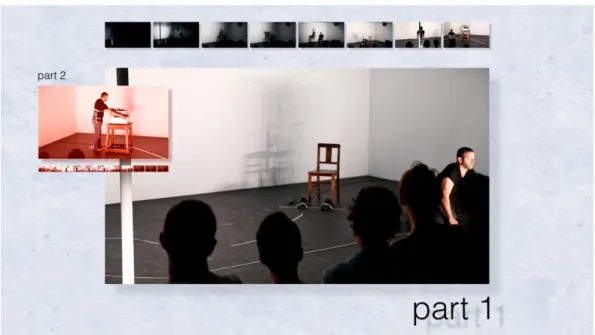
Fig. 5 Video still taken from the I am sitting... film, visualizing the scenic structure.
Figure 5 shows how the “two pieces existing within the same piece” are visually identified as Part One and Part Two, and the respective scenes are represented as video thumbnails. The narrator explains in what ways the two parts contain each other.
Fig. 6 Video still taken from the I am sitting... film, showing the percentages of the duration of the scenes.
introduces the central idea of the work (namely, the composition by Alvin Lucier) in three performative gestures, which set the conditions for everything that will happen subsequently. “The piece always starts somewhere else” thus means including the presentation of this “dramaturgical apparatus” (a performance generating system) in the beginning of a performance, and is a frequently employed method in Fiadeiro’s choreographic modus operandi. In an analogous way the piece ends for Fiadeiro before the audience thinks it has ended: the several endings refer to the respective conclusion of the performative actions of Fiadeiro, the denouement of the light, and finally of the sound.
Final Thoughts
For the authors, the production of the animated infographic films constituted a creative process in a virtual studio space-time, where our media-as-research approach materialized as the performance of appreciation acts of the SOLOS | ENACTMENTS performance series, and of the graphic models Fiadeiro uses to visualize complex concepts of the Composition in Real Time method. What do we exactly mean by
performance of appreciation acts? This term describes our discovery that the multiple
conceptual and dramaturgical dimensions in João Fiadeiro’s choreographic studio can be both investigated and performed in the “expanded studio” of the animated infographic film. In other words, the novel visualization method we propose here combines qualitative research methods from the humanities with a (media) practice-as-research approach towards the presentation of a virtual pedagogical space, one which allows both for the study and the experience of essential elements in the creative process of João Fiadeiro.
Qualitative research methods have helped us primarily with the study design and video annotation. The development of a video annotation scheme for the processing and analysis of our research documents was based on prevalent concepts and notions from dance theory and performance ethnography. From Sullivan’s perspective we have carried out “theoretical acts” of research in the early stages of the case study: for exemple, we contextualized Fiadeiro’s work in the artistic field of concept dance and reflexive post-modern dance to consequently decide which materials and documents had to be collected,22 and what kind of activities and events needed to be accompanied and documented.23 In identifying the community of art writers and theorists who
produced work on Fiadeiro, we carried out “interpretive acts” of research and included specific video annotations regarding this kind of information.24 Theoretical and interpretive acts of research have thus served as the methodological framework for the video annotation of our database on Fiadeiro’s creative process.
The re-construction of Fiadeiro’s choreographic studio as an “expanded studio” in the medium of the animated infographic film was realized in a (Sullivanian) “create to critique” mode of art-based research and production. Here the focus lies on creating artistic forms “from which critical options can be more clearly assessed and addressed.”25 Several PAR theorists have argued that the knowledge produced in and through a live performance situation is specific and cannot be represented or even replaced by its documentation, for exemple a video recording. Accordingly, we contend that the assessment of live performance, critical reflection and knowledge production clearly benefits from a performative approach to investigation and research dissemination. In our particular case this approach could have resulted in the (live) presentation of a conference-performance hybrid on our findings. However, through the discovery of the performative space of the animated infographic film as an adequate platform, we can escape the spatiotemporal limitations of the live performance and yet still provide a more “embodied” access to Fiadeiro’s artistic universe, for those who do not have the opportunity to participate in workshops or see his stage works. Current and further research in the context of the BlackBox Arts&Cognition project is specifically addressing the question of how recent, screen-based visualization formats and techniques can provide novel forms of accessing the conceptual and imaginative universe of a particular choreographer in an increasingly “embodied” way.
1 European Research Council. https://erc.europa.eu accessed September 2016
2http://blackbox.fcsh.unl.pt/ accessed September 2016.
3 Compare the BlackBox project website; each study is presented in a dedicated area.
4 CTR stand for the Portuguese Composição em Tempo Real, and is the abbreviation
habitually used by Fiadeiro.
5 Jorge Louça (Complexity Sciences/Social Stigmergy); António Alvarenga
(Economy) and Fernanda Eugénio (Anthropology). For a detailed discussion of these collaborations and their influence in the development of the CTR method see our forthcoming article “Moving from an artist-led practice into self-emerging
educational approaches,” Performance Research 21, no. 6, “On Radical Education” (2016).
6 For example, António Alvarenga and João Fiadeiro conjointly have developed “Soft Skills for Hard Decisions” workshops based on the CTR method.
7 Many CTR workshops are specifically designed for performing arts students and professionals.
8 As director of Atelier REAL Fiadeiro has organized a regular program of artistic residencies and offered coaching for young artists.
9 Fiadeiro knew that Jürgens is a theatre interaction designer, and invited him based on Jürgens’ professional experience.
10 For each work Fiadeiro develops “performance generating systems”, which produce variations in every performance of the piece. However, these systems are different from “improvisation in performance” or similar approaches, because they are organized within a clear and set dramaturgical structure.
11 An annotation scheme allows to codify the collected data for subsequent analysis and interpretation. The annotator of example looks out for choreographic concepts
and ideas, compositional strategies and techniques, dramaturgical structures, evolution and context of the piece, and so forth. Once the documents are annotated,
the researcher can query the database quickly for particular information on a certain topic.
12 See for example Anne Teresa de Keersmaeker, A Choreographer’s Score,
Book/4DVD, 2012; Emio Greco | PC, Double Skin/Double Mind, Interactive Installation and interactive DVD/DVD-ROM and Book (Capturing) Intention; Rosemary Lee, The Suchness of Heni and Eddie, DVD, 2005; Siobhan Jeyasingh, Animating Architecture: Foliage Chorus, DVD.
13 See for instance William Forsythe, Synchronous Objects website, 2010, and
Motionbank online score, Deborah Haye, Under The Sky, a Motionbank online score,
among numerous other examples.
14 Tim Finke and Sebastian Manger, ed., Informotion - Animated Infographics (Berlin: Gestalten Verlag, 2012), 21.
15 Ibid., 24.
16 GraemeSullivan has suggested four types of research acts, which we will refer to with respect to the production of our films in the closing section of this paper. They are: forming acts, critical acts, theoretical acts and interpretive acts of research. Graeme Sullivan, “Research Acts in Art Practice,” Studies in Art Education 48, no. 1 (2006): 19-35.
17 “Expanded studio” is a term proposed by Elisabeth Grierson. She explains: “Then there is the notion that one’s field work in creative arts can be considered as studio work – albeit it in external spaces. In this case I would call it the ‘expanded studio’ where much of the creative thought, data gathering and analysis takes place.” Graeme Harper, “Interview with Elizabeth Grierson,” Creative Industries Journal 4, no. 1 (2011): 97-110.
18 “Create to inquire” is a notion Sullivan advances to describe an art-based research approach, in which one employs forming acts and critical acts of research to create art forms “from which critical options can be more clearly assessed and addressed.” 19 For a comprehensive description of this and the other solo works comprising the
SOLOS | ENACTMENTS performance series please see: http://blackbox.fcsh.unl.pt/
accessed September 2016.
20 Compare https://en.wikipedia.org/wiki/I_Am_Sitting_in_a_Room accessed May
2016.
21 Video annotation session with Fiadeiro, April 2015.
22 In concept dance, the dancing body is not anymore the sole medium of
contemporary choreography, and choreography is no longer only understood as the organization of the movements of human bodies in space and time. Instead,
contemporary choreography is conceived as a “collection and organization of heterogeneous materials, as an intermedial arrangement of bodies, spoken language, texts, images, light, sound and objects. Gabriele Klein, ed., Choreographischer
Baukasten. Das Buch (Bielefeld: Transcript Verlag, 2015), 43.
23 According to Klein, self-reflexive choreographic practice and choreographic practice-as-research have produced concomitant formats of public presentation of the work. For example, the presentation of the artistic creative process onstage in the (hybrid) form of lecture-demonstration is a clear example of novel performance formats that have entered mainstream theatre programs more recently. Another
experimental format that has been widely implemented is the real-time composition as live performance, which allows simultaneous presentation of the content and the presentation of the artistic methods and techniques onstage, which in turn may encourage certain forms of active participation of the audiences.
24 In the case of Fiadeiro, performance theorists André Lepecki, Paula Caspão and Gabriele Klein are vitally important, not least because they also have directly collaborated in different contexts with him.