REPORT ON INTERNSHIP IN PALLIATIVE CARE
SOUTH ADELAIDE PALLIATIVE SERVICES,
SOUTH AUSTRALIA
Report submitted to The Catholic University of Portugal
as a requirement in full for the degree of Masters in
Palliative Care
By
Diana Marques Barroso Honório Ferreira
REPORT ON INTERNSHIP IN PALLIATIVE CARE
SOUTH ADELAIDE PALLIATIVE SERVICES,
SOUTH AUSTRALIA
Report submitted to The Catholic University of Portugal
as a requirement in full for the degree of Masters in
Palliative Care
Under the supervision of
Ms Catherine Swetenham and Professor David Currow
By
Diana Marques Barroso Honório Ferreira
i
“You treat a disease, you win, you lose. You treat a person, I guarantee you, you'll win, no matter what the outcome.”
iii
Summary
Having acquired some knowledge in the palliative-care field over the last year, I felt the urgency for developing some practical skills. As such, contacts have been made and I enrolled in a 9-week internship in the South Adelaide Palliative Services (SAPS), in Adelaide, South Australia, from July to September 2014. I got to know a high-quality palliative-care service and develop activities like inpatients’ and outpatients’ assistance, consultancy and a research project. In my last week in Australia, I visited another palliative-care service at the Royal Melbourne Hospital, in order to compare different perspectives and ways of working.
My main goal was to get the full experience of a highly specialised palliative-care service and because of that my schedule was rather flexible. I also wanted to develop skills in symptom management, communication, psychosocial approaches and research. All the activities developed were extremely productive and helped me to build some solid knowledge and ideas to apply in my daily work. Additionally, it helped me to see changes that can be made to improve the quality of care we provide to our patients.
The research project concerning the issue of chronic refractory breathlessness has resulted in an article which is currently submitted for peer review to the “The Journal of Pain and Symptom Management”.
Key Words: Palliative Care, Symptom Control, Psychosocial Approaches, Chronic Refractory Breathlessness.
iv
Resumo
Dado ter adquirido algum conhecimento teórico na área dos cuidados paliativos no ano precedente, senti uma necessidade urgente de desenvolver algumas competências práticas neste campo. Neste contexto, estabeleci alguns contactos e realizei um estágio prático de 9 semanas nos South Adelaide Palliative Services (SAPS), em Adelaide, Austrália, de Julho a Setembro de 2014. Durante o período que passei no SAPS pude observar um serviço de cuidados paliativos de elevada qualidade e desenvolver actividades no serviço de internamento, consulta externa, consultoria hospitalar e um projecto de investigação. Na minha última semana na Austrália visitei um segundo serviço de cuidados paliativos no
Royal Melbourne Hospital, em Melbourne com o intuito de comparar diferente perspectivas
e modos de trabalho.
O principal objectivo era captar toda a experiência de um serviço de cuidados paliativos altamente especializado e portanto a minha rotação pelos diferentes serviços disponíveis era particularmente flexível. Outros objectivos eram desenvolver competências nas áreas do controlo sintomático, comunicação, abordagem psicossocial e investigação. Todas as actividades desenvolvidas foram extremamente produtivas e ajudaram-me a construir conhecimento sólido e ideias para aplicação no meu trabalho diário. Adicionalmente, permitiu-me identificar as mudanças que podem ser feitas para melhorar a qualidade dos cuidados que prestamos aos doentes.
O projecto de investigação desenvolvido sobre dispneia crónica refractária resultou num artigo científico que foi submetido para revisão no “The Journal of Pain and Symptom
Management”.
Palavras-Chave: Cuidados Paliativos, Controlo Sintomático, Abordagem Psicossocial, Dispneia Crónica Refractária.
v
Acknowledgments
The completion of this project would not have been possible without the help of some great people. Some were old friends, others had appeared along the way, but all of them contributed one way or another. I would like to thank to
José for his idea of enrolling in this Masters and for being an extraordinary friend along the way, and especially during the time spent in Adelaide. Without his skills and commitment it would not have been possible to write an article in English in such a short period.
Carlos for welcoming me in such an amazing way in Adelaide, for all the encouragement and support during the last weeks and all the hard work reviewing my report. I will never forget that.
Manuel Luís Capelas and all the teachers participating in this Masters, for their ability to present us a new field of knowledge in such a captivating way and for impelling us to work further in this area.
SAPS’ staff members for welcoming me, for the support they gave me and for all that I have learnt with them. They all have become great friends.
Kate for allowing me to be part of her team and for all the kindness and generosity she revealed along the way. Adelaide would not have been the same without her.
David for his truly inspirational path and for being an amazing teacher. I have learnt so much with him in only 9 weeks.
My parents for allowing me the possibility of going to a distant country and for all the support they have been giving me through the years. I am really proud of being their daughter.
vi Index Summary iii Resumo iv Acknowledgments v Introduction xi
General Goals xiii
Report Structure xiv
Bibliography referencing methodology xv
1. Host Institution 1
1.1 Human Resources 2
1.2DAW HOUSE HOSPICE (INPATIENT UNIT) 4
1.3OUTPATIENTS CLINICS 7
1.3.1 Palliative-Care Initial-Assessment Clinic 7 1.3.2 Hospital-Based Outpatients Clinics 8
1.4COMMUNITY SUPPORT 9
1.5HOSPITAL CONSULTANCY 10
1.6AFTER-HOURS SUPPORT 10
1.7RESEARCH ACTIVITIES 10
1.8EDUCATION 11
1.9MULTIDISCIPLINARY MEETINGS 11
1.9.1 Psychosocial Meeting 11
1.9.2 Multidisciplinary Meeting 11
1.9.3 Medical Journal Club 12
1.9.4 Nursing Journal Club 12
1.9.5 Discussion of research projects 12
1.9.6 Weekly team education session 12
1.9.7 Palliative Care Grand Round 13
1.9.8 General Grand Round 13
vii
2.1 Objectives and Internship Structure 15
2.2 Clinical Activities 17
2.2.1 Daw House Hospice 17
2.2.2 Outpatient Setting 22
2.2.3 Domiciliary Setting 27
2.3 Consultancy Activities 28
2.4 Multidisciplinary Meetings and Education Sessions 32
2.5 Research Project 33
2.6 Royal Melbourne Hospital Palliative Care Department 34
3. Implications for the Clinical Practice 35
4. Conclusions 39 References Attachments Attachment 1 Attachment 2 Attachment 3 Appendix 1
viii
Table Index
Table 1 - Activities Developed at SAPS ... 15
Table 2 - Inpatients’ Characterisation ... 158
Table 3 - Inpatients’ Main Diagnosis ... 159
Table 4 - Inpatients’ Main Reason for Admission ... 20
Table 5 - Inpatients’ discharge reasons ... 20
Table 6 - Deceased inpatients’ details ... 21
Table 7 - Outpatients’ details ... 23
Table 8 - Outpatients’ Main Diagnosis ... 25
Table 9 - Outpatients’ Main Reasons For Observation ... 26
Table 10 - Patients Observed in the Domiciliary Setting ... 27
Table 11 - Consultancy patients’ details ... 29
Table 12 - Consultancy patients’ Main Diagnosis ... 30
ix
Figure Index
Figure 1 - Outpatients’ AKPS score ... 24 Figure 2 - Consultancy patients’ AKPS score ... 29
x
Abbreviation Key
AKPS The Australia-modified Karnofsky Performance Scale COPD Chronic Obstructive Pulmonary Disease
ESMO European Society for Medical Oncology FMC Flinders Medical Centre
MSOAP Medical Specialist Outreach Assistance Programme NHS Noarlunga Health Services
PaCCCS Palliative Care Clinical Collaborative Studies RDNS Royal District Nursing Society
RGH Repatriation General Hospital
SALHN Southern Adelaide Local Health Service Network SAPS Southern Adelaide Palliative Services
xi
Introduction
In the beginning of the 20th century, life expectancy in most developed countries was around 45-50 years1. Death was typically a sudden event, and the leading causes were infections, accidents, and childbirth2. With the general improvement of hygiene standards, life conditions and new advances in the medical field, a drastic increase in life expectancy, particularly in developed countries, has occurred. With the increasing ageing of the population, unknown or poorly-understood nosological entities have emerged. Until then, these nosological entities were a minor concern for the medical community, since they accounted for only a small percentage of cases. From that moment on, infectious diseases, the main cause for morbidity and mortality, started to be replaced for chronic, degenerative diseases3.
Throughout the last century there was a progressive incidence of oncologic diseases, which became a major cause of death in developed countries, only superseded by cardiovascular diseases. In 2012, 14 million new cases of cancer were diagnosed accounting for 8.2 million deaths worldwide and the number of new cases is expected to rise by about 70% over the next two decades4. Among the most prevalent chronic conditions of our time, dementia and organ failures also affect primarily older people leading frequently to disability and dependence5-8. Although the illness trajectory is different for the three mentioned conditions9, they all lead to a limitation in life expectancy and to a progressive rise in physical limitations. As such, providing care aimed at increasing the quality of life is crucial, especially for those in the advanced stages of the diseases.
In 2002, the World Health Organization defined Palliative care as “an approach that improves the quality of life of patients and their families facing the problem associated with life-threatening illness, through the prevention and relief of suffering by means of early identification and impeccable assessment and treatment of pain and other problems, physical, psychosocial and spiritual”10. In a cultural context in which the intensity for cure searching has led to an almost negation of death, or to an illusion of full control over the disease, the terminal disease is considered a defeat and the situation in which there is nothing else to be done. Nonetheless, palliative care is a basic human right and has the
xii
potential to make us turn off from the prognostic focused approach, and face the patient in front of us and address their needs based on what is important to them. Palliative care brings us back to the essence of medicine: the focus on the patient, for the best interest of the patient and not for the physiopathologic interest in the disease.
There is a scarcity of palliative-care services in Portugal and therefore the patients with advanced diseases and palliative needs are admitted under other-specialties in acute hospital wards. Actually, palliative care is not recognised as a specialty in Portugal, but merely a competence. Advanced dementia is the main cause of hospital admission in internal-medicine wards for palliative-needed patients, while patients with advanced cancer are usually admitted in oncology services. When I started my training as an Oncologist I was told 50% of the patients in the Oncology Service were in their terminal phase. As a suggestion from senior colleagues, and allied to my experience to date, I decided to enrol in a Post-graduate course in Palliative Care at The Catholic University of Portugal. This course has shown me the main job of a practitioner is to care, rather than to cure, and that there were many things we could do for incurable patients. Therefore, the continuation to the Master’s degree was an obvious decision.
This Master’s degree can include a research-project component, or alternatively a clinical-practice internship. While the idea of a research project was very tempting, it has always been obvious to me that acquiring clinical competence and confidence as practitioner is most urgent. The daily contact with suffering patients has led me to try to acquire all the possible tools and resources so I can provide comprehensive, holistic care to them. Therefore, the clinical-practice internship, including this report, seemed to be the most appropriated choice to meet my objectives.
Palliative care is a developing area in Portugal. The existent units do not cover all the population needs, while some of them do not provide all the required services. Additionally, there are a large number of medical interns interested in internships in these services, which makes it harder for one to be placed. As such, I have decided for an internship outside Portugal, in a country where palliative care is well established. This would allow me to understand the technical side of palliative care, but also the organisation and structure of
xiii
the services. After advice from experts in this field, I opted for an internship at the Southern Adelaide Palliative Services (SAPS). This choice was mainly due to its worldwide recognition as a high-level palliative-care institution, and to being recognised by the European Society for Medical Oncology (ESMO).
After the first contact, via email, with SAPS, the main features of the internship were established:
▪ Place: Southern Adelaide Palliative Services, Adelaide, South Australia, Australia
▪ Time period: From 10/07/2014 to 11/09/2014 (9 weeks)
▪ Work Schedule: From 8:30 am to 5:00 pm (5 days a week)
GENERAL GOALS
Prior to this internship, general goals were carefully thought and discussed in order to choose suitable activities. Since I had no experience in palliative care whatsoever, my main purpose was to capture the full experience of a high-level palliative-care centre. In this context, the goals below were established.
Symptom Control
For a junior doctor, the issue of symptom control is probably one of the most appealing and necessary. As such, acquiring more knowledge and practical skills regarding symptom management was a priority. In order to do that, my goal was to follow senior doctors and nurses in all settings (hospice, outpatients clinics and community), to watch their approach to patients’ symptomatic issues (pain, chronic refractory breathlessness, malignant bowel obstruction, delirium, anorexia, etc) and to discuss intervention strategies (which could include pharmacologic and non-pharmacologic ones).
Psychosocial Issues
Having little experience in systematic approach of psychosocial problems, this was an area to be carefully addressed. In Portugal, doctors’ foundation program does not include training in communication, conveying bad news, social support and techniques to prevent burnout. The basic knowledge I had in this area was acquired during the palliative-care
xiv
masters and it was grounded on theoretical foundations. As such, developing practical skills in this field was urgent particularly considering my scope of practice. Consequently, my goals were to watch and learn some basic techniques used by doctors, nurses and social workers to access these issues, try to apply some of them, and to attend to and participate in psychosocial multidisciplinary meetings.
System Implementation and Functioning
Australia is a country where a complex palliative-care network is in place. The experience in this field is vast and most of the population needs are met. On the contrary, palliative care is a new-born area in Portugal where most patients have no access to these services. Having that in mind, my goals were to understand the efforts made to implement a proper palliative-care network, to observe the daily functioning of this unit and to comprehend the articulation amongst the different services within SAPS. Improving my knowledge about the Australian system might be useful for the development and implementation of some ideas in Portugal.
Research Activities
SAPS have one of the most active research centres around the world in the palliative-care field. With high-standard research and several clinical studies being conducted at a given moment, the research centre was highly appealing to me. One of my goals was to enrol in a research project and to learn as much as I could from this team. It is my belief, that in order to be a complete physician, constant questioning is required. Developing a research project might stimulate a curious mind to go further with other questions, ultimately improving patients’ lives.
REPORT STRUCTURE
This report describes the activities developed during my nine-week internship. It is divided in four sections: service description, internship description, professional implications and conclusions. The service description encompasses the general characteristics of SAPS with a detailed description of the physical spaces, the services provided and the team structure. The internship description consists on a deeper analysis of the goals and activities
xv
developed with a short statistic overview of the observed cases. A critical reflection is also conducted in relation to every developed activity. The professional implications are analysed in the third section of this report. I will describe not only the impact I expect this internship to have on my professional life but also the practical consequences it has already had. Finally, in the conclusions, I will end this report with a brief overview and a global evaluation of this placement in Adelaide.
BIBLIOGRAPHY REFERENCING METHODOLOGY
1
1. Host Institution
Palliative care in Adelaide dates back to 1976 with the opening of the Mary Potter Hospice at a private hospital in Central Adelaide. The Southern Hospice Association was created in 1979 with a community visiting program and a few hospice beds located at Kalyara in the southern hills of Adelaide. In 1988 the Daw House facility located on the grounds of the Repatriation General Hospital was refurbished to accommodate the Hospice patients from Kalyara and the Southern Community Hospice program was born. Throughout the decade there was an exponential increase in the number of inpatient units across South Australia. At the same time, the Royal District Nursing Society (RDNS) which provides primary nursing care services to people in their homes experienced an increase in services to the dying who wished to be cared for in their own home. Palliative care in 2014 is divided into either specialist or generalist care. The RDNS provide the generalist care to those dying where care needs are not complicated Specialist services like SAPS focus on those patients where care needs are complex and challenging to the generalist providers. Specialist metropolitan palliative-care services have supported regional nurse and GP teams in country towns and remote areas of South Australia through the Commonwealth Medical Specialist Outreach Assistance Program (MSOAP). With the creation of the South Australian Palliative Care Plan 2009-2016, links were formally established between services in Adelaide and services in rural and remote parts of South Australia.
The Southern Adelaide Local Health Service Network (SALHN) was created to provide medical care to the southern part of Metropolitan Adelaide. It works in close connection with Flinders University and encompasses three hospitals: Repatriation General Hospital (RGH), Flinders Medical Centre (FMC) and Noarlunga Health Services (NHS). There are also some additional community-supporting units.
SAPS are SALHN’s palliative-care services. Their mission is to provide care to patients with chronic, incapacitating diseases that limit life expectancy, therefore alleviating their suffering. SAPS are services of reference that provide highly-specialised care to patients, families and caretakers with complex needs. It also provides support to other less-resourced
2
health units. Multiple services are provided to the community, such as: Daw House Hospice (Inpatients Unit), Outpatient Clinics, Community Support, Hospital Consultation, After-Hours Support, Research and Education.
SAPS also work in close connection with other supportive services, such as:
▪ RDNS – primary nursing services in home care, which included specialised professionals in palliative care;
▪ Metropolitan Domiciliary Care (Metro Dom Care) - service that provides medical equipment (e.g. wheelchairs, hospital bed, commode chairs etc), as well as support from health care workers to assist with hygiene support to people at home;
▪ Local Councils – Coordinate home-care services according to local specificities.
1.1HUMAN RESOURCES
▪ Head of department: Ms. Kate Swetenham
▪ Medical Team: The medical team provides support to Daw House, outpatients’ clinic and domiciliary care. It is led by Dr Michael Briffa, the only element of this team working full-time. Dr Peter Allcroft, Dr Susan Haynes, Dr Tim To and Dr Toula Christos complete the consultants’ team, all working part-time. Additionally, Dr Karin Myhill, a senior consultant psychiatrist working part-time, is also part of the team.
▪ Nursing Staff: The Australian system is drastically different from the Portuguese one on what concerns nurses’ training. There are three categories of nurses depending on their level of specialisation: enrolled nurses have undertaken a diploma in nursing and work under the supervision of a registered nurse. Registered nurses have undertaken a degree in nursing and are categorized from level 1 to 3. Level 1 registered nurses have basic training in nursing. Level 2 nurses generally hold a post graduate qualification in an area of nursing specialty and have clinical experience in that area. Level 3 nurses are considered to have specialist qualifications and work at an advanced level. They are required to fulfil registration standards, and these can
3
include continuing professional development, recency of practice, criminal-history checks and English language competency. The role of Nurse practitioner is a protected role and nurses must have completed a Master of Nurse Practitioner and undertaken a candidacy clinical training program.
In SAPS, level 1 nurses work predominantly at the hospice whereas level 2 and 3 nurses are more community-based. Ms Jane Cotton is in charge of the Hospice (level 3 nurse). Two senior clinical nurses, Ms Sharenne Codrington and Ms Kate Vialls, work closely with her to coordinate the inpatient nursing team which is made up of enrolled and registered nurses. The community team includes registered and nurse practitioners. The registered nurses are: Miss Joanne Wells, a registered nurse responsible for the triage of new service referrals; Ms Miranda Gibbs, Ms Robyn Jezewski, Ms Shawn Johnson and Mr Patrick Cox, all registered nurses are responsible for community home visits. Ms Karen Glaetzer and Ms Heather Broadbent, two nurse practitioners, also responsible for community home visits. Finally the liaison services are provided by Ms Liz Reilly and Ms Sarah Flynn at the FMC and Ms Dianne Anthony at the RGH and NHS, all registered nurses, level 3.
▪ Research Team: The head of the research institute is Professor David Currow. Dr Peter Allcroft, working part-time, completes the medical team. Ms Aine Green, Ms Urska Cosic, Ms Vera Margitanovic are the research nurses and will conduct home visits to support research participants whilst they are on a study.
▪ Pharmacist: Mr Paul Tait
▪ Social workers: There are two social workers in SAPS. Ms Sarah Lawton is a member of the community team and Ms Jenny Richards member of the inpatient team
▪ Clerical Services: Ms Christine Waterson provides clerical services to the inpatient unit
4
▪ Volunteers: Ms Anne Friedman manages a volunteer program which has 120 registered volunteers
▪ Assistant: Ms Denise Alder provides support to the service director Ms Kate Swetenham and is in charge of medical typing for outpatient clinics run by palliative medicine consultants
▪ Bereavement Service Assistant: Ms Ros Ramsay supports the bereavement service by providing administrative support in maintaining their data base, sending out bereavement information and preparing the memorial services
▪ Administration officers: Administration officers provide support to the clinicians
▪ Front Desk Receptionist: Ms Ros Strapps manages the front reception desk and receives all referrals to the service that come from the community
1.2DAW HOUSE HOSPICE (INPATIENT UNIT)
Formerly a private residence, Daw House Hospice opened its doors to the public in 1988. Daw House is a short-term inpatient unit that mostly receives patients needing aggressive control of symptoms, aiming to better manage their last days of life, or to provide respite care. It has 15 beds, 7 in single rooms and 4 in double rooms. Usually the distribution of the patients by the different rooms takes into account their special needs and their comfort.
The environment at the Hospice is similar to that of a community house, more so than to that of a hospital. There is a well-decorated, large common area, with couches, TV, piano, books, magazines and board games available to patients and their families, in which they can spend quality time. There is also an area for children with TV, toys, games and play stations. Associated to these rooms there is a kitchen where patients can prepare their own meals. There is a quiet room, more reserved, which is used in situations that require a higher degree of privacy, such as meetings where important news can be given and delicate
5
matters can be discussed. During their stay at the Daw House the patients are encouraged to dress in their own clothes, and bring in personal objects in order to feel as at home as possible, and to diminish the discomfort associated to the hospital admission. The Hospice provides domestic bedding such as duvet covers with matching pillow cases, and hand quilted rugs to further reduce the clinical feel of a hospital environment. There is no pre established time for visits. The families are encouraged to spend as much time as possible with the patients, including staying overnight. All rooms have direct access to the garden area, with enough space to move the beds, which allows patients in bed to spend quality time in the garden. Volunteers support the functioning of the Hospice by washing all the domestic bedding, assisting patients with their meals and providing gentle massage and support.
The work developed at the Hospice is of multidisciplinary nature, involving professionals from different fields, as follows.
a. Palliative-Care Team: A medical team constituted of a consultant, a resident/registrar
and a year-6 student is permanently in the unit from 9 am until 5 pm, Monday to Friday. A consultant remains on call after 5 pm for emergency purposes.
b. Nursing Staff: The inpatient nursing team provides a 24-7-365 presential assistance. The
nurses systematically evaluate the needs of the patients through clinical tools that measure pain and other symptoms, recording of vital signs, and monitoring of psychological coping mechanisms that aid in the identification of problems. They also give patients the prescribed medicines and other treatments. The nurse patient ratio means that nurses can spend more time with their patients and their families which allows assessment of psychological, social, spiritual or family related issues to be identified and addressed.
c. Psychiatrist: Similarly to the medical team, Daw House’s psychiatrist is available three
days a week. The psychiatrist service is required (i) in cases of psychological/psychiatric malfunctions of patients or families, (ii) when guidance is needed for family-dynamics issues, (iii) if patients or families are showing deficient coping with the disease or (iv)
6
when families show a high risk of pathologic mourning. Although there is no structured aid to prevent burn-out in staff members, the psychiatrist is also available to assist them should they have the need.
d. Pharmacist: The pharmacist is available permanently and its role is to assist the
medical/nurses staff in questions related to the prescribed medicines, interactions between medicines and possible side effects.
e. Social Workers: This team assists the other teams in the inpatients unit, outpatients’
clinic and domiciliary care. These elements are crucial for the reorganisation of family and social life of palliative-needed patients. They are responsible for identifying, in each patient, the amount of distress caused by the illness. They also help patients to review their lives and provide guidance about community resources, residential care placements, wills and power of attorney (legal document in which one person nominates and gives legal authority to another to act on affairs on their behalf).
f. Pastoral-Care Team: A spiritual assistant is available during working hours to the
patients. The patients are encouraged to invite their own spiritual leaders if they wish so. There is a praying room available at the Hospice for patients use.
g. Complementary-Care Team: The Complementary-Care Centre is coordinated by a nurse
with complementary therapy qualifications. The other elements of the team are volunteers, also with qualifications in the areas of care provided. This centre is characterised by a quite environment where patients can sit, relax, listen to music, read the books available or simply have a conversation with the staff. Therapies available are dependent on the qualified volunteers and include massage, kinesiology, reiki, aromatherapy, hypnotherapy, therapeutic touch, among others. These services are offered to inpatients but also to outpatients and carers.
h. Art Therapist: Art-based therapy allows patients and families to express emotions
through artistic creation. They are encouraged to share stories and to develop artistic work such as painting, sculpture and sew as means to promote well-being.
7
i. Pet Therapy: The unit has four volunteers walking therapy dogs daily. These dogs are
specifically trained for their therapy role and are tested to prevent disease transmission. The patients can also receive their own pets at the hospice.
j. Volunteers: The volunteers are specifically trained to be able to deal with
palliative-needed patients. They provided assistance to the patients in several activities, for example: meals, manicure, hair-dressing, reading, letter-writing, garden-walking and anamnesis.
SAPS do not have a dedicated Physiotherapist, Occupational therapist, Speech Pathologist or Dietician. When these services are need a phone call is made to the department of Allied Health that sends these professionals to see patients in the hospice.
1.3OUTPATIENTS CLINICS
1.3.1 Palliative-Care Initial-Assessment Clinic
The initial assessments are held outside the Hospital, in two clinics with several medical specialties not directly palliative-care related: GP Plus Health Care Centre Marion and GP Plus Super Clinic Noarlunga. The benefit of these clinics is for patients to have appointments in a neutral environment, less associated to the hospital context, therefore allowing for a gradual coping with the disease. Usually, the patient referral is done rapidly by an assistant practitioner in case of limited prognosis. The majority of the patients reviewed in this clinic do not need immediate palliative care. Nonetheless, the contact with the palliative-care unit happens at an initial stage so that future problems are planned for and patients and their family members are introduced to the services that are available that they may require at a future time.
This initial assessment is made by a Nurse Practitioner, a Community Social Worker, and a Psychosocial Nurse / Caregiver Facilitator. It lasts 90 to 120 minutes and encompasses three stages. The first stage constitutes of: evaluation of physical symptoms, an objective exam,
8
therapeutics review and information provided to the patient on the services available at SAPS. The second stage constitutes of an evaluation by the social workers of the patient’s practical needs: financial difficulties are evaluated, in-home assistance is guaranteed (meals, gardening, checking safety conditions, etc.), vouchers for transportation are provided, and the filling of an Advance Care Directive is promoted. In the third stage the patient and carer are taken to separate rooms where their psychological needs are evaluated. Usually scales for depression evaluation are applied, and potential points of preoccupation with the disease are explored. The stress levels of the carer are evaluated, as well as their ability to adapt to the new circumstances and possible assistance within the family environment.
The main needs of the patient are covered in about two hours. This system promotes strategies that avoid further deterioration of patient’s condition, avoids unnecessary hospital admissions and promotes the well-being of the family as a whole. The patient is referred to the appropriated medical specialty in particularly complex cases. A letter is sent to the assistant practitioner after every assessment, which allows for a proper articulation of the services.
1.3.2 Hospital-Based Outpatients Clinics
The medical assessment is done at SALHN’s hospitals (FMC, NHS e RGH) to outpatients with periodic or episodic needs of medical observation. This is mainly for patients of difficult symptomatic control or with frequent needs of therapeutic adjustments. This assessment is done by a physician and a nurse and lasts about one hour. While waiting for the appointment, the patient is given a Symptom Assessment Scale. The scale allows the physician to give special attention to uncontrolled symptoms. This is followed by an evaluation of the patient’s physical, psychological, family and spiritual dimensions. A physical exam evaluating the patient’s complaints is carried out, and the appropriated measures are taken. The collaboration between specialties is common. Subsequent appointments to evaluate the effects of the taken measures are made in the majority of the cases.
9 1.4COMMUNITY SUPPORT
When asked, the palliative-care unit provides assistance to GPs and nurses in charge of in-home palliative-care-needed patients, which often have difficulties in going to the hospital due to their condition. These patients include those with limited physical ability to travel, without enough family support, with financial difficulties or in end-of-life situations that wish to remain at home. The home-care service also provides support to residential-care facilities. Usually, the assistance is provided by a specialised nurse that periodically evaluates (in person or over the phone) the patient’s needs. If needed, the nurse slightly adjusts the therapeutics and provides nursing services that help maintain the patient’s well-being. If the symptom control becomes more challenging the nurse refers it to a specialist practitioner, who then takes part on the next visit, therefore assuring the best possible care to the patient. The visits are as frequent as needed, including daily in the more complex cases.
SAPS have launched a pioneer home-care project: TeleHealth. Included in the Project, a patient is handed a multiple-functions, internet-connected tablet. The tablet applications allow the patient/carer to answer on a daily basis a set of question in a scale of symptom and well-being evaluation, which allows monitoring the evolution of signs and symptoms. The in-charge nurse is notified if there is a variation in the intensity of complaints or if the patient fails to answer to the scales and the patient is contacted immediately, either over the phone or via teleconference. Teleconferences are particularly interesting in Australia due to the large geographical dispersion, helping doctors and nurses avoid travelling which impacts negatively on their ability to provide services to the many patients that are on the community caseload.. Another advantage of teleconferences in these cases is allowing different professionals (e.g. physicians, nurses, social workers) to interact simultaneously with the patient in a multidisciplinary and coordinated team response to the patient’s needs.
10 1.5HOSPITAL CONSULTANCY
The palliative-care hospital-consultancy service works daily in SALHN’s three hospitals. This service is done by a physician that can be assisted by a nurse if needed. The objective is to provide specialised care to inpatients of other health units, usually for acute decompensated disease, that show palliative-care needs. The observation of the patients is focused on the problem that raised the request for assistance, and the physician then prescribes the appropriate therapeutics to be administrated by the medical team at the unit. Additional assessments are considered for following up the evolution of the patient if needed.
1.6AFTER-HOURS SUPPORT
Outside normal working hours and during the weekends the assistance to patients is assured by a specialised physician and a specialised nurse, which guarantees 24-7-365 telephone advice to patients. This service is exclusively provided over the phone. If the situation is urgent enough the patient/carer are advised to call an ambulance to go to an emergency service. If, on the contrary, the situation is manageable at home the physician and/or the nurse provide guidance to the patient/carer in how to better handle the situation, therefore avoiding unnecessary emergency calls or hospital admittances.
1.7RESEARCH ACTIVITIES
SAPS’ research institute is dynamic in nature and counts with the vast majority of the staff. It is part of the Palliative Care Clinical Collaborative Studies (PaCCCS), which is a national research network. It is a world-leading research centre in palliative care with a vast publication record. The unit has a policy on encouraging patients to collaborate on the research studies being carried out, and periodically reinforces the importance of patient referral for such studies by the practitioners. The patients seem keen in collaborating in research studies aiming to develop new interventions or medicines to help others. The research centre runs several studies at a time with a strong focus on acquiring solid scientific knowledge to propose new interventions and medicines to contribute for a better quality of life to those on an end-of-life stage.
11 1.8EDUCATION
SAPS provide continuous education to staff, other health professionals, volunteers and community members through multiple programs. The services are closely linked with the Flinders University providing undergraduate and postgraduate medical, nursing and allied health education. SAPS hosts health practitioners from around the world that wish to receive training and strengthen their knowledge in the palliative-care area.
1.9MULTIDISCIPLINARY MEETINGS
Several meetings are held at SAPS on a weekly basis aiming at organising and coordinating services, optimising care given to patients and families, and providing training to practitioners. The main meetings are described as follows.
1.9.1 Psychosocial Meeting
The psychosocial meeting is held every Tuesday afternoon and lasts for about one and a half hours. It is attended by a medical consultant in palliative care, residents, medical students, chief nurse, psychiatrist, social workers, spiritual assistance, art therapist and complementary therapist. The meeting intends to review all Daw House inpatients’ cases, with special focus on those showing psychological/psychiatric, social or spiritual problems. In this way efforts are coordinated and strategies are designed to provide patients a quality end-of-life period and emotional relief to their families.
1.9.2 Multidisciplinary Meeting
The multidisciplinary meeting is held weekly and is attended by all staff members. Physicians and nurses expose highly complex cases allowing for free sharing of ideas and suggestions, ultimately eying the best possible care given to patients. Several types of therapeutic intervention are also coordinated if necessary. Attention is given to patients in terminal stage that need to be followed-up more frequently. Lastly, the deaths of the week are discussed and an analysis of the care given to the deceased is made. By allowing the review of the direction taken to assist the patients, the meeting promotes not only the
12
continuous improvement of the service, but also the recognition of the practitioners for the work they develop, therefore raising motivation levels within the team.
1.9.3 Medical Journal Club
The Medical Journal Club meeting is held every week on Thursday morning and goes for about one hour. Usually a consultant presents an article or a topic relevant for the daily clinical practice. This meeting is also used for sharing knowledge obtained from conferences. It is mainly a space for sharing information with a healthy and productive discussion of relevant matters, aiming at contributing to residents and students training and consultants updating.
1.9.4 Nursing Journal Club
The nursing journal club is held fortnightly on Friday mornings. It works similarly to the medical journal club although the issues discussed are especially relevant for nursing practice. The meeting is also attended by a pharmacist, which enriches discussion relative to therapeutics.
1.9.5 Discussion of research projects
The meeting for research-project discussion is held fortnightly on Friday mornings. It allows information-sharing, reviewing, updating and discussing the on-going research projects at the institution. This meeting also serves to discuss the feasibility of certain studies, to present new research ideas/projects and to renovate staff motivation to participate in the clinical studies.
1.9.6 Weekly team education session
The training sessions are held weekly, on Monday afternoon and go for about one hour, being attended by all staff members. A practitioner presents and discusses a relevant topic for the clinical practice. The meeting also serves to discuss practical issues, such as application of new triage tools, discussion of new laws/policies/directives, etc. This meeting
13
is very useful to answer staff-member questions relative to practical issues, which allows optimising human resources and a more informed, better decision-making process.
1.9.7 Palliative Care Grand Round
This session is held monthly and attended by all SAPS staff members. An in-house practitioner or an invited person presents a theoretical topic of common interest to the service. This meeting is particularly useful because it promotes acquirement of knowledge in the palliative-care area, such as disease mechanisms, symptomatic control and project presentation.
1.9.8 General Grand Round
Similarly to the Palliative Care Grand Round, this is a monthly session, but attended by members of all SALHN specialties. Usually, an element of a given service presents and discusses a topic related to their field but with interest to all services. This session is particularly relevant to promote professional-experience sharing across the services, enhancing multidisciplinary knowledge, and coordination and collaboration between different specialties.
15
2. Internship Description
2.1OBJECTIVES AND INTERNSHIP STRUCTURE
When I started this internship, I wanted to get the full experience of a palliative care, high level service. As such, my roster was planned to make me rotate for all the activities developed at SAPS. It was previously agreed with my mentor Kate Swetenham that I was free enough to adapt this roster along the way and spend more or less time doing the proposed activities. During this internship I found out that the mentioned roster was actually perfect for my goals, so I stuck with it. Since this was an observational placement, I had no autonomy to make clinical decisions or interventions by myself. However, I had total freedom to interact with patients under supervision, to discuss clinical cases and to ask questions about the service organisation. The time spent in each service is represented on Table 1.
Table 1 - Activities Developed at SAPS
Setting Hours per Week Total Amount of Hours
Outpatient Clinic 8 72
Consultancy 8 72
Daw House Hospice 4 36
Home visits 4 36
Meetings 4 36
Research 12 108
Total 40 360
As previously referred, my goals were to acquire competencies concerning symptom control, psychosocial approaches, research activities and system implementation and functioning.
16
Pain and other symptoms are known to be central factors impacting the quality of life of palliative care patients and caregivers11-13. I previously defined as a quality indicator, having contact with at least 30 patients who required symptom control. This could be achieved in the outpatient, inpatient or domiciliary setting. The cases observed should contemplate the most frequent symptoms in the palliative care setting such as pain, refractory breathlessness, constipation, fatigue, among others14-15. I should engage in the clinical discussion regarding therapeutical interventions with a palliative care specialist, in order to understand the treatment pattern of these patients.
It is also known the importance of a structured psychosocial approach in the end-of-life setting16. As such, I defined as a major goal, the attendance to at least 8 psychosocial meetings. I should, not only apprehend the main issues focused but also engage in the discussion with my peers in order to contribute to solve some of the identified problems.
Additionally, I set some other objectives concerning patients in their last days. In Portugal, like in some other European countries, most doctors do not have specific training in breaking bad news to patients and families17. As such, I should observe at least 10 of these cases and understand some of the techniques used to this end. I should also observe/participate in at least in 10 situations requiring symptom management, psychosocial and spiritual interventions in order to apprehend the totality of the holistic care offered to these patients18.
Palliative Care is a recent field of knowledge and when it comes to research, much has to be done19. Given the high quality of the research institute connected with SAPS, another one of my goals was to get to know the clinical studies being conducted, to observe some of the work behind that, and if possible, to participate as a researcher in one of the trials concerning symptom control.
The difficulties Portugal crosses when it comes to implement a wide palliative care network are known. As such, I defined as one of my goals, to learn as much as I could about the Australian system. As previously mentioned, my roster included a wide variety of activities
17
so that I could see all the services available and the articulation among them. If I could bring some of the acquired ideas for our country, that would be a good contribution.
2.2CLINICAL ACTIVITIES
2.2.1 Daw House Hospice
I had the opportunity to participate in Daw House activities on Tuesdays, for 4 weeks. At around 8:30 am, a multidisciplinary meeting with doctors and nurses was held in order to share information on the over-night occurrences. This allowed all professionals to rapidly understand the recently-identified problems of each patient and act accordingly. Recently-admitted patients were then approached separately by both the nurses team and the medical team. Usually, the nurses took a small history with the patient and family in order to know the patient and his/her support system and identify the most important problems they faced. Additionally, several tools were used to classify and stratify patients’ complaints. This approach is part of an initiative called Palliative Care Outcomes Collaborative (PCOC) (Attachment 1), whose main goal is to improve the quality of care offered to these patients. The medical approach was made by an element of the medical team. A detailed clinical history and a physical exam were carried out. The patient plan was then discussed and the intervention strategies arranged. It is important to say that the communication among nurses, doctors and other members of the team started in this early phase which made patients’ assistance much more productive.
Usually, patients who had not been recently admitted were seen by the medical team in the daily round. Registrar, Resident and 6th year student did the inpatients’ round together. This system allowed the younger members of the team to learn with the older ones the right approach to a palliative-care patient. During the medical rounds, the inpatients were observed. The patients’ complaints were addressed as well as any psychological, social and spiritual problems. At the same time, a team member made sure the clinical notes were written. After the round, therapeutics and the intervention strategies were discussed and updated. Later in the afternoon, a meeting would be held with the consultant in order to discuss the inpatients’ cases, specially the most challenging ones. I attended all these
18
medical activities, first simply watching and later taking the clinical history on admission, discussing patients’ cases, witting clinical notes and proposing therapeutic changes.
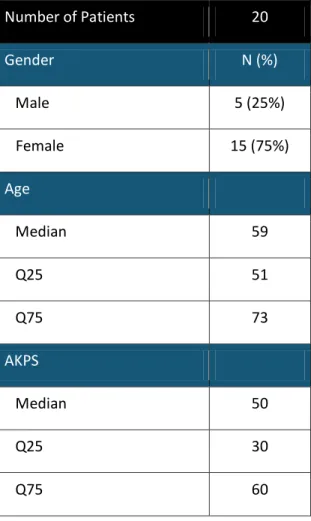
At the Hospice I followed 20 patients. The main demographic data is represented on Table 2. Fifteen patients were females (75%) and 5 were males (25%). The median of age was 59 years old (IQ25%-IQ75% 51-73). The youngest patient was 39 years old and the oldest one was 90 years old, which means the age distribution was quite wide. The median Australian Karnofsky Performance Scale score was 50% (IQ25%-IQ75% 30-60). This puts into evidence that most patients had some degree of physical dependence.
Table 2 - Inpatients’ Characterisation
Number of Patients 20 Gender N (%) Male 5 (25%) Female 15 (75%) Age Median 59 Q25 51 Q75 73 AKPS Median 50 Q25 30 Q75 60
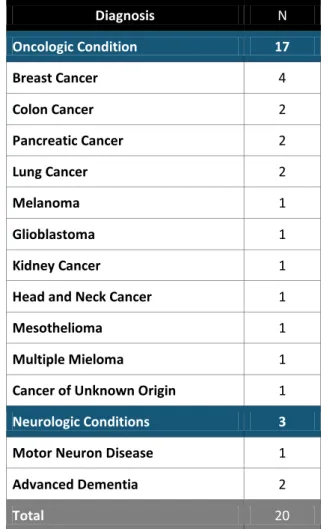
Most patients admitted at the Daw House Hospice had cancer as main diagnosis (Table 3). Since most of the patients I followed were females, breast cancer was the most frequent disease. Besides neoplasms, neurologic conditions were also observed which included 1 case of motor neurone disease and 2 cases of advanced dementia. Even though there is a
19
clear predominance of oncologic diseases, SAPS are prepared to give full support and specialised care to patients with different conditions. However, like in other countries, patients with non-oncologic diseases seem to be less referred to the palliative-care services20.
Table 3 - Inpatients’ Main Diagnosis
Diagnosis N Oncologic Condition 17 Breast Cancer 4 Colon Cancer 2 Pancreatic Cancer 2 Lung Cancer 2 Melanoma 1 Glioblastoma 1 Kidney Cancer 1
Head and Neck Cancer 1
Mesothelioma 1
Multiple Mieloma 1
Cancer of Unknown Origin 1
Neurologic Conditions 3
Motor Neuron Disease 1
Advanced Dementia 2
Total 20
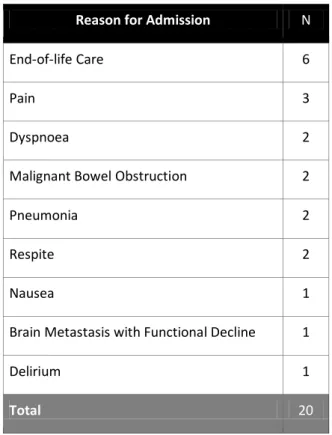
The main reasons for admission at the hospice are highlighted in Table 4. Six patients required end-of-life care. Pain, dyspnoea and nausea were among the most frequent symptoms requiring aggressive management. Two patients with malignant bowel obstruction were also admitted for symptom control. Additionally, respite is contemplated as a motive for hospice admission which provides patients and families with extra support in case of family exhaustion.
20
Table 4 - Inpatients’ Main Reason for Admission
Reason for Admission N
End-of-life Care 6
Pain 3
Dyspnoea 2
Malignant Bowel Obstruction 2
Pneumonia 2
Respite 2
Nausea 1
Brain Metastasis with Functional Decline 1
Delirium 1
Total 20
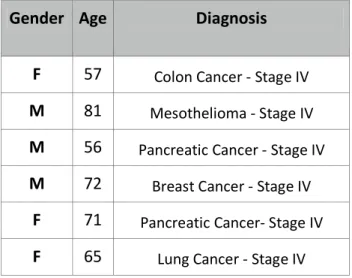
From the 20 patients admitted at Daw House, 14 (70%) were discharge home and only 6 patients (30%) died in the hospice (Table 5). This seems to deny the idea that the only reason for admission in a hospice-type facility is end-of-life care. Considering patients that died in the hospice, all of them had stage IV cancers. Given the proportion of cancer patients admitted, these data is expectable.
Table 5 - Inpatients’ discharge reasons
Hospice discharge (N=20) N (%)
Death 6 (30%)
21
Gender, age and diagnosis of deceased patients are resumed on Table 6.
Table 6 - Deceased inpatients’ details
Gender Age Diagnosis
F 57 Colon Cancer - Stage IV
M 81 Mesothelioma - Stage IV
M 56 Pancreatic Cancer - Stage IV
M 72 Breast Cancer - Stage IV
F 71 Pancreatic Cancer- Stage IV
F 65 Lung Cancer - Stage IV
The experience I had at the hospice was extremely rich. This was probably the only setting where I had some freedom to interact with patients all by myself. The language barrier was my worst fear. Since most patients were extremely debilitated, I wanted to make sure they did not have to make a great amount of effort to understand me. In most cases I was able to establish a productive relationship with patients, to understand their main concerns and to transmit those to my peers in clinical discussions. Additionally, the hospice was also the place where I had the chance to see patients in consecutive days/weeks and to follow their evolution. This allowed me not only to see the efficacy of some interventions but also to connect with some patients on a deeper level.
During the time spent in Daw House I could also engage in the Complementary Care Services. These services are not considered alternative, since they are usually not used as the only form of care but rather complementary since they provide extra support for patients and families. The interest in these therapeutics’ approaches is growing since it seems to improve people’s well-being21-23. As such, I was introduced to therapies like simple relaxation techniques, reiki, kinesiology, massage among others. These therapies were methods of positively impacting patients’ daily routine with a small amount of resources, and they are very easy to implement in our country.
22 2.2.2 Outpatient Setting
The outpatients’ services include the Palliative Care Initial-Assessment Clinic and the hospital based Outpatients’ Clinic conducted at the RGH, FMC and NHS. I was also invited to attend some palliative-care appointments carried out in a private hospital. The Palliative Care Initial-Assessment Clinic was probably the most exiting experience I had through the internship. I think those appointments were probably the best example of an adequate resource management. One might think that a 90 minute appointment is a luxury. However, in those 90 minutes most patient-related problems were covered. Taking into account the trajectory of a specific disease, support was put in place to promote coping to the disease and to prevent further complications. It might be easy to forget that functional-declining patients have also a higher risk of hospital admissions. When appointments like these are put in place, the goal is not only to improve patients’ quality of life but also to prevent unnecessary burden for the health system. This higher vision is undoubtedly much needed in Portugal and could prevent emergency department break-downs and deaths in shameful conditions.
In this clinic I had the chance to follow a patient from the beginning till the end. As such I participated in physical evaluation taking clinical histories, doing the clinical exam and discussing therapeutic interventions. During the psychosocial evaluation I was able to observe and be part of the systematic approach to patients where tools like the distress thermometer (attachment 2) and the K10 (attachment 3) were used. Similarly, I observed the approach made to the caregiver and the proposed strategies to overcome.
The hospital based Outpatient’s Clinic had a model of care much closer to the Portuguese one. The main difference was perhaps the greatest focus on psychosocial and existential suffering issues that we regularly do not approach. Another difference was the time each appointment took (between 30 minutes and one hour). This allowed a greater degree of understanding of people’s complaints and more time to prepare therapeutic interventions. Most appointments were carried out together by doctors and nurses. The interesting fact about this system is that there were some moments when one could see that both the
23
physician and the nurse assessed and covered all of the five different domains of the person (physical, psychological, social, familiar and spiritual). For instance, a doctor could be examining the patients and accessing his symptoms at the same time whereas the nurse was talking to the caregiver to explore his coping to the situation and the need for some extra support in the domiciliary setting. In the outpatients’ clinics I was allowed to talk and explore patients’ complaints, to perform the physical exam and to discuss some of the caregivers’ main concerns. After the patient and the caregiver had left, I would discuss the case with the palliative-care team in order to understand the reasons that had motivated an intervention over another.
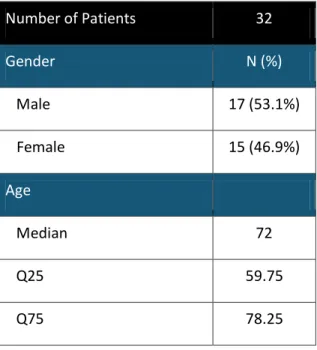
I have observed 32 patients in the outpatient setting (Table 7). Seventeen patients (53.1%) were males and 15 patients (46.9%) were females. The median of age was 72 years old (IQ25%-IQ75% 59.75-78.25).
Table 7 - Outpatients’ details
Number of Patients 32 Gender N (%) Male 17 (53.1%) Female 15 (46.9%) Age Median 72 Q25 59.75 Q75 78.25
Outpatients’ AKPS score can be seen on Figure 1. Most patients had a AKPS of 80%, which means they could carry out normal activity with effort despite having some signs and symptoms of the disease24. This brings into attentions that most patients are referred to the palliative-care services in an early stage of the disease, which is proven to be beneficial25. As such, arrangements can be put in place to help patients maintain their physical function
24
which allows them to cope and manage at home longer. Additionally, it allows patients the time to fulfil their last wishes and to decide how and where they want to spend their last weeks/months/years.
Figure 1 - Outpatients’ AKPS score
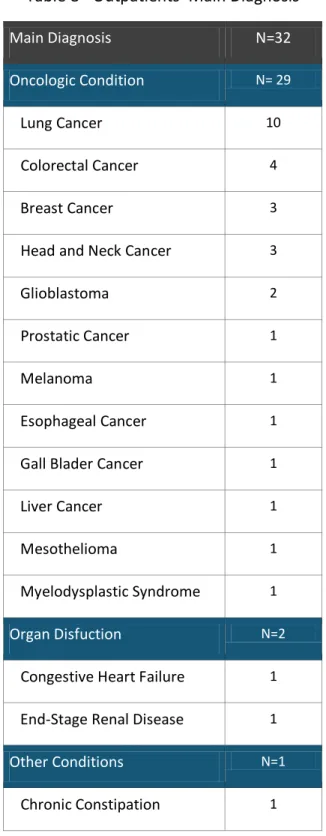
The main diagnoses for those patients attending outpatient clinics are outlined on Table 8. Similarly to the hospice population, most patients had oncologic conditions. Like in Portugal, lung cancer, colorectal cancer and breast cancer were among the most frequent oncologic conditions. Breast cancer and prostate cancer have a high prevalence rate in the Australian population but there are less terminal cases in comparison with lung cancer which can explain the diagnosis distribution. Organ dysfunction like congestive heart failure and end-stage renal disease were also seen. One patient was referred for chronic constipation. Since he had had several emergency department admissions, the referral to palliative-care services was made to prevent further complications.
25
Table 8 - Outpatients’ Main Diagnosis
Main Diagnosis N=32
Oncologic Condition N= 29
Lung Cancer 10
Colorectal Cancer 4
Breast Cancer 3
Head and Neck Cancer 3
Glioblastoma 2
Prostatic Cancer 1
Melanoma 1
Esophageal Cancer 1
Gall Blader Cancer 1
Liver Cancer 1
Mesothelioma 1
Myelodysplastic Syndrome 1
Organ Disfuction N=2 Congestive Heart Failure 1
End-Stage Renal Disease 1
Other Conditions N=1 Chronic Constipation 1
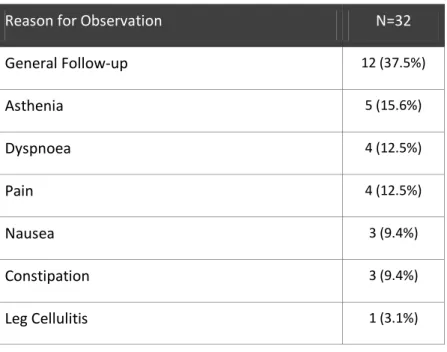
The main reasons for scheduling a palliative-care appointment at SAPS (Table 9) were general follow-up (37.5% of the cases) followed by situations of uncontrolled symptoms like asthenia (15.6%), dyspnoea (12.5%), pain (12.5%), nausea (9.4%) and constipation (9.4%).
26
One patient was seen and treated for leg cellulitis (3.1%). Despite the fact that most patients presented additional symptoms, those were not the main reason for the appointment, and therefore they are not included in Table 9.
Table 9 - Outpatients’ Main Reasons For Observation
Reason for Observation N=32
General Follow-up 12 (37.5%) Asthenia 5 (15.6%) Dyspnoea 4 (12.5%) Pain 4 (12.5%) Nausea 3 (9.4%) Constipation 3 (9.4%) Leg Cellulitis 1 (3.1%)
Outpatients’ Clinics was a very important setting to experience since most patients I see in my professional practice come from it. Most cases of uncontrolled symptoms were seen in these appointments which gave an idea of how to properly adjust medication for patients I would not follow in a daily basis. It is very important to say that patients had an extremely active role in this setting. Physicians knew it was their job to help as much as they could but patients almost actively reported symptoms and concerns which means that if a specific drug did not work, patients would report with detail the drug effects in order to establish a proper adjustment of dosage or to switch the drug. The reinforcement of this kind of attitude is very important because it empowers the patient which actually makes the difference in their own heath status both mentally and physically. Even though we have traditionally a more paternalist model in Portugal, I have tried this approach a few times with good results.
27 2.2.3 Domiciliary Setting
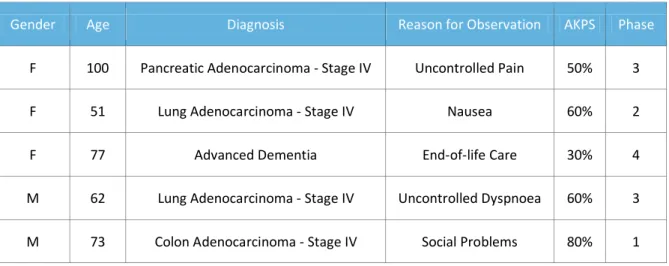
Non-specialised domiciliary care is provided by RDNS to patients with palliative-care needs. As previously mentioned, RDNS work in close cooperation with SAPS. As such, whenever they feel there is a need, a referral is made to the palliative care team. Most visits were carried out by registered or nurse practitioners. A medical consultant was called when the cases appeared to be more challenging. I had the opportunity to participate in 5 domiciliary appointments, 4 with the nurses and 1 with a doctor. Data related to these patients is shown on Table 10.
Table 10 - Patients Observed in the Domiciliary Setting
Gender Age Diagnosis Reason for Observation AKPS Phase
F 100 Pancreatic Adenocarcinoma - Stage IV Uncontrolled Pain 50% 3 F 51 Lung Adenocarcinoma - Stage IV Nausea 60% 2 F 77 Advanced Dementia End-of-life Care 30% 4 M 62 Lung Adenocarcinoma - Stage IV Uncontrolled Dyspnoea 60% 3 M 73 Colon Adenocarcinoma - Stage IV Social Problems 80% 1
Two of the patients were male and 3 were female. All the patients were above 50 years old, one of them was 100 years old. Four patients had advanced cancer and one had advanced dementia. The main reason for requesting observation was the need of symptom control. However, one patient was observed for social reasons. With the exception of the patient facing social problems, the other patients had AKPS ≤ 60% and PHASE ≤ 2.
During the domiciliary visits I could talk to patients and families in their own environment and understand the main problems they face. When questioned, most patients want to die in the home setting26.However, since most patients develop challenging symptoms in their last days, a support network has to be arranged27. Moreover, it is not easy for families to stay at home with a dying loved one. Where the need is for symptom control, it is possible
28
to provide treatments like opioid and benzodiazepine infusions in the home setting, which makes hospital admissions much less frequent. During the visits I could discuss the treatments being administered with the health care staff and to understand how families are helped to deal with all the different medications provided. Home visits were also opportunities to talk about fears and to reassure patients and families. As such, I was lucky enough to hear some patients’ and family members’ perspectives and to discuss their perspective about palliative-care services. Home visits may be more or less frequent according to people’s needs and when it is recognised that the patient is in his/her last days or hours, an overnight nurse may be arranged to support the family to manage the patient at home.
In the domiciliary setting, I saw the model I would like Portugal to have. I saw people facing some hard times, but I also saw the appreciation they had for the palliative-care team and their work. It was the first time I realised that death can bring families together around a loved one and not just tear them apart.
2.3CONSULTANCY ACTIVITIES
Consultancy activities were held in all the three hospitals. Usually there was a formal request from another specialty in order for a patient to be seen by the palliative-care team. Most patients had been admitted in specialised wards to address acute medical problems (ex. infections). However, if they had underlying chronic and progressive conditions they usually had other problems that a particular specialty was not prepared to address. Additionally, some patients were admitted in the wards for symptom management or end-of-life care when there was no vacancy at the hospice. The palliative-care-consultancy service could be carried out by a doctor, a nurse or both. Normally the team would focus on the specific motive for the observation required which made their intervention very incisive. They would talk with the patient about the specific complaint, perform a small physical exam and suggest an intervention to the ward team. During the internship I followed consultants and nurses and watched their intervention with patients and families. When
29
clinical notes where being written, I would discuss with them the intervention being adopted.
I observed a total of 21 patients while performing consultancy activities, nine (42.9%) were males and 12 (57.1%) were females. The median of age was 76 years old (IQ25%-IQ75% 84-69) (Table 11). Most of these patients had an AKPS between 40 and 60% (Figure 2), which means they had a heavier burden of disease with a much more marked functional decline comparing to those seen in the outpatients’ setting.
Table 11 - Consultancy patients’ details
Number of Patients 21 Gender N (%) Male 9 (42.9%) Female 12 (57.1%) Age Median 76 Q25 69 Q75 84